Article

Rapid Evaluation of Off-Highway Powertrain Architectures

by
Rupert Tull de Salis
ZeBeyond Ltd., The Fold, Spencer Street, Leamington Spa CV31 3NE, UK
World Electr. Veh. J. 2025, 16(12), 671; https://doi.org/10.3390/wevj16120671
Submission received: 7 November 2025 / Revised: 5 December 2025 / Accepted: 10 December 2025 / Published: 12 December 2025
(This article belongs to the Section Propulsion Systems and Components)

Abstract

Task-specific off-highway vehicles are typically produced in small volumes, so limited resources must be used in their design. The fuel efficiency benefits of hybridizing an off-highway vehicle are typically in the range of 10–30%, meaning that a simulation tool should ideally be able to predict fuel usage within about ±10%, to support stage-gate design decisions. However, such simulation tools typically require significant cost, setup effort, and simulation expertise. A wheel loader and four agricultural tractors were analyzed with a new tool, “ePOP Concept (v1.0)” from ZeBeyond Ltd. of Leamington Spa, UK, to estimate the benefits of electrification. This method is quick to set up, requiring minimal data preparation and simulation expertise. The results were compared with measured fuel consumption data, and with those of commercially available analysis tools. The errors deriving from ePOP Concept’s BSFC assumptions alone were large at 17% RMS when using a generic value for engine BSFC, but could be improved to 6.7% RMS when applying a readily available minimum BSFC value in the model setup. For future development, a target accuracy of ±10% could potentially be achieved with one-dimensional loss models, requiring minimal extra setup effort, while reducing the subject BSFC errors to 3.9% RMS.

1. Introduction

1.1. Background

Vehicle electrification applications are growing in scope and variety, as enabling technologies appear in the marketplace, including among off-highway vehicles that are traditionally powered by diesel engines alone. However, interested vehicle manufacturers, wishing to weigh the cost and benefits of electrifying a specialist vehicle, must access complex and expensive simulation processes before they can make even a simple stage-gate decision. It is not immediately obvious how electrification will benefit a particular vehicle design, as it depends on the compatibility of the powertrain architecture with the duty cycle specific to its tasks. Software tools are required to estimate the benefits, the most important being fuel efficiency. The total cost of ownership (TCO) over a vehicle’s lifetime, e.g., 10 years, is dominated by the cost of fuel, far outweighing the capital cost of the vehicle. Off-highway vehicles represent a special case in respect of electrification for several reasons. Many are task-specific and therefore sold in low volumes; they are relatively neglected in the research literature for electrification simulation and analysis; and they often have very specific duty cycles that determine whether they would benefit from BEV (Battery Electric Vehicle) or hybrid architectures. For example, a vehicle working in remote locations is unlikely to have regular access to a charging point, making it unsuitable for a BEV or rechargeable hybrid powertrain. On the other hand, a task-specific vehicle may require maximum power only for very short periods, interspersed with opportunities for an engine to recharge the battery, making it a good candidate for hybridization without charging. In such cases it is beneficial to downsize the engine, using the electrification hardware to make up the shortfalls in maximum power.
As a case in point, several studies have been published on the electrification of agricultural tractors [1,2,3,4]. These studies conclude that small tractors are best suited to electrification. Small tractors are denoted “utility tractors” and are sold in higher volumes, which can better justify the cost of major re-engineering work. Large row-crop tractors, by contrast, have long periods of continuous high power demand with little respite for engine recharging, eliminating mild-hybrid opportunities, and they do not suit recharging architectures either, as the batteries required for a whole day’s work are too large compared to the weight of the vehicle. Off-highway vehicles in other sectors, like construction, more frequently have task-specific load cycles that are good candidates for electrification, but they are sold in low volumes, so they do not justify heavy investment in reengineering costs. The manufacturers of low-volume, task-specific off-highway vehicles could therefore benefit from easily accessible methods to evaluate the effects of electrification.
A range of software tools is commercially available for the analysis of powertrain efficiency, including Advisor, AMESIM, Alpha, Autonomie, AVL Cruise, FASTSIM, GT Suite and Simulink, which are reviewed in Section 2. These all require significant investments in preparation work, and/or simulation expertise. Even more input is required if, as an alternative to commercial software, a simulation is built from scratch—enabling customization and avoiding licensing costs, but requiring great expertise in simulation and much labor. At the other end of the scale, the most accessible method now available is FASTSIM, which is a free Excel-based tool available from NREL, but it lacks instruction materials and still requires simulation expertise to set up correctly. The effort required to set up each tool, and in many cases the significant cost of the license, are prohibitive for a small manufacturer when considering a design change for a low-volume vehicle.

1.2. Objectives of This Study

This study addresses the question “Can an easily accessible powertrain simulation tool, requiring minimal setup effort and non-specialist expertise, predict fuel efficiency with sufficient accuracy for early stage-gate decisions in off-highway vehicle design?” There is a gap in the methods currently available for evaluating electrification benefits for off-highway vehicles. The user must invest significant effort in model setup, pay for expensive licenses in most cases (the equivalent cost of Simulink at a minimum), and possess simulation expertise, which in practice may mean that a small manufacturer must either employ dedicated simulation engineers or use expensive consulting services. This study is intended to evaluate the advantages and disadvantages of an ultra-simplified, Concept-based analysis method, provisionally named “ePOP Concept,” which is under development at ZeBeyond Ltd. ePOP Concept is intended to provide accessibility for non-expert users, requiring minimal setup and data gathering effort, at a price point that is far below that of any competitor except for FASTSIM, which is free. Since it relies on simplified assumptions to reduce setup time, the accuracy of ePOP Concept is potentially its weak point. The fuel efficiency benefits of hybridizing an off-highway vehicle are typically less than 30% [4,5] and unlikely to be pursued if they offer less than, say, 5%, meaning that a simulation tool should ideally be able to predict fuel usage within about ±10%, to support stage-gate design decisions. In this study, the accuracy of ePOP Concept is evaluated, both by analyzing vehicle test data and by inspecting its assumptions, and compared with reported figures for several alternative analysis methods that are commercially available, including the option of generating a custom analysis with general tools such as Simulink. The relative accessibility (both setup time and expertise required) is compared to that of its competitors, to evaluate the accessibility benefit offered by ePOP Concept, together with its accuracy. The results suggest that the initial methodology is over-simplified and creates errors that are too large to be useful, as they are comparable to the electrification benefits being evaluated, i.e., the error of the measurement is comparable to the thing being measured. However, analysis of the errors, and their root causes, indicates that an acceptable balance could potentially be found, first by securing readily available BSFC data for the engine type concerned, and then further by including a simple one-dimensional correction approach to the component loss assumptions used in the method. This improved approach is identified and discussed, and the successful effect of correcting engine BSFC is demonstrated for one case. Extension to other cases, and other components, is reserved for future work. ePOP Concept also estimates capital costs, running costs, package space, weight, and some emissions values, giving it practical advantages over all the competitors reviewed, but this study is concerned only with fuel efficiency.

2. Literature Review

2.1. Custom Analysis with General-Purpose Math Tools

Much vehicle efficiency analysis has been published in which the researchers customized and performed their own calculations, without the use of a pre-configured software tool dedicated for the purpose. For example, Ali et al. [6] created a quasi-static, backward-facing model to simulate ICE, BEV and diesel–electric hybrid architectures for four different tractors that were tested over a wide range of farming activities. This was a sub-model used as part of a larger tool for decision support in choosing tractors for specific applications. Heikkilä et al. [7], using the same wheel loader dataset as this paper [8], created a simulation of the vehicle from scratch, including detailed component efficiency models such as a multidimensional loss model for each hydraulic component. They simulated the effects of replacing the hydraulic system with alternative architectures, also hydraulic but applying four different alternative sets of components and control algorithms, to achieve the same duty cycle while using less fuel. They applied a rigorous, laborious method, involving a substantial amount of data gathering and simulation setup, and succeeded in demonstrating significant fuel efficiency improvements for three of the four alternative hydraulic architectures that they proposed. Allam and Linjama [9] used the same dataset to model the wheel loader, but configured as a series-electric hybrid. Their model was built from scratch using MATLAB/Simulink. All these examples involved expert and laborious methods to build and integrate efficiency models for several components.

2.2. ADVISOR

ADVISOR (Advanced Vehicle Simulator) is a product of NREL (Washington, DC, USA) that has been developed to assist OEMs and the US Department of Energy to characterize the performance, economy and emissions of hybrid electric vehicles (HEVs). It is a steady-state model that uses MATLAB and Simulink for its calculations, and the user must therefore purchase these licenses in order to use it. The use of the program is described by Gao et al. [10]. It delivers both “forward” and “backward” analysis paths, where the operating point is set from either the throttle pedal or the vehicle speed, respectively. Users do not need to be experts in MATLAB or Simulink, but they must be skilled in simulation.

2.3. ALPHA

The ALPHA (Advanced Light Duty Powertrain and Hybrid Analysis) tool was created by the EPA, for the purpose of calculating emissions for road vehicles. It is a forward-looking, physics-based model. Like ADVISOR, it uses MATLAB/Simulink for its calculations. The results of Newman et al. [11] indicate a fuel economy prediction accuracy within 5% over a wide range of drive cycles. The level of simulation expertise and effort required is similar to that for ADVISOR.

2.4. AMESIM

AMESIM is a 1D Multiphysics simulation suite under the Siemens Simcenter brand that is particularly well suited to off-highway vehicles. Its library of components includes hydraulics and pneumatics as well as vehicle powertrain components. It covers thermal, mechanical, electrical and control systems. It is a highly capable tool compared with the others described in this section, but also has expensive licensing and is used by engineers who are experts in simulation. The literature covering AMESIM, e.g., Qu et al. [12], does not offer direct accuracy comparisons with measured fuel efficiency data.

2.5. AUTONOMIE

Autonomie is a vehicle simulation tool developed by Argonne National Laboratories, covering a wide range of vehicle architectures (e.g., conventional, hybrid, PHEV, BEV) and fuels (e.g., diesel, gasoline, fuel cell, CNG). It uses MATLAB/Simulink for calculations and requires significant setup effort. Accuracy within 2% is claimed for fuel efficiency predictions using the AI-enhanced version AutonomieAI Moawad et al. [13], EPA [14].

2.6. AVL Cruise M

AVL Cruise M, demonstrated in Tang [15] and Huang et al. [16], is a simulation suite offered by AVL List GmbH. It covers a wide range of powertrain technologies and example vehicle models, including off-highway vehicles such as tractors. It is a tool of choice for major OEMs, but also ranks among the most expensive tools available. It requires simulation expertise and relies on very detailed component models. Its accuracy depends on the agreement between its subsystem models and the vehicle being simulated, but errors within 5.5% were reported for CVT vehicle simulations in the work of Tang [15].

2.7. GT Suite

GT-Suite, by Gamma Technologies, demonstrated in Chen et al. [17], is a suite of 1D simulation tools similar in capability and scope to AVL Cruise. It is particularly effective for detailed modeling of internal combustion engines (GT-Power), and for vehicle modeling it includes GT-Drive+. It is a tool of choice for major OEMs, but also ranks among the most expensive solutions available in this group. It is an expert tool, requiring dedicated simulation expertise, and takes significant effort to set up and run.

2.8. FASTSIM

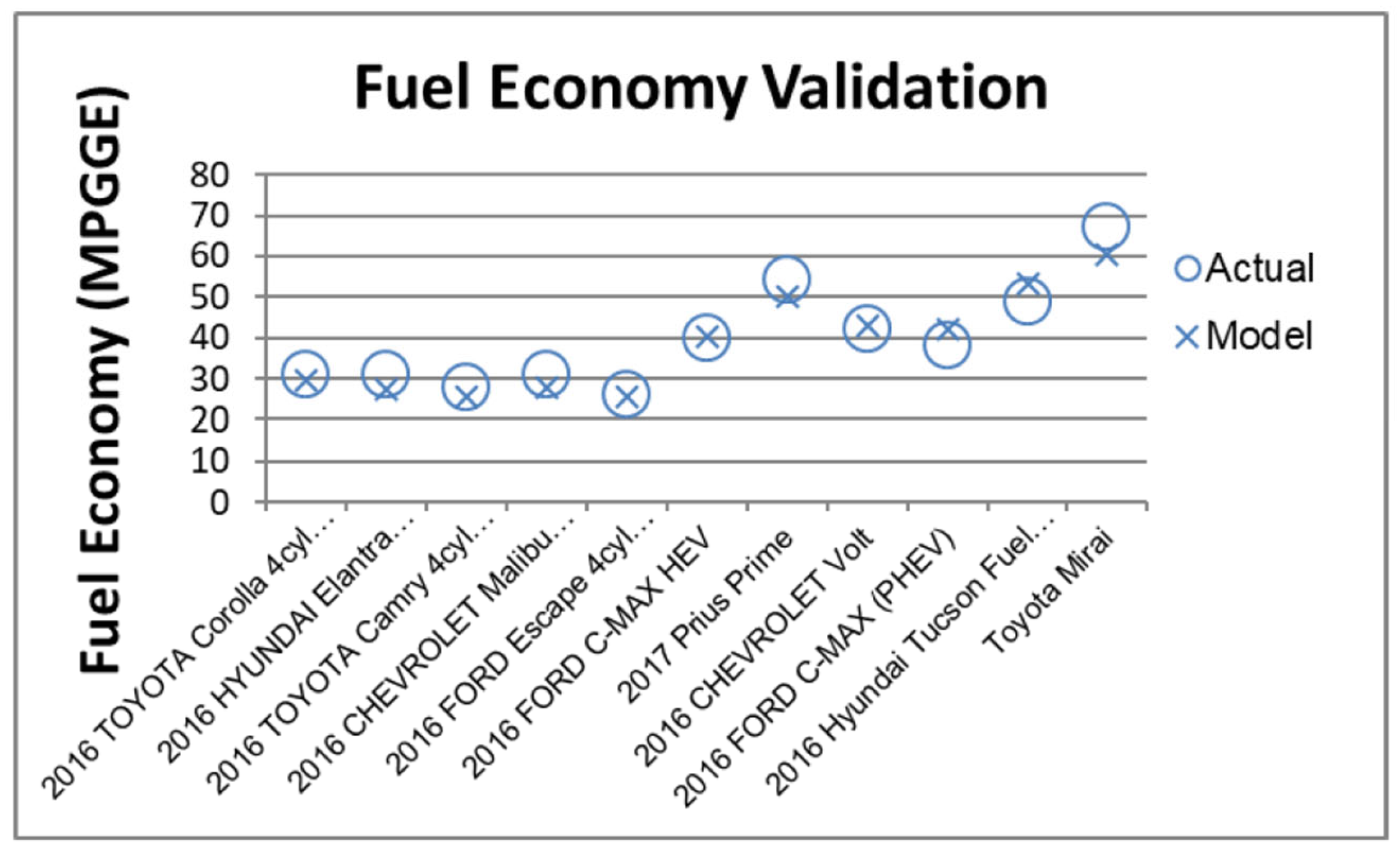
FASTSIM (Future Automotive Systems Technology Simulator) is a forward-facing, open-source, computationally lightweight, Excel-based tool for powertrain simulation. There is also a Python-based version offering faster computation. It appears to be the only tool available for this purpose that is free to access and does not rely on external software licenses such as MATLAB/Simulink. The explanation of FASTSIM in Brooker et al. [18] includes Figure 1, indicating that FASTSIM is intended to provide reduced complexity in exchange for the compromise of sub-optimal accuracy. Its predictions of fuel economy, electrical energy efficiency, and performance are stated by [18] and Baker et al. [19] to fall typically within 10%, and often within 5%, of measured data, with results illustrated in Figure 2. In particular, an exercise conducted by Argonne and NREL, simulating a Ford Fusion vehicle to compare with measured rolling road data, calculated fuel consumption to within a 2.4% RMS error.
Given the claims of reduced complexity, fast computation time, and free access, FASTSIM appears to be the most direct competitor for ePOP Concept among the selected comparators. It is therefore important to consider FASTSIM’s ease of use and requirement for user expertise. In [18], FASTSIM is described as “approachable by any user regardless of software experience level”. However, inspection of the model indicates an array of user choices that could appear bewildering to a non-expert. In the best case it may be possible to select matching component models if the target vehicle is of a common type, but the non-expert user is not easily able to see how much they must do before the model is ready to run, among the hundreds of choices available. There is no supporting material provided by NREL to guide the new user, or videos showing it in use, except for written documentation aimed at the Python/Rust versions of the program. The spreadsheet itself does not appear to be intuitive for either an expert or a non-expert user.

2.9. Summary of Simulation Tools

The tools described in Section 2.1, Section 2.2, Section 2.3, Section 2.4, Section 2.5, Section 2.6, Section 2.7, Section 2.8, are listed in Table 1 with their important characteristics, comprising, on the one hand, the accuracy claimed for fuel consumption prediction, and on the other hand various aspects of their accessibility, including the expertise required of the user, and the amount of effort needed to set them up. ePOP Concept is still under development, and it remains to be decided how it should be positioned among its competitors. The competitors require simulation expertise and longer setup times, and setup must be repeated for every architecture considered, whereas ePOP Concept is designed to evaluate multiple architectures from a single setup. The collection of data required by the competitors (component loss models, BSFC maps, etc.) is laborious, and such information is not always made available by manufacturers.
There is a gap at the “simplified” end of the list, which is best filled now by FASTSIM, for a tool accessible to a small manufacturer who cannot justify expending large-scale engineering resources on a low-volume vehicle; or for any manufacturer who wishes to conduct several quick, low-cost assessments of electrification opportunities with minimal labor, time and cost. The accuracy required for this purpose can be estimated very roughly by considering that hybridization typically offers fuel efficiency improvements of up to 30%, so a target accuracy in the range of ±10% for full-cycle fuel consumption would be ideal. ePOP Concept also estimates cost, weight and package to support architecture selection, and allows rapid optimization among multiple architectures. These features are not offered by any of the competitor products.

3. Methods

3.1. Allam and Linjama Method (Benchmark)

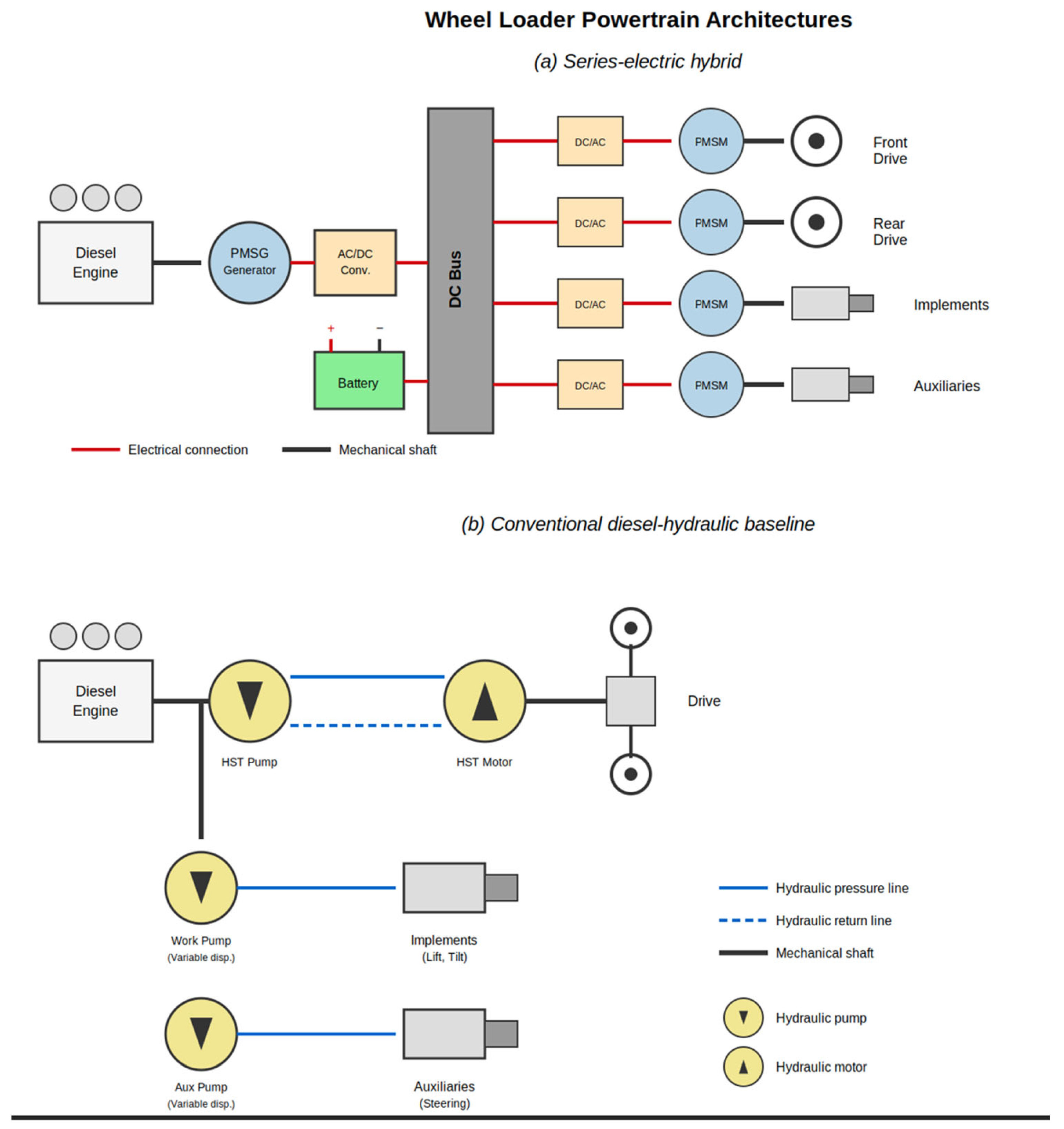
Allam and Linjama’s study [9] is discussed here in detail to illustrate what is involved when creating a model from scratch. They used a dataset [8] for a 5.7-tonne Wille 665 wheel loader (Manufacturer: Wille (Cimcorp Group), Ylöjärvi, Finland), and they created a custom model from scratch, modeling it both in its original form and in the form of a series-electric hybrid, matching the architectures in Section 2.1. The architecture of their model is shown in Figure 3. They assigned a larger diesel engine (91 kW) for the hybrid, and a torque limit for the generator that was significantly below the engine torque rating, but otherwise used similar components to those used for the ePOP Concept method in this paper. However, only the HST mechanism (drive to the wheels) was electrified in the hybrid system, while the tilt, lift, and boost mechanisms remained hydraulic, unlike the ePOP Concept method, where all power delivery routes were electrified.
The diesel engine efficiency was modeled using a fuel efficiency map adapted from published data for another engine. It is typically challenging to obtain component data of this type for simulation studies, even when the measurements are made by the researchers conducting the study, as such information is often held only by the manufacturers of the component. For this reason, some kind of simplification is often required, and the researchers in this case chose to use data from a similar engine. This approach, if scaled appropriately to the output of the engine, can result in accuracy within 2.5% of the correct BSFC characteristics (brake-specific fuel consumption), for diesel engines with similar technology.
Losses for the battery were calculated with a more sophisticated time-step model, inverter efficiency was assumed at a constant 98%, pump loss calculation assumed a fixed leakage and a fixed friction torque, and the electric motors were characterized by a calculated relationship between torque and input current, based on parameters from the datasheets of a motor manufacturer. The hydraulic pumps were simplified to fixed-displacement pumps, although the subject vehicle was in fact fitted with variable-displacement pumps. Taken together, these simulation methods entailed a significant amount of data gathering, coding and correlation work, presumably justified by the accuracy targets of the researchers.

3.2. Dedicated Software Tools

The software tools listed in Section 2.2, Section 2.3, Section 2.4, Section 2.5, Section 2.6, Section 2.7 have excellent fuel efficiency errors ranging from 2% to 5.5%, as reported in the references. All these methods require detailed component models, which can usually be obtained from manufacturers or technical publications, and simulation expertise to verify the quality of the inputs and to integrate them correctly into the system models. Errors within 10.5% are reported for FASTSIM (Section 2.8). FASTSIM is pre-populated with several example models, so in the best case, a model could be set up without the need for externally sourced component data. However, the Excel format, and the lack of instructions, example videos, etc., mean that in practice there is a need for simulation expertise in order to ensure that the setup is correct.

3.3. ePOP Concept

An account of the ePOP Concept process follows, in order to illustrate both the relative difficulty of setup, and the assumptions that affect its accuracy. ePOP Concept models the efficiencies of the powertrain components using simplifying assumptions, which are reviewed as follows, in the order of the list.

3.3.1. Efficiency Assumption—Inverters

Inverter efficiency is treated as a fixed percentage, whether converting generator output power or motor input power, and the user simply selects an inverter type from a short list (e.g., SiC, silicon carbide, or GaN, Gallium Nitride). The scale of the errors may be estimated by reference to Su et al. [20], where efficiencies for IGBT inverters are stated to range from 74.8% to 99.1% depending on load conditions, with over 90% efficiency for around 90% of commonly visited operating conditions. The most significant parameter affecting efficiency is current (a measure of load), since losses increase in approximate proportion to the square of the current. Similar figures (86–99.9%) are reported for SiC inverters. Therefore, the assumption of fixed efficiency introduces significant errors which are systematic, and may distort the effects of upsizing or downsizing system components.

3.3.2. Efficiency Assumption—eMotors

eMotor efficiency is treated as a fixed percentage, whether used as a motor or as a generator. The user selects from a short list of motor types (e.g., a permanent magnet synchronous motor, or induction motor) and the efficiency is set to a fixed value accordingly. The scale of the resulting errors may be estimated from Huynh et al. [21], which compares efficiencies for three types of traction motor on selected city and highway driving cycles (thus prioritizing commonly used operating points over those less visited). At low load, efficiency falls to 80–86%; it is best at moderate loads (90–96%); and it falls to 86–90% at high load. This indicates a spread of 10 percentage points for load variation alone, which would translate into errors where a fixed efficiency is assumed. This error range is quite large compared to the effects that ePOP Concept is intended to measure, i.e., those arising from vehicle electrification.

3.3.3. Efficiency Assumption—Batteries

Battery efficiency is treated as a fixed percentage, whether charging or discharging, according to a battery type (e.g., Li-ion) selected by the user. However, the round-trip efficiencies for Li-ion BEV batteries reported in Lin et al. [22] are 85–88% at a charge and discharge rate of 1C, and 73–76% at 2C, indicating a significant effect of charge rate.

3.3.4. Efficiency Assumption—ICE (Internal Combustion Engine)

ICE brake-specific fuel consumption (BSFC) is assigned according to a choice of engine type made by the user (e.g., off-highway diesel, or gasoline) and assumed constant under all conditions. In the work of Friso [23], the BSFC of a 58.8 kW tractor engine is reported as 216 g/kWh at the optimal condition (mid speed, high load), but rising to 250 g/kWh at moderate load, and over 400 g/kWh at low load. This pattern is typical of internal combustion engines, as noted by Heywood [24], and is largely caused by a quasi-constant FMEP (friction mean effective pressure) that affects the efficiency in a greater proportion as the load is decreased. If the best BSFC value is assumed in this case, but the engine runs predominantly at moderate load, which is not an unusual situation, then this assumption can introduce a simulation error of more than 15%, which is comparable in size to the effects that the software is intended to measure. However, the full-cycle error is consistently smaller than the worst-case error, since vehicle powertrains tend to use very light-load operating points for only a minor fraction of their duty cycles. An additional error is induced by assuming that all engines of a certain type (e.g., “off-highway diesels”) have the same BSFC regardless of size, emissions level, etc. This component is therefore the one with the largest potential error, if a constant efficiency is assumed. However, the assumption of fixed BSFC for one engine type can be improved with minimal effort by simply researching the minimum BSFC more specifically for the type of engine envisaged, which is readily available for most types of commercial engine, or similar surrogates.

3.3.5. Efficiency Assumption—Cooling

The airflow through a vehicle radiator requires a fan, which can consume a significant percentage of engine power under some conditions, depending on how it is controlled. ePOP Concept assumes that accessory loads are a constant percentage of engine power output, which can be set by the user. There are also other vehicle accessories (e.g., power steering, alternator, brake air compressor) that are not included in dynamometer testing to determine BSFC, but are present in the vehicle and affect the overall efficiency. These are assumed to be captured in the cooling load. Pettersson et al. [25] discusses methods to model accessory loads in heavy-duty commercial trucks and concludes that they are heavily dependent on engine speed. Their results suggest that BSFC is increased due to accessory loads by up to 2% at high engine load, 8% at medium load (i.e., 20–50% of rated power), and 15% at low loads, which could be consistent with a quasi-constant value of FMEP at all loads, but clearly not a fixed percentage. Saetti et al. [26] analyses accessory loads for an agricultural tractor and finds that the percentage effect on BSFC changes from 13.7% during a field work duty cycle, to 22.3% while in transport, to 38.5% at light load. Therefore, the assumption of a constant percentage would create unacceptable errors for duty cycles dominated by low engine loads, and would also systematically mask the benefits of moving engine operating points to higher loads, which is a key benefit of some hybrid architectures, such as serial hybrids.

3.3.6. Efficiency Assumption—Transmission

ePOP Concept assumes a constant percentage energy loss for mechanical transmissions, with pre-populated model efficiencies between 90% and 100%. Transmission tests reported by Blom [27], Wileman [28], Ryu et al. [29], and Kim et al. [30], covering heavy-duty trucks and agricultural tractors, indicate losses ranging from 84 to 95% for trucks and from 88 to 96% for tractors (56% to 86% including tire/soil losses), with the variations being primarily load-dependent rather than speed-dependent.

3.3.7. Efficiency Assumption—Hydraulic Pumps and Motors

In some off-highway vehicles, such as wheel loaders, most or all of the engine power is delivered through hydraulic pumps and actuators, so hydraulic efficiency is an important quantity for off-highway powertrain models. ePOP Concept allows the user to select from a list of pump and actuator types, or to create custom alternatives, and each component is then assumed to have a fixed efficiency percentage for transmitted power that is independent of speed, load, or any other variable. The efficiency variations of various hydraulic components are listed in Table 2, using data from Hasan et al. [31], Sârbu et al. [32], Zwemin et al. [33], Kauranne [34], and Lobsinger et al. [35]. We assume that the system is adequately designed to avoid common error states leading to further losses from vibration effects and pump torque ripple effects, as reported in Stosiak et al. [36]. The span of efficiency estimates ranges up to 20 percentage points (e.g., 75–95%) indicating up to ±10% error if a fixed efficiency is assumed. Baek et al. [37] report 67–80% efficiency for a complete hydraulic transmission comprising both pumps and actuators, in an agricultural tractor, the value varying mainly by speed/load operating point, which is compatible with these results. Karpenko [38] identifies additional losses from hoses and fittings that are not captured by component-level efficiency models, suggesting that ePOP’s summation of component losses may underestimate total system losses.

3.3.8. Proposed Improvement—BSFC Adjustment for Load

In ePOP Concept, a single BSFC value is assigned for off-highway diesel engines (0.25 kg/kWh) across all load conditions. This clearly causes fuel prediction errors.
A correction method is proposed in order to reduce BSFC errors, based on the constant FMEP methodology from Pelletier et al. [39], Uyehara [40], Suijs et al. [41], Guzzella et al. [42] and Rakopoulos et al. [43], and derived as follows:
BSFC = ISFC × IMEP/BMEP
       = ISFC × (BMEP + FMEP)/BMEP
So provided we know ISFC, FMEP and BMEP, we can calculate BSFC from BMEP, which introduces the desired correction for load at the operating point.
We can calculate BMEPop from Pop provided we know the RPM and engine displacement.
We assume that BMEPmax and FMEP (assumed constant) are known for a given engine type, and that ISFC is constant for a given commercial diesel engine, and that we know Pop and Prated. For commercial diesel engines, BSFC_min is assumed to occur at the same RPM as BMEP_max, a reasonable approximation according to Heywood [24]. Therefore, to determine ISFC,
ISFC = BSFCmin × BMEPmax/(BMEPmax + FMEP)
BMEPop = BMEPmax × Pop/Prated
BSFCop = ISFC × IMEPop/BMEPop
                       = BSFCmin × BMEPmax/IMEPmax × (BMEPmax × Pop/Prated + FMEP)/(BMEPmax × Pop/Prated)
                       = BSFCmin × BMEPmax/(BMEPmax + FMEP) × (1 + (FMEP × Prated/(BMEPmax × Pop))
We assume the following representative values for commercial diesel engines [39,40,41,42,43]:
BMEPmax = 21 bar
FMEP = 0.8 bar
and assume that the value of BSFC_min is selected from published data to match the available engine type and size. We can then use this method to correct the BSFC for load.
where
BSFC=Brake-specific fuel consumption (kg/kWh).
BSFCmin=Minimum BSFC at optimal operating point (kg/kWh).
BSFCop=BSFC at the operating point (kg/kWh).
ISFC=Indicated specific fuel consumption (kg/kWh).
IMEP=Indicated mean effective pressure (bar).
BMEP=Brake mean effective pressure (bar).
BMEPmax=Maximum BMEP at rated power (bar).
BMEPop=BMEP at the operating point (bar)
FMEP=Friction mean effective pressure (bar).
Pop=Power at the operating point (kW).
Prated=Rated (maximum) power (kW).
IMEPmax=Maximum IMEP at rated power (bar).
IMEPop=IMEP at the operating point (bar).

3.3.9. Efficiency Assumptions—Summary

The efficiency estimates listed in Section 3.3.1, Section 3.3.2, Section 3.3.3, Section 3.3.4, Section 3.3.5, Section 3.3.6, Section 3.3.7 are tabulated in Table 3, expressed as the percentage loss of engine power. The estimated errors are not intended to be definitive, but simply to illustrate the approximate scale of errors that may be introduced when a fixed efficiency value is assumed. In practice, the estimated errors are reduced, partly because the worst cases are usually found at edges of the operating envelope that are rarely visited, and partly because powertrain duty cycles usually demonstrate higher residency in operating regions with better efficiency, so the average efficiency is significantly better than the worst cases. However, an important technique of hybrid architecture design is to shift operating points from less to more efficient regions, and this effect is systematically distorted by error mechanisms that favor higher load operation (which is often the case). Most of the variations in component losses are primarily influenced by a single input variable, such as torque or current. Multidimensional component loss models (with several independent variables) are potentially accurate to within a few percent, whereas Table 3 suggests that fixed-efficiency assumptions can introduce errors in the range of 10–30%. However, the primary dependency of each loss on a single input variable suggests that a simple 1D model for each component, correcting (for example) for the percentage of maximum torque or current being used, ensuring the variable is one that is readily available in the analysis, might be able to eliminate a significant amount of the error in return for a minimal requirement of data discovery, setup effort, and simulation expertise.

3.4. Case Studies

The case studies comprised one for a wheel loader, which had hydraulic actuators for all work (including driving the wheels), and one for a group of agricultural tractors, with mechanical transmissions for traction, and PTO (power take-off) drive for accessories.

3.4.1. Wheel Loader Analysis

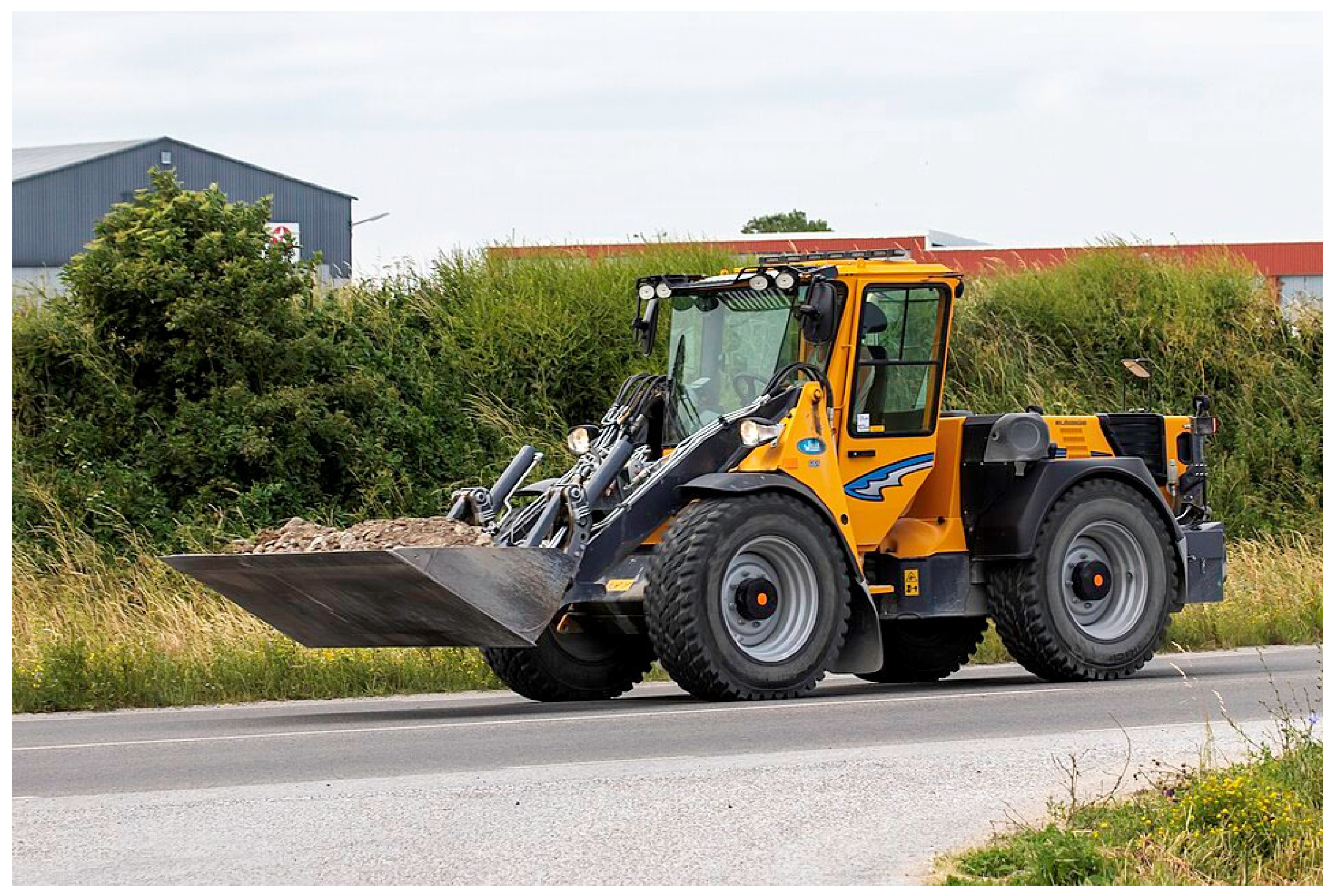
A wheel loader, as shown in Figure 4, is an example of an off-highway vehicle with a very specific task. Its normal work pattern is most commonly represented for simulation purposes by the “Y cycle”, in which it loads bulk material from a pile and transfers it to a truck, a short distance away. This work pattern, for the interested reader, can be found in a YouTube video [44]. The cycle exercises the mechanical movements of raising the bucket, tilting the bucket, articulating the chassis about a central vertical-axis joint to provide steering, and wheel drive. In the case of the test vehicle for this study, these actions are powered by four separate hydraulic pumps driven by an 83 kW diesel engine.
A dataset for a wheel loader performing the Y cycle has been generated and made publicly available by Heikkilä et al. [8], in which measurements of the mechanical actuations are logged over repeated Y cycles for a Wille 665 diesel-powered wheel loader loading gravel at a logging frequency of 10 Hz. Using these measurements, it is possible to calculate the power used for each of the four actuation modes. The efficiency of the diesel-hydraulic powertrain is analyzed using ePOP Concept to assess the potential benefits of hybridization, and the fuel efficiency results are compared with measured data from the test vehicle.
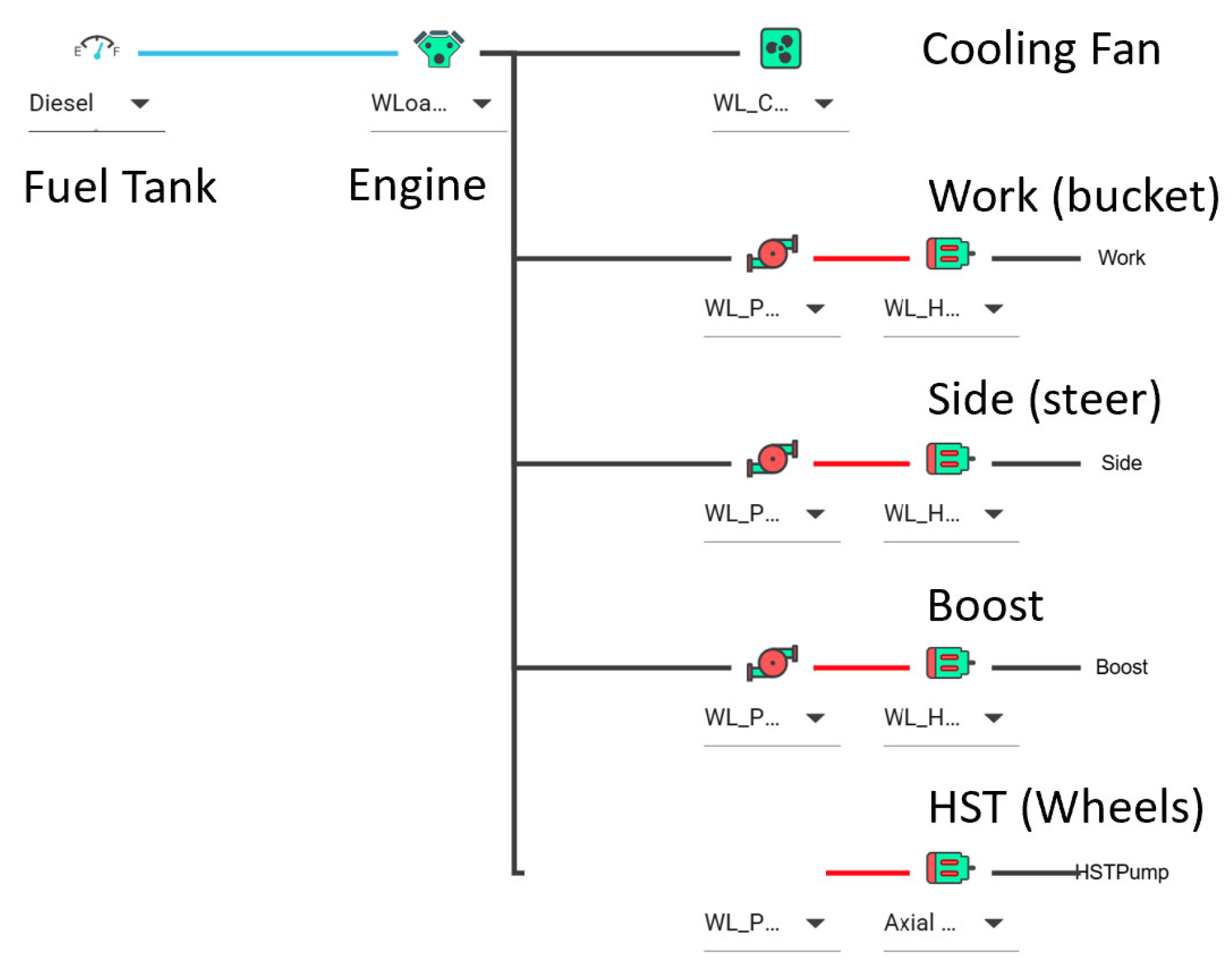
The vehicle used in the wheel loader dataset [7] was a 5.7-tonne Wille 665 wheel loader with an inline 6-cylinder, 4.4 L, 83 kW Cat diesel engine (Engine manufacturer: Caterpillar Inc., Deerfield, IL, USA). The engine drives four hydraulic pumps; Work Pump, Side Pump, HST Pump (hydrostatic transmission), and Boost Pump. The Work Pump actuates the bucket, the Side Pump actuates the articulation for steering, the HST Pump actuates the wheels, and the Boost Pump primes the circuits with pressure before actuation. Fuel flow was logged from the engine management system, and mechanical power output was calculated from the measured pressure drop and fluid flow (calculated from the speed of each actuator). Therefore, the input fuel flow is known, and the useful hydraulic power delivered by the pumps, but the output mechanical work can only be estimated by assigning efficiency models to the actuators.
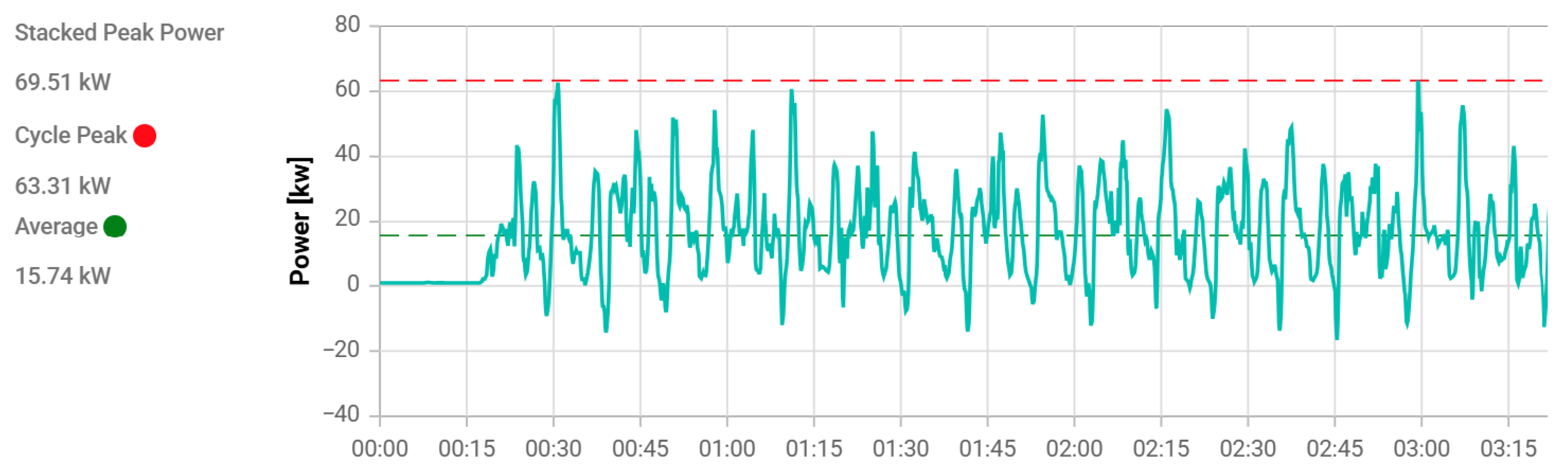
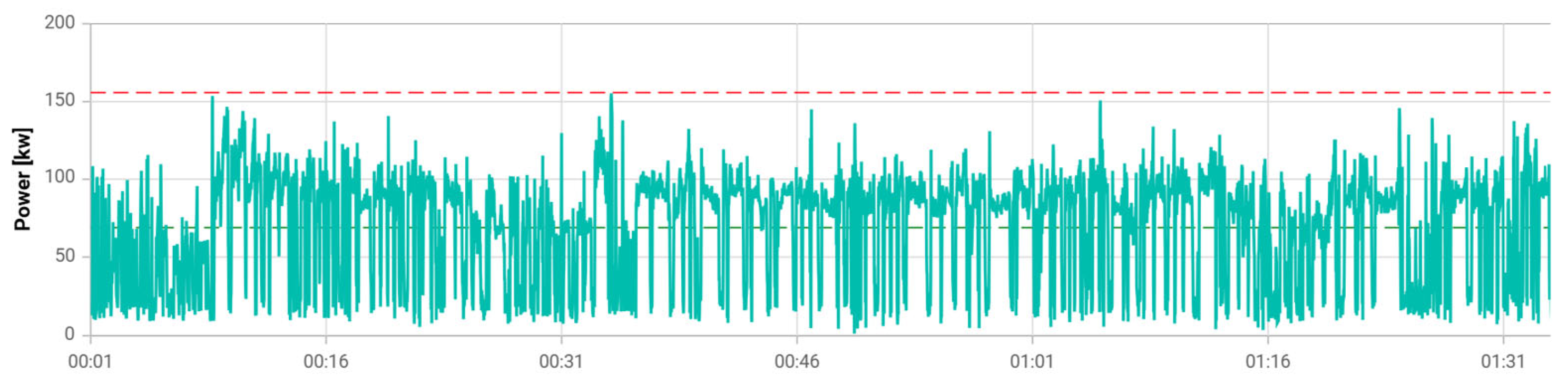
The dataset comprises measurements at 10 Hz, over 440 s, of the data channels shown in Appendix A. This comprises just one Y cycle, which is considered sufficient to exercise the system for the purposes of stage-gate efficiency comparisons. The channels for “WorkPump” were repeated for the three other pumps. The data were processed to provide a time series of (time, power) for each of the four pumps, and these series were used as inputs for the analysis software. For the purposes of fuel consumption comparison with measured data, the actuators were removed from the model and the power input to the model was taken as the hydraulic power delivered by the pumps, as the measurements did not include the mechanical forces in the actuators, so any attempt to recreate the actuators with efficiency models would not add any useful information. For the purposes of estimating the benefits of electrification, the actuators were included with a suitably modified input load cycle. Part of the combined load cycle is shown in Figure 5.
An important feature of the ePOP Concept software is that the load cycles (in this case four, one for each pump) are the only data inputs required. Some internal parameters are available for adjustment, as described in the following sections, but the program is ready to run with load cycle data alone. The user inputs the number of these load cycles to be completed in a week, in order to support calculations of TCO.
After the load cycles are loaded, the ePOP Concept program generates an architecture layout for each of two powertrains to be compared. The user can choose between architecture types with choices such as “parallel hybrid without charging” and between output paths, such as hydraulic pumps and motors, for the outputs. The original hydraulic powertrain is denoted “A”, and the alternative electrified powertrain is denoted “B”.
Powertrain “A” is shown in Figure 6. This simplified architecture, which ignores control valves and control strategies, shows the diesel engine driving four separate hydraulic pumps, each powering different hydraulic actuators. Three (side, work, and boost) are characterized as hydraulic cylinders, and one (HST) is a vane motor driving the wheels.
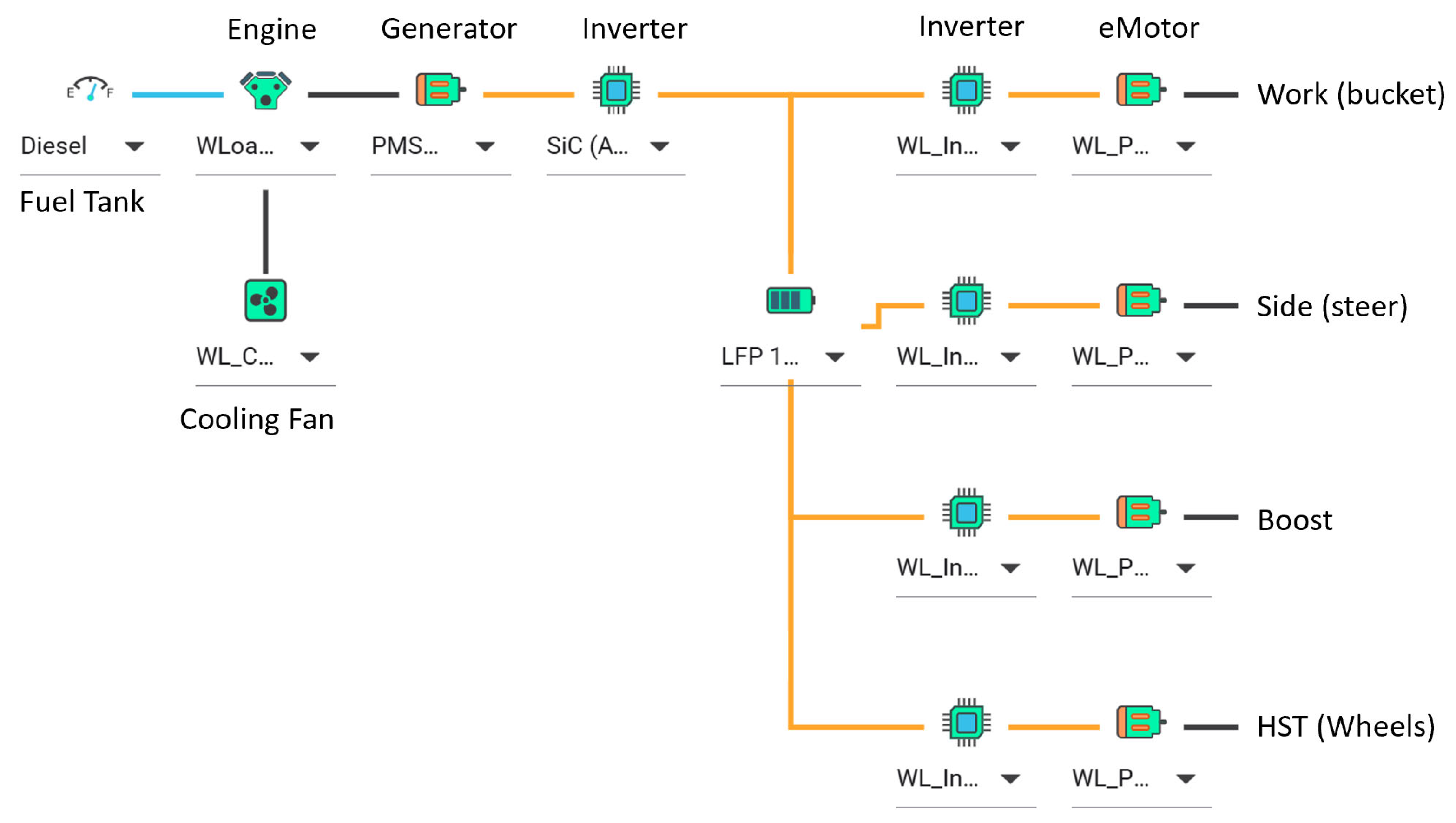
Powertrain “B” is shown in Figure 7. This is a series-hybrid architecture without external recharging. The hydraulic pump is replaced by an inverter and generator, powered by the engine. The actuators are replaced by inverters and electric motors, ignoring the mechanical hardware that would be required. In the middle is a battery, which is used to store energy when the power demand is low, and to supplement the engine maximum power when demand is high. Both these architectures were quickly set up by selecting choices from drop-down menus.
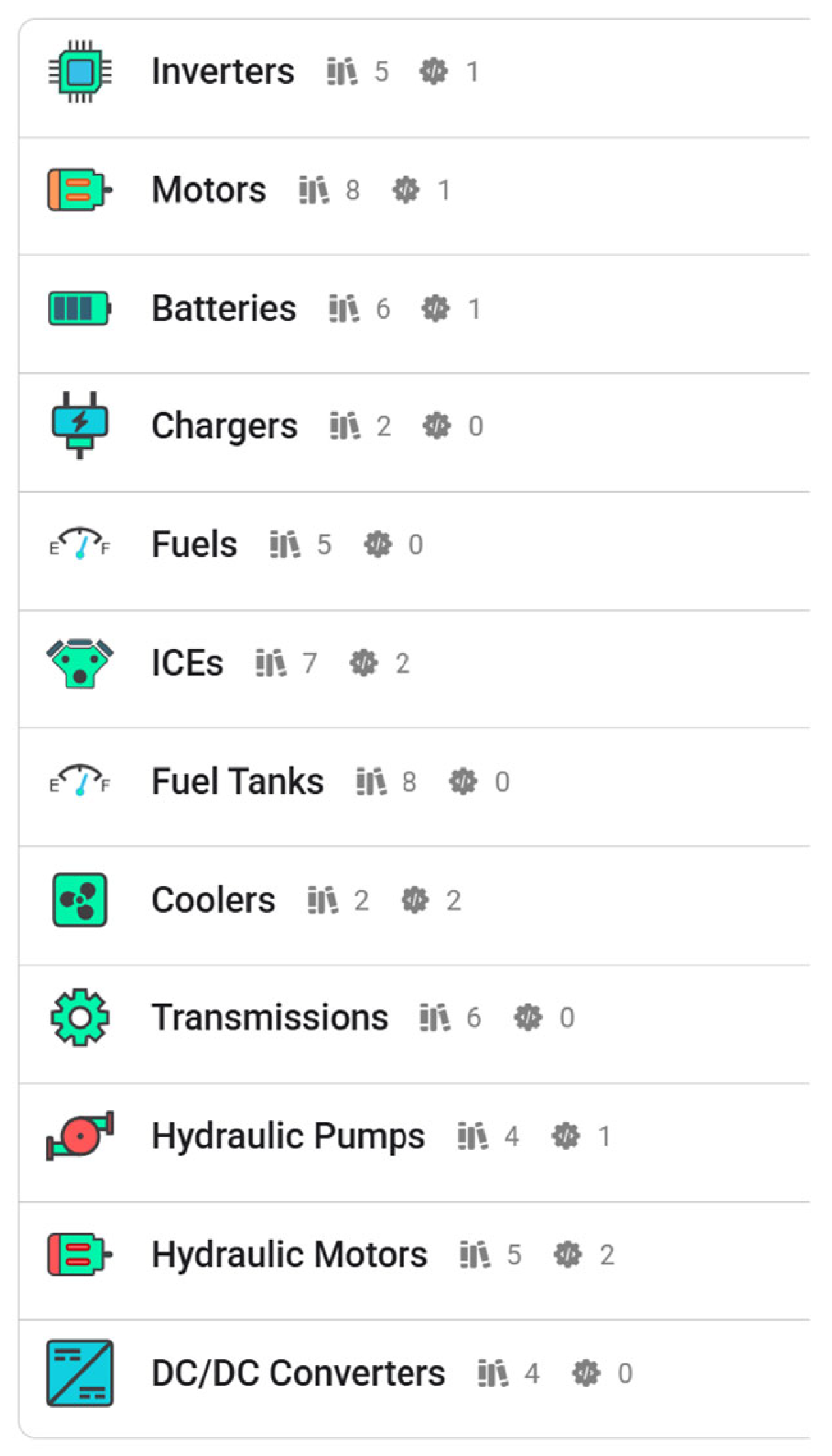
The ePOP Concept program contains pre-populated characteristics for the powertrain components in the layouts. The menu is shown in Figure 8. Each component name is followed by the numbers of pre-filled examples and user-customized examples behind the tab (e.g., 5 and 1 for the first item).
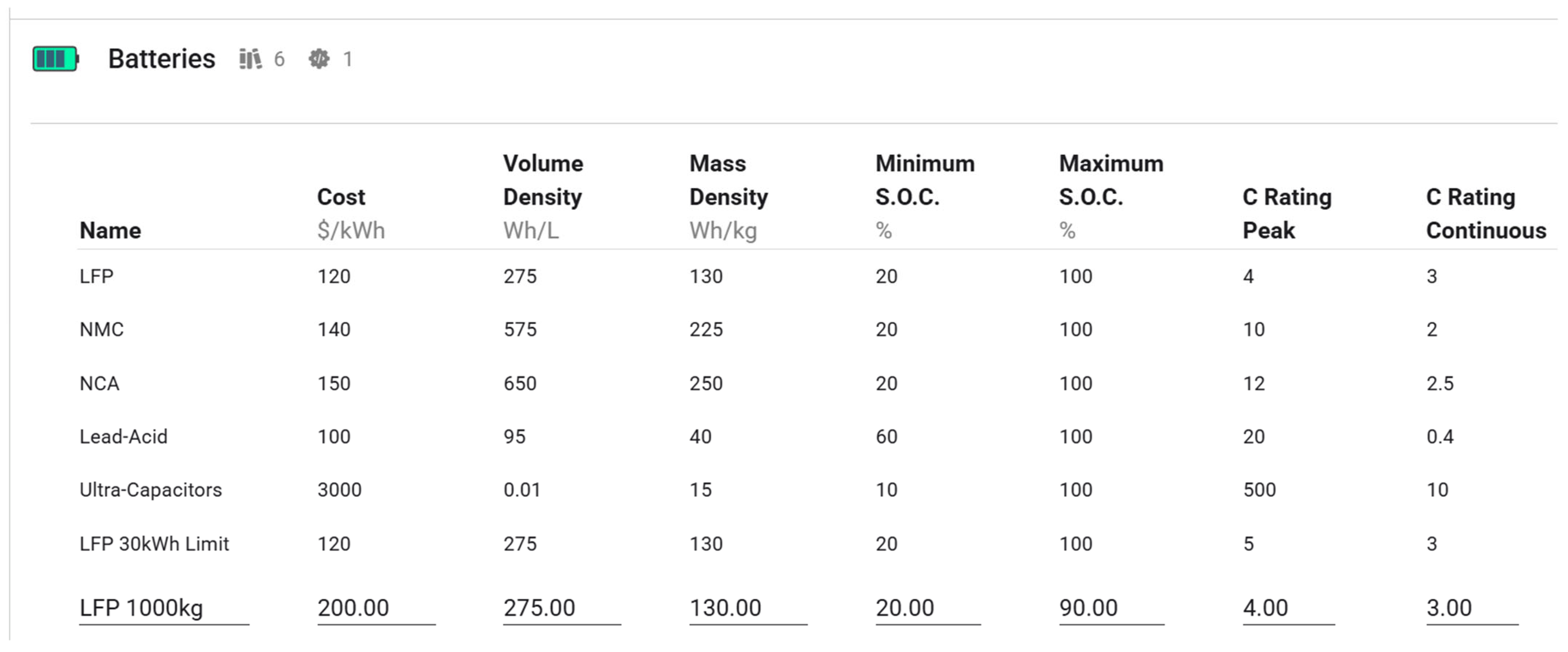
Each component category contains pre-populated choices, as seen for Batteries in Figure 9. The user may either select an existing example from those presented or create a new one, as in the last line of Figure 9. It is also possible to limit the size of the component between upper and lower limits—e.g., for the battery, the user could specify 30 and 130 kWh as minimum and maximum size limits in the cropped image of Figure 9). Within the allowable size limits, the program then sizes the hardware necessary to meet the load cycle. The component parameters are all expressed in scalable form, so that whatever the size of the component, its parameters can be calculated from the table. This simplifies the setup greatly, as the user is not required to find characterization data for the components, but it also over-simplifies the relationship between parameters and component size, introducing inaccuracies. For this reason, the ePOP Concept software is suitable only for initial evaluations of hardware configurations, its intended application.

3.4.2. Tractor Analysis

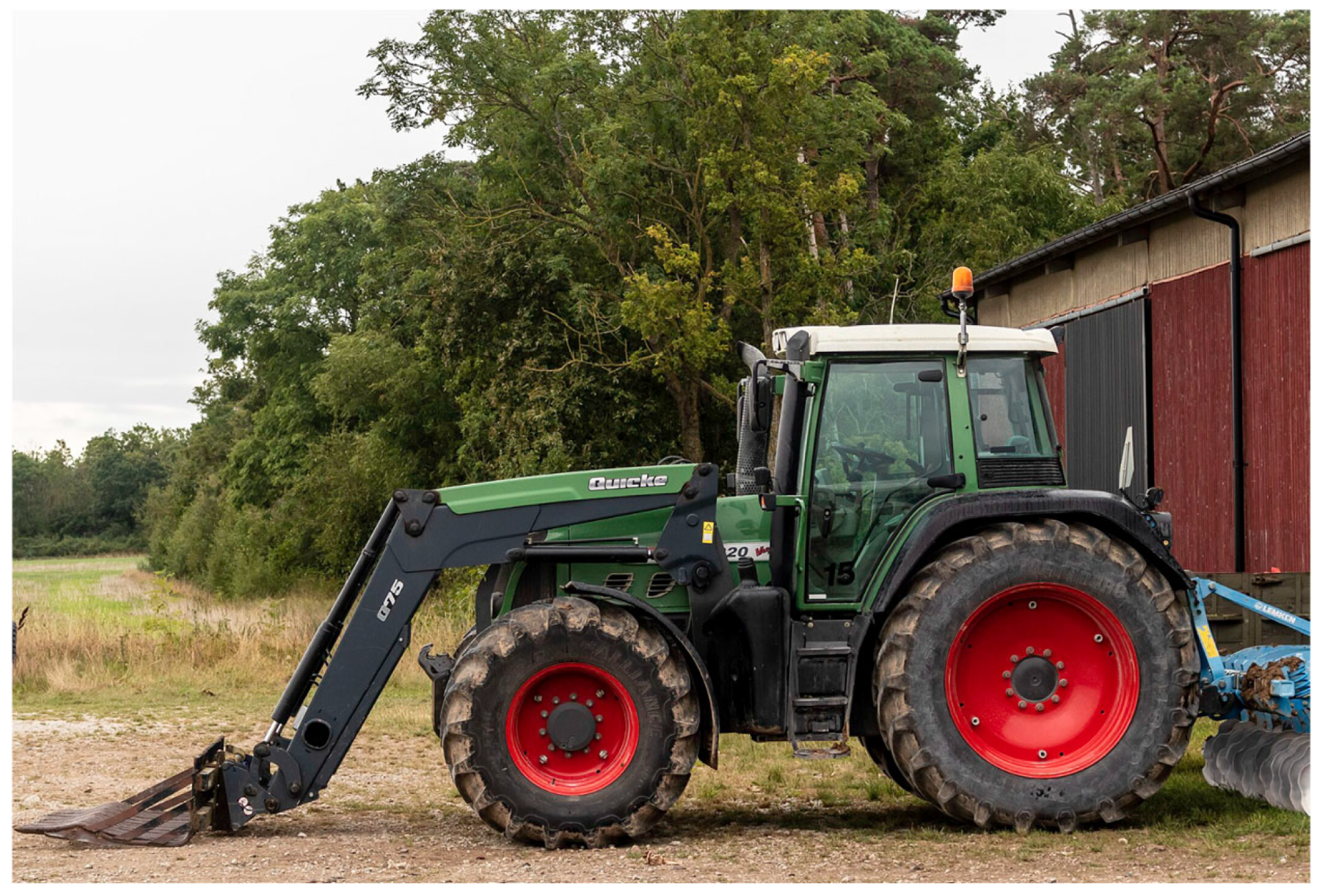
Agricultural tractors are produced in a range of sizes for different applications. Smaller tractors have engines up to about 80 kW and are denoted “utility tractors”, designed for mixed tasks, including mowing and everyday farm duties not requiring high power. “Large row-crop tractors” with engines above about 125 kW are used for tasks with high drawbar loads, often using wide implements to cover as many crop rows as possible. A large row crop tractor (a Fendt 820 Vario, Manufacturer: Fendt (AGCO GmbH), Marktoberdorf, Germany) is shown in Figure 10. This paper analyzes four farming tractors of different sizes (Fendt 211, 314, 722 and 820) using ePOP Concept, performing common farming tasks such as harrowing and seed drilling, to determine whether hybridization could improve the total ownership and running cost over a period of 10 years, and if so, with what architecture. The fuel efficiency results are compared with measured data from the test vehicles. The dataset was taken from Götz et al. [45].
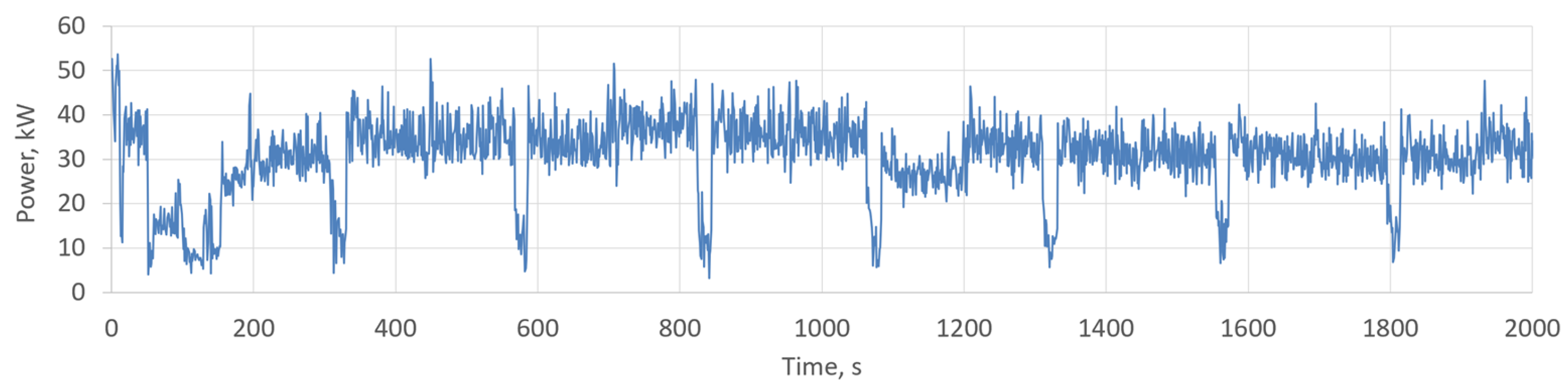
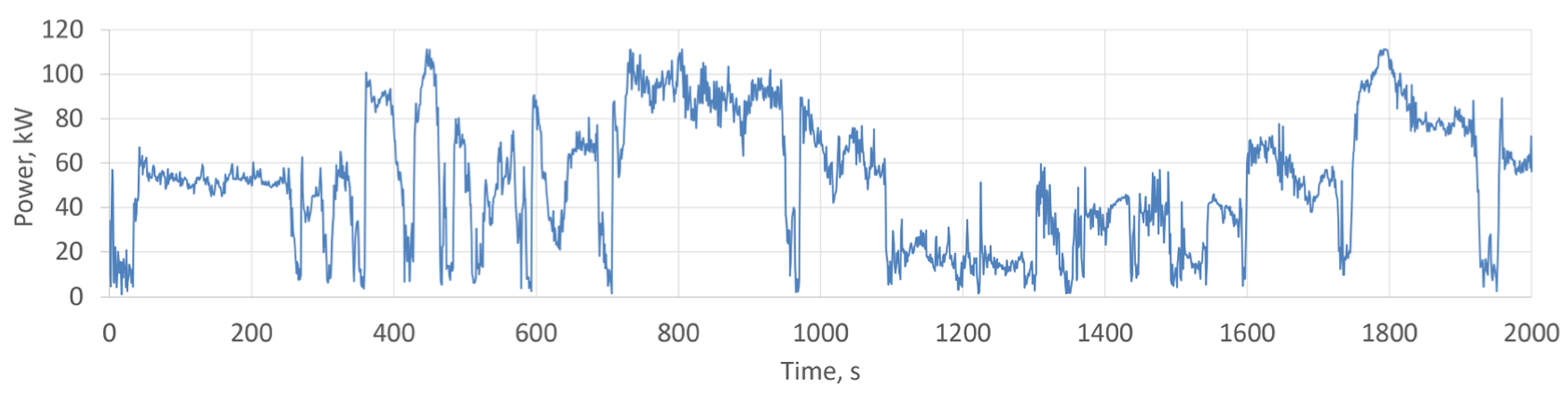
The four tractors were measured with data loggers over 92 different farming activities, and each one was analyzed using ePOP Concept. The activities were performed over a period of several months encompassing a range of weather conditions, over around 14 different fields. Examples of the load cycles are shown in Figure 11, Figure 12 and Figure 13. The results indicated that the benefits of hybridization decreased with increasing tractor size and power, mainly because the larger models (722 and 820) are used for tasks requiring high power for long continuous periods.
For the purposes of this paper, it was not the effects of hybridization that were of primary interest, but the accuracy of fuel prediction. Therefore, the simulated fuel consumption for each tractor was compared with the actual fuel flow logged from the engine management systems via CAN-BUS.

4. Results

4.1. Wheel Loader Analysis—ePOP Concept

The ePOP Concept program analyzed the input data from the wheel loader and presented two architectures, A and B, as in Figure 6 and Figure 7, one being the hydraulic system of the base vehicle and the other a proposed diesel-electric series hybrid. Table 4 shows the calculated fuel costs over 10 years as USD 154,914 for the base vehicle and USD 123,436 for the hybrid, giving a reduction of 20%.
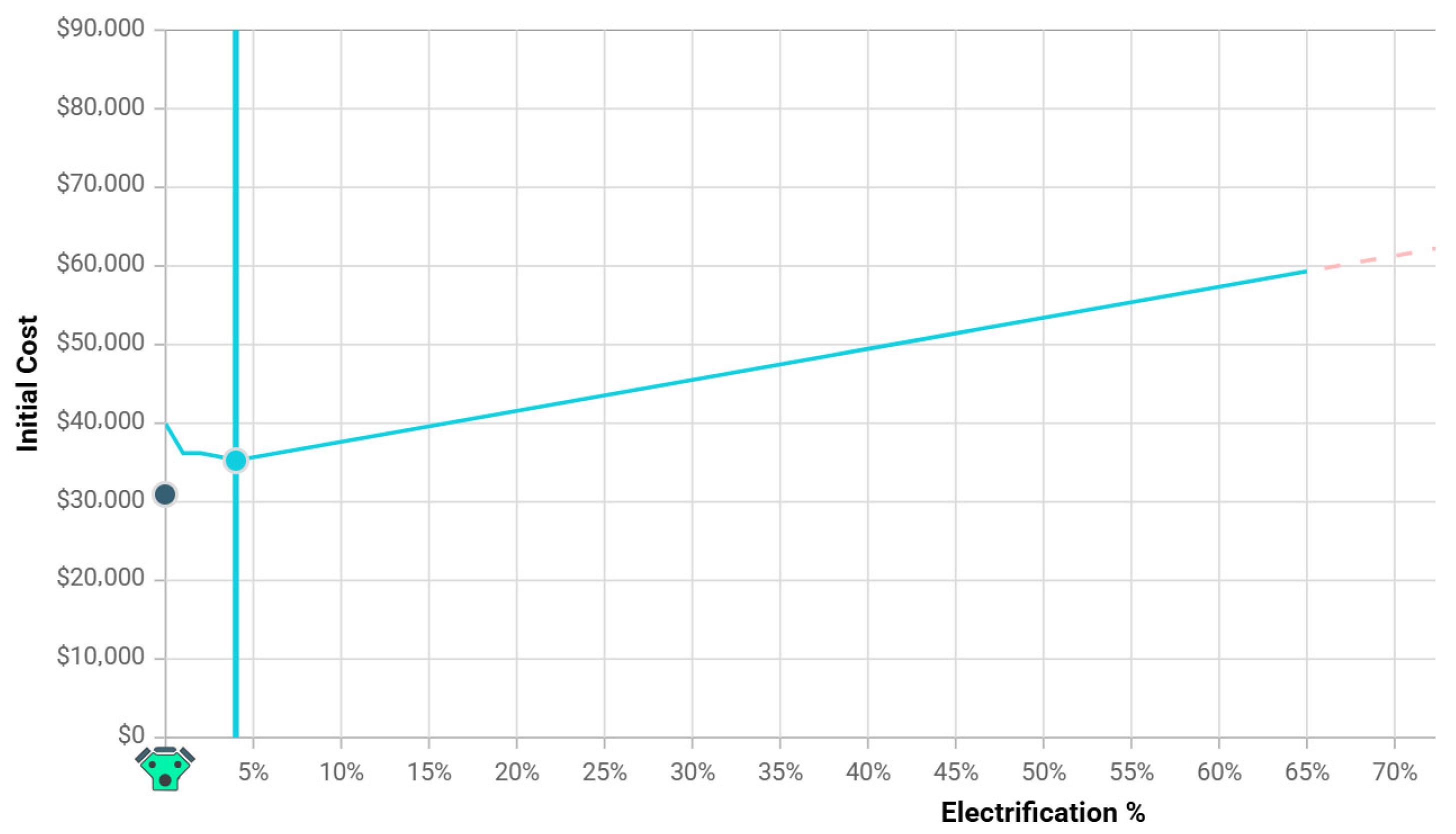
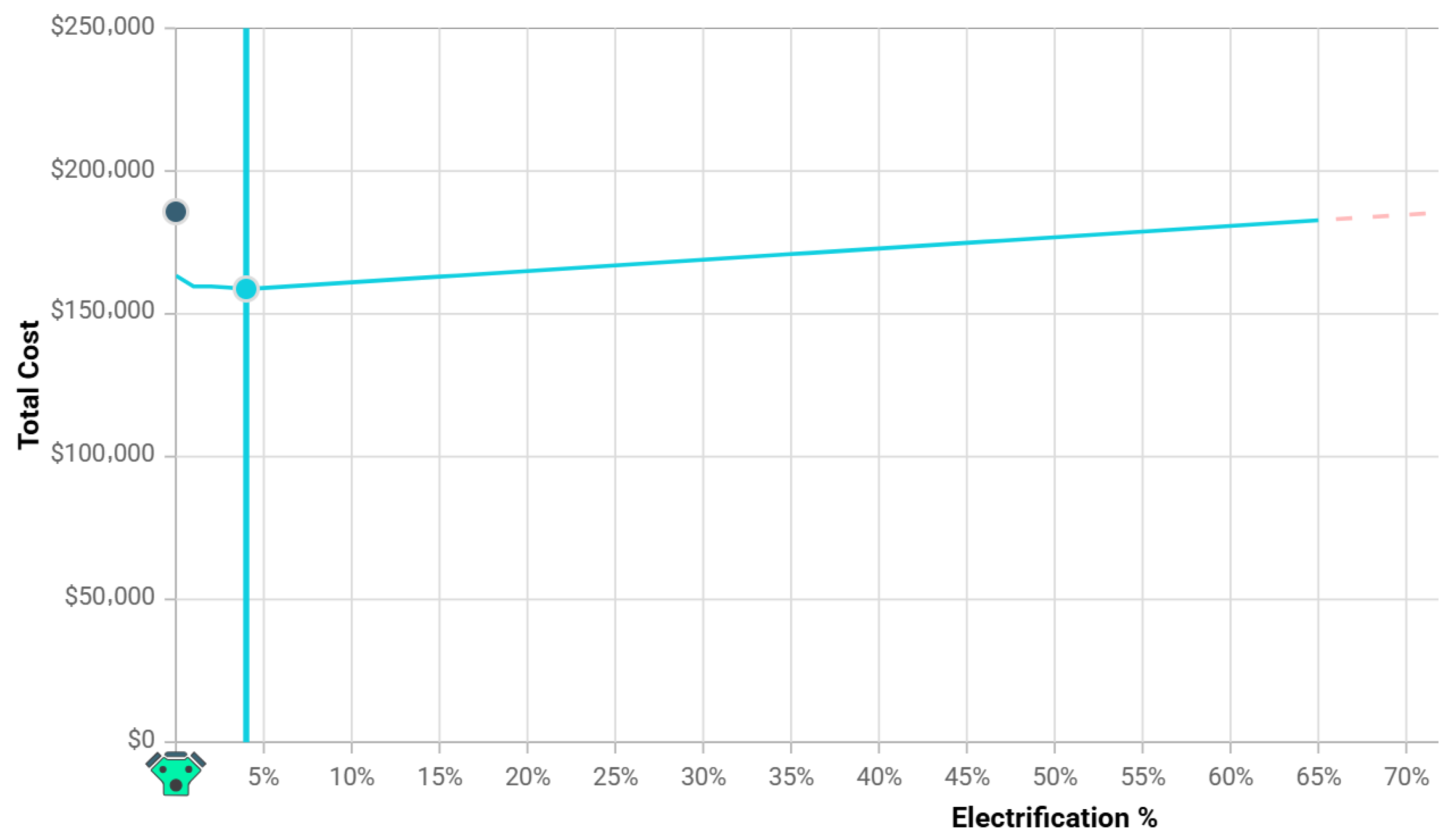
Figure 14 illustrates the results by showing the equipment cost (powertrain only) versus the degree of electrification. The lower solid dot at the 0% position represents the original hydraulic hardware, Powertrain A, while the line represents the electrified hardware, Powertrain B, which is more expensive. Figure 15 is similar, but the y axis represents the TCO, or total cost of ownership. There is a second solid dot on the line in each graph, with a vertical line through it, representing the position on the x axis currently being considered for Powertrain B. The user can grab and move the vertical line to the right or left. Movement to the far left indicates “0% electrification” or vanishingly small electrical components, so effectively a pure-ICE solution. Movement to the right introduces increasingly large electrical components, until at the far right (100%) the hybrid powertrain has a vanishingly small ICE, or effectively it is a pure BEV. There is no possibility of increasing the electrification of A from 0%, because it is all hydraulic, and therefore pure-ICE. There is also an infeasible condition at either end of B; it would make no sense to build a series hybrid with no battery (0%), even though a solution appears on the graph, while for a fully electrified powertrain (100%), there would be no source of power at all, as this option does not allow recharging. The weight of the battery was arbitrarily limited to 1000 kg during setup (user-selected in proportion to the base vehicle weight of 5700 kg), so there is a limit to the “electrification %” that can be achieved without exceeding this limit—indicated where the solid line, in both Figure 14 and Figure 15, turns into a dotted line.
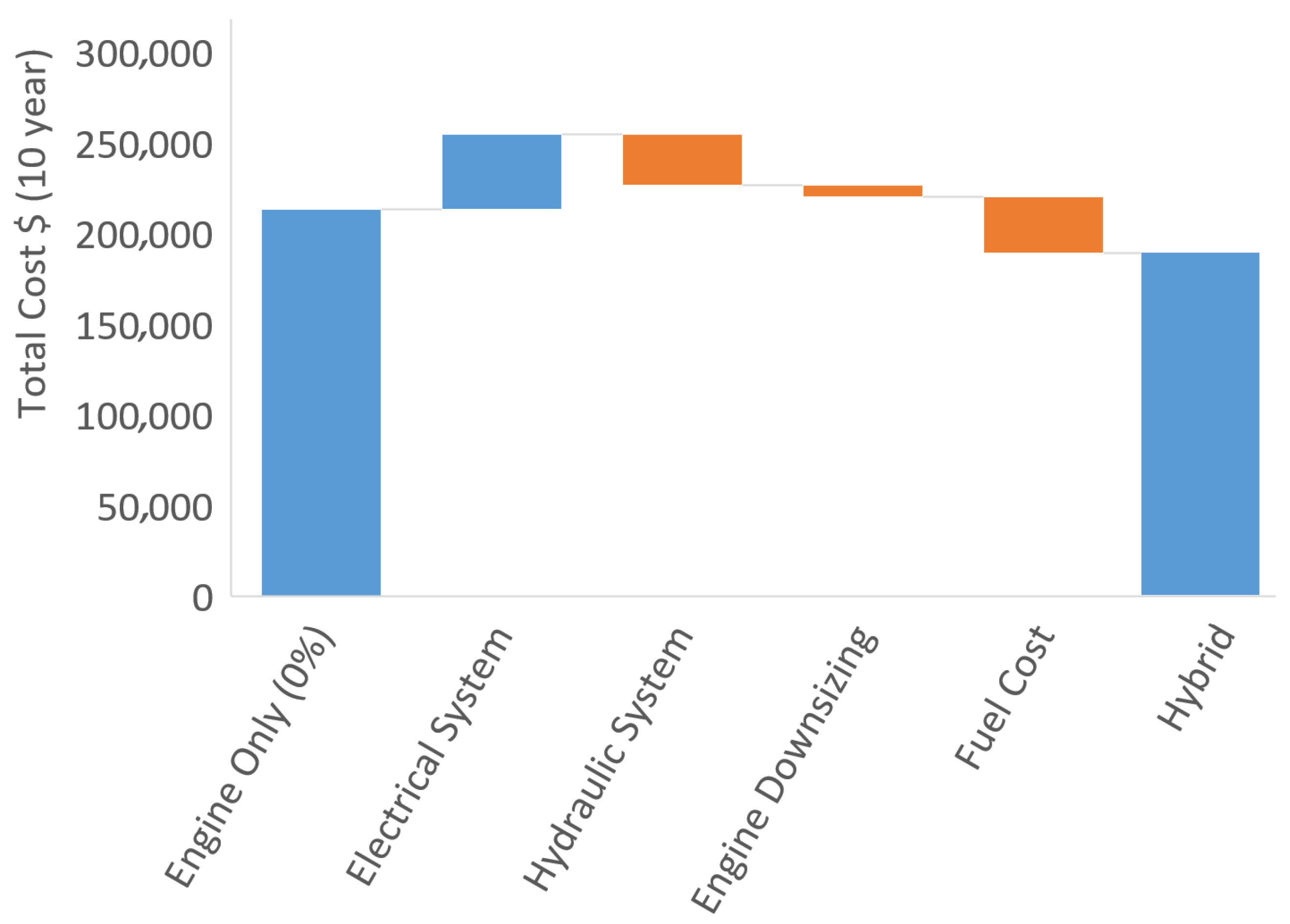
Table 4 shows estimated sizing and cost for the major components of powertrains A and B, where B is set to the minimum point of “4% electrification” (noting that this percentage is an arbitrary scale). Figure 16 shows a waterfall chart of the same data, indicating how the cost additions and deletions result in the overall change in capital cost, when replacing the hydraulics with electrical hardware.
The wheel loader fuel consumption was measured during the vehicle test, and the result is shown in Table 5. The prediction shows an error of only 2.6%, despite the inherent errors possible in the assumptions. This cannot be taken as a validation of the method, however, as it covers only one data point, and errors can of course cancel each other out. However, had the error been larger than theoretically possible, it would have constituted useful information.

4.2. Tractor Analysis—ePOP Concept

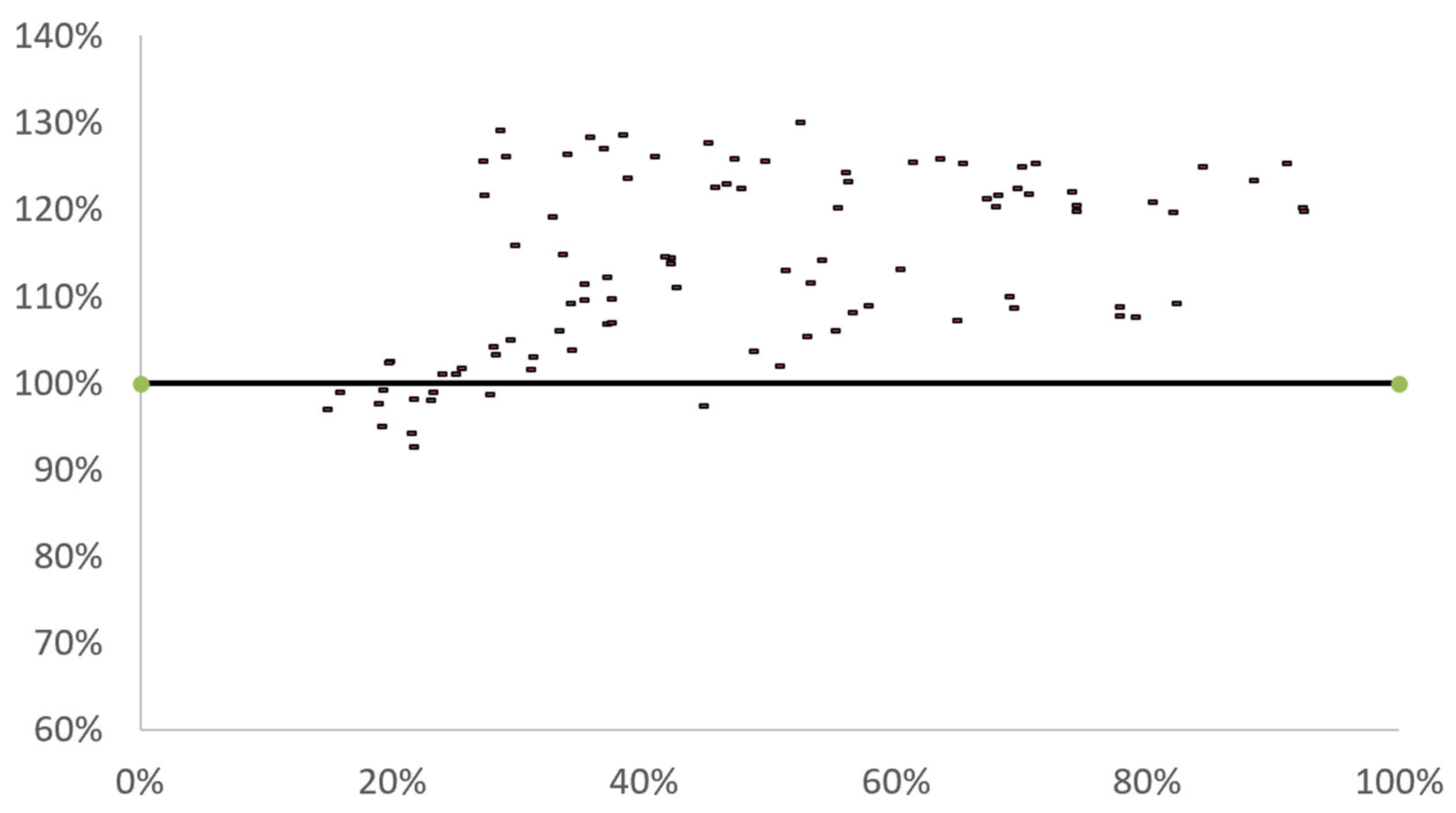
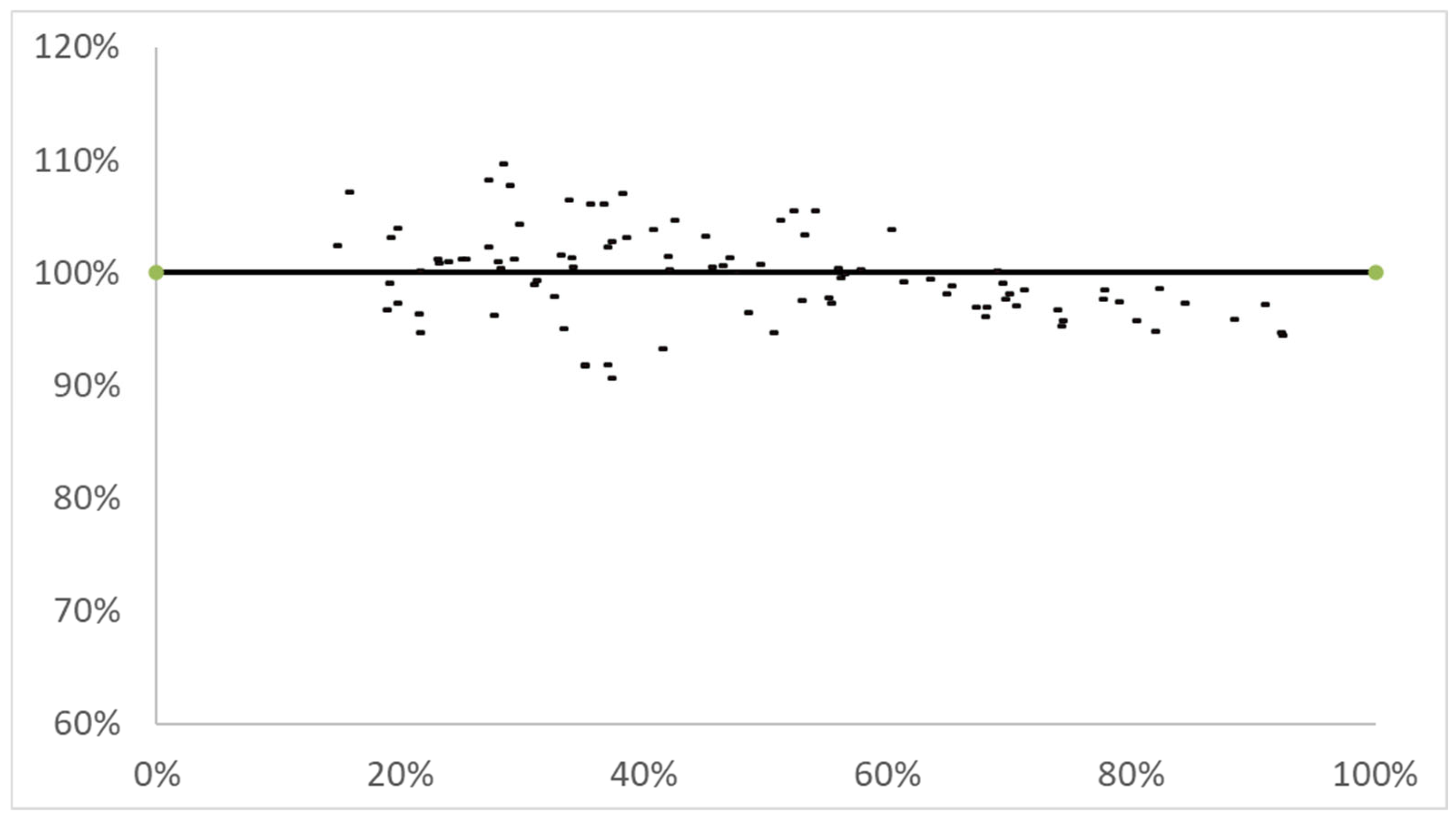
The ePOP Concept program analyzed the input data from the four tractors over a total of 92 farming activities. The source data did not include measurements of mechanical drawbar loads or PTO torque sufficiently to measure the total mechanical work performed, but it was possible to access the engine shaft work and the fuel flow as inferred values logged from the engine management system. ePOP Concept simulated the system based on the input load cycles and predicted the fuel consumption, which was then compared with the logged fuel data. This was effectively a test of the BSFC assumption in the program, as it did not include other components of the transmission. The resulting comparison is shown in Figure 17, where the ePOP estimation is shown as a percentage of the logged fuel consumption, plotted versus engine power as a percentage of rated (maximum) power. The 100% in the y axis indicates that the two estimates of fuel flow were in agreement, while a value greater than 100% indicates that ePOP Concept estimated more fuel flow than that which was logged from the engine management system.

4.3. BSFC Correction

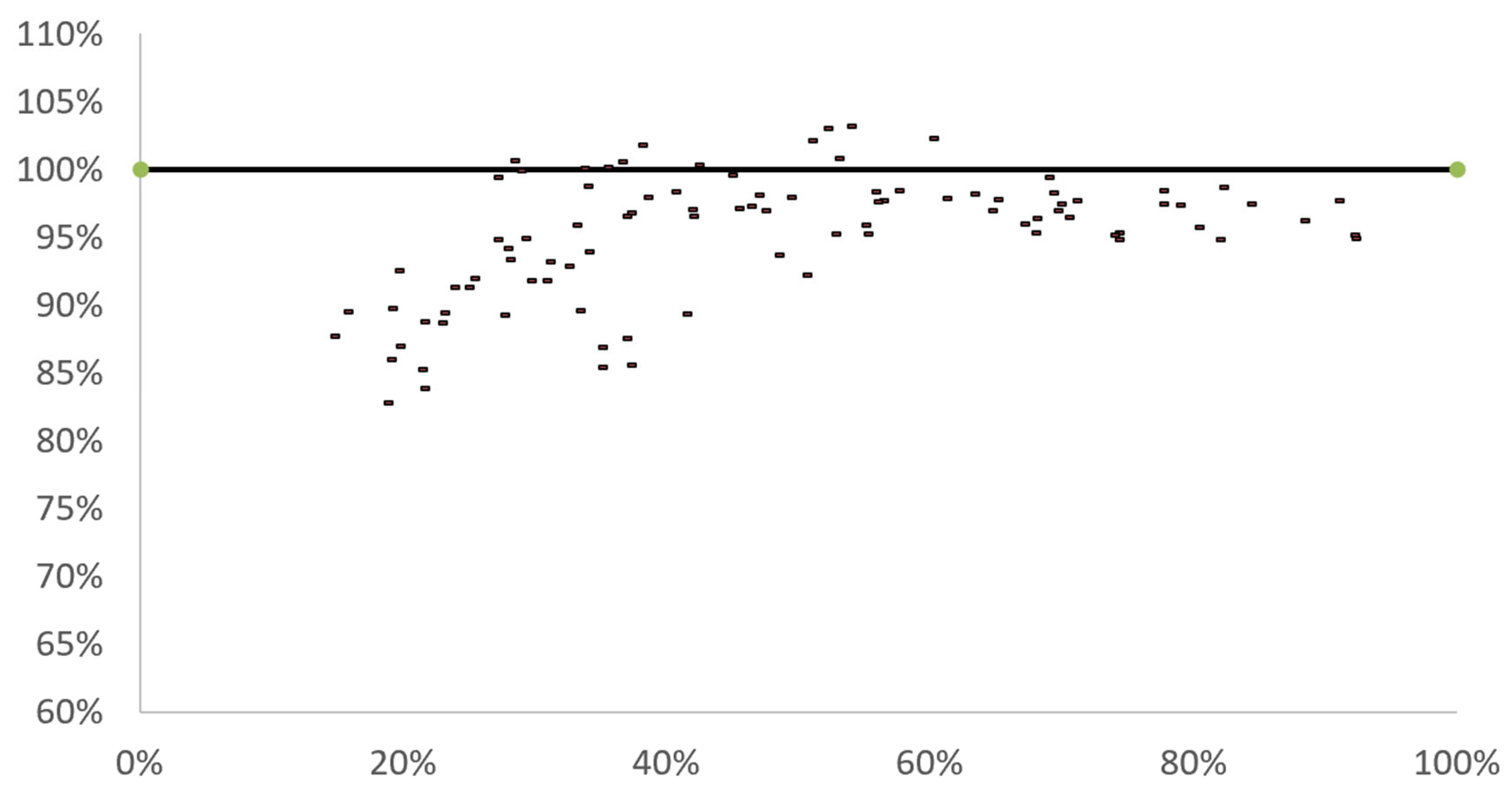
The analysis was repeated after adjusting the BSFC assumed for each of the four engines by substituting published manufacturer data for minimum BSFC instead of the generic value assumed by ePOP Concept for off-highway diesel engines. These values can be seen in Table 6 under the heading “Engine Only” [46,47,48,49,50,51,52]. The load-based BSFC correction of Section 3.3.8 was also applied, and these two changes resulted in the errors shown in Figure 18, which now lie between −10% and +10% and yield errors of 3.9% RMS.

5. Discussion

The ePOP Concept software is a cloud-based program intended to make the simulation capabilities of its sister program, ePOP Desktop version 3.4.0, accessible for non-expert users. The methodology of the ePOP suite of software is described by Dotter et al. [53] and Holdstock et al. [54]. ePOP Concept is designed to generate the figures and results shown in Section 4, as an early-stage assessment of the benefits of electrification, based on the nature of the load cycle. If the results are strongly positive, the user would be expected to pursue more accurate methods in creating a new vehicle design, whereas if not, the user would be spared the expense of the more thorough approach.
The cost calculations illustrated in the results were not part of this study, and represent hypothetical scenarios, so they cannot be compared with real data. They are presented here to illustrate the process of using ePOP Concept, and the nature of its user interface.
The most important output of ePOP Concept is the estimation of fuel costs over the vehicle lifetime—typically 10 years—since this cost outweighs the capital cost of the equipment by far. Therefore, this study concentrates on the accuracy of the fuel prediction calculation, and the inherent trade-off between prediction accuracy and accessibility.

5.1. Accuracy of Fuel Prediction

The target fuel prediction accuracy for ePOP Concept is ±10%. The wheel loader fuel usage calculated by ePOP Concept, per daily cycle, seen in Table 5, equates to 59.6 L, whereas the logged data from the vehicle indicates fuel usage of 61.2 L, giving an under-estimate of 2.6%. This is within target, but the results in Figure 17 have an RMS error of 17.0%, which is biased towards over-estimation except at low engine loads. Even if engine BSFC were the only source of error, the target would clearly not be met. However, an RMS error of 6.7% can be achieved by a simple setup adjustment using an easily obtained published BSFC value for the type of engine envisaged.

5.2. Causes of Fuel Prediction Errors

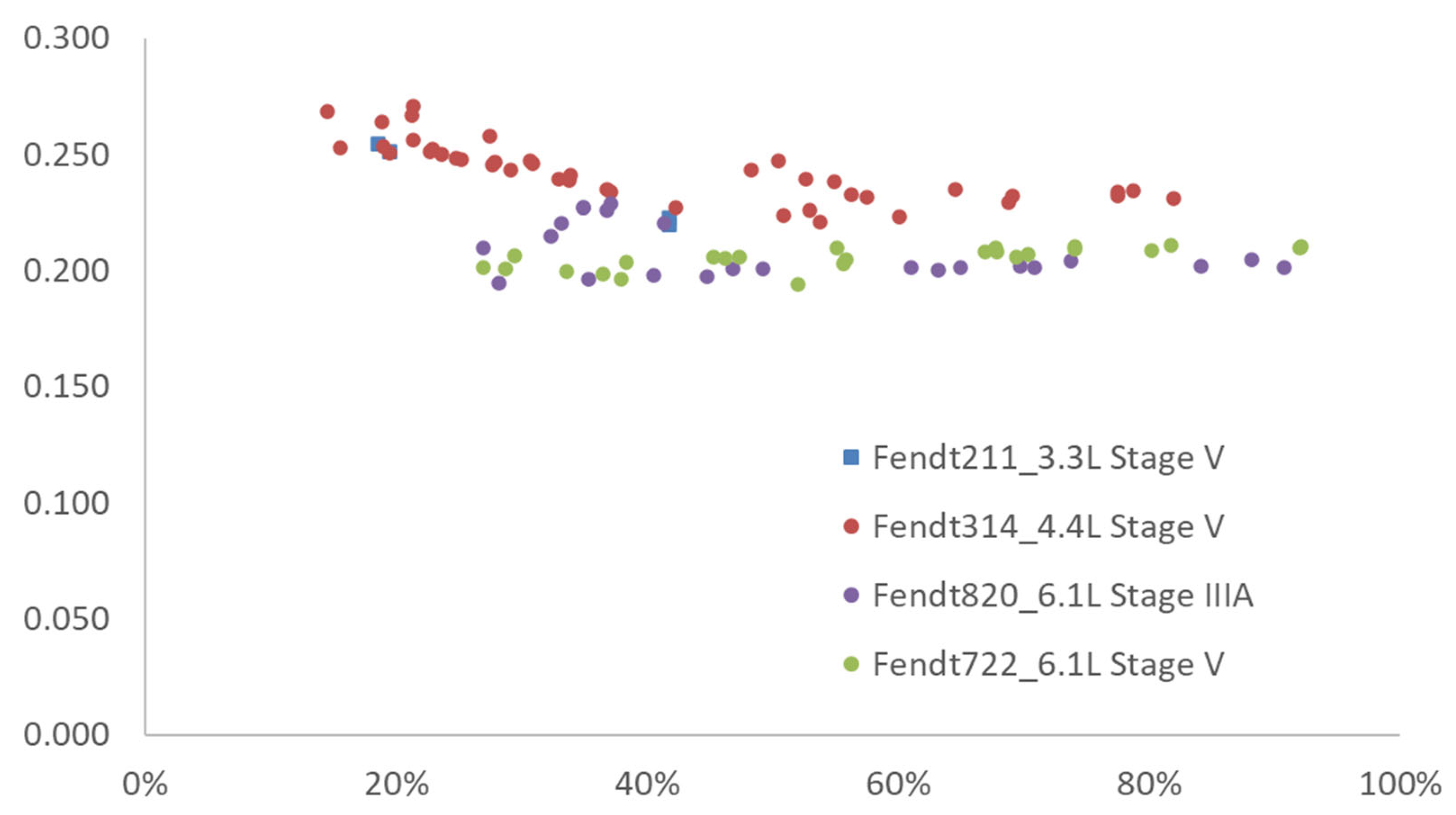
A major cause of this error spread may be seen in Figure 19, where the average BSFC of the engine is calculated for each activity, using the fuel flow, RPM, and inferred torque logged from the tractor engine management system. This calculation from the dataset has nothing to do with ePOP Concept, but it illustrates the dependency of BSFC on the engine load and the engine type. With regard to engine load, it is well known that diesel engines are more efficient at higher loads, partly because the losses due to friction and accessory loads become smaller by comparison with the output power. The dependency of BSFC on engine type is also significant, and it illustrates two phenomena. First, the older Stage IIIA engine of the 820 is designed to meet a lower emissions standard than the other engines, and therefore has relatively better BSFC, being less compromised by aftertreatment, EGR and injection timing. Secondly, among the Stage V engines, the challenge of meeting the higher emissions standard is known to place more efficiency compromises on smaller diesel engines than larger engines, while the surface–-volume ratio of the largest engine is also an efficiency advantage, and so the results favor the larger engines over the smaller.
ePOP Concept recommends a single BSFC value for all off-highway diesel engines, of 0.25 kg/kWh. It can be seen from Figure 19 that this value (if it must be fixed) is reasonable for the 3.3 L 3-cylinder and 4.4 L engines, but not for the larger engines, for the reasons stated above. Therefore, the constant-BSFC assumption introduces systematic errors into the fuel consumption results from ePOP Concept.

5.3. Methods to Reduce Fuel Prediction Errors

The trend in Figure 19 is that larger displacement diesel engines tend to achieve better BSFC. Table 6 shows published BSFC data for all four engines and confirms the trends seen in Figure 19. Regardless of the cause, it is clear that the assumption of constant BSFC across a range of engines introduces a significant error, some of which could possibly be avoided by applying simple corrections. Pelletier et al. [39], Uyehara [40], Suijs et al. [41], Guzzella et al. [42], and Rakopoulos [43] propose methods of estimating minimum BSFC using scaling algorithms, given minimal information about the engine beyond the required size and type. A version of this method could also be incorporated in future versions of ePOP Concept to remove much of the observed error in Figure 17. Changes to engine size would then be adjusted by ePOP Concept during optimization starting from a known base. A simpler approach would be to search the literature (a quick process with modern search tools) to find the minimum BSFC of similar engines to those anticipated for the application, and to use that BSFC value in ePOP Concept, where it can be manually added to a new engine selection. This is a very light addition to the setup burden, since it is a single scalar value that is generally advertised and easily available for commercial engines or engine types.
Having determined the minimum BSFC for an engine, the FMEP-based correction method described in Section 3.3.8 could be used to adjust for engine load, as a proportion of maximum load (using torque as the load metric if available in the simulation, or power if not).
Combining both these methods, the results were corrected using the formulae in Section 4.3, and the errors were reduced to within ±10% (Figure 19) with RMS error = 3.9%.
Similar approaches could be applied to the other components in the powertrain (inverters, motors, hydraulic components, etc.) where errors are strongly influenced by a single, accessible variable, such as engine load.
In its current form, ePOP Concept is not yet modified to apply both these correction methods, but it is already possible to apply one of them by substituting the published minimum BSFC value for the engine, or a similar surrogate, instead of the generic value pre-populated in the program. This simple step is easily managed without simulation expertise, and this information is generally easy to obtain. The runs were repeated with this correction alone, but without the load-based correction formula, and the results are shown in Figure 20. The RMS error was not reduced entirely from the original 17% to the 3.9% RMS obtained with the formula included, but it was instead reduced to 6.7% RMS. This value is compatible with the overall target of ±10% for early gate-stage evaluation of electrification opportunities, and could be further improved in future by application of the load-based formula, and by similar attention to the loss models for the remaining powertrain components.

5.4. Evaluation of Hybridization Benefits

ePOP Concept includes estimation methods for cost, weight, and package space for the vehicle powertrain. These methods are based on simplified methods that are not described in this study, but the most significant element of TCO is the fuel cost over 10 years, and this dominates the cost–benefit calculation for the vehicle. The most striking result of the ePOP Concept analysis in the Section 4, although a very simple one, is that the fuel cost of powertrain A (USD 154,914) is much higher than the capital cost of the equipment (USD 28,839), showing that fuel costs dominate the TCO equation. Diesel fuel costs are expected to increase at least in line with inflation over the next 10 years [55]. This suggests that investment in efficiency technology should yield a worthwhile return.
As may be expected, the capital cost of electrification hardware in the ePOP results (USD 35,255) is higher than that of the hydraulic architecture (USD 28,839), even before the amortized cost of engineering a new hybrid architecture is considered. Despite this, the TCO (USD 154,914) is 16% lower than that reported for hydraulic architecture (USD 183,753).
With increasing electrification in the ePOP Concept analysis (i.e., larger electrical components and a smaller engine), the initial cost (Figure 14) drops to a minimum at the 4% point, indicating that quite a small battery (7.9 kWh) is sufficient. However, with increasing electrification sizing, the total cost increases, indicating no returns for further up-sizing of the electrical components. The TCO calculated by ePOP Concept (Figure 15) shows a similar response to the capital cost in Figure 14. There is still a minimum value at 4%, but the overall result is positive over a wide range, compared to the base vehicle.

5.5. Comparison with Alternative Methods

The ePOP Concept method is intended to fill a perceived gap in the available tools for powertrain architecture comparisons. It is to be applied at an early stage-gate in the development process, to determine whether further effort is justified. If so, then more accurate and resource-intensive tools may be deployed for implementation. Therefore, the accuracy of the method must be good enough for an early gate-stage decision, but need not be accurate enough for absolute predictions or final system optimization. The alternative methods reviewed in Section 2 offer some advantages over ePOP Concept, at the expense of requiring more setup effort and expertise.
  • The use of engine efficiency maps enables the benefits of operating-point modification to be included, whereas ePOP Concept assumes constant efficiency. It also introduces engine-specific BSFC data, which reduces error significantly.
  • The control strategy can be defined, e.g., when to switch off the engine of a hybrid and run from battery power only.
  • As well as engine data, other component-specific characterization data can be used, reducing errors, but at the cost of some effort in data collection.
The fuel prediction accuracy of ePOP Concept does not meet the target of ±10% accuracy, as 17.0% RMS error was observed in the engine BSFC calculation alone. However, the sources of the errors appear to have systematic causes that could potentially be addressed, with modeling improvements that would add very little setup burden, preserving ePOP Concept’s main advantage. Also, the accuracy can be improved significantly by simply adjusting the generic engine BSFC adjustment to match the type of engine envisaged for the vehicle.

5.6. Future Development Work

Future improvements to ePOP Concept might include the following elements:
  • Scaling algorithms to account automatically for engine scale effects, improving the generic assumptions for engine BSFC.
  • Simple 1-dimensional engine BSFC modeling to account for load dependency
  • Similar efficiency modeling approaches applied to other components, including inverters, e-motors, hydraulics, transmissions and engine accessories.
  • Automatic elimination of infeasible conditions, e.g., electrical or ICE components tending to zero size.
The results of this study suggest that these improvements may be sufficient to allow ePOP Concept to meet the ±10% target for fuel prediction accuracy.

6. Conclusions

This study set out to answer the question “Can an easily accessible powertrain simulation tool, requiring minimal setup effort and non-specialist expertise, predict fuel efficiency with sufficient accuracy for early stage-gate decisions in off-highway vehicle design?” The “ePOP Concept” analysis method was evaluated using two case studies including vehicle test data. The results showed that ePOP Concept could not meet the target for fuel prediction accuracy in its current form, owing to potential errors in the estimation of engine BSFC leading to fuel prediction errors of 17% RMS. However, improvements were identified that could potentially make this possible, while only minimally adding to the setup effort required, thereby preserving one of the program’s main advantages. In its current form, the user can reduce the BSFC-related errors to 6.7% RMS during setup, simply by replacing the program’s generic BSFC value with a custom scalar value specifically for the desired engine type that is readily available for most commercial engines in the public domain. For future development, simple enhancements to the program’s efficiency models show promising potential for reducing BSFC-related errors further to around 3.9% RMS, with only minimal additions to the setup effort required. ePOP Concept provides estimates not only of fuel efficiency, but also the cost, weight, and package implications of multiple alternative powertrain architectures in one simple setup, based on a single input load case. Commercially available simulation tools were reviewed for comparison purposes, and the results showed that ePOP Concept could fill a gap among the available tools by providing an accessible solution, while also providing calculations of total cost of ownership to support early stage-gate architecture decisions.

Funding

This research received no external funding.

Data Availability Statement

The raw dataset for the wheel loader is available at reference [8], and the tractor dataset at reference [55].

Acknowledgments

We thank Heikkilä, M., Huova, M., Tammisto, J., Linjama, M., Tervonen, J., for making their dataset publicly available for research [8], and Götz, T., Korb, L., Bosch, T., & Bernhardt, H. likewise [55]. Generative AI was not used to create any of the text in this paper.

Conflicts of Interest

Rupert Tull de Salis was employed by the company ZeBeyond Ltd., and declares that the research was conducted in the absence of any commercial or financial relationships that could be construed as a potential conflict of interest.

Abbreviations

The following abbreviations are used in this manuscript:
BEVBattery Electric Vehicle.
BMEPBrake Mean Effective Pressure.
BSFCBrake-Specific Fuel Consumption.
BTEBrake Thermal Efficiency.
CAN-BUSController Area Network Bus.
CNGCompressed Natural Gas.
CVTContinuously Variable Transmission.
EGRExhaust Gas Recirculation.
FMEPFriction Mean Effective Pressure.
GaNGallium Nitride.
GNSSGlobal Navigation Satellite System.
HEVHybrid Electric Vehicle.
HSTHydrostatic Transmission.
ICEInternal Combustion Engine.
IGBTInsulated-Gate Bipolar Transistor.
IMEPIndicated Mean Effective Pressure.
ISFCIndicated Specific Fuel Consumption.
NRELNational Renewable Energy Laboratory.
OEMOriginal Equipment Manufacturer.
PHEVPlug-in Hybrid Electric Vehicle.
PTOPower Take-Off.
RMSRoot Mean Square.
SiCSilicon Carbide.
TCOTotal Cost of Ownership.

Appendix A

Data Channels Provided in the Raw Dataset for the Wheel Loader [8].
ParameterUnits
times
Machine_Speedm/s
Machine_Direction
Diesel_wrad/s
Diesel_TorqueEstimateNm
Diesel_FuelRateL/h
Diesel_PowerEstimateW
LiftCylinder_xm
LiftCylinder_vm/s
LiftCylinder_pAPa
LiftCylinder_pBPa
LiftCylinder_FN
LiftCylinder_Q_Am3/s
LiftCylinder_Q_Bm3/s
TiltCylinder_xm
TiltCylinder_vm/s
TiltCylinder_pAPa
TiltCylinder_pBPa
TiltCylinder_FN
TiltCylinder_Q_Am3/s
TiltCylinder_Q_Bm3/s
StabilizerCylinder_xm
StabilizerCylinder_vm/s
StabilizerCylinder_Q_Am3/s
StabilizerCylinder_Q_Bm3/s
StabilizerCylinder_pAPa
StabilizerCylinder_pBPa
StabilizerCylinder_FN
LiftValve_Q_PAm3/s
LiftValve_Q_BTm3/s
LiftValve_Q_PBm3/s
LiftValve_Q_ATm3/s
TiltValve_Q_PAm3/s
TiltValve_Q_BTm3/s
TiltValve_Q_PBm3/s
TiltValve_Q_ATm3/s
WorkPump_wrad/s
WorkPump_pPPa
WorkPump_FlowEstimatem3/s
WorkPump_TorqueEstimateNm
WorkPump_AngleEstimate
WorkPump_ShaftPowerEstW
WorkPump_HydraulicPowerEstW
WorkPump_ErrorFlag

References

  1. Götz, K.; Pointner, M.; Mayr, L.; Mailhammer, S.; Lienkamp, M. Electrify the Field: Designing and Optimizing Electric Tractor Drivetrains with Real-World Cycles. World Electr. Veh. J. 2025, 16, 463. [Google Scholar] [CrossRef]
  2. Beligoj, M.; Scolaro, E.; Alberti, L.; Renzi, M.; Mattetti, M. Feasibility Evaluation of Hybrid Electric Agricultural Tractors Based on Life Cycle Cost Analysis. IEEE Access 2022, 10, 28853–28867. [Google Scholar] [CrossRef]
  3. Lagnelöv, O.; Larsson, G.; Nilsson, D.; Larsolle, A.; Hansson, P.-A. Performance comparison of charging systems for autonomous electric field tractors using dynamic simulation. Biosyst. Eng. 2020, 194, 121–137. [Google Scholar] [CrossRef]
  4. Lajunen, A.; Kivekäs, K.; Freyermuth, V.; Vijayagopal, R.; Kim, N. Simulation of Alternative Powertrains in Agricultural Tractors. In Proceedings of the 36th International Electric Vehicle Symposium and Exhibition (EVS36), Sacramento, CA, USA, 11–14 June 2023; pp. 1–11. [Google Scholar]
  5. Nieto Prada, D.; Vijayagopal, R.; Costanzo, V. Opportunities for Medium and Heavy Duty Vehicle Fuel Economy Improvements Through Hybridization; SAE Technical Paper 2021-01-0717; SAE International: Warrendale, PA, USA, 2021. [Google Scholar] [CrossRef]
  6. Ali, D.; de Castro, R.; Ehsani, R.; Vougioukas, S.; Wei, P. Unlocking the potential of electric and hybrid tractors via sensitivity and techno-economic analysis. Appl. Energy 2025, 377, 124545. [Google Scholar] [CrossRef]
  7. Heikkilä, M.; Huova, M.; Tammisto, J.; Linjama, M.; Tervonen, J. Fuel efficiency optimization of a baseline wheel loader and its hydraulic hybrid variants using dynamic programming. In Proceedings of the BATH/ASME 2018 Symposium on Fluid Power and Motion Control FPMC2018, Bath, UK, 12–14 September 2018. [Google Scholar] [CrossRef]
  8. Linjama, M.; Huova, M.; Tammisto, J.; Tervonen, J.; Ahola, V. 6-ton wheel loader short Y-cycle data for 440 seconds loading of gravel. Zenodo 2024. [Google Scholar] [CrossRef]
  9. Allam, M.; Linjama, M. Optimisation of series electric hybrid wheel loader energy management strategies using dynamic programming. Int. J. Heavy Veh. Syst. 2025, 32, 1–29. [Google Scholar] [CrossRef]
  10. Gao, D.W.; Mi, C.; Emadi, A. Modeling and Simulation of Electric and Hybrid Vehicles. Proc. IEEE 2007, 95, 729–745. [Google Scholar] [CrossRef]
  11. Newman, K.A.; Doorlag, M.; Barba, D. Modeling of a Conventional Mid-Size Car with CVT Using ALPHA and Comparable Powertrain Technologies; SAE Technical Paper 2016-01-1141; SAE International: Warrendale, PA, USA, 2016. [Google Scholar] [CrossRef]
  12. Qu, S.; Liu, Z.; Cardoso, R.; Busquets, E. Electrification of a compact skid-steer loader—Redesign of the hydraulic functions. In River Publishers Series in Transport, Logistics and Supply Chain Management; River Publishers: Gistrup, Denmark, 2024; Chapter 12; Available online: https://www.riverpublishers.com/pdf/ebook/chapter/RP_9788770047456C12.pdf (accessed on 5 December 2025).
  13. Moawad, A.; Xu, B.; Pagerit, S.; Nieto Prada, D.; Vijayagopal, R.; Sharer, P.; Islam, E.; Kim, N.; Phillips, P.; Rousseau, A. AutonomieAI: An efficient and deployable vehicle energy consumption estimation toolkit. Transp. Res. Part D Transp. Environ. 2025, 139, 104569. [Google Scholar]
  14. EPA/NHTSA. Vehicle System Simulation to Support NHTSA CAFE Standards for the Draft TAR; NHTSA Workshop: San Diego, CA, USA, 11 November 2018. Available online: https://www.nhtsa.gov/sites/nhtsa.gov/files/anl-nhtsa-workshop-vehicle-system-simulation.pdf (accessed on 5 December 2025).
  15. Tang, B. Simulational energy analyses of different transmission (automated manual transmission vs continuously variable transmission) selection effects on fuel cell hybrid electric vehicles’ energetic performance. Int. J. Hydrogen Energy 2024, 75, 506–514. [Google Scholar] [CrossRef]
  16. Lei, Y.L.; Jia, Y.Z.; Lei, Y.L.; Fu, Y.; Liu, K.; Zhang, Y.; Liu, Z.J. Car Fuel Economy Simulation Forecast Method Based on CVT Efficiencies Measured from Bench Test. Chin. J. Mech. Eng. 2018, 31, 83. [Google Scholar] [CrossRef]
  17. Chen, C. The development of hybrid electric vehicle control strategy based on GT-SUITE and Simulink. In Proceedings of the 2015 International Conference on Intelligent Systems Research and Mechatronics Engineering, Zhengzhou, China, 11–13 April 2015; pp. 2056–2059. [Google Scholar] [CrossRef]
  18. Brooker, A.; Gonder, J.; Lopp, S.; Ward, J. FASTSim Validation Report; NREL Technical Report NREL/TP-5400-81097; National Renewable Energy Laboratory: Golden, CO, USA, 2022. Available online: https://docs.nrel.gov/docs/fy22osti/81097.pdf (accessed on 5 December 2025).
  19. Baker, C.; Moniot, M.; Brooker, A.; Wang, L.; Wood, E.; Gonder, J. Future Automotive Systems Technology Simulator (FASTSim) Validation Report—2021; NREL/TP-5400-81097; National Renewable Energy Laboratory: Golden, CO, USA, 2021. Available online: https://www.osti.gov/biblio/1828851 (accessed on 5 December 2025).
  20. Su, H.; Zhang, L.; Meng, D.; Li, Y.; Han, N.; Xia, Y. Modeling and Evaluation of SiC Inverters for EV Applications. Energies 2022, 15, 7025. [Google Scholar] [CrossRef]
  21. Huynh, T.A.; Hsieh, M.-F. Performance Analysis of Permanent Magnet Motors for Electric Vehicles (EV) Traction Considering Driving Cycles. Energies 2018, 11, 1385. [Google Scholar] [CrossRef]
  22. Lin, Z.; Li, D.; Zou, Y. Energy efficiency of lithium-ion batteries: Influential factors and long-term degradation. J. Energy Storage 2023, 74, 109386. [Google Scholar] [CrossRef]
  23. Friso, D. Brake Thermal Efficiency and BSFC of Diesel Engines: Mathematical Modeling and Comparison between Diesel Oil and Biodiesel Fueling. Appl. Math. Sci. 2014, 8, 6515–6528. [Google Scholar] [CrossRef]
  24. Heywood, J.B. Internal Combustion Engine Fundamentals; McGraw-Hill: New York, NY, USA, 1988; ISBN 0-07-028637-X. [Google Scholar]
  25. Pettersson, N.; Johansson, K.H. Modelling and control of auxiliary loads in heavy vehicles. Int. J. Control 2006, 79, 479–495. [Google Scholar] [CrossRef]
  26. Saetti, M.; Mattetti, M.; Varani, M.; Lenzini, N.; Molari, G. On the power demands of accessories on an agricultural tractor. Biosyst. Eng. 2021, 206, 109–122. [Google Scholar] [CrossRef]
  27. Blom, H. Gearbox Efficiency; Blom Engineering Blog, Sweden. 2020. Available online: https://hblom.se/summer-scope-inspire/ (accessed on 9 December 2025).
  28. Wileman, C. Heavy-Duty Vehicle Transmission Benchmarking—Volvo I-Shift 12-Speed Automated Manual Transmission; Tech Report, DOT HS 813 620; National Highway Traffic Safety Administration: Washington, DC, USA, 2025.
  29. Ryu, I.H.; Kim, D.C.; Kim, K.U. Power Efficiency Characteristics of a Tractor Drive Train. Trans. ASAE 2003, 46, 1481–1486. [Google Scholar] [CrossRef]
  30. Kim, D.; Park, J.; Kim, K. Gear Train Power Loss Characteristics for Agricultural Tractor Transmission. J. Biosyst. Eng. 2017, 42, 248–256. [Google Scholar]
  31. Hasan, M.E.; Dasgupta, K.; Ghoshal, S. Comparison of the Efficiency of the High Speed Low Torque Hydrostatic Drives Using Bent Axis Motor: An Experimental Study. Proc. Inst. Mech. Eng. Part E J. Process Mech. Eng. 2015, 231, 650–666. [Google Scholar] [CrossRef]
  32. Sârbu, F.A.; Arnăut, F.; Deaconescu, A.; Deaconescu, T. Theoretical and Experimental Research Concerning the Friction Forces Developed in Hydraulic Cylinder Coaxial Sealing Systems Made from Polymers. Polymers 2024, 16, 157. [Google Scholar] [CrossRef]
  33. Zwemin, P.; Fiebig, W. The Influence of Radial and Axial Gaps on Volumetric Efficiency of External Gear Pumps. Energies 2021, 14, 4468. [Google Scholar] [CrossRef]
  34. Kauranne, H. Effect of Operating Parameters on Efficiency of Swash-Plate Type Axial Piston Pump. Energies 2022, 15, 4030. [Google Scholar] [CrossRef]
  35. Lobsinger, T.; Hieronymus, T.; Brenner, G. A CFD Investigation of a 2D Balanced Vane Pump Focusing on Leakage Flows and Multiphase Flow Characteristics. Energies 2020, 13, 3314. [Google Scholar] [CrossRef]
  36. Stosiak, M.; Yatskiv, I.; Prentkovskis, O.; Karpenko, M. Reduction of Pressure Pulsations over a Wide Frequency Range in Hydrostatic Systems. Machines 2025, 13, 25. [Google Scholar] [CrossRef]
  37. Baek, S.-M.; Kim, W.-S.; Kim, Y.-S.; Baek, S.-Y.; Kim, Y.-J. Development of a simulation model for HMT of a 50 kW class agricultural tractor. Appl. Sci. 2020, 10, 4064. [Google Scholar] [CrossRef]
  38. Karpenko, M. Investigation of Energy Efficiency of Mobile Machinery Hydraulic Drives. Ph.D. Thesis, Vilnius Gediminas Technical University, Vilnius, Lithuania, 2021. [Google Scholar] [CrossRef]
  39. Pelletier, E.; Brennan, S. Diesel Engine Characterization and Performance Scaling via Brake Specific Fuel Consumption Map Dimensional Analysis. In Proceedings of the ASME 2019 Dynamic Systems and Control Conference, Park City, Utah, USA, 8–11 October 2019; Volume 2. [Google Scholar] [CrossRef]
  40. Uyehara, O.A. Factors that Affect BSFC and Emissions for Diesel Engines: Part 1—Presentation of Concepts; SAE Technical Paper 870343; SAE International: Warrendale, PA, USA, 1987. [Google Scholar] [CrossRef]
  41. Suijs, W.; Verhelst, S. Scaling Performance Parameters of Reciprocating Engines for Sustainable Energy System Optimization Modelling. Energies 2023, 16, 7497. [Google Scholar] [CrossRef]
  42. Guzzella, L.; Onder, C.H. Introduction to Modeling and Control of Internal Combustion Engine Systems, 2nd ed.; Springer: Berlin, Germany, 2009; ISBN 978-3-642-10774-0. [Google Scholar]
  43. Rakopoulos, C.D.; Giakoumis, E.G. Second-law analyses applied to internal combustion engines operation. Prog. Energy Combust. Sci. 2006, 32, 2–47. [Google Scholar] [CrossRef]
  44. Youtube Video. Available online: https://www.youtube.com/watch?v=mAyLr9AO_rQ (accessed on 5 December 2025).
  45. Götz, K.; Kusuma, A.; Dörfler, A.; Lienkamp, M. Agricultural Load Cycles: Tractor Mission Profiles From Recorded GNSS and CAN Bus Data. Data Brief. 2025, 60, 111494. [Google Scholar] [CrossRef]
  46. OECD Code 2 abstract for Fendt 724 Vario Gen6 4WD with Deutz TCD 6.1 L6. Available online: https://site.unibo.it/trattori-certificati-ocse/en/year-2022/fendt-724-vario-gen6 (accessed on 5 December 2025).
  47. OECD Code 2 Abstract, Fendt 820 Vario TMS, COM IIIa. Available online: https://webfs.oecd.org/TADWEB/agriculture/data/tractor/2010/2.1-2010_Abstract_Eng.pdf (accessed on 5 December 2025).
  48. OECD Code 2 Abstract, Fendt 314 Vario Gen4. Available online: https://site.unibo.it/trattori-certificati-ocse/en/year-2022/fendt-314-vario-gen4 (accessed on 5 December 2025).
  49. Fendt 300 Vario S4 brochure (AGCO 4.4 L). Available online: https://www.tractorrepairs.co.nz/wp-content/uploads/2022/04/300Vario-S4-BROCHURE.pdf (accessed on 5 December 2025).
  50. DLG PowerMix datasheet for Fendt 211 S Vario. Available online: https://pruefberichte.dlg.org/filestorage/PowerMix_Datenblatt_Fendt-211-S-Vario_en.pdf (accessed on 5 December 2025).
  51. DEUTZ AG—AGRI Engine Series “TCD 4.1/6.1” PDF. Retrieved via DEUTZ Engine Finder (Product Group: Agricultural Machinery). Available online: https://www.deutz.com/fileadmin/user_upload/produkte/kraftstoffe_der_zukunft/tr_0199_99_01218_6_en.pdf (accessed on 5 December 2025).
  52. Nebraska Tractor Test Laboratory. OECD Tractor Test 3298 for Fendt 314 Vario Gen4 Diesel. Nebraska Summary 1215; University of Nebraska-Lincoln: Lincoln, NE, USA, 2022. Available online: https://digitalcommons.unl.edu/tractormuseumlit (accessed on 5 December 2025).
  53. Design for Circularity with ePOP: A Software Solution built for Powertrain Optimisation of Performance, Cost and Sustainability—Wiktor Dotter (ZeBeyond Ltd.), David Hind (Drive System Design), CTI Symposium Germany (Dec 2023). Available online: https://www.zebeyond.com/publications/design-for-circularity-with-epop (accessed on 5 December 2025).
  54. Electric Drivetrain Architecture Optimisation for Autonomous Vehicles Based on Representative Cycles—Thomas Holdstock, Michael Bryant (Drive System Design), CTI Symposium, Berlin (Dec 2018). Available online: https://www.zebeyond.com/publications/electric-drivetrain-architecture-optimisation-for-autonomous-vehicles-based-on-representative-cycles (accessed on 5 December 2025).
  55. U.S. Energy Information Administration. Annual Energy Outlook 2025 (AEO2025). 15 April 2025. Available online: https://www.eia.gov/outlooks/aeo/ (accessed on 5 December 2025).
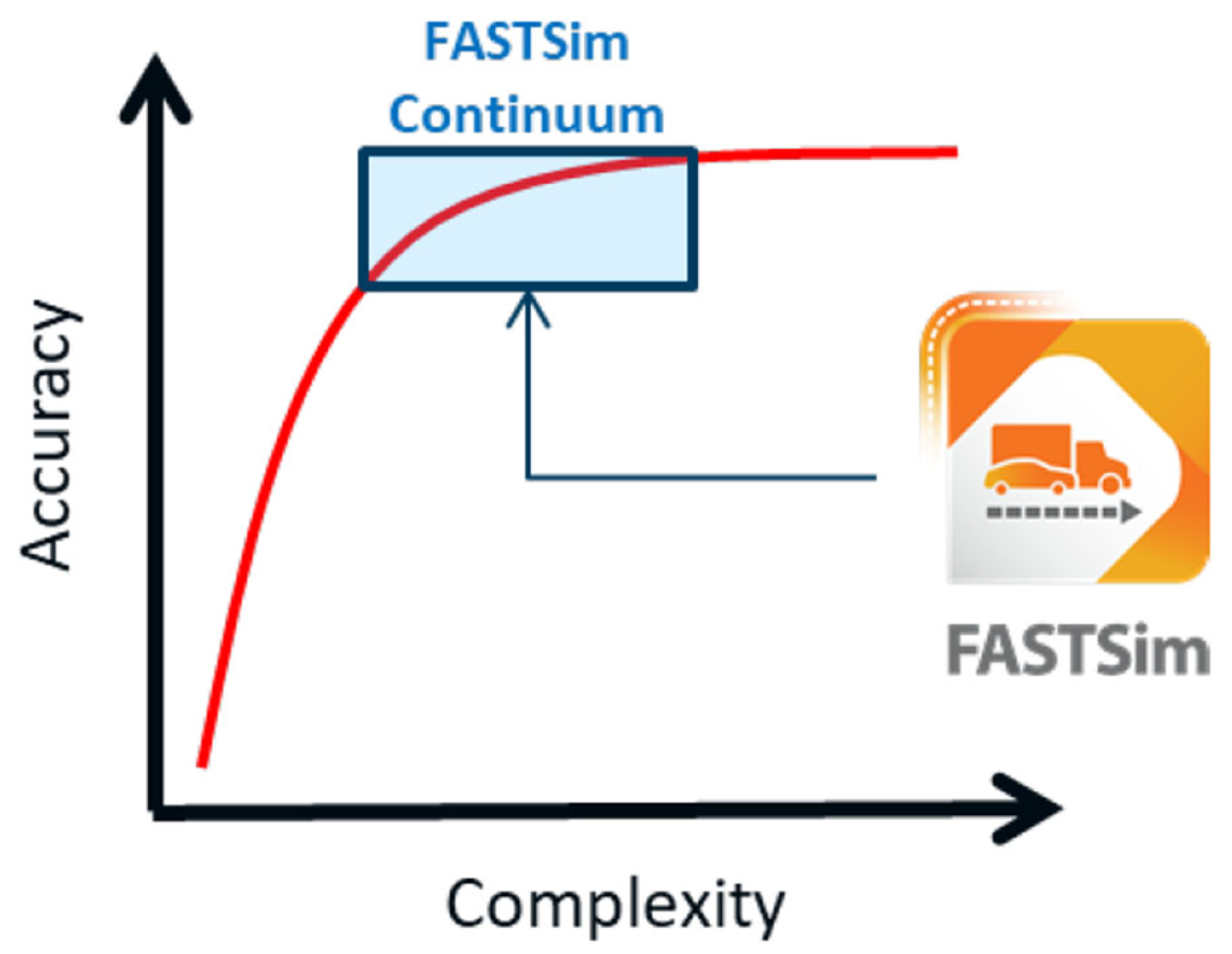
Figure 1. FASTSIM’s conceptual positioning among its competitors, in terms of complexity and accuracy. Reproduced from Brooker et al. [18] under the public domain.
Wevj 16 00671 g001
Figure 2. A graph showing FASTSIM’s fuel economy predictions (x) versus EPA window sticker advertised fuel economy (O) for a number of production vehicles. Reproduced from Brooker et al. [18] under the public domain.
Wevj 16 00671 g002
Figure 3. Wheel loader architectures. Adapted from Allam and Linjama [9].
Wevj 16 00671 g003
Figure 4. A Wille 665 wheel loader. Image by Pasi Varjotie. Licensed under CC-BY-SA 4.0 (https://creativecommons.org/licenses/by-sa/4.0/ accessed 5 December 2025). Source: Wikimedia Commons (Wille 665.jpg).
Wevj 16 00671 g004
Figure 5. Mechanical output power (kW) versus time (s) for the beginning of the combined load cycle for the wheel loader.
Wevj 16 00671 g005
Figure 6. ePOP Concept representation of powertrain “A”.
Wevj 16 00671 g006
Figure 7. ePOP Concept representation of powertrain “B”.
Wevj 16 00671 g007
Figure 8. ePOP Concept menu of components.
Wevj 16 00671 g008
Figure 9. ePOP Concept component parameters for Batteries. Customized entries may be created with edited values where superior information is available, as in the last entry.
Wevj 16 00671 g009
Figure 10. Fendt 820 Vario tractor. Image by joost j. bakker, licensed under CC-BY 2.0. Source: Wikimedia Commons (File: Fendt 820 Vario TMS.jpg).
Wevj 16 00671 g010
Figure 11. Power (kW) versus time (s) for Fendt 211, power harrowing.
Wevj 16 00671 g011
Figure 12. Power (kW) versus time (s) for Fendt 314, seed drilling.
Wevj 16 00671 g012
Figure 13. Power (kW) versus time (h) for Fendt 820, seedbed activity.
Wevj 16 00671 g013
Figure 14. Results for Powertrain A (round dot, lower) and B (solid line, upper). Showing initial capital cost, USD, versus electrification %, where 0% represents pure-ICE and 100% represents pure-electric.
Wevj 16 00671 g014
Figure 15. Results for Powertrain A (round dot, upper) and B (solid line, lower). Showing total cost of ownership (TCO), USD, over 10 years, comprising capital cost plus fuel cost, versus electrification %, where 0% represents pure-ICE and 100% represents pure-electric.
Wevj 16 00671 g015
Figure 16. Waterfall chart showing the TCO cost walk from the original hydraulic system (left) to the hybrid system (right). The graph shows the TCO delta for each step on the X axis.
Wevj 16 00671 g016
Figure 17. Graph of (ePOP fuel consumption prediction)/(actual fuel usage) versus average power used as a percentage of rated power, for each of several farming activities performed by the four Fendt tractors. A positive value indicates that ePOP is over-predicting the fuel consumption for the activity. RMS error = 17.0%.
Wevj 16 00671 g017
Figure 18. Graph of Figure 17 after applying a correction formula. The Y axis shows (ePOP fuel consumption prediction)/(actual fuel usage) as a percentage, and the X axis shows the average power used as a percentage of rated power. Each point represents one of several farming activities performed by the four Fendt tractors. The correction improved the errors by using the published BSFC data from Table 6, with a formula for adjusting BSFC according to percent load, instead of a single BSFC value to cover all off-highway diesel engines at all loads. RMS error = 3.9%.
Wevj 16 00671 g018
Figure 19. Graph of average BSFC, kg/kWh, versus percentage of rated power, for the farming activities in Figure 17, calculated from logged data. ePOP assumes constant BSFC (0.25) for all off-highway diesel engines, but the graph shows that actual BSFC varies significantly, with an increasing trend towards lighter load.
Wevj 16 00671 g019
Figure 20. Results of Figure 17 when each ePOP Concept run is adjusted to the published minimum BSFC of the engine. The y axis shows (ePOP fuel consumption prediction)/(actual fuel usage) as a percentage, and the x axis shows average power used as a percentage of rated power. Each point represents one of several farming activities performed by the four Fendt tractors. The correction improved the errors by using the published BSFC data from Table 6, instead of a single BSFC value to cover all off-highway diesel engines at all loads. RMS error = 6.7%.
Wevj 16 00671 g020
Table 1. Comparison of powertrain simulation methods for off-highway vehicle electrification analysis. Accuracy figures are as reported in the cited literature. Setup effort and expertise assessments are qualitative estimates based on tool documentation and the authors’ experience.
Method/ToolUser ExpertiseSoftware CostOutputsData Gathering/
Setup Effort
Reported
Accuracy
Custom analysisExpertMATLABCustomHigh (weeks–months)2–5%
ADVISORSkilledMATLAB + LicenseEfficiencyModerate (days–weeks)~5%
ALPHASkilledMATLAB + LicenseEfficiencyModerate (days–weeks)Within 5%
AMESIMExpertHigh (commercial)EfficiencyHigh (weeks)Not reported
AutonomieSkilledMATLAB + LicenseEfficiencyModerate (days–weeks)Within 2%
AVL Cruise MExpertVery HighEfficiencyHigh (weeks)Within 5.5%
GT-SuiteExpertVery HighEfficiencyHigh (weeks)Not reported
FASTSIMModerateFreeEfficiencyLow–Moderate (days)Within 10.5%
Potential Gap:LowLowEfficiency + Cost, Weight and PackageMinimalWithin 10%
Abbreviations: MATLAB = MathWorks MATLAB/Simulink platform required.
Table 2. Efficiency characteristics of hydraulic components.
Component TypeTypical Throughput
Efficiency Range (%)
Primary Cause of VariationMain Physical Sources of Loss
Bent-axis axial piston motor75–92%Mostly pressure-dependentLeakage; friction; torque losses
Swash-plate axial piston pump80–93%Mostly pressure-dependentLeakage; friction; viscous drag
External gear pump70–88%Mostly pressure-dependentGap leakage; viscous drag; gear/bearing losses
Balanced vane pump65–85%Speed- and pressure-dependent Leakage; viscous drag; cavitation
Hydraulic cylinder 75–95%Strongly speed-dependentSeal friction; mixed lubrication
Table 3. Efficiency characteristics of major powertrain components.
Component TypeTypical Losses (% of Power)Primary Cause of VariationMain Physical Sources of Loss
Inverter1–25%Current dependent; efficiency decreases at low current and near high-current limitsSwitching losses; conduction losses; gate drive losses
Electric Motor 4–20%Load dependent; mild speed dependencyCopper losses; iron losses; inverter-induced harmonics; mechanical friction
Battery Pack (Round Trip Efficiency)12–27%Current (power) dependent Internal resistance (I2R losses); charge-transfer losses; thermal effects
Internal Combustion Engine (ICE)61–79%Load dependent; mild speed dependency.Combustion losses; heat transfer; pumping loss; friction; accessory loads.
Cooling/Accessories2–15% (heavy truck)Power dependentCooling fan, steering, brakes
Mechanical Transmission4–16%Torque dependent; mild speed dependencyGear mesh losses; bearing friction; oil churning and windage
Hydraulic Components (Pumps, Motors, Cylinders)5–35%Load dependentLeakage; seal friction; viscous drag; cavitation at high speed
Table 4. Size and cost of major components in Powertrain A and Powertrain B.
“A” ComponentSizeCost (USD)“B” ComponentSizeCost $
Hydraulic System 20,188Electrical System 29,963
ICE91.7 kW8201ICE41 kW4949
Cooler 12.1 kW82Cooler 11 kW 50
Fuel Tank 368Fuel Tank 293
Total Initial Cost USD 28,839 35,255
Fuel Cost (10 yr) USD 154,914 123,436
Total TCO (10 yr) USD 183,753 158,681
Table 5. ePOP Concept predicted fuel usage for the wheel loader in the Y cycle. Assumes diesel fuel density 0.835 kg/L.
Cycle Average Power (Measured), kWFuel Usage
(Measured), L
Fuel Usage
(Predicted), L
BSFC (Measured), g/kWhBSFC (Predicted), g/kWh
15.74 kW61.259.6406395.2
Table 6. Published BSFC data for the diesel engines used in the subject Fendt tractors and wheel loader.
Engine ModelVehicle ModelMinimum BSFC kg/kWh
Engine Only/PTO
AGCO 3.3 L I3 Stage V Fendt 2110.212/0.293
AGCO 4.4 L I4 Stage VFendt 3140.226/0.277–0.303
Deutz 6.1 L I6 Stage IIIAFendt 8200.195/0.240
Deutz 6.1 L I6 Stage VFendt 7220.198/0.244
Disclaimer/Publisher’s Note: The statements, opinions and data contained in all publications are solely those of the individual author(s) and contributor(s) and not of MDPI and/or the editor(s). MDPI and/or the editor(s) disclaim responsibility for any injury to people or property resulting from any ideas, methods, instructions or products referred to in the content.