Article

Liability for Autonomous Vehicle Torts: Who Should Be Held Responsible?

1
School of Economics, Shenzhen Polytechnic University, Shenzhen 518055, China
2
The Faculty of Law and Justice, The University of New South Wales, Sydney, NSW 2052, Australia
3
School of Law, Wuhan University, Wuhan 430072, China
*
Author to whom correspondence should be addressed.
World Electr. Veh. J. 2025, 16(12), 665; https://doi.org/10.3390/wevj16120665
Submission received: 31 October 2025 / Revised: 1 December 2025 / Accepted: 4 December 2025 / Published: 9 December 2025

Abstract

The swift advancement of autonomous driving technology in China renders the traditional driver-centred liability framework inadequate for the regulatory demands of advanced automation. Traffic accidents involving advanced autonomous cars frequently provide difficulties in identifying responsible parties and assigning liability. This study employs a comparative analytical approach to evaluate the liability regimes utilised across different jurisdictions, such as the driver liability, the system liability, the manufacturer and operator liability, and the composite liability regimes. It proposes that liability standards ought to differ according to levels of automation, mirroring the benefits and constraints of each regime within China’s legal and industrial framework. Liability should be assigned to the driver at Levels 0–2, divided between the driver and manufacturer or operator at Level 3, contingent upon road and system circumstances, and predominantly attributed to manufacturers, operators, and system providers at Levels 4–5. This study outlines a framework for enhancing China’s autonomous vehicle liability system and aligning legal accountability with technological advancements, while offering recommendations for other jurisdictions in regulating developing technology.

1. Introduction

In recent years, the rapid advancement of autonomous driving technology has markedly diminished the driver’s actual control over automobiles. The conventional driver-centred responsibility paradigm has grown more inconsistent with the reality of contemporary intelligent driving [1,2].
Academic studies regarding responsibility for traffic incidents using Intelligent and Connected Vehicles (ICVs) have mostly concentrated on those functioning at Level 3 and above, indicative of advanced automation. The majority of experts agree that at lower automation levels, namely Level 2 and below, the driver retains primary liability, and the conventional driver-centred attribution paradigm remains applicable [3,4,5]. Nonetheless, when automation attains Level 3 or above, the distinction between vehicle ownership and operational control complicates and intensifies the identification of the accountable party. The primary concern is the allocation of responsibility when an autonomous driving system erroneously assesses road or vehicle conditions, resulting in a civil infringement. Researchers disagree on the allocation of responsibility, with opinions varying among the driver, the manufacturer, the operator, the software developer, or the system itself.
The majority of experts contend that strict culpability ought to remain with the driver to preserve stability in traffic safety and behavioural standards [6]. Some argue that the culpability framework should differ based on the level of technical supremacy, placing main accountability on manufacturers while constraining the driver’s obligation of care [7,8,9]. Furthermore, research indicates that responsibility should be contingent upon the driver’s intervention in the automated system. If the driver intervenes, the driver’s obligation is applicable. Otherwise, responsibility should transfer to the manufacturer or the system operator [10,11]. To enhance responsibility allocation after driver intervention, several academics suggest evaluating the degree and extent of the driver’s control to ascertain the amount of due care and proving causality between actions and injury as the foundation for attribution. Simultaneously, they contend that manufacturers need to get a reasonable range of exemptions under legislative requirements to guarantee proportionality and equity in risk allocation [12,13].
In addition, several studies support the implementation of strict responsibility for manufacturers [14,15,16,17,18,19]. Some researchers advocate for the acknowledgement of autonomous systems as legal entities, therefore transitioning to a system-centred tort paradigm where human drivers have a merely ancillary role [20,21,22,23]. Some advocate for a mixture of responsibility frameworks that integrates fault-based and fair allocation principles, seeking to harmonise compensating and preventative roles [17]. While researchers have analysed the liability for traffic incidents involving autonomous cars from multiple viewpoints, the majority of studies are confined to a fixed distribution of accountability. Systematic study on dynamic liability mechanisms across varying levels of automation remains insufficient.
However, the existing studies have failed to provide a comprehensive analysis of the liability frameworks for traffic incidents attributable to autonomous driving. They have not analysed the particular circumstances in which each regime is applicable, nor the methods by which these regimes should be integrated with one another. This paper seeks to fill this gap by categorising and comparing existing liability in the context of autonomous driving. It analyses countries with comparatively mature autonomous driving technology and legal structures, as well as countries now experiencing technical and legislative transformations. Drawing on this comparative sample, the paper identifies four main types of liability that arise in autonomous driving traffic accidents: driver liability, system liability, manufacturer or operator liability, and composite liability regimes. This study assesses the legal relevance of four liability regimes and, considering China’s technology advancements and societal context, offers institutional suggestions to enhance China’s autonomous driving liability system. It also aims to provide an approach that harmonises safety and innovation while facilitating the modernisation of tort law in the context of autonomous vehicles

2. Autonomous Vehicle Liability in China: Legal Framework and Challenges

China’s autonomous driving technology has advanced swiftly, while the existing human-centred legal framework is inadequate for regulating algorithm-driven driving. As control transitions from drivers to systems, there is an urgent necessity for explicit regulations on the culpability of manufacturers, operators, and developers. Local legislation has provided significant experiments, but liability standards remain inconsistent. Reconciling innovation with risk control has emerged as a significant concern for China’s developing legal framework regarding autonomous vehicles.

2.1. The Legal Framework for Autonomous Driving Liability

The Road Traffic Safety Law clarifies various types of traffic participants, encompassing drivers, pedestrians, passengers, entities, and individuals. It employs a hierarchical attribution framework predicated on behavioural control and culpability, distributing liability based on the nature of the parties involved and their level of negligence. In motor vehicle accidents, compensation is allocated according to the degree of fault of each party. In accidents involving motor vehicles and non-motorised vehicle operators or pedestrians, a fault-based liability framework, augmented by no-fault compensation, is implemented. In such cases, the motor vehicle party holds primary or complete liability while at fault and may even incur partial compensatory obligation even in the absence of fault, contingent upon the circumstances [24].
Moreover, the Tort Liability section of the Civil Code, along with a series of judicial interpretations from the Supreme People’s Court, further elucidates the applicability of tort law in traffic accidents. They discuss matters such as the distribution of the burden of proof, the presumption of liability, the criteria for attributing product liability, and specific regulations regarding motor vehicle damage. These standards collectively form a conventional traffic accident liability framework focused on subjective culpability, behavioural control, and outcome-based accountability [25].
In the absence of national legislation particularly addressing autonomous driving, municipal legislation has assumed a pioneering role. In 2022, Shenzhen implemented the Regulations on the Administration of Intelligent Connected Cars within the Shenzhen Special Economic Zone, stipulating that for cars with automation levels below Level 2, the driver retains primary liability. In Level 4 or above full automation, where human drivers are absent, the vehicle owner or manager assumes duty for damages, while manufacturers or companies have a system for product-liability recourse [26]. From 2023 to 2025, multiple cities, including Shanghai, Wuxi, Suzhou, and Hangzhou, enacted local regulations that enhance the standards pertaining to vehicle operation, accident liability, and insurance frameworks for autonomous driving (Table 1).
Chinese regulations delineate the parameters of liability concerns for autonomous driving in two major approaches. The initial strategy offers a clear identification of accountable entities. Shenzhen categorises participants as owners, managers, manufacturers, and sellers. Shanghai broadens this list to encompass system developers, vehicle manufacturers, and equipment providers, alongside owners and managers. Suzhou designates passengers as potentially accountable persons in accordance with Jiangsu Province’s legislation, although Wuhan and Hangzhou incorporate onboard safety officials. The second method employs a broad definition of liability subjects. Beijing and Yangquan, upon differentiating among several categories of responsible entities, defer the precise determination to superior laws and regulations. Guangzhou presents the expansive notion of a “responsible third party” to encompass prospective technology service providers or data participants.
In terms of liability allocation, three primary patterns of liability allocation have arisen. Shenzhen, Shanghai, Guangzhou, and Wuhan differentiate between human-operated and autonomous scenarios, instituting distinct liability and remedy frameworks for drivers and automated vehicles. Hefei and Hangzhou delineate culpability broadly, attributing responsibility to drivers or safety officers in the presence of a human driver and to vehicle owners or managers in their absence. Wuxi, Suzhou, Jiangsu, Yangquan, and Beijing do not differentiate in this regard, instead empowering traffic management agencies to address cases in accordance with existing laws and regulations. To sum up, these municipal regulations serve as transitional mechanisms that address legislative deficiencies and promote the normative localisation of China’s autonomous driving liability framework.

2.2. The Dilemma of Liability Attribution in Autonomous Driving

2.2.1. Difficulties in Liability Attribution

China’s existing legal framework for traffic liability continues to assume human oversight of cars and does not consider the legal ramifications of system takeover and control transfer. The Draft Revision of the Road Traffic Safety Law established provisions for system intervention and data collection but failed to develop systematic regulations for culpability distribution, causation, or the burden of proof in autonomous driving contexts [27]. As a result, the existing human-centred liability framework cannot adequately cover risks arising from algorithmic decision-making or system malfunction [28].
At the subnational level, regulations vary considerably in identifying accountable parties, resulting in structural ambiguity characterised by “diverse actors but indistinct boundaries”. Some regional legislative instruments employ an enumerative strategy that improves operability and predictability [29] while neglecting to incorporate essential stakeholders like software developers and data service providers. Moreover, regional regulations frequently exhibit inconsistency in distributing liability among various parties. Many individuals struggle to differentiate between driver negligence and product culpability attributed to manufacturers, especially in human–machine shared-control contexts. This overlap often leads to simultaneous liabilities and application conflicts [29]. In numerous jurisdictions, car owners or managers are identified as the principal accountable parties, whilst makers and sellers have supplementary liability [29]. These arrangements contravene the tort law premise that accountability should align with control and risk.
Overall, China’s national legislation is outdated compared to technology advancements, and subnational regulations are disjointed and inconsistent. This misalignment undermines the efficacy of tort law in governing emerging technology and reveals shortcomings in risk distribution and normative alignment. A comparative review of the liability frameworks of leading jurisdictions is crucial for developing a cohesive and valid regime for China’s autonomous driving system.

2.2.2. Insurance System Deficits in Autonomous Driving

From an insurance perspective, the existing system is inadequate in delivering appropriate coverage for autonomous vehicles. The existing car insurance programmes are based on driver liability regimes and are intended for human driving situations [30,31]. Autonomous systems are changing how accidents occur by shifting risks towards software failures, sensor errors and system defects. The traditional insurance framework is not equipped to address these new forms of risk [32].
The ambiguity in liability distribution further constrains the function of insurance. China has not yet formulated standardised regulations for ascertaining culpability in various tiers of autonomous driving [5,33]. As a result, responsibility remains unclear between the human driver and the automated system, making it difficult for insurers to design coherent liability structures or define policy boundaries. Furthermore, insurers do not have access to the operational and system-level data maintained by car manufacturers. In the absence of such data, they are unable to do precise risk assessments or establish equitable premiums. Autonomous systems are changing how accidents occur by shifting risks towards software failures, sensor errors and system defects. The traditional insurance framework is not equipped to address these new forms of risk [34,35].
These institutional obstacles indicate that the current insurance regime is still incomplete. It lacks clear mechanisms for identifying liability and does not yet have adequate tools for assessing the risks associated with autonomous driving. As a result, the system cannot provide stable or predictable coverage for accidents involving autonomous-driving technologies.

3. Analysis of Liability Regimes for Autonomous Driving

There is strong institutional activity in autonomous-driving testing and early commercialisation in the Asia–Pacific, Western Europe and the Americas. This paper selects representative countries from these regions for comparative study [36]. The sample includes China, the United States, and Canada, which are preeminent in autonomous driving technology and industrial implementation [37,38,39,40]. It further encompasses Germany, Japan, France, South Korea, Spain and Australia, which are transitioning from conventional automobile industries to autonomous driving technologies [41,42,43,44]. The United Kingdom is featured due to its provision of an early legal framework [39]. Singapore has also been chosen due to its execution of public road autonomous driving demonstrations in densely populated settings [45,46,47].

3.1. Driver Liability Regime

The driver liability regime primarily applies to situations below Level 2 automation, wherein human drivers maintain effective control of the vehicle. In this approach, the driver is the primary entity responsible for liability in traffic incidents. The approach is founded on the notion of fault-based liability, highlighting the driver’s obligation of care and control over the vehicle’s operation. A driver who violates traffic safety regulations or behaves with negligence assumes main liability for the damages [3].
This regime is commonly applied in jurisdictions that have not yet enacted specific laws governing autonomous driving. It is also retained in countries that continue to rely on traditional fault-based liability frameworks for vehicles at or below Level 2 automation. In such countries, the regulation of autonomous cars is conducted using established civil and criminal legal frameworks. Spain’s Road Traffic and Motor Vehicle Civil Liability and Insurance Act, together with the General Traffic Regulations, mandates that drivers keep constant control of their cars (Art. 17(1)). Advanced driver-assistance systems (ADAS) are regarded as supplementary technologies that do not change the driver’s liability [48].
In countries that have implemented specific legislation, this strategy remains applicable at reduced degrees of automation. The United Kingdom requires that drivers in Level 2 or below situations keep continuous attention and bear responsibility for accidents resulting from negligence or noncompliance with operational standards [49,50,51]. Furthermore, Japan and South Korea mandate that drivers maintain control and execute timely remedial measures as needed. Neglecting to execute these monitoring and intervention responsibilities renders the driver chiefly accountable for subsequent damages.
Overall, the driver liability regime serves as a transitional mechanism connecting conventional traffic law with new regulatory frameworks. It continues to function as a fundamental framework in regions where human supervision is essential for operational management.

3.2. Manufacturer and Operator Liability Regime

The manufacturer and operator liability regime mainly applies to Level 3 and above, where control of the vehicle is delegated from the human driver to the automated system. This regime establishes liability based on technical control and product safety, placing primary responsibility for accidents on manufacturers, operators, and system providers, who undertake associated control and safety requirements. Its normative foundation lies in the extension of product and service liability. The law allocates harm to entities with preventive and control capacities through objective and institutionalised mechanisms of risk distribution. This regime is a reassessment of legal responsibility in light of technological governance, seeking to ensure an equitable distribution of risk in a progressively automated and data-centred mobility context.
From a legislative perspective, some counties have enacted specific laws or amendments to assign liability for autonomous vehicle accidents to manufacturers or operators. In Germany, the Road Traffic Act dictates that autonomous vehicles must be fitted with a “black box” to capture operating data for the purpose of determining accident liability (§ 63a). In the event of an accident occurring under manual control, the driver retains liability. However, it the accident transpires during system operation or due to system failure, liability transfers to the vehicle manufacturer [17,52]. Additionally, the Highway Code of France has a comparable methodology. When a vehicle functions in an approved automated-driving mode and under specified conditions, the driver is absolved of liability, with responsibility resting on the manufacturer or system operator (Art. L.123-2) [53]. The state of Tennessee has implemented a comparable regulation. An automated driving system that is completely engaged and operates in accordance with the manufacturer’s specifications is legally considered the driver or operator of the vehicle (§ 55-30-106(b) [54]. In 2024, the European Union issued the Product Liability Directive, which establishes strict liability for manufacturers when a product defect causes harm (Art. 4) [55].
Moreover, some countries have instituted legal frameworks that allocate main accountability to licenced operators within designated autonomous-operation systems. In Korea, the Autonomous Vehicles Act stipulates that within designated Level-4 autonomous zones, the operator or owner is liable for any harm incurred. They must also uphold ongoing safety management, vehicle maintenance, and risk mitigation strategies [56]. Building on a similar rationale, Japan’s government revised the Road Traffic Act and established a framework for specified autonomous operation. It mandates service providers or operators to remotely monitor vehicles and assume legal responsibility for safety and accidents (Arts. 2-17-2, 75-12) [57]. Singapore’s Road Traffic Act similarly identifies the operator as the primary body accountable for safety management and compensation when autonomous cars function on public roads (Rules 2017, rr. 7, 9, 14) [58].
This regime’s strength resides in aligning liability with control capabilities. With the progression of automation, algorithms, software, and system integration rather than human judgement emerge as critical determinants of safety. Transferring obligation to entities proficient in algorithm design, system maintenance, and safety oversight guarantees that legal accountability aligns with technological authority. Manufacturers and operators have enhanced financial resources, facilitating equitable loss distribution and formalised risk sharing [59].
Overall, this operator and manufacturer liability regime signifies a legal adjustment to the rising technological autonomy. This signifies a transition from human-centred to system-centred accountability, connecting liability with control competency and redefining the conceptual underpinnings of tort law in the era of autonomous driving.

3.3. System Liability Regime

The system liability regime is predominantly applicable to Level 3 and higher autonomous driving. The essence is creating an authorised organisation responsible for compliance, safety, and oversight of the automated system’s functioning. The technological compliance and regulatory responsibilities that were formerly distributed among several companies are now centralised within this body, which assumes legal accountability for vehicle safety and driver conduct. Simultaneously, human drivers are exempt from personal liability for traffic violations occurring while the system is in operation. The associated compliance responsibilities and penalties are delegated to the designated entity. In civil cases, insurers must initially indemnify victims and subsequently pursue recovery from the liable party in accordance with relevant legislation.
The United Kingdom illustrates this regime prominently. The Automated and Electric Vehicles Act 2018 established a no-fault insurance framework focused on the insurer and empowered the Department for Transport to release a list of automated vehicles. Vehicles listed above are acknowledged as capable of legal autonomous operation under designated conditions. In the event of an accident during automated vehicle operation, the insurance company is obligated to reimburse the victims irrespective of culpability. Subsequently, the insurance company may pursue compensation from the manufacturer or system provider [60]. The Automated Vehicles Act 2024 broadened the boundaries of system accountability to reinforce this framework. The Authorised Self-Driving Entity (ASDE) regime was formed, assigning certified business companies direct legal responsibility for the safety and compliance of their operated autonomous systems [51]. The Act established the No Unreasonable Risk of Unsafe Conduct (NUiC) criterion to evaluate the safety of automated actions and to function as a prerequisite for authorisation and operational licence (Part 1) [51]. Australia has implemented a comparable strategy. The proposed Automated Vehicle Safety Law (AVSL) designates the Authorised Driving Entity (ADSE) as accountable for adhering to administrative and traffic regulations, while ensuring the safe functioning of the automated driving system to the fullest extent feasible [61].
To sum up, the system liability regime aligns legal responsibility with technological control. It facilitates victim compensation by appointing a sole payer, so diminishing the necessity to establish the culpability of many parties and decreasing litigation expenses. The system liability regime prioritises legal certainty, procedural efficiency, and risk allocation. This signifies a transition from individual to systemic liability, indicating a legal shift from human-centred to technology-centred accountability in the era of autonomous driving.

3.4. Composite Liability Regime

The composite liability regime primarily concerns the transitional phase between Level 2 and higher levels of automated driving, when system control and human interaction coexist. Where no specific autonomous vehicle laws exist, liability is governed by traditional legal and judicial mechanisms. During this transitional phase, control is collaboratively managed by human and automated systems. Drivers, manufacturers, system developers, and operators each possess a distinct level of influence regarding vehicle safety. This regime facilitates the distribution of responsibility among many parties, offering a flexible approach to manage intricate cause linkages in traffic incidents.
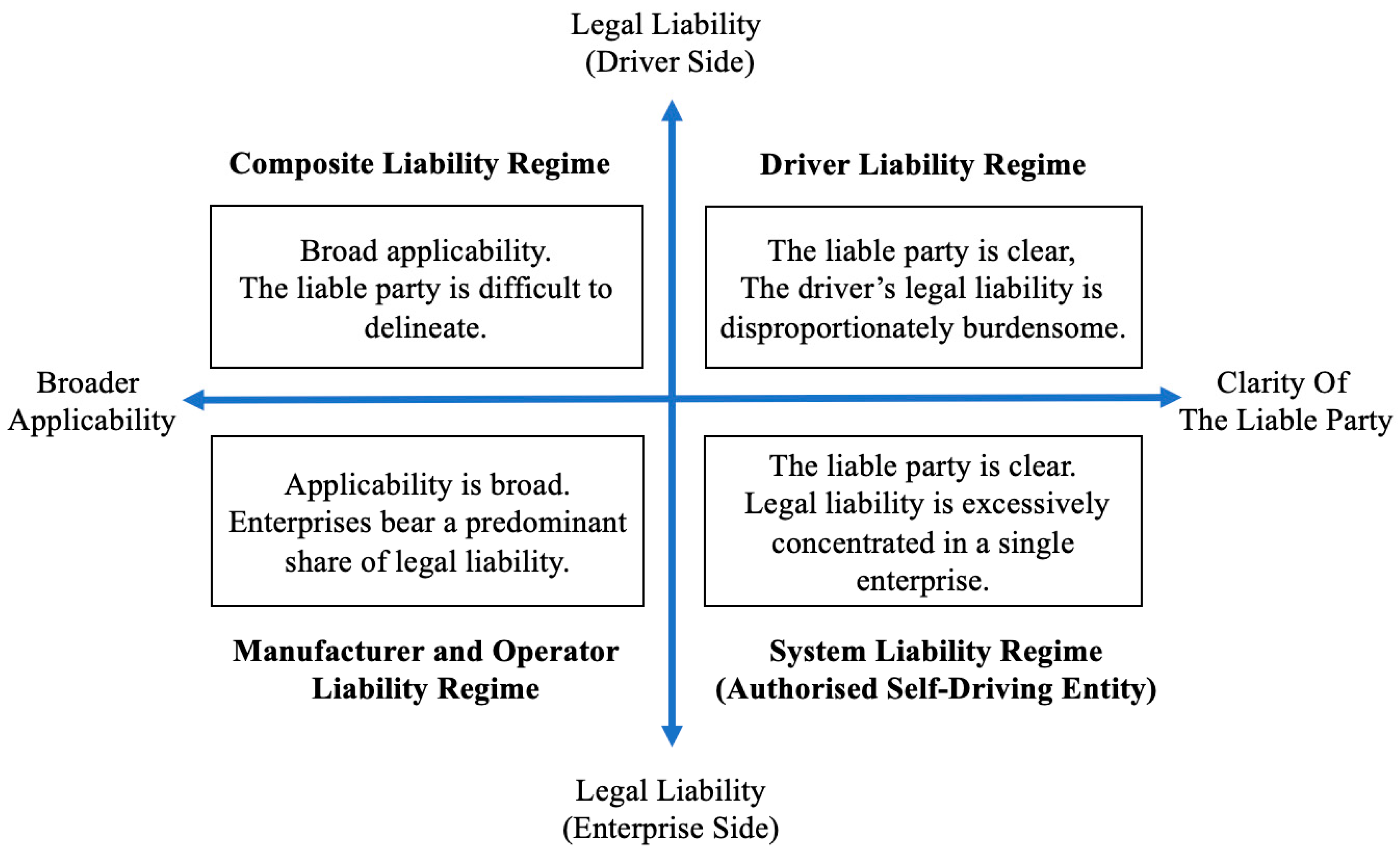
Within the composite liability regime, countries have implemented two primary strategies for delineating liability in incidents involving autonomous vehicles. The initial regime is a legislative multidisciplinary arrangement, wherein legislation requires both compensation and recovery. In the U.S. and Australian states, victims obtain fundamental compensation for physical harm or property damage via mandatory vehicle insurance or strict responsibility. In cases of established negligence or product faults, conventional tort and product liability govern the assessment of additional responsibility [62,63,64]. The second method creates a fault-allocation framework wherein courts dynamically distribute responsibility in specific circumstances. Ontario’s Negligence Act offers multiple options for the evaluation of proportional fault (ss. 1–2) [65]. In adjudicating autonomous vehicle accident cases, courts evaluate the degree of fault of each party based on facts and cause. They may impose joint and several liability as necessary to guarantee that victims obtain complete and prompt compensation (Figure 1 and Table 2).

4. Exploring Liability Regimes for Autonomous Driving in China

4.1. The Development of China’s Autonomous Driving Industry

In recent years, China’s autonomous driving industry has experienced remarkable growth [66]. By the end of 2025, China had created 17 national testing zones for driverless vehicles. In excess of 32,000 kilometres of test roads were inaugurated, and more than 7700 testing or demonstration licences were granted. The total test mileage surpassed 120 million kilometres, indicating the extent and sophistication of China’s autonomous driving experiments [67]. The government has integrated the “Integrated Vehicle Road Cloud Collaborative System” strategy, selecting 20 pilot cities for execution [68]. Over thirty provinces and municipalities have implemented policies to advance autonomous driving, signifying the preliminary establishment of a regional legislative and regulatory framework [69]. The New Energy Vehicle Industry Development Plan (2021–2035) aims for the extensive commercial deployment of autonomous vehicles by 2035. This target embodies the Chinese government’s strategic dedication to promoting the industrialisation of intelligent mobility.
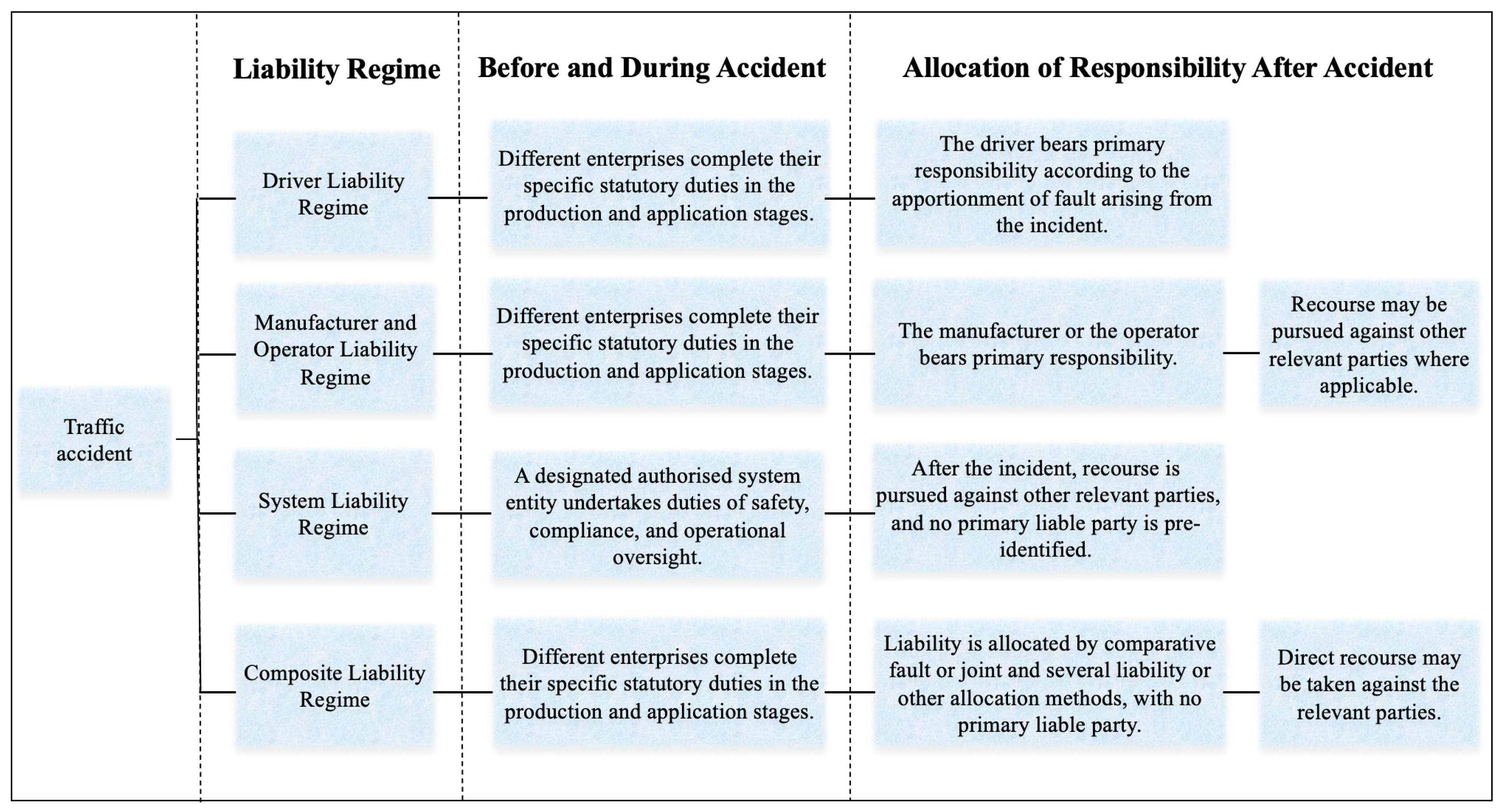
However, China’s legal responsibility framework for autonomous driving is still inadequately developed. Existing legislation is predicated on the premise of “human control”, wherein liability is contingent upon driver conduct and fault assignment. This institutional inefficiency is also evident in the buildup of technological dangers. By the conclusion of 2024, China had enacted 89 recalls for intelligent and connected cars, including 4.491 million units, along with 19 over-the-air (OTA) software-based recalls affecting 4.068 million vehicles. The prevalence of these recalls and OTA updates indicates that software faults, system malfunctions, and cybersecurity vulnerabilities have emerged as significant safety issues for autonomous cars. These challenges further underscore the inadequacies of the existing legal framework in risk management and responsibility allocation [70,71]. This legal gap gets exacerbated by China’s complicated transportation conditions. Autonomous driving faces significant challenges in liability determination within China’s complex traffic environment. In dense urban areas with mixed traffic and uneven infrastructure, system limitations often blur the boundary between human and algorithmic control, making the allocation of legal responsibility highly uncertain. In light of these challenges, neither a driver-centred nor a system-centred responsibility regime can satisfy China’s legal requirements. A composite regime is necessary to facilitate the dynamic distribution and coordination of obligations among various subjects to reconcile legal certainty with technological advancement (Figure 2).

4.2. Proposed Liability Regime for Automated Driving in China

China’s automated-driving industry is developing rapidly while the legal framework is still evolving. No single liability regime can accommodate the diversity of technical scenarios or the complexity of real-world traffic conditions. China shows geographical, infrastructural and industrial heterogeneity. A multi-level, interoperable and evolvable liability regime is therefore required, drawing on international experience. This regime should integrate vertical stratification by automation level and horizontal differentiation by regulatory domain. The aim is to achieve a dynamic balance between liability attribution and risk control.

4.2.1. Liability Regime Across Levels of Driving Automation

The vertical design should rest on two pivots. The first is the degree of technical autonomy. The second is the shifting locus of control over human driving. As the level of vehicle automation rises, the active subject of “driving” shifts from human to system, and the centre of risk control moves accordingly.
1.
L0–L2: Driver Liability Regime
At the L0–L2 stage, system functionality is largely confined to route guidance, headway control and certain assisted-driving operations. These functions are “assistive rather than substitutive.” Although features such as cruise control and automated parking enable limited automation, the core operation still depends on human driving with continuous control of steering, acceleration and braking. The driver must at all times monitor the driving environment and remain ready to take over vehicle control. Behavioural command of the vehicle remains with human driving. Manufacturers, system developers and operators do not exercise instantaneous operational control [72]. At this stage, China can continue to apply the existing road traffic rules, the Law of the People’s Republic of China on Road Traffic Safety, on driving conduct (Articles 22, 70 and 76) and the relevant provisions on tort liability in the Civil Code (Articles 1165, 1202–1207, 1208–1217) [24,25]. At the same time, it should make early preparations for the transition to more advanced levels of automated driving technology.
In complex conditions or emergencies, such as evasive manoeuvres, close following, negotiating intersections or recovering from lane departures, systems may detect risks and provide prompts, but decisions and execution depend on human reactions and judgement. Attention, reaction time and anticipation remain decisive. Failures in vigilance or delayed responses can directly cause accidents.
Accordingly, the traditional driver-liability regime should be retained at this stage. It reflects the actual allocation of human driving and control. It also avoids over-reliance on assistance systems and preserves the predictability of road safety. Existing legal frameworks such as the Civil Code and the Road Traffic Safety Law remain applicable, providing operability and stability while allowing institutional continuity and judicial applicability amid rapid technological evolution.
2.
L3: Driver, Manufacturer or Operator Liability Regime
At L3, the system can exercise autonomous control under specified conditions. The human may disengage from direct operation for limited periods but must remain in a monitoring posture and promptly retake control when requested. Human and machine co-governance produces a dynamic and partially overlapping allocation of control. Safety no longer depends solely on human driving. It also depends on algorithmic stability, perception capability and software integrity. These elements are designed, produced and maintained by manufacturers and system developers. A purely driver-centred regime no longer fits this structure of control and risk.
China should account for the complexity of domestic road-traffic structure and driving behaviour patterns. It can then draw on the German Autonomous Driving Act (Sections 1d–1l), the French Ordonnance 2021-443, the Decret 2021-873 and the Tennessee Automated Vehicles Act on autonomous driving (Chapter 30). And it allocates responsibility among manufacturers and operators by their degree of technical control [73,74,75,76]. In particular, in expressways and approved pilot corridors where infrastructure is robust and performance is stable, the regulatory framework should assign primary liability to manufacturers and system developers. The human bears supplementary liability. Where a driver has complied with all legally prescribed operating protocols and an accident is attributable to abnormal system performance or a functional defect, primary liability lies with the manufacturer or system developer; by contrast, a driver’s non-compliance with operating protocols or failure to respond to a takeover request grounds corresponding supplementary liability. In areas with highly variable conditions, including complex urban roads and rural roads, a co-liability mechanism for operators should apply. As the entities responsible for remote supervision and system maintenance, operators bear joint-and-several or proportionate liability where inadequate maintenance, delayed instructions or untimely software updates contribute to harm. On roads that do not meet the conditions for automated driving, activation of Level 3 systems should be confined to low-speed assistance. The human should be the sole liable party in order to prevent high-risk misuse.
In sum, L3 liability determination should account for heterogeneity across road types and environments and construct a multi-layered, shared liability system centred on manufacturers and operators with drivers in a complementary role.
3.
L4–L5: Manufacturer, Operator or System Liability Regime
At Level 4 and above, automated driving systems achieve high intelligence and full autonomous operation. Within a defined operational design domain and specified conditions, the vehicle completes the entire driving task without human intervention. In such circumstances, vehicle occupants are passive passengers. They bear no supervisory or control obligations. They also lack the practical capacity to discharge a duty of care [23]. Responsibility shifts from human driving to legal persons with technical control and managerial capacity. These are the manufacturer, the operator and the system developer. This allocation may combine the manufacturer and operator regime with the system liability regime. The extended application of product liability and service liability provides the doctrinal pivot. And it would combine insights from the German, Korean, and Tennessee legislation mentioned above, and the UK Automated Vehicles Act 2024 on authorised self-driving entities (Sections 2–6) [51]. It establishes a clear pathway to identify the responsible party before the crash, during operation and after the crash.
Before the crash and during operation, regulators should leverage the strengths of the system liability regime. Assign the safety and compliance obligations of automated vehicles to a specifically designated authorised entity. The obligations cover manufacture, installation and on-road operation. This approach additionally establishes a new principal duty-bearer for compliance and safety. The manufacturer is the most critical link in production. It supervises upstream safety and performs conformity assessments. It also provides safety commitments and quality assurance at the sales stage. In practice the manufacturer holds a structurally stronger position. In other words, when the manufacturer bears compliance and safety obligations, it can exercise supervisory functions before and during operation in a manner commensurate with its central role and capabilities. Designating the manufacturer as the authorised entity thus creates an added layer of protection for the safe operation of automated-driving technologies and vehicles, beyond the allocation of liability after the crash.
After the crash, adopt the manufacturer and operator regime. Identify the primary liable party by the cause of the crash and by the scenario. If the harm arises from product design or manufacturing defects, such as failures of perception hardware, actuator defects, or imbalances in functional safety, the manufacturer should bear primary compensatory liability. If the harm stems from algorithmic logic, data distortion, regime drift or missed software updates, the system developer should assume the corresponding liability. And if an accident results from deficient operational management, untimely remote monitoring, or out-of-scope operation, the operator should bear primary or proportionate liability to third parties. Vehicle owners bear supplementary liability if they make unauthorised modifications. They also bear such liability if they violate mandatory technical standards or neglect long-term maintenance in a way that creates safety risks. Establish a mechanism of external joint liability with internal recourse. External joint liability ensures prompt relief for victims. Internal recourse then distributes the ultimate burden in a manner consistent with fairness and justice.
In sum, this stage positions the designated authorised entity as the compliance and safety supervisor before the crash and during operation, and identifies the manufacturer, operator, and system developer as the core bearers of liability after the crash. Supported by strict liability and a first-resort compensation mechanism, this design aligns legal responsibility with technical control. It not only secures adequate and timely redress for victims but also promotes the internalisation of risk and the disciplining effect of compliance, thereby enabling the automated-driving industry to strike an appropriate balance between safety and innovation and providing a systematic rule-of-law response to risk in the age of intelligent technologies [77,78] (Table 3).

4.2.2. Complementary Rules for Liability Attribution

After clarifying the allocation regimes at each automation level, China should establish institutional safeguards. The objective is to ensure a stable and consistent approach to liability attribution. China’s legal framework for automated driving should develop a coherent structure connecting national laws, industry standards, and local regulations [79,80].
At the national level, the allocation of liability for automated-driving traffic incidents should be governed by amendments to existing statutes or by a dedicated Automated Driving Act. China can revise the Road Traffic Safety Law or adopt a stand-alone statute [79,80]. The legal framework should clearly define the essential concepts, technical requirements, and operational limits of automated driving. Specifically, definitions of the automated driving mode, the minimum risk manoeuvre, and the operational design domain establish the normative basis for regulating different levels of automation. Moreover, the database of accidents ought to be developed to improve accountability and transparency. The exact alignment between judicial and administrative regulations is essential to guarantee legal coherence across all operational phases.
At the local level, a city-scale management regime oriented towards collaborative governance should be established. Relying on intelligent transport and data governance platforms, local authorities should build unified systems for accident reporting, evidence preservation and responsibility coordination. They should implement dynamic controls and targeted restrictions for high-risk periods and road segments. These measures reduce institutional risks from any misalignment between liability regimes and road environments. Maintenance of roadside infrastructure, communications assurance, and the construction of digital foundations should be incorporated into legally mandated performance assessments to ensure that national and industry rules are implemented substantively across regions and road types. Through vertically integrated and horizontally coordinated institutional design, liability regimes for automated driving can operate systematically and be normalised within a multi-level governance structure.
At the industry level, China should institute a full-cycle system of technical standards and managerial norms. The objective is to enhance industry regulation and to guarantee the efficient execution of legal and operational responsibilities. China ought to develop a standards framework that regulates safety, human–machine interaction, data management, and operational practices across the complete lifetime of automated driving. Industry governance should incorporate third-party auditing and insurance participation. Accredited testing bodies, insurers and independent assessors should take part in annual compliance reviews and after-accident liability assessments. Furthermore, the government may also direct the insurance industry by promoting the creation of specialised products for Level 3 and higher autonomous driving. These items may need collaborative coverage from makers and operators, with insurers offering preemptive recompense to victims in the event of mishaps. This approach addresses the void resulting from the diminishing significance of driver-centred responsibility [63]. Insurers may then integrate both systemic and operational risks into a measurable and stratified insurance framework. Significant or excessive risks may be further mitigated by reinsurance agreements or specialised compensation funds [81,82,83].
In this way, the rights of victims under conditional and fully automated driving can be robustly protected while market incentives encourage manufacturers and operators to enhance technical safety and system robustness on a continuous basis.

4.3. Global Applicability and Potential Uptake of the Chinese Approach

China is a vast country with diverse territory. It must construct a comprehensive framework that can operate across different road and terrain conditions, driving habits and cultural settings. This places higher demands on the stability and applicability of its legal rules on autonomous driving. This article adopts a level-based and scenario-specific path as the core approach to constructing a Chinese legal framework in the context of autonomous driving. The design fits the current stage of technological development and also prepares for future higher levels of automation. It further has instructive value and potential applicability in other parts of the world.
From the perspective of different legal families, the Chinese liability framework shows strong adaptability across systems. In civil law jurisdictions, legislatures can use statutory instruments to regulate different levels of autonomous driving and multiple operational scenarios in a systematic way and to clarify liability boundaries in codified form. The Chinese approach in this article keeps the driver liability regime for levels from L0 to L2. Civil law jurisdictions that draw on this approach therefore do not need fundamental changes to their existing tort law frameworks. They only need supplementary rules for special situations involving high-level autonomous driving. In contrast, common law jurisdictions can rely on the case law tradition. By introducing composite liability regimes, they can move step by step from traditional fault-based liability to a more diversified structure of responsibility. For example, insurance legislation can build an initial structure for risk sharing, which is then refined through judicial interpretation and subsequent special legislation.
From the perspective of enforcement and adjudication, graded allocation of liability combined with layered operational scenarios gives police, traffic management bodies and accident investigation authorities a workable basis for evidence collection and case handling. Under different levels of autonomous driving systems, the obligations of each subject, the powers attached to vehicles and the collection and use of data can be standardised. This enables enforcement bodies to identify the focus of accident investigations and to reduce evidentiary barriers created by technical black boxes [84]. Clear boundaries of responsibility for traffic accidents caused by autonomous driving also support courts in forming a consistent logic of liability in their judgements. In states that still lack judicial experience with autonomous driving, such a predictable structure of decisions has important value for institutional guidance [8].
From the perspective of geography and traffic conditions, the proposal grows out of China’s complex road networks, traffic patterns and social environment. It is therefore designed with broad applicability and strong environmental compatibility. Other states can adjust the application scenarios in light of their own geographic features and transport infrastructure. For example, states with limited road conditions or island-based territories can restrict the range of open roads for autonomous driving at the L3 stage and then expand the scope of use as technology matures. Through this flexible adaptation mechanism, the Chinese approach can remain workable and institutionally robust under diverse natural environments and traffic structures (Table 4).

5. Conclusions

The global advancement of autonomous driving has expedited industrial transformation. As the largest vehicle market and an international centre for intelligent mobility, China confronts an immediate necessity to establish a proactive and adaptable legislative framework. The four liability regimes from overseas practices exhibit distinct legal frameworks and road conditions, complicating their immediate integration into China’s legal system. This study contends that China ought to establish a diversified and context-specific liability regime. At Levels 0–2, the traditional fault-based liability focused on the human operator should be preserved. At Level 3, culpability ought to be distributed among drivers, manufacturers, and operators, contingent upon road conditions and the intricacy of human to machine interaction. At Levels 4–5, manufacturers take the responsibility for guaranteeing the safety and compliance of autonomous systems. In the occurrence of an incident, accountability ought to encompass makers, operators, and system suppliers. An effective liability regime for autonomous driving must include ethical, economic, and insurance factors. The ethical use of developing technology must correspond with societal norms and safeguard individual rights. Liability regimes must be rational and should not impose constraints that obstruct technological progress or commercial implementation. From an insurance standpoint, the system must establish risk-sharing mechanisms that align with the characteristics of autonomous driving.
This study presents a paradigm demonstrating that a tiered and context-specific distribution of responsibility may enhance legal governance and risk management in autonomous driving. By aligning various responsibility models with the degree of automation and the operational context, the regime enables each liability type to execute its normative and remedial tasks more efficiently. Its structured design and flexible application also give the proposed regime relevance beyond China. It offers a practical reference for countries developing liability rules for autonomous driving and provides a methodological basis for jurisdictions seeking level-based and scenario-specific systems. In this sense, the framework advanced in this paper not only contributes to the refinement of China’s own legal regime but also presents a model with broader value for risk governance and legal development in emerging technologies.

Author Contributions

Conceptualization, Z.B.; methodology, Z.Z.; validation, Z.B. and Z.Z.; formal analysis, Z.B. and Z.Z.; investigation, Z.B.; resources, B.Z.; data curation, Z.Z.; writing—original draft preparation, Z.B.; writing—review and editing, Z.Z.; visualisation, Z.B.; supervision, Z.B. and B.Z.; project administration, B.Z.; funding acquisition, B.Z. All authors have read and agreed to the published version of the manuscript.

Funding

This work was supported by the China Scholarship Council, grant number 202206270151, and Ministry of Justice of the People’s Republic of China, grant number 20SFB4055.

Data Availability Statement

The original contributions presented in this study are included in the article. Further inquiries can be directed to the corresponding author.

Conflicts of Interest

The authors declare no conflicts of interest.

References

  1. Liu, S. New Reflections on the Criminal Liability of Traffic Accidents by Autonomous Vehicle. J. Railw. Police Coll. 2025, 35, 48–54. [Google Scholar]
  2. Davola, A. A Model for Tort Liability in a World of Driverless Cars: Adapting the Civil Liability System to the Shifting Paradigm of Driving. Ida. Law Rev. 2018, 54, 592–614. [Google Scholar]
  3. Calvert, S.C.; Zgonnikov, A. A Lack of Meaningful Human Control for Automated Vehicles: Pressing Issues for Deployment and Regulation. Front. Future Transp. 2025, 6, 1534157. [Google Scholar] [CrossRef]
  4. He, Y. Research on the Identification of the Subject of Infringement Liability of Autonomous Driving Vehicles. Open J. Leg. Sci. 2024, 12, 2492–2500. [Google Scholar] [CrossRef]
  5. Wei, X.; Guo, C. A Comparative Legal Study on the Attribution of Liability for Autonomous Driving Accidents in China and Germany. Ctry. Area Adv. Technol. 2025, 1, 28–45. [Google Scholar] [CrossRef]
  6. Widen, W.H.; Wolf, M.C. Law as a Design Consideration for Automated Vehicles Suitable to Transport Intoxicated Persons. In Proceedings of the 2025 Design, Automation & Test in Europe Conference (DATE), Lyon, France, 31 March–2 April 2025; pp. 1–7. [Google Scholar]
  7. Steege, H.; Caggiano, I.A.; Gaeta, M.C.; Bodungen, B. Autonomous Vehicles and Civil Liability in a Global Perspective: Liability Law Study Across the World in Relation to SAE J3016 Standard for Driving Automation, 1st ed.; Springer: Cham, Switzerland, 2024; pp. 19–28, 409–428, 430–432. [Google Scholar]
  8. Chen, Z.; Cai, Q.; Wei, H. Distribution of the Burden of Proof in Autonomous Driving Tort Cases: Implications of the German Legislation for China. World Electr. Veh. J. 2024, 15, 305. [Google Scholar] [CrossRef]
  9. Wang, L. New Challenges to Civil Law in the AI Era. Orient. Law 2018, 3, 4–9. [Google Scholar]
  10. Zheng, F. Legal Risks of Driver Assistance and Countermeasures. Shanghai Rule of Law Daily. 2025. Available online: https://zjkxyjy.cupl.edu.cn/info/2538/8359.htm (accessed on 26 November 2025).
  11. Ye, F.; Fan, S. Research on the Tort Liability Subject in Autonomous Vehicle Traffic Accidents. J. Chongqing Univ. Sci. Technology 2025, 2, 45–57. [Google Scholar]
  12. U.S. Chamber Institute for Legal Reform. Torts of the Future III: Autonomous Vehicles and Emerging Liability Challenges; U.S. Chamber Institute for Legal Reform: Washington, DC, USA, 2018; Available online: https://instituteforlegalreform.com/wp-content/uploads/2020/10/Torts_of_the_Future_Repackage_Update051418_Web.pdf (accessed on 26 November 2025).
  13. De Bruyne, J.; Werbrouck, J. Merging Self-Driving Cars with the Law. Comput. Law Secur. Rev. 2018, 34, 1150–1153. [Google Scholar] [CrossRef]
  14. Han, X. The Liability Structure of Automated Driving—Also on the Three-Layer Insurance Structure of Automated Driving Vehicles. J. Shanghai Univ. (Soc. Sci.) 2019, 36, 90–103. [Google Scholar]
  15. Wang, Y.; Xu, C. Research on Tort Liability of Driverless Vehicles in Traffic Accidents. J. Heilongjiang Univ. Technol. 2022, 22, 128–133. [Google Scholar]
  16. Gao, W.; Ning, Z. Regulations on the Risk of Harm Caused by Artificial Intelligence Products and Its Tort Liability. Henan Soc. Sci. 2021, 29, 57–67. [Google Scholar]
  17. Tao, Y. Research about compensation for damage of automatic vehicle traffic accidents. J. Hunan Univ. 2018, 32, 136–141. [Google Scholar]
  18. Rimkutė, D.; Povylius, K. Civil and Criminal Liability for Damage Caused by Self-Driving Cars. In Teisės Mokslo Pavasaris; Vilnius University Press: Vilnius, Lithuania, 2021; pp. 182–210. [Google Scholar]
  19. Ghavami Pour Sereshkeh, M.; Mahmoudi, A. An Introduction to the Legal Frameworks of Criminal Liability for Artificial Intelligence Systems. Mod. Technol. Law J. 2025, 6, 209–232. [Google Scholar]
  20. Huang, Y. Dilemmas and Solutions in Applying Product Liability to Autonomous Vehicles. Open J. Leg. Sci. 2025, 13, 154–161. [Google Scholar] [CrossRef]
  21. Chu, Y. The Impact of Artificial Intelligence on the Tort Legal System and its Response. Int. J. Educ. Humanit. 2024, 9, 199–203. [Google Scholar] [CrossRef]
  22. Ye, F.; Wu, T. Reflections on the Subject of Civil Tort Liability in Autonomous Vehicle Traffic Accidents. J. Xinyu Univ. 2025, 30, 20–28. [Google Scholar]
  23. Widen, W.H.; Koopman, P. The Awkward Middle for Automated Vehicles: Liability Attribution Rules When Humans and Computers Share Driving Responsibilities. Jurimetrics 2023, 64, 41–78. [Google Scholar] [CrossRef]
  24. Standing Committee of the National People’s Congress of the People’s Republic of China. Road Traffic Safety Law of the People’s Republic of China 29 April 2021; Standing Committee of the National People’s Congress of the People’s Republic of China: Beijing, China, 2021. Available online: https://flk.npc.gov.cn/detail?id=ff8081817ab231eb017abd617ef70519 (accessed on 27 October 2025).
  25. National People’s Congress of the People’s Republic of China. Civil Code of the People’s Republic of China, Book on Tort Liability 28 May 2025; National People’s Congress of the People’s Republic of China: Beijing, China, 2025. Available online: https://flk.npc.gov.cn/detail?id=ff808081729d1efe01729d50b5c500bf (accessed on 27 October 2025).
  26. Standing Committee of Shenzhen Municipal People’s Congress. Shenzhen Special Economic Zone Regulations on Intelligent and Connected Vehicles (Arts. 53–54). 2022. Available online: https://www.szrd.gov.cn/v2/zx/szfg/content/post_966190.html (accessed on 27 October 2025).
  27. Ministry of Public Security of the People’s Republic of China. Road Traffic Safety Law (Draft Revision—Solicitation of Comments); Ministry of Public Security of the People’s Republic of China: Beijing, China, 2021. Available online: https://www.mps.gov.cn/n2254536/n4904355/c7787881/content.html (accessed on 27 October 2025).
  28. Soyer, B.; Tettenborn, A. Artificial Intelligence and Civil Liability—Do We Need a New Regime? Int. J. Law Inf. Technol. 2022, 30, 385–397. [Google Scholar] [CrossRef]
  29. Yang, L. Comparative Study on the Liability Rules for Traffic Accidents of Autonomous Vehicles in Local Regulations. Law Sci. Mag. 2025, 46, 22–37+2. Available online: https://d.wanfangdata.com.cn/periodical/CiBQZXJpb2RpY2FsQ0hJU29scjkyMDI1MTExNzE2MDExNxINZnh6ejIwMjUwMTAwMxoIZ3JhdmE4ZnY%3D (accessed on 1 December 2025).
  30. Lin, X.; Lee, C.-Y.; Fan, C.K. Exploring the Impacts of Autonomous Vehicles on the Insurance Industry and Strategies for Adaptation. World Electr. Veh. J. 2025, 16, 119. [Google Scholar] [CrossRef]
  31. Yeo, H.Y.; Yeo, R.S. Autonomous Vehicles and Insurance Law Principles: Navigating New Frontiers in Singapore. Singap. Acad. Law J. 2024, 36, 164–194. [Google Scholar]
  32. China TAIPING. White Paper on Insurance Innovation for Intelligent and Connected Vehicles; China TAIPING: Hong Kong China, 2024; Available online: https://www.cntaiping.com/news/110611.html (accessed on 26 November 2025).
  33. Yang, D. Legislation of Intelligent Connected Vehicles and Innovative Practice in Shenzhen. Urban Transp. China 2023, 3, 1–6. [Google Scholar]
  34. Wei, C.; Zhao, J.; Sun, L. Achieving Regulatory Alignment for E2E Autonomous Driving in China: A Framework for Tort Liability and Data Governance. Comput. Law Secur. Rev. 2025, 59, 106192–106202. [Google Scholar] [CrossRef]
  35. Alhabib, R.; Yadav, P. Data Authorisation and Validation in Autonomous Vehicles: A Critical Review. Discov. Appl. Sci. 2025, 7, 735. [Google Scholar] [CrossRef]
  36. Mordor Intelligence. Autonomous Car Market Size & Share Analysis—Growth Trends & Forecasts (2025–2030); Mordor Intelligence: Hyderabad, India, 2024; Available online: https://www.mordorintelligence.com/industry-reports/autonomous-driverless-cars-market-potential-estimation (accessed on 26 November 2025).
  37. IDTechEx. Autonomous Vehicles Markets 2025–2045: Robotaxis, Autonomous Cars, Sensors; IDTechEx: Cambridge, UK, 2024; Available online: https://www.idtechex.com/en/research-report/autonomous-vehicles-markets-2025/1045 (accessed on 26 November 2025).
  38. Wan, D.; Peng, L. Autonomous Vehicle Acceptance in China: TAM-Based Comparison of Civilian and Military Contexts. World Electr. Veh. J. 2025, 16, 2. [Google Scholar] [CrossRef]
  39. Sever, T.; Contissa, G. Automated Driving Regulations—Where Are We Now? Transp. Res. Interdiscip. Perspect. 2024, 24, 101033–101051. [Google Scholar] [CrossRef]
  40. DeGuzman, C.A.; Mostafa, T.S.; Othman, K.; Donmez, B.; Abdulhai, B.; Shalaby, A.; Niece, J. What Influences Intention to Use a First-Mile/Last-Mile Automated Shuttle Service in a Suburban Area? A Case Study in Toronto, Canada. Transp. Plan. Technol. 2025, 48, 536–554. [Google Scholar] [CrossRef]
  41. Federal Ministry for Digital and Transport (Germany). Germany Will Be the World Leader in Autonomous Driving; Federal Ministry for Digital and Transport: Berlin, Germany, 2021; Available online: https://www.bmv.de/SharedDocs/EN/Articles/DG/act-on-autonomous-driving.html (accessed on 26 November 2025).
  42. KPMG. Autonomous Vehicles Readiness Index 2020; KPMG: Amstelveen, The Netherlands, 2020; Available online: https://electricautonomy.ca/automakers/autonomous-vehicles/2020-07-07/kpmg-2020-autonomous-vehicles-readiness-index/ (accessed on 26 November 2025).
  43. GoAuto Premium. Getting Ready Index Names AV League Table; GoAuto Premium: Edmonton, AL, Canada, 2018; Available online: https://premium.goauto.com.au/getting-ready-index-names-av-league-table/ (accessed on 26 November 2025).
  44. Yu, Z.; Yu, Z.; Lu, Y.; Zhan, H.; Yu, Y.; Wang, Z. A Quantitative Legal Support System for Transnational Autonomous Vehicle Design. Drones 2025, 9, 316. [Google Scholar] [CrossRef]
  45. Chng, S.; Cheah, L. Understanding Autonomous Road Public Transport Acceptance: A Study of Singapore. Sustainability 2020, 12, 4974. [Google Scholar] [CrossRef]
  46. KPMG Thailand. Singapore Tops the List for AV Readiness as Self-Driving Vehicles Gain Momentum in the Wake of COVID-19; KPMG Thailand: Bangkok, Thailand, 2020; Available online: https://kpmg.com/th/en/home/media/press-releases/2020/07/press-release-avri-en.html (accessed on 26 November 2025).
  47. Tan, S.Y.; Taeihagh, A. Adaptive Governance of Autonomous Vehicles: Accelerating the Adoption of Disruptive Technologies in Singapore. Gov. Inf. Q. 2021, 64, 101546–101560. [Google Scholar] [CrossRef]
  48. Agencia Estatal Boletín Oficial del Estado. Real Decreto Legislativo 8/2004, de 29 de Octubre, por el que se Aprueba el Texto Refundido de la Ley Sobre Responsabilidad Civil y Seguro en la Circulación de Vehículos a Motor. 2004. Available online: https://www.boe.es/buscar/act.php?id=BOE-A-2004-18911 (accessed on 27 October 2025).
  49. UK Parliament. Road Traffic Act 1988; UK Parliament: London, UK, 2024. Available online: https://www.legislation.gov.uk/ukpga/1988/52/contents (accessed on 27 October 2025).
  50. UK Department for Transport; Driver and Vehicle Standards Agency. The Highway Code. 2025. Available online: https://www.gov.uk/guidance/the-highway-code/updates (accessed on 27 October 2025).
  51. UK Parliament. Automated Vehicles Act 2024, c.10. 2024. Available online: https://www.legislation.gov.uk/ukpga/2024/10/contents (accessed on 27 October 2025).
  52. German Bundestag and Bundesrat. Verkehrsvorschriften. 2024. Available online: https://datenbank.nwb.de/Dokument/79226_1b/ (accessed on 27 October 2025).
  53. Government of the French Republic. Code de la Route. 2021. Available online: https://www.legifrance.gouv.fr/codes/section_lc/LEGITEXT000006074228/LEGISCTA000043371833/ (accessed on 27 October 2025).
  54. Tennessee General Assembly. 2024 Tennessee Code. 2021. Available online: https://law.justia.com/codes/tennessee/title-55/chapter-30/section-55-30-106/ (accessed on 27 October 2025).
  55. European Union. Directive (EU) 2024/2853 on Liability for Defective Products (repealing 85/374/EEC). 2024. Available online: https://eur-lex.europa.eu/eli/dir/2024/2853/oj/eng (accessed on 27 October 2025).
  56. National Assembly of the Republic of Korea. Compulsory Motor Vehicle Liability Security Act. 2016. Available online: https://elaw.klri.re.kr/eng_mobile/viewer.do?hseq=40982&key=4&type=sogan (accessed on 27 October 2025).
  57. National Diet of Japan. Japan’s Road Traffic Act. 2024. Available online: https://perma.cc/GAU9-HY5J (accessed on 27 October 2025).
  58. Parliament of Singapore. Road Traffic Act 1961. 2021. Available online: https://sso.agc.gov.sg/Act/RTA1961 (accessed on 27 October 2025).
  59. MacCarthy, M. Setting the Standard of Liability for Self-Driving Cars. 2025. Available online: https://www.brookings.edu/articles/setting-the-standard-of-liability-for-self-driving-cars/ (accessed on 27 October 2025).
  60. UK Parliament. Automated and Electric Vehicles Act 2018. 2018. Available online: https://www.legislation.gov.uk/ukpga/2018/18/pdfs/ukpga_20180018_en.pdf (accessed on 27 October 2025).
  61. Australian National Transport Commission. Automated Vehicle Safety Reforms, Public Consultation. 2024. Available online: https://www.ntc.gov.au/sites/default/files/assets/files/Automated%20vehicle%20safety%20reforms%20April%202024%20-%20Copy.pdf (accessed on 27 October 2025).
  62. Geistfeld, M.A. Civil Liability for Motor Vehicle Crashes in the United States: From Conventional Vehicles to Autonomous Vehicles. In Autonomous Vehicles and Civil Liability in a Global Perspective, 1st ed.; Data Science, Machine Intelligence, and Law; Steege, H., Caggiano, I.A., Gaeta, M.C., Bodungen, B., Eds.; Springer: Cham, Switzerland, 2024; Volume 3, pp. 91–107. [Google Scholar]
  63. Abraham, K.S.; Rabin, R.L. Automated Vehicles and Manufacturer Responsibility for Accidents: A New Legal Regime for a New Era. Va. Law Rev. 2019, 105, 127–171. [Google Scholar] [CrossRef]
  64. Australian National Transport Commission. Guidelines for Trials of Automated Vehicles in Australia 2023. 2023. Available online: https://www.ntc.gov.au/sites/default/files/assets/files/Guidelines%20for%20trials%20of%20automated%20vehicles%20in%20Australia%202023.pdf (accessed on 27 October 2025).
  65. Government of Ontario. Negligence Act, R.S.O. 1990, c. N.1. 2004. Available online: https://www.ontario.ca/laws/statute/90n01 (accessed on 27 October 2025).
  66. ICV TA&K. 2024 Will Be a Milestone Year for Global Intelligent Driving, with China Set to Lead the Global Progress. 2024. Available online: https://www.icvtank.com/newsinfo/968952.html (accessed on 27 October 2025).
  67. Shanghai Securities Journal. By September 2024, China Had Designated 32,000 Kilometres of Test Roads for Intelligent Connected Vehicles. 2024. Available online: https://www.sohu.com/a/816462753_120988576 (accessed on 27 October 2025).
  68. Ministry of Industry and Information Technology of the People’s Republic of China; Ministry of Public Security of the People’s Republic of China; Ministry of Natural Resources of the People’s Republic of China; Ministry of Housing and Urban-Rural Development of the People’s Republic of China; Ministry of Transport of the People’s Republic of China. Notice on Implementing the Pilot Program of Applying “Vehicle-Road-Cloud Integration” to Intelligent Connected Vehicles. 2024. Available online: https://www.gov.cn/zhengce/zhengceku/202407/content_6965771.htm (accessed on 27 October 2025).
  69. Qianzhan Industry Research Institute. Major Update: Policy Summary, Interpretation, and Development Target Analysis for China’s Driverless Vehicle Industry in 2024 and across 31 Provinces or Municipalities—The Entire Intelligent Vehicle Value Chain Is Poised to Benefit. 2024. Available online: https://bg.qianzhan.com/trends/detail/506/240415-cbc5526c.html (accessed on 27 October 2025).
  70. Ministry of Industry and Information Technology of the People’s Republic of China; State Administration for Market Regulation. Notice on Further Strengthening Access, Recall, and Over-the-Air Software Update Management for Intelligent and Connected Vehicles. 2025. Available online: https://www.gov.cn/zhengce/zhengceku/202503/content_7009422.htm (accessed on 26 November 2025).
  71. State Administration for Market Regulation. Circular on National Product Recalls in 2024. 2025. Available online: https://www.samr.gov.cn:8890/zw/zfxxgk/fdzdgknr/zlfzs/art/2025/art_cdc38c75aad549d88af6a4c71a4d0ad2.html (accessed on 26 November 2025).
  72. J3016_202104; Taxonomy and Definitions for Terms Related to Driving Automation Systems for On-Road Motor Vehicles. SAE International: Warrendale, PA, USA, 2021. Available online: https://www.sae.org/standards/j3016_202104-taxonomy-definitions-terms-related-driving-automation-systems-road-motor-vehicles (accessed on 27 October 2025).
  73. Federal Ministry for Digital and Transport (Germany). Act to Amend the Road Traffic Act and the Compulsory Insurance Act—Act on Autonomous Driving. 2021. Available online: https://media.offenegesetze.de/bgbl1/2021/bgbl1_2021_48.pdf (accessed on 1 December 2025).
  74. République Française. Ordonnance No. 2021-443 of 14 April 2021 Relative to the Criminal Liability Regime Applicable to the Circulation of a Vehicle with Delegated Driving and Its Conditions of Use, Arts. 1–8. 2021. Available online: https://www.legifrance.gouv.fr/eli/ordonnance/2021/4/14/2021-443/jo/texte (accessed on 1 December 2025).
  75. République Française. Décret No. 2021-873 of 29 June 2021 Implementing Ordonnance No. 2021-443 of 14 April 2021 on the Criminal Liability Regime Applicable in the Event of the Circulation of a Vehicle with Delegated Driving and Its Conditions of Use, Arts. 1–10. 2021. Available online: https://www.legifrance.gouv.fr/eli/decret/2021/6/29/2021-873/jo/texte (accessed on 1 December 2025).
  76. Tennessee General Assembly. Automated Vehicles Act, Tennessee Code Annotate. 2017. Available online: https://law.justia.com/codes/tennessee/2018/title-55/chapter-30/ (accessed on 1 December 2025).
  77. European Union. Regulation (EU) 2018/858 on the Approval and Market Surveillance of Motor Vehicles and Their Trailers. 2018. Available online: https://eur-lex.europa.eu/eli/reg/2018/858/oj/eng (accessed on 27 October 2025).
  78. IATF 16949:2016; Quality Management System Requirements for Automotive Production and Relevant Service Parts Organizations. International Automotive Task Force (IATF): Versailles, France, 2024. Available online: https://www.iatfglobaloversight.org/?s=IATF+16949%3A2016 (accessed on 27 October 2025).
  79. Sun, H.; Zhang, L.; Ji, G. Research and Prospects on the Standards System and Key Standards for Intelligent and Connected Vehicles. J. Automot. Saf. Energy 2024, 15, 795–812. [Google Scholar]
  80. Jiang, C. Evolutionary Pathway and Institutional Innovation in Local Legislation for Autonomous Vehicle–Infrastructure Cooperation: From Road Testing to Commercial Deployment. Open J. Leg. Stud. 2025, 13, 1841–1851. [Google Scholar]
  81. Evas, T. A Common EU Approach to Liability Rules and Insurance for Connected and Autonomous Vehicles; European Parliament: Brussels, Belgium, 2018; Available online: https://www.europarl.europa.eu/RegData/etudes/STUD/2018/615635/EPRS_STU(2018)615635_EN.pdf (accessed on 1 December 2025).
  82. Schellekens, M. No-Fault Compensation Schemes for Self-Driving Vehicles. Law Innov. Technol. 2018, 10, 314–333. [Google Scholar] [CrossRef]
  83. Chatzipanagiotis, M.; Leloudas, G. Automated Vehicles and Third-Party Liability: A European Perspective. Univ. Ill. J. Law Technol. Policy 2020, 2020, 109–199. [Google Scholar] [CrossRef]
  84. Kim, H.; Han, H.; You, Y.; Cho, M.-J.; Hong, J.; Song, T.-J. A Comprehensive Traffic Accident Investigation System for Identifying Causes of the Accident Involving Events with Autonomous Vehicles. J. Adv. Transp. 2024, 2024, 9966310. [Google Scholar] [CrossRef]
Figure 1. Implementation pathways of the four liability regimes.
Wevj 16 00665 g001
Figure 2. A comparison of the four liability regimes.
Wevj 16 00665 g002
Table 1. China’s Local Legislation on Autonomous Driving.
PolicyDriverOwnerManagerManufacturerSellerTest Safety OfficerPassengerOther
Regulations of Shenzhen Special Economic Zone on the Administration of Intelligent Connected VehiclesApplicableApplicableApplicableApplicableApplicableNot applicableNot applicableNot applicable
Provisions of Pudong New Area of Shanghai Municipality on Promoting the Innovative Application of Driverless Intelligent Connected VehiclesNot applicableApplicableApplicableApplicableNot applicableNot applicableNot applicablePartially applicable, including automatic driving system developer, Vehicle manufacturer, Equipment provider
Regulations of Wuxi Municipality on Promoting the Development of the Internet of VehiclesNot applicableNot applicableNot applicableNot applicableNot applicableNot applicableNot applicablePartially applicable, including Relevant entities in the internet of vehicles sector
Regulations of Suzhou Municipality on Promoting the Development of the Intelligent Internet of VehiclesApplicableApplicableApplicableApplicableApplicableNot applicableApplicableNot applicable
Decision on Promoting the Development of Vehicle-to-Everything and Intelligent Connected VehiclesApplicableApplicableApplicableApplicableApplicableNot applicableApplicableNot applicable
Measures of Yangquan Municipality for the Administration of Intelligent Connected VehiclesApplicableApplicableApplicableNot applicableNot applicableApplicableNot applicablePartially applicable, including entities responsible for testing, pilot application and pilot operation
Regulations of Hangzhou Municipality on Promoting the Testing and Application of Intelligent Connected VehiclesApplicableApplicableApplicableNot applicableNot applicableApplicableNot applicablePartially applicable, including testing entities and application entities
Regulations of Hefei Municipality on Promoting the Application of Intelligent Connected VehiclesApplicableApplicableApplicableNot applicableNot applicableNot applicableNot applicableNot applicable
Regulations of Guangzhou Municipality on the Innovative Development of Intelligent Connected VehiclesApplicableNot applicableNot applicableNot applicableNot applicableApplicableNot applicablePartially applicable, including users of intelligent connected vehicles
Regulations of Wuhan Municipality on Promoting the Development of Intelligent Connected VehiclesApplicableApplicableApplicableNot applicableNot applicableApplicableNot applicablePartially applicable, including parties, Other relevant liable entities
Beijing Autonomous Vehicle RegulationsNot applicableNot applicableNot applicableNot applicableNot applicableApplicableNot applicableNot applicable
Table 2. Typology of Liability Regimes (L3–L5) in Selected Countries.
StateLiability Regimes
(L0–L2)
Liability Regimes
(L3–L5)
ChinaDriver liability regimeDriver liability regime
SpainDriver liability regime
United KingdomSystem Liability Regime
GermanyManufacturer and operator liability
Japan
France
South Korea
Singapore
Tennessee (United States)
United StatesComposite liability regime
Canada
Australia
Table 3. Liability Regime for Automated Driving in China.
Automation LevelApplicable ScenarioControlling EntityLegal Liability
Human Driving
(L0–L2)
Any roadDriverDriver
Driving Automation
(L3)
Highways with well-developed infrastructure, or urban roads opened for pilot operationDriver and the automated driving systemThe driver, or the manufacturer or the operator
High-grade rural roads or urban roads with incomplete infrastructureDriver and the automated driving systemThe driver and the manufacturer, or the operator, jointly or severally
Roads that do not meet the conditions for automated drivingDriver with a driver-assistance systemDriver
High and Full Driving Automation
(L4–L5)
Any roadAutomated driving systemDesignated authorised entities assume safety, compliance and supervisory responsibilities before the crash. Manufacturers or operators bear the primary responsibilities after the crash
Table 4. Roadmap of Legal Regulation and Supporting Institutional Arrangements for Automated Driving.
StageLiability RegimeLegislationIndustry StandardsLocal GovernanceInsurance
Phase I:
Present—short term
  • Driver liability as the principal regime
  • Small-scale pilots of composite liability for L3
  • Clarify basic concepts
  • Add provisions on intelligent and connected vehicles
  • Launch a nationwide accident database
  • Develop baseline safety standards
  • Develop data traceability standards
  • Introduce pilot programmes for third-party testing
  • Establish pilot cities and road sections
  • Standardise accident reporting
  • Standardise evidence preservation
  • Add L3 riders and clauses to existing motor vehicle insurance
  • Explore reinsurance arrangements
  • Explore fund-based arrangements
Phase II:
Medium term
  • Composite liability as the general regime for L3
  • For L4, system- or enterprise-centred liability in specific scenarios
  • Codify level-based allocation of liability in the Road Traffic Law or a dedicated Automated Driving Act
  • Codify scenario-based allocation of liability in the Road Traffic Law or a dedicated Automated Driving Act
  • Establish end-to-end standards covering safety
  • Establish end-to-end standards covering data
  • Establish end-to-end standards covering operation
  • Promote standardisation and mutual recognition of data
  • Roll out city-level collaborative governance
  • Open driving scenarios on the basis of risk-based zoning
  • Establish dedicated liability insurance for L3 and above
  • Adopt pooled underwriting
  • Put in place advance-compensation mechanisms
Phase III:
Long term
  • In high-level automation scenarios, system liability becomes a principal regime
  • Manufacturer or operator liability becomes a principal regime
  • Driver liability is largely marginalised
  • Complete the shift from a “driver-centred” liability paradigm to a paradigm combined Manufacturer or operator liability regime and System liability regime
  • Subject the rules to dynamic fine-tuning
  • Establish a dynamic system of standards oriented towards OTA updates
  • Establish a dynamic system of standards oriented toward software iteration
  • Put in place nationally applicable automated-driving governance rules
  • Build cross-regional coordination mechanisms
  • Operate a mature, tiered liability insurance system
  • Render risk predictable
  • Render risk manageable
Disclaimer/Publisher’s Note: The statements, opinions and data contained in all publications are solely those of the individual author(s) and contributor(s) and not of MDPI and/or the editor(s). MDPI and/or the editor(s) disclaim responsibility for any injury to people or property resulting from any ideas, methods, instructions or products referred to in the content.