Review

Application of Psychoacoustic Metrics in the Noise Assessment of Geared Drives

by
Krisztian Horvath
Department of Whole Vehicle Engineering, Audi Hungaria Faculty of Vehicle Engineering, Széchenyi István University, Egyetem tér 1, H-9026 Győr, Hungary
World Electr. Veh. J. 2025, 16(11), 611; https://doi.org/10.3390/wevj16110611
Submission received: 28 September 2025 / Revised: 27 October 2025 / Accepted: 1 November 2025 / Published: 6 November 2025

Abstract

Psychoacoustic metrics offer a valuable complement to traditional noise evaluation methods for gear transmissions, as they account for the human perception of sound quality rather than relying solely on physical measurements. While parameters such as overall sound pressure level (SPL) and spectral content quantify noise intensity and frequency distribution, they often fail to reflect subjective annoyance caused by tonal or high-frequency components common in gear systems. This review provides a structured overview of how psychoacoustic metrics—including loudness, sharpness, roughness, fluctuation strength, and tonality—are applied in the analysis of gear transmission noise. Relevant studies were identified through a comprehensive search across multiple scientific databases, with 54 meeting the inclusion criteria. The findings highlight both the benefits and limitations of these metrics, and present examples of their industrial application in automotive and mechanical engineering contexts. The review also identifies gaps in current research, particularly in integrating psychoacoustic evaluation with predictive modelling and machine learning, and suggests directions for future work.

1. Introduction

A moderately loud sound can be extremely irritating if it contains certain tonal components, while a higher-level broadband noise might be deemed less annoying. In other words, noise is not defined purely by amplitude; it is “a sound that is negatively evaluated by humans” and can cause annoyance even at moderate levels. The subjective perception of gear noise depends not only on its level but also on specific characteristics like tonal whine, grinding roughness, or modulation—features that the human ear is particularly sensitive to [1].
Psychoacoustics is the branch of acoustics that studies the relationship between physical sound stimuli and human auditory perception [1]. Over the past few decades, researchers have developed a set of psychoacoustic metrics that quantify sound attributes in terms of how they are perceived by the human ear (loudness, sharpness, etc.), rather than just their physical amplitude or frequency content. These metrics have been widely adopted in the automotive industry for evaluating the sound quality of vehicles and components. By using psychoacoustic metrics, engineers can directly measure aspects of sound that correlate with human sensations of loudness, tonal prominence, harshness, and fluctuation [2]. This sound quality approach provides a more nuanced noise assessment, focusing on subjective annoyance or pleasantness rather than solely on decibels.
In recent years, interest has grown in applying psychoacoustic analysis to gear-driven systems (e.g., automotive transmissions, electric vehicle (EV) reduction gears, wind turbine gearboxes). However, relatively few publications have specifically addressed gear noise from a psychoacoustic perspective until the last decade. Geared drives produce distinctive noise features, such as gear mesh tonal whine and rattling modulations, that standard metrics like A-weighted SPL (Sound Pressure Level) may not adequately characterize in terms of human annoyance. Early work in this area showed the potential of psychoacoustic parameters to provide additional information about gear faults and noise issues beyond traditional vibration or spectral indicators. For example, Guo et al. [2] demonstrated that analyzing gear fault noise using loudness, sharpness, tonality and other psychoacoustic metrics revealed fault-specific noise signatures that could be used for condition monitoring. Moreover, they argued that these metrics could serve as design targets for reducing objectionable noise in gear design [2].
Another driver for psychoacoustic evaluation is the shift in technology and operating conditions. In conventional vehicles, the combustion engine often masked some of the gear whine or other transmission noises. With the rise of electric vehicles (EVs) and hybrid drivetrains, the background noise profile has changed significantly. Electric motors are quieter at low frequencies, which means high-frequency gear whine and tonal components become more prominent and noticeable to passengers. As Pietrzyk et al. [1] note in the context of hydraulic drives, when the masking noise of engines is removed (through electrification), previously hidden noise sources become dominant, necessitating new analysis approaches. This trend holds for geared drives in EVs as well—engineers must pay closer attention to sound quality because even moderate gear noise can be annoying in the otherwise silent cabin [1].
By focusing on sound quality in addition to sound level, engineers can gain a deeper understanding of gear noise problems and devise solutions that not only reduce noise intensity but also improve the perceived acoustic comfort for users. The application of psychoacoustic metrics in geared drive noise assessment is an interdisciplinary development at the intersection of mechanical engineering, acoustics, and psychology—ultimately aiming to design quieter and more pleasant-sounding machines.
Psychoacoustics emerged from the need to better understand how humans perceive sound—beyond what can be measured through purely physical parameters like SPL. Traditional acoustic measures often failed to reflect the actual auditory experience of listeners, especially in contexts where subjective impressions such as annoyance, comfort, or quality play a central role [3,4].
The foundational work in this field is largely attributed to Eberhard Zwicker, Hugo Fastl, and Brian C. J. Moore, whose research laid the groundwork for modern psychoacoustic theory. Together, they introduced a set of perceptual metrics that describe how sound is experienced rather than just measured. These include loudness, sharpness, roughness, fluctuation strength, and tonality—core concepts that remain central to psychoacoustic analysis today [5,6,7].
Zwicker’s loudness model, later standardized through DIN 45631 [8] and ISO 532-1/2 [9,10], became one of the first comprehensive attempts to quantify auditory sensation. This model was further refined by Moore and Glasberg to account for time-varying sounds and listeners with hearing impairments [11]. These perceptual models continue to underpin many sound quality applications, from product development to environmental noise assessment.
More recent work has extended these models to new contexts, such as urban noise monitoring and human–computer interaction. Researchers have demonstrated the relevance of psychoacoustic metrics for describing not only technical sound characteristics but also perceptual responses like annoyance, clarity, and sensory pleasantness [12,13]. The continued refinement and application of these metrics show how the field has grown from foundational theory into a widely adopted framework for evaluating sound from a human-centered perspective.
The shift to electric powertrains has significantly increased the relevance of psychoacoustic evaluation in automotive design. Unlike combustion engines, electric motors produce minimal broadband noise, reducing natural masking and making narrow-band tonal elements—such as those from gear meshes, electric motors, and inverters—far more prominent and perceptible to vehicle occupants [14].
These tonal peaks, often perceived as whining or high-pitched frequencies, can affect the perceived quality of the vehicle and negatively influence user comfort. Studies have shown that harmonic order and switching noise from inverters can significantly impact subjective impressions of sound quality [15]. Similarly, psychoacoustic characteristics such as tonality, roughness, and sharpness have proven to be more effective than traditional SPL in predicting driver annoyance and satisfaction [16].
As a result, manufacturers are increasingly integrating psychoacoustic thresholds into NVH (Noise, Vibration, and Harshness) analysis and design targets. Gear designers, for instance, are using psychoacoustic descriptors to assess and optimize the sound quality of transmission systems under the quieter acoustic conditions of EVs.
Tonality in particular has become a focal point for vehicle refinement efforts, with standardized metrics such as ECMA-418-2 [17] being adopted to quantify and reduce its perceptual impact [18].
With customer expectations rising for quiet and premium-sounding interiors, electric vehicles represent a unique testbed for perception-based acoustic design. Leveraging psychoacoustic models allows engineers not only to identify problematic tonal features but also to tune the acoustic signature of EVs for a more refined and competitive product offering.
Although psychoacoustic evaluation has been applied in interior sound design for several decades, its systematic integration into the assessment of mechanical sources such as gears is still at an early stage. Most published studies address individual metrics or isolated case studies, but a unified overview of their applicability, strengths, and limitations for geared drives is lacking. The motivation for this review arises from this gap: to bring together the scattered knowledge across automotive, mechanical, and psychoacoustic research domains and provide a coherent picture of how human-perception-based evaluation can enhance gear noise analysis. This approach is particularly relevant for electric vehicles, where traditional NVH targets are being redefined by the absence of masking engine noise and the increased prominence of tonal excitations. The novelty of this work lies in connecting established psychoacoustic models with current engineering practice, identifying where perception-driven analysis adds diagnostic value, and outlining the path toward integrating these metrics into predictive and simulation-based design workflows.
The remainder of this paper is structured as follows. Section 2 outlines the materials and methods used in the comprehensive literature review. Section 3 introduces the fundamentals of psychoacoustic metrics relevant to gear transmission noise. Section 4 reviews recent research findings and comparative analyses. Section 5 presents practical and industrial applications. Section 6 discusses the limitations of current approaches and emerging trends. Finally, Section 7 summarizes the main conclusions and outlines future research directions.

2. Materials and Methods

The literature review followed a structured but narrative approach to ensure completeness while maintaining technical relevance. Publications were retrieved from Scopus, Web of Science, ScienceDirect, IEEE Xplore, SpringerLink, and MDPI Journals, covering the period 2016–2024. This time range was selected to capture the emergence of psychoacoustic evaluation methods in the context of electric vehicle drivetrains while retaining key foundational studies for reference. Keyword combinations included psychoacoustic metrics, gear noise, sound quality, tonality, roughness, fluctuation strength, and electric vehicle transmission noise.
In total, 87 studies were identified. After screening titles, abstracts, and full-texts, 54 papers were retained for detailed analysis. The inclusion criteria required that each study (i) focused on geared power transmission systems, (ii) applied or discussed psychoacoustic metrics derived from measured or simulated noise, and (iii) provided transparent methodology or validation procedures. Studies were excluded if they relied solely on conventional NVH indicators, examined non-mechanical acoustic phenomena, or lacked sufficient methodological detail.
The majority of rejected papers were excluded because they provided only qualitative or perceptual descriptions without quantitative psychoacoustic evaluation, or because their scope was limited to general vehicle interior noise unrelated to gear mechanisms. Some conference papers were removed due to incomplete datasets or non-peer-reviewed content, while others addressed psychoacoustic evaluation in unrelated domains such as speech, product sound branding, or consumer electronics. A few studies presented relevant mathematical formulations but without experimental or validation evidence. These exclusions ensured that only methodologically sound and application-oriented works remained in the final corpus.
Although the primary focus was on studies published after 2016, several earlier classical references (e.g., Zwicker & Fastl’s Psychoacoustics: Facts and Models, ISO standards, and foundational works) were retained to provide the necessary theoretical background for understanding the modern psychoacoustic framework applied to gear transmissions.
The final dataset therefore represents the most relevant and rigorously validated studies published between 2016 and 2024, integrating both human perception and physical excitation analysis into the psychoacoustic evaluation of electric vehicle gearbox noise.

3. Background: Traditional vs. Psychoacoustic Noise Evaluation

3.1. Traditional Gear Noise Evaluation Methods

Historically, gear noise has been evaluated using classical acoustic metrics and mechanical diagnostics. The most common measure is the overall SPL, often expressed in decibels with A-weighting (dB(A)) to approximate human hearing sensitivity. Engineers would measure SPL at certain microphone positions (for example, 1 m from the gearbox or at the driver’s ear in a vehicle) across operating conditions. Lowering the SPL has been a primary objective for NVH refinement in transmissions. Another traditional approach is frequency-domain analysis of gear noise. Using spectrum or order analysis, engineers identify tonal peaks at gear meshing frequencies and their harmonics. A prominent narrow-band tone at the gear mesh frequency (and its sidebands) is a hallmark of gear whine. Reduction in these tonal components—often by improving manufacturing precision or modifying gear tooth micro-geometry—has been a key strategy in lowering noise. In addition, overall vibration levels at bearing locations or housing surfaces are monitored as a proxy for radiated noise (since vibration often correlates with noise radiation).
A fundamental mechanical metric related to gear noise is Transmission Error (TE), defined as the deviation between the actual position of the driven gear and the position it would be in if the gear drive were perfect and without deformation. TE is essentially a measure of the “smoothness” of gear meshing; even small tooth profile errors or deflections can cause a varying TE, which in turn excites vibrations and tonal noise. Traditionally, gear designers aim to minimize static and dynamic TE as a means to reduce noise excitation. Indeed, for many years TE was considered the predominant cause of gear noise, and design modifications like profile corrections (tip relief, lead crowning) were introduced to reduce peak-to-peak TE and thereby mitigate whine. However, it has been recognized that solely minimizing TE is not always sufficient—other factors like gear housing modes, bearing stiffness, and even psychoacoustic factors can influence the perceived noise [19].
Traditional signal processing techniques for gear noise also include time-domain metrics (e.g., root-mean-square of sound pressure, crest factor, kurtosis of vibration signals) and time-frequency analysis (such as spectrograms or wavelet transforms to detect transient gear rattle or whining during run-up). These objective indicators focus on physical characteristics of the sound or vibration. For gear fault diagnosis, for instance, classical approaches rely on identifying changes in vibration signatures (like sideband patterns or statistical moments) rather than assessing how the noise sounds to a person [2]. In the context of product testing, a skilled technician might listen to a gearbox on a test bench and subjectively judge whether it sounds “normal” or has an issue; but quantitatively, end-of-line inspection often depends on measuring noise levels or vibration peaks and comparing them to thresholds.
The limitation of these traditional methods is that they treat the human as an afterthought—the metrics are objective physical quantities that do not necessarily predict human response. A-weighted decibels, for example, compress all frequency information into a single number and may underestimate the annoyance of prominent tones. Two gearboxes might have the same dB(A) level, but if one has a pure tone or a rapid modulation, it could be judged much more unfavorably by listeners. In earlier work on hydraulic pumps (whose noise shares some traits with geared drives), researchers noted that evaluations considering only sound level failed to account for subjective perception or annoyance [1]. In other words, a design change that reduces SPL by a few dB might not yield an appreciable improvement in customer-perceived sound quality if it makes the noise spectrum sharper or more tonal. This gap has driven interest in metrics that correlate better with what humans actually hear.

3.2. Psychoacoustic Noise Evaluation Approaches

Psychoacoustic evaluation methods emerged to address the shortcomings of purely physical measurements by incorporating human auditory characteristics into the analysis. Psychoacoustic metrics quantify specific attributes of sound as perceived by the listener’s ear and brain. Key metrics include loudness (the perceived intensity of sound), sharpness (the perceived high-frequency content or “brightness” of sound), tonality (the prominence of tonal components vs. noise), roughness (perception of rapid amplitude modulation, contributing to a “rough” or rattling sound quality), and fluctuation strength (perception of slower amplitude modulations). Each of these will be detailed in Section 4. Psychoacoustic metrics were developed through extensive listening experiments and auditory modeling, and they attempt to simulate how the human inner ear and auditory system process sounds.
By using psychoacoustic metrics, one can perform an objective analysis that directly relates to subjective perception. For example, instead of simply stating that a gear whine tone is 60 dB at 1000 Hz, one would calculate the tone’s perceived loudness in sones (accounting for human frequency sensitivity and masking effects) and its tonality (how detectable that tone is against background noise). These metrics often explain why a certain noise is annoying: a high sharpness value might indicate an overly “shrill” gear noise due to excessive high-frequency content, or a high roughness might correlate with an unpleasant rattling character in a loose gearset.
Automotive companies have been at the forefront of adopting psychoacoustic metrics. In vehicle sound design, standard psychoacoustic parameters are now commonly used to evaluate the sound quality of interior noise and component noise. Genuit [20] and others advocated extending noise evaluation with psychoacoustics to better predict annoyance [1]. As the SAE (Society of Automotive Engineers) community reported, Psychoacoustic metrics are considered “direct measurements of human perceptions of the noise” and therefore valuable in product sound quality assessments [1]. A well-known example is the development of overall sound quality indices that combine multiple psychoacoustic metrics to predict customer preferences (for instance, metrics like Psychoacoustic Annoyance (PA) have been introduced to aggregate loudness, sharpness, roughness, and fluctuation into a single annoyance predictor.
In the context of geared drives, applying psychoacoustic metrics involves measuring the sound of a gearbox (e.g., using microphones either in a lab setup or in a vehicle cabin) and computing the psychoacoustic parameters of that sound. These calculations are often performed using specialized software or analyzers (such as HEAD Acoustics Artemis or Siemens LMS Test. Lab), which include built-in functions for psychoacoustic analysis. Modern NVH analysis systems can perform order tracking and modulation analysis while also defining sound quality parameters for psychoacoustic evaluation. This means an engineer can acquire a noise signal and immediately obtain values like overall loudness (in sones) and sharpness (in acum) along with the traditional spectra. The psychoacoustic approach therefore enriches the data available for diagnosing noise issues [21].
Crucially, psychoacoustic evaluation often pairs objective metric calculation with subjective testing for validation. It is common to conduct listening tests where participants rate or compare sounds of geared drives (e.g., recordings of different gear designs or fault conditions) in terms of annoyance or preference. These subjective scores are then correlated with the psychoacoustic metrics to identify which metrics best predict human response. For example, in a study on hydraulic pump noise, sounds from different operating conditions were recorded and played back to listeners in a paired comparison test to judge relative pleasantness. The researchers found that both SPL and loudness increased with pump speed, and by using regression analysis they could predict the perceived annoyance from the measured psychoacoustic metrics. Similarly, for gear whine, one might find that a tonality metric correlates strongly with annoyance ratings, validating that reducing that metric (e.g., by design modifications to smear tonal energy) would lead to a perceivably better sound [1].
In summary, traditional gear noise evaluation focuses on physical magnitudes and often seeks to minimize them, whereas psychoacoustic evaluation seeks to optimize the sound quality by focusing on characteristics to which the human ear is most sensitive.
The main differences between traditional and psychoacoustic evaluation methods are as follows:
  • Overall Level vs. Loudness: Traditional: dB(A) level; Psychoacoustic: loudness in sones accounts for frequency weighting and masking as per human hearing [1].
  • Frequency Spectrum vs. Sharpness/Tonality: Traditional: identify spectral peaks; Psychoacoustic: quantify how tonal a sound is or how high-frequency-weighted it is (sharpness), which better predicts harshness.
  • Time Waveform vs. Roughness/Fluctuation: Traditional: time-domain metrics like kurtosis; Psychoacoustic: quantify modulation effects that cause rough or throbbing sensations.
  • TE vs. Sound Quality Index: Traditional: minimize mechanical error; Psychoacoustic: measure resultant sound’s annoyance (which may involve multiple factors beyond just error magnitude).
Both approaches are complementary—physical root causes (like TE or manufacturing errors) ultimately need to be addressed to reduce the noise at source. But psychoacoustic metrics provide an improved language to describe how that noise will be perceived by end-users, ensuring that engineering efforts are aligned with customer satisfaction. In the next section, we delve deeper into the core psychoacoustic metrics used for noise assessment, explaining what they represent and how they are calculated.
Figure 1 presents a flowchart of a psychoacoustic noise analysis process for geared drives, from signal acquisition to perceptual evaluation. In this process, acoustic signal acquisition is first performed (using microphones to record the gear noise). The raw signal undergoes preprocessing (filtering, weighting, and analog-to-digital conversion). Two parallel paths then proceed: one path computes objective psychoacoustic metrics using a psychoacoustic model (e.g., critical band analysis to obtain specific loudness, followed by calculation of loudness, sharpness, etc.), yielding values that characterize the sound. In the other path, the recorded sound is used for subjective evaluation, for example, by conducting listening tests or jury surveys to gather human responses (annoyance ratings, preferences, etc.). The results of the objective metrics and subjective evaluations are then brought together in a correlation and analysis step. This is where one can develop regression models or simply analyze how well the metrics predict the human judgments. Finally, the analysis culminates in a perceptual noise evaluation of the gear drive, meaning that engineers can interpret the results to make sound quality ratings and design decisions. This flow ensures that the objective measurements are validated against human perception, and it guides the improvement of geared drives in terms of both noise levels and noise quality [9].

4. Psychoacoustic Metrics and Models

In this section, we review the primary psychoacoustic metrics relevant to gear noise assessment: loudness, sharpness, tonality, roughness, and fluctuation strength. For each metric, we discuss its perceptual meaning, how it is quantified (including any key mathematical or computational aspects), and any standardization or models. These metrics originate from psychoacoustic research and have been adapted into engineering practice for sound quality evaluation.

4.1. Loudness

Loudness is the perceptual quantity corresponding to “how loud” a sound is, as heard by a human. It differs from SPL: loudness accounts for the frequency-dependent sensitivity of human hearing and for masking effects between frequencies. The standard unit of loudness is the sone, defined such that 1 sone equals the loudness of a 1 kHz tone at 40 dB SPL. A doubling of perceived loudness corresponds to a doubling in sones. Loudness level is sometimes given in phon, which is another way (1 phon = loudness level in dB of an equally loud 1 kHz tone).
The most widely used model for calculating loudness is based on the work of Eberhard Zwicker, a pioneer in psychoacoustics. Zwicker’s model (first proposed in 1960) forms the basis of the ISO 532-1 [9] standard for loudness calculation. The Zwicker loudness model involves three main steps.
  • Frequency Analysis in Critical Bands: The sound’s spectrum is broken into frequency bands that correspond to the critical bands or auditory filters of human hearing. This is often done by converting the linear frequency axis into the Bark scale (a psychoacoustic frequency scale named after Heinrich Barkhausen). Each Bark corresponds to a critical band width of the cochlea. For example, 1 Bark is around 100 Hz wide at low frequencies but much wider at high frequencies. The input sound (e.g., a gear noise recording) is filtered into these critical bands, yielding a spectrum of sound pressure in each band [9].
  • Incorporating Masking and Specific Loudness: Within each critical band, the model accounts for masking effects—louder components will raise the hearing threshold for nearby frequencies. Zwicker’s method calculates an “excitation pattern” along the basilar membrane, then derives specific loudness in each band (in sones per Bark). This involves non-linear compression (to reflect the ear’s dynamic range) and subtracting the absolute threshold of hearing. The output of this stage is a specific loudness distribution across the Bark scale [22].
  • Integration to Total Loudness: Finally, the specific loudness values across all bands are summed up to give the total loudness in sones. If the sound is stationary, this might be a single number. For time-varying sounds (like a changing gear noise), loudness can be computed as a function of time (short-term loudness), and sometimes a percentile loudness (N5 or N10—the loudness value exceeded 5% or 10% of the time) is used to represent the loudness of fluctuating sounds [22].
One important aspect is that loudness is not linearly related to SPL: a 10 dB increase in broadband SPL roughly doubles the loudness (10 phon increase = 2× sones). However, if the frequency content changes (say, concentrating energy in a band where hearing is more sensitive), loudness can increase more for the same SPL. Zwicker’s model [18] captures these nuances. It has been refined and validated over the years and implemented in standards. Loudness models can handle both stationary sounds (steady-state noise) and, in extended forms, time-varying sounds. For gear noise, often a steady operating condition (like a constant speed, load) is analyzed as a quasi-stationary sound for which loudness is computed. During run-ups or transient conditions, short-term loudness profiles can be obtained [9].
In practice, loudness is a foundational metric: many other psychoacoustic metrics (sharpness, roughness, fluctuation) build on the concept of specific loudness. Loudness is also the dominant term in composite sound quality indices. For instance, the metric (PA) proposed by Zwicker adds penalties for sharpness and fluctuations on top of a base loudness value (specifically using N5 loudness). The rationale is that, for equal loudness, sounds with more sharpness or roughness are more annoying. We will discuss those metrics next [23].
In summary, loudness provides a more perceptually accurate measure of gear noise magnitude than raw SPL. A gear whine at 2000 Hz at 50 dB(A) might produce a higher loudness than a broadband gear noise at 50 dB(A), because the ear is very sensitive at 2 kHz and less so at lower frequencies. Loudness calculation reflects that. In gear noise assessment, loudness is used to compare different designs or conditions on a perceptual basis (e.g., design A has 20% lower loudness than design B under the same load) [24]. It is standardized and well-established: ISO 532-1 [18] describes Zwicker’s calculation for both stationary and arbitrary sounds and describes Moore-Glasberg’s loudness model [25] (an alternative, particularly for binaural or tonal precision). Most implementations in industry still rely on the Zwicker method [9,24].

4.2. Sharpness

Sharpness is a metric that quantifies the high-frequency content of a sound in relation to its loudness—essentially, the perceived “brightness” or “edge” of the sound. A sound that is rich in high-frequency components (e.g., a hiss or a screech) is described as “sharp,” whereas a sound dominated by low frequencies (like a rumble) is “dull” or “boomy” rather than sharp. In the context of gear noise, a whine that has significant energy in higher harmonics or a gearset that produces a hissing broadband noise (from meshing micro-asperities, for instance) may exhibit high sharpness.
Mathematically, sharpness is computed once the specific loudness distribution across frequency is known. Zwicker and Fastl’s method [9] for sharpness involves weighting the specific loudness as a function of Bark with an increasing weight towards higher frequencies. A common formula is [26]:
S = z   g z   N   z   d z z N z d z
where S is the perceived sharpness (in acum), N′(z) is the specific loudness (in sone/Bark), g(z) is a frequency-dependent weighting function that increases with Bark number, and z is the critical-band rate (in Bark).
The numerator represents the weighted contribution of high-frequency loudness, normalized by the total loudness. The resulting value is expressed in acum (from “acuity”), where, by definition, a 1 kHz narrow-band noise at 60 dB with a 1-Bark bandwidth corresponds to 1 acum. Conceptually, sharpness can be interpreted as the first moment of the loudness distribution weighted toward higher frequencies—thus, sounds with stronger high-frequency components yield greater sharpness values [23].
In practical terms: If you have a noise with a certain loudness, and you add more high-frequency content to it (without significantly changing overall loudness), the sharpness increases. Conversely, adding low-frequency energy (e.g., a low hum) can decrease sharpness by shifting the perceived balance downward. Fastl points out an example: adding a low-frequency tone to a high-pass noise can reduce the sharpness more than it increases the loudness, thus overall making the sound less annoying if its loudness was not too high to begin with. This has practical implications—for instance, some manufacturers mask high-frequency whines by adding a bit of broadband noise at lower frequencies (provided it does not raise loudness too much) to reduce the sharpness and make the noise gentler [23].
Sharpness is particularly relevant for gear noise when comparing, say, gear materials or lubrication states that might change the spectral content. A dry gear might produce a sharper noise (more high frequency) than a well-lubricated one. In cabin noise, sharpness has been linked to perceptions of sound quality: more “powerful” or “luxurious” sounds often have moderate sharpness, whereas too much sharpness yields an “aggressive” or “tiring” sound. In fact, in engine sound design (another automotive domain), adding sharpness can enhance the sporty impression up to a point, but excessive sharpness is unpleasant. In gear whine, usually, lower sharpness is desired because a shrill gear noise is typically a complaint.
The calculation of sharpness is relatively straightforward once loudness is known, making it computationally inexpensive. It has been standardized: DIN 45692 [27] defines a method for calculating sharpness from Zwicker’s loudness. Originally, that DIN assumed the Zwicker loudness method as input. Recent research has even extended sharpness to work with Moore-Glasberg loudness as input, confirming that the concept holds regardless of the loudness model used [25]. The latter approach is formalized in ISO 532-2 [10], which specifies the Moore-Glasberg loudness model [25] as an alternative standard to ISO 532-1 based on Zwicker’s method.
For gear engineers, sharpness provides insight into the spectral balance of the noise. A design change that, for example, reduces a gear’s mesh frequency but spreads energy into broadband might reduce tonality but could increase sharpness if high-frequency noise grows—psychoacoustic analysis would catch that trade-off. By monitoring sharpness, one ensures that a solution to one problem (tonal whine) does not inadvertently create another (hissing sharp noise).

4.3. Tonality

Tonality measures the degree to which a sound is tonal versus noise-like. A perfectly tonal sound would be a pure tone (like a whistle), whereas a noise-like sound is broadband (like white noise). Gear noise often has tonal components (gear mesh frequency and its harmonics) superimposed on a broadband background (random tooth impacts, etc.). Human hearing is particularly sensitive to tones; even relatively low-level tones can be noticeable and annoying if they stand out above the broadband noise. Therefore, quantifying tonality is crucial for assessing gear whine.
Unlike loudness or sharpness, tonality does not have a single universally agreed calculation method; several have been proposed and are in use. Generally, tonality metrics involve identifying tonal components in the sound spectrum and evaluating their prominence over the neighboring background noise. Some key approaches include:
  • Tone-to-Noise Ratio (TNR): For each detected tonal frequency, compute the difference in level between the tone and the noise floor in its critical band vicinity. The larger the difference, the more prominent (tonal) the tone is. Aures [28] proposed a tonality metric that effectively integrates the contributions of all tonal components weighted by such contrasts. Aures’s tonality (also called tonalness) is one classical psychoacoustic metric; it yields a value in a range roughly from 0 (no tone) to 1 (very tonal), or sometimes expressed in “tu” (tonality units) [28].
  • Prominence Ratio (PR): Defined in certain standards, PR is the ratio of the sound energy in a critical band around the tone to the energy in adjacent bands. If the ratio exceeds certain thresholds, the tone is considered prominent. PR is more of a detection criterion but can be used as a metric too.
  • Tone Audibility (ΔLta): Defined in DIN 45681 [29], this metric calculates how far a tone is above the masking noise threshold. DIN 45681 provides a procedure to quantify tonal audibility in dB for discrete tones in product sound measurements. High tonal audibility values indicate clearly audible tones.
A key challenge is when the sound is non-stationary or has modulated tones, as in certain gear whines that vary with load or have sidebands due to modulation (e.g., from assembly errors causing amplitude modulation of the mesh frequency). In such cases, simple stationary metrics might misrepresent the perceived tonality. Kim et al. [30]. confronted this issue in an axle gear whine context: they found that Aures’s tonality metric did not correlate well with the subjective tonal impression of gear whine because the whine was not steady—it had frequency modulation and amplitude modulation. The standard method failed to capture these fluctuations. They developed a new tonality evaluation method for non-stationary signals, combining the Prominence Ratio approach, a “tonality impression function,” and consideration of the hearing threshold, to better quantify the tonal annoyance of a time-varying gear noise. This improved the accuracy and reliability of predicting subjective responses to gear whine [30].
In essence, tonality metrics aim to quantify how noticeable tonal components are. For gear drives, the primary tones are at the gear mesh frequency (often a high-frequency whine for automotive gears, e.g., several hundred Hz up to a few kHz) and its multiples. If a gear pair has slight manufacturing errors or meshing stiffness variations, sideband tones can appear around the main mesh frequency (modulation sidebands). These also contribute to perceived tonality or roughness. A comprehensive tonality assessment might sum the prominence of the fundamental and its harmonics. Some sound quality metrics use a single “tone penalty” value which is added to overall noise ratings if tones exceed a threshold (this is done in environmental noise standards, for example, adding a penalty of 5 dB for tones). But a psychoacoustic tonality metric would give a continuous scale of tonality.
For practical gear noise evaluation, a high tonality value indicates the noise is dominated by distinct pitches (whine). Engineers might then try to reduce it by micro-geometry optimization (introducing slight random variations to “smear out” the tone into a broader spectrum). Indeed, Brecher et al. [31] implemented a method of “chaotic pitch scattering”—intentionally introducing slight randomness in gear tooth pitch to break up the coherence of the tone and thus reduce tonality by up to 50%. The psychoacoustic metrics (loudness, sharpness, roughness, tonality) were used to verify the effect. Reducing tonality usually improves the perceived sound quality significantly, even if the overall loudness does not drop by as much [31,32].
In terms of standardization, unlike loudness or sharpness, there is not a single ISO standard purely for “tonality.” However, DIN 45681 and some engineering guidelines (like ANSI methods for prominent tones) provide methodologies [30]. Many researchers use their own implementations. For this review’s scope, tonality is important as a concept: gear noise with strong tonality is often targeted for improvement.

4.4. Roughness

Roughness is a metric quantifying the rapid amplitude modulation of a sound in the range of about 20–150 Hz modulation frequency. It reflects the perception of rapid “fluttering” or harsh modulation, which can give a sound a coarse or rattling character. In psychoacoustic terms, roughness is associated with modulation depths that are not too shallow and not too slow—roughly around 70 Hz modulation yields maximal roughness sensation for a 100% modulated tone [22]. One asper (the unit of roughness) is defined as the roughness produced by a 1 kHz tone at 60 dB SPL, 100% amplitude-modulated at 70 Hz.
Mechanically, roughness in gear noise can come from phenomena such as gear rattle (e.g., in manual transmissions at idle, where loose gear pairs chatter and produce a rapid burbling sound) or from sidebands around gear mesh frequency caused by slight oscillatory disturbances. If a gear’s mesh force is modulated at a few tens of Hz (perhaps due to engine firing pulses or torque fluctuations), the radiated sound can have an amplitude modulation that contributes to roughness.
The psychoacoustic modeling of roughness involves looking at temporal envelope fluctuations of the sound within critical bands. According to Zwicker’s concept, one can think of roughness as related to the temporal masking pattern of the sound. A fully amplitude-modulated sound has a fluctuating envelope; the human auditory system’s limited time resolution (due to phenomena like persistence and post-masking) means it will not follow extremely fast changes beyond a certain point. Roughness arises when the modulation is in a range that the ear can follow as fluctuations but finds it intrusive [22].
A simplified model for roughness can be expressed as [33]:
R Δ L × f m o d
where R is the roughness (perceived modulation strength, in asper), ΔL is the modulation depth of the envelope (in dB), and f m o d is the modulation frequency (in Hz).
This product has units of dB/s, reflecting how roughness represents the rate of amplitude change. For modulation frequencies around the 70 Hz optimum [19], the sensation of roughness is strongest. Beyond this range, the auditory system can no longer resolve the modulations, and the perceptual character transitions from roughness to tonal coloration or increased loudness.
In Zwicker’s implementation, roughness is calculated by filtering the sound into critical bands, demodulating each band to find envelope fluctuations, then analyzing those fluctuations in the 20–150 Hz range. The contributions are summed with certain weights. The result is given in asper. A roughness of 1 asper corresponds to a fairly rough sound (like the reference 70 Hz modulated tone); most everyday sounds have roughness below 1 asper.
For gear noise, roughness might be used to quantify phenomena like gear grind or rattle. A smoothly meshing gear (no rattle) could have low roughness (mostly tonal and broadband components but steady), whereas a gear with backlash being excited (as in neutral gear rattle in a gearbox) can have a high roughness due to the rapid impacts. Also, the presence of certain modulation sidebands around the gear mesh frequency can cause a “shimmer” in the sound which contributes to roughness [34].
One interesting application is in characterizing engine sportiness: engine sounds with a certain amount of modulation (from firing cycles) have a roughness that can give a sense of vibrancy or “sporty” feeling—too much is bad, but a moderate controlled roughness is sometimes desired. In gear whine, however, roughness is usually an undesirable trait, as it indicates uncontrolled fluctuation possibly due to instabilities or interactions (like a gear coupling with another resonance) [35].
There is no widely cited ISO standard solely for roughness (no ISO number as for loudness or sharpness). It is defined in research literature and often computed according to Zwicker’s algorithm or others. For instance, some implementations follow the method described by Zwicker, or the refinements by Daniel & Weber [33], and they all yield results in asper. The units have been standardized indirectly: roughness in asper, and indeed texts note that asper is associated with the hearing sensation of roughness [33]. The roughness perception was described by Hörmann and Zwicker [36] and later refined by Daniel and Weber [33].
In summary, roughness provides insight into the fine temporal structure of gear noise. A high roughness value in a gear noise might prompt investigation into sources of 20–150 Hz modulations: perhaps a loose component causing amplitude beats, or a torsional vibration coupling into the mesh. Mitigation might involve increasing damping (to reduce modulation depth) or altering inertias (to shift modulation frequency out of the sensitive band). Psychoacoustic roughness thus connects an auditory impression (harsh, rattling sound) with objective modulation metrics of the noise signal.

4.5. Fluctuation Strength

Fluctuation Strength is closely related to roughness but pertains to slower amplitude modulations, roughly in the 1–20 Hz range, with a peak sensitivity around 4 Hz. It measures the perception of slower “wavering” or beating in the sound. While roughness is like a fast rattle, fluctuation strength is like a slow throbbing or amplitude sway. The classic example of fluctuation is the amplitude modulation heard in AM (Amplitude Modulation) radio when tuned slightly off-frequency or the “wah-wah” beating of two close musical tones—if the beat frequency is around a few Hz, you hear a noticeable fluctuation [37,38].
In gear noise, fluctuation strength could be relevant if there are low-frequency modulations of the sound. For instance, if a vehicle’s gearbox noise increases and decreases in a 4 Hz pattern due to engine torque pulses (say a 4-cylinder engine at idle might induce a 2–4 Hz torsional oscillation), that could cause the gear whine to surge periodically, creating a fluctuation. Another scenario: in a wind turbine gearbox, as the turbine blades pass (at a few Hz), they could modulate the load on the gear and cause a periodic fluctuation in sound level [37].
The modeling of fluctuation strength uses a similar approach to roughness but focuses on low modulation frequencies. Zwicker’s model for fluctuation strength (denoted in units called vacil, sometimes) integrates the envelope modulation energy at low frequencies. Maximal fluctuation strength occurs at ~4 Hz modulation for 100% modulation depth. One vacil is defined such that a 1 kHz tone at 60 dB, 100% modulated at 4 Hz, has 1 vacil of fluctuation strength. The function describing fluctuation strength often shows that very low modulations (<0.5 Hz) are heard as separate events (not a fluctuation sensation per se), and higher ones (>20 Hz) transition into roughness or just loudness variation [35].
A simplified relation, as described by Zwicker and Fastl [26], is that Fluctuation Strength F can be calculated by a formula analogous to roughness but normalized for 4 Hz:
F Δ L 2 ×   f m o d 4   H z  
where F is the fluctuation strength (in vacil), ΔL is the modulation depth of the envelope (in dB), and f m o d is the modulation frequency (in Hz).
This approximation holds f m o d up to about 4 Hz, at which the auditory system is most sensitive. The value then decreases for both slower and faster modulations. Interestingly, this 4 Hz optimum corresponds roughly to the syllabic rhythm of human speech—an evolutionary adaptation that makes our hearing particularly responsive to amplitude fluctuations around that rate [39].
In practice, fluctuation strength is less commonly reported in gear noise studies than loudness, sharpness, roughness, or tonality. This is because many gear noise are either fairly steady (no strong 4 Hz modulation) or if they fluctuate, it might be considered a non-stationary scenario and often analyzed via time-varying loudness or just noted qualitatively. However, it is part of the psychoacoustic toolbox. If one were to, for example, evaluate a drivetrain booming noise that has a cyclic surge (like a throbbing at a few Hz), fluctuation strength would quantify that. Kane [40] suggests that psychoacoustic characteristics—including loudness, sharpness, roughness, and fluctuation strength—are potentially useful for analyzing engine noise, although fluctuation strength is less commonly reported.
Standardization: like roughness, fluctuation strength does not have an ISO standard, but it is defined in the literature and by Zwicker’s original work. The unit vacil (from “vacillation”) is mentioned in texts. The units acum, vacil, asper stand, respectively, for sharpness, fluctuation strength, and roughness. Simmons [41] points out that among psychoacoustic indicators, only loudness has an official standard (ISO), while the others—including fluctuation strength—are not standardized [42].
Computationally, once you have the critical band signals, you would demodulate and low-pass filter the envelopes to the 20 Hz range and integrate the energy—similar to roughness but using a different weighting favoring 4 Hz.
To summarize, fluctuation strength captures the annoyance of slow amplitude modulations in sound. In combination, roughness and fluctuation strength cover the spectrum of modulation frequencies that cause temporal annoyance in sounds. Gear sounds that are perfectly steady in amplitude (no fluctuation) would have minimal fluctuation strength, whereas those that go “woo-woo-woo” in loudness would have a higher value. Designs that cause cyclic loading (like certain differential gear designs under variation) might introduce such fluctuations, which could be quantitatively assessed by this metric.

4.6. Summary of Metrics Characteristics

Each psychoacoustic metric targets a different aspect of the auditory experience of sound, and they often complement each other in diagnosing issues. Table 1 provides a comparative overview of these metrics, highlighting what they are sensitive to, the relative computational effort to calculate them, and their standardization status:
As seen in Table 1, loudness and sharpness are well standardized and relatively straightforward to compute with modern tools, whereas tonality, roughness, and fluctuation strength, while conceptually defined, have more variability in implementation. Nonetheless, all have been applied in various studies of gear noise to diagnose and quantify specific issues. In Section 5, we will see examples of how these metrics (individually or in combination) were used in practical analyses of geared drive noise, and what insights they provided.

5. Applications in Gear Noise Analysis

The psychoacoustic principles and computational models outlined in the previous section provide the theoretical foundation for perceptually oriented noise assessment in engineering practice. While metrics such as loudness, sharpness, roughness, and tonality originated in auditory perception research, they have been successfully adapted to characterize and optimize gear transmission sound quality. These parameters enable engineers to translate raw acoustic and vibration data into perceptually meaningful indicators that correlate with human annoyance and comfort. In recent years, the integration of psychoacoustic metrics into NVH analysis workflows has bridged the gap between acoustical theory and industrial implementation, allowing manufacturers to evaluate both physical and perceptual aspects of gearbox noise within the same framework. The following sections review representative studies and industrial cases where these psychoacoustic measures have been applied to analyze, validate, and improve the sound quality of gear systems.
Psychoacoustic metrics have been applied to a range of problems and case studies involving gear noise. These applications can be grouped into a few categories:
  • Automotive NVH and Sound Quality: optimizing the sound of vehicle transmissions and axles (e.g., reducing gear whine in passenger cars) [42].
  • Gear Design and Manufacturing: guiding design modifications (like gear micro-geometry or tolerance scatter) to achieve better sound quality metrics, often by companies like ZF (a major gearbox manufacturer) or through academic–industry collaborations [32].
  • Fault Diagnosis and Condition Monitoring: identifying gear faults (wear, misalignment, damage) by analyzing noise in psychoacoustic terms, which can sometimes reveal issues that traditional metrics miss [43].
  • Product Quality Control (End-of-Line Testing): using psychoacoustic features in automated systems to detect if a gearbox sounds abnormal (as an alternative to human listening tests on the production line) [44].
  • Comparative studies and fundamental research: academic works that compare traditional and psychoacoustic evaluations for gear noise, or that develop new metrics tailored to gears (e.g., specialized tonality metrics) [45].
In this section, we review representative examples in these areas and provide a concise summary of several case studies, including their context, applied psychoacoustic metrics, and main findings.

5.1. Automotive Case Studies (Axle Whine and Transmission NVH)

One of the classic challenges in vehicle NVH is rear axle gear whine—a tonal noise typically audible at certain speeds when engine and road noise are low (for example, a light throttle cruise). Audi and other automakers have long worked to reduce axle whine because it can be particularly annoying to drivers, coming from the rear of the vehicle as a pure tone around a few hundred Hz to 1 kHz. Traditional fixes include adjusting the gear set design (to minimize TE and avoid resonances) and adding damping to axle housings. However, psychoacoustic analysis allows a more detailed evaluation of any remaining noise. Engineers at Hyundai/Kia (and researchers in Korea) studied the sound quality of an SUV rear axle gear noise: Kim et al. [30] developed a new tonality metric for this non-stationary gear whine, as mentioned in Section 4.3. They found that by using a combination of prominence ratio and other functions, they could better correlate the objective metric with how test listeners rated the whine’s annoyance. The result was a more reliable sound quality index for axle whine, which could then be used to evaluate design changes. For instance, if a particular gear geometry change reduced the new tonality metric significantly, it would likely be perceived as an improvement by customers, even if overall dB levels remained the same [30].
Another automotive example is the use of psychoacoustic metrics in EV transmission noise. Electric drivetrains remove engine noise that used to mask gear noise, so customers started noticing high-pitched tones or whining more. Automakers like Audi, BMW, and Tesla have employed sound quality analyses for their EV reduction gears. Public literature from manufacturers is sparse (as these developments are often internal), but we know from suppliers like ZF that they integrate psychoacoustic criteria into design. A notable study by Brecher et al. [31], and Kasten et al. [32], from RWTH Aachen (with ties to industry) explored a psychoacoustic optimization of an e-drive gearbox. They intentionally introduced microscopic irregularities in the gear teeth to smear the tonal noise (chaotic pitch scattering), which led to a measurable reduction in tonality and an improvement in subjective scoring. The loudness was essentially redistributed over a broader spectrum, trading a little increase in overall noise for a big drop in tonal annoyance—a net win for sound quality. This kind of approach is guided by psychoacoustic metrics: a conventional dB-based design might reject adding any noise, but a psychoacoustic-informed design realizes that a slight broadband increase is acceptable if it cuts a tone significantly [31,32].
Interior sound quality indices are sometimes used by automakers for overall vehicle NVH targets. For example, a “sound quality index” might be formulated combining loudness, sharpness, and tonality penalty. If a new transmission design yields lower index than the old one, it is deemed an improvement. Some automakers use composite sound quality indices—such as combinations of loudness and sharpness—to evaluate and optimize vehicle NVH performance more effectively than relying on dB levels alone. For example, case studies on gear whine noise control in drivetrains have applied these metrics to assess perceived noise improvements, and cabin noise in forklifts has been evaluated using loudness and sharpness to identify dominant noise contributors and enhance acoustic comfort [2,46].

5.2. Gear Design Optimization and Industrial Applications

Gear manufacturers like ZF, Gleason, and others, as well as industrial consortia, have recognized the benefit of psychoacoustic analysis in gear development. Beyond automotive, think of wind turbine gearboxes or industrial gear reducers—a tonal noise could translate to annoyance for nearby residents or operators. Psychoacoustic metrics allow engineers to set targets like “tonality of gearbox noise must be below X” which might align with regulatory or comfort criteria better than a pure dB limit [47,48,49].
One example from industry-academic collaboration is the work by Brecher’s team [47] (WZL RWTH Aachen) on gear micro-geometry. In a paper “Benefit of Psychoacoustic Analysis Methods for Gear Noise”, they examined how variations in gear tooth profile and pitch can affect psychoacoustic values, and thus the perceived noise. They found that certain micro-geometry modifications that slightly increased broadband noise (and maybe even overall SPL) could drastically reduce the sharpness and tonality of the gear noise, leading to a more favorable sound. This is a counter-intuitive result from a traditional standpoint, but psychoacoustic metrics illuminated it [47].
ZF has reportedly used something called a “sound quality objective function” in some design optimization of their transmissions. While specific references are proprietary, the concept was mentioned in conference circles: they would simulate gear noise for different micro-geometry tolerances and evaluate a weighted sum of loudness and tonality as a cost function to minimize. The outcome was gear teeth with slight stochastic variations that produced a more diffuse noise (i.e., less tonal). This aligns with the chaotic scattering study in Gear Technology magazine and shows technology transfer into real products (for example, some modern automatic transmissions are known to have uneven tooth spacing on purpose to reduce noise peaks) [31].
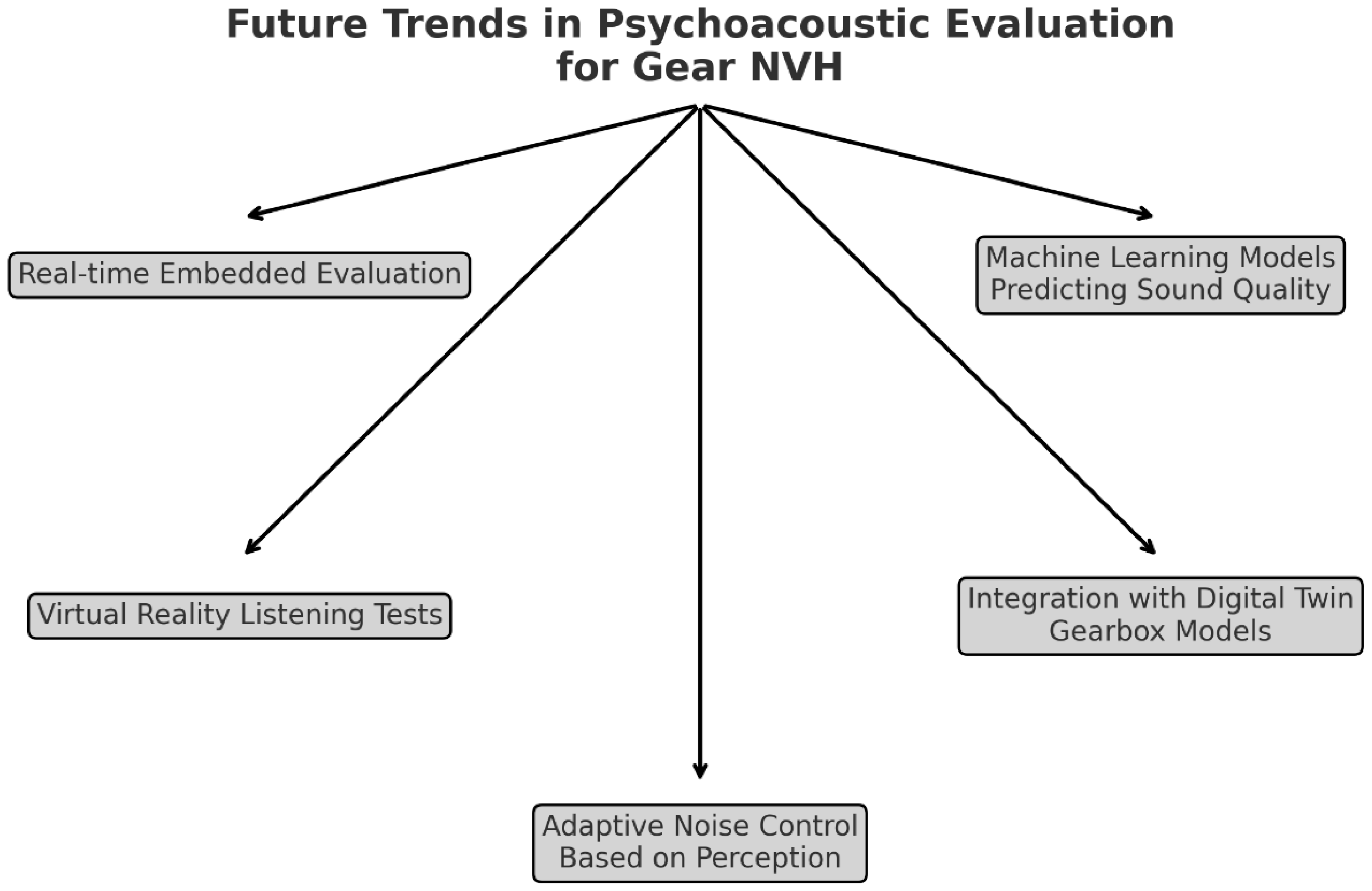
In heavy machinery, like construction equipment, psychoacoustic evaluation is also emerging. Pietrzyk et al. [1] focused on hydraulic pumps and used psychoacoustic metrics to improve sound quality. While pumps are not gears, the principle carries over: it demonstrated the method of combining objective metrics with listening tests. They even trained a neural network to predict subjective pleasantness from the psychoacoustic metrics. One can imagine a similar approach for gear drives—e.g., using machine learning to predict annoyance from loudness, sharpness, tonality of a gearset noise, which could speed up the design iteration [1].
Garanto et al. [50] demonstrated an industrial development framework that integrates psychoacoustic metrics into the sound quality optimization process for powertrain noise. Their methodology combines physical NVH testing with perceptual analysis, using loudness, tonality, roughness, and sharpness to identify noise characteristics that most strongly affect perceived quality. The study highlighted that psychoacoustic-based evaluation can replace traditional dB-level assessment in early design phases, providing clearer guidance for engineers to improve sound comfort in electric and hybrid vehicles.
Beyond the examples already discussed, several other industrial players have integrated psychoacoustic evaluation into their NVH development workflows.
AVL List GmbH, for instance, has developed dedicated Sound Quality Analysis (SQA) modules in their NVH simulation environment (AVL EXCITE and Testbed Suite), enabling direct calculation of loudness, sharpness, and tonality from simulated or measured signals. This allows engineers to assess the perceptual impact of design changes in real time during drivetrain testing, linking psychoacoustic metrics with order analysis and structural dynamics results.
Similarly, Bosch has incorporated psychoacoustic parameters into its electric powertrain validation process. During inverter and e-axle testing, Bosch engineers evaluate both the physical noise levels and psychoacoustic attributes to ensure that tonal inverter noise and gear whine remain within perceptually acceptable ranges. Their studies have shown that reducing tonality by spectral spreading or optimized PWM switching patterns improves subjective sound quality without major structural redesign.
Siemens Digital Industries and HEAD Acoustics have also contributed significantly through software integration. Siemens LMS Test.Lab and HEAD ArtemiS provide standardized psychoacoustic analysis modules—fully compliant with ISO 532-1/2 and DIN 45681—which are used by automotive OEMs and gearbox suppliers to quantify sound quality during both virtual prototyping and vehicle testing.
These industrial efforts demonstrate that psychoacoustic methods have moved beyond academic interest, forming a practical bridge between CAE-based design, hardware testing, and customer perception. The growing adoption across OEMs and Tier-1 suppliers confirms that perceptual sound metrics are becoming a core element of drivetrain NVH optimization.

5.3. Fault Diagnosis and Condition Monitoring

Psychoacoustic metrics have also been applied to gear fault detection and diagnosis, as an alternative or complement to vibration analysis. The idea is that some faults manifest in changes in the sound quality of the gearbox even before catastrophic failure. For example, gear wear or pitting might introduce a gritty noise (increasing roughness) or add sideband tones (affecting tonality and fluctuation) [51].
Guo et al. [2] in an SAE paper analyzed gear noise with induced faults (like wear and misalignment) by synthesizing the expected noise spectra and then computing psychoacoustic metrics. They reported that the psychoacoustic analysis provided more information about the faults than conventional vibration metrics. For instance, wear might have increased the broadband noise floor leading to higher loudness and sharpness, whereas misalignment introduced a strong modulation in the gear mesh leading to a higher roughness or tonality shift. The conclusion was that psychoacoustic metrics could be used in gear health monitoring—a new perspective since typically one monitors acceleration signals. Furthermore, they suggested that designers could set allowable thresholds for psychoacoustic metrics (like “tonality must not exceed Y” or “roughness must be below Z for a healthy gear”). This is essentially bringing sound quality thinking into reliability engineering [2].
Another study by Kane et al. [40] took this concept to the manufacturing floor: they attempted to automate end-of-line inspection of gearboxes using psychoacoustic features. Normally, a human expert listens to each gearbox on a test rig to decide if it sounds acceptable or if it has some defect (a very subjective and skill-based process). Kane et al. recorded sound from gearboxes labeled good or faulty and extracted psychoacoustic features (loudness, sharpness, etc., along with some statistical measures). They then trained an artificial neural network to classify the gearboxes. Remarkably, the psychoacoustic features achieved 98–99% classification accuracy for good vs. faulty gearboxes, essentially matching the human inspector performance. This demonstrates the power of these metrics to capture the essence of what the human ear/brain is detecting as “wrong” in a sound. Meanwhile, purely statistical features (like traditional vibration kurtosis, etc.) were slightly less accurate. The conclusion was that psychoacoustic metrics can indeed serve to make the inspection process objective and automated. This result is promising for any high-volume gearbox production—it can reduce reliance on golden-ear experts and instead use a computer listening for anomalies in terms of sound quality [40].

5.4. Product Quality Control

In industrial practice, psychoacoustic evaluation is gradually entering the field of end-of-line (EOL) testing and product quality control. For example, at the Audi manufacturing plants, every electric drive unit is tested at the end of the assembly line on a dynamometer bench, where dynamic measurements are performed on each motor–gear unit. During these automated tests, accelerometer and microphone signals are recorded, and the resulting noise levels are evaluated on a decibel scale according to predefined tolerance limits. At this stage, the focus is primarily on meeting quantitative noise thresholds, ensuring that no abnormal tonal components or mechanical faults exceed acceptable limits. After installation in the vehicle, further track tests are carried out by development engineers, where psychoacoustically relevant aspects such as tonal balance, roughness, and perceived sound quality are assessed under real driving conditions. Manufacturers are increasingly aiming to predict these perceptual outcomes already at the production stage by integrating machine-learning models trained on vibration and acoustic signatures. Such systems can correlate objective measurements from the EOL test bench with human perception, enabling early detection of potentially annoying sound characteristics and reducing the reliance on subjective evaluation during prototype testing. This convergence of psychoacoustics, data analytics, and automated quality control represents a key step toward perceptually optimized and digitally traceable drivetrain production.
Similar psychoacoustic-based development workflows have been described by Garanto et al. [50], where perceptual features were systematically correlated with engineering metrics to support automated product sound evaluation in the powertrain development process.

5.5. Academic Research and Case Studies

Researchers have been actively investigating psychoacoustic methods for gear noise. Some notable efforts:
  • A human perception of gear noise depending on gear geometry. They had subjects listen to recordings of gears with different helix angles, profile modifications, etc., and correlated subjective rankings with metrics. They found, for instance, that certain modifications reduced PA more effectively than they reduced SPL, highlighting again that psychoacoustic metrics guided to better solutions. Psychoacoustic metrics—such as loudness, tonality, fluctuation strength and sharpness—are not merely acoustic quantities, but indicators relevant to subjective noise quality. According to an article in Gear Technology [49], even a relatively quiet engine noise can be extremely disturbing if it appears as a high-pitched sound, which clearly illustrates that SPL alone is not sufficient for assessing noise comfort [51,52].
  • Choi et al. [53] applied a genetic algorithm on gear macro-geometry (module, teeth number, etc.) optimizing for minimal noise. Interestingly, while their objective was mainly dB-based, the results were later evaluated for sound quality and did show improvements in metrics like sharpness (the example showing 3.1 dB(A) reduction along with harmonic noise reduction; one can infer psychoacoustic benefit though it was not explicitly quantified) [53].
  • Yang [54] and others modeled complex gear dynamics to reduce vibration at the source. While that work is simulation-heavy, when it comes to evaluating outcomes, increasingly the researchers use psychoacoustic descriptors to say “the optimized design sounds quieter or smoother” in psychoacoustic terms, not just in raw forces.
The intersection of soundscapes and product sound quality research has even included gear noise in larger contexts. For example, how does gear noise in EVs affect overall user experience? Studies combining soundscape approaches (holistic listening) with Psychoacoustic metrics are emerging. They try to capture not just annoyance but also preferences (maybe a slight gear whine might be acceptable if it provides feedback that the car is working—a phenomenon sometimes called “feedback sound”) [55].
To give a structured overview, Table 2 below summarizes a few key case studies from the literature, highlighting the application context, which psychoacoustic metrics were utilized, and the main findings or outcomes:
These cases collectively demonstrate how Psychoacoustic metrics are applied and interpreted in real-world scenarios. They underscore several recurring themes: the importance of tonality in gear whine perception, the usefulness of roughness in detecting problems like rattling, the value of combining metrics for predictive modeling, and the innovative design solutions (like micro-geometry scatter or masking) that arise from a psychoacoustic understanding of noise.
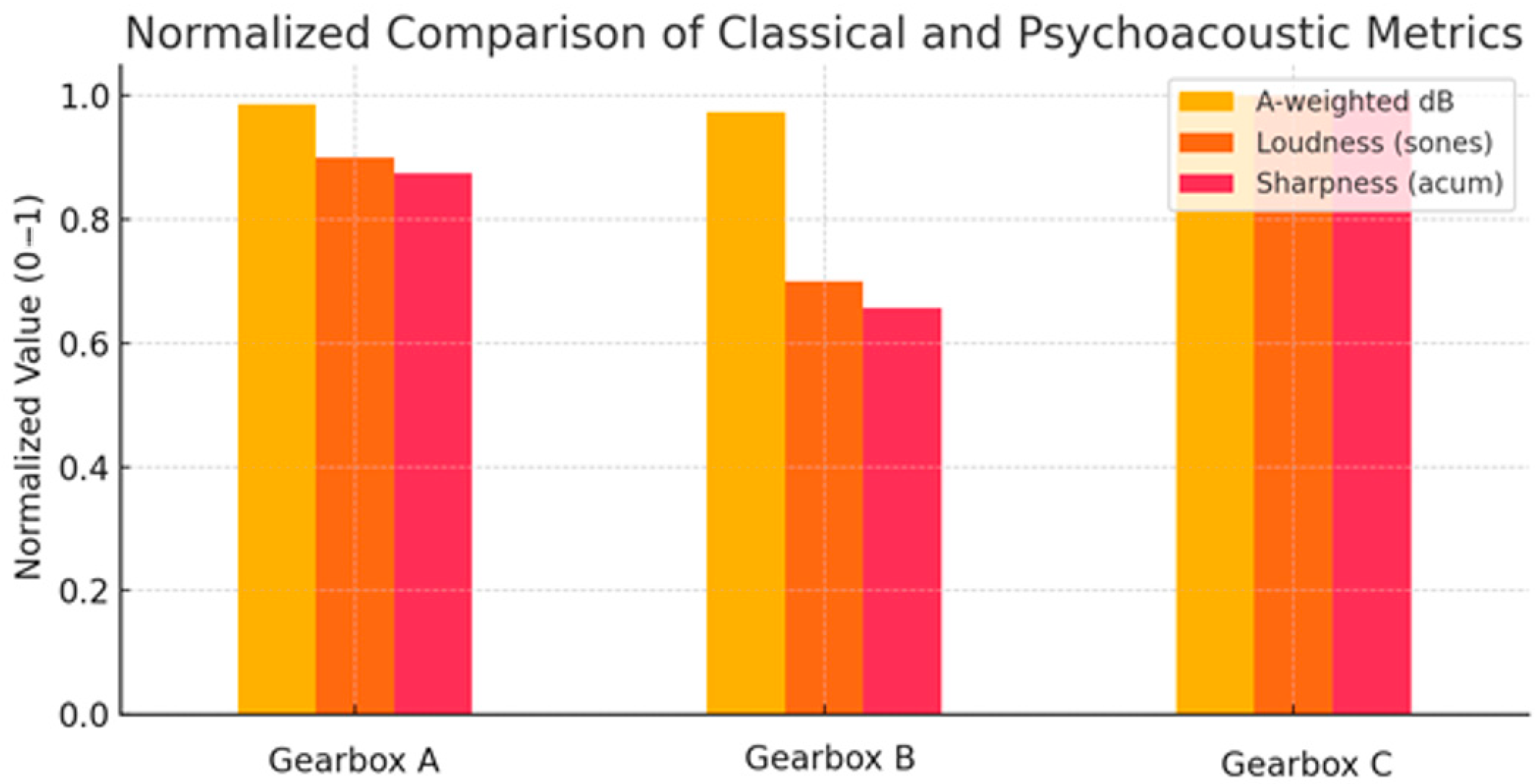
Figure 2 shows the comparison of classical and psychoacoustic metrics (A-weighted SPL, loudness, and sharpness) for three gearbox configurations. To facilitate a direct comparison between metrics expressed in different units (dB, sones, acum), all values were normalized to a 0–1 scale, where 1 corresponds to the highest observed value for each metric across all configurations. This normalization highlights relative differences and trends without the influence of absolute unit magnitudes.
The results indicate that while A-weighted SPL differences between the gearboxes remain relatively small, the psychoacoustic metrics (particularly loudness and sharpness) reveal more pronounced variations, suggesting perceptual differences not fully captured by conventional dB measurements.

6. Discussion

The above applications highlight that psychoacoustic metrics provide significant value in gear noise assessment, but they also bring to light several challenges and limitations when applying these methods to gear transmissions. In this section, we discuss those challenges, as well as the validation techniques used to ensure psychoacoustic metrics truly reflect human perception. We also consider the current state of standardization and potential improvements or future directions.

6.1. Benefits and Insights Gained

Before addressing challenges, it is worth emphasizing the benefits demonstrated: Psychoacoustic analysis can reveal counter-intuitive insights that traditional metrics might miss. For example, adding a small amount of random surface texture to gear teeth increased overall noise slightly but decreased annoyance because it cut tonality. Traditional analysis focusing on dB would have dismissed that solution, whereas psychoacoustic analysis endorsed it. Similarly, psychoacoustic metrics can pick up early fault symptoms (like increased roughness) that a broad-band energy metric might not flag if the overall level change is minor. These insights lead to more effective noise mitigation strategies aligned with human perception.

6.2. Challenges in Applying Psychoacoustic Metrics to Gears

Despite the successes, engineers and researchers face several challenges:
(a) Non-Stationary Operating Conditions: Gear noise often varies with load, speed, and time. A vehicle accelerates through gear whine resonances, a gearbox may have varying torque causing cyclic modulation, etc. Many psychoacoustic metrics (especially older implementations) assume a steady-state sound or use a short time slice. Capturing time-varying psychoacoustics is more complex. Metrics like loudness can be computed instantaneously, but interpreting a time series of loudness requires deciding on representative values (e.g., percentile loudness N5, or average vs. maximum). Tonality is particularly hard for non-stationary noise—as seen, Kim et al. [30] had to create a new method for a modulated whine. One limitation is that standard algorithms might under-report tonality if a tone is moving in frequency (because energy smears in a spectral analysis). Thus, applying psychoacoustics to gear noise needs careful attention to signal stationarity. Solutions include using short-time analyses and perhaps summarizing metrics over cycles or conditions (e.g., separate metrics for accelerating vs. steady cruise).
(b) Overlapping Contributions and Interdependence: The metrics are not entirely independent. If a design change is made, often multiple metrics shift. For instance, reducing a tonal peak might lower tonality, but if you replace it with more broadband noise, sharpness could increase. Or if you damp a rattle (lower roughness), you might reduce overall loudness too. In analysis, it can be tricky to attribute an improvement to one particular metric—because human annoyance is some complex combination. While composite metrics like PA attempt to combine them, their weighting (e.g., how much sharpness contributes relative to loudness) might not be universally agreed. One challenge is to decide which metric to prioritize. In some cases, loudness dominates perception unless tonality or roughness crosses certain thresholds. In others, a tiny tonal component drives annoyance disproportionately. This interplay means gear engineers should ideally look at a suite of metrics together, not just one.
(c) Lack of Standardization for Certain Metrics: As Table 1 indicated, loudness and sharpness are standardized and widely implemented consistently. However, for tonality, roughness, and fluctuation strength, different research groups or software may use different algorithms, yielding different numeric values for the same sound. For example, one software might report a tonality of 0.3 (dimensionless) while another says 5 dB tonality for the same sound—understanding the relation is non-trivial. Roughness algorithms can differ in how they handle multi-band sounds (some sum roughness across bands, others take the highest roughness band as dominant). This lack of standardization can hamper communication; an engineer at one company might find roughness = 1 asper acceptable, but another’s method might rarely exceed 0.5 asper for similar sounds. There is ongoing work to perhaps include roughness and fluctuation in standards or recommended practices (e.g., within ASA or ISO working groups), but currently this is a limitation. In the meantime, it’s important in studies to specify the method used.
(d) Calibration and Absolute Interpretation: Psychoacoustic scales (sones, acum, asper) are based on human references, but individual variability exists. One person’s perception might differ slightly. Usually these metrics reflect an average response of normal-hearing individuals. But in practice, when we say a gear noise has loudness of 5 sones, how does that translate to an expectation of annoyance? Generally, more sones = more loud, but context matters (5 sones of a pure tone might be more annoying than 5 sones of a broad hum). So, while Psychoacoustic metrics are closer to perception than dB, translating their absolute values to design criteria often requires empirical tuning. Companies might develop their own guidelines like “sharpness above 2.5 acum is not acceptable for our luxury segment” based on tests. Without those, raw numbers might not immediately tell you if it is “good” or “bad”. Therefore, validation with listening tests remains crucial whenever new scenarios are encountered.
(e) Computation and Integration: Although computational cost is not prohibitive (nowadays PCs can calculate these metrics quickly), integrating psychoacoustic analysis into standard CAE (Computer-Aided Engineering) workflows is still evolving. Acoustic simulations (like FEA/SEA of gear whine) traditionally output spectra or dB values. To obtain psychoacoustic predictions, one must take those outputs and run them through psychoacoustic models. Some integrated tools exist, but it is not yet as common as, say, achieving a sound power level. As a result, many psychoacoustic evaluations are performed post hoc on measured data rather than in predictive simulation. With increasing computational power and perhaps AI surrogates (one study even developed a deep neural network to speed up loudness calculation), we can expect better integration in the future [54].

6.3. Validation and Human Perception Studies

Validation of psychoacoustic metrics in the gear noise domain typically involves listening tests with human subjects to ensure that the metrics correspond to what people actually perceive and care about. Several validation approaches are noted:
  • Paired Comparison and Ranking Tests: As used by Pietrzyk et al. [1], paired comparison forces a listener to choose which of two sounds is more pleasant or more annoying. By presenting many pairs and analyzing choices (often using Bradley-Terry model or similar), one can derive a ranking scale of perceived annoyance. This can then be compared to metrics. If listeners consistently prefer the sound with lower tonality metric, that validates the metric’s relevance. Paired comparisons are good because they are easier for subjects than rating scales, especially for small differences [1].
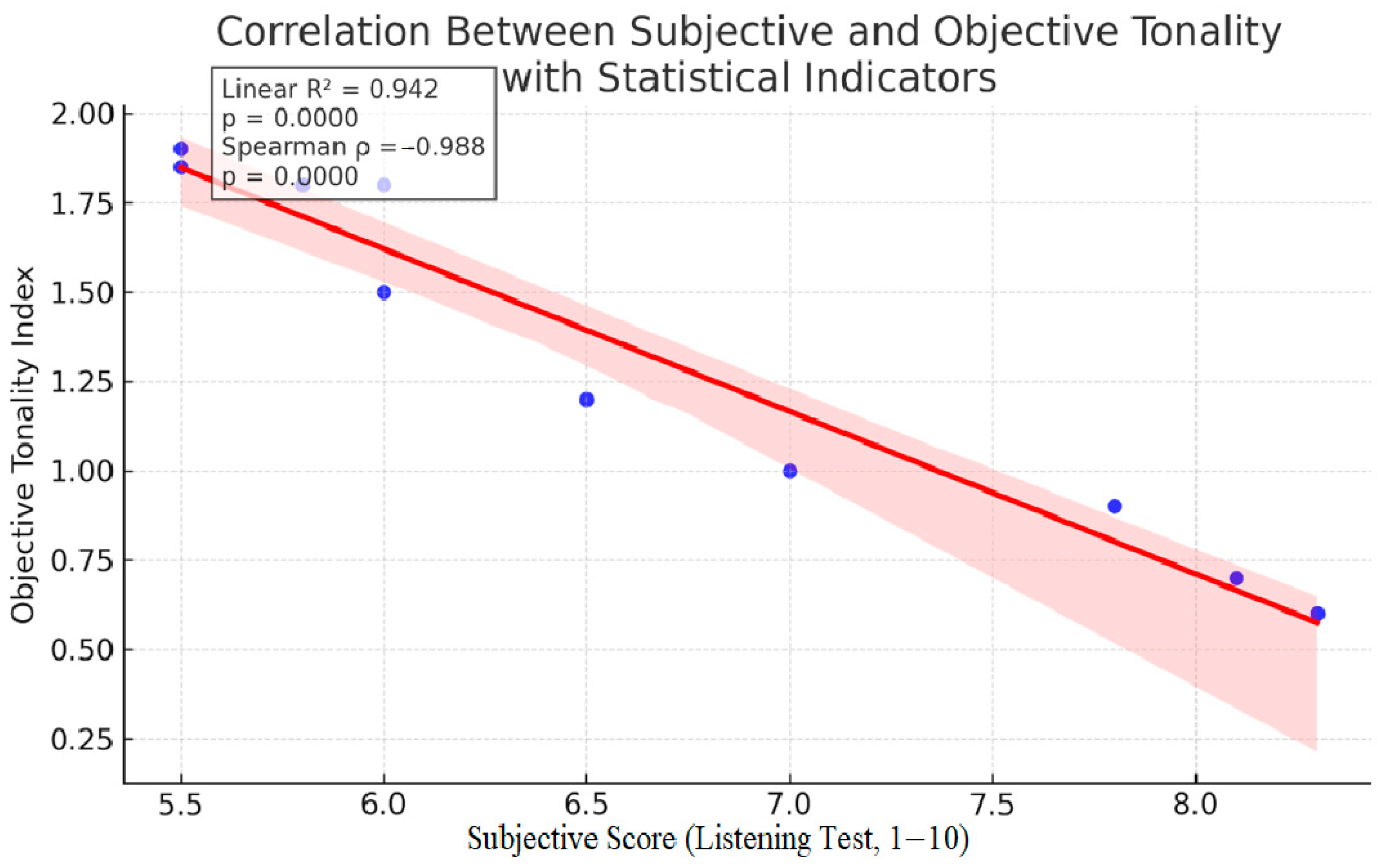
  • Absolute Rating Scales: Some studies use a numerical scale or categorical scale (e.g., 1 to 10 annoyance, or opinions like “not noticeable” to “extremely annoying”). This can yield data for correlation (Pearson or Spearman correlation between metric values and mean subjective ratings). For instance, a researcher might play various gear noise recordings at different conditions and have listeners rate annoyance; then find that roughness (asper) correlates r = 0.8 while A-weighted dB correlates only r = 0.5, suggesting roughness is a better predictor.
  • Jury Workshops with Sound Quality Metrics: Automakers sometimes conduct sound clinics with experts who both listen and measure. They might adjust a noise sample’s equalizer (tone controls) to reach a subjectively optimal sound, then analyze how metrics changed. This is more free-form but can reveal, say, that they always try to reduce sharpness when complaining of harshness.
  • Psychoacoustic Model Validation: As mentioned, the concept of a composite like PA has been proposed. Validation involves seeing if PA correlates better with subjective annoyance than any single component. Often, loudness is weighted heavily because it is primary, but including sharpness and fluctuation terms improves the match to subjective annoyance data from experiments. In context of gear noise, one could test PA vs. actual annoyance votes for various gear whine samples.
  • Real-world feedback: For products in the field, sometimes customer complaint data can serve as validation., e.g., if a new gear design that had lower tonality metric yields fewer NVH complaints from drivers, that retroactively validates the metric’s predictive power. This is of course less formal but very convincing to management.
One interesting validation example from our review: Kane and Andhare [40] validated features by essentially using the human inspector’s judgment (pass/fail) as ground truth and seeing if an algorithm using psychoacoustic features could replicate that. The high accuracy obtained is a form of validation that those features encapsulated the expert’s “mental model” of acceptable vs. faulty sound [40].
Although listening tests provide essential subjective validation for psychoacoustic metrics, they also present several methodological limitations. First, most studies rely on relatively small listener panels—typically 10 to 20 participants—whose responses may not statistically represent the broader population. Moreover, listener fatigue and learning effects can influence the consistency of ratings, especially in long test sessions. Differences in cultural background, hearing sensitivity, and expectation bias can also alter perceived annoyance and sound-quality judgments. Environmental factors, such as headphone characteristics or room acoustics, further affect reproducibility if not standardized. Finally, the absence of universal test protocols for gearbox and powertrain noise evaluation leads to variability across laboratories, making it difficult to compare results from different studies. Therefore, while listening tests remain indispensable for perceptual validation, their findings should be interpreted with caution and ideally supported by objective psychoacoustic analysis.
A recurring theme across the reviewed studies is the validation of objective psychoacoustic metrics through subjective listening experiments. Whether conducted as formal jury tests or expert evaluations, linking quantitative metric values to human auditory impressions remains essential. When newly developed metrics—such as improved tonality indices—exhibited a strong correlation with listener ratings, they proved to be reliable indicators for perceptual sound-quality assessment. Conversely, metrics that failed to align with human perception, as initially observed for standard tonality models under non-steady conditions, required refinement to better capture transient auditory phenomena. This feedback loop between perceptual validation and model development ensures that psychoacoustic metrics remain faithful to their original intent: predicting human response. Figure 3 shows the scatter plot illustrating the relationship between the objective tonality index and the subjective listening scores.
This strong dependency demonstrates the practical relevance of psychoacoustic evaluation in engineering applications. By quantifying perceived sound quality through objective measures, manufacturers can significantly reduce reliance on time-consuming and potentially biased listening panels.
By quantifying perceived sound quality through objective psychoacoustic measures, manufacturers can reduce their reliance on subjective jury testing while maintaining perceptual relevance in product validation and development.

6.4. Limitations and Future Work

While psychoacoustic evaluation has become an increasingly powerful complement to traditional NVH metrics, several limitations and open challenges remain. The reviewed studies show that there is still no universally accepted standard for implementing psychoacoustic metrics in gearbox noise assessment. Different authors rely on varying implementations of loudness or tonality (e.g., ISO 532-1 vs. ISO 532-2), which complicates direct comparison of results. Furthermore, many experimental setups employ small listening panels under controlled laboratory conditions, which may not fully represent real driving environments. Subjective evaluations can also be affected by listener fatigue, individual sensitivity, and cultural perception biases, making cross-study validation difficult.
From a methodological standpoint, most published research still focuses on static psychoacoustic indicators, whereas modern drivetrain systems operate under non-stationary, transient conditions. This highlights the need for future work in time-resolved psychoacoustic analysis and machine-learning-based feature extraction capable of predicting perceived noise quality directly from raw vibration or acoustic data. Integration of such perceptual models into real-time simulation and end-of-line testing systems could enable predictive sound-quality monitoring and design feedback loops.
Finally, although current review results indicate consistent correlations between psychoacoustic metrics and subjective annoyance ratings, validation under industrial conditions is still limited. Future research should therefore aim to establish standardized test protocols and reference datasets for the psychoacoustic evaluation of gear noise—bridging the gap between perceptual science and engineering design.
Human Factors: Even with good metrics, individual human preferences can vary. Some people are more tolerant of certain sounds than others. Psychoacoustic metrics typically represent an average ear. Future work may consider this.
Human Variability: Psychoacoustic models are generally based on average responses of listeners with normal hearing. In reality, individuals may respond differently to certain noise characteristics. Some people might be more sensitive to high-frequency whines; others might be more bothered by modulation. Thus, a gearbox that psychoacoustically “scores” well may still receive a few complaints due to individual differences. Future work may involve personalized or adjustable models of annoyance or using larger listener panels to ensure metrics cover a broad population. Moreover, as hearing capabilities change (e.g., older drivers with high-frequency hearing loss might find sharpness less bothersome but could be more annoyed by fluctuation), adapting sound quality targets to the demographic is a potential consideration.
As outlined in Figure 4, emerging technologies such as machine learning, real-time embedded processing, and digital twin simulations are expected to transform psychoacoustic-based NVH evaluation.
Extending Metrics for Transient Sounds: Gear noise during shifts or other transient events (think of the brief clunk or engagement noise) are not well captured by steady-state psychoacoustic metrics. These are impulsive or short-lived sounds. Psychoacoustics has other metrics for impulsiveness or transient sharpness, but these are less established. Future research might extend or create new metrics to quantify the perceived quality of very short-duration gear noise (for example, a metric for “clunk pleasantness” or using existing impulse metrics like Kurtosis in a psychoacoustic context).
Composite Indices and Machine Learning: As seen with neural network approaches, there is potential to combine multiple metrics and perhaps other features into a single predictive model of human evaluation. The PA formula is one such composite, but more sophisticated data-driven methods could fine-tune weightings for specific contexts (e.g., a model specifically for EV gearbox sound quality). We anticipate more use of AI in sound quality—for example, training models on large datasets of sounds and human ratings to directly predict “annoyance score” or “quality grade.” These models might discover nonlinear interactions between metrics that the human-designed formulas do not capture. However, transparency and physical meaning remain important—designers often prefer knowing why a sound is problematic rather than obtaining a black-box output.
Integration into Design Cycle: In the future, psychoacoustic evaluations will likely be incorporated earlier in the design process. Today, a gear design is made, then tested for sound, and then adjusted. With better simulation tools, one can simulate the sound radiated by a gearbox (from tooth contact analyses to acoustic FEM/BEM), and then compute psychoacoustic metrics from the simulated sound. If a certain micro-geometry concept shows a lower predicted loudness and tonality, it could be chosen before cutting metal. This virtual sound quality prediction is still developing, but progress in multiphysics simulation and fast psychoacoustic computations is closing the loop. One challenge is ensuring simulation captures all real-world subtleties. But as those improve, psychoacoustic targets can be part of design requirements alongside strength and efficiency.
Standardization and Guidelines: We expect continued efforts to standardize how Psychoacoustic metrics are applied in specific industries. For instance, the automotive indust a guideline for “Sound Quality of Electric Drive Units” that specifies using ISO 532-1 loudness and a certain tonality metric to evaluate compliance. Regulatory bodies might also incorporate psychoacoustic considerations: environmental noise ordinances in some countries already add penalties for tonal or impulsive noise. Likewise, interior noise standards include sound quality, not just sound level. Having common agreed methods (like a standard method for tonality of non-stationary vehicle tones) would allow easier comparison across studies and clearer communication [9].
In summary, the application of psychoacoustics to geared drive noise is still a developing field. The stands demonstrate clear benefits, but they also highlight the need for advanced tools and methods to handle the complexities of real gear noise. By addressing these challenge metric handling of non-stationary sounds, combining metrics intelligently, and standardizing methods—engineers will be better equipped to design the next generation of quiet and pleasant-sounding gear drives.

7. Conclusions

Geared drives will likely always produce some level of noise, but how that noise is perceived by humans can make the difference between a product deemed acceptable or objectionable. This literature review has shown that incorporating into the noise assessment of geared drives provides a richer and more human-centric evaluation than traditional methods alone. The key conclusions and takeaways are:
  • Traditional vs. Psychoacoustic Approaches: Conventional noise metrics (dB levels, spectra, TE) are essential for quantifying and addressing the physical causes of gear noise, but they do not reliably indicate the pact of the noise. Psychoacoustic metrics bridge this gap by relating measurements to human perception. An integrated approach is ideal: use traditional analysis to identify and mitigate root causes, and use analysis to fine-tune the sound quality outcome.
  • Understanding Psychoacoustic Metrics: Loudness, sharpness, tons, and fluctuation strength each capture a different auditory dimension of gear noise. Loudness correlates with overall intensity as heard; sharpness with high-frequency content; tonality with presence of tonal gear whine; roughness with rapid modulations (e.g., rattling); and fluctuation with slow amplitude beats. These metrics can be computed using established models.
  • Applications in Gear Noise illustrate the practical benefits. Psychoacoustic metrics have been used to diagnose gear noise issues (identifying exactly why a noise is annoying), to compare design alternatives (choosing a design that yields lower perceived noise, not just lower SPL), and to develop innovative solutions (like micro-geometry modulation to reduce tonality). Automotive examples showed improved customer NVH by focusing on reducing sharpness and tonality of axle whine rather than only reducing amplitude. In manufacturing, psychoacoustic features enabled automated detection of faulty gearboxes with accuracy on par with human inspectors. These successes underline that Psychoacoustic metrics are not just academic; they have tangible impact on engineering outcomes.
  • Challenges and Future Work: Applying psychoacoustic metrics to geared drives is not without difficulties. Non-stationary noise and multiple simultaneous phenomena can complicate metric calculation and interpretation. The lack of standardized methods for some metrics (tonality, roughness) can lead to inconsistency. However, ongoing research and development are addressing these issues. New metrics and analysis techniques are being developed for time-varying sounds, and there is movement toward industry standards that include sound quality. Additionally, increasing computational power and simulation fidelity will likely allow psychoacoustic optimization to be a part of the early design phase, not just a post-test evaluation. The future geared drive might be “tuned” for sound quality in much the same way engines have been, using these metrics as design targets.
Key take-home messages:
  • Human-centric evaluation is essential. Psychoacoustic metrics—such as loudness, sharpness, tonality, roughness, and fluctuation strength—provide an additional dimension for assessing gearbox noise beyond conventional energy-based parameters.
  • Integration into engineering workflows is viable. The review shows that psychoacoustic analysis can be effectively combined with CAE simulations, test bench data, and machine learning algorithms to support noise optimization at earlier design stages.
  • Industrial adoption is emerging. While still limited, there are clear trends in automotive and transmission manufacturing towards including psychoacoustic criteria in NVH targets, especially in EVs where tonal noise is more prominent.
Contribution of this work:
Unlike earlier fragmented studies, this review provides a structured synthesis of methods, case studies, and validation strategies for applying psychoacoustic metrics specifically to geared transmission systems. It consolidates industrial and academic findings into a single framework, offering both theoretical underpinnings and practical insights for implementation. The inclusion of emerging computational approaches, such as AI-assisted parameter optimization, positions this work as a forward-looking reference for NVH engineers.
Future research directions:
  • Real-time psychoacoustic evaluation: Development of embedded algorithms that can process psychoacoustic metrics in real-time during drivetrain operation, enabling adaptive control strategies for noise reduction.
  • Coupling with advanced CAE and digital twins: Integration of psychoacoustic evaluation modules into multi-body dynamics and vibroacoustic simulation platforms to predict perceived sound quality directly from design data.
  • Machine learning and big data analytics: Leveraging large datasets of measured and simulated NVH signals to train AI models capable of predicting psychoacoustic outcomes from early-stage design parameters or manufacturing tolerances.
  • Psychoacoustics for electric drivetrains: Focused studies on EV-specific tonal and high-frequency noise, where masking by combustion engines is absent, making perceived noise more critical to passenger comfort.
  • Standardization and benchmarking: Establishing standardized procedures for psychoacoustic measurement and evaluation in gearbox NVH, facilitating cross-comparison between research groups and industry applications.
In conclusion, psychoacoustic metrics have proven to be valuable tools in the noise assessment and refinement of geared drives. They complement traditional engineering metrics by focusing on the human experience of sound. By leveraging metrics like loudness, sharpness, and tonality, engineers can design gear systems that are not only quieter in a physical sense but also psychoacoustically optimized for minimum annoyance and maximum perceived quality. This leads to quieter cars, more pleasant machinery, and an overall reduction in noise pollution impacts on people. As the field advances, we anticipate wider adoption of psychoacoustic evaluations in gear design and noise control, ultimately contributing to products that sound as good as they perform.

Funding

This research received no external funding.

Data Availability Statement

No new data were created or analyzed in this study.

Conflicts of Interest

The authors declare no conflict of interest.

References

  1. Pietrzyk, T.; Georgi, M.; Schlittmeier, S.; Schmitz, K. Psychoacoustic Evaluation of Hydraulic Pumps. Sustainability 2021, 13, 7320. [Google Scholar] [CrossRef]
  2. Guo, D.; Shi, Q.; Yi, P. Psychoacoustic Analysis of Gear Noise with Gear Faults. SAE Int. J. Passeng. Cars–Mech. Syst. 2016, 9, 459–464. [Google Scholar] [CrossRef]
  3. Genuit, K. Need for Standardization of Psychoacoustics. J. Acoust. Soc. Am. 2010, 127, 1880. [Google Scholar] [CrossRef]
  4. Groby, J. Introduction to Psychoacoustics and Psychoacoustic Tests; University of Zagreb: Zagreb, Croatia, 2018. [Google Scholar]
  5. Seeber, B. Echoes from the Archives of the Munich School of Psychoacoustics. In Proceedings of the 10th Convention of the European Acoustics Association Forum Acusticum, Torino, Italy, 11–15 September 2023. [Google Scholar] [CrossRef]
  6. Ferguson, S.; Cabrera, D.; Beilharz, K.; Song, H. Using Psychoacoustical Models for Information Sonification. In Proceedings of the International Conference on Auditory Display, London, UK, 20–23 June 2006. [Google Scholar]
  7. Schell-Majoor, L.; Rennies, J.; Ewert, S.; Kollmeier, B. Modeling Sound Quality from Psychoacoustic Measures; Institute of Noise Control Engineering: Wakefield, MA, USA, 2016. [Google Scholar]
  8. DIN 45631:1991-03; Acoustics—Calculation of Loudness Level and Loudness from the Sound Spectrum (Zwicker Method). DIN: Berlin, Germany, 1991. Available online: https://webstore.ansi.org/standards/din/din456311991de (accessed on 27 October 2025).
  9. ISO 532-1:2017; Acoustics—Methods for Calculating Loudness—Part 1: Zwicker Method. ISO: Geneva, Switzerland, 2017. Available online: https://www.iso.org/standard/63069.html (accessed on 27 October 2025).
  10. ISO 532-2; Acoustics—Methods for Calculating Loudness—Part 2: Zwicker Method. ISO: Geneva, Switzerland, 2017.
  11. Fastl, H. Advanced Procedures for Psychoacoustic Noise Evaluation. In Proceedings of the 6th European Confernce on Noise Control 2006, Tampere, Finland, 30 May–1 June 2006. [Google Scholar]
  12. Pastor-Aparicio, A.; Segura-García, J.; Lopez-Ballester, J.; Felici-Castell, S.; García-Pineda, M.; Perez-Solano, J. Psychoacoustic Annoyance Implementation with Wireless Acoustic Sensor Networks for Monitoring in Smart Cities. IEEE Internet Things J. 2020, 7, 128–136. [Google Scholar] [CrossRef]
  13. Ziemer, T.; Yu, Y.; Tang, S. Using Psychoacoustic Models for Sound Analysis in Music. In Proceedings of the 8th Annual Meeting of the Forum for Information Retrieval Evaluation, Kolkata, India, 8–10 December 2016. [Google Scholar] [CrossRef]
  14. Cheerla, G.; Pulugundla, K.; Kolla, K.; Sathyanarayana, P. Solving Whine Noise in Electric Vehicles: A Comprehensive Study Using Experimental and Multiphysics Techniques; SAE Tech. Pap. Ser.; SAE International: Warrendale, PN, USA, 2024. [Google Scholar] [CrossRef]
  15. Fang, Y.; Zhang, T. Sound Quality of the Acoustic Noise Radiated by PWM-Fed Electric Powertrain. IEEE Trans. Ind. Electron. 2018, 65, 4534–4541. [Google Scholar] [CrossRef]
  16. Altinsoy, M. The Evaluation of Conventional, Electric and Hybrid Electric Passenger Car Pass-By Noise Annoyance Using Psychoacoustical Properties. Appl. Sci. 2022, 12, 5146. [Google Scholar] [CrossRef]
  17. ECMA-418-2:2022; Psychoacoustic Metrics for ITT Equipment—Part 2: Models Based on Human Perception, 2nd ed. Ecma International: Geneva, Switzerland, 2022. Available online: https://www.ecma-international.org/wp-content/uploads/ECMA-418-2_2nd_edition_december_2022.pdf?trk=organization_guest_main-feed-card_reshare-copy (accessed on 27 October 2025).
  18. Sottek, R.; Lobato, T. Applications of the Psychoacoustic Tonality Method. J. Acoust. Soc. Am. 2023, 153, A149. [Google Scholar] [CrossRef]
  19. Zakrajsek, J.J.; Townsend, D.P. The Root Cause for Gear Noise Excitation. Gear Solut. 2000. Available online: https://gearsolutions.com/features/the-root-cause-for-gear-noise-excitation/ (accessed on 27 October 2025).
  20. Genuit, K. The Sound Quality of Vehicle Interior Noise: A Challenge for the NVH-Engineers. Int. J. Veh. Noise Vib. 2004, 1, 158–168. [Google Scholar] [CrossRef]
  21. Wu, X.; Liu, S.; Shi, Z.; Yue, H. Noise Analysis and Optimization of the Gear Transmission System for Two-Speed Automatic Transmission of Pure Electric Vehicles. Mech. Sci. 2023, 14, 361–374. [Google Scholar] [CrossRef]
  22. Fastl, H. Psychoacoustics and Sound Quality. Technical Acoustics Group, Technical University of Munich, 2007. Available online: https://mediatum.ub.tum.de/doc/1138438/document.pdf (accessed on 27 October 2025).
  23. Fastl, H. Psycho Acoustics and Sound Quality. In Communication Acoustics; Blauert, J., Ed.; Springer: Berlin, Germany, 2005; pp. 139–162. [Google Scholar] [CrossRef]
  24. Swift, S.H.; Gee, K.L. Extending Sharpness Calculation for an Alternative Loudness Metric Input. J. Acoust. Soc. Am. 2017, 142, EL549. [Google Scholar] [CrossRef] [PubMed]
  25. Moore, B.C.J.; Glasberg, B.R. A Revision of Zwicker’s Loudness Model. Acust. Acta Acust. 1996, 82, 335–345. [Google Scholar]
  26. Zwicker, E.; Fastl, H. Roughness. In Psychoacoustics: Facts and Models, 3rd ed.; Springer: Berlin, Germany, 2007. [Google Scholar]
  27. Deutsches Institut für Normung. DIN 45692: Measurement Technique for the Simulation of the Auditory Sensation of Fluctuation Strength; Beuth Verlag: Berlin, Germany, 2009. [Google Scholar]
  28. Aures, W. Procedure for Calculating the Sensory Pleasantness of Various Sounds. Acustica 1985, 59, 130–141. [Google Scholar]
  29. DIN 45681; Acoustics—Determination of Tonal Components of Noise and Determination of a Tone Adjustment for the Assessment of Noise Immissions. Beuth Verlag: Berlin, Germany, 2005.
  30. Kim, E.Y.; Jang, J.U.; Lee, S.K. Tonality Design for Sound Quality Evaluation for Gear Whine Sound. Trans. Korean Soc. Noise Vib. Eng. 2012, 22, 1172. [Google Scholar] [CrossRef]
  31. Brecher, C.; Löpenhaus, C.; Kasten, M. Psychoacoustic Optimization of Gear Noise: Chaotic Scattering of Micro Geometry and Pitch on Cylindrical Gears. Gear Technol. 2021. Available online: https://www.geartechnology.com/psychoacoustic-optimization-of-gear-noise-chaotic-scattering-of-micro-geometry-and-pitch-on-cylindrical-gears (accessed on 27 October 2025).
  32. Kasten, M.; Brecher, C.; Löpenhaus, C. Reduction of the Tonality of Gear Noise by Application of Topography Scattering for Ground Bevel Gears. Gear Solut. 2021. Available online: https://gearsolutions.com/features/reduction-of-the-tonality-of-gear-noise-by-application-of-topography-scattering-for-ground-bevel-gears (accessed on 27 October 2025).
  33. Daniel, P.; Weber, R. Psychoacoustical Roughness: Implementation of an Optimized Model. Acta Acust. United Acust. 1997, 83, 113–123. [Google Scholar]
  34. Hoeldrich, R.; Pflueger, M. A Parametrized Model of Psychoacoustical Roughness for Objective Vehicle Noise Quality Evaluation. J. Acoust. Soc. Am. 1999, 105, 1371. [Google Scholar] [CrossRef]
  35. Fastl, H. The Hearing Sensation Roughness and Neuronal Responses to AM Tones. Hear. Res. 1990, 46, 293–295. [Google Scholar] [CrossRef] [PubMed]
  36. Hörmann, H.; Zwicker, E. Loudness of Noise Containing Tones. Acustica 1972, 27, 229–233. [Google Scholar]
  37. Fastl, H. Fluctuation Strength and Temporal Masking Patterns of Amplitude Modulated Broadband Noise. Hear. Res. 1982, 8, 59–69. [Google Scholar] [CrossRef]
  38. Fastl, H.; Zwicker, E. Fluctuation Strength. In Psychoacoustics; Springer: Berlin, Germany, 2007. [Google Scholar] [CrossRef]
  39. Poeppel, D.; Assaneo, M.F. Speech Rhythms and Their Neural Foundations. Nat. Rev. Neurosci. 2020, 21, 322–334. [Google Scholar] [CrossRef]
  40. Kane, P.V.; Andhare, A.B. Application of Psychoacoustics for Gear Fault Diagnosis Using Artificial Neural Network. J. Low Freq. Noise Vib. Act. Control 2016, 3, 207–220. [Google Scholar] [CrossRef]
  41. Simmons, D. Test Signals for Validating Sound Quality Measurement Instrumentation. Proc. Inst. Acoust. 2005, 27, 189–194. [Google Scholar]
  42. Lee, H.; Kim, S.; Lee, S. Design of New Sound Metric and Its Application for Quantification of an Axle Gear Whine Sound by Utilizing Artificial Neural Network. J. Mech. Sci. Technol. 2009, 23, 1182–1193. [Google Scholar] [CrossRef]
  43. Singh, A.; Nakra, B.C. Vibration and Noise Analysis for Gearbox Fault Detection Using Acoustic Signals. Appl. Acoust. 2009, 70, 1378–1385. [Google Scholar] [CrossRef]
  44. Kim, S.J.; Lee, H.H.; Lee, S.K. Sound Quality Evaluation for the Axle Gear Noise in the Vehicle. SAE Int. J. Passeng. Cars Mech. Syst. 2008, 1, 1514–1521. [Google Scholar]
  45. Jiang, Q.; Liu, X.; Wang, H.; Zhang, Y.; Li, P. Correlation of the Sound Quality and Vibration of End-of-Line Testing for Automatic Transmission. Meas. Control. 2024, 57, 1348–1362. [Google Scholar]
  46. Kim, B.; Yang, S. A Study on Contribution Analysis Using Operational Transfer Path Analysis Based on the Correlation between Subjective Evaluation and Zwicker’s Sound Quality Index for Sound Quality of Forklifts. Korean Soc. Fluid Power Constr. Equip. 2016, 13, 19–25. [Google Scholar] [CrossRef][Green Version]
  47. Brecher, C.; Gorgels, C.; Carl, C.; Brumm, M. Benefit of Psychoacoustic Analyzing Methods for Gear Noise Investigation. Gear Technol. 2011, 28, 49–55. [Google Scholar][Green Version]
  48. Marrant, B. An Automated Simulation Approach of Drive Trains towards Tonality-Free Wind Turbines; ZF Wind Power Antwerpen NV: Lommel, Belgium, 2020. [Google Scholar][Green Version]
  49. Gear Technology. Aspects of Gear Noise, Quality, and Manufacturing Technologies for Electromobility; Gear Technology: Elk Grove Village, IL, USA, 2023. [Google Scholar][Green Version]
  50. Garanto, V.; Geng, Z.; Hu, J.; Deng, X.; Yang, W.; Wang, H. Sound Quality Development Using Psychoacoustic Parameters with Special Focus on Powertrain Noise; SAE Tech. Pap.; SAE International: Warrendale, PA, USA, 2020. [Google Scholar] [CrossRef]
  51. Wißbrock, P.; Richter, Y.; Pelkmann, D.; Ren, Z.; Palmer, G. Cutting Through the Noise: An Empirical Comparison of Psychoacoustic and Envelope-Based Features for Machinery Fault Detection. arXiv 2022, arXiv:2211.01704. [Google Scholar] [CrossRef]
  52. Qian, K.; Hou, Z.; Sun, Q.; Yang, G.; Sun, D.; Liu, R. Evaluation and Optimization of Sound Quality in High-Speed Trains. Appl. Acoust. 2021, 174, 107830. [Google Scholar] [CrossRef]
  53. Choi, C.; Ahn, H.; Yu, J.; Han, J.S.; Kim, S.C.; Park, Y.J. Optimization of Gear Macro Geometry for Reducing Gear Whine Noise in Agricultural Tractor Transmission. Comput. Electron. Agric. 2021, 188, 106358. [Google Scholar] [CrossRef]
  54. Yang, Y.; Li, W.; Lu, H.; Peng, Z. Development of a Deep Neural Network for Intelligent Fault Diagnosis of Rotating Machinery. J. Manuf. Process. 2020, 59, 116–126. [Google Scholar] [CrossRef]
  55. Zakri, K.W.; Sarwono, R.S.J.; Santosa, S.P.; Soelami, F.X.N. Modeling and Validation of Acoustic Comfort for Electric Vehicle Using Hybrid Approach Based on Soundscape and Psychoacoustic Methods. World Electr. Veh. J. 2025, 16, 64. [Google Scholar] [CrossRef]
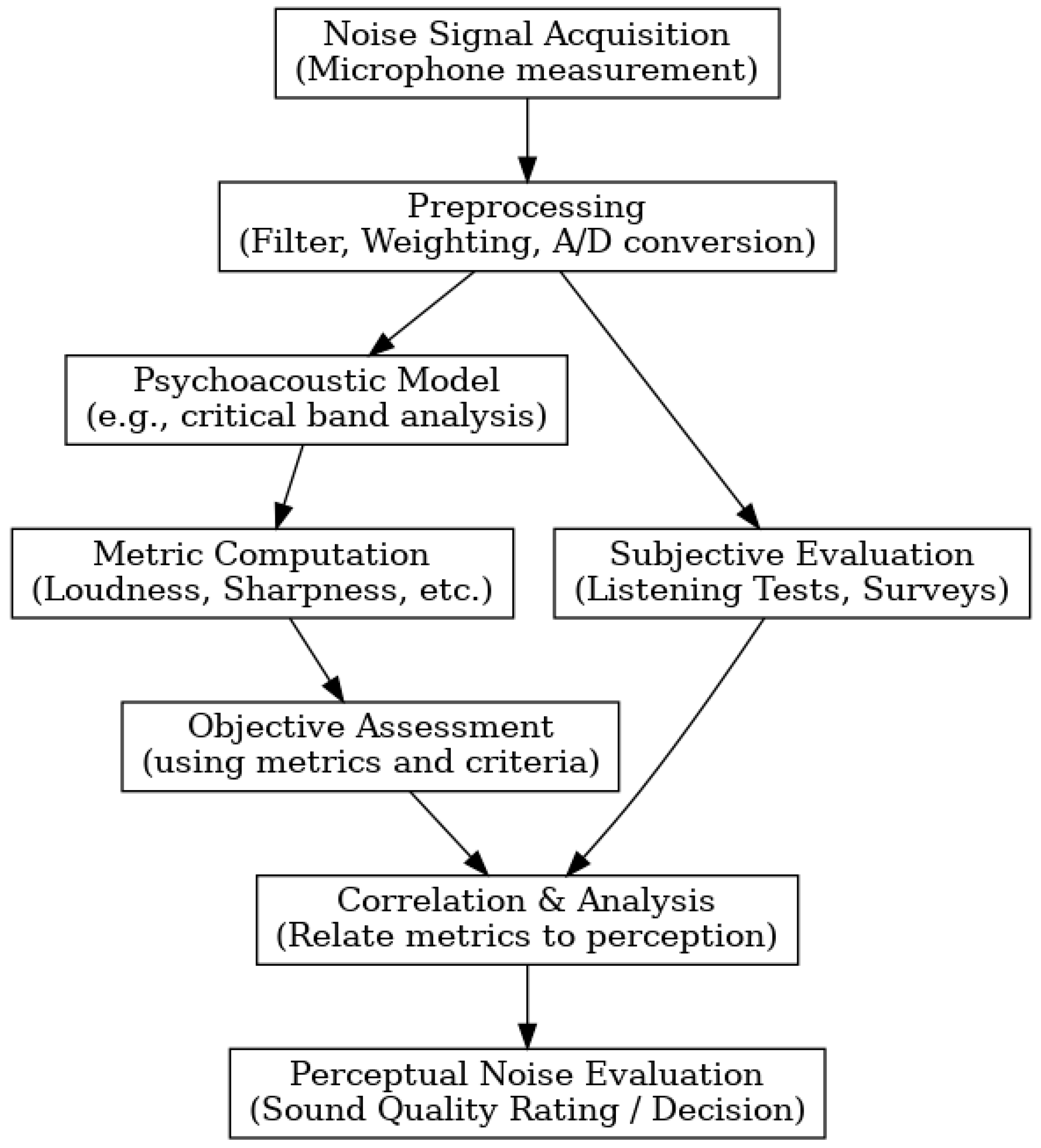
Figure 1. Psychoacoustic noise evaluation workflow, adapted from Fastl & Zwicker (2007) and industry practice [22].
Wevj 16 00611 g001
Figure 2. Comparison of Classical and Psychoacoustic Metrics for Gearbox Noise Evaluation.
Wevj 16 00611 g002
Figure 3. Correlation between objective tonality index and subjective listening scores. The red line represents the linear regression fit, demonstrating a strong inverse relationship (R2 = 0.92, p < 0.001).
Wevj 16 00611 g003
Figure 4. Future Trends and Integration of Psychoacoustic Metrics into Advanced NVH Analysis.
Wevj 16 00611 g004
Table 1. Comparison of psychoacoustic metrics for gear noise evaluation.
MetricPrimary Sensitivity (Perceptual Aspect)Computational CostStandardization Status
Loudness (sone)Overall perceived intensity; accounts for frequency weighting and masking. Affected by total sound energy and spectrum (critical bands).Moderate—requires critical band spectral analysis and masking model.ISO 532-1:2017; ISO 532-2:2017 Widely standardized and used.
Sharpness (acum)High-frequency content of sound (“brightness”). Increases with more energy in >~1 kHz range relative to total loudness.Low—calculated from specific loudness distribution (post-loudness calculation) with a simple weighting function.DIN 45692:2009 [24] standardized calculation Can also be applied with Moore loudness.
Tonality (tonal units or dB tonality)Prominence of tonal components (gear whine tones) over noise background. Sensitive to distinct frequency components (mesh frequency, harmonics).Moderate—involves spectral analysis and identification of tones vs. noise. Possibly multiple steps: tone finding, masking assessment.No single metric standard across all fields; methods defined in DIN 45681 (tone audibility ΔL). Aures’s tonality is used. Ongoing research for time-varying tonality metrics.
Roughness (asper)Rapid amplitude modulations (~30–150 Hz) producing a “harsh” or rattling sensation. Sensitive to modulation depth and frequency (max ~70 Hz)Moderate—requires demodulating the signal in critical bands and analyzing modulation spectra in the roughness range.Defined in psychoacoustic literature. No ISO standard; unit asper commonly used. Implementation typically per Zwicker’s model.
Fluctuation Strength (vacil)Slow amplitude modulations (~<20 Hz, peak sensitivity ~4 Hz) causing a “wavy” or throbbing loudness variation.Moderate—similar to roughness calculation, but focusing on low-frequency envelope fluctuations.Defined in the literature; no ISO standard; unit vacil used for 4 Hz reference. Often included in sound quality analysis tools.
Table 2. Summary of prior research applying psychoacoustic metrics to gear noise analysis.
Study (Year)ContextGear Type and Test ConditionsPsychoacoustic Metrics AnalyzedKey Results and Conclusions
Brecher et al., [47]. Demonstration of psychoacoustic method benefits for gear noise investigation (early study). Focus on correlating perceptual noise quality with gear design parameters.Automotive gearbox gear sets (lab tests); compared noise from gear pairs with different geometries and quality levels.Loudness, Sharpness, Roughness, Tonality (evaluated alongside traditional SPL).Conventional acoustic metrics (dB, FFT) are insufficient for evaluating gear noise quality, while psychoacoustic metrics—such as tonality, roughness, and sharpness—vary systematically with gear speed and design changes, correlate with human perception, and enable sound-quality–oriented design optimization.
Kim et al., [30].Automotive gear whine sound quality evaluation. Studied tonal axle whine noise in a production SUV rear drivetrain.Hypoid rear axle gear whine (SUV); non-stationary tonal noise varying with vehicle speed (frequency-modulated gear whine). Tests included on-road or dyno measurements of axle noise for sound quality analysis.Tonality (used Aures’s tonality metric from prior work; developed a new Prominence Ratio-based tonality metric for time-varying tones), Overall Loudness (for referenceThe existing tonality index failed to predict annoyance for modulated gear whine. A new high-resolution tonality metric correlated well with subjective evaluations. Applying this metric enabled rear-axle design changes that reduced perceived whine. This demonstrates the value of specialized tonality metrics for gear noise.
Guo et al., [2].Gear fault diagnosis using psychoacoustic analysis. Investigated noise signatures of gear defects for condition monitoring.Automotive spur gear transmission (simulated gearbox noise spectra) with induced faults (gear tooth wear, misalignment). Noise signals were synthesized and analyzed in lieu of physical tests.Loudness, Sharpness, Tonality, Spectral Centroid, Kurtosis (psychoacoustic metrics combined with spectral features)Psychoacoustic metrics identified fault-specific noise patterns missed by traditional analysis. Misalignment introduced sideband modulations that increased roughness and tonality. These metrics provided more diagnostic insight into gear condition than standard methods. Setting thresholds on them enables early fault detection and improved sound-quality design.
Kim & Yang, [46].Forklift cabin noise sound quality study. Analyzed operator-perceived noise in industrial vehicles, emphasizing comfort in heavy equipment.Forklift drivetrain and hydraulic noise (construction equipment); in-cabin noise recorded during operation. Conducted blind listening tests with forklift operators in multiple countries.Zwicker’s Sound Quality Index (composite metric combining Loudness, Sharpness, etc.), with specific analysis of Loudness and Sharpness contributions.Loudness and sharpness were the main factors affecting perceived sound quality in forklift cabins. The Zwicker index correlated strongly with operator comfort ratings. OTPA identified which noise sources most influenced loudness and sharpness at the driver’s ear. Psychoacoustic indices reliably reflected operator preferences and guided noise-source targeting.
Kane & Andhare, [40].Automated end-of-line (EOL) gear inspection via AI. Explored replacing human experts with an ANN classifier using sound-quality features.Automotive transmission EOL test bench; recordings of gearboxes labeled “good” vs. “faulty” during quality control run-up. Training and testing were performed on this dataset under controlled conditions.Loudness, Sharpness, Roughness, Tonality (a broad psychoacoustic feature set), plus statistical features (e.g., variance, etc.) as inputs to a neural network.The model achieved about 98–99% accuracy in classifying healthy and defective gearboxes. Psychoacoustic features allowed the ANN to match expert listeners in detecting faulty sounds. Models using perceptual metrics outperformed those based only on vibration features. This shows that psychoacoustic metrics can replace human judgment in automated gear noise inspection.
Jiang et al., [45].Correlation of the sound quality and vibration of end-of-line testing for automatic transmission.Automatic transmission end-of-line (EOL) testing in industrial production; comparing psychoacoustic parameters and vibration data against human subjective ratings.Loudness, Sharpness, Roughness, and Tonality (also composite sound quality indices).Psychoacoustic metrics correlated strongly with listener perception and vibration-based indicators. The study confirmed that perceptual features (e.g., tonality, sharpness) better predict subjective annoyance than A-weighted SPL. Results support replacing subjective listening tests with automated psychoacoustic evaluation in transmission QA.
Kim et al., [44].Sound quality evaluation for the axle gear noise in the vehicle.Automotive axle and transmission NVH evaluation. Each gearbox or axle run on a dynamometer test bench; aiming to introduce objective psychoacoustic-based criteria for quality assurance.Loudness, Sharpness, Tonality, and Psychoacoustic Annoyance (PA).The study developed and validated a psychoacoustic framework for assessing gear noise quality in vehicle transmissions. Objective metrics such as tonality and sharpness showed strong correlation with subjective evaluations, enabling reliable detection of abnormal gear noise during production testing. Integrating psychoacoustic evaluation improved NVH quality control and alignment with perceived sound quality.
Garanto et al., [50].Automotive powertrain sound quality development. Proposed a comprehensive framework using psychoacoustic criteria in vehicle NVH design and evaluation.Full vehicle powertrain (engine/motor + transmission) in development; combined simulation and physical NVH tests with perceptual analysis in a loop. Especially relevant for EV and hybrid drivetrain noise refinement.Loudness, Sharpness, Roughness, Tonality (used in concert to evaluate sound quality). Also aggregated “sound quality” indices for annoyance.Integrating psychoacoustic metrics into the design process improved noise refinement beyond traditional dB measures. Correlating perceptual metrics with engineering data revealed which attributes most affected perceived sound quality. Using loudness and tonality metrics early in design improved alignment with customer comfort goals in EVs and hybrids. The study established a practical workflow where psychoacoustic evaluation enhances conventional NVH analysis.
Marrant, [48].Wind turbine gearbox noise optimization. Explored design approaches to achieve “tonality-free” wind turbines for reduced community noise annoyance.Wind turbine multi-MW gearbox (wind energy drivetrain); simulation-based study optimizing gear design and micro-modifications to minimize tonal mesh noise. Possibly validated by test data from wind turbines (not detailed here).Tonality (primary focus, e.g., tone-to-noise ratio or psychoacoustic tonality metrics); also considered overall loudness to ensure no large increase in broadband noise.Tonal gear noise in wind turbines can cause strong annoyance even at low levels. An automated design simulation modified gear micro-geometry to reduce tonal components. This approach lowered tonal prominence without increasing overall sound energy. Setting psychoacoustic tonality targets helps design wind turbine gearboxes that meet noise comfort requirements.
Brecher et al., [31].Psychoacoustic optimization of EV gear whine via micro-geometry scatter (industry case study). Investigated intentional gear deviations to improve sound quality.EV single-speed reduction gear for automotive drivetrain (ZF/RWTH study). Applied “chaotic” pitch and micro-geometry variations to gear teeth; noise measured on test bench for baseline vs. modified gears.Loudness, Sharpness, Roughness, Tonality; also composite Psychoacoustic Annoyance (PA) as an overall sound quality metric.Slight random variations in gear pitch and tooth geometry reduced tonal gear whine by about 50%. Psychoacoustic metrics, especially tonality and sharpness, showed major improvement and lower annoyance. Listeners rated the modified gears as noticeably more pleasant despite similar SPL values. The study introduced a design approach that trades minor spectral purity for better perceived sound quality.
Kasten et al., [32].Reducing bevel gear whine via topography scattering. Extended psychoacoustic gear optimization to ground bevel gears in automotive applications.Automotive bevel gear pair (rear axle or differential) tested under load on a noise rig and in-vehicle. Employed targeted micro-topography deviations on gear teeth and compared noise of two gear variants (baseline vs. scattered surface).Loudness, Tonality (primary metrics for evaluation). Standard gear mesh excitation metrics (TE) were also measured to link physical vs. perceptual effects.Topography scattering with controlled surface irregularities significantly reduced bevel gear tonality. Smeared excitation lowered tonal amplitudes but slightly increased broadband noise. Psychoacoustic analysis showed an overall improvement in perceived sound quality. Minimizing tonal metrics proved more effective for gear noise refinement than reducing overall SPL.
Zakri et al., [55].Holistic EV interior noise comfort (soundscape + psychoacoustics). Assessed how gear noise in quiet EVs affects user experience and preferences.Electric vehicle passenger cabin noise, including reduction gear whine and motor/inverter sounds (no engine masking). Combined objective metric measurements with subjective soundscape evaluation (user surveys in situ or via playback).Loudness, Sharpness, Tonality, Roughness (used to quantify the EV’s interior noise character) alongside subjective “soundscape” descriptors.In quiet EV cabins, even moderate gear whine becomes noticeable and affects comfort. Psychoacoustic metrics combined with soundscape analysis explained both annoyance and user preference. Some drivers found slight tonal whine acceptable or useful as operational feedback. Evaluating gear noise in the context of user expectations ensures EV sound tuning balances comfort and information.
Disclaimer/Publisher’s Note: The statements, opinions and data contained in all publications are solely those of the individual author(s) and contributor(s) and not of MDPI and/or the editor(s). MDPI and/or the editor(s) disclaim responsibility for any injury to people or property resulting from any ideas, methods, instructions or products referred to in the content.