
From Collaborative Logistics Theory to Implementation: A Multi-Organizational Hyperledger Fabric Network for Vertical and Horizontal Collaboration


Abstract
1. Introduction
1.1. Multi-Organizational Logistics Collaboration: Types and Challenges
1.2. Blockchain Technology as Enabling Solution
1.3. The Implementation Gap: Related Systems and Remaining Challenges
- ➢
- (Q1) Does it present an implemented blockchain artifact rather than a conceptual proposal?
- ➢
- (Q2) Does it support horizontal collaboration among competing organizations rather than only vertical coordination?
- ➢
- (Q3) Does it implement and evaluate a fine-grained confidentiality mechanism—PDC, Zero-Knowledge Proofs, or Multi-Party Computation?
1.4. Problem Statement and Research Questions
- ➢
- RQ1: How can a blockchain network architecture simultaneously support selective transparency and organizational independence for both vertical and horizontal collaborative logistics interactions?
- ➢
- RQ2: To what extent can organization-specific PDC configurations preserve competitive confidentiality while enabling horizontal logistics collaboration among rival actors?
- ➢
- RQ3: What performance characteristics, including latency, throughput, and confidentiality-related overhead, emerge under collaborative logistics transaction workloads within a multi-organizational blockchain deployment?
1.5. Contributions
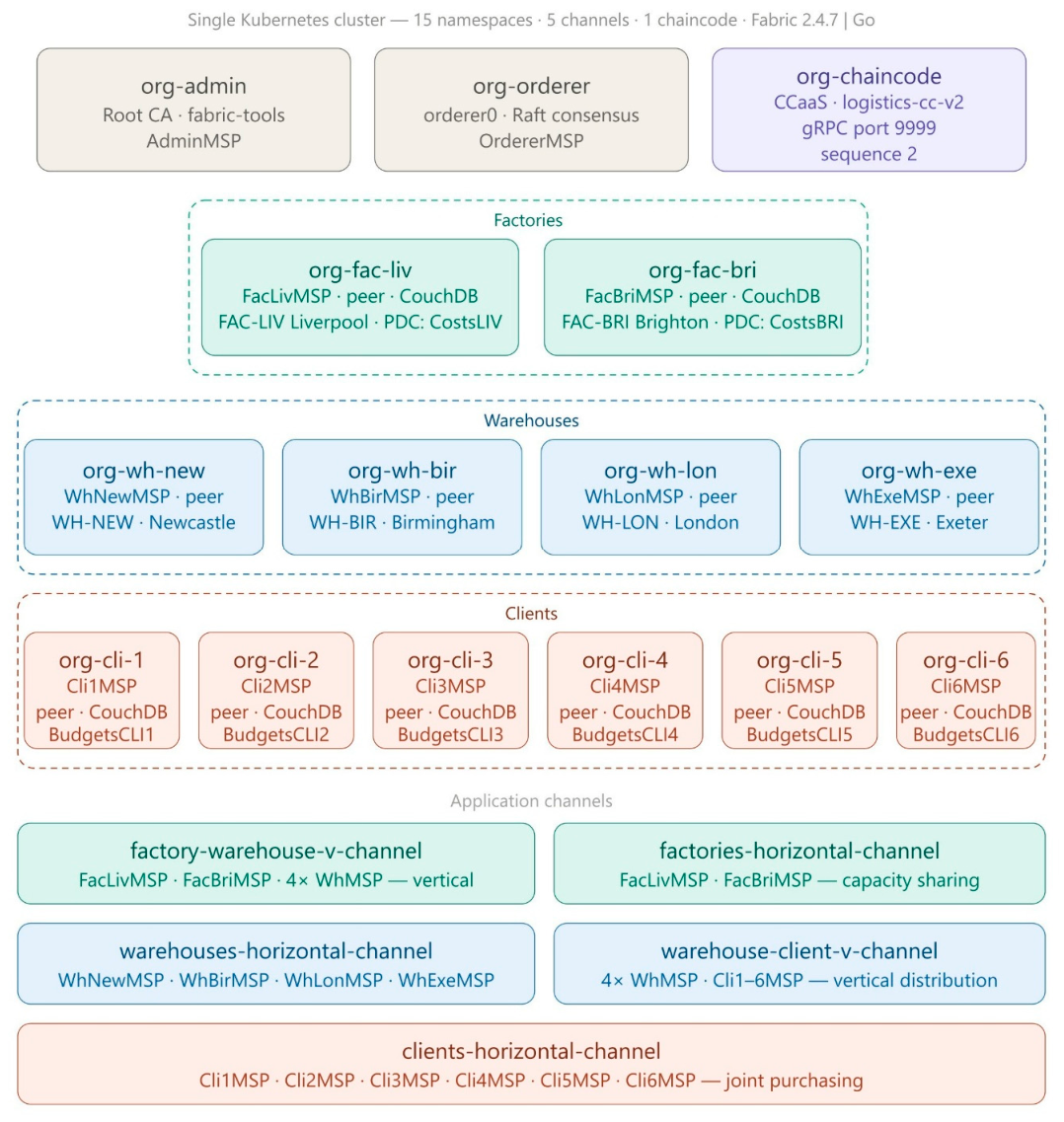
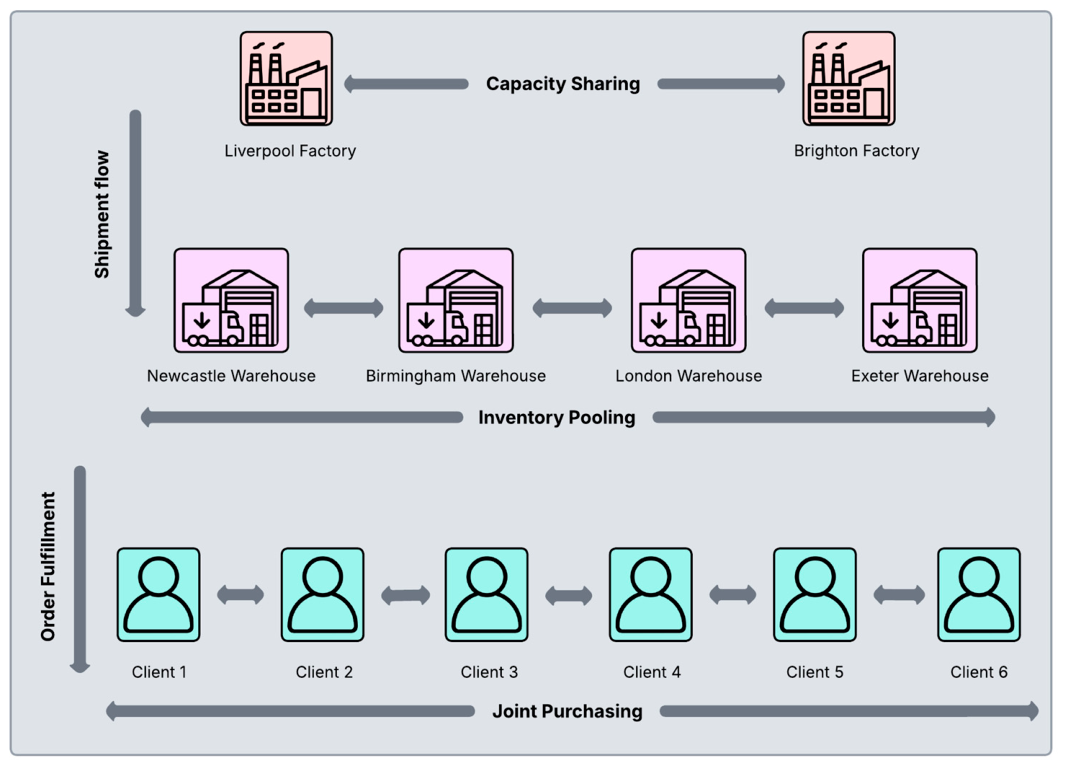
- A multi-organizational collaborative logistics network architecture comprising 15 Kubernetes namespaces, 12 independent MSPs, and five dedicated collaboration channels supporting both vertical and horizontal logistics interactions among factories, warehouses, and clients.
- A confidentiality-preserving collaboration design combining MSP-level organizational separation, channel-based governance, and twelve organization-specific PDC to support selective information sharing while maintaining competitive confidentiality among rival actors.
- A publicly reproducible implementation artifact including chaincode, Kubernetes deployment manifests, channel and PDC configurations, benchmark scripts, and deployment documentation released through a public repository and archived research artifact (GitHub + Zenodo DOI).
- A comprehensive empirical evaluation comprising 175 functional validation transactions and 3000 Hyperledger Caliper benchmark transactions executed across 12 controlled workload scenarios to assess governance enforcement, confidentiality preservation, latency, throughput, and resource utilization.
- A controlled analysis of confidentiality-related performance implications, including comparative benchmark scenarios designed to isolate and evaluate the operational impact of PDC-based information protection mechanisms within collaborative logistics workflows.
1.6. Paper Organization
2. Implementation: From Use Case to Operational Network
2.1. Study Case: UK Distribution Network
2.1.1. Network Topology and Business Context
2.1.2. Stakeholders, Roles, and Collaboration Objectives
2.2. Platform Selection: Hyperledger Fabric
2.2.1. Permissioned vs. Public Blockchain
2.2.2. Hyperledger Fabric Choice
2.3. Architectural Choice: Namespace-Based Network
2.3.1. Hardware Constraints and Architecture Design
2.3.2. Technology Decisions
2.4. Network Design
2.4.1. Network Architecture and Channel Design
2.4.2. Confidential Coordination via PDC
2.4.3. Collaborative Workflow Functions
2.4.4. Threat Model and Isolation Boundaries
2.4.5. Key Management and TLS Configuration
2.5. Infrastructure Configuration
2.6. Deployment Process
2.6.1. Deployment Phases
2.6.2. Test Methodology and Transaction Injection
3. Results
3.1. Implementation Journey: Platform Selection Through Iterative Learning
3.2. Operational Network Evidence
3.2.1. Network Deployment and Operational Metrics
3.2.2. Evaluation Framework
3.3. Protocol-Enforced Vertical Coordination
3.3.1. Problem and Mechanisms
3.3.2. Workflow Validation Results
3.3.3. Governance and Integrity Results
3.3.4. Operational Finding
3.4. Selective Transparency for Horizontal Collaboration
3.4.1. Problem and Mechanisms
3.4.2. Horizontal Collaboration Workflows
3.4.3. PDC Confidentiality Validation
3.4.4. Auditability Through Hash Commitments
3.4.5. Operational Finding
3.5. Performance and Operational Viability
3.5.1. Problem and Mechanisms
3.5.2. Load Scaling
3.5.3. PDC Overhead
3.5.4. Operational Finding
3.6. Governance Baseline: Fabric vs. Centralized Architecture
3.7. Results Summary
4. Discussion
4.1. Blockchain as Governance Infrastructure
4.2. Feasibility of Horizontal Collaboration Under Competitive Confidentiality
4.3. Infrastructure Barriers
4.4. Study Scope and Design Trade-Offs
4.5. Governance Assumptions and Industrial Extensions
4.6. Design Knowledge Derived from the Evaluated Artifact
5. Conclusions
Author Contributions
Funding
Data Availability Statement
Acknowledgments
Conflicts of Interest
Abbreviations
| SME | Small and Medium Enterprise |
| PDC | Private Data Collections |
| MSP | Membership Service Provider |
| DSR | Design Science Research |
| DSRM | Design Science Research Methodology |
| CA | Certificate Authority |
| HLF | Hyperledger Fabric |
| LTS | Long-Term Support |
| IPFS | InterPlanetary File System |
| DNS | Domain Name System |
| TLS | Transport Layer Security |
| RBAC | Role-Based Access Control |
| TPS | Transactions Per Second |
| SDK | Software Development Kit |
| CCaaS | Chaincode as a Service |
| ERP | Enterprise Resource Planning |
| EDI | Electronic Data Interchange |
| MVCC | Multi-Version Concurrency Control |
| CLI | Command Line Interface |
| PoC | Proof of Concept |
| gRPC | Google Remote Procedure Call |
| CRL | Certificate Revocation List |
| HSM | Hardware Security Module |
| mTLS | Mutual Transport Layer Security |
| PVC | Persistent Volume Claim |
| DP | Design Principle |
Appendix A
Appendix A.1. Algorithm A1: Vertical Shipment Lifecycle with State-Machine Enforcement
| Algorithm A1: InitiateShipment/ConfirmReceipt (vertical factory → warehouse) |
| Input: shipmentID, originFactoryID, destWarehouseID, productID, quantity Context: ctx (transaction context with client identity and ledger stub) 1: callerMSP ← cid.GetMSPID(ctx) 2: if callerMSP does not own originFactoryID then 3: return error “ACCESS_DENIED: only <ownerMSP> can endorse this proposal” 4: factory ← GetState(originFactoryID) 5: if factory = nil then return error “entity <originFactoryID> not found” 6: if factory.availableCapacity < quantity then 7: return error “proposing factory no longer has sufficient capacity” 8: warehouse ← GetState(destWarehouseID) 9: if warehouse = nil then return error “requesting warehouse <destWarehouseID> does not exist” 10: if GetState(shipmentID) ≠ nil then return error “shipment <shipmentID> already exists” 11: shipment ← { ID, origin, destination, product, quantity, status: “INITIATED”, initiatedAt: txTimestamp } 12: factory.availableCapacity ← factory.availableCapacity − quantity 13: PutState(originFactoryID, factory) // read-modify-write on shared key 14: PutState(shipmentID, shipment) 15: return success(shipment) --- ConfirmReceipt (invoked later by destination warehouse) --- 16: callerMSP ← cid.GetMSPID(ctx) 17: shipment ← GetState(shipmentID) 18: if shipment = nil then return error “shipment <shipmentID> not found” 19: if callerMSP does not own shipment.destination then 20: return error “ACCESS_DENIED: order <id> belongs to <ownerMSP>” 21: if shipment.status ≠ “INITIATED” then 22: return error “shipment <id> is not in initiated state (current: <status>)” 23: warehouse.currentStock ← warehouse.currentStock + shipment.quantity 24: shipment.status ← “DELIVERED”; shipment.confirmedAt ← txTimestamp 25: PutState(destWarehouseID, warehouse); PutState(shipmentID, shipment) 26: return success(shipment) |
Appendix A.2. Algorithm A2: PDC Confidential Write and Cross-MSP Access Control with SHA-256 Commitment
| Algorithm A2: StorePrivateCosts / QueryOwnPrivateData/QueryCompetitorPublicData |
| Context: ctx (transaction context); transient map carries private payload --- StorePrivateCosts (confidential write) --- 1: callerMSP ← cid.GetMSPID(ctx) 2: collection ← collectionForMSP(callerMSP) // e.g. FacLivMSP → “CostsLIV” 3: if collection = nil then 4: return error “ACCESS_DENIED: unknown MSP type (caller: <callerMSP>)” 5: privatePayload ← GetTransient(ctx)[“costs”] // {unitCost, margin}, never on public ledger 6: if privatePayload = nil then 7: return error “no private data found in <collection> for key <entityID>” 8: PutPrivateData(collection, entityID, privatePayload) // side-DB of owning MSP only 9: if PutPrivateData failed then 10: return error “failed to store private costs in <collection>” 11: hash ← GetPrivateDataHash(collection, entityID) // SHA-256, computed by Fabric 12: publicRecord ← GetState(entityID) 13: publicRecord.privateCostsHash ← hash // commitment on public ledger 14: PutState(entityID, publicRecord) 15: return success(hash) --- QueryOwnPrivateData (authorized read) --- 16: callerMSP ← cid.GetMSPID(ctx) 17: collection ← collectionForMSP(callerMSP) 18: data ← GetPrivateData(collection, entityID) 19: if data = nil then return error “no private data found in <collection> for key <entityID>” 20: return success(data) // plaintext to owning MSP --- QueryCompetitorPublicData / VerifyPrivacyBoundary (cross-MSP attempt) --- 21: callerMSP ← cid.GetMSPID(ctx) 22: targetCollection ← collectionForEntity(targetEntityID) // e.g. “CostsBRI” 23: // PDC policy OR(‘<owner>MSP.member’) is enforced by Fabric’s gossip layer: 24: // a non-owning peer never received the private data, independent of this code. 25: hashOnChain ← GetPrivateDataHash(targetCollection, targetEntityID) // visible to all 26: attempt ← GetPrivateData(targetCollection, targetEntityID) 27: if attempt = nil then // caller’s peer holds no copy → boundary holds 28: return { cryptographicBoundary: true, privateDataAccessible: false, publicHash: hashOnChain } 29: else 30: return { cryptographicBoundary: false, privateDataAccessible: true } // owner only |
References
- Cao, M.; Zhang, Q. Supply Chain Collaboration: Impact on Collaborative Advantage and Firm Performance. J. Oper. Manag. 2011, 29, 163–180. [Google Scholar] [CrossRef] [Scilit]
- Christopher, M.; Holweg, M. “Supply Chain 2.0”: Managing Supply Chains in the Era of Turbulence. Int. J. Phys. Distrib. Logist. Manag. 2011, 41, 63–82. [Google Scholar] [CrossRef] [Scilit]
- Dutta, P.; Choi, T.M.; Somani, S.; Butala, R. Blockchain Technology in Supply Chain Operations: Applications, Challenges and Research Opportunities. Transp. Res. E Logist. Transp. Rev. 2020, 142, 102067. [Google Scholar] [CrossRef] [Scilit] [PubMed]
- Cruijssen, F.; Cools, M.; Dullaert, W. Horizontal Cooperation in Logistics: Opportunities and Impediments. Transp. Res. E Logist. Transp. Rev. 2007, 43, 129–142. [Google Scholar] [CrossRef] [Scilit]
- Pomponi, F.; Fratocchi, L.; Tafuri, S.R. Trust Development and Horizontal Collaboration in Logistics: A Theory Based Evolutionary Framework. Supply Chain Manag. Int. J. 2015, 20, 83–97. [Google Scholar] [CrossRef] [Scilit]
- Nakamoto, S. Bitcoin: A Peer-to-Peer Electronic Cash System; White Paper. 2008. Available online: https://bitcoin.org/bitcoin.pdf (accessed on 19 July 2026).
- Androulaki, E.; Barger, A.; Bortnikov, V.; Muralidharan, S.; Cachin, C.; Christidis, K.; De Caro, A.; Enyeart, D.; Murthy, C.; Ferris, C.; et al. Hyperledger Fabric: A Distributed Operating System for Permissioned Blockchains. In Proceedings of the 13th EuroSys Conference, EuroSys 2018; Association for Computing Machinery, Inc.: New York, NY, USA, 2018. [Google Scholar] [CrossRef] [Scilit]
- Helo, P.; Hao, Y. Blockchains in Operations and Supply Chains: A Model and Reference Implementation. Comput. Ind. Eng. 2019, 136, 242–251. [Google Scholar] [CrossRef] [Scilit]
- Wang, Y.; Han, J.H.; Beynon-Davies, P. Understanding Blockchain Technology for Future Supply Chains: A Systematic Literature Review and Research Agenda. Supply Chain Manag. 2019, 24, 62–84. [Google Scholar] [CrossRef] [Scilit]
- Cachin, C.; Schubert, S.; Vukolić, M. Non-Determinism in Byzantine Fault-Tolerant Replication. In Proceedings of the Leibniz International Proceedings in Informatics, LIPIcs; Schloss Dagstuhl–Leibniz-Zentrum fur Informatik GmbH, Dagstuhl Publishing: Wadern, Germany, 2017; Volume 70, pp. 24.1–24.16. [Google Scholar]
- Christidis, K.; Devetsikiotis, M. Blockchains and Smart Contracts for the Internet of Things. IEEE Access 2016, 4, 2292–2303. [Google Scholar] [CrossRef] [Scilit]
- Li, M.; Shen, L.; Huang, G.Q. Blockchain-Enabled Workflow Operating System for Logistics Resources Sharing in E-Commerce Logistics Real Estate Service. Comput. Ind. Eng. 2019, 135, 950–969. [Google Scholar] [CrossRef] [Scilit]
- Choi, T.M.; Siqin, T. Blockchain in Logistics and Production from Blockchain 1.0 to Blockchain 5.0: An Intra-Inter-Organizational Framework. Transp. Res. E Logist. Transp. Rev. 2022, 160, 102653. [Google Scholar] [CrossRef] [Scilit]
- Treiblmaier, H. The Impact of the Blockchain on the Supply Chain: A Theory-Based Research Framework and a Call for Action. Supply Chain Manag. 2018, 23, 545–559. [Google Scholar] [CrossRef] [Scilit]
- Jensen, T.; Hedman, J.; Henningsson, S. How TradeLens Delivers Business Value with Blockchain Technology. MIS Q. Exec. 2019, 18, 221–243. [Google Scholar] [CrossRef] [Scilit]
- Jovanovic, M.; Kostić, N.; Sebastian, I.M.; Sedej, T. Managing a Blockchain-Based Platform Ecosystem for Industry-Wide Adoption: The Case of TradeLens. Technol. Forecast. Soc. Change 2022, 184, 121981. [Google Scholar] [CrossRef] [Scilit]
- Choi, T.M. Blockchain-Technology-Supported Platforms for Diamond Authentication and Certification in Luxury Supply Chains. Transp. Res. E Logist. Transp. Rev. 2019, 128, 17–29. [Google Scholar] [CrossRef] [Scilit]
- Balci, G.; Surucu-Balci, E. Blockchain Adoption in the Maritime Supply Chain: Examining Barriers and Salient Stakeholders in Containerized International Trade. Transp. Res. E Logist. Transp. Rev. 2021, 156, 102539. [Google Scholar] [CrossRef] [Scilit]
- IBM. IBM Food Trust: Transforming Food Transparency; IBM: Armonk, NY, USA, 2022. [Google Scholar]
- Chang, S.E.; Chen, Y.C.; Wu, T.C. Exploring Blockchain Technology in International Trade: Business Process Re-Engineering for Letter of Credit. Ind. Manag. Data Syst. 2019, 119, 1712–1733. [Google Scholar] [CrossRef] [Scilit]
- Agrawal, T.K.; Kumar, V.; Pal, R.; Wang, L.; Chen, Y. Blockchain-Based Framework for Supply Chain Traceability: A Case Example of Textile and Clothing Industry. Comput. Ind. Eng. 2021, 154, 107130. [Google Scholar] [CrossRef] [Scilit]
- Durach, C.; Kembro, J.; Wieland, A. A New Paradigm for Systematic Literature Reviews in Supply Chain Management. J. Supply Chain Manag. 2017, 53, 67–85. [Google Scholar] [CrossRef] [Scilit]
- Cho, G.; Go, Y.; Kim, M. A Hyperledger Fabric-Based SBOM Management System for Secure Software Supply Chain Integrity. Electronics 2026, 15, 2573. [Google Scholar] [CrossRef] [Scilit]
- Ravi, D.; Ramachandran, S.; Vignesh, R.; Falmari, V.R.; Brindha, M. Privacy Preserving Transparent Supply Chain Management through Hyperledger Fabric. Blockchain Res. Appl. 2022, 3, 100072. [Google Scholar] [CrossRef] [Scilit]
- Neto, B.; Febra, J.; Durães, P.; Domingues, P.; Antunes, C.M.; Maximiano, M.; Gomes, R.; Távora, V.; Remédios, O. Supply Chain Traceability by Recording EPCIS Data on Hyperledger Fabric. Procedia Comput. Sci. 2026, 278, 709–716. [Google Scholar] [CrossRef] [Scilit]
- Rahaman, M.; Tabassum, F.; Arya, V.; Bansal, R. Secure and Sustainable Food Processing Supply Chain Framework Based on Hyperledger Fabric Technology. Cyber Secur. Appl. 2024, 2, 100045. [Google Scholar] [CrossRef] [Scilit]
- Keo, R.; Firdaus, M.; Rhee, K.-H. A Secure Rubber Supply Chain Management System Based on Hyperledger Fabric Blockchain: A Use Case in Cambodia. Front. Blockchain 2025, 8, 1474329. [Google Scholar] [CrossRef] [Scilit]
- Ni, L.; Irannezhad, E. Performance Analysis of LogisticChain: A Blockchain platform for Maritime Logistics. Comput. Ind. 2024, 154, 104038. [Google Scholar] [CrossRef] [Scilit]
- Zhou, Z.; Feng, Y.; Sakurai, K. Design and Implementation of a Trusted Food Supply Chain Traceability System with Incentive Using Hyperledger Fabric. Computers 2026, 15, 108. [Google Scholar] [CrossRef] [Scilit]
- Duman, E.; Aydoğan, E. Enhancing Traceability and Reliability in Cold Chain Logistics Through Hyperledger Fabric and IoT. Appl. Sci. 2025, 15, 12149. [Google Scholar] [CrossRef] [Scilit]
- Sayar, A.; Kurtbaş, M.C.; Sancaktar, Ç.; Kabak, R.D.; Çakmak, Ş. Application of Hyperledger Blockchain Technology to Logistics Supply Chain with IoT. Procedia Comput. Sci. 2025, 252, 814–823. [Google Scholar] [CrossRef] [Scilit]
- Ismail, S.; Othman, B.; Reza, H.; Teshome Hunde, E. Towards an Agentic AI-Enabled Blockchain-Based Fish Supply Chain Using Hyperledger Fabric. Electronics 2026, 15, 1916. [Google Scholar] [CrossRef] [Scilit]
- Kutybayeva, K.; Razaque, A.; Rai, H.M. Enhancing Pharmaceutical Supply Chain Transparency and Security with Blockchain and Big Data Integration. Procedia Comput. Sci. 2025, 259, 1511–1522. [Google Scholar] [CrossRef] [Scilit]
- Naga Sudha, C.M.; Nayahi J, J.V. TrackChain: Hyperledger Based Pharmaceutical Supply Chain–Resource Utilization Perspective. Heliyon 2024, 10, e23250. [Google Scholar] [CrossRef] [Scilit] [PubMed]
- Zineb, K.I.; Mohamed, L.; Hamid, H.; Meryem, Y.; Ghita, L.; Hanae, H. BlockSupply: Blockchain-Based Logistics Traceability Solution. Softw. Impacts 2024, 21, 100666. [Google Scholar] [CrossRef] [Scilit]
- Qiao, M.; Chen, X.; Zhou, Y.; Mok, P.Y. Blockchain-Driven Innovation in Fashion Supply Chain Contractual Party Evaluations as an Emerging Collaboration Model. Blockchain Res. Appl. 2025, 6, 100266. [Google Scholar] [CrossRef] [Scilit]
- Chou, C.-C.; Richard Hwang, N.-C.; Li, C.-W.; Wang, T.; Wang, Y.-Y. Implementing a Multichain Framework Using Hyperledger for Supply Chain Transparency in a Dynamic Partnership: A Feasibility Study. Comput. Ind. Eng. 2023, 175, 108906. [Google Scholar] [CrossRef] [Scilit]
- Peffers, K.; Tuunanen, T.; Rothenberger, M.A.; Chatterjee, S. A Design Science Research Methodology for Information Systems Research. J. Manag. Inf. Syst. 2007, 24, 45–77. [Google Scholar] [CrossRef] [Scilit]
- Hevner, A.R.; March, S.T.; Park, J.; Ram, S. Design Science in Information Systems Research. MIS Q. 2004, 28, 75–106. [Google Scholar] [CrossRef] [Scilit]
- Williams, H.P. Model Building in Mathematical Programming, 5th ed.; John Wiley & Sons: Chichester, UK, 2013; ISBN 9781118443330. [Google Scholar]
- Caldarola, F.; d’Atri, G.; Zanardo, E. Neural Fairness Blockchain Protocol Using an Elliptic Curves Lottery. Mathematics 2022, 10, 3040. [Google Scholar] [CrossRef] [Scilit]




| System/Study | Scope | Privacy Mechanism | Deployment Model | Evaluation Depth | Public Artifact |
|---|---|---|---|---|---|
| TradeLens [15,16] | Global vertical shipping; documentation | Channel-based (Coarse isolation) | Enterprise Cloud (Proprietary HLF) | Anecdotal: Adoption and port efficiency metrics | ❌ |
| IBM Food Trust [19] | Vertical farm-to-retail; provenance | Channel-based (Membership only) | IBM Managed Cloud (SaaS) | Anecdotal: Trace-time reduction logs | ❌ |
| Helo & Hao [8] | Vertical buyer-supplier operations | None: Single-channel (Full visibility) | Simulated (2-node local prototype) | Functional: System walkthrough/logic test | ❌ |
| Li et al. [12] | Cross-org logistics resource sharing | Channel-level (Shared visibility) | Unspecified Fabric prototype | Functional: Coordination logic (No stress test) | ❌ |
| Chang et al. [20] | Vertical trade finance (Letters of Credit) | Logic-based: ABAC in chaincode | Conceptual (Case study analysis) | Conceptual: Algorithmic validation only | ❌ |
| Agrawal et al. [21] | Vertical textile traceability | None: Ledger-wide (Public to members) | Permissioned PoC (Centralized) | Functional: Proof-of-concept transactions | ❌ |
| This Study | Vertical + Horizontal (Competitor Coordination) | PDC-based (Field-level isolation) | Multi-Org: 15-namespace/12 MSPs single-cluster K8s | Empirical: 3000+ tx Caliper benchmarks + Adversarial testing | ✅ (GitHub (v3.5.6) + Zenodo) |
| Study | Operational Artifact | Vertical Collaboration | Horizontal Collaboration | Confidentiality Mechanism | Empirical Evaluation |
|---|---|---|---|---|---|
| Cho et al. (2026) [23] | ✓ | ✓ | ✗ | Organization-specific PDCs | ✓ |
| Ravi et al. (2022) [24] | ✓ | ✓ | ✗ | Private channels | ✓ |
| Neto et al. (2026) [25] | ✓ | ✓ | ✗ | Dual public/private channels | ✓ |
| Rahaman et al. (2024) [26] | ✓ | ✓ | ✗ | Access-control policies | ✓ |
| Keo et al. (2025) [27] | ✓ | ✓ | ✗ | No implemented confidentiality mechanism (metadata discussion only) | ✓ |
| Ni & Irannezhad (2024) [28] | ✓ | ✓ | ✗ | None | ✓ |
| Zhou et al. (2026) [29] | ✓ | ✓ | ✗ | PDC discussed (not competitor-specific) | ✓ |
| Duman & Aydoğan (2025) [30] | ✓ | ✓ | ✗ | Role-based access control | ✓ |
| Sayar et al. (2025) [31] | ✓ | ✓ | ✗ | MSP/CA authentication | ✓ |
| Ismail et al. (2026) [32] | ✓ | ✓ | ✗ | None | ✓ |
| Kutybayeva et al. (2025) [33] | Partial | ✓ | ✗ | None | Limited |
| Naga Sudha et al. (2024) [34] | ✓ | ✓ | ✗ | None | ✓ |
| Kamal Idrissi et al. (2024) [35] | ✓ | ✓ | ✗ | None | ✓ |
| Qiao et al. (2025) [36] | Partial | ✓ | ✗ | None | Limited |
| Chou et al. (2023) [37] | ✓ | ✓ | Partial | Multichain/channel isolation | ✓ |
| This study | ✓ | ✓ | ✓ | Organization-specific PDC | Functional validation + adversarial testing + Caliper benchmarking (>3000 transactions) |
| DSRM Activity | Realized in | Evidence |
|---|---|---|
| 1. Problem identification and motivation | Section 1.1, Section 1.2 and Section 1.3 | Documented theory–practice gap: vertical transparency vs. horizontal confidentiality tension; structured review of prior implementations (Table 1 and Table 2) |
| 2. Definition of objectives for a solution | Section 1.4 (RQ1–RQ3), Section 1.5 (Contributions) | Explicit, falsifiable research questions targeting architecture, confidentiality preservation, and performance characteristics |
| 3. Design and development | Section 2 (entire); iterated per Section 3.1 | 15-namespace, 12-MSP, 5-channel architecture; four deployment iterations, each evaluated and fed back into redesign before convergence |
| 4. Demonstration | Section 3.2, Section 3.3 and Section 3.4 (V1–V4, AV1–AV3) | Artifact executed against six vertical shipment lifecycles and horizontal capacity-sharing, inventory-pooling, and joint-purchasing scenarios |
| 5. Evaluation | Section 3.4.3 (P1a–P1c, G1, INT1), Section 3.5, Section 3.6 | Adversarial PDC-boundary testing, governance-violation attempts, Caliper performance benchmarking, and comparison against a centralized RBAC baseline—assessing whether the stated objectives (Activity 2) were actually met, not merely whether the artifact runs |
| 6. Communication | This manuscript; GitHub + Zenodo artifact | Full chaincode, deployment manifests, and benchmark configurations publicly archived for independent replication |
| Organization | MSP | Namespace | CA | Role |
|---|---|---|---|---|
| FAC-LIV | FacLivMSP | org-fac-liv | ca.facliv | Factory |
| FAC-BRI | FacBriMSP | org-fac-bri | ca.facbri | Factory |
| WH-NEW | WhNewMSP | org-wh-new | ca.whnew | Warehouse |
| WH-BIR | WhBirMSP | org-wh-bir | ca.whbir | Warehouse |
| WH-LON | WhLonMSP | org-wh-lon | ca.whlon | Warehouse |
| WH-EXE | WhExeMSP | org-wh-exe | ca.whexe | Warehouse |
| CLI-1 to CLI-6 | Cli1MSP–Cli6MSP | org-cli-1 to org-cli-6 | ca.cli1–ca.cli6 | Client |
| — | AdminMSP | org-admin | ca.admin | Network Governance |
| — | OrdererMSP | org-orderer | ca.orderer | Consensus service |
| — | — | org-chaincode | — | Chaincode execution |
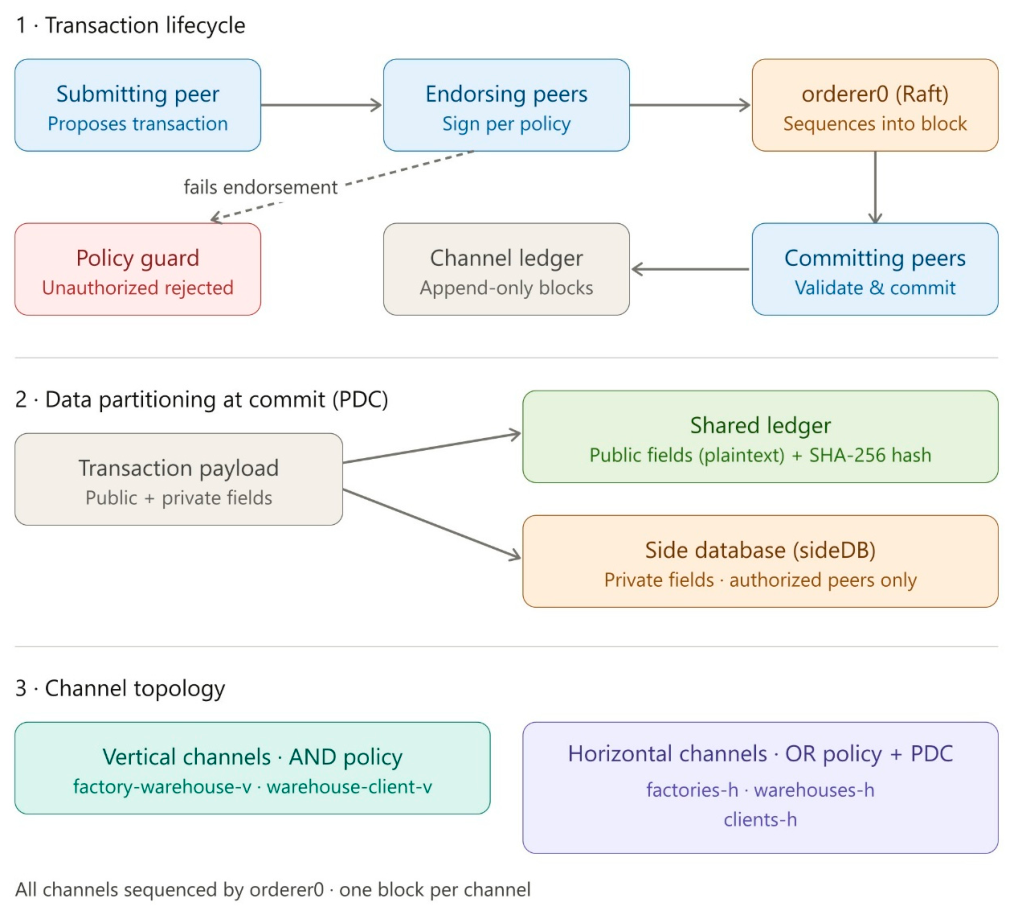
| Channel | Collaboration Type | Member MSPs | Representative Functions |
|---|---|---|---|
| Factory-warehouse-v-channel | Vertical | FacLivMSP, FacBriMSP, 4× WhMSP | InitiateShipment, ConfirmReceipt |
| Warehouse-client-v-channel | Vertical | 4× WhMSP, 6× CliMSP | PlaceOrder, ConfirmDelivery |
| Factories-horizontal-channel | Horizontal | FacLivMSP, FacBriMSP | ProposeCapacityShare, StorePrivateCosts |
| Warehouses-horizontal-channel | Horizontal | WhNewMSP, WhBirMSP, WhLonMSP, WhExeMSP | RequestInventoryTransfer, StorePrivatePricing |
| Clients-horizontal-channel | Horizontal | Cli1MSP–Cli6MSP | ProposeJointOrder, StorePrivateBudget |
| Collection | Policy | Stored Fields |
|---|---|---|
| CostsLIV | OR(‘FacLivMSP.member’) | unitCost, margin |
| CostsBRI | OR(‘FacBriMSP.member’) | unitCost, margin |
| PricingNEW | OR(‘WhNewMSP.member’) | storageCost, markup |
| PricingBIR | OR(‘WhBirMSP.member’) | storageCost, markup |
| PricingLON | OR(‘WhLonMSP.member’) | storageCost, markup |
| PricingEXE | OR(‘WhExeMSP.member’) | storageCost, markup |
| BudgetsCLI1–CLI6 | OR(‘Cli[N]MSP.member’) | maxPricePerUnit, totalBudget |
| Adversary Class | Covered by This Study | Mitigation Present | Future Extension |
|---|---|---|---|
| Passive insider (unauthorized PDC/state access attempt) | Yes | PDC isolation, MSP identity checks, mTLS | — |
| Malicious cluster administrator | No | None in single-cluster deployment | VM or multi-cluster isolation |
| Compromised Kubernetes node (non-admin) | No | Namespace NetworkPolicies limit lateral movement | Node-level runtime security controls |
| Compromised certificate authority | No | Independent root CA per organization (Section 2.4.5) | HSMs, key rotation, revocation management (Section 4.5) |
| Malicious orderer operator | No | None in single-orderer deployment | Multi-organization ordering service (Section 4.5) |
| Malicious chaincode developer | Partially | Multi-organization chaincode approval required before commitment (Phase 8, Section 2.6.1) | Independent chaincode audit process |
| Colluding organizations | No | Not preventable through protocol-level access control | Governance and contractual mechanisms |
| Denial-of-service attacks | No | Not evaluated | Distributed deployment and infrastructure protections |
| Metadata inference attacks | Partial | PDC hides content, not transaction existence, timing, or size | Traffic shaping or batching—see below |
| Property | Namespace Isolation (This Study) | VM/Multi-Cluster Isolation |
|---|---|---|
| Boundary type | Logical (NetworkPolicy + RBAC) | Hypervisor or physical |
| Shared control plane | Yes (single etcd, single API server) | No |
| Cross-org secret access | Possible for cluster-admin | Not possible |
| Fabric protocol isolation | Full (independent CA, MSP, TLS per org) | Full |
| PDC access-control enforcement | Full | Full |
| Suitable for adversarial production | No | Yes |
| Suitable for trusted research consortium | Yes | Yes |
| Parameter | Value |
|---|---|
| Hardware | Single laptop (Lenovo ThinkPad L15) |
| CPU allocated to Kubernetes | 8 cores (AMD Ryzen 7 Pro, 2.6 GHz) |
| RAM allocated to Kubernetes | 16 GB |
| Kubernetes distribution | Rancher Desktop v1.20.0 (dockerd/moby) |
| Hyperledger Fabric version | 2.4.7 LTS |
| Fabric CA version | 1.5.5 |
| State database | CouchDB 3.2.1 (per organization) |
| Orderer consensus | Raft (single-node) |
| Block size (MaxMessageCount) | 10 transactions |
| Batch timeout | 2 s |
| Namespaces | 15 |
| Independent MSPs | 12 |
| Channels | 5 |
| Chaincode deployment | CCaaS (Chaincode as a Service) |
| PDCs | 12 |
| Caliper version | 0.6.0 |
| Chaincode language | Go |
| Phase | Objective | Key Activities | Critical Success Factor |
|---|---|---|---|
| 1. Environment Setup | Establish Kubernetes infrastructure | Install Rancher Desktop v1.20.0, configure dockerd runtime, allocate 16 GB RAM/8 CPU cores, install Fabric binaries (peer, configtxgen, cryptogen, osnadmin) | Fabric binaries in PATH; CoreDNS and metrics-server running |
| 2. Namespace Creation | Create 15 organizational boundaries | Create all 15 namespaces; apply default-deny NetworkPolicies; configure cross-namespace allow rules | Cross-namespace DNS resolution functional; isolation verified |
| 3. CA Deployment | Deploy 12 independent CAs | Deploy Fabric CA per operational namespace; initialize unique root CA per org; configure TLS CA | 12 CA pods at 1/1 Running; no certificate conflicts |
| 4. Crypto Generation | Generate MSP structures for all 12 orgs | Enroll peer/admin identities; generate MSP directories; create TLS certificates; package as Kubernetes Secrets | Complete independent MSP structure per org; cross-org TLS bundle validated |
| 5. Peer Deployment | Deploy 12 independent peer nodes | Deploy CouchDB + peer containers per namespace; mount MSP/TLS secrets; verify gossip | All 12 peer pods at 1/1 Running; CouchDB accessible per org |
| 6. Orderer Deployment | Deploy consensus service | Generate genesis block; deploy single-node Raft orderer; expose service via DNS | Orderer reachable from all peer namespaces |
| 7. Channel Creation | Create 5 collaboration channels | Generate channel configs; create channels (osnadmin); join peers; configure anchor peers | All 5 channels created with correct MSP membership |
| 8. Chaincode Deployment | Deploy smart contracts with PDC | Package and install chaincode; approve per org; commit to channels; configure 12 PDCs | Identical PDC configurations across all approving orgs; chaincode initialized |
| 9. Validation and Benchmarking | Verify functionality and collect evidence | Execute 175 CLI operations; execute 3000 Caliper benchmark transactions; verify confidentiality and governance | All 175 CLI operations successful; PDC isolation confirmed |
| Round | Function | Channel | PDC | Workers | Send Rate (TPS) | Tx Count | Purpose |
|---|---|---|---|---|---|---|---|
| R1 | InitiateShipment | factory-warehouse-v | None | 2 | 5 | 200 | Invoke baseline, low load |
| R2 | InitiateShipment | factory-warehouse-v | None | 5 | 10 | 300 | Same function, medium load |
| R3 | InitiateShipment | factory-warehouse-v | None | 10 | 20 | 400 | Same function, high load |
| R4 | StorePrivateCosts | factories-horizontal | CostsLIV | 2 | 5 | 200 | PDC invoke—identical load to R1 |
| R5 | StorePrivateCosts | factories-horizontal | CostsLIV | 5 | 10 | 300 | PDC invoke—identical load to R2 |
| R6 | StorePrivatePricing | warehouses-horizontal | PricingNEW | 5 | 10 | 200 | PDC write, warehouse tier |
| R7 | QueryFactory | factory-warehouse-v | None | 5 | 20 | 250 | Public query baseline |
| R8 | QueryFactory | factory-warehouse-v | None | 10 | 40 | 300 | Same query, peak load |
| R9 | QueryOwnPrivateData | factories-horizontal | CostsLIV | 5 | 20 | 250 | PDC query—identical load to R7 |
| R10 | QueryOwnPrivateData | factories-horizontal | CostsLIV | 10 | 40 | 300 | PDC query—identical load to R8 |
| R11 | ProposeJointOrder | clients-horizontal | None | 5 | 10 | 150 | Client horizontal invoke |
| R12 | StorePrivateBudget | clients-horizontal | BudgetsCLI1 | 5 | 10 | 150 | Client PDC write |
| Test Group | Research Question | Method | Transaction Count |
|---|---|---|---|
| V1–V4: Collaboration workflows | RQ1 | CLI functional tests | 74 invokes + queries |
| P1a–P1c: PDC confidentiality | RQ2 | CLI controlled access tests | 40 invokes + queries |
| G1: Governance enforcement | RQ2 | CLI unauthorized attempts | 12 blocked invokes |
| INT1: Ledger immutability | RQ1 | CLI rejection tests | 5 invokes + queries |
| AV1–AV3: Added-value scenarios | RQ1 + RQ2 | CLI cross-org observations | 44 invokes + queries |
| R1–R12: Caliper benchmarks | RQ3 | Automated load testing | 3000 transactions |
| Total | 3175 operations |
| Test | Logistics Problem Addressed | Key Mechanism | Invokes | Queries | Result | Operational Finding |
|---|---|---|---|---|---|---|
| V1 | Vertical information asymmetry and process sequencing | Shared ledger + endorsement + state machine | 36 ✅ | 12 ✅ | PASSED | Cross-peer byte-identical synchronization; sequential lifecycle enforced |
| V2 | Factory horizontal coordination with cost confidentiality | MSP isolation + PDC (CostsLIV/CostsBRI) + channel | 15 ✅ | 12 ✅ | PASSED | Capacity sharing completed; cost data inaccessible to competitor |
| V3 | Warehouse inventory pooling with pricing confidentiality | MSP isolation + PDC (PricingNEW–EXE) + channel | 12 ✅ | 10 ✅ | PASSED | Inventory transfers executed; storage pricing remained protected |
| V4 | Client joint purchasing with budget confidentiality | MSP isolation + PDC (BudgetsCLI1–6) + channel | 11 ✅ | 0 | PASSED | Price negotiation completed; individual budgets unexposed |
| P1a | Own PDC data access verification | Fabric gossip dissemination to authorized MSP peers | 8 ✅ | 6 ✅ | PASSED | All 12 orgs read own plaintext; protocol delivers private data correctly |
| P1b | Cross-org PDC access prevention | Fabric gossip rejection at dissemination layer | — | 5 ✅ blocked | PASSED | cryptographicBoundary:true; cross-tier blocked at channel level |
| P1c | Hash commitment visibility to non-owners | SHA-256 hash on public ledger | — | 3 ✅ | PASSED | Hash consistent across all querying orgs; audit proof accessible |
| G1 | Governance enforcement—unauthorized access | Channel membership + endorsement policies | 12 ✅ blocked | — | PASSED | 11/12 rejected via channel-not-found; 1/12 via state machine |
| INT1 | Ledger immutability against duplicate writes | Chaincode state machine | 4 ✅ blocked | 1 ✅ | PASSED | All duplicate/out-of-sequence writes rejected before ordering |
| AV1 | Simultaneous transparency and confidentiality | Shared ledger + PDC partition | 2 ✅ | 5 ✅ | PASSED | Three org perspectives confirm selective visibility |
| AV2 | Cross-channel state isolation | Channel membership boundaries | 3 ✅ | 4 ✅ | PASSED | Horizontal state change does not propagate to vertical channel |
| AV3 | PDC hash as live audit proof | SHA-256 dynamic commitment | 2 ✅ | 4 ✅ | PASSED | Hash changes on private data update—proves live binding |
| Sub-Test | Calling MSP | Target Collection | Expected Result | Actual Result | Protocol Evidence |
|---|---|---|---|---|---|
| P1a—FAC-LIV own read | FacLivMSP | CostsLIV | Plaintext returned | ✅ Plaintext returned | unitCost:52.30, margin:18 |
| P1a—FAC-BRI own read | FacBriMSP | CostsBRI | Plaintext returned | ✅ Plaintext returned | unitCost:48.50, margin:21 |
| P1a—WH-NEW own read | WhNewMSP | PricingNEW | Plaintext returned | ✅ Plaintext returned | storageCost, markup fields |
| P1a—CLI-1 own read | Cli1MSP | BudgetsCLI1 | Plaintext returned | ✅ Plaintext returned | maxPricePerUnit, totalBudget |
| P1b—FAC-BRI → CostsLIV | FacBriMSP | CostsLIV | Rejected at protocol | ✅ Rejected | cryptographicBoundary:true, privateDataAccessible:false |
| P1b—FAC-LIV → CostsBRI | FacLivMSP | CostsBRI | Rejected at protocol | ✅ Rejected | cryptographicBoundary:true, privateDataAccessible:false |
| P1b—WH-NEW → CostsLIV (cross-tier) | WhNewMSP | CostsLIV | Rejected at channel | ✅ Rejected (stronger) | channel ‘factories-horizontal-channel’ not found |
| P1b—WH-BIR → PricingNEW | WhBirMSP | PricingNEW | Rejected at protocol | ✅ Rejected | cryptographicBoundary:true, privateDataAccessible:false |
| P1b—WH-LON → PricingBIR | WhLonMSP | PricingBIR | Rejected at protocol | ✅ Rejected | cryptographicBoundary:true, privateDataAccessible:false |
| P1c—FAC-BRI queries FAC-LIV hash | FacBriMSP | Public ledger (FAC-LIV) | Hash visible | ✅ Hash visible | 5e07123270… |
| Round | Function | Channel | PDC | Workers | Send Rate (TPS) | Avg Latency (s) | Max Latency (s) | Throughput (TPS) |
|---|---|---|---|---|---|---|---|---|
| R1 | InitiateShipment | factory-warehouse-v | None | 2 | 5.0 | 1.82 | 1.94 | 5.0 |
| R2 | InitiateShipment | factory-warehouse-v | None | 5 | 10.1 | 0.99 | 1.08 | 10.0 |
| R3 | InitiateShipment | factory-warehouse-v | None | 10 | 20.1 | 0.58 | 0.76 | 19.9 |
| R4 | StorePrivateCosts | factories-horizontal | CostsLIV | 2 | 5.0 | 0.95 | 1.78 | 5.0 |
| R5 | StorePrivateCosts | factories-horizontal | CostsLIV | 5 | 10.1 | 0.54 | 0.99 | 10.0 |
| R6 | StorePrivatePricing | warehouses-horizontal | PricingNEW | 5 | 10.1 | 0.56 | 1.04 | 10.0 |
| R7 | QueryFactory | factory-warehouse-v | None | 5 | 20.2 | 0.02 | 0.06 | 20.1 |
| R8 | QueryFactory | factory-warehouse-v | None | 10 | 40.2 | 0.04 | 0.08 | 40.1 |
| R9 | QueryOwnPrivateData | factories-horizontal | CostsLIV | 5 | 20.1 | 0.03 | 0.10 | 20.1 |
| R10 | QueryOwnPrivateData | factories-horizontal | CostsLIV | 10 | 40.2 | 0.04 | 0.10 | 40.0 |
| R11 | ProposeJointOrder | clients-horizontal | None | 5 | 10.1 | 0.55 | 1.00 | 10.0 |
| R12 | StorePrivateBudget | clients-horizontal | BudgetsCLI1 | 5 | 10.1 | 0.56 | 1.03 | 10.0 |
| Governance Property | Centralized RBAC-Protected API + Database | Hyperledger Fabric (This Study) |
|---|---|---|
| Access control enforcement | Admin manually configures permissions; trust-dependent | Enforced via MSP + chaincode; trust-independent |
| Multi-party endorsement | Not native; requires custom workflow | Protocol-enforced policies per channel |
| Competitive data confidentiality | Admin-managed row/column permissions; trust-dependent | Per-organization PDCs with independent MSP policies |
| Audit trail integrity | Mutable database logs; admin can alter records | Immutable, hash-linked ledger; committed blocks cannot be modified |
| Transaction non-repudiation | Depends on logging configuration | Cryptographically signed by submitting organization MSP identity |
| Single point of trust | Yes; central operator controls all access | No; governance distributed across 12 independent MSP members |
| Data sovereignty | Single database owner holds all data | Each of 12 organizations maintains independent MSP, CA, and PDCs |
| Dimension | Test Conducted | Observed Result | Collaboration Implication |
|---|---|---|---|
| Ledger synchronization | Factory initiates shipment; warehouse queries independently | Byte-identical block number, hash, timestamp, state across independent MSP peers | Eliminates information asymmetry in vertical collaboration |
| Endorsement enforcement | Unauthorized out-of-sequence invocations attempted | 16/16 unauthorized or duplicate attempts rejected before ordering | Governance enforced ex ante; no ex post audit required |
| Channel-based visibility | Cross-tier and cross-channel queries executed | Organizations observe only transactions relevant to their channel membership | Enables differentiated visibility across supply-chain tiers |
| PDC confidentiality | Competing factories coordinate while querying each other’s collections | Own data returned as plaintext; competitor data returns cryptographicBoundary:true at gossip layer | Selective transparency enforced at protocol layer |
| PDC access control | 5 cross-org PDC access attempts submitted | 100% rejection; 4 at gossip layer, 1 at channel layer | Confidentiality enforced under deliberate adversarial attempts |
| Performance under load | 12 Caliper rounds; 3000 transactions; workers 2–10; TPS 5–40 | Invoke: 0.54–1.82 s at 5–20 TPS; Query: 0.02–0.04 s at 20–40 TPS | Operationally adequate for logistics consortium planning cycles |
| PDC performance overhead | Controlled pairs R7/R9, R8/R10, R11/R12—PDC sole variable | PDC read overhead ≤10 ms; PDC write overhead ~10 ms when endorsement held constant | Confidentiality introduces negligible overhead |
| Governance vs. centralized | Fabric vs. RBAC + database | Protocol-enforced endorsement, immutable audit, per-org PDC vs. administrator-dependent access | Trust-independent governance unavailable in centralized architectures |
| Resource viability | 15 namespaces, 12 peers, 12 CouchDB instances on single node | 1640m CPU (10%), 6055 MiB RAM (39%); zero pod failures | Independent per-organization deployment achievable within 16 GB |
| Governance Dimension | Theoretical Claim (Literature) | Operational Mechanism Observed | Governance Implication |
|---|---|---|---|
| Vertical transparency | Shared ledger reduces information asymmetry | Multi-party endorsement + unified shared ledger state | Coordination enforced ex ante, not reconciled ex post |
| Vertical control | Smart contracts automate processes | Endorsement policies prevent unauthorized state transitions | Unilateral actions become technically impossible |
| Horizontal collaboration | Blockchain enables trustless coopetition | PDC with per-organization MSP policies | Selective transparency without strategic exposure |
| Trust assumption | Trust shifts from organizations to system | Protocol-level validation replaces organizational trust | Governance embedded in infrastructure |
| Deployment feasibility | Each organization runs independent infrastructure | 12 independent MSPs on shared 15-namespace single-cluster architecture | Multi-organizational governance achievable under resource constraints |
| Performance–governance trade-off | Higher security requires more overhead | PDC overhead within measurement noise; endorsement policy held constant across functions; invoke latency governed by state contention (MVCC), not by confidentiality controls | Governance strictness calibratable per collaboration type without confidentiality penalty |
| Design Knowledge | Basis in This Study | Scope of Inference | Broader Implication |
|---|---|---|---|
| DP1 | Adversarial tests P1a–P1c | Protocol-level property | Commercial confidentiality should be implemented through protocol-level identity and data-distribution mechanisms rather than application-level access control alone. |
| DP2 | Governance tests G1 | Governance architecture | Layered enforcement reduces dependence on any single mechanism and provides in-depth defense against misconfiguration. |
| DP3 | Controlled benchmark design | Evaluation methodology | The method of isolating PDC as the sole variable generalizes to evaluating other confidentiality mechanisms; the specific overhead figures reported here characterize this testbed only and should not be assumed to hold at production scale. |
| DP4 | Discussion Section 4.5 | Architectural implication | Consortium designers should not treat confidentiality mechanisms as evidence of decentralized governance; sequencing authority and certificate trust require independent evaluation and, where needed, independent hardening. |
Disclaimer/Publisher’s Note: The statements, opinions and data contained in all publications are solely those of the individual author(s) and contributor(s) and not of MDPI and/or the editor(s). MDPI and/or the editor(s) disclaim responsibility for any injury to people or property resulting from any ideas, methods, instructions or products referred to in the content. |
© 2026 by the authors. Licensee MDPI, Basel, Switzerland. This article is an open access article distributed under the terms and conditions of the Creative Commons Attribution (CC BY) license.
Share and Cite
Chabba, Y.; El Oualidi, M.A.; Ahlaqqach, M. From Collaborative Logistics Theory to Implementation: A Multi-Organizational Hyperledger Fabric Network for Vertical and Horizontal Collaboration. Future Internet 2026, 18, 382. https://doi.org/10.3390/fi18080382
Chabba Y, El Oualidi MA, Ahlaqqach M. From Collaborative Logistics Theory to Implementation: A Multi-Organizational Hyperledger Fabric Network for Vertical and Horizontal Collaboration. Future Internet. 2026; 18(8):382. https://doi.org/10.3390/fi18080382
Chicago/Turabian StyleChabba, Yousra, Moulay Ali El Oualidi, and Mustapha Ahlaqqach. 2026. "From Collaborative Logistics Theory to Implementation: A Multi-Organizational Hyperledger Fabric Network for Vertical and Horizontal Collaboration" Future Internet 18, no. 8: 382. https://doi.org/10.3390/fi18080382
APA StyleChabba, Y., El Oualidi, M. A., & Ahlaqqach, M. (2026). From Collaborative Logistics Theory to Implementation: A Multi-Organizational Hyperledger Fabric Network for Vertical and Horizontal Collaboration. Future Internet, 18(8), 382. https://doi.org/10.3390/fi18080382