

Topology-Aware Joint Control Plane Placement and Assignment for Resilient Hierarchical Cloud–Edge Networks


Abstract
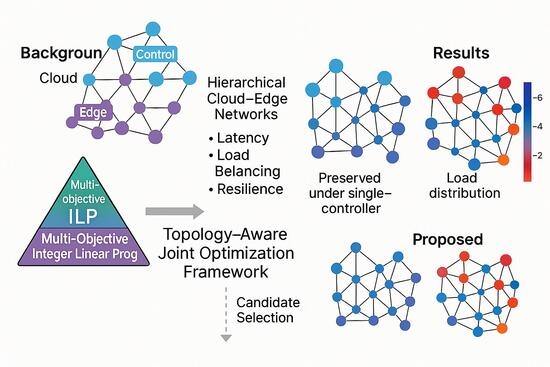
1. Introduction
- We propose a multi-objective ILP that integrates k-core decomposition and node degree as explicit optimization criteria alongside latency minimization and assignment coverage, enabling the network’s structural backbone to directly guide resilient controller placement decisions.
- We introduce five topology-aware candidate selection strategies of polynomial complexity and provide a systematic comparison of structural criteria, from local degree to global core number, for controller placement, together with a complete complexity analysis.
- We design a two-phase heuristic framework that separates candidate selection from switch assignment, guarantees per-switch redundancy through minimum assignment constraints, and enforces controller capacity limits using a proximity-driven greedy assignment algorithm.
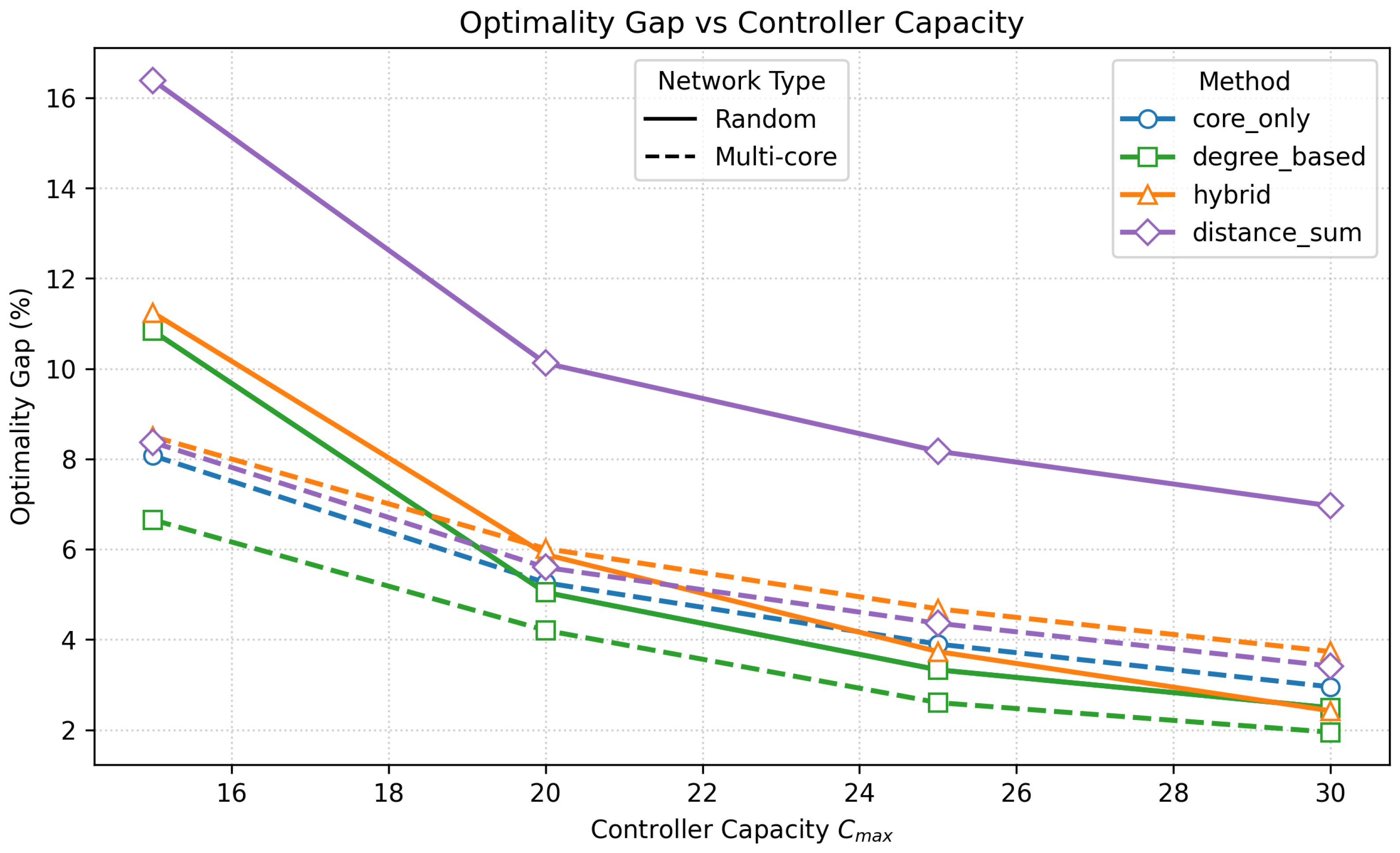
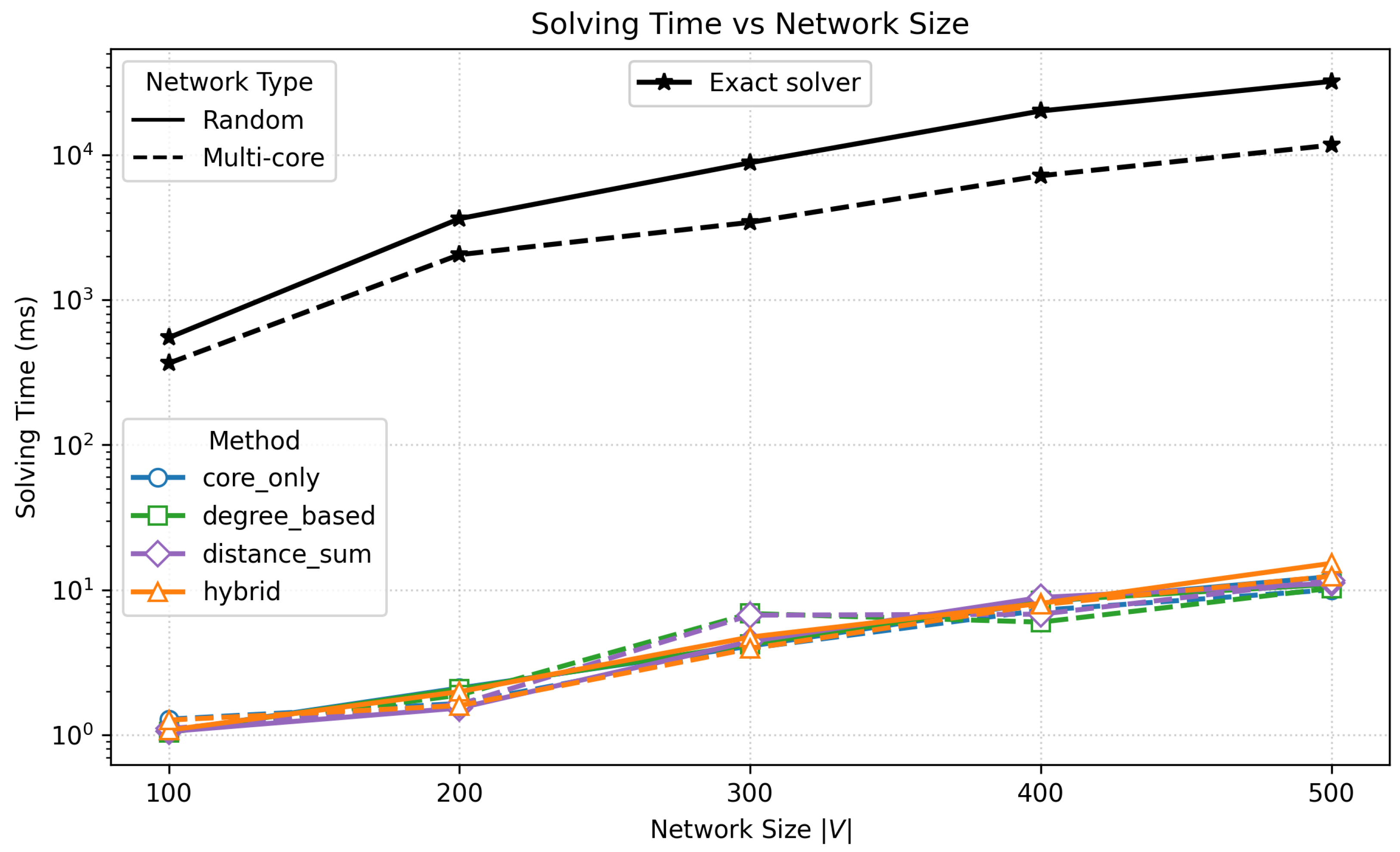
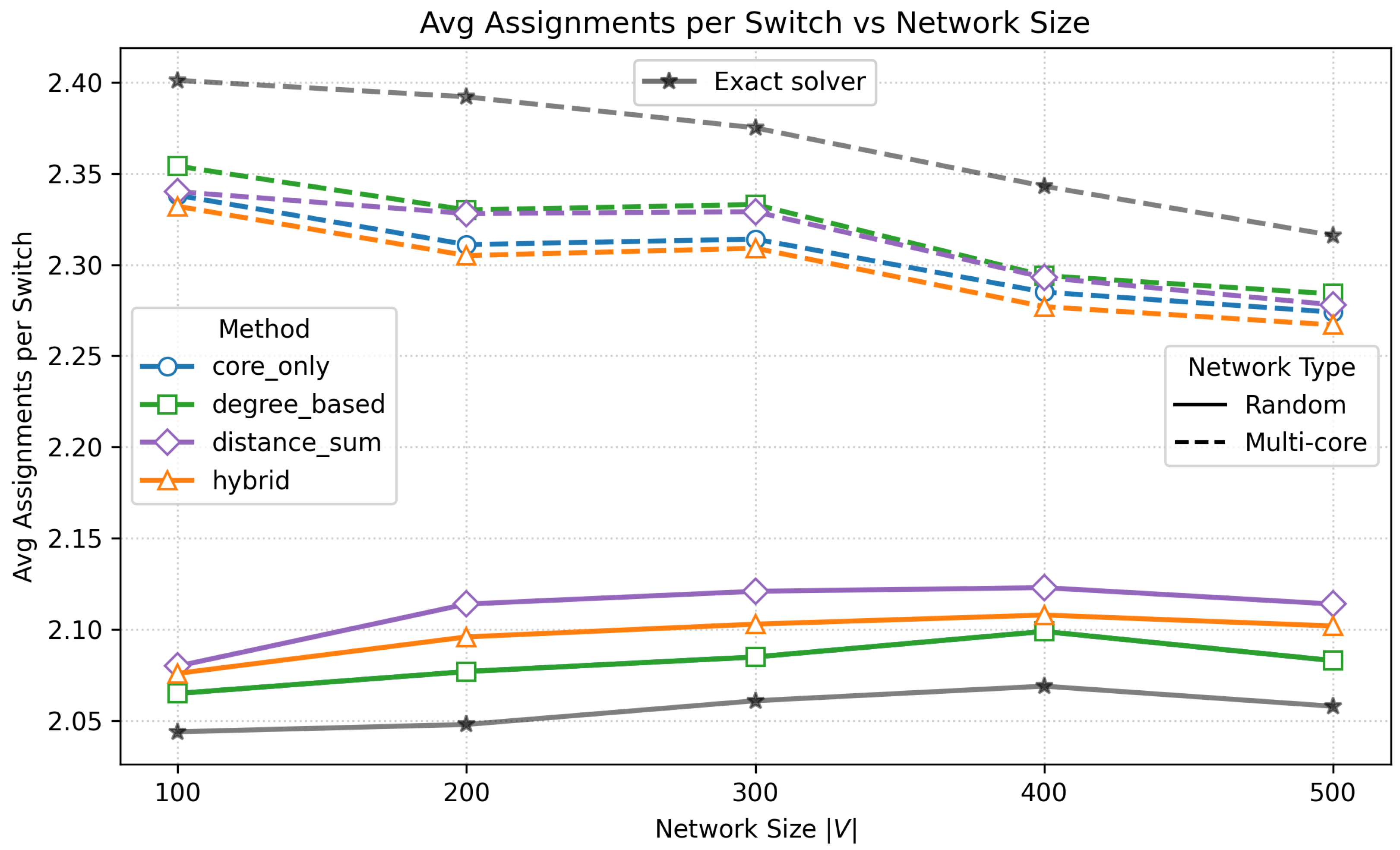
- We perform a systematic scalability study comparing exact and heuristic controller placement across two structurally distinct topologies, namely flat random and hierarchical multi-core networks, up to 500 nodes. The results quantify optimality gaps and demonstrate that richer hierarchical k-core structures significantly improve heuristic solution quality by reducing placement symmetry.
2. Literature Review
2.1. Latency-Aware Controller Placement
2.2. Resilience and Fault Tolerance
2.3. Switch Assignment
2.4. Joint Placement and Assignment
2.5. Positioning of This Work
3. System Model
3.1. Network Model
3.1.1. Local Connectivity: Node Degree
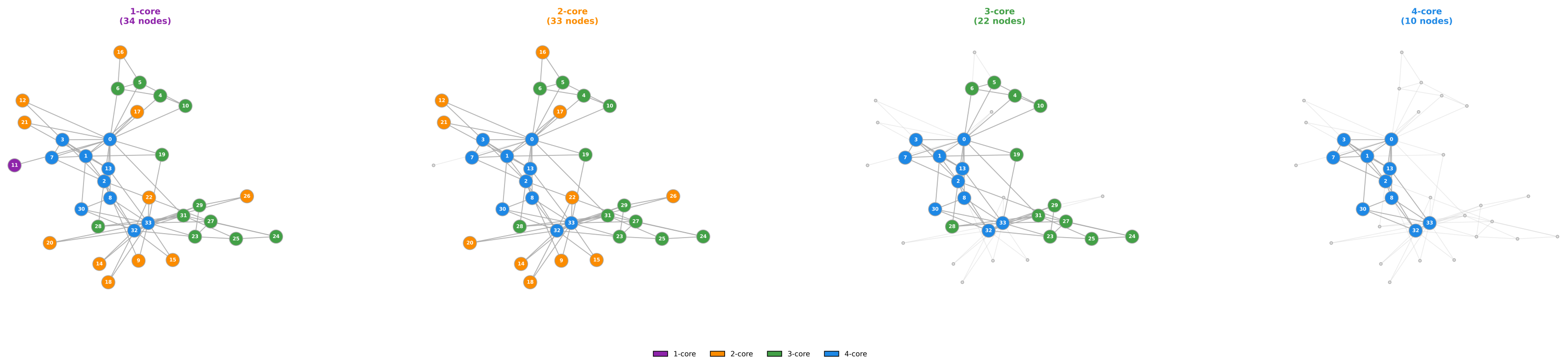
3.1.2. Global Centrality: Core Number
3.1.3. Topological Motivation for Placement
3.2. SDN Control Plane Architecture
3.2.1. Switch-Controller Assignment
3.2.2. Resilience Through Redundant Assignment
3.2.3. Controller Capacity
3.2.4. Number of Controllers
3.3. Communication Cost Model
3.3.1. Distance as a Proxy for Propagation Delay
3.3.2. Distance and QoS Requirements
4. Problem Formulation
4.1. Decision Variables
4.2. Parameters
4.3. Constraints
4.3.1. Assignment Bounds per Switch
4.3.2. Valid Assignments Only to Active Controllers
4.3.3. Controller Capacity Constraint
4.3.4. Limit on Total Number of Controllers
4.4. Objective Function
4.4.1. Assignment Coverage
4.4.2. Local Connectivity Preference
4.4.3. Global Centrality Preference
4.4.4. Distance Penalty
4.4.5. Overall Objective
4.5. Complete ILP Formulation
4.6. Scalability Challenges and Heuristic Design Rationale
5. Heuristic Controller Placement and Switch Assignment
5.1. Controller Candidate Selection
5.1.1. Motivation
5.1.2. Core-Only
5.1.3. Degree-Based
5.1.4. Hybrid Centrality
5.1.5. Distance-Sum
5.1.6. Greedy Coverage
| Algorithm 1 Candidate Controller Selection Strategies |
|
5.2. Complexity of Candidate Selection
5.2.1. Core-Only: Complexity Analysis
5.2.2. Degree-Based: Complexity Analysis
5.2.3. Hybrid Centrality: Complexity Analysis
5.2.4. Distance-Sum: Complexity Analysis
5.2.5. Greedy Coverage: Complexity Analysis
5.2.6. Overall Complexity of Candidate Selection
5.3. Switch Assignment Algorithm
| Algorithm 2 Heuristic Switch-to-Controller Assignment |
|
5.4. Complexity Analysis of the Switch Assignment Heuristic
5.4.1. Global Feasibility Check
5.4.2. Step 1: Minimum Redundancy Assignment
5.4.3. Step 2: Extended Assignment
5.4.4. Overall Complexity
5.5. Overall Complexity of the Heuristic Framework
6. Numerical Results
6.1. Placement Philosophy: Coverage vs. Centrality
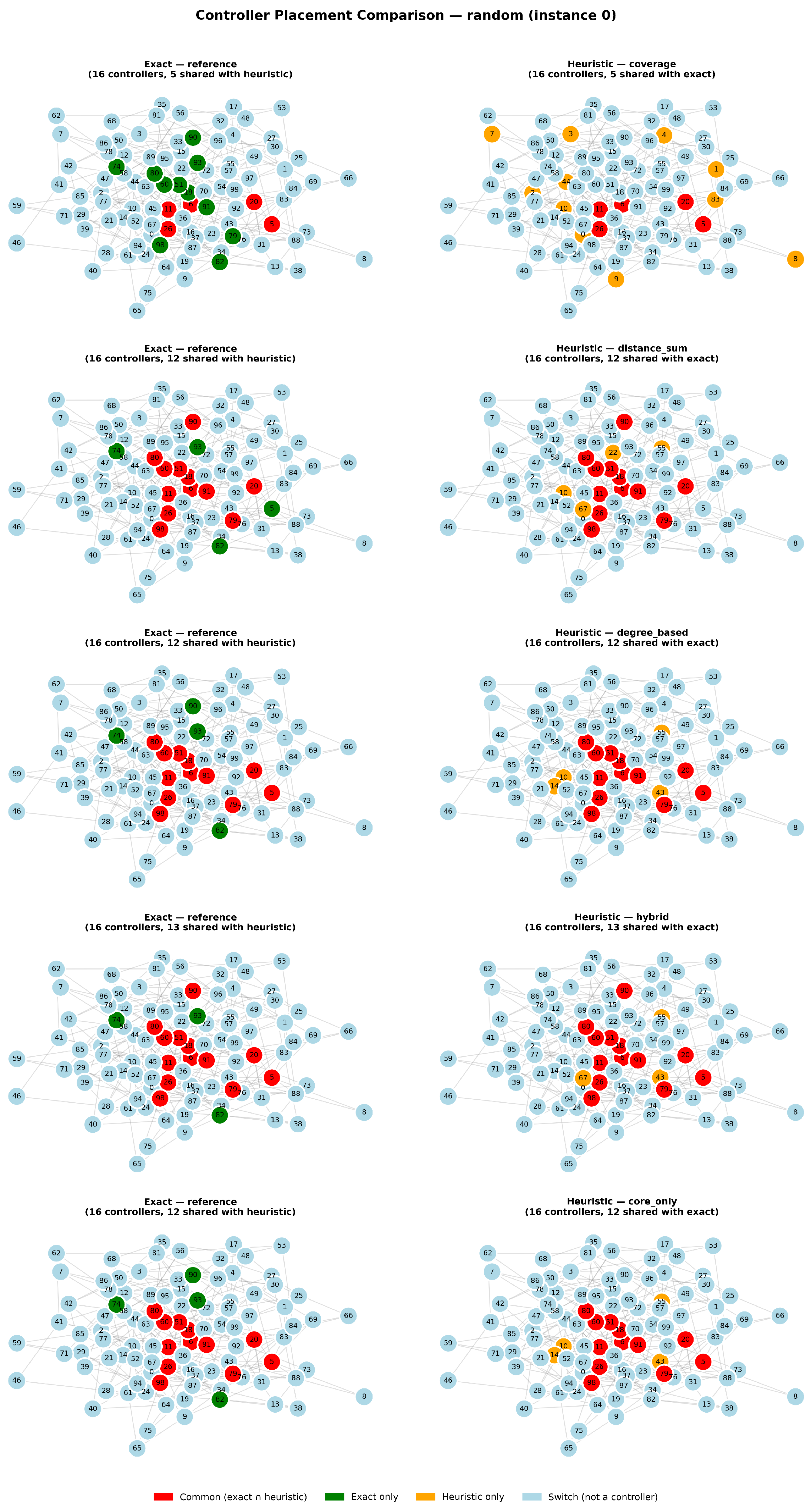
6.2. Heuristic vs. Exact Controller Placement
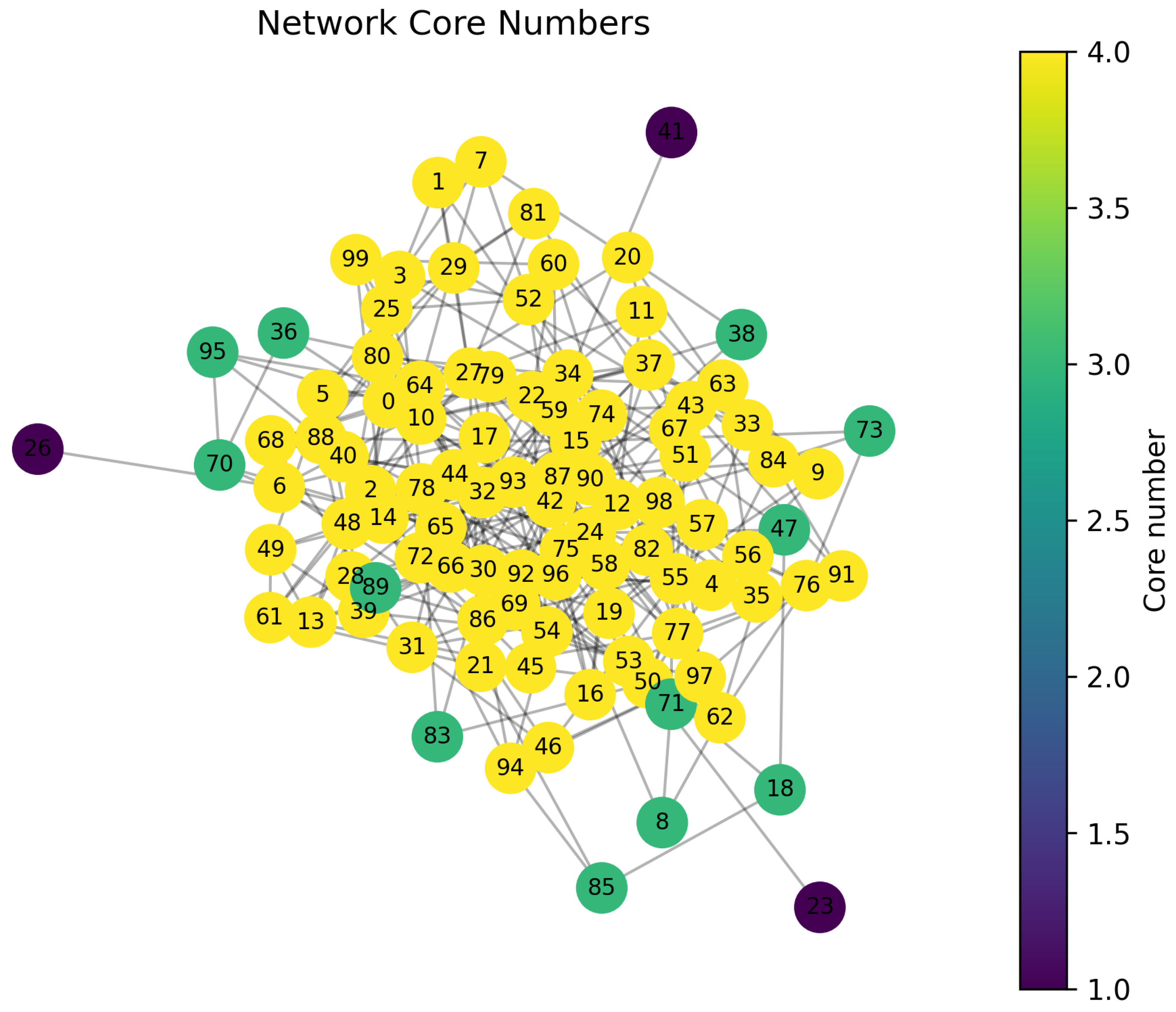
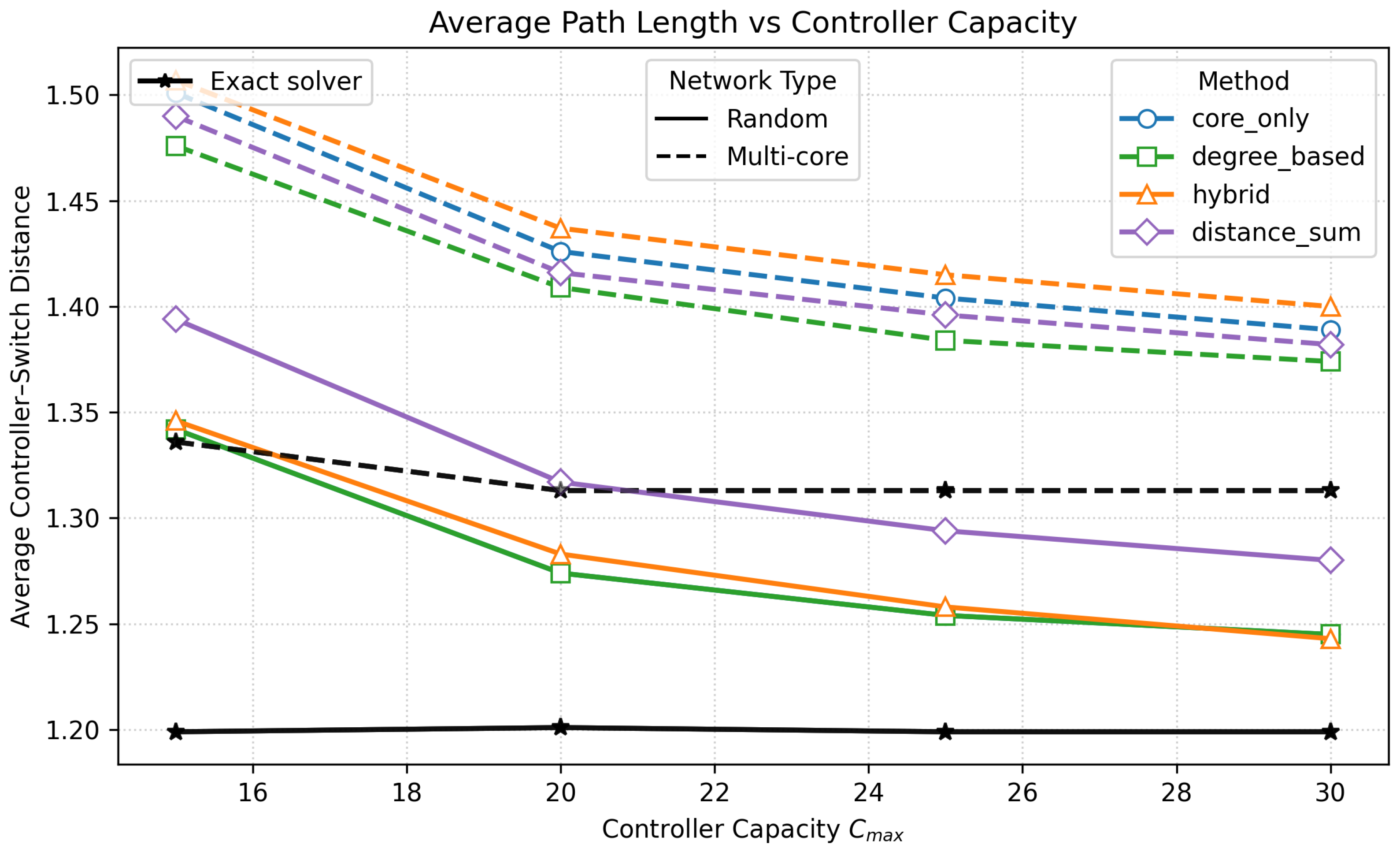
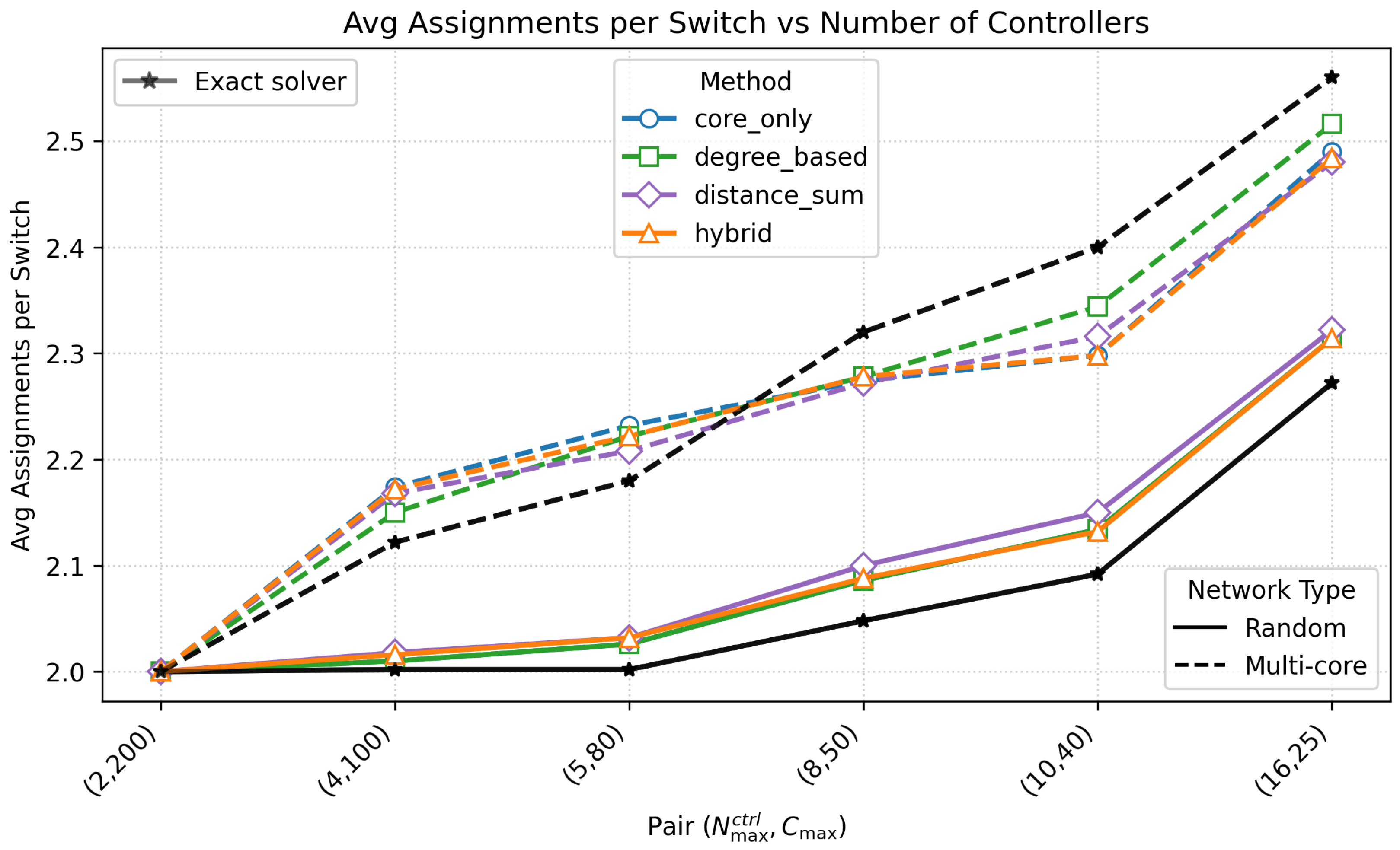
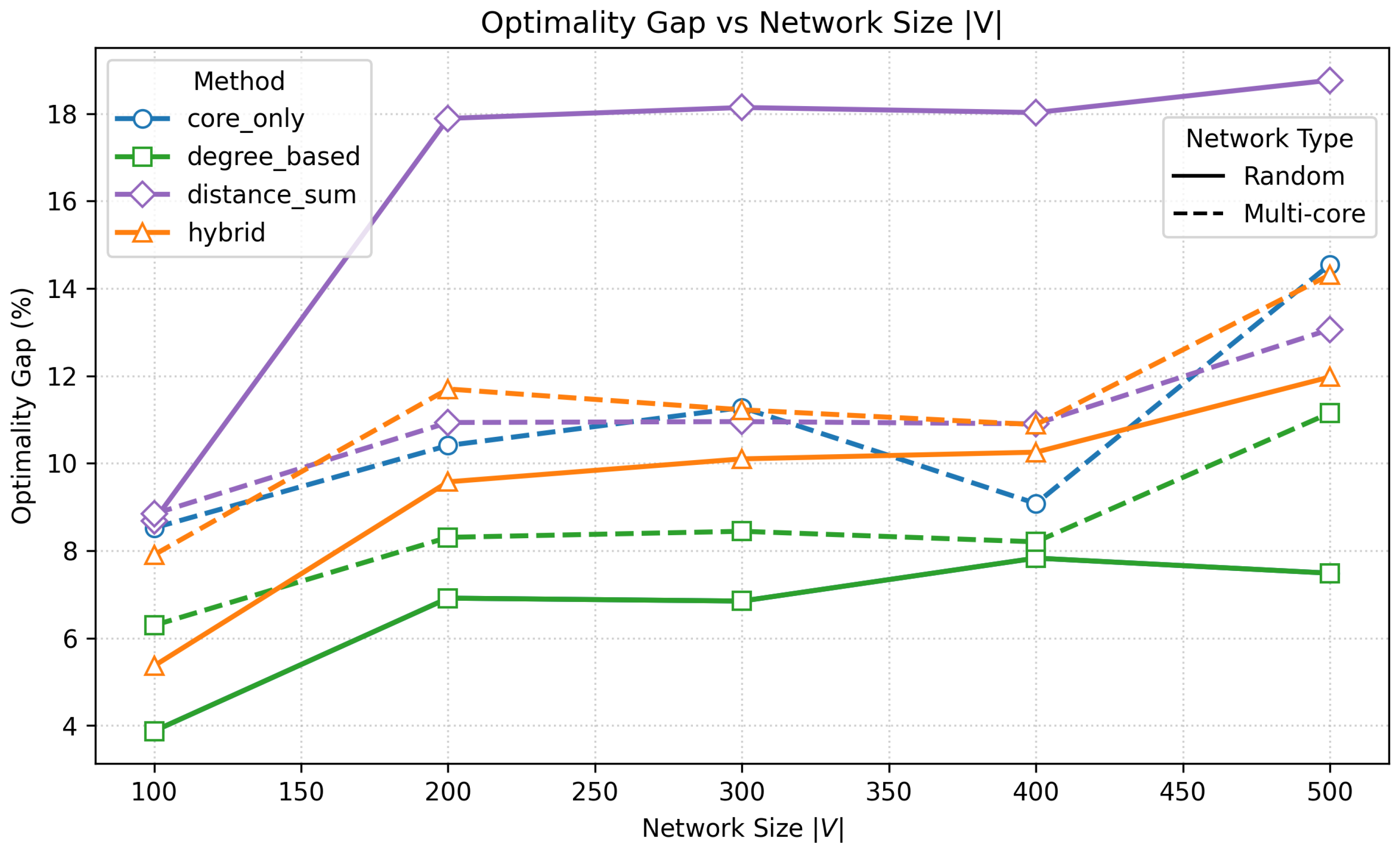
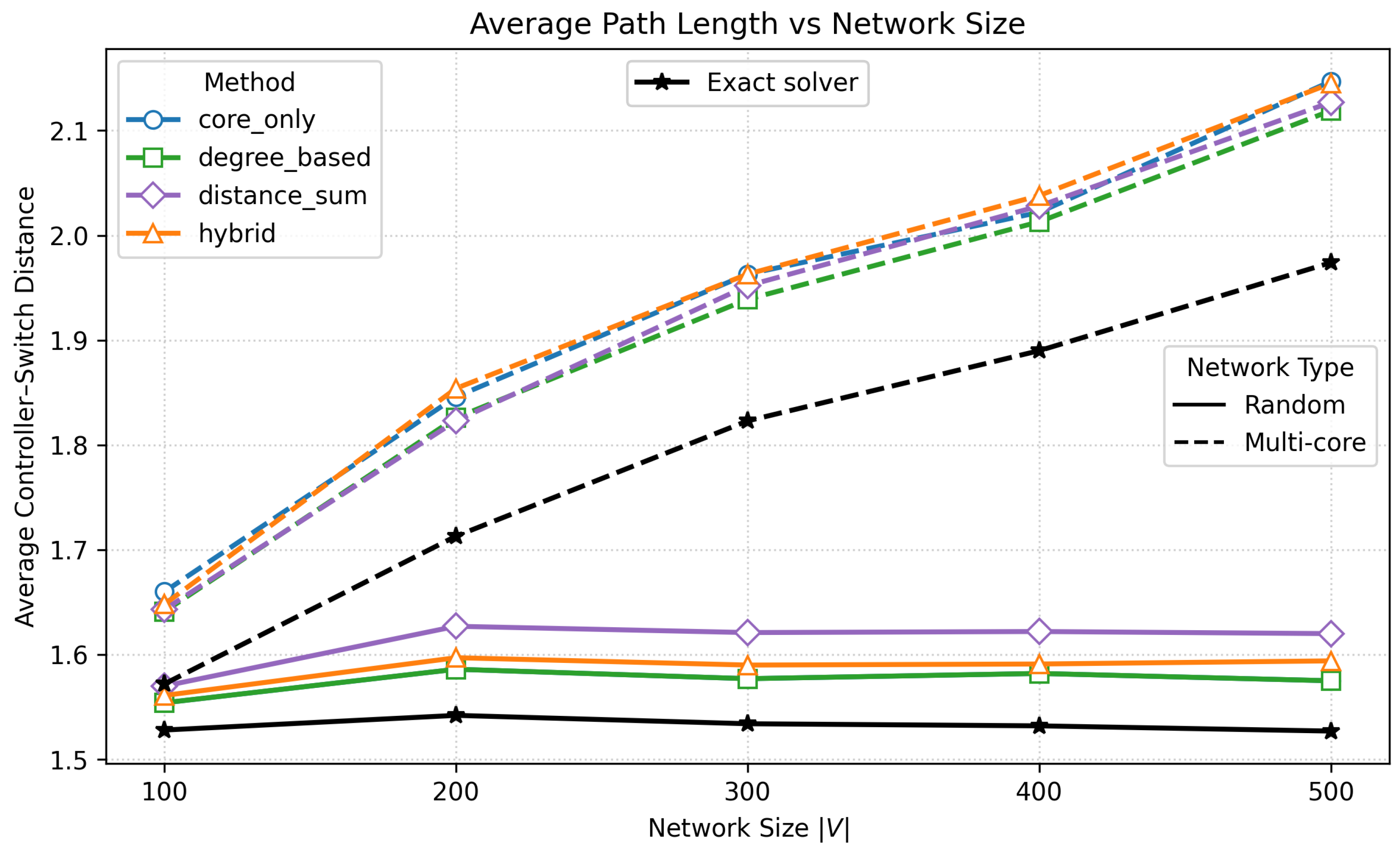
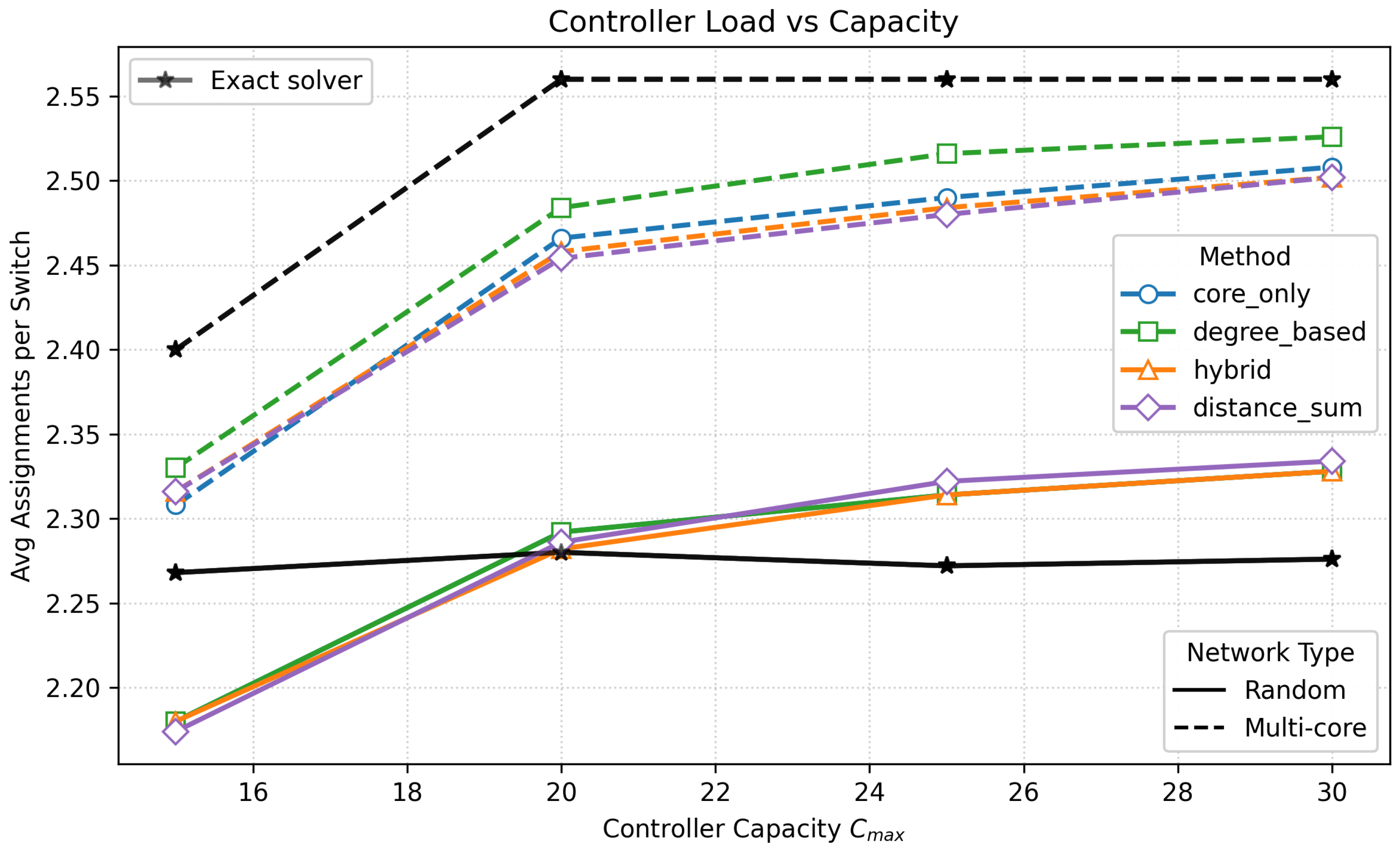
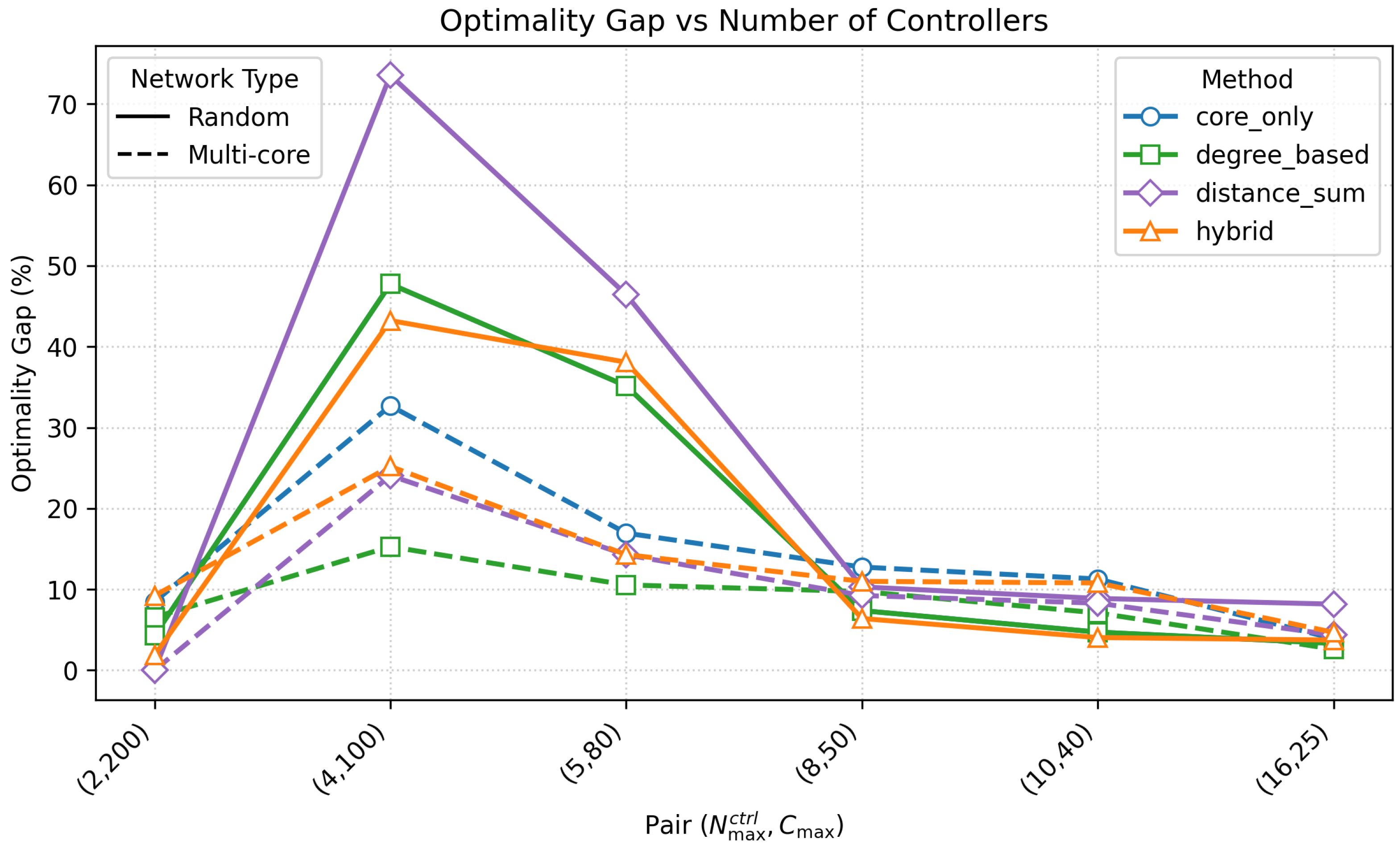
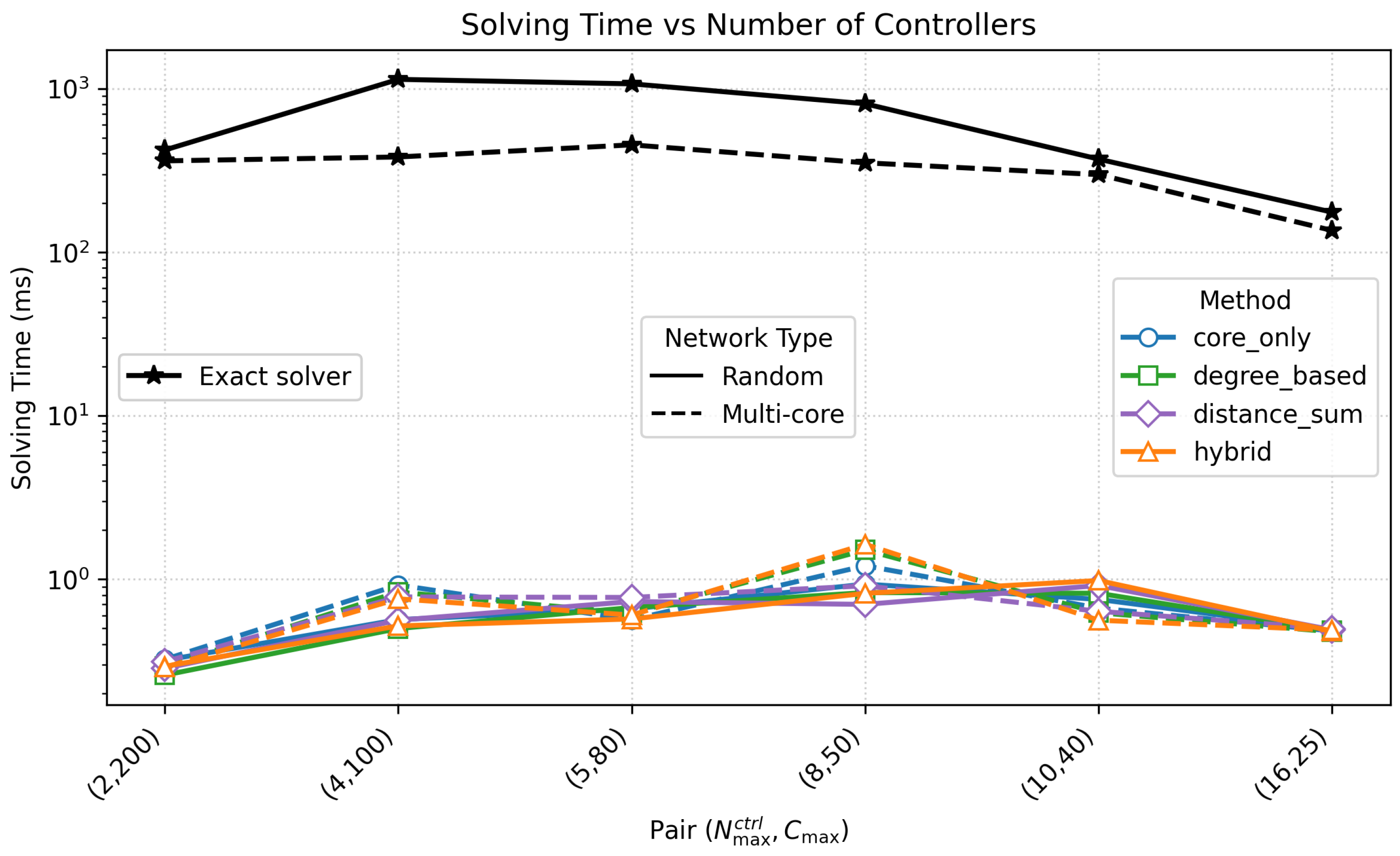
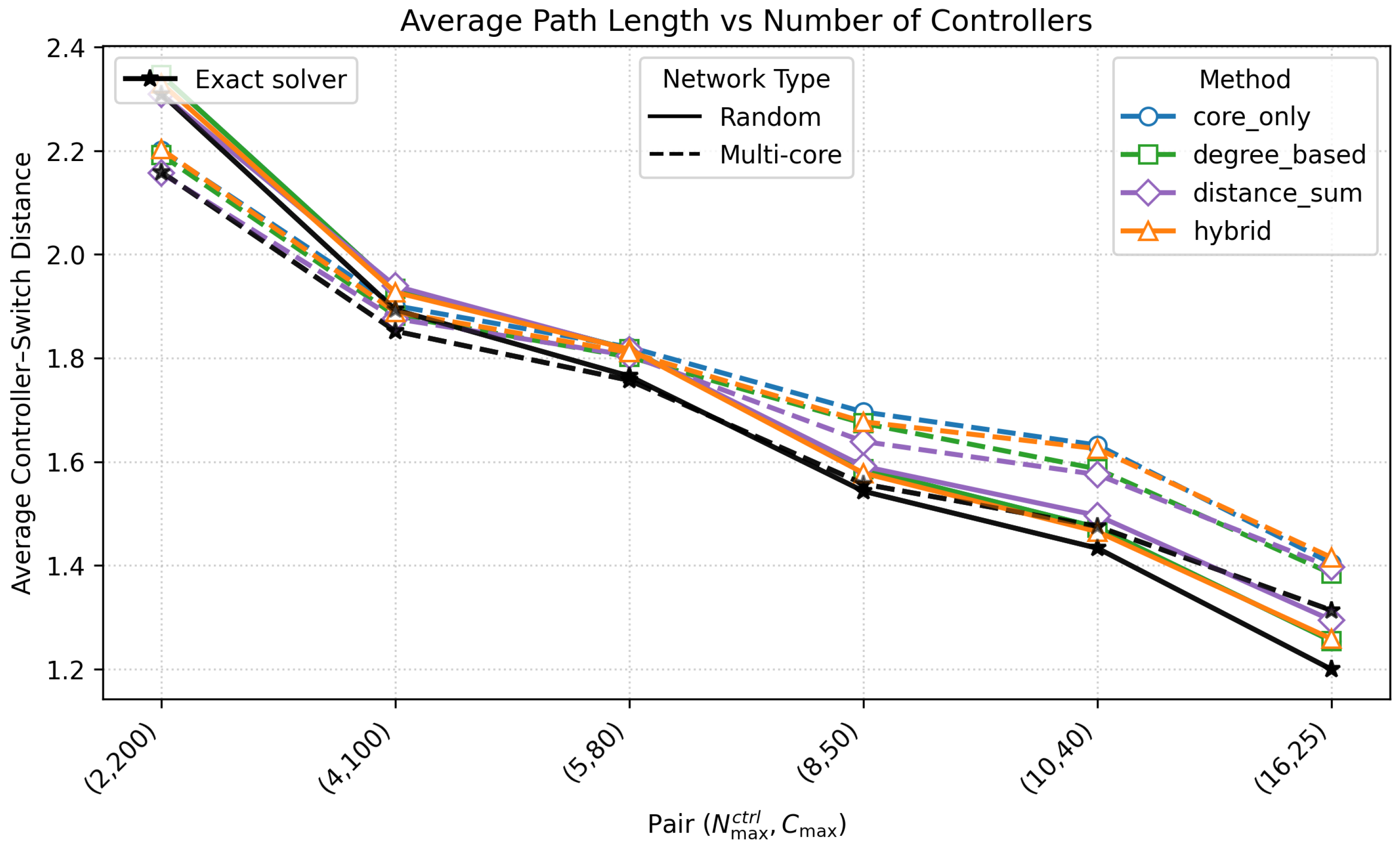
- Random network: Generated using the Erdős–Rényi model, with approximately 295 edges and three k-core levels (), yielding a relatively flat structure (Figure 3).
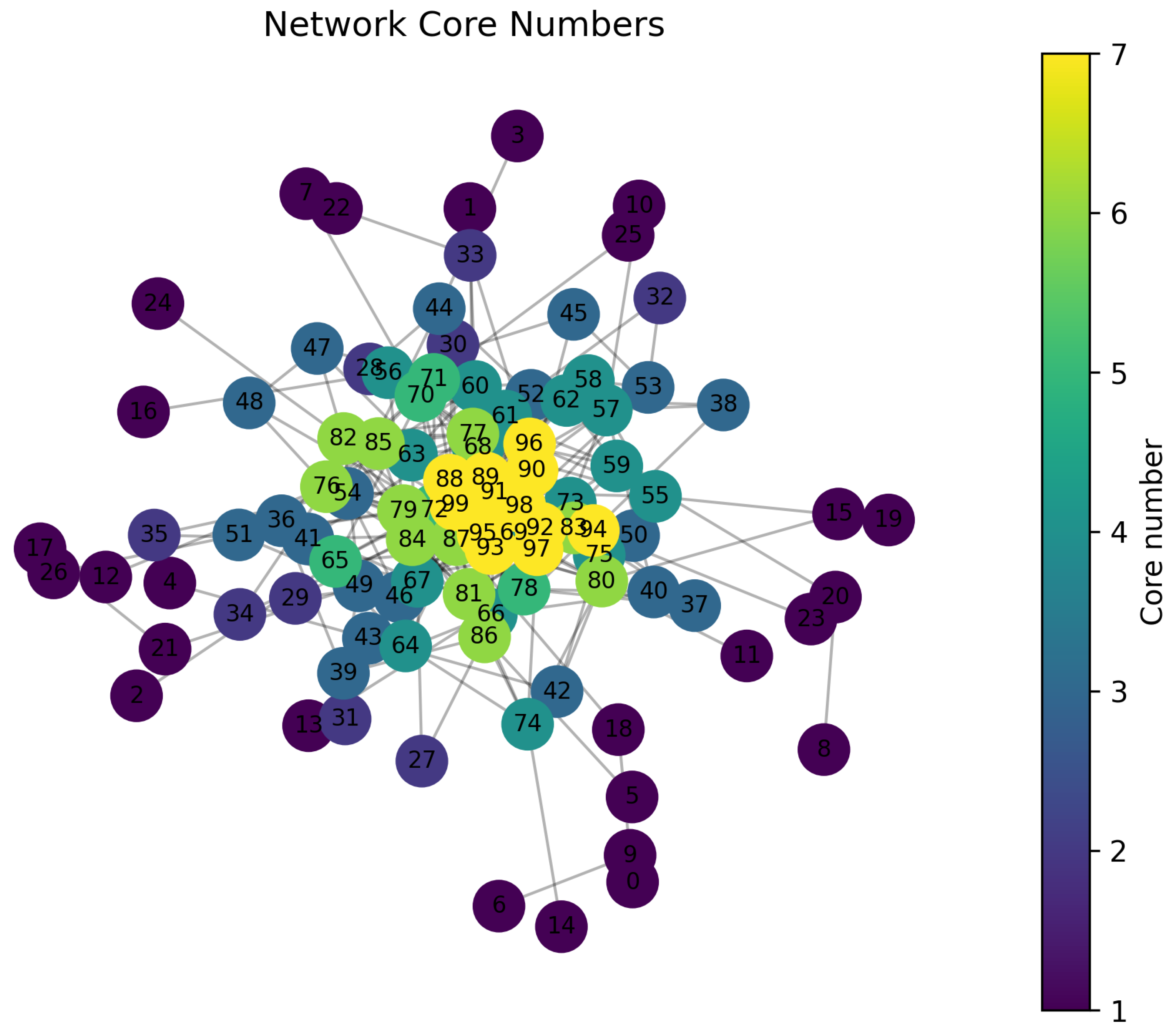
- Multi-core network: Generated using a custom procedure designed to maximize hierarchical depth, with approximately 298 edges and seven k-core levels (), providing a markedly more hierarchical structure (Figure 4).
6.3. Effect of the Number of Controllers
6.4. Scalability Analysis
7. Conclusions and Future Work
Author Contributions
Funding
Data Availability Statement
Conflicts of Interest
References
- McKeown, N.; Anderson, T.; Balakrishnan, H.; Parulkar, G.; Peterson, L.; Rexford, J.; Shenker, S.; Turner, J. OpenFlow: Enabling innovation in campus networks. ACM SIGCOMM Comput. Commun. Rev. 2008, 38, 69–74. [Google Scholar] [CrossRef]
- Kreutz, D.; Ramos, F.M.; Verissimo, P.E.; Rothenberg, C.E.; Azodolmolky, S.; Uhlig, S. Software-defined networking: A comprehensive survey. Proc. IEEE 2014, 103, 14–76. [Google Scholar] [CrossRef]
- Heller, B.; Sherwood, R.; McKeown, N. The controller placement problem. ACM SIGCOMM Comput. Commun. Rev. 2012, 42, 473–478. [Google Scholar] [CrossRef]
- Sallahi, A.; St-Hilaire, M. Optimal model for the controller placement problem in software defined networks. IEEE Commun. Lett. 2014, 19, 30–33. [Google Scholar] [CrossRef]
- Lange, S.; Gebert, S.; Zinner, T.; Tran-Gia, P.; Hock, D.; Jarschel, M.; Hoffmann, M. Heuristic approaches to the controller placement problem in large scale SDN networks. IEEE Trans. Netw. Serv. Manag. 2015, 12, 4–17. [Google Scholar] [CrossRef]
- Tanha, M.; Sajjadi, D.; Ruby, R.; Pan, J. Capacity-aware and delay-guaranteed resilient controller placement for software-defined WANs. IEEE Trans. Netw. Serv. Manag. 2018, 15, 991–1005. [Google Scholar] [CrossRef]
- Mojez, H.; Kamel, H.; Zanjani, R.; Bidgoli, A.M. Controller placement issue in software-defined networks with different goals: A comprehensive survey. J. Supercomput. 2024, 80, 19127–19209. [Google Scholar] [CrossRef]
- Hu, Y.; Wang, W.; Gong, X.; Que, X.; Cheng, S. On reliability-optimized controller placement for software-defined networks. China Commun. 2014, 11, 38–54. [Google Scholar] [CrossRef]
- Xing, L. Cascading failures in Internet of Things: Review and perspectives on reliability and resilience. IEEE Internet Things J. 2020, 8, 44–64. [Google Scholar] [CrossRef]
- Darwish, T.; Alhaj, T.A.; Elhaj, F.A. Controller placement in software defined emerging networks: A review and future directions. Telecommun. Syst. 2025, 88, 18. [Google Scholar] [CrossRef]
- Choi, I.; Kim, S.; Lee, Y.; Choi, J.P. A Scalable Multicontroller SDN Framework for LEO Mega-Constellation via Topology Virtualization. IEEE Internet Things J. 2025, 12, 33311–33327. [Google Scholar] [CrossRef]
- Chiti, F.; Morosi, S.; Pierucci, L. Multiple SDN Controllers Placement for Integrated Satellite/Terrestrial Network. IEEE Trans. Netw. Serv. Manag. 2026, 23, 3341–3350. [Google Scholar] [CrossRef]
- Dong, X.; Xue, L.; Zhang, Z.; Zhang, Y.; Li, T.; You, Z.; Shen, Y. Joint controller placement and control-service connection in hybrid-band control. IEEE Trans. Cloud Comput. 2023, 11, 3139–3152. [Google Scholar] [CrossRef]
- Rasool, S.; Boujelben, Y.; Zarai, F. Optimizing high availability multi-controller placement in SDN/NFV 5G networks: A survey. Indones. J. Electr. Eng. Comput. Sci. 2024, 34, 1800. [Google Scholar] [CrossRef]
- Isong, B.; Molose, R.R.S.; Abu-Mahfouz, A.M.; Dladlu, N. Comprehensive review of SDN controller placement strategies. IEEE Access 2020, 8, 170070–170092. [Google Scholar] [CrossRef]
- Bari, M.F.; Chowdhury, S.R.; Ahmed, R.; Boutaba, R. On orchestrating virtual network functions. In Proceedings of the 2015 11th International Conference on Network and Service Management (CNSM); IEEE: Piscataway, NJ, USA, 2015; pp. 50–56. [Google Scholar]
- Naseri, A.; Ahmadi, M.; PourKarimi, L. Placement of SDN controllers based on network setup cost and latency of control packets. Comput. Commun. 2023, 208, 15–28. [Google Scholar] [CrossRef]
- Ma, Y.; Chen, J.; Lv, W.; Qiu, X.; Zhang, Y.; Liu, W. An improved artificial bee colony algorithm to minimum propagation latency and balanced load for controller placement in Software Defined Network. Comput. Netw. 2024, 250, 110600. [Google Scholar] [CrossRef]
- Li, B.; Deng, X.; Chen, X.; Deng, Y.; Wan, S.; Zhang, H. DDPG-Based Load-Aware QoS Guaranteed SDN Controller Placement for Internet of Vehicles. IEEE Internet Things J. 2025, 12, 52575–52590. [Google Scholar] [CrossRef]
- Vizarreta, P.; Machuca, C.M.; Kellerer, W. Controller placement strategies for a resilient SDN control plane. In 2016 8th International Workshop on Resilient Networks Design and Modeling (RNDM); IEEE: Piscataway, NJ, USA, 2016; pp. 253–259. [Google Scholar] [CrossRef]
- Perrot, N.; Reynaud, T. Optimal placement of controllers in a resilient SDN architecture. In 2016 12th International Conference on the Design of Reliable Communication Networks (DRCN); IEEE: Piscataway, NJ, USA, 2016; pp. 145–151. [Google Scholar] [CrossRef]
- Kumari, A.; Sairam, A.S. A survey of controller placement problem in software defined networks. arXiv 2019, arXiv:1905.04649. [Google Scholar] [CrossRef]
- Mogyorósi, F.; Babarczi, P.; Zerwas, J.; Blenk, A.; Pašić, A. Resilient Control Plane Design for Virtualized 6G Core Networks. IEEE Trans. Netw. Serv. Manag. 2022, 19, 2453–2467. [Google Scholar] [CrossRef]
- Bouzidi, E.H.; Outtagarts, A.; Langar, R.; Boutaba, R. Dynamic clustering of software defined network switches and controller placement using deep reinforcement learning. Comput. Netw. 2022, 207, 108852. [Google Scholar] [CrossRef]
- Kumari, A.; Roy, A.; Singh Sairam, A. Optimizing SDN Controller Load Balancing Using Online Reinforcement Learning. IEEE Access 2024, 12, 131591–131604. [Google Scholar] [CrossRef]
- Liao, L.; Leung, V.C.M. Genetic algorithms with particle swarm optimization based mutation for distributed controller placement in SDNs. In 2017 IEEE Conference on Network Function Virtualization and Software Defined Networks (NFV-SDN); IEEE: Piscataway, NJ, USA, 2017; pp. 1–6. [Google Scholar] [CrossRef]
- Radam, N.S.; Al-Janabi, S.T.F.; Jasim, K.S. Multi-controllers placement optimization in SDN by the hybrid HSA-PSO algorithm. Computers 2022, 11, 111. [Google Scholar] [CrossRef]
- Sirjani, M.S.; Maleki, A.; Pakmehr, A.; Abedini Bagha, M.; Ghaffari, A.; Pour Haji Kazem, A.A. Controller placement in software-defined networks using reinforcement learning and metaheuristics. Clust. Comput. 2025, 28, 660. [Google Scholar] [CrossRef]
- Kumar, S.; Malik, A. Optimized Controller Placement and Load Balancing in SDN-Enabled IoT Networks. Microsyst. Technol. 2026, 32, 47. [Google Scholar] [CrossRef]
- Batagelj, V.; Zaversnik, M. An O(m) Algorithm for Cores Decomposition of Networks. arXiv 2003, arXiv:cs/0310049v1. [Google Scholar] [CrossRef]
- Zachary, W.W. An Information Flow Model for Conflict and Fission in Small Groups. J. Anthropol. Res. 1977, 33, 452–473. [Google Scholar] [CrossRef]
- Garey, M.R.; Johnson, D.S. Computers and Intractability: A Guide to the Theory of NP-Completeness; W. H. Freeman: New York, NY, USA, 1979. [Google Scholar]
- Brandes, U. A Faster Algorithm for Betweenness Centrality. J. Math. Sociol. 2001, 25, 163–177. [Google Scholar] [CrossRef]








| Parameter | Description |
|---|---|
| Minimum number of controllers per switch (resilience requirement) | |
| Maximum number of controllers per switch | |
| Maximum number of switches managed by a single controller | |
| Maximum number of controllers to deploy | |
| Shortest-path distance between switch s and controller node l | |
| Degree of node l in graph G | |
| Core number of node l in G | |
| Non-negative weights controlling the relative importance of each objective component |
| Strategy | Complexity | Bottleneck |
|---|---|---|
| Core-Only | Sorting | |
| Degree-Based | Sorting | |
| Distance-Sum | All-pairs BFS | |
| Hybrid Centrality | Betweenness centrality | |
| Greedy Coverage | Greedy selection loop |
| Step | Complexity | Condition |
|---|---|---|
| Feasibility check | — | |
| Step 1: Minimum redundancy | ||
| Step 2: Extended assignment | ||
| Overall | Precomputed |
| Parameter | Value | Description |
|---|---|---|
| Objective weights | ||
| 15 | Assignment coverage and resilience weight | |
| 10 | Controller degree weight | |
| 12 | Controller core number weight | |
| 10 | Distance penalty weight | |
| Redundancy constraints | ||
| 2 | Minimum controllers per switch | |
| 4 | Maximum controllers per switch | |
| Strategy-specific | ||
| Hybrid centrality scoring weights | ||
| 1 hop | Coverage distance threshold | |
Disclaimer/Publisher’s Note: The statements, opinions and data contained in all publications are solely those of the individual author(s) and contributor(s) and not of MDPI and/or the editor(s). MDPI and/or the editor(s) disclaim responsibility for any injury to people or property resulting from any ideas, methods, instructions or products referred to in the content. |
© 2026 by the authors. Licensee MDPI, Basel, Switzerland. This article is an open access article distributed under the terms and conditions of the Creative Commons Attribution (CC BY) license.
Share and Cite
Rasool, S.M.; Boujelben, Y.; Zarai, F. Topology-Aware Joint Control Plane Placement and Assignment for Resilient Hierarchical Cloud–Edge Networks. Future Internet 2026, 18, 311. https://doi.org/10.3390/fi18060311
Rasool SM, Boujelben Y, Zarai F. Topology-Aware Joint Control Plane Placement and Assignment for Resilient Hierarchical Cloud–Edge Networks. Future Internet. 2026; 18(6):311. https://doi.org/10.3390/fi18060311
Chicago/Turabian StyleRasool, Samer Mohammed, Yassine Boujelben, and Faouzi Zarai. 2026. "Topology-Aware Joint Control Plane Placement and Assignment for Resilient Hierarchical Cloud–Edge Networks" Future Internet 18, no. 6: 311. https://doi.org/10.3390/fi18060311
APA StyleRasool, S. M., Boujelben, Y., & Zarai, F. (2026). Topology-Aware Joint Control Plane Placement and Assignment for Resilient Hierarchical Cloud–Edge Networks. Future Internet, 18(6), 311. https://doi.org/10.3390/fi18060311