Article

An Auditable LLM-RAG Architecture for Financial Document Intelligence and Decision Support

Department of Informatics, Modeling, Electronics and Systems Engineering (DIMES), University of Calabria, 87036 Rende, Italy
*
Author to whom correspondence should be addressed.
Future Internet 2026, 18(6), 284; https://doi.org/10.3390/fi18060284
Submission received: 16 April 2026 / Revised: 15 May 2026 / Accepted: 19 May 2026 / Published: 26 May 2026
(This article belongs to the Special Issue Human-Centric Explainability in Large-Scale IoT and AI Systems)

Abstract

Financial analysis increasingly depends on the ability to transform heterogeneous textual evidence into reliable, verifiable, and actionable knowledge. However, adoption in finance requires generated outputs to be not only accurate, but also traceable and auditable. This work presents an audit-oriented LLM-RAG architecture for financial document intelligence. Rather than proposing a new foundation model, the contribution is a reproducible pipeline that integrates financial document processing, hybrid retrieval, evidence-grounded generation, structured validation, and persistent audit artifacts within a state-machine-based workflow. Designed for analyst-facing use, the system produces structured answers linked to explicit evidence while preserving the intermediate artifacts needed to inspect, reproduce, and validate each result. Experiments on AI-FinanceQA, a benchmark of heterogeneous financial documents and analyst-style questions, show that hybrid retrieval with reranking improves evidence selection over single-signal baselines and that the selected LLM backend achieves a compliance-oriented score of S comp = 0.9527 . Additional experiments on FinQA confirm that targeted evidence selection improves numerical robustness and semantic alignment compared with uncontrolled context expansion. Overall, the proposed architecture provides an evidence-grounded and audit-oriented framework that supports human review rather than replacing expert financial judgment.

1. Introduction

Financial decision-making has long been supported by quantitative models trained on structured signals such as prices, volumes, and macroeconomic indicators. However, a substantial portion of market-moving information is conveyed through unstructured sources, including regulated filings, quarterly reports, investor presentations, press releases, earnings-call transcripts, and real-time news. The growing role of textual analysis and NLP in accounting and finance has therefore motivated systems that complement quantitative models with evidence extracted from documents and narratives [1,2]. In this context, Large Language Models (LLMs) offer new capabilities for summarizing narratives, identifying salient events, and extracting relevant signals from financial text at scale [3].
Despite this potential, deploying LLMs in finance introduces a fundamental tension between usefulness and trustworthiness. Generative models may produce fluent answers that contain unsupported claims, incorrect attributions, or numerical errors, which is particularly critical in a domain where small mistakes can affect economic, operational, and compliance-related decisions [4]. Moreover, financial applications typically operate under stringent governance constraints: analysts and organizations must be able to justify conclusions, reconstruct the provenance of supporting evidence, and demonstrate appropriate controls over data access and processing. Purely parametric generation is therefore problematic because it offers limited visibility into why a claim was produced and which source supports it [5].
Retrieval-Augmented Generation (RAG) mitigates part of this problem by conditioning generation on explicit evidence retrieved from a document collection rather than relying solely on memorized model knowledge [5,6]. However, in financial settings, auditability requires more than attaching citations to generated answers. A system should preserve the processing path from the original document to the final output, including document versions, extracted text, chunks, metadata, embeddings, retrieved evidence, prompts, generated answers, validation outcomes, and error states. In this paper, we use provenance to refer to the stored record of these artifacts, traceability to refer to the ability to link generated claims back to supporting evidence and processing steps, groundedness to refer to the degree to which an answer is supported by retrieved evidence, and auditability to refer to the possibility of inspecting and reproducing this evidence path.
The research gap addressed in this work is therefore not the absence of a single retrieval model, reranker, or LLM, but the lack of a reproducible methodology that connects retrieval, grounded generation, structured validation, numerical consistency, and persistent audit artifacts into one financial document workflow. Existing LLM-RAG pipelines often evaluate answer quality or retrieval quality in isolation, while providing limited support for reconstructing how an answer was produced, which evidence was used, whether numerical claims are consistent with the sources, and how failures or low-confidence outputs should be handled in compliance-sensitive scenarios.
Motivated by these requirements, this work develops an auditable LLM-RAG architecture for financial document intelligence and analyst-facing review. The proposed methodology builds on established components, including retrieval-augmented generation, hybrid dense–sparse retrieval, late-interaction reranking, schema-constrained generation, and groundedness evaluation. However, the contribution of this work is not the introduction of these components in isolation, but their organization into a unified financial-document workflow in which auditability, provenance reconstruction, numerical verification, and compliance-oriented traceability are treated as first-class design requirements. The system is not intended to automate investment decisions, risk ratings, or compliance judgments. Instead, it supports human review by producing structured, evidence-linked answers together with validation signals that indicate whether the output is grounded, numerically consistent, and suitable for inspection. The architecture is orchestrated through a state-machine-based workflow that manages the document lifecycle through atomic transitions, enabling deterministic recovery, idempotent execution, and end-to-end traceability through a persistent audit trail.
To support evidence quality over long and heterogeneous inputs, the pipeline implements multi-format extraction, controlled normalization, semantic chunking with overlap, and a financial enrichment layer that extracts entities, tickers, sentiment, and analyst-oriented topics. At the retrieval layer, the architecture adopts a hybrid two-stage strategy that combines dense semantic representations with sparse lexical matching, followed by multivector reranking to improve evidence ranking [7,8,9]. This design targets a common failure mode of financial QA, where both semantic similarity and exact matching of tickers, accounting terms, dates, percentages, currencies, and numerical expressions are necessary [4,10]. Finally, generation is constrained through citation anchoring, JSON-schema validation, groundedness checks, and strict handling of finance-critical tokens.
The main contributions of this paper are as follows:
  • We propose an auditability-focused LLM-RAG methodology for financial documents, based on state-machine orchestration, atomic state transitions, persistent provenance artifacts, and recoverable processing states.
  • We define an evidence-centric retrieval and enrichment pipeline that combines semantic chunking, finance-oriented metadata extraction, dense–sparse retrieval, rank fusion, and late-interaction reranking.
  • We introduce a validation layer that combines citation anchoring, schema-constrained JSON output, groundedness assessment, and strict numerical consistency checks for finance-critical values.
  • We evaluate the approach on AI-FinanceQA and FinQA through retrieval metrics, groundedness, numerical consistency, structured-output compliance, latency analysis, enrichment ablation, and an auditability-oriented demonstration.
Empirically, the evaluation shows that hybrid retrieval with reranking improves evidence ranking over single-signal baselines, that financial enrichment provides measurable retrieval benefits, and that the selected LLM backend achieves the strongest compliance-oriented score among the tested models. Additional experiments show that targeted evidence selection improves numerical robustness and semantic alignment compared with uncontrolled context expansion. The auditability-oriented demonstration further shows that generated outputs can be linked to persisted chunk identifiers, document versions, retrieval artifacts, validation results, and state-transition logs. At the same time, we explicitly limit the scope of the claims: the evaluation does not demonstrate improvements in analyst productivity, financial decision quality, risk assessment, or compliance outcomes, which remain directions for future work.
The remainder of this paper is organized as follows. Section 2 reviews related work on LLMs in finance, retrieval-augmented generation, and evidence-grounded verification. Section 3 describes the proposed auditable LLM-RAG architecture. Section 4 reports the experimental setup and empirical results. Section 5 and Section 6 discuss the main findings, limitations, practical implications, and future research directions. Finally, Section 7 concludes the paper.

2. Related Work

Textual analysis has become an established component of financial research and practice, since relevant signals are often conveyed not only through numerical indicators but also through unstructured sources such as regulated filings, annual and quarterly reports, earnings calls, investor presentations, and specialized news. In accounting and finance, prior work has shown that textual information can complement structured data for understanding risk, strategy, disclosure, and market behavior, while also introducing methodological challenges absent in purely quantitative settings [1]. These challenges become even more pronounced in modern NLP pipelines, where technical language, long documents, numerical expressions, and heterogeneous document structures make financial text a demanding domain for language understanding and information extraction.
To support the development and evaluation of such systems, several benchmarks have been introduced for financial question answering and reasoning. FinQA formalizes numerical reasoning over financial data by requiring models to combine textual and tabular evidence in order to derive correct answers [4]. FinanceBench further highlights the difficulty of evidence-based financial QA by exposing factual and numerical failures that may remain hidden in fluent model outputs [11]. More recently, FinTextQA has shifted attention toward long-form financial question answering over lengthy documents, emphasizing the importance of retrieval quality, passage selection, and context construction when relevant evidence is distributed across extended reports [9]. Together, these benchmarks show that reliable financial QA requires not only linguistic fluency, but also accurate evidence retrieval, numerical consistency, and traceable support for generated answers.
In parallel, advances in semantic retrieval have strengthened the connection between information retrieval and NLP. Dense retrieval methods based on contextual embeddings make it possible to retrieve passages through conceptual similarity rather than exact keyword overlap, thereby improving coverage in cases where relevant evidence is expressed indirectly or paraphrastically [7]. However, in financial applications, semantic similarity alone is often insufficient. Queries frequently depend on precise lexical or symbolic matches, including company names, tickers, accounting terminology, dates, percentages, and currency values. This makes financial retrieval a natural setting for hybrid strategies that combine semantic and lexical signals.
The increasing adoption of Large Language Models in summarization and question answering has further expanded the potential of document intelligence systems, but it has also amplified concerns about reliability. When used directly, LLMs may generate outputs that are fluent and plausible yet unsupported by the underlying sources, and they may introduce misattributions or subtle numerical errors that are unacceptable in high-stakes domains. For this reason, recent work has emphasized the importance of evaluating faithfulness and groundedness, distinguishing surface-level coherence from factual support and explicit linkage to evidence [12,13]. In regulated and compliance-sensitive settings, this distinction is especially important, since system outputs must be inspectable, justifiable, and suitable for human validation rather than merely persuasive.
Retrieval-Augmented Generation (RAG) provides a principled response to these limitations by conditioning generation on externally retrieved evidence rather than relying only on parametric model memory [5,6]. In practice, however, the effectiveness of RAG depends heavily on the quality of the retrieval stage. In financial settings, retrieval must preserve both recall and precision, capturing semantic relevance while also retaining exact matches on critical financial terms and values. This has motivated hybrid retrieval approaches that combine sparse and dense representations, as well as multi-stage architectures in which an initial broad candidate set is refined through reranking [14,15]. Among reranking approaches, late-interaction models such as ColBERT are especially relevant because they operate at token level, making them better suited to domains in which small lexical differences or numerical details can materially change the meaning of an answer. Since our setting requires preserving both semantic relevance and fine-grained lexical precision, we adopt a ColBERT-style reranking strategy in the proposed architecture [8].
Beyond retrieval itself, an important line of research concerns the evaluation of end-to-end RAG systems. Recent studies have proposed automatic metrics and evaluation frameworks that separate retrieval failures from generation failures and assess the consistency between answers and their supporting evidence [16,17]. Robustness is also increasingly recognized as a key requirement in operational deployments, since paraphrases, noisy contexts, or adversarial perturbations may lead to inconsistent and difficult-to-audit outputs even when the underlying information need remains unchanged [18,19]. In addition, structured generation strategies have gained attention because schema-constrained outputs, such as JSON-based formats, make responses easier to validate automatically and reduce ambiguity in downstream decision-support workflows [20].
A related line of work has examined how LLM-based and evidence-driven pipelines can support analysis and reporting in data-intensive and high-stakes settings, where source traceability, content consistency, and controlled generation are essential. In this direction, prior studies have explored token-efficient summarization of large collections [21], retrieval-oriented mechanisms to improve factual accuracy in health information access [22], and explainable reasoning pipelines for sensitive domains such as law and finance [23]. Other works have emphasized explicit evidence support in legal question answering through retrieval-augmented and case-based strategies [24], as well as explainability and traceability in cybersecurity applications through knowledge-graph-enhanced LLM systems [25] and agentic RAG architectures for cyberattack classification and reporting [26]. Taken together, these studies suggest that retrieval grounding, source attribution, and controlled output generation are increasingly central reliability mechanisms whenever LLMs are deployed in operational decision-support workflows.
Overall, the literature suggests three main design principles that are directly relevant to financial document intelligence: first, retrieval quality is a central determinant of answer reliability; second, faithfulness and groundedness must be evaluated explicitly rather than inferred from fluency; and third, structured and evidence-linked outputs are essential when system responses are intended to support auditable and compliance-sensitive decision processes. These observations motivate the design of our proposed architecture, which combines hybrid retrieval, citation-grounded generation, and explicit verification mechanisms to produce financial insights that are concise, traceable, and verifiable.
Compared with generic RAG systems, the proposed contribution lies in the combination of four design choices within a single financial document-intelligence workflow: persistent provenance across all processing states, retrieval that jointly preserves semantic and lexical financial evidence, schema-validated generation with citation anchoring, and explicit numerical and auditability checks. The novelty is therefore methodological and system-level: each component is known, but the paper specifies how these components are connected, validated, and audited for financial QA where small evidence and numeric errors may materially affect analyst interpretation.

3. Materials and Methods

3.1. Auditable LLM-RAG Pipeline

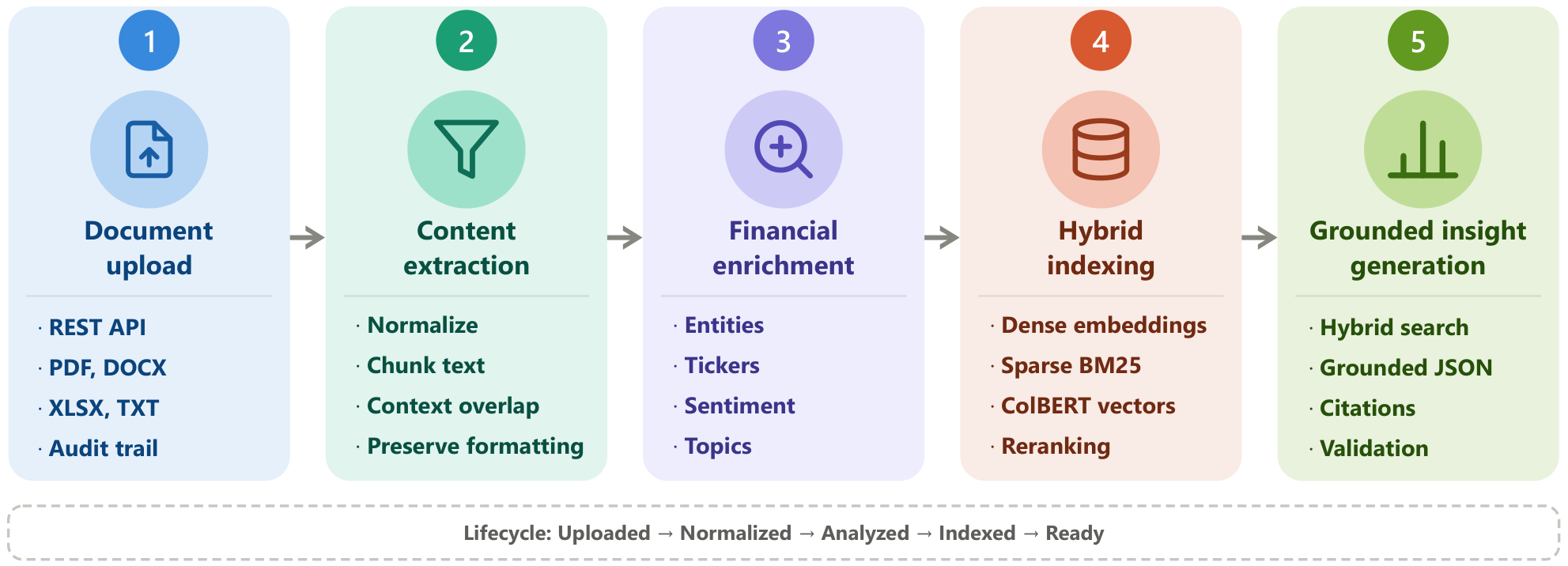
We present an auditability-focused LLM-RAG pipeline for financial documents, designed to produce structured and verifiable insights whose claims are traceable to explicit evidence. As illustrated in Figure 1, the workflow is organized into five main stages: ( i ) document upload, ( i i ) content extraction and normalization, ( i i i ) financial enrichment, ( i v ) hybrid indexing, and ( v ) grounded insight generation. The guiding principle is that each stage produces persistent artifacts, including chunks, metadata, indexed representations, retrieved evidence, and validation signals, that enable end-to-end provenance reconstruction.
Methodologically, the proposed work should be understood as a design-and-evaluation study rather than as the introduction of a new foundation model or a standalone retrieval algorithm. The proposed architecture builds on established components, including retrieval-augmented generation, hybrid dense–sparse retrieval, late-interaction reranking, schema-constrained generation, and groundedness evaluation. Its originality lies in organizing these components into a unified financial-document workflow in which auditability, provenance reconstruction, numerical verification, and compliance-oriented traceability are treated as first-class design requirements. The methodological contribution lies in formalizing a state-machine lifecycle for financial RAG processing, integrating finance-oriented enrichment with persistent audit trails, and validating citations and finance-critical numerical tokens as explicit objects of verification rather than as generic generated text.
Formally, let d denote an uploaded document. After extraction and normalization, the system produces a textual representation T ( d ) , which is segmented into a sequence of chunks C ( d ) = { c i } i = 1 n . Each chunk c i is associated with metadata m i , such as entities, tickers, sentiment, topics, and confidence scores. The enriched chunks are stored in an index I that maintains chunk text, metadata, dense and sparse retrieval representations, and multivector representations for reranking. Given a query q, retrieval returns an evidence set E ( q ) = { c i 1 , , c i k } , which constitutes the sole context used for generation. The final output is a structured prediction y in JSON format, enriched with chunk-level citations and groundedness metrics.
A core requirement in finance is operational traceability under heterogeneous inputs and partial failures. To this end, the pipeline is orchestrated through a fi nite-state workflow with the lifecycle states Uploaded, Normalized, Analyzed, Indexed, and Ready. State transitions are atomic and recorded in a persistent audit trail containing timestamps, source and target states, execution outcomes, and generated artifacts. Failures trigger a dedicated error state with diagnostic logging, while the execution model remains idempotent in order to avoid unintended reprocessing. This design ensures that every generated insight can be traced back to the exact document version, chunk set, retrieved evidence, and verification outcomes.
In Stage 1, the pipeline acquires financial documents through a document-upload interface. The system supports heterogeneous inputs, including PDF, Word, Excel, and plain-text files. At upload time, each document is assigned an internal identifier and linked to audit metadata so that all subsequent processing steps can be reconstructed and verified.
In Stage 2, each document is converted into text while preserving structure as much as possible. Controlled normalization removes non-printable characters, applies Unicode normalization, and regularizes whitespace, while preserving finance-critical patterns such as currencies, percentages, dates, and accounting notations. Since financial reports are often long and distribute relevant information across multiple sections, the normalized text T ( d ) is segmented with a recursive splitter that prioritizes section boundaries, paragraphs, line breaks, sentences, and whitespace. Unless otherwise stated, the main experiments use 768-token chunks with 128-token overlap; both values are stored with the chunk metadata and are varied in the chunking-sensitivity experiment.
In Stage 3, each chunk c i is enriched in parallel through four analyzers: named entity recognition, ticker extraction, sentiment analysis, and topic classification. In the implementation evaluated here, entity recognition is performed with a transformer-based NER component followed by financial post-processing for organizations, currencies, dates, products, and accounting terms; ticker extraction combines regular expressions, capitalization constraints, and a ticker/company-name dictionary; sentiment analysis uses a finance-oriented sentiment classifier; and topic classification maps chunks to analyst-oriented categories such as risk factors, governance, guidance, liquidity, capital allocation, and market events. The outputs of these analyzers are aggregated through deduplication and confidence-score combination, producing structured metadata m i . Enrichment is used both as inspectable metadata and as an enhanced retrieval view appended to the chunk text.
In Stage 4, the enriched chunks ( c i , m i ) are stored in a hybrid index that combines three complementary representations: dense embeddings for semantic similarity, sparse representations for exact lexical matching, and multivector representations supporting token-level interaction during reranking. This design reflects the characteristics of financial queries, where relevance often depends simultaneously on conceptual similarity and exact matching of precise terms and values, such as tickers, accounting terminology, dates, and numerical quantities.
In Stage 5, the system performs grounded insight generation through a retrieval-augmented pipeline. Candidate generation retrieves the top 100 dense candidates and the top 100 sparse candidates. Dense and sparse rankings are combined with reciprocal rank fusion, using the score s ( c , q ) = r { d , s } 1 / ( 60 + rank r ( c , q ) ) for candidates that appear in either list. The fused pool is then reranked with a ColBERT-style late-interaction model [8], and the final generation context contains the top 5 chunks unless otherwise specified. The resulting evidence set E ( q ) is persisted through chunk identifiers, document identifiers, offsets, retrieval scores, and reranking scores to support citation anchoring and auditability. Generation is conditioned exclusively on this evidence and follows a fixed prompt template containing: system-level instructions, the JSON schema, the user query, the retrieved evidence blocks, and the instruction to cite chunk identifiers for every claim. The main experiments use temperature 0 and deterministic JSON validation with up to two automatic repair attempts for malformed outputs.
In addition to schema validation, the pipeline reduces high-risk hallucinations by computing groundedness, i.e., by verifying whether the generated content is supported by the retrieved evidence set E ( q ) . Financial tokenization preserves numbers, currencies, and percentages as critical tokens. Critical tokens require exact matching to be considered grounded, whereas non-critical tokens may be evaluated through controlled fuzzy matching. Overall groundedness, critical groundedness, and numerical consistency are recorded together with the generated output and mapped to an automatic validation status (e.g., High, Medium, Low, Requires Review, or Critical Issues), thereby supporting human-in-the-loop operation in compliance-sensitive settings.
To evaluate the proposed pipeline under realistic financial question-answering conditions, we constructed AI-FinanceQA, a benchmark tailored to evidence-grounded and auditability-oriented analysis over heterogeneous financial documents. Its document composition, annotation protocol, and availability are described below.

3.2. AI-FinanceQA Benchmark: Construction and Availability

AI-FinanceQA pairs a heterogeneous financial document corpus with analyst-style questions whose answers must be supported by explicit evidence. It is designed to evaluate evidence-grounded financial question answering over long and heterogeneous documents. The benchmark used in the experiments contains 312 documents and 524 questions. The document set includes 126 regulatory filings, 58 annual reports, 44 earnings-call transcripts, 39 investor presentations, and 45 market-news items. The benchmark was not drawn from a single homogeneous source. Rather, it was constructed as a composite corpus reflecting the main document categories used in financial analysis. Each document is assigned to one primary document type to avoid double counting across partially overlapping categories. Each document is versioned and normalized through the same ingestion pipeline used in deployment. To support auditability and reproducibility, we persist immutable identifiers and provenance metadata for every document, including, when available, the source reference, ingestion timestamp, text-extraction settings, content hash, chunk identifiers, chunk offsets, and the mapping between original evidence spans and normalized chunks.
Regarding the empirical basis of the benchmark, regulatory filings, including 10-K and 10-Q forms, were collected from the SEC EDGAR public repository (https://www.sec.gov/edgar/search/, accessed on 21 May 2026). IFRS-style annual reports and investor presentations were retrieved in PDF format from publicly accessible corporate Investor Relations websites. Earnings-call transcripts were sourced from transcript aggregators, such as Seeking Alpha or equivalent institutional providers, depending on access and licensing. Short market-news items were collected from publicly available financial-news sources and newswire-style feeds. All documents were ingested through the same normalization pipeline, and source references, ingestion timestamps, and content hashes are stored for provenance tracking. The corpus covers documents published between 2020 and 2026, inclusive. Some sources carry licensing restrictions that prevent full redistribution of the raw corpus.
The query set is designed to reflect four classes of analyst-style information needs: descriptive extraction (142 queries), comparative analysis (118 queries), numerically critical questions involving amounts, percentages, guidance changes, margins, or buybacks (154 queries), and compliance-oriented questions involving risk factors, governance, disclosure, or forward-looking statements (110 queries). Each query is annotated with (i) a structured reference answer in the target JSON schema, (ii) one or more supporting evidence spans, (iii) the corresponding normalized chunk identifiers, and (iv) a label indicating whether the answer requires exact numerical matching. The benchmark contains 1486 evidence spans, with a median of two evidence spans per query.
Two annotators independently selected minimally sufficient evidence spans and reference answers using written guidelines covering numeric claims, missing information, conflicting statements, and multi-span evidence. Disagreements were resolved by a third adjudicator. Inter-annotator agreement before adjudication was Cohen’s κ = 0.76 at the evidence-presence level and κ = 0.74 at the answer-type level. The final evaluation uses a fixed document-level split to prevent leakage: 218 documents for development/index tuning, 47 for validation, and 47 for held-out testing. Unless otherwise specified, reported AI-FinanceQA results are computed on the held-out test queries; the phrase “benchmark-wide” denotes aggregation across all question categories in the held-out test set rather than evaluation on the training portion.

4. Experimental Results

We evaluate the proposed auditable LLM-RAG pipeline on AI-FinanceQA, the benchmark introduced in Section 3.2. Although the architecture is technology-agnostic, the experimental implementation uses Qdrant as the vector database, OpenAI text-embedding-3-small for dense embeddings, SPLADE-style sparse representations, and ColBERT multivectors for reranking. The main configuration uses 768-token chunks, 128-token overlap, top-100 dense candidates, top-100 sparse candidates, reciprocal-rank fusion with constant 60, ColBERT reranking, and final top-5 evidence chunks for generation.
The end-to-end workflow follows the implemented document state machine (Uploaded, Normalized, Analyzed, Indexed, and Ready). Timestamps are recorded at each transition to enable stage-level latency accounting and audit-log inspection. Normalization converts raw inputs into plain text by removing layout artifacts and standardizing whitespace while preserving financial symbols and numeric patterns. Each normalized chunk stores document identifier, chunk index, character offsets, token offsets, hash, enrichment metadata, dense/sparse/multivector identifiers, and processing state. These metadata are kept with the retrieved context and the generated output so that an answer can be reconstructed from the original document version to the final validation status.
Table 1 summarizes the benchmark composition and the reproducibility material used in the experiments.
Retrieved chunks are concatenated through a deterministic context builder that preserves chunk boundaries, metadata, and scores. The LLM produces a structured output constrained by JSON Schema, with fields for summary, insights, signals, citations, numbers, and validation_status. We apply schema validation with up to two automatic repair attempts for malformed JSON, and we persist the final validated object together with its evidence links. Generation settings are fixed across experiments unless explicitly varied: temperature 0.0 , top-p 1.0 , deterministic schema validation, and the same prompt structure for all backends.
We evaluate the system along five dimensions. First, retrieval quality is measured through Precision@k, Recall@k, NDCG@5, MAP, and MRR against manually adjudicated evidence chunks. A retrieved chunk is considered relevant if its identifier matches an annotated evidence chunk or if its normalized character span overlaps an annotated evidence span. Second, generation reliability is assessed through token-level groundedness and JSON-schema compliance. Third, numeric correctness is evaluated through exact matching of finance-critical tokens. Fourth, auditability is assessed through traceability coverage, audit-log completeness, and recovery under injected processing failures. Fifth, latency is measured both end-to-end and by pipeline stage.
Table 2 lists the main experimental settings used across the evaluation.
Groundedness is computed at token level by verifying whether each response token can be traced to at least one retrieved chunk. Because financial answers are highly sensitive to small deviations, we treat numeric tokens, including numbers, percentages, and currencies, as critical and require exact matching for them to be considered grounded. For non-critical tokens, we allow controlled fuzzy matching and ignore predefined financial stop-words. In addition to overall token groundedness, we compute numerical accuracy and a critical-groundedness score in order to isolate failures on high-risk tokens. To summarize compliance-oriented answer quality, we define
S comp = 0.50 · G + 0.25 · J + 0.25 · N ,
where G denotes token-level groundedness, J the JSON-valid rate (schema compliance after validation and retries), and N numerical consistency (critical-token correctness). The weighting emphasizes evidence traceability as the primary compliance requirement while still penalizing schema and numeric failures.

4.1. LLM Backend Selection

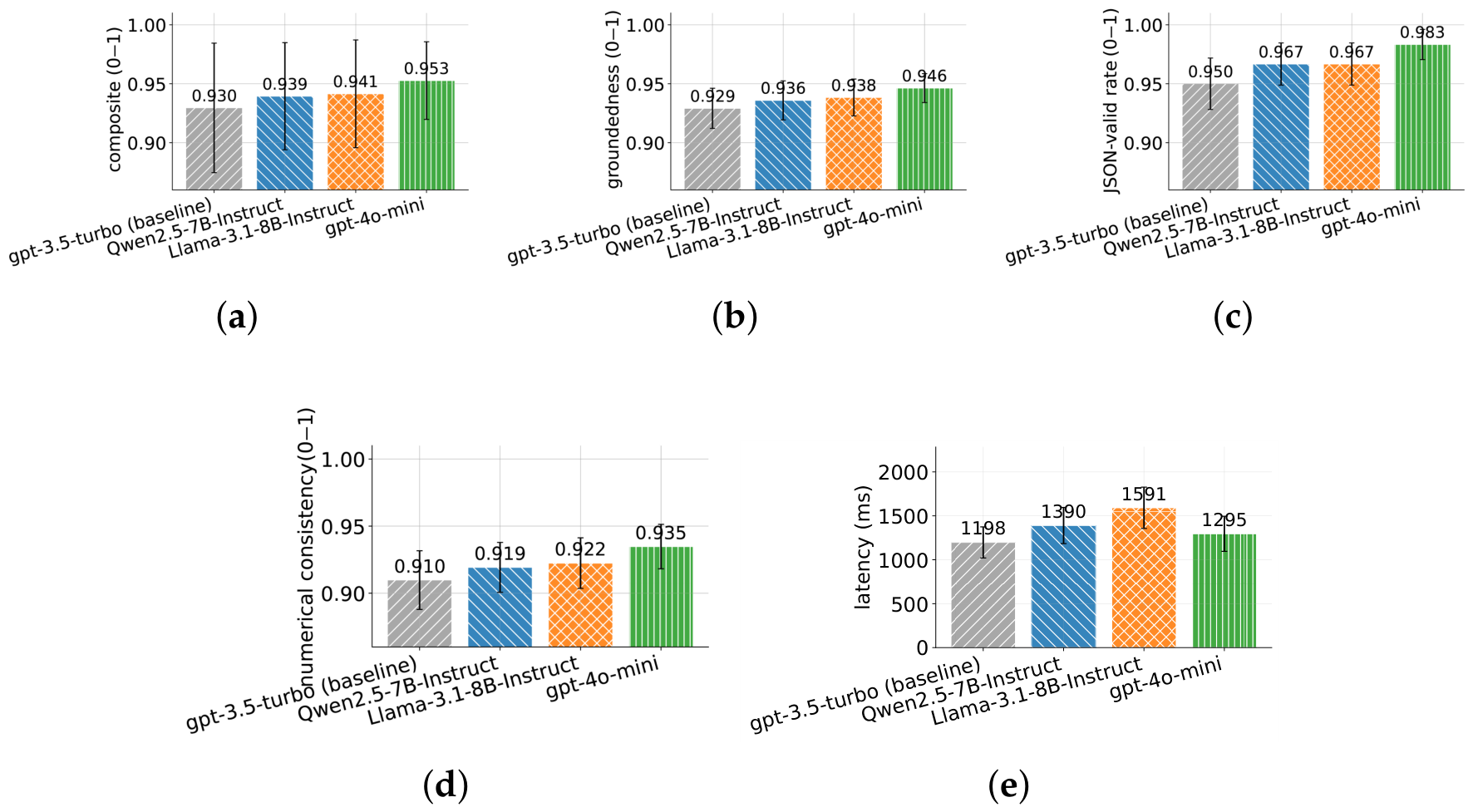
In this experiment, we keep the retrieval stack fixed (hybrid dense and sparse retrieval with ColBERT reranking) and vary only the LLM backend. Context construction, JSON Schema validation, citation anchoring, and groundedness scoring remain unchanged across models in order to isolate the contribution of the generator. Figure 2 and Table 3 report mean ± SD across the held-out AI-FinanceQA test queries for the considered metrics. The composite score S comp defined in Equation (1) summarizes compliance-oriented quality, whereas latency reflects operational cost.
The results show a consistent ranking across the evaluated models. gpt-4o-mini achieves the best overall performance, obtaining the highest groundedness, JSON-valid rate, numerical consistency, and composite score. In particular, its gains are not limited to a single dimension, but are observed across all compliance-relevant metrics, indicating a more reliable balance between evidence adherence, structured-output validity, and numerical correctness. Compared with the baseline gpt-3.5-turbo, the improvement in S comp is accompanied by higher groundedness and stronger numerical consistency, which are especially important in financial question answering.
The trade-off with latency is also favorable. Although gpt-4o-mini is not the fastest backend, its response time remains substantially lower than that of Llama-3.1-8B-Instruct while providing better performance across all quality dimensions. Qwen2.5-7B-Instruct and Llama-3.1-8B-Instruct both improve over the baseline, but neither matches the overall quality of gpt-4o-mini. Based on this comparative analysis, we use gpt-4o-mini in the subsequent experiments as the most favorable quality–latency compromise among the evaluated backends. Because the absolute differences between backends are moderate, we interpret this result as a practical configuration choice for the present implementation rather than as a general claim that one backend is universally superior across financial RAG settings.

4.2. Retrieval Ablation Study

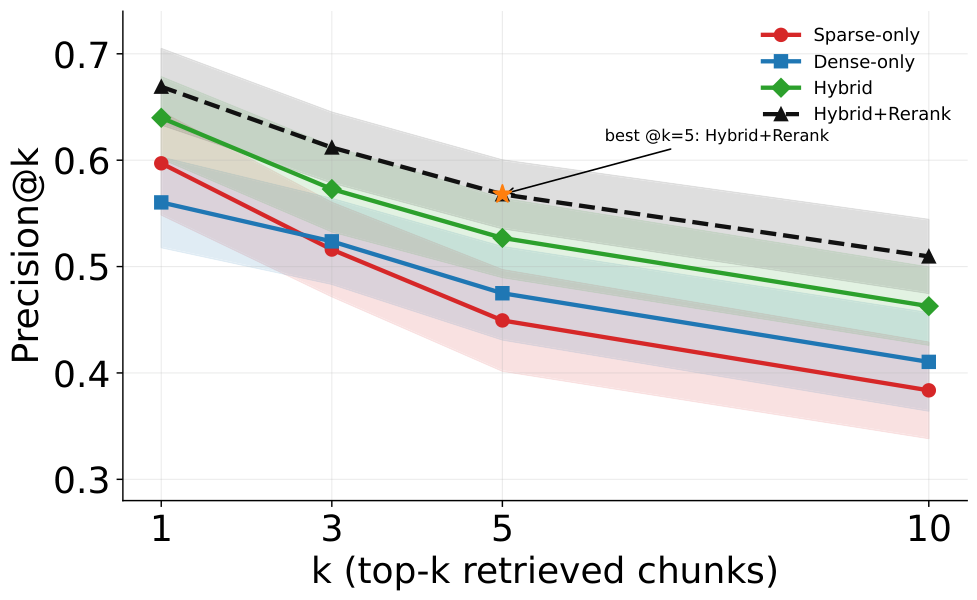
We ablate the retrieval component by progressively enabling complementary signals: Sparse-only (lexical retrieval), Dense-only (semantic similarity), Hybrid (dense and sparse fusion), and Hybrid+Rerank (hybrid prefetch followed by ColBERT reranking). We report Precision@k for k { 1 , 3 , 5 , 10 } , where k denotes the number of top-ranked chunks considered in the evaluation. This protocol isolates the marginal contribution of lexical cues, dense semantics, and reranking, and matches the standard practice of evaluating hybrid pipelines at multiple cut-offs to reflect production operating points.
Figure 3 shows that hybrid retrieval consistently improves precision over single-signal baselines, confirming that lexical and semantic cues are complementary in financial text. Adding ColBERT reranking yields the best ranking quality around moderate cutoffs (notably k = 5 ), aligning with the two-stage design: increasing first-stage k tends to improve recall but also introduces noise and additional latency, while reranking focuses evidence at the top of the list, improving downstream groundedness.
To make the retrieval evaluation consistent with the metrics described above, Table 4 reports additional retrieval metrics for the same ablation. Hybrid+Rerank obtains the best MAP and MRR, indicating better ordering of relevant chunks, while the hybrid candidate set improves Recall@5 over single-signal baselines. These results support the design choice of combining lexical and semantic candidate generation before reranking.

4.3. Financial Enrichment Ablation

To assess whether the enrichment layer contributes measurable value, we compare retrieval over raw chunks against retrieval over enriched chunks, keeping dense embeddings, sparse representations, fusion, reranking, and generation settings fixed. In the raw condition, the retriever indexes only normalized chunk text. In the enriched condition, the retriever indexes the normalized chunk text plus structured metadata derived from entity recognition, ticker extraction, sentiment, and topic classification.
Table 5 shows that enriched chunks improve retrieval and downstream compliance-oriented quality. The improvement is modest but consistent, suggesting that enrichment is not merely an architectural feature: it helps expose financial entities, tickers, and analyst-oriented topics that are sometimes weakly represented in the raw chunk text. The gain is largest for ticker/entity-heavy and compliance-oriented queries, where exact lexical signals and metadata categories help the retriever place the relevant chunk higher in the ranking.

4.4. Chunking Sensitivity and Latency Breakdown

Finally, we analyze two operational aspects that strongly affect real deployments: (i) chunk granularity, which controls the retriever’s resolution and the LLM context budget, and (ii) end-to-end latency, which determines responsiveness and cost.
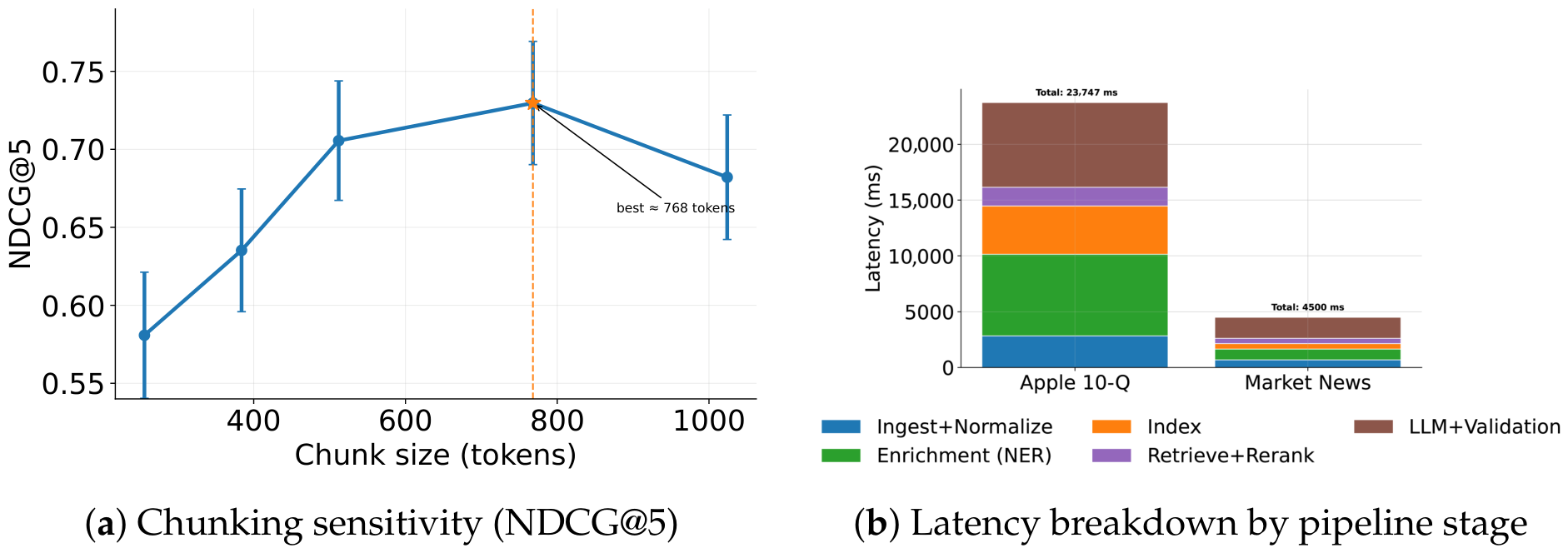
Figure 4a reports NDCG@5 under different chunk sizes. In our implementation, chunking is configured through a recursive splitter with overlap; for reporting, we express chunk size in tokens after tokenization to make the analysis comparable across documents with different formatting and numeric density. Performance peaks at an intermediate granularity (around ∼768 tokens), highlighting the expected trade-off: smaller chunks improve pinpointing but fragment context, whereas larger chunks preserve narrative continuity but dilute relevance signals and introduce unrelated content.
Figure 4b decomposes end-to-end latency across pipeline stages for two representative inputs: a long-form 10-Q filing and a short market-news article. Stage timing is computed from the timestamps recorded at state transitions and handler boundaries (normalization, enrichment, indexing, retrieval/rerank, and LLM+validation). As expected, enrichment and LLM+validation dominate overall runtime on long documents, whereas shorter documents reduce indexing/retrieval overhead and shift the bottleneck toward LLM execution. The two-stage retriever keeps retrieval latency bounded while improving ranking quality, enabling a practical balance between recall, precision, and responsiveness.

4.5. Additional Experiments on FinQA: Answer Distance and Context-Utility

While AI-FinanceQA is used to evaluate the full auditability-oriented pipeline, we also conduct complementary experiments on FinQA to isolate the effect of retrieval augmentation on answer quality under controlled context conditions. Specifically, this subsection introduces a distance-based analysis on FinQA, a benchmark for financial question answering with numerical reasoning over heterogeneous evidence (text and tables) extracted from financial reports.
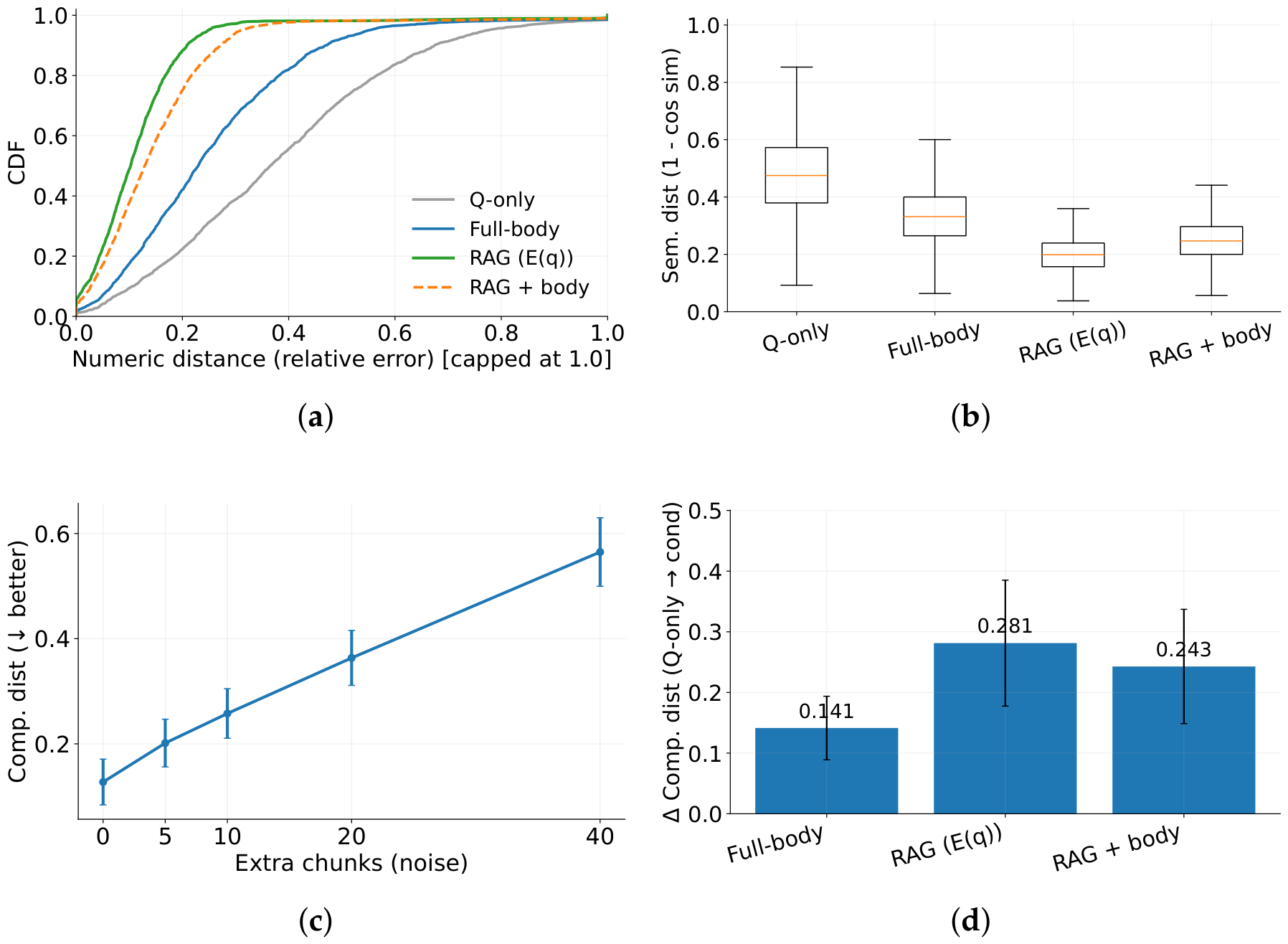
We compare four inference conditions that progressively enrich the input context: ( i ) Q-only, where the model receives only the question; ( i i ) Full-body, where the question is paired with the full document body; ( i i i ) RAG ( E ( q ) ), where the model is conditioned on a compact set of evidence chunks retrieved for query q; and ( i v ) RAG + body, combining retrieved evidence with the full body. This design isolates the trade-off between adding information and injecting noise through unfiltered context.
We evaluate answer quality through two complementary distances. First, we compute a numeric distance based on relative error between predicted and reference numerical values (capped to limit the influence of extreme outliers), capturing arithmetic fidelity. Second, we compute a semantic distance as 1 cos ( · , · ) between answer representations, capturing alignment when responses include explanatory text or intermediate statements. Finally, we aggregate these signals into a composite distance, enabling a unified comparison across context conditions.
Figure 5a reports the cumulative distribution of numeric distance. RAG ( E ( q ) ) concentrates substantially more mass at low errors than both Q-only and Full-body, indicating that evidence selection is critical for controlling numerical deviation in financial QA. While RAG + body remains competitive, it exhibits a weaker concentration than pure RAG, suggesting that appending the full document can dilute salient signals with irrelevant content.
Figure 5b shows the distribution of semantic distance. All context-aware configurations reduce semantic divergence compared to Q-only, with RAG ( E ( q ) ) achieving the tightest distribution. This indicates that retrieval not only improves numerical fidelity but also stabilizes the generated rationale by anchoring responses to consistent evidence.
A key requirement in real deployments is robustness to noisy or excessive context. Figure 5c analyzes a controlled inflation setting where additional irrelevant chunks are appended to the retrieved context. The composite distance increases monotonically as noise grows, highlighting a predictable degradation pattern: beyond a certain context size, extra information acts as a distractor rather than support.
Figure 5d summarizes the improvement in composite distance with respect to Q-only. Providing the full body yields a measurable gain, but the largest improvement is obtained by RAG ( E ( q ) ), confirming that targeted evidence selection is more effective than raw context expansion. The RAG + body variant remains beneficial but does not surpass pure RAG, reinforcing the practical recommendation of keeping prompts concise and evidence-driven for financial QA.

4.6. Auditability-Oriented Demonstration

Because auditability is a central claim of the system, we conduct a targeted demonstration to evaluate whether the artifacts required to reconstruct an answer are complete and usable. For each generated answer, we check whether every insight contains at least one citation to a persisted chunk identifier, whether the cited chunk can be resolved to the original document version and offsets, whether the retrieval scores and validation signals are stored with the output, and whether state transitions from upload to ready are present in the audit log. We also inject recoverable failures during normalization, enrichment, and indexing to verify that the state machine records the error state and resumes processing without duplicating artifacts.
Table 6 reports the auditability checks used to verify traceability and failure recovery.
The most common auditability failure was not an unsupported answer, but an incomplete citation assignment for secondary explanatory sentences. These cases were still assigned a low-confidence or requires-review validation status, but they show that auditability should be evaluated as a first-class property rather than inferred from retrieval and groundedness alone.

4.7. Analyst-Facing Decision-Support Example

To clarify the decision-support scope, we consider an analyst-facing example. Consider a compliance analyst asking whether a quarterly filing contains a material change in liquidity risk. The system retrieves the relevant liquidity-risk and debt-maturity chunks, produces a JSON answer with a concise summary, lists the cited chunk identifiers, extracts the reported cash, debt, maturity, and percentage values, and assigns a validation status based on groundedness and numerical consistency. The analyst can then inspect the cited chunks and decide whether the finding should be escalated. In this workflow, the system supports evidence gathering, drafting, and triage; it does not make an investment decision, assign a credit rating, or replace compliance judgment. This example aligns the decision-support claim with the empirical evaluation, which measures evidence retrieval, grounded answer generation, numerical consistency, traceability, and latency rather than direct effects on analyst productivity or decision quality.

5. Discussion

The experimental analysis shows that an evidence-centric, auditability-focused RAG design can improve the reliability of LLM-based financial document intelligence along the dimensions evaluated in this paper: retrieval relevance, groundedness, numerical consistency, structured-output compliance, traceability, and latency. These dimensions are necessary foundations for decision support, but they do not by themselves demonstrate improved analyst decisions or downstream financial outcomes. For this reason, the system is framed as a financial document-intelligence pipeline for analyst-facing review rather than as an autonomous financial decision-making system. Across heterogeneous inputs, the pipeline maintains traceability by persisting intermediate artifacts and by orchestrating the document lifecycle through atomic state transitions.
A key outcome is that retrieval quality—not only generation capacity—remains the dominant driver of trustworthy outputs in finance. Hybrid candidate generation (dense and sparse) consistently improves ranking quality over single-signal baselines, and late-interaction reranking further refines evidence placement at the top of the list. Practically, this reduces the probability that the LLM is conditioned on partially relevant or noisy context, thereby improving groundedness and stabilizing the downstream reasoning. In addition, enforcing structured outputs (JSON Schema) constrains the response space and supports automated validation, while citation anchoring makes each insight inspectable at the chunk level. Taken together, hybrid retrieval, reranking, and schema-guided generation act as complementary controls: retrieval maximizes evidence relevance, reranking improves precision under tight cutoffs, and structured generation improves consistency and downstream auditability.
Despite these safeguards, limitations emerge that are especially relevant in high-stakes financial workflows. First, micro-errors on numerical tokens (e.g., small deviations in values, dates, or percentages) remain a critical failure mode. Even when the system applies strict handling for numbers and other finance-critical tokens, errors can still originate upstream from extraction noise (e.g., layout artifacts, OCR-like distortions, or table-to-text conversion) or from ambiguity in how a value is reported across document sections. Second, context sensitivity persists: adding large, unfiltered context can dilute salient evidence with irrelevant content, which is particularly problematic for long-form filings and for noisy news articles that mix factual statements with interpretive or opinionated passages. Third, chunking introduces an inherent trade-off: smaller chunks improve pinpointing but fragment narrative continuity, whereas larger chunks preserve context but may carry unrelated material that harms ranking and increases the risk of spurious grounding.
These observations motivate a clear operational stance: the pipeline is designed to support, not replace, expert judgment. A human-in-the-loop reviewer remains essential whenever ( i ) validation statuses indicate low confidence or critical issues, ( i i ) critical groundedness on numbers/currencies/percentages is below acceptable thresholds, ( i i i ) retrieved evidence spans multiple partially conflicting chunks, or ( i v ) the task requires distinguishing hard information from interpretive claims (common in market news and forward-looking statements). In practice, the analyst’s validation effort should focus on high-impact elements: numerical values and units, temporal references, ticker/entity attribution, and any claim that implies causality, guidance changes, or governance-sensitive events. Under these conditions, the system’s main value is to provide fast, structured hypotheses with explicit evidence links, enabling efficient verification and escalation rather than unaudited automation.

6. Future Work

Future work will proceed in several directions. A first direction concerns the extension and release of AI-FinanceQA. Although the current benchmark supports the evaluation of retrieval, grounded generation, numerical consistency, and structured-output compliance, its coverage can be broadened with additional document classes and more diverse financial scenarios. We plan to expand the benchmark with redistributable public filings, investor reports, earnings-call material, regulatory documents, and synthetic cases designed to stress specific reasoning patterns. Particular attention will be given to licensing-compliant metadata for restricted sources, stable document identifiers, evidence-span annotations, and reproducibility artifacts that allow researchers to replicate the evaluation even when some original documents cannot be redistributed.
A second direction concerns the evaluation of the pipeline in realistic analyst and compliance-review workflows. The current experiments assess evidence retrieval, groundedness, numerical consistency, structured-output validity, latency, enrichment effects, and auditability-oriented properties, but they do not directly measure the impact of the system on human work. Future studies will therefore involve financial analysts and compliance reviewers in task-based evaluations. These studies will measure review time, evidence-verification accuracy, escalation quality, error detection, perceived trust, cognitive effort, and the usefulness of structured outputs and validation signals during document inspection. Such evaluations are necessary to determine whether evidence-grounded LLM-RAG systems improve analyst productivity, evidence-verification quality, and review effectiveness in practice.
A third direction concerns robustness, auditability, and deployment conditions. We plan to strengthen the auditability evaluation through external audit scenarios, richer failure injection, controlled recovery tests, and checks for prompt-injection-style content embedded in financial documents. We will also test the system under more diverse operational settings, including larger document collections, streaming news, multilingual reports, OCR-heavy PDFs, complex tables, and versioned filings in which the same financial value may change across document revisions. These experiments will help assess whether the proposed architecture remains reliable, traceable, and auditable when moving from controlled benchmark settings to dynamic financial environments.

7. Conclusions

This work presented an evidence-centric LLM-RAG architecture for financial document intelligence and evidence-grounded QA. The proposed pipeline transforms heterogeneous financial documents into structured, auditable outputs whose claims can be traced to persisted evidence chunks and validation artifacts. The contribution is methodological and system-level: state-driven orchestration, hybrid retrieval, enrichment, schema-constrained generation, numerical consistency checks, and audit trails are connected into a single workflow designed for analyst-facing verification.
The evaluation indicates that reliability in financial LLM-RAG systems depends primarily on evidence quality, context controllability, and validation mechanisms. Hybrid retrieval and reranking increase the likelihood that generation is conditioned on high-utility evidence, while schema-guided outputs and automated checks constrain responses into machine-verifiable formats. At the same time, the study highlights the practical boundaries of current LLM-based automation: numerical micro-errors, ambiguous temporal references, noisy document structure, and model/API variability remain critical risks. The framework is therefore best positioned as an analyst-facing assistant that accelerates evidence gathering and drafting while preserving explicit points for expert validation.

Author Contributions

Conceptualization, C.C. and F.M.; methodology, C.C. and F.M.; software, S.S. and C.C.; validation, C.C.; formal analysis, C.C.; investigation, S.S. and C.C.; data curation, S.S. and C.C.; writing—original draft preparation, S.S. and C.C.; writing—review and editing, C.C. and F.M.; visualization, S.S. and C.C.; supervision, F.M. All authors have read and agreed to the published version of the manuscript.

Funding

This research received no external funding.

Data Availability Statement

The full document corpus is subject to licensing constraints and is not fully redistributable.

Conflicts of Interest

The authors declare no conflicts of interest.

References

  1. Loughran, T.; McDonald, B. Textual Analysis in Accounting and Finance: A Survey. J. Account. Res. 2016, 54, 1187–1230. [Google Scholar] [CrossRef]
  2. Du, K.; Zhao, Y.; Mao, R.; Xing, F.; Cambria, E. Natural Language Processing in Finance: A Survey. Inf. Fusion 2025, 115, 102755. [Google Scholar] [CrossRef]
  3. Lee, J.; Stevens, N.; Han, S.C.; Song, M. Large Language Models in Finance (FinLLMs). Neural Comput. Appl. 2025, 37, 24853–24867. [Google Scholar] [CrossRef]
  4. Chen, Z.; Chen, W.; Smiley, C.; Shah, S.; Borova, I.; Langdon, D.; Moussa, R.; Beane, M.; Huang, T.H.; Routledge, B.; et al. FinQA: A Dataset of Numerical Reasoning over Financial Data. In Proceedings of the 2021 Conference on Empirical Methods in Natural Language Processing, Punta Cana, Dominican Republic, 7–11 November 2021; pp. 3697–3711. [Google Scholar] [CrossRef]
  5. Gao, Y.; Xiong, Y.; Gao, X.; Jia, K.; Pan, J.; Bi, Y.; Dai, Y.; Sun, J.; Wang, M.; Wang, H. Retrieval-Augmented Generation for Large Language Models: A Survey. arXiv 2023, arXiv:2312.10997. [Google Scholar] [CrossRef]
  6. Lewis, P.; Perez, E.; Piktus, A.; Petroni, F.; Karpukhin, V.; Goyal, N.; Küttler, H.; Lewis, M.; Yih, W.t.; Rocktäschel, T.; et al. Retrieval-Augmented Generation for Knowledge-Intensive NLP Tasks. arXiv 2020, arXiv:2005.11401. [Google Scholar] [CrossRef]
  7. Reimers, N.; Gurevych, I. Sentence-BERT: Sentence Embeddings using Siamese BERT-Networks. In Proceedings of the 2019 Conference on Empirical Methods in Natural Language Processing and the 9th International Joint Conference on Natural Language Processing (EMNLP-IJCNLP), Hong Kong, China, 3–7 November 2019; pp. 3982–3992. [Google Scholar] [CrossRef]
  8. Khattab, O.; Zaharia, M. ColBERT: Efficient and Effective Passage Search via Contextualized Late Interaction over BERT. In Proceedings of the 43rd International ACM SIGIR Conference on Research and Development in Information Retrieval; ACM: New York, NY, USA, 2020. [Google Scholar] [CrossRef]
  9. Chen, J.; Zhou, P.; Hua, Y.; Xin, L.; Chen, K.; Li, Z.; Zhu, B.; Liang, J. FinTextQA: A Dataset for Long-form Financial Question Answering. In Proceedings of the 62nd Annual Meeting of the Association for Computational Linguistics (Volume 1: Long Papers), Bangkok, Thailand, 11–16 August 2024; pp. 6025–6047. [Google Scholar] [CrossRef]
  10. Reddy, V.; Koncel-Kedziorski, R.; Lai, V.D.; Krumdick, M.; Lovering, C.; Tanner, C. DocFinQA: A Long-Context Financial Reasoning Dataset. In Proceedings of the 62nd Annual Meeting of the Association for Computational Linguistics (Volume 2: Short Papers), Bangkok, Thailand, 11–16 August 2024; pp. 445–458. [Google Scholar] [CrossRef]
  11. Islam, P.; Kannappan, A.; Kiela, D.; Qian, R.; Scherrer, N.; Vidgen, B. FinanceBench: A New Benchmark for Financial Question Answering. arXiv 2023, arXiv:2311.11944. [Google Scholar] [CrossRef]
  12. Zhou, W.; Zhang, S.; Poon, H.; Chen, M. Context-faithful Prompting for Large Language Models. In Proceedings of the Findings of the Association for Computational Linguistics: EMNLP 2023, Singapore, 6–10 December 2023; pp. 14544–14556. [Google Scholar] [CrossRef]
  13. Stolfo, A. Groundedness in Retrieval-augmented Long-form Generation: An Empirical Study. In Proceedings of the Findings of the Association for Computational Linguistics: NAACL 2024, Mexico City, Mexico, 16–21 June 2024; pp. 1537–1552. [Google Scholar] [CrossRef]
  14. Cheng, H.; Shen, Y.; Liu, X.; He, P.; Chen, W.; Gao, J. UnitedQA: A Hybrid Approach for Open Domain Question Answering. In Proceedings of the 59th Annual Meeting of the Association for Computational Linguistics and the 11th International Joint Conference on Natural Language Processing (Volume 1: Long Papers), Online, 1–6 August 2021; pp. 3080–3090. [Google Scholar] [CrossRef]
  15. Chen, T.; Zhang, M.; Lu, J.; Bendersky, M.; Najork, M. Out-of-Domain Semantics to the Rescue! Zero-Shot Hybrid Retrieval Models. In Advances in Information Retrieval; Lecture Notes in Computer Science; Springer: Cham, Switzerland, 2022; Volume 13185, pp. 95–110. [Google Scholar] [CrossRef]
  16. Es, S.; James, J.; Espinosa Anke, L.; Schockaert, S. RAGAs: Automated Evaluation of Retrieval Augmented Generation. In Proceedings of the 18th Conference of the European Chapter of the Association for Computational Linguistics: System Demonstrations, St. Julians, Malta, 17–22 March 2024; pp. 150–158. [Google Scholar] [CrossRef]
  17. Yu, H.; Gan, A.; Zhang, K.; Tong, S.; Liu, Q.; Liu, Z. Evaluation of Retrieval-Augmented Generation: A Survey. arXiv 2024, arXiv:2405.07437. [Google Scholar] [CrossRef]
  18. Ribeiro, M.T.; Wu, T.; Guestrin, C.; Singh, S. Beyond Accuracy: Behavioral Testing of NLP Models with CheckList. In Proceedings of the 58th Annual Meeting of the Association for Computational Linguistics, Online, 5–10 July 2020; pp. 4902–4912. [Google Scholar] [CrossRef]
  19. Zhang, K.; Wu, L.; Yu, K.; Lv, G.; Zhang, D. Evaluating and Improving Robustness in Large Language Models: A Survey and Future Directions. arXiv 2025, arXiv:2506.11111. [Google Scholar] [CrossRef]
  20. Lu, Y.; Li, H.; Cong, X.; Zhang, Z.; Wu, Y.; Lin, Y.; Liu, Z.; Liu, F.; Sun, M. Learning to Generate Structured Output with Schema Reinforcement Learning. In Proceedings of the 63rd Annual Meeting of the Association for Computational Linguistics (Volume 1: Long Papers), Vienna, Austria, 27 July–1 August 2025; pp. 4905–4918. [Google Scholar] [CrossRef]
  21. Marozzo, F.; Belcastro, L.; Cosentino, C.; Liò, P. Balanced and Token-Efficient Summarization of User Reviews via Stratified Sampling and Large Language Models. In Machine Learning and Knowledge Discovery in Databases. Research Track; Lecture Notes in Computer Science; Springer: Cham, Switzerland, 2026; Volume 16016, pp. 290–306. [Google Scholar] [CrossRef]
  22. Upadhyay, R.; Viviani, M. Enhancing Health Information Retrieval with RAG by prioritizing topical relevance and factual accuracy. Discov. Comput. 2025, 28, 27. [Google Scholar] [CrossRef]
  23. Chu, X.; Tan, Z.; Xue, H.; Wang, G.; Mo, T.; Li, W. Domaino1s: Guiding LLM Reasoning for Explainable Answers in High-Stakes Domains. arXiv 2025, arXiv:2501.14431. [Google Scholar] [CrossRef]
  24. Wiratunga, N.; Abeyratne, R.; Jayawardena, L.; Martin, K.; Massie, S.; Nkisi-Orji, I.; Weerasinghe, R.; Liret, A.; Fleisch, B. CBR-RAG: Case-Based Reasoning for Retrieval Augmented Generation in LLMs for Legal Question Answering. arXiv 2024, arXiv:2404.04302. [Google Scholar] [CrossRef]
  25. Belcastro, L.; Carlucci, C.; Cosentino, C.; Liò, P.; Marozzo, F. Enhancing network security using knowledge graphs and large language models for explainable threat detection. Future Gener. Comput. Syst. 2026, 176, 108160. [Google Scholar] [CrossRef]
  26. Blefari, F.; Cosentino, C.; Pironti, F.A.; Furfaro, A.; Marozzo, F. CyberRAG: An agentic RAG cyber attack classification and reporting tool. Future Gener. Comput. Syst. 2026, 176, 108186. [Google Scholar] [CrossRef]
Figure 1. Overview of the proposed auditable LLM-RAG pipeline for financial document intelligence.
Futureinternet 18 00284 g001
Figure 2. LLM backend selection on AI-FinanceQA. Mean±SD over the held-out benchmark queries while keeping the retrieval stack fixed and varying only the LLM backend. The composite score summarizes compliance-oriented quality (evidence groundedness, schema validity, and numerical consistency), whereas latency captures operational cost. (a) Composite score S comp (Equation (1)). (b) Groundedness (G). (c) JSON-valid rate (J). (d) Numerical consistency (N). (e) Latency (ms).
Futureinternet 18 00284 g002
Figure 3. Retrieval ablation on AI-FinanceQA (Precision@k). Each curve reports mean Precision@k over the held-out test queries; higher is better. Hybrid retrieval improves over sparse-only and dense-only baselines, while ColBERT reranking provides the strongest gains at moderate cutoffs (notably around k = 5 ), improving evidence placement at the top of the ranked list.
Futureinternet 18 00284 g003
Figure 4. Operational analyses on AI-FinanceQA. (a): chunk-size sensitivity measured via NDCG@5, highlighting an intermediate optimum where chunks preserve enough context while remaining rankable. (b): end-to-end latency decomposition across pipeline stages (ingestion/normalization, enrichment, indexing, retrieval/rerank, and LLM+validation), comparing a long regulatory filing to a short market-news document.
Futureinternet 18 00284 g004
Figure 5. Answer distance and context-utility analysis on FinQA. We compare four inference conditions (Q-only, Full-body, RAG ( E ( q ) ), RAG + body) using numeric and semantic distances and their composite aggregation. Retrieval-based evidence selection improves both numerical robustness and semantic alignment, whereas uncontrolled context expansion increases noise sensitivity, as shown by the inflation study. (a) Numeric distance CDF (relative error, capped). (b) Semantic distance distribution ( 1 cos ). (c) Context inflation curve (extra irrelevant chunks). (d) Composite-distance gain vs. Q-only; arrows indicate the direction of improvement, with lower composite distance corresponding to better performance.
Futureinternet 18 00284 g005
Table 1. AI-FinanceQA benchmark composition and reproducibility material.
CategorySpecification
Document corpus
Total documents312
Document types and source categories126 regulatory filings from SEC EDGAR; 58 annual reports from corporate Investor Relations material; 44 earnings-call transcripts from transcript aggregators or equivalent providers; 39 investor presentations from corporate Investor Relations websites; 45 market-news items from publicly available financial-news sources and newswire-style feeds
Document provenanceVersioned document identifiers, primary document type, source references when available, ingestion timestamps, text-extraction settings, content hashes, chunk identifiers, chunk offsets, and evidence-span mappings
Temporal coverageDocuments published between 2020 and 2026, inclusive
Query and annotation layer
Total queries524
Query types142 descriptive extraction; 118 comparative analysis; 154 numerical questions; 110 compliance-oriented questions
Evidence annotations1486 supporting spans; median of two spans per query; each span mapped to normalized chunk identifiers
Answer formatStructured JSON with evidence chunk IDs, citation fields, numerical fields, and validation status
Annotation protocolTwo independent annotators and one adjudicator; Cohen’s κ = 0.76 for evidence presence and κ = 0.74 for answer type before adjudication
Evaluation and release  
SplitDocument-level split: 218 documents for development/index tuning, 47 for validation, and 47 for held-out testing
Redistribution policyFull corpus not fully redistributable because of licensing constraints
Reproducible materialQueries, answer schemas, prompts, JSON schemas, evaluation scripts, retrieval configuration, anonymized metadata, content hashes, evidence-span offsets where permitted, and a limited redistributable subset
Table 2. Main experimental settings used in the evaluation.
BlockParameterValue Used in the Main Experiments
IndexingVector storeQdrant
IndexingDense representationOpenAI text-embedding-3-small
IndexingSparse representationSPLADE-style sparse vectors
ChunkingChunk size/overlap768 tokens/128 tokens
RetrievalCandidate poolTop-100 dense candidates and top-100 sparse candidates
RetrievalFusion methodReciprocal-rank fusion with constant 60
RetrievalReranking and contextColBERT-style late interaction; final top-5 chunks used as generation context
GenerationPrompt structureSystem instructions, JSON schema, user query, retrieved evidence blocks, and citation instruction
GenerationDecoding settingsTemperature 0.0 , top-p 1.0
ValidationOutput controlJSON-schema validation with up to two automatic repair attempts for malformed outputs
Table 3. Summary (mean ± SD) for LLM backend selection on AI-FinanceQA. The retrieval stack is fixed; only the LLM backend varies.
LLM BackendG (Groundedness)J (JSON-Valid)N (Numerical) S Comp Latency (ms)
gpt-3.5-turbo (baseline) 0.9291 ± 0.0170 0.9500 ± 0.0218 0.9098 ± 0.0219 0.9295 ± 0.0549 1197.5 ± 176.9
Qwen2.5-7B-Instruct 0.9359 ± 0.0166 0.9667 ± 0.0179 0.9193 ± 0.0186 0.9394 ± 0.0454 1389.8 ± 206.1
Llama-3.1-8B-Instruct 0.9384 ± 0.0156 0.9667 ± 0.0179 0.9224 ± 0.0189 0.9415 ± 0.0457 1591.4 ± 235.2
gpt-4o-mini (selected) 0.9463 ± 0.0123 0.9833 ± 0.0128 0.9348 ± 0.0166 0.9527 ± 0.0329 1295.3 ± 199.6
Note: Bold values indicate the best performance among the evaluated LLM backends.
Table 4. Retrieval metrics on the AI-FinanceQA held-out test split.
RetrieverMain SignalP@5Recall@5NDCG@5MAPMRR
Sparse-onlyLexical0.540.410.600.470.62
Dense-onlySemantic0.580.450.650.500.66
HybridDense+sparse0.630.510.700.550.72
Hybrid+RerankDense+sparse+ColBERT0.690.550.740.610.78
Note: Bold values indicate the best performance among the compared retrieval configurations.
Table 5. Ablation of the financial enrichment layer on AI-FinanceQA.
ConditionIndexed ContentP@5Recall@5NDCG@5 S comp
Raw chunksNormalized chunk text only0.640.510.700.945
Enriched chunksChunk text plus entities, tickers, sentiment, and topic labels0.690.550.740.953
Absolute gainEnriched—raw+0.05+0.04+0.04+0.008
Note: Bold values indicate the best performance between the compared enrichment conditions.
Table 6. Auditability-oriented checks on the AI-FinanceQA held-out test split and injected-failure runs.
DimensionCheckObserved Value
Citation coverageGenerated insights with at least one citation98.7%
itation resolutionCitations resolvable to persisted chunk IDs and offsets97.8%
Artifact completenessOutputs with complete retrieval scores, validation signals, and stored JSON artifacts99.1%
Pipeline traceabilityDocuments with complete state-transition logs from upload to ready/error states99.4%
Failure recoveryInjected recoverable failures correctly resumed without duplicated artifacts29/30
Disclaimer/Publisher’s Note: The statements, opinions and data contained in all publications are solely those of the individual author(s) and contributor(s) and not of MDPI and/or the editor(s). MDPI and/or the editor(s) disclaim responsibility for any injury to people or property resulting from any ideas, methods, instructions or products referred to in the content.