
A Framework to Measure Maturity of Industrial IoT Technology for Agricultural Regulatory Compliance Activities and Decentralization


Abstract
1. Introduction
- Identify the regulatory burden and process prevalent in agriculture, along with the technologies that can reduce such burden and help with regulatory compliance.
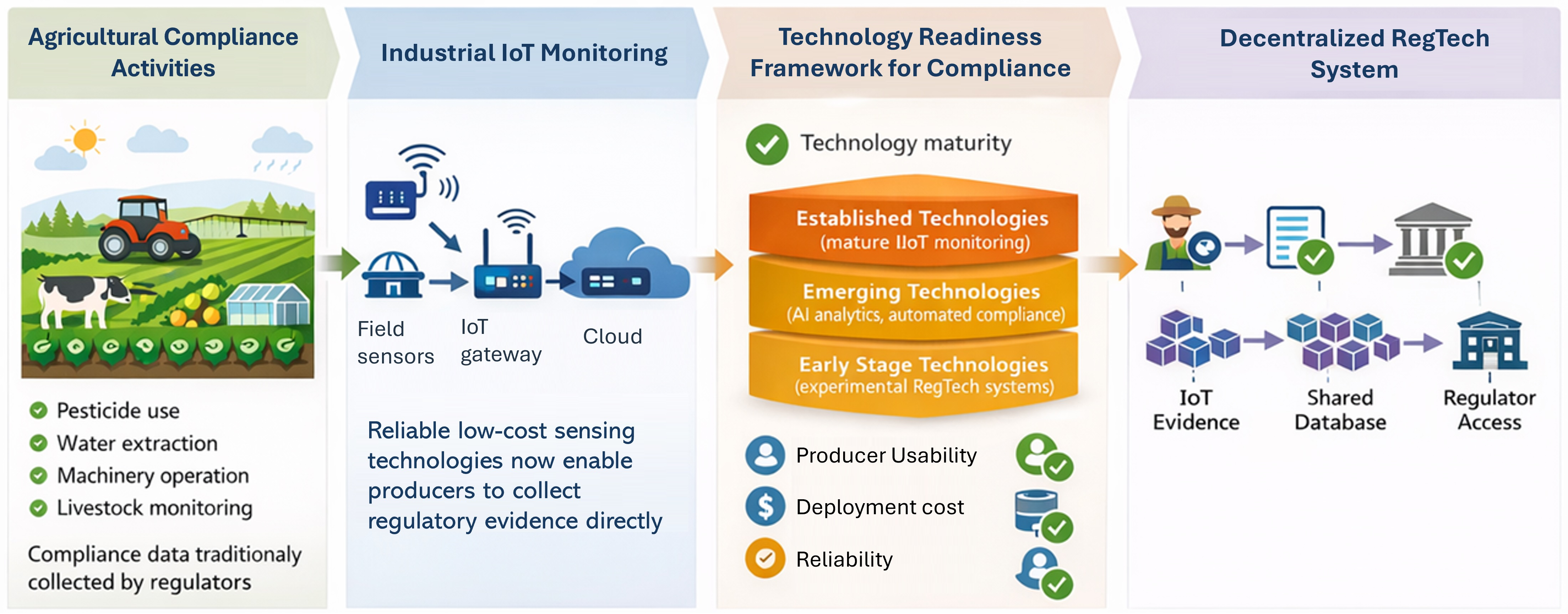
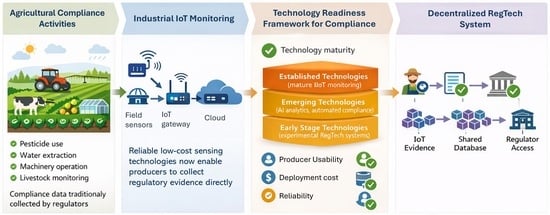
- Develop a Technology Readiness framework for agriculture, specifically for RegTech purposes. This framework, although similar to the Technology Readiness Level (TRL) framework [13], proposes 6 specific attributes and 3 maturity levels. The framework is applied to key IIoT and related digital technologies in agriculture. to establish their maturity and suitability in RegTech. We classify technologies into Early-stage, Emerging, and Established. The categorization sheds light on possible future integration into RegTech.
2. Agriculture Process and Regulatory Burden
2.1. Agriculture as a Cycle of Activities
2.2. Regulatory Activities and Burden
3. RegTech in Agriculture
3.1. Defining RegTech
- i.
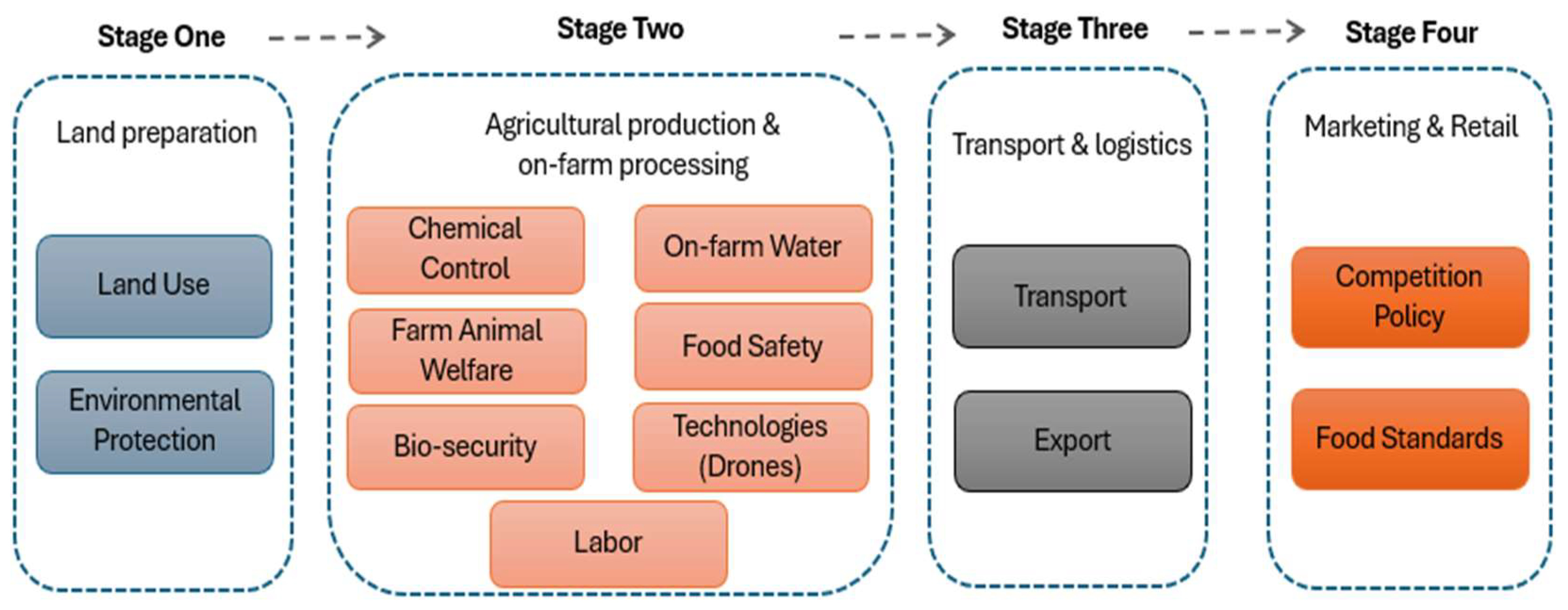
- Individual products are produced (Stages 1–2 in Figure 2);
- ii.
- Undergoes various changes, including ownership and packaging (Stage 3);
- iii.
- Finally, it is consumed and has an impact on society, for example, on public health (Stage 4 in Figure 2).
3.2. Key RegTech and IIoT Technologies
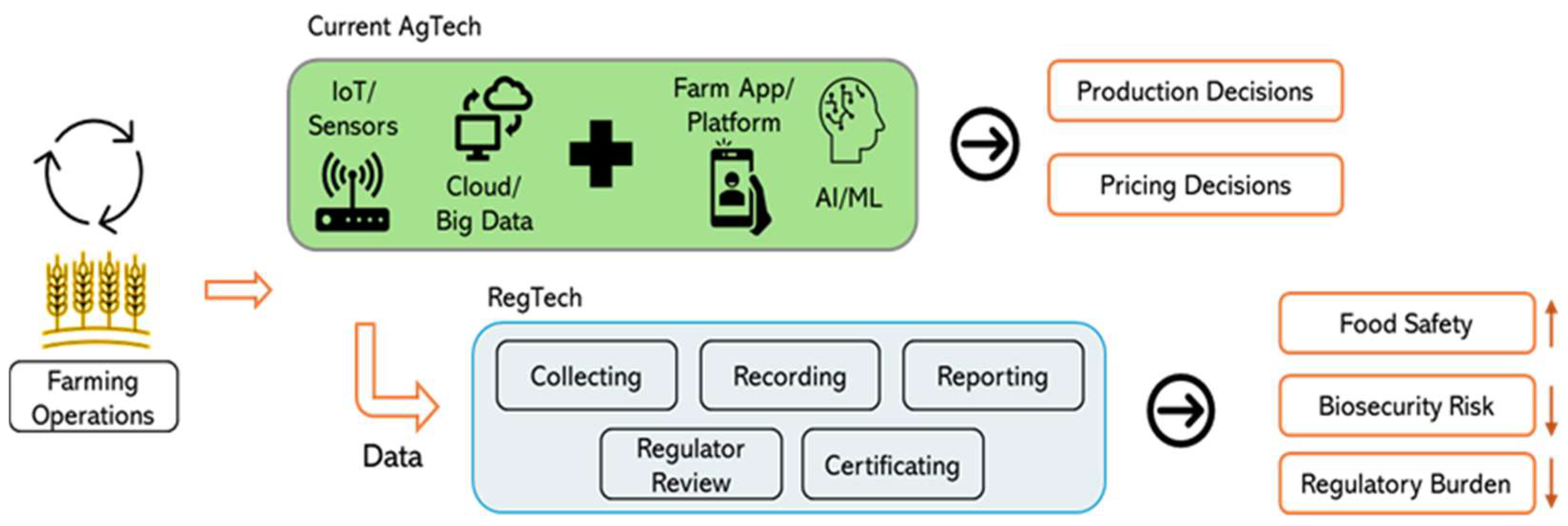
- IIoT: This technology is applied in Agriculture for real-time monitoring of environmental conditions such as soil water, pest control, livestock health, food safety, and anti-counterfeiting traceability [6]. This existing IIoT infrastructure can be repurposed for RegTech to meet compliance requirements. For instance, data on pesticide and fertilizer applications, water use, and emissions can be automatically recorded and reported to support environmental compliance.
- Sensors: Their cost has fallen over the years. They simply gather precise data about the farm environment and operations, such as soil nutrient levels [26], pesticide residues [27], and product quality [28]. These existing tools can easily be used for compliance tasks. They can monitor food quality throughout the supply chain to ensure safety, detect contamination quickly, and track environmental conditions to help meet regulatory requirements.
- AI and Machine Learning (ML): Both are already used in farming for tasks such as pest and disease detection and prediction [29], weed identification [30], product grading [31], and optimizing resource use. These existing analytical tools create major opportunities for RegTech. AI/ML can analyze farm data to identify compliance risks and prioritize inspections. They can detect anomalies that indicate noncompliance and automate the generation of reports for regulators. This approach yields synergistic benefits from the initial AgTech investment.
- Computer Vision: Computer vision capabilities in AgTech include product identification, sorting, and quality control [32], and pest and disease detection [33]. These provide a strong foundation for automated compliance verification in RegTech. This technology can help verify compliance with labeling regulations, product quality standards, and other visual inspection requirements, reducing the need for manual inspection.
- Blockchain: It has been employed for supply chain traceability and provenance verification [3]. This technology’s inherent security and immutability create an audit trail of compliance activities, enhancing audit efficiency and transparency. Furthermore, it provides a secure and verifiable platform for storing and managing certifications [34], and enhance confidence in compliance claims for cross-border transactions.
- Radio-Frequency Identification (RFID) and Near Field Communication (NFC): Both play a crucial role in AgTech for livestock tracking and product identification [28]. Their ability to provide granular tracking information makes them particularly valuable to RegTech. They enable rapid, efficient product recalls, thereby minimizing potential harm to consumers and economic losses for producers.
- Farm Management Software (FMS): FMS is commonly used for crop life cycle reporting, record-keeping, and managing daily farm activities [35]. By using its existing data collection, recording, and storage capabilities, RegTech can automate the generation of compliance reports or provide auditors with direct access to the necessary data for compliance verification [36].
- Drones and Satellites: Both are already implemented in AgTech for pest and disease monitoring [37], pesticide application [38], air pollution identification [39], and yield prediction and field mapping. Compliance monitoring can be streamlined and made more efficient by using existing imagery. For instance, this imagery can verify compliance with land use regulations, environmental restrictions, and crop insurance requirements.
3.3. Assessing Technological Maturity
3.3.1. Technological Maturity Framework for RegTech
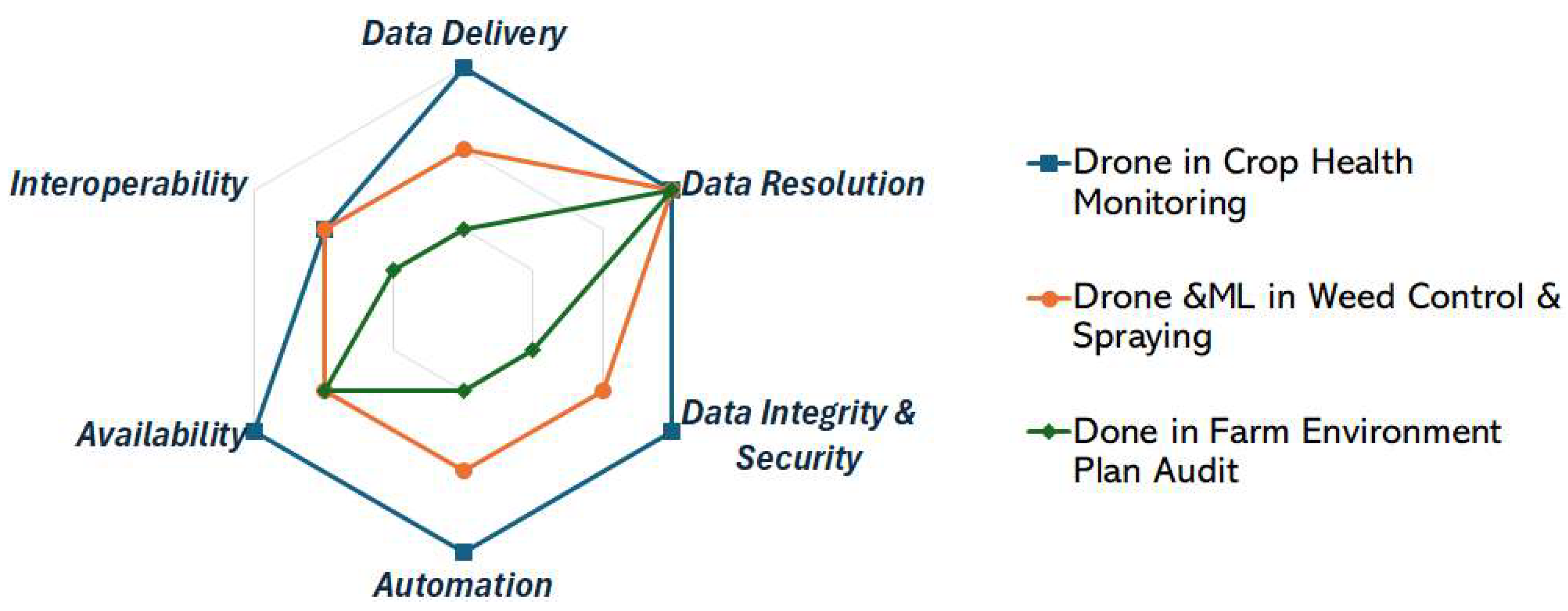
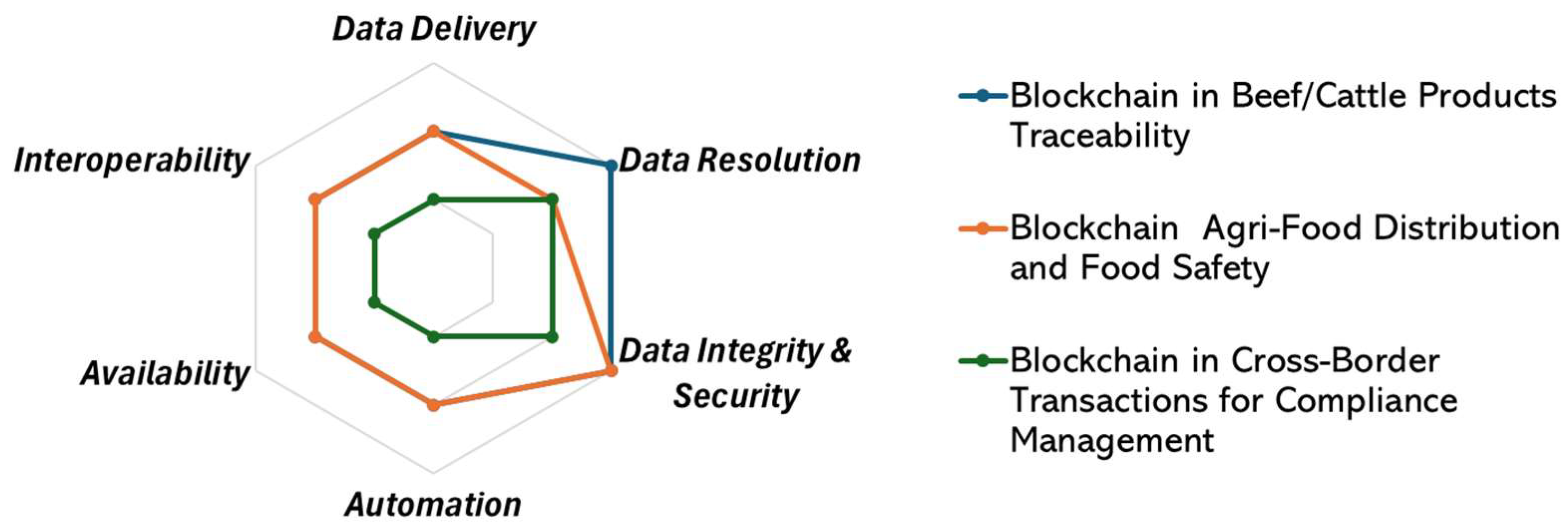
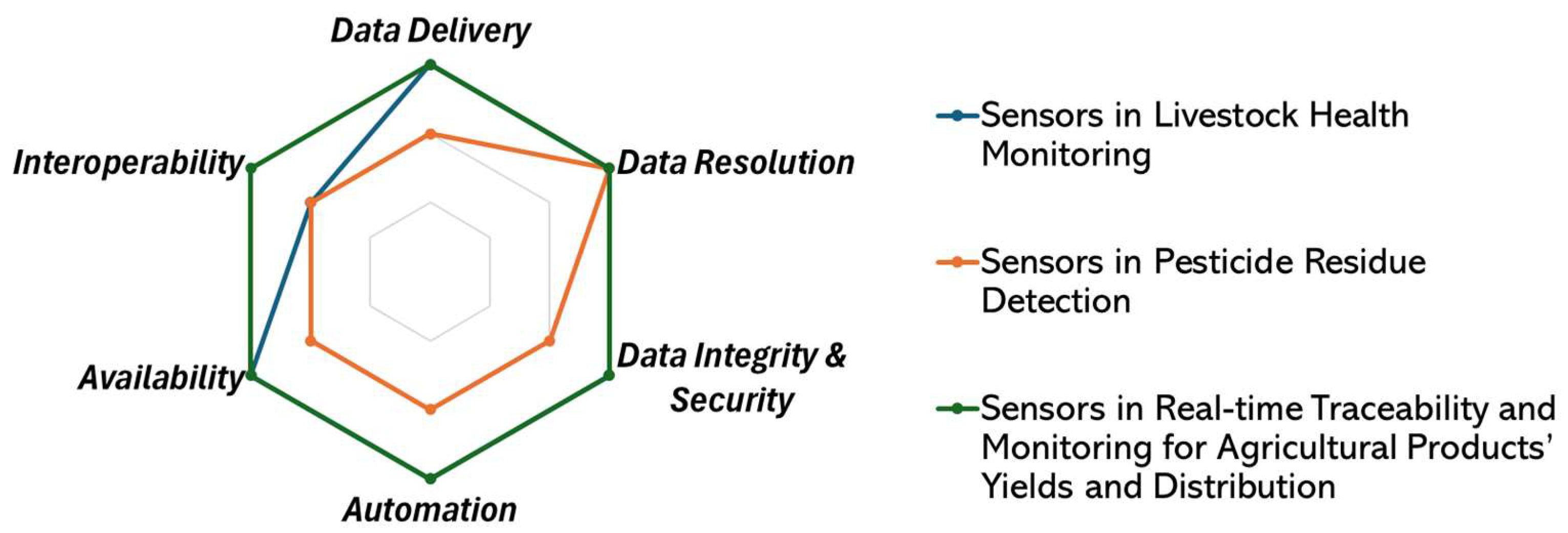
- Data delivery and accessibility refer to the speed, reliability, and ease of data transfer from the point of collection (e.g., a sensor or device) through the network to the user interface (i.e., screen or decision-making system). It assesses the technical mechanisms that ensure data are readily accessible and timely, supporting real-time regulatory decisions.
- Data resolution refers to the scale, volume, and level of granularity of the collected data for compliance checks. It assesses the spatial and temporal density of data required to support precise decisions at the necessary scale.
- Data integrity and security concern the trustworthiness, accuracy, and confidentiality of collected and transmitted data. It assesses the risk of data being inaccurate, compromised, or modified without authorization during its lifecycle. These three attributes are critical for regulatory compliance because regulators require accurate, sufficient, and timely data to enforce standards such as biosecurity traceability, cold-chain monitoring, and chemical application reporting.
- 4.
- Automation refers to the degree to which the technology minimizes human intervention and manual workloads without risk of failure. A highly automated operational process is expected to reduce labor and management costs associated with farming. This would also ensure more frequent data collection and consistent regulatory checks.
- 5.
- Interoperability indicates the seamless and secure exchange of collected data or devices to software compatibilities.
- 6.
- Availability refers to whether users can access the application with ease, without barriers or complex procurement procedures. When interoperability and availability are high, they act as catalysts for more frequent, reliable compliance checks involving multiple stakeholders, especially when they are not well known to each other.
- Early stage (E.S., Proof of Concept): technologies at this level are still considered as under development or in the initial stages of pilot projects. Their feasibility and potential benefits are being explored, but they are not yet widely available for commercial use. This loosely follows TRL 1–6.
- Emerging (Growth Stage): technologies at this stage have transitioned from the initial concept stage and are being adopted by early users. They are commercially available but may still have limitations in terms of functionality or scalability. This loosely follows TRL 6–7.
- Established (Est., Mature Stage): technologies at this level are widely adopted and considered standard practice within their respective industries. They are well-developed and reliable, and they offer a broad range of functionalities. This loosely follows TRL 8–9.
- The granularity in which the information can be collected, and the ability to process the information for the use case purpose.
- The ability to control the process with high precision for the specific use case purpose.
3.3.2. Measuring Technology Readiness: Drones
3.3.3. Measuring Technology Readiness: Blockchain
3.3.4. Measuring Technology Readiness: Sensors
3.3.5. Technology Maturity Status

| Functions/ Applications | Sub Theme (Use Case) | Primary Technologies | Readiness for RegTech | Ref. |
|---|---|---|---|---|
| Land | Land Cover Classification | AI/ML | Emerging | [52] |
| Soil Management | Soil Moisture Estimation | AI/ML | Emerging | [53] |
| Seed | Seed Classification | Computer Vision/ML | Emerging | [54] |
| Crop Production | Crop Classification | Deep Learning (DL) | Emerging | [55] |
| Vegetable or Fruit Grading | AI/ML | Emerging | [31] | |
| Weed Control | Weed Identification | DL | Emerging | [30,56,57] |
| Weed Detection | DL | Emerging | [58] | |
| Spraying and Weed Identification | Drone & ML | Emerging | [59] | |
| Diseases Monitoring | Plant Disease Classification | ML/DL/Computer Vision | Emerging | [29,33,60,61,62] |
| Disease Detection | AI/ML | Emerging | [63,64] | |
| Disease Localization | DL | Emerging | [65] | |
| Crop Health Monitoring | Drone | Est. | [66,67,68] | |
| Livestock Health Monitoring and Record | Sensor/Wireless Sensor Network (WSN)/Biosensor | Est. | [47,69,70,71] | |
| RFID | Est. | [72] | ||
| Pest & Disease Control | Pest Identification and Control | IIoT | E.S. | [73,74] |
| Spraying | Drone | Est. | [75] | |
| Plant Pest and Disease Monitoring | Drones and Satellites | Est. | [37,76] | |
| Plant Pest and Disease Detection/Identification/Classification | AI and ML | Emerging | [77,78,79,80] | |
| Insect Classification and Detection | ML | Emerging | [81] | |
| Pesticide Application | Drones | Emerging | [38,75] | |
| Pesticide Residue Detection | Sensors | Emerging | [27,82] | |
| Food Traceability | Transparency in agri-food distribution, food origin and sourcing, food safety, and quality. | Blockchain | Emerging | [11,12] |
| Real-time traceability and monitoring for agricultural products’ yields and distribution | Sensors | Est. | [49,83,84] | |
| Fresh Fruits and Vegetables Traceability | IIoT networks | E.S. | [85] | |
| Anti- counterfeiting | Food Anti-counterfeiting | Blockchain & IIoT | Emerging | [3] |
| Beef Cattle Products Traceability | Blockchain | Emerging | [86] | |
| Wine Anti-counterfeiting | RFID | Est. | [28,87] | |
| Agricultural Products Provenance | NFC | Est. | [88,89] | |
| Food Safety and Commercial Fraud | DNA Barcoding | E.S. | [90,91] | |
| Food Authentication and Traceability/Animal Identification, and Meat Products Traceability | Chemical Fingerprinting | E.S. | [92,93] | |
| Quality Control and Inspection | Product Identification and Sorting (inspection and quality control of fruits and vegetables/food products) | Computer Vision | Emerging | [32,94] |
| Real-time Data Collection | Precision Agriculture/Environmental Factors Control for Crops | IIoT | Est. | [10,48,95] |
| Livestock Management | Precision Livestock Farming | Agricultural Robots | Emerging | [96,97] |
| Moving Indoor Livestock | Drone | E.S. | [98] | |
| Behavior Recognition | ML/DL | Emerging | [99,100] | |
| Product Management | Product Monitoring/Food Security | Blockchain | Emerging | [101] |
| Food Safety Monitoring | Blockchain & IIoT | Emerging | [102,103,104] | |
| Crop Life Cycle Reporting | Crop Production; Crop Data Management | Farm Management Software | Est. | [105,106] |
| Environment Monitoring | Crop Farming | AI/ML | Emerging | [107] |
| Remote real-time unattended agriculture environment monitoring (habitat, greenhouse, climate, forest) | WSN | Est. | [108,109,110] | |
| Soil Water Content (Irrigation scheduling); controlled environment monitoring, and controlling | IIoT sensors | Est. | [26] | |
| Soil source pollution identification in forestry/air pollution | Drone, ML | Emerging | [39,111] | |
| Technology Compatibility | Farm Digitalization | Integration System | E.S. | [1] |
| Agricultural Regulation Translation | Automatic Rule Classification (Pesticide Regulations) | ML & Natural Language Processing (NLP) | E.S. | [25] |
| Compliance Management | Halal Certification | AI/Blockchain | E.S. | [34,112] |
| Cross-Border Transactions | Blockchain | E.S. | [113] | |
| Cross-compliance with Environmental Requirements | FMS | Emerging | [36,114] | |
| Smart Sustainability Compliance Reporting | Integrate Farm Management Information System (FMIS) & Farm Financial Accounting (FFA) | E.S. | [115] | |
| Automatic Compliance Control | Standards/legislation encoding & Computer Inference System | E.S. | [116] | |
| Farm events record keeping/GAP (good agricultural practices) compliance | Decision support system (“GAP-a-Farm”) | E.S. | [117,118] | |
| Law Compliance Check | AI | E.S. | [119] | |
| Admin Issues | Farm Environment Plans Audit | Drone | E.S. | [40] |
| Farm Audit Streaming, Simplified Reporting, Lab Analysis Management | Global Compliance Platform (Agri-Place) | E.S. | [120] | |
| Simplifying audit and inspection, document management and verification, and improving the certification process | AI | E.S. | [121] |
3.4. Economic Maturity
- i.
- ii.
- The risk of the product being counterfeited, thus causing reputational harm and, in turn, economic harm. A higher risk of counterfeiting would be a motivating factor for implementing RegTech and decentralizing it, thereby enabling greater flexibility in implementing anti-counterfeit measures [124].
- iii.
- The capital cost of installing RegTech-related infrastructure is affected by, for example, the lower the initial cost of implementing RegTech, the easier it is to decentralize it by enabling smaller stakeholders to install the infrastructure [125].
- iv.
3.5. Social Factors
- Bias in recording and analysing regulatory data by automated processes. Biased training data, flawed algorithms, or human oversight can all contribute to bias. Bias in regulatory data analysis can lead to unfair or discriminatory outcomes, thereby reducing stakeholders’ willingness to adopt or rely on such analyses. This reluctance can hinder broader IIoT and RegTech implementation.
- Perceived Ease of Use: The technology must be user-friendly and easy to understand, even for those with limited technical expertise. Complex or difficult-to-use systems are often rejected, even if they offer significant benefits.
- Trust and Confidence with increased regulatory scrutiny: Stakeholders must have trust in the technology and the data it generates. Concerns about data privacy, security, and the system’s reliability can significantly hinder adoption [133].
4. Future Decentralized Compliance Management Framework
4.1. Monitoring Coverage-Time and Space
- frequency of data collection: Assuming technology can accurately collect data, it is necessary to collect the data at the correct frequency or on demand for compliance purposes, to ensure the data can be used for verification and compliance. Frequency can vary and may be adjusted by regulators or farmers, ranging from real-time to event-oriented.
- data collection location: In addition to adhering to the correct data collection times, it is crucial to gather the most critical data from the designated locations. This “space” dimension refers to the extent to which the relevant area or objects are monitored, with higher spatial coverage offering better RegTech oversight. Coverage can range from complete (e.g., scanning every item) to partial (e.g., sampling or sensor density).
4.2. Shared Responsibility
- a.
- shared responsibility: RegTech would need to distribute the compliance activity to minimize the risk of missing any information or misidentifying a non-compliance. Shared responsibility should delineate clear expectations regarding the activities to be undertaken, including their frequency and location, for the respective stakeholders. Activities are to be done by everybody, i.e., every stakeholder holds a piece of the information chain, and the data is always attributed to the corresponding stakeholder.
- b.
- smooth exchange or handover of the product: Every time the product changes ownership, the data previously collected about the product by RegTech needs to be passed on. The manner and quantity of this information should vary with regard to the privacy of trade information.
- c.
- trust in the stakeholder: The shared responsibility is based on the trust that the owners intend to record compliance-related information and possess the technical ability to utilize advanced RegTech to collect the information and perform compliance checks.
4.3. Benefits of Decentralization
4.4. Risk Management
4.4.1. Reliability of Personnel and Equipment
4.4.2. Redundancy of Technology and Operation
4.4.3. Social and Legal Risks
5. Conclusions
Author Contributions
Funding
Data Availability Statement
Acknowledgments
Conflicts of Interest
References
- Romera, A.; Sharifi, M.; Charters, S. Digitalization in agriculture. Towards an integrative approach. Comput. Electron. Agric. 2024, 219, 108817. [Google Scholar] [CrossRef] [Scilit]
- Zhou, J.; Yang, Z.; Liang, Q.; Zhou, W. Effects of public and private regulations on wholesale vendors’ adoption of agrifood traceability to farms. Agribusiness 2025, 41, 633–653. [Google Scholar] [CrossRef] [Scilit]
- Han, Y.; Liu, X.; Xiang, P. Design and Implementation of Blockchain-based Anti-Counterfeit Traceability System for Beef Cattle Products. Adv. Comput. Signals Syst. 2023, 7, 69–80. [Google Scholar]
- Zamri, I.H.; Lord, B.R.; Steenkamp, N. Measuring and reporting environmental impacts of dairy farming. Meditari Account. Res. 2024, 32, 1423–1444. [Google Scholar] [CrossRef] [Scilit]
- Adams, J.; Kennedy, A.; Cotton, J.; Brumby, S. Child farm-related injury in Australia: A review of the literature. Int. J. Environ. Res. Public Health 2021, 18, 6063. [Google Scholar] [CrossRef] [Scilit]
- Li, J.; Maiti, A.; Fei, J. Features and Scope of Regulatory Technologies: Challenges and Opportunities with Industrial Internet of Things. Future Internet 2023, 15, 256. [Google Scholar] [CrossRef] [Scilit]
- Buckmaster, D.; Basir, S.; Sakata, H. Facilitating Digital Agriculture with Simple Databases. arXiv 2023, arXiv:2312.06517. [Google Scholar] [CrossRef] [Scilit]
- Sikes, A.; McDonnell, C.; Beckett, S. Defining the Overarching Requirements for Automated Product Verification and the Development of Key Industry Standards; Meat and Livestock Australia Limited: North Sydney, Australia, 2020. [Google Scholar]
- Savastano, M.; Amendola, C.; Bellini, F.; D’Ascenzo, F. Contextual impacts on industrial processes brought by the digital transformation of manufacturing: A systematic review. Sustainability 2019, 11, 891. [Google Scholar] [CrossRef] [Scilit]
- Dewi, C.; Chen, R.-C. Decision making based on IoT data collection for precision agriculture. Intell. Inf. Database Syst. Recent Dev. 2020, 11, 31–42. [Google Scholar]
- Menon, S.; Jain, K. Blockchain technology for transparency in agri-food supply chain: Use cases, limitations, and future directions. IEEE Trans. Eng. Manag. 2021, 71, 106–120. [Google Scholar] [CrossRef] [Scilit]
- Kumar, S.V.S.; Avinash, V.S.; Gowri, S. Tracking of Food Products from Source to consumption, Enhancing Transparency and Food Safety using Blockchain. In Proceedings of the 2024 International Conference on Inventive Computation Technologies (ICICT), Lalitpur, Nepal, 24–26 April 2024; IEEE: Piscataway, NJ, USA, 2024; pp. 1573–1578. [Google Scholar]
- Mankins, J.C. Technology readiness assessments: A retrospective. Acta Astronaut. 2009, 65, 1216–1223. [Google Scholar] [CrossRef] [Scilit]
- Productivity Commission. Regulation of Australian Agriculture, Report No. 79; Research Report; The Productivity Commission Canberra: Barton, Australia, 2016.
- Längle, A.; Burgess, P.; Sunmola, F. Requirements Analysis for Digital Supply Chain Compliance Management Platforms: Case of German Meat Industry. Procedia Comput. Sci. 2024, 232, 2038–2048. [Google Scholar] [CrossRef] [Scilit]
- TROVE. Measuring Red Tape: Understanding the Compliance Burden on Tasmanian Businesses; Department of Economic Development, Tourism and the Arts: Hobart, Australia, 2013. Available online: https://trove.nla.gov.au/work/236431188 (accessed on 12 June 2024).
- Lengai, G.M.; Fulano, A.M.; Muthomi, J.W. Improving access to export market for fresh vegetables through reduction of phytosanitary and pesticide residue constraints. Sustainability 2022, 14, 8183. [Google Scholar] [CrossRef] [Scilit]
- Jaureguiberry, F.; Tappata, M. The role of public–private coordination: The case of sweet cherries in Argentina 2000–2020. J. Agribus. Dev. Emerg. Econ. 2022, 12, 689–713. [Google Scholar] [CrossRef] [Scilit]
- Deuss, A.; Laget, E. Sanitary and Phytosanitary Approval Procedures: Key Issues, their Impact on Trade, and Ways to Address Them; OECD Publishing: Paris, France, 2023. [Google Scholar]
- Kaila, L.; Ketola, J.; Toivonen, M.; Loukola, O.; Hakala, K.; Raiskio, S.; Hurme, T.; Jalli, M. Pesticide residues in honeybee-collected pollen: Does the EU regulation protect honeybees from pesticides? Environ. Sci. Pollut. Res. 2022, 29, 18225–18244. [Google Scholar] [CrossRef] [Scilit] [PubMed]
- Schaefer, K.A.; Scheitrum, D. Sewing terror: Price dynamics of the strawberry needle crisis. Aust. J. Agric. Resour. Econ. 2020, 64, 229–243. [Google Scholar] [CrossRef] [Scilit]
- Bose, D.; Padmavati, M. Honey authentication: A review of the issues and challenges associated with honey adulteration. Food Biosci. 2024, 61, 105004. [Google Scholar] [CrossRef] [Scilit]
- Zhu, X.; Mishra, A.K.; Sha, W. The Fallacy of Sustainability: Evidence from Yangtze River Fishing Ban. Agribusiness 2025. early view. [Google Scholar] [CrossRef] [Scilit]
- Johansson, E.; Sutinen, K.; Lassila, J.; Lang, V.; Martikainen, M.; Lehner, O.M. Regtech-a necessary tool to keep up with compliance and regulatory changes. ACRN J. Financ. Risk Perspect. 2019, 8, 71–85. [Google Scholar]
- Espejo-Garcia, B.; Martinez-Guanter, J.; Pérez-Ruiz, M.; Lopez-Pellicer, F.J.; Zarazaga-Soria, F.J. Machine learning for automatic rule classification of agricultural regulations: A case study in Spain. Comput. Electron. Agric. 2018, 150, 343–352. [Google Scholar] [CrossRef] [Scilit]
- Chamara, N.; Islam, M.D.; Bai, G.F.; Shi, Y.; Ge, Y. Ag-IoT for crop and environment monitoring: Past, present, and future. Agric. Syst. 2022, 203, 103497. [Google Scholar] [CrossRef] [Scilit]
- Issaka, E.; Wariboko, M.A.; Johnson, N.A.N.; Nyame-do Aniagyei, O. Advanced visual sensing techniques for on-site detection of pesticide residue in water environments. Heliyon 2023, 9, e13986. [Google Scholar] [CrossRef] [Scilit] [PubMed]
- Khalil, G.; Doss, R.; Chowdhury, M. A comparison survey study on RFID based anti-counterfeiting systems. J. Sens. Actuator Netw. 2019, 8, 37. [Google Scholar] [CrossRef] [Scilit]
- Ashwinkumar, S.; Rajagopal, S.; Manimaran, V.; Jegajothi, B. Automated plant leaf disease detection and classification using optimal MobileNet based convolutional neural networks. Mater. Today Proc. 2022, 51, 480–487. [Google Scholar] [CrossRef] [Scilit]
- Hu, C.; Thomasson, J.A.; Bagavathiannan, M.V. A powerful image synthesis and semi-supervised learning pipeline for site-specific weed detection. Comput. Electron. Agric. 2021, 190, 106423. [Google Scholar] [CrossRef] [Scilit]
- Cen, H.; Lu, R.; Zhu, Q.; Mendoza, F. Nondestructive detection of chilling injury in cucumber fruit using hyperspectral imaging with feature selection and supervised classification. Postharvest Biol. Technol. 2016, 111, 352–361. [Google Scholar] [CrossRef] [Scilit]
- Saldaña, E.; Siche, R.; Luján, M.; Quevedo, R. Computer vision applied to the inspection and quality control of fruits and vegetables. Braz. J. Food Technol. 2013, 16, 254–272. [Google Scholar] [CrossRef] [Scilit]
- Singh, P.; Verma, A.; Alex, J.S.R. Disease and pest infection detection in coconut tree through deep learning techniques. Comput. Electron. Agric. 2021, 182, 105986. [Google Scholar] [CrossRef] [Scilit]
- Sunmola, F.; Baryannis, G.; Tan, A.; Co, K.; Papadakis, E. Holistic Framework for Blockchain-Based Halal Compliance in Supply Chains Enabled by Artificial Intelligence. Systems 2025, 13, 21. [Google Scholar] [CrossRef] [Scilit]
- Dhonju, H.K.; Walsh, K.B.; Bhattarai, T. Management information systems for tree fruit—1: A review. Horticulturae 2024, 10, 108. [Google Scholar] [CrossRef] [Scilit]
- Knuth, U.; Amjath-Babu, T.; Knierim, A. Adoption of farm management systems for cross compliance–an empirical case in Germany. J. Environ. Manag. 2018, 220, 109–117. [Google Scholar] [CrossRef] [Scilit] [PubMed]
- Zhang, J.; Huang, Y.; Pu, R.; Gonzalez-Moreno, P.; Yuan, L.; Wu, K.; Huang, W. Monitoring plant diseases and pests through remote sensing technology: A review. Comput. Electron. Agric. 2019, 165, 104943. [Google Scholar] [CrossRef] [Scilit]
- Hafeez, A.; Husain, M.A.; Singh, S.; Chauhan, A.; Khan, M.T.; Kumar, N.; Chauhan, A.; Soni, S. Implementation of drone technology for farm monitoring & pesticide spraying: A review. Inf. Process. Agric. 2023, 10, 192–203. [Google Scholar] [CrossRef] [Scilit]
- Cozma, A.; Firculescu, A.-C.; Tudose, D.; Ruse, L. Autonomous multi-rotor aerial platform for air pollution monitoring. Sensors 2022, 22, 860. [Google Scholar] [CrossRef] [Scilit] [PubMed]
- Westbrooke, V.; Lucock, X.; Greenhalgh, I. Drone use in on-farm environmental compliance: An investigation of regulators’ perspectives. Sustainability 2023, 15, 2153. [Google Scholar] [CrossRef] [Scilit]
- Rafi, M.S.M.; Behjati, M.; Rafsanjani, A.S. Reliable and Cost-Efficient IoT Connectivity for Smart Agriculture: A Comparative Study of LPWAN, 5G, and Hybrid Connectivity Models. In Smart Computing Paradigms: Intelligence and Network Applications; Bhateja, V., Hoong, A.L.S., Kong, J.D., Urooj, S., Eds.; Springer Nature: Cham, Switzerland, 2026; pp. 389–411. [Google Scholar]
- Cao, S.; Boyen, X.; Deane, F.; Miller, T.; Foth, M. Enabling cross-border trade in the face of regulatory barriers to data flow–the case of the blockchain-based service network. In Blockchain for Industry 4.0; CRC Press: Boca Raton, FL, USA, 2022; pp. 285–303. [Google Scholar]
- Wu, S. The Legal Problems of Blockchain Technology in Cross-border E-Commerce. J. Econ. Law 2024, 1, 20–28. [Google Scholar] [CrossRef] [Scilit]
- Agnola, T.; Ambrosini, L.; Beretta, E.; Gremlich, G. Empowering Global Supply Chains Through Blockchain-Based Platforms: New Evidence from the Coffee Industry. FinTech 2025, 4, 3. [Google Scholar] [CrossRef] [Scilit]
- Sinha, D.; Roy Chowdhury, S. Blockchain-based smart contract for international business—A framework. J. Glob. Oper. Strateg. Sourc. 2021, 14, 224–260. [Google Scholar] [CrossRef] [Scilit]
- Kulothungan, V. A blockchain-enabled approach to cross-border compliance and trust. In Proceedings of the 2024 IEEE 6th International Conference on Trust, Privacy and Security in Intelligent Systems, and Applications (TPS-ISA), Washington, DC, USA, 28–31 October 2024; IEEE: Piscataway, NJ, USA, 2024; pp. 446–454. [Google Scholar]
- Dos Reis, B.R.; Easton, Z.; White, R.R.; Fuka, D. A LoRa sensor network for monitoring pastured livestock location and activity. Transl. Anim. Sci. 2021, 5, txab010. [Google Scholar] [CrossRef] [Scilit] [PubMed]
- Karunathilake, E.M.B.M.; Le, A.T.; Heo, S.; Chung, Y.S.; Mansoor, S. The Path to Smart Farming: Innovations and Opportunities in Precision Agriculture. Agriculture 2023, 13, 1593. [Google Scholar] [CrossRef] [Scilit]
- Brochado, Â.F.; Rocha, E.M.; Costa, D. A Modular IoT-Based Architecture for Logistics Service Performance Assessment and Real-Time Scheduling towards a Synchromodal Transport System. Sustainability 2024, 16, 742. [Google Scholar]
- Jedermann, R.; Singh, K.; Lang, W.; Mahajan, P. Digital twin concepts for linking live sensor data with real-time models. J. Sens. Sens. Syst. 2023, 12, 111–121. [Google Scholar] [CrossRef] [Scilit]
- Yadav, A.; Yadav, K. Portable solutions for plant pathogen diagnostics: Development, usage, and future potential. Front. Microbiol. 2025, 16, 1516723. [Google Scholar] [CrossRef] [Scilit]
- Rußwurm, M.; Körner, M. Multi-temporal land cover classification with sequential recurrent encoders. ISPRS Int. J. Geo-Inf. 2018, 7, 129. [Google Scholar]
- Liu, D.; Mishra, A.K.; Yu, Z. Evaluating uncertainties in multi-layer soil moisture estimation with support vector machines and ensemble Kalman filtering. J. Hydrol. 2016, 538, 243–255. [Google Scholar] [CrossRef] [Scilit]
- Kurtulmuş, F.; Ünal, H. Discriminating rapeseed varieties using computer vision and machine learning. Expert Syst. Appl. 2015, 42, 1880–1891. [Google Scholar] [CrossRef] [Scilit]
- Zhong, L.; Hu, L.; Zhou, H. Deep learning based multi-temporal crop classification. Remote Sens. Environ. 2019, 221, 430–443. [Google Scholar] [CrossRef] [Scilit]
- Dyrmann, M.; Karstoft, H.; Midtiby, H.S. Plant species classification using deep convolutional neural network. Biosyst. Eng. 2016, 151, 72–80. [Google Scholar] [CrossRef] [Scilit]
- Yu, J.; Sharpe, S.M.; Schumann, A.W.; Boyd, N.S. Deep learning for image-based weed detection in turfgrass. Eur. J. Agron. 2019, 104, 78–84. [Google Scholar] [CrossRef] [Scilit]
- Osorio, K.; Puerto, A.; Pedraza, C.; Jamaica, D.; Rodríguez, L. A deep learning approach for weed detection in lettuce crops using multispectral images. AgriEngineering 2020, 2, 471–488. [Google Scholar] [CrossRef] [Scilit]
- Esposito, M.; Crimaldi, M.; Cirillo, V.; Sarghini, F.; Maggio, A. Drone and sensor technology for sustainable weed management: A review. Chem. Biol. Technol. Agric. 2021, 8, 18. [Google Scholar] [CrossRef] [Scilit]
- Atila, Ü.; Uçar, M.; Akyol, K.; Uçar, E. Plant leaf disease classification using EfficientNet deep learning model. Ecol. Inform. 2021, 61, 101182. [Google Scholar] [CrossRef] [Scilit]
- Bedi, P.; Gole, P. Plant disease detection using hybrid model based on convolutional autoencoder and convolutional neural network. Artif. Intell. Agric. 2021, 5, 90–101. [Google Scholar] [CrossRef] [Scilit]
- Aravind, K.R.; Maheswari, P.; Raja, P.; Szczepański, C. Crop disease classification using deep learning approach: An overview and a case study. In Deep Learning for Data Analytics; Elsevier: Amsterdam, The Netherlands, 2020; pp. 173–195. [Google Scholar]
- Phadikar, S.; Sil, J.; Das, A.K. Rice diseases classification using feature selection and rule generation techniques. Comput. Electron. Agric. 2013, 90, 76–85. [Google Scholar] [CrossRef] [Scilit]
- Stegmayer, G.; Milone, D.H.; Garran, S.; Burdyn, L. Automatic recognition of quarantine citrus diseases. Expert Syst. Appl. 2013, 40, 3512–3517. [Google Scholar] [CrossRef] [Scilit]
- Lee, S.H.; Goëau, H.; Bonnet, P.; Joly, A. Attention-based recurrent neural network for plant disease classification. Front. Plant Sci. 2020, 11, 601250. [Google Scholar] [CrossRef] [Scilit] [PubMed]
- Devi, G.; Sowmiya, N.; Yasoda, K.; Muthulakshmi, K.; Balasubramanian, K. Review on application of drones for crop health monitoring and spraying pesticides and fertilizer. J. Crit. Rev. 2020, 7, 667–672. [Google Scholar]
- Reinecke, M.; Prinsloo, T. The influence of drone monitoring on crop health and harvest size. In Proceedings of the 2017 1st International Conference on Next Generation Computing Applications (NextComp), Le Méridien Ile Maurice, Mauritius, 19–21 July 2017; IEEE: Piscataway, NJ, USA, 2017; pp. 5–10. [Google Scholar]
- Abbas, A.; Zhang, Z.; Zheng, H.; Alami, M.M.; Alrefaei, A.F.; Abbas, Q.; Naqvi, S.A.H.; Rao, M.J.; Mosa, W.F.; Abbas, Q. Drones in plant disease assessment, efficient monitoring, and detection: A way forward to smart agriculture. Agronomy 2023, 13, 1524. [Google Scholar] [CrossRef] [Scilit]
- Helwatkar, A.; Riordan, D.; Walsh, J. Sensor technology for animal health monitoring. Int. J. Smart Sens. Intell. Syst. 2014, 7, 1–6. [Google Scholar] [CrossRef] [Scilit]
- Sharma, B.; Koundal, D. Cattle health monitoring system using wireless sensor network: A survey from innovation perspective. IET Wirel. Sens. Syst. 2018, 8, 143–151. [Google Scholar] [CrossRef] [Scilit]
- Neethirajan, S.; Tuteja, S.K.; Huang, S.-T.; Kelton, D. Recent advancement in biosensors technology for animal and livestock health management. Biosens. Bioelectron. 2017, 98, 398–407. [Google Scholar] [CrossRef] [Scilit] [PubMed]
- Ariff, M.; Ismarani, I.; Shamsuddin, N. RFID based systematic livestock health management system. In Proceedings of the 2014 IEEE Conference on Systems, Process and Control (ICSPC 2014), Kuala Lumpur, Malaysia, 12–14 December 2014; IEEE: Piscataway, NJ, USA, 2014; pp. 111–116. [Google Scholar]
- Saranya, K.; Dharini, P.U.; Darshni, P.U.; Monisha, S. IoT based pest controlling system for smart agriculture. In Proceedings of the 2019 International Conference on Communication and Electronics Systems (ICCES), Coimbatore, India, 17–19 July 2019; IEEE: Piscataway, NJ, USA, 2019; pp. 1548–1552. [Google Scholar]
- Nayagam, M.G.; Vijayalakshmi, B.; Somasundaram, K.; Mukunthan, M.; Yogaraja, C.; Partheeban, P. Control of pests and diseases in plants using iot technology. Meas. Sens. 2023, 26, 100713. [Google Scholar] [CrossRef] [Scilit]
- Mogili, U.R.; Deepak, B. Review on application of drone systems in precision agriculture. Procedia Comput. Sci. 2018, 133, 502–509. [Google Scholar] [CrossRef] [Scilit]
- Pinter, P.J., Jr.; Hatfield, J.L.; Schepers, J.S.; Barnes, E.M.; Moran, M.S.; Daughtry, C.S.; Upchurch, D.R. Remote sensing for crop management. Photogramm. Eng. Remote Sens. 2003, 69, 647–664. [Google Scholar]
- Orchi, H.; Sadik, M.; Khaldoun, M. On using artificial intelligence and the internet of things for crop disease detection: A contemporary survey. Agriculture 2021, 12, 9. [Google Scholar] [CrossRef] [Scilit]
- Wani, J.A.; Sharma, S.; Muzamil, M.; Ahmed, S.; Sharma, S.; Singh, S. Machine learning and deep learning based computational techniques in automatic agricultural diseases detection: Methodologies, applications, and challenges. Arch. Comput. Methods Eng. 2022, 29, 641–677. [Google Scholar]
- Mekha, J.; Parthasarathy, V. An automated pest identification and classification in crops using artificial intelligence—A state-of-art-review. Autom. Control Comput. Sci. 2022, 56, 283–290. [Google Scholar] [CrossRef] [Scilit]
- Selvaraj, M.G.; Vergara, A.; Ruiz, H.; Safari, N.; Elayabalan, S.; Ocimati, W.; Blomme, G. AI-powered banana diseases and pest detection. Plant Methods 2019, 15, 92. [Google Scholar] [CrossRef] [Scilit]
- Kasinathan, T.; Singaraju, D.; Uyyala, S.R. Insect classification and detection in field crops using modern machine learning techniques. Inf. Process. Agric. 2021, 8, 446–457. [Google Scholar]
- Umapathi, R.; Ghoreishian, S.M.; Sonwal, S.; Rani, G.M.; Huh, Y.S. Portable electrochemical sensing methodologies for on-site detection of pesticide residues in fruits and vegetables. Coord. Chem. Rev. 2022, 453, 214305. [Google Scholar]
- Ko, D.; Kwak, Y.; Song, S. Real time traceability and monitoring system for agricultural products based on wireless sensor network. Int. J. Distrib. Sens. Netw. 2014, 10, 832510. [Google Scholar]
- Badia-Melis, R.; Ruiz-Garcia, L. Real-time tracking and remote monitoring in food traceability. In Advances in Food Traceability Techniques and Technologies; Elsevier: Amsterdam, The Netherlands, 2016; pp. 209–224. [Google Scholar]
- Tagarakis, A.C.; Benos, L.; Kateris, D.; Tsotsolas, N.; Bochtis, D. Bridging the gaps in traceability systems for fresh produce supply chains: Overview and development of an integrated IoT-based system. Appl. Sci. 2021, 11, 7596. [Google Scholar] [CrossRef] [Scilit]
- Lu, Y.; Li, P.; Xu, H. A Food anti-counterfeiting traceability system based on Blockchain and Internet of Things. Procedia Comput. Sci. 2022, 199, 629–636. [Google Scholar] [CrossRef] [Scilit]
- Bernardi, P.; Gandino, F.; Lamberti, F.; Montrucchio, B.; Rebaudengo, M.; Sanchez, E. An anti-counterfeit mechanism for the application layer in low-cost RFID devices. In Proceedings of the 2008 4th European Conference on Circuits and Systems for Communications, Shanghai, China, 26–28 May 2008; IEEE: Piscataway, NJ, USA, 2008; pp. 227–231. [Google Scholar]
- Liu, B. Research on NFC Anti-Counterfeit Traceability Based on Signcryption AlgorithmResearch on NFC Anti-Counterfeit Traceability. In Proceedings of the 2023 4th International Conference on Machine Learning and Computer Application, Hangzhou China, 27–29 October 2023; Association for Computing Machinery: New York, NY, USA, 2023; pp. 941–949. [Google Scholar]
- Pigini, D.; Conti, M. NFC-based traceability in the food chain. Sustainability 2017, 9, 1910. [Google Scholar] [CrossRef] [Scilit]
- Galimberti, A.; De Mattia, F.; Losa, A.; Bruni, I.; Federici, S.; Casiraghi, M.; Martellos, S.; Labra, M. DNA barcoding as a new tool for food traceability. Food Res. Int. 2013, 50, 55–63. [Google Scholar] [CrossRef] [Scilit]
- Galimberti, A.; Labra, M.; Sandionigi, A.; Bruno, A.; Mezzasalma, V.; De Mattia, F. DNA barcoding for minor crops and food traceability. Adv. Agric. 2014, 2014, 831875. [Google Scholar] [CrossRef] [Scilit]
- Siddiqi, K.; Nollet, L.M. Fingerprinting Techniques in Food Authentication and Traceability; CRC Press: Boca Raton, FL, USA, 2018. [Google Scholar]
- Zhao, J.; Li, A.; Jin, X.; Pan, L. Technologies in individual animal identification and meat products traceability. Biotechnol. Biotechnol. Equip. 2020, 34, 48–57. [Google Scholar] [CrossRef] [Scilit]
- Brosnan, T.; Sun, D.-W. Improving quality inspection of food products by computer vision––A review. J. Food Eng. 2004, 61, 3–16. [Google Scholar] [CrossRef] [Scilit]
- Muangprathub, J.; Boonnam, N.; Kajornkasirat, S.; Lekbangpong, N.; Wanichsombat, A.; Nillaor, P. IoT and agriculture data analysis for smart farm. Comput. Electron. Agric. 2019, 156, 467–474. [Google Scholar] [CrossRef] [Scilit]
- Subach, T.; Shmeleva, Z.N. Introduction of digital innovations in livestock farming. IOP Conf. Ser. Earth Environ. Sci. 2022, 1112, 012079. [Google Scholar] [CrossRef] [Scilit]
- Bhoj, S.; Tarafdar, A.; Singh, M.; Gaur, G. Smart and automatic milking systems: Benefits and prospects. In Smart and Sustainable Food Technologies; Springer: Berlin/Heidelberg, Germany, 2022; pp. 87–121. [Google Scholar]
- Krul, S.; Pantos, C.; Frangulea, M.; Valente, J. Visual SLAM for indoor livestock and farming using a small drone with a monocular camera: A feasibility study. Drones 2021, 5, 41. [Google Scholar] [CrossRef] [Scilit]
- Fuentes, A.; Yoon, S.; Park, J.; Park, D.S. Deep learning-based hierarchical cattle behavior recognition with spatio-temporal information. Comput. Electron. Agric. 2020, 177, 105627. [Google Scholar]
- Jiang, M.; Rao, Y.; Zhang, J.; Shen, Y. Automatic behavior recognition of group-housed goats using deep learning. Comput. Electron. Agric. 2020, 177, 105706. [Google Scholar] [CrossRef] [Scilit]
- Xu, Y.; Li, X.; Zeng, X.; Cao, J.; Jiang, W. Application of blockchain technology in food safety control: Current trends and future prospects. Crit. Rev. Food Sci. Nutr. 2022, 62, 2800–2819. [Google Scholar]
- Tian, F. An Information System for Food Safety Monitoring in Supply Chains Based on HACCP, Blockchain and Internet of Things. Ph.D. Thesis, Vienna University of Economics and Business, Wien, Austria, 2018. [Google Scholar]
- Guixia, X.; Samian, N.; Faizal, M.F.M.; Mohd, M.A.Z.; As’ad, M.F.M.F.; Abdullah, A.; Seah, W.K.G.; Ishak, M.; Hermadi, I. A framework for blockchain and internet of things integration in improving food security in the food supply chain. J. Adv. Res. Appl. Sci. Eng. Technol. 2024, 34, 24–37. [Google Scholar]
- Iftekhar, A.; Cui, X.; Hassan, M.; Afzal, W. Application of blockchain and Internet of Things to ensure tamper-proof data availability for food safety. J. Food Qual. 2020, 2020, 5385207. [Google Scholar] [CrossRef] [Scilit]
- Fountas, S.; Carli, G.; Sørensen, C.G.; Tsiropoulos, Z.; Cavalaris, C.; Vatsanidou, A.; Liakos, B.; Canavari, M.; Wiebensohn, J.; Tisserye, B.a. Farm management information systems: Current situation and future perspectives. Comput. Electron. Agric. 2015, 115, 40–50. [Google Scholar] [CrossRef] [Scilit]
- Saiz-Rubio, V.; Rovira-Más, F. From smart farming towards agriculture 5.0: A review on crop data management. Agronomy 2020, 10, 207. [Google Scholar] [CrossRef] [Scilit]
- Shackelford, G.E.; Haddaway, N.R.; Usieta, H.O.; Pypers, P.; Petrovan, S.O.; Sutherland, W.J. Cassava farming practices and their agricultural and environmental impacts: A systematic map protocol. Environ. Evid. 2018, 7, 30. [Google Scholar] [CrossRef] [Scilit]
- Zhu, Y.; Song, J.; Dong, F. Applications of wireless sensor network in the agriculture environment monitoring. Procedia Eng. 2011, 16, 608–614. [Google Scholar] [CrossRef] [Scilit]
- Kassim, M.R.M.; Harun, A.N. Applications of WSN in agricultural environment monitoring systems. In Proceedings of the 2016 International Conference on Information and Communication Technology Convergence (ICTC), Jeju Island, Republic of Korea, 19–21 October 2016; IEEE: Piscataway, NJ, USA, 2016; pp. 344–349. [Google Scholar]
- Srbinovska, M.; Gavrovski, C.; Dimcev, V.; Krkoleva, A.; Borozan, V. Environmental parameters monitoring in precision agriculture using wireless sensor networks. J. Clean. Prod. 2015, 88, 297–307. [Google Scholar] [CrossRef] [Scilit]
- Jia, X.; Cao, Y.; O’Connor, D.; Zhu, J.; Tsang, D.C.; Zou, B.; Hou, D. Mapping soil pollution by using drone image recognition and machine learning at an arsenic-contaminated agricultural field. Environ. Pollut. 2021, 270, 116281. [Google Scholar] [CrossRef] [Scilit]
- Nusran, M.; Nasution, E.N.; Prayitno, M.A.; Sudarmanto, E. Halal certification in the digital age: Leveraging online platforms for enhanced transparency and accessibility. J. Ekon. Akunt. Dan Manaj. Indones. 2023, 2, 105–115. [Google Scholar] [CrossRef] [Scilit]
- Zhang, W.; Yuan, Y.; Hu, Y.; Nandakumar, K.; Chopra, A.; Sim, S.; De Caro, A. Blockchain-Based Distributed Compliance in Multinational Corporations’ Cross-Border Intercompany Transactions: A New Model for Distributed Compliance Across Subsidiaries in Different Jurisdictions. In Proceedings of the Advances in Information and Communication Networks: Proceedings of the 2018 Future of Information and Communication Conference (FICC), Singapore, 5–6 April 2018; Springer: Berlin/Heidelberg, Germany, 2019; Volume 2, pp. 304–320. [Google Scholar]
- Jongeneel, R.; Farmer, M.; Mussner, R.; de Roest, K.; Meister, A.; Varela Ortéga, C.; Poux, X.; Karaczun, Z.; Winston, J. Compliance with Mandatory Standards in Agriculture: A Comparative Approach of the EU vis-à-vis the United States, Canada and New Zealand; Deliverable for the Study on Compliance and Competitiveness of European Agriculture (Funded from FP6 Strep Project); Agricultural Economics Research Institute, Wageningen UR: The Hague, The Netherlands, 2007. [Google Scholar]
- Poppe, K.J.; Vrolijk, H.C.; van Asseldonk, M.A. Innovation in the Farm Office for Smart Sustainability Reporting. EuroChoices 2024, 23, 42–47. [Google Scholar] [CrossRef] [Scilit]
- Nikkilä, R. Automated Control of Compliance with Production Standards in Precision Agriculture. Ph.D. Thesis, Aalto University, Espoo, Finland, 2013. [Google Scholar]
- Baumont de Oliveira, F.; Marconi, A.; Pino, M.d.; Fernández, A.; Hernández, J.E. A Gateway for Technology Adoption in Agriculture: A Design-Thinking Approach for a Compliance Decision Support System. In Proceedings of the 6th International Conference on Decision Support System Technology (ICDSST 2020), Zaragoza, Spain, 27–29 May 2020. [Google Scholar]
- Fernandez, A.; Marconi, A.; del Pino, M.; de Oliveira, F.B.; Hernández, J. GAP-A-Farm: A Tool to Support GAP Compliance and Information Based Decision Making in Horticulture. In Agriculture Value Chain—Challenges and Trends in Academia and Industry: RUC-APS; Springer: Berlin/Heidelberg, Germany, 2025; Volume 2, pp. 283–294. [Google Scholar]
- Kruse, N.; Schöning, J. Legal conform data sets for yard tractors and robots: AI-based law compliance check on the right to one’s image. Comput. Electron. Agric. 2024, 223, 109106. [Google Scholar] [CrossRef] [Scilit]
- Agriplace. Empowering Safe and Sustainable Supply Chains. Available online: https://www.agriplace.com/ (accessed on 4 March 2026).
- Chhetri, K.B. Applications of artificial intelligence and machine learning in food quality control and safety assessment. Food Eng. Rev. 2024, 16, 1–21. [Google Scholar] [CrossRef] [Scilit]
- Astill, J.; Dara, R.; Campbell, M.; Farber, J.; Fraser, E.; Sharif, S.; Yada, R. Transparency in food supply chains: A review of enabling technology solutions. Trends Food Sci. Technol. 2019, 91, 240–247. [Google Scholar] [CrossRef] [Scilit]
- Feng, H.; Wang, X.; Duan, Y.; Zhang, J.; Zhang, X. Applying blockchain technology to improve agri-food traceability: A review of development methods, benefits and challenges. J. Clean. Prod. 2020, 260, 121031. [Google Scholar] [CrossRef] [Scilit]
- Hastig, G.M.; Sodhi, M.S. Blockchain for Supply Chain Traceability: Business Requirements and Critical Success Factors. Prod. Oper. Manag. 2020, 29, 935–954. [Google Scholar] [CrossRef] [Scilit]
- Lioutas, E.D.; Charatsari, C.; De Rosa, M. Digitalization of agriculture: A way to solve the food problem or a trolley dilemma? Technol. Soc. 2021, 67, 101744. [Google Scholar] [CrossRef] [Scilit]
- Wiseman, L.; Sanderson, J.; Zhang, A.; Jakku, E. Farmers and their data: An examination of farmers’ reluctance to share their data through the lens of the laws impacting smart farming. NJAS—Wagening. J. Life Sci. 2019, 90–91, 100301. [Google Scholar] [CrossRef] [Scilit]
- Basso, B.; Antle, J. Digital agriculture to design sustainable agricultural systems. Nat. Sustain. 2020, 3, 254–256. [Google Scholar] [CrossRef] [Scilit]
- Walter, A.; Finger, R.; Huber, R.; Buchmann, N. Smart farming is key to developing sustainable agriculture. Proc. Natl. Acad. Sci. USA 2017, 114, 6148–6150. [Google Scholar] [CrossRef] [Scilit] [PubMed]
- Patrício, D.I.; Rieder, R. Computer vision and artificial intelligence in precision agriculture for grain crops: A systematic review. Comput. Electron. Agric. 2018, 153, 69–81. [Google Scholar] [CrossRef] [Scilit]
- Chuang, J.-H.; Wang, J.-H.; Liou, Y.-C. Farmers’ knowledge, attitude, and adoption of smart agriculture technology in Taiwan. Int. J. Environ. Res. Public Health 2020, 17, 7236. [Google Scholar]
- Tubtiang, A.; Pipatpanuvittaya, S. A study of factors that affect attitude toward deploying smart-farm technologies in Tanud subdistrict, Damnoen Saduak district in Ratchaburi province. J. Food Sci. Agric. Technol. (JFAT) 2015, 1, 144–148. [Google Scholar]
- Castellini, G.; Romanò, S.; Merlino, V.M.; Barbera, F.; Costamagna, C.; Brun, F.; Graffigna, G. Determinants of consumer and farmer acceptance of new production technologies: A systematic review. Front. Sustain. Food Syst. 2025, 9, 1557974. [Google Scholar] [CrossRef] [Scilit]
- Da Silveira, F.; Da Silva, S.L.C.; Machado, F.M.; Barbedo, J.G.A.; Amaral, F.G. Farmers’ perception of the barriers that hinder the implementation of agriculture 4.0. Agric. Syst. 2023, 208, 103656. [Google Scholar] [CrossRef] [Scilit]
- Giua, C.; Materia, V.C.; Camanzi, L. Smart farming technologies adoption: Which factors play a role in the digital transition? Technol. Soc. 2022, 68, 101869. [Google Scholar] [CrossRef] [Scilit]
- Moreno, J.C.; Berenguel, M.; Donaire, J.G.; Rodríguez, F.; Sánchez-Molina, J.A.; Guzmán, J.L.; Giagnocavo, C.L. A pending task for the digitalisation of agriculture: A general framework for technologies classification in agriculture. Agric. Syst. 2024, 213, 103794. [Google Scholar] [CrossRef] [Scilit]
- Guo, Y.; Zhou, X.; Yao, L. Social Capital, Risk Attitude, and the Adoption of Agriculture Land Quality Improvement Technologies: Evidence from South-West China. Agribusiness 2025. early view. [Google Scholar] [CrossRef] [Scilit]
- Van Loo, R. Regulatory monitors. Columbia Law Rev. 2019, 119, 369–444. [Google Scholar]


| IIoT AgTech | RegTech with IIoT | How Can These Be Blended? |
|---|---|---|
| Optimization is the aim. | Compliance is the aim. | RegTech can piggyback on existing IIoT and digital technologies. |
| Heavyweight–Hi-tech AI and data analysis for prediction/optimization and management. | Lightweight–only check for compliance (if things happen within limits) | An extra layer of functionality can be created on existing software to summarize its output for compliance decisions |
| Private consumption of services and data | Data is meant to be shared. | The required data can be shared only with designated authorities when needed. |
| Data originates from the farm and remains there | Not all data/services come from the farm or remain on the farm | The required data can be shared only with designated authorities when needed. |
| No strong external stakeholder | Strong external stakeholder (regulator) | The required data can be shared only with designated authorities when needed. |
| Farmer dependent | Time-bound (data must be collected at the right time and place) | A minimum set of IIoT hardware and software needs to be deployed |
| Attribute | Level 1 (High Compliance Risk) | Level 2 (Functional Readiness) | Level 3 (Strategic Readiness) | |
|---|---|---|---|---|
| 1 | Data Delivery | Disconnected and manual data transfer, poor remote coverage. Data is collected locally on a device, stored, and must be manually transferred by the user. | Remote connectivity, but not 100% reliable; Automated to the central hub. Data is automatically transferred when a network connection is available. | Real-time or on-demand, reliable high-speed delivery regardless of location or temporary connectivity issues. |
| 2 | Data Resolution | Low resolution, data cannot support specific, actionable compliance decisions, or when not sure what decision can be made with the data | Medium resolution, data support discrete (binary) compliance decisions, | High-resolution, very high-level decisions can be made based on the data. |
| 3 | Data integrity and security/risk | High risk (low accuracy, weak security); data is easily manipulated, lost, or corrupted | Moderate risk, improving accuracy, basic data security protocols. Data is generally reliable, but can be questioned by regulators | Low risk (high accuracy, strong security); Data is immutable, cryptographically secured, and fully auditable with a verified chain of custody |
| 4 | Automation | Mostly manual or manually triggered workflows. Requires high labor input and constant human intervention for core tasks. | Partial automation; requires manual steps to change configurations in response to unknown factors | Fully automated workflows; Requires minimal human oversight for routine compliance tasks. |
| 5 | Interoperability | Currently not integrated with any external system, or difficult to integrate with an external system | Can integrate with limited external systems, but must have the capability to integrate with governmental or peak bodies’ systems | Easy to integrate with any external systems |
| 6 | Availability | A few apps or devices (limited vendor options) | Growing competition (multiple vendors) limits viable adoption to large-scale producers. | Wide and diverse market availability (multiple vendors) using standardized components |
Disclaimer/Publisher’s Note: The statements, opinions and data contained in all publications are solely those of the individual author(s) and contributor(s) and not of MDPI and/or the editor(s). MDPI and/or the editor(s) disclaim responsibility for any injury to people or property resulting from any ideas, methods, instructions or products referred to in the content. |
© 2026 by the authors. Licensee MDPI, Basel, Switzerland. This article is an open access article distributed under the terms and conditions of the Creative Commons Attribution (CC BY) license.
Share and Cite
Li, J.; Maiti, A.; Cahoon, S. A Framework to Measure Maturity of Industrial IoT Technology for Agricultural Regulatory Compliance Activities and Decentralization. Future Internet 2026, 18, 142. https://doi.org/10.3390/fi18030142
Li J, Maiti A, Cahoon S. A Framework to Measure Maturity of Industrial IoT Technology for Agricultural Regulatory Compliance Activities and Decentralization. Future Internet. 2026; 18(3):142. https://doi.org/10.3390/fi18030142
Chicago/Turabian StyleLi, Jinying, Ananda Maiti, and Stephen Cahoon. 2026. "A Framework to Measure Maturity of Industrial IoT Technology for Agricultural Regulatory Compliance Activities and Decentralization" Future Internet 18, no. 3: 142. https://doi.org/10.3390/fi18030142
APA StyleLi, J., Maiti, A., & Cahoon, S. (2026). A Framework to Measure Maturity of Industrial IoT Technology for Agricultural Regulatory Compliance Activities and Decentralization. Future Internet, 18(3), 142. https://doi.org/10.3390/fi18030142