
Cross Layer Optimization Using AI/ML-Assisted Federated Edge Learning in 6G Networks

Abstract
1. Introduction
1.1. Background and Motivation
1.2. The International Literature Survey
1.3. Paper Contribution
1.4. Paper Organization
2. The Cross Layer Optimization Model
2.1. The Average HARQ Retransmissions
2.2. The HARQ Retransmission Gain
2.3. Transmission Latency Inflation Factor Due to HARQ Retransmissions
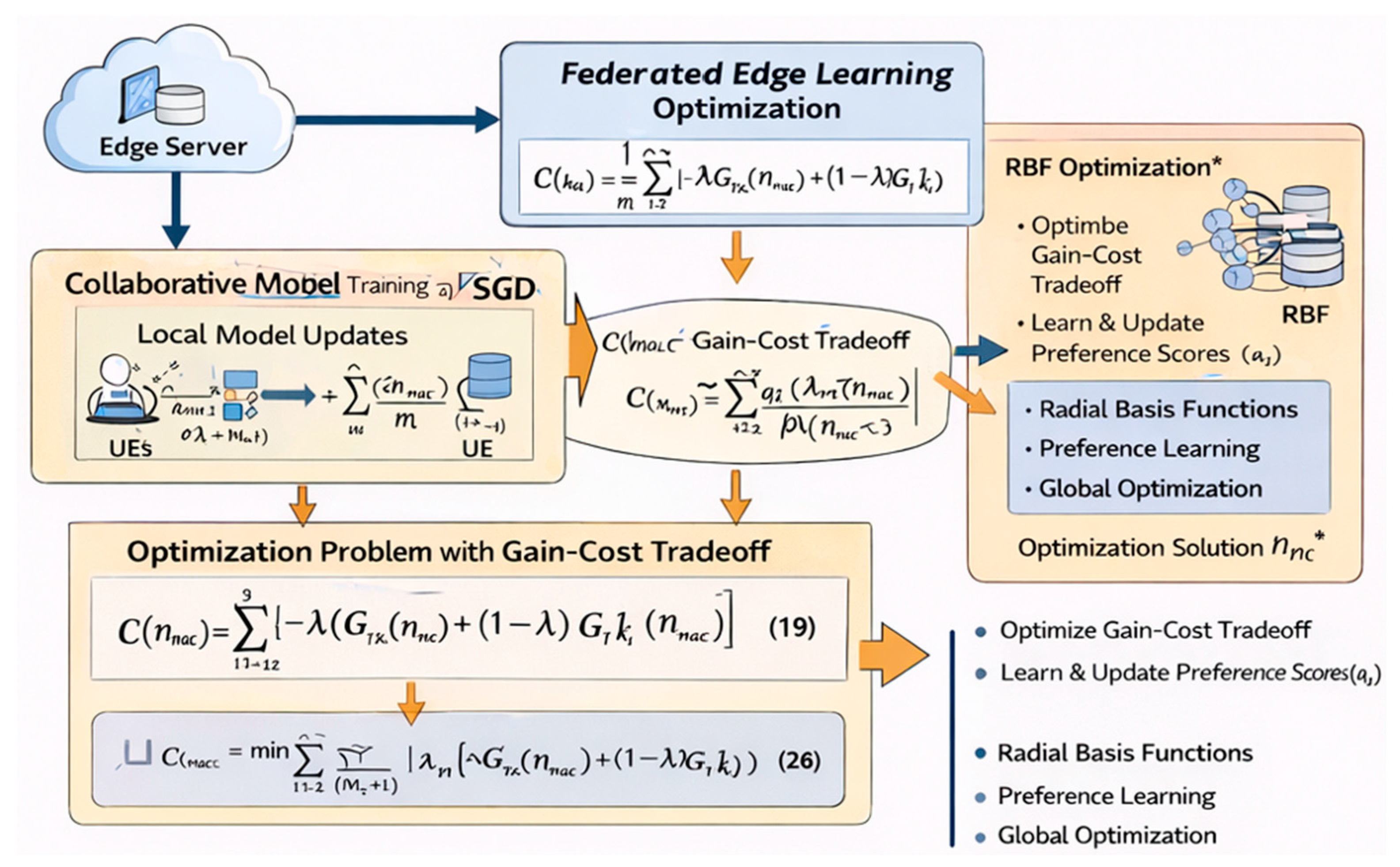
3. The Optimization Approach
3.1. The Optimization Problem Statement
- Up to our knowledge this is a discrete, non-convex optimization problem due to the constraints nmac ∈ {0, 1, …ν}. Solving this directly with SGD involves approximating gradients and handling combinatorial constraints.
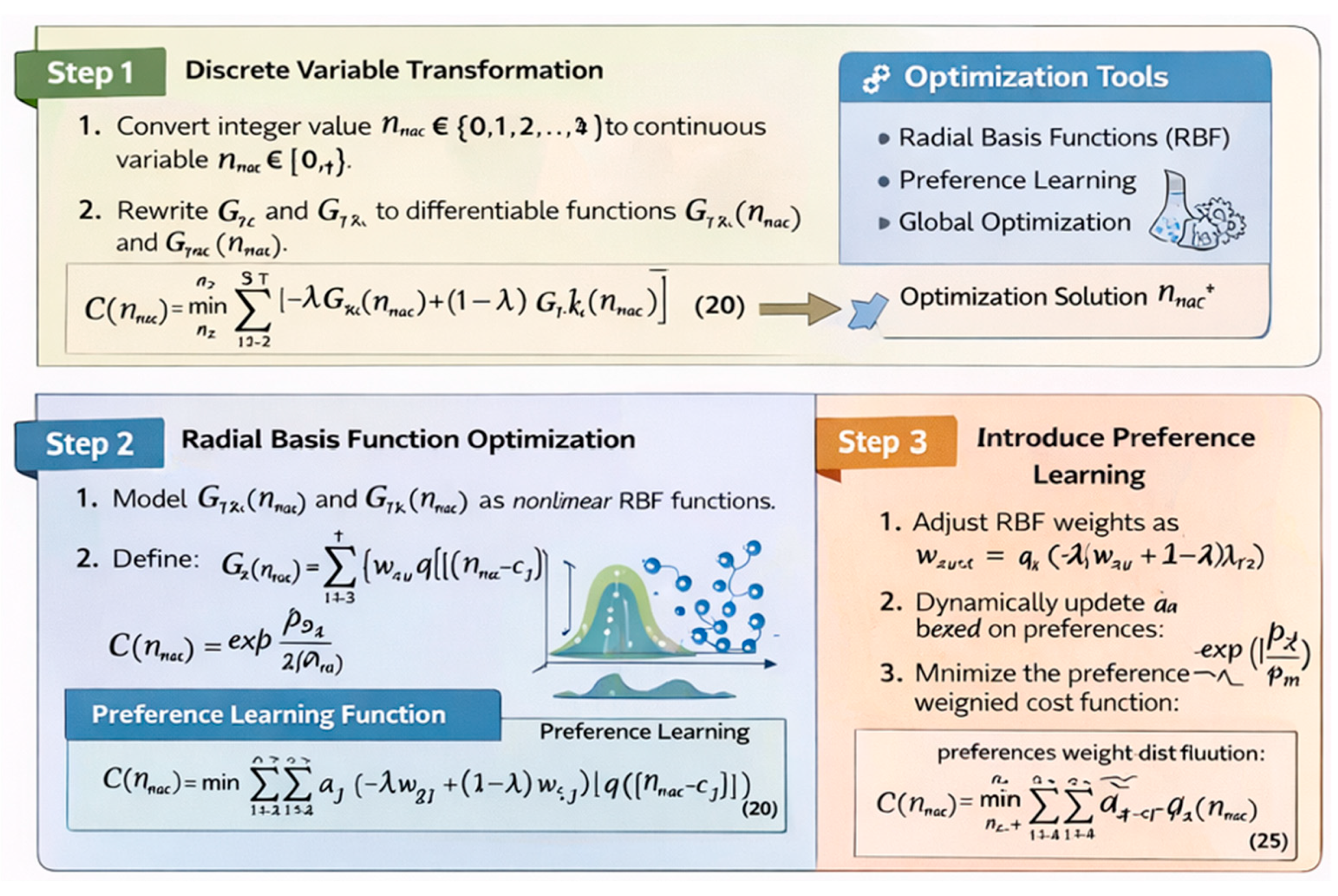
3.2. The Proposed Optimization Algorithm
- Step 1: Discrete Variables transformation
- Convert integer value nmac ∈ [0, 1, 2, …,ν] to a continuous variable: nmac ∈ [0, ν].
- Rewrite and as continuous differentiable functions and .
- Step 2: Radial Basis Functions
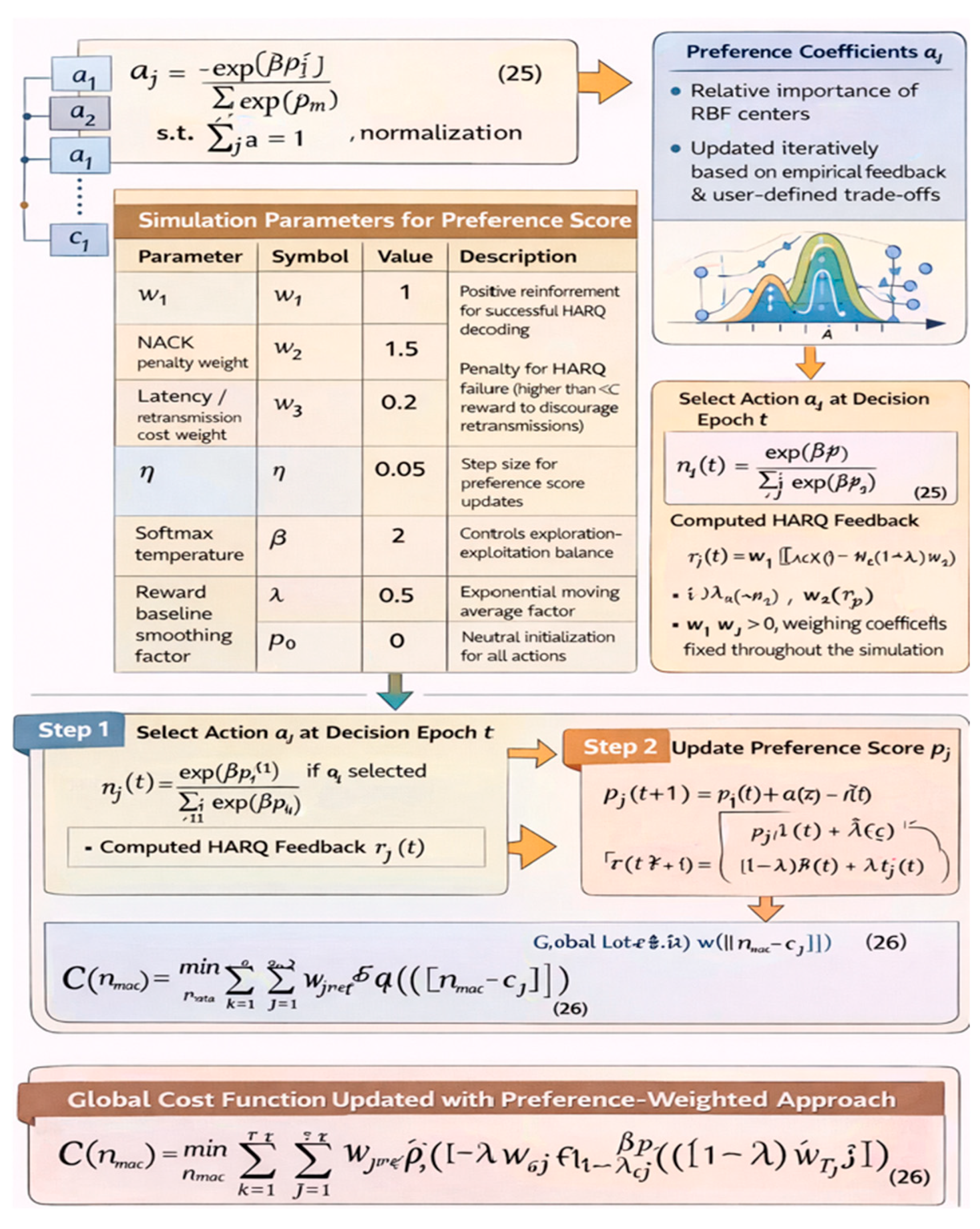
- Step 3: Introduce a Preference Learning variant
- where in Table 1
- and are binary indicators of HARQ success or failure,
- is the normalized retransmission or latency cost,
- are weighing coefficients fixed throughout the simulation.
- is the learning rate,
- is an exponential moving average baseline, used to reduce variance and stabilize convergence.
4. Discussion
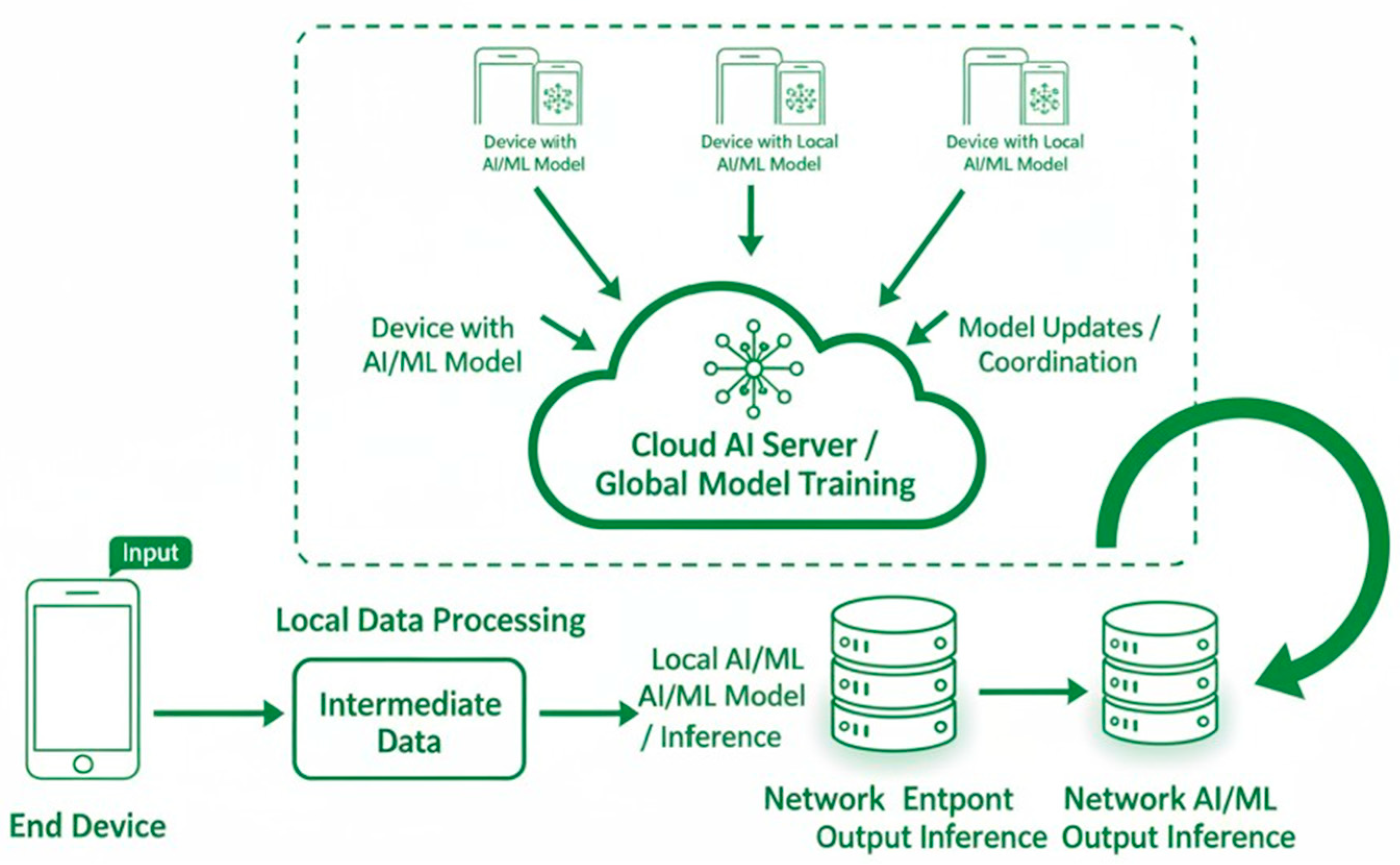
- Network Topology: A single edge server with K connected devices, each storing nk local datasets.
- Wireless Environment: Fading channels with varying SINR and packet error rates (PER).
- Compared Algorithms: The proposed RBF-based optimization was benchmarked against SGD.
- Metrics Evaluated: Convergence rate, accuracy, retransmissions, and latency.
- Channel Model: Rayleigh fading to simulate dynamic wireless channel behavior.
- SINR Variations: SINR is dynamic per round, varying between 0 and 12 dB.
- HARQ Model: Maximum 10 retransmissions per packet based on packet error rate (PER).
- RBF: Utilizes surrogate modeling for efficient global optimization.
- KKT: Applies a fixed retransmission-based optimization strategy.
- DSGD: A decentralized learning framework where nodes exchange information among themselves.
- SGD: The standard centralized gradient-based optimization method.
- Action sampling: Draw
- Execution: Apply to the system
- Observation: Measure HARQ outcome and compute
- Update: Adjust
- Repeat for the next TTI/scheduling interval
- 1.
- Objective Function Mismatch
- 2.
- Relaxation of Discrete HARQ Dynamics
- 3.
- Reliability–Latency Trade-off Bias
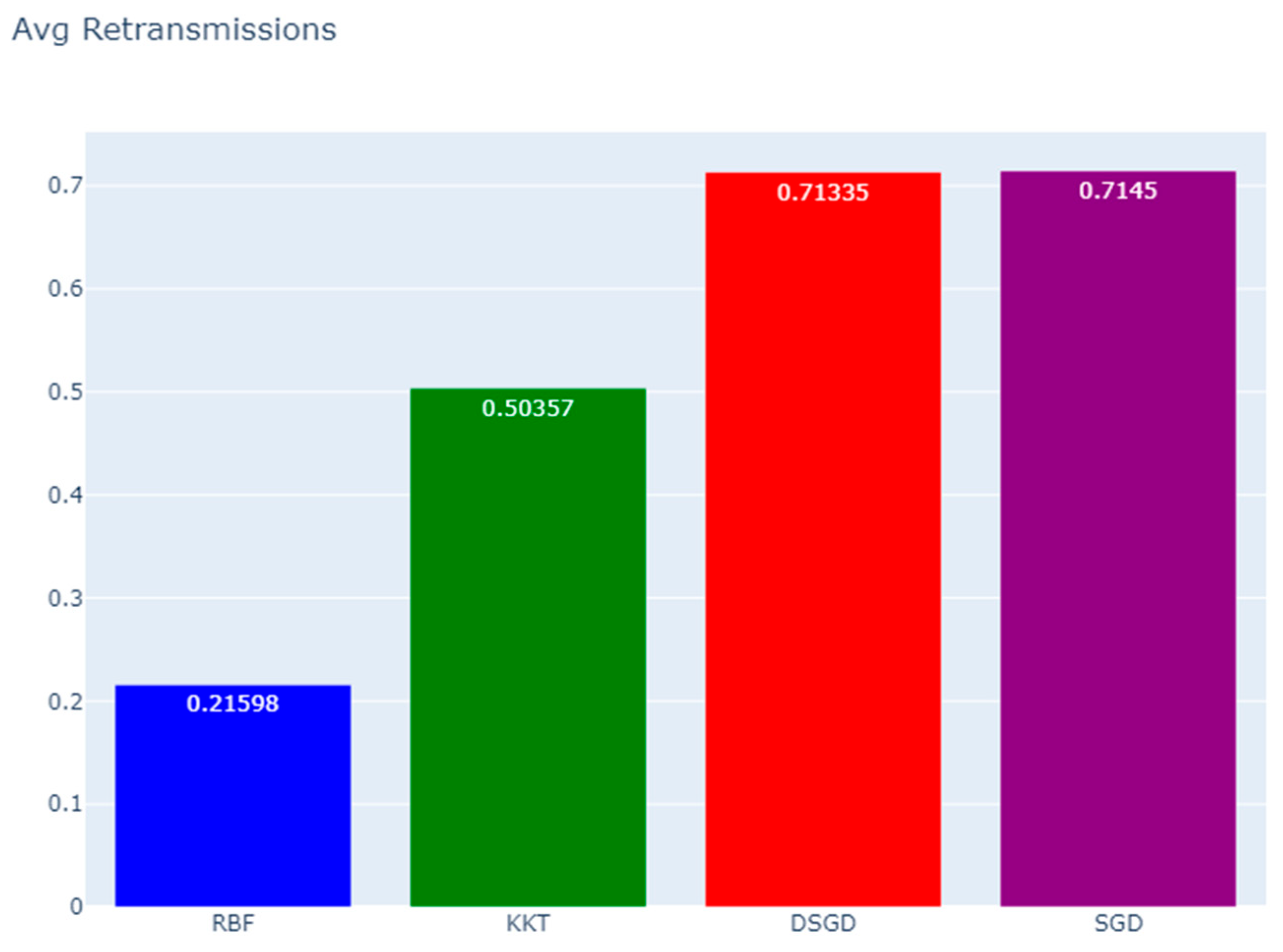
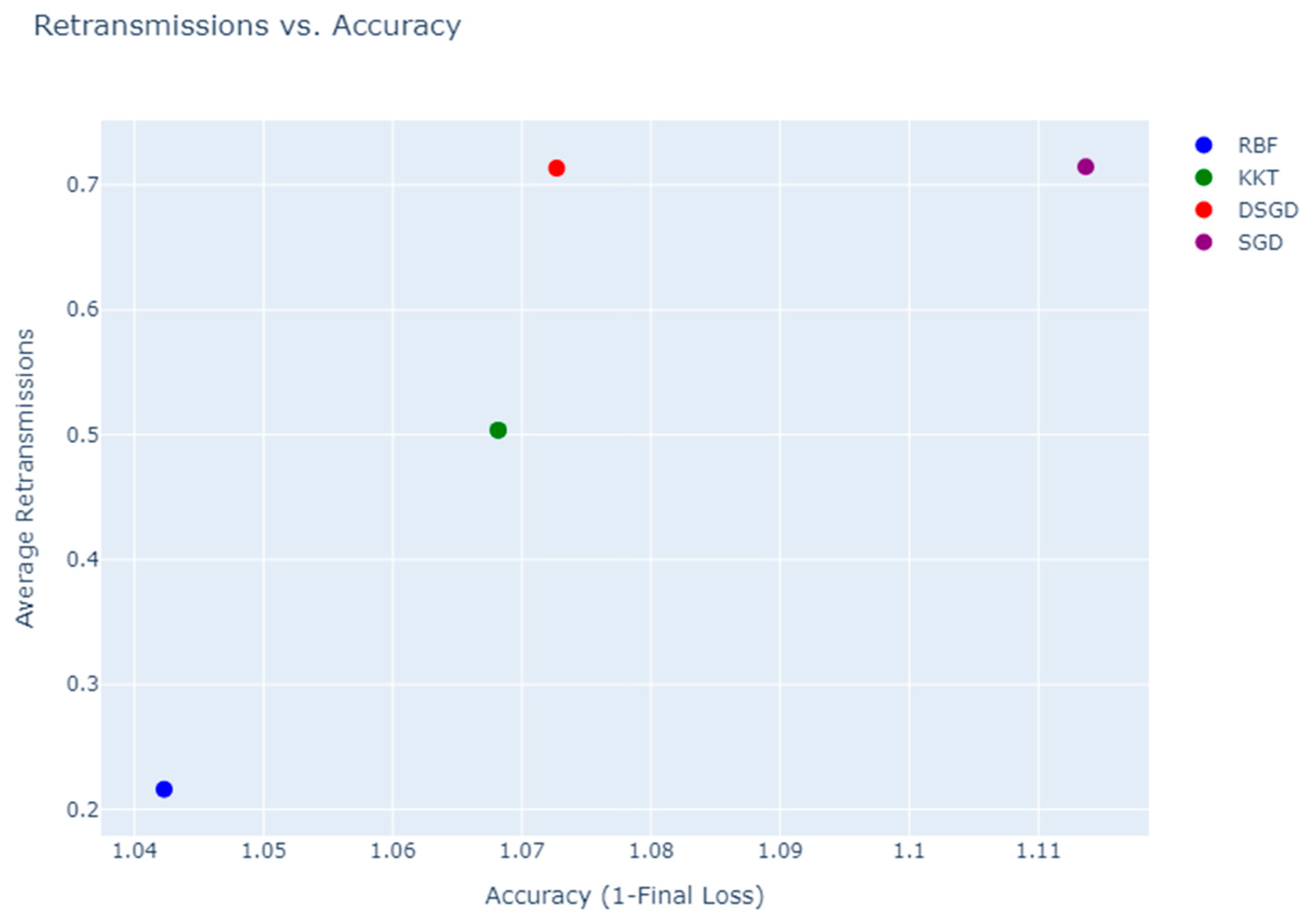
- RBF achieved the lowest final loss (indicating highest accuracy) while requiring the fewest retransmissions.
- KKT performed well in accuracy but incurred significantly higher retransmission overhead.
- DSGD and SGD struggled with slow convergence and experienced high retransmission rates.
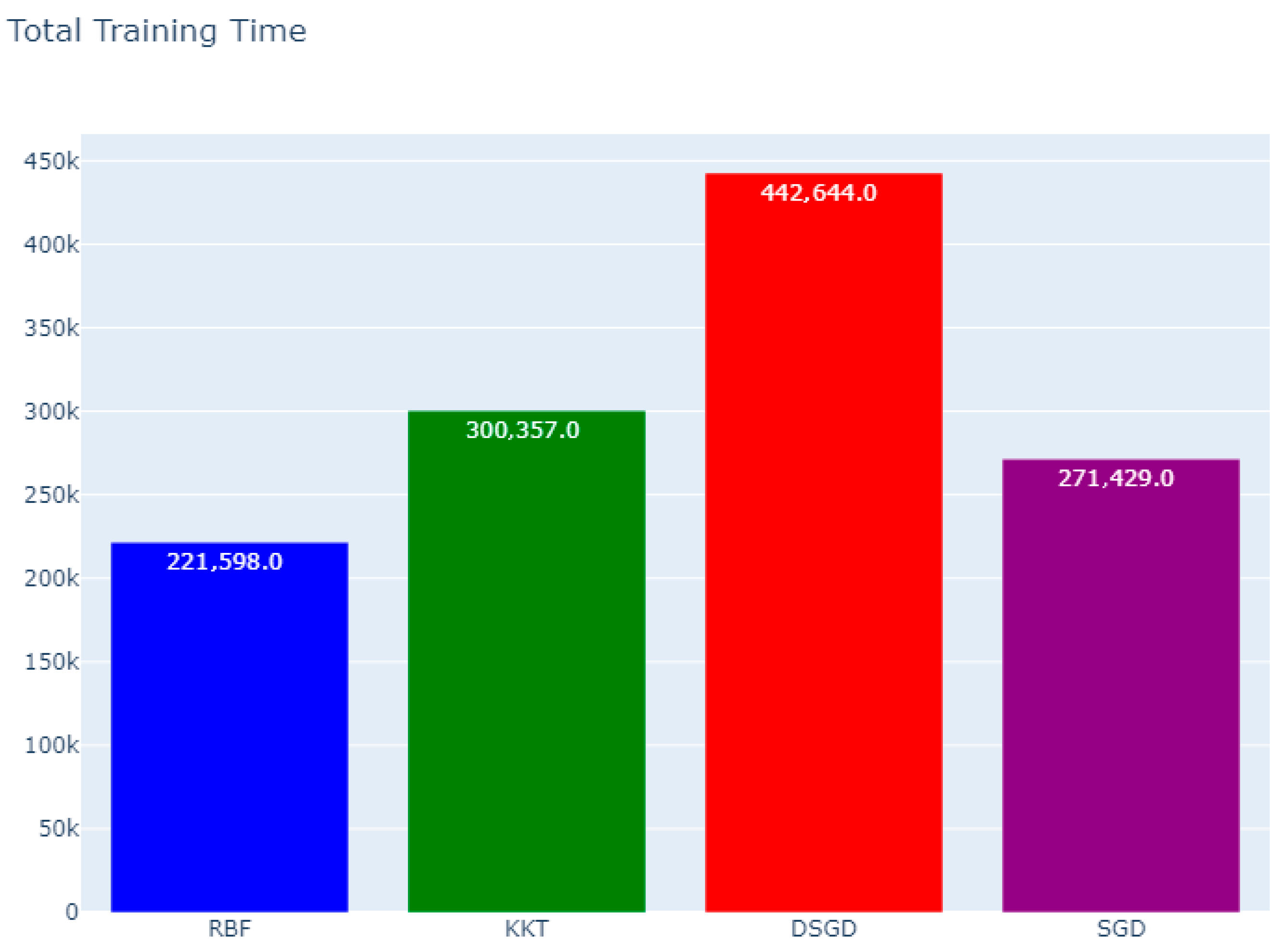
- Latency correlated directly with retransmissions, with DSGD facing the most significant delays.
5. Conclusions
Author Contributions
Funding
Data Availability Statement
Acknowledgments
Conflicts of Interest
Appendix A
Appendix B
- denotes the vector of optimization variables,
- captures the retransmission-related gain or utility,
- represents the latency-related cost.
- ➢
- Assumption A1 (Boundedness).
- ➢
- Assumption A2 (Continuity).
- are fixed radial basis functions,
- are coefficients determined by the scalarized cost in .
- -
- Any solution obtained for is Pareto optimal with respect to the original bi-objective formulation;
- -
- Changes in correspond to preference shifts rather than structural changes in the optimization problem;
- -
- The proposed framework is robust against moderate variations of , and the qualitative performance trends reported in the simulations are preserved across a wide range of trade-off values.
Appendix C

| Notation | Meaning |
|---|---|
| O(1) | Constant time (independent of problem size) |
| O(m) | Linear in number of samples |
| O(d) | Linear in model dimension |
| O(md) | Linear in both samples and model size |
| O(mdT) | Repeated over TTT rounds |
- Gradient vector of size ,
- With average retransmissions .
- I.
- Transmitted information
- Scalar feedback ,
- ACK/NACK indicators,
- Optional latency metric .
- II.
- HARQ Retransmission Reduction
- is the gradient variance,
- is the effective curvature (strong convexity constant),
- is the training horizon,
- is the RBF approximation error,
- is the preference learning error,
- is the integer projection error.
- : variance of stochastic gradients
- : strong convexity constant (or effective curvature)
- : number of successful gradient aggregation rounds
- Lipschitz continuous (e.g., Gaussian, multiquadric),
- centers uniformly spaced over ,
- optimal weights (least-squares or projection).
- is the fill distance,
- is a constant depending only on .
- Gradients are reliable;
- Retransmissions are rare;
- Communication noise is negligible.
- SGD variance explodes;
- Gradient distortion accumulates;
- RBF smooths noisy feedback.
| SINR (dB) | BLER | E[nmac] |
|---|---|---|
| ≥15 dB | ≤1% | ≈1.01 |
| 10 dB | 5% | ≈1.05 |
| 5 dB | 15% | ≈1.18 |
| 0 dB | 30% | ≈1.43 |
| −5 dB | ≥50% | ≥2 |
- Reliability dominates,
- Latency cost negligible,
- Retransmissions encouraged.
- Latency is critical,
- Over-retransmission is harmful,
- Explicit optimization of is needed.
- Almost no HARQ flexibility,
- Essentially fixed-rate transmission,
- Discrete optimization advantage disappears,
- The optimization space becomes non-trivial,
- SGD cannot reason over-retransmission structure,
- RBF captures global cost trends.
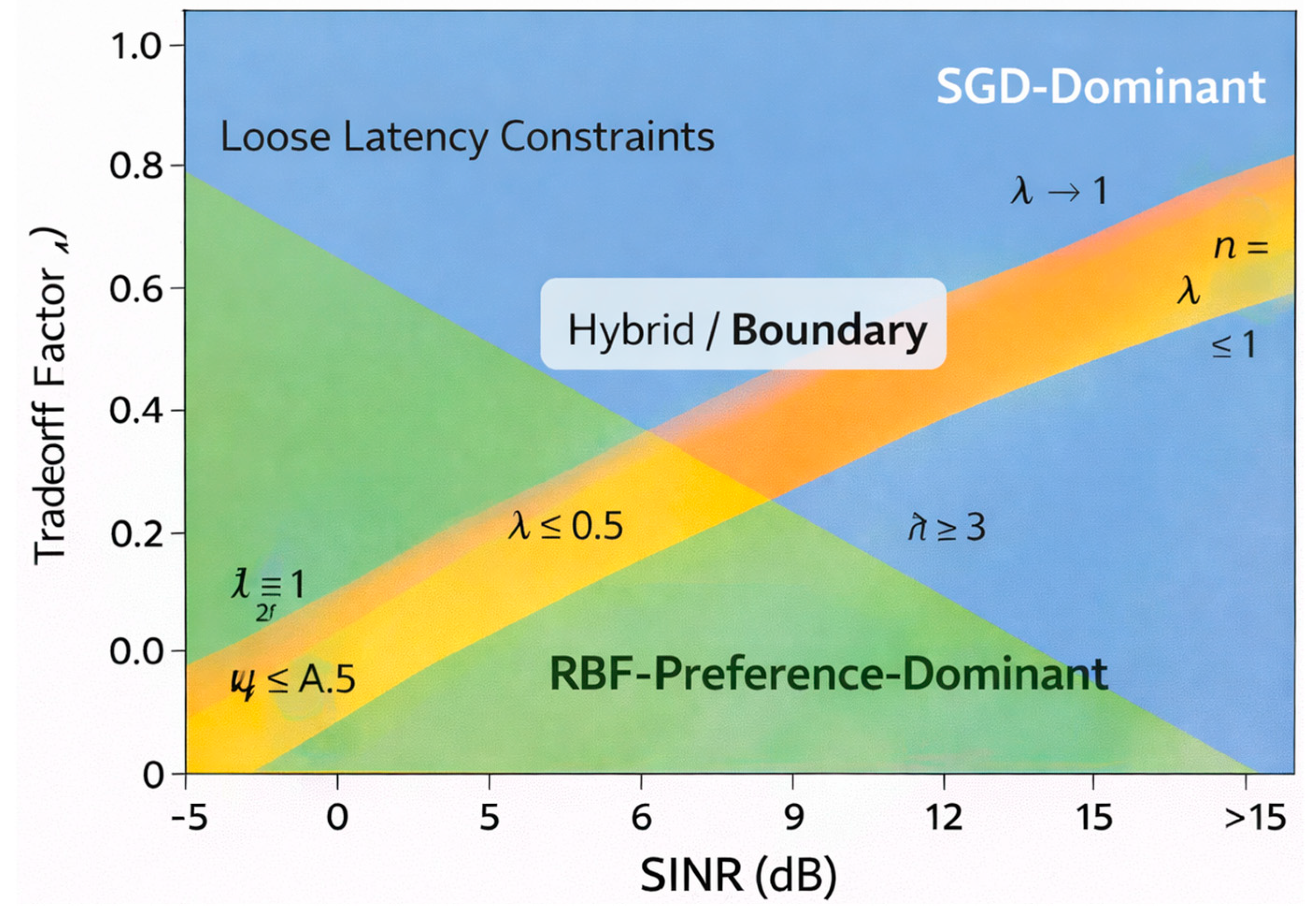
| Condition | SGD Better | RBF/Preference Better |
|---|---|---|
| SINR | High (≳15 dB) | Low/medium |
| BLER | ≈0 | ≥10% |
| Avg. HARQ rounds | ≈1 | ≥2 |
| λ | →1 | ≤0.5 |
| HARQ max ν | ≤1 | ≥3 |
| Training Horizon T | Very large | Limited |
| Latency constraint | Loose | Strict |

References
- 3GPP TR 37.817 v17.0.0. Study on Enhancement for Data Collection for NR and EN-DC, Release 17 April 2022. Available online: https://portal.3gpp.org/desktopmodules/Specifications/SpecificationDetails.aspx?specificationId=3817 (accessed on 15 November 2024).
- Li, T.; Sahu, A.K.; Talwalkar, A.; Smith, V. Federated learning: Challenges, methods, and future directions. IEEE Signal Process. Mag. 2020, 37, 50–60. [Google Scholar] [CrossRef]
- Aledhari, M.; Razzak, R.; Parizi, R.M.; Saeed, F. Federated Learning: A Survey on Enabling Technologies, Protocols, and Applications. IEEE Access 2020, 8, 140699–140725. [Google Scholar] [CrossRef]
- Peter, K.; Brendan, M.H.; Brendan, A.; Aurélien, B.; Mehdi, B.; Nitin, B.A.; Kallista, B.; Zachary, C.; Graham, C.; Rachel, C.; et al. Advances and Open Problems in Federated Learning. Found. Trends Mach. Learn. 2021, 14, 1–210. [Google Scholar]
- 3GPP TR 23.700-84 v0.2.0. Study on Core Network Enhanced Support for Artificial Intelligence (AI)/Machine Learning (ML), Release 19 March 2024. Available online: https://portal.3gpp.org/desktopmodules/Specifications/SpecificationDetails.aspx?specificationId=4252 (accessed on 20 November 2024).
- 3GPP TR 23.288 v19.1.0. Architecture Enhancements for 5G System (5GS) to Support Network Data Analytics Services, Release 19 December 2024. Available online: https://portal.3gpp.org/desktopmodules/Specifications/SpecificationDetails.aspx?specificationId=3579 (accessed on 6 January 2025).
- 3GPP TR 23.501 v19.2.1. System Architecture for the 5G System (5GS), Release 19 January 2025. Available online: https://portal.3gpp.org/desktopmodules/Specifications/SpecificationDetails.aspx?specificationId=3144 (accessed on 10 February 2025).
- 3GPP TR 23.502 v19.2.0. Procedures for the 5G System (5GS), Release 19 December 2024. Available online: https://portal.3gpp.org/desktopmodules/Specifications/SpecificationDetails.aspx?specificationId=3145 (accessed on 10 February 2025).
- 3GPP TR 23.503 v19.2.0. Policy and Charging Control Framework for the 5G System (5GS), Release 19 December 2024. Available online: https://portal.3gpp.org/desktopmodules/Specifications/SpecificationDetails.aspx?specificationId=3334 (accessed on 10 February 2025).
- Qu, M.; Tang, X.; Zhang, Y.; Chen, Z.; Zhang, T.; Zhao, Y.; Li, Y. An Overview of Enabling Artificial Intelligence in 3GPP 5G-Advanced Networks. In Proceedings of the IEEE International Conferences on Internet of Things (iThings) and IEEE Green Computing & Communications (GreenCom) and IEEE Cyber, Physical & Social Computing (CPSCom) and IEEE Smart Data (SmartData) and IEEE Congress on Cybermatics (Cybermatics), Danzhou, China, 17–21 December 2023; pp. 65–70. [Google Scholar]
- Lin, X. Artificial Intelligence in 3GPP 5G-Advanced: A Survey. IEEE ComSoc Technology News, 6 September 2023.
- 3GPP TR 22.874 v18.2.0. Study on Traffic Characteristics and Performance Requirements for AI/ML Model Transfer. December 2021. Available online: https://portal.3gpp.org/desktopmodules/Specifications/SpecificationDetails.aspx?specificationId=3721 (accessed on 12 February 2025).
- 3GPP TS 22.261 v18.10.0. Service Requirements for the 5G System. June 2023. Available online: https://portal.3gpp.org/desktopmodules/Specifications/SpecificationDetails.aspx?specificationId=3107 (accessed on 10 February 2025).
- 3GPP TR 38.843 v18.0.0. Study on Artificial Intelligence (AI)/Machine Learning (ML) for NR Air Interface, Release 18 December 2023. Available online: https://portal.3gpp.org/desktopmodules/Specifications/SpecificationDetails.aspx?specificationId=3983 (accessed on 18 January 2025).
- El Mokadem, R.; Ben Maissa, Y.; El Akkaoui, Z. eXtreme Federated Learning (XFL): A layer-wise approach. Clust. Comput. 2024, 27, 5741–5754. [Google Scholar] [CrossRef]
- Tao, M.; Zhou, Y.; Shi, Y.; Lu, J.; Cui, S.; Lu, J.; Letaief, K.B. Federated Edge Learning for 6G: Foundations, Methodologies, and Applications. Proc. IEEE 2024, 113, 1075–1113. [Google Scholar] [CrossRef]
- Liu, Y.; Yuan, X.; Xiong, Z.; Kang, J.; Wang, X.; Niyato, D. Federated learning for 6G communications: Challenges, methods, and future directions. China Commun. 2020, 17, 105–118. [Google Scholar] [CrossRef]
- Parra-Ullauri, J.M.; Zhang, X.; Bravalheri, A.; Moazzeni, S.; Wu, Y.; Nejabati, R.; Simeonidou, D. Federated Analytics for 6G Networks: Applications, Challenges, and Opportunities. IEEE Netw. 2024, 38, 9–17. [Google Scholar] [CrossRef]
- Jiao, L.; Shao, Y.; Sun, L.; Liu, F.; Yang, S.; Ma, W.; Li, L.; Liu, X.; Hou, B.; Zhang, X.; et al. Advanced Deep Learning Models for 6G: Overview, Opportunities, and Challenges. IEEE Access 2024, 12, 133245–133314. [Google Scholar] [CrossRef]
- Driss, M.B.; Sabir, E.; Elbiaze, H.; Saad, W. Federated Learning for 6G: Paradigms, Taxonomy, Recent Advances and Insights. arXiv 2023, arXiv:2312.04688. [Google Scholar] [CrossRef]
- Yu, C.; Shen, S.; Wang, S.; Zhang, K.; Zhao, H. Efficient Multi-Layer Stochastic Gradient Descent Algorithm for Federated Learning in E-health. In Proceedings of the ICC 2022—IEEE International Conference on Communications, Seoul, Republic of Korea, 16–20 May 2022; pp. 1263–1268. [Google Scholar]
- Gao, Y. Federated learning: Impact of different algorithms and models on prediction results based on fashion-MNIST data set. Appl. Comput. Eng. 2024, 86, 204–212. [Google Scholar] [CrossRef]
- Acar, D.A.E.; Zhao, Y.; Navarro, R.M.; Mattina, M.; Whatmough, P.N.; Saligrama, V. Federated Learning Based on Dynamic Regularization. In Proceedings of the International Conference on Learning Representations (ICLR), Virtual, 3–7 May 2021; pp. 1–36. [Google Scholar]
- Yeganeh, Y.; Farshad, A.; Navab, N.; Albarqouni, S. Inverse Distance Aggregation for Federated Learning with Non-IID Data. In Proceedings of the Domain Adaptation and Representation Transfer, and Distributed and Collaborative Learning: Second MICCAI Workshop, DART 2020, and First MICCAI Workshop, DCL 2020, Held in Conjunction with MICCAI 2020, Lima, Peru, 4–8 October 2020. [Google Scholar]
- Salari, A.; Johnson, S.J.; Vucetic, B.; Shirvanimoghaddan, M. Rate-convergence tradeoff of federated learning over wireless channel. J. IEEE Internet Things 2022, 10, 22703–22716. [Google Scholar] [CrossRef]
- Ye, H.; Liang, L.; Li, G.Y. Decentralized Federated Learning with Unreliable Communications. IEEE J. Sel. Top. Signal Process. 2022, 16, 487–500. [Google Scholar] [CrossRef]
- Jeong, E.; Zecchin, M.; Kountouris, M. Asynchronous decentralized learning over unreliable wireless networks. In Proceedings of the IEEE International Conference on Communications (ICC), Seoul, Republic of Korea, 16–20 May 2022; pp. 607–612. [Google Scholar]
- Shah, S.W.H.; Mahboob-Ur-Rahman, M.; Mian, A.N.; Dobre, O.A.; Crowcroft, J. Effective capacity analysis of HARQ-enabled D2D communication in multi-tier cellular networks. IEEE Trans. Veh. Technol. 2021, 70, 9144–9159. [Google Scholar] [CrossRef]
- Campolo, C.; Iera, A.; Molinaro, A. Network for Distributed Intelligence: A Survey and Future Perspectives. IEEE Access 2023, 11, 52840–52861. [Google Scholar] [CrossRef]
- Hu, J.; Wang, F.; Xu, W.; Gao, H.; Zhang, P. SemHARQ: Semantic-Aware HARQ for Multi-task Semantic Communications. arXiv 2024, arXiv:2404.08490. [Google Scholar]
- Xu, X.; Liu, S.; Yu, G.D. Adaptive retransmission design for wireless federated edge learning. ZTE Commun. 2023, 21, 3–14. [Google Scholar]
- Amiri, M.M.; Gündüz, D. Federated learning over wireless fading channels. IEEE Trans. Wirel. Commun. 2020, 19, 3546–3557. [Google Scholar] [CrossRef]
- Yu, T.; Huang, P.; Zhang, S.; Chen, X.; Sun, Y.; Wang, X. IREE Oriented Green 6G Networks: A Radial Basis Function-Based Approach. IEEE J. Sel. Areas Commun. 2024, 42, 3246–3261. [Google Scholar] [CrossRef]
- Loh, C.-H.; Chen, Y.-C.; Su, C.-T. Using Transfer Learning and Radial Basis Function Deep Neural Network Feature Extraction to Upgrade Existing Product Fault Detection Systems for Industry 4.0: A Case Study of a Spring Factory. Appl. Sci. 2024, 14, 2913. [Google Scholar] [CrossRef]
- Banholzer, D.; Fliege, J.; Werner, R. A radial basis function method for noisy global optimisation. Math. Program. 2025, 211, 49–92. [Google Scholar] [CrossRef]
- Xi, Y.; Burr, A.; Wei, J.; Grace, D. A General Upper Bound to Evaluate Packet Error Rate over Quasi-Static Fading Channels. IEEE Trans. Wirel. Commun. 2011, 10, 1373–1377. [Google Scholar] [CrossRef]
- Spiros, L.; Paraskevas, M. Analytical average throughput and delay estimations for LTE uplink cell edge users. Comput. Electr. Eng. 2014, 40, 1552–1563. [Google Scholar] [CrossRef]
- 3GPP TS 38.321. Access Network NR; Medium Access Control (MAC) Protocol Specification, Release 18. 2024. Available online: https://portal.3gpp.org/desktopmodules/Specifications/SpecificationDetails.aspx?specificationId=3194 (accessed on 11 January 2026).
- 3GPP TS 38.211. Access Network NR; Physical Channels and Modulation, Release 18 2024. Available online: https://portal.3gpp.org/desktopmodules/Specifications/SpecificationDetails.aspx?specificationId=3213 (accessed on 11 January 2026).
- 3GPP TS 38.300. Access Network NR and NG-RAN Overall Description. Stage 2, Release 18. 2024. Available online: https://portal.3gpp.org/desktopmodules/Specifications/SpecificationDetails.aspx?specificationId=3191 (accessed on 11 January 2026).
- Louvros, S.; Iossifides, A.C.; Aggelis, K.; Baltagiannis, A.; Economou, G. A Semi-Analytical Macroscopic MAC Layer Model for LTE Uplink. In Proceedings of the 5th International Conference on New Technologies, Mobility and Security (NTMS), Istanbul, Turkey, 7–10 May 2012; pp. 1–5. [Google Scholar]
- Göktepe, B.; Hellge, C.; Schierl, T.; Stanczak, S. Distributed Machine-Learning for Early HARQ Feedback Prediction in Cloud RANs. IEEE Trans. Wirel. Commun. 2024, 23, 31–44. [Google Scholar] [CrossRef]
- Stanojev, I.; Simeone, O.; Bar-Ness, Y. Performance Analysis of Collaborative Hybrid-ARQ Incremental Redundancy Protocols Over Fading Channels. In Proceedings of the IEEE 7th Workshop on Signal Processing Advances in Wireless Communications, Cannes, France, 2–5 July 2006; pp. 1–5. [Google Scholar]
- McDonald, D.; Grantham, W.; Tabor, W.; Murphy, M. Global and local optimization using radial basis function response surface models. Appl. Math. Model. 2007, 31, 2095–2110. [Google Scholar] [CrossRef]
- Armijo, L. Minimization of functions having Lipschitz continuous first partial derivatives. Pac. J. Math. 1966, 16, 1–3. [Google Scholar] [CrossRef]
- Buhmann, M.D. Radial Basis Functions: Theory and Implementations; Cambridge University Press: Cambridge, UK, 2003. [Google Scholar]
- Méndez-Monsanto, L.; MacQuarrie, A.; Ghourtani, M.R.; Morales, M.J.L.; Armada, A.G.; Burr, A. BLER-SNR Curves for 5G NR MCS under AWGN Channel with Optimum Quantization. In Proceedings of the 2024 IEEE 100th Vehicular Technology Conference (VTC2024-Fall), Washington, DC, USA, 7–10 October 2024; pp. 1–6. [Google Scholar]



| Parameter | Symbol | Value | Description |
|---|---|---|---|
| ACK reward weight | w1 | 1 | Positive reinforcement for successful HARQ decoding |
| NACK penalty weight | w2 | 1.5 | Penalty for HARQ failure (higher than ACK reward to discourage retransmissions) |
| Latency/retransmission cost weight | w3 | 0.2 | Normalized delay/retransmission cost penalty |
| Learning rate | η | 0.05 | Step size for preference score updates |
| Softmax temperature | β | 2 | Controls exploration–exploitation balance |
| Reward baseline smoothing factor | λ | 0.5 | Exponential moving average factor |
| Initial preference score | p0 | 0 | Neutral initialization for all actions |
| Parameter | Value |
|---|---|
| Number of Devices (K) | 20 |
| Training Rounds/Iterations | 10,000 |
| Max HARQ Retransmissions | 10 |
| SINR Range (dB) | Dynamic (0 to 12 dB) |
| Computation Time per Iteration | RBF: 1.0, KKT: 1.5, DSGD: 1.0, SGD: 1.0 |
| Convergence Factor | RBF: 0.95, KKT: 0.97, DSGD: 0.97, SGD: 0.98 |
| Packet Error Rate (PER) | Determined dynamically based on SINR |
| Transmission Power (P) | 10 dB |
| Noise Power (N0) | 1 |
| Method | Final Loss | Avg. Retransmissions | Avg. PER ** | Total Training Time (ms) |
|---|---|---|---|---|
| RBF | −0.042301 | 0.21598 | 17.76% | 221,598.0 |
| KKT | −0.068169 | 0.50357 | 33.49% | 300,357.0 |
| DSGD | −0.072695 | 0.71335 | 41.64% | 442,644.0 |
| SGD | −0.113663 | 0.71450 | 41.68% | 271,429.0 |
Disclaimer/Publisher’s Note: The statements, opinions and data contained in all publications are solely those of the individual author(s) and contributor(s) and not of MDPI and/or the editor(s). MDPI and/or the editor(s) disclaim responsibility for any injury to people or property resulting from any ideas, methods, instructions or products referred to in the content. |
© 2026 by the authors. Licensee MDPI, Basel, Switzerland. This article is an open access article distributed under the terms and conditions of the Creative Commons Attribution (CC BY) license.
Share and Cite
Louvros, S.; Pandey, A.; Shah, B.; Buch, Y. Cross Layer Optimization Using AI/ML-Assisted Federated Edge Learning in 6G Networks. Future Internet 2026, 18, 71. https://doi.org/10.3390/fi18020071
Louvros S, Pandey A, Shah B, Buch Y. Cross Layer Optimization Using AI/ML-Assisted Federated Edge Learning in 6G Networks. Future Internet. 2026; 18(2):71. https://doi.org/10.3390/fi18020071
Chicago/Turabian StyleLouvros, Spyridon, AnupKumar Pandey, Brijesh Shah, and Yashesh Buch. 2026. "Cross Layer Optimization Using AI/ML-Assisted Federated Edge Learning in 6G Networks" Future Internet 18, no. 2: 71. https://doi.org/10.3390/fi18020071
APA StyleLouvros, S., Pandey, A., Shah, B., & Buch, Y. (2026). Cross Layer Optimization Using AI/ML-Assisted Federated Edge Learning in 6G Networks. Future Internet, 18(2), 71. https://doi.org/10.3390/fi18020071