Systematic Review

The Challenge of Dynamic Environments in Regard to RSSI-Based Indoor Wi-Fi Positioning—A Systematic Review


by
Zi Yang Chia
1,
Pey Yun Goh
1,2,*,
Lee Yeng Ong
1,2 and
Shing Chiang Tan
1,2
1
Faculty of Information Science and Technology, Multimedia University, Malacca 75450, Malaysia
2
Centre for Advanced Analytics, CoE for Artificial Intelligence, Faculty of Information Science and Technology, Multimedia University, Melaka 75450, Malaysia
*
Author to whom correspondence should be addressed.
Future Internet 2025, 17(12), 540; https://doi.org/10.3390/fi17120540
Submission received: 23 September 2025 / Revised: 27 October 2025 / Accepted: 7 November 2025 / Published: 25 November 2025

Abstract

Among indoor positioning technologies, Wi-Fi fingerprinting using the Received Signal Strength Indicator (RSSI) is the most convenient and cost-effective method for indoor positioning. Instability and interference in wireless signal transmission cause significant variations in the RSSI, especially in a dynamic environment (DE). These factors hamper the accuracy of fingerprint-based indoor positioning system (IPSs), as these systems may struggle to reliably match observed signal patterns with stored fingerprints. Thus, ensuring positioning accuracy is critically important when designing and implementing Wi-Fi IPSs. Currently, there is a lack of surveys that provide a detailed and systematic analysis of the impact of DEs on the accuracy and reliability of Wi-Fi indoor positioning. This systematic literature review (SLR) was conducted to examine three aspects of Wi-Fi indoor positioning based on the RSSI: the impact of a DE on indoor positioning accuracy, the importance of constructing radio maps for indoor localization, and the role of machine learning (ML)/deep learning (DL) models in predicting indoor position with minimal error despite the DE. This review was conducted according to a structured and well-defined methodology to search for and filter relevant studies on Wi-Fi indoor positioning using the RSSI. Through this systematic process, 128 papers (2018–2024) were identified as relevant and then extracted and thoroughly analyzed to effectively answer the specified research questions. Additionally, this review highlights gaps in existing research, suggests directions for future studies, and provides practical recommendations for enhancing Wi-Fi-based indoor positioning in DEs.

1. Introduction

With the widespread use of wireless networks, location-based services have been integrated into our daily lives. Currently, there are two main types of navigation systems: indoor (inside a building) and outdoor (outside a building in the open air). Global Positioning System (GPS) is well known as one of the outdoor navigation methods that can accurately provide the position of an object from satellites. However, this method only works effectively in open areas with a direct line of sight with respect to the satellites [1]. GPS signals may be interfered with or blocked by building structures, such as walls and roofs [2]. Therefore, indoor location cannot be determined when the signal is lost inside a building. GPS is not applicable when indoor positioning is required.
Although GPS is not applicable in these cases, the advancement of technology has made indoor positioning feasible. Such technologies have been proposed to implement indoor positioning, i.e., Radio Frequency Identification (RFID), Wi-Fi, Bluetooth, and ultra-wide band (UWB) [1,3,4]. Along with positioning, these technologies also enable indoor navigation. This has allowed the development of indoor maps, which ease human life in airports, parking garages, alleys, underground locations, or inside multistory buildings. With indoor positioning technology, passengers can receive a customized route with guided directions to the desired destination by using a mobile phone. This reduces unnecessary travel time and improves the passenger experience. Among all technologies for indoor positioning, Wi-Fi is preferred because it does not require additional modifications to the existing infrastructure, has minimal hardware requirements, and is commonly available in public spaces [3,5,6].
In Wi-Fi indoor positioning, the RSSI has become a prominent tool for various reasons. Due to the widespread availability of Wi-Fi in indoor environments and wireless access points (WAPs) that can function as transmitting devices [7], this method has gained increasing popularity and significance in recent years for indoor positioning. The cost of deploying it on a larger scale can be reduced by utilizing existing WAPs [7,8]. In addition, Wi-Fi has a wider coverage area than other methods [9,10]. This expanded reach enables Wi-Fi IPSs based on the RSSI to provide comprehensive coverage across large indoor spaces, including multistory buildings and complex facilities.
The RSSI fingerprinting method usually involves two stages: an offline stage (training stage) and an online stage (positioning stage) [11,12]. In the offline stage, a device such as a smartphone, laptop, or Wi-Fi-enabled device captures RSSI fingerprint data at the target area to build the training data sets (i.e., a radio map). These recorded RSSI values are associated with the corresponding coordinates of each location. In the online stage, the mobile device measures the current RSSI values from surrounding WAPs, and these RSSI measurements serve as input data for the localization system. Then, the current RSSI measurements are compared to the pre-existing fingerprints in the database. Based on the best match, the system estimates the current location of the device, and the result will be sent back to the user. However, the RSSI signal from the wireless access point is vulnerable to various factors such as obstacles, signal fluctuations, noise, environmental changes, non-line-of-sight communication, and multipath interference [13,14,15,16,17]. In short, these factors are part of the DE.
Therefore, considering DEs is essential, especially in real-world implementations. Neglecting DEs in the design and evaluation of indoor positioning systems can lead to significant performance degradation, including reduced localization accuracy, increased latency, and system instability. Since real-world applications require reliable and adaptive positioning solutions, incorporating DEs into discussions ensures that positioning algorithms and models are resilient to environmental changes. With the popularity of RSSI signals, review papers on the RSSI can easily be found online. However, knowledge gaps remain. Detailed explanations are provided in Section 1.1, with the motivation discussed in Section 1.2. In this paper, we attempt to address these gaps by providing a deeper analysis of how a DE could influence Wi-Fi IPSs.

1.1. Existing Survey Articles

Several review papers on Wi-Fi indoor positioning were organized and summarized, as shown in Table 1. The table indicates that the topic of a Wi-Fi RSSI for indoor positioning is common in most of the reviewed studies. Specifically, papers such as [3,4,13,18,19,20,21,22,23,24] include discussions on the Wi-Fi RSSI in their studies.
However, earlier studies, such as [25,26,27], either do not specify or do not include discussions on the Wi-Fi RSSI, indicating a potential gap in their methodologies. Regarding the challenges associated with DEs, only [3,23] mention this aspect, while most studies do not discuss DE challenges or do not provide clear information. This is a significant gap in the literature, as DEs can impact indoor positioning accuracy. The lack of attention to this aspect in most studies presents an opportunity for future research to better explain and analyze this topic. Besides that, many papers do not include discussions of radio map construction methods, with only three papers discussing this aspect [4,21,23]. In contrast, the application of ML and DL techniques is covered in most studies, with only five papers either not mentioning them or briefly mentioning them without providing detailed insights into their implementation [3,13,19,23,25]. To the best of our knowledge, there are no systematic literature reviews (SLRs) that focus on DEs and how ML/DL impact DEs in indoor positioning. Additionally, the role of radio map construction in improving positioning accuracy and time efficiency in DEs is rarely mentioned. A list of review or survey papers published between 2018 and 2024 and the discussed features are summarized in Table 1, which shows that existing reviews explore these areas separately but rarely address DEs specifically.

1.2. Motivation and Contributions

Based on the existing knowledge gap (refer to Section 1), the primary motivation of this work is to shed light on this intricate domain and provide readers with essential references about Wi-Fi indoor positioning based on the RSSI regarding DEs. The contributions of this SLR are summarized as follows:
  • It shows the reasons behind the impact of DEs on Wi-Fi indoor positioning accuracy.
  • It analyzes how the construction of a radio map can improve positioning accuracy and training time efficiency in DEs.
  • It highlights the role of ML and DL in adapting indoor positioning to different environmental conditions.
  • It identifies areas for further exploration and proposes innovative ideas to advance this field.
The main content and contributions of this SLR are organized as follows. In Section 2, the research methodology of this study is explained. Section 3 discusses the fundamental concept of the RSSI and evaluates the advantages and challenges of RSSI-based techniques through insights drawn from various research studies. Section 4 concludes and discusses the research outcomes obtained from relevant studies that address the defined research questions. Section 5 identifies the limitations mentioned in existing works and clarifies areas for further exploration. Finally, Section 6 summarizes the entire research study.

2. Research Methodology

In this study, an SLR was conducted in accordance with the PRISMA 2020 guidelines. We applied a systematic method to identify, evaluate, and select research publications in an organized manner. The steps, which include the definition of the eligibility criteria, are illustrated in Figure 1. The review protocol was not registered.

2.1. Research Questions

The following research questions were formulated to align with the primary objective:
  • RQ1: How does a DE affect the accuracy of indoor positioning?
  • RQ2: How can constructing a radio map improve positioning accuracy and training time efficiency in DEs?
  • RQ3: How can ML/DL models predict indoor position with minimal error despite the challenges posed by a DE?
RQ1 pertains to the influence of a DE on the accuracy of indoor positioning. Indoor positioning plays a vital role in various areas, ranging from industrial automation, asset tracking, and logistics to healthcare, retail, and smart homes [4,29]. However, the effectiveness of these systems can be significantly influenced by the dynamic nature of indoor environments. Therefore, this investigation identifies dynamic factors and their impact on the precision and reliability of indoor positioning technologies.
With RQ2, we aim to specify the impact of constructing a radio map on enhancing the accuracy of localization systems and reducing training time. In the context of indoor positioning, radio maps serve as a fundamental basis for localization algorithms, providing critical information for accurate positioning of devices. This study seeks to examine the methodologies and techniques employed in creating radio maps and analyze how the advantages of these construction methods contribute to improving accuracy in localization and training time efficiency, even in DEs.
RQ3 was specifically formulated to explore the capabilities of ML or DL models in predicting indoor positions despite the challenges posed by a DE. By investigating this question, we seek to assess the effectiveness of ML/DL techniques in adapting to continuously changing environments, such as areas featuring variations in signal strength, dynamic object movement, and evolving interference patterns within indoor spaces. Overall, this investigation is important for identifying the potential of ML/DL approaches in addressing the challenges pertaining to IPSs and predicting indoor position with minimal error in practical scenarios.

2.2. Data Search Strategy

The data search strategy plays a crucial role in conducting an SLR. The steps involve identifying the primary sources for the research and defining the relevant keywords. To ensure comprehensive coverage and access to high-quality scholarly articles, we selected the following digital libraries: Google Scholar, IEEE Xplore, ScienceDirect, ACM Digital Library, MDPI Journals, and Springer.
To enhance the precision and relevance of the search results, the search terms (keywords) were determined based on the following steps:
  • Identifying primary terms aligned with the respective research questions;
  • Exploring alternative spellings and synonyms for the designated main terms;
  • Confirming the validity of the search terms through reference to pertinent studies;
  • Using Boolean operators (OR/AND) to systematically combine these terms for a comprehensive search strategy.
Table 2 presents the search terms (keywords) used in this research. The specified search terms are applied within the titles and abstracts in the identified digital libraries.

2.3. Paper Selection Criteria

Initially, an investigation was conducted on 607 papers to assess their relevance to the research question. The next step involved the removal of duplicate articles collected from different digital libraries. Next, these articles were examined and selected based on the following criteria:
  • Consideration was given to the sources of publication, such as journals and conferences, excluding theses, white papers, and dissertations.
  • Articles were reviewed to determine whether they constituted original research, excluding reviews or summaries.
  • Inclusion was restricted to articles published within the timeframe from 2018 to 2024.
  • The articles needed to be written in English.
  • The articles had to apply to the specified research questions

2.4. Paper Selection Process

In this step, papers were selected based on the search string, title, abstract, and keywords. After the screening process, 196 papers that contained relevant information in their titles and abstracts were identified. Next, the abstracts of these papers were read to filter out irrelevant articles, as although some may contain the keywords, their contents are not related to indoor positioning. Finally, 128 selected papers proceeded to the extraction process to evaluate their relevance and contribution to the research objectives of this study.

2.5. Data Extraction

In this step, a critical analysis of the selected papers was conducted by examining and evaluating the complete content of each paper. The primary outcomes extracted from each study were matched with the research questions. When studies presented multiple scenarios, the most relevant data corresponding to these outcomes were collected. Then, the process involved organizing relevant information into a table format to address the specified research questions. The following information was extracted from each paper: the title of the paper, publication year, RQ1, RQ2, RQ3, limitations, and notes. Potential sources of bias were identified and noted, including differences in sample size, restricted testing environments, and limited performance metrics. Any missing or unclear information was marked as “-” and verified based on the original study. The primary effect measure used in this paper was mean positioning error (in meters). Additional measures, including RMSE, MAE, median error, and percentile error, were also included, enabling cross-study comparisons. No automation tools were employed in this process.

2.6. Data Synthesis

Finally, the data collected from the selected papers had to be synthesized systematically to address the research questions effectively. Studies reporting similar types of information, such as dynamic environments or performance indicators, were grouped. Reported performance metrics were used as presented in the original studies. In cases where different but related measures of accuracy were reported (e.g., RMSE, MAE, and mean error), they were treated as comparable indicators of positioning error to enable meaningful comparison. Studies with insufficient or missing data were summarized narratively rather than excluded. Additionally, the results of the studies were tabulated to support comparison across key variables, including dataset, method, cost, complexity, scalability, and experimental environment. Visual representations such as tables and comparative summaries were used to highlight similarities and differences across studies. A narrative synthesis approach was applied to provide a descriptive and organized summary of findings. No subgroup analyses, meta-regression, or sensitivity analyses were conducted, as the primary objective was to compare and synthesize findings descriptively rather than statistically.

3. RSSI

In this section, the fundamental concept of the RSSI will be described in terms of its significance and role within IPSs. Moreover, this section will draw insights from various research papers to evaluate the advantages and challenges of employing RSSI-based techniques for indoor positioning.
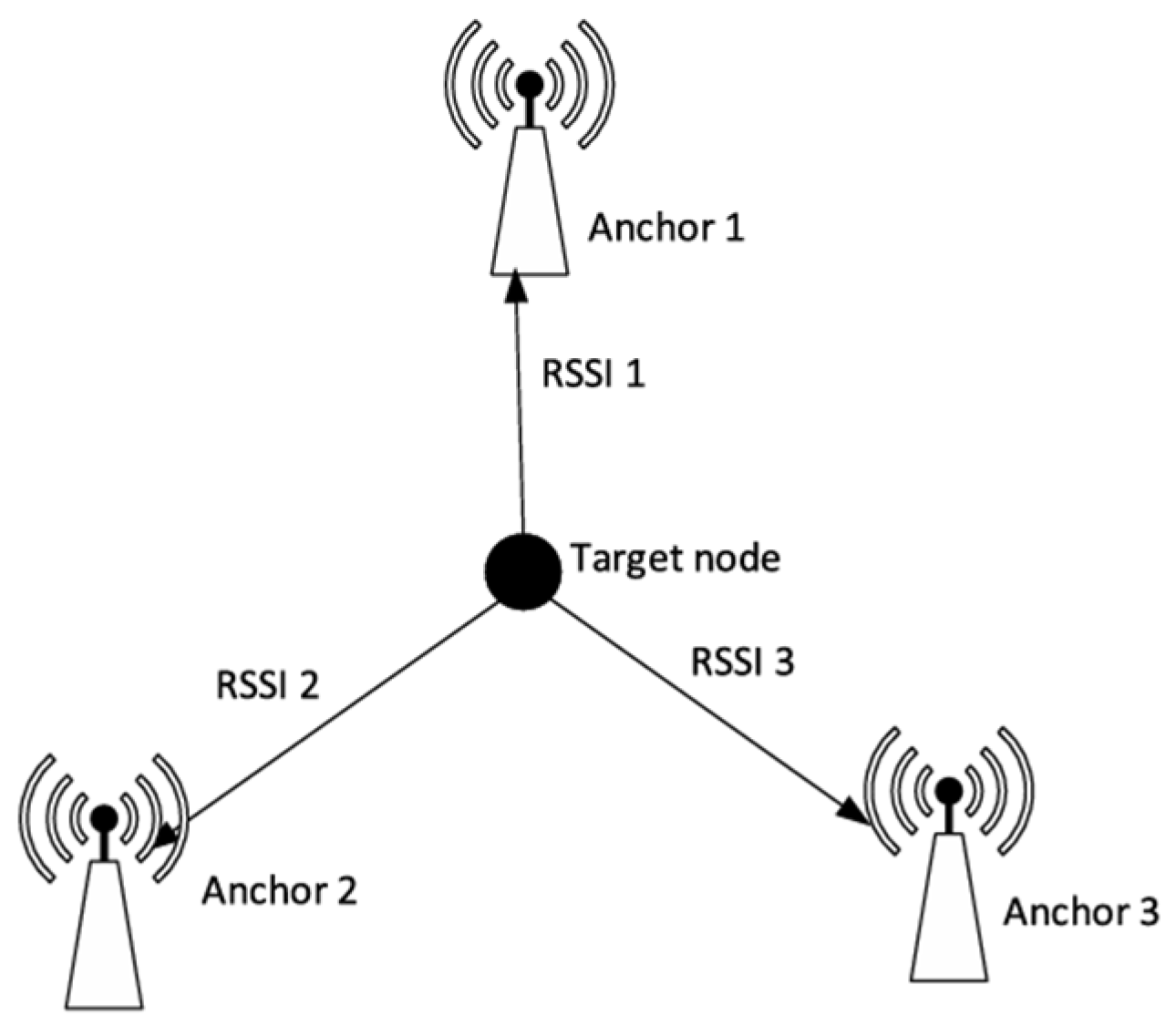
RSSI is a measure of the power level of a radio infrastructure’s Received Signal Strength (RSS) that can estimate the distance between transmitters and receivers [30]. Figure 2 illustrates the RSSI positioning method. In this method, signal strength is obtained from the target device in decibel-milliwatts (dBm) [31]. Since the RSSI is measured in dBm, RSSI values that are negative and closer to 0 dBm represent stronger signal quality, indicating closer proximity to the corresponding AP. For signal strengths not detected by the device, the RSSI is commonly set to +100 dBm or 100 dBm by default [32,33]. In a wireless environment, the RSSI is the relative RSS; signal quality depends on the value of the RSSI [34]. Table 3 presents the levels of different signal strengths.
In Wi-Fi-based IPSs, the RSSI is widely used and considered a practical method for IPSs compared to other approaches. However, in fact, the RSSI often struggles to meet the accuracy requirements due to the inherent limitations of RSSI measurements. To better understand the landscape of RSSI-related research, a comprehensive review of RSSI discussions from various papers is presented in Table 4.
The analysis indicates that researchers prefer using the RSSI for Wi-Fi indoor positioning primarily because of its widespread availability, the lack of need for additional hardware or infrastructure, and its cost efficiency [43]. Despite being widely used and offering many advantages, the RSSI still faces significant challenges related to DEs and signal stability. First, the accuracy of the RSSI can be affected, especially in situations where there are obstructions to the line of sight, resulting in decreased precision caused by signal attenuation and multi-path fading [43,44]. Additionally, device heterogeneity can also cause inconsistencies in RSSI measurements due to variations in hardware sensitivity across different devices. Due to this situation, substantial efforts may be required to collect and maintain accurate signal strength data, making the construction of the fingerprint database more labor-intensive and time-consuming. Achieving high position accuracy using RSSI values remains a challenge because of these dynamic factors.

4. Results

4.1. RQ1: How Does a DE Affect the Accuracy of Indoor Positioning?

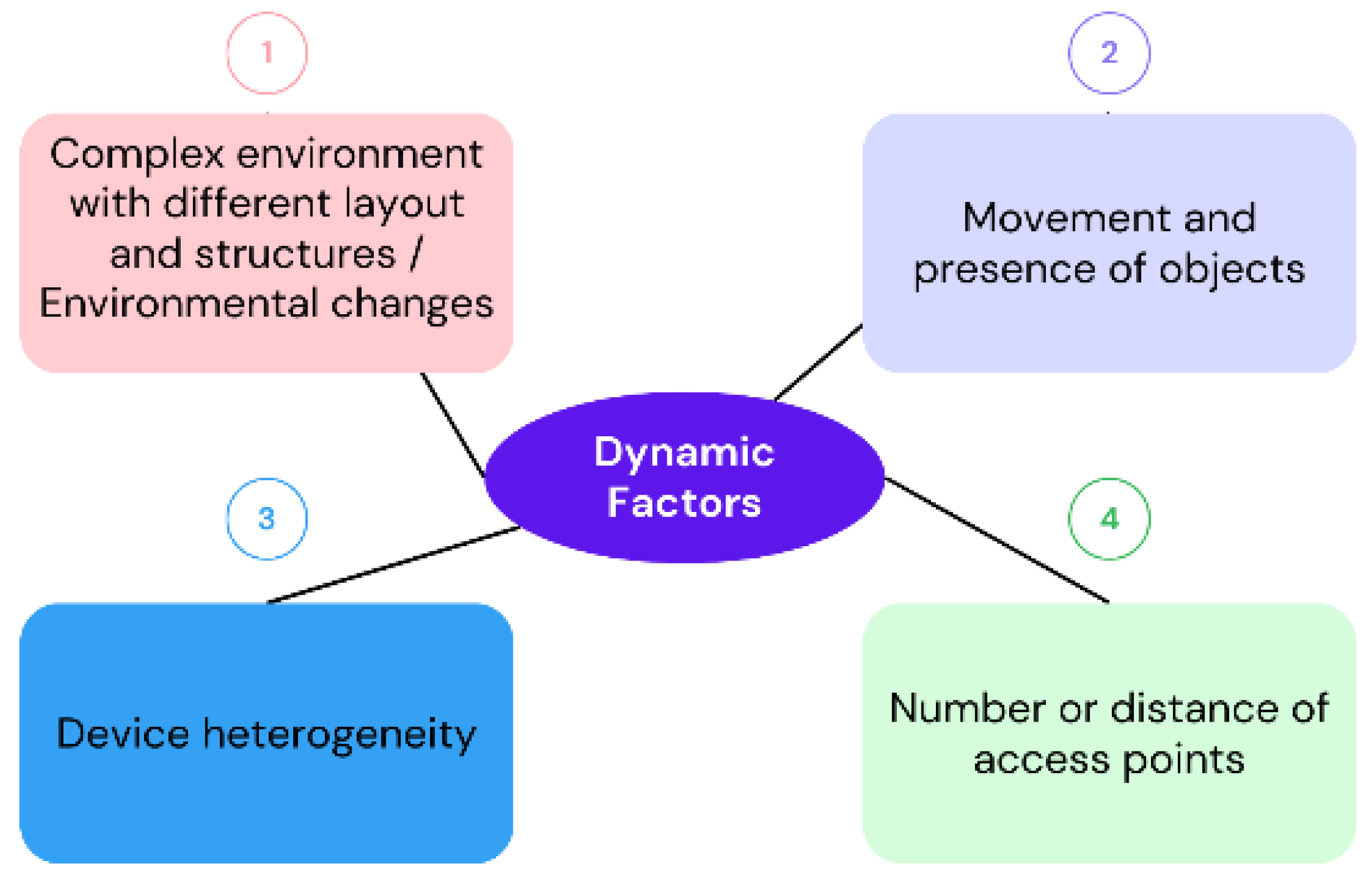
Today, Wi-Fi has emerged as the most widely used technology for indoor positioning because of the extensive deployment of APs, particularly in urban areas. However, Wi-Fi IPSs still face many challenges, and one of the primary issues is accuracy. In indoor positioning using Wi-Fi, signal stability can directly affect the positioning estimation and performance of the trained model. This problem is usually caused by DEs. Therefore, RQ1 was formulated to identify and characterize a DE and examine its effects on the accuracy of Wi-Fi IPSs. Specifically, the focus is on four key aspects: (1) the complexity of the environment and environmental changes over time; (2) the movement and presence of objects; (3) device heterogeneity; and (4) the number and distance of access points. Table 5 summarizes these dynamic factors by listing the number of papers associated with each category.
In fact, complex environments with different layouts and structures, including walls, furniture, and doors, are some of the dynamic factors that cause the inconsistencies in Wi-Fi signal strength [14,16,45,46,47,48,49,50,51,52,53,54,55,56,57]. Besides that, the indoor environment may undergo temporal changes. These dynamics also involve alterations in furniture placement, introducing new obstacles or modifications in the spatial layout. These environments or changes introduce a complexity that can lead to signal attenuation, reflection, or multipath effects, causing fluctuations in the RSSI [7,11,16,36,37,45,46,47,48,50,52,53,58,59,60,61,62,63,64,65,66,67,68,69]. Therefore, effectively navigating through temporal changes and reducing the impact of signal interference pose a critical challenge.
Apart from that, one of the key dynamic factors arises from the presence of moving objects within indoor spaces. As people or objects move, they can intermittently obstruct or reflect these signals, causing variations in RSSI values [14,48,52,53,54,55,70,71,72,73,74,75]. The unpredictable nature of these movements makes it challenging to maintain consistent and accurate RSSI measurements [41]. Consequently, the dynamic nature of moving objects within indoor spaces introduces a level of uncertainty that directly influences the overall accuracy of IPSs.
Furthermore, device heterogeneity is also regarded as a significant dynamic factor affecting Wi-Fi IPSs. This heterogeneity includes differences in hardware components (e.g., sensors, antennas, and signal-processing chips) or software configurations (e.g., operating systems and firmware versions). These variations can lead to inconsistencies in signal measurements, such as differences in RSSI values, despite the devices being in the same position [76,77,78,79,80,81,82,83,84]. This variability poses challenges for maintaining accurate and reliable positioning results, as the system must adapt to the unique attributes of each device type to ensure consistent performance across a wide range of devices.
In addition, the effectiveness of indoor positioning often correlates with the distance between or number of access points [47,55,61,62,64,66,71,85,86,87]. For example, a higher density of access points typically will improve accuracy [40]. The signals from nearby access points can overlap or interfere with each other, leading to difficulties in accurately determining the position of a target [40]. Although conventional wisdom suggests that an increased number of access points should enhance precision [49,51,53,88], the distance between access points is also important. As the number of access points increases, the signals emitted by each access point can intersect and interfere with one another. This interference may affect the reliability of Wi-Fi fingerprinting methods and degrade prediction performance. Here, achieving the optimal balance between access point density and spacing is important for maximizing the accuracy of indoor positioning and reducing the potential dynamic factors. The taxonomy of the dynamic factors is summarized in Figure 3.
As mentioned above, these dynamic factors can gradually degrade the accuracy and reliability of RSSI-based IPSs. These factors change the signal propagation paths and received signal strength, leading to mismatches between stored fingerprints and real measurements. Moreover, such inconsistencies reduce the validity of the existing radio map, making periodic recalibration necessary to maintain positioning accuracy. To provide a clearer understanding of the factors that require radio map updates, in Table 6, we summarize the key environmental and system variations influencing the need for recalibration.
Table 5. Dynamic factors in RSSI-based IPSs.
No of PaperDynamic Factors
[7,11,14,16,36,37,45,46,47,48,49,50,51,52,53,54,55,56,57,58,59,60,61,62,63,64,65,66,67,68,69]
  • Complex environment with different layouts and structures
  • Environmental changes
[14,41,48,52,53,54,55,70,71,72,73,74,75]
  • Movement and presence of objects
[77,78,79,80,81,82,83,84,85]
  • Device heterogeneity
[43,48,50,52,54,56,62,63,65,67,72,86,87,88,89]
  • Number of or distance between access points
Table 6. Summary of key dynamic factors affecting radio map stability and the necessity of updates.
FactorExample of ChangesImpact of SignalNeed for Radio Map Update
Environment layoutEmpty or full; open or closed doorsAlters signal propagation paths and attenuation.Moderate High
Structural modificationAddition/removal of walls or partitionsCauses major RSSI pattern changes.Very High
Human movementWalking individuals or dense crowdsIntroduces temporal signal fluctuation.Moderate High
Object movementFurniture or equipment relocationAffects reflection and scattering.High
Device heterogeneityUsing different Wi-Fi chipsets or antenna orientationsProduces inconsistent RSSI readings.Moderate
Access point relocation/configurationMoving APs and adjusting transmission power and channel or antenna directionShifts signal coverage and strength.Very High

4.2. RQ2: How Can Constructing a Radio Map Improve Positioning Accuracy and Training Time Efficiency in DEs?

Creating a radio map is a crucial stage in deploying the fingerprinting indoor positioning technique [89,90]. A well-constructed radio map, including detailed signal strength measurements at various locations, can help improve overall system performance during indoor positioning. Besides that, the use of advanced ML algorithms (e.g., K-Nearest Neighbors (KNNs), Neural Networks, or other methods) trained on a quality radio map can increase a model’s reliability to ensure more precise position estimation. Hence, it is evident that the accuracy of Wi-Fi indoor positioning is closely related to the quality of the constructed radio map. However, the creation or maintenance of a radio map requires considerable time and effort through manual calibration [90].
Indoor personnel movement or indoor environment may change over time, which will affect positioning accuracy. Therefore, it is necessary to update the radio map regularly based on environmental changes. Most of the time, a radio map may require several days or weeks to build or maintain, so its construction is time-consuming and labor-intensive. These substantial time and labor requirements have become a major barrier to the development of fingerprint indoor positioning.
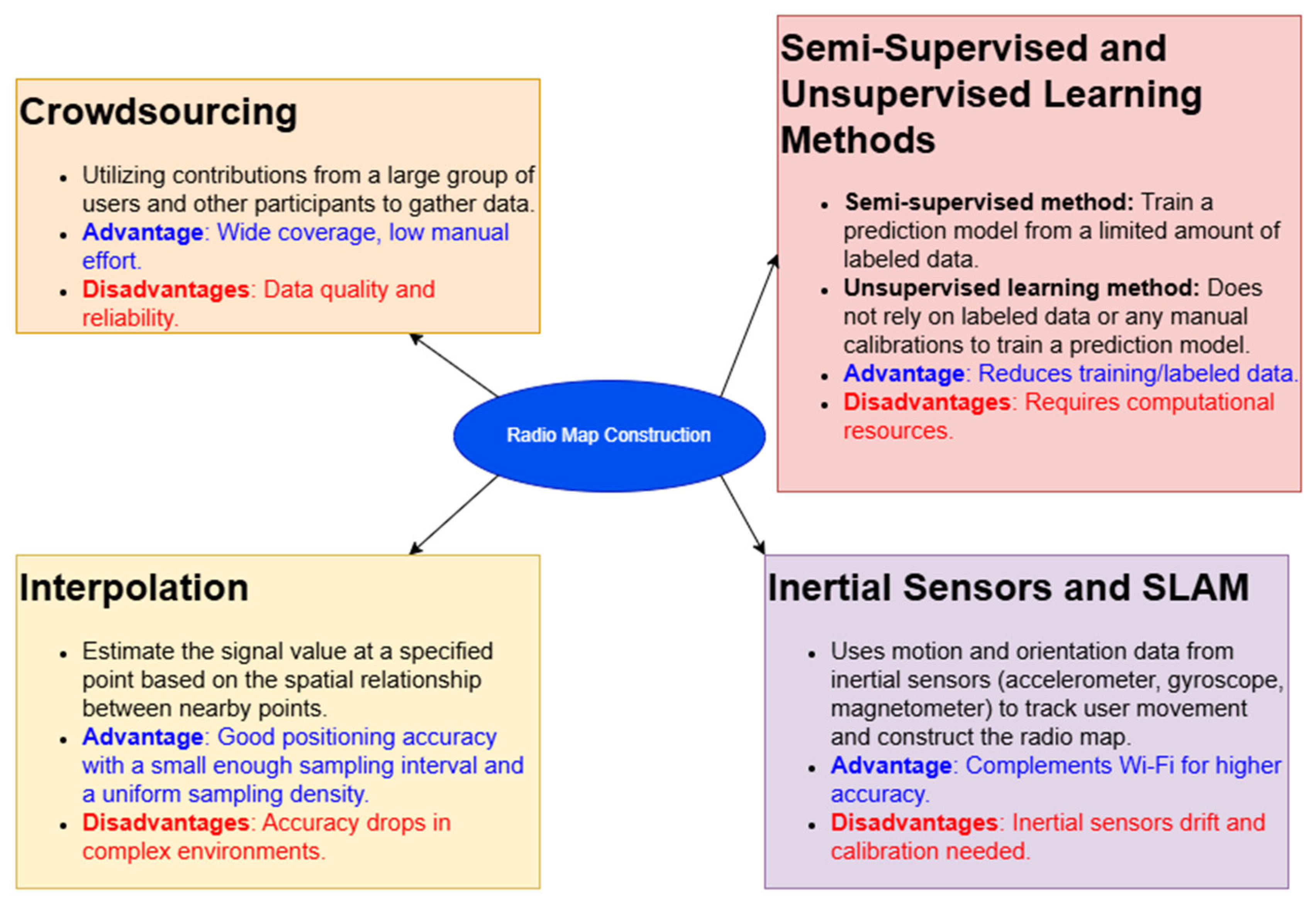
Accordingly, finding ways to quickly and cost-effectively construct radio maps has become an important topic in this field in recent years. Researchers have introduced various methods based on interpolation, crowdsourcing, semi-supervised learning, simulators, unsupervised learning, and inertial sensors. The primary purpose of RQ2 was to discuss the methodologies and techniques different researchers have applied in creating radio maps and analyze how these construction methods contribute to improving accuracy in localization and training-time efficiency in DEs. A detailed discussion of each technique is presented in the following sections.

4.2.1. Crowdsourcing

Using crowdsourcing for indoor map construction has attracted growing interest in recent years. The basic concept of crowdsourcing involves collecting contributions from a large group of users and other participants, including both professional surveyors and common users, to gather data within indoor environments [91]. Currently, smartphones are widespread and contain many sensors, such as IMUs, cameras, microphones, Bluetooth, and Wi-Fi scanners [92]. When a user walks indoors, these sensors in the phone can be used passively or actively to record map-related information in order to extract the indoor map structure from the sensor data [91,93].
In passive mode, sensors record information that will be gathered in the background without direct user input, interaction, or awareness [94]. In contrast, active mode typically requires user intervention or input to collect data [91]. This may involve starting sensor measurements through an application or selecting certain features or functionalities that depend on sensor data.
Regardless of whether passive or active modes are employed, the main purposes of crowdsourcing are reducing labor costs, time, and storage during the construction of the radio map [77,95,96,97,98]. However, there remain some potential challenges associated with using crowdsourcing, including issues related to device heterogeneity [77,97], variations in sample dimensionality and spatial distribution [97,99], and inaccurate sample annotation and location information [97,100].
The typical positioning accuracy of crowdsourced radio map construction ranges from approximately 0.6 m to 3 m [95,97,98]. However, the actual accuracy depends heavily on the density of the crowdsourced data, the algorithm used to clean or interpolate the radio map, and the stability of the wireless infrastructure.
Even though crowdsourcing methods have accelerated the collection of RSS samples throughout a building with minimal effort and time, these samples may not effectively represent their distributions, affecting positioning performance [91]. Therefore, while crowdsourcing offers relative simplicity in collecting data, verifying the reliability of the data remains a challenging issue [6].

4.2.2. Interpolation

Interpolation is a mathematical tool that can estimate a value at a specified point based on the spatial relationship among nearby points. The authors of [89,101,102] suggest that interpolation methods can improve the accuracy of indoor positioning or reduce the time required for data collection while also maintaining accuracy. Although some systems utilize interpolation methods, different approaches may involve the application of interpolation in constructing the radio map. Examples include the Biharmonic spline interpolation method [89], Inverse Distance Weighting [101], KNN interpolation [101], Linear interpolation [102], and Gaussian process regression (GPR) [102].
These interpolation methods can achieve accurate positioning with a sufficiently small sampling interval and uniform sampling density. When the sampling interval is large and there are numerous APs, performance deteriorates. Moreover, this approach may neglect factors such as wall attenuation and device heterogeneity, which pose challenges in real-world environments [91,103]. Interpolation methods have difficulty handling dynamic factors.

4.2.3. Semi-Supervised and Unsupervised Learning Methods

Semi-supervised and unsupervised learning methods are also applied in radio map construction. In the semi-supervised learning method, a prediction model can be trained using a limited labeled dataset with a large set of unlabeled data [6,104]. This method utilizes unlabeled data effectively during the construction of the radio map to reduce the need a great deal of labeled data and annotation effort [6,105,106]. However, it is undeniable that researchers still need to spend some time collecting accurate data for initializing the learning process [91].
The unsupervised learning method rarely depends on labeled data or any manual calibration to train a prediction model [107]. By using this method, a radio map can still be constructed for specific indoor environments that contain only a few reference locations [90,108]. Obtaining a significant number of unlabeled fingerprints has become easier through crowdsourcing, especially now. Hence, the unsupervised learning method emerges as a promising solution [91]. In fact, there are several limitations to unsupervised learning methods, including their inability to handle dynamic indoor environments and challenges in accurately modeling path loss. Here, unsupervised learning methods usually need to be combined with other techniques to improve overall reliability [6].

4.2.4. Inertial Sensors and SLAM

Currently, smartphones typically incorporate several inertial sensors, including accelerometers, magnetometers, and gyroscopes, which can also be called Inertial Measurement Units (IMUs) [109,110,111]. These sensors provide crucial data on linear acceleration, angular velocity, and magnetic field strength. In addition, this data is fundamental for techniques like Pedestrian Dead Reckoning (PDR), which uses an accelerometer to count steps and combines data from a magnetic field and gyroscope to estimate orientation angles [91,112]. Thus, this information offers reliable solutions for using indoor positioning to enhance the accuracy of a radio map during construction and makes real-time location tracking possible.
Similarly, SLAM is a technology used to create a radio map of an unknown environment while simultaneously tracking a device’s location in real time [109]. This approach utilizes data from various sensors, including cameras, lidars, and IMUs, to perceive the environment and build a radio map. The positions obtained through IMUs or SLAM often suffer from significant inaccuracies due to the accumulation of errors from noisy sensors and feature mismatching [5,91,107,111]. Additionally, new challenges continue to arise, including sensor drift, orientation estimation, feature extraction, device heterogeneity, and power consumption [91,112,113]. These limitations may affect reliability during radio map construction and lead to an overall performance decline of IPSs in DEs.
Figure 4 and Table 7 summarizes various methods for radio map construction. In the table, it can be observed that several methods have been proposed to minimize the effort required for creating radio maps and enhance accuracy during indoor positioning. These include techniques based on crowdsourcing, interpolation, semi-supervised or unsupervised learning, inertial sensors, and SLAM. It is worth mentioning that SLAM-based, inertial sensor-based, semi-supervised learning, unsupervised learning, and interpolation methods are typically combined with the crowdsourcing method, with no clear distinction among them.

4.3. RQ3: How Can ML/DL Models Predict Indoor Position with Minimal Error Despite the Challenges of a DE?

As previously mentioned, Wi-Fi IPSs have attracted a significant amount of attention because of their simplicity and low hardware requirements [35]. However, ensuring accuracy, adaptability, and scalability still represents a severe challenge for widespread deployment, especially in DEs.
With the rapid development of Artificial Intelligence (AI) in recent years, various ML and DL techniques are increasingly being explored by researchers to address these challenges, with reasonable success (e.g., supervised learning, unsupervised learning, or deep learning methods) [2,17,40,41,46,58,60,114,115,116]. In fact, achieving high accuracy in a complex environment requires models that can not only process large amounts of data but also adjust to environmental changes in real time.
ML and DL techniques have the potential to provide more reliable solutions by learning patterns from data and compensating for uncertainties. Hence, RQ3 aims to identify a method that delivers accurate indoor position estimates while minimizing errors and overcoming the limitations of dynamic conditions.

4.3.1. Traditional ML Models

Traditional ML models for Wi-Fi indoor positioning are typically categorized into two groups: supervised learning and unsupervised learning. Supervised learning methods depend on labeled data to train models to predict the user’s position based on signal patterns. Techniques such as KNN [17,117,118], Support Vector Machines (SVMs) [15], Decision Trees (DTs), and Random Forests (RFs) [15,36] are widely applied. One notable advantage of supervised learning methods is their ability to achieve high accuracy, as the corresponding model learns directly from labeled real-world data. These models perform well in stable environments where signal readings closely correlate with specific locations. However, it is well recognized that indoor environments are dynamic, with changes such as shifting furniture, new obstacles, and fluctuations in human movement, all of which can affect signal strength and reduce the accuracy of Wi-Fi IPSs [119]. For this reason, models often require re-training or fine-tuning to maintain accuracy in DEs [73]. This is because accuracy depends heavily on the density and distribution of access points and the quality of the labeled dataset.
In contrast, unsupervised learning does not require labeled data with known positions; the corresponding model independently identifies patterns and features within the dataset. This is beneficial in scenarios where obtaining labeled data is difficult or costly [120]. Moreover, Wi-Fi fingerprinting has a major limitation: the performance of these techniques can decline when the corresponding dataset contains hundreds or thousands of stored fingerprints. This leads to slower response times during the online phase since each incoming fingerprint must be compared with every fingerprint in the radio map [121]. Consequently, this method is inefficient for real-time indoor positioning. To improve response time in the online phase, some researchers have proposed using unsupervised methods, including clustering algorithms. Techniques such as k-Means [122,123], Density-based Spatial Clustering of Applications with Noise (DBSCAN) [124], or C-Means [125] are commonly used to group similar fingerprints in a radio map. These clusters can then be associated with specific areas or locations, thus providing an estimate of a user’s current position. However, unsupervised methods usually offer lower accuracy compared to supervised methods, as these approaches do not learn from explicit examples of locations [126]. Additionally, mapping discovered clusters to actual physical locations can be challenging and may require manual intervention or supplementary data.
In summary, supervised learning is valuable due to its ability to provide accurate location predictions. However, its capacity becomes limited when handling unpredictable environmental changes. Although unsupervised learning is more adaptable to DEs, the lack of labeled training data often results in less precise location estimates compared to supervised methods. Therefore, integrating semi-supervised or hybrid learning models is essential for enhancing the reliability of IPSs, enabling them to better address challenges posed by varying conditions, especially in DEs.

4.3.2. Deep Learning (DL) Models

Motivated by the development of AI, recent years have shown the potential of DL methods such as the Multilayer Perceptron (MLP) [127], Convolutional Neural Network (CNN) [2,11,128], Recurrent Neural Network (RNN) [129,130], and Deep Q-Network (DQN) [131], which have outperformed traditional ML approaches in terms of Wi-Fi indoor positioning. Unlike traditional ML methods, DL has the ability to learn complex features from large datasets with no extensive manual feature engineering. Moreover, DL models can adapt to varying conditions and incorporate temporal dependencies. This makes DL particularly suitable for addressing the complexities of Wi-Fi signals in dynamic indoor environments.
However, training DL models requires substantial computational resources and large amounts of data, which can be difficult and expensive to obtain. Additionally, DL-based IPSs can be prone to overfitting, especially if the training data is not representative of the real-world deployment environment. To address these issues, some researchers have proposed to use transfer-learning techniques since this method allows the learning of new information in a different environment by applying knowledge acquired previously [8,132,133,134,135,136]. For example, transfer learning can improve system scalability without requiring extensive site surveys and without compromising accuracy, particularly in situations where labeled data is inadequate [137]. This approach can significantly reduce the amount of labeled data and computational resources needed for training, ensuring the accuracy of indoor positioning, especially in a DE.
Fluctuations in RSSI values are the primary issue that will impact positioning accuracy. DL has demonstrated significant potential in enhancing localization in DEs, especially in situations where extracting and modeling non-linear correlated features prove challenging [138]. Traditional methods may struggle to effectively capture and model these intricate relationships. However, DL models are adept at learning hierarchical representations of data, enabling them to automatically extract relevant features from raw input data [18,139,140,141,142,143]. This capability makes DL techniques suitable for addressing the challenges posed by complex environments, where traditional methods may fall short. Therefore, DL techniques have shown great promise in improving localization accuracy in such scenarios [108].
Table 8 provides a comparative analysis of different schemes used for Wi-Fi IPSs. It compares their performance, accuracy, and practical considerations of various approaches applied in this domain. Based on the results, one can see that tools like CNNs and LSTMs show high accuracy and excel in large and complex environments but have increased complexity. Simpler methods, such as KNN and traditional ML approaches, are cost-effective and easy to implement but lack scalability. Comparing these methods directly is challenging, as different datasets (either public or self-collected) may be used for experiments. Therefore, this also highlights the importance of public datasets, which enable standardized evaluation and support fair comparisons across methods.

4.4. Risk of Bias, Reporting Bias, and Certainty of Evidence

A formal risk of bias assessment was not conducted for each included study because existing tools are not well-suited to the methodological diversity of Wi-Fi-based indoor positioning research. Instead, potential sources of bias were addressed narratively. Common concerns included incomplete reporting of experimental conditions, selective presentation of favorable outcomes, and limited validation under realistic dynamic settings. In addition, a formal statistical assessment of reporting biases, such as funnel plot asymmetry, was not feasible due to the heterogeneity of studies.

5. Discussion and Suggestions

By examining the existing literature and drawing upon established research findings, in this section, we aim to address the limitations mentioned in existing works, clarifying areas for further exploration and proposing recommendations for future research.

5.1. Optimization of ML Algorithms

As discussed in RQ1, complex environments with different layouts and structures, moving objects within indoor spaces, device heterogeneity, and the distance between or number of access points are dynamic factors that impact the inconsistencies of Wi-Fi signal strength. These dynamic factors induce variability and unpredictability into indoor environments, potentially leading to signal attenuation, reflection, multipath effects, or fluctuations in the RSSI. Although various approaches have integrated ML to address environmental change, there appears to be limited emphasis on developing ML models specifically designed for this issue. Existing solutions that utilize general algorithms face challenges related to high computational complexity and significant demands on device performance. Therefore, developing specialized ML algorithms that are both cost-effective and optimized for handling environmental changes represents a promising direction for future research. For instance, approaches such as Interval Random Parameter Lognormal Shadowing–Adaptive Bayesian Comprehensive Learning (IRPLS-ABCL) and Inverse-Distance-Weight-Assisted Particle-Swarm-Optimized Indoor Localization (IDWPSOInLoc) have shown enhanced robustness and accuracy in dynamic indoor environments by effectively mitigating signal fluctuations and adapting to varying environmental conditions [150,151].

5.2. Hybrid Method for DEs

With regard to strategies for addressing DE factors, integrating technologies such as inertial sensors and fingerprinting also presents a promising approach to enhancing indoor positioning accuracy. Currently, smartphones are equipped with built-in inertial sensors, including accelerometers, gyroscopes, and magnetometers. These sensors provide data on movement and orientation, while fingerprinting uses pre-recorded signal characteristics to estimate positions. Combining these two methods can reduce their respective limitations. For example, fingerprinting can correct the drift errors typically associated with inertial sensors, while inertial sensors can provide continuous location tracking in areas where fingerprinting alone may be less reliable. This hybrid method may improve overall accuracy, making it a valuable solution for dynamic indoor environments [152,153].

5.3. Emerging Role of Wi-Fi 6/6E/7

Currently, most existing IPSs rely on Wi-Fi (802.11 standards), utilizing the signals emitted by the Wi-Fi access points to estimate the position of the target [16,47,48,154,155,156]. Recent advancements in Wi-Fi technology, especially Wi-Fi 6 (IEEE 802.11ax), Wi-Fi 6E, and the emerging Wi-Fi 7 (IEEE 802.11be), have significantly improved the potential for high-accuracy indoor positioning. These newer standards utilize wideband channels (up to 160 MHz or higher) and advanced physical-layer features, enabling more precise fine-time measurements (FTMs) and time-of-flight (ToF) estimations [157,158]. By harnessing these capabilities, Wi-Fi systems can achieve sub-meter-level accuracy, substantially improving upon traditional RSSI-based methods, which are often affected by multipath fading and environmental noise. In the future, the adoption of these advanced Wi-Fi standards could enable more reliable and scalable indoor localization frameworks, especially when combined with machine learning or sensor fusion approaches. Therefore, exploring the potential of wideband Wi-Fi standards represents a promising research direction for enhancing both the accuracy and resilience of indoor positioning systems.

5.4. Adaptability of Radio Maps

In indoor localization, a well-constructed radio map is essential for enhancing the efficiency and accuracy of Wi-Fi indoor positioning. However, constructing a radio map is a complex and demanding task. Therefore, several methods have been proposed to simplify this process, as mentioned in RQ2. The results indicate that each technique for radio map construction in Wi-Fi indoor positioning has its own advantages and limitations. Creating a radio map that can adapt to a DE remains a significant challenge. Consequently, there is an increasing need for adaptive radio map construction algorithms that can identify environmental changes and update the map automatically. Approaches such as crowdsourcing for data collection and the use of semi-supervised learning methods show potential in addressing this challenge of adaptive radio map construction [159]. Researchers should carefully consider the trade-offs and choose techniques based on the specific requirements of the application environment to effectively utilize the benefits of these methods for improving indoor localization performance.

5.5. The Capabilities of DL and Transfer Learning

As outlined in research question RQ3, DL-based models require large amounts of annotated data to train. However, this kind of extensive data collection requires a time-consuming and labor-intensive site survey, which may not be suitable for practical scenarios [135,160,161]. The number of labeled samples is often restricted, which may lead to overfitting of the trained model [143,161].
Moreover, the models based on DL are commonly trained on data from a single building and cannot be applied to other buildings since these models learn the relationship between RSSI values and a location within a particular environment. Therefore, there is a need to explore and develop an adaptive Wi-Fi positioning algorithm using DL that can generalize to different environments with only limited data. For example, Few-Shot Learning (FSL) techniques are an ML paradigm designed to address cases where limited annotated training data is available for model development [162,163,164]. In FSL, a model can learn about new or unseen data from a limited set of labeled samples. The model can then continuously refine and improve its performance by adapting to new data. By periodically incorporating new labeled data into the training process, the model can adjust to changes in the environment, device features, or user behavior, leading to more accurate and reliable positioning estimates. Therefore, future research on Wi-Fi IPSs based on RSSI values should explore the potential of this approach as a dependable method. The changing environment requires innovative IPSs, encouraging competition and progress in the field.
Most of the existing RSSI-based IPSs are designed to operate within single-level structures such as individual floors of buildings or specific areas like laboratories or rooms [35,38,45,46,165,166]. However, the fluctuation of wireless signals resulting from environmental uncertainties has become a significant challenge on a single floor. It can be expected that this challenge may become more substantial when expanding positioning coverage to multiple floors or three-dimensional spaces [73]. Hence, future research should focus on identifying floors within multi-level structures, a task that would require addressing the challenges posed by DEs, such as signal attenuation, reflection, or multipath effects. To achieve multi-level positioning, more advanced ML or DL techniques should be further investigated to enhance the corresponding models (e.g., by improving accuracy and accelerating or stabilizing training). By employing the capabilities of ML or DL to process complex data and infer vertical position, accurate multi-level positioning can be attained.

5.6. The Possibility of Channel-State Information (CSI)

Today, the RSSI has become mainstream in Wi-Fi indoor positioning due to its advantage of imposing no additional equipment requirements. However, extracting the abundant multipath information present in the subcarriers of orthogonal frequency division multiplexing (OFDM) poses a significant challenge, primarily because of the limitations of RSSI values in providing only a rough representation of the wireless channel [167,168]. This can cause difficulties in adapting to dynamic environmental conditions and lead to inaccuracies in indoor positioning. Compared with the RSSI, CSI utilizes the fine-grained features for accurate positioning, and integrating visual elements with Wi-Fi localization expands the potential for acquiring more comprehensive and detailed location information [4,167,169,170,171]. In future research, it will be essential to investigate the feasibility of using CSI as a reliable approach.

6. Conclusions

This paper is an SLR of Wi-Fi indoor positioning based on the RSSI. First, the foundational concepts of RSSI, such as signal strength levels, advantages, and limitations, were presented. Before writing this study, a comprehensive research methodology was developed. This methodology encompassed defining research questions, developing a data search strategy, defining paper selection criteria, selecting papers, extracting data, and synthesizing data. Finally, 128 review papers published between 2018 and 2024 were selected to address the specified research questions.
Based on the results regarding RQ1, it can be concluded that the performance of Wi-Fi-based indoor positioning systems is strongly related to a variety of dynamic factors. These dynamic factors include complex layouts and structures, environmental changes, the movement and presence of objects, device heterogeneity, and variations in the number of and distance between access points. These dynamic factors introduce variability and unpredictability into an indoor environment, potentially leading to signal attenuation, reflection, multipath effects, or fluctuations in the RSSI. Despite many efforts to address these dynamic factors in Wi-Fi indoor positioning systems through improved algorithms and optimized deployment strategies, the dynamic nature of these factors makes it challenging to fully adapt existing solutions, thus emphasizing the need for further research and innovation in order to enhance the reliability and robustness of such systems in real-world applications.
For RQ2, the results indicate that each method of radio map construction in Wi-Fi indoor positioning possesses its own set of advantages and limitations. Researchers should consider the trade-offs and select techniques based on the specific requirements of the application environment to effectively utilize the benefits of these methods for improving indoor localization performance. For example, integrating crowdsourced data with automated techniques could increase scalability and reduce manual effort, while the application of advanced machine learning models could enhance the accuracy and adaptability of radio maps in dynamic environments. For further research, it is essential to examine methods to ensure the long-term stability and real-time updating capability of radio maps, especially in environments subject to frequent changes.
For RQ3, the results have indicated that both ML and DL hold significant potential for predicting indoor positions with minimal error. Notably, DL demonstrates exceptional promise, particularly in addressing the challenges posed by DEs. By utilizing the power of data-driven algorithms, DL models can adjust to changing conditions, enabling the extraction and modeling of complex features from raw input data. Hence, a promising direction for further research is to explore the development of advanced DL architectures designed for indoor positioning in dynamic environments. This includes examining techniques such as transfer learning or Few-Shot learning to adapt models across different environments.
Lastly, a discussion section has been included to explore the findings, limitations, and potential directions for future research based on the review papers. Although Wi-Fi indoor positioning based on RSSI values still faces various challenges, it is firmly believed that positioning will play an increasingly important role in wireless networks in the future.

Author Contributions

Conceptualization, P.Y.G. and L.Y.O.; methodology, Z.Y.C.; software, Z.Y.C.; validation, Z.Y.C., P.Y.G., L.Y.O., and S.C.T.; formal analysis, Z.Y.C.; investigation, Z.Y.C.; resources, P.Y.G. and L.Y.O.; data curation, Z.Y.C.; writing—original draft preparation, Z.Y.C.; writing—review and editing, P.Y.G. and L.Y.O.; visualization, Z.Y.C.; supervision, P.Y.G., L.Y.O., and S.C.T.; project administration, P.Y.G. and L.Y.O.; funding acquisition, P.Y.G. and L.Y.O. All authors have read and agreed to the published version of the manuscript.

Funding

This work was supported by Telekom Malaysia Research and Development under grant RDTC/241125 (MMUE/240066).

Data Availability Statement

No new data were created or analyzed in this study. Data sharing is not applicable to this article.

Acknowledgments

This work was supported by Telekom Malaysia Research and Development under grant RDTC/221073 (MMUE/230002) and the Internal Fund of Multimedia University under grant number MMUI/210025.

Conflicts of Interest

The authors declare no conflicts of interest. The funders had no role in the design of the study; in the collection, analyses, or interpretation of data; in the writing of the manuscript; or in the decision to publish the results.

Abbreviations

The following abbreviations are used in this manuscript:
AIArtificial Intelligence
BPBackpropagation
CNNConvolutional Neural Network
CSIChannel State Information
dBmDecibel-milliwatts
DBSCANDensity-based Spatial Clustering of Applications with Noise
DEDynamic Environment
DLDeep learning
DQNDeep Q-Network
DTDecision Tree
EVSFMExtended Viterbi Signal Fluctuation Matrix
FSLFew-Shot Learning
FTMFine Time Measurement
GPRGaussian Process Regression
GPSGlobal Positioning System
IDWInverse Distance Weight
IDWPSOInLocInverse-Distance-Weight-assisted Particle-Swarm-Optimized Indoor Localization
IMUInertial Measurement Unit
IRPLS-ABCLInterval Random Parameter Lognormal Shadowing–Adaptive Bayesian Comprehensive Learning
IPSIndoor Positioning System
KNNsK-Nearest Neighbors
MLMachine learning
MLPMultilayer Perceptron
NNNearest Neighbor
OFDMOrthogonal Frequency Division Multiplexing
PDRPedestrian Dead Reckoning
RFRandom Forest
RFIDRadio Frequency Identification
RMRadio Map
RMSERoot Mean Square Deviation
RNNRecurrent Neural Network
RSSReceived Signal Strength
RSSIReceived Signal Strength Indicator
SLAMSimultaneous Localization and Mapping
SLRSystematic Literature Review
SVMSupport Vector Machine
SVRSupport Vector Regression
ToFTime-of-Flight
UWBUltra-Wide Band
VAEVariation Autoencoder
WAPsWireless Access Points
WKNNWeighted K-nearest Neighbor
WLSWeighted Least Squares

References

  1. Wahab, N.H.A.; Sunar, N.; Ariffin, S.H.S.; Wong, K.Y.; Aun, Y. Indoor Positioning System: A Review. Int. J. Adv. Comput. Sci. Appl. 2022, 13. [Google Scholar] [CrossRef]
  2. Chen, X.; Siu, W.-C.; Chan, Y.-H.; Chan, C.-Y.; Chau, C.-P. A Convolutional Neural Network Architecture for Multi-Floor Indoor Localization Based on Wi-Fi Fingerprinting. In Proceedings of the 2023 24th International Conference on Digital Signal Processing (DSP), Rhodes (Rodos), Greece, 11–13 June 2023; pp. 1–5. [Google Scholar]
  3. Zafari, F.; Gkelias, A.; Leung, K.K. A Survey of Indoor Localization Systems and Technologies. IEEE Commun. Surv. Tutor. 2019, 21, 2568–2599. [Google Scholar] [CrossRef]
  4. Sonny, A.; Kumar, A.; Cenkeramaddi, L.R. A Survey of Application of Machine Learning in Wireless Indoor Positioning Systems 2024. arXiv 2024, arXiv:2403.04333. [Google Scholar]
  5. Lee, G.; Moon, B.-C.; Lee, S.; Han, D. Fusion of the SLAM with Wi-Fi-Based Positioning Methods for Mobile Robot-Based Learning Data Collection, Localization, and Tracking in Indoor Spaces. Sensors 2020, 20, 5182. [Google Scholar] [CrossRef]
  6. Chidlovskii, B.; Antsfeld, L. Semi-Supervised Variational Autoencoder for WiFi Indoor Localization. In Proceedings of the 2019 International Conference on Indoor Positioning and Indoor Navigation (IPIN), Pisa, Italy, 30 September–3 October 2019; IEEE: Pisa, Italy, September 2019; pp. 1–8. [Google Scholar]
  7. Montoliu, R.; Sansano, E.; Belmonte, O.; Torres-Sospedra, J. A New Methodology for Long-Term Maintenance of WiFi Fingerprinting Radio Maps. In Proceedings of the 2018 International Conference on Indoor Positioning and Indoor Navigation (IPIN), Nantes, France, 24–27 September 2018; IEEE: Nantes, France, September 2018; pp. 1–7. [Google Scholar]
  8. Labinghisa, B.A.; Lee, D.M. Indoor Localization System Using Deep Learning Based Scene Recognition. Multimed. Tools Appl. 2022, 81, 28405–28429. [Google Scholar] [CrossRef]
  9. Wu, X.; Safari, M.; Haas, H. Access Point Selection for Hybrid Li-Fi and Wi-Fi Networks. IEEE Trans. Commun. 2017, 65, 5375–5385. [Google Scholar] [CrossRef]
  10. Obeidat, H.; Shuaieb, W.; Obeidat, O.; Abd-Alhameed, R. A Review of Indoor Localization Techniques and Wireless Technologies. Wirel. Pers. Commun. 2021, 119, 289–327. [Google Scholar] [CrossRef]
  11. Song, X.; Fan, X.; Xiang, C.; Ye, Q.; Liu, L.; Wang, Z.; He, X.; Yang, N.; Fang, G. A Novel Convolutional Neural Network Based Indoor Localization Framework with WiFi Fingerprinting. IEEE Access 2019, 7, 110698–110709. [Google Scholar] [CrossRef]
  12. Dong, Y.; Arslan, T.; Yang, Y.; Ma, Y. A WiFi Fingerprint Augmentation Method for 3-D Crowdsourced Indoor Positioning Systems. In Proceedings of the 2022 IEEE 12th International Conference on Indoor Positioning and Indoor Navigation (IPIN), Beijing, China, 5–8 September 2022; IEEE: Beijing, China, 5 September 2022; pp. 1–8. [Google Scholar]
  13. Chen, B.; Ma, J.; Zhang, L.; Zhou, J.; Fan, J.; Lan, H. Research Progress of Wireless Positioning Methods Based on RSSI. Electronics 2024, 13, 360. [Google Scholar] [CrossRef]
  14. Cha, J.; Lee, S.; Kim, K.S. Automatic Building and Floor Classification using Two Consecutive Multi-layer Perceptron. In Proceedings of the 18th International Conference on Control, Automation and Systems (ICCAS), PyeongChang, Republic of Korea, 22–25 October 2018; IEEE: New York, NY, USA, 2018; pp. 87–91. [Google Scholar]
  15. Niang, M.; Canalda, P.; Ndong, M.; Spies, F.; Dioum, I.; Diop, I.; Abd El Ghany, M.A. An Adapted Machine Learning Algorithm Based-Fingerprints Using RLS to Improve Indoor Wi-Fi Localization Systems. In Proceedings of the 2022 4th International Conference on Emerging Trends in Electrical, Electronic and Communications Engineering (ELECOM), Mauritius, Africa, 22–24 November 2022; IEEE: Mauritius, Africa, 22 November 2022; pp. 1–6. [Google Scholar]
  16. Wang, J.; Peng, J.; Wang, X.; Hwang, J.G.; Park, J.G. Distance Estimation Algorithm Based on Multi-Antenna Signal Attenuation Model. In Proceedings of the 2021 Twelfth International Conference on Ubiquitous and Future Networks (ICUFN), Jeju Island, Republic of Korea, 17–20 August 2021; IEEE: Jeju Island, Republic of Korea, 17 August 2021; pp. 316–318. [Google Scholar]
  17. Aydin, H.M.; Ali, M.A.; Soyak, E.G. Faster Wi-Fi Fingerprinting Using Feature Selection. In Proceedings of the 2020 28th Signal Processing and Communications Applications Conference (SIU), Gaziantep, Turkey, 5–7 October 2020; IEEE: Gaziantep, Turkey, 5 October 2020; pp. 1–4. [Google Scholar]
  18. Nessa, A.; Adhikari, B.; Hussain, F.; Fernando, X.N. A Survey of Machine Learning for Indoor Positioning. IEEE Access 2020, 8, 214945–214965. [Google Scholar] [CrossRef]
  19. Liu, F.; Liu, J.; Yin, Y.; Wang, W.; Hu, D.; Chen, P.; Niu, Q. Survey on WiFi-based Indoor Positioning Techniques. IET Commun. 2020, 14, 1372–1383. [Google Scholar] [CrossRef]
  20. Zhu, X.; Qu, W.; Qiu, T.; Zhao, L.; Atiquzzaman, M.; Wu, D.O. Indoor Intelligent Fingerprint-Based Localization: Principles, Approaches and Challenges. IEEE Commun. Surv. Tutor. 2020, 22, 2634–2657. [Google Scholar] [CrossRef]
  21. Singh, N.; Choe, S.; Punmiya, R. Machine Learning Based Indoor Localization Using Wi-Fi RSSI Fingerprints: An Overview. IEEE Access 2021, 9, 127150–127174. [Google Scholar] [CrossRef]
  22. Feng, X.; Nguyen, K.A.; Luo, Z. A Survey of Deep Learning Approaches for WiFi-Based Indoor Positioning. J. Inf. Telecommun. 2022, 6, 163–216. [Google Scholar] [CrossRef]
  23. Dai, J.; Wang, M.; Wu, B.; Shen, J.; Wang, X. A Survey of Latest Wi-Fi Assisted Indoor Positioning on Different Principles. Sensors 2023, 23, 7961. [Google Scholar] [CrossRef] [PubMed]
  24. Rathnayake, R.M.M.R.; Maduranga, M.W.P.; Tilwari, V.; Dissanayake, M.B. RSSI and Machine Learning-Based Indoor Localization Systems for Smart Cities. Eng 2023, 4, 1468–1494. [Google Scholar] [CrossRef]
  25. Shit, R.C.; Sharma, S.; Puthal, D.; Zomaya, A.Y. Location of Things (LoT): A Review and Taxonomy of Sensors Localization in IoT Infrastructure. IEEE Commun. Surv. Tutor. 2018, 20, 2028–2061. [Google Scholar] [CrossRef]
  26. Zhang, H.; Dai, L. Mobility Prediction: A Survey on State-of-the-Art Schemes and Future Applications. IEEE Access 2019, 7, 802–822. [Google Scholar] [CrossRef]
  27. Bourdoux, A.; Barreto, A.N.; van Liempd, B.; de Lima, C.; Dardari, D.; Belot, D.; Lohan, E.-S.; Seco-Granados, G.; Sarieddeen, H.; Wymeersch, H.; et al. 6G White Paper on Localization and Sensing. arXiv 2020, arXiv:2006.01779. [Google Scholar] [CrossRef]
  28. Lin, Y.; Yu, K.; Zhu, F.; Bu, J.; Dua, X. The State of the Art of Deep Learning-Based Wi-Fi Indoor Positioning: A Review. IEEE Sens. J. 2024, 24, 27076–27098. [Google Scholar] [CrossRef]
  29. Li, Z.; Xu, K.; Wang, H.; Zhao, Y.; Wang, X.; Shen, M. Machine-Learning-Based Positioning: A Survey and Future Directions. IEEE Netw. 2019, 33, 96–101. [Google Scholar] [CrossRef]
  30. Subhan, F.; Hasbullah, H.; Rozyyev, A.; Bakhsh, S.T. Indoor Positioning in Bluetooth Networks Using Fingerprinting and Lateration Approach. In Proceedings of the 2011 International Conference on Information Science and Applications, Jeju, Republic of Korea, 26–29 April 2011; IEEE: Jeju Island, Republic of Korea, April 2011; pp. 1–9. [Google Scholar]
  31. Garg, A.; Gupta, A. Indoor tracking using BLE-brief survey of techniques. In Proceedings of the International Conference on Data Sciences and Machine Learning (ICDSML-2020), Berlin/Heidelberg, Germany, 19–20 March 2020; pp. 1–3. [Google Scholar]
  32. Klus, L.; Klus, R.; Lohan, E.S.; Nurmi, J.; Granell, C.; Valkama, M.; Talvitie, J.; Casteleyn, S.; Torres-Sospedra, J. TUJI1 Dataset: Multi-Device Dataset for Indoor Localization with High Measurement Density. Data Brief 2024, 54, 110356. [Google Scholar] [CrossRef]
  33. Torres-Sospedra, J.; Montoliu, R.; Martínez-Usó, A.; Avariento, J.P.; Arnau, T.J.; Benedito-Bordonau, M.; Huerta, J. UJIIndoorLoc: A New Multi-Building and Multi-Floor Database for WLAN Fingerprint-Based Indoor Localization Problems. In Proceedings of the 2014 International Conference on Indoor Positioning and Indoor Navigation (IPIN), Busan, Republic of Korea, 27–30 October 2014; pp. 261–270. [Google Scholar]
  34. Liu, H.; Darabi, H.; Banerjee, P.; Liu, J. Survey of Wireless Indoor Positioning Techniques and Systems. Syst. Man Cybern. Part C Appl. Rev. IEEE Trans. 2007, 37, 1067–1080. [Google Scholar] [CrossRef]
  35. Song, H.; Jiang, R.; Liu, D. Comparison of Fingerprint Matching Methods for Wi-Fi Indoor Positioning. In Proceedings of the 2018 IEEE 4th International Conference on Computer and Communications (ICCC), Chengdu, China, 7–10 December 2018; pp. 748–752. [Google Scholar]
  36. Charoenruengkit, W.; Saejun, S.; Jongfungfeuang, R.; Multhonggad, K. Position Quantization Approach with Multi-Class Classification for Wi-Fi Indoor Positioning System. In Proceedings of the 2018 International Conference on Information Technology (InCIT), Khon Kaen, Thailand, 24–26 October 2018; pp. 1–5. [Google Scholar]
  37. Zeng, C.; Zhao, S.; Zhong, Y.; Yuan, Z.; Luo, X. An Improved Method for Indoor Positioning of Wifi Based on Location Fingerprint. In Proceedings of the 2018 7th International Conference on Digital Home (ICDH), Guiliin, China, 30 November–1 December 2018; pp. 280–285. [Google Scholar]
  38. Ren, J.; Wang, Y.; Niu, C.; Song, W.; Huang, S. A Novel Clustering Algorithm for Wi-Fi Indoor Positioning. IEEE Access 2019, 7, 122428–122434. [Google Scholar] [CrossRef]
  39. Chen, P.; Shang, J.; Gu, F. Learning RSSI Feature via Ranking Model for Wi-Fi Fingerprinting Localization. IEEE Trans. Veh. Technol. 2020, 69, 1695–1705. [Google Scholar] [CrossRef]
  40. Yao, Z.; Wu, H.; Chen, Y. Enhanced Wi-Fi Indoor Positioning Real Application Based on Access Points Optimization Ensemble Model. In Proceedings of the 2022 34th Chinese Control and Decision Conference (CCDC), Hefei, China, 15–17 August 2022; pp. 2183–2188. [Google Scholar]
  41. Li, F.; Wu, H.; Nie, J.; Cao, H. Research on Fingerprint Algorithm for Indoor Positioning Based on Improved BP Neural Network. In Proceedings of the 2022 4th International Academic Exchange Conference on Science and Technology Innovation (IAECST), Guangzhou, China, 9–11 December 2022; pp. 800–803. [Google Scholar]
  42. Li, J.; Park, J.; Cui, S.; Dong, J.; Rana, L.; Hwang, J. An Indoor Positioning Method Using High Probability RSSI. In Proceedings of the 2024 9th International Conference on Computer and Communication Systems (ICCCS), Xi’an, China, 19–22 April 2024; pp. 483–488. [Google Scholar]
  43. Xu, G. Method of Enhancing the Accuracy of Indoor Positioning (RSSI to UL-AOA). J. Phys. Conf. Ser. 2021, 1871, 012076. [Google Scholar] [CrossRef]
  44. Sakpere, W.; Adeyeye Oshin, M.; Mlitwa, N. A State-of-the-Art Survey of Indoor Positioning and Navigation Systems and Technologies. S. Afr. Comput. J. 2017, 29, 145. [Google Scholar] [CrossRef]
  45. Yu, H.K.; Oh, S.H.; Kim, J.G. AI Based Location Tracking in WiFi Indoor Positioning Application. In Proceedings of the 2020 International Conference on Artificial Intelligence in Information and Communication (ICAIIC), Fukuoka, Japan, 19–21 February 2020; pp. 199–202. [Google Scholar]
  46. Han, X.; He, Z. A Wireless Fingerprint Location Method Based on Target Tracking. In Proceedings of the 2018 12th International Symposium on Antennas, Propagation and EM Theory (ISAPE), Hangzhou, China, 3–6 December 2018; pp. 1–4. [Google Scholar]
  47. Yimwadsana, B.; Serey, V.; Sanghlao, S. Performance Analysis of an AoA-Based Wi-Fi Indoor Positioning System. In Proceedings of the 2019 19th International Symposium on Communications and Information Technologies (ISCIT), Ho Chi Minh, Vietnam, 25–27 September 2019; pp. 36–41. [Google Scholar]
  48. Yu, D.; Li, C. An Accurate WiFi Indoor Positioning Algorithm for Complex Pedestrian Environments. IEEE Sens. J. 2021, 21, 24440–24452. [Google Scholar] [CrossRef]
  49. Duong, D.; Xu, Y.; David, K. Comparing the Performance of Wi-Fi Fingerprinting Using the 2.4 GHz and 5 GHz Signals. In Proceedings of the 2018 IEEE 87th Vehicular Technology Conference (VTC Spring), Porto, Portugal, 3–6 June 2018; pp. 1–5. [Google Scholar]
  50. Javed, A.; Hassan, N.U.; Yuen, C. Accurate and Stable Wi-Fi Based Indoor Localization and Classification Using Convolutional Neural Network. In Proceedings of the 2021 IEEE VTS 17th Asia Pacific Wireless Communications Symposium (APWCS), Online, 30–31 August 2021; pp. 1–5. [Google Scholar]
  51. Zhou, B.; Tu, W.; Mai, K.; Xue, W.; Ma, W.; Li, Q. A Novel Access Point Placement Method for WiFi Fingerprinting Considering Existing APs. IEEE Wirel. Commun. Lett. 2020, 9, 1799–1802. [Google Scholar] [CrossRef]
  52. Li, M.; Kang, X.; Qiao, W. Performance Comparison and Evaluation of Indoor Positioning Technology Based on Machine Learning Algorithms. In Proceedings of the 2019 IEEE 19th International Conference on Communication Technology (ICCT), Xi’an, China, 16–19 October 2019; pp. 456–460. [Google Scholar]
  53. Retscher, G.; Bekenova, A. Urban Wi-Fi RSSI Analysis along a Public Transport Route for Kinematic Localization. In Proceedings of the 2020 IEEE/ION Position, Location and Navigation Symposium (PLANS), Portland, OR, USA, 23–26 April 2020; pp. 1412–1419. [Google Scholar]
  54. Khattak, S.B.A.; Pasha, M.A.; Farooq, M.U.; Hassan, N.U.; Yuen, C. Empirical Performance Evaluation of WIFI Fingerprinting Algorithms for Indoor Localization. In Proceedings of the 2018 IEEE International Conference on Communication Systems (ICCS), Chengdu, China, 19–21 December 2018; pp. 303–308. [Google Scholar]
  55. Liu, H.; Hao, B.; Yang, J. Research on Indoor Location Algorithm Based on WiFi Technology. In Proceedings of the 2022 IEEE International Conference on Artificial Intelligence and Computer Applications (ICAICA), Dalian, China, 24–26 June 2022; pp. 708–714. [Google Scholar]
  56. Quezada-Gaibor, D.; Torres-Sospedra, J.; Nurmi, J.; Koucheryavy, Y.; Huerta, J. Lightweight Hybrid CNN-ELM Model for Multi-Building and Multi-Floor Classification. In Proceedings of the 2022 International Conference on Localization and GNSS (ICL-GNSS), Tampere, Finland, 7–9 June 2022; pp. 1–6. [Google Scholar]
  57. Zhou, X.; Wei, J.; Zhao, F.; Luo, H.; Ye, L. A Shop-Level Location Algorithm Based on CNN for Crowdsourcing Fingerprint. In Proceedings of the 2018 Ubiquitous Positioning, Indoor Navigation and Location-Based Services (UPINLBS), Wuhan, China, 2 March 2018; pp. 1–7. [Google Scholar]
  58. Aydin, H.M.; Ali, M.A.; Soyak, E.G. The Analysis of Feature Selection with Machine Learning for Indoor Positioning. In Proceedings of the 2021 29th Signal Processing and Communications Applications Conference (SIU), Online, 9–11 June 2021; pp. 1–4. [Google Scholar]
  59. Kim, K.S. Hybrid Building/Floor Classification and Location Coordinates Regression Using A Single-Input and Multi-Output Deep Neural Network for Large-Scale Indoor Localization Based on Wi-Fi Fingerprinting. In Proceedings of the 2018 Sixth International Symposium on Computing and Networking Workshops (CANDARW), Takayama, Japan, 27–30 November 2018; pp. 196–201. [Google Scholar]
  60. Pei, Y.; Wang, B.; Zhang, L. A WiFi Indoor Positioning Strategy Based on Two-Step Fingerprint Matching. In Proceedings of the 2021 40th Chinese Control Conference (CCC), Shanghai, China, 26–28 July 2021; pp. 5696–5701. [Google Scholar]
  61. Yan, M.; Wang, J.; Zhao, Z. Online Detection of Wi-Fi Fingerprint Alteration Strength via Deep Learning. In Proceedings of the 2020 IEEE 45th Conference on Local Computer Networks (LCN), Sydney, Australia, 16–19 November 2020; pp. 321–324. [Google Scholar]
  62. ul Husnain Lodhi, N.; Malik, A.; Zulfiqar, T.; Javed, M.A.; Nafi, N.S. Performance Evaluation of Wi-Fi Finger Printing Based Indoor Positioning System. In Proceedings of the 2018 IEEE Conference on Wireless Sensors (ICWiSe), Langkawi, Malaysia, 21–22 November 2018; pp. 56–61. [Google Scholar]
  63. Yu, H.; Gao, Y.; Wu, J. An Indoor Positioning System Based on Intelligent Terminal. In Proceedings of the 2021 8th International Conference on Dependable Systems and Their Applications (DSA), Online, 5–6 August 2021; pp. 428–433. [Google Scholar]
  64. Tian, Y.; Wang, J.; Zhao, Z. Wi-Fi Fingerprint Update for Indoor Localization via Domain Adaptation. In Proceedings of the 2021 IEEE 27th International Conference on Parallel and Distributed Systems (ICPADS), Beijing, China, 14–16 December 2021; pp. 835–842. [Google Scholar]
  65. Wang, T.; Sui, T.; Liu, X.; Yuan, M.; Sun, G.; Gao, Z. WiFi Positioning Algorithm in Tunnel Based on Fuzzy C-Means Clustering and KNN Algorithm. In Proceedings of the 2019 Chinese Automation Congress (CAC), Hangzhou, China, 22–24 November 2019; pp. 567–571. [Google Scholar]
  66. Cui, H.; Liu, K. Indoor Positioning and Fingerprint Updating Based on Affinity Propagation Clustering. In Proceedings of the 2018 Eighth International Conference on Instrumentation & Measurement, Computer, Communication and Control (IMCCC), Harbin, China, 19–21 July 2018; pp. 226–230. [Google Scholar]
  67. Quezada-Gaibor, D.; Torres-Sospedra, J.; Nurmi, J.; Koucheryavy, Y.; Huerta, J. SURIMI: Supervised Radio Map Augmentation with Deep Learning and a Generative Adversarial Network for Fingerprint-Based Indoor Positioning. In Proceedings of the 2022 IEEE 12th International Conference on Indoor Positioning and Indoor Navigation (IPIN), Beijing, China, 5–8 September 2022; pp. 1–8. [Google Scholar]
  68. Zheng, H.; Zhang, Y.; Zhang, L.; Xia, H.; Bai, S.; Shen, G.; He, T.; Li, X. GraFin: An Applicable Graph-Based Fingerprinting Approach for Robust Indoor Localization. In Proceedings of the 2021 IEEE 27th International Conference on Parallel and Distributed Systems (ICPADS), Beijing, China, 14–16 December 2021; pp. 747–754. [Google Scholar]
  69. Singh, V.; Aggarwal, G.; Ujwal, B.V.S. Ensemble Based Real-Time Indoor Localization Using Stray WiFi Signal. In Proceedings of the 2018 IEEE International Conference on Consumer Electronics (ICCE), Las Vegas, NV, USA, 12–14 January 2018; pp. 1–5. [Google Scholar]
  70. Lin, L.; Yang, L.; Dong, W.; Yang, S.; Yu, B. A Feature Extration Method Based on Bi-Tower for Indoor Positioning. In Proceedings of the 2022 IEEE 4th International Conference on Power, Intelligent Computing and Systems (ICPICS), Shenyang, China, 29–31 July 2022; pp. 955–959. [Google Scholar]
  71. Pendão, C.; Moreira, A. Automatic RF Interference Maps and Their Relationship with Wi-Fi Positioning Errors. In Proceedings of the 2019 International Conference on Indoor Positioning and Indoor Navigation (IPIN), Pisa, Italy, 30 September–3 October 2019; pp. 1–8. [Google Scholar]
  72. Wei, L.; Qi, T.; Ouyang, G.; Wang, B. A Signal-Physical Siamese Neural Network for Wi-Fi Fingerprint Localization. In Proceedings of the 2022 IEEE 20th International Conference on Embedded and Ubiquitous Computing (EUC), Wuhan, China, 9–11 December 2022; pp. 9–16. [Google Scholar]
  73. Dou, F.; Lu, J.; Xu, T.; Huang, C.-H.; Bi, J. A Bisection Reinforcement Learning Approach to 3-D Indoor Localization. IEEE Internet Things J. 2021, 8, 6519–6535. [Google Scholar] [CrossRef]
  74. Guo, X.; Li, L.; Xu, F.; Ansari, N. Expectation Maximization Indoor Localization Utilizing Supporting Set for Internet of Things. IEEE Internet Things J. 2019, 6, 2573–2582. [Google Scholar] [CrossRef]
  75. Turgut, Z.; Kakisim, A.G. An Explainable Hybrid Deep Learning Architecture for WiFi-Based Indoor Localization in Internet of Things Environment. Future Gener. Comput. Syst. 2024, 151, 196–213. [Google Scholar] [CrossRef]
  76. Duong, D.; Xu, Y.; David, K. The Influence of Fast Fading and Device Heterogeneity on Wi-Fi Fingerprinting. In Proceedings of the 2018 IEEE 87th Vehicular Technology Conference (VTC Spring), Porto, Portugal, 3–6 June 2018; pp. 1–5. [Google Scholar]
  77. Bi, J.; Wang, Y.; Cao, H.; Qi, H.; Liu, K.; Xu, S. A Method of Radio Map Construction Based on Crowdsourcing and Interpolation for Wi-Fi Positioning System. In Proceedings of the 2018 International Conference on Indoor Positioning and Indoor Navigation (IPIN), Nantes, France, 24–27 September 2018; pp. 1–6. [Google Scholar]
  78. Caso, G.; De Nardis, L.; Lemic, F.; Handziski, V.; Wolisz, A.; Benedetto, M.-G.D. ViFi: Virtual Fingerprinting WiFi-Based Indoor Positioning via Multi-Wall Multi-Floor Propagation Model. IEEE Trans. Mob. Comput. 2020, 19, 1478–1491. [Google Scholar] [CrossRef]
  79. Ye, Q.; Fan, X.; Bie, H.; Puthal, D.; Wu, T.; Song, X.; Fang, G. SE-Loc: Security-Enhanced Indoor Localization With Semi-Supervised Deep Learning. IEEE Trans. Netw. Sci. Eng. 2023, 10, 2964–2977. [Google Scholar] [CrossRef]
  80. Gufran, D.; Pasricha, S. FedHIL: Heterogeneity Resilient Federated Learning for Robust Indoor Localization with Mobile Devices. ACM Trans. Embed. Comput. Syst. 2023, 22, 1–24. [Google Scholar] [CrossRef]
  81. Saccomanno, N.; Brunello, A.; Montanari, A. Let’s Forget About Exact Signal Strength: Indoor Positioning Based on Access Point Ranking and Recurrent Neural Networks. In Proceedings of the MobiQuitous 2020-17th EAI International Conference on Mobile and Ubiquitous Systems: Computing, Networking and Services; ACM: Darmstadt, Germany, 7 December 2020; pp. 215–224. [Google Scholar]
  82. Tiku, S.; Kale, P.; Pasricha, S. QuickLoc: Adaptive Deep-Learning for Fast Indoor Localization with Mobile Devices. ACM Trans. Cyber-Phys. Syst. 2021, 5, 1–30. [Google Scholar] [CrossRef]
  83. Yaro, A.S.; Maly, F.; Prazak, P. A Survey of the Performance-Limiting Factors of a 2-Dimensional RSS Fingerprinting-Based Indoor Wireless Localization System. Sensors 2023, 23, 2545. [Google Scholar] [CrossRef]
  84. Singh, J.; Tyagi, N.; Singh, S.; Ali, F.; Kwak, D. A Systematic Review of Contemporary Indoor Positioning Systems: Taxonomy, Techniques, and Algorithms. IEEE Internet Things J. 2024, 11, 34717–34733. [Google Scholar] [CrossRef]
  85. Silva, I.; Pendão, C.; Torres-Sospedra, J.; Moreira, A. Quantifying the Degradation of Radio Maps in Wi-Fi Fingerprinting. In Proceedings of the 2021 International Conference on Indoor Positioning and Indoor Navigation (IPIN), Lloret de Mar, Spain, 29 November–2 December 2021; pp. 1–8. [Google Scholar]
  86. Mendoza-Silva, G.M.; Costa, A.C.; Torres-Sospedra, J.; Painho, M.; Huerta, J. Environment-Aware Regression for Indoor Localization Based on WiFi Fingerprinting. IEEE Sens. J. 2022, 22, 4978–4988. [Google Scholar] [CrossRef]
  87. Sugasaki, M.; Tsubouchi, K.; Shimosaka, M.; Nishio, N. Group Wi-Lo: Maintaining Wi-Fi-Based Indoor Localization Accurate via Group-Wise Total Variation Regularization. In Proceedings of the 2019 International Conference on Indoor Positioning and Indoor Navigation (IPIN), Pisa, Italy, 30 September–3 October 2019; pp. 1–8. [Google Scholar]
  88. Soares Lima, M.W.; Fernandes de Oliveira, H.A.B.; dos Santos, E.M.; de Moura, E.S.; Costa, R.K.; Levorato, M. Efficient and Robust WiFi Indoor Positioning Using Hierarchical Navigable Small World Graphs. In Proceedings of the 2018 IEEE 17th International Symposium on Network Computing and Applications (NCA), Cambridge, MA, USA, 31 October–2 November 2018; pp. 1–5. [Google Scholar]
  89. Sulaiman, B.; Tarapiah, S.; Natsheh, E.; Atalla, S.; Mansoor, W.; Himeur, Y. Radio Map Generation Approaches for an RSSI-Based Indoor Positioning System. Syst. Soft Comput. 2023, 5, 200054. [Google Scholar] [CrossRef]
  90. Han, D.; Sahar, A.; Berkner, J.; Lee, G. City Radio Map Construction for Wi-Fi-Based Citywide Indoor Positioning. IEEE Access 2019, 7, 99867–99877. [Google Scholar] [CrossRef]
  91. Bi, J.; Wang, Y.; Li, Z.; Xu, S.; Zhou, J.; Sun, M.; Si, M. Fast Radio Map Construction by Using Adaptive Path Loss Model Interpolation in Large-Scale Building. Sensors 2019, 19, 712. [Google Scholar] [CrossRef] [PubMed]
  92. Naser, R.S.; Lam, M.C.; Qamar, F.; Zaidan, B.B. Smartphone-Based Indoor Localization Systems: A Systematic Literature Review. Electronics 2023, 12, 1814. [Google Scholar] [CrossRef]
  93. Li, W.; Xu, X.; Wang, Y.; Li, D. A Survey of Crowdsourcing-Based Indoor Map Learning Methods Using Smartphones. Results Control Optim. 2023, 10, 100186. [Google Scholar] [CrossRef]
  94. Cornet, V.P.; Holden, R.J. Systematic Review of Smartphone-Based Passive Sensing for Health and Wellbeing. J. Biomed. Inform. 2018, 77, 120–132. [Google Scholar] [CrossRef]
  95. Yu, N.; Xiao, C.; Wu, Y.; Feng, R. A Radio-Map Automatic Construction Algorithm Based on Crowdsourcing. Sensors 2016, 16, 504. [Google Scholar] [CrossRef]
  96. Du, X.; Liao, X.; Liu, M.; Gao, Z. CRCLoc: A Crowdsourcing-Based Radio Map Construction Method for WiFi Fingerprinting Localization. IEEE Internet Things J. 2022, 9, 12364–12377. [Google Scholar] [CrossRef]
  97. Ye, Y.; Wang, B. RMapCS: Radio Map Construction From Crowdsourced Samples for Indoor Localization. IEEE Access 2018, 6, 24224–24238. [Google Scholar] [CrossRef]
  98. Rajab, A.M.; Wang, B. Automatic Radio Map Database Maintenance and Updating Based on Crowdsourced Samples for Indoor Localization. IEEE Sens. J. 2022, 22, 575–588. [Google Scholar] [CrossRef]
  99. Guan, F.; Tang, K.; Zhang, J.; Bao, S.; Chen, L.; Chen, R.; Yu, Y. Autonomous Wireless Positioning System Using Crowdsourced Wi-Fi Fingerprinting and Self-Detected FTM Stations. Expert Syst. Appl. 2024, 255, 124566. [Google Scholar] [CrossRef]
  100. Li, Z.; Zhao, X.; Liang, H. Automatic Construction of Radio Maps by Crowdsourcing PDR Traces for Indoor Positioning. In Proceedings of the 2018 IEEE International Conference on Communications (ICC), Kansas City, MO, USA, 20–24 May 2018; pp. 1–6. [Google Scholar]
  101. Kiring, A.; Yew, H.T.; Farm, Y.Y.; Chung, S.K.; Wong, F.; Chekima, A. Wi-Fi Radio Map Interpolation with Sparse and Correlated Received Signal Strength Measurements for Indoor Positioning. In Proceedings of the 2020 IEEE 2nd International Conference on Artificial Intelligence in Engineering and Technology (IICAIET); IEEE: Kota Kinabalu, Malaysia, 26 September 2020; pp. 1–5. [Google Scholar]
  102. Bravenec, T.; Gould, M.; Fryza, T.; Torres-Sospedra, J. Influence of Measured Radio Map Interpolation on Indoor Positioning Algorithms. IEEE Sens. J. 2023, 23, 20044–20054. [Google Scholar] [CrossRef]
  103. Wang, J.; Zeng, Z.; Jiang, J.; Wan, P.; Sutthiphan, W. An Improved Kriging Algorithm for Spatial Variability in Wi-Fi Fingerprint Positioning Database Construction. In Proceedings of the 2024 IEEE/CIC International Conference on Communications in China (ICCC Workshops), Hangzhou, China, 7–9 August 2024; pp. 829–833. [Google Scholar]
  104. Shao, Y.; Li, L.; Guo, X. A Semi-Supervised Deep Learning Approach towards Localization of Crowdsourced Data. In Proceedings of the Proceedings of the ACM Turing Celebration Conference, China; ACM: Chengdu, China, 17 May 2019; pp. 1–5. [Google Scholar]
  105. Ni, Y.; Chai, J.; Wang, Y.; Fang, W. A Fast Radio Map Construction Method Merging Self-Adaptive Local Linear Embedding (LLE) and Graph-Based Label Propagation in WLAN Fingerprint Localization Systems. Sensors 2020, 20, 767. [Google Scholar] [CrossRef]
  106. He, Y.-W.; Hsu, T.-T.; Tseng, P.-H. A Semi-Supervised Ladder Network-Based Indoor Localization Using Channel State Information. IEEE Trans. Instrum. Meas. 2022, 71, 1–13. [Google Scholar] [CrossRef]
  107. Trogh, J.; Joseph, W.; Martens, L.; Plets, D. An Unsupervised Learning Technique to Optimize Radio Maps for Indoor Localization. Sensors 2019, 19, 752. [Google Scholar] [CrossRef]
  108. Le, D.V.; Meratnia, N.; Havinga, P.J.M. Unsupervised Deep Feature Learning to Reduce the Collection of Fingerprints for Indoor Localization Using Deep Belief Networks. In Proceedings of the 2018 International Conference on Indoor Positioning and Indoor Navigation (IPIN), Nantes, France, 24–27 September 2018; pp. 1–7. [Google Scholar]
  109. Liu, R.; Marakkalage, S.H.; Padmal, M.; Shaganan, T.; Yuen, C.; Guan, Y.L.; Tan, U.-X. Collaborative SLAM Based on WiFi Fingerprint Similarity and Motion Information. IEEE Internet Things J. 2020, 7, 1826–1840. [Google Scholar] [CrossRef]
  110. Li, Y.; Yan, K. Indoor Localization Based on Radio and Sensor Measurements. IEEE Sens. J. 2021, 21, 25090–25097. [Google Scholar] [CrossRef]
  111. Lin, Y.; Yu, K. An Improved Integrated Indoor Positioning Algorithm Based on PDR and Wi-Fi Under Map Constraints. IEEE Sens. J. 2024, 24, 24096–24107. [Google Scholar] [CrossRef]
  112. Tan, J.; Fan, X.; Wang, S.; Ren, Y. Optimization-Based Wi-Fi Radio Map Construction for Indoor Positioning Using Only Smart Phones. Sensors 2018, 18, 3095. [Google Scholar] [CrossRef] [PubMed]
  113. Hamadi, A.; Latoui, A. An Accurate Smartphone-Based Indoor Pedestrian Localization System Using ORB-SLAM Camera and PDR Inertial Sensors Fusion Approach. Measurement 2025, 240, 115642. [Google Scholar] [CrossRef]
  114. Ebaid, E.; Navaie, K. Optimum NN Algorithms Parameters on the UJIIndoorLoc for Wi-Fi Fingerprinting Indoor Positioning Systems. In Proceedings of the 2022 32nd International Telecommunication Networks and Applications Conference (ITNAC), Wellington, New Zealand, 30 November–2 December 2022; pp. 280–286. [Google Scholar]
  115. Cui, X.; Yang, J.; Li, J.; Wu, C. Improved Genetic Algorithm to Optimize the Wi-Fi Indoor Positioning Based on Artificial Neural Network. IEEE Access 2020, 8, 74914–74921. [Google Scholar] [CrossRef]
  116. Meng, H.; Yuan, F.; Yan, T.; Zeng, M. Indoor Positioning of RBF Neural Network Based on Improved Fast Clustering Algorithm Combined With LM Algorithm. IEEE Access 2019, 7, 5932–5945. [Google Scholar] [CrossRef]
  117. Poulose, A.; Han, D.S. Performance Analysis of Fingerprint Matching Algorithms for Indoor Localization. In Proceedings of the 2020 International Conference on Artificial Intelligence in Information and Communication (ICAIIC), Fukuoka, Japan, 19–21 February 2020; pp. 661–665. [Google Scholar]
  118. Kostas, K.; Kostas, R.Y.; Zampella, F.; Alsehly, F. WiFi Based Distance Estimation Using Supervised Machine Learning. In Proceedings of the 2022 IEEE 12th International Conference on Indoor Positioning and Indoor Navigation (IPIN), Beijing, China, 5–8 September 2022; pp. 1–8. [Google Scholar]
  119. Li, S.; Tang, Z.; Kim, K.S.; Smith, J.S. On the Use and Construction of Wi-Fi Fingerprint Databases for Large-Scale Multi-Building and Multi-Floor Indoor Localization: A Case Study of the UJIIndoorLoc Database. Sensors 2024, 24, 3827. [Google Scholar] [CrossRef] [PubMed]
  120. Guo, X.; Zhu, S.; Li, L.; Hu, F.; Ansari, N. Accurate WiFi Localization by Unsupervised Fusion of Extended Candidate Location Set. IEEE Internet Things J. 2019, 6, 2476–2485. [Google Scholar] [CrossRef]
  121. Abed, A.; Abdel-Qader, I. RSS-Fingerprint Dimensionality Reduction for Multiple Service Set Identifier-Based Indoor Positioning Systems. Appl. Sci. 2019, 9, 3137. [Google Scholar] [CrossRef]
  122. Torres-Sospedra, J.; Quezada-Gaibor, D.; Mendoza-Silva, G.M.; Nurmi, J.; Koucheryavy, Y.; Huerta, J. New Cluster Selection and Fine-Grained Search for k-Means Clustering and Wi-Fi Fingerprinting. In Proceedings of the 2020 International Conference on Localization and GNSS (ICL-GNSS), Tampere, Finland, 2–4 June 2020; pp. 1–6. [Google Scholar]
  123. Zhong, Y.; Yuan, Z.; Li, Y.; Yang, B. A Wifi Positioning Algorithm Based on Deep Learning. In Proceedings of the 2019 7th International Conference on Information, Communication and Networks (ICICN), Macao, 24–26 April 2019; pp. 99–104. [Google Scholar]
  124. Wang, K.; Yu, X.; Xiong, Q.; Zhu, Q.; Lu, W.; Huang, Y.; Zhao, L. Learning to Improve WLAN Indoor Positioning Accuracy Based on DBSCAN-KRF Algorithm from RSS Fingerprint Data. IEEE Access 2019, 7, 72308–72315. [Google Scholar] [CrossRef]
  125. Quezada-Gaibor, D.; Torres-Sospedra, J.; Nurmi, J.; Koucheryavy, Y.; Huerta, J. Lightweight Wi-Fi Fingerprinting with a Novel RSS Clustering Algorithm. In Proceedings of the 2021 International Conference on Indoor Positioning and Indoor Navigation (IPIN), Lloret de Mar, Spain, 29 November–2 December 2021; pp. 1–8. [Google Scholar]
  126. Yoo, J. Wi-Fi Fingerprint Indoor Localization by Semi-Supervised Generative Adversarial Network. Sensors 2024, 24, 5698. [Google Scholar] [CrossRef]
  127. Lukman Ayinla, S.; Aziz, A.A.; Drieberg, M.; Susanto, M.; Tumian, A.; Yahya, M. An Enhanced Deep Neural Network Approach for WiFi Fingerprinting-Based Multi-Floor Indoor Localization. IEEE Open J. Commun. Soc. 2025, 6, 560–575. [Google Scholar] [CrossRef]
  128. Kargar-Barzi, A.; Farahmand, E.; Taheri Chatrudi, N.; Mahani, A.; Shafique, M. An Edge-Based WiFi Fingerprinting Indoor Localization Using Convolutional Neural Network and Convolutional Auto-Encoder. IEEE Access 2024, 12, 85050–85060. [Google Scholar] [CrossRef]
  129. Hsieh, H.-Y.; Prakosa, S.W.; Leu, J.-S. Towards the Implementation of Recurrent Neural Network Schemes for WiFi Fingerprint-Based Indoor Positioning. In Proceedings of the 2018 IEEE 88th Vehicular Technology Conference (VTC-Fall), Chicago, IL, USA, 27–30 August 2018; pp. 1–5. [Google Scholar]
  130. Hoang, M.T.; Yuen, B.; Dong, X.; Lu, T.; Westendorp, R.; Reddy, K. Recurrent Neural Networks for Accurate RSSI Indoor Localization. IEEE Internet Things J. 2019, 6, 10639–10651. [Google Scholar] [CrossRef]
  131. Dou, F.; Lu, J.; Wang, Z.; Xiao, X.; Bi, J.; Huang, C.-H. Top-Down Indoor Localization with Wi-Fi Fingerprints Using Deep Q-Network. In Proceedings of the 2018 IEEE 15th International Conference on Mobile Ad Hoc and Sensor Systems (MASS), Chengdu, China, 9–12 October 2018; pp. 166–174. [Google Scholar]
  132. Chen, Z.; Zou, H.; Yang, J.; Jiang, H.; Xie, L. WiFi Fingerprinting Indoor Localization Using Local Feature-Based Deep LSTM. IEEE Syst. J. 2020, 14, 3001–3010. [Google Scholar] [CrossRef]
  133. Wang, J.; Zhao, Z.; Ou, M.; Cui, J.; Wu, B. Automatic Update for Wi-Fi Fingerprinting Indoor Localization via Multi-Target Domain Adaptation. Proc. ACM Interact. Mob. Wearable Ubiquitous Technol. 2023, 7, 1–27. [Google Scholar] [CrossRef]
  134. Song, Y.; Guo, X. An Adaptive and Robust Model for WiFi-Based Localization. In Proceedings of the ACM Turing Celebration Conference, China; ACM: Hefei, China, 22 May 2020; pp. 107–111. [Google Scholar]
  135. Yoon, J.; Oh, J.; Kim, S. Transfer Learning Approach for Indoor Localization with Small Datasets. Remote Sens. 2023, 15, 2122. [Google Scholar] [CrossRef]
  136. Hui Yong, L.; Zhao, M. Indoor Positioning Based on Hybrid Domain Transfer Learning. IEEE Access 2020, 8, 130527–130539. [Google Scholar] [CrossRef]
  137. Liu, K.; Zhang, H.; Ng, J.K.-Y.; Xia, Y.; Feng, L.; Lee, V.C.S.; Son, S.H. Toward Low-Overhead Fingerprint-Based Indoor Localization via Transfer Learning: Design, Implementation, and Evaluation. IEEE Trans. Ind. Inform. 2018, 14, 898–908. [Google Scholar] [CrossRef]
  138. Jiang, C.; Shen, J.; Chen, S.; Chen, Y.; Liu, D.; Bo, Y. UWB NLOS/LOS Classification Using Deep Learning Method. IEEE Commun. Lett. 2020, 24, 2226–2230. [Google Scholar] [CrossRef]
  139. Vakili, M.; Ghamsari, M.; Rezaei, M. Performance Analysis and Comparison of Machine and Deep Learning Algorithms for IoT Data Classification. arXiv 2020, arXiv:2001.09636. [Google Scholar] [CrossRef]
  140. Jiang, H.; He, M.; Xi, Y.; Zeng, J. Machine-Learning-Based User Position Prediction and Behavior Analysis for Location Services. Information 2021, 12, 180. [Google Scholar] [CrossRef]
  141. Löffler, C.; Riechel, S.; Fischer, J.; Mutschler, C. Evaluation Criteria for Inside-Out Indoor Positioning Systems Based on Machine Learning. In Proceedings of the 2018 International Conference on Indoor Positioning and Indoor Navigation (IPIN), Nantes, France, 24–27 September 2018; pp. 1–8. [Google Scholar]
  142. Taye, M.M. Understanding of Machine Learning with Deep Learning: Architectures, Workflow, Applications and Future Directions. Computers 2023, 12, 91. [Google Scholar] [CrossRef]
  143. Shao, W.; Luo, H.; Zhao, F.; Ma, Y.; Zhao, Z.; Crivello, A. Indoor Positioning Based on Fingerprint-Image and Deep Learning. IEEE Access 2018, 6, 74699–74712. [Google Scholar] [CrossRef]
  144. Hsu, C.-S.; Chen, Y.-S.; Juang, T.-Y.; Wu, Y.-T. An Adaptive Wi-Fi Indoor Localization Scheme Using Deep Learning. In Proceedings of the 2018 IEEE Asia-Pacific Conference on Antennas and Propagation (APCAP), Incheon, Korea, 4–7 August 2018; pp. 132–133. [Google Scholar]
  145. Ramires, M.; Torres-Sospedra, J.; Moreira, A. Accurate and Efficient Wi-Fi Fingerprinting-Based Indoor Positioning in Large Areas. In Proceedings of the 2022 IEEE 96th Vehicular Technology Conference (VTC2022-Fall), London, UK, Beijing, China, 26–29 September 2022; pp. 1–6. [Google Scholar]
  146. Jang, J.-W.; Hong, S.-N. Indoor Localization with WiFi Fingerprinting Using Convolutional Neural Network. In Proceedings of the 2018 Tenth International Conference on Ubiquitous and Future Networks (ICUFN), Prague, Czech Republic, 3–6 July 2018; pp. 753–758. [Google Scholar]
  147. Javed, A.; Ul Hassan, N. Low-Effort Deep Learning Method Trained through Virtual Trajectories for Indoor Tracking. In Proceedings of the 2021 IEEE 32nd Annual International Symposium on Personal, Indoor and Mobile Radio Communications (PIMRC), Virtual Conference, 13–16 September 2021; pp. 1546–1551. [Google Scholar]
  148. Lezama, F.; González, G.G.; Larroca, F.; Capdehourat, G. Indoor Localization Using Graph Neural Networks. In Proceedings of the 2021 IEEE URUCON, Montevideo, Uruguay, 24–26 November 2021; pp. 51–54. [Google Scholar]
  149. Wang, L.; Tiku, S.; Pasricha, S. CHISEL: Compression-Aware High-Accuracy Embedded Indoor Localization With Deep Learning. IEEE Embed. Syst. Lett. 2022, 14, 23–26. [Google Scholar] [CrossRef]
  150. Bi, J.; Wang, J.; Cao, H.; Yao, G.; Wang, Y.; Li, Z.; Sun, M.; Yang, H.; Zhen, J.; Zheng, G. Inverse Distance Weight-Assisted Particle Swarm Optimized Indoor Localization. Appl. Soft Comput. 2024, 164, 112032. [Google Scholar] [CrossRef]
  151. Zhang, X.; Sun, W.; Zheng, J.; Lin, A.; Liu, J.; Ge, S.S. Wi-Fi-Based Indoor Localization With Interval Random Analysis and Improved Particle Swarm Optimization. IEEE Trans. Mob. Comput. 2024, 23, 9120–9134. [Google Scholar] [CrossRef]
  152. Chen, J.; Ou, G.; Peng, A.; Zheng, L.; Shi, J. An INS/WiFi Indoor Localization System Based on the Weighted Least Squares. Sensors 2018, 18, 1458. [Google Scholar] [CrossRef] [PubMed]
  153. Xiao, W.; Ni, W.; Toh, Y.K. Integrated Wi-Fi Fingerprinting and Inertial Sensing for Indoor Positioning. In Proceedings of the 2011 International Conference on Indoor Positioning and Indoor Navigation; IEEE: Guimaraes, Guimarães, Portugal, 21–23 September 2011; pp. 1–6. [Google Scholar]
  154. Malyshev, A.P.; Chuykin, S.A.; Petukhov, N.I.; Anuchin, P.Y.; Brovko, T.A.; Evseev, A.D. Optimization of Navigation Algorithms Parameters in Fingerprint Method by Received Wi-Fi Signal. In Proceedings of the 2023 5th International Youth Conference on Radio Electronics, Electrical and Power Engineering (REEPE), Moscow, Russia, 16–18 March 2023; Volume 5, pp. 1–6. [Google Scholar]
  155. Tao, Y.; Zhao, L. A Novel System for WiFi Radio Map Automatic Adaptation and Indoor Positioning. IEEE Trans. Veh. Technol. 2018, 67, 10683–10692. [Google Scholar] [CrossRef]
  156. Gonzalez Díaz, N.; Zola, E.; Martin-Escalona, I. Assessing the Impact of Coupling RTT and RSSI Measurements in Fingerprinting Wi-Fi Indoor Positioning. In Proceedings of the Int’l ACM Conference on Modeling Analysis and Simulation of Wireless and Mobile Systems; ACM: Montreal, QC, Canada, 30 October 2023; pp. 19–26. [Google Scholar]
  157. Xu, S.; Wang, Y.; Si, M. A Two-Step Fusion Method of Wi-Fi FTM for Indoor Positioning. Sensors 2022, 22, 3593. [Google Scholar] [CrossRef]
  158. Hashem, O.; Harras, K.A.; Youssef, M. Accurate Indoor Positioning Using IEEE 802.11mc Round Trip Time. Pervasive Mob. Comput. 2021, 75, 101416. [Google Scholar] [CrossRef]
  159. Song, C.; Wang, J. WLAN Fingerprint Indoor Positioning Strategy Based on Implicit Crowdsourcing and Semi-Supervised Learning. ISPRS Int. J. Geo-Inf. 2017, 6, 356. [Google Scholar] [CrossRef]
  160. Mohammed, A.; Kora, R. A Comprehensive Review on Ensemble Deep Learning: Opportunities and Challenges. J. King Saud Univ. Comput. Inf. Sci. 2023, 35, 757–774. [Google Scholar] [CrossRef]
  161. Taylor, L.; Nitschke, G. Improving Deep Learning with Generic Data Augmentation. In Proceedings of the 2018 IEEE Symposium Series on Computational Intelligence (SSCI), Bangalore, India, 18–21 November 2018; IEEE: Bangalore, India, 2018; pp. 1542–1547. [Google Scholar]
  162. Wang, Y.; Yao, Q.; Kwok, J.T.; Ni, L.M. Generalizing from a Few Examples: A Survey on Few-Shot Learning. ACM Comput. Surv. 2021, 53, 1–34. [Google Scholar] [CrossRef]
  163. Sun, Q.; Liu, Y.; Chua, T.-S.; Schiele, B. Meta-Transfer Learning for Few-Shot Learning. In Proceedings of the 2019 IEEE/CVF Conference on Computer Vision and Pattern Recognition (CVPR), Long Beach, CA, USA, 15–20 June 2019. arXiv:1812.02391. [Google Scholar]
  164. Sung, F.; Yang, Y.; Zhang, L.; Xiang, T.; Torr, P.H.S.; Hospedales, T.M. Learning to Compare: Relation Network for Few-Shot Learning. In Proceedings of the IEEE Conference on Computer Vision and Pattern Recognition (CVPR), Salt Lake City, UT, USA, 18–23 June 2018. arXiv:1711.06025. [Google Scholar]
  165. Cui, X.; Lou, J.; Li, J.; Jiang, B.; Li, S.; Liu, J. POSTER: Wi-Fi Indoor Positioning Based on Sparse Autoencoder and Deep Belief Network. In Proceedings of the 2023 IEEE 24th International Symposium on a World of Wireless, Mobile and Multimedia Networks (WoWMoM), Boston, MA, USA, 12–15 June 2023; pp. 323–325. [Google Scholar]
  166. Yang, X.; Liu, Z.; Nie, W.; He, W.; Pu, Q. AP Optimization for Wi-Fi Indoor Positioning-Based on RSS Feature Fuzzy Mapping and Clustering. IEEE Access 2020, 8, 153599–153609. [Google Scholar] [CrossRef]
  167. Wang, Y.; Wang, Y.; Liu, Q.; Zhang, Y. Dynamic WiFi Indoor Positioning Based on the Multi-Scale Metric Learning. Comput. Commun. 2024, 213, 49–60. [Google Scholar] [CrossRef]
  168. Joo, J.; Park, M.C.; Han, D.S.; Pejovic, V. Deep Learning-Based Channel Prediction in Realistic Vehicular Communications. IEEE Access 2019, 7, 27846–27858. [Google Scholar] [CrossRef]
  169. He, Z.; Deng, K.; Gong, J.; Zhou, Y.; Wang, D. Transfer Learning-Enhanced Instantaneous Multi-Person Indoor Localization by CSI. arXiv 2024, arXiv:2403.01153. [Google Scholar]
  170. Yang, Y.; Chen, M.; Blankenship, Y.; Lee, J.; Ghassemlooy, Z.; Cheng, J.; Mao, S. Positioning Using Wireless Networks: Applications, Recent Progress and Future Challenges. IEEE J. Sel. Areas Commun. 2024, 42, 2149–2178. [Google Scholar] [CrossRef]
  171. Shahverdi, H.; Nabati, M.; Fard Moshiri, P.; Asvadi, R.; Ghorashi, S.A. Enhancing CSI-Based Human Activity Recognition by Edge Detection Techniques. Information 2023, 14, 404. [Google Scholar] [CrossRef]
Figure 1. Review method.
Futureinternet 17 00540 g001
Figure 2. Positioning based on received signal strength indication (RSSI) method [18].
Futureinternet 17 00540 g002
Figure 3. Dynamic factors influencing Wi-Fi IPS-based RSSI values.
Futureinternet 17 00540 g003
Figure 4. Comparison of radio map construction methods used for indoor positioning.
Futureinternet 17 00540 g004
Table 1. Summary of existing surveys on indoor positioning. “Yes” indicates that the paper addresses or includes information about this aspect. “No” indicates that the paper does not address or include information about this aspect. “Not specified” indicates that the paper does not clearly mention or discuss this aspect.
PaperYearWi-Fi RSSIDE ChallengesRM Construction MethodML and DL
[25]2018Not specifiedNot specifiedNoNot specified
[26]2019NoNoNoYes
[3]2019YesYesNoNo
[18]2020YesNot specifiedNoYes
[27]2020NoNot specifiedNoYes
[19]2020YesNot specifiedNoNot specified
[20]2020YesNot specifiedNoYes
[21]2021YesNot specifiedYesYes
[22]2022YesNot specifiedNoYes
[23]2023YesYesYesNo
[24]2023YesNot specifiedNoYes
[4]2024YesNot specifiedYesYes
[13]2024YesNot specifiedNot specifiedNo
[28]2024YesNot specifiedNoYes
Our SLR2024YesYesYesYes
Table 2. Keywords used in the search.
“WiFi indoor positioning” OR “WiFi fingerprinting” OR “Wi-Fi indoor positioning” OR “Wi-Fi fingerprinting” OR “Machine learning” AND “WiFi indoor positioning” OR “Machine learning” AND “Wi-Fi indoor positioning” OR “RSSI” AND “WiFi indoor positioning” OR “RSSI” AND “Wi-Fi indoor positioning”
Table 3. RSSI signal strength.
Signal StrengthGrade
>−50 dBmExcellent
−50 dBm to −60 dBmGood
−60 dBm to −70 dBmFair
<−70 dBmWeak
Table 4. Comparative analysis of RSSI studies.
Study ReferenceYearAdvantagesLimitations
[35]2018
  • Availability for indoor positioning
  • Low implementation costs
  • Device-specific fingerprinting
  • Challenges in fast-changing environments
[36]2018
  • Widely available
  • Readings of the RSSI often fluctuate
  • Large storage space is required to store reference RSSI data
[37]2018
  • Easy to obtain from wireless devices
  • Low cost
  • Sensitivity to environmental changes
  • Limited range
  • Device heterogeneity
[14]2018
  • Does not require any additional hardware or infrastructure
  • Cost-effective
  • Wide coverage
  • Sensitivity to environmental changes
  • Variability in RSSI values
[38]2019
  • No need for additional hardware
  • Not specified
[17]2020
  • Wide availability
  • Low cost
  • Signal interference
  • Sensitivity to environmental factors
  • Limited range
  • Dependency on Wi-Fi infrastructure
[39]2020
  • Widely available
  • Sensitivity to environmental changes
  • Requires labor-intensive fingerprint database construction
[16]2021
  • Low cost and easy implementation
  • Widespread availability
  • Sensitivity to environmental factors
  • Limited range
  • Lack of environmental adaptability
[40]2022
  • Requires less spending on physical equipment.
  • Easy implementation and control.
  • Good positioning effect
  • Signal amplitudes will interfere with each other due to the rapid increase in the number of available access points
[41]2022
  • Does not require any additional hardware or infrastructure
  • Wide availability
  • Supports multiple users simultaneously
  • Signal interference
  • Signal propagation variability
  • Limited accuracy in a dynamic environment
  • One needs to spend a significant amount of time creating a reference database for calibration
[15]2022
  • Simplicity
  • Low hardware requirements
  • Random fluctuations caused by fading and multi-path phenomena
[42]2024
  • Low cost
  • Multipath and Non-Line-Of-Sight
  • Complexity variability of the indoor environment
Table 7. Summary of methods for radio map construction.
MethodIDPositioning Method/Testbed AreaDataset/Radio Map SourcePublic AvailabilityAdvantagesDisadvantagesAccuracy
Crowdsourcing[98]
  • Weighted K-nearest neighbor (WKNN)
  • 4th floor of Building
  • 695 WLAN APs
  • Self-collected dataset
  • No
  • Avoids the need to repeatedly conduct site surveys using expert surveyors, which is power-consuming, time-consuming, and labor-intensive
  • Ensures accuracy while updating the indoor radio map using crowdsourcing
  • Dependency on crowdsourcing participation
  • 0.6325 m (Mean/Best)
[97]
  • Nearest neighbor (NN)
  • A typical office environment
  • The total area is 592 m2
  • Self-collected dataset
  • No
  • Labor cost and time can be reduced
  • Crowdsourced samples may be inaccurate due to the dynamic environment
  • Device heterogeneity
  • Crowdsourced samples may not be uniformly distributed
  • Average localization error of around 1.5 m
[95]
  • WKNN
  • One floor of a typical office building
  • 3600 m2
  • 194 APs
  • Self-collected dataset
  • No
  • Solves the high-sampling-cost problem
  • Guarantees localization accuracy
  • Difficult to ensure the data is collected consistently and accurately
  • Crowdsourced data collection is prone to including duplicates
  • The 60th percentile (60%ile) localization error for RACC is 3 m.
Interpolation[91]
  • WKNN
  • 211 m × 2.4 m
  • 56 TP-Link 2.4 GHz APs
  • Self-collected dataset
  • No
  • Reduces the workload and time pertaining to radio map construction
  • Ensures the same positioning accuracy as a complete manual radio map
  • Device heterogeneity
  • The proposed method may not reflect the distance between the AP and device due to dynamic environments
  • 4.1 m (ME)
[101]
  • KNN and inverse distance weight (IDW)
  • A floor area of 150 m × 150 m
  • 3 Wi-Fi transmitters
  • Simulated dataset
  • No
  • Improves indoor positioning accuracy
  • Reduces the offline workload while updating the radio map
  • Interpolation errors
  • Interpolation error reduces by 54% when a correlation exists in the collected Wi-Fi measurements
[102]
  • KNN
  • An office
  • 16.71 × 10.76 m
  • Self-collected dataset
  • Yes
  • Computational requirements can be significantly lowered without affecting the positioning error
  • Interpolation does not completely remove large positioning errors near the edges of the office
  • 2.29 (MAE)
Semi-supervised[104]
  • ANN
  • 4-floor university building
  • Wi-Fi crowdsourced fingerprinting dataset
  • Yes
  • Solve the problem of overfitting due to insufficient labeled data
  • Reduces costs
-
  • Average floor detection accuracy is up to 93.94%
[6]
  • Variation auto-encoder (VAE)
  • Surface measuring 108,703 m2
  • Three buildings with 4 or 5 floors in a university
  • UJIIndoorLoc dataset
  • Yes
  • Reduces the need for labeled data
  • A dynamic environment can impact signal strength and positioning accuracy
  • 4.65 m (RMSE)
Unsupervised[107]
  • Weighted least squares (WLS)
  • Ninth floor of an office building
  • 1100 m2 (41 m by 27 m)
  • A total of 35 fixed access points
  • Self-collected dataset
  • No
  • Optimizes model-based radio maps
  • Radio maps can automatically cope with changes in the environment
  • Influence of dynamic environment
  • The median accuracy with the WHIPP path loss model improved from 2.90 m to 2.07 m
[108]
  • Support vector regression (SVR)
  • Surface measuring 108,703 m2
  • Three buildings with 4 or 5 floors in a university
  • UJIIndoorLoc dataset
  • Yes
  • Does not require location annotation and is less sensitive to user privacy
-
  • 1.9 m (RMSE)
Inertial Sensors[112]
  • PDR, Wi-Fi Constraints and Landmark Constraints
  • Mall
  • Self-collected dataset
  • No
  • There is no need for extra hardware; this approach only relies on a smartphone
  • Simplifies the site survey process
  • Device heterogeneity
  • Mean error of 1.10 m
[111]
  • Backpropagation (BP) neural network
  • Third and fourth floors of an office building
  • 128.4 m × 55.5 m
  • Self-collected dataset
  • No
  • Low cost and easy implementation
  • Adequate accuracy
  • Wi-Fi signal fluctuations
  • Sensor deviations
  • 1.12 m (RMSE)
Simultaneous Localization and Mapping (SLAM)[109]
  • Tango-based PDR and step-counter-based PDR
  • One building on campus
  • 130 m × 70 m
  • Self-collected dataset
  • No
  • Cost-effective alternative for estimating the trajectory of multiple users in unknown environments.
  • Reduces labor-intensive phase in collecting measurements in the existing infrastructure
  • Enhances accuracy by incorporating PDR
  • Incorrect loop closures due to data association errors
  • 0.6 m with Tango-based PDR and 4.76 m of a step counter-based PDR (RMSE)
[5]
  • Extended Viterbi Tracking Signal Fluctuation Matrix (EVSFM)
  • A medium-scale office building
  • 89 m2
  • 118 APs
  • Self-collected dataset
  • No
  • Increases the reliability of training-data collection
  • Improves the accuracy of Wi-Fi radio map construction
  • The construction radio map process has to be repeated in a new building or space.
  • Open-space limitations
  • Positioning accuracy close to 1 m can be obtained
Table 8. Overview of indoor localization schemes.
IDMethodPublic DatasetsClassification AccuracyPositioning Error (Best Result)CostComplexityScalabilityExperiment Environment
[2]CNN98.37%-MediumMediumMediumMultiple floors
[11]CNN-Avg 7.60 mMediumHighHighMultiple floors
[144]DBNs×-Avg 1.9 mLowMediumMediumSingle floor (540 m2)
[15]RF, XGBoost,
KNN,
SVM
×-Avg 1.53 mLowLowMediumMultiple rooms (88 m2)
[17]KNN>90%-MediumMediumMediumMultiple floors and buildings
[38]IPC + FS-KNN×-2.46 m (RMSE)LowMediumMediumSingle room
(300 m2/192 m2)
[41]BP neural network×-3.52 m
(MSE)
LowMediumLow-
[36]1-KNN,
GNB,
SVC,
RF
68.50%Avg 5.65 mMediumLowLowMultiple floors and buildings
[37]Gauss filtering + Bayes probability×-Avg 1.3 mLowMediumLowSingle floor
(72 m2)
[125]KNN + FPC-Avg 1.425 mMediumLowHigh-
[115]IAGA-BP-Avg 1.07 mMediumHighMedium-
[122]K-means-Avg 0.871 mMediumLowHighMultiple floors and buildings
[145]SAS-Avg 2.04 mMediumMediumHigh-
[50]1-D CNN×Floor (70.50%) and Region (81.23%)Avg 3.47 mHighMediumMediumMultiple floors (740 m2)
[61]AReAE + FADet×-Avg 3.4 mMediumHighHighSingle building and floor (8400 m2)
[14]Two consecutive multi-layer perceptrons-Floor (9.34833 × 10⁻¹ and Variance (4.42699 × 10⁻⁵)MediumLowMediumMultiple buildings and floors
[146]CNN95.41%-LowMediumMediumMultiple buildings and floors
[11]CNN96.03%Avg 11.78 mMediumHighHighMultiple buildings and floors
[117]NN, KNN, WKNN, Bayesian fingerprint matching×-Avg 0.8323 mLowLowLowSingle floor (900 m2)
[147]1-D CNN×-1.24 m (MSE)LowMediumLowSingle floor (740 m2)
[144]Deep belief networks×-Avg 1.38 mLowLowLowSingle floor (540 m2)
[148]GNN97.2%-MediumMediumMediumMultiple buildings and floors
[149]CAE + CNNBuilding (99.96%) and Floor (93.87%)Avg 6.95 mMediumHighHighMultiple buildings and floors
[118]LR, DTR, BR, LSVR, XGBR, KNN, ANN-34.197 (MSE) and 5.848 (RMSE)HighHighHigh-
[129]LSTM + RNN5-layer LSTM (99.7%)Avg 2.5–2.7 mMediumHighMedium-
[130]Vanilla RNN, LSTM, GRU, BiRNN, BiLSTM, BiGRU-Avg 0.75 mHighHighMediumSingle floor (336 m2)
[131]DQN-0.55 mMediumHighLowSingle building and floor (25,000 m2)
[123]SVM + Kmeans + ReliefF + SAE96%-MediumLowMediumMultiple buildings and floors
Disclaimer/Publisher’s Note: The statements, opinions and data contained in all publications are solely those of the individual author(s) and contributor(s) and not of MDPI and/or the editor(s). MDPI and/or the editor(s) disclaim responsibility for any injury to people or property resulting from any ideas, methods, instructions or products referred to in the content.