Article

A Resilient Deep Learning Framework for Mobile Malware Detection: From Architecture to Deployment


1
College of Information Technology, University of Bahrain, Sakhir P.O. Box 32038, Bahrain
2
College of Computing, Umm Al-Qura University (UQU), Makkah 21955, Saudi Arabia
*
Author to whom correspondence should be addressed.
Future Internet 2025, 17(12), 532; https://doi.org/10.3390/fi17120532
Submission received: 16 October 2025 / Revised: 15 November 2025 / Accepted: 19 November 2025 / Published: 21 November 2025
(This article belongs to the Special Issue Cybersecurity in the Age of AI, IoT, and Edge Computing)

Abstract

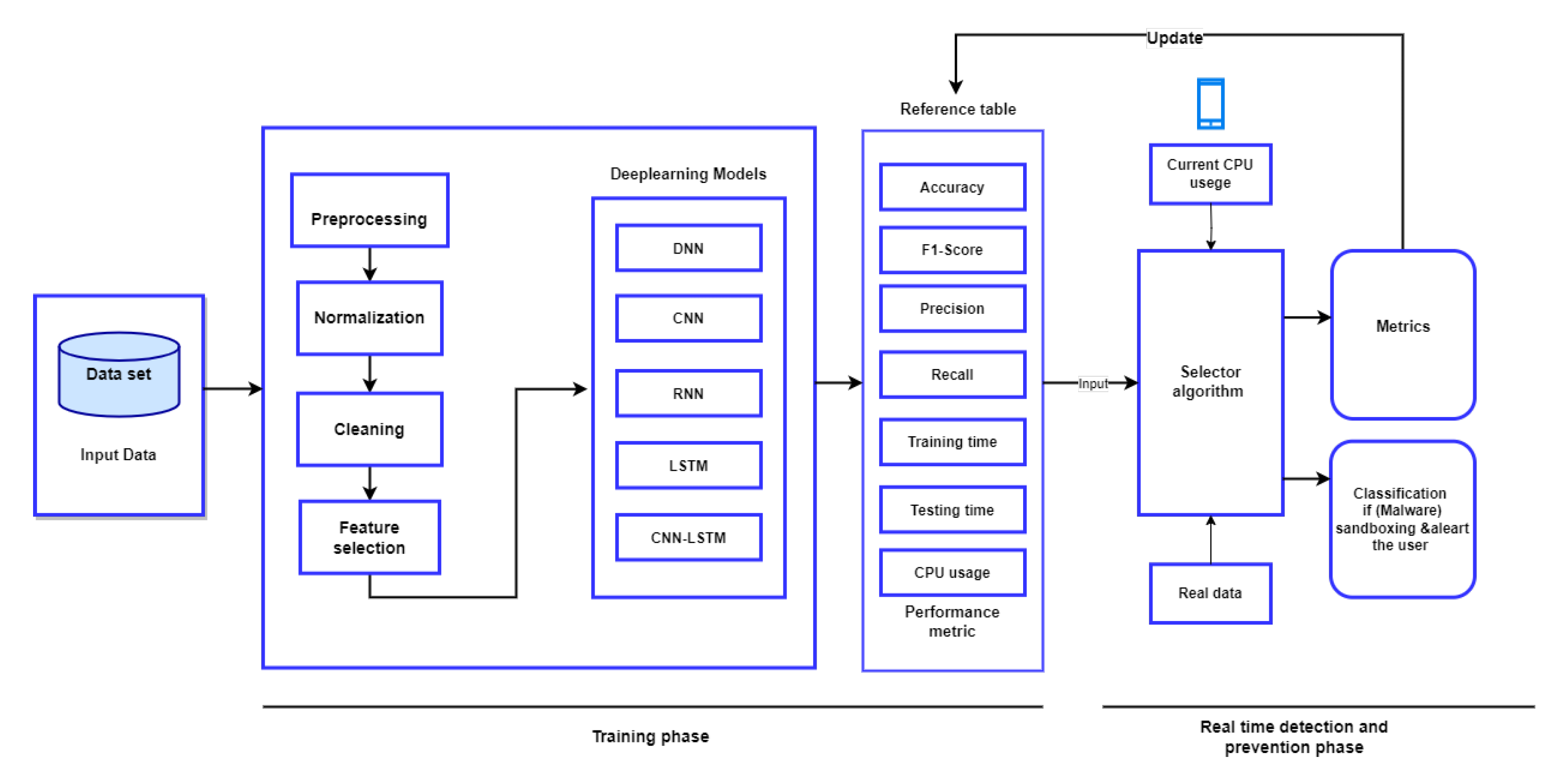
Mobile devices are frequent targets of malware due to the large volume of sensitive personal, financial, and corporate data they process. Traditional static, dynamic, and hybrid analysis methods are increasingly insufficient against evolving threats. This paper proposes a resilient deep learning framework for Android malware detection, integrating multiple models and a CPU-aware selection algorithm to balance accuracy and efficiency on mobile devices. Two benchmark datasets (i.e., the Android Malware Dataset for Machine Learning and CIC-InvesAndMal2019) were used to evaluate five deep learning models: DNN, CNN, RNN, LSTM, and CNN-LSTM. The results show that CNN-LSTM achieves the highest detection accuracy of 97.4% on CIC-InvesAndMal2019, while CNN delivers strong accuracy of 98.07%, with the lowest CPU usage (5.2%) on the Android Dataset, making it the most practical for on-device deployment. The framework is implemented as an Android application using TensorFlow Lite, providing near-real-time malware detection with an inference time of under 150 ms and memory usage below 50 MB. These findings confirm the effectiveness of deep learning for mobile malware detection and demonstrate the feasibility of deploying resilient detection systems on resource-constrained devices.
Keywords: mobile malware; deep learning; indicators of compromise; malware detection; android security mobile malware; deep learning; indicators of compromise; malware detection; android security