Influence of Chronobiology on the Nanoparticle-Mediated Drug Uptake into the Brain
Abstract
1. Introduction
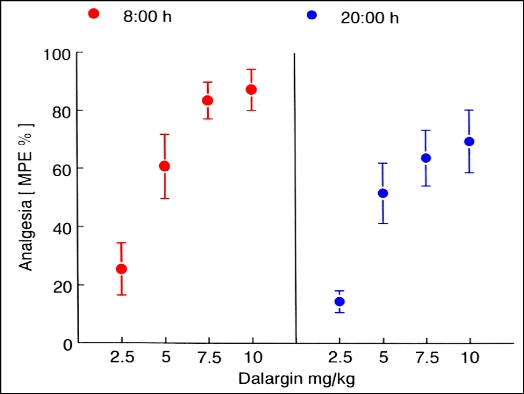
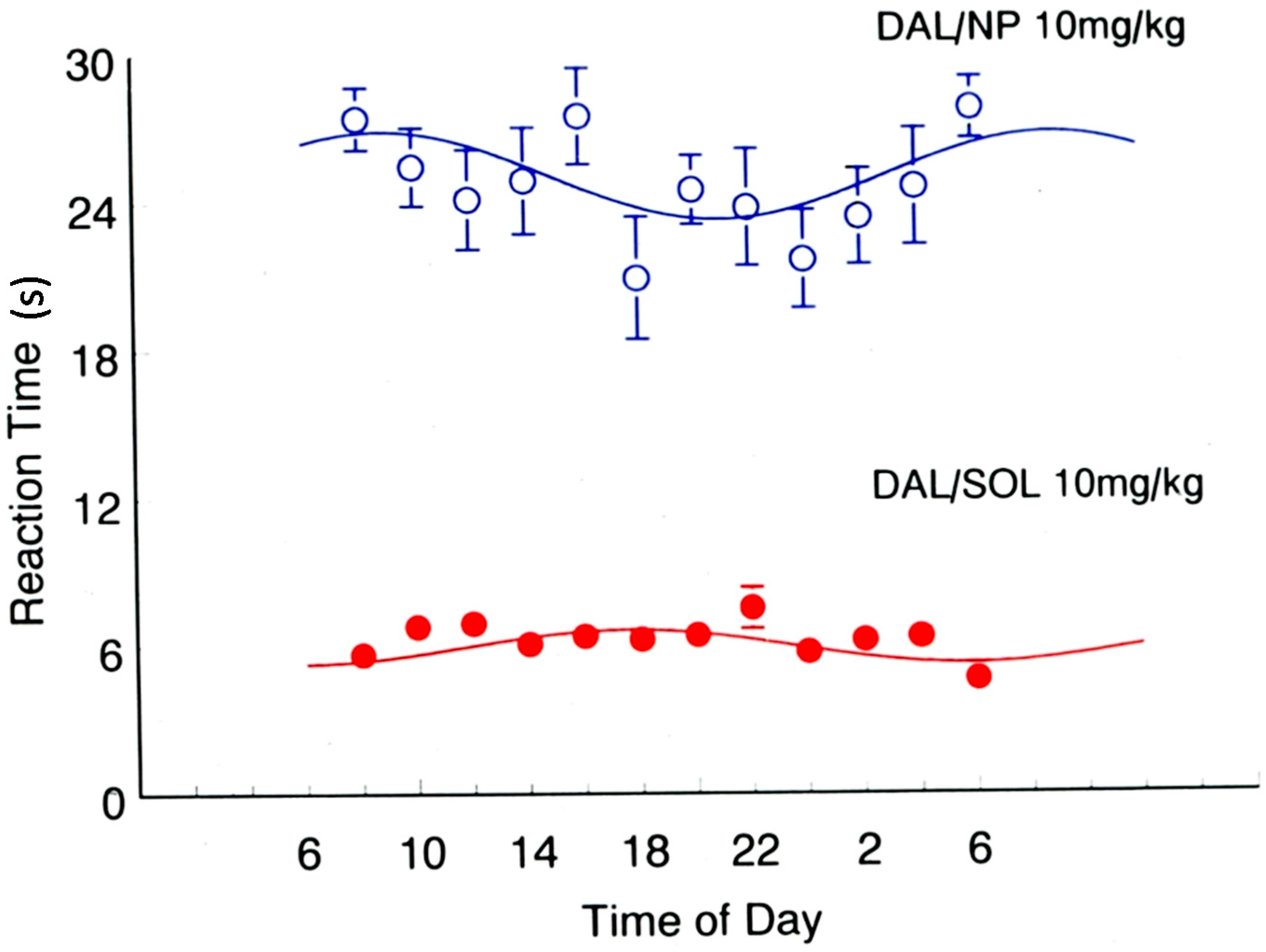
2. Circadian Influence on the Pharmacological Activity of an Analgesic Hexapeptide Delivered by Nanoparticles across the Blood–Brain Barrier
3. Conclusions
Conflicts of Interest
References
- Davson, H.; Segal, M. Physiology of the CSF and Blood–Brain Barrier; CRC Press: Boca Raton, FL, USA, 1996. [Google Scholar]
- Begley, D.J. The blood-brain barrier: Principles for targeting peptides and drugs to the central nervous system. J. Pharm. Pharmacol. 1996, 48, 136–146. [Google Scholar] [CrossRef] [PubMed]
- Begley, D.J. Delivery of therapeutic agents to the central nervous system: The problems and possibilities. Pharmacol. Ther. 2004, 104, 29–45. [Google Scholar] [CrossRef] [PubMed]
- Kreuter, J. Drug delivery to the central nervous system by polymeric nanoparticles: What do we know? Adv. Drug Deliv. Rev. 2014, 71, 2–14. [Google Scholar] [CrossRef] [PubMed]
- Wohlfart, S.; Gelperina, S.; Kreuter, J. Transport of drugs across the blood-brain barrier by nanoparticles. J. Control. Release 2012, 161, 264–273. [Google Scholar] [CrossRef] [PubMed]
- Kreuter, J. Mechanism of polymeric nanoparticle-based drug transport across the blood-brain barrier (BBB). J. Microencapsul. 2013, 30, 49–54. [Google Scholar] [CrossRef] [PubMed]
- Zensi, A.; Begley, D.; Pontikis, C.; Legros, C.; Mihoreanu, L.; Wagner, S.; Büchel, C.; von Briesen, H.; Kreuter, J. Albumin nanoparticles targeted with Apo E enter the CNS by transcytosis and are delivered to neurones. J. Control. Release 2009, 137, 78–86. [Google Scholar] [CrossRef] [PubMed]
- Kreuter, J.; Petrov, V.E.; Kharkevich, D.A.; Alyautdin, R.N. Influence of the type of surfactant on the analgesic effects induced by the peptide dalargin after its delivery across the blood-brain barrier using surfactant-coated nanoparticles. J. Control. Release 1997, 49, 81–87. [Google Scholar] [CrossRef]
- Petri, B.; Bootz, A.; Khalansky, A.; Hekmatara, T.; Müller, R.; Uhl, R.; Kreuter, J.; Gelperina, S. Chemotherapy of brain tumour using doxorubicin bound to surfactant-coated poly(butyl cyanoacrylate) nano-particles: Revisiting the role of surfactants. J. Control. Release 2007, 117, 51–58. [Google Scholar] [CrossRef] [PubMed]
- Kreuter, J.; Hekmatara, T.; Dreis, S.; Vogel, T.; Gelperina, S.; Langer, K. Covalent attachment of apolipoprotein A-I and apolipoprotein B-100 to albumin nanoparticles enables drug transport into the brain. J. Control. Release 2007, 118, 54–58. [Google Scholar] [CrossRef] [PubMed]
- Ulbrich, K.; Hekmatara, T.; Herbert, E.; Kreuter, J. Transferrin- and transferrin-receptor-antibody-modified nanoparticles enable drug delivery across the blood-brain barrier (BBB). Eur. J. Pharm. Biopharm. 2009, 71, 251–256. [Google Scholar] [CrossRef] [PubMed]
- Ulbrich, K.; Knobloch, T.; Kreuter, J. Targeting the insulin receptor: Nanoparticles for drug delivery across the blood-brain barrier (BBB). J. Drug Target. 2011, 19, 125–132. [Google Scholar] [CrossRef] [PubMed]
- Ramge, P.; Kreuter, J.; Lemmer, B. Circadian phase-dependent antinociceptive reaction in mice after i. v. injection of dalargin-loaded nanoparticles determined by the hot-plate test and the tail-flick test. Chronobiol. Int. 1999, 17, 767–777. [Google Scholar]
- Lemmer, B. Chronobiology, drug-delivery, and chronotherapeutics. Adv. Drug Deliv. Rev. 2007, 59, 825–827. [Google Scholar] [CrossRef] [PubMed]
- Lemmer, B. Discoveries of rhythms in human biological functions: A historical review. Chronobiol. Int. 2009, 26, 1019–1068. [Google Scholar] [CrossRef] [PubMed]
- Lemmer, B. The importance of circadian rhythms on drug response in hypertension and coronary heart disease—From mice and man. Pharmacol. Ther. 2006, 111, 629–651. [Google Scholar] [CrossRef] [PubMed]
- Reppert, S.M.; Weaver, D.R. Coordination of circadian timing in mammals. Nature 2002, 418, 935–941. [Google Scholar] [CrossRef] [PubMed]
- Hastings, M.H.; Herzog, E.D. Clock genes, oscillators, and cellular networks in the suprachiasmatic nuclei. J. Biol. Rhythm. 2004, 19, 400–413. [Google Scholar] [CrossRef]
- Dallmann, R.; Brown, S.A.; Gachon, F. Chronopharmacology: New Insights and therapeutic implications. Ann. Rev. Pharmacol. Toxicol. 2014, 54, 339–361. [Google Scholar] [CrossRef]
- Lemmer, B. Chronopharmacology and controlled drug release. Exp. Opin. Drug Deliv. 2005, 2, 667–681. [Google Scholar] [CrossRef]
- Labrecque, G.; Reinberg, A.E. Chronopharmacology of nonsteroid anti-inflammatory drugs. In Chronopharmacology-Cellular and Biochemical Interactions; Lemmer, B., Ed.; Marcel Dekker: New York, NY, USA, 1989; pp. 545–579. [Google Scholar]
- Labrecque, G.; Karzazi, M.; Vanier, M.-C. Biological rhythms in pain and analgesia. In Physiology and Pharmacology of Biological Rhythms. Handbook of Experimental Pharmacology; Redfern, P., Lemmer, B., Eds.; Springer: Heidelberg, Germany, 1997; Volume 125, pp. 619–649. [Google Scholar]
- Naber, D.; Wirz-Justice, A.; Kafka, M.S. Circadian rhythm in rat brain opiate receptor. Neurosci. Lett. 1981, 21, 45–50. [Google Scholar] [CrossRef] [PubMed]
- Frederickson, R.C.A.; Burgis, V.; Edwards, J.D. Hyperalgesia induced by naloxone follows diurnal rhythm in responsivity to painful stimuli. Science 1977, 198, 756–758. [Google Scholar] [CrossRef] [PubMed]
- Pencheva, N.; Pospišek, J.; Hauzerova, L.; Barth, T.; Milanov, P. Activity profiles of dalargin and its analogues in μ-, δ- and κ-opioid receptor selective bioassays. Br. J. Pharmacol. 1999, 128, 569–576. [Google Scholar] [CrossRef]
- Kreuter, J.; Alyautdin, R.N.; Kharkevich, D.A.; Ivanov, A.A. Passage of peptides through the blood-brain barrier with colloidal polymer particles (nanoparticles). Brain Res. 1995, 674, 171–174. [Google Scholar] [CrossRef] [PubMed]
- Alyautdin, R.; Gothier, D.; Petrov, V.; Kharkevich, D.; Kreuter, J. Analgesic activity of the hexapeptide dalargin adsorbed on the surface of polysorbate 80-coated poly(butyl cyanoacrylate) nanoparticles. Eur. J. Pharm. Biopharm. 1995, 41, 44–48. [Google Scholar]
- Lück, M. Plasmaproteinadsorption als möglicher Schlüsselfaktor für eine kontrollierte Arzneistoffapplikation mit partikulären Trägern. Ph.D. Thesis, Freie Universität, Berlin, Germany, 1997; pp. 14–24, 137–154. [Google Scholar]
- Kreuter, J.; Shamenkov, D.; Petrov, V.; Ramge, P.; Cychutek, K.; Koch-Brandt, C.; Alyautdin, R. Apolipoprotein-mediated transport of nanoparticle-bound drugs across the blood-brain barrier. J. Drug Target. 2002, 10, 317–325. [Google Scholar] [CrossRef] [PubMed]
- Wagner, S.; Zensi, A.; Wien, S.L.; Tschickardt, S.E.; Maier, W.; Vogel, T.; Worek, F.; Pietrzik, C.U.; Kreuter, J.; von Briesen, H. Uptake mechanism of apoE-modified nanoparticles on brain capillary endothelial cells as a blood-brain barrier model. PLoS One 2012, 7, e32568. [Google Scholar] [CrossRef] [PubMed]
- Endo, Y.; Jinnai, K.; Endo, M.; Fujita, K.; Kimura, F. Diurnal variation of cerebral blood flow in rat hippocampus. Stroke 1990, 21, 1464–1469. [Google Scholar] [CrossRef] [PubMed]
- Engelhardt, B.; Wolburg, H. Mini review: Transendothelial migration of leukocytes: Through the front door or around the side of the house? Eur. J. Immunol. 2004, 34, 2955–2963. [Google Scholar] [CrossRef] [PubMed]
© 2015 by the authors; licensee MDPI, Basel, Switzerland. This article is an open access article distributed under the terms and conditions of the Creative Commons Attribution license (http://creativecommons.org/licenses/by/4.0/).
Share and Cite
Kreuter, J. Influence of Chronobiology on the Nanoparticle-Mediated Drug Uptake into the Brain. Pharmaceutics 2015, 7, 3-9. https://doi.org/10.3390/pharmaceutics7010003
Kreuter J. Influence of Chronobiology on the Nanoparticle-Mediated Drug Uptake into the Brain. Pharmaceutics. 2015; 7(1):3-9. https://doi.org/10.3390/pharmaceutics7010003
Chicago/Turabian StyleKreuter, Jörg. 2015. "Influence of Chronobiology on the Nanoparticle-Mediated Drug Uptake into the Brain" Pharmaceutics 7, no. 1: 3-9. https://doi.org/10.3390/pharmaceutics7010003
APA StyleKreuter, J. (2015). Influence of Chronobiology on the Nanoparticle-Mediated Drug Uptake into the Brain. Pharmaceutics, 7(1), 3-9. https://doi.org/10.3390/pharmaceutics7010003