This is an early access version, the complete PDF, HTML, and XML versions will be available soon.
Open AccessReview
Advancing MSC-EV Therapies: Harnessing Preconditioning and Mito-EVs to Tackle Neuroinflammation and Neurodegeneration
by
Eva Costanzi
 Eva Costanzi
Luca Fontana
 Luca Fontana
Francesca Giroldo
Francesca Giroldo
Silvia Coco
Silvia Coco 
1
School of Medicine and Surgery, University of Milano-Bicocca, 20900 Monza, Italy
2
Ph.D. Program in Neuroscience, School of Medicine and Surgery, University of Milano-Bicocca, 20900 Monza, Italy
*
Authors to whom correspondence should be addressed.
†
These authors contributed equally to this work.
Pharmaceutics 2026, 18(6), 730; https://doi.org/10.3390/pharmaceutics18060730 (registering DOI)
Submission received: 7 May 2026
/
Revised: 5 June 2026
/
Accepted: 8 June 2026
/
Published: 12 June 2026
Abstract
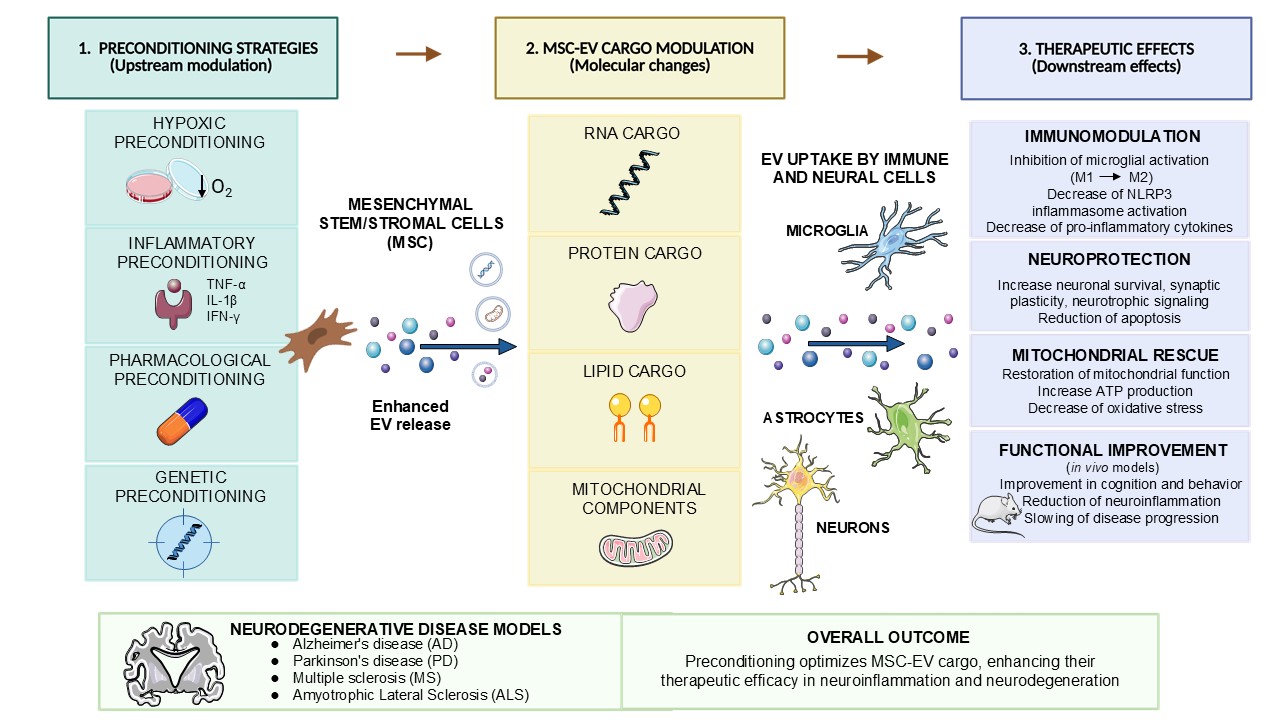
Neuroinflammation plays a central role in the onset and progression of neurodegenerative disorders. Several disease-modifying therapies have been developed to target neuroinflammatory pathways in specific disorders. However, their ability to stop disease progression or restore neuronal and mitochondrial homeostasis remains limited. This is still a major unmet clinical need. In this context, mesenchymal stromal cell (MSC)-derived Extracellular Vesicles (EVs) have emerged as a promising cell-free therapeutic strategy due to their ability to modulate immune responses and promote neuroprotection through the delivery of bioactive cargo. Recent evidence has identified a distinct subset of EVs, known as mitochondrial EVs (mito-EVs), which carry mitochondrial DNA, proteins, and functional components. These vesicles may uniquely influence cellular bioenergetics, redox balance, and neuroinflammatory signaling, offering additional therapeutic potential compared to conventional MSC-EVs. This review summarizes the role of MSC-derived EVs in neuroinflammatory disorders, with a particular focus on mito-EVs. It also discusses preconditioning strategies to enhance EV efficacy, including hypoxic, inflammatory, pharmacological priming and genetic engineering approaches. Finally, we critically evaluate current preclinical evidence regarding the treatment of major neurodegenerative disorders, including Alzheimer’s disease, Parkinson’s disease, Multiple Sclerosis, and Amyotrophic Lateral Sclerosis, as well as Traumatic Injury, highlighting the key challenges for clinical translation.
Share and Cite
MDPI and ACS Style
Costanzi, E.; Fontana, L.; Giroldo, F.; Coco, S.
Advancing MSC-EV Therapies: Harnessing Preconditioning and Mito-EVs to Tackle Neuroinflammation and Neurodegeneration. Pharmaceutics 2026, 18, 730.
https://doi.org/10.3390/pharmaceutics18060730
AMA Style
Costanzi E, Fontana L, Giroldo F, Coco S.
Advancing MSC-EV Therapies: Harnessing Preconditioning and Mito-EVs to Tackle Neuroinflammation and Neurodegeneration. Pharmaceutics. 2026; 18(6):730.
https://doi.org/10.3390/pharmaceutics18060730
Chicago/Turabian Style
Costanzi, Eva, Luca Fontana, Francesca Giroldo, and Silvia Coco.
2026. "Advancing MSC-EV Therapies: Harnessing Preconditioning and Mito-EVs to Tackle Neuroinflammation and Neurodegeneration" Pharmaceutics 18, no. 6: 730.
https://doi.org/10.3390/pharmaceutics18060730
APA Style
Costanzi, E., Fontana, L., Giroldo, F., & Coco, S.
(2026). Advancing MSC-EV Therapies: Harnessing Preconditioning and Mito-EVs to Tackle Neuroinflammation and Neurodegeneration. Pharmaceutics, 18(6), 730.
https://doi.org/10.3390/pharmaceutics18060730
Note that from the first issue of 2016, this journal uses article numbers instead of page numbers. See further details
here.
Article Metrics
Article Access Statistics
For more information on the journal statistics, click
here.
Multiple requests from the same IP address are counted as one view.