
Development and Evaluation of “a PEGylated Anti-Tau ScFv for SPECT Imaging” in a Rat Model of Traumatic Brain Injury

 , ,
, ,
Abstract
1. Introduction
2. Methods and Materials
2.1. Materials
2.2. Immunofluorescence Staining of Rat Brain Sections
2.3. Pegylation of Scfv
2.4. Sds-Page Analysis
2.5. Binding Assay
2.6. Radiolabeling Methods
2.6.1. Preparation of [99mTc(H2O)3(CO)3] + Precursor
2.6.2. Radiolabeling of Scfv with [99mTc(H2O)3(CO)3]+ Precursor
2.7. Stability Study
2.7.1. Stability in Saline
2.7.2. Stability in Human Serum
2.8. Estimation of Logp
2.9. In Vivo Study
2.9.1. Animal Model
2.9.2. In Vivo Spect Imaging
2.9.3. Biodistribution Studies
2.10. Statistical Analysis
3. Results and Discussion
3.1. Pegylation of Scfv and Sds-Page Analysis
3.2. Radiolabeling with Technetium Tricarbonyl
3.3. In Vitro Stability Studies
3.4. Logp Analysis
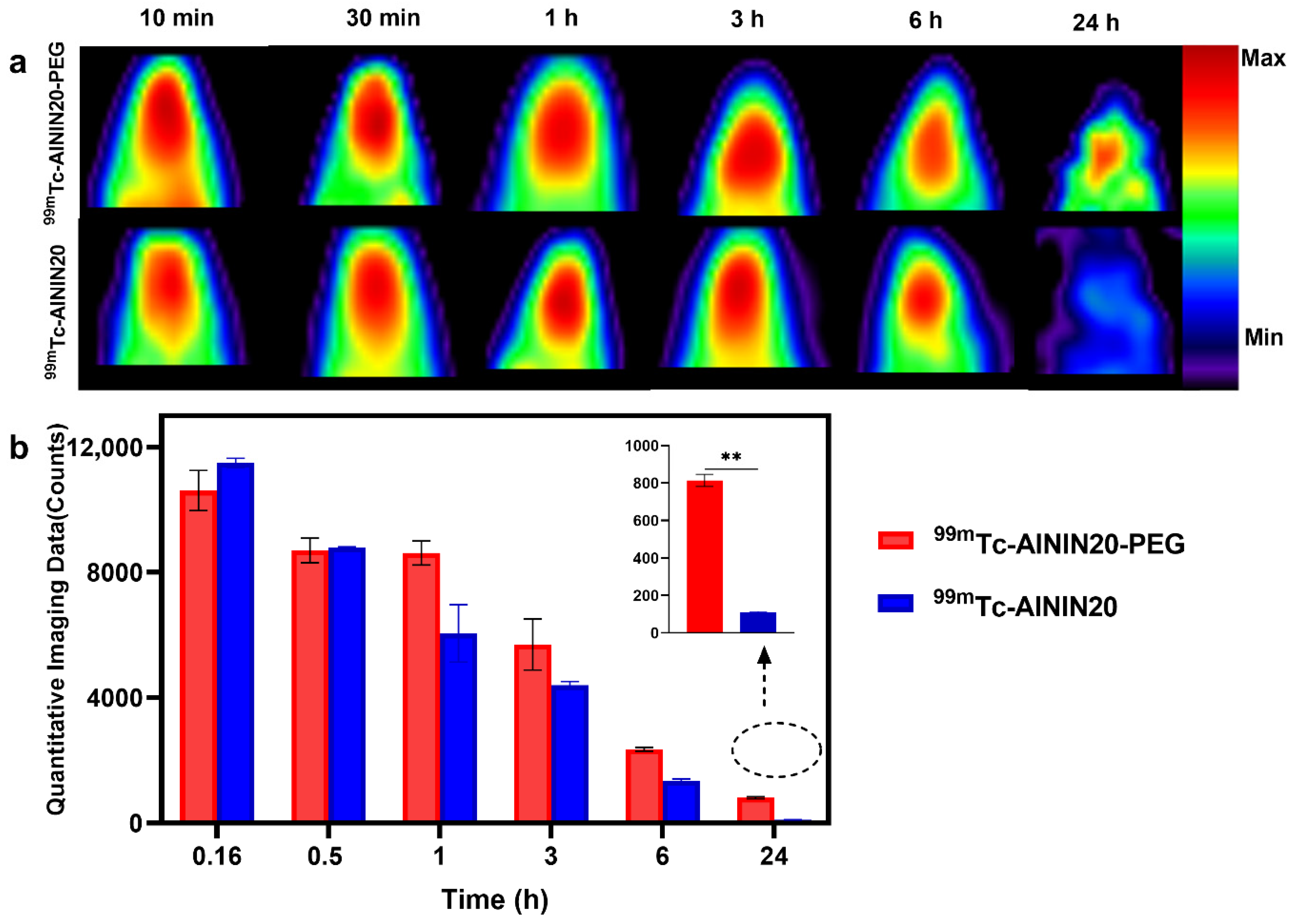
3.5. Spect Imaging
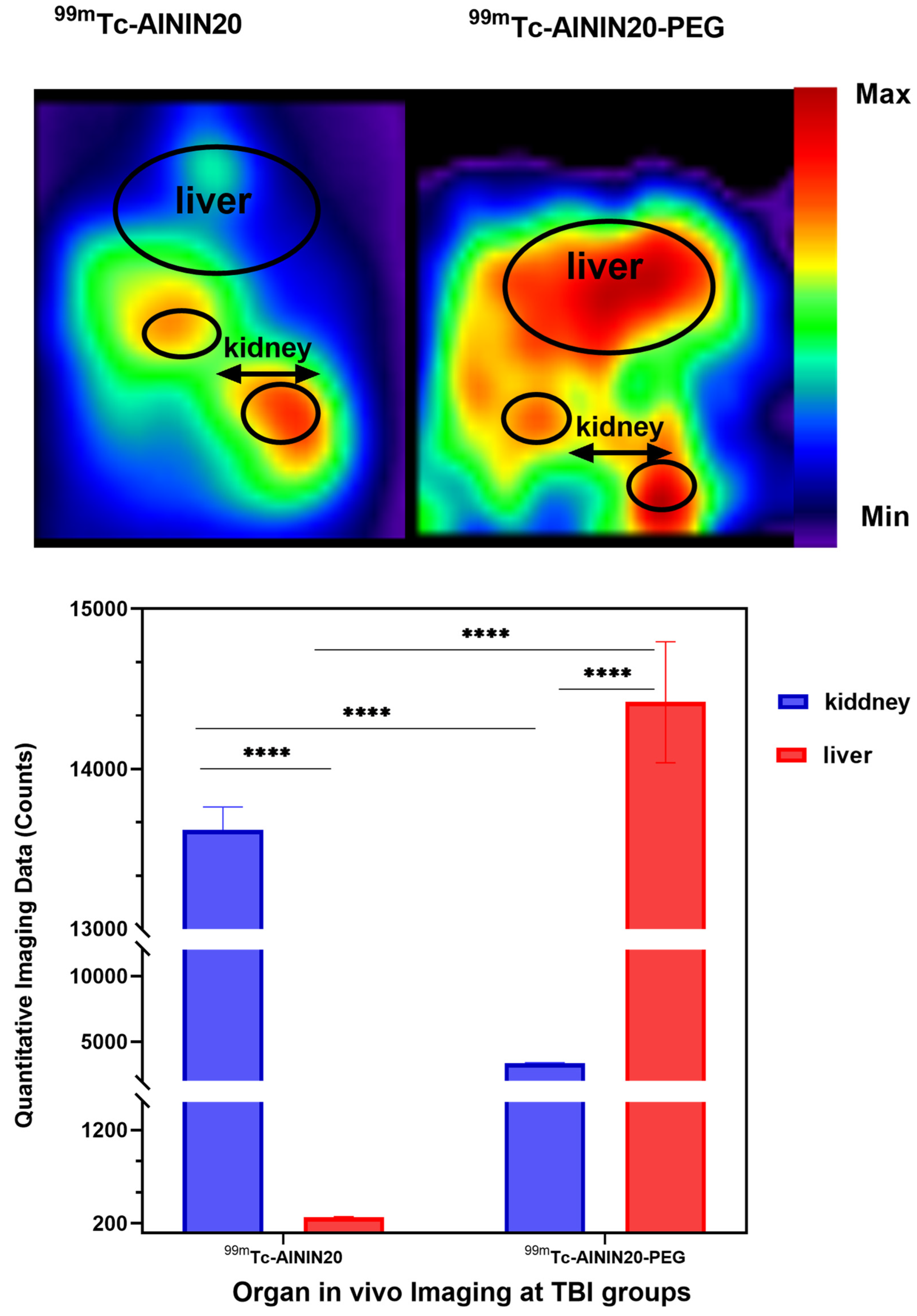
3.6. In Vivo and Ex Vivo Biodistribution
4. Conclusions
Supplementary Materials
Author Contributions
Funding
Institutional Review Board Statement
Informed Consent Statement
Data Availability Statement
Acknowledgments
Conflicts of Interest
References
- Loane, D.J.; Pocivavsek, A.; Moussa, C.E.; Thompson, R.; Matsuoka, Y.; Faden, A.I.; Rebeck, G.W.; Burns, M.P. Amyloid precursor protein secretases as therapeutic targets for traumatic brain injury. Nat. Med. 2009, 15, 377–379. [Google Scholar] [CrossRef] [PubMed]
- Cross, D.J.; Meabon, J.S.; Cline, M.M.; Richards, T.L.; Stump, A.J.; Cross, C.G.; Minoshima, S.; Banks, W.A.; Cook, D.G. Paclitaxel Reduces Brain Injury from Repeated Head Trauma in Mice. J. Alzheimers Dis. 2019, 67, 859–874. [Google Scholar] [CrossRef]
- Keating, C.E.; Cullen, D.K. Mechanosensation in traumatic brain injury. Neurobiol. Dis. 2021, 148, 105210. [Google Scholar] [CrossRef]
- Maas, A.I.; Menon, D.K.; Manley, G.T.; Abrams, M.; Åkerlund, C.; Andelic, N.; Aries, M.; Bashford, T.; Bell, M.J.; Bodien, Y.D. Traumatic brain injury: Progress and challenges in prevention, clinical care, and research. Lancet Neurol. 2022, 21, 1004–1060. [Google Scholar] [CrossRef] [PubMed]
- Injury, G. Global, regional, and national burden of traumatic brain injury and spinal cord injury, 1990–2016: A systematic analysis for the Global Burden of Disease Study 2016. Lancet Neurol. 2019, 18, 56–87. [Google Scholar] [CrossRef] [PubMed]
- Lennon, M.J.; Brooker, H.; Creese, B.; Thayanandan, T.; Rigney, G.; Aarsland, D.; Hampshire, A.; Ballard, C.; Corbett, A.; Raymont, V. Lifetime traumatic brain injury and cognitive domain deficits in late life: The PROTECT-TBI cohort study. J. Neurotrauma 2023, 40, 1423–1435. [Google Scholar] [CrossRef]
- Andelic, N.; Howe, E.I.; Hellstrøm, T.; Sanchez, M.F.; Lu, J.; Løvstad, M.; Røe, C. Disability and quality of life 20 years after traumatic brain injury. Brain Behav. 2018, 8, e01018. [Google Scholar] [CrossRef]
- Xu, X.-J.; Yang, M.-S.; Zhang, B.; Niu, F.; Dong, J.-Q.; Liu, B.-Y. Glucose metabolism: A link between traumatic brain injury and Alzheimer’s disease. Chin. J. Traumatol. 2021, 24, 5–10. [Google Scholar] [CrossRef]
- Sivanandam, T.M.; Thakur, M.K. Traumatic brain injury: A risk factor for Alzheimer’s disease. Neurosci. Biobehav. Rev. 2012, 36, 1376–1381. [Google Scholar] [CrossRef]
- Martin, L.; Latypova, X.; Terro, F. Post-translational modifications of tau protein: Implications for Alzheimer’s disease. Neurochem. Int. 2011, 58, 458–471. [Google Scholar] [CrossRef]
- Gaikwad, S.; Puangmalai, N.; Bittar, A.; Montalbano, M.; Garcia, S.; McAllen, S.; Bhatt, N.; Sonawane, M.; Sengupta, U.; Kayed, R. Tau oligomer induced HMGB1 release contributes to cellular senescence and neuropathology linked to Alzheimer’s disease and frontotemporal dementia. Cell Rep. 2021, 36, 109419. [Google Scholar] [CrossRef]
- Smith, D.H.; Johnson, V.E.; Stewart, W. Chronic neuropathologies of single and repetitive TBI: Substrates of dementia? Nat. Rev. Neurol. 2013, 9, 211–221. [Google Scholar] [CrossRef]
- Chauhan, N.B. Chronic neurodegenerative consequences of traumatic brain injury. Restor. Neurol. Neurosci. 2014, 32, 337–365. [Google Scholar] [CrossRef]
- Yang, W.J.; Chen, W.; Chen, L.; Guo, Y.J.; Zeng, J.S.; Li, G.Y.; Tong, W.S. Involvement of tau phosphorylation in traumatic brain injury patients. Acta Neurol. Scand. 2017, 135, 622–627. [Google Scholar] [CrossRef]
- Katsumoto, A.; Takeuchi, H.; Tanaka, F. Tau Pathology in Chronic Traumatic Encephalopathy and Alzheimer’s Disease: Similarities and Differences. Front. Neurol. 2019, 10, 980. [Google Scholar] [CrossRef]
- Wang, Y.; Mandelkow, E. Tau in physiology and pathology. Nat. Rev. Neurosci. 2016, 17, 5–21. [Google Scholar] [CrossRef] [PubMed]
- Stern, R.A.; Riley, D.O.; Daneshvar, D.H.; Nowinski, C.J.; Cantu, R.C.; McKee, A.C. Long-term consequences of repetitive brain trauma: Chronic traumatic encephalopathy. PmR 2011, 3, S460–S467. [Google Scholar] [CrossRef] [PubMed]
- Albayram, O.; Kondo, A.; Mannix, R.; Smith, C.; Tsai, C.-Y.; Li, C.; Herbert, M.K.; Qiu, J.; Monuteaux, M.; Driver, J. Cis P-tau is induced in clinical and preclinical brain injury and contributes to post-injury sequelae. Nat. Commun. 2017, 8, 1000. [Google Scholar] [CrossRef] [PubMed]
- Hampel, H.; Blennow, K.; Shaw, L.M.; Hoessler, Y.C.; Zetterberg, H.; Trojanowski, J.Q. Total and phosphorylated tau protein as biological markers of Alzheimer’s disease. Exp. Gerontol. 2010, 45, 30–40. [Google Scholar] [CrossRef]
- Lasagna-Reeves, C.A.; Castillo-Carranza, D.L.; Sengupta, U.; Sarmiento, J.; Troncoso, J.; Jackson, G.R.; Kayed, R. Identification of oligomers at early stages of tau aggregation in Alzheimer’s disease. FASEB J. 2012, 26, 1946. [Google Scholar] [CrossRef]
- Wang, M.-L.; Li, W.-B. Cognitive impairment after traumatic brain injury: The role of MRI and possible pathological basis. J. Neurol. Sci. 2016, 370, 244–250. [Google Scholar] [CrossRef] [PubMed]
- Narayana, P.A.; Yu, X.; Hasan, K.M.; Wilde, E.A.; Levin, H.S.; Hunter, J.V.; Miller, E.R.; Patel, V.K.S.; Robertson, C.S.; McCarthy, J.J. Multi-modal MRI of mild traumatic brain injury. NeuroImage Clin. 2015, 7, 87–97. [Google Scholar] [CrossRef]
- Lesman-Segev, O.H.; La Joie, R.; Stephens, M.L.; Sonni, I.; Tsai, R.; Bourakova, V.; Visani, A.V.; Edwards, L.; O’Neil, J.P.; Baker, S.L. Tau PET and multimodal brain imaging in patients at risk for chronic traumatic encephalopathy. NeuroImage Clin. 2019, 24, 102025. [Google Scholar] [CrossRef] [PubMed]
- Mantyh, W.G.; Spina, S.; Lee, A.; Iaccarino, L.; Soleimani-Meigooni, D.; Tsoy, E.; Mellinger, T.J.; Grant, H.; Vandevrede, L.; La Joie, R. Tau positron emission tomographic findings in a former US football player with pathologically confirmed chronic traumatic encephalopathy. JAMA Neurol. 2020, 77, 517–521. [Google Scholar] [CrossRef]
- Chételat, G.; Arbizu, J.; Barthel, H.; Garibotto, V.; Law, I.; Morbelli, S.; Van de Giessen, E.; Agosta, F.; Barkhof, F.; Brooks, D.J. Amyloid-PET and 18F-FDG-PET in the diagnostic investigation of Alzheimer’s disease and other dementias. Lancet Neurol. 2020, 19, 951–962. [Google Scholar] [CrossRef]
- Nedd, K.; Sfakianakis, G.; Ganz, W.; Uricchio, B.; Vernberg, D.; Villanueva, P.; Jabir, A.M.; Bartlett, J.; Keena, J. 99mTc-HMPAO SPECT of the brain in mild to moderate traumatic brain injury patients: Compared with CT—A prospective study. Brain Inj. 1993, 7, 469–479. [Google Scholar] [CrossRef] [PubMed]
- Lin, A.; Liao, H.; Merugumala, S.; Prabhu, S.; Meehan, W.; Ross, B. Metabolic imaging of mild traumatic brain injury. Brain Imaging Behav. 2012, 6, 208–223. [Google Scholar] [CrossRef]
- McGoron, A.J.; Capille, M.; Georgiou, M.F.; Sanchez, P.; Solano, J.; Gonzalez-Brito, M.; Kuluz, J.W. Post traumatic brain perfusion SPECT analysis using reconstructed ROI maps of radioactive microsphere derived cerebral blood flow and statistical parametric mapping. BMC Med. Imaging 2008, 8, 4. [Google Scholar] [CrossRef]
- Bullich, S.; Seibyl, J.; Catafau, A.M.; Jovalekic, A.; Koglin, N.; Barthel, H.; Sabri, O.; De Santi, S. Optimized classification of 18F-Florbetaben PET scans as positive and negative using an SUVR quantitative approach and comparison to visual assessment. NeuroImage Clin. 2017, 15, 325–332. [Google Scholar] [CrossRef]
- Ertveldt, T.; Meulewaeter, S.; De Vlaeminck, Y.; Olarte, O.; Broos, K.; Van Calenbergh, S.; Bourgeois, S.; Deprez, J.; Heremans, Y.; Goyvaerts, C. Nanobody-mediated SPECT/CT imaging reveals the spatiotemporal expression of programmed death-ligand 1 in response to a CD8+ T cell and iNKT cell activating mRNA vaccine. Theranostics 2023, 13, 5483. [Google Scholar] [CrossRef]
- Bridoux, J.; Broos, K.; Lecocq, Q.; Debie, P.; Martin, C.; Ballet, S.; Raes, G.; Neyt, S.; Vanhove, C.; Breckpot, K. Anti-human PD-L1 nanobody for immuno-PET imaging: Validation of a conjugation strategy for clinical translation. Biomolecules 2020, 10, 1388. [Google Scholar] [CrossRef]
- Jain, M.; Batra, S.K. Genetically engineered antibody fragments and PET imaging: A new era of radioimmunodiagnosis. J. Nucl. Med. 2003, 44, 1970–1972. [Google Scholar]
- Papagiannopoulou, D. Technetium-99m radiochemistry for pharmaceutical applications. J. Label. Compd. Radiopharm. 2017, 60, 502–520. [Google Scholar] [CrossRef]
- Zou, X.; Yuan, M.; Zhang, T.; Wei, H.; Xu, S.; Jiang, N.; Zheng, N.; Wu, Z. Extracellular vesicles expressing a single-chain variable fragment of an HIV-1 specific antibody selectively target Env+ tissues. Theranostics 2019, 9, 5657. [Google Scholar] [CrossRef]
- Rashidian, M.; Ploegh, H. Nanobodies as non-invasive imaging tools. Immuno-Oncol. Technol. 2020, 7, 2–14. [Google Scholar] [CrossRef] [PubMed]
- Sharif-Paghaleh, E.; Yap, M.L.; Puhl, S.-L.; Badar, A.; Torres, J.B.; Chuamsaamarkkee, K.; Florian, S.; Richard, A.C.; James, B.; Philip, J. Non-Invasive whole-body detection of complement activation using radionuclide imaging in a mouse model of myocardial ischaemia-reperfusion injury. Sci. Rep. 2017, 7, 16090. [Google Scholar] [CrossRef]
- Freise, A.C.; Wu, A.M. In vivo imaging with antibodies and engineered fragments. Mol. Immunol. 2015, 67, 142–152. [Google Scholar] [CrossRef] [PubMed]
- Monnier, P.P.; Vigouroux, R.J.; Tassew, N.G. In vivo applications of single chain Fv (variable domain)(scFv) fragments. Antibodies 2013, 2, 193–208. [Google Scholar] [CrossRef]
- Stork, R.; Zettlitz, K.A.; Muller, D.; Rether, M.; Hanisch, F.-G.; Kontermann, R.E. N-glycosylation as novel strategy to improve pharmacokinetic properties of bispecific single-chain diabodies. J. Biol. Chem. 2008, 283, 7804–7812. [Google Scholar] [CrossRef]
- Veronese, F.M.; Mero, A. The impact of PEGylation on biological therapies. BioDrugs 2008, 22, 315–329. [Google Scholar] [CrossRef]
- Santos, J.H.P.M.; Torres-Obreque, K.M.; Meneguetti, G.P.; Amaro, B.P.; Rangel-Yagui, C.O. Protein PEGylation for the design of biobetters: From reaction to purification processes. Braz. J. Pharm. Sci. 2018, 54, e01009. [Google Scholar] [CrossRef]
- Pfister, D.; Morbidelli, M. Process for protein PEGylation. J. Control. Release 2014, 180, 134–149. [Google Scholar] [CrossRef]
- Rotman, M.; Welling, M.M.; Bunschoten, A.; de Backer, M.E.; Rip, J.; Nabuurs, R.J.; Gaillard, P.J.; van Buchem, M.A.; van Buchem, M.A.; van der Maarel, S.M. Enhanced glutathione PEGylated liposomal brain delivery of an anti-amyloid single domain antibody fragment in a mouse model for Alzheimer’s disease. J. Control. Release 2015, 203, 40–50. [Google Scholar] [CrossRef]
- Hamidi, M.; Azadi, A.; Rafiei, P. Pharmacokinetic consequences of pegylation. Drug Deliv. 2006, 13, 399–409. [Google Scholar] [CrossRef] [PubMed]
- Yang, K.; Basu, A.; Wang, M.; Chintala, R.; Hsieh, M.C.; Liu, S.; Hua, J.; Zhang, Z.; Zhou, J.; Li, M. Tailoring structure-function and pharmacokinetic properties of single-chain Fv proteins by site-specific PEGylation. Protein Eng. 2003, 16, 761–770. [Google Scholar] [CrossRef]
- Chapman, A.P. PEGylated antibodies and antibody fragments for improved therapy: A review. Adv. Drug Deliv. Rev. 2002, 54, 531–545. [Google Scholar] [CrossRef] [PubMed]
- Natarajan, A.; Xiong, C.-Y.; Albrecht, H.; DeNardo, G.L.; DeNardo, S.J. Characterization of site-specific ScFv PEGylation for tumor-targeting pharmaceuticals. Bioconjugate Chem. 2005, 16, 113–121. [Google Scholar] [CrossRef]
- Gogola, A.; Minhas, D.S.; Villemagne, V.L.; Cohen, A.D.; Mountz, J.M.; Pascoal, T.A.; Laymon, C.M.; Mason, N.S.; Ikonomovic, M.D.; Mathis, C.A. Direct comparison of the tau PET tracers 18F-flortaucipir and 18F-MK-6240 in human subjects. J. Nucl. Med. 2022, 63, 108–116. [Google Scholar] [CrossRef]
- Kotari, V.; Southekal, S.; Navitsky, M.; Kennedy, I.A.; Lu, M.; Morris, A.; Zimmer, J.A.; Fleisher, A.S.; Mintun, M.A.; Devous, M.D., Sr. Early tau detection in flortaucipir images: Validation in autopsy-confirmed data and implications for disease progression. Alzheimer’s Res. Ther. 2023, 15, 41. [Google Scholar] [CrossRef]
- Beyer, L.; Brendel, M. (Eds.) Imaging of tau pathology in neurodegenerative diseases: An update. In Seminars in Nuclear Medicine; Elsevier: Amsterdam, The Netherlands, 2021. [Google Scholar]
- Groot, C.; Villeneuve, S.; Smith, R.; Hansson, O.; Ossenkoppele, R. Tau PET imaging in neurodegenerative disorders. J. Nucl. Med. 2022, 63, 20S–60S. [Google Scholar] [CrossRef] [PubMed]
- Ye, J.; Wan, H.; Chen, S.; Liu, G.-P. Targeting tau in Alzheimer’s disease: From mechanisms to clinical therapy. Neural Regen. Res. 2024, 19, 1489–1498. [Google Scholar] [CrossRef]
- Ogasawara, K.; Ogawa, A.; Ezura, M.; Konno, H.; Suzuki, M.; Yoshimoto, T. Brain single-photon emission CT studies using 99mTc-HMPAO and 99mTc-ECD early after recanalization by local intraarterial thrombolysis in patients with acute embolic middle cerebral artery occlusion. Am. J. Neuroradiol. 2001, 22, 48–53. [Google Scholar]
- Koyama, M.; Kawashima, R.; Ito, H.; Ono, S.; Sato, K.; Goto, R.; Kinomura, S.; Yoshioka, S.; Sato, T.; Fukuda, H. SPECT imaging of normal subjects with technetium-99m-HMPAO and technetium-99m-ECD. J. Nucl. Med. 1997, 38, 587–592. [Google Scholar]
- Donnemiller, E.; Heilmann, J.; Wenning, G.K.; Berger, W.; Decristoforo, C.; Moncayo, R.; Poewe, W.; Ransmayr, G. Brain perfusion scintigraphy with 99m Tc-HMPAO or 99m Tc-ECD and 123 I-β-CIT single-photon emission tomography in dementia of the Alzheimer-type and diffuse Lewy body disease. Eur. J. Nucl. Med. 1997, 24, 320–325. [Google Scholar] [CrossRef]
- Mauro, L.; Manuela, M.; Valentina, M.; Sara, C.; Chondrogiannis, S.; Maria, D.F. Role of brain perfusion SPECT with 99mTc HMPAO in the assessment of response to drug therapy in patients with autoimmune vasculitis: A prospective study. North. Am. J. Med. Sci. 2015, 7, 135. [Google Scholar] [CrossRef]
- Congdon, E.E.; Ji, C.; Tetlow, A.M.; Jiang, Y.; Sigurdsson, E.M. Tau-targeting therapies for Alzheimer disease: Current status and future directions. Nat. Rev. Neurol. 2023, 19, 715–736. [Google Scholar] [CrossRef]
- Shahpasand, K. Conformation-Independent Antibodies Against Neurotoxic Tau Proteins. U.S. Patent 10,570,195, 25 February 2020. [Google Scholar]
- Reichard, E.E.; Nanaware-Kharade, N.; Gonzalez, G.A.; Thakkar, S.; Owens, S.M.; Peterson, E.C. PEGylation of a high-affinity anti-(+) methamphetamine single chain antibody fragment extends functional half-life by reducing clearance. Pharm. Res. 2016, 33, 2954–2966. [Google Scholar] [CrossRef]
- Abbasi, S.; Farahani, H.; Lanjanian, H.; Taheri, M.; Firoozpour, L.; Davoodi, J.; Pirkalkhoran, S.; Riazi, G.; Pooyan, S. Site Directed Disulfide PEGylation of Interferon-β-1b with Fork Peptide Linker. Bioconjug Chem. 2020, 31, 708–720. [Google Scholar] [CrossRef]
- Guichard, M.J.; Patil, H.P.; Koussoroplis, S.J.; Wattiez, R.; Leal, T.; Vanbever, R. Production and characterization of a PEGylated derivative of recombinant human deoxyribonuclease I for cystic fibrosis therapy. Int. J. Pharm. 2017, 524, 159–167. [Google Scholar] [CrossRef]
- Alberto, R.; Schibli, R.; Egli, A.; Schubiger, A.P.; Abram, U.; Kaden, T.A. A novel organometallic aqua complex of technetium for the labeling of biomolecules: Synthesis of [99mTc (OH2) 3 (CO) 3]+ from [99mTcO4]-in aqueous solution and its reaction with a bifunctional ligand. J. Am. Chem. Soc. 1998, 120, 7987–7988. [Google Scholar] [CrossRef]
- Schibli, R.; La Bella, R.; Alberto, R.; Garcia-Garayoa, E.; Ortner, K.; Abram, U.; Schubiger, P.A. Influence of the denticity of ligand systems on the in vitro and in vivo behavior of 99mTc (I)− tricarbonyl complexes: A hint for the future functionalization of biomolecules. Bioconjugate Chem. 2000, 11, 345–351. [Google Scholar] [CrossRef]
- Badar, A.; Williams, J.; de Rosales, R.T.; Tavare, R.; Kampmeier, F.; Blower, P.J.; Mullen, G.E. Optimising the radiolabelling properties of technetium tricarbonyl and His-tagged proteins. EJNMMI Res. 2014, 4, 14. [Google Scholar] [CrossRef] [PubMed]
- Kampmeier, F.; Williams, J.D.; Maher, J.; Mullen, G.E.; Blower, P.J. Design and preclinical evaluation of a 99m Tc-labelled diabody of mAb J591 for SPECT imaging of prostate-specific membrane antigen (PSMA). Ejnmmi Res. 2014, 4, 13. [Google Scholar] [CrossRef]
- Badar, A.; DeFreitas, S.; McDonnell, J.M.; Yahya, N.; Thakor, D.; Razavi, R.; Smith, R.; Sacks, S.; Mullen, G.E.D. Recombinant complement receptor 2 radiolabeled with [99mTc (CO)3]+: A potential new radiopharmaceutical for imaging activated complement. PLoS ONE 2011, 6, e18275. [Google Scholar] [CrossRef] [PubMed]
- Xavier, C.; Devoogdt, N.; Hernot, S.; Vaneycken, I.; D’Huyvetter, M.; De Vos, J.; Massa, S.; Lahoutte, T.; Caveliers, V. Site-specific labeling of His-tagged Nanobodies with 99m Tc: A practical guide. In Single Domain Antibodies: Methods and Protocols; Humana Press: Totowa, NJ, USA, 2012; pp. 485–490. [Google Scholar]
- Jokar, S.; Behnammanesh, H.; Erfani, M.; Sharifzadeh, M.; Gholami, M.; Sabzevari, O.; Amini, M.; Geramifar, P.; Hajiramezanali, M.; Beiki, D. Synthesis, biological evaluation and preclinical study of a novel 99mTc-peptide: A targeting probe of amyloid-β plaques as a possible diagnostic agent for Alzheimer’s disease. Bioorganic Chem. 2020, 99, 103857. [Google Scholar] [CrossRef] [PubMed]
- Maresca, K.P.; Marquis, J.C.; Hillier, S.M.; Lu, G.; Femia, F.J.; Zimmerman, C.N.; Eckelman, W.C.; Joyal, J.L.; Babich, J.W. Novel polar single amino acid chelates for technetium-99m tricarbonyl-based radiopharmaceuticals with enhanced renal clearance: Application to octreotide. Bioconjugate Chem. 2010, 21, 1032–1042. [Google Scholar] [CrossRef] [PubMed]
- Amorini, A.M.; Lazzarino, G.; Di Pietro, V.; Signoretti, S.; Lazzarino, G.; Belli, A.; Tavazzi, B. Metabolic, enzymatic and gene involvement in cerebral glucose dysmetabolism after traumatic brain injury. Biochim. Et. Biophys. Acta (BBA) -Mol. Basis Dis. 2016, 1862, 679–687. [Google Scholar] [CrossRef]
- Di Pietro, V.; Lazzarino, G.; Amorini, A.M.; Tavazzi, B.; D’Urso, S.; Longo, S.; Vagnozzi, R.; Signoretti, S.; Clementi, E.; Giardina, B. Neuroglobin expression and oxidant/antioxidant balance after graded traumatic brain injury in the rat. Free Radic. Biol. Med. 2014, 69, 258–264. [Google Scholar] [CrossRef]
- Kondo, A.; Shahpasand, K.; Mannix, R.; Qiu, J.; Moncaster, J.; Chen, C.H.; Yao, Y.; Lin, Y.M.; Driver, J.A.; Sun, Y.; et al. Antibody against early driver of neurodegeneration cis P-tau blocks brain injury and tauopathy. Nature 2015, 523, 431–436. [Google Scholar] [CrossRef]
- Alipour, M.; Tebianian, M.; Tofigh, N.; Taheri, R.S.; Mousavi, S.A.; Naseri, A.; Ahmadi, A.; Munawar, N.; Shahpasand, K. Active immunotherapy against pathogenic Cis pT231-tau suppresses neurodegeneration in traumatic brain injury mouse models. Neuropeptides 2022, 96, 102285. [Google Scholar] [CrossRef]
- Tofigh, N.; Agahi, S.; Riazi, G.; Ghalamkar Moazzam, M.; Shahpasand, K. A Novel Phosphorylated Tau Conformer Implicated in the Tauopathy Pathogenesis of Human Neurons. Biomolecules 2025, 15, 585. [Google Scholar] [CrossRef]
- Zhang, D.; Zhuang, R.; Guo, Z.; Gao, M.; Huang, L.; You, L.; Zhang, P.; Li, J.; Su, X.; Wu, H. Desmin-and vimentin-mediated hepatic stellate cell-targeting radiotracer 99mTc-GlcNAc-PEI for liver fibrosis imaging with SPECT. Theranostics 2018, 8, 1340. [Google Scholar] [CrossRef] [PubMed]
- Chen, Y.; Yu, Y. Tau and neuroinflammation in Alzheimer’s disease: Interplay mechanisms and clinical translation. J. Neuroinflamm. 2023, 20, 165. [Google Scholar] [CrossRef]
- Pan, H.; Liu, J.; Deng, W.; Xing, J.; Li, Q.; Wang, Z. Site-specific PEGylation of an anti-CEA/CD3 bispecific antibody improves its antitumor efficacy. Int. J. Nanomed. 2018, 13, 3189–3201. [Google Scholar] [CrossRef]
- Pike, V.W. PET radiotracers: Crossing the blood–brain barrier and surviving metabolism. Trends Pharmacol. Sci. 2009, 30, 431–440. [Google Scholar] [CrossRef]
- Yoshizuka, K.; Pietzsch, H.-J.; Seifert, S.; Stephan, H. Quantitative structure property relationship of logP for radiopharmaceutical technetium and rhenium complexes by using molecular dynamics calculations. Solvent Extr. Res. Dev. Jpn. 2013, 20, 15–27. [Google Scholar] [CrossRef]
- Erfani, M.; Doroudi, A.; Hadisi, L.; Andishmand, A.; Mirshojaei, S.F.; Shafiei, M. 99mTc-tricabonyl labeling of ofloxacin and its biological evaluation in Staphylococcus aureus as an infection imaging agent. J. Label. Compd. Radiopharm. 2013, 56, 627–631. [Google Scholar] [CrossRef]
- Panayi, N.; Schulz, P.; He, P.; Hanna, B.; Lifshitz, J.; Rowe, R.K.; Sierks, M.R. Traumatic brain injury in mice generates early-stage Alzheimer’s disease related protein pathology that correlates with neurobehavioral deficits. Mol. Neurobiol. 2024, 61, 7567–7582. [Google Scholar] [CrossRef]
- Gao, Y.; Joshi, M.; Zhao, Z.; Mitragotri, S. PEGylated therapeutics in the clinic. Bioeng. Transl. Med. 2024, 9, e10600. [Google Scholar] [CrossRef] [PubMed]
- Ryman, J.T.; Meibohm, B. Pharmacokinetics of monoclonal antibodies. CPT Pharmacomet. Syst. Pharmacol. 2017, 6, 576–588. [Google Scholar] [CrossRef]
- Sehlin, D.; Fang, X.T.; Cato, L.; Antoni, G.; Lannfelt, L.; Syvanen, S. Antibody-based PET imaging of amyloid beta in mouse models of Alzheimer’s disease. Nat. Commun. 2016, 7, 10759. [Google Scholar] [CrossRef] [PubMed]
- Gainkam, L.O.T.; Huang, L.; Caveliers, V.; Keyaerts, M.; Hernot, S.; Vaneycken, I.; Vanhove, C.; Revets, H.; De Baetselier, P.; Lahoutte, T. Comparison of the biodistribution and tumor targeting of two 99mTc-labeled anti-EGFR nanobodies in mice, using pinhole SPECT/micro-CT. J. Nucl. Med. 2008, 49, 788–795. [Google Scholar] [CrossRef] [PubMed]
- Behr, T.M.; Goldenberg, D.M.; Becker, W. Reducing the renal uptake of radiolabeled antibody fragments and peptides for diagnosis and therapy: Present status, future prospects and limitations. Eur. J. Nucl. Med. 1998, 25, 201–212. [Google Scholar] [CrossRef] [PubMed]
- Fishburn, C.S. The pharmacology of PEGylation: Balancing PD with PK to generate novel therapeutics. J. Pharm. Sci. 2008, 97, 4167–4183. [Google Scholar] [CrossRef] [PubMed]



| Organ | Healthy Control (99mTc-AININ20) | TBI + Native Ab (99mTc-AININ20) | TBI + PEG-Ab (99mTc-AININ20-PEG) |
|---|---|---|---|
| Brain | 0.047 ± 0.11 | 1.92 ± 0.27 | 2.12 ± 0.39 |
| Heart | 4.28 ± 0.66 | 3.11 ± 1.615 | 4.51 ± 0.91 |
| Blood | 19.9 ± 0.17 | 22.56 ± 1.19 | 24.63 ± 0.18 |
| Liver | 2.1 ± 1.13 | 1.23 ± 1.47 | 13.36 ± 1.03 |
| Spleen | 6.56 ± 0.6 | 3.803 ± 0.19 | 3.24 ± 0.61 |
| Kidney | 23.09 ± 4.94 | 28.97 ± 1.84 | 15.13 ± 1.78 |
| Stomach | 3.98 ± 3.13 | 4.63 ± 1.2 | 3.49 ± 0.68 |
| Lung | 11.44 ± 2.71 | 12.17 ± 1.143 | 9.28 ± 1.28 |
| Thyroid | 0.34 ± 0.84 | 0.19 ± 0.19 | 0.22 ± 0.125 |
| Intestine | 7.98 ± 0.74 | 16.52 ± 0.74 | 13.97 ± 0.47 |
| Bladder | 13.57 ± 0.95 | 14.03 ± 0.93 | 8.96 ± 0.61 |
Disclaimer/Publisher’s Note: The statements, opinions and data contained in all publications are solely those of the individual author(s) and contributor(s) and not of MDPI and/or the editor(s). MDPI and/or the editor(s) disclaim responsibility for any injury to people or property resulting from any ideas, methods, instructions or products referred to in the content. |
© 2026 by the authors. Licensee MDPI, Basel, Switzerland. This article is an open access article distributed under the terms and conditions of the Creative Commons Attribution (CC BY) license.
Share and Cite
Sajjadi, E.; Sharif-Paghaleh, E.; Akrami, M.; Shahpasand, K.; Haririan, I.; Maghsoudian, S. Development and Evaluation of “a PEGylated Anti-Tau ScFv for SPECT Imaging” in a Rat Model of Traumatic Brain Injury. Pharmaceutics 2026, 18, 626. https://doi.org/10.3390/pharmaceutics18050626
Sajjadi E, Sharif-Paghaleh E, Akrami M, Shahpasand K, Haririan I, Maghsoudian S. Development and Evaluation of “a PEGylated Anti-Tau ScFv for SPECT Imaging” in a Rat Model of Traumatic Brain Injury. Pharmaceutics. 2026; 18(5):626. https://doi.org/10.3390/pharmaceutics18050626
Chicago/Turabian StyleSajjadi, Esmat, Ehsan Sharif-Paghaleh, Mohammad Akrami, Koorosh Shahpasand, Ismaeil Haririan, and Samane Maghsoudian. 2026. "Development and Evaluation of “a PEGylated Anti-Tau ScFv for SPECT Imaging” in a Rat Model of Traumatic Brain Injury" Pharmaceutics 18, no. 5: 626. https://doi.org/10.3390/pharmaceutics18050626
APA StyleSajjadi, E., Sharif-Paghaleh, E., Akrami, M., Shahpasand, K., Haririan, I., & Maghsoudian, S. (2026). Development and Evaluation of “a PEGylated Anti-Tau ScFv for SPECT Imaging” in a Rat Model of Traumatic Brain Injury. Pharmaceutics, 18(5), 626. https://doi.org/10.3390/pharmaceutics18050626