This is an early access version, the complete PDF, HTML, and XML versions will be available soon.
Open AccessArticle
Assessment of PEG-Asparaginase and Erwinia Asparaginase Activity Under Variable Storage Conditions
by
Søren Aleksander Friederici Dahl
 Søren Aleksander Friederici Dahl
Elke Hoffmann-Lücke
Elke Hoffmann-Lücke  ,
,
Birgitte Klug Albertsen
Birgitte Klug Albertsen
Eva Greibe
Eva Greibe
1
Department of Emergency Medicine, Randers Regional Hospital, 8930 Randers, Denmark
2
Department of Clinical Biochemistry, Aarhus University Hospital, 8200 Aarhus, Denmark
3
Department of Clinical Medicine, Aarhus University, 8200 Aarhus, Denmark
4
Department of Paediatrics and Adolescent Medicine, Aarhus University Hospital, 8200 Aarhus, Denmark
*
Author to whom correspondence should be addressed.
Pharmaceutics 2026, 18(5), 618; https://doi.org/10.3390/pharmaceutics18050618 (registering DOI)
Submission received: 9 March 2026
/
Revised: 1 May 2026
/
Accepted: 13 May 2026
/
Published: 18 May 2026
Abstract
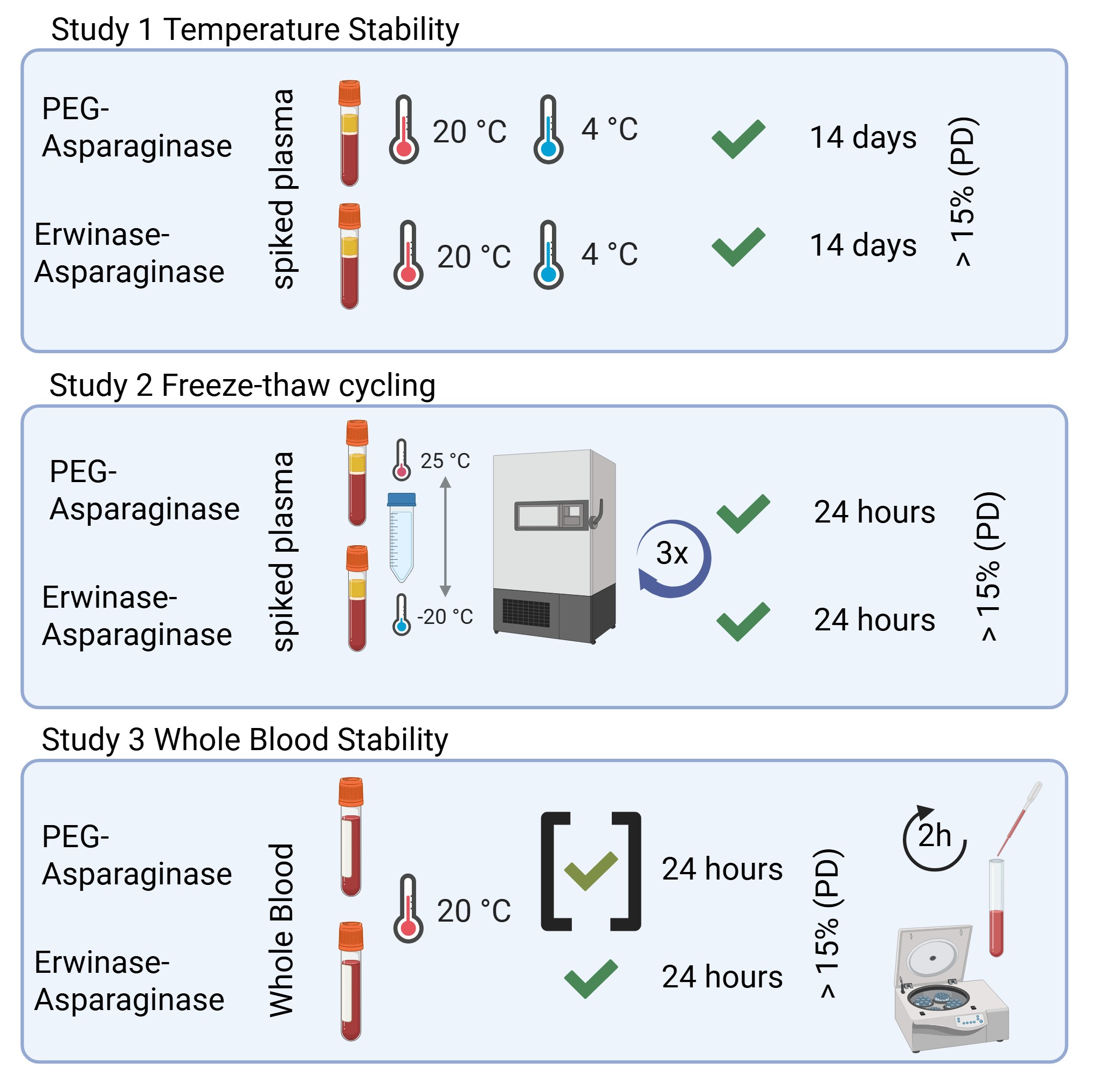
Background: PEG-Asparaginase and Erwinia asparaginase are enzyme-based anticancer therapies used in the treatment of acute lymphoblastic leukaemia (ALL) and lymphoblastic lymphoma (LBL), where adequate plasma enzyme activity is required for therapeutic efficacy. In many study groups, therapeutic drug monitoring is routinely applied due to pharmacokinetic variability and the risk of hypersensitivity reactions followed by increased clearance and insufficient treatment. In clinical practice, samples may be exposed to prolonged transport and variable pre-analytical conditions. Knowledge on pre-analytical stability is important for correct interpretation of PEG-Asparaginase and Erwinia asparaginase activity in plasma. This study aimed to evaluate the in vitro stability of PEG-Asparaginase and Erwinia asparaginase under pre-analytical conditions. Methods: Three experimental stability studies were conducted at two activity levels. Enzyme stability in plasma was assessed during storage at 4 °C and 20 °C for up to 14 days and following three freeze–thaw cycles. Stability in whole blood prior to centrifugation was evaluated over 24 h. Enzyme activity was measured using a validated spectrophotometric assay, and stability was defined as a deviation within ±15% of baseline activity. Results: Both enzymes remained stable in plasma for up to 14 days at 4 °C and 20 °C, and no clinically relevant reduction in enzyme activity of freeze–thaw cycling was observed. In whole blood, Erwinia asparaginase and high-activity PEG-Asparaginase remained stable for 24 h at 20 °C, whereas low-activity PEG-Asparaginase showed a reduction in activity of approximately 22%, mainly within the first two hours. Conclusions: PEG-Asparaginase and Erwinia asparaginase are stable in plasma for up to 14 days at room temperature, enabling shipment of plasma samples by mail. However, prompt centrifugation is recommended for samples with low PEG-Asparaginase activity to ensure accurate therapeutic drug monitoring.
Share and Cite
MDPI and ACS Style
Friederici Dahl, S.A.; Hoffmann-Lücke, E.; Klug Albertsen, B.; Greibe, E.
Assessment of PEG-Asparaginase and Erwinia Asparaginase Activity Under Variable Storage Conditions. Pharmaceutics 2026, 18, 618.
https://doi.org/10.3390/pharmaceutics18050618
AMA Style
Friederici Dahl SA, Hoffmann-Lücke E, Klug Albertsen B, Greibe E.
Assessment of PEG-Asparaginase and Erwinia Asparaginase Activity Under Variable Storage Conditions. Pharmaceutics. 2026; 18(5):618.
https://doi.org/10.3390/pharmaceutics18050618
Chicago/Turabian Style
Friederici Dahl, Søren Aleksander, Elke Hoffmann-Lücke, Birgitte Klug Albertsen, and Eva Greibe.
2026. "Assessment of PEG-Asparaginase and Erwinia Asparaginase Activity Under Variable Storage Conditions" Pharmaceutics 18, no. 5: 618.
https://doi.org/10.3390/pharmaceutics18050618
APA Style
Friederici Dahl, S. A., Hoffmann-Lücke, E., Klug Albertsen, B., & Greibe, E.
(2026). Assessment of PEG-Asparaginase and Erwinia Asparaginase Activity Under Variable Storage Conditions. Pharmaceutics, 18(5), 618.
https://doi.org/10.3390/pharmaceutics18050618
Note that from the first issue of 2016, this journal uses article numbers instead of page numbers. See further details
here.
Article Metrics
Article Access Statistics
For more information on the journal statistics, click
here.
Multiple requests from the same IP address are counted as one view.