Pulmonary Drug Delivery for Infectious Diseases: Cutting-Edge Formulations and Manufacturing Technologies

 , , and
Abstract
1. Introduction
Comparative Limitations of Pulmonary Drug Delivery
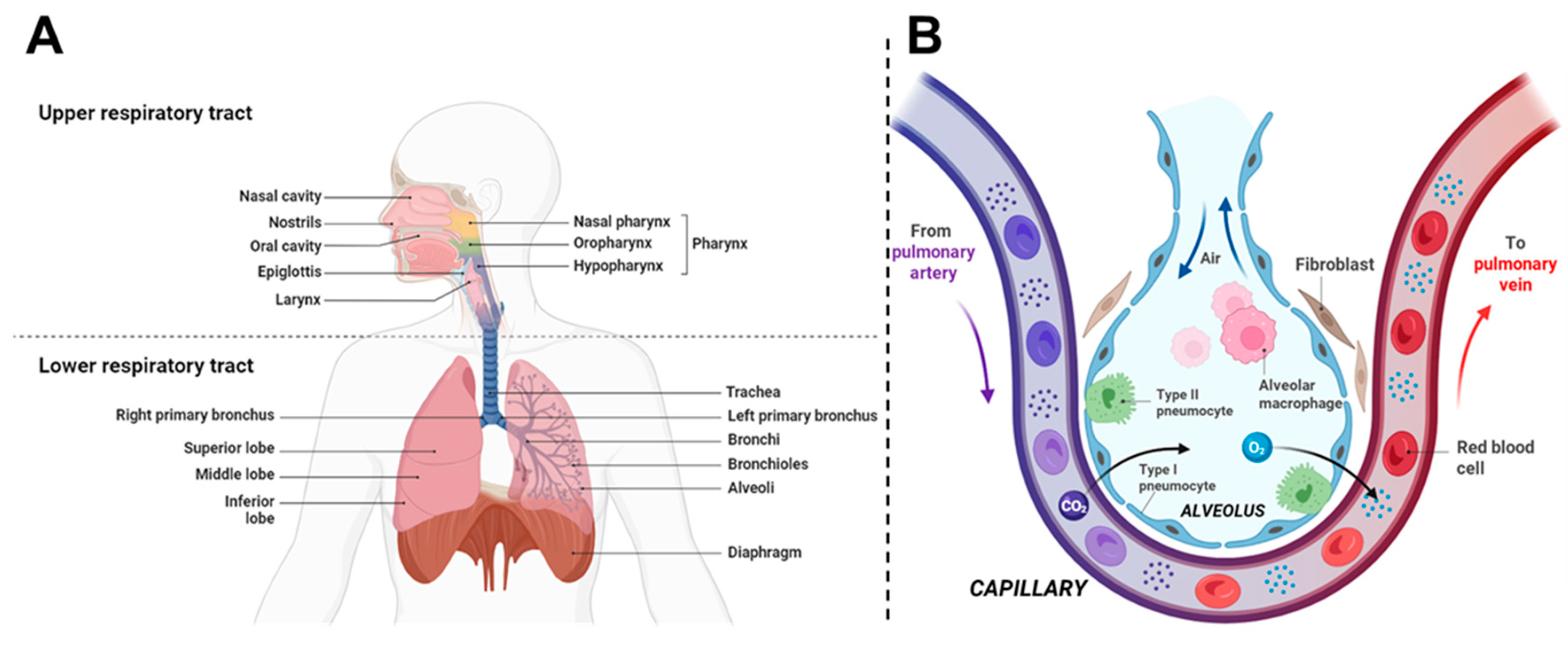
2. Understanding the Physiology of the Respiratory System
3. Progression of Infectious Diseases in the Respiratory Tract
- (1)
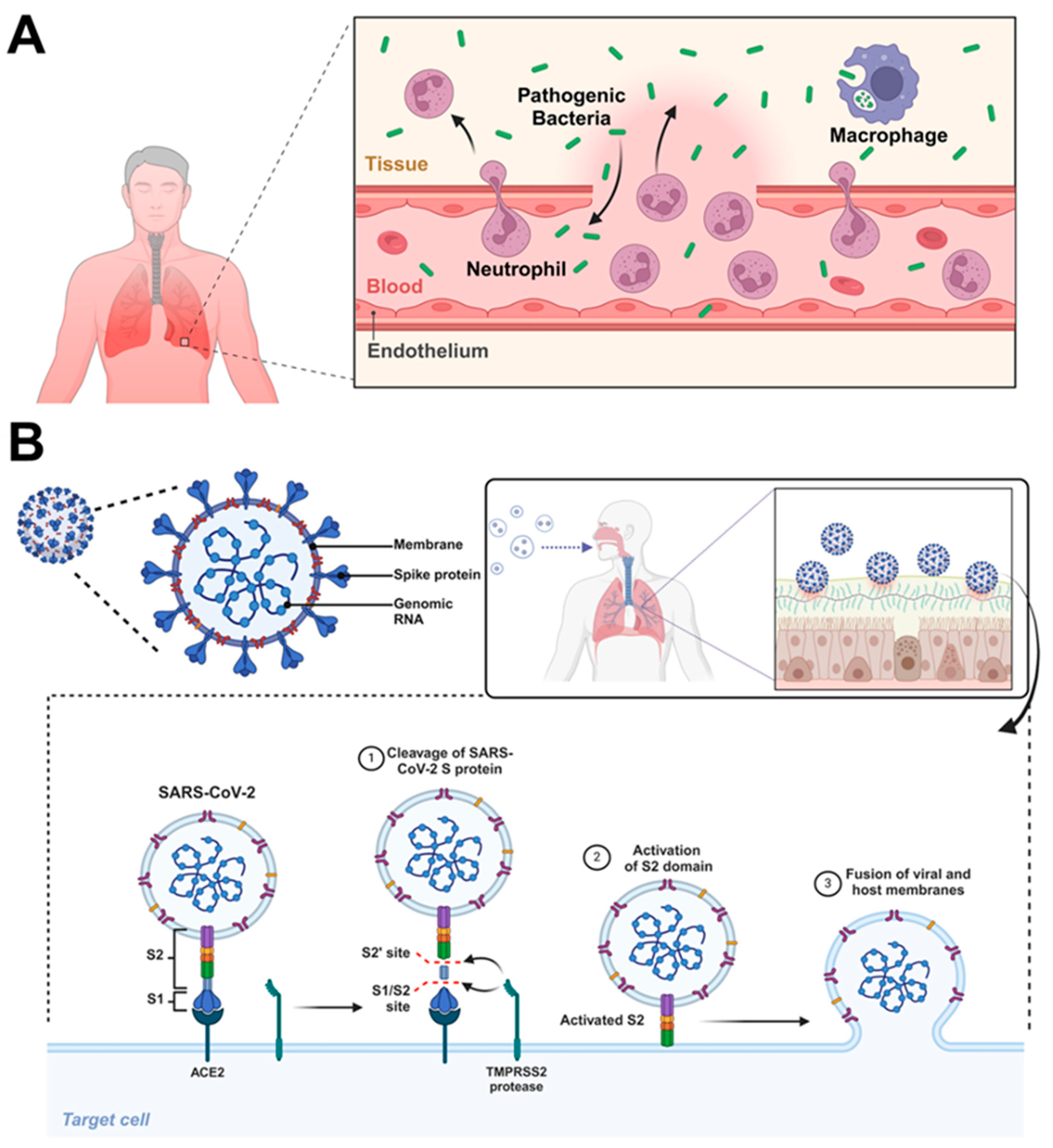
- Pathogen entry and colonization: Pathogens generally enter the respiratory system by inhaling contaminated droplets or particles. The upper respiratory tract, including the nasal passages and pharynx, is often the initial site of colonization. In some cases, pathogens may also reach the respiratory system through hematogenous spread [75].Bacterial Infections: Pneumococcal bacteria, for example, employ specific ligand-receptor interactions to colonize the respiratory tract, invade the lungs, and potentially spread to the bloodstream and brain. This process involves a series of molecular events that can lead to severe disease symptoms if not controlled [76].Viral Infections: Viruses such as the influenza A virus, as well as emerging pathogens such as SARS-CoV-2 and H7N9, have distinct entry mechanisms. These viruses typically target the mucosal surfaces of the respiratory tract to initiate infection. The upper respiratory tract is particularly vulnerable, as it tends to have higher viral loads and faster infection resolution compared to the lower respiratory tract [77,78,79].Fungal Infections: The entry mechanism of fungal pathogens into the respiratory system involves several key steps. Fungal spores or conidia first evade the mucociliary clearance of the upper respiratory tract, reaching the lower airways and alveoli [80,81]. Once in the alveolar spaces, fungal spores can adhere to pulmonary epithelial cells through specific receptor-ligand interactions [82]. In individuals with compromised immune systems or impaired mucosal defenses, the immune response, primarily mediated by alveolar macrophages and neutrophils, may not be sufficient to clear the fungal elements effectively. Consequently, the spores can germinate into more invasive forms, such as hyphae or yeast, enabling penetration of the respiratory epithelial barrier [83]. This process facilitates tissue invasion and triggers localized inflammatory responses, eventually leading to clinical infection [84].
- (2)
- Overcoming Host Defenses: The respiratory system has several innate defense mechanisms to prevent pathogen colonization, including (a) mucociliary clearance which is a mucus layer that traps particles and pathogens and then moved them upward by ciliary action, (b) antimicrobial peptides which are secreted by epithelial cells and possess broad-spectrum antimicrobial activity, and (c) resident alveolar macrophages that can phagocytose and eliminate invading pathogens. For pathogens to establish infection, they must overcome these defenses. This may involve strategies such as inhibition of ciliary function, degradation of antimicrobial peptides, or evading phagocytosis [66].
- (3)
- Adherence and Invasion: The transmission of respiratory pathogens is strongly influenced by fluid dynamics, which govern the encapsulation, emission, and transport of pathogens in respiratory droplets [85]. Pathogens adhere to respiratory epithelial cells using various adhesins that bind to specific receptors on host cells. For example, influenza viruses bind to sialic acid residues, while Streptococcus pneumoniae uses surface proteins to attach to epithelial cells. After adherence, some pathogens may invade the epithelial cells directly or penetrate between them to reach underlying tissues [86]. Understanding these dynamics is essential for assessing transmission risks and developing effective control strategies.
- (4)
- Replication and Spread: After establishing infection, pathogens begin to replicate within the host environment. Viruses hijack host cellular machinery for replication, while bacteria multiply using available nutrients. As the pathogen population grows, the infection can spread locally within the respiratory tract or, in some cases, systemically, affecting other organs or tissues [76].
- (5)
- Tissue Damage and Inflammation: The presence and replication of pathogens stimulate host inflammatory responses, including the release of pro-inflammatory cytokines and chemokines that recruit immune cells to the site of infection. While this response is essential for pathogen clearance, it can also lead to tissue damage. For example, neutrophils release proteases and reactive oxygen species, which not only target pathogens but can also cause harm to host tissues, contributing to inflammation and damage [87].
- (6)
- Resolution or Progression: The outcome of the infection depends on the balance between pathogen virulence and host defense mechanisms. In many cases, the immune response successfully clears the infection, resulting in recovery. However, if the pathogen overcomes host defenses or if the immune response is excessive, the infection may progress, potentially leading to severe conditions such as pneumonia or ARDS [88].
- (7)
- Tissue Repair and Remodeling: After the infection is cleared, the respiratory system undergoes repair and remodeling processes. This involves the proliferation and differentiation of epithelial cells to restore the integrity of the respiratory epithelium. However, in some cases, especially following severe or recurrent infections, this repair process may result in long-term changes to respiratory function, potentially leading to chronic conditions or impairments in lung health [89].
4. Inhalation Devices

5. Particle Engineering
6. Assessment of Pulmonary Deposition

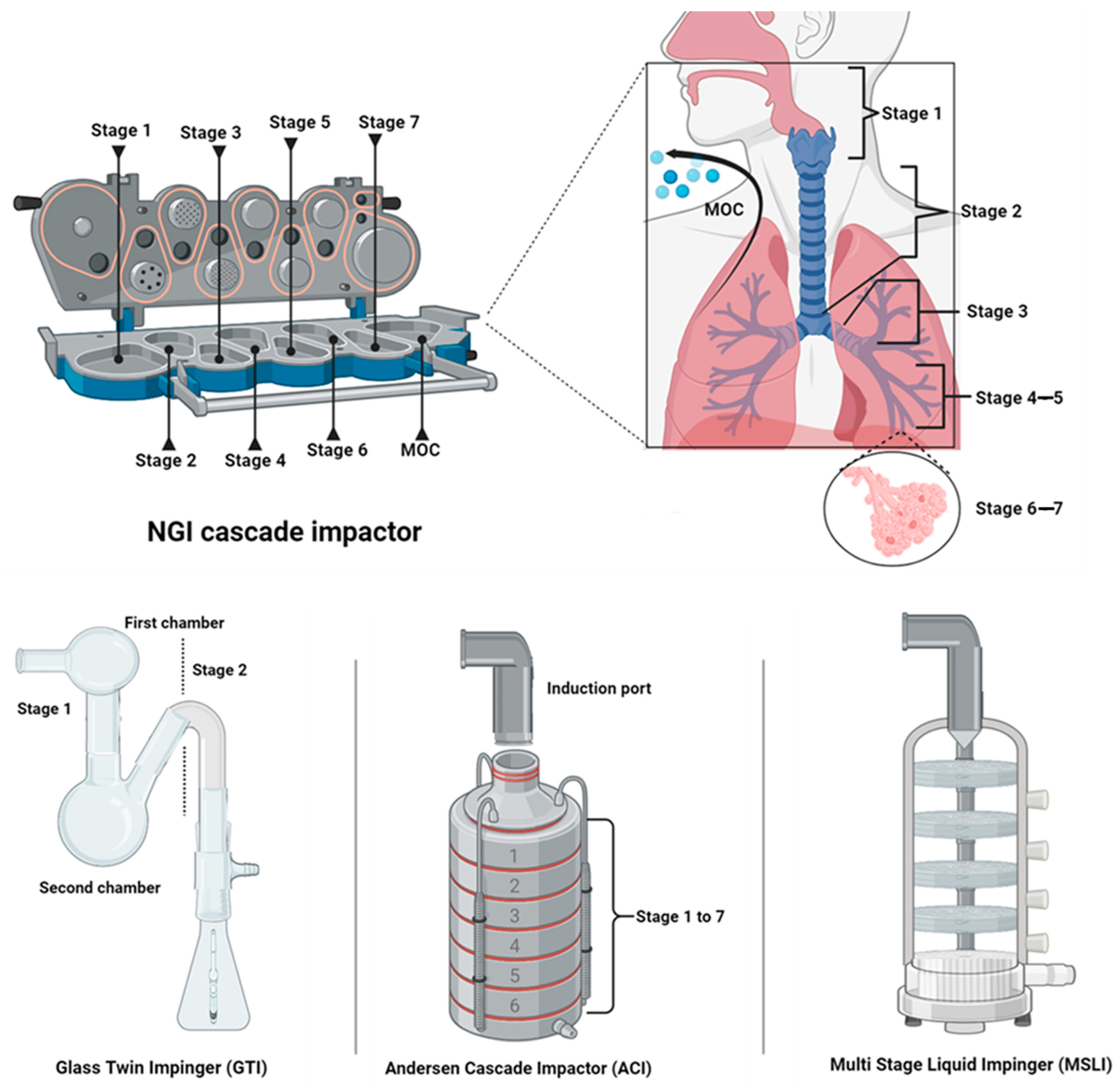
| L/min.Stage of the NGI | Aerodynamic Particle Size Range | Lung Region | Ref |
|---|---|---|---|
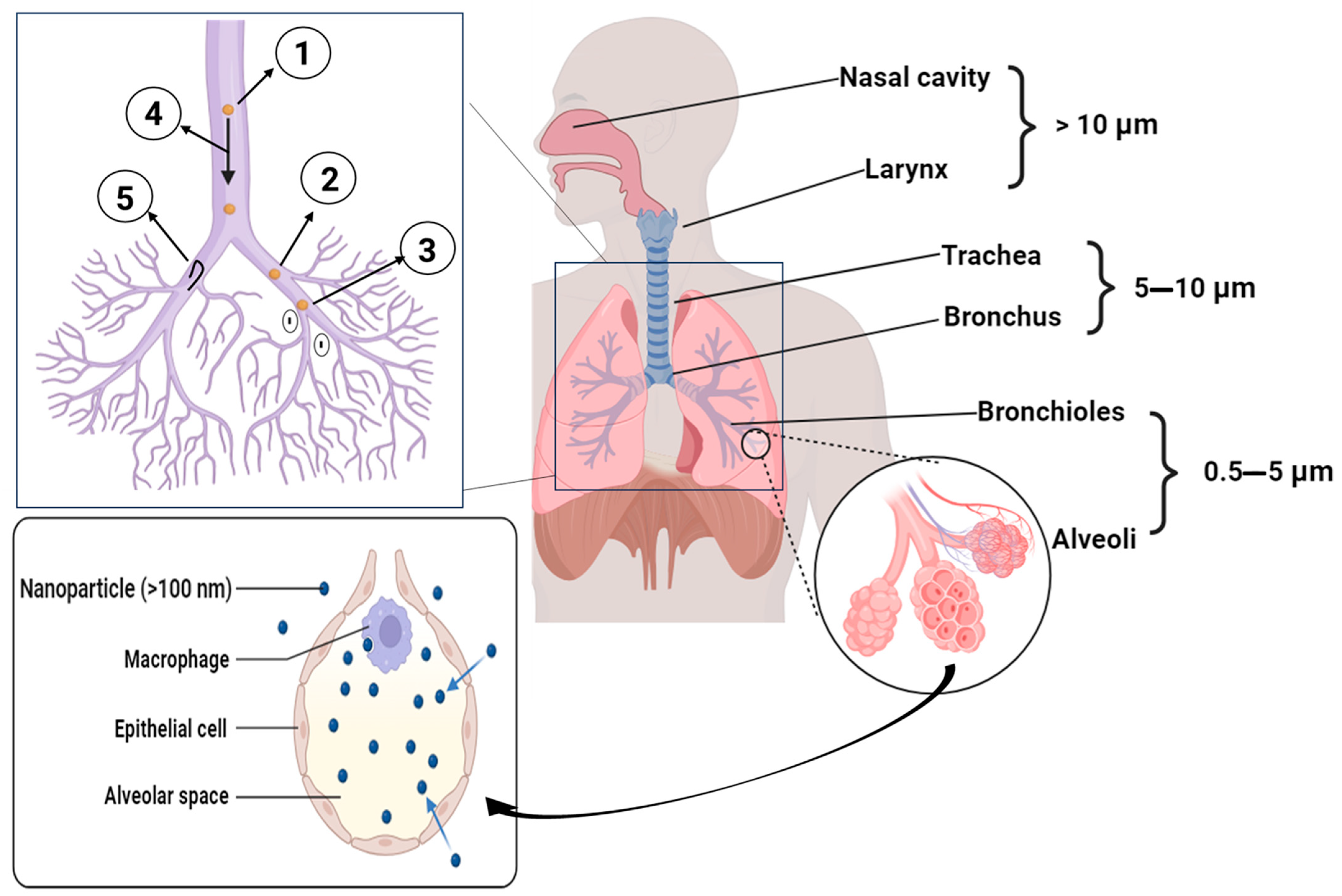
| Stage 1: Oropharyngeal region | >8 μm | Particles collected in Stage 1 are generally too large to penetrate the lungs and instead are deposited in the oropharyngeal and upper airway regions (mouth and throat). These particles do not contribute to therapeutic lung delivery but can cause local side effects such as irritation or an unpleasant taste. | [163,164,165] |
| Stage 2: Upper Tracheobronchial region | >5–8 μm | These particles primarily deposit in the upper tracheobronchial tree, which includes the large bronchi. Particles in this range may be cleared by mucociliary action and do not reach the lung. | [143,166,167] |
| Stage 3: Lower Tracheobronchial region | 3–5 μm | Particles collected in Stage 3 are more likely to deposit in the lower tracheobronchial tree, specifically in the smaller bronchi and bronchioles. This is an important site for drugs treating bronchoconstriction and airway inflammation, such as bronchodilators and corticosteroids. | [166,167,168,169] |
| Stage 4–5: Bronchiolar region | 1–3 μm | These particles represent deposition in the terminal bronchioles, which are critical for respiratory diseases such as asthma and COPD. Effective deposition in this region is necessary for medications aimed at reducing airway inflammation and preventing bronchoconstriction. Also, particles in this range are small enough to reach the alveolar ducts. Drugs deposited in this region are crucial for treating diseases like pulmonary hypertension or delivering systemic therapies that require deep lung absorption. | [143,170,171] |
| Stage 6–7: Alveolar region | <1 μm | Particles collected in Stage 6 typically deposit in the alveolar sacs. This region is responsible for gas exchange, making it a target for systemic drug delivery via the lungs. Effective deposition here is crucial for drugs that rely on absorption into the bloodstream, such as insulin. Stage 7 represents the deposition of fine particles in the deep alveolar region, close to the pulmonary capillaries. This region is key for highly efficient drug absorption due to the large surface area and proximity to the blood supply, which is essential for systemic treatments administered via the lungs. | [172,173] |
| MOC: Exhalation and/or nanoparticles deposition | <0.34 μm | Particles with an MMAD below 100 nm exhibit low inertia and are prone to exhalation before deposition occurs. However, nanoparticles can penetrate deeply into the alveolar region and even cross into the bloodstream. This is the focus for drug delivery systems involving nanotechnology and for inhalation toxicology studies involving ultrafine particles. | [174,175,176,177] |
| Technique | Principle | Advantages | Limitations | Ref |
|---|---|---|---|---|
| NGI | It is a multi-stage cascade impactor that separates aerosol particles by aerodynamic diameter across several stages. Each stage corresponds to different lung regions, from large particles depositing in the upper airways to smaller particles reaching deep into the lungs. | High resolution across a wide range of particle sizes, making it highly accurate. Considered a regulatory standard for measuring FPF in inhalation aerosols. Provides detailed information on regional lung deposition. | Time-consuming setup, operation, and maintenance. Requires careful cleaning to prevent sample cross-contamination. High operational complexity and cost. | [150,178,179] |
| GTI | Consists of a simple, two-stage device designed to mimic the upper and lower regions of the respiratory tract. Aerosols pass through the stages, with larger particles depositing in the first stage (representing the oropharynx and upper airways), and smaller particles depositing in the second stage (representing the lower airways). The GTI separates particles based on their aerodynamic size, using liquid media in each stage to capture particles for analysis. | The GTI is cost-effective, easy to use, and offers a straightforward means to estimate deposition in the upper and lower respiratory tract. It provides useful data for screening DPIs and MDIs early in inhaled drug development. | Its primary limitation is the low resolution, as it only offers two stages of particle separation. This limits the granularity of data compared to other impactors, making it insufficient for detailed analysis of APSD across all regions of the lung. | [152] |
| ACI | This is a multi-stage device used to measure the APSD of aerosols. It separates particles by their aerodynamic diameter as the aerosol passes through a series of nozzles, with larger particles collecting in earlier stages and finer particles in later stages. Each stage simulates different regions of the respiratory tract, from the upper airways to the alveoli, allowing for detailed characterization of particle deposition. | The ACI provides high-resolution particle size distribution data across a wide range of particle sizes. It is considered the gold standard for in vitro aerosol testing, widely used in regulatory submissions due to its precision and reproducibility. | Despite its accuracy, the ACI is complex to set up and requires significant time and effort for testing, cleaning, and maintenance. Additionally, the manual nature of particle collection and stage handling increases the risk of sample loss or contamination between tests. | [180] |
| MSLI | Improves upon the GTI by providing additional stages, typically five, to separate particles by aerodynamic size with greater resolution. As the aerosol passes through each stage, particles deposit in liquid impingers according to their size, mimicking the progressive deposition in the respiratory tract. | The MSLI offers better resolution than the GTI, allowing for a more detailed analysis of the APSD. The use of liquid impingers reduces particle re-entrainment, improving the accuracy of measurements. It is particularly useful for characterizing the FPF of DPIs and MDIs. | While the MSLI improves on the GTI, it still lacks the high resolution of cascade impactors such as the ACI or NGI. It may not be as effective for characterizing particles at the submicron level, making it less suitable for detailed regulatory submissions. | [153,181,182] |
| FSI | This is a simplified version of a cascade impactor designed for rapid screening of APSD in aerosol formulations. It typically consists of a few stages, often two or three, to quickly classify aerosols into larger and smaller particle fractions. The FSI is particularly useful in early-stage formulation development, where rapid, high-throughput screening is required. | The FSI provides a fast and efficient method for assessing APSD, making it ideal for early-stage development where multiple formulations need to be tested in a short time. It requires minimal setup and cleaning compared to more complex impactors like the ACI or NGI. | The primary limitation of the FSI is its lower resolution compared to full cascade impactors. It provides limited data on particle size distribution and is not suitable for detailed regulatory submissions. Its use is primarily for screening purposes rather than in-depth analysis. | [183,184] |
7. Manufacturing Technologies for Pulmonary Drug Delivery
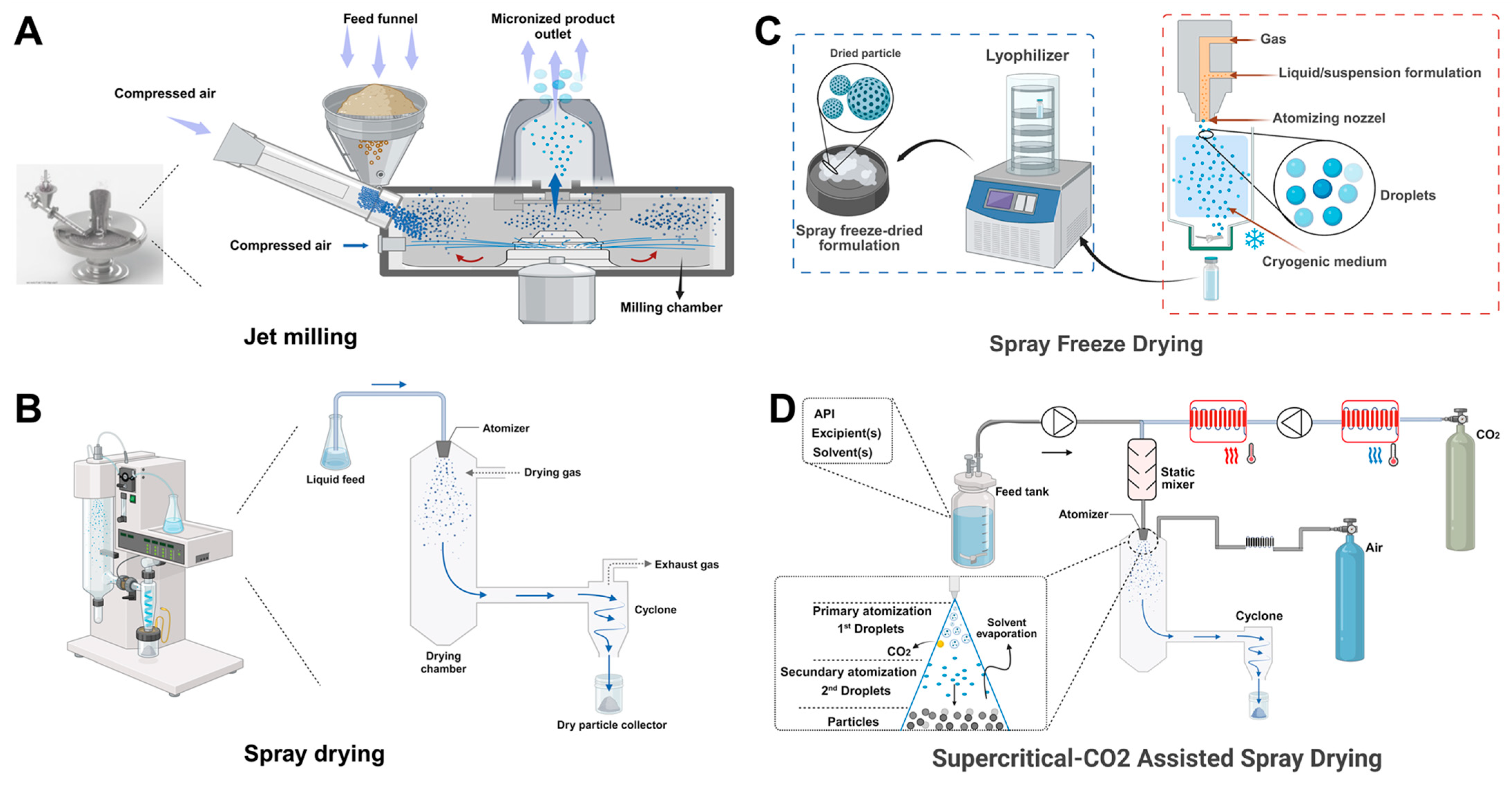
| Manufacturing Technology | Advantages (+) vs. Limitations (−) | Particle Morphology | Typical Aerodynamic Performance | Ref | |
|---|---|---|---|---|---|
| FPF (%) | MMAD (µm) | ||||
| Jet milling | (+) Solvent-free, simple, preserves crystallinity. (−) Broad particle size distribution, high cohesiveness requires carrier/force control agents. | Irregular, crystalline, rough-surfaced microparticles | 20–40 | 2–7 | [190,231] |
| Spray drying | (+) High tunability of density/porosity enables “Trojan” nano-in-micro systems. (−) Thermal/shear stress on biologics; hygroscopic powders often need protection. | Spherical, corrugated, or donut-shaped (hollow) | 40–80 | 1–5 | [232,233] |
| Spray freeze drying | (+) Excellent dispersibility due to low density; preserves the bioactivity of proteins. (−) High energy cost; fragile particles are difficult to fill in capsules. | Highly porous, light, fluffy agglomerates | 50–70 | 3–10 (geometric), <5 (aerodynamic) | [234,235,236] |
| Supercritical fluid technology | (+) Single-step, solvent-free (or low residue), narrow size distribution. (−) High equipment cost; complex scale-up at the industrial level. | Smooth spherical or nanostructured particles | 40–75 | 1–5 | [221,237,238,239] |
8. Nano- and Microparticulate Drug Delivery Systems
| (A) | |||||||||
| API | Manufacturing Method | Inhalation Dispositive | Inhalation Technique | Application | Type of Particle | Formulation Properties | Aerodynamic Properties | Ref | |
| MMAD (µm) | FPF (%) | ||||||||
| Azithromycin | Spray drying | DPI | NGI | Bacterial infections | Microparticles | Well-defined spheres | 2.7 ± 0.0 | 65.4 ± 5.1 | [212] |
| Tobramycin | Spray freeze-drying | DPI | NGI | Cystic fibrosis | Microparticles | Loose and porous structure | 1.3 ± 0.1 | 83.3 ± 3.9 | [279] |
| Rifabutin (RFB) and isoniazid (INH) | Spray drying | DPI | ACI | Tuberculosis | Microparticles | Irregular and acquired corrugated surfaces | 3.6 ± 0.3 (RFB)/ 3.9 ± 0.0 (INH) | 38.1 ± 1.8 (RFB)/ 38.0 ± 1.6 (INH) | [280] |
| Cyclodextrin/Ibuprofen | Nano-spray-drying | DPI | ACI | Cystic fibrosis treatment | Microparticles | Slightly wrinkled surface | 3.8–5.2 | 15.1–51.0 | [281] |
| Ciprofloxacin | Wet milling/spray drying | DPI | ACI | Cystic fibrosis | Nano-in-Microparticles | Spherical shape | 3.2–3.7 | 36.5–41.4 | [282] |
| Colistin | Freeze-drying | MDI | ACI | Bacterial infections | Nanoparticles | Smooth surfaces | 3.3 ± 1.0 | 61.1 ± 2.0 | [283] |
| Colistin | Spray drying | DPI | NGI | Bacterial infections | Microparticles | Smooth surface/irregular dimpled surface | 2.7 ± 0.1 | 59.5 ± 5.4 | [284] |
| Levofloxacin | Solvent evaporation | DPI | ACI | Tuberculosis | Microspheres | Spherical shape | 2.1 ± 1.2 | 75.4 ± 1.4 | [285] |
| Amikacin liposome | Microscale flow method | Lamira nebulizer | NGI | Pulmonary nontuberculous mycobacteria | Lipid microparticles | Complete shape of a lipid vesicle | 4.8–5.0 | 50.3–53.5 | [286] |
| (B) | |||||||||
| API | Manufacturing Method | Inhalation Dispositive | Inhalation Technique | Application | Type of Particle | Formulation Properties | Aerodynamic Properties | Ref | |
| MMAD (µm) | FPF (%) | ||||||||
| Itraconazole | Wet milling/co-spray drying | DPI | NGI | Pulmonary aspergillosis | Nano-in-Microparticles | Irregular shapes with aggregated forms and undulations in the particle structure | 2.5–3.2 | 64.6–89.9 | [287] |
| Amphotericin B (AmB) and Itraconazole (ITR) | Spray drying | DPI | NGI | Fungal pulmonary infections | Microparticles | Irregular non-smooth collapsed surface | ~6.0 (AmB)/ ~3.0 (ITR) | 67.0–91.0 (AmB) 25.0–42.0 (ITR) | [258] |
| Amphotericin B | Spray drying | DPI | ACI | Allergic Bronchopulmonary Aspergillosis | Nanostuctured Lipid Carriers | Spherical and uniform shape | 3.9–4.7 | 44.5–49.3 | [288] |
| Posaconazole | Wet medium milling/spray-drying | DPI | NGI | Invasive pulmonary aspergillosis | Nanocrystals-agglomerated | Dimpled and hollow shape | 2.3–3.3 | 62.9–78.6 | [289] |
| Voriconazole | Thin film freezing | DPI | NGI | Aspergillus species | Crystalline and amorphous microparticles | Aggregate particles | 2.7–5.2 | 19.6–46.5 | [290] |
| Voriconazole | Spray drying | DPI | NGI | Invasive pulmonary aspergillosis | Microparticles | Irregular with crystalline appearance/spherical appearance and smooth surface | 6.1 ± 0.2/3.7 ± 0.1 | 20.9 ± 2.0/43.6 ± 0.1 | [291] |
| Itraconazole | Anti-solvent precipitation/wet milling | DPI | ACI | allergic bronchopulmonary aspergillosis and invasive aspergillosis | Nanoclusters | NR | 1.2 ± 0.1 | 91.8 ± 1.2 | [292] |
| (C) | |||||||||
| API | Manufacturing Method | Inhalation Dispositive | Inhalation Technique | Application | Type of Particle | Formulation Properties | Aerodynamic Properties | Ref | |
| MMAD (µm) | FPF (%) | ||||||||
| Heparin sodium | Jet milling | DPI | NGI | Viruses such as COVID-19 | Microparticles | Particle agglomerations | 2.6–2.9 | 61.5–76.8 | [192] |
| Fluc mRNA | Thin-film hydration method | Vibrating Mesh Nebulizer | NGI | Viruses such as COVID-19 | Lipid nanoparticles | Complete shape of a lipid vesicle | 3.7–4.4 | 54.0–61.1 | [293] |
| Camostat mesylate | Thin-film hydration method | Jet nebulizer | ACI | SARS-CoV-2 Infection | Nanoliposomes | NR | 4.2 ± 0.1 | 42.0 ± 6.9 | [294] |
| Tamibarotene | Spray freeze drying/spray drying | DPI | NGI | Influenza and SARS-CoV-2 | Microparticles | Spherical structures | NR | 10.0–44.0 | [295] |
| Heparin sodium/AZM | Spray drying | DPI | NGI | SARS-CoV-2 Infection | Microparticles | Corrugated appearance | 2.7–4.4 | 31.5–54.1 | [257] |
| Favipiravir | Rotary evaporation/spray drying | DPI | NGI | SARS-CoV-2 | Cocrystal | Dimpled spheres | 2.9–4.9 | 26.7–79.3 | [296] |
| Zanamivir | Spray drying | DPI | NGI | Viruses such as influenza (A and B) | Microparticles | Corrugated appearance | 2.2–2.3 | 56.3–58.8 | [297] |
| Remdesivir | Film hydration method/freeze drying | Nebulizer | NGI | SARS-CoV-2 | Liposomes | Spherical morphology | 4.1 ± 0.1/3.6 ± 0.1 | 56.9 ± 0.4/64.3 ± 2.3 | [298] |
| (D) | |||||||||
| API | Manufacturing Method | Inhalation Dispositive | Inhalation Technique | Application | Type of Particle | Formulation Properties | Aerodynamic Properties | Ref | |
| MMAD (µm) | FPF (%) | ||||||||
| Chitosan | Supercritical CO2-assisted atomization | Suitable for DPI | – | Lung cancer treatment | Nano-in-microparticles | Well-defined spheres | 1.0–2.0 | NR | [299] |
| Atorvastatin | Spray drying | DPI | ACI | pulmonary artery atherosclerosis | Nanoemulsion-loaded microspheres | Irregular morphology | 1.0–1.5 | 45.0–54.0 | [300] |
| Rivaroxaban | Bead milling/jet milling | DPI | NGI | Pulmonary embolism | Microparticles | Irregular shapes and sizes | 6.5 ± 1.3 | 45.5 ± 4.9 | [301] |
| Budesonide | Spray drying | DPI | NGI | Asthma | Microparticles | Irregular wrinkled structure | 3.4–3.7 | 43.0–47.0 | [302] |
| Cinaciguat | Single emulsification | DPI | NGI | Pulmonary hypertension | Microparticles | Porous | 4.8–6.1 | 19.8–36.0 | [303] |
| Salbutamol sulfate | Spray drying | DPI | NGI | Asthma, COPD | Microparticles | Spherical shape, dimpled and corrugated surface | 4.2 ± 0.1 | 32.8 ± 0.4 | [304] |
| Nintedanib | Antisolvent precipitation/probe ultrasonication | Vibrating Mesh Nebulizer | MSLI | Idiopathic pulmonary fibrosis | Nanocrystals | Irregular shapes | ~4.3~4.7 | ~51.0~54.0 | [305] |
| Docosahexaenoic acid/S-nitrosothiol | Synthesizing DHA-SON/isolating macrophage cell membranes/extruding them to prepare RCM | Nebulizer cup | NGI | Ferroptosis-radiotherapy in lung cancer | Nanoformulation | Spherical morphology with a discontinuous membrane layer | 3.4 ± 0.1 | 77.8 ± 4.2 | [306] |
| Celastrol | spontaneous low-energy method (mixing specific components in optimized ratios) | Nebulizer cup | NGI | Non-small cell lung cancer | Nanoemulsion | Spherical morphology | 4.8 ± 0.2 | 70.7 ± 5.2 | [307] |
9. Application of 3D Printing Technologies in Pulmonary Drug Delivery
10. Future Perspective and Conclusions
Author Contributions
Funding
Institutional Review Board Statement
Informed Consent Statement
Data Availability Statement
Acknowledgments
Conflicts of Interest
Abbreviations
| RSV | Respiratory syncytial virus |
| COPD | Chronic Obstructive Pulmonary Disease |
| ILD | interstitial lung diseases |
| CPA | Chronic Pulmonary Aspergillosis |
| ICU | Intensive Care Unit |
| ARDS | respiratory distress syndrome |
| pMDIs | pressurized metered-dose inhalers |
| DPIs | dry powder inhalers |
| HFA | hydrofluoroalkane |
| MMAD | Mass median aerodynamic diameter |
| Da | Particle diameter |
| Dg | Geometric diameter |
| FPF | fine particle fraction |
| GSD | geometric standard deviation |
| CFD | Computational fluid dynamics |
| ABPA | allergic bronchopulmonary aspergillosis |
| NGI | Next Generation Impactor |
| APSD | aerodynamic particle size distribution |
| PSD | particle size distribution |
| ACI | Andersen Cascade Impactor |
| MSLI | Multi-Stage Liquid Impinger |
| GTI | Glass Twin Impinger |
| FSA | Fast Screening Andersen |
| MOC | micro-orifice collector |
| SEDS | Solution-Enhanced Dispersion by Supercritical Fluids |
| AZM | azithromycin |
| RA | rheumatoid arthritis |
| AM | Additive manufacturing |
| CT | Computed tomography |
| MRI | Magnetic resonance imaging |
| CAD | Computer-aided design |
| FDM | Fused deposition modeling |
| SLS | Selective laser sintering |
| DA | Aerodynamic diameter |
| PLGA | Poly(lactic-co-glycolic acid) |
| PLA | Poly(lactic acid) |
| SLN | Solid lipid nanoparticles |
| NLC | Nanostructured lipid carriers |
| NP | Polymeric nanoparticle |
| ADPIs | acoustic dry powder inhalers |
| SLA | stereolithography |
| LCD | liquid crystal display |
| nCmP | nanocomposite microparticles |
| LOC | Lung-on-chip |
| SCF | Supercritical fluid |
| SAS | Supercritical anti-solvent |
| SFD | Spray Freeze Drying |
| SA-SD | supercritical fluid-assisted spray-drying |
| RESS | Rapid expansion of supercritical solutions |
| CO2 | Carbon dioxide |
References
- Quinton, L.J.; Walkey, A.J.; Mizgerd, J.P. Integrative physiology of pneumonia. Physiol. Rev. 2018, 98, 1417–1464. [Google Scholar] [CrossRef]
- Jartti, T.; Gern, J.E. Role of viral infections in the development and exacerbation of asthma in children. J. Allergy Clin. Immunol. 2017, 140, 895–906. [Google Scholar] [CrossRef] [PubMed]
- Fitzpatrick, A.M.; Busse, W.W. Perspectives in Respiratory Infections and the Lung. J. Allergy Clin. Immunol. Pract. 2022, 10, 694–696. [Google Scholar] [CrossRef] [PubMed]
- Yang, F.; Pang, B.; Jin, X.; Chen, Z.; Pang, W.; Liu, Q.; Zhang, J.; Zhang, B. Post COVID-19 Burden: Focus on the Short-Term Condition. Acupunct. Herb. Med. 2022, 2, 139–142. [Google Scholar] [CrossRef] [PubMed]
- Shang, W.; Wang, Y.; Yuan, J.; Guo, Z.; Liu, J.; Liu, M. Global excess mortality during COVID-19 pandemic: A systematic review and meta-analysis. Vaccines 2022, 10, 1702. [Google Scholar] [CrossRef]
- Msemburi, W.; Karlinsky, A.; Knutson, V.; Aleshin-Guendel, S.; Chatterji, S.; Wakefield, J. The WHO estimates of excess mortality associated with the COVID-19 pandemic. Nature 2023, 613, 130–137. [Google Scholar] [CrossRef]
- Wiersinga, W.J.; Rhodes, A.; Cheng, A.C.; Peacock, S.J.; Prescott, H.C. Pathophysiology, transmission, diagnosis, and treatment of coronavirus disease 2019 (COVID-19): A review. JAMA 2020, 324, 782–793. [Google Scholar] [CrossRef]
- Ong, C.W.M.; Migliori, G.B.; Raviglione, M.; MacGregor-Skinner, G.; Sotgiu, G.; Alffenaar, J.-W.; Tiberi, S.; Adlhoch, C.; Alonzi, T.; Archuleta, S. Epidemic and pandemic viral infections: Impact on tuberculosis and the lung: A consensus by the World Association for Infectious Diseases and Immunological Disorders (WAidid), Global Tuberculosis Network (GTN), and members of the European Society of Clinical Microbiology and Infectious Diseases Study Group for Mycobacterial Infections (ESGMYC). Eur. Respir. J. 2020, 56, 2001727. [Google Scholar]
- Sethi, S.; Murphy, T.F. Infection in the pathogenesis and course of chronic obstructive pulmonary disease. N. Engl. J. Med. 2008, 359, 2355–2365. [Google Scholar] [CrossRef]
- Britto, C.J.; Brady, V.; Lee, S.; Cruz, C.S.D. Respiratory viral infections in chronic lung diseases. Clin. Chest Med. 2017, 38, 87–96. [Google Scholar] [CrossRef]
- Azadeh, N.; Limper, A.H.; Carmona, E.M.; Ryu, J.H. The role of infection in interstitial lung diseases: A review. Chest 2017, 152, 842–852. [Google Scholar] [CrossRef]
- Grigg, C.; Rizvi, N.A. PD-L1 biomarker testing for non-small cell lung cancer: Truth or fiction? J. Immunother. Cancer 2016, 4, 48. [Google Scholar] [CrossRef]
- Belluomini, L.; Caldart, A.; Avancini, A.; Dodi, A.; Trestini, I.; Kadrija, D.; Sposito, M.; Tregnago, D.; Casali, M.; Riva, S.T. Infections and immunotherapy in lung cancer: A bad relationship? Int. J. Mol. Sci. 2020, 22, 42. [Google Scholar] [CrossRef] [PubMed]
- Budisan, L.; Zanoaga, O.; Braicu, C.; Pirlog, R.; Covaliu, B.; Esanu, V.; Korban, S.S.; Berindan-Neagoe, I. Links between infections, lung cancer, and the immune system. Int. J. Mol. Sci. 2021, 22, 9394. [Google Scholar] [CrossRef]
- Sung, H.; Ferlay, J.; Siegel, R.L.; Laversanne, M.; Soerjomataram, I.; Jemal, A.; Bray, F. Global cancer statistics 2020: GLOBOCAN estimates of incidence and mortality worldwide for 36 cancers in 185 countries. CA A Cancer J. Clin. 2021, 71, 209–249. [Google Scholar] [CrossRef]
- Bray, F.; Laversanne, M.; Sung, H.; Ferlay, J.; Siegel, R.L.; Soerjomataram, I.; Jemal, A. Global cancer statistics 2022: GLOBOCAN estimates of incidence and mortality worldwide for 36 cancers in 185 countries. CA A Cancer J. Clin. 2024, 74, 229–263. [Google Scholar] [CrossRef] [PubMed]
- Alter, P.; Baker, J.R.; Dauletbaev, N.; Donnelly, L.E.; Pistenmaa, C.; Schmeck, B.; Washko, G.; Vogelmeier, C.F. Update in chronic obstructive pulmonary disease 2019. Am. J. Respir. Crit. Care Med. 2020, 202, 348–355. [Google Scholar] [CrossRef]
- Filho, P.P.R.; Barros, A.C.d.S.; Ramalho, G.L.; Pereira, C.R.; Papa, J.P.; de Albuquerque, V.H.C.; Tavares, J.M.R. Automated recognition of lung diseases in CT images based on the optimum-path forest classifier. Neural Comput. Appl. 2019, 31, 901–914. [Google Scholar] [CrossRef]
- Li, Z.; Lu, G.; Meng, G. Pathogenic fungal infection in the lung. Front. Immunol. 2019, 10, 1524. [Google Scholar] [CrossRef] [PubMed]
- Deigendesch, N.; Nunez, J.C.; Stenzel, W. Parasitic and fungal infections. Handb. Clin. Neurol. 2018, 145, 245–262. [Google Scholar]
- Barac, A.; Ong, D.S.; Jovancevic, L.; Peric, A.; Surda, P.; Tomic Spiric, V.; Rubino, S. Fungi-induced upper and lower respiratory tract allergic diseases: One entity. Front. Microbiol. 2018, 9, 583. [Google Scholar] [CrossRef]
- Li, J.; Han, Z.W.; Gao, S.S.; Guo, Q.; Cang, H.Q. Risk of pulmonary fungal infections associated with biologics: A FAERS database disproportionality analysis. Front. Immunol. 2025, 16, 1672343. [Google Scholar] [CrossRef] [PubMed]
- Chowdhary, A.; Agarwal, K.; Meis, J.F. Filamentous fungi in respiratory infections. What lies beyond Aspergillosis and Mucormycosis? PLoS Pathog. 2016, 12, e1005491. [Google Scholar] [CrossRef]
- Kainz, K.; Bauer, M.A.; Madeo, F.; Carmona-Gutierrez, D. Fungal infections in humans: The silent crisis. Microb. Cell 2020, 7, 143. [Google Scholar] [CrossRef] [PubMed]
- Salzer, H.J.; Cornely, O.A. Awareness of predictors of mortality may help improve outcome in chronic pulmonary aspergillosis. Eur. Respir. Soc. 2017, 49, 1602520. [Google Scholar] [CrossRef]
- Palmieri, F.; Koutsokera, A.; Bernasconi, E.; Junier, P.; von Garnier, C.; Ubags, N. Recent Advances in Fungal Infections: From Lung Ecology to Therapeutic Strategies With a Focus on Aspergillus spp. Front. Med. 2022, 9, 832510. [Google Scholar] [CrossRef] [PubMed]
- Howard-Jones, A.R.; Sparks, R.; Pham, D.; Halliday, C.; Beardsley, J.; Chen, S.C.-A. Pulmonary cryptococcosis. J. Fungi 2022, 8, 1156. [Google Scholar] [CrossRef]
- Bantun, F. Fungal–bacterial co-infections and super-infections among hospitalized COVID-19 patients: A systematic review. J. Fungi 2023, 9, 598. [Google Scholar] [CrossRef]
- Smith, A.P.; Williams, E.P.; Plunkett, T.R.; Selvaraj, M.; Lane, L.C.; Zalduondo, L.; Xue, Y.; Vogel, P.; Channappanavar, R.; Jonsson, C.B. Time-dependent increase in susceptibility and severity of secondary bacterial infections during SARS-CoV-2. Front. Immunol. 2022, 13, 894534. [Google Scholar] [CrossRef]
- Soltani, S.; Zandi, M.; Faramarzi, S.; Shahbahrami, R.; Vali, M.; Rezayat, S.A.; Pakzad, R.; Malekifar, P.; Pakzad, I.; Jahandoost, N. Worldwide prevalence of fungal coinfections among COVID-19 patients: A comprehensive systematic review and meta-analysis. Osong Public Health Res. Perspect. 2022, 13, 15. [Google Scholar] [CrossRef]
- Rafat, Z.; Ramandi, A.; Khaki, P.A.; Ansari, S.; Ghaderkhani, S.; Haidar, H.; Tajari, F.; Roostaei, D.; Ghazvini, R.D.; Hashemi, S.J. Fungal and bacterial co-infections of the respiratory tract among patients with COVID-19 hospitalized in intensive care units. Gene Rep. 2022, 27, 101588. [Google Scholar] [CrossRef]
- Sarvestani, H.K.; Khansari, M.; Rafat, Z.; Abdollahi, A. P211 Fungal and bacterial co-infections of the respiratory tract among patients with COVID-19 hospitalized in intensive care units. Med. Mycol. 2022, 60, myac072P211. [Google Scholar] [CrossRef]
- Seyedjavadi, S.S.; Bagheri, P.; Nasiri, M.J.; Razzaghi-Abyaneh, M.; Goudarzi, M. Fungal infection in co-infected patients with COVID-19: An overview of case reports/case series and systematic review. Front. Microbiol. 2022, 13, 888452. [Google Scholar] [CrossRef]
- Ozyurt, E.; Daloglu, A.E.; Inanoglu, K.; Ozturk, N.K.; Ozmen, S. Bacterial and fungal secondary infections occurring in COVID-19 patients followed in intensive care: A retrospective study. J. Infect. Dev. Ctries. 2024, 18, 350–354. [Google Scholar] [CrossRef]
- Jayakumar, D.; Kumar, P. Current Status of COVID-19-Associated Secondary Bacterial and Fungal Infection: A Mini Review. ACTA Microbiol. Bulg. 2023, 39, 93–101. [Google Scholar] [CrossRef]
- Yordanov, P.; Mustafa, F.; Kostadinova, V.; Dobreva, T.; Ilieva, N.; Tasheva, V.; Krasteva, R.; Kapitanov, K.; Peneva, P.; Miteva, D. The impact of bacterial and fungal co-infections in patients with severe COVID–19: A retrospective analysis. In Proceedings of the ERS International Congress 2023 Abstracts, Milan, Italy, 9–13 September 2023. [Google Scholar]
- Newman, S.P. Drug delivery to the lungs: Challenges and opportunities. Ther. Deliv. 2017, 8, 647–661. [Google Scholar] [CrossRef] [PubMed]
- Labiris, N.R.; Dolovich, M.B. Pulmonary drug delivery. Part I: Physiological factors affecting therapeutic effectiveness of aerosolized medications. Br. J. Clin. Pharmacol. 2003, 56, 588–599. [Google Scholar] [CrossRef]
- Stein, S.W.; Thiel, C.G. The history of therapeutic aerosols: A chronological review. J. Aerosol Med. Pulm. Drug Deliv. 2017, 30, 20–41. [Google Scholar] [CrossRef] [PubMed]
- Chrystyn, H.; van der Palen, J.; Sharma, R.; Barnes, N.; Delafont, B.; Mahajan, A.; Thomas, M. Device errors in asthma and COPD: Systematic literature review and meta-analysis. NPJ Prim. Care Respir. Med. 2017, 27, 22. [Google Scholar] [CrossRef] [PubMed]
- Myrdal, P.B.; Sheth, P.; Stein, S.W. Advances in metered dose inhaler technology: Formulation development. Aaps Pharmscitech 2014, 15, 434–455. [Google Scholar] [CrossRef]
- Benke, E.; Varga, P.; Szabó-Révész, P.; Ambrus, R. Stability and in vitro aerodynamic studies of inhalation powders containing ciprofloxacin hydrochloride applying different DPI capsule types. Pharmaceutics 2021, 13, 689. [Google Scholar] [CrossRef]
- Committee for Medicinal Products for Human Use (CHMP). Guideline on the Pharmaceutical Quality of Inhalation and Nasal Products; European Medicines Agency: London, UK, 2006. [Google Scholar]
- Usmani, O.S.; Roche, N.; Jenkins, M.; Stjepanovic, N.; Mack, P.; De Backer, W. Consistent pulmonary drug delivery with whole lung deposition using the aerosphere inhaler: A review of the evidence. Int. J. Chronic Obstr. Pulm. Dis. 2021, 16, 113–124. [Google Scholar] [CrossRef]
- Darquenne, C.; Corcoran, T.E.; Lavorini, F.; Sorano, A.; Usmani, O.S. The effects of airway disease on the deposition of inhaled drugs. Expert Opin. Drug Deliv. 2024, 21, 1175–1190. [Google Scholar] [CrossRef]
- Borgström, L.; Bengtsson, T.; Derom, E.; Pauwels, R. Variability in lung deposition of inhaled drug, within and between asthmatic patients, with a pMDI and a dry powder inhaler, Turbuhaler®. Int. J. Pharm. 2000, 193, 227–230. [Google Scholar] [CrossRef]
- Sahakijpijarn, S.; Smyth, H.D.; Miller, D.P.; Weers, J.G. Post-inhalation cough with therapeutic aerosols: Formulation considerations. Adv. Drug Deliv. Rev. 2020, 165, 127–141. [Google Scholar] [CrossRef] [PubMed]
- Shetty, N.; Cipolla, D.; Park, H.; Zhou, Q.T. Physical stability of dry powder inhaler formulations. Expert Opin. Drug Deliv. 2020, 17, 77–96. [Google Scholar] [CrossRef] [PubMed]
- Shahin, H.I.; Chablani, L. A comprehensive overview of dry powder inhalers for pulmonary drug delivery: Challenges, advances, optimization techniques, and applications. J. Drug Deliv. Sci. Technol. 2023, 84, 104553. [Google Scholar] [CrossRef]
- Rachelefsky, G.S.; Liao, Y.; Faruqi, R. Impact of inhaled corticosteroid-induced oropharyngeal adverse events: Results from a meta-analysis. Ann. Allergy Asthma Immunol. 2007, 98, 225–238. [Google Scholar] [CrossRef] [PubMed]
- Galván, C.A.; Guarderas, J.C. Practical considerations for dysphonia caused by inhaled corticosteroids. Mayo Clin. Proc. 2012, 87, 901–904. [Google Scholar] [CrossRef]
- Konstan, M.W.; Flume, P.A.; Kappler, M.; Chiron, R.; Higgins, M.; Brockhaus, F.; Zhang, J.; Angyalosi, G.; He, E.; Geller, D.E. Safety, efficacy and convenience of tobramycin inhalation powder in cystic fibrosis patients: The EAGER trial. J. Cyst. Fibros. 2011, 10, 54–61. [Google Scholar] [CrossRef]
- Lu, D.; Lee, S.L.; Lionberger, R.A.; Choi, S.; Adams, W.; Caramenico, H.N.; Chowdhury, B.A.; Conner, D.P.; Katial, R.; Limb, S. International guidelines for bioequivalence of locally acting orally inhaled drug products: Similarities and differences. AAPS J. 2015, 17, 546–557. [Google Scholar] [CrossRef]
- Lee, S.L.; Adams, W.P.; Li, B.V.; Conner, D.P.; Chowdhury, B.A.; Yu, L.X. In vitro considerations to support bioequivalence of locally acting drugs in dry powder inhalers for lung diseases. AAPS J. 2009, 11, 414–423. [Google Scholar] [CrossRef]
- Rehfeld, A.; Nylander, M.; Karnov, K. The Respiratory System. In Compendium of Histology: A Theoretical and Practical Guide; Springer International Publishing: Cham, Switzerland, 2017; pp. 351–377. [Google Scholar]
- Khong, T.Y. The Respiratory System. In Keeling’s Fetal and Neonatal Pathology; Khong, T.Y., Malcomson, R.D.G., Eds.; Springer International Publishing: Cham, Switzerland, 2015; pp. 531–559. [Google Scholar]
- Gholap, A.; Pardeshi, S.; Giram, P.; Nangare, S.; Sodha, S.; Kapare, H.; More, M.; Sonar, Y.; Shukla, R.; Naik, J. Breathing new life nanomedicines for pulmonary drug delivery: Targeting approaches, experimental models, and regulatory aspects. Beni-Suef Univ. J. Basic Appl. Sci. 2025, 14, 65. [Google Scholar] [CrossRef]
- Weibel, E.R. Lung morphometry: The link between structure and function. Cell Tissue Res. 2017, 367, 413–426. [Google Scholar] [CrossRef]
- Fan, Y.; Jiang, Y.; Gong, L.; Wang, Y.; Su, Z.; Li, X.; Wu, H.; Pan, H.; Wang, J.; Meng, Z. Epidemiological and demographic drivers of lung cancer mortality from 1990 to 2019: Results from the global burden of disease study 2019. Front. Public Health 2023, 11, 1054200. [Google Scholar] [CrossRef]
- Peate, I. Anatomy and physiology, 10. The respiratory system. Br. J. Healthc. Assist. 2018, 12, 178–181. [Google Scholar] [CrossRef]
- Miyamoto, T. System physiology of respiratory control in man. J. Phys. Fit. Sports Med. 2016, 5, 329–337. [Google Scholar] [CrossRef][Green Version]
- Rock, J.R.; Randell, S.H.; Hogan, B.L. Airway basal stem cells: A perspective on their roles in epithelial homeostasis and remodeling. Dis. Models Mech. 2010, 3, 545–556. [Google Scholar] [CrossRef] [PubMed]
- Martinu, T.; Todd, J.L.; Gelman, A.E.; Guerra, S.; Palmer, S.M. Club cell secretory protein in lung disease: Emerging concepts and potential therapeutics. Annu. Rev. Med. 2023, 74, 427–441. [Google Scholar] [CrossRef]
- Herzog, E.L.; Brody, A.R.; Colby, T.V.; Mason, R.; Williams, M.C. Knowns and unknowns of the alveolus. Proc. Am. Thorac. Soc. 2008, 5, 778–782. [Google Scholar] [CrossRef]
- Kasper, M.; Barth, K. Potential contribution of alveolar epithelial type I cells to pulmonary fibrosis. Biosci. Rep. 2017, 37, BSR20171301. [Google Scholar] [CrossRef]
- Whitsett, J.A.; Alenghat, T. Respiratory epithelial cells orchestrate pulmonary innate immunity. Nat. Immunol. 2015, 16, 27–35. [Google Scholar] [CrossRef]
- Miserocchi, G. The impact of heterogeneity of the air-blood barrier on control of lung extravascular water and alveolar gas exchange. Front. Netw. Physiol. 2023, 3, 1142245. [Google Scholar] [CrossRef] [PubMed]
- Boudin, L.; Götz, D.; Grec, B. Diffusion models of multicomponent mixtures in the lung. ESAIM Proc. 2010, 30, 90–103. [Google Scholar] [CrossRef]
- Samavedam, S.; Asrnanna, K.R. Diffusion of Oxygen and its Applied Physiology. In Manual of Oxygen Therapy; Jaypee Brothers Medical Publishers: Delhi, India, 2022; p. 69. [Google Scholar]
- Hsia, C.C.; Hyde, D.M.; Weibel, E.R. Lung structure and the intrinsic challenges of gas exchange. Compr. Physiol. 2016, 6, 827. [Google Scholar] [CrossRef] [PubMed]
- Weibel, E.R. On the tricks alveolar epithelial cells play to make a good lung. Am. J. Respir. Crit. Care Med. 2015, 191, 504–513. [Google Scholar] [CrossRef] [PubMed]
- Travaglini, K.J.; Nabhan, A.N.; Penland, L.; Sinha, R.; Gillich, A.; Sit, R.V.; Chang, S.; Conley, S.D.; Mori, Y.; Seita, J. A molecular cell atlas of the human lung from single-cell RNA sequencing. Nature 2020, 587, 619–625. [Google Scholar] [CrossRef]
- Matthay, M.A.; Zemans, R.L.; Zimmerman, G.A.; Arabi, Y.M.; Beitler, J.R.; Mercat, A.; Herridge, M.; Randolph, A.G.; Calfee, C.S. Acute respiratory distress syndrome. Nat. Rev. Dis. Primers 2019, 5, 18. [Google Scholar] [CrossRef]
- Zhou, Q.T.; Leung, S.S.Y.; Tang, P.; Parumasivam, T.; Loh, Z.H.; Chan, H.-K. Inhaled formulations and pulmonary drug delivery systems for respiratory infections. Adv. Drug Deliv. Rev. 2015, 85, 83–99. [Google Scholar] [CrossRef]
- Johansson, N.; Kalin, M.; Tiveljung-Lindell, A.; Giske, C.G.; Hedlund, J. Etiology of community-acquired pneumonia: Increased microbiological yield with new diagnostic methods. Clin. Infect. Dis. 2010, 50, 202–209. [Google Scholar] [CrossRef]
- Dockrell, D.H.; Whyte, M.K.; Mitchell, T.J. Pneumococcal pneumonia: Mechanisms of infection and resolution. Chest 2012, 142, 482–491. [Google Scholar] [CrossRef]
- Gautret, P.; Gray, G.C.; Charrel, R.N.; Odezulu, N.G.; Al-Tawfiq, J.A.; Zumla, A.; Memish, Z.A. Emerging viral respiratory tract infections—Environmental risk factors and transmission. Lancet Infect. Dis. 2014, 14, 1113–1122. [Google Scholar] [CrossRef]
- Quirouette, C.; Younis, N.P.; Reddy, M.B.; Beauchemin, C.A. A mathematical model describing the localization and spread of influenza A virus infection within the human respiratory tract. PLoS Comput. Biol. 2020, 16, e1007705. [Google Scholar]
- Anaya, B.J.; Osouli-Bostanabad, K.; Tirado, D.F.; González-Burgos, E.; Lalatsa, A.; Serrano, D. Heparin-azithromycin microparticulate nasal gels block SARS-CoV-2 and bacterial respiratory infections. Carbohydr. Polym. Technol. Appl. 2025, 12, 101031. [Google Scholar] [CrossRef]
- Porter, P.; Polikepahad, S.; Qian, Y.; Morgan Knight, J.; Lu, W.; Tai, W.M.-T.; Roberts, L.; Ongeri, V.; Yang, T.; Seryshev, A. Respiratory tract allergic disease and atopy: Experimental evidence for a fungal infectious etiology. Med. Mycol. 2011, 49, S158–S163. [Google Scholar] [CrossRef]
- Gonçalves, S.M.; Lagrou, K.; Duarte-Oliveira, C.; Maertens, J.A.; Cunha, C.; Carvalho, A. The microbiome-metabolome crosstalk in the pathogenesis of respiratory fungal diseases. Virulence 2017, 8, 673–684. [Google Scholar] [CrossRef]
- Gomez, P.; Hackett, T.L.; Moore, M.M.; Knight, D.A.; Tebbutt, S.J. Functional genomics of human bronchial epithelial cells directly interacting with conidia of Aspergillus fumigatus. BMC Genom. 2010, 11, 358. [Google Scholar] [CrossRef]
- Nicod, L.; Pache, J.C.; Howarth, N. Fungal infections in transplant recipients. Eur. Respir. J. 2001, 17, 133–140. [Google Scholar] [CrossRef] [PubMed]
- Salazar, F.; Bignell, E.; Brown, G.D.; Cook, P.C.; Warris, A. Pathogenesis of respiratory viral and fungal coinfections. Clin. Microbiol. Rev. 2022, 35, e0009421. [Google Scholar] [CrossRef]
- Bourouiba, L. Fluid dynamics of respiratory infectious diseases. Annu. Rev. Biomed. Eng. 2021, 23, 547–577. [Google Scholar] [CrossRef]
- Kline, K.A.; Fälker, S.; Dahlberg, S.; Normark, S.; Henriques-Normark, B. Bacterial adhesins in host-microbe interactions. Cell Host Microbe 2009, 5, 580–592. [Google Scholar] [CrossRef]
- Rai, R.C. Host inflammatory responses to intracellular invaders: Review study. Life Sci. 2020, 240, 117084. [Google Scholar] [CrossRef] [PubMed]
- Meyer, N.J.; Gattinoni, L.; Calfee, C.S. Acute respiratory distress syndrome. Lancet 2021, 398, 622–637. [Google Scholar] [CrossRef]
- Crosby, L.M.; Waters, C.M. Epithelial repair mechanisms in the lung. Am. J. Physiol. -Lung Cell. Mol. Physiol. 2010, 298, L715–L731. [Google Scholar] [CrossRef]
- He, S.; Gui, J.; Xiong, K.; Chen, M.; Gao, H.; Fu, Y. A roadmap to pulmonary delivery strategies for the treatment of infectious lung diseases. J. Nanobiotechnol. 2022, 20, 101. [Google Scholar] [CrossRef]
- Debnath, S.K.; Debnath, M.; Srivastava, R. Opportunistic etiological agents causing lung infections: Emerging need to transform lung-targeted delivery. Heliyon 2022, 8, e12620. [Google Scholar] [CrossRef]
- Knap, K.; Kwiecień, K.; Reczyńska-Kolman, K.; Pamuła, E. Inhalable microparticles as drug delivery systems to the lungs in a dry powder formulations. Regen. Biomater. 2023, 10, rbac099. [Google Scholar] [CrossRef] [PubMed]
- Longest, P.W.; Tian, G.; Walenga, R.L.; Hindle, M. Comparing MDI and DPI aerosol deposition using in vitro experiments and a new stochastic individual path (SIP) model of the conducting airways. Pharm. Res. 2012, 29, 1670–1688. [Google Scholar] [CrossRef] [PubMed]
- Martin, A.R.; Finlay, W.H. Nebulizers for drug delivery to the lungs. Expert Opin. Drug Deliv. 2015, 12, 889–900. [Google Scholar] [CrossRef]
- Stein, S.W.; Sheth, P.; Hodson, P.D.; Myrdal, P.B. Advances in metered dose inhaler technology: Hardware development. AAPS PharmSciTech 2014, 15, 326–338. [Google Scholar] [CrossRef]
- Vallorz, E.; Sheth, P.; Myrdal, P. Pressurized metered dose inhaler technology: Manufacturing. AAPS PharmSciTech 2019, 20, 177. [Google Scholar] [CrossRef]
- Zhou, Q.T.; Tang, P.; Leung, S.S.Y.; Chan, J.G.Y.; Chan, H.-K. Emerging inhalation aerosol devices and strategies: Where are we headed? Adv. Drug Deliv. Rev. 2014, 75, 3–17. [Google Scholar] [CrossRef] [PubMed]
- de Boer, A.H.; Thalberg, K. Dry powder inhalers (DPIs). In Inhaled Medicines; Academic Press: Cambridge, MA, USA, 2021; pp. 99–146. [Google Scholar]
- Arı, A. Jet, Ultrasonic, and Mesh Nebulizers: An Evaluation of Nebulizers for Better Clinical Outcomes. Eurasian J. Pulmonol. 2014, 16, 1–7. [Google Scholar] [CrossRef]
- Pritchard, J.N.; Hatley, R.H.; Denyer, J.; Hollen, D.v. Mesh nebulizers have become the first choice for new nebulized pharmaceutical drug developments. Ther. Deliv. 2018, 9, 121–136. [Google Scholar] [CrossRef] [PubMed]
- Iwanaga, T.; Tohda, Y.; Nakamura, S.; Suga, Y. The Respimat® soft mist inhaler: Implications of drug delivery characteristics for patients. Clin. Drug Investig. 2019, 39, 1021–1030. [Google Scholar] [CrossRef] [PubMed]
- Fink, J.B.; Stapleton, K.W. Nebulizers. J. Aerosol Med. Pulm. Drug Deliv. 2024, 37, 140–156. [Google Scholar] [CrossRef]
- Feng, Z.; Han, Z.; Wang, Y.; Guo, H.; Liu, J. Comparison of the application of vibrating mesh nebulizer and jet nebulizer in chronic obstructive pulmonary disease: A systematic review and meta-analysis. Int. J. Chronic Obstr. Pulm. Dis. 2024, 19, 829–839. [Google Scholar] [CrossRef]
- Denyer, J.; Nikander, K.; Smith, N. Adaptive aerosol delivery (AAD®) technology. Expert Opin. Drug Deliv. 2004, 1, 165–176. [Google Scholar] [CrossRef]
- Knoch, M. New generation nebulizers. J. Aerosol Med. Pulm. Drug Deliv. 2024, 37, 157–165. [Google Scholar] [CrossRef]
- COPLEY. Inhaler Testing. Available online: https://www.copleyscientific.com/ (accessed on 22 October 2024).
- Xu, Y.; Liu, H.; Song, L. Novel drug delivery systems targeting oxidative stress in chronic obstructive pulmonary disease: A review. J. Nanobiotechnol. 2020, 18, 145. [Google Scholar] [CrossRef]
- Jin, Z.; Gao, Q.; Wu, K.; Ouyang, J.; Guo, W.; Liang, X.-J. Harnessing inhaled nanoparticles to overcome the pulmonary barrier for respiratory disease therapy. Adv. Drug Deliv. Rev. 2023, 202, 115111. [Google Scholar] [CrossRef]
- Sung, J.C.; Pulliam, B.L.; Edwards, D.A. Nanoparticles for drug delivery to the lungs. Trends Biotechnol. 2007, 25, 563–570. [Google Scholar] [CrossRef]
- Patton, J.S.; Byron, P.R. Inhaling medicines: Delivering drugs to the body through the lungs. Nat. Rev. Drug Discov. 2007, 6, 67–74. [Google Scholar] [CrossRef]
- Brunaugh, A.D.; Smyth, H.D. Formulation techniques for high dose dry powders. Int. J. Pharm. 2018, 547, 489–498. [Google Scholar] [CrossRef]
- DeCarlo, P.F.; Slowik, J.G.; Worsnop, D.R.; Davidovits, P.; Jimenez, J.L. Particle morphology and density characterization by combined mobility and aerodynamic diameter measurements. Part 1: Theory. Aerosol Sci. Technol. 2004, 38, 1185–1205. [Google Scholar] [CrossRef]
- Roos, R.A. # 11 Hinds 1999 Aerosol Technology Respirato. In Aerosol Technology; Wiley-Interscience: New York, NY, USA, 1999. [Google Scholar]
- Rahman, M.M.; Zhao, M.; Islam, M.S.; Dong, K.; Saha, S.C. Numerical study of nanoscale and microscale particle transport in realistic lung models with and without stenosis. Int. J. Multiph. Flow 2021, 145, 103842. [Google Scholar] [CrossRef]
- Al-Obaidi, H.; Florence, A.T. Nanoparticle delivery and particle diffusion in confined and complex environments. J. Drug Deliv. Sci. Technol. 2015, 30, 266–277. [Google Scholar] [CrossRef]
- Naureen, F.; Shah, Y.; Rehman, M.U.; Chaubey, P.; Nair, A.K.; Khan, J.; Abdullah Shafique, M.; Shah, K.U.; Ahmad, B. Inhalable dry powder nano-formulations: Advancing lung disease therapy-a review. Front. Nanotechnol. 2024, 6, 1403313. [Google Scholar] [CrossRef]
- Silva, A.S.; Tavares, M.T.; Aguiar-Ricardo, A. Sustainable strategies for nano-in-micro particle engineering for pulmonary delivery. J. Nanoparticle Res. 2014, 16, 2602. [Google Scholar] [CrossRef]
- Scherließ, R.; Bock, S.; Bungert, N.; Neustock, A.; Valentin, L. Particle engineering in dry powders for inhalation. Eur. J. Pharm. Sci. 2022, 172, 106158. [Google Scholar] [CrossRef] [PubMed]
- Rogueda, P.G.; Traini, D. The nanoscale in pulmonary delivery. Part 2: Formulation platforms. Expert Opin. Drug Deliv. 2007, 4, 607–620. [Google Scholar] [CrossRef] [PubMed]
- Yang, M.-S.; Kang, J.-H.; Kim, D.-W.; Park, C.-W. Recent developments in dry powder inhalation (DPI) formulations for lung-targeted drug delivery. J. Pharm. Investig. 2024, 54, 113–130. [Google Scholar] [CrossRef]
- Cao, J.; Xu, Y.; Zhang, J.; Fang, T.; Wu, F.; Zhen, Y.; Yu, X.; Liu, Y.; Li, J.; Wang, D. “Nano-in-Micro” Structured Dry Powder Inhalers for pulmonary delivery: Advances and challenges. J. Drug Deliv. Sci. Technol. 2024, 96, 105648. [Google Scholar] [CrossRef]
- Pasero, L.; Susa, F.; Limongi, T.; Pisano, R. A review on micro and nanoengineering in Powder-Based pulmonary drug delivery. Int. J. Pharm. 2024, 659, 124248. [Google Scholar] [CrossRef]
- Alhajj, N.; O’Reilly, N.J.; Cathcart, H. Nano-in-Microparticles for Pulmonary Drug Delivery. In Pulmonary Drug Delivery Systems: Material and Technological Advances; Springer: Berlin/Heidelberg, Germany, 2023; pp. 91–129. [Google Scholar]
- Bohr, A.; Ruge, C.A.; Beck-Broichsitter, M. Preparation of nanoscale pulmonary drug delivery formulations by spray drying. Nanomater. Impacts Cell Biol. Med. 2014, 811, 183–206. [Google Scholar]
- Peng, S.; Wang, W.; Zhang, R.; Wu, C.; Pan, X.; Huang, Z. Nano-formulations for pulmonary delivery: Past, present, and future perspectives. Pharmaceutics 2024, 16, 161. [Google Scholar] [CrossRef]
- Xiong, L.; Li, X.; Lu, X.; Zhang, Z.; Zhang, Y.; Wu, W.; Wang, C. Inhaled multilevel size-tunable, charge-reversible and mucus-traversing composite microspheres as trojan horse: Enhancing lung deposition and tumor penetration. Chin. Chem. Lett. 2024, 35, 109384. [Google Scholar] [CrossRef]
- Forest, V.; Pourchez, J. Nano-delivery to the lung-by inhalation or other routes and why nano when micro is largely sufficient? Adv. Drug Deliv. Rev. 2022, 183, 114173. [Google Scholar] [CrossRef]
- Ivey, J.W.; Lewis, D.; Church, T.; Finlay, W.H.; Vehring, R. A correlation equation for the mass median aerodynamic diameter of the aerosol emitted by solution metered dose inhalers. Int. J. Pharm. 2014, 465, 18–24. [Google Scholar] [CrossRef]
- Wiggins, N.A. The development of a mathematical approximation technique to determine the mass median aerodynamic diameter (MMAD) and geometric standard deviation (GSD) of drug particles in an inhalation aerosol sprat. Drug Dev. Ind. Pharm. 1991, 17, 1971–1986. [Google Scholar] [CrossRef]
- Rajput, P.; Izhar, S.; Gupta, T. Deposition modeling of ambient aerosols in human respiratory system: Health implication of fine particles penetration into pulmonary region. Atmos. Pollut. Res. 2019, 10, 334–343. [Google Scholar] [CrossRef]
- Dunbar, C.; Mitchell, J. Analysis of cascade impactor mass distributions. J. Aerosol Med. 2005, 18, 439–451. [Google Scholar] [CrossRef]
- Newman, S.P. Fine particle fraction: The good and the bad. J. Aerosol Med. Pulm. Drug Deliv. 2022, 35, 2–10. [Google Scholar] [CrossRef]
- Muddle, J.; Kirton, S.B.; Parisini, I.; Muddle, A.; Murnane, D.; Ali, J.; Brown, M.; Page, C.; Forbes, B. Predicting the fine particle fraction of dry powder inhalers using artificial neural networks. J. Pharm. Sci. 2017, 106, 313–321. [Google Scholar] [CrossRef] [PubMed][Green Version]
- Jabbal, S.; Poli, G.; Lipworth, B. Does size really matter?: Relationship of particle size to lung deposition and exhaled fraction. J. Allergy Clin. Immunol. 2017, 139, 2013–2014. [Google Scholar] [CrossRef] [PubMed]
- Scherließ, R. Particle size measurements in aerosols. In Analytical Techniques in the Pharmaceutical Sciences; Springer: Berlin/Heidelberg, Germany, 2016; pp. 701–715. [Google Scholar]
- Clark, A.R. Essentials for aerosol delivery to term and pre-term infants. Ann. Transl. Med. 2021, 9, 594. [Google Scholar] [CrossRef] [PubMed]
- Koehler, K.A.; Volckens, J. Development of a sampler to estimate regional deposition of aerosol in the human respiratory tract. Ann. Occup. Hyg. 2013, 57, 1138–1147. [Google Scholar] [CrossRef]
- Chien, C.-H.; Theodore, A.; Wu, C.-Y.; Hsu, Y.-M.; Birky, B. Upon correlating diameters measured by optical particle counters and aerodynamic particle sizers. J. Aerosol Sci. 2016, 101, 77–85. [Google Scholar] [CrossRef]
- Manigrasso, M.; Costabile, F.; Di Liberto, L.; Gobbi, G.P.; Gualtieri, M.; Zanini, G.; Avino, P. Size resolved aerosol respiratory doses in a Mediterranean urban area: From PM10 to ultrafine particles. Environ. Int. 2020, 141, 105714. [Google Scholar] [CrossRef]
- Raabe, O.G. Particle size analysis utilizing grouped data and the log-normal distribution. J. Aerosol Sci. 1971, 2, 289–303. [Google Scholar] [CrossRef]
- Geller, D.E.; Weers, J.; Heuerding, S. Development of an inhaled dry-powder formulation of tobramycin using PulmoSphere™ technology. J. Aerosol Med. Pulm. Drug Deliv. 2011, 24, 175–182. [Google Scholar] [CrossRef]
- de Pablo, E.; O’Connell, P.; Fernández-García, R.; Marchand, S.; Chauzy, A.; Tewes, F.; Dea-Ayuela, M.A.; Kumar, D.; Bolás, F.; Ballesteros, M. Targeting lung macrophages for fungal and parasitic pulmonary infections with innovative amphotericin B dry powder inhalers. Int. J. Pharm. 2023, 635, 122788. [Google Scholar] [CrossRef]
- Islam, M.S.; Saha, S.C.; Sauret, E.; Gemci, T.; Gu, Y. Pulmonary aerosol transport and deposition analysis in upper 17 generations of the human respiratory tract. J. Aerosol Sci. 2017, 108, 29–43. [Google Scholar] [CrossRef]
- Jena, B.R.; Tripathy, S.; Swain, S.K.; Budha, R.R.; Shaik, N.B.; Alavala, R.R.; Rao, G.S.K.; Prusty, A.; Parida, P. Inhalation Aerosol Based Targeted Drug Delivery to Upper Airways: Computational Fluid Dynamics (CFD) Approach. In Applications of Computational Tools in Drug Design and Development; Springer: Berlin/Heidelberg, Germany, 2025; pp. 245–277. [Google Scholar]
- Roboubi, A.; Audousset, C.; Fréalle, É.; Brun, A.-L.; Laurent, F.; Vitte, J.; Mortuaire, G.; Lefevre, G.; Cadranel, J.; Chenivesse, C. Allergic bronchopulmonary aspergillosis: A multidisciplinary review. J. Med. Mycol. 2023, 33, 101392. [Google Scholar] [CrossRef]
- Cheng, S.N.; Tan, Z.G.; Pandey, M.; Srichana, T.; Pichika, M.R.; Gorain, B.; Choudhury, H. A critical review on emerging trends in dry powder inhaler formulation for the treatment of pulmonary aspergillosis. Pharmaceutics 2020, 12, 1161. [Google Scholar] [CrossRef] [PubMed]
- Flerlage, T.; Boyd, D.F.; Meliopoulos, V.; Thomas, P.G.; Schultz-Cherry, S. Influenza virus and SARS-CoV-2: Pathogenesis and host responses in the respiratory tract. Nat. Rev. Microbiol. 2021, 19, 425–441. [Google Scholar] [CrossRef] [PubMed]
- Mohan, M.; Lee, S.; Guo, C.; Peri, S.P.; Doub, W.H. Evaluation of abbreviated impactor measurements (AIM) and efficient data analysis (EDA) for dry powder inhalers (DPIs) against the full-resolution next generation impactor (NGI). AAPS PharmSciTech 2017, 18, 1585–1594. [Google Scholar] [CrossRef]
- Yoshida, H.; Kuwana, A.; Shibata, H.; Izutsu, K.-i.; Goda, Y. Comparison of aerodynamic particle size distribution between a next generation impactor and a cascade impactor at a range of flow rates. Aaps Pharmscitech 2017, 18, 646–653. [Google Scholar] [CrossRef]
- Marple, V.A.; Roberts, D.L.; Romay, F.J.; Miller, N.C.; Truman, K.G.; Van Oort, M.; Olsson, B.; Holroyd, M.J.; Mitchell, J.P.; Hochrainer, D. Next generation pharmaceutical impactor (a new impactor for pharmaceutical inhaler testing). Part I: Design. J. Aerosol Med. 2003, 16, 283–299. [Google Scholar] [CrossRef]
- Ong, H.X.; Traini, D.; Young, P.M. Pharmaceutical applications of the Calu-3 lung epithelia cell line. Expert Opin. Drug Deliv. 2013, 10, 1287–1302. [Google Scholar] [CrossRef]
- Mendes, P.J.; Sousa, J.M.; Pinto, J.F. Prediction of the deposition of dry powder aerosols. AAPS J. 2009, 11, 186–194. [Google Scholar] [CrossRef][Green Version]
- Zhao, H.; Le, Y.; Liu, H.; Hu, T.; Shen, Z.; Yun, J.; Chen, J.-F. Preparation of microsized spherical aggregates of ultrafine ciprofloxacin particles for dry powder inhalation (DPI). Powder Technol. 2009, 194, 81–86. [Google Scholar] [CrossRef]
- Abdelrahim, M.E.; Saeed, H.; Harb, H.S.; Madney, Y.M.; Abdelrahim, M.E.; Saeed, H.; Harb, H.S.; Madney, Y.M. Methods of Detecting Aerosol Delivery to the Lung. In Essentials of Aerosol Therapy in Critically Ill Patients; Springer: Cham, Switzerland, 2021; pp. 195–217. [Google Scholar]
- Mitchell, J.P. Particle Size Measurements from Orally Inhaled and Nasal Drug Products. J. Aerosol Med. Pulm. Drug Deliv. 2021, 34, 325–345. [Google Scholar] [CrossRef] [PubMed]
- Mitchell, J.P.; Stein, S.W.; Doub, W.; Goodey, A.P.; Christopher, J.D.; Patel, R.B.; Tougas, T.P.; Lyapustina, S. Determination of passive dry powder inhaler aerodynamic particle size distribution by multi-stage cascade impactor: International Pharmaceutical Aerosol Consortium on Regulation & Science (IPAC-RS) recommendations to support both product quality control and clinical programs. AAPS PharmSciTech 2019, 20, 206. [Google Scholar] [PubMed]
- Bittelli, M.; Pellegrini, S.; Olmi, R.; Andrenelli, M.C.; Simonetti, G.; Borrelli, E.; Morari, F. Experimental evidence of laser diffraction accuracy for particle size analysis. Geoderma 2022, 409, 115627. [Google Scholar] [CrossRef]
- De Boer, A.; Gjaltema, D.; Hagedoorn, P.; Frijlink, H. Characterization of inhalation aerosols: A critical evaluation of cascade impactor analysis and laser diffraction technique. Int. J. Pharm. 2002, 249, 219–231. [Google Scholar] [CrossRef]
- Mitchell, J.P.; Nagel, M.W.; Nichols, S.; Nerbrink, O. Laser diffractometry as a technique for the rapid assessment of aerosol particle size from inhalers. J. Aerosol Med. 2006, 19, 409–433. [Google Scholar] [CrossRef]
- Buttini, F.; Brambilla, G.; Copelli, D.; Sisti, V.; Balducci, A.G.; Bettini, R.; Pasquali, I. Effect of flow rate on in vitro aerodynamic performance of NEXThaler® in comparison with Diskus® and Turbohaler® dry powder inhalers. J. Aerosol Med. Pulm. Drug Deliv. 2016, 29, 167–178. [Google Scholar] [CrossRef]
- Ruzycki, C.A.; Tavernini, S.; Martin, A.R.; Finlay, W.H. Characterization of dry powder inhaler performance through experimental methods. Adv. Drug Deliv. Rev. 2022, 189, 114518. [Google Scholar] [CrossRef]
- Wong, C.Y.J.; Cuendet, M.; Spaleniak, W.; Gholizadeh, H.; Marasini, N.; Ong, H.X.; Traini, D. Validation of a cell integrated next-generation impactor to assess in vitro drug transport of physiologically relevant aerosolised particles. Int. J. Pharm. 2022, 624, 122024. [Google Scholar] [CrossRef]
- Rocha, T.; Rhem, R.; Dolovich, M. Regional Deposition Analysis of Non-Radioactive Aerosol In Mouth-Throat Models and a Realistic 3d Printed Oropharynx Model. In Proceedings of the Drug Delivery to the Lungs 30, Edinburgh, UK, 11–13 December 2019. [Google Scholar]
- Chow, M.Y.T.; Tai, W.; Chang, R.Y.K.; Chan, H.-K.; Kwok, P.C.L. In vitro-in vivo correlation of cascade impactor data for orally inhaled pharmaceutical aerosols. Adv. Drug Deliv. Rev. 2021, 177, 113952. [Google Scholar] [CrossRef]
- Ehtezazi, T.; Saleem, I.; Shrubb, I.; Allanson, D.; Jenkinson, I.; O’Callaghan, C. The interaction between the oropharyngeal geometry and aerosols via pressurised metered dose inhalers. Pharm. Res. 2010, 27, 175–186. [Google Scholar] [CrossRef][Green Version]
- Deng, Q.; Ou, C.; Chen, J.; Xiang, Y. Particle deposition in tracheobronchial airways of an infant, child and adult. Sci. Total Environ. 2018, 612, 339–346. [Google Scholar] [CrossRef] [PubMed]
- Zhang, Z.; Kleinstreuer, C.; Kim, C.S. Comparison of analytical and CFD models with regard to micron particle deposition in a human 16-generation tracheobronchial airway model. J. Aerosol Sci. 2009, 40, 16–28. [Google Scholar] [CrossRef]
- Walenga, R.L.; Longest, P.W. Current inhalers deliver very small doses to the lower tracheobronchial airways: Assessment of healthy and constricted lungs. J. Pharm. Sci. 2016, 105, 147–159. [Google Scholar] [CrossRef] [PubMed]
- Lintermann, A.; Schröder, W. Simulation of aerosol particle deposition in the upper human tracheobronchial tract. Eur. J. Mech. -B/Fluids 2017, 63, 73–89. [Google Scholar] [CrossRef]
- Miguel, A.F. Penetration of inhaled aerosols in the bronchial tree. Med. Eng. Phys. 2017, 44, 25–31. [Google Scholar] [CrossRef]
- Zhang, Z.; Kleinstreuer, C.; Kim, C.S. Airflow and nanoparticle deposition in a 16-generation tracheobronchial airway model. Ann. Biomed. Eng. 2008, 36, 2095–2110. [Google Scholar] [CrossRef]
- Tavernini, S.; Farina, D.J.; Martin, A.R.; Finlay, W.H. Using filters to estimate regional lung deposition with pressurized metered dose inhalers. Pharm. Res. 2022, 39, 3371–3380. [Google Scholar] [CrossRef]
- Khan, I.; Al-Hasani, A.; Khan, M.H.; Khan, A.N.; -Alam, F.E.; Sadozai, S.K.; Elhissi, A.; Khan, J.; Yousaf, S. Impact of dispersion media and carrier type on spray-dried proliposome powder formulations loaded with beclomethasone dipropionate for their pulmonary drug delivery via a next generation impactor. PLoS ONE 2023, 18, e0281860. [Google Scholar] [CrossRef]
- Choi, H.S.; Ashitate, Y.; Lee, J.H.; Kim, S.H.; Matsui, A.; Insin, N.; Bawendi, M.G.; Semmler-Behnke, M.; Frangioni, J.V.; Tsuda, A. Rapid translocation of nanoparticles from the lung airspaces to the body. Nat. Biotechnol. 2010, 28, 1300–1303. [Google Scholar] [CrossRef]
- Kreyling, W.G.; Semmler-Behnke, M.; Takenaka, S.; Möller, W. Differences in the biokinetics of inhaled nano-versus micrometer-sized particles. Acc. Chem. Res. 2013, 46, 714–722. [Google Scholar] [CrossRef] [PubMed]
- Thorley, A.J.; Ruenraroengsak, P.; Potter, T.E.; Tetley, T.D. Critical determinants of uptake and translocation of nanoparticles by the human pulmonary alveolar epithelium. Acs Nano 2014, 8, 11778–11789. [Google Scholar] [CrossRef]
- Mangal, S.; Gao, W.; Li, T.; Zhou, Q.T. Pulmonary delivery of nanoparticle chemotherapy for the treatment of lung cancers: Challenges and opportunities. Acta Pharmacol. Sin. 2017, 38, 782–797. [Google Scholar] [CrossRef]
- Marple, V.A.; Olson, B.A.; Santhanakrishnan, K.; Roberts, D.L.; Mitchell, J.P.; Hudson-Curtis, B.L. Next generation pharmaceutical impactor: A new impactor for pharmaceutical inhaler testing. Part III. Extension of archival calibration to 15 L/min. J. Aerosol Med. 2004, 17, 335–343. [Google Scholar] [CrossRef] [PubMed]
- Marple, V.A.; Olson, B.A.; Santhanakrishnan, K.; Mitchell, J.P.; Murray, S.C.; Hudson-Curtis, B.L. Next generation pharmaceutical impactor (a new impactor for pharmaceutical inhaler testing). Part II: Archival calibration. J. Aerosol Med. 2003, 16, 301–324. [Google Scholar] [CrossRef] [PubMed]
- Dunbar, C.; Kataya, A.; Tiangbe, T. Reducing bounce effects in the Andersen cascade impactor. Int. J. Pharm. 2005, 301, 25–32. [Google Scholar] [CrossRef]
- Dunbar, C.; Scheuch, G.; Sommerer, K.; DeLong, M.; Verma, A.; Batycky, R. In vitro and in vivo dose delivery characteristics of large porous particles for inhalation. Int. J. Pharm. 2002, 245, 179–189. [Google Scholar] [CrossRef]
- Miyamoto, K.; Ishibashi, Y.; Akita, T.; Yamashita, C. Systemic delivery of hGhrelin derivative by lyophilizate for dry powder inhalation system in monkeys. Pharmaceutics 2021, 13, 233. [Google Scholar] [CrossRef]
- Nichols, S.C.; Mitchell, J.P.; Sandell, D.; Andersson, P.U.; Fischer, M.; Howald, M.; Pengilley, R.; Krüger, P. A Multi-laboratory in vitro study to compare data from abbreviated and pharmacopeial impactor measurements for orally inhaled products: A report of the European Aerosol Group (EPAG). AAPS PharmSciTech 2016, 17, 1383–1392. [Google Scholar] [CrossRef]
- Nimmano, N.; Somavarapu, S.; Taylor, K.M. Aerosol characterisation of nebulised liposomes co-loaded with erlotinib and genistein using an abbreviated cascade impactor method. Int. J. Pharm. 2018, 542, 8–17. [Google Scholar] [CrossRef]
- Duong, T.; López-Iglesias, C.; Szewczyk, P.K.; Stachewicz, U.; Barros, J.; Alvarez-Lorenzo, C.; Alnaief, M.; García-González, C.A. A pathway from porous particle technology toward tailoring aerogels for pulmonary drug administration. Front. Bioeng. Biotechnol. 2021, 9, 671381. [Google Scholar] [CrossRef]
- Chaurasiya, B.; Zhao, Y.-Y. Dry powder for pulmonary delivery: A comprehensive review. Pharmaceutics 2021, 13, 31. [Google Scholar] [CrossRef]
- ElKasabgy, N.A.; Adel, I.M.; Elmeligy, M.F. Respiratory tract: Structure and attractions for drug delivery using dry powder inhalers. AAPS PharmSciTech 2020, 21, 238. [Google Scholar] [CrossRef]
- Moura, C.; Neves, F.; Costa, E. Impact of jet-milling and wet-polishing size reduction technologies on inhalation API particle properties. Powder Technol. 2016, 298, 90–98. [Google Scholar] [CrossRef]
- Gommeren, H.; Heitzmann, D.; Moolenaar, J.; Scarlett, B. Modelling and control of a jet mill plant. Powder Technol. 2000, 108, 147–154. [Google Scholar] [CrossRef]
- Lau, M.; Young, P.M.; Traini, D. A review of co-milling techniques for the production of high dose dry powder inhaler formulation. Drug Dev. Ind. Pharm. 2017, 43, 1229–1238. [Google Scholar] [CrossRef] [PubMed]
- Mangal, S.; Park, H.; Nour, R.; Shetty, N.; Cavallaro, A.; Zemlyanov, D.; Thalberg, K.; Puri, V.; Nicholas, M.; Narang, A.S. Correlations between surface composition and aerosolization of jet-milled dry powder inhaler formulations with pharmaceutical lubricants. Int. J. Pharm. 2019, 568, 118504. [Google Scholar] [CrossRef] [PubMed]
- Liu, Z.; Ye, Y.; Ma, Y.; Shao, Y.; Wei, X.; Hu, B.; Zhu, J. Development of high-dose carrier-free inhalable heparin sodium microparticles using co-jet-milling technology. Int. J. Pharm. 2025, 680, 125802. [Google Scholar] [CrossRef]
- Dobson, D.P.; Yanez, E.; Lubach, J.W.; Stumpf, A.; Pellet, J.; Tso, J. Utilizing solid-state techniques and accelerated conditions to understand particle size instability in inhaled drug substances. J. Pharm. Sci. 2021, 110, 3037–3046. [Google Scholar] [CrossRef]
- Ma, Z.; van der Veen, H.; Merkus, H.G.; Scarlett, B. In-line Particle Size Measurement for Control of Jet Milling. Part. Part. Syst. Charact. Meas. Descr. Part. Prop. Behav. Powders Other Disperse Syst. 2001, 18, 99–106. [Google Scholar] [CrossRef]
- Chamayou, A.; Dodds, J.A. Air jet milling. Handb. Powder Technol. 2007, 12, 421–435. [Google Scholar]
- Liu, W.; Chen, X.; Selomulya, C. On the spray drying of uniform functional microparticles. Particuology 2015, 22, 1–12. [Google Scholar] [CrossRef]
- Homayoonfal, M.; Malekjani, N.; Baeghbali, V.; Ansarifar, E.; Hedayati, S.; Jafari, S.M. Optimization of spray drying process parameters for the food bioactive ingredients. Crit. Rev. Food Sci. Nutr. 2024, 64, 5631–5671. [Google Scholar] [CrossRef]
- Steckel, H.; Brandes, H.G. A novel spray-drying technique to produce low density particles for pulmonary delivery. Int. J. Pharm. 2004, 278, 187–195. [Google Scholar] [CrossRef]
- Alamilla-Beltrán, L.; Chanona-Pérez, J.; Jiménez-Aparicio, A.; Gutiérrez-López, G. Description of morphological changes of particles along spray drying. J. Food Eng. 2005, 67, 179–184. [Google Scholar] [CrossRef]
- Luciano, F.; Yuste, I.; Sanz-Ruiz, P.; Ribed-Sánchez, A.; Ballesteros, M.; Rodríguez, C.; Anaya, B.; Tiboni, M.; Maurizzi, G.; Casettari, L. Unraveling the potential of bioadhesive antimicrobial microparticles for the treatment of prosthetic joint infections. J. Drug Deliv. Sci. Technol. 2025, 109, 107001. [Google Scholar] [CrossRef]
- Elversson, J.; Millqvist-Fureby, A. Particle size and density in spray drying—Effects of carbohydrate properties. J. Pharm. Sci. 2005, 94, 2049–2060. [Google Scholar] [CrossRef] [PubMed]
- Goula, A.M.; Adamopoulos, K.G. Spray drying of tomato pulp in dehumidified air: II. The effect on powder properties. J. Food Eng. 2005, 66, 35–42. [Google Scholar] [CrossRef]
- Xiao, Z.; Xie, X.; Yuan, Y.; Liu, X. Influence of atomizing parameters on droplet properties in a pulse combustion spray dryer. Dry. Technol. 2008, 26, 427–432. [Google Scholar] [CrossRef]
- Huang, L.X.; Kumar, K.; Mujumdar, A. A comparative study of a spray dryer with rotary disc atomizer and pressure nozzle using computational fluid dynamic simulations. Chem. Eng. Process. Process Intensif. 2006, 45, 461–470. [Google Scholar] [CrossRef]
- Way, E.D.Y. Tobi Podhaler. Available online: https://www.tobipodhaler.com/ (accessed on 15 September 2025).
- Vazquez-Espinosa, E.; Marcos, C.; Alonso, T.; Giron, R.; Gomez-Punter, R.; Garcia-Castillo, E.; Zamora, E.; Cisneros, C.; Garcia, J.; Valenzuela, C. Tobramycin inhalation powder (TOBI Podhaler®) for the treatment of lung infection in patients with cystic fibrosis. Expert Rev. Anti-Infect. Ther. 2016, 14, 9–17. [Google Scholar] [CrossRef]
- Loebinger, M.R.; Polverino, E.; Chalmers, J.D.; Tiddens, H.A.; Goossens, H.; Tunney, M.; Ringshausen, F.C.; Hill, A.T.; Pathan, R.; Angyalosi, G. Efficacy and safety of TOBI Podhaler in Pseudomonas aeruginosa-infected bronchiectasis patients: iBEST study. Eur. Respir. J. 2021, 57, 2001451. [Google Scholar] [CrossRef]
- VanDevanter, D.R.; Geller, D.E. Tobramycin administered by the TOBI® Podhaler® for persons with cystic fibrosis: A review. Med. Devices Evid. Res. 2011, 4, 179–188. [Google Scholar] [CrossRef]
- Zhu, B.; Padroni, M.; Colombo, G.; Phillips, G.; Crapper, J.; Young, P.M.; Traini, D. The development of a single-use, capsule-free multi-breath tobramycin dry powder inhaler for the treatment of cystic fibrosis. Int. J. Pharm. 2016, 514, 392–398. [Google Scholar] [CrossRef]
- Pangeni, R.; Poudel, S.; Momin, M.A.; Farkas, D.; Dalton, C.; Hall, F.; Kang, J.D.; Hylemon, P.; Longest, W.; Hindle, M. Inhalable tobramycin EEG powder formulation for treating Pseudomonas aeruginosa-induced lung infection. Int. J. Pharm. 2024, 662, 124504. [Google Scholar] [CrossRef]
- Dieplinger, J.; Urich, A.I.A.; Mohsenzada, N.; Pinto, J.T.; Dekner, M.; Paudel, A. Influence of L-leucine content on the aerosolization stability of spray-dried protein dry powder inhalation (DPI). Int. J. Pharm. 2024, 666, 124822. [Google Scholar] [CrossRef] [PubMed]
- Molina, G.; Serrano, D.R.; Dea-Ayuela, M.A.; Rodriguez, C.; González-Burgos, E.; Anaya, B.J. Lung Delivery of Lactose-Free Microparticles Loaded with Azithromycin for the Treatment of Bacterial Infections. Pharmaceutics 2025, 17, 770. [Google Scholar] [CrossRef] [PubMed]
- Adali, M.B.; Barresi, A.A.; Boccardo, G.; Pisano, R. Spray freeze-drying as a solution to continuous manufacturing of pharmaceutical products in bulk. Processes 2020, 8, 709. [Google Scholar] [CrossRef]
- Ioannou Sartzi, M.; Drettas, D.; Stramarkou, M.; Krokida, M. A comprehensive review of the latest trends in spray freeze drying and comparative insights with conventional technologies. Pharmaceutics 2024, 16, 1533. [Google Scholar] [CrossRef] [PubMed]
- Brunaugh, A.D.; Wu, T.; Kanapuram, S.R.; Smyth, H.D. Effect of particle formation process on characteristics and aerosol performance of respirable protein powders. Mol. Pharm. 2019, 16, 4165–4180. [Google Scholar] [CrossRef]
- Emami, F.; Vatanara, A.; Vakhshiteh, F.; Kim, Y.; Kim, T.W.; Na, D.H. Amino acid-based stable adalimumab formulation in spray freeze-dried microparticles for pulmonary delivery. J. Drug Deliv. Sci. Technol. 2019, 54, 101249. [Google Scholar] [CrossRef]
- Liang, W.; Chan, A.Y.; Chow, M.Y.; Lo, F.F.; Qiu, Y.; Kwok, P.C.; Lam, J.K. Spray freeze drying of small nucleic acids as inhaled powder for pulmonary delivery. Asian J. Pharm. Sci. 2018, 13, 163–172. [Google Scholar] [CrossRef] [PubMed]
- Ye, T.; Yu, J.; Luo, Q.; Wang, S.; Chan, H.-K. Inhalable clarithromycin liposomal dry powders using ultrasonic spray freeze drying. Powder Technol. 2017, 305, 63–70. [Google Scholar] [CrossRef]
- Chang, R.Y.K.; Chow, M.Y.; Khanal, D.; Chen, D.; Chan, H.-K. Dry powder pharmaceutical biologics for inhalation therapy. Adv. Drug Deliv. Rev. 2021, 172, 64–79. [Google Scholar] [CrossRef]
- Arte, K.S.; Tower, C.W.; Mutukuri, T.T.; Chen, Y.; Patel, S.M.; Munson, E.J.; Zhou, Q.T. Understanding the impact of mannitol on physical stability and aerosolization of spray-dried protein powders for inhalation. Int. J. Pharm. 2024, 650, 123698. [Google Scholar] [CrossRef]
- Rehman, M.; Shekunov, B.Y.; York, P.; Lechuga-Ballesteros, D.; Miller, D.P.; Tan, T.; Colthorpe, P. Optimisation of powders for pulmonary delivery using supercritical fluid technology. Eur. J. Pharm. Sci. 2004, 22, 1–17. [Google Scholar] [CrossRef]
- Jung, J.; Perrut, M. Particle design using supercritical fluids: Literature and patent survey. J. Supercrit. Fluids 2001, 20, 179–219. [Google Scholar] [CrossRef]
- Kankala, R.K.; Chen, B.-Q.; Liu, C.-G.; Tang, H.-X.; Wang, S.-B.; Chen, A.-Z. Solution-enhanced dispersion by supercritical fluids: An ecofriendly nanonization approach for processing biomaterials and pharmaceutical compounds. Int. J. Nanomed. 2018, 13, 4227–4245. [Google Scholar] [CrossRef] [PubMed]
- Chakravarty, P.; Famili, A.; Nagapudi, K.; Al-Sayah, M.A. Using supercritical fluid technology as a green alternative during the preparation of drug delivery systems. Pharmaceutics 2019, 11, 629. [Google Scholar] [CrossRef]
- Lobo, J.M.; Schiavone, H.; Palakodaty, S.; York, P.; Clark, A.; Tzannis, S.T. SCF-engineered powders for delivery of budesonide from passive DPI devices. J. Pharm. Sci. 2005, 94, 2276–2288. [Google Scholar] [CrossRef]
- Sun, Y. Carrier free inhaled dry powder of budesonide tailored by supercritical fluid particle design. Powder Technol. 2016, 304, 248–260. [Google Scholar] [CrossRef]
- Amani, A.; Chrystyn, H.; Clark, B.J.; Abdelrahim, M.E.; York, P. Evaluation of supercritical fluid engineered budesonide powder for respiratory delivery using nebulisers. J. Pharm. Pharmacol. 2009, 61, 1625–1630. [Google Scholar] [CrossRef] [PubMed]
- Cabral, R.; Sousa, A.; Silva, A.; Paninho, A.; Temtem, M.; Costa, E.; Casimiro, T.; Aguiar-Ricardo, A. Design of experiments approach on the preparation of dry inhaler chitosan composite formulations by supercritical CO2-assisted spray-drying. J. Supercrit. Fluids 2016, 116, 26–35. [Google Scholar] [CrossRef]
- Woodward, I.R.; Fromen, C.A. Recent Developments in Aerosol Pulmonary Drug Delivery: New Technologies, New Cargos, and New Targets. Annu. Rev. Biomed. Eng. 2024, 26, 307–330. [Google Scholar] [CrossRef]
- Chang, R.Y.K.; Chan, H.-K. Advancements in particle engineering for inhalation delivery of small molecules and biotherapeutics. Pharm. Res. 2022, 39, 3047–3061. [Google Scholar] [CrossRef]
- Lee, H.-J.; Kang, J.-H.; Lee, H.-G.; Kim, D.-W.; Rhee, Y.-S.; Kim, J.-Y.; Park, E.-S.; Park, C.-W. Preparation and physicochemical characterization of spray-dried and jet-milled microparticles containing bosentan hydrate for dry powder inhalation aerosols. Drug Des. Dev. Ther. 2016, 10, 4017–4030. [Google Scholar] [CrossRef] [PubMed]
- Martínez-García, M.Á.; Oscullo, G.; Barreiro, E.; Cuenca, S.; Cervera, A.; Padilla-Galo, A.; de la Rosa, D.; Navarro, A.; Giron, R.; Carbonero, F. Inhaled dry powder antibiotics in patients with non-cystic fibrosis bronchiectasis: Efficacy and safety in a real-life study. J. Clin. Med. 2020, 9, 2317. [Google Scholar] [CrossRef]
- Lechanteur, A.; Evrard, B. Influence of composition and spray-drying process parameters on carrier-free DPI properties and behaviors in the lung: A review. Pharmaceutics 2020, 12, 55. [Google Scholar] [CrossRef]
- Rostamnezhad, M.; Jafari, H.; Moradikhah, F.; Bahrainian, S.; Faghihi, H.; Khalvati, R.; Bafkary, R.; Vatanara, A. Spray freeze-drying for inhalation application: Process and formulation variables. Pharm. Dev. Technol. 2022, 27, 251–267. [Google Scholar] [CrossRef]
- Farinha, S.; Sá, J.V.; Lino, P.R.; Galésio, M.; Pires, J.; Rodrigues, M.Â.; Henriques, J. Spray freeze drying of biologics: A review and applications for inhalation delivery. Pharm. Res. 2023, 40, 1115–1140. [Google Scholar] [CrossRef] [PubMed]
- Liao, Q.; Yip, L.; Chow, M.Y.; Chow, S.F.; Chan, H.-K.; Kwok, P.C.; Lam, J.K. Porous and highly dispersible voriconazole dry powders produced by spray freeze drying for pulmonary delivery with efficient lung deposition. Int. J. Pharm. 2019, 560, 144–154. [Google Scholar] [CrossRef]
- Parhi, R.; Suresh, P. Supercritical fluid technology: A review. J. Adv. Pharm. Sci. Technol. 2013, 1, 13–36. [Google Scholar] [CrossRef]
- Okamoto, H.; Danjo, K. Application of supercritical fluid to preparation of powders of high-molecular weight drugs for inhalation. Adv. Drug Deliv. Rev. 2008, 60, 433–446. [Google Scholar] [CrossRef]
- Deniz, I.; Ozen, M.O.; Yesil-Celiktas, O. Supercritical fluid extraction of phycocyanin and investigation of cytotoxicity on human lung cancer cells. J. Supercrit. Fluids 2016, 108, 13–18. [Google Scholar] [CrossRef]
- Moreno-Sastre, M.; Pastor, M.; Salomon, C.J.; Esquisabel, A.; Pedraz, J. Pulmonary drug delivery: A review on nanocarriers for antibacterial chemotherapy. J. Antimicrob. Chemother. 2015, 70, 2945–2955. [Google Scholar] [CrossRef]
- Chan, H.W.; Chow, S.; Zhang, X.; Zhao, Y.; Tong, H.H.Y.; Chow, S.F. Inhalable nanoparticle-based dry powder formulations for respiratory diseases: Challenges and strategies for translational research. AAPS PharmSciTech 2023, 24, 98. [Google Scholar] [CrossRef]
- Wang, C.; Gaurkhede, S.G.; Liu, M.; Zhou, Y. Electrosprayed micro-to-nanoscale particles with tunable morphologies and compositions for pulmonary drug delivery applications and inhalation therapies: A review. ACS Biomater. Sci. Eng. 2025, 11, 5237–5263. [Google Scholar] [CrossRef]
- Sham, J.O.-H.; Zhang, Y.; Finlay, W.H.; Roa, W.H.; Löbenberg, R. Formulation and characterization of spray-dried powders containing nanoparticles for aerosol delivery to the lung. Int. J. Pharm. 2004, 269, 457–467. [Google Scholar] [CrossRef]
- Costabile, G.; Conte, G.; Brusco, S.; Savadi, P.; Miro, A.; Quaglia, F.; d’Angelo, I.; Ungaro, F. State-of-the-art review on inhalable lipid and polymer nanocarriers: Design and development perspectives. Pharmaceutics 2024, 16, 347. [Google Scholar] [CrossRef] [PubMed]
- d’Angelo, I.; Conte, C.; Miro, A.; Quaglia, F.; Ungaro, F. Pulmonary drug delivery: A role for polymeric nanoparticles? Curr. Top. Med. Chem. 2015, 15, 386–400. [Google Scholar] [CrossRef][Green Version]
- Das, S.; Khadka, P.; Shah, R.; McGill, S.; Smyth, H. Chapter 14—Nanomedicine in pulmonary delivery. In Theory and Applications of Nonparenteral Nanomedicines; Academic Press: Cambridge, MA, USA, 2021; pp. 319–354. [Google Scholar]
- Weber, S.; Zimmer, A.; Pardeike, J. Solid lipid nanoparticles (SLN) and nanostructured lipid carriers (NLC) for pulmonary application: A review of the state of the art. Eur. J. Pharm. Biopharm. 2014, 86, 7–22. [Google Scholar] [CrossRef] [PubMed]
- Chennakesavulu, S.; Mishra, A.; Sudheer, A.; Sowmya, C.; Reddy, C.S.; Bhargav, E. Pulmonary delivery of liposomal dry powder inhaler formulation for effective treatment of idiopathic pulmonary fibrosis. Asian J. Pharm. Sci. 2018, 13, 91–100. [Google Scholar] [CrossRef]
- Misra, A.; Jinturkar, K.; Patel, D.; Lalani, J.; Chougule, M. Recent advances in liposomal dry powder formulations: Preparation and evaluation. Expert Opin. Drug Deliv. 2009, 6, 71–89. [Google Scholar] [CrossRef]
- Khan, O.; Chaudary, N. The use of amikacin liposome inhalation suspension (Arikayce) in the treatment of refractory nontuberculous mycobacterial lung disease in adults. Drug Des. Dev. Ther. 2020, 14, 2287–2294. [Google Scholar] [CrossRef] [PubMed]
- Shirley, M. Amikacin liposome inhalation suspension: A review in Mycobacterium avium complex lung disease. Drugs 2019, 79, 555–562. [Google Scholar] [CrossRef] [PubMed]
- Qu, J.; Zhang, L.; Chen, Z.; Mao, G.; Gao, Z.; Lai, X.; Zhu, X.; Zhu, J. Nanostructured lipid carriers, solid lipid nanoparticles, and polymeric nanoparticles: Which kind of drug delivery system is better for glioblastoma chemotherapy? Drug Deliv. 2016, 23, 3408–3416. [Google Scholar] [CrossRef]
- Elhissi, A.; Elkhalifa, D.; Khan, I.; Ahmed, W. Formulation Approaches for Proliposomes in Pulmonary Drug Delivery. In Proliposomes: A Manufacturing Technology of Liposomes for Pulmonary Drug Delivery; Springer: Berlin/Heidelberg, Germany, 2025; pp. 63–112. [Google Scholar]
- Wang, Q.; Mi, G.; Hickey, D.; Li, Y.; Tu, J.; Webster, T.J.; Shen, Y. Azithromycin-loaded respirable microparticles for targeted pulmonary delivery for the treatment of pneumonia. Biomaterials 2018, 160, 107–123. [Google Scholar] [CrossRef]
- Elborn, J.S.; Flume, P.A.; Van Devanter, D.R.; Procaccianti, C. Management of chronic Pseudomonas aeruginosa infection with inhaled levofloxacin in people with cystic fibrosis. Future Microbiol. 2021, 16, 1087–1104. [Google Scholar] [CrossRef]
- Islam, N.; Reid, D. Inhaled antibiotics: A promising drug delivery strategies for efficient treatment of lower respiratory tract infections (LRTIs) associated with antibiotic resistant biofilm-dwelling and intracellular bacterial pathogens. Respir. Med. 2024, 227, 107661. [Google Scholar] [CrossRef]
- Anaya, B.J.; D’Angelo, D.; Bettini, R.; Molina, G.; Sanz-Perez, A.; Dea-Ayuela, M.A.; Galiana, C.; Rodríguez, C.; Tirado, D.F.; Lalatsa, A. Heparin-azithromycin microparticles show anti-inflammatory effects and inhibit SARS-CoV-2 and bacterial pathogens associated to lung infections. Carbohydr. Polym. 2025, 348, 122930. [Google Scholar] [CrossRef]
- Celi, S.S.; Fernández-García, R.; Afonso-Urich, A.I.; Ballesteros, M.P.; Healy, A.M.; Serrano, D.R. Co-Delivery of a High Dose of Amphotericin B and Itraconazole by Means of a Dry Powder Inhaler Formulation for the Treatment of Severe Fungal Pulmonary Infections. Pharmaceutics 2023, 15, 2601. [Google Scholar] [CrossRef]
- Arora, S.; Haghi, M.; Young, P.M.; Kappl, M.; Traini, D.; Jain, S. Highly respirable dry powder inhalable formulation of voriconazole with enhanced pulmonary bioavailability. Expert Opin. Drug Deliv. 2016, 13, 183–193. [Google Scholar] [CrossRef] [PubMed]
- Sun, D. Remdesivir for treatment of COVID-19: Combination of pulmonary and IV administration may offer aditional benefit. AAPS J. 2020, 22, 77. [Google Scholar] [CrossRef]
- Ray, B.; Ali, I.; Jana, S.; Mukherjee, S.; Pal, S.; Ray, S.; Schütz, M.; Marschall, M. Antiviral strategies using natural source-derived sulfated polysaccharides in the light of the COVID-19 pandemic and major human pathogenic viruses. Viruses 2021, 14, 35. [Google Scholar] [CrossRef]
- Lu, W.; Yang, Z.; Chen, J.; Wang, D.; Zhang, Y. Recent advances in antiviral activities and potential mechanisms of sulfated polysaccharides. Carbohydr. Polym. 2021, 272, 118526. [Google Scholar] [CrossRef]
- Ji, J.; Sun, L.; Luo, Z.; Zhang, Y.; Xianzheng, W.; Liao, Y.; Tong, X.; Shan, J. Potential therapeutic applications of pulmonary surfactant lipids in the host defence against respiratory viral infections. Front. Immunol. 2021, 12, 730022. [Google Scholar] [CrossRef]
- Zamora, M.R.; Budev, M.; Rolfe, M.; Gottlieb, J.; Humar, A.; DeVincenzo, J.; Vaishnaw, A.; Cehelsky, J.; Albert, G.; Nochur, S. RNA interference therapy in lung transplant patients infected with respiratory syncytial virus. Am. J. Respir. Crit. Care Med. 2011, 183, 531–538. [Google Scholar] [CrossRef]
- Al-Obaidi, H.; Granger, A.; Hibbard, T.; Opesanwo, S. Pulmonary drug delivery of antimicrobials and anticancer drugs using solid dispersions. Pharmaceutics 2021, 13, 1056. [Google Scholar] [CrossRef] [PubMed]
- Chokwassanasakulkit, T.; Oti, V.B.; Idris, A.; McMillan, N.A. SiRNAs as antiviral drugs–Current status, therapeutic potential and challenges. Antivir. Res. 2024, 232, 106024. [Google Scholar] [CrossRef] [PubMed]
- Matson, S.M.; Demoruelle, M.K.; Castro, M. Airway disease in rheumatoid arthritis. Ann. Am. Thorac. Soc. 2022, 19, 343–352. [Google Scholar] [CrossRef]
- Lyly, A.; Laulajainen-Hongisto, A.; Gevaert, P.; Kauppi, P.; Toppila-Salmi, S. Monoclonal antibodies and airway diseases. Int. J. Mol. Sci. 2020, 21, 9477. [Google Scholar] [CrossRef]
- Fernández-García, R.; Fraguas-Sánchez, A.I. Nanomedicines for pulmonary drug delivery: Overcoming barriers in the treatment of respiratory infections and lung cancer. Pharmaceutics 2024, 16, 1584. [Google Scholar] [CrossRef]
- Resnier, P.; Mottais, A.; Sibiril, Y.; Le Gall, T.; Montier, T. Challenges and successes using nanomedicines for aerosol delivery to the airways. Curr. Gene Ther. 2016, 16, 34–46. [Google Scholar] [CrossRef]
- Gai, J.; Liu, L.; Zhang, X.; Guan, J.; Mao, S. Impact of the diseased lung microenvironment on the in vivo fate of inhaled particles. Drug Discov. Today 2024, 29, 104019. [Google Scholar] [CrossRef]
- Mangla, B.; Kumar, P.; Javed, S.; Pathan, T.; Ahsan, W.; Aggarwal, G. Regulating nanomedicines: Challenges, opportunities, and the path forward. Nanomedicine 2025, 20, 1911–1927. [Google Scholar] [CrossRef] [PubMed]
- Bhatt, S.P.; Rabe, K.F.; Hanania, N.A.; Vogelmeier, C.F.; Cole, J.; Bafadhel, M.; Christenson, S.A.; Papi, A.; Singh, D.; Laws, E. Dupilumab for COPD with type 2 inflammation indicated by eosinophil counts. N. Engl. J. Med. 2023, 389, 205–214. [Google Scholar] [CrossRef] [PubMed]
- Chow, M.Y.; Qiu, Y.; Lam, J.K. Inhaled RNA therapy: From promise to reality. Trends Pharmacol. Sci. 2020, 41, 715–729. [Google Scholar] [CrossRef]
- Aksamit, T.; De Soyza, A.; Bandel, T.-J.; Criollo, M.; Elborn, J.S.; Operschall, E.; Polverino, E.; Roth, K.; Winthrop, K.L.; Wilson, R. RESPIRE 2: A phase III placebo-controlled randomised trial of ciprofloxacin dry powder for inhalation in non-cystic fibrosis bronchiectasis. Eur. Respir. J. 2018, 51, 1702053. [Google Scholar] [CrossRef] [PubMed]
- Haworth, C.S.; Bilton, D.; Chalmers, J.D.; Davis, A.M.; Froehlich, J.; Gonda, I.; Thompson, B.; Wanner, A.; O’Donnell, A.E. Inhaled liposomal ciprofloxacin in patients with non-cystic fibrosis bronchiectasis and chronic lung infection with Pseudomonas aeruginosa (ORBIT-3 and ORBIT-4): Two phase 3, randomised controlled trials. Lancet Respir. Med. 2019, 7, 213–226. [Google Scholar] [CrossRef]
- Bassetti, M.; Vena, A.; Russo, A.; Peghin, M. Inhaled liposomal antimicrobial delivery in lung infections. Drugs 2020, 80, 1309–1318. [Google Scholar] [CrossRef] [PubMed]
- Murray, A.; Cass, L.; Ito, K.; Pagani, N.; Armstrong-James, D.; Dalal, P.; Reed, A.; Strong, P. PC945, a novel inhaled antifungal agent, for the treatment of respiratory fungal infections. J. Fungi 2020, 6, 373. [Google Scholar] [CrossRef]
- Cheng, S.; Huang, H.; Zhang, Z.; Chen, M.; Zhang, Y.; Lin, M.; Yang, G.; Kanye, L.T.; Zhang, Q.; Xue, N. Pulmonary delivery of excipient-free tobramycin DPIs for the treatment of Pseudomonas aeruginosa lung infection with CF. Front. Pharmacol. 2025, 16, 1528905. [Google Scholar] [CrossRef]
- Cunha, L.; Rodrigues, S.; Rosa da Costa, A.M.; Faleiro, M.L.; Buttini, F.; Grenha, A. Inhalable fucoidan microparticles combining two antitubercular drugs with potential application in pulmonary tuberculosis therapy. Polymers 2018, 10, 636. [Google Scholar] [CrossRef]
- Motzwickler-Németh, A.; Körmendi, E.; Farkas, Á.; Csóka, I.; Ambrus, R. Nano-Spray-Drying of Cyclodextrin/Ibuprofen Complexes with Aerosolization-Enhancing Additives for Pulmonary Drug Delivery. Int. J. Mol. Sci. 2025, 26, 4320. [Google Scholar] [CrossRef]
- Party, P.; Klement, M.L.; Gaudio, B.M.; Sorrenti, M.; Ambrus, R. Nanoparticle-Based Dry Powder Inhaler Containing Ciprofloxacin for Enhanced Targeted Antibacterial Therapy. Pharmaceutics 2025, 17, 486. [Google Scholar] [CrossRef]
- Changsan, N.; Atipairin, A.; Muenraya, P.; Sritharadol, R.; Srichana, T.; Balekar, N.; Sawatdee, S. In vitro evaluation of colistin conjugated with chitosan-capped gold nanoparticles as a possible formulation applied in a metered-dose inhaler. Antibiotics 2024, 13, 630. [Google Scholar] [CrossRef]
- Tewes, F.; Brillault, J.; Gregoire, N.; Olivier, J.-C.; Lamarche, I.; Adier, C.; Healy, A.-M.; Marchand, S. Comparison between colistin sulfate dry powder and solution for pulmonary delivery. Pharmaceutics 2020, 12, 557. [Google Scholar] [CrossRef]
- Al Hagbani, T.; Vishwa, B.; Abu Lila, A.S.; Alotaibi, H.F.; Khafagy, E.-S.; Moin, A.; Gowda, D.V. Pulmonary targeting of levofloxacin using microsphere-based dry powder inhalation. Pharmaceuticals 2022, 15, 560. [Google Scholar] [CrossRef] [PubMed]
- Li, Z.; Perkins, W.; Cipolla, D. Robustness of aerosol delivery of amikacin liposome inhalation suspension using the eFlow® Technology. Eur. J. Pharm. Biopharm. 2021, 166, 10–18. [Google Scholar] [CrossRef] [PubMed]
- Jeong, J.-H.; Lee, H.-S.; Choi, J.-C.; Kang, J.-H.; Kim, D.-W.; Park, C.-S.; Park, C.-W. Lung-Targeted Itraconazole Delivery Using PVA-Based Nano-in-Microparticles for Improved Treatment of Pulmonary Aspergillosis. Int. J. Nanomed. 2025, 20, 4357–4380. [Google Scholar] [CrossRef] [PubMed]
- Carla, B.F.D.; Fachriza, A.; Umar, M.T.; Unawekla, J.E.; Anggraini, W.A.; Mir, M.; Alsayed, A.R.; Permana, A.D. Nanostructured lipid carriers-loaded dry powder inhaler for pulmonary delivery of amphotericin B in treatment of allergic bronchopulmonary aspergillosis. Int. J. Pharm. 2025, 682, 125926. [Google Scholar] [CrossRef] [PubMed]
- Li, X.; Wang, Q.; Huang, J.; Yue, X.; Zhang, X.; Fan, X.; Fang, Z.; Wang, G.; Qiu, Z.; Luo, D. Posaconazole nanocrystals dry powder inhalers for the local treatment of invasive pulmonary aspergillosis. Int. J. Pharm. 2025, 668, 124938. [Google Scholar] [CrossRef] [PubMed]
- Beinborn, N.A.; Du, J.; Wiederhold, N.P.; Smyth, H.D.; Williams, R.O., III. Dry powder insufflation of crystalline and amorphous voriconazole formulations produced by thin film freezing to mice. Eur. J. Pharm. Biopharm. 2012, 81, 600–608. [Google Scholar] [CrossRef]
- Arora, S.; Haghi, M.; Loo, C.-Y.; Traini, D.; Young, P.M.; Jain, S. Development of an inhaled controlled release voriconazole dry powder formulation for the treatment of respiratory fungal infection. Mol. Pharm. 2015, 12, 2001–2009. [Google Scholar] [CrossRef]
- Pornputtapitak, W.; El-Gendy, N.; Berkland, C. NanoCluster itraconazole formulations provide a potential engineered drug particle approach to generate effective dry powder aerosols. J. Aerosol Med. Pulm. Drug Deliv. 2015, 28, 341–352. [Google Scholar] [CrossRef]
- Li, H.-Y.; Granger, L.; Raimi-Abraham, B.T.; Shattock, R.; Makatsoris, C.; Forbes, B. Pulmonary delivery of LNP-mRNAs aerosolised by vibrating mesh nebulizer: An emphasis on variations and in-depth analyses of physicochemical properties. Int. J. Pharm. 2025, 680, 125796. [Google Scholar] [CrossRef]
- Kashikar, R.; Kotha, A.K.; Shrestha, R.; Channappanavar, R.; Chougule, M.B. Formulation and In-Vitro Testing of Nebulized Camostat Mesylate Loaded Nanoliposomes for the Treatment of SARS-CoV-2 Infection. AAPS PharmSciTech 2025, 26, 139. [Google Scholar] [CrossRef]
- Seow, H.C.; Liao, Q.; Lau, A.T.; Leung, S.W.; Yuan, S.; Lam, J.K. Dual targeting powder formulation of antiviral agent for customizable nasal and lung deposition profile through single intranasal administration. Int. J. Pharm. 2022, 619, 121704. [Google Scholar] [CrossRef]
- Wong, S.N.; Weng, J.; Ip, I.; Chen, R.; Lakerveld, R.; Telford, R.; Blagden, N.; Scowen, I.J.; Chow, S.F. Rational development of a carrier-free dry powder inhalation formulation for respiratory viral infections via quality by design: A drug-drug cocrystal of favipiravir and theophylline. Pharmaceutics 2022, 14, 300. [Google Scholar] [CrossRef]
- Cai, X.; Yang, Y.; Xie, X.; Yu, F.; Yang, Y.; Yang, Z.; Zhang, T.; Mei, X. Preparation, characterization and pulmonary pharmacokinetics of a new inhalable zanamivir dry powder. Drug Deliv. 2016, 23, 1962–1971. [Google Scholar] [CrossRef][Green Version]
- Li, J.; Zhang, K.; Wu, D.; Ren, L.; Chu, X.; Qin, C.; Han, X.; Hang, T.; Xu, Y.; Yang, L. Liposomal remdesivir inhalation solution for targeted lung delivery as a novel therapeutic approach for COVID-19. Asian J. Pharm. Sci. 2021, 16, 772–783. [Google Scholar] [CrossRef]
- Peng, H.-H.; Wang, Z.-D.; Guan, Y.-X.; Yao, S.-J. Supercritical CO2 assisted preparation of chitosan-based nano-in-microparticles with potential for efficient pulmonary drug delivery. J. CO2 Util. 2021, 46, 101486. [Google Scholar] [CrossRef]
- Saeed, M.D.; Shah, K.U.; Nawaz, A.; Naz, F.F.; Metouekel, A.; Shazly, G.A.; Dauelbait, M. Fabrication and evaluation of solidified nanoemulsion designs for systemic delivery of atorvastatin through the lung. Sci. Rep. 2025, 15, 20884. [Google Scholar] [CrossRef] [PubMed]
- Kim, Y.-J.; Son, J.; Han, C.-S.; Park, C.-W. Preparation of Carrier-Free Inhalable Dry Powder of Rivaroxaban Using Two-Step Milling for Lung-Targeted Delivery. Pharmaceutics 2025, 17, 634. [Google Scholar] [CrossRef] [PubMed]
- Zhang, L.; Yang, L.; Zhang, X.; Jiaqi, L.; Fan, L.; Beck-Broichsitter, M.; Zhang, X.; Muenster, U.; Wang, X.; Zhao, J. Sustained therapeutic efficacy of budesonide-loaded chitosan swellable microparticles after lung delivery: Influence of in vitro release, treatment interval and dose. J. Control. Release 2018, 283, 163–174. [Google Scholar] [CrossRef]
- Ni, R.; Muenster, U.; Zhao, J.; Zhang, L.; Becker-Pelster, E.M.; Rosenbruch, M.; Mao, S. Exploring polyvinylpyrrolidone in the engineering of large porous PLGA microparticles via single emulsion method with tunable sustained release in the lung: In vitro and in vivo characterization. J. Control Release 2017, 249, 11–22. [Google Scholar] [CrossRef]
- Li, Y.; Han, M.; Liu, T.; Cun, D.; Fang, L.; Yang, M. Inhaled hyaluronic acid microparticles extended pulmonary retention and suppressed systemic exposure of a short-acting bronchodilator. Carbohydr. Polym. 2017, 172, 197–204. [Google Scholar] [CrossRef]
- Zheng, H.; Li, J.; Leung, S.S.Y. Inhalable polysorbates stabilized nintedanib nanocrystals to facilitate pulmonary nebulization and alveolar macrophage evasion. Biomater. Adv. 2025, 166, 214084. [Google Scholar] [CrossRef]
- Chen, Y.; Huang, X.; Hu, R.; Lu, E.; Luo, K.; Yan, X.; Zhang, Z.; Ma, Y.; Zhang, M.; Sha, X. Inhalable biomimetic polyunsaturated fatty acid-based nanoreactors for peroxynitrite-augmented ferroptosis potentiate radiotherapy in lung cancer. J. Nanobiotechnol. 2025, 23, 338. [Google Scholar] [CrossRef]
- Quadros, M.; Goyal, M.; Chauhan, G.; Gadhave, D.; Gupta, V. An Inhaled Nanoemulsion Encapsulating a Herbal Drug for Non-Small Cell Lung Cancer (NSCLC) Treatment. Pharmaceutics 2025, 17, 540. [Google Scholar] [CrossRef]
- Nelson, H.S. Inhalation devices, delivery systems, and patient technique. Ann. Allergy Asthma Immunol. 2016, 117, 606–612. [Google Scholar] [CrossRef]
- Hadiwinoto, G.D.; Lip Kwok, P.C.; Lakerveld, R. A review on recent technologies for the manufacture of pulmonary drugs. Ther. Deliv. 2018, 9, 47–70. [Google Scholar] [CrossRef]
- Pavan Kalyan, B.; Kumar, L. 3D printing: Applications in tissue engineering, medical devices, and drug delivery. Aaps Pharmscitech 2022, 23, 92. [Google Scholar] [CrossRef]
- Serrano, D.R.; Kara, A.; Yuste, I.; Luciano, F.C.; Ongoren, B.; Anaya, B.J.; Molina, G.; Diez, L.; Ramirez, B.I.; Ramirez, I.O. 3D printing technologies in personalized medicine, nanomedicines, and biopharmaceuticals. Pharmaceutics 2023, 15, 313. [Google Scholar] [CrossRef] [PubMed]
- Anaya, B.J.; Cerda, J.R.; D’Atri, R.M.; Yuste, I.; Luciano, F.C.; Kara, A.; Ruiz, H.K.; Ballesteros, M.P.; Serrano, D.R. Engineering of 3D printed personalized polypills for the treatment of the metabolic syndrome. Int. J. Pharm. 2023, 642, 123194. [Google Scholar] [CrossRef] [PubMed]
- Yuste, I.; Luciano, F.C.; Anaya, B.J.; Sanz-Ruiz, P.; Ribed-Sánchez, A.; González-Burgos, E.; Serrano, D.R. Engineering 3D-printed advanced healthcare materials for periprosthetic joint infections. Antibiotics 2023, 12, 1229. [Google Scholar] [CrossRef]
- Kara, A.; Cerda, J.R.; Yuste, I.; Luciano, F.C.; Anaya, B.J.; Serrano, D.R. 3D Printing Technologies for Personalized Drug Delivery. In Emerging Drug Delivery and Biomedical Engineering Technologies; CRC Press: Boca Raton, FL, USA, 2023; pp. 31–47. [Google Scholar]
- Rapti, C.; Luciano, F.C.; Anaya, B.J.; Ramirez, B.I.; Ongoren, B.; Dea-Ayuela, M.A.; Lalatsa, A.; Serrano, D.R. Amphotericin B Ocular Films for Fungal Keratitis and a Novel 3D-Printed Microfluidic Ocular Lens Infection Model. J. Fungi 2024, 10, 762. [Google Scholar] [CrossRef] [PubMed]
- Santamaría, K.J.; Anaya, B.J.; Lalatsa, A.; González-Barranco, P.; Cantú-Cárdenas, L.; Serrano, D.R. Engineering 3D printed gummies loaded with metformin for paediatric use. Gels 2024, 10, 620. [Google Scholar] [CrossRef]
- Geronzi, L.; Fanni, B.M.; De Jong, B.; Roest, G.; Kenjeres, S.; Celi, S.; Biancolini, M.E. A parametric 3D model of human airways for particle drug delivery and deposition. Fluids 2024, 9, 27. [Google Scholar] [CrossRef]
- Kuo, C.F.J.; Yang, Z.-X.; Lai, W.-S.; Liu, S.-C. Application of image processing and 3D printing technique to development of computer tomography system for automatic segmentation and quantitative analysis of pulmonary bronchus. Mathematics 2022, 10, 3354. [Google Scholar] [CrossRef]
- Baran, E.; Birczynski, A.; Milanowski, B.; Klaja, J.; Nowak, P.; Dorożyński, P.; Kulinowski, P. 3D Printed Drug Delivery Systems in Action–Magnetic Resonance Imaging and Relaxometry for Monitoring Mass Transport Phenomena. ACS Appl. Mater. Interfaces 2024, 16, 40714–40725. [Google Scholar] [CrossRef] [PubMed]
- Yuan, C.-S.; Hsu, C.-W.; Cheng, W.-H.; Huang, B.-Y.; Jiang, Y. Optimizing the droplet size distribution of personal nebulizers to enhance the effectiveness of inhalation using 3D printing technology. J. Drug Deliv. Sci. Technol. 2025, 115, 107667. [Google Scholar] [CrossRef]
- Suwanpitak, K.; Lim, L.-Y.; Singh, I.; Sriamornsak, P.; Thepsonthi, T.; Huanbutta, K.; Sangnim, T. Development of an Add-On Device Using 3D Printing for the Enhancement of Drug Administration Efficiency of Dry Powder Inhalers (Accuhaler). Pharmaceutics 2022, 14, 1922. [Google Scholar] [CrossRef]
- Anaya, B.J.; Kara, A.; Raposo, R.; Tirado, D.F.; Lalatsa, A.; González-Burgos, E.; Serrano, D.R. Integration of 3D-printed micromixers and spray drying for pulmonary delivery of antimicrobial microparticles. Int. J. Pharm. 2025, 674, 125493. [Google Scholar] [CrossRef]
- Hagiya, H.; Nishimura, Y.; Otsuka, F. Safety and usefulness of nebulized liposomal amphotericin B: Systematic scoping review. Pulm. Pharmacol. Ther. 2023, 82, 102233. [Google Scholar] [CrossRef]
- McKinzie, C.J.; Chen, L.; Ehlert, K.; Grisso, A.G.; Linafelter, A.; Lubsch, L.; O’Brien, C.E.; Pan, A.C.; Wright, B.A.; Elson, E.C. Off-label use of intravenous antimicrobials for inhalation in patients with cystic fibrosis. Pediatr. Pulmonol. 2019, 54, S27–S45. [Google Scholar] [CrossRef]
- Van Ackerbroeck, S.; Rutsaert, L.; Roelant, E.; Dillen, K.; Wauters, J.; Van Regenmortel, N. Inhaled liposomal amphotericin-B as a prophylactic treatment for COVID-19-associated pulmonary aspergillosis/aspergillus tracheobronchitis. Crit. Care 2021, 25, 298. [Google Scholar] [CrossRef]
- Fortún, J.; Gómez-García de la Pedrosa, E.; Martínez-Lorca, A.; Paredes, P.; Martín-Dávila, P.; Gómez-López, A.; Buitrago, M.J.; López-Jiménez, J.; Gioia, F.; Escudero, R.; et al. A phase I/IIa prospective, randomized, open-label study on the safety and efficacy of nebulized liposomal amphotericin for invasive pulmonary aspergillosis. J. Fungi 2024, 10, 191. [Google Scholar] [CrossRef] [PubMed]


Disclaimer/Publisher’s Note: The statements, opinions and data contained in all publications are solely those of the individual author(s) and contributor(s) and not of MDPI and/or the editor(s). MDPI and/or the editor(s) disclaim responsibility for any injury to people or property resulting from any ideas, methods, instructions or products referred to in the content. |
© 2026 by the authors. Licensee MDPI, Basel, Switzerland. This article is an open access article distributed under the terms and conditions of the Creative Commons Attribution (CC BY) license.
Share and Cite
Anaya, B.J.; Osorio-Vargas, E.; Monterrosa-Moreno, S.; Tirado, D.F.; González-Burgos, E.; Serrano, D.R. Pulmonary Drug Delivery for Infectious Diseases: Cutting-Edge Formulations and Manufacturing Technologies. Pharmaceutics 2026, 18, 242. https://doi.org/10.3390/pharmaceutics18020242
Anaya BJ, Osorio-Vargas E, Monterrosa-Moreno S, Tirado DF, González-Burgos E, Serrano DR. Pulmonary Drug Delivery for Infectious Diseases: Cutting-Edge Formulations and Manufacturing Technologies. Pharmaceutics. 2026; 18(2):242. https://doi.org/10.3390/pharmaceutics18020242
Chicago/Turabian StyleAnaya, Brayan J., Emanuel Osorio-Vargas, Samir Monterrosa-Moreno, Diego F. Tirado, Elena González-Burgos, and Dolores R. Serrano. 2026. "Pulmonary Drug Delivery for Infectious Diseases: Cutting-Edge Formulations and Manufacturing Technologies" Pharmaceutics 18, no. 2: 242. https://doi.org/10.3390/pharmaceutics18020242
APA StyleAnaya, B. J., Osorio-Vargas, E., Monterrosa-Moreno, S., Tirado, D. F., González-Burgos, E., & Serrano, D. R. (2026). Pulmonary Drug Delivery for Infectious Diseases: Cutting-Edge Formulations and Manufacturing Technologies. Pharmaceutics, 18(2), 242. https://doi.org/10.3390/pharmaceutics18020242