
You are currently viewing a new version of our website. To view the old version click .
Pharmaceutics
  • Review
  • Open Access

7 December 2025

Microneedle Mediated Gas Delivery for Rapid Separation, Enhanced Drug Penetration, and Combined Therapy


,
,
,
,
,
,
,
and
1
State Key Laboratory of Bioactive Molecules and Druggability Assessment, Guangdong Basic Research Center of Excellence for Natural Bioactive Molecules and Discovery of Innovative Drugs, College of Pharmacy, Jinan University, Guangzhou 511436, China
2
School of Automobile and Transportation Engineering, Guangdong Polytechnic Normal University, Guangzhou 510665, China
3
International School, Jinan University, Guangzhou 511436, China
*
Authors to whom correspondence should be addressed.
Pharmaceutics2025, 17(12), 1576;https://doi.org/10.3390/pharmaceutics17121576 
(registering DOI)
This article belongs to the Special Issue Advanced Research on Transdermal Drug Delivery

Abstract

In recent years, microneedles (MNs) have emerged as a novel transdermal drug delivery technology, offering advantages such as avoidance of the first-pass effect, pain-free and minimally invasive administration, and convenient application. However, conventional MNs still face challenges, including slow detachment of MN tips from the base substrate and limited transdermal efficiency. This review systematically summarizes recent advances in MNs-mediated gas delivery for rapid separation, enhanced drug penetration, and combined therapy. The discussion encompasses the benefits and limitations of MNs and recent developments in MN-facilitated gas delivery to accelerate separation rate and improve delivery efficiency. By analyzing the therapeutic roles of various gases (e.g., H2, O2, NO, H2S, CO, CO2) and their synergistic potential when combined with MNs, this review also provides insights and references for the further application of gas-assisted MN systems for combined therapy in various disease treatments.

1. Introduction

Transdermal drug delivery systems (TDDS) are a method of administering medications through the skin. The drug is absorbed through the skin’s blood vessels into the body’s circulation and subsequently enters into the systemic circulation. In addition, these systems encompass formulations that facilitate localized therapeutic responses. In comparison with conventional drug delivery methodologies, TDDS offers several advantages, including the circumvention of hepatic first-pass metabolism, reduced invasiveness, ease of application, and the elimination of the necessity for specialized medical personnel [1]. However, the efficacy of TDDS is significantly hindered by the innate skin barrier, particularly the stratum corneum, which limits drug penetration. To address this challenge, current studies are exploring a variety of strategies. These include the formulation of drugs into micro- and nano-sized carriers [2], as well as chemical enhancement methods including chemotactic agents, liposomes, and advanced nanoformulations. Physical enhancement techniques such as iontophoresis, ultrasound, electroporation, and thermal ablation are also being explored [1]. However, these methods impose stringent requirements on the physicochemical properties of the drug, exhibit skin irritation, and suffer from the drawback of being equipment-dependent [1].
This review focuses specifically on microneedles (MNs) due to their ease of fabrication, reliability, and ability to effectively deliver therapeutic doses [3]. MNs are composed of hundreds of microscopic needles arranged on small patches, and they are structurally similar to conventional transdermal patches [4]. MNs can penetrate the stratum corneum and create microchannels within the skin. This process has been demonstrated to remarkably enhance drug penetration efficacy while maintaining minimal invasiveness [5]. Consequently, MNs have demonstrated great potential for treating a variety of medical conditions, including skin disorders [6,7], neurological diseases [8,9], bone diseases [10,11], cardiovascular diseases [12,13,14], and endocrine diseases [15,16,17,18]. Furthermore, the integration of wearable sensors with MNs has led to advancement in real-time detection and drug delivery, enabling precise and on-demand medication administration [19,20].
However, MN-based delivery methods encounter significant challenges. Firstly, the hydrophilic polymer-based MNs exhibit a slow dissolution rate in the skin compared to in vitro conditions, resulting in insufficient needle tip-substrate separation [21]. This results in prolonged application times and reduced patient compliance. Secondly, the transdermal efficiency of MNs remains limited, primarily due to passive diffusion of drugs through multiple skin layers, which restricts deep penetration in dense lesions and systemic absorption [22]. Thus, developing MNs that accelerate separation and enhance skin penetration is crucial.
Recently, gas therapies employing bioactive gaseous molecules (e.g., nitric oxide (NO), oxygen (O2), hydrogen (H2), hydrogen sulfide (H2S), sulfur dioxide (SO2), and carbon monoxide (CO)) have emerged as promising therapeutic adjuncts [23]. These gases possess therapeutic properties and can enhance drug diffusion and release via gas dynamics, thereby improving drug bioavailability [24]. The integration of MN delivery technology with gas therapies has the potential to leverage MN’s drug delivery advantages, thereby addressing current limitations such as slow MN separation rates and low transdermal efficiency. This synergistic approach integrates the enhanced delivery efficiency of MNs with the therapeutic benefits and dynamic augmentation of gas therapies.
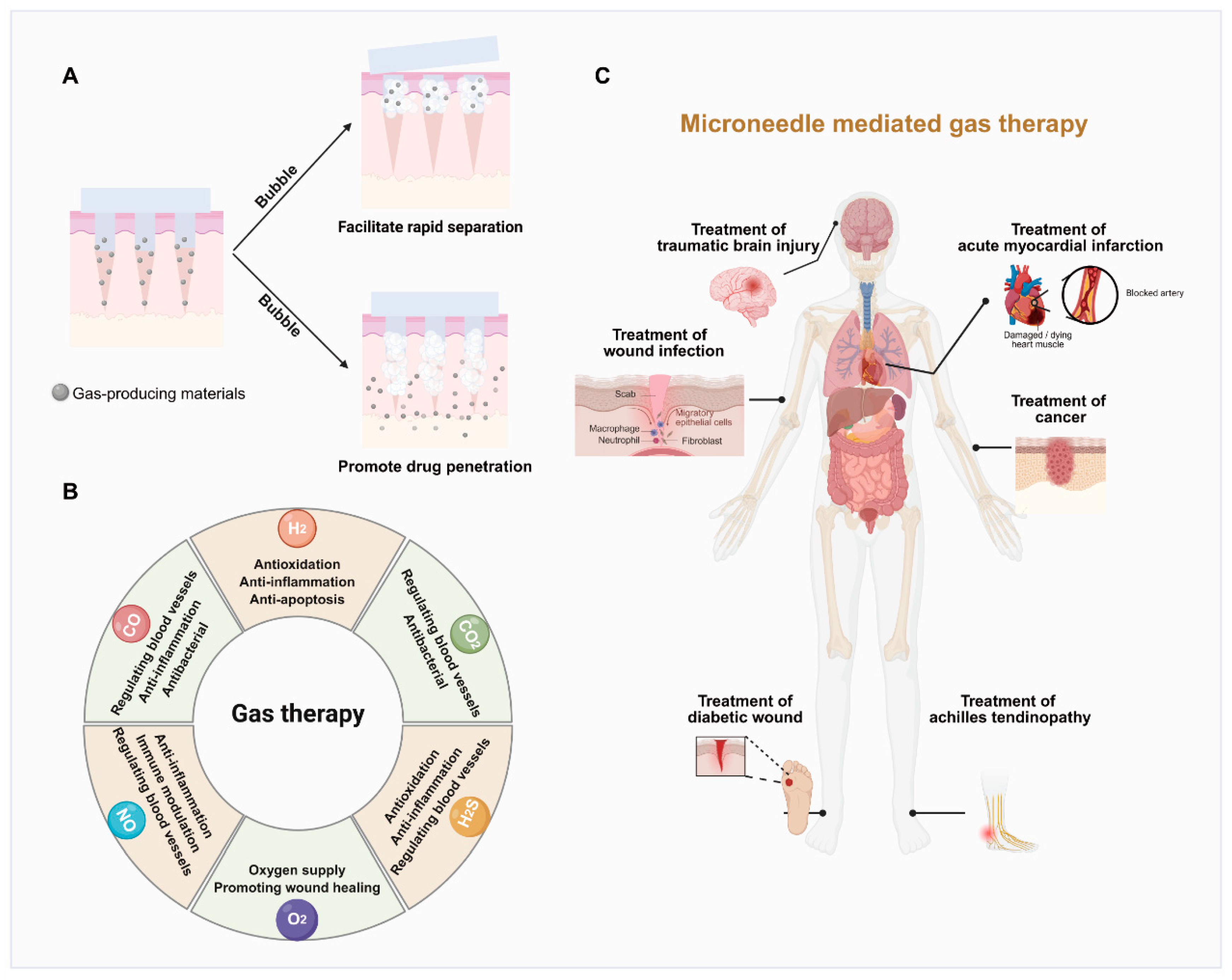
Overall, in comparison with conventional transdermal technologies, MNs offer the advantage of creating micro-pores that overcome limitations of the skin barrier, thereby significantly enhancing drug penetration. When utilized in combination with gas therapy, MNs exhibit a pronounced enhancement in drug delivery efficiency, surpassing the capabilities of non-gas-producing MNs. The utilization of gas to promote base separation and facilitate drug diffusion is a strategy that has been employed to optimize the safety and efficacy of transdermal delivery. In summary, the present study adopts MNs as its central research focus, leveraging their unique advantages over traditional TDDS while addressing their current shortcomings through combination with gas delivery. Firstly, this review methodically appraises the merits and limitations of MN delivery, then explores the MN-mediated gas delivery for rapid separation and enhanced drug penetration. Subsequently, we investigated the application potential of combined therapy assisted by MNs-mediated gas delivery for various diseases, along with an analysis of their potential developments and future challenges (Scheme 1).
Scheme 1. Schematic illustration of the advances of MNs-mediated gas delivery for rapid separation, enhanced drug penetration, and combined therapy. (A) MNs-mediated gas delivery for rapid separation and enhanced drug penetration. (B) Gas species for disease treatment. (C) MNs-mediated gas delivery for combined therapy. (Created in BioRender. Th, Zw. (2025). https://biorender.com/fh2smj0).

2. MNs-Mediated Gas Delivery Facilitate Rapid Separation

The existing polymeric MN systems are characterized by inherent limitations. The process of wearing off the MN patches to ensure the release of the therapeutic agent can be quite protracted, often requiring several minutes in the case of water-soluble materials or even several days in the case of biodegradable polymers. This prolonged duration can lead to diminished patient compliance and the occurrence of undesirable cutaneous effects, such as erythema and edema. This phenomenon is of particular concern in the case of pediatric patients who are naturally active and thus less likely to remain still [25,26]. To address these challenges, researchers have enhanced patient comfort by incorporating gas-producing substances within MNs. The gas bubbles that form upon skin penetration facilitate the rapid separation of the MN tip from the substrate, thereby allowing the drug-loaded tip to remain embedded in the skin. This approach has been demonstrated to enhance the efficacy of drug delivery while concurrently reducing the duration of MN contact with the skin [27].
Ning et al. [21] developed a Dual-Layer Dressing Microneedle System (DDMNS). The DDMNS comprised two components: the first component was the chitosan hydrogel dressing (CSHD), which served as the upper layer dressing, and the second component was the detachable MN patch with a panax notoginseng saponins (PNS)-loaded chitosan (CS) tip and a polyvinyl pyrrolidone (PVP) backing substrate loaded with magnesium (Mg) microparticles, which served as the bottom layer dressing. The Mg-PVP backing substrate exhibited rapid dissolution in the humid environment facilitated by the upper layer dressing. Furthermore, the moist local environment provided by CSHD enhances the response between Mg particles and hydrogen ions in an inflammatory environment, thereby facilitating the separation of the MN tip from the substrate. In model wound tissues, MNs containing magnesium achieved a separation rate of 87.5% and demonstrated effective drug penetration within 5 min. In contrast, DDMNS without Mg exhibited a reduced degree of penetration.
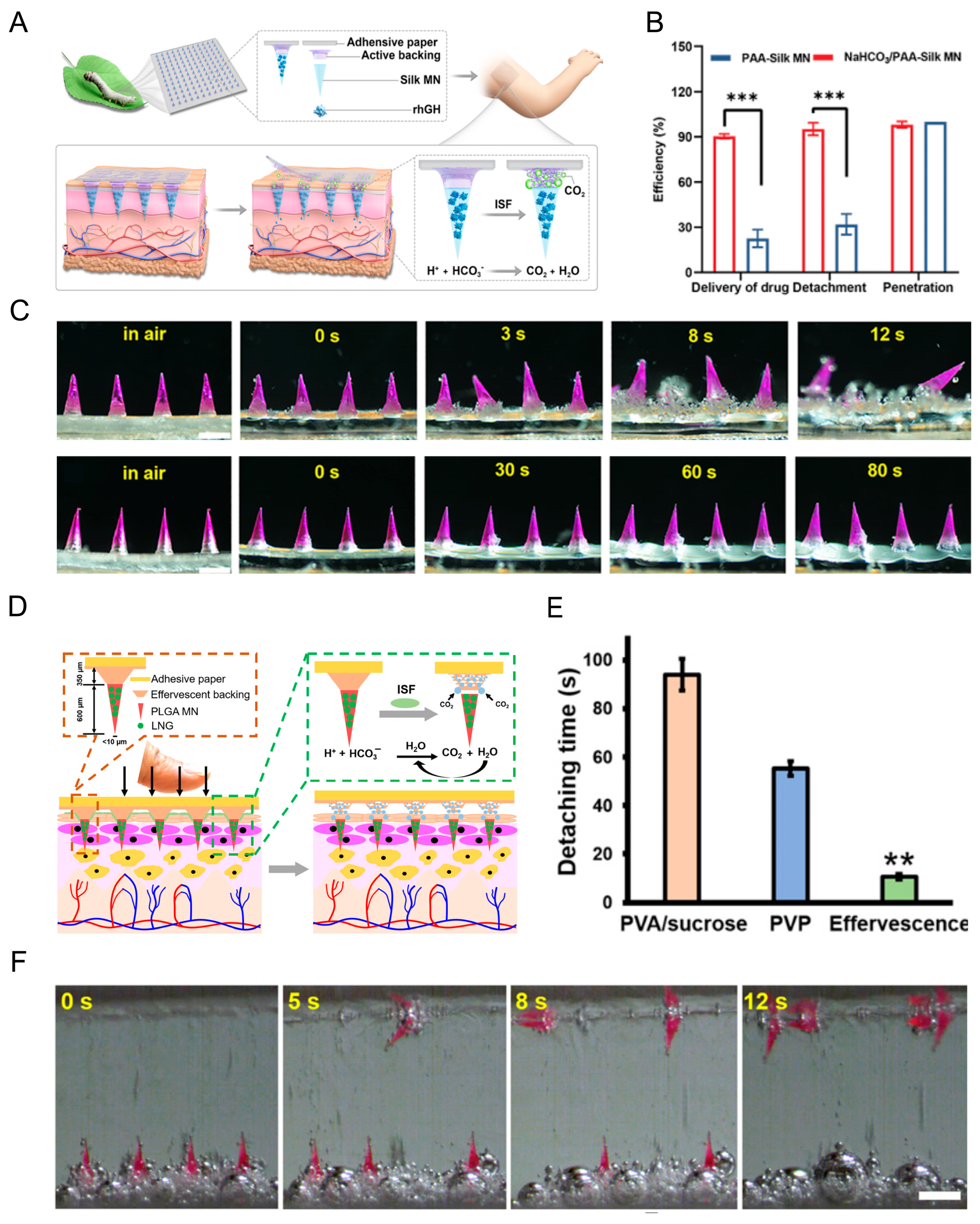
Yang et al. [26] (Figure 1A) designed an actively separable MN patch for treating growth hormone deficiency. The researchers integrated the effervescent agent sodium bicarbonate (NaHCO3) into a separating poly (acrylic acid) (PAA) layer. Upon absorbing interstitial skin fluid, PAA generates protons, which react with NaHCO3 to produce CO2. This reaction is characterized by its rapidity and efficacy, resulting in the separation of the MN tip from the base within approximately 11.41 ± 0.43 s (Figure 1C). The experimental results demonstrated a separation efficiency that exceeded 95% in isolated pig skin, in comparison to a mere 32% in the absence of NaHCO3 (Figure 1B). In a rat model of growth hormone deficiency, the weekly application of this MN patch demonstrated efficacy that was comparable to the daily subcutaneous injections.
Figure 1. (A) Schematic illustration of the design of an MN patch with active backing and the process of MN application to skin. (B) Quantification of the detachment and drug delivery efficiency of MN patches with or without active backing, *** p < 0.001. (C) In vitro separation behavior of NaHCO3/PAA-Silk MN patch (upper) and PAA-Silk MN patch (lower) at different times. Scale bar = 500 μm. Reproduced with permission from ref. [26]. under the terms of the Creative Commons CC BY-NC-ND 4.0 license. Copyright 2023, with permission from Elsevier. (D) Schematic illustration of the design of an MN patch with effervescent backing and the process of MN patch application to skin. (E) Quantification of detaching time of MNs patches with effervescent backing, PVA/sucrose backing, and PVP backing. ** p < 0.01. (F) Dissolution of the effervescent backing and detachment of MNs in PBS over time. Scale bar=500 μm. Reproduced with permission from ref. [28]. 1 under the terms of the Creative Commons CC BY-NC license. Copyright 2019, The American Association for the Advancement of Science.
In another study, Li et al. [28] (Figure 1D) introduced a MN patch designed for sustained levonorgestrel (LNG) release. The researchers incorporated effervescent substances, namely NaHCO3 and citric acid, between the tip and substrate layers. This effervescent MN patches demonstrated the capacity to achieve rapid MN separation within 10.7 s in phosphate-buffer solution, while MNs without effervescent backing exhibited a longer separation time (Figure 1E,F). Ex vivo experiments also validated this rapid separation, with the separated MN tips remaining embedded in the skin to degrade gradually and sustain LNG release for up to one month in rat models.

3. MNs-Mediated Gas Delivery for Enhanced Drug Penetration

MN technology is a promising drug delivery system, with polymeric MNs being most prevalent [29]. However, their drug delivery typically relies on passive diffusion [30], and skin elasticity limits MN penetrate depth [31], often insufficient for effectively treating deep tumors or thickened skin conditions like hypertrophic scar and psoriasis [32,33]. Consequently, strategies to enhance drug delivery efficiency using MNs are required. Although external driving forces such as ion electroosmosis [30], ultrasound [34], or magnetic fields [35] can improve drug diffusion, they necessitate complex equipment, making gas-driven MNs a simpler, more practical alternative.
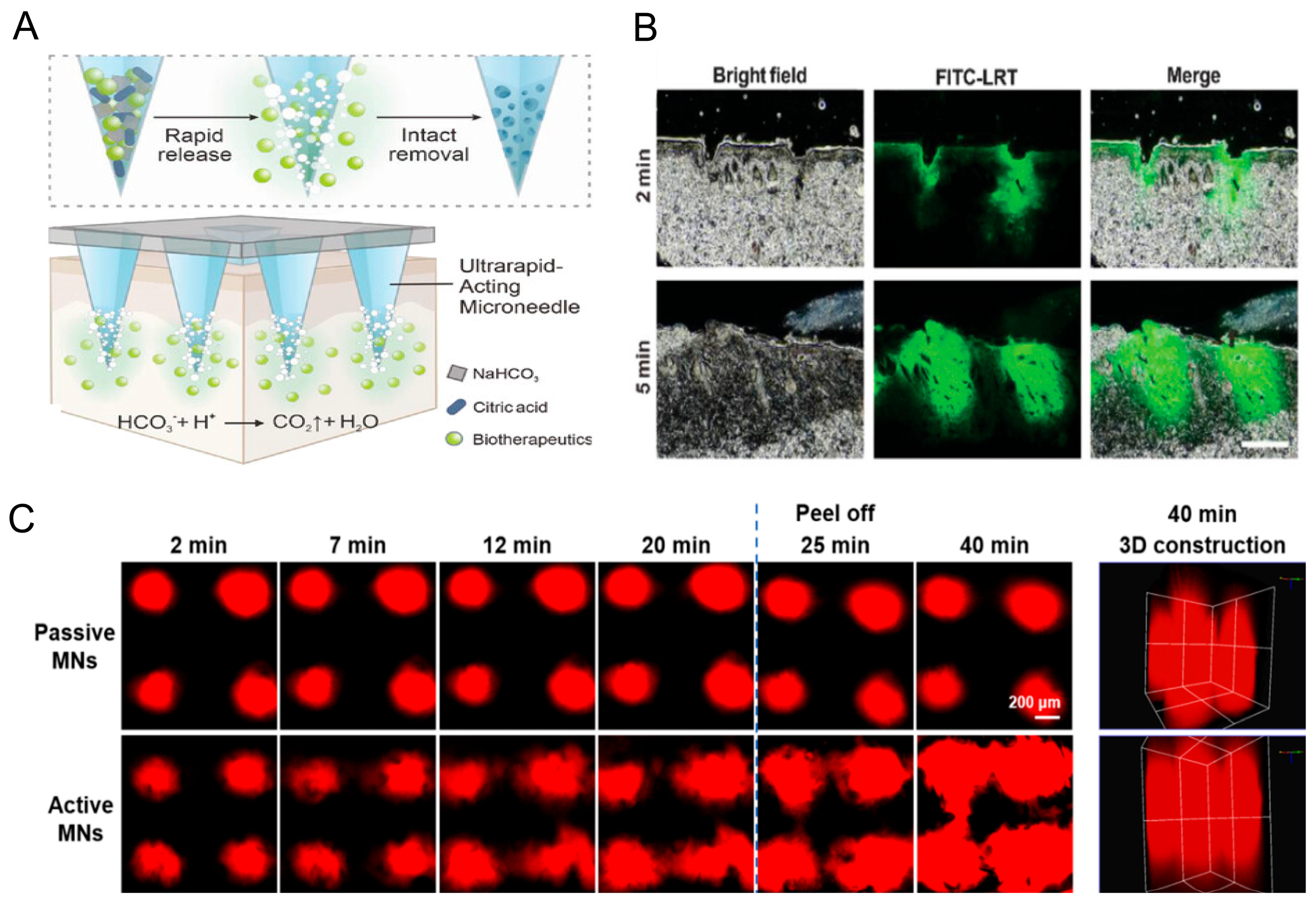
Gas-producing MNs function by embedding substances that generate gas upon contact with interstitial skin fluid, creating bubbles and vortices that significantly enhance drug diffusion and penetration [36,37]. Typically, effervescent components (organic acids combined with basic carbonate salts) can produce CO2 upon hydration. For instance, Zhang et al. [22] used PVP K30, polyvinyl alcohol (PVA), potassium carbonate (K2CO3), and citric acid to develop gas-driven MNs, achieving a cumulative transdermal drug delivery rate 1.19 times greater than passive MNs. In another study, Chen et al. [37] enhanced anti-follicle aging treatment by employing NaHCO3 and citric acid to facilitate deeper drug penetration. You et al. [36] (Figure 2A) similarly developed an ultra-rapid-action MN patch (URA-MN) using NaHCO3 and citric acid, rapidly producing CO2 bubbles and a porous structure to accelerate drug release within minutes. Frozen sections show that the drug loaded in URA-MN could rapidly diffuse within 5 min (Figure 2B). Wen and colleagues [38] (Figure 2C) also introduced NaHCO3 and citric acid into MNs as a built-in engine to generate CO2 bubbles, thereby enabling enhanced lateral and vertical drug diffusion into dense scar tissue.
Figure 2. (A) Schematic illustration of immediate delivery of biotherapeutics via the URA-MN patch. (B) Fluorescence microscopy images of rat skin sections after application of fluorescein isothiocyanate (FITC)-labeled URA-MN patch for different durations. Scale bar: 500 µm. Reproduced with permission from ref. [36]. Copyright 2023, Wiley. (C) Drug transverse diffusion and longitudinal penetration of MNs containing effervescent agents in isolated rat skin. Reproduced with permission from ref. [38]. under the terms of the Creative Commons CC BY 4.0 license. Copyright 2025, with permission from Elsevier.
Furthermore, gas generation utilizing NaHCO3 has been exploited to target acidic microenvironments [39]. Tao et al. [40] developed a bubble pump MN system, integrating NaHCO3 within copper sulfide nanoparticles loaded with fucoidan and doxorubicin in hyaluronic acid MNs. The generated CO2 notably improved drug penetration in vitro. Shi et al. [41] created cannabidiol loaded MNs employing calcium carbonate and NaHCO3 to produce CO2, enhancing cannabidiol penetration and altering tumor microenvironment pH to promote immune responses against melanoma. Ke et al. [42] similarly demonstrated sequential drug release via MNs containing Alexa 488 and polylactic acid-polyglycolic acid hollow microspheres loaded with Cy5 and NaHCO3, significantly enhancing drug diffusion under acidic conditions. Addressing postoperative analgesia, Zhang et al. [43] developed a pH-responsive core–shell MN containing ropivacaine microcrystals. Under acidic conditions, CO2 production ruptured the MN shell, achieving sustained analgesia for up to 72 h. For diabetes management, Ullah et al. [44] developed MNs encapsulating insulin, glucose oxidase (GOx), and NaHCO3 within porous polymer layers coated with polylactic acid-polyglycolic acid films. Upon the diffusion of glucose into the porous layer, the ensuing oxidation to gluconic acid is catalyzed by GOx. This reaction initiates a local pH decline, leading to the decomposition of NaHCO3 to yield CO2. The glucose-induced CO2 release ruptured the polymer film, enabling controlled insulin release and preventing hypoglycemia.
Besides CO2, other gases such as O2 and H2 have been explored. Sodium percarbonate functions as an oxygen-releasing material, facilitating the delivery of sustainable levels of oxygen to hypoxic sites and tissues [45]. As posited by Liu and colleagues [46], the utilization of chlorin e6 (Ce6)-loaded MN patches has been demonstrated to facilitate more profound transdermal drug delivery, in conjunction with enhanced photodynamic therapy (PDT). This enhancement is achieved through the incorporation of sodium percarbonate into PVP MNs. In vivo experiments in tumor-bearing mice demonstrated that tumor growth was significantly inhibited, and the survival rate increased by 50%. Lopez-Ramirez et al. [47] developed degradable MNs with Mg particles generating H2, significantly improving drug penetration and immune response in melanoma treatment. Psoriasis is a prevalent chronic inflammatory skin disease marked by accelerated keratinocyte proliferation. Consequently, enhancing drug delivery to the epidermis can markedly improve therapeutic efficacy [48]. Zheng et al. [24] created a microbe-driven bilayer MN employing Enterobacter aerogenes (E.A.) to generate H2, effectively enhancing drug penetration depth. This innovative approach offers precise control of drug delivery depth and provides a promising advancement for MN drug delivery systems.

4. MNs-Mediated Gas Delivery for Combined Therapy

Beyond its capacity to expedite the segregation of the tip and base and the diffusion of pharmaceutical agents, gas can also function as a therapeutic tool. Gas therapy has emerged as a novel therapeutic modality, garnering heightened interest due to its notable capabilities in the management and treatment of various diseases [49,50]. This prominence can be ascribed to the merits of gas therapy, including its efficiency and biosafety when compared to conventional pharmaceutical interventions [51]. In clinical practice, therapeutic gases are administered by inhalation. However, the therapeutic potential of this mode of administration is limited by several factors. Direct inhalation of gases is difficult to control, and there may be a risk of gas toxicity [52,53]. In recent years, due to the rapid development of nanomaterials, some researchers have enhanced the efficacy of gas therapy by integrating gases or gas precursors with nanocarriers to enable controlled, responsive release of gases in response to endogenous stimuli (e.g., H2O2, lactic acid, glucose, and enzymes) and exogenous stimuli (e.g., light, X-rays, ultrasound, magnetic fields, and heat) [49,54]. As a multifunctional platform, MNs can be used for gas therapy through transdermal drug delivery, while combining different therapeutic strategies for synergistic treatment [55]. Advances in medical technology have led to the exploration of MN-mediated gas delivery as a potential therapeutic modality for various diseases. In this section, we provide a synopsis of the various types of therapeutic gases (Table 1) and recent advancements in MN-mediated gas delivery for various diseases (Table 2).

4.1. Gas Species for Disease Treatment

4.1.1. Hydrogen (H2)

Recent research has demonstrated that low concentrations of H2 can neutralize intracellular reactive species such as hydroxyl radicals and peroxynitrites, thereby reducing oxidative stress, inflammation, apoptosis, and fibrosis without disrupting normal metabolic processes [56]. Conversely, high concentrations of H2 can induce apoptosis in cancer cells by inhibiting energy metabolism, suppressing vascular endothelial growth factor (VEGF) expression, modulating the PI3K/Akt pathway, and triggering systemic immune responses [57]. However, traditional H2 delivery methods, such as inhalation, oral consumption, and injection of H2-rich water, encounter significant limitations. These methods lack targeted delivery, owing to H2’s high diffusivity and low solubility, which impede its therapeutic efficacy at lesion sites [58,59].
To address this challenge, Yuan et al. [57] developed metal-semiconductor heterostructured nanocomposites (Pt-Bi2S3), which, under ultrasound irradiation, generated substantial amounts of H2 under normoxic or hypoxic conditions. This strategy caused severe mitochondrial dysfunction in tumor cells, disrupted the antioxidant defense system, and effectively induced tumor cell death. Similarly, Gong et al. [60] engineered calcium hydride (CaH2) nanoparticles dispersed in polyethylene glycol, which, upon injection into tumors, reacted with water to produce abundant H2, calcium ions (Ca2+), and hydroxyl ions (OH), enabling H2 therapy, intracellular calcium overload, and tumor microenvironment neutralization, collectively suppressing tumor growth. Xu et al. [61] developed a novel near-infrared (NIR)active photocatalyst through the heating of melamine and 2,4,6-triamino-pyrimidine in a solid potassium chloride template. This system-mediated NIR photocatalysis has been shown to generate H2, thereby reducing the energy metabolism and contributing to efficient tumor therapy.

4.1.2. Carbon Monoxide (CO)

CO is a colorless, odorless gas historically known for its high affinity for hemoglobin, resulting in toxicity at elevated concentrations, such as hypoxia, convulsions, or death. Recently, however, CO at low physiological concentrations has gained attention as a signaling molecule, demonstrating beneficial biological effects including anti-inflammatory, anti-apoptotic, antihypertensive, vasodilatory, anti-atherosclerotic, and cytoprotective properties. Despite these promising attributes, clinical application of gaseous CO has been hindered by challenges in safe storage, controlled delivery, and targeted release. CO-releasing molecules have emerged as promising alternatives, safely delivering CO to therapeutic sites for conditions such as inflammation, cardiovascular disease, microbial infections, cancer, and organ transplantation [62].
For example, Ma et al. [63] developed a NIR-II activated aggregation-induced emission (AIE)-based nanocarrier, releasing CO specifically in the tumor microenvironment. This released CO inhibited heat shock protein expression, significantly enhancing the efficacy of low-temperature photothermal therapy (PTT). Wang et al. [64] introduced a gaseous nano-adjuvant containing manganese carbonyl encapsulated with AIE luminogens, which released CO under NIR laser irradiation, triggering mitochondrial damage and activating the cGAS-STING pathway, thus enhancing anti-tumor immunotherapy in poorly immunogenic mammary tumors. Additionally, Wu et al. [65] developed engineered exosomes loaded with 5-hexyl aminolevulinate hydrochloride, enabling biosynthetic CO and bilirubin production upon administration, resulting in potent anti-inflammatory effects and improved treatment of atherosclerosis.

4.1.3. Nitric Oxide (NO)

NO is an endogenous gaseous signaling molecule integral to various physiological processes, including vasodilation, regulation of blood pressure and flow, inhibition of platelet aggregation and leukocyte adhesion, smooth muscle proliferation, and neurotransmission [66]. Due to its short half-life and susceptibility to interactions with glutathione (GSH), hemoglobin, superoxide, and molecular oxygen, direct therapeutic use of free NO gas is challenging. To address these limitations, multifunctional nanocarriers containing NO donors or NO-releasing agents have been extensively investigated [67].
For instance, Wang et al. [68] designed photosensitizer-free polymeric nanocapsules loaded with the NO donor DETA NONOate, achieving controlled NO release within acidic lysosomes of cancer cells. Upon photoacoustic activation, reactive oxygen species (ROS) generated at the site reacted with released NO, forming peroxynitrite (ONOO), inducing mitochondrial dysfunction, DNA damage, and subsequent cancer cell death. Zheng et al. [69] developed a biohybrid assembly of carbon-dots doped nitrogen-rich carbon and Escherichia coli bacteria, generating NO from nitrate under controlled irradiation, achieving effective anti-tumor photodynamic microbial therapy. Similarly, Sun et al. [70] fabricated electrospun nanocomposite membranes, producing sufficient ROS and NO under NIR illumination, enabling highly effective antibacterial PDT. He et al. [71] engineered conductive, self-healing hydrogels capable of controlled and targeted NO release under NIR irradiation, significantly enhancing angiogenesis and diabetic wound healing.

4.1.4. Oxygen (O2)

O2 therapy, particularly hyperbaric O2 therapy, is extensively used clinically to treat decompression sickness, arterial embolism, carbon monoxide poisoning, osteomyelitis, radionecrosis, and chronic wounds [72]. O2 availability critically influences PDT, as tumor hypoxia limits PDT efficacy. Intravenous oxygenation faces challenges due to oxygen’s poor solubility in blood, necessitating alternative methods for localized oxygen supply [73].
To address this problem, Zhou et al. [74] reported an activatable singlet O2-generating system using linoleic acid hydroperoxide and catalytic Fe2+ ions under acidic tumor conditions. Jiang et al. [75] designed conjugated polymer nanoparticles linked to hemoglobin, enhancing chemiluminescence resonance energy transfer-mediated ROS production and O2 supply for effective anticancer PDT. Furthermore, Chen et al. [76] developed algal gel patches providing sustained O2 delivery, effectively healing chronic hypoxic wounds. Guan et al. [77] proposed hydrogels containing O2-releasing microspheres and ROS-scavenging systems to continuously supply O2, enhancing cell survival, angiogenesis, and tissue regeneration in diabetic wounds.

4.1.5. Hydrogen Sulfide (H2S)

H2S is an endogenous gaseous signaling molecule recognized for its antioxidant, anti-inflammatory, and cytoprotective properties [78]. Despite these beneficial effects, direct inhalation of H2S poses toxicity risks, prompting exploration of nanocarriers and H2S-donor systems for controlled therapeutic release.
Giovinazzo et al. [79] employed slow-release H2S donor sodium GYY4137 (NaGYY) in Alzheimer’s disease models, significantly reducing cognitive and motor deficits. Wang et al. [64] developed virus-mimicking hollow mesoporous organosilica structures releasing H2S in tumor cells upon GSH-triggered degradation, inducing targeted anticancer effects. Xie et al. [80] synthesized FeS-embedded bovine serum albumin nanoclusters that simultaneously released Fe2+ and H2S under acidic tumor conditions, inhibiting cancer cell peroxidase activity. Xie et al. [81] demonstrated cardioprotective effects of the H2S donor GYY4137 during myocardial ischemia–reperfusion injury by reducing oxidative stress. Similarly, Wang et al. [82] showed that exogenous H2S alleviated emphysema and airway inflammation via activation of Nrf2 and PPAR-γ signaling pathways.

4.1.6. Carbon Dioxide (CO2)

CO2 therapy enhances localized blood supply, improves tissue oxygenation, and exhibits antiseptic and anti-tumor properties [83]. Due to systemic administration challenges, researchers have developed innovative delivery methods [84]. Xie et al. [85,86] developed photothermally activated hydrogels and CaCO3-based nanoparticles for targeted CO2 release, effectively treating skin wounds and tumors. Jeon et al. [87] created immunostimulatory nanoparticles generating CO2 and ROS, inducing immunogenic cell death and enhancing anticancer efficacy.
Overall, emerging strategies leveraging gas therapies offer promising advances in cancer treatment, diabetic wound management, wound infection control, and other pathological conditions, highlighting their potential for improved therapeutic outcomes.
Table 1. Gas species for disease treatment.
Gas TypeGas Carrier or PrecursorDriving Force or StimulationTreatment of DiseaseRef
H2Pt-Bi2S3 P t B i 2 S 3 + H + U S H 2 Anti-4T1 tumor therapy[57]
Nanoscale CaH2 particles C a H 2 + H 2 O H 2 + C a 2 + + O H Anti-orthotopic liver tumor therapy[60]
Carbon/potassium doped heptazine-based red polymer carbon nitride (RPCN) R P C N N I R H 2 Anti-4T1 tumor therapy[61]
COCORM (donor) C O R M C O Treatment of inflammation, cardiovascular disease, microbial infections, cancer[62]
Chemiexcitation-triggered AIE nanobomb
(PBPTV@mPEG(CO))
P B P T V @ m P E G E x c e s s   H 2 O 2 C O Anti-4T1 tumor therapy[63]
Gas nano-adjuvant (MTHMS) M T H M S A I E g e n M n 2 + + C O Anti-4T1 tumor therapy[64]
Hydrochloride-containing M2 exosomes
(HAL@M2 Exo)
H A L   r e l e a s e H e m e   b i o s y n t h e s i s   m e t a b o l i s m C O + b i l i r u b i n Anti-Atherosclerosis[65]
NONO-loaded nanocapsules
(NO-NCPs)
N O N C P s H + D E T A + N O Anti-EMT6 tumor therapy[68]
Carbon-dot doped carbon nitrid and E. coli MG1655 (CCN@ E. coli) N O 3 e N O Anti-4T1 tumor therapy[69]
Electrostatically spun nanocomposite membrane (UCNP@PCN@LA-PVDF) L A R O S   i n d u c t i o n N O Antimicrobial therapy[70]
Carboxymethyl chitosan/2,3,4-trihydroxybenzaldehyde/copper chloride/graphene oxide-N, N′-di-sec-butyl-N, N′-dinitroso-1,4-phenylenediamine hydrogel(CMCS/THB/Cu/GB) C M C S / T H B / C u / G B N I R N O Diabetic wound healing treatment[71]
O2Iron oxide-linoleic acid hydroperoxide nanoparticles
(IO-LAHP NPs)
I O L A H P H + 1 O 2 Anti-U87MG tumor therapy[74]
Hemoglobin-nanoparticles @liposomes
(Hb-NPs@liposome)
H b N P s C R E T 1 O 2 Anti-tumor therapy[75]
Gel beads of S. elongatus PCC7942 C O 2 , C O 3 , H C O 3 P h o t o s y n t h e s i s O 2 Diabetic wound healing therapy[76]
Oxygen releasing microspheres (ORM) O R M s O 2 Diabetic wound healing therapy[77]
H2SNAGYY (donor) N A G Y Y H 2 S Alzheimer’s disease treatment[79]
MTHMS M T H M S G S H G S S G + H 2 S Anti-4T1 tumor therapy[64]
Ferrous sulfide-embedded bovine serum albumin nanoclusters
(FeS@BSA nanoclusters)
F e S H + F e 2 + + H 2 S Anti-Huh7 tumor therapy[80]
GYY4137 (donor) G Y Y 4137 H 2 S Anti-atherosclerosis treatment[81]
Sodium hydrogen sulfide (NaHS) (exogenous donor) N a H S H 2 S Relief of emphysema and airway inflammation[82]
CO2Bicarbonate C a r b o n   N P s S u n l i g h t Thermal   Bicarbonatate CO 2 Accelerated wound healing[85]
Core–shell hybrid nanoparticles consisting of CaCO3 and MnSiOx
(CaCO3@MS nanoparticles)
C a C O 3 H + C O 2 Anti-4T1 tumor therapy[86]
Immunostimulatory CRET nanoparticles
(iCRET NPs)
i C R E T   N P s H 2 O 2 C O 2 Anti-CT26 tumor therapy[87]

4.2. Application of MNs-Mediated Gas Therapy

4.2.1. Cancer

Cancer remains a leading cause of premature mortality worldwide [88]. Traditional treatments, including surgery [89], radiotherapy [90], and chemotherapy [91], frequently result in suboptimal outcomes due to drug resistance, systemic toxicity [92], and radiation-induced damage to healthy tissues [93]. Emerging therapeutic modalities, such as immunotherapy [94], targeted therapy [95], and phototherapy [96], have broadened cancer treatment options, yet these approaches also have inherent limitations. Recently, gas therapy has emerged as a promising adjuvant due to its high selectivity, minimal side effects, and distinct therapeutic mechanisms [97,98].
Yang et al. [99] developed a wearable smart MN device composed of a dual-layer MN patch, a heating membrane, a Bluetooth-enabled flexible printed circuit board, a smartphone application, and a wristband. The inner microneedle layer made of silk fibroin (SF) is loaded with anti-PD-1 antibody (aPD-1), while the outer layer is polycaprolactone (PCL) encapsulating ammonia borane-loaded mesoporous silica nanoparticles (AB-MSN). Upon insertion into melanoma lesions and heating to 50 °C via the integrated heating membrane, the outer polycaprolactone coating melts, releasing AB-MSN, which generates H2 in the tumor’s acidic environment. H2 inhibits tumor cell proliferation and migration and effectively targets and eliminates cancer stem cells. Subsequently, the dissolution of the inner fibroin layer leads to controlled release of aPD-1 antibodies, blocking immune evasion and promoting further tumor destruction by activated T cells. The results of anti-melanoma study demonstrated that the proportion of CD8+ T cells in the aPD-1+ AB-MSN group was 38.7% ± 3.1%, which was twice higher than that of the AB-MSN group.
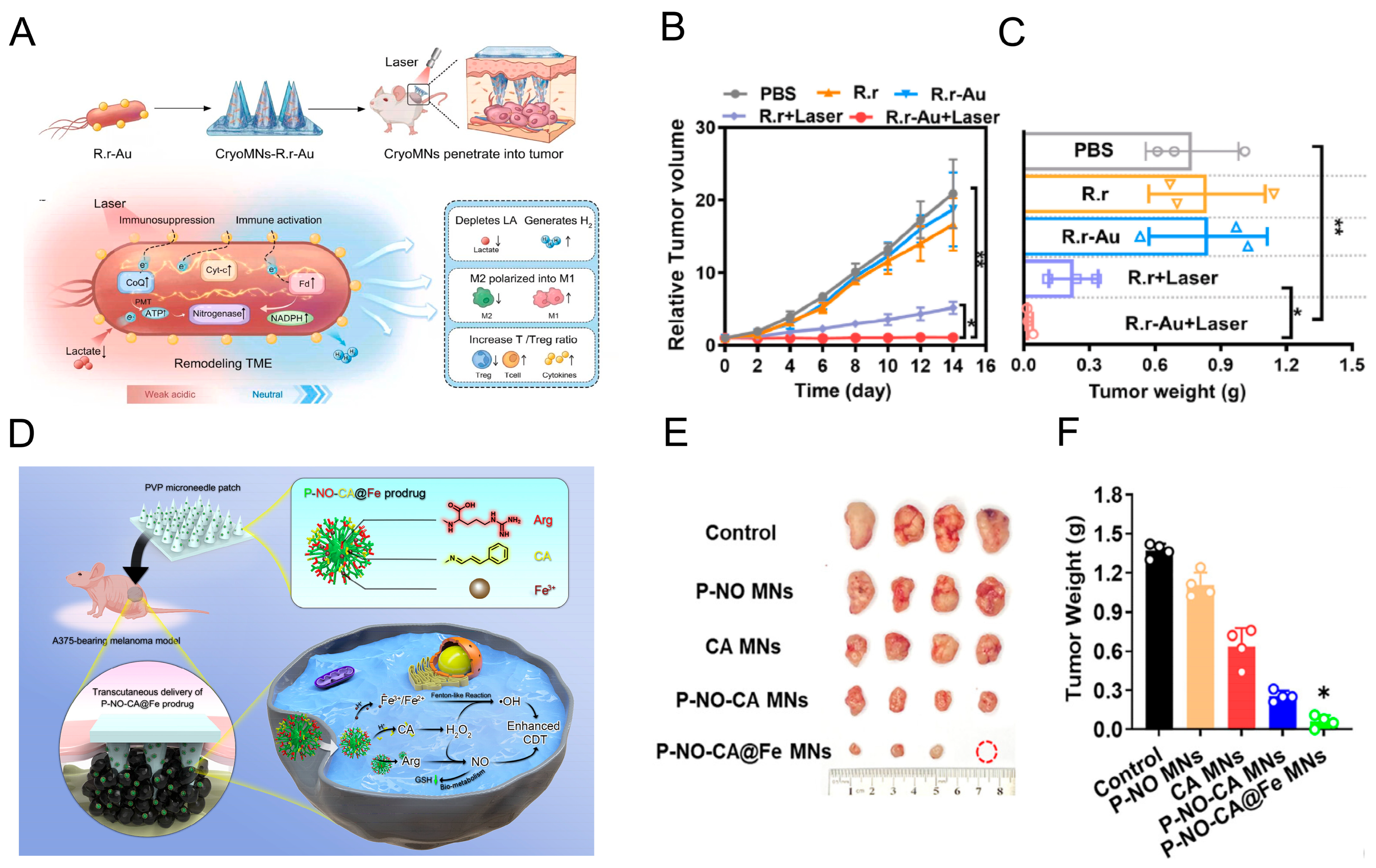
Shi et al. [100] (Figure 3A) fabricated gold-engineered cryomicroneedle (CryoMN) patches containing Rhodospirillum rubrum bacteria (R.r-Au). These bacteria metabolize lactic acid, an immunosuppressive byproduct abundant in tumor microenvironments, to produce H2 under laser irradiation. This system effectively transformed tumor-associated macrophages from an M2-type (immunosuppressive) to an M1-type (immunostimulatory) phenotype, restored cytotoxic CD8+ T cell activity, and suppressed regulatory T cells. The antitumor effect was verified by measuring the tumor volume and weight of harvested tumors, and the CryoMNs-R.r-Au (+) group showed higher antitumor activity (Figure 3B,C).
Figure 3. (A) Schematic outline of the fabrication and application of CryoMNs-R.r-Au. (B) Relative tumor volume after different treatments. (C) Weight of the extracted B16F10 tumors after day 14. * p < 0.05, ** p < 0.01. Reproduced with permission from ref. [100]. under the terms of the Creative Commons CC BY-NC-ND 4.0 license. Copyright 2024, with permission from Elsevier. (D) Schematic illustration of MNs-mediated NO-enhanced CDT for melanoma treatment. (E) Photograph and (F) weights of A375 tumors isolated from mice on day 15. * p < 0.05. Reproduced with permission from ref. [101]. Copyright 2023, American Chemical Society.
Yu and colleagues [101] (Figure 3D) tackled the inefficiencies of chemodynamic therapy (CDT), specifically insufficient tumor H2O2 and elevated GSH, using MNs loaded with poly(amidoamine) dendrimers functionalized with hydrazine groups, caffeic acid (CA, an H2O2 enhancer), ferric ions (Fe3+, a Fenton reaction initiator), and arginine (an NO precursor). Arginine is converted to NO by tumor-derived H2O2, simultaneously depleting GSH, thereby markedly enhancing antitumor efficacy in melanoma mouse models. The mice treated with this system exhibited significantly enhanced tumor inhibition compared with other groups (Figure 3E). The tumor growth inhibition rate of against A375 melanoma tumor was calculated to be 94.5% according to the weight of the excised tumors (Figure 3F).
Dong et al. [102] integrated PTT with NO therapy by developing multifunctional MNs containing sodium nitroprusside (SNP) and ferrous lactate (SNP-Fe). Upon activation by ultraviolet (UV) or natural light, SNP released NO, inducing effective tumor ablation at high concentrations while promoting tissue regeneration at lower concentrations. This dual-functionality strategy addressed common limitations of traditional PTT, including inadequate thermal penetration and poor tissue regeneration post-ablation. Mild PTT is a novel therapeutic modality that utilizes temperatures marginally above body temperature (approximately 45 °C) to heat tumor tissues for therapeutic effect, with minimal damage to normal tissues [103,104]. However, mild PTT can result in the excessive expression of heat shock proteins, leading to tumor heat resistance and diminished therapeutic efficacy [105]. To address this issue, Dong and colleagues [106] designed partitioned MNs incorporating copper sulfide nanoparticles and S-nitroso-N-acetylpenicillamine (SNAP). Under irradiation, SNAP produced NO and ROS, suppressing heat shock protein synthesis that typically leads to tumor thermoresistance, thus significantly improving mild PTT therapeutic outcomes.
CO, recognized for its potential as an adjunctive cancer treatment due to its minimal adverse effects, was employed by Jin et al. [107] through hollow mesoporous silica nanoparticles loaded with manganese-based CO-releasing molecules (MnCO@hMSN). These nanoparticles responded to tumor H2O2 by releasing CO, leading to substantial inhibition of tumor growth with negligible toxicity. Fu et al. [108] further developed core–shell MNs containing NaHCO3, tartaric acid, photocatalysts, and doxorubicin hydrochloride. Upon insertion, CO2 rapidly generated from the vesicants enhanced the diffusion of doxorubicin hydrochloride and provided substrate for CO release via photocatalysis, significantly enhancing the combined anticancer effects.
In another study, Hu et al. [23] presented smart MNs integrating gas therapy, starvation therapy, and imaging. Optimized Bi/BiVO4 Schottky heterojunctions enabled excellent photothermal conversion and computed tomography imaging capabilities, while loaded GOx and diallyl trisulfide (DATS) allowed ultrasound- or NIR-triggered H2S gas release, synergistically enhancing antitumor efficacy through combined gas and starvation therapy. In vivo antitumor experiments reH2Svealed that the MN + US + NIR group exhibited the most significant reduction in tumor volume.

4.2.2. Diabetic Wound

Diabetic wound remain clinically challenging, characterized by prolonged hyperglycemia, elevated pH [109], oxidative stress, chronic inflammation [110], impaired angiogenesis, and increased susceptibility to infections [111,112]. Current standard treatments such as surgical debridement and infection control often yield limited success [113,114]. Consequently, gas-based therapies utilizing endogenous signaling molecules, including NO, H2S, H2, and O2, have gained prominence due to their potent roles in modulating inflammation, bacterial infections, and promoting healing [115,116,117,118,119].
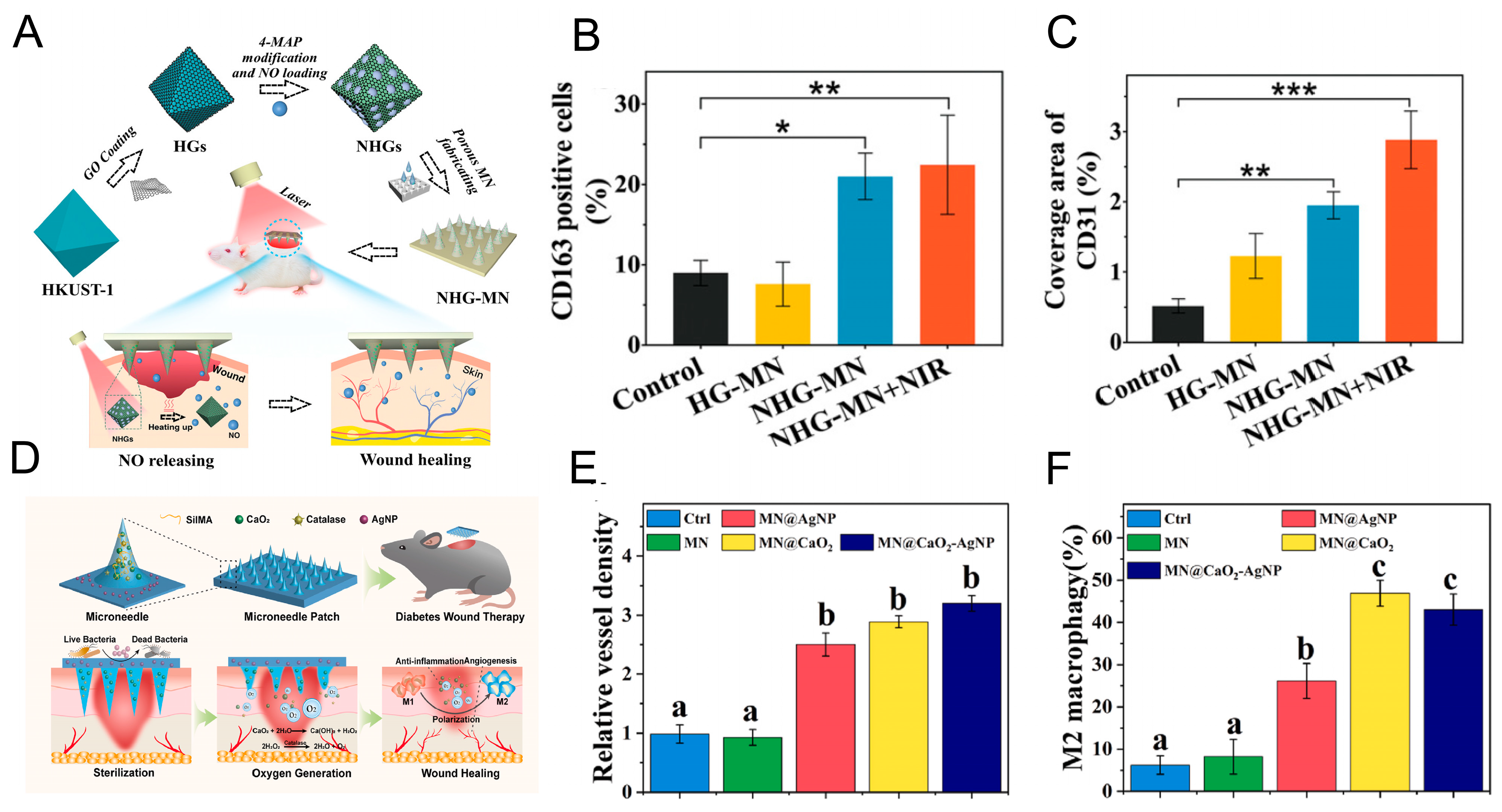
Yao et al. [120] (Figure 4A) designed a MN patch composed of copper-based metal–organic frameworks combined with graphene oxide, enabling controlled release of NO under NIR irradiation. This approach significantly accelerated diabetic wound healing by promoting M2 macrophage polarization and enhancing angiogenesis (Figure 4B,C). In another study, Cai et al. [121] synthesized a biomineralized nanoenzyme functionalized with Polymyxin B, delivering continuous and controlled release of H2S. The nanoenzyme was further loaded into MNs prepared with polyvinyl alcohol and hydroxyethyl methacrylate. These MNs exhibited potent antioxidant, antimicrobial, and anti-inflammatory effects.
Wang and colleagues [122] developed MNs loaded with magnesium hydride (MgH2) facilitating sustained H2 and magnesium ions (Mg2+) release. The ex vivo experiments demonstrated that H2 significantly enhanced diabetic wound healing by reducing ROS production as well as Mg2+-promoted M2 macrophage polarization. In a diabetic mouse model, the wounds in the MN-MgH2 group exhibited signs of healing, while the wounds in the other groups remained unresolved. In a similar study, Tao et al. [123] designed a MN patch loaded with graphene oxide (GO)/Co2+ and ammonia borane@mesoporous silica nanoparticles (AB@MSN). The H2 generated by AB@MSN has been shown to remove excess ROS, and subsequent H2 reduction of oxygen-containing functional groups in GO has been demonstrated to result in the release of Co2+. This, in turn, has been observed to promote vascular regeneration. In vivo experiments in diabetic rats demonstrated the efficacy of this system in promoting wound healing.
Chronic diabetic wounds are characterized by impaired oxygen delivery to the wound site due to compromised blood vessel integrity. This results in the formation of a hypoxic environment surrounding the wound, which, in turn, contributes to a protracted healing process [124]. To address this issue, Sun et al. [125] (Figure 4D) used silk fibroin methacryloyl (SiLMA) as a MN material, with the tip of the MN encapsulated with calcium peroxide and catalase, and the bottom coated with antimicrobial silver nanoparticles. Calcium peroxide, when exposed to water, undergoes a reaction that results in the formation of H2O2. In the presence of catalase, the decomposition of H2O2 occurs, leading to the sustained production of O2 for up to seven days. In a murine model of diabetes, the system demonstrated a substantial propensity for enhancing angiogenesis and M2 macrophage polarization (Figure 4E,F). As indicated by the works of Ran et al. [126], Zhang et al. [127], Liu et al. [128], Zhao et al. [129], and Gao et al. [130], the focus also has been placed on the alleviation of hypoxia in diabetic wounds through the utilization of MNs for the delivery or generation of oxygen. These innovative strategies incorporated calcium peroxide, catalase, responsive hydrogels, and photosynthetic microalgae (Chlorella vulgaris), improving oxygenation, enhancing angiogenesis, and facilitating faster wound healing.
Figure 4. (A) Schematic diagram of the preparation and application of the MN array for NO release to promote diabetic wound healing. (B) Quantification analysis of CD163 positive cells. (C) Quantitative evaluation of the coverage area of CD31. * p < 0.05, ** p < 0.01, *** p < 0.001. Reproduced with permission from ref. [120]. under the terms of the Creative Commons CC BY license. Copyright 2021, with permission from Wiley. (D) Schematic illustration of the MN patch for O2 generation to promote wound healing. (E) Quantitative analysis of vascular density. (F) Analysis of the proportion of M2 macrophages. Different letters denote statistically significant differences (p < 0.05). Reproduced with permission from ref. [125]. under the terms of the Creative Commons CC BY 4.0 license. Copyright 2024, with permission from Elsevier.

4.2.3. Wound Infection

Gas therapy mediated by MNs is also effective against infected wounds. In a recent study, Shi et al. [131] designed a multifunctional heterostructure consisting of ultrasmall platinum–ruthenium nanoalloys and porous graphitic carbon nitride C3N5 nanosheets (PtRu/C3N5), which were embedded within hyaluronic acid MNs. This approach resulted in the generation of H2 under light irradiation, accompanied by noteworthy antimicrobial and anti-inflammatory activities. The authors demonstrated that the H2 production increased with irradiation time and that there was no significant decrease in H2 production efficiency after four consecutive cycles of irradiation. The in vivo experiments demonstrated that this system exhibited a substantial enhancement in the healing process of skin wounds in bacterially infected mice.
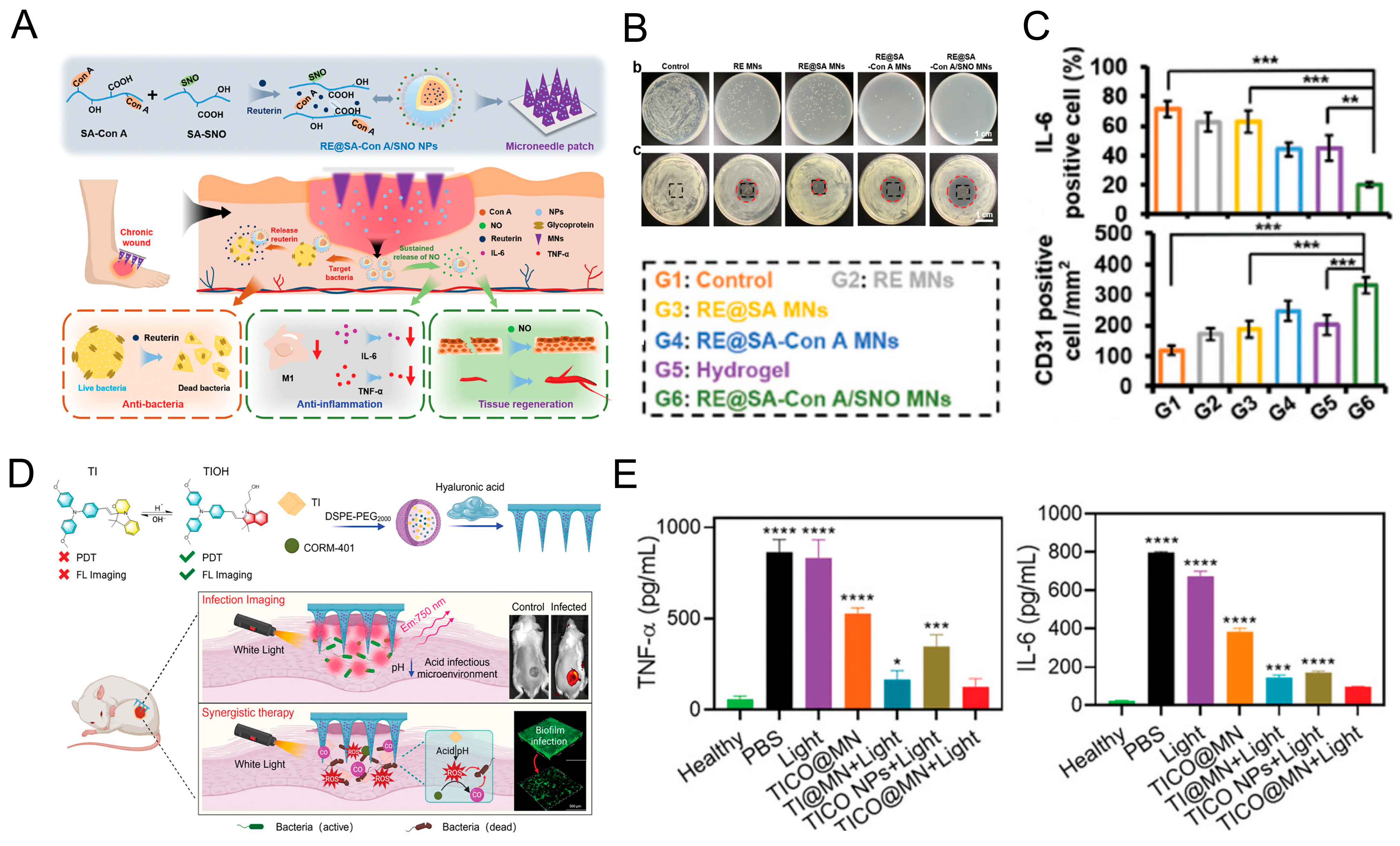
Jin et al. [132] (Figure 5A) proposed a novel MN patch loaded with NO-encapsulated nanocarriers for the synergistic treatment of chronic skin wounds. The nanocarriers were composed of sodium alginate (SA) encapsulating reuterin (RE@SA) and immobilized concanavalin A (Con A) and NO molecules (RE@SA-ConA/SNO). Con A can target bacteria through specific recognition of polysaccharides on bacterial surfaces, which is followed by the release of the antimicrobial agent to achieve an effective antimicrobial effect. With the assistance of MNs, the nanoparticles could achieve effective antibacterial effect (Figure 5B). Moreover, NO was released in a sustained manner accompanied by the dissociation of nanoparticles in the wound tissue, which exerted potent anti-inflammatory action and benefited vascular regeneration (Figure 5C), further promoting chronic wounds closure.
Figure 5. (A) Schematic illustration of MN patches mediated NO delivery for accelerating chronic wound healing. (B) The antibacterial effect of MNs in vitro (b: Representative images of LB agar plates showing the growth of S. aureus after incubation with different MNs for 24 h; c: Representative images of the inhibition zones against S. aureus with different treatments for 24 h. Black dashed squares indicate the application position of MN patch, and red dashed circles indicate the inhibition zone). (C) Quantitative analysis of IL-6 positive cell and CD31 positive cell in different groups on day 9. ** p < 0.01, *** p < 0.001. Reproduced with permission from ref. [132]. Copyright 2024, Wiley. (D) Schematic illustration of a theranostic MN platform that integrates infection-activated fluorescence imaging and PDT-CO gas synergistic antibacterial activities. (E) The levels of IL-6 and TNF-α in the infected tissue after different treatments. * p < 0.05, *** p < 0.001 and **** p < 0.0001. Reproduced with permission from ref. [133]. Copyright 2024, Wiley.
In another study, Xu and colleagues [133] (Figure 5D) constructed a multifunctional MN platform encapsulating a ROS-responsive CO donor (CORM-401) and a diagnostic fluorescent probe (TICO). Upon encountering acid-producing bacteria, the probe undergoes molecular structural change and exhibits significant near-infrared fluorescence output for detecting infections and assessing their severity. Concurrently, the nanoprobe is capable of generating ROS, which not only directly eliminates the bacteria through oxidative damage, but also triggers the release of CO for adjuvant therapy. In a mouse subcutaneous infection model, infected wounds treated with TICO@MN plus light exhibited nearly complete healing, with a wound healing rate exceeding 87%. Compared with other experimental groups, the wounds treated with TICO@MN + light groups showed a significant decrease in IL-6 and TNF-a levels (Figure 5E), thereby inhibiting the spread of wound inflammation and promoting tissue regeneration.

4.2.4. Other Diseases

Beyond cancer and wounds, MN-based gas therapy shows promise in treating conditions such as Achilles tendinopathy, traumatic brain injury, acute myocardial infarction, postoperative pain, and skin photoaging.
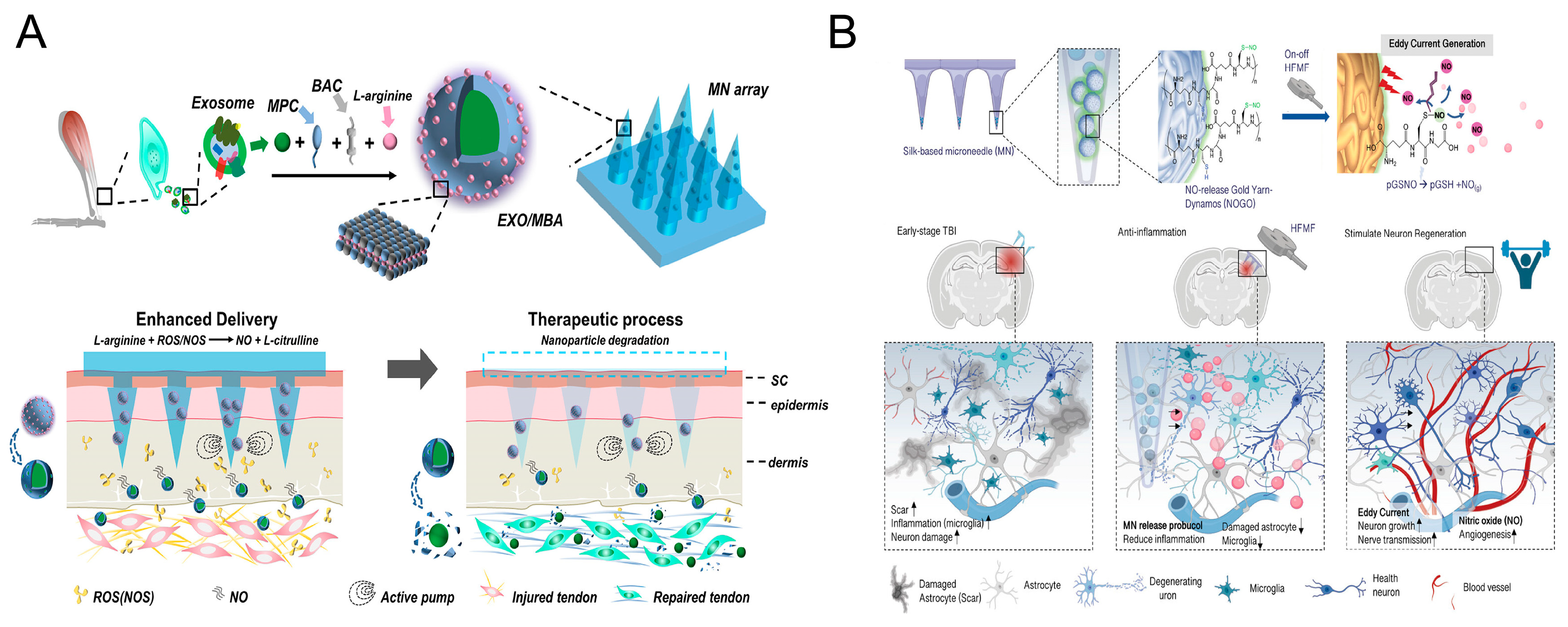
Achilles tendinopathy (AT) is a chronic degenerative disease in which persistent oxidative stress and inflammation lead to tendon degeneration [134]. Recent studies have demonstrated the efficacy of tendon stem cell-derived exosomes in promoting the healing of injured tendons [135]. However, satisfactory therapeutic effects cannot be obtained by injecting exosomes. To address this issue, Liu et al. [136] (Figure 6A) designed a detachable MN array loaded with tendon-derived exosomes and NO-producing nanomotors for the purpose of facilitating AT healing. L-arginine functions as an NO donor, leading to the production of anti-inflammatory gaseous NO in the presence of ROS. Additionally, NO functions as a driving force, thereby enhancing the depth of penetration of exosomes. The in vivo experiments demonstrated that the MN patch induced a more efficient healing process in AT rats than a single exosome injection.
Traumatic brain injury (TBI) is a series of injuries caused by external head trauma, such as intracranial hematomas, which can lead to disability and even death [137]. Chiang et al. [138] (Figure 6B) proposed the development of high-frequency magnetic field (HFMF)-responsive NO-release gold yarn-dynamos (mNOGO). These dynamos utilize HFMF to trigger NO release and electrical stimulation, with the objective of restoring brain function after TBI. The system consists of an NO donor (poly(S-nitrosoglutathione)) and a gold yarn-dynamo (GY), which is loaded into a silk MN. In vivo experiments demonstrated that the GY and NO donors-loaded MNs lowered astrocytes and immune responses, leading to improved nerve regeneration. Moreover, the MNs promoted angiogenesis with the assistance of HFMF, thereby facilitating the regeneration of neurons in vivo.
Figure 6. (A) Schematic illustration of MN array loaded with tendon-derived exosomes and NO-producing nanomotors for AT healing. (B) Schematic illustration of MNs-mediated NO release to improve TBI therapeutic efficacy. Reproduced with permission from ref. [138]. under the terms of the Creative Commons CC BY license. Copyright 2023, with permission from Wiley.
Acute myocardial infarction (AMI) is a serious cardiovascular emergency that arises primarily from coronary artery occlusion. The condition is characterized by an overproduction of ROS, in addition to persistent inflammation and oxidative stress. Wang et al. [139] developed a ROS- and US-responsive bilayer MNs. In the acute phase of AMI, the upper MNs could rapidly release cerium oxide nanoparticles in the presence of ROS. In contrast, during the chronic repair phase, micro-nano reactors (mesoporous silica nanoparticles loaded with curcumin and L-Arg (CLMS)) located in the lower MNs produced NO under ultrasound irradiation. The experimental results indicated that the NO generation was activated by US irradiation. This design has been demonstrated to resist oxidative stress and reduce inflammation in the acute phase, while promoting myocardial repair in the chronic phase. In evaluations of in vivo therapeutic efficacy, the US + MN group demonstrated improvements in cardiac function and exhibited the most potent immunomodulatory effects.
Postoperative pain management is a critical issue that needs to be addressed in modern anesthesiology and perioperative medicine. Inadequate pain management has been demonstrated to prolong hospital stays, impede wound healing, and diminish quality of life. Previous research indicates that H2 has the capacity to not only mitigate pain but also to facilitate wound healing by decreasing inflammation and oxidative stress. Zhang et al. [140] employed dissolving MNs to deliver polydopamine-modified ZIF-8@ammonia borane nanoparticles (PDA@ZIF-8@AB) and temperature-responsive QX-314-loaded PCL microspheres. The experimental results demonstrated that the nanoparticles could sustainably release H2 in the postoperative acidic environment, alleviating pain and promoting wound healing. Meanwhile, PCL@QX-314 microspheres, activated by NIR light, could regulate the release of the local anesthetic drug QX-314, thereby achieving effective analgesic effects.
Excessive exposure to UV radiation is a major factor in the development of skin photoaging wrinkles. Although there are currently various methods for combating photoaging, including the topical application of antioxidants, Botox injections, and platelet-rich plasma therapy [141,142], the therapeutic effects are often limited to slowing the progression of the disease, making it difficult to achieve true “reversal”. Lin et al. [143] introduced galvanic cell MN patches with magnesium-containing bipolar electrodes. These patches operate through a galvanic cell mechanism, generating microcurrents and releasing H2 and magnesium ions via a redox reaction. The combination of antioxidant and anti-inflammatory properties of H2, microcurrent-induced stimulation of cell migration, and promotion of angiogenesis and macrophage M2 polarization of magnesium synergistically works to reverse photoaging wrinkles and rejuvenate the skin. This approach demonstrates potential for promoting research and development in the domain of medical cosmetology.
Table 2. Applications of MNs-mediated gas delivery.
ApplicationGasMN TypesGas-Producing ComponentsConditionRef
Facilitate rapid separationCO2Dissolving MNsNaHCO3Growth hormone deficiency[26]
CO2Dissolving MNsNaHCO3, citric acidLong-acting contraception[28]
H2Dissolving MNsMgChronic wounds[21]
Enhanced drug penetrationCO2Dissolving MNsK2CO3, citric acid/[22]
CO2Dissolving MNsNaHCO3, citric acidAndrogenetic alopecia (AGA)[37]
CO2Dissolving MNsNaHCO3, citric acidDiabetic[36]
CO2Dissolving MNsNaHCO3, citric acidHypertrophic scar[38]
CO2Dissolving MNsNaHCO3Melanoma[40]
CO2Dissolving MNsNaHCO3Melanoma[41]
CO2Dissolving MNsNaHCO3/[42]
CO2Dissolving MNsNaHCO3Postoperative pain[43]
CO2Coated MNsNaHCO3Diabetic[44]
H2Dissolving MNsMgMelanoma[47]
Combined therapyH2Dissolving MNsAB-MSNMelanoma[99]
H2Dissolving MNsAB-MSNDiabetic wounds[123]
H2Dissolving MNsMgH2Diabetic wounds[122]
H2Dissolving MNsE.A.Psoriasis[24]
H2Dissolving MNsPDA@ZIF-8@ABPostoperative pain[140]
H2Dissolving MNsPtRu/C3N5Wound infection[131]
H2Galvanic cell MNsMgSkin photoaging[143]
H2CryomicroneedlesR.r-AuMelanoma[100]
NODissolving MNsP-NO-CA@FeMelanoma[101]
NODissolving MNsSNAPMelanoma[106]
NODissolving MNsSNP-FeMaxillofacial malignant skin tumors[102]
NODissolving MNsRE@SA-ConA/SNOWound infection[132]
NOHydrogel MNsmNOGOTBI[138]
NOHydrogel MNsCLMSAMI[139]
O2Hydrogel MNsOxygen-carrying protein hemoglobinDiabetic wounds[127]
O2Hydrogel MNsDopamine-functionalized sericin protein (SDA)Diabetic wounds[128]
O2Hydrogel MNsChlorella vulgarisDiabetic wounds[129]
O2Hydrogel MNsChlorellaDiabetic wounds[130]
O2Hydrogel MNsCalcium peroxideDiabetic wounds[125]
O2Dissolving MNsManganese/Dopamine-enhanced calcium peroxideDiabetic wounds[126]
H2SDissolving MNsDATSBreast cancer[23]
H2SDissolving MNsBiomineralized nanoenzyme functionalized with Polymyxin BDiabetic wounds[121]
CODissolving MNsTICOWound infection[133]

5. Conclusions

In summary, gas-mediated delivery via MNs demonstrates significant advantages in both drug transport and disease therapy. Medical gases can accelerate MN tip separation to reduce application time and improve patient compliance, while simultaneously serving as driving forces to enhance drug diffusion and penetration through the skin, thereby improving therapeutic efficacy. More importantly, gases such as H2, CO, NO, O2, H2S, and CO2 possess intrinsic biological activities that can be effectively delivered through MNs and act synergistically with other therapeutic modalities, including PTT, PDT, CDT, and chemotherapy. Current studies have shown that MN-based gas delivery can administer diverse gas-loaded nanomaterials for the treatment of skin diseases (e.g., melanoma, diabetic wounds, psoriasis) as well as other diseases (e.g., AT, TBI, AMI, postoperative pain, skin photoaging). Furthermore, the integration of MNs with electronic devices is driving the intelligent evolution of transdermal diagnostics and therapeutics, enabling real-time physiological signal monitoring while releasing drugs precisely on demand.
Despite these promising advances, several challenges remain. First, existing research is primarily focused on melanoma, highlighting the need to broaden applications to other skin disorders such as atopic dermatitis and hypertrophic scars. Second, the bidirectional effects of gases at different concentrations underscore the importance of precise dosage control. Most current studies employ in vitro experiments to measure gas production. These experiments use tools like gas chromatography-mass spectrometry, electrochemical sensors, kits, and fluorescence probes. However, it is still hard to monitor how gas is released from MNs in the body in real time. Consequently, the development of a simple and real-time in vivo gas release monitoring system is imperative to ensure its safety and therapeutic efficacy. Third, to ensure stability and prevent premature gas leakage during transportation or storage, it is essential to select appropriate MN materials. Ideally, the MN material should remain completely inert and stable during dry storage and only undergo dissolution or degradation upon contact with target tissue fluid (or under specific triggering conditions), thereby releasing gas as needed. In addition, the industrialization of gas-producing MNs still faces bottlenecks in manufacturing feasibility and scalability. There is an urgent need to address challenges in precision, consistency, and cost during large-scale production through systematic process optimization and automation upgrades. While the majority of MNs are still in the preclinical phase of gas delivery research, a number of MN technologies have advanced to the clinical trial stage, including MN-assisted vaccines and insulin delivery [144]. This finding indicates the potential for clinical translation of the system, contingent upon the resolution of the aforementioned challenges.
Overall, MN-mediated gas delivery not only enhances transdermal efficiency but also expands therapeutic strategies and clinical applications. This innovative approach holds substantial potential for future clinical translation as a next-generation treatment modality.

Author Contributions

Conceptualization: Z.Z., T.Z., Y.F. and H.L.; Investigation: Z.Z., T.Z., Y.F. and J.J.X.L.Z.; Methodology: Z.Z., T.Z., and J.J.X.L.Z.; Supervision: C.L., T.P., C.W. and G.Q.; Writing—original draft: Z.Z. and T.Z.; Writing—review and editing: H.L. and G.Q.; Funding acquisition: G.Q. All authors have read and agreed to the published version of the manuscript.

Funding

This study was supported by the National Natural Science Foundation of China (No. 82173747, China), the Keynote Project of National Natural Science Foundation of China (No. 82330112, China), the Special Fund Project for Science and Technology Innovation Strategy of Guangdong Province (No. 2021TQ060944, China), and Science and Technology Projects in Guangzhou (No. 202102070001, China).

Data Availability Statement

No new data were created or analyzed in this study.

Acknowledgments

We would like to thank BioRender for providing the drawing materials.

Conflicts of Interest

The authors declare no conflicts of interest.

References

  1. Ramadon, D.; McCrudden, M.T.C.; Courtenay, A.J.; Donnelly, R.F. Enhancement strategies for transdermal drug delivery systems: Current trends and applications. Drug Deliv. Transl. Res. 2022, 12, 758–791. [Google Scholar] [CrossRef]
  2. Santos, L.F.; Correia, I.J.; Silva, A.S.; Mano, J.F. Biomaterials for drug delivery patches. Eur. J. Pharm. Sci. 2018, 118, 49–66. [Google Scholar] [CrossRef] [PubMed]
  3. Waghule, T.; Singhvi, G.; Dubey, S.K.; Pandey, M.M.; Gupta, G.; Singh, M.; Dua, K. Microneedles: A smart approach and increasing potential for transdermal drug delivery system. Biomed. Pharmacother. 2019, 109, 1249–1258. [Google Scholar] [CrossRef]
  4. Nguyen, H.X.; Nguyen, C.N. Microneedle-mediated transdermal delivery of biopharmaceuticals. Pharmaceutics 2023, 15, 277. [Google Scholar] [CrossRef] [PubMed]
  5. Jung, J.H.; Jin, S.G. Microneedle for transdermal drug delivery: Current trends and fabrication. J. Pharm. Investig. 2021, 51, 503–517. [Google Scholar] [CrossRef]
  6. Liu, L.; Zhao, W.; Ma, Q.; Gao, Y.; Wang, W.; Zhang, X.; Dong, Y.; Zhang, T.; Liang, Y.; Han, S.; et al. Functional nano-systems for transdermal drug delivery and skin therapy. Nanoscale Adv. 2023, 5, 1527–1558. [Google Scholar] [CrossRef] [PubMed]
  7. Qu, F.; Geng, R.; Liu, Y.; Zhu, J. Advanced nanocarrier- and microneedle-based transdermal drug delivery strategies for skin diseases treatment. Theranostics 2022, 12, 3372–3406. [Google Scholar] [CrossRef]
  8. Yadav, N.; Mittal, A.; Ali, J.; Sahoo, J. Current updates in transdermal therapeutic systems and their role in neurological disorders. Curr. Protein Pept. Sci. 2021, 22, 458–469. [Google Scholar] [CrossRef]
  9. Ita, K. Recent trends in the transdermal delivery of therapeutic agents used for the management of neurodegenerative diseases. J. Drug Target. 2017, 25, 406–419. [Google Scholar] [CrossRef]
  10. Xu, Y.; Zhao, M.; Cao, J.; Fang, T.; Zhang, J.; Zhen, Y.; Wu, F.; Yu, X.; Liu, Y.; Li, J.; et al. Applications and recent advances in transdermal drug delivery systems for the treatment of rheumatoid arthritis. Acta Pharm. Sin. B 2023, 13, 4417–4441. [Google Scholar] [CrossRef]
  11. Sharma, G.; Alle, M.; Chakraborty, C.; Kim, J.-C. Strategies for transdermal drug delivery against bone disorders: A preclinical and clinical update. J. Control. Release 2021, 336, 375–395. [Google Scholar] [CrossRef] [PubMed]
  12. Cui, Y. Investigation of microemulsion system for transdermal delivery of ligustrazine phosphate. Afr. J. Pharm. Pharmacol. 2011, 5, 1674–1681. [Google Scholar] [CrossRef]
  13. Ahad, A.; Aqil, M.; Ali, A. Investigation of antihypertensive activity of carbopol valsartan transdermal gel containing 1,8-cineole. Int. J. Biol. Macromol. 2014, 64, 144–149. [Google Scholar] [CrossRef]
  14. Zahedipour, F.; Hosseini, S.A.; Reiner, Ž.; Tedeschi-Reiner, E.; Jamialahmadi, T.; Sahebkar, A. Therapeutic effects of statins: Promising drug for topical and transdermal administration. Curr. Med. Chem. 2024, 31, 3149–3166. [Google Scholar] [CrossRef] [PubMed]
  15. Ahad, A.; Raish, M.; Bin Jardan, Y.A.; Al-Mohizea, A.M.; Al-Jenoobi, F.I. Delivery of insulin via skin route for the management of diabetes mellitus: Approaches for breaching the obstacles. Pharmaceutics 2021, 13, 100. [Google Scholar] [CrossRef] [PubMed]
  16. Zhang, Y.; Yu, J.; Kahkoska, A.R.; Wang, J.; Buse, J.B.; Gu, Z. Advances in transdermal insulin delivery. Adv. Drug Deliv. Rev. 2019, 139, 51–70. [Google Scholar] [CrossRef] [PubMed]
  17. Yu, J.; Wang, J.; Zhang, Y.; Chen, G.; Mao, W.; Ye, Y.; Kahkoska, A.R.; Buse, J.B.; Langer, R.; Gu, Z. Glucose-responsive insulin patch for the regulation of blood glucose in mice and minipigs. Nat. Biomed. Eng. 2020, 4, 499–506. [Google Scholar] [CrossRef] [PubMed]
  18. Jorge, L.R.; Harada, L.K.; Silva, E.C.; Campos, W.F.; Moreli, F.C.; Shimamoto, G.; Pereira, J.F.B.; Oliveira, J.M.; Tubino, M.; Vila, M.M.D.C.; et al. Non-invasive transdermal delivery of human insulin using ionic liquids: In vitro studies. Front. Pharmacol. 2020, 11, 243. [Google Scholar] [CrossRef]
  19. Razzaghi, M.; Ninan, J.A.; Azimzadeh, M.; Askari, E.; Najafabadi, A.H.; Khademhosseini, A.; Akbari, M. Remote-controlled sensing and drug delivery via 3D-printed hollow microneedles. Adv. Healthc. Mater. 2024, 13, 2400881. [Google Scholar] [CrossRef]
  20. Liu, Y.; Huang, T. Extensible and swellable hydrogel-forming microneedles for deep point-of-care sampling and drug deployment. Chin. Chem. Lett. 2023, 34, 108103. [Google Scholar] [CrossRef]
  21. Ning, T.; Yang, F.; Chen, D.; Jia, Z.; Yuan, R.; Du, Z.; Liu, S.; Yu, Y.; Dai, X.; Niu, X.; et al. Synergistically detachable microneedle dressing for programmed treatment of chronic wounds. Adv. Healthc. Mater. 2022, 11, e2102180. [Google Scholar] [CrossRef] [PubMed]
  22. Zhang, M.; Yang, B.; Luan, X.; Jiang, L.; Lu, C.; Wu, C.; Pan, X.; Peng, T. State of the art in constructing gas-propelled dissolving microneedles for significantly enhanced drug-loading and delivery efficiency. Pharmaceutics 2023, 15, 1059. [Google Scholar] [CrossRef]
  23. Hu, T.; Jia, L.; Li, H.; Yang, C.; Yan, Y.; Lin, H.; Zhang, F.; Qu, F.; Guo, W. An intelligent and soluble microneedle composed of Bi/BiVO4 schottky heterojunction for tumor ct imaging and starvation/gas therapy-promoted synergistic cancer treatment. Adv. Healthc. Mater. 2024, 13, e2303147. [Google Scholar] [CrossRef]
  24. Zheng, B.; Li, Q.; Fang, L.; Cai, X.; Liu, Y.; Duo, Y.; Li, B.; Wu, Z.; Shen, B.; Bai, Y.; et al. Microorganism microneedle micro-engine depth drug delivery. Nat. Commun. 2024, 15, 8947. [Google Scholar] [CrossRef]
  25. Fan, L.; Zhang, X.; Nie, M.; Xu, Y.; Wang, Y.; Shang, L.; Zhao, Y.; Zhao, Y. Photothermal responsive microspheres-triggered separable microneedles for versatile drug delivery. Adv. Funct. Mater. 2022, 32, 2110746. [Google Scholar] [CrossRef]
  26. Yang, L.; Liu, Q.; Wang, X.; Gao, N.; Li, X.; Chen, H.; Mei, L.; Zeng, X. Actively separated microneedle patch for sustained-release of growth hormone to treat growth hormone deficiency. Acta Pharm. Sin. B 2023, 13, 344–358. [Google Scholar] [CrossRef]
  27. Huang, H.; Hu, D.; Chen, Z.; Xu, J.; Xu, R.; Gong, Y.; Fang, Z.; Wang, T.; Chen, W. Immunotherapy for type 1 diabetes mellitus by adjuvant-free schistosoma japonicum-egg tip-loaded asymmetric microneedle patch (STAMP). J. Nanobiotechnol. 2022, 20, 377. [Google Scholar] [CrossRef]
  28. Li, W.; Tang, J.; Terry, R.N.; Li, S.; Brunie, A.; Callahan, R.L.; Noel, R.K.; Rodríguez, C.A.; Schwendeman, S.P.; Prausnitz, M.R. Long-acting reversible contraception by effervescent microneedle patch. Sci. Adv. 2019, 5, eaaw8145. [Google Scholar] [CrossRef] [PubMed]
  29. Bauleth-Ramos, T.; El-Sayed, N.; Fontana, F.; Lobita, M.; Shahbazi, M.-A.; Santos, H.A. Recent approaches for enhancing the performance of dissolving microneedles in drug delivery applications. Mater. Today 2023, 63, 239–287. [Google Scholar] [CrossRef]
  30. Zheng, Y.; Ye, R.; Gong, X.; Yang, J.; Liu, B.; Xu, Y.; Nie, G.; Xie, X.; Jiang, L. Iontophoresis-driven microneedle patch for the active transdermal delivery of vaccine macromolecules. Microsyst. Nanoeng. 2023, 9, 35. [Google Scholar] [CrossRef] [PubMed]
  31. Wang, X.; Wang, Z.; Xiao, M.; Li, Z.; Zhu, Z. Advances in biomedical systems based on microneedles: Design, fabrication, and application. Biomater. Sci. 2024, 12, 530–563. [Google Scholar] [CrossRef] [PubMed]
  32. Wang, C.; He, G.; Zhao, H.; Lu, Y.; Jiang, P.; Li, W. Enhancing deep-seated melanoma therapy through wearable self-powered microneedle patch. Adv. Mater. 2024, 36, e2311246. [Google Scholar] [CrossRef] [PubMed]
  33. Su, L.; Zhu, Y.; Li, X.; Wang, D.; Chen, X.; Liu, Z.; Li, J.; Zhang, C.; Zhang, J. Topical adhesive spatio-temporal nanosystem co-delivering chlorin e6 and HMGB1 inhibitor glycyrrhizic acid for in situ psoriasis chemo-phototherapy. Acta Pharm. Sin. B 2025, 15, 1126–1142. [Google Scholar] [CrossRef] [PubMed]
  34. Zeng, Q.; Li, G.; Chen, W. Ultrasound-activatable and skin-associated minimally invasive microdevices for smart drug delivery and diagnosis. Adv. Drug Deliv. Rev. 2023, 203, 115133. [Google Scholar] [CrossRef] [PubMed]
  35. Jayaneththi, V.R.; Aw, K.; Sharma, M.; Wen, J.; Svirskis, D.; McDaid, A. Controlled transdermal drug delivery using a wireless magnetic microneedle patch: Preclinical device development. Sens. Actuators B Chem. 2019, 297, 126708. [Google Scholar] [CrossRef]
  36. You, J.; Yang, C.; Han, J.; Wang, H.; Zhang, W.; Zhang, Y.; Lu, Z.; Wang, S.; Cai, R.; Li, H.; et al. Ultrarapid-acting microneedles for immediate delivery of biotherapeutics. Adv. Mater. 2023, 35, e2304582. [Google Scholar] [CrossRef]
  37. Chen, Y.; Ren, T.; Wu, W.; Yang, B.; Lu, A.; Pan, K.; Xu, J.; Lu, C.; Quan, G.; Wu, C.; et al. Gas-propelled anti-hair follicle aging microneedle patch for the treatment of androgenetic alopecia. J. Control. Release 2025, 379, 636–651. [Google Scholar] [CrossRef]
  38. Wen, T.; Fu, Y.; Yi, X.; Sun, Y.; Zhao, W.; Shi, C.; Chang, Z.; Yang, B.; Li, S.; Lu, C.; et al. Autonomous drug delivery and scar microenvironment remodeling using micromotor-driven microneedles for hypertrophic scars therapy. Acta Pharm. Sin. B 2025, 15, 3738–3755. [Google Scholar] [CrossRef]
  39. Cappellesso, F.; Orban, M.P.; Shirgaonkar, N.; Berardi, E.; Serneels, J.; Neveu, M.-A.; Di Molfetta, D.; Piccapane, F.; Caroppo, R.; Debellis, L.; et al. Targeting the bicarbonate transporter SLC4A4 overcomes immunosuppression and immunotherapy resistance in pancreatic cancer. Nat. Cancer 2022, 3, 1464–1483. [Google Scholar] [CrossRef]
  40. Tao, J.; Wang, B.; Dong, Y.; Chen, X.; Li, S.; Jiang, T.; Zhao, X. Photothermal and acid-responsive fucoidan-CuS bubble pump microneedles for combined CDT/PTT/CT treatment of melanoma. ACS Appl. Mater. Interfaces 2023, 15, 40267–40279. [Google Scholar] [CrossRef] [PubMed]
  41. Shi, J.; Ma, Q.; Su, W.; Liu, C.; Zhang, H.; Liu, Y.; Li, X.; Jiang, X.; Ge, C.; Kong, F.; et al. Effervescent cannabidiol solid dispersion-doped dissolving microneedles for boosted melanoma therapy via the “TRPV1-NFATc1-ATF3” pathway and tumor microenvironment engineering. Biomater. Res. 2023, 27, 48. [Google Scholar] [CrossRef] [PubMed]
  42. Ke, C.J.; Lin, Y.J.; Hu, Y.C.; Chiang, W.-L.; Chen, K.-J.; Yang, W.-C.; Liu, H.-L.; Fu, C.-C.; Sung, H.-W. Multidrug release based on microneedle arrays filled with pH-responsive PLGA hollow microspheres. Biomaterials 2012, 33, 5156–5165. [Google Scholar] [CrossRef] [PubMed]
  43. Zhang, A.; Zeng, Y.; Xiong, B.; Jiang, X.; Jin, Y.; Wang, S.; Yuan, Y.; Li, W.; Peng, M. A pH-responsive core-shell microneedle patch with self-monitoring capability for local long-lasting analgesia. Adv. Funct. Mater. 2024, 34, 2314048. [Google Scholar] [CrossRef]
  44. Ullah, A.; Choi, H.J.; Jang, M.; An, S.; Kim, G.M. Smart microneedles with porous polymer layer for glucose-responsive insulin delivery. Pharmaceutics 2020, 12, 606. [Google Scholar] [CrossRef] [PubMed]
  45. Ullah, A.; Al Mamun, A.; Zaidi, M.B.; Roome, T.; Hasan, A. A calcium peroxide incorporated oxygen releasing chitosan-PVA patch for diabetic wound healing. Biomed. Pharmacother. 2023, 165, 115156. [Google Scholar] [CrossRef]
  46. Liu, P.; Fu, Y.; Wei, F.; Ma, T.; Ren, J.; Xie, Z.; Wang, S.; Zhu, J.; Zhang, L.; Tao, J.; et al. Microneedle patches with O2 propellant for deeply and fast delivering photosensitizers: Towards improved photodynamic therapy. Adv. Sci. 2022, 9, e2202591. [Google Scholar] [CrossRef]
  47. Lopez-Ramirez, M.A.; Soto, F.; Wang, C.; Rueda, R.; Shukla, S.; Silva-Lopez, C.; Kupor, D.; McBride, D.A.; Pokorski, J.K.; Nourhani, A.; et al. Built-In active microneedle patch with enhanced autonomous drug delivery. Adv. Mater. 2020, 32, e1905740. [Google Scholar] [CrossRef]
  48. Cibrian, D.; de la Fuente, H.; Sánchez-Madrid, F. Metabolic pathways that control skin homeostasis and inflammation. Trends Mol. Med. 2020, 26, 975–986. [Google Scholar] [CrossRef] [PubMed]
  49. Opoku-Damoah, Y.; Zhang, R.; Ta, H.T.; Xu, Z.P. Therapeutic gas-releasing nanomedicines with controlled release: Advances and perspectives. Exploration 2022, 2, 20210181. [Google Scholar] [CrossRef]
  50. He, Q. Precision gas therapy using intelligent nanomedicine. Biomater. Sci. 2017, 5, 2226–2230. [Google Scholar] [CrossRef] [PubMed]
  51. Lu, H.; Liang, B.; Hu, A.; Zhou, H.; Jia, C.; Aji, A.; Chen, Q.; Ma, Y.; Cui, W.; Jiang, L.; et al. Engineered biomimetic cancer cell membrane nanosystems trigger gas-immunometabolic therapy for spinal-metastasized tumors. Adv. Mater. 2025, 37, e2412655. [Google Scholar] [CrossRef] [PubMed]
  52. Yin, J.; Zhong, J.; Pan, W.; Li, Y.; Li, N.; Tang, B. Gas-mediated cancer therapy: Advances in delivery strategies and therapeutic mechanisms. Chem. Sci. 2025, 16, 18535–18558. [Google Scholar] [CrossRef] [PubMed]
  53. Yu, Y.; Zhang, L.; Jia, H.; Ji, C.; Liu, Y.; Zhao, Z.; Dai, C.; Ding, D.; Tang, B.Z.; Feng, G. Dual-mode reactive oxygen species-stimulated carbon monoxide release for synergistic photodynamic and gas tumor therapy. ACS Nano 2024, 18, 31286–31299. [Google Scholar] [CrossRef]
  54. Wang, Y.; Yang, T.; He, Q. Strategies for engineering advanced nanomedicines for gas therapy of cancer. Natl. Sci. Rev. 2020, 7, 1485–1512. [Google Scholar] [CrossRef]
  55. Wang, S.; Zhao, M.; Yan, Y.; Li, P.; Huang, W. Flexible monitoring, diagnosis, and therapy by microneedles with versatile materials and devices toward multifunction scope. Research 2023, 6, 128. [Google Scholar] [CrossRef]
  56. Yuan, T.; Zhao, J.N.; Bao, N.R. Hydrogen applications: Advances in the field of medical therapy. Med. Gas Res. 2023, 13, 99–107. [Google Scholar] [CrossRef]
  57. Yuan, M.; Liang, S.; Yang, L.; Li, F.; Liu, B.; Yang, C.; Yang, Z.; Bian, Y.; Ma, P.; Cheng, Z.; et al. Rational design of platinum-bismuth sulfide schottky heterostructure for sonocatalysis-mediated hydrogen therapy. Adv. Mater. 2023, 35, e2209589. [Google Scholar] [CrossRef]
  58. Ma, Y.; Wu, F.; Hu, Y.H. Microfactories for intracellular locally generated hydrogen therapy: Advanced materials, challenges, and opportunities. ChemPlusChem 2020, 85, 57–67. [Google Scholar] [CrossRef]
  59. Kou, Z.; Zhao, P.; Wang, Z.; Jin, Z.; Chen, L.; Su, B.-L.; He, Q. Acid-responsive H2-releasing Fe nanoparticles for safe and effective cancer therapy. J. Mater. Chem. B 2019, 7, 2759–2765. [Google Scholar] [CrossRef] [PubMed]
  60. Gong, F.; Xu, J.; Liu, B.; Yang, N.; Cheng, L.; Huang, P.; Wang, C.; Chen, Q.; Ni, C.; Liu, Z. Nanoscale CaH2 materials for synergistic hydrogen-immune cancer therapy. Chem 2022, 8, 268–286. [Google Scholar] [CrossRef]
  61. Xu, Y.; Fan, M.; Yang, W.; Xiao, Y.; Zeng, L.; Wu, X.; Xu, Q.; Su, C.; He, Q. Homogeneous carbon/potassium-incorporation strategy for synthesizing red polymeric carbon nitride capable of near-infrared photocatalytic H2 production. Adv. Mater. 2021, 33, e2101455. [Google Scholar] [CrossRef]
  62. Ling, K.; Men, F.; Wang, W.C.; Zhou, Y.-Q.; Zhang, H.-W.; Ye, D.-W. Carbon monoxide and its controlled release: Therapeutic application, detection, and development of carbon monoxide releasing molecules (CORMs). J. Med. Chem. 2018, 61, 2611–2635. [Google Scholar] [CrossRef] [PubMed]
  63. Ma, G.; Liu, Z.; Zhu, C.; Chen, H.; Kwok, R.T.K.; Zhang, P.; Tang, B.Z.; Cai, L.; Gong, P. H2O2-responsive NIR-II AIE nanobomb for carbon monoxide boosting low-temperature photothermal therapy. Angew. Chem. 2022, 61, e202207213. [Google Scholar] [CrossRef]
  64. Wang, K.; Li, Y.; Wang, X.; Zhang, Z.; Cao, L.; Fan, X.; Wan, B.; Liu, F.; Zhang, X.; He, Z.; et al. Gas therapy potentiates aggregation-induced emission luminogen-based photoimmunotherapy of poorly immunogenic tumors through cGAS-STING pathway activation. Nat. Commun. 2023, 14, 2950. [Google Scholar] [CrossRef]
  65. Wu, G.; Zhang, J.; Zhao, Q.; Zhuang, W.; Ding, J.; Zhang, C.; Gao, H.; Pang, D.-W.; Pu, K.; Xie, H.-Y. Molecularly engineered macrophage-derived exosomes with inflammation tropism and intrinsic heme biosynthesis for atherosclerosis treatment. Angew. Chem. 2020, 59, 4068–4074. [Google Scholar] [CrossRef]
  66. Hao, J.; Ye, Y.; Zhang, G.; Shen, H.; Li, J.; Chen, G. Mechanisms of nitric oxide in spinal cord injury. Med. Gas Res. 2024, 14, 192–200. [Google Scholar] [CrossRef] [PubMed]
  67. Yang, H.; Zheng, G.; Li, G.; Chen, J.; Qi, L.; Luo, Y.; Ke, T.; Xiong, J.; Ji, X. Ultrasound-responsive nanoparticles for nitric oxide release to inhibit the growth of breast cancer. Cancer Cell Int. 2024, 24, 434. [Google Scholar] [CrossRef] [PubMed]
  68. Wang, Z.; Zhan, M.; Li, W.; Chu, C.; Xing, D.; Lu, S.; Hu, X. Photoacoustic cavitation-ignited reactive oxygen species to amplify peroxynitrite burst by photosensitization-free polymeric nanocapsules. Angew. Chem. 2021, 60, 4720–4731. [Google Scholar] [CrossRef]
  69. Zheng, D.W.; Chen, Y.; Li, Z.H.; Xu, L.; Li, C.-X.; Li, B.; Fan, J.-X.; Cheng, S.-X.; Zhang, X.-Z. Optically-controlled bacterial metabolite for cancer therapy. Nat. Commun. 2018, 9, 1680. [Google Scholar] [CrossRef]
  70. Sun, J.; Fan, Y.; Ye, W.; Tian, L.; Niu, S.; Ming, W.; Zhao, J.; Ren, L. Near-infrared light triggered photodynamic and nitric oxide synergistic antibacterial nanocomposite membrane. Chem. Eng. J. 2021, 417, 128049. [Google Scholar] [CrossRef]
  71. He, J.; Li, Z.; Wang, J.; Li, T.; Chen, J.; Duan, X.; Guo, B. Photothermal antibacterial antioxidant conductive self-healing hydrogel with nitric oxide release accelerates diabetic wound healing. Compos. Part B Eng. 2023, 266, 110985. [Google Scholar] [CrossRef]
  72. Sen, S.; Sen, S. Therapeutic effects of hyperbaric oxygen: Integrated review. Med. Gas Res. 2021, 11, 30–33. [Google Scholar] [CrossRef]
  73. Wu, B.; Sun, Z.; Wu, J.; Ruan, J.; Zhao, P.; Liu, K.; Zhao, C.; Sheng, J.; Liang, T.; Chen, D. Nanoparticle-stabilized oxygen microcapsules prepared by interfacial polymerization for enhanced oxygen delivery. Angew. Chem. 2021, 60, 9284–9289. [Google Scholar] [CrossRef]
  74. Zhou, Z.; Song, J.; Tian, R.; Yang, Z.; Yu, G.; Lin, L.; Zhang, G.; Fan, W.; Zhang, F.; Niu, G.; et al. Activatable singlet oxygen generation from lipid hydroperoxide nanoparticles for cancer therapy. Angew. Chem. 2017, 56, 6492–6496. [Google Scholar] [CrossRef]
  75. Jiang, L.; Bai, H.; Liu, L.; Lv, F.; Ren, X.; Wang, S. Luminescent, oxygen-supplying, hemoglobin-linked conjugated polymer nanoparticles for photodynamic therapy. Angew. Chem. 2019, 58, 10660–10665. [Google Scholar] [CrossRef] [PubMed]
  76. Chen, H.; Cheng, Y.; Tian, J.; Yang, P.; Zhang, X.; Chen, Y.; Hu, Y.; Wu, J. Dissolved oxygen from microalgae-gel patch promotes chronic wound healing in diabetes. Sci. Adv. 2020, 6, eaba4311. [Google Scholar] [CrossRef] [PubMed]
  77. Guan, Y.; Niu, H.; Liu, Z.; Dang, Y.; Shen, J.; Zayed, M.; Ma, L.; Guan, J. Sustained oxygenation accelerates diabetic wound healing by promoting epithelialization and angiogenesis and decreasing inflammation. Sci. Adv. 2021, 7, eabj0153. [Google Scholar] [CrossRef]
  78. Sung, Y.C.; Jin, P.R.; Chu, L.A.; Hsu, F.-F.; Wang, M.-R.; Chang, C.-C.; Chiou, S.-J.; Qiu, J.T.; Gao, D.-Y.; Lin, C.-C.; et al. Delivery of nitric oxide with a nanocarrier promotes tumour vessel normalization and potentiates anti-cancer therapies. Nat. Nanotechnol. 2019, 14, 1160–1169. [Google Scholar] [CrossRef] [PubMed]
  79. Giovinazzo, D.; Bursac, B.; Sbodio, J.I.; Nalluru, S.; Vignane, T.; Snowman, A.M.; Albacarys, L.M.; Sedlak, T.W.; Torregrossa, R.; Whiteman, M.; et al. Hydrogen sulfide is neuroprotective in Alzheimer’s disease by sulfhydrating GSK3β and inhibiting Tau hyperphosphorylation. Proc. Natl. Acad. Sci. USA 2021, 118, e2017225118. [Google Scholar] [CrossRef]
  80. Xie, C.; Cen, D.; Ren, Z.; Wang, Y.; Wu, Y.; Li, X.; Han, G.; Cai, X. FeS@BSA Nanoclusters to Enable H2S-Amplified ROS-Based Therapy with MRI Guidance. Adv. Sci. 2020, 7, 1903512. [Google Scholar] [CrossRef]
  81. Xie, L.; Gu, Y.; Wen, M.; Zhao, S.; Wang, W.; Ma, Y.; Meng, G.; Han, Y.; Wang, Y.; Liu, G.; et al. Hydrogen sulfide induces Keap1 S-sulfhydration and suppresses diabetes-accelerated atherosclerosis via Nrf2 activation. Diabetes 2016, 65, 3171–3184. [Google Scholar] [CrossRef]
  82. Wang, Y.; Liao, S.; Pan, Z.; Jiang, S.; Fan, J.; Yu, S.; Xue, L.; Yang, J.; Ma, S.; Liu, T.; et al. Hydrogen sulfide alleviates particulate matter-induced emphysema and airway inflammation by suppressing ferroptosis. Free Radic. Biol. Med. 2022, 186, 1–16. [Google Scholar] [CrossRef] [PubMed]
  83. Ratano, S.; Jovanovic, B.; Ouabo, E.C. Effects of the percutaneous carbon dioxide therapy on post-surgical and post-traumatic hematoma, edema and pain. J. Orthop. Case Rep. 2023, 13, 11–17. [Google Scholar] [CrossRef] [PubMed]
  84. Ji, P.; Yang, K.; Xu, Q.; Qin, G.; Zhu, Q.; Qian, Y.; Yao, W. Mechanisms and application of gas-based anticancer therapies. Pharmaceuticals 2023, 16, 1394. [Google Scholar] [CrossRef] [PubMed]
  85. Xie, G.; Zhou, N.; Gao, Y.; Du, S.; Du, H.; Tao, J.; Zhang, L.; Zhu, J. On-demand release of CO2 from photothermal hydrogels for accelerating skin wound healing. Chem. Eng. J. 2021, 403, 126353. [Google Scholar] [CrossRef]
  86. Xie, C.; Zhang, T.; Fu, Y.; Han, G.; Li, X. CaCO3-MnSiOx hybrid particles to enable CO2-mediated combinational tumor therapy. Nano Res. 2022, 15, 8281–8290. [Google Scholar] [CrossRef]
  87. Jeon, J.; Yoon, B.; Song, S.H.; Um, W.; Song, Y.; Lee, J.; Gil You, D.; An, J.Y.; Park, J.H. Chemiluminescence resonance energy transfer-based immunostimulatory nanoparticles for sonoimmunotherapy. Biomaterials 2022, 283, 121466. [Google Scholar] [CrossRef]
  88. Frick, C.; Rumgay, H.; Vignat, J.; Ginsburg, O.; Nolte, E.; Bray, F.; Soerjomataram, I. Quantitative estimates of preventable and treatable deaths from 36 cancers worldwide: A population-based study. The Lancet. Glob. Health 2023, 11, e1700–e1712. [Google Scholar] [CrossRef]
  89. Chen, Z.; Zhang, P.; Xu, Y.; Yan, J.; Liu, Z.; Lau, W.B.; Lau, B.; Li, Y.; Zhao, X.; Wei, Y.; et al. Surgical stress and cancer progression: The twisted tango. Mol. Cancer 2019, 18, 132. [Google Scholar] [CrossRef]
  90. Zhou, Z.; Guan, B.; Xia, H.; Zheng, R.; Xu, B. Particle radiotherapy in the era of radioimmunotherapy. Cancer Lett. 2023, 567, 216268. [Google Scholar] [CrossRef]
  91. Singh, A.K.; Awasthi, R.; Malviya, R. Bioinspired microrobots: Opportunities and challenges in targeted cancer therapy. J. Control. Release 2023, 354, 439–452. [Google Scholar] [CrossRef] [PubMed]
  92. Peng, S.; Yuan, X.; Li, H.; Wei, Y.; Zhou, B.; Ding, G.; Bai, J. Recent progress in nanocarrier-based drug delivery systems for antitumour metastasis. Eur. J. Med. Chem. 2023, 252, 115259. [Google Scholar] [CrossRef] [PubMed]
  93. Tang, R.; Yin, J.; Liu, Y.; Xue, J. FLASH radiotherapy: A new milestone in the field of cancer radiotherapy. Cancer Lett. 2024, 587, 216651. [Google Scholar] [CrossRef]
  94. Liu, Z.; Shi, M.; Ren, Y.; Xu, H.; Weng, S.; Ning, W.; Ge, X.; Liu, L.; Guo, C.; Duo, M.; et al. Recent advances and applications of CRISPR-Cas9 in cancer immunotherapy. Mol. Cancer 2023, 22, 35. [Google Scholar] [CrossRef] [PubMed]
  95. Waarts, M.R.; Stonestrom, A.J.; Park, Y.C.; Levine, R.L. Targeting mutations in cancer. J. Clin. Investig. 2022, 132, e154943. [Google Scholar] [CrossRef]
  96. Yang, H.; Xu, B.; Li, S.; Wu, Q.; Lu, M.; Han, A.; Liu, H. A photoresponsive nanozyme for synergistic catalytic therapy and dual phototherapy. Small 2021, 17, e2007090. [Google Scholar] [CrossRef]
  97. Wu, J.; Meng, Z.; Exner, A.A.; Cai, X.; Xie, X.; Hu, B.; Chen, Y.; Zheng, Y. Biodegradable cascade nanocatalysts enable tumor-microenvironment remodeling for controllable CO release and targeted/synergistic cancer nanotherapy. Biomaterials 2021, 276, 121001. [Google Scholar] [CrossRef]
  98. Yu, H.; Tiemuer, A.; Yao, X.; Zuo, M.; Wang, H.-Y.; Liu, Y.; Chen, X. Mitochondria-specific near-infrared photoactivation of peroxynitrite upconversion luminescent nanogenerator for precision cancer gas therapy. Acta Pharm. Sin. B 2024, 14, 378–391. [Google Scholar] [CrossRef] [PubMed]
  99. Yang, J.; Li, G.; Yuan, J.; Jing, S.; Wang, X.; Yang, F.; Liu, Y.; Ding, Y.; Li, G.; Xie, G.; et al. A smart silk-based microneedle for cancer stem cell synergistic immunity/hydrogen therapy. Adv. Funct. Mater. 2022, 32, 2206406. [Google Scholar] [CrossRef]
  100. Shi, Q.; Yin, T.; Zeng, C.; Pan, H.; Chen, Z.; Wang, L.; Wang, B.; Zheng, M.; Cai, L. Cryomicroneedle delivery of nanogold-engineered rhodospirillum rubrum for photochemical transformation and tumor optical biotherapy. Bioact. Mater. 2024, 37, 505–516. [Google Scholar] [CrossRef]
  101. Yu, W.; Jia, F.; Fu, J.; Chen, Y.; Huang, Y.; Jin, Q.; Wang, Y.; Ji, J. Enhanced transcutaneous chemodynamic therapy for melanoma treatment through cascaded fenton-like reactions and nitric oxide delivery. ACS Nano 2023, 17, 15713–15723. [Google Scholar] [CrossRef]
  102. Dong, S.; Zhang, Y.; Zhang, Y.; Mei, Y.; Sina, A.; Zou, R.; Niu, L. A novel multifunctional microneedle patch for synergistic photothermal- gas therapy against maxillofacial malignant melanoma and associated skin defects. J. Nanobiotechnol. 2024, 22, 199. [Google Scholar] [CrossRef]
  103. Chen, Q.; Li, Y.; Hu, J.; Xu, Z.; Wang, S.; Cai, N.; He, M.; Xiao, Y.; Ding, Y.; Sun, M.; et al. Local exosome inhibition potentiates mild photothermal immunotherapy against breast cancer. Adv. Sci. 2025, 12, e2406328. [Google Scholar] [CrossRef]
  104. Yi, X.; Duan, Q.Y.; Wu, F.G. Low-temperature photothermal therapy: Strategies and applications. Research 2021, 2021, 9816594. [Google Scholar] [CrossRef]
  105. Dong, S.; Dong, Y.; Zhao, Z.; Liu, J.; Liu, S.; Feng, L.; He, F.; Gai, S.; Xie, Y.; Yang, P. “Electron transport chain interference” strategy of amplified mild-photothermal therapy and defect-engineered multi-enzymatic activities for synergistic tumor-personalized suppression. J. Am. Chem. Soc. 2023, 145, 9488–9507. [Google Scholar] [CrossRef] [PubMed]
  106. Dong, Y.; Tao, J.; Wang, B.; Zhang, A.; Xiang, G.; Li, S.; Jiang, T.; Zhao, X. Partitioned microneedle patch based on NO release and HSP inhibition for mPTT/GT combination treatment of melanoma. ACS Appl. Mater. Interfaces 2024, 16, 49104–49113. [Google Scholar] [CrossRef] [PubMed]
  107. Jin, Z.; Wen, Y.; Xiong, L.; Yang, T.; Zhao, P.; Tan, L.; Wang, T.; Qian, Z.; Su, B.-L.; He, Q. Intratumoral H2O2-triggered release of CO from a metal carbonyl-based nanomedicine for efficient CO therapy. Chem. Commun. 2017, 53, 5557–5560. [Google Scholar] [CrossRef] [PubMed]
  108. Fu, J.; Yu, W.; Qian, X.; Wang, Y.; Ji, J. A photocatalytic carbon monoxide-generating effervescent microneedle patch for improved transdermal chemotherapy. J. Mater. Chem. B 2023, 11, 5406–5415. [Google Scholar] [CrossRef] [PubMed]
  109. Xiang, G.; Wang, B.; Zhang, W.; Dong, Y.; Tao, J.; Zhang, A.; Chen, R.; Jiang, T.; Zhao, X. A Zn-MOF-GOx-based cascade nanoreactor promotes diabetic infected wound healing by NO release and microenvironment regulation. Acta Biomater. 2024, 182, 245–259. [Google Scholar] [CrossRef] [PubMed]
  110. Chen, L.; Peng, M.; He, W.; Hu, X.; Xiao, J.; Shi, L.; Liu, Y.; Li, Y. Microenvironment-adaptive nanodecoy synergizes bacterial eradication, inflammation alleviation, and immunomodulation in promoting biofilm-associated diabetic chronic wound healing cascade. Aggregate 2024, 5, e640. [Google Scholar] [CrossRef]
  111. Zhu, S.; Zhao, B.; Li, M.; Wang, H.; Zhu, J.; Li, Q.; Gao, H.; Feng, Q.; Cao, X. Microenvironment responsive nanocomposite hydrogel with NIR photothermal therapy, vascularization and anti-inflammation for diabetic infected wound healing. Bioact. Mater. 2023, 26, 306–320. [Google Scholar] [CrossRef] [PubMed]
  112. Wang, Y.; Liu, K.; Wei, W.; Dai, H. A multifunctional hydrogel with photothermal antibacterial and antioxidant activity for smart monitoring and promotion of diabetic wound healing. Adv. Funct. Mater. 2024, 34, 2402531. [Google Scholar] [CrossRef]
  113. Shu, F.; Huang, H.; Xiao, S.; Xia, Z.; Zheng, Y. Netrin-1 co-cross-linked hydrogel accelerates diabetic wound healing in situ by modulating macrophage heterogeneity and promoting angiogenesis. Bioact. Mater. 2024, 39, 302–316. [Google Scholar] [CrossRef] [PubMed]
  114. Liu, J.; Chen, Z.; Liu, H.; Qin, S.; Li, M.; Shi, L.; Zhou, C.; Liao, T.; Li, C.; Lv, Q.; et al. Nickel-based metal-organic frameworks promote diabetic wound healing via scavenging reactive oxygen species and enhancing angiogenesis. Small 2024, 20, e2305076. [Google Scholar] [CrossRef]
  115. Jin, T.; Lu, H.; Zhou, Q.; Chen, D.; Zeng, Y.; Shi, J.; Zhang, Y.; Wang, X.; Shen, X.; Cai, X. H2S-releasing versatile montmorillonite nanoformulation trilogically renovates the gut microenvironment for inflammatory bowel disease modulation. Adv. Sci. 2024, 11, e2308092. [Google Scholar] [CrossRef] [PubMed]
  116. Xu, Y.; Jiang, J.; Lv, X.; Li, H.; Yang, D.; Wang, W.; Hu, Y.; Liu, L.; Dong, X.; Cai, Y. Environment-triggered nanoagent with programmed gas release performance for accelerating diabetic infected wound healing. Chem. Eng. J. 2024, 479, 147645. [Google Scholar] [CrossRef]
  117. Zhao, Y.; Luo, L.; Huang, L.; Zhang, Y.; Tong, M.; Pan, H.; Shangguan, J.; Yao, Q.; Xu, S.; Xu, H. In situ hydrogel capturing nitric oxide microbubbles accelerates the healing of diabetic foot. J. Control. Release 2022, 350, 93–106. [Google Scholar] [CrossRef]
  118. Ge, Y.; Rong, F.; Lu, Y.; Wang, Z.; Liu, J.; Xu, F.; Chen, J.; Li, W.; Wang, Y. Glucose oxidase driven hydrogen sulfide-releasing nanocascade for diabetic infection treatment. Nano Lett. 2023, 23, 6610–6618. [Google Scholar] [CrossRef] [PubMed]
  119. Chen, J.; Chen, D.; Chen, J.; Shen, T.; Jin, T.; Zeng, B.; Li, L.; Yang, C.; Mu, Z.; Deng, H.; et al. An all-in-one CO gas therapy-based hydrogel dressing with sustained insulin release, anti-oxidative stress, antibacterial, and anti-inflammatory capabilities for infected diabetic wounds. Acta Biomater. 2022, 146, 49–65. [Google Scholar] [CrossRef]
  120. Yao, S.; Wang, Y.; Chi, J.; Yu, Y.; Zhao, Y.; Luo, Y.; Wang, Y. Porous MOF microneedle array patch with photothermal responsive nitric oxide delivery for wound healing. Adv. Sci. 2022, 9, 2103449. [Google Scholar] [CrossRef]
  121. Cai, G.; Li, R.; Chai, X.; Cai, X.; Zheng, K.; Wang, Y.; Fan, K.; Guo, Z.; Guo, J.; Jiang, W. Catalase-templated nanozyme-loaded microneedles integrated with polymyxin B for immunoregulation and antibacterial activity in diabetic wounds. J. Colloid Interface Sci. 2024, 667, 529–542. [Google Scholar] [CrossRef] [PubMed]
  122. Wang, P.; Wu, J.; Yang, H.; Liu, H.; Yao, T.; Liu, C.; Gong, Y.; Wang, M.; Ji, G.; Huang, P.; et al. Intelligent microneedle patch with prolonged local release of hydrogen and magnesium ions for diabetic wound healing. Bioact. Mater. 2023, 24, 463–476. [Google Scholar] [CrossRef]
  123. Tao, H.; Xia, Y.; Tang, T.; Zhang, Y.; Qiu, S.; Chen, J.; Xu, Z.; Li, L.; Qiu, J.; Wang, P.; et al. Self-responsive H2-releasing microneedle patch temporally adapts to the sequential microenvironment requirements for optimal diabetic wound healing. Chem. Eng. J. 2024, 489, 151200. [Google Scholar] [CrossRef]
  124. Shao, Z.; Yin, T.; Jiang, J.; He, Y.; Xiang, T.; Zhou, S. Wound microenvironment self-adaptive hydrogel with efficient angiogenesis for promoting diabetic wound healing. Bioact. Mater. 2023, 20, 561–573. [Google Scholar] [CrossRef] [PubMed]
  125. Sun, M.; Zhong, X.; Dai, M.; Feng, X.; Tang, C.; Cao, L.; Liu, L. Antibacterial microneedle patch releases oxygen to enhance diabetic wound healing. Mater. Today Bio 2024, 24, 100945. [Google Scholar] [CrossRef] [PubMed]
  126. Ran, J.; Xie, Z.; Yan, L.; Ye, C.; Hou, Y.; Hu, Y.; Lu, X.; Xie, C. Oxygen-propelled dual-modular microneedles with dopamine-enhanced RNA delivery for regulating each stage of diabetic wounds. Small 2024, 20, e2404538. [Google Scholar] [CrossRef] [PubMed]
  127. Zhang, X.; Chen, G.; Liu, Y.; Sun, L.; Sun, L.; Zhao, Y. Black phosphorus-loaded separable microneedles as responsive oxygen delivery carriers for wound healing. ACS Nano 2020, 14, 5901–5908. [Google Scholar] [CrossRef] [PubMed]
  128. Liu, H.; Qin, S.; Zhang, H.; Chen, Z.; Zhao, Y.; Liu, J.; Deng, Y.; Liu, M.; Chen, W.; Wang, Z.; et al. Silk sericin-based ROS-responsive oxygen generating microneedle platform promotes angiogenesis and decreases inflammation for scarless diabetic wound healing. Adv. Funct. Mater. 2025, 35, 2404461. [Google Scholar] [CrossRef]
  129. Zhao, E.; Xiao, T.; Tan, Y.; Zhou, X.; Li, Y.; Wang, X.; Zhang, K.; Ou, C.; Zhang, J.; Li, Z.; et al. Separable microneedles with photosynthesis-driven oxygen manufactory for diabetic wound healing. ACS Appl. Mater. Interfaces 2023, 15, 7725–7734. [Google Scholar] [CrossRef] [PubMed]
  130. Gao, S.; Rao, Y.; Wang, X.; Zhang, Q.; Zhang, Z.; Wang, Y.; Guo, J.; Yan, F. Chlorella-loaded antibacterial microneedles for microacupuncture oxygen therapy of diabetic bacterial infected wounds. Adv. Mater. 2024, 36, e2307585. [Google Scholar] [CrossRef]
  131. Shi, S.; Jiang, Y.; Yu, Y.; Liang, M.; Bai, Q.; Wang, L.; Yang, D.; Sui, N.; Zhu, Z. Piezo-augmented and photocatalytic nanozyme integrated microneedles for antibacterial and anti-inflammatory combination therapy. Adv. Funct. Mater. 2023, 33, 2210850. [Google Scholar] [CrossRef]
  132. Jin, Y.; Liu, S.; Wang, X.; Wang, C.; Ruan, Q.; Li, W. Multifunctional microneedle patches loaded with engineered nitric oxide-releasing nanocarriers for targeted and synergistic chronic wound therapy. Adv. Mater. 2025, 37, 2413108. [Google Scholar] [CrossRef]
  133. Xu, Y.; Zhang, D.; Kang, X.; Zhang, P.; Chen, T.; Li, Y.; Wu, H.; Qi, J.; Li, X.; Bing, W.; et al. Bacterial microenvironment-responsive microneedle patches for real-time monitoring and synergistic eradication of infection. Adv. Funct. Mater. 2025, 35, 2414834. [Google Scholar] [CrossRef]
  134. Han, Q.; Bai, L.; Qian, Y.; Zhang, X.; Wang, J.; Zhou, J.; Cui, W.; Hao, Y.; Yang, X. Antioxidant and anti-inflammatory injectable hydrogel microspheres for in situ treatment of tendinopathy. Regen. Biomater. 2024, 11, rbae007. [Google Scholar] [CrossRef] [PubMed]
  135. Wang, Y.; He, G.; Guo, Y.; Tang, H.; Shi, Y.; Bian, X.; Zhu, M.; Kang, X.; Zhou, M.; Lyu, J.; et al. Exosomes from tendon stem cells promote injury tendon healing through balancing synthesis and degradation of the tendon extracellular matrix. J. Cell. Mol. Med. 2019, 23, 5475–5485. [Google Scholar] [CrossRef]
  136. Liu, A.; Wang, Q.; Zhao, Z.; Wu, R.; Wang, M.; Li, J.; Sun, K.; Sun, Z.; Lv, Z.; Xu, J.; et al. Nitric oxide nanomotor driving exosomes-loaded microneedles for achilles tendinopathy healing. ACS Nano 2021, 15, 13339–13350. [Google Scholar] [CrossRef] [PubMed]
  137. Zhang, X.; Huang, X.; Hang, D.; Jin, J.; Li, S.; Zhu, Y.; Liu, H. Targeting pyroptosis with nanoparticles to alleviate neuroinflammatory for preventing secondary damage following traumatic brain injury. Sci. Sci. Adv. 2024, 10, eadj4260. [Google Scholar] [CrossRef]
  138. Chiang, M.R.; Lin, Y.H.; Zhao, W.J.; Liu, H.; Hsu, R.; Chou, T.; Lu, T.; Lee, I.; Liao, L.; Chiou, S.; et al. In situ forming of nitric oxide and electric stimulus for nerve therapy by wireless chargeable gold yarn-dynamos. Adv. Sci. 2023, 10, e2303566. [Google Scholar] [CrossRef] [PubMed]
  139. Wang, Q.; Cao, S.; Zhang, T.; Lv, F.; Zhai, M.; Bai, D.; Zhao, M.; Cheng, H.; Wang, X. Reactive oxide species and ultrasound dual-responsive bilayer microneedle array for in-situ sequential therapy of acute myocardial infarction. Biomater. Adv. 2024, 162, 213917. [Google Scholar] [CrossRef]
  140. Zhang, A.; Jiang, X.; Xiong, B.; Chen, J.; Liu, X.; Wang, S.; Li, B.; Peng, M.; Li, W. Sustained-release photothermal microneedles for postoperative incisional analgesia and wound healing via hydrogen therapy. Adv. Sci. 2025, 12, e03698. [Google Scholar] [CrossRef]
  141. Griffiths, T.W.; Watson, R.E.B.; Langton, A.K. Skin ageing and topical rejuvenation strategies. Br. J. Dermatol. 2023, 189, i17–i23. [Google Scholar] [CrossRef] [PubMed]
  142. Camargo, C.P.; Xia, J.; Costa, C.S.; Gemperli, R.; Tatini, M.D.; Bulsara, M.K.; Riera, R. Botulinum toxin type a for facial wrinkles. Cochrane Database Syst. Rev. 2021, 7, CD011301. [Google Scholar] [CrossRef]
  143. Lin, X.; Jia, Q.; Lin, X.; Shi, J.; Gong, W.; Shen, K.; Liu, B.; Sun, L.; Fan, Z. Galvanic cell bipolar microneedle patches for reversing photoaging wrinkles. Adv. Mater. 2025, 37, e2500552. [Google Scholar] [CrossRef] [PubMed]
  144. Zhang, J.; Li, H.; Albakr, L.; Zhang, Y.; Lu, A.; Chen, W.; Shao, T.; Zhu, L.; Yuan, H.; Yang, G.; et al. Microneedle-enabled therapeutics delivery and biosensing in clinical trials. J. Control. Release 2023, 360, 687–704. [Google Scholar] [CrossRef]
Disclaimer/Publisher’s Note: The statements, opinions and data contained in all publications are solely those of the individual author(s) and contributor(s) and not of MDPI and/or the editor(s). MDPI and/or the editor(s) disclaim responsibility for any injury to people or property resulting from any ideas, methods, instructions or products referred to in the content.

Article Metrics

Citations

Article Access Statistics

Multiple requests from the same IP address are counted as one view.