Clinical Pharmacokinetic Assessment of Kratom (Mitragyna speciosa), a Botanical Product with Opioid-like Effects, in Healthy Adult Participants
 , ,
, ,
Abstract
1. Introduction
2. Materials and Methods
2.1. Chemicals and Reagents
2.2. Clinical Pharmacokinetic Study
2.3. Bioanalytical Method Development and Validation for Clinical Samples
2.4. Pharmacokinetic Analysis
2.5. Follow-Up In Vitro Studies
3. Results
3.1. Participants, Safety, and Tolerability of Kratom Tea
3.2. Bioanalysis of Kratom Alkaloids in Human Plasma and Urine
3.3. Pharmacokinetics of Kratom Alkaloids
3.4. Follow-Up In Vitro Studies
4. Discussion
Supplementary Materials
Author Contributions
Funding
Institutional Review Board Statement
Informed Consent Statement
Data Availability Statement
Acknowledgments
Conflicts of Interest
References
- Degenhardt, L.; Grebely, J.; Stone, J.; Hickman, M.; Vickerman, P.; Marshall, B.D.; Bruneau, J.; Altice, F.L.; Henderson, G.; Rahimi-Movaghar, A. Global patterns of opioid use and dependence: Harms to populations, interventions, and future action. Lancet 2019, 394, 1560–1579. [Google Scholar] [CrossRef] [Scilit]
- Hall, W.; Degenhardt, L.; Hickman, M. Generational trends in US opioid-overdose deaths. Nat. Med. 2020, 26, 651–652. [Google Scholar] [CrossRef] [Scilit] [PubMed]
- Wilson, N.; Kariisa, M.; Seth, P.; Smith IV, H.; Davis, N.L. Drug and opioid-involved overdose deaths—United States, 2017–2018. Morb. Mortal. Wkly. Rep. 2020, 69, 290–297. [Google Scholar] [CrossRef] [Scilit] [PubMed]
- Assanangkornchai, S.; Muekthong, A.; Sam-Angsri, N.; Pattanasattayawong, U. The use of Mitragynine speciosa (“Krathom”), an addictive plant, in Thailand. Subst. Use Misuse 2007, 42, 2145–2157. [Google Scholar] [CrossRef] [Scilit] [PubMed]
- Matsumoto, K.; Mizowaki, M.; Suchitra, T.; Takayama, H.; Sakai, S.-I.; Aimi, N.; Watanabe, H. Antinociceptive action of mitragynine in mice: Evidence for the involvement of supraspinal opioid receptors. Life Sci. 1996, 59, 1149–1155. [Google Scholar] [CrossRef] [Scilit]
- Todd, D.; Kellogg, J.; Wallace, E.; Khin, M.; Flores-Bocanegra, L.; Tanna, R.; McIntosh, S.; Raja, H.; Graf, T.; Hemby, S. Chemical composition and biological effects of kratom (Mitragyna speciosa): In vitro studies with implications for efficacy and drug interactions. Sci. Rep. 2020, 10, 19158. [Google Scholar] [CrossRef] [Scilit]
- Flores-Bocanegra, L.; Raja, H.A.; Graf, T.N.; Augustinović, M.; Wallace, E.D.; Hematian, S.; Kellogg, J.J.; Todd, D.A.; Cech, N.B.; Oberlies, N.H. The chemistry of kratom [Mitragyna speciosa]: Updated characterization data and methods to elucidate indole and oxindole alkaloids. J. Nat. Prod. 2020, 83, 2165–2177. [Google Scholar] [CrossRef] [Scilit]
- Hassan, Z.; Muzaimi, M.; Navaratnam, V.; Yusoff, N.H.; Suhaimi, F.W.; Vadivelu, R.; Vicknasingam, B.K.; Amato, D.; von Hörsten, S.; Ismail, N.I. From Kratom to mitragynine and its derivatives: Physiological and behavioural effects related to use, abuse, and addiction. Neurosci. Biobehav. Rev. 2013, 37, 138–151. [Google Scholar] [CrossRef] [Scilit]
- Matsumoto, K.; Horie, S.; Ishikawa, H.; Takayama, H.; Aimi, N.; Ponglux, D.; Watanabe, K. Antinociceptive effect of 7-hydroxymitragynine in mice: Discovery of an orally active opioid analgesic from the Thai medicinal herb Mitragyna speciosa. Life Sci. 2004, 74, 2143–2155. [Google Scholar] [CrossRef] [Scilit]
- Kamble, S.H.; Sharma, A.; King, T.I.; León, F.; McCurdy, C.R.; Avery, B.A. Metabolite profiling and identification of enzymes responsible for the metabolism of mitragynine, the major alkaloid of Mitragyna speciosa (kratom). Xenobiotica 2019, 49, 1279–1288. [Google Scholar] [CrossRef] [Scilit]
- Kruegel, A.C.; Uprety, R.; Grinnell, S.G.; Langreck, C.; Pekarskaya, E.A.; Le Rouzic, V.; Ansonoff, M.; Gassaway, M.M.; Pintar, J.E.; Pasternak, G.W. 7-Hydroxymitragynine is an active metabolite of mitragynine and a key mediator of its analgesic effects. ACS Cent. Sci. 2019, 5, 992–1001. [Google Scholar] [CrossRef] [Scilit] [PubMed]
- Takayama, H. Chemistry and pharmacology of analgesic indole alkaloids from the rubiaceous plant, Mitragyna speciosa. Chem. Pharm. Bull. 2004, 52, 916–928. [Google Scholar] [CrossRef] [Scilit] [PubMed]
- Obeng, S.; Kamble, S.H.; Reeves, M.E.; Restrepo, L.F.; Patel, A.; Behnke, M.; Chear, N.J.-Y.; Ramanathan, S.; Sharma, A.; León, F. Investigation of the adrenergic and opioid binding affinities, metabolic stability, plasma protein binding properties, and functional effects of selected indole-based kratom alkaloids. J. Med. Chem. 2019, 63, 433–439. [Google Scholar] [CrossRef] [Scilit] [PubMed]
- Olsen, E.O.M.; O’Donnell, J.; Mattson, C.L.; Schier, J.G.; Wilson, N. Notes from the field: Unintentional drug overdose deaths with kratom detected—27 states, July 2016–December 2017. Morb. Mortal. Wkly. Rep. 2019, 68, 326. [Google Scholar] [CrossRef] [Scilit]
- Drug Enforcement Administration. DEA Announces Intent to Schedule Kratom. 2016. Available online: https://www.dea.gov/press-releases/2016/08/30/dea-announces-intent-schedule-kratom (accessed on 12 April 2021).
- FDA and Kratom. U.S. Food and Drug Administration. 2019. Available online: https://www.fda.gov/news-events/public-health-focus/fda-and-kratom (accessed on 12 April 2021).
- Kamble, S.H.; Berthold, E.C.; King, T.I.; Raju Kanumuri, S.R.; Popa, R.; Herting, J.R.; León, F.; Sharma, A.; McMahon, L.R.; Avery, B.A. Pharmacokinetics of eleven kratom alkaloids following an oral dose of either traditional or commercial kratom products in rats. J. Nat. Prod. 2021, 84, 1104–1112. [Google Scholar] [CrossRef] [Scilit]
- Maxwell, E.A.; King, T.I.; Kamble, S.H.; Raju, K.S.R.; Berthold, E.C.; León, F.; Avery, B.A.; McMahon, L.R.; McCurdy, C.R.; Sharma, A. Pharmacokinetics and safety of mitragynine in beagle dogs. Planta Med. 2020, 86, 1278–1285. [Google Scholar] [CrossRef] [Scilit]
- Trakulsrichai, S.; Sathirakul, K.; Auparakkitanon, S.; Krongvorakul, J.; Sueajai, J.; Noumjad, N.; Sukasem, C.; Wananukul, W. Pharmacokinetics of mitragynine in man. Drug Des. Dev. Ther. 2015, 9, 2421. [Google Scholar]
- Kellogg, J.J.; Paine, M.F.; McCune, J.S.; Oberlies, N.H.; Cech, N.B. Selection and characterization of botanical natural products for research studies: A NaPDI center recommended approach. Nat. Prod. Rep. 2019, 36, 1196–1221. [Google Scholar] [CrossRef] [Scilit]
- Birer-Williams, C.; Gufford, B.T.; Chou, E.; Alilio, M.; VanAlstine, S.; Morley, R.E.; McCune, J.S.; Paine, M.F.; Boyce, R.D. A new data repository for pharmacokinetic natural product-drug interactions: From chemical characterization to clinical studies. Drug Metab. Dispos. 2020, 48, 1104–1112. [Google Scholar] [CrossRef] [Scilit]
- Bioanalytical Method Validation Guidance for Industry; U.S. Food and Drug Administration: Silver Spring, MD, USA, 2018.
- Kamble, S.H.; León, F.; King, T.I.; Berthold, E.C.; Lopera-Londoño, C.; Siva Rama Raju, K.; Hampson, A.J.; Sharma, A.; Avery, B.A.; McMahon, L.R. Metabolism of a kratom alkaloid metabolite in human plasma increases its opioid potency and efficacy. ACS Pharmacol. Transl. Sci. 2020, 3, 1063–1068. [Google Scholar] [CrossRef] [Scilit]
- Yang, J.; Jamei, M.; Yeo, K.R.; Rostami-Hodjegan, A.; Tucker, G.T. Misuse of the well-stirred model of hepatic drug clearance. Drug Metab. Dispos. 2007, 35, 501–502. [Google Scholar] [CrossRef] [Scilit] [PubMed]
- Statement from FDA Commissioner Scott Gottlieb, M.D., on the Agency’s Scientific Evidence on the Presence of Opioid Compounds in Kratom, Underscoring Its Potential for Abuse. 2018. Available online: https://www.fda.gov/news-events/press-announcements/statement-fda-commissioner-scott-gottlieb-md-agencys-scientific-evidence-presence-opioid-compounds (accessed on 12 April 2021).
- Ricardo Buenaventura, M.; Rajive Adlaka, M.; Nalini Sehgal, M. Opioid complications and side effects. Pain Physician 2008, 11, S105–S120. [Google Scholar]
- Avery, B.A.; Boddu, S.P.; Sharma, A.; Furr, E.B.; Leon, F.; Cutler, S.J.; McCurdy, C.R. Comparative pharmacokinetics of mitragynine after oral administration of Mitragyna speciosa (Kratom) leaf extracts in rats. Planta Med. 2019, 85, 340–346. [Google Scholar] [CrossRef] [Scilit] [PubMed]
- Beckett, A.; Dwuma-Badu, D. The influence of stereochemistry on pKa, rate of quaternization and partition coefficients of corynantheidine-type alkaloids. J. Pharm. Pharmacol. 1969, 21, 162S–168S. [Google Scholar] [CrossRef] [Scilit]
- Boxenbaum, H.; Battle, M. Effective half-life in clinical pharmacology. J. Clin. Pharmacol. 1995, 35, 763–766. [Google Scholar] [CrossRef] [Scilit]
- Sahin, S.; Benet, L.Z. The operational multiple dosing half-life: A key to defining drug accumulation in patients and to designing extended release dosage forms. Pharm. Res. 2008, 25, 2869–2877. [Google Scholar] [CrossRef] [Scilit]
- Tanna, R.S.; Tian, D.-D.; Cech, N.B.; Oberlies, N.H.; Rettie, A.E.; Thummel, K.E.; Paine, M.F. Refined prediction of pharmacokinetic kratom-drug interactions: Time-dependent inhibition considerations. J. Pharmacol. Exp. Ther. 2021, 376, 64–73. [Google Scholar] [CrossRef] [Scilit]
- Thompson, M.; Ellison, S.L.; Wood, R. Harmonized Guidelines for Single-Laboratory Validation of Methods of Analysis (IUPAC Technical Report). Pure Appl. Chem. 2002, 74, 835–855. [Google Scholar] [CrossRef] [Scilit]



| Alkaloid (mg/g Kratom Powder) | Median (Range) | |||
|---|---|---|---|---|
| Plasma | Urine | |||
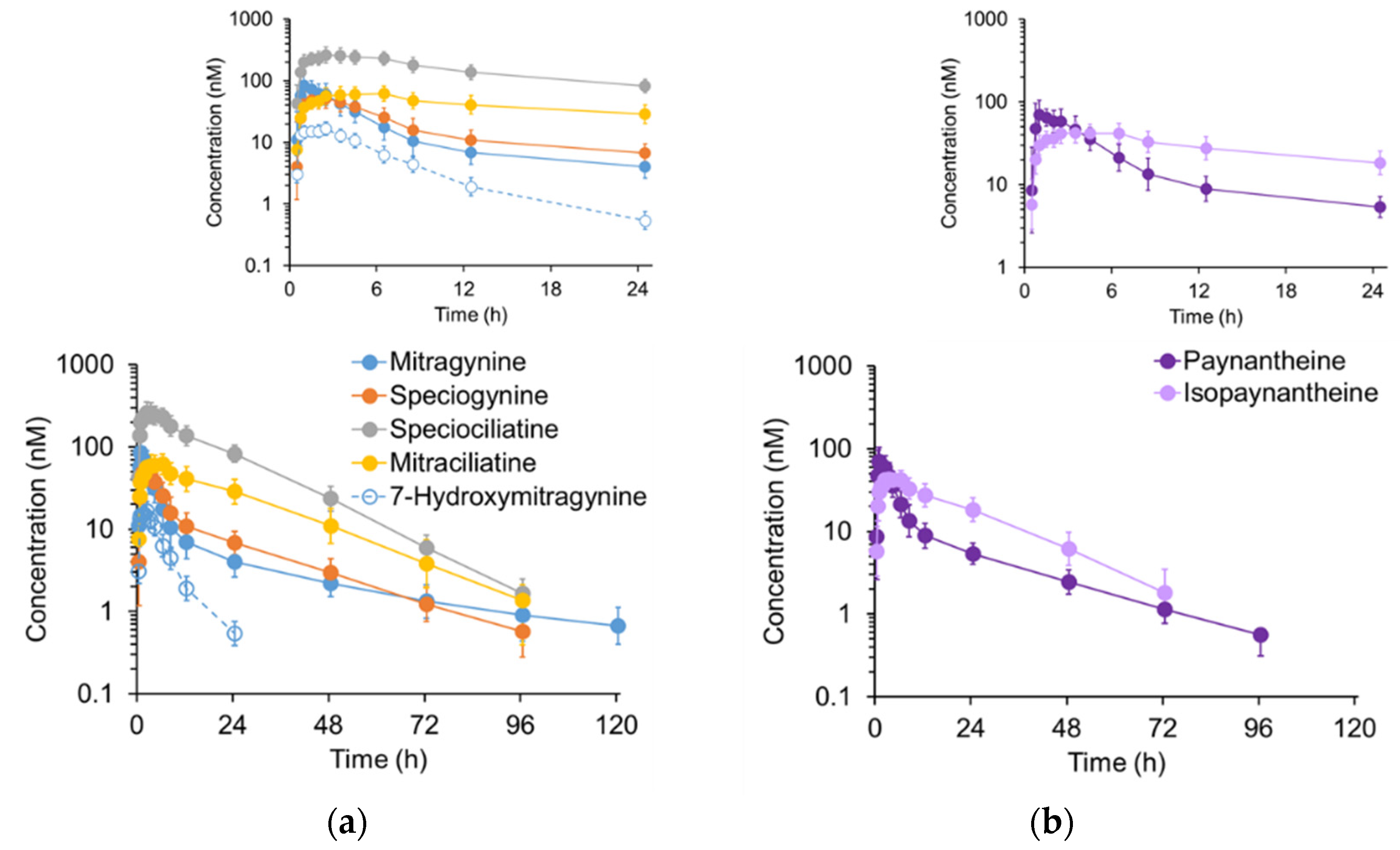
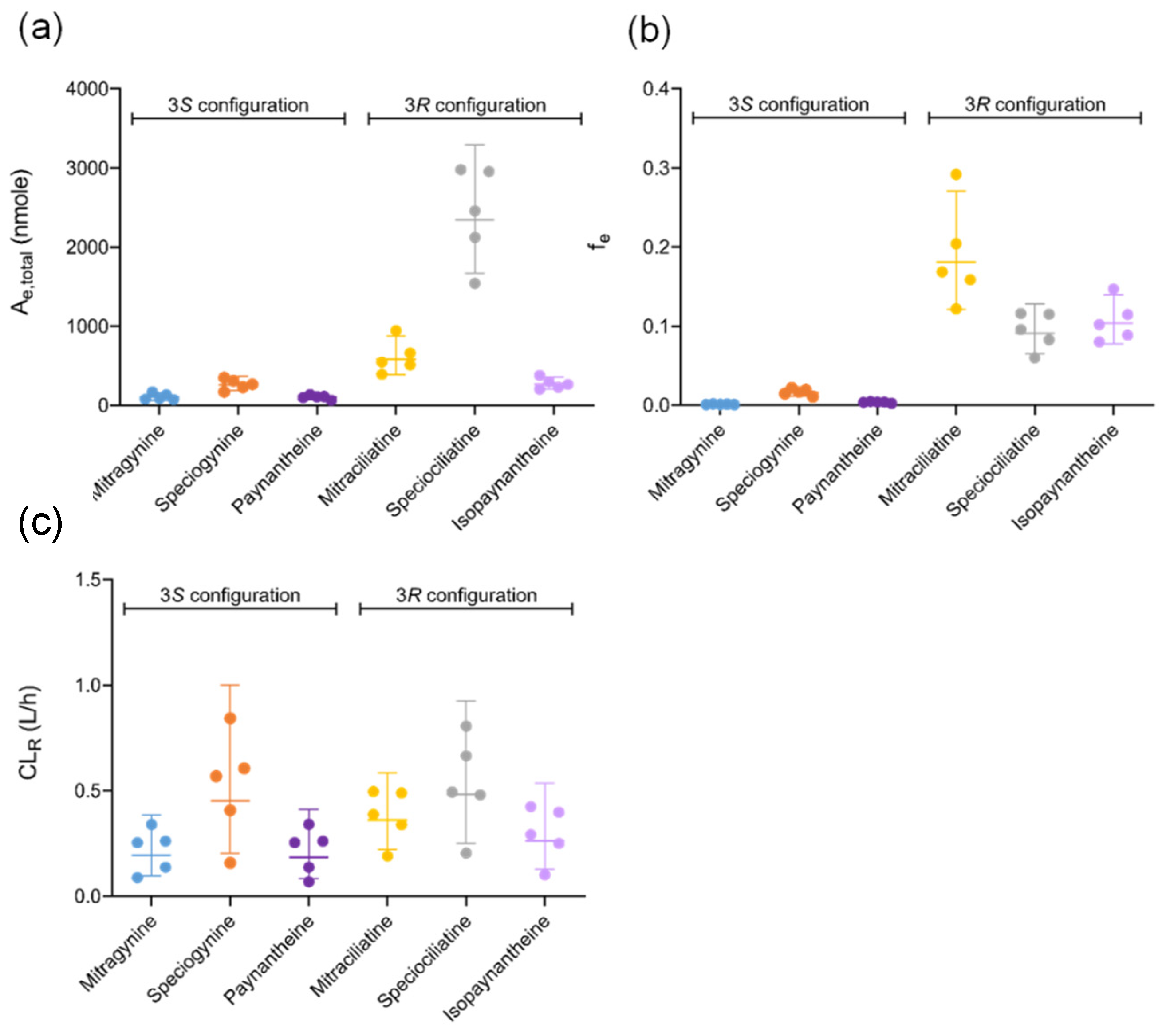
| Mitragynine | t1/2 (h) | 45.3 (31.9–50.2) | Ae (nmol) | 102 (78–134) |
| (19.48 ± 0.81) | tmax (h) | 1 (0.75–1.5) | fe | 0.0010 (0.0008–0.0013) |
| Cmax (nM) | 81.9 (50.1–177) | CLR (L/h) | 0.194 (0.129–0.291) | |
| AUC0–120h (nM×h) | 388 (300–1240) | |||
| AUCinf (nM×h) | 420 (324–1360) | |||
| Vz/F (L) | 12,700 (5190–19,700) | |||
| CL/F (L/h) | 233 (71.7–302) | |||
| Speciogynine | t1/2 (h) | 23.5 (16.1–28.3) | Ae (nmol) | 258 (210–317) |
| (3.18 ± 0.13) | tmax (h) | 2 (1–3.5) | fe | 0.016 (0.013–0.020) |
| Cmax (nM) | 51.4 (34.2–121) | CLR (L/h) | 0.451 (0.282–0.723) | |
| AUC0–120h (nM×h) | 469 (368–1080) | |||
| AUCinf (nM×h) | 477 (379–1120) | |||
| Vz/F (L) | 962 (584–1235) | |||
| CL/F (L/h) | 33.5 (14.3–42.1) | |||
| Mitraciliatine | t1/2 (h) | 17.8 (11.2–24.7) | Ae (nmol) | 586 (461–744) |
| (0.647 ± 0.035) | tmax (h) | 4.5 (3.5–6.5) | fe | 0.18 (0.14–0.23) |
| Cmax (nM) | 73.5 (34.9–98.6) | CLR (L/h) | 0.361 (0.271–0.481) | |
| AUC0–120h (nM×h) | 1160 (1030–3460) | |||
| AUCinf (nM×h) | 1160 (1040–3520) | |||
| Vz/F (L) | 46.0 (26.2–74.0) | |||
| CL/F (L/h) | 2.78 (0.92–3.11) | |||
| Speciociliatine | t1/2 (h) | 12.3 (10.4–21.1) | Ae (nmol) | 2350 (1920–2870) |
| (5.12 ± 0.26) | tmax (h) | 2.5 (1–3.5) | fe | 0.091 (0.075–0.11) |
| Cmax (nM) | 308 (154–380) | CLR (L/h) | 0.482 (0.327–0.709) | |
| AUC0–120h (nM×h) | 5110 (3190–7550) | |||
| AUCinf (nM×h) | 5120 (3200–7560) | |||
| Vz/F (L) | 130 (60.1–159) | |||
| CL/F (L/h) | 5.01 (3.40–8.04) | |||
| Paynantheine | t1/2 (h) | 27.0 (17.7–30.8) | Ae (nmol) | 101 (81.9–124) |
| (5.86 ± 0.26) | tmax (h) | 1 (0.75–2.5) | fe | 0.0034 (0.0028–0.0042) |
| Cmax (nM) | 61.1 (56.4–157) | CLR (L/h) | 0.185 (0.115–0.296) | |
| AUC0–120h (nM×h) | 428 (383–917) | |||
| AUCinf (nM×h) | 438 (389–956) | |||
| Vz/F (L) | 1940 (1370–2620) | |||
| CL/F (L/h) | 67.4 (30.9–76.0) | |||
| Isopaynantheine | t1/2 (h) | 14.4 (11.8–20.9) | Ae (nmol) | 269 (226–320) |
| (0.512 ± 0.010) | tmax (h) | 4.5 (2.5–6.5) | fe | 0.10 (0.087–0.12) |
| Cmax (nM) | 48.8 (26.2–68.2) | CLR (L/h) | 0.262 (0.172–0.401) | |
| AUC0–120h (nM×h) | 784 (662–2040) | |||
| AUCinf (nM×h) | 794 (667–2130) | |||
| Vz/F (L) | 55.5 (36.6–76.0) | |||
| CL/F (L/h) | 3.25 (1.21–3.87) | |||
| 7-Hydroxymitragynine | t1/2 (h) | 5.67 (5.03–6.52) | Ae (nmol) a | 179 (120–268) |
| (< LOQ) | tmax (h) | 1 (0.75–2.5) | fe | NA |
| Cmax (nM) | 16.1 (11.9–22.2) | CLR (L/h) | 2.03 (1.57–2.63) | |
| AUC0–120h (nM×h) | 103 (57.5–120) | |||
| AUCinf (nM×h) | 106 (60.8–126) | |||
| Cmax,m/Cmax,p | 0.27 (0.07–0.28) | |||
| AUCinf,m/AUCinf,p | 0.24 (0.07–0.29) | |||
| Metric | Mitragynine | Speciogynine | Paynantheine | Mitraciliatine | Speciociliatine | Isopaynantheine |
|---|---|---|---|---|---|---|
| Estimate (Standard Error) | ||||||
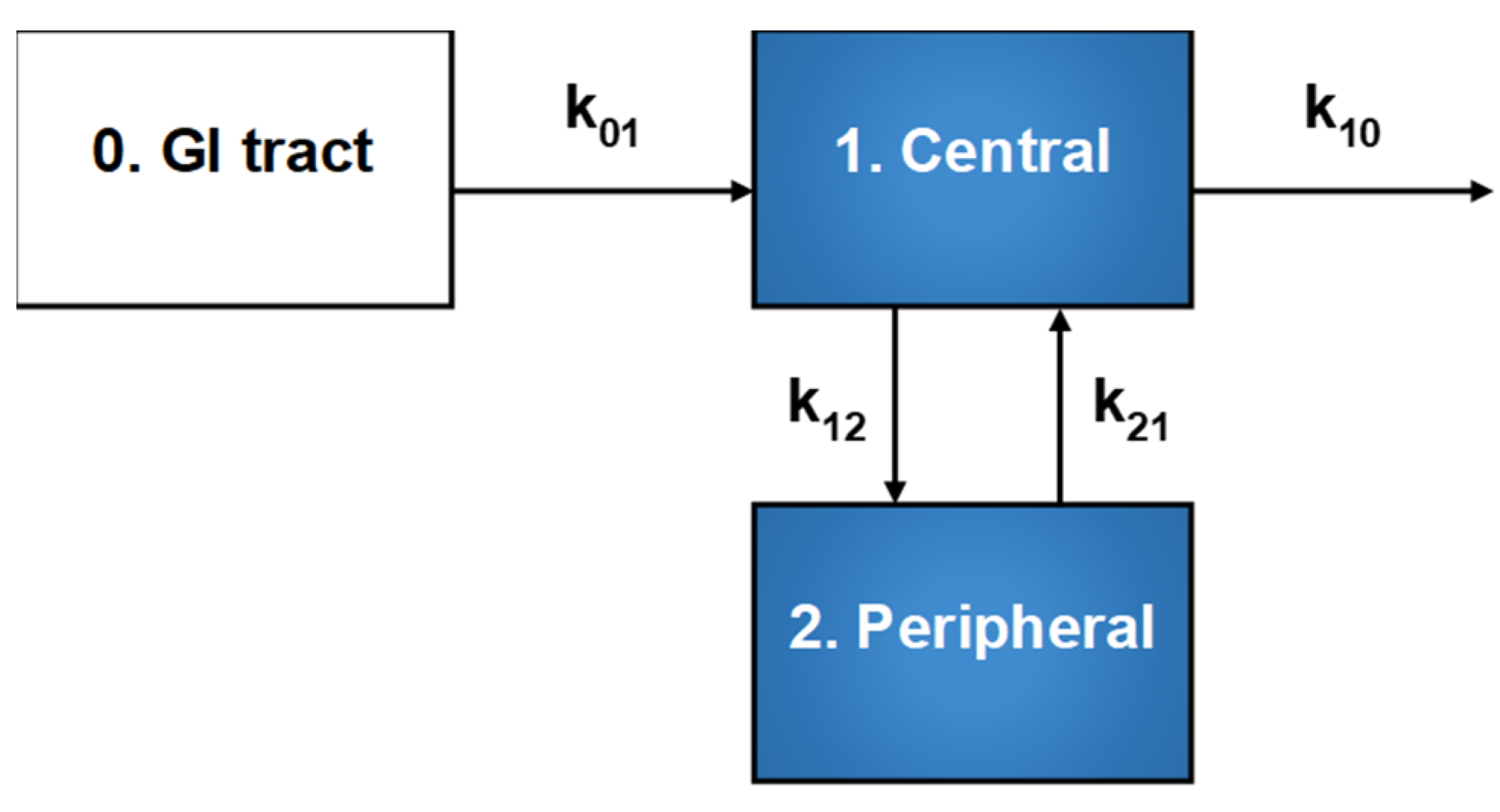
| V1/F (L) | 1170 (105) | 157 (43.6) | 329 (37.2) | 35.5 (15.9) | 75.1 (10.2) | 47.8 (8.41) |
| k01 (1/h) | 4.10 (1.16) | 0.970 (0.352) | 2.69 (0.691) | 0.706 (0.4) | 1.31 (0.321) | 1.17 (0.341) |
| CL/F (L/h) | 227 (8.11) | 32.7 (1.38) | 62.9 (2.54) | 2.44 (0.136) | 5.16 (0.233) | 3.07 (0.154) |
| V2/F (L) | 5620 (524) | 468 (42.9) | 895 (79.1) | 18.6 (14.5) | 19.8 (10.7) | 12.8 (8.28) |
| CLD/F (L/h) | 213 (20.7) | 33.9 (5.93) | 54.7 (7.63) | 2.59 (3.73) | 2.11 (2.18) | 1.38 (1.96) |
| tlag (h) | 0.49 (0.004) | 0.48 (0.004) | 0.49 (0.004) | 0.42 (0.018) | 0.45 (0.010) | 0.45 (0.011) |
| AUC (nM×h) | 431 (15.4) | 488 (20.6) | 470 (19) | 1320 (73.7) | 4980 (225) | 842 (42.3) |
| t1/2,α (h) | 1.76 (0.163) | 1.5 (0.47) | 1.78 (0.244) | 2.88 (3.13) | 4.42 (2.72) | 4.41 (4.17) |
| t1/2,β (h) | 37.3 (3.32) | 21.3 (1.58) | 23 (1.85) | 17.5 (1.43) | 14.8 (1.13) | 15.7 (2.52) |
| k10 (1/h) | 0.194 (0.0156) | 0.208 (0.055) | 0.192 (0.0197) | 0.0688 (0.0308) | 0.0686 (0.001) | 0.0642 (0.0119) |
| k12 (1/h) | 0.182 (0.0228) | 0.215 (0.0871) | 0.166 (0.033) | 0.0728 (0.136) | 0.0281 (0.0323) | 0.0289 (0.0455) |
| k21 (1/h) | 0.0379 (0.0045) | 0.072 (0.0109) | 0.0611 (0.0085) | 0.139 (0.106) | 0.107 (0.0613) | 0.108 (0.103) |
| tmax (h) | 1.13 (0.111) | 2.03 (0.143) | 1.36 (0.121) | 3.45 (0.335) | 2.63 (0.23) | 2.84 (0.267) |
| Cmax (nM) | 65.6 (4.22) | 53.8 (3.28) | 66.2 (4.37) | 62.2 (4.96) | 279 (17.1) | 43.6 (3.05) |
| Alkaloid | t1/2,HIMs (min) | t1/2,HLMs (min) | fu,p | fu,mic | CB/CP | CLint,H (mL/min/kg) | CLH,u (mL/min/kg) |
|---|---|---|---|---|---|---|---|
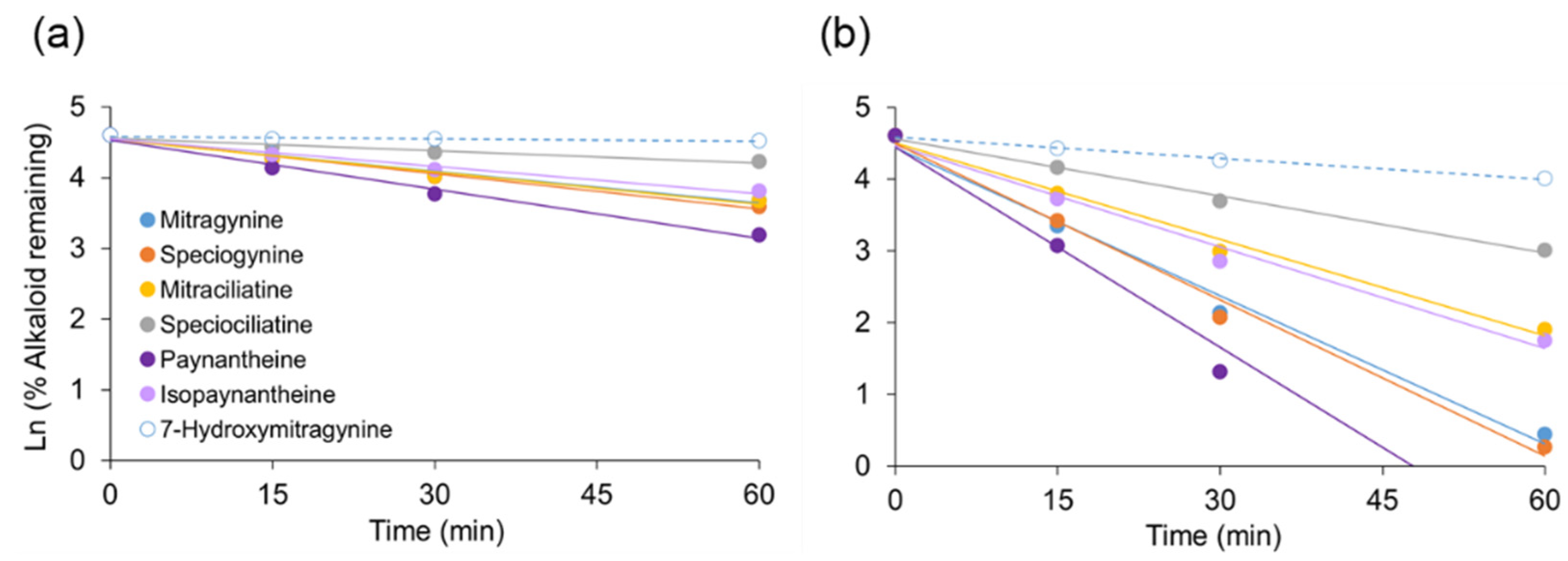
| Mitragynine | 45.9 ± 0.8 | 10.1 ± 0.2 | 0.039 ± 0.003 | 0.536 ± 0.003 | 0.93 ± 0.02 | 31.0 | 1.22 |
| Speciogynine | 41.7 ± 1.3 | 9.6 ± 0.1 | 0.057 ± 0.001 | 0.602 ± 0.009 | 0.65 ± 0.02 | 32.6 | 2.53 |
| Mitraciliatine | 45.6 ± 3.4 | 15.5 ± 0.2 | 0.019 ± 0.003 | 0.337 ± 0.006 | 1.05 ± 0.01 | 20.2 | 0.49 |
| Speciociliatine | >60 | 26.2 ± 0.4 | 0.040 ± 0.003 | 0.509 ± 0.012 | 0.74 ± 0.04 | 11.9 | 0.61 |
| Paynantheine | 29.9 ± 0.3 | 7.5 ± 0.3 | 0.055 ± 0.005 | 0.516 ± 0.016 | 0.75 ± 0.01 | 41.9 | 2.67 |
| Isopaynantheine | 53.5 ± 2.9 | 14.7 ± 0.2 | 0.024 ± 0.002 | 0.412 ± 0.004 | 0.66 ± 0.02 | 21.2 | 0.73 |
Publisher’s Note: MDPI stays neutral with regard to jurisdictional claims in published maps and institutional affiliations. |
© 2022 by the authors. Licensee MDPI, Basel, Switzerland. This article is an open access article distributed under the terms and conditions of the Creative Commons Attribution (CC BY) license (https://creativecommons.org/licenses/by/4.0/).
Share and Cite
Tanna, R.S.; Nguyen, J.T.; Hadi, D.L.; Manwill, P.K.; Flores-Bocanegra, L.; Layton, M.E.; White, J.R.; Cech, N.B.; Oberlies, N.H.; Rettie, A.E.; et al. Clinical Pharmacokinetic Assessment of Kratom (Mitragyna speciosa), a Botanical Product with Opioid-like Effects, in Healthy Adult Participants. Pharmaceutics 2022, 14, 620. https://doi.org/10.3390/pharmaceutics14030620
Tanna RS, Nguyen JT, Hadi DL, Manwill PK, Flores-Bocanegra L, Layton ME, White JR, Cech NB, Oberlies NH, Rettie AE, et al. Clinical Pharmacokinetic Assessment of Kratom (Mitragyna speciosa), a Botanical Product with Opioid-like Effects, in Healthy Adult Participants. Pharmaceutics. 2022; 14(3):620. https://doi.org/10.3390/pharmaceutics14030620
Chicago/Turabian StyleTanna, Rakshit S., James T. Nguyen, Deena L. Hadi, Preston K. Manwill, Laura Flores-Bocanegra, Matthew E. Layton, John R. White, Nadja B. Cech, Nicholas H. Oberlies, Allan E. Rettie, and et al. 2022. "Clinical Pharmacokinetic Assessment of Kratom (Mitragyna speciosa), a Botanical Product with Opioid-like Effects, in Healthy Adult Participants" Pharmaceutics 14, no. 3: 620. https://doi.org/10.3390/pharmaceutics14030620
APA StyleTanna, R. S., Nguyen, J. T., Hadi, D. L., Manwill, P. K., Flores-Bocanegra, L., Layton, M. E., White, J. R., Cech, N. B., Oberlies, N. H., Rettie, A. E., Thummel, K. E., & Paine, M. F. (2022). Clinical Pharmacokinetic Assessment of Kratom (Mitragyna speciosa), a Botanical Product with Opioid-like Effects, in Healthy Adult Participants. Pharmaceutics, 14(3), 620. https://doi.org/10.3390/pharmaceutics14030620