
Article

Markers for Ongoing or Previous Hepatitis E Virus Infection Are as Common in Wild Ungulates as in Humans in Sweden
1
Department of Infectious Diseases, Institute of Biomedicine, University of Gothenburg, 413 46 Gothenburg, Sweden
2
Department of Virology, Microbiology, National Veterinary Institute, 756 51 Uppsala, Sweden
3
Department of Biomedical Science and Veterinary Public Health, Swedish University of Agricultural Sciences (SLU), 756 51 Uppsala, Sweden
4
The OIE (World Organisation for Animal Health) Collaborating Centre for the Biotechnology-Based Diagnosis of Infectious Diseases in Veterinary Medicine, 756 51 Uppsala, Sweden
5
Ulf Lundahl Foundation, 116 21 Stockholm, Sweden
*
Author to whom correspondence should be addressed.
Viruses 2016, 8(9), 259; https://doi.org/10.3390/v8090259
Submission received: 27 July 2016 / Revised: 30 August 2016 / Accepted: 13 September 2016 / Published: 19 September 2016
(This article belongs to the Section Animal Viruses)

Abstract

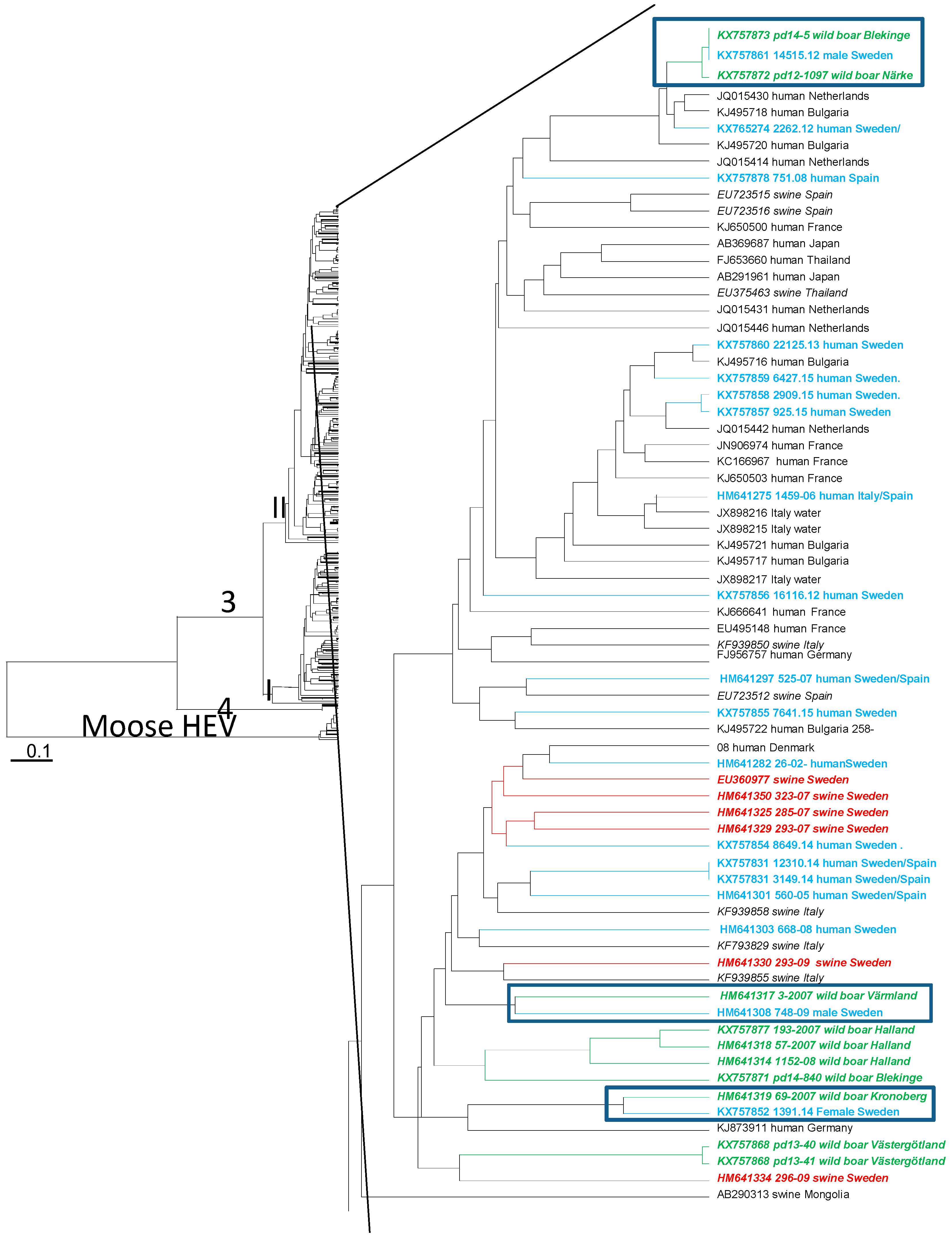
Hepatitis E virus (HEV) is a human pathogen with zoonotic spread, infecting both domestic and wild animals. About 17% of the Swedish population is immune to HEV, but few cases are reported annually, indicating that most infections are subclinical. However, clinical hepatitis E may also be overlooked. For identified cases, the source of infection is mostly unknown. In order to identify whether HEV may be spread from wild game, the prevalence of markers for past and/or ongoing infection was investigated in sera and stool samples collected from 260 hunted Swedish wild ungulates. HEV markers were found in 43 (17%) of the animals. The most commonly infected animal was moose (Alces alces) with 19 out of 69 animals (28%) showing HEV markers, followed by wild boar (Sus scrofa) with 21 out of 139 animals (15%), roe deer (Capreolus capreolus) with 2 out of 30 animals, red deer (Cervus elaphus) with 1 out of 15 animals, and fallow deer (Dama dama) 0 out of 7 animals. Partial open reading frame 1 (ORF1) of the viral genomes from the animals were sequenced and compared with those from 14 endemic human cases. Phylogenetic analysis revealed that three humans were infected with HEV strains similar to those from wild boar. These results indicate that wild animals may be a source of transmission to humans and could be an unrecognized public health concern.
Keywords: hepatitis E virus; zoonosis; moose; wild boar; deer; phylogenetic analysis; wild animals; Sweden hepatitis E virus; zoonosis; moose; wild boar; deer; phylogenetic analysis; wild animals; Sweden