

Molecular Signatures of Hepatitis C Virus (HCV)-Induced Type II Mixed Cryoglobulinemia (MCII)



Abstract
1. Introduction
2. HCV in Induction of MCII
2.1. HCV
2.2. HCV Infection and MCII
3. Molecular Mechanisms Involved in the Establishment of HCV-Related MCII
3.1. Molecular Mimicry
3.2. HCV Lymphotropism and Interaction with CD81
3.3. HCV-Restricted Induction of Determined Ig VH and Vκ Subfamily Genes
3.4. Complement Factors and Proteins
4. B-cell Subsets Involved in MCII
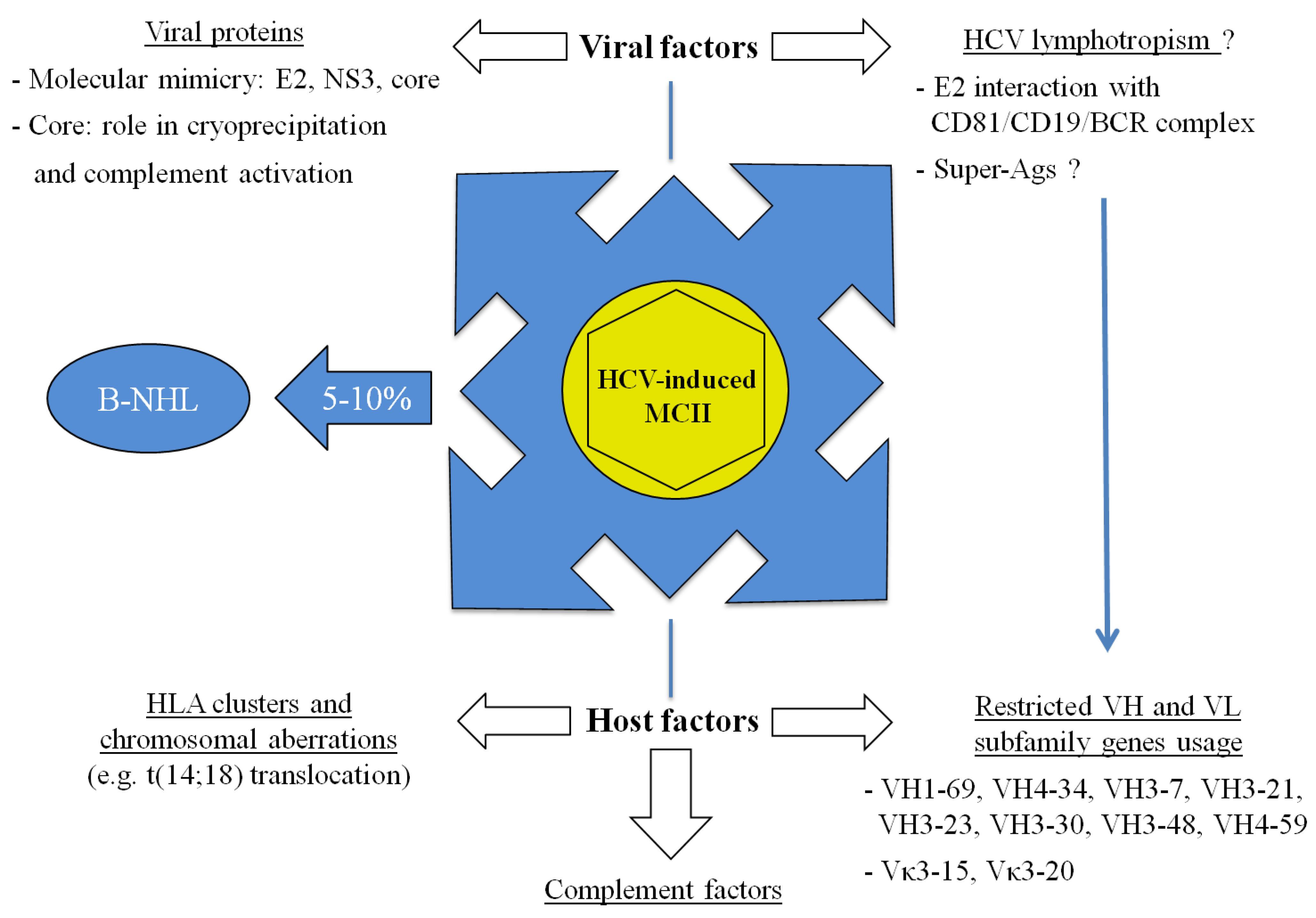
5. Conclusions
Conflict of Interest
References
- Shepard, C.W.; Finelli, L.; Alter, M.J. Global epidemiology of hepatitis c virus infection. Lancet Infect. Dis. 2005, 5, 558–567. [Google Scholar] [CrossRef]
- Galossi, A.; Guarisco, R.; Bellis, L.; Puoti, C. Extrahepatic manifestations of chronic hcv infection. J. Gastrointestin. Liver Dis. 2007, 16, 65–73. [Google Scholar]
- Agnello, V. The aetiology of mixed cryoglobulinaemia associated with hepatitis c virus infection. Scand. J. Immunol. 1995, 42, 179–184. [Google Scholar] [CrossRef]
- Saadoun, D.; Resche-Rigon, M.; Thibault, V.; Piette, J.C.; Cacoub, P. Antiviral therapy for hepatitis c virus-associated mixed cryoglobulinemia vasculitis: A long-term followup study. Arthritis Rheum. 2006, 54, 3696–3706. [Google Scholar] [CrossRef]
- Vassilopoulos, D.; Calabrese, L.H. Hepatitis c virus infection and vasculitis: Implications of antiviral and immunosuppressive therapies. Arthritis Rheum. 2002, 46, 585–597. [Google Scholar]
- Donada, C.; Crucitti, A.; Donadon, V.; Tommasi, L.; Zanette, G.; Crovatto, M.; Santini, G.F.; Chemello, L.; Alberti, A. Systemic manifestations and liver disease in patients with chronic hepatitis c and type ii or iii mixed cryoglobulinaemia. J. Viral Hepat. 1998, 5, 179–185. [Google Scholar] [CrossRef]
- Marcucci, F.; Mele, A. Hepatitis viruses and non-hodgkin lymphoma: Epidemiology, mechanisms of tumorigenesis, and therapeutic opportunities. Blood 2011, 117, 1792–1798. [Google Scholar] [CrossRef]
- Shihabi, Z.K. Cryoglobulins: An important but neglected clinical test. Ann. Clin. Lab. Sci. 2006, 36, 395–408. [Google Scholar]
- Cacoub, P.; Costedoat-Chalumeau, N.; Lidove, O.; Alric, L. Cryoglobulinemia vasculitis. Curr Opin. Rheumatol. 2002, 14, 29–35. [Google Scholar] [CrossRef]
- Viganò, M.; Lampertico, P.; Rumi, M.G.; Folli, C.; Maggioni, L.; Morabito, A.; Del Ninno, E.; Cicardi, M.; Colombo, M. Natural history and clinical impact of cryoglobulins in chronic hepatitis c: 10-year prospective study of 343 patients. Gastroenterology 2007, 133, 835–842. [Google Scholar]
- Kayali, Z.; Buckwold, V.E.; Zimmerman, B.; Schmidt, W.N. Hepatitis c, cryoglobulinemia, and cirrhosis: A meta-analysis. Hepatology 2002, 36, 978–985. [Google Scholar]
- Monti, G.; Galli, M.; Invernizzi, F.; Pioltelli, P.; Saccardo, F.; Monteverde, A.; Pietrogrande, M.; Renoldi, P.; Bombardieri, S.; Bordin, G.; et al. Cryoglobulinaemias: A multi-centre study of the early clinical and laboratory manifestations of primary and secondary disease. Gisc – italian group for the study of cryoglobulinaemias. QJM 1995, 88, 115–126. [Google Scholar]
- Kawamura, Y.; Ikeda, K.; Arase, Y.; Yatsuji, H.; Sezaki, H.; Hosaka, T.; Akuta, N.; Kobayashi, M.; Suzuki, F.; Suzuki, Y.; et al. Viral elimination reduces incidence of malignant lymphoma in patients with hepatitis c. Am. J. Med. 2007, 120, 1034–1041. [Google Scholar] [CrossRef]
- Invernizzi, F.; Galli, M.; Serino, G.; Monti, G.; Meroni, P.L.; Granatieri, C.; Zanussi, C. Secondary and essential cryoglobulinemias. Frequency, nosological classification, and long-term follow-up. Acta Haematol. 1983, 70, 73–82. [Google Scholar] [CrossRef]
- Ohsawa, M.; Shingu, N.; Miwa, H.; Yoshihara, H.; Kubo, M.; Tsukuma, H.; Teshima, H.; Hashimoto, M.; Aozasa, K. Risk of non-hodgkin's lymphoma in patients with hepatitis c virus infection. Int. J. Cancer 1999, 80, 237–239. [Google Scholar]
- Giordano, T.P.; Henderson, L.; Landgren, O.; Chiao, E.Y.; Kramer, J.R.; El-Serag, H.; Engels, E.A. Risk of non-hodgkin lymphoma and lymphoproliferative precursor diseases in us veterans with hepatitis c virus. JAMA 2007, 297, 2010–2017. [Google Scholar] [CrossRef]
- Sautto, G.; Mancini, N.; Solforosi, L.; Diotti, R.A.; Clementi, M.; Burioni, R. Hcv proteins and immunoglobulin variable gene (igv) subfamilies in hcv-induced type ii mixed cryoglobulinemia: A concurrent pathogenetic role. Clin. Dev. Immunol. 2012, 2012, 705013. [Google Scholar]
- Robertson, B.; Myers, G.; Howard, C.; Brettin, T.; Bukh, J.; Gaschen, B.; Gojobori, T.; Maertens, G.; Mizokami, M.; Nainan, O.; et al. Classification, nomenclature, and database development for hepatitis c virus (hcv) and related viruses: Proposals for standardization. International committee on virus taxonomy. Arch. Virol. 143, 1998; 2493–2503. [Google Scholar]
- Choo, Q.L.; Richman, K.H.; Han, J.H.; Berger, K.; Lee, C.; Dong, C.; Gallegos, C.; Coit, D.; Medina-Selby, R.; Barr, P.J.; et al. Genetic organization and diversity of the hepatitis c virus. Proc. Natl. Acad. Sci. U S A 1991, 88, 2451–2455. [Google Scholar]
- Ashfaq, U.A.; Javed, T.; Rehman, S.; Nawaz, Z.; Riazuddin, S. An overview of hcv molecular biology, replication and immune responses. Virol. J. 2011, 8, 161. [Google Scholar]
- Koutsoudakis, G.; Kaul, A.; Steinmann, E.; Kallis, S.; Lohmann, V.; Pietschmann, T.; Bartenschlager, R. Characterization of the early steps of hepatitis c virus infection by using luciferase reporter viruses. J. Virol. 2006, 80, 5308–5320. [Google Scholar] [CrossRef]
- Barth, H.; Schafer, C.; Adah, M.I.; Zhang, F.; Linhardt, R.J.; Toyoda, H.; Kinoshita-Toyoda, A.; Toida, T.; Van Kuppevelt, T.H.; Depla, E.; et al. Cellular binding of hepatitis c virus envelope glycoprotein e2 requires cell surface heparan sulfate. J. Biol. Chem. 2003, 278, 41003–41012. [Google Scholar]
- Dubuisson, J.; Hsu, H.H.; Cheung, R.C.; Greenberg, H.B.; Russell, D.G.; Rice, C.M. Formation and intracellular localization of hepatitis c virus envelope glycoprotein complexes expressed by recombinant vaccinia and sindbis viruses. J. Virol. 1994, 68, 6147–6160. [Google Scholar]
- Agnello, V.; Abel, G.; Elfahal, M.; Knight, G.B.; Zhang, Q.X. Hepatitis c virus and other flaviviridae viruses enter cells via low density lipoprotein receptor. Proc. Natl. Acad. Sci. U S A 1999, 96, 12766–12771. [Google Scholar]
- Molina, S.; Castet, V.; Fournier-Wirth, C.; Pichard-Garcia, L.; Avner, R.; Harats, D.; Roitelman, J.; Barbaras, R.; Graber, P.; Ghersa, P. The low-density lipoprotein receptor plays a role in the infection of primary human hepatocytes by hepatitis c virus. J. Hepatol. 2007, 46, 411–419. [Google Scholar] [CrossRef]
- Scarselli, E.; Ansuini, H.; Cerino, R.; Roccasecca, R.M.; Acali, S.; Filocamo, G.; Traboni, C.; Nicosia, A.; Cortese, R.; Vitelli, A. The human scavenger receptor class b type i is a novel candidate receptor for the hepatitis c virus. EMBO J. 2002, 21, 5017–5025. [Google Scholar]
- Pileri, P.; Uematsu, Y.; Campagnoli, S.; Galli, G.; Falugi, F.; Petracca, R.; Weiner, A.J.; Houghton, M.; Rosa, D.; Grandi, G.; et al. Binding of hepatitis c virus to cd81. Science 1998, 282, 938–941. [Google Scholar] [CrossRef]
- Evans, M.J.; von Hahn, T.; Tscherne, D.M.; Syder, A.J.; Panis, M.; Wolk, B.; Hatziioannou, T.; McKeating, J.A.; Bieniasz, P.D.; Rice, C.M. Claudin-1 is a hepatitis c virus co-receptor required for a late step in entry. Nature 2007, 446, 801–805. [Google Scholar]
- Ploss, A.; Evans, M.J.; Gaysinskaya, V.A.; Panis, M.; You, H.; de Jong, Y.P.; Rice, C.M. Human occludin is a hepatitis c virus entry factor required for infection of mouse cells. Nature 2009, 457, 882–886. [Google Scholar] [CrossRef]
- Benedicto, I.; Molina-Jimenez, F.; Bartosch, B.; Cosset, F.L.; Lavillette, D.; Prieto, J.; Moreno-Otero, R.; Valenzuela-Fernandez, A.; Aldabe, R.; Lopez-Cabrera, M.; et al. The tight junction-associated protein occludin is required for a postbinding step in hepatitis c virus entry and infection. J. Virol. 2009, 83, 8012–8020. [Google Scholar]
- Liu, S.; Yang, W.; Shen, L.; Turner, J.R.; Coyne, C.B.; Wang, T. Tight junction proteins claudin-1 and occludin control hepatitis c virus entry and are downregulated during infection to prevent superinfection. J. Virol. 2009, 83, 2011–2014. [Google Scholar]
- Sainz, B., Jr.; Barretto, N.; Martin, D.N.; Hiraga, N.; Imamura, M.; Hussain, S.; Marsh, K.A.; Yu, X.; Chayama, K.; Alrefai, W.A.; et al. Identification of the niemann-pick c1-like 1 cholesterol absorption receptor as a new hepatitis c virus entry factor. Nat. Med. 2012, 18, 281–285. [Google Scholar]
- Burioni, R.; Plaisant, P.; Manzin, A.; Rosa, D.; Delli Carri, V.; Bugli, F.; Solforosi, L.; Abrignani, S.; Varaldo, P.E.; Fadda, G.; et al. Dissection of human humoral immune response against hepatitis c virus e2 glycoprotein by repertoire cloning and generation of recombinant fab fragments. Hepatology 1998, 28, 810–814. [Google Scholar] [CrossRef]
- Burioni, R.; Perotti, M.; Mancini, N.; Clementi, M. Perspectives for the utilization of neutralizing human monoclonal antibodies as anti-hcv drugs. J. Hepatol. 2008, 49, 299–300. [Google Scholar]
- Mancini, N.; Diotti, R.A.; Perotti, M.; Sautto, G.; Clementi, N.; Nitti, G.; Patel, A.H.; Ball, J.K.; Clementi, M.; Burioni, R. Hepatitis c virus (hcv) infection may elicit neutralizing antibodies targeting epitopes conserved in all viral genotypes. PLoS One 2009, 4, e8254. [Google Scholar]
- Mancini, N.; Sautto, G.; Clementi, N.; Diotti, R.A.; Criscuolo, E.; Castelli, M.; Solforosi, L.; Clementi, M.; Burioni, R. Neutralization interfering antibodies: A “novel” example of humoral immune dysfunction facilitating viral escape? Viruses 2012, 4, 1731–1752. [Google Scholar] [CrossRef]
- Sautto, G.; Mancini, N.; Diotti, R.A.; Solforosi, L.; Clementi, M.; Burioni, R. Anti-hepatitis c virus e2 (hcv/e2) glycoprotein monoclonal antibodies and neutralization interference. Antiviral Res. 2012, 96, 82–89. [Google Scholar]
- Burioni, R.; Williamson, R.A.; Sanna, P.P.; Bloom, F.E.; Burton, D.R. Recombinant human fab to glycoprotein d neutralizes infectivity and prevents cell-to-cell transmission of herpes simplex viruses 1 and 2 in vitro. Proc. Natl. Acad. Sci. U S A 1994, 91, 355–359. [Google Scholar] [CrossRef]
- Burioni, R.; Bugli, F.; Mancini, N.; Rosa, D.; Di Campli, C.; Moroncini, G.; Manzin, A.; Abrignani, S.; Varaldo, P.E.; Clementi, M.; et al. Nonneutralizing human antibody fragments against hepatitis c virus e2 glycoprotein modulate neutralization of binding activity of human recombinant fabs. Virology 2001, 288, 29–35. [Google Scholar] [CrossRef]
- Zignego, A.L.; Ferri, C.; Giannini, C.; Monti, M.; La Civita, L.; Careccia, G.; Longombardo, G.; Lombardini, F.; Bombardieri, S.; Gentilini, P. Hepatitis c virus genotype analysis in patients with type ii mixed cryoglobulinemia. Ann. Intern. Med. 1996, 124, 31–34. [Google Scholar]
- Ramos-Casals, M.; Forns, X.; Brito-Zeron, P.; Vargas, A.; Ruiz, M.; Laguno, M.; Yague, J.; Sanchez-Tapias, J.M.; Gatell, J.M.; Font, J. Cryoglobulinaemia associated with hepatitis c virus: Influence of hcv genotypes, hcv-rna viraemia and hiv coinfection. J. Viral. Hepat. 2007, 14, 736–742. [Google Scholar]
- Crovatto, M.; Ceselli, S.; Mazzaro, C.; Modolo, M.L.; Martelli, P.; Mazzi, G.; Pozzato, G.; Giannini, F.; Barbisin, M.; Chiarotto, B.; et al. Hcv genotypes and cryoglobulinemia. Clin. Exp. Rheumatol. 1995, 13 Suppl 13, S79–S82. [Google Scholar]
- Sinico, R.A.; Ribero, M.L.; Fornasieri, A.; Renoldi, P.; Zhou, J.; Fasola, M.; Portera, G.; Arrigo, G.; Gibelli, A.; D'Amico, G.; et al. Hepatitis c virus genotype in patients with essential mixed cryoglobulinaemia. QJM 1995, 88, 805–810. [Google Scholar]
- Zehender, G.; de Maddalena, C.; Monti, G.; Ballare, M.; Saccardo, F.; Piconi, S.; Invernizzi, F.; Monteverde, A.; Galli, M. Hcv genotypes in bone marrow and peripheral blood mononuclear cells of patients with mixed cryoglobulinemia. Clin. Exp. Rheumatol. 1995, 13 Suppl 13, S87–S90. [Google Scholar]
- Monteverde, A.; Ballare, M.; Pileri, S. Hepatic lymphoid aggregates in chronic hepatitis c and mixed cryoglobulinemia. Springer Semin. Immunopathol. 1997, 19, 99–110. [Google Scholar]
- Sansonno, D.; De Vita, S.; Iacobelli, A.R.; Cornacchiulo, V.; Boiocchi, M.; Dammacco, F. Clonal analysis of intrahepatic b cells from hcv-infected patients with and without mixed cryoglobulinemia. J. Immunol. 1998, 160, 3594–3601. [Google Scholar]
- Knight, G.B.; Gao, L.; Gragnani, L.; Elfahal, M.M.; De Rosa, F.G.; Gordon, F.D.; Agnello, V. Detection of wa b cells in hepatitis c virus infection: A potential prognostic marker for cryoglobulinemic vasculitis and b cell malignancies. Arthritis Rheum. 2010, 62, 2152–2159. [Google Scholar]
- Racanelli, V.; Sansonno, D.; Piccoli, C.; D'Amore, F.P.; Tucci, F.A.; Dammacco, F. Molecular characterization of b cell clonal expansions in the liver of chronically hepatitis c virus-infected patients. J. Immunol. 2001, 167, 21–29. [Google Scholar]
- Sansonno, D.; Lauletta, G.; Nisi, L.; Gatti, P.; Pesola, F.; Pansini, N.; Dammacco, F. Non-enveloped hcv core protein as constitutive antigen of cold-precipitable immune complexes in type ii mixed cryoglobulinaemia. Clin. Exp. Immunol. 2003, 133, 275–282. [Google Scholar] [CrossRef]
- Gabrielli, A.; Zhang, Z.X.; Cherubini, G.; Candela, M.; Savoldi, S.; Manzin, A.; Clementi, M.; Amoroso, A.; Sallberg, M. Differential humoral immune response against hepatitis c virus antigenic synthetic peptides in infected patients with and without mixed cryoglobulinaemia. Clin. Exp. Immunol. 1996, 105, 59–64. [Google Scholar]
- Gorevic, P.D. Rheumatoid factor, complement, and mixed cryoglobulinemia. Clin. Dev. Immunol. 2012, 2012, 439018. [Google Scholar]
- Tanaka, T.; Lau, J.Y.; Mizokami, M.; Orito, E.; Tanaka, E.; Kiyosawa, K.; Yasui, K.; Ohta, Y.; Hasegawa, A.; Tanaka, S.; et al. Simple fluorescent enzyme immunoassay for detection and quantification of hepatitis c viremia. J. Hepatol. 1995, 23, 742–745. [Google Scholar] [CrossRef]
- Manzin, A.; Solforosi, L.; Candela, M.; Cherubini, G.; Piccinini, G.; Brugia, M.; Gabrielli, A.; Clementi, M. Hepatitis c virus infection and mixed cryoglobulinaemia: Assessment of hcv rna copy numbers in supernatant, cryoprecipitate and non-liver cells. J. Viral Hepat. 1996, 3, 285–292. [Google Scholar] [CrossRef]
- Sansonno, D.; Dammacco, F. Hepatitis c virus, cryoglobulinaemia, and vasculitis: Immune complex relations. Lancet Infect. Dis. 2005, 5, 227–236. [Google Scholar] [CrossRef]
- Ghebrehiwet, B.; Peerschke, E.I. Structure and function of gc1q-r: A multiligand binding cellular protein. Immunobiology 1998, 199, 225–238. [Google Scholar] [CrossRef]
- Sansonno, D.; Tucci, F.A.; Ghebrehiwet, B.; Lauletta, G.; Peerschke, E.I.; Conteduca, V.; Russi, S.; Gatti, P.; Sansonno, L.; Dammacco, F. Role of the receptor for the globular domain of c1q protein in the pathogenesis of hepatitis c virus-related cryoglobulin vascular damage. J. Immunol. 2009, 183, 6013–6020. [Google Scholar] [CrossRef]
- Ray, R.B.; Meyer, K.; Ray, R. Suppression of apoptotic cell death by hepatitis c virus core protein. Virology 1996, 226, 176–182. [Google Scholar] [CrossRef]
- Ishikawa, T.; Shibuya, K.; Yasui, K.; Mitamura, K.; Ueda, S. Expression of hepatitis c virus core protein associated with malignant lymphoma in transgenic mice. Comp. Immunol. Microbiol. Infect. Dis. 2003, 26, 115–124. [Google Scholar] [CrossRef]
- Canducci, F.; Saita, D.; Foglieni, C.; Piscopiello, M.R.; Chiesa, R.; Colombo, A.; Cianflone, D.; Maseri, A.; Clementi, M.; Burioni, R. Cross-reacting antibacterial auto-antibodies are produced within coronary atherosclerotic plaques of acute coronary syndrome patients. PLoS One 2012, 7, e42283. [Google Scholar]
- Oldstone, M.B. Molecular mimicry and immune-mediated diseases. FASEB J. 1998, 12, 1255–1265. [Google Scholar]
- Hu, Y.W.; Rocheleau, L.; Larke, B.; Chui, L.; Lee, B.; Ma, M.; Liu, S.; Omlin, T.; Pelchat, M.; Brown, E.G. Immunoglobulin mimicry by hepatitis c virus envelope protein e2. Virology 2005, 332, 538–549. [Google Scholar] [CrossRef]
- Mondelli, M.U.; Cerino, A.; Segagni, L.; Meola, A.; Cividini, A.; Silini, E.; Nicosia, A. Hypervariable region 1 of hepatitis c virus: Immunological decoy or biologically relevant domain? Antiviral Res. 2001, 52, 153–159. [Google Scholar] [CrossRef]
- Martell, M.; Esteban, J.I.; Quer, J.; Vargas, V.; Esteban, R.; Guardia, J.; Gomez, J. Dynamic behavior of hepatitis c virus quasispecies in patients undergoing orthotopic liver transplantation. J. Virol. 1994, 68, 3425–3436. [Google Scholar]
- Lawal, Z.; Petrik, J.; Wong, V.S.; Alexander, G.J.; Allain, J.P. Hepatitis c virus genomic variability in untreated and immunosuppressed patients. Virology 1997, 228, 107–111. [Google Scholar]
- Ndifon, W.; Wingreen, N.S.; Levin, S.A. Differential neutralization efficiency of hemagglutinin epitopes, antibody interference, and the design of influenza vaccines. Proc. Natl. Acad. Sci. U S A 2009, 106, 8701–8706. [Google Scholar]
- Clementi, N.; Mancini, N.; Solforosi, L.; Castelli, M.; Clementi, M.; Burioni, R. Phage display-based strategies for cloning and optimization of monoclonal antibodies directed against human pathogens. Int. J. Mol. Sci. 2012, 13, 8273–8292. [Google Scholar] [CrossRef]
- Chandra, P.K.; Hazari, S.; Poat, B.; Gunduz, F.; Prabhu, R.; Liu, G.; Burioni, R.; Clementi, M.; Garry, R.F.; Dash, S. Intracytoplasmic stable expression of igg1 antibody targeting ns3 helicase inhibits replication of highly efficient hepatitis c virus 2a clone. Virol. J. 2010, 7, 118. [Google Scholar]
- Corper, A.L.; Sohi, M.K.; Bonagura, V.R.; Steinitz, M.; Jefferis, R.; Feinstein, A.; Beale, D.; Taussig, M.J.; Sutton, B.J. Structure of human igm rheumatoid factor fab bound to its autoantigen igg fc reveals a novel topology of antibody-antigen interaction. Nat. Struct. Biol. 1997, 4, 374–381. [Google Scholar] [CrossRef]
- Potter, K.N. Molecular characterization of cold agglutinins. Transfus. Sci. 2000, 22, 113–119. [Google Scholar]
- Potter, K.N.; Hobby, P.; Klijn, S.; Stevenson, F.K.; Sutton, B.J. Evidence for involvement of a hydrophobic patch in framework region 1 of human v4-34-encoded igs in recognition of the red blood cell i antigen. J. Immunol. 2002, 169, 3777–3782. [Google Scholar]
- Ferri, S.; Dal Pero, F.; Bortoletto, G.; Bianchi, F.B.; Lenzi, M.; Alberti, A.; Gerotto, M. Detailed analysis of the e2-igm complex in hepatitis c-related type ii mixed cryoglobulinaemia. J. Viral Hepat. 2006, 13, 166–176. [Google Scholar] [CrossRef]
- Quinn, E.R.; Chan, C.H.; Hadlock, K.G.; Foung, S.K.; Flint, M.; Levy, S. The b-cell receptor of a hepatitis c virus (hcv)-associated non-hodgkin lymphoma binds the viral e2 envelope protein, implicating hcv in lymphomagenesis. Blood 2001, 98, 3745–3749. [Google Scholar] [CrossRef]
- Domiati-Saad, R.; Attrep, J.F.; Brezinschek, H.P.; Cherrie, A.H.; Karp, D.R.; Lipsky, P.E. Staphylococcal enterotoxin d functions as a human b cell superantigen by rescuing vh4-expressing b cells from apoptosis. J. Immunol. 1996, 156, 3608–3620. [Google Scholar]
- Yao, Z.Q.; Nguyen, D.T.; Hiotellis, A.I.; Hahn, Y.S. Hepatitis c virus core protein inhibits human t lymphocyte responses by a complement-dependent regulatory pathway. J. Immunol. 2001, 167, 5264–5272. [Google Scholar]
- Zignego, A.L.; Macchia, D.; Monti, M.; Thiers, V.; Mazzetti, M.; Foschi, M.; Maggi, E.; Romagnani, S.; Gentilini, P.; Brechot, C. Infection of peripheral mononuclear blood cells by hepatitis c virus. J. Hepatol. 1992, 15, 382–386. [Google Scholar]
- Valli, M.B.; Crema, A.; Lanzilli, G.; Serafino, A.; Bertolini, L.; Ravagnan, G.; Ponzetto, A.; Menzo, S.; Clementi, M.; Carloni, G. Molecular and cellular determinants of cell-to-cell transmission of hcv in vitro. J. Med. Virol. 2007, 79, 1491–1499. [Google Scholar]
- Sung, V.M.; Shimodaira, S.; Doughty, A.L.; Picchio, G.R.; Can, H.; Yen, T.S.; Lindsay, K.L.; Levine, A.M.; Lai, M.M. Establishment of b-cell lymphoma cell lines persistently infected with hepatitis c virus in vivo and in vitro: The apoptotic effects of virus infection. J. Virol. 2003, 77, 2134–2146. [Google Scholar] [CrossRef]
- Navas, M.C.; Fuchs, A.; Schvoerer, E.; Bohbot, A.; Aubertin, A.M.; Stoll-Keller, F. Dendritic cell susceptibility to hepatitis c virus genotype 1 infection. J. Med. Virol. 2002, 67, 152–161. [Google Scholar] [CrossRef]
- Bernardin, F.; Tobler, L.; Walsh, I.; Williams, J.D.; Busch, M.; Delwart, E. Clearance of hepatitis c virus rna from the peripheral blood mononuclear cells of blood donors who spontaneously or therapeutically control their plasma viremia. Hepatology 2008, 47, 1446–1452. [Google Scholar] [CrossRef]
- Ito, M.; Kusunoki, H.; Mochida, K.; Yamaguchi, K.; Mizuochi, T. Hcv infection and b-cell lymphomagenesis. Adv. Hematol. 2011, 2011, 835314. [Google Scholar]
- Pham, T.N.; Michalak, T.I. Occult persistence and lymphotropism of hepatitis c virus infection. World J. Gastroenterol. 2008, 14, 2789–2793. [Google Scholar] [CrossRef]
- Machida, K.; Kondo, Y.; Huang, J.Y.; Chen, Y.C.; Cheng, K.T.; Keck, Z.; Foung, S.; Dubuisson, J.; Sung, V.M.; Lai, M.M. Hepatitis c virus (hcv)-induced immunoglobulin hypermutation reduces the affinity and neutralizing activities of antibodies against hcv envelope protein. J. Virol. 2008, 82, 6711–6720. [Google Scholar] [CrossRef]
- Landau, D.A.; Saadoun, D.; Calabrese, L.H.; Cacoub, P. The pathophysiology of hcv induced b-cell clonal disorders. Autoimmun. Rev. 2007, 6, 581–587. [Google Scholar] [CrossRef]
- Machida, K.; Cheng, K.T.; Pavio, N.; Sung, V.M.; Lai, M.M. Hepatitis c virus e2-cd81 interaction induces hypermutation of the immunoglobulin gene in b cells. J. Virol. 2005, 79, 8079–8089. [Google Scholar]
- De Re, V.; De Vita, S.; Marzotto, A.; Rupolo, M.; Gloghini, A.; Pivetta, B.; Gasparotto, D.; Carbone, A.; Boiocchi, M. Sequence analysis of the immunoglobulin antigen receptor of hepatitis c virus-associated non-hodgkin lymphomas suggests that the malignant cells are derived from the rheumatoid factor-producing cells that occur mainly in type ii cryoglobulinemia. Blood 2000, 96, 3578–3584. [Google Scholar]
- Thomssen, R.; Bonk, S.; Thiele, A. Density heterogeneities of hepatitis c virus in human sera due to the binding of beta-lipoproteins and immunoglobulins. Med. Microbiol. Immunol. 1993, 182, 329–334. [Google Scholar]
- Silverman, G.J. B cell superantigens: Possible roles in immunodeficiency and autoimmunity. Semin. Immunol. 1998, 10, 43–55. [Google Scholar] [CrossRef]
- Karray, S.; Juompan, L.; Maroun, R.C.; Isenberg, D.; Silverman, G.J.; Zouali, M. Structural basis of the gp120 superantigen-binding site on human immunoglobulins. J. Immunol. 1998, 161, 6681–6688. [Google Scholar]
- Graille, M.; Stura, E.A.; Corper, A.L.; Sutton, B.J.; Taussig, M.J.; Charbonnier, J.B.; Silverman, G.J. Crystal structure of a staphylococcus aureus protein a domain complexed with the fab fragment of a human igm antibody: Structural basis for recognition of b-cell receptors and superantigen activity. Proc. Natl. Acad. Sci. U S A 2000, 97, 5399–5404. [Google Scholar]
- Silverman, G.J.; Goodyear, C.S. Confounding b-cell defences: Lessons from a staphylococcal superantigen. Nat. Rev. Immunol. 2006, 6, 465–475. [Google Scholar] [CrossRef]
- Silverman, G.J. Adoptive transfer of a superantigen-induced hole in the repertoire of natural igm-secreting cells. Cell Immunol. 2001, 209, 76–80. [Google Scholar] [CrossRef]
- De Re, V.; Simula, M.P.; Pavan, A.; Garziera, M.; Marin, D.; Dolcetti, R.; de Vita, S.; Sansonno, D.; Geremia, S.; Toffoli, G. Characterization of antibodies directed against the immunoglobulin light kappa chain variable chain region (vk) of hepatitis c virus-related type-ii mixed cryoglobulinemia and b-cell proliferations. Ann. N. Y. Acad. Sci. 2009, 1173, 152–160. [Google Scholar] [CrossRef]
- Charles, E.D.; Orloff, M.I.; Dustin, L.B. A flow cytometry-based strategy to identify and express igm from vh1-69+ clonal peripheral b cells. J. Immunol. Methods 2011, 363, 210–220. [Google Scholar]
- Perotti, M.; Ghidoli, N.; Altara, R.; Diotti, R.A.; Clementi, N.; De Marco, D.; Sassi, M.; Clementi, M.; Burioni, R.; Mancini, N. Hepatitis c virus (hcv)-driven stimulation of subfamily-restricted natural igm antibodies in mixed cryoglobulinemia. Autoimmun. Rev. 2008, 7, 468–472. [Google Scholar] [CrossRef]
- Fazi, C.; Dagklis, A.; Cottini, F.; Scarfo, L.; Bertilaccio, M.T.; Finazzi, R.; Memoli, M.; Ghia, P. Monoclonal b cell lymphocytosis in hepatitis c virus infected individuals. Cytometry B Clin. Cytom. 2010, 78 Suppl 1, S61–S68. [Google Scholar]
- Perotti, M.; Mancini, N.; Diotti, R.A.; Tarr, A.W.; Ball, J.K.; Owsianka, A.; Adair, R.; Patel, A.H.; Clementi, M.; Burioni, R. Identification of a broadly cross-reacting and neutralizing human monoclonal antibody directed against the hepatitis c virus e2 protein. J. Virol. 2008, 82, 1047–1052. [Google Scholar] [CrossRef]
- Bugli, F.; Mancini, N.; Kang, C.Y.; Di Campli, C.; Grieco, A.; Manzin, A.; Gabrielli, A.; Gasbarrini, A.; Fadda, G.; Varaldo, P.E.; et al. Mapping b-cell epitopes of hepatitis c virus e2 glycoprotein using human monoclonal antibodies from phage display libraries. J. Virol. 2001, 75, 9986–9990. [Google Scholar]
- Chan, C.H.; Hadlock, K.G.; Foung, S.K.; Levy, S. V(h)1-69 gene is preferentially used by hepatitis c virus-associated b cell lymphomas and by normal b cells responding to the e2 viral antigen. Blood 2001, 97, 1023–1026. [Google Scholar] [CrossRef]
- Keck, Z.Y.; Xia, J.; Cai, Z.; Li, T.K.; Owsianka, A.M.; Patel, A.H.; Luo, G.; Foung, S.K. Immunogenic and functional organization of hepatitis c virus (hcv) glycoprotein e2 on infectious hcv virions. J. Virol. 2007, 81, 1043–1047. [Google Scholar] [CrossRef]
- De Marco, D.; Clementi, N.; Mancini, N.; Solforosi, L.; Moreno, G.J.; Sun, X.; Tumpey, T.M.; Gubareva, L.V.; Mishin, V.; Clementi, M.; et al. A non-vh1-69 heterosubtypic neutralizing human monoclonal antibody protects mice against h1n1 and h5n1 viruses. PLoS One 2012, 7, e34415. [Google Scholar]
- Clementi, N.; De Marco, D.; Mancini, N.; Solforosi, L.; Moreno, G.J.; Gubareva, L.V.; Mishin, V.; Di Pietro, A.; Vicenzi, E.; Siccardi, A.G.; et al. A human monoclonal antibody with neutralizing activity against highly divergent influenza subtypes. PLoS One 2011, 6, e28001. [Google Scholar]
- Solforosi, L.; Mancini, N.; Canducci, F.; Clementi, N.; Sautto, G.A.; Diotti, R.A.; Clementi, M.; Burioni, R. A phage display vector optimized for the generation of human antibody combinatorial libraries and the molecular cloning of monoclonal antibody fragments. New Microbiol. 2012, 35, 289–294. [Google Scholar]
- Mancini, N.; Solforosi, L.; Clementi, N.; De Marco, D.; Clementi, M.; Burioni, R. A potential role for monoclonal antibodies in prophylactic and therapeutic treatment of influenza. Antiviral Res. 2011, 92, 15–26. [Google Scholar]
- Burioni, R.; Canducci, F.; Mancini, N.; Clementi, N.; Sassi, M.; De Marco, D.; Diotti, R.A.; Saita, D.; Sampaolo, M.; Sautto, G.; et al. Monoclonal antibodies isolated from human b cells neutralize a broad range of h1 subtype influenza a viruses including swine-origin influenza virus (s-oiv). Virology 2010, 399, 144–152. [Google Scholar] [CrossRef]
- Burioni, R.; Canducci, F.; Mancini, N.; Clementi, N.; Sassi, M.; De Marco, D.; Saita, D.; Diotti, R.A.; Sautto, G.; Sampaolo, M.; et al. Molecular cloning of the first human monoclonal antibodies neutralizing with high potency swine-origin influenza a pandemic virus (s-oiv). New Microbiol. 2009, 32, 319–324. [Google Scholar]
- Sui, J.; Hwang, W.C.; Perez, S.; Wei, G.; Aird, D.; Chen, L.M.; Santelli, E.; Stec, B.; Cadwell, G.; Ali, M.; et al. Structural and functional bases for broad-spectrum neutralization of avian and human influenza a viruses. Nat. Struct. Mol. Biol. 2009, 16, 265–273. [Google Scholar]
- Burioni, R.; Mancini, N.; De Marco, D.; Clementi, N.; Perotti, M.; Nitti, G.; Sassi, M.; Canducci, F.; Shvela, K.; Bagnarelli, P.; et al. Anti-hiv-1 response elicited in rabbits by anti-idiotype monoclonal antibodies mimicking the cd4-binding site. PLoS One 2008, 3, e3423. [Google Scholar]
- Huang, C.C.; Venturi, M.; Majeed, S.; Moore, M.J.; Phogat, S.; Zhang, M.Y.; Dimitrov, D.S.; Hendrickson, W.A.; Robinson, J.; Sodroski, J.; et al. Structural basis of tyrosine sulfation and vh-gene usage in antibodies that recognize the hiv type 1 coreceptor-binding site on gp120. Proc. Natl. Acad. Sci. U S A 2004, 101, 2706–2711. [Google Scholar]
- Burioni, R.; Matsuura, Y.; Mancini, N.; Tani, H.; Miyamura, T.; Varaldo, P.E.; Clementi, M. Diverging effects of human recombinant anti-hepatitis c virus (hcv) antibody fragments derived from a single patient on the infectivity of a vesicular stomatitis virus/hcv pseudotype. J. Virol. 2002, 76, 11775–11779. [Google Scholar] [CrossRef]
- Messmer, B.T.; Albesiano, E.; Efremov, D.G.; Ghiotto, F.; Allen, S.L.; Kolitz, J.; Foa, R.; Damle, R.N.; Fais, F.; Messmer, D.; et al. Multiple distinct sets of stereotyped antigen receptors indicate a role for antigen in promoting chronic lymphocytic leukemia. J. Exp. Med. 2004, 200, 519–525. [Google Scholar] [CrossRef]
- Carbonari, M.; Caprini, E.; Tedesco, T.; Mazzetta, F.; Tocco, V.; Casato, M.; Russo, G.; Fiorilli, M. Hepatitis c virus drives the unconstrained monoclonal expansion of vh1-69-expressing memory b cells in type ii cryoglobulinemia: A model of infection-driven lymphomagenesis. J. Immunol. 2005, 174, 6532–6539. [Google Scholar]
- Messmer, B.T.; Albesiano, E.; Messmer, D.; Chiorazzi, N. The pattern and distribution of immunoglobulin vh gene mutations in chronic lymphocytic leukemia b cells are consistent with the canonical somatic hypermutation process. Blood 2004, 103, 3490–3495. [Google Scholar] [CrossRef]
- Charles, E.D.; Green, R.M.; Marukian, S.; Talal, A.H.; Lake-Bakaar, G.V.; Jacobson, I.M.; Rice, C.M.; Dustin, L.B. Clonal expansion of immunoglobulin m+cd27+ b cells in hcv-associated mixed cryoglobulinemia. Blood 2008, 111, 1344–1356. [Google Scholar]
- Bende, R.J.; Aarts, W.M.; Riedl, R.G.; de Jong, D.; Pals, S.T.; van Noesel, C.J. Among b cell non-hodgkin's lymphomas, malt lymphomas express a unique antibody repertoire with frequent rheumatoid factor reactivity. J. Exp. Med. 2005, 201, 1229–1241. [Google Scholar] [CrossRef]
- Marasca, R.; Vaccari, P.; Luppi, M.; Zucchini, P.; Castelli, I.; Barozzi, P.; Cuoghi, A.; Torelli, G. Immunoglobulin gene mutations and frequent use of vh1-69 and vh4-34 segments in hepatitis c virus-positive and hepatitis c virus-negative nodal marginal zone b-cell lymphoma. Am. J. Pathol. 2001, 159, 253–261. [Google Scholar] [CrossRef]
- Mackworth-Young, C.G.; Harmer, I.J.; Mageed, R.A. The role of antigen in the selection of the human v3-23 immunoglobulin heavy chain variable region gene. Clin. Exp. Immunol. 2003, 134, 420–425. [Google Scholar] [CrossRef]
- Ivanovski, M.; Silvestri, F.; Pozzato, G.; Anand, S.; Mazzaro, C.; Burrone, O.R.; Efremov, D.G. Somatic hypermutation, clonal diversity, and preferential expression of the vh 51p1/vl kv325 immunoglobulin gene combination in hepatitis c virus-associated immunocytomas. Blood 1998, 91, 2433–2442. [Google Scholar]
- Herve, M.; Xu, K.; Ng, Y.S.; Wardemann, H.; Albesiano, E.; Messmer, B.T.; Chiorazzi, N.; Meffre, E. Unmutated and mutated chronic lymphocytic leukemias derive from self-reactive b cell precursors despite expressing different antibody reactivity. J. Clin. Invest. 2005, 115, 1636–1643. [Google Scholar] [CrossRef]
- Chu, C.C.; Catera, R.; Zhang, L.; Didier, S.; Agagnina, B.M.; Damle, R.N.; Kaufman, M.S.; Kolitz, J.E.; Allen, S.L.; Rai, K.R.; et al. Many chronic lymphocytic leukemia antibodies recognize apoptotic cells with exposed nonmuscle myosin heavy chain iia: Implications for patient outcome and cell of origin. Blood 2010, 115, 3907–3915. [Google Scholar]
- Burioni, R.; Mancini, N.; Carletti, S.; Perotti, M.; Grieco, A.; Canducci, F.; Varaldo, P.E.; Clementi, M. Cross-reactive pseudovirus-neutralizing anti-envelope antibodies coexist with antibodies devoid of such activity in persistent hepatitis c virus infection. Virology 2004, 327, 242–248. [Google Scholar] [CrossRef]
- Mancini, N.; Clementi, M.; Burioni, R. Natalizumab-associated progressive multifocal leukoencephalopathy. N. Engl. J. Med. 2012, 367, 871–872, author reply 872.. [Google Scholar] [CrossRef]
- Racanelli, V.; Brunetti, C.; De Re, V.; Caggiari, L.; De Zorzi, M.; Leone, P.; Perosa, F.; Vacca, A.; Dammacco, F. Antibody v(h) repertoire differences between resolving and chronically evolving hepatitis c virus infections. PLoS One 2011, 6, e25606. [Google Scholar]
- Matteucci, C.; Bracci, M.; Barba, G.; Carbonari, M.; Casato, M.; Visentini, M.; Pulsoni, A.; Varasano, E.; Roti, G.; La Starza, R.; et al. Different genomic imbalances in low- and high-grade hcv-related lymphomas. Leukemia 2008, 22, 219–222. [Google Scholar]
- Solé, F.; Salido, M.; Espinet, B.; Garcia, J.L.; Martinez Climent, J.A.; Granada, I.; Hernandez, J.M.; Benet, I.; Piris, M.A.; Mollejo, M.; et al. Splenic marginal zone b-cell lymphomas: Two cytogenetic subtypes, one with gain of 3q and the other with loss of 7q. Haematologica 2001, 86, 71–77. [Google Scholar]
- Gruszka-Westwood, A.M.; Matutes, E.; Coignet, L.J.; Wotherspoon, A.; Catovsky, D. The incidence of trisomy 3 in splenic lymphoma with villous lymphocytes: A study by fish. Br J. Haematol. 1999, 104, 600–604. [Google Scholar] [CrossRef]
- Riethmuller, G.; Meltzer, M.; Franklin, E.; Miescher, P.A. Serum complement levels in patients with mixed (igm-igg) cryoglobulinaemia. Clin. Exp. Immunol. 1966, 1, 337–339. [Google Scholar]
- Ohsawa, I.; Ohi, H.; Tamano, M.; Endo, M.; Fujita, T.; Satomura, A.; Hidaka, M.; Fuke, Y.; Matsushita, M. Cryoprecipitate of patients with cryoglobulinemic glomerulonephritis contains molecules of the lectin complement pathway. Clin. Immunol. 2001, 101, 59–66. [Google Scholar] [CrossRef]
- Roughan, J.E.; Reardon, K.M.; Cogburn, K.E.; Quendler, H.; Pockros, P.J.; Law, M. Chronic hepatitis c virus infection breaks tolerance and drives polyclonal expansion of autoreactive b cells. Clin. Vaccine Immunol. 2012, 19, 1027–1037. [Google Scholar] [CrossRef]
- Racanelli, V.; Frassanito, M.A.; Leone, P.; Galiano, M.; De Re, V.; Silvestris, F.; Dammacco, F. Antibody production and in vitro behavior of cd27-defined b-cell subsets: Persistent hepatitis c virus infection changes the rules. J. Virol. 2006, 80, 3923–3934. [Google Scholar] [CrossRef]
- Fournillier, A.; Freida, D.; Defrance, T.; Merle, P.; Trepo, C.; Inchauspe, G. Analysis of b-lymphocyte differentiation in patients infected with hepatitis c virus. J. Med. Virol. 2004, 72, 566–574. [Google Scholar] [CrossRef]
- Ohtsubo, K.; Sata, M.; Kawaguchi, T.; Morishige, S.; Takata, Y.; Oku, E.; Imamura, R.; Seki, R.; Hashiguchi, M.; Osaki, K.; et al. Characterization of the light chain-restricted clonal b cells in peripheral blood of hcv-positive patients. Int. J. Hematol. 2009, 89, 452–459. [Google Scholar]
- Ellis, M.; Rathaus, M.; Amiel, A.; Manor, Y.; Klein, A.; Lishner, M. Monoclonal lymphocyte proliferation and bcl-2 rearrangement in essential mixed cryoglobulinaemia. Eur. J. Clin. Invest. 1995, 25, 833–837. [Google Scholar]
- Burioni, R.; Canducci, F.; Saita, D.; Perotti, M.; Mancini, N.; De Marco, D.; Clementi, N.; Chieffo, A.; Denaro, M.; Cianflone, D.; et al. Antigen-driven evolution of b lymphocytes in coronary atherosclerotic plaques. J. Immunol. 2009, 183, 2537–2544. [Google Scholar] [CrossRef]
- Zeremski, M.; Petrovic, L.M.; Talal, A.H. The role of chemokines as inflammatory mediators in chronic hepatitis c virus infection. J. Viral Hepat. 2007, 14, 675–687. [Google Scholar]
- De Re, V.; Caggiari, L.; Monti, G.; Libra, M.; Spina, M.; Dolcetti, R.; De Zorzi, M.; Racanelli, V.; Crovatto, M.; Toffoli, G. Hla dr-dq combination associated with the increased risk of developing human hcv positive non-hodgkin's lymphoma is related to the type ii mixed cryoglobulinemia. Tissue Antigens 2010, 75, 127–135. [Google Scholar] [CrossRef]
- Cacoub, P.; Renou, C.; Kerr, G.; Hue, S.; Rosenthal, E.; Cohen, P.; Kaplanski, G.; Charlotte, F.; Thibault, V.; Ghillani, P.; et al. Influence of hla-dr phenotype on the risk of hepatitis c virus-associated mixed cryoglobulinemia. Arthritis Rheum. 2001, 44, 2118–2124. [Google Scholar] [CrossRef]
- Luppi, M.; Grazia Ferrari, M.; Bonaccorsi, G.; Longo, G.; Narni, F.; Barozzi, P.; Marasca, R.; Mussini, C.; Torelli, G. Hepatitis c virus infection in subsets of neoplastic lymphoproliferations not associated with cryoglobulinemia. Leukemia 1996, 10, 351–355. [Google Scholar]
- Ferri, C.; Caracciolo, F.; Zignego, A.L.; La Civita, L.; Monti, M.; Longombardo, G.; Lombardini, F.; Greco, F.; Capochiani, E.; Mazzoni, A.; et al. Hepatitis c virus infection in patients with non-hodgkin's lymphoma. Br. J. Haematol. 1994, 88, 392–394. [Google Scholar] [CrossRef]
© 2012 by the authors; licensee MDPI, Basel, Switzerland. This article is an open-access article distributed under the terms and conditions of the Creative Commons Attribution license (http://creativecommons.org/licenses/by/3.0/).
Share and Cite
Sautto, G.; Mancini, N.; Clementi, M.; Burioni, R. Molecular Signatures of Hepatitis C Virus (HCV)-Induced Type II Mixed Cryoglobulinemia (MCII). Viruses 2012, 4, 2924-2944. https://doi.org/10.3390/v4112924
Sautto G, Mancini N, Clementi M, Burioni R. Molecular Signatures of Hepatitis C Virus (HCV)-Induced Type II Mixed Cryoglobulinemia (MCII). Viruses. 2012; 4(11):2924-2944. https://doi.org/10.3390/v4112924
Chicago/Turabian StyleSautto, Giuseppe, Nicasio Mancini, Massimo Clementi, and Roberto Burioni. 2012. "Molecular Signatures of Hepatitis C Virus (HCV)-Induced Type II Mixed Cryoglobulinemia (MCII)" Viruses 4, no. 11: 2924-2944. https://doi.org/10.3390/v4112924
APA StyleSautto, G., Mancini, N., Clementi, M., & Burioni, R. (2012). Molecular Signatures of Hepatitis C Virus (HCV)-Induced Type II Mixed Cryoglobulinemia (MCII). Viruses, 4(11), 2924-2944. https://doi.org/10.3390/v4112924

