Determinants of Senecavirus A Pathogenesis: From Viral Genome to ANTXR1, Immunity, and Programmed Cell Death

 and
and
Abstract
1. Introduction
2. Roles of Viral Factors in the Pathogenesis of SVA
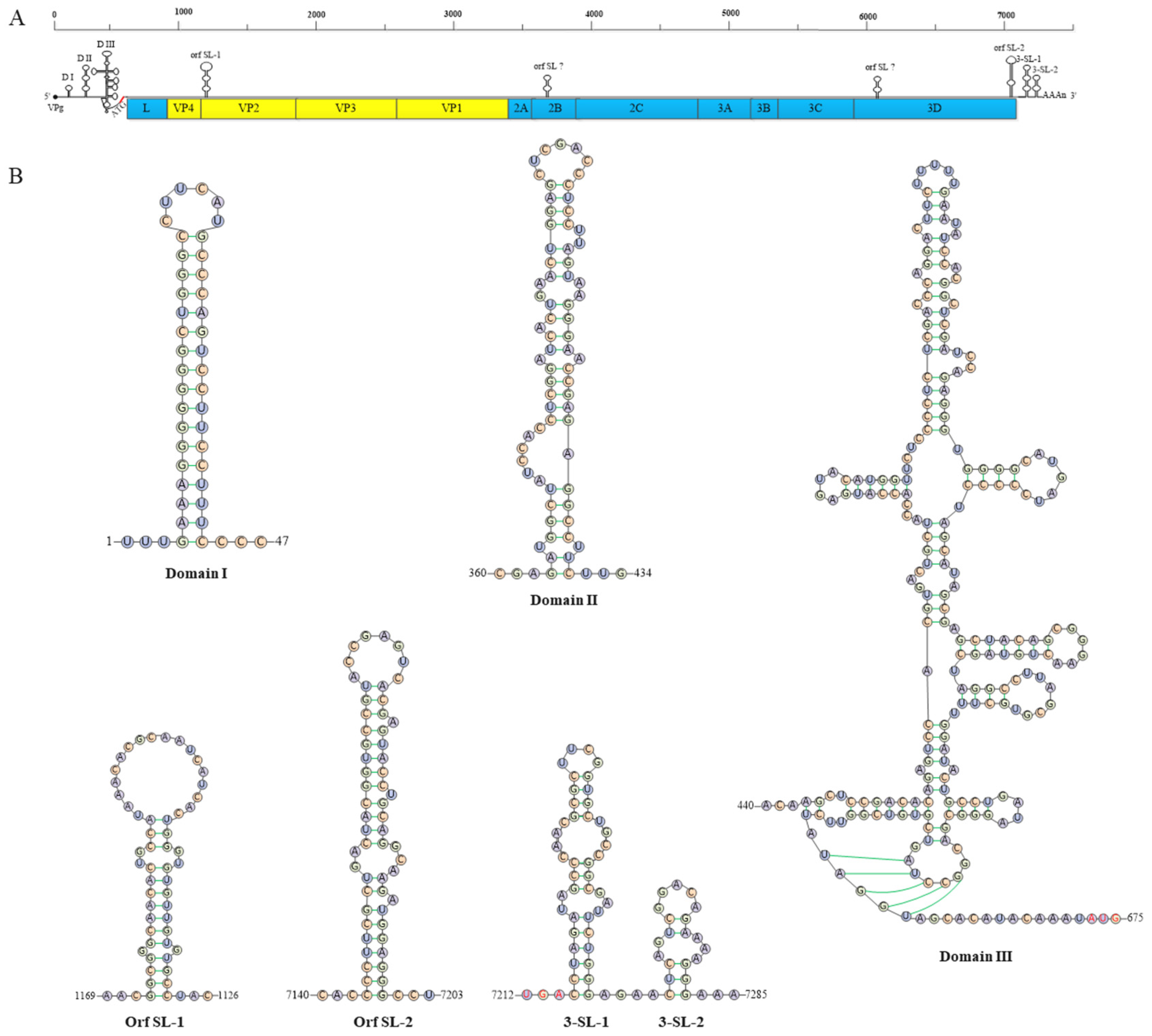
2.1. Viral Genome RNA Structure Is Vital for the Replication of SVA
2.2. Genetic Evolution and Recombination Alters the Infectious of SVA
3. ANTXR1 Mediates the Cellular Tropism and Pathogenesis of SVA
4. The Interplay Between SVA and Host Immunity During Infection
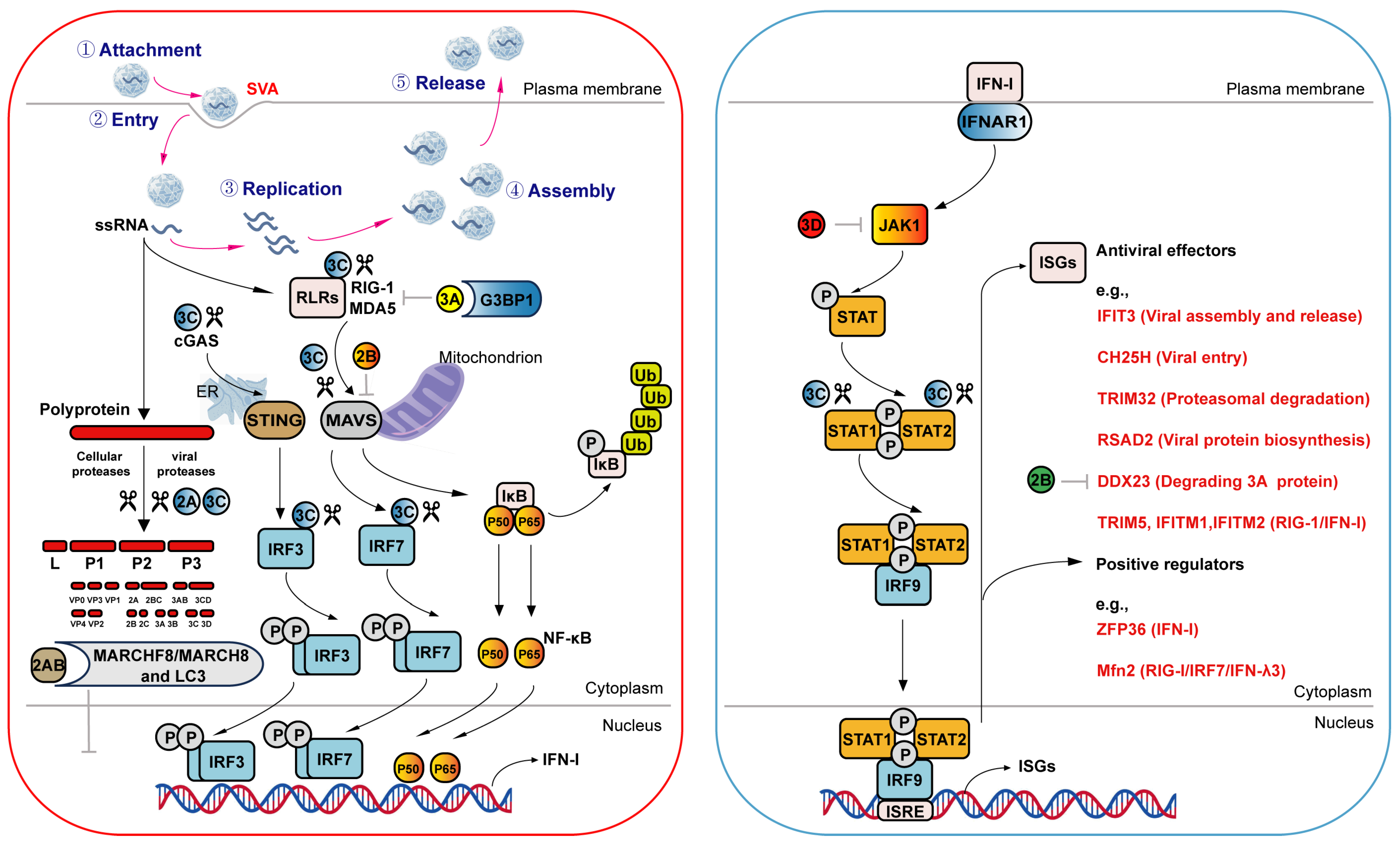
4.1. The Host Antiviral Immune Response Restricts SVA Infection
4.2. SVA Antagonizes the Antiviral Immune Response During Infection
4.3. The Host Adaptive Immune Response During SVA Infection
5. Reprogramming of Multiple Cell Death Processes Underlies SVA Pathogenesis
5.1. SVA Modulates Cell Autophagy Process
5.2. SVA Modulates Programmed Cell Apoptosis Process
5.3. SVA Modulates Programmed Cell Pyroptosis Process
6. Conclusions and Future Prospects
Author Contributions
Funding
Institutional Review Board Statement
Informed Consent Statement
Data Availability Statement
Acknowledgments
Conflicts of Interest
Abbreviations
| SVA | Senecavirus A |
| SAVD | Senecavirus-associated vesicular disease |
| ORF | open reading frame |
| UTR | untranslated regions |
| IRES | internal ribosome entry site |
| ANTXR1 | anthrax toxin receptor 1 |
| VPg | viral protein covalently linked to the 5′ end of viral RNA genome |
| eIF | eukaryotic initiation factor |
| SL | stem-loop structure |
| IFN | Interferon |
| RLRs | RIG-I-like receptors |
| ISGs | Interferon-stimulated genes |
| ZAP | zinc-finger antiviral protein |
| CH25H | cholesterol-25-hydroxylase |
| hnRNP | heterogeneous nuclear ribonucleoprotein |
| HCC | hepatocellular carcinoma |
| Stu | swine turbinate |
| ER | endoplasmic reticulum |
| GSDM | Gasdermin |
| vWA | von Willebrand factor A |
| CavME | caveolae-mediated endocytosis |
References
- Hales, L.M.; Knowles, N.J.; Reddy, P.S.; Xu, L.; Hay, C.; Hallenbeck, P.L. Complete genome sequence analysis of Seneca Valley virus-001, a novel oncolytic picornavirus. J. Gen. Virol. 2008, 89, 1265–1275. [Google Scholar] [CrossRef] [Scilit] [PubMed]
- Zhang, J.; Pineyro, P.; Chen, Q.; Zheng, Y.; Li, G.; Rademacher, C.; Derscheid, R.; Guo, B.; Yoon, K.J.; Madson, D.; et al. Full-length genome sequences of Senecavirus A from recent idiopathic vesicular disease outbreaks in U.S. swine. Genome Announc. 2015, 3, e01270-15. [Google Scholar] [CrossRef] [Scilit] [PubMed]
- Vannucci, F.A.; Linhares, D.C.; Barcellos, D.E.; Lam, H.C.; Collins, J.; Marthaler, D. Identification and complete genome of Seneca Valley virus in vesicular fluid and sera of pigs affected with idiopathic vesicular disease, Brazil. Transbound. Emerg. Dis. 2015, 62, 589–593. [Google Scholar] [CrossRef] [Scilit] [PubMed]
- Canning, P.; Canon, A.; Bates, J.L.; Gerardy, K.; Linhares, D.C.; Pineyro, P.E.; Schwartz, K.J.; Yoon, K.J.; Rademacher, C.J.; Holtkamp, D.; et al. Neonatal mortality, vesicular lesions and lameness associated with Senecavirus A in a U.S. sow farm. Transbound. Emerg. Dis. 2016, 63, 373–378. [Google Scholar] [CrossRef] [Scilit] [PubMed]
- Hole, K.; Vernygora, O.; Handel, K.; Nebroski, M.; Lung, O.; Nfon, C.; Babiuk, S. Phylogeographic characterizations of recent (2015–2023) Senecavirus A isolates from Canada. Viruses 2025, 17, 141. [Google Scholar] [CrossRef] [Scilit] [PubMed]
- Wu, Q.; Zhao, X.; Bai, Y.; Sun, B.; Xie, Q.; Ma, J. The First Identification and complete genome of Senecavirus A affecting pig with idiopathic vesicular disease in China. Transbound. Emerg. Dis. 2017, 64, 1633–1640. [Google Scholar] [CrossRef] [Scilit] [PubMed]
- Saeng-Chuto, K.; Rodtian, P.; Temeeyasen, G.; Wegner, M.; Nilubol, D. The first detection of Senecavirus A in pigs in Thailand, 2016. Transbound. Emerg. Dis. 2018, 65, 285–288. [Google Scholar] [CrossRef] [Scilit] [PubMed]
- Sun, D.; Vannucci, F.; Knutson, T.P.; Corzo, C.; Marthaler, D.G. Emergence and whole-genome sequence of Senecavirus A in Colombia. Transbound. Emerg. Dis. 2017, 64, 1346–1349. [Google Scholar] [CrossRef] [Scilit] [PubMed]
- Navarro-López, R.; Perez-de, L.R.J.; Rocha-Martínez, M.K.; Galván, H.G.; Villarreal-Silva, M.; Solís-Hernández, M.; Rojas-Torres, E.; Gomez-Romero, N. First detection and genetic characterization of Senecavirus A in pigs from Mexico. J. Swine Health Prod. 2023, 31, 289–294. [Google Scholar] [CrossRef] [Scilit] [PubMed]
- Maan, S.; Batra, K.; Chaudhary, D.; Punia, M.; Kadian, V.; Joshi, V.G.; Kumar, A. Detection and genomic characterization of Senecavirus from Indian pigs. Indian J. Anim. Res. 2023, 57, 1344–1350. [Google Scholar]
- Arzt, J.; Bertram, M.R.; Vu, L.T.; Pauszek, S.J.; Hartwig, E.J.; Smoliga, G.R.; Palinski, R.; Stenfeldt, C.; Fish, I.H.; Hoang, B.H.; et al. First detection and genome sequence of Senecavirus A in Vietnam. Microbiol. Resour. Announc. 2019, 8, e01247-18. [Google Scholar] [CrossRef] [Scilit] [PubMed]
- Bennett, B.; Urzua-Encina, C.; Pardo-Roa, C.; Ariyama, N.; Lecocq, C.; Rivera, C.; Badia, C.; Suarez, P.; Agredo, M.; Aguayo, C.; et al. First report and genetic characterization of Seneca Valley virus (SVV) in Chile. Transbound. Emerg. Dis. 2022, 69, e3462–e3468. [Google Scholar] [CrossRef] [Scilit] [PubMed]
- Gao, H.; Chen, Y.J.; Xu, X.Q.; Xu, Z.Y.; Xu, S.J.; Xing, J.B.; Liu, J.; Zha, Y.F.; Sun, Y.K.; Zhang, G.H. Comprehensive phylogeographic and phylodynamic analyses of global Senecavirus A. Front. Microbiol. 2022, 13, 980862. [Google Scholar] [CrossRef] [Scilit] [PubMed]
- Hellen, C.U.; de Breyne, S. A distinct group of hepacivirus/pestivirus-like internal ribosomal entry sites in members of diverse picornavirus genera: Evidence for modular exchange of functional noncoding RNA elements by recombination. J. Virol. 2007, 81, 5850–5863. [Google Scholar] [CrossRef] [Scilit] [PubMed]
- Liu, F.; Wang, Q.; Wang, N.; Shan, H. Impacts of single nucleotide deletions from the 3’ end of Senecavirus A 5’ untranslated region on activity of viral IRES and on rescue of recombinant virus. Virology 2021, 563, 126–133. [Google Scholar] [CrossRef] [Scilit] [PubMed]
- Liu, F.; Zhao, D.; Wang, N.; Li, Z.; Dong, Y.; Liu, S.; Zhang, F.; Cui, J.; Meng, H.; Ni, B.; et al. Tolerance of Senecavirus A to Mutations in Its Kissing-Loop or Pseudoknot Structure Computationally Predicted in 3’ Untranslated Region. Front. Microbiol. 2022, 13, 889480. [Google Scholar] [CrossRef] [Scilit] [PubMed]
- Venkataraman, S.; Reddy, S.P.; Loo, J.; Idamakanti, N.; Hallenbeck, P.L.; Reddy, V.S. Structure of Seneca Valley Virus-001, an oncolytic picornavirus representing a new genus. Structure 2008, 16, 1555–1561. [Google Scholar] [CrossRef] [Scilit] [PubMed]
- Wang, Q.; Meng, H.; Ge, D.; Shan, H.; Geri, L.; Liu, F. Structural and nonstructural proteins of Senecavirus A: Recent research advances, and lessons learned from those of other picornaviruses. Virology 2023, 585, 155–163. [Google Scholar] [CrossRef] [Scilit] [PubMed]
- Reddy, P.S.; Burroughs, K.D.; Hales, L.M.; Ganesh, S.; Jones, B.H.; Idamakanti, N.; Hay, C.; Li, S.S.; Skele, K.L.; Vasko, A.J.; et al. Seneca Valley virus, a systemically deliverable oncolytic picornavirus, and the treatment of neuroendocrine cancers. J. Natl. Cancer Inst. 2007, 99, 1623–1633. [Google Scholar] [CrossRef] [Scilit] [PubMed]
- Martinez-Salas, E.; Francisco-Velilla, R.; Fernandez-Chamorro, J.; Lozano, G.; Diaz-Toledano, R. Picornavirus IRES elements: RNA structure and host protein interactions. Virus Res. 2015, 206, 62–73. [Google Scholar] [CrossRef] [Scilit] [PubMed]
- Willcocks, M.M.; Locker, N.; Gomwalk, Z.; Royall, E.; Bakhshesh, M.; Belsham, G.J.; Idamakanti, N.; Burroughs, K.D.; Reddy, P.S.; Hallenbeck, P.L.; et al. Structural features of the Seneca Valley virus internal ribosome entry site (IRES) element: A picornavirus with a pestivirus-like IRES. J. Virol. 2011, 85, 4452–4461. [Google Scholar] [CrossRef] [Scilit] [PubMed]
- Easton, L.E.; Locker, N.; Lukavsky, P.J. Conserved functional domains and a novel tertiary interaction near the pseudoknot drive translational activity of hepatitis C virus and hepatitis C virus-like internal ribosome entry sites. Nucleic Acids Res. 2009, 37, 5537–5549. [Google Scholar] [CrossRef] [Scilit] [PubMed]
- Otto, G.A.; Puglisi, J.D. The pathway of HCV IRES-mediated translation initiation. Cell 2004, 119, 369–380. [Google Scholar] [CrossRef] [Scilit] [PubMed]
- Liu, F.; Wang, Q.; Meng, H.; Zhao, D.; Hao, X.; Zhang, S.; Lu, J.; Shan, H. Experimental evidence for occurrence of putative copy-choice recombination between two Senecavirus A genomes. Vet. Microbiol. 2022, 271, 109487. [Google Scholar] [CrossRef] [Scilit] [PubMed]
- Willcocks, M.M.; Zaini, S.; Chamond, N.; Ulryck, N.; Allouche, D.; Rajagopalan, N.; Davids, N.A.; Fahnoe, U.; Hadsbjerg, J.; Rasmussen, T.B.; et al. Distinct roles for the IIId2 sub-domain in pestivirus and picornavirus internal ribosome entry sites. Nucleic Acids Res. 2017, 45, 13016–13028. [Google Scholar] [CrossRef] [Scilit] [PubMed]
- Liu, F.; Wang, N.; Huang, Y.; Wang, Q.; Shan, H. Stem II-disrupting pseudoknot does not abolish ability of Senecavirus A IRES to initiate protein expression, but inhibits recovery of virus from cDNA clone. Vet. Microbiol. 2021, 255, 109024. [Google Scholar] [CrossRef] [Scilit] [PubMed]
- Liu, F.; Wang, N.; Wang, Q.; Shan, H. Motif mutations in pseudoknot stem I upstream of start codon in Senecavirus A genome: Impacts on activity of viral IRES and on rescue of recombinant virus. Vet. Microbiol. 2021, 262, 109223. [Google Scholar] [CrossRef] [Scilit] [PubMed]
- Wang, N.; Wang, H.; Shi, J.; Li, C.; Liu, X.; Fan, J.; Sun, C.; Cameron, C.E.; Qi, H.; Yu, L. The stem-loop I of Senecavirus A IRES is essential for cap-independent translation activity and virus recovery. Viruses 2021, 13, 2159. [Google Scholar] [CrossRef] [Scilit] [PubMed]
- Meng, H.; Wang, Q.; Liu, M.; Li, Z.; Hao, X.; Zhao, D.; Dong, Y.; Liu, S.; Zhang, F.; Cui, J.; et al. The 5’-end motif of Senecavirus A cDNA clone is genetically modified in 36 different ways for uncovering profiles of virus recovery. Front. Microbiol. 2022, 13, 957849. [Google Scholar] [CrossRef] [Scilit] [PubMed]
- Zhao, D.; Wang, Q.; Wang, M.; Lyu, L.; Liu, S.; Jiang, Y.; Zhou, S.; Liu, F. A putative wild-type or wild-type-like hairpin structure is required within 3’ untranslated region of Senecavirus A for virus replication. Virology 2023, 585, 72–77. [Google Scholar] [CrossRef] [Scilit] [PubMed]
- Wang, X.; Meng, H.; Duan, X.; Sang, Y.; Zhang, Y.; Li, Y.; Liu, F. The 3’ end of the coding region of senecavirus A contains a highly conserved sequence that potentially forms a stem-loop structure required for virus rescue. Arch. Virol. 2023, 168, 256. [Google Scholar] [CrossRef] [Scilit] [PubMed]
- Lasecka-Dykes, L.; Tulloch, F.; Simmonds, P.; Luke, G.A.; Ribeca, P.; Gold, S.; Knowles, N.J.; Wright, C.F.; Wadsworth, J.; Azhar, M.; et al. Mutagenesis Mapping of RNA Structures within the Foot-and-Mouth Disease Virus Genome Reveals Functional Elements Localized in the Polymerase (3D(pol))-Encoding Region. Msphere 2021, 6, e1521. [Google Scholar] [CrossRef] [Scilit] [PubMed]
- Peng, T.; Yang, F.; Yang, F.; Cao, W.; Zheng, H.; Zhu, Z. Structural diversity and biological role of the 5’ untranslated regions of picornavirus. Rna Biol. 2023, 20, 548–562. [Google Scholar] [CrossRef] [Scilit] [PubMed]
- Joshi, L.R.; Mohr, K.A.; Gava, D.; Kutish, G.; Buysse, A.S.; Vannucci, F.A.; Pineyro, P.E.; Crossley, B.M.; Schiltz, J.J.; Jenkins-Moore, M.; et al. Genetic diversity and evolution of the emerging picornavirus Senecavirus A. J. Gen. Virol. 2020, 101, 175–187. [Google Scholar] [CrossRef] [Scilit] [PubMed]
- Kikuti, M.; Yue, X.; Melini, C.M.; Vadnais, S.; Corzo, C.A. Senecavirus A Incidence in U.S. Breeding Herds: A Decade of Surveillance Data. Animals 2025, 15, 1650. [Google Scholar] [CrossRef] [Scilit] [PubMed]
- Li, C.; Gao, C.; Tao, L.; Cui, J.; Zhang, H.; Zheng, H.; Wei, R.; Gu, S.; Sha, Z.; Ni, B. Epidemiological investigation of Senecavirus A infection in pig herds in China from 2018 to 2021. Front. Vet. Sci. 2024, 11, 1391513. [Google Scholar] [CrossRef] [Scilit] [PubMed]
- Zhang, H.; Chen, P.; Hao, G.; Liu, W.; Chen, H.; Qian, P.; Li, X. Comparison of the pathogenicity of two different branches of Senecavirus a strain in China. Pathogens 2020, 9, 39. [Google Scholar] [CrossRef] [Scilit] [PubMed]
- Buckley, A.C.; Michael, D.D.; Faaberg, K.S.; Guo, B.; Yoon, K.J.; Lager, K.M. Comparison of historical and contemporary isolates of Senecavirus A. Vet. Microbiol. 2021, 253, 108946. [Google Scholar] [CrossRef] [Scilit] [PubMed]
- Wang, Z.; Zhang, X.; Yan, R.; Yang, P.; Wu, Y.; Yang, D.; Bian, C.; Zhao, J. Emergence of a novel recombinant Seneca Valley virus in Central China, 2018. Emerg. Microbes Infect. 2018, 7, 180. [Google Scholar] [CrossRef] [Scilit] [PubMed]
- Zhang, X.; Li, X.; Liu, Y.; Lv, N.; Yang, B.; Fu, S.; Jiang, Z.; Zhao, P.; Guo, Y.; Song, J.; et al. Detection, isolation and molecular characterization of Senecavirus A in porcine semen: Implications for control programs. Vet. J. 2026, 317, 106616. [Google Scholar] [CrossRef] [Scilit] [PubMed]
- Ribeiro, L.C.; Butt, S.L.; Rani, R.; Tochetto, C.; Cardia Caserta, L.; de Oliveira Barbosa, A.; Gava, D.; Fischer, G.; Fernandes Camargos, M.; Schaefer, R.; et al. Genetic diversity and evolutionary dynamics of Senecavirus A in Brazil. J. Gen. Virol. 2026, 107, 002212. [Google Scholar] [CrossRef] [Scilit] [PubMed]
- Li, C.; Wu, X.; Wang, X.; Shi, J.; Liu, C.; Peng, Z.; Han, H.; Xu, S.; Wang, S.; Ma, Y.; et al. Complete genome and pathogenesis of a novel recombinant Senecavirus A isolate in P.R. China. J. Gen. Virol. 2022, 103, 001788. [Google Scholar] [CrossRef] [Scilit] [PubMed]
- Dong, J.; Rao, D.; Geng, X.; Chen, M.; He, S.; Jiao, F.; Huang, L.; Chen, B.; Zhao, P.; Cong, F. Evolutionary analysis of 3 isolates of Seneca Valley virus from a single pig farm. Can. J. Vet. Res. 2022, 86, 102–107. [Google Scholar] [PubMed]
- Wang, W.; Zhang, S.; Zhao, Q.; Jiang, L.; Zhu, Z.; Wen, W.; Li, X. Integrated genomic analysis uncovers the evolutionary landscape and global dissemination of Senecavirus A. Vet. Sci. 2026, 13, 429. [Google Scholar] [CrossRef] [Scilit] [PubMed]
- Guo, Z.; Chen, X.X.; Ruan, H.; Qiao, S.; Deng, R.; Zhang, G. Isolation of three novel Senecavirus A strains and recombination analysis Among Senecaviruses in China. Front. Vet. Sci. 2020, 7, 2. [Google Scholar] [CrossRef] [Scilit] [PubMed]
- Yang, J.; Zhang, Z.; Sha, W.; Peng, M.; Li, Y.; Ge, X.; Li, J.; Cui, W.; Jiang, Y.; Wang, X.; et al. Adaptive VP1 sites 93 and 97 modulate antigenic evolution and receptor binding of Senecavirus A: Phylogenetic analysis and validation with recombinant viruses. Vet. Microbiol. 2026, 316, 110997. [Google Scholar] [CrossRef] [Scilit] [PubMed]
- Li, C.; Wang, H.; Shi, J.; Yang, D.; Zhou, G.; Chang, J.; Cameron, C.E.; Woodman, A.; Yu, L. Senecavirus-specific recombination assays reveal the intimate link between polymerase fidelity and RNA recombination. J. Virol. 2019, 93, e00576-19. [Google Scholar] [CrossRef] [Scilit] [PubMed]
- Fu, S.; Tong, X.; Cai, C.; Zhao, Y.; Wu, Y.; Li, Y.; Xu, J.; Zhang, X.C.; Xu, L.; Chen, W.; et al. The structure of tumor endothelial marker 8 (TEM8) extracellular domain and implications for its receptor function for recognizing anthrax toxin. PLoS ONE 2010, 5, e11203. [Google Scholar] [CrossRef] [Scilit] [PubMed]
- Jayawardena, N.; Miles, L.A.; Burga, L.N.; Rudin, C.; Wolf, M.; Poirier, J.T.; Bostina, M. N-Linked Glycosylation on Anthrax Toxin Receptor 1 Is Essential for Seneca Valley Virus Infection. Viruses 2021, 13, 769. [Google Scholar] [CrossRef] [Scilit] [PubMed]
- Jayawardena, N.; Burga, L.N.; Easingwood, R.A.; Takizawa, Y.; Wolf, M.; Bostina, M. Structural basis for anthrax toxin receptor 1 recognition by Seneca Valley Virus. Proc. Natl. Acad. Sci. USA 2018, 115, E10934–E10940. [Google Scholar] [CrossRef] [Scilit] [PubMed]
- Wang, M.; Mou, C.; Chen, M.; Chen, Z. Infectious recombinant Senecavirus A expressing novel reporter proteins. Appl. Microbiol. Biotechnol. 2021, 105, 2385–2397. [Google Scholar] [CrossRef] [Scilit] [PubMed]
- Jia, M.; Sun, M.; Tang, Y.D.; Zhang, Y.Y.; Wang, H.; Cai, X.; Meng, F. Senecavirus A entry into host cells is dependent on the cholesterol-mediated endocytic pathway. Front. Vet. Sci. 2022, 9, 840655. [Google Scholar] [CrossRef] [Scilit] [PubMed]
- Chen, P.R.; Rowland, R.R.R.; Stoian, A.M.; Petrovan, V.; Sheahan, M.; Ganta, C.; Cino-Ozuna, G.; Kim, D.Y.; Dunleavey, J.M.; Whitworth, K.M.; et al. Disruption of anthrax toxin receptor 1 in pigs leads to a rare disease phenotype and protection from senecavirus A infection. Sci. Rep. 2022, 12, 5009. [Google Scholar] [CrossRef] [Scilit] [PubMed]
- Zhou, X.; Liang, W.F.; Si, G.B.; Li, J.H.; Chen, Z.F.; Cai, W.Y.; Lv, D.H.; Wen, X.H.; Zhai, Q.; Zhai, S.L.; et al. Buffalo-origin Seneca Valley virus in China: First report, isolation, genome characterization, and evolution analysis. Front. Vet. Sci. 2021, 8, 730701. [Google Scholar] [CrossRef] [Scilit] [PubMed]
- Zhou, X.; Zhai, Q.; Niu, J.; Li, G.; Chen, T.; Li, Y.; Kang, H.; Li, C.; Gou, H.; Chu, P.; et al. Pathogenicity of the first buffalo-origin Senecavirus A in conventional piglets and buffaloes. Transbound. Emerg. Dis. 2025, 2025, 6222217. [Google Scholar] [CrossRef] [Scilit] [PubMed]
- Joshi, L.R.; Mohr, K.A.; Clement, T.; Hain, K.S.; Myers, B.; Yaros, J.; Nelson, E.A.; Christopher-Hennings, J.; Gava, D.; Schaefer, R.; et al. Detection of the emerging picornavirus Senecavirus A in pigs, mice, and houseflies. J. Clin. Microbiol. 2016, 54, 1536–1545. [Google Scholar] [CrossRef] [Scilit] [PubMed]
- Zhang, J.; Li, C.; Meng, Y.; Xie, Y.; Shi, N.; Zhang, H.; Yu, C.; Nan, F.; Xie, C.; Ha, Z.; et al. Pathogenicity of Seneca Valley virus in pigs and detection in Culicoides from an infected pig farm. Virol. J. 2021, 18, 209. [Google Scholar] [CrossRef] [Scilit] [PubMed]
- Turner, J.H.; Paim, W.P.; Maggioli, M.F.; Peter, C.M.; Miknis, R.; Talley, J.; Bauermann, F.V. Prolonged viability of Senecavirus A in exposed house flies (Musca domestica). Viruses 2022, 14, 127. [Google Scholar] [CrossRef] [Scilit] [PubMed]
- Li, N.; Qiao, Q.L.; Guo, H.F.; Wang, B.Y.; Huang, Q.; Wang, Z.; Li, Y.T.; Zhao, J. Evaluation of immunogenicity and protective efficacy of a novel Senecavirus A strain-based inactivated vaccine in mice. Res. Vet. Sci. 2021, 142, 133–140. [Google Scholar] [CrossRef] [Scilit] [PubMed]
- Unterholzner, L.; Bowie, A.G. The interplay between viruses and innate immune signaling: Recent insights and therapeutic opportunities. Biochem. Pharmacol. 2008, 75, 589–602. [Google Scholar] [CrossRef] [Scilit] [PubMed]
- Li, P.; Zhang, X.; Cao, W.; Yang, F.; Du, X.; Shi, Z.; Zhang, M.; Liu, X.; Zhu, Z.; Zheng, H. RIG-I is responsible for activation of type I interferon pathway in Seneca Valley virus-infected porcine cells to suppress viral replication. Virol. J. 2018, 15, 162. [Google Scholar] [CrossRef] [Scilit] [PubMed]
- Wang, J.; Mou, C.; Wang, M.; Pan, S.; Chen, Z. Transcriptome analysis of senecavirus A-infected cells: Type I interferon is a critical anti-viral factor. Microb. Pathog. 2020, 147, 104432. [Google Scholar] [CrossRef] [Scilit] [PubMed]
- Peng, K.; Deng, L.; Wei, J.; Zhao, J.; Deng, H.; Tao, Q.; Jiang, C.; Zeng, Y.; Li, F.; Zhang, R.; et al. Transcriptome analyses of Senecavirus A infected PK-15 cells: RIG-I and IRF7 are the important factors in inducing type III interferons. Front. Microbiol. 2022, 13, 846343. [Google Scholar] [CrossRef] [Scilit] [PubMed]
- Deng, H.; Zhu, S.; Zhu, L.; Sun, J.; Ding, Y.; Li, F.; Jian, Z.; Zhao, J.; Deng, L.; Deng, J.; et al. Mfn2 is responsible for inhibition of the RIG-I/IRF7 pathway and activation of NLRP3 inflammasome in Seneca Valley virus-infected PK-15 cells to promote viral replication. Front. Immunol. 2022, 13, 955671. [Google Scholar] [CrossRef] [Scilit] [PubMed]
- Yin, M.; Guan, L.; Zhang, M.; Li, X.; Qian, P. ZFP36 Facilitates Senecavirus A (SVA) replication by inhibiting the production of type I interferon. Virus Res. 2024, 350, 199498. [Google Scholar] [CrossRef] [Scilit] [PubMed]
- Li, H.; Yu, X.; Guo, R.; Jia, W.; Qi, W.; Ning, Z. Zinc-finger antiviral protein inhibits replication of Senecavirus A by the short isoform activating RIG-I signaling pathway and the longer isoform targeting viral 3D(pol). Int. J. Biol. Macromol. 2025, 318, 145255. [Google Scholar] [CrossRef] [Scilit] [PubMed]
- Gao, H.; Xiang, Z.; Ge, X.; Zhou, L.; Han, J.; Guo, X.; Chen, Y.; Zhang, Y.; Yang, H. Comparative proteomic analysis reveals Mx1 inhibits Senecavirus A replication in PK-15 cells by interacting with the capsid proteins VP1, VP2 and VP3. Viruses 2022, 14, 863. [Google Scholar] [CrossRef] [Scilit] [PubMed]
- Xu, F.; Dang, W.; Li, T.; Wang, Y.; Yang, F.; Zheng, H. IFIT3 mediated the type I interferon antiviral response by targeting Senecavirus A entry, assembly and release pathways. Vet. Microbiol. 2022, 275, 109594. [Google Scholar] [CrossRef] [Scilit] [PubMed]
- Li, H.; Zhao, Z.; Li, X.; Qin, L.; Wen, W.; Chen, H.; Qian, P. Cholesterol-25-Hydroxylase Suppresses Seneca Valley Virus Infection via Producing 25-Hydroxycholesterol to Block Adsorption Procedure. Virol. Sin. 2021, 36, 1210–1219. [Google Scholar] [CrossRef] [Scilit] [PubMed]
- Yang, J.; Li, Z.; Ma, R.; Xie, S.; Wang, D.; Quan, R.; Liu, J.; Song, J. Seneca Valley virus 3C protease targets TRIM32 for cleavage to antagonize its antiviral effects. J. Virol. 2025, 99, e59025. [Google Scholar] [CrossRef] [Scilit] [PubMed]
- Hou, L.; Wu, Z.; Zeng, P.; Yang, X.; Shi, Y.; Guo, J.; Zhou, J.; Song, J.; Liu, J. RSAD2 suppresses viral replication by interacting with the Senecavirus A 2 C protein. Vet. Res. 2024, 55, 115. [Google Scholar] [CrossRef] [Scilit] [PubMed]
- Li, H.; Xie, Z.; Lei, X.; Chen, M.; Zheng, T.; Lin, C.; Ning, Z. TRIM5 inhibits the replication of Senecavirus A by promoting the RIG-I-mediated type I interferon antiviral response. Vet. Res. 2024, 55, 101. [Google Scholar] [CrossRef] [Scilit] [PubMed]
- Li, H.; Chen, M.; Zheng, T.; Lei, X.; Lin, C.; Li, S.; Mo, J.; Ning, Z. IFITM1 and IFITM2 inhibit the replication of senecavirus A by positive feedback with RIG-I signaling pathway. Vet. Microbiol. 2024, 292, 110050. [Google Scholar] [CrossRef] [Scilit] [PubMed]
- Zhang, X.; Yang, F.; Li, K.; Cao, W.; Ru, Y.; Chen, S.; Li, S.; Liu, X.; Zhu, Z.; Zheng, H. The insufficient activation of RIG-I-Like signaling pathway contributes to highly efficient replication of porcine picornaviruses in IBRS-2 cells. Mol. Cell Proteom. 2021, 20, 100147. [Google Scholar] [CrossRef] [Scilit] [PubMed]
- Sun, X.; Wang, J.; Mou, C.; Shi, K.; Bao, W.; Chen, Z. Knockout of IRF3 and IRF7 genes by CRISPR/Cas9 technology enhances porcine virus replication in the swine testicular (ST) cell line. Biotechnol. J. 2024, 19, e2300389. [Google Scholar] [CrossRef] [Scilit] [PubMed]
- You, L.; Zhang, Q.; Gao, S.; Fu, L.; Jia, M.; Wang, Y. Establishment of a Senecavirus A infection model in C57BL/6J IFNAR-/- mice and evaluation of its infection characteristics. Acta Microbiol. Sin. 2026, 66, 2430–2443. [Google Scholar]
- Meng, K.; Zhang, L.; Xue, X.; Xue, Q.; Sun, M.; Meng, G. Structure of Senecavirus A 3C protease revealed the cleavage pattern of 3C protease in picornaviruses. J. Virol. 2022, 96, e73622. [Google Scholar] [CrossRef] [Scilit] [PubMed]
- Yan, Y.; Wu, L.; Yuan, Y.; Wang, H.; Yin, H.; Li, M.; Chai, L.; Liang, R.; Liu, Y.; Zhao, D.; et al. Species-specific cleavage of cGAS by picornavirus protease 3C disrupts mitochondria DNA-mediated immune sensing. PLoS Pathog. 2023, 19, e1011641. [Google Scholar] [CrossRef] [Scilit] [PubMed]
- Wen, W.; Yin, M.; Zhang, H.; Liu, T.; Chen, H.; Qian, P.; Hu, J.; Li, X. Seneca Valley virus 2C and 3C inhibit type I interferon production by inducing the degradation of RIG-I. Virology 2019, 535, 122–129. [Google Scholar] [CrossRef] [Scilit] [PubMed]
- Xue, Q.; Liu, H.; Zhu, Z.; Yang, F.; Xue, Q.; Cai, X.; Liu, X.; Zheng, H. Seneca Valley virus 3C protease negatively regulates the type I interferon pathway by acting as a viral deubiquitinase. Antivir. Res. 2018, 160, 183–189. [Google Scholar] [CrossRef] [Scilit] [PubMed]
- Qian, S.; Fan, W.; Liu, T.; Wu, M.; Zhang, H.; Cui, X.; Zhou, Y.; Hu, J.; Wei, S.; Chen, H.; et al. Seneca Valley virus suppresses host type I interferon production by targeting adaptor proteins MAVS, TRIF, and TANK for cleavage. J. Virol. 2017, 91, e00823-17. [Google Scholar] [CrossRef] [Scilit] [PubMed]
- Xue, Q.; Liu, H.; Zhu, Z.; Yang, F.; Ma, L.; Cai, X.; Xue, Q.; Zheng, H. Seneca Valley Virus 3C(pro) abrogates the IRF3- and IRF7-mediated innate immune response by degrading IRF3 and IRF7. Virology 2018, 518, 1–7. [Google Scholar] [CrossRef] [Scilit] [PubMed]
- Zhang, X.; Li, P.; Chen, W.; Zhang, S.; Li, K.; Ru, Y.; Zhao, Z.; Cao, W.; Yang, F.; Tian, H.; et al. Impaired interferon response in senecavirus A infection and identification of 3C(pro) as an antagonist. J. Virol. 2024, 98, e58524. [Google Scholar] [CrossRef] [Scilit] [PubMed]
- Li, Z.; Yang, J.; Ma, R.; Xie, S.; Wang, D.; Quan, R.; Wen, X.; Liu, J.; Song, J. Seneca Valley virus 3C protease cleaves HDAC4 to antagonize type I interferon signaling. J. Virol. 2025, 99, e217624. [Google Scholar] [CrossRef] [Scilit] [PubMed]
- Yang, J.; Li, Z.; Ma, R.; Xie, S.; Wang, D.; Quan, R.; Wen, X.; Song, J. The Seneca Valley virus 3C protease cleaves DCP1A to attenuate its antiviral effects. Vet. Res. 2025, 56, 46. [Google Scholar] [CrossRef] [Scilit] [PubMed]
- Yin, H.; Zhao, Z.; Yan, Y.; Yuan, Y.; Qu, W.; Wang, H.; Zhu, C.; Li, P.; Li, X. Seneca Valley virus circumvents Gasdermin A-mediated inflammation by targeting the pore-formation domain for cleavage. Mbio 2024, 15, e168024. [Google Scholar] [CrossRef] [Scilit] [PubMed]
- Wen, W.; Li, X.; Wang, H.; Zhao, Q.; Yin, M.; Liu, W.; Chen, H.; Qian, P. Seneca Valley virus 3C protease induces pyroptosis by directly cleaving porcine gasdermin D. J. Immunol. 2021, 207, 189–199. [Google Scholar] [CrossRef] [Scilit] [PubMed]
- Huang, X.; Zhao, Z.; Zhu, C.; Chai, L.; Yan, Y.; Yuan, Y.; Wu, L.; Li, M.; Jiang, X.; Wang, H.; et al. Species-specific IL-1beta is an inflammatory sensor of Seneca Valley Virus 3C Protease. PLoS Pathog. 2024, 20, e1012398. [Google Scholar] [CrossRef] [Scilit] [PubMed]
- Wen, W.; Zheng, Z.; Wang, H.; Zhao, Q.; Yin, M.; Chen, H.; Li, X.; Qian, P. Seneca Valley virus induces DHX30 cleavage to antagonize its antiviral effects. J. Virol. 2022, 96, e112122. [Google Scholar] [CrossRef] [Scilit] [PubMed]
- Zhao, K.; Guo, X.R.; Liu, S.F.; Liu, X.N.; Han, Y.; Wang, L.L.; Lei, B.S.; Zhang, W.C.; Li, L.M.; Yuan, W.Z. 2B and 3C proteins of Senecavirus A antagonize the antiviral activity of DDX21 via the aaspase-dependent degradation of DDX21. Front. Immunol. 2022, 13, 951984. [Google Scholar] [CrossRef] [Scilit] [PubMed]
- Xue, Q.; Liu, H.; Zhu, Z.; Xue, Z.; Liu, X.; Zheng, H. Seneca Valley virus 3C(pro) cleaves PABPC1 to promote viral replication. Pathogens 2020, 9, 443. [Google Scholar] [CrossRef] [Scilit]
- Song, J.; Quan, R.; Wang, D.; Liu, J. Seneca Valley virus 3C(pro) mediates cleavage and redistribution of nucleolin to facilitate viral replication. Microbiol. Spectr. 2022, 10, e30422. [Google Scholar] [CrossRef] [Scilit] [PubMed]
- Song, J.; Quan, R.; Wang, D.; Liu, J. Seneca Valley virus 3C (pro) cleaves feterogeneous nuclear ribonucleoprotein K to facilitate viral replication. Front. Microbiol. 2022, 13, 945443. [Google Scholar]
- Song, J.; Wang, D.; Quan, R.; Liu, J. Seneca Valley virus 3C(pro) degrades heterogeneous nuclear ribonucleoprotein A1 to facilitate viral replication. Virulence 2021, 12, 3125–3136. [Google Scholar] [CrossRef] [Scilit]
- Liu, H.; Li, K.; Chen, W.; Yang, F.; Cao, W.; Zhang, K.; Li, P.; Tang, L.; Zhu, Z.; Zheng, H. Senecavirus A 2B protein suppresses type I interferon production by inducing the degradation of MAVS. Mol. Immunol. 2022, 142, 11–21. [Google Scholar] [CrossRef] [Scilit] [PubMed]
- Sun, D.; Kong, N.; Dong, S.; Chen, X.; Qin, W.; Wang, H.; Jiao, Y.; Zhai, H.; Li, L.; Gao, F.; et al. 2AB protein of Senecavirus A antagonizes selective autophagy and type I interferon production by degrading LC3 and MARCHF8. Autophagy 2022, 18, 1969–1981. [Google Scholar] [CrossRef] [Scilit] [PubMed]
- Yang, W.; Li, D.; Ru, Y.; Bai, J.; Ren, J.; Zhang, J.; Li, L.; Liu, X.; Zheng, H. Foot-and-mouth disease virus 3A protein causes upregulation of autophagy-related protein LRRC25 to inhibit the G3BP1-mediated RIG-like helicase-signaling pathway. J. Virol. 2020, 94, e02086-19. [Google Scholar] [CrossRef] [Scilit] [PubMed]
- Li, J.; Lin, H.; Zhou, Y.; Lei, Z.; Wang, X.; Bi, R.; Liu, X.; Wang, J.; Zhang, H.; Wang, X.; et al. 3A and 2B proteins of SVA play chess game with host restriction factor DDX23 by apoptotic pathway. J. Virol. 2025, 99, e0076125. [Google Scholar] [CrossRef] [Scilit] [PubMed]
- Choudhury, S.M.; Ma, X.; Zeng, Z.; Luo, Z.; Li, Y.; Nian, X.; Ma, Y.; Shi, Z.; Song, R.; Zhu, Z.; et al. Senecavirus a 3D Interacts with NLRP3 to Induce IL-1beta Production by Activating NF-kappaB and Ion Channel Signals. Microbiol. Spectr. 2022, 10, e209721. [Google Scholar]
- Li, K.; Zhang, X.; Liu, C.; Zhu, G.; Wang, S.; Dong, D.; Wen, X.; Chao, W.; Liu, B.; Mao, R.; et al. Picornavirus 3D polymerase inhibits antiviral innate immunity by blocking the activation of JAK-STAT signaling pathway. Mbio 2025, 16, e166625. [Google Scholar] [CrossRef] [Scilit] [PubMed]
- Oliveira, T.E.S.; Leme, R.A.; Agnol, A.M.D.; Gerez, J.R.; Pelaquim, I.F.; Miyabe, F.M.; Alfieri, A.F.; Alfieri, A.A.; Headley, S.A. Seneca Valley virus induces immunodepressionin suckling piglets by selective apoptosis of B lymphocytes. Microb. Pathog. 2021, 158, 105022. [Google Scholar] [CrossRef] [Scilit] [PubMed]
- Wang, W.; Han, F.; He, X.; Zhao, S.; Zou, Z.; Tian, M.; Chen, H.; Wu, S.; Sun, Y.; Jiang, Y.; et al. Breed varieties of pigs for disease resistance and susceptibility to Seneca Valley virus infection. Int. J. Mol. Sci. 2025, 26, 8746. [Google Scholar] [CrossRef] [Scilit] [PubMed]
- Maggioli, M.F.; Lawson, S.; de Lima, M.; Joshi, L.R.; Faccin, T.C.; Bauermann, F.V.; Diel, D.G. Adaptive immune responses following Senecavirus A infection in pigs. J. Virol. 2018, 92, e01717-17. [Google Scholar] [CrossRef] [Scilit] [PubMed]
- de Oliveira Barbosa, A.; Gava, D.; Bastos, A.P.A.; de Lima, M.; Schaefer, R. Immunogenicity of an inactivated vaccine against senecavirus a and duration of the immune response in pigs. Arch. Virol. 2026, 171, 33. [Google Scholar] [CrossRef] [Scilit] [PubMed]
- Cao, N.; Li, Y.; Chen, X.; Li, H.; Tian, L.; Hu, Z.; Bo, Y.; Diao, F.; Chen, H.; Li, X.; et al. A divalent nanoparticle vaccine confers robust protective immunity against serotype O FMDV and SVA in pigs. Vet. Microbiol. 2026, 320, 111128. [Google Scholar] [CrossRef] [Scilit] [PubMed]
- Barbosa, A.O.; Gava, D.; Tochetto, C.; Ribeiro, L.C.; Bastos, A.P.A.; Morés, M.A.Z.; Schaefer, R.; de Lima, M. Immunogenicity of an inactivated Senecavirus A vaccine with a contemporary Brazilian strain in mice. Vaccines 2024, 12, 845. [Google Scholar] [CrossRef] [Scilit] [PubMed]
- Mu, S.; Wang, S.; Dong, H.; Li, S.; Chen, L.; Shang, S.; Guo, H.; Sun, S. Senecavirus A non-structural protein 2C and 3A-specific T cell-epitopes promote inactivated vaccine efficacy in pigs via synergistic cellular and humoral immunity. Virulence 2026, 17, 2664943. [Google Scholar] [CrossRef] [Scilit] [PubMed]
- Mizushima, N.; Levine, B.; Cuervo, A.M.; Klionsky, D.J. Autophagy fights disease through cellular self-digestion. Nature 2008, 451, 1069–1075. [Google Scholar] [CrossRef] [Scilit] [PubMed]
- Wang, R.; Zhu, Y.; Zhao, J.; Ren, C.; Li, P.; Chen, H.; Jin, M.; Zhou, H. Autophagy promotes replication of Influenza A virus in vitro. J. Virol. 2019, 93, e01984-18. [Google Scholar] [CrossRef] [Scilit] [PubMed]
- Wen, B.; Yang, L.; Guo, J.; Chang, W.; Wei, S.; Yu, S.; Qi, X.; Xue, Q.; Wang, J. Peste des petits ruminants virus induces ERS-mediated autophagy to promote virus replication. Vet. Microbiol. 2022, 270, 109451. [Google Scholar] [CrossRef] [Scilit] [PubMed]
- Hou, L.; Dong, J.; Zhu, S.; Yuan, F.; Wei, L.; Wang, J.; Quan, R.; Chu, J.; Wang, D.; Jiang, H.; et al. Seneca valley virus activates autophagy through the PERK and ATF6 UPR pathways. Virology 2019, 537, 254–263. [Google Scholar] [CrossRef] [Scilit] [PubMed]
- Song, J.; Hou, L.; Quan, R.; Wang, D.; Jiang, H.; Liu, J. Synergetic contributions of viral VP1, VP3, and 3C to activation of the AKT-AMPK-MAPK-MTOR signaling pathway for Seneca Valley virus-induced autophagy. J. Virol. 2022, 96, e155021. [Google Scholar] [CrossRef] [Scilit] [PubMed]
- Wen, W.; Li, X.; Yin, M.; Wang, H.; Qin, L.; Li, H.; Liu, W.; Zhao, Z.; Zhao, Q.; Chen, H.; et al. Selective autophagy receptor SQSTM1/ p62 inhibits Seneca Valley virus replication by targeting viral VP1 and VP3. Autophagy 2021, 17, 3763–3775. [Google Scholar] [CrossRef] [Scilit]
- Gong, T.; Liu, X.; Li, Q.; Branch, D.R.; Loriamini, M.; Wen, W.; Shi, Y.; Tan, Q.; Fan, B.; Zhou, Z.; et al. Oncolytic virus Senecavirus A inhibits hepatocellular carcinoma proliferation and growth by inducing cell cycle arrest and apoptosis. J. Clin. Transl. Hepatol. 2024, 12, 713–725. [Google Scholar] [CrossRef] [Scilit] [PubMed]
- Liu, T.; Li, X.; Wu, M.; Qin, L.; Chen, H.; Qian, P. Seneca Valley virus 2C and 3C(pro) induce apoptosis via mitochondrion-mediated intrinsic pathway. Front. Microbiol. 2019, 10, 1202. [Google Scholar] [CrossRef] [Scilit] [PubMed]
- Fernandes, M.; Maggioli, M.F.; Otta, J.; Joshi, L.R.; Lawson, S.; Diel, D.G. Senecavirus A 3C protease mediates host cell apoptosis late in infection. Front. Immunol. 2019, 10, 363. [Google Scholar] [CrossRef] [Scilit] [PubMed]
- Hou, L.; Yang, X.; Liu, C.; Yu, J.; Wu, Z.; Wang, Y.; Zeng, P.; Guo, J.; Shi, Y.; Zhou, J.; et al. Seneca Valley virus induces mitochondrial apoptosis by activating ER stress or the PERK pathway based on Ca2+ transfer from ER to mitochondria. J. Virol. 2025, 99, e217724. [Google Scholar] [CrossRef] [Scilit] [PubMed]
- Shao, F. Gasdermins: Making pores for pyroptosis. Nat. Rev. Immunol. 2021, 21, 620–621. [Google Scholar] [CrossRef] [Scilit] [PubMed]
- Wang, Z.; Yu, H.; Zhuang, W.; Chen, J.; Jiang, Y.; Guo, Z.; Huang, X.; Liu, Q. Cell pyroptosis in picornavirus and its potential for treating viral infection. J. Med. Virol. 2022, 94, 3570–3580. [Google Scholar] [CrossRef] [Scilit] [PubMed]
- Yang, D.; Sun, C.; Gao, R.; Wang, H.; Liu, W.; Yu, K.; Zhou, G.; Zhao, B.; Yu, L. A temperature-dependent translation defect caused by internal ribosome entry site mutation attenuates foot-and-mouth disease virus: Implications for rational vaccine design. J. Virol. 2020, 94, e00990-20. [Google Scholar] [CrossRef] [Scilit] [PubMed]
- Yang, F.; Zhu, Z.; Cao, W.; Liu, H.; Wei, T.; Zheng, M.; Zhang, K.; Jin, Y.; He, J.; Guo, J. Genetic determinants of altered virulence of type O foot-and-mouth disease virus. J. Virol. 2020, 94, e01657-19. [Google Scholar] [CrossRef] [Scilit] [PubMed]
- Sturos, M.J.; Murray, D.; Johnson, L.; Preis, G.; Corzo, C.A.; Rossow, S.; Vannucci, F.A. Persistence and shedding of senecavirus A in naturally infected boars. J. Vet. Diagn. Investig. 2022, 34, 474–481. [Google Scholar] [CrossRef] [Scilit] [PubMed]



| Strain | Year | Location of Detection | Proposed Parental Lineages | Genomic Breakpoints | Detection Methods | References |
|---|---|---|---|---|---|---|
| HeN-1/2018 | 2018 | China | USA/IA44952/2015 (Major) USA/IN_Purdue_4885/2015 (Minor) | VP4 (partial)-VP2-VP3 (partial) | RDP4, SimPlot | [39] |
| seHN-3-2/2024 | 2024 | China | USA/IA09-34037/2009 (Major) Canada/MB/NCFAD-104-9/2015 (Minor) | VP2 (partial)-VP3-VP1-2A-2B (partial) | RDP4, SimPlot | [40] |
| SVA/BRA/PR/446/22 | 2022 | Brazil | SVA/BRA/GO/236/21 (Major) SVA/BRA/PR/458/22 (Minor) | VP2 (partial)-VP3-VP1 (partial) | RDP5, SimPlot | [41] |
| SVA/BRA/PR/363/21 | 2021 | Brazil | SVA/BRA/PR/384/22 (Major) SVA/BRA/PR/362/21 (Minor) | 2B(partial)-2C-3A-3B-3C | RDP5, SimPlot | [41] |
| SVA/BRA/MT/11/19 | 2019 | Brazil | SVA_Brazil_949_22 (Major) SVA/BRA/MT/39/19 (Minor) | VP2 (partial)-VP3-VP1 (partial) | RDP5, SimPlot | [41] |
| SVA/BRA/PR/595/22 | 2022 | Brazil | SVA/BRA/GO/462/22 (Major) SVA/BRA/PR/587/22 (Minor) | 2B(partial)-2C-3A-3B-3C (partial) | RDP5, SimPlot | [41] |
| SVA/BRA/PR/490/22 | 2022 | Brazil | SVA/BRA/PR/489/22 (Major) SVA/BRA/PR/431/22 (Minor) | VP2 (partial)-VP3-VP1 (partial) | RDP5, SimPlot | [41] |
| SVA-CH-SDGT-2017 | 2017 | China | USA/IA44952/2015-P1 (Major) CH-GDLZ01-2017 (Minor) | VP2 (partial)-VP3(partial) | RDP4 | [42] |
| CH-GDSG-2018-3 | 2018 | China | CHhb2017 (Major) HeNKF-1 (Minor) | VP2 (partial)-VP3(partial) VP3 (partial)-VP1(partial) | SimPlot | [43] |
| SVA/Canada/ON/FMA-028-9F/2016 | 2016 | Canada | SVA/Canada/ON/FMA-025-2C/2016 (Major) SVA/Canada/ON/FMA-029-2D/2016 (Minor) | VP1(partial)-2A-2B-2C-3A-3B-3C-3D (partial) | RDP5 | [5] |
| 11-55910-3 | 2011 | Canada | USA/MN99-29256/1999 (Major) SVA/Canada/MB/NCFAD-104-6/2015 (Minor) | 5′UTR(partial)-VP4-VP2-VP3-VP1(partial) | RDP5 | [5] |
| USA/HI13-007758/2013 | 2013 | USA | USA/IA09-34037/2009 (Major) SVA/Canada/MB/NCFAD-104-9/2015 (Minor) | VP2(partial)-VP3-VP1-2A-2B (partial) | RDP5 | [5] |
| USA/IL01-84124/2001 | 2001 | USA | USA/LA97-98061/1997 (Major) USA/TN06-00310/2006 (Minor) | VP1(partial)-2A-2B-2C (partial) | RDP5 | [5] |
| SVA/CHN/10/2017 | 2017 | China | SVA/CHN/11/2017 (Major) SVA/CHN/01/2017 (Minor) | 2C(partial)-3A-3B-3C (partial) | SplitsTree, RDP4, RDP5 | [5,44,45] |
| CH-GDJY-2018 | 2018 | China | SVA/CHN/07/2017 (Major) GD-ZYY02-2018 (Minor) | 2C(partial)-3A-3B-3C-3D (partial) | SplitsTree, SimPlot, RDP4, RDP5 | [5,44] |
| CH-GD-2017-2 | 2017 | China | CH-GD-2017-1 (Major) CH-HN-2017 (Minor) | VP1(partial)-2A-2B-2C (partial) | SplitsTree, RDP4, RDP5 | [5,44] |
| HeNNY-1/2018 | 2018 | China | AH02-CH-2017 (Major) HeNZMD-1/2018 (Minor) | 2C(partial)-3A-3B-3C (partial) | RDP4, SimPlot | [45] |
| Host Cell Protein | Cleavage Site | Activity | Effect | References |
|---|---|---|---|---|
| cGAS | GAWK138LQTV (porcine) | Direct cleavage | Immune evasion | [78] |
| RIG-I | - | Degrade via the caspase pathway/Deubiquitinate of K63-linked polyubiquitin | Immune evasion | [79,80] |
| TBK1 | - | Deubiquitinate of K48-linked polyubiquitin | Immune evasion | [80] |
| TRAF3 | - | Deubiquitinate of K63-linked polyubiquitin | Immune evasion | [80] |
| MAVS | VQETQ148APESPG | Direct cleavage | Immune evasion | [81] |
| TRIF | IRTLQ159SNLGCL | Direct cleavage | Immune evasion | [81] |
| TANK | ME272FRDNPGNFVKTEETLFEIQ291G | Direct cleavage | Immune evasion | [81] |
| IRF3 and IRF7 | - | Degradation by its protease activity | Immune evasion | [82] |
| STAT1 | PMEL693D694GPKG | Direct cleavage | Immune evasion | [83] |
| STAT2 | DELQ707QPL/LESV754L755E756S757TLE (human)/PMLQ758STL (porcine) | Direct cleavage | Immune evasion | [83] |
| HDAC4 | LLEQ599QRIH | Direct cleavage/degrade via the caspase pathway | Immune evasion/promote replication | [84] |
| DCP1A | MMQ343AVKT | Direct cleavage | Promote replication | [85] |
| GSDMA | GLQG187S188INHKE | Direct cleavage | Promote replication | [86] |
| GSDMD | LQ193GQ……FQ277SD (porcine) | Direct cleavage | Promote replication | [87] |
| pro-IL-1β | ECK123L124QDK (porcine) | Direct cleavage | Promote inflammatory response | [88] |
| DHX30 | Q220 (porcine) | Direct cleavage | Promote replication | [89] |
| DDX21 | - | Degrade via the caspase pathway | Promote replication | [90] |
| PABPC1 | Q437 | Direct cleavage | Promote replication | [91] |
| nucleolin | Q545 | Direct cleavage | Promote replication | [92] |
| HnRNP K | YEPQ364GGSG | Direct cleavage | Promote replication | [93] |
| HnRNP A1 | - | Degrade via the proteasome pathway | Promote replication | [94] |
Disclaimer/Publisher’s Note: The statements, opinions and data contained in all publications are solely those of the individual author(s) and contributor(s) and not of MDPI and/or the editor(s). MDPI and/or the editor(s) disclaim responsibility for any injury to people or property resulting from any ideas, methods, instructions or products referred to in the content. |
© 2026 by the authors. Licensee MDPI, Basel, Switzerland. This article is an open access article distributed under the terms and conditions of the Creative Commons Attribution (CC BY) license.
Share and Cite
Zhang, X.; Wang, S.; Lu, P.; Zeng, R.; Li, G.; Li, C.; Li, Y.; Li, X.; Song, J.; Zhao, P.; et al. Determinants of Senecavirus A Pathogenesis: From Viral Genome to ANTXR1, Immunity, and Programmed Cell Death. Viruses 2026, 18, 922. https://doi.org/10.3390/v18080922
Zhang X, Wang S, Lu P, Zeng R, Li G, Li C, Li Y, Li X, Song J, Zhao P, et al. Determinants of Senecavirus A Pathogenesis: From Viral Genome to ANTXR1, Immunity, and Programmed Cell Death. Viruses. 2026; 18(8):922. https://doi.org/10.3390/v18080922
Chicago/Turabian StyleZhang, Xiaozhan, Siyu Wang, Ping Lu, Runfan Zeng, Guoyang Li, Changyao Li, Yiting Li, Xiuqing Li, Jinxing Song, Pandeng Zhao, and et al. 2026. "Determinants of Senecavirus A Pathogenesis: From Viral Genome to ANTXR1, Immunity, and Programmed Cell Death" Viruses 18, no. 8: 922. https://doi.org/10.3390/v18080922
APA StyleZhang, X., Wang, S., Lu, P., Zeng, R., Li, G., Li, C., Li, Y., Li, X., Song, J., Zhao, P., Guo, Y., Bian, C., Yang, D., & Yan, X. (2026). Determinants of Senecavirus A Pathogenesis: From Viral Genome to ANTXR1, Immunity, and Programmed Cell Death. Viruses, 18(8), 922. https://doi.org/10.3390/v18080922