Integrated Diagnosis of Hepatitis B, C, and D Viruses and HIV in Populations Evaluated for Sexually Transmitted Infections: A Narrative Review and Operational Framework
 ,
,  , , ,
on behalf of the REVIRAL Working Group
, , ,
on behalf of the REVIRAL Working Group
Abstract
1. Introduction
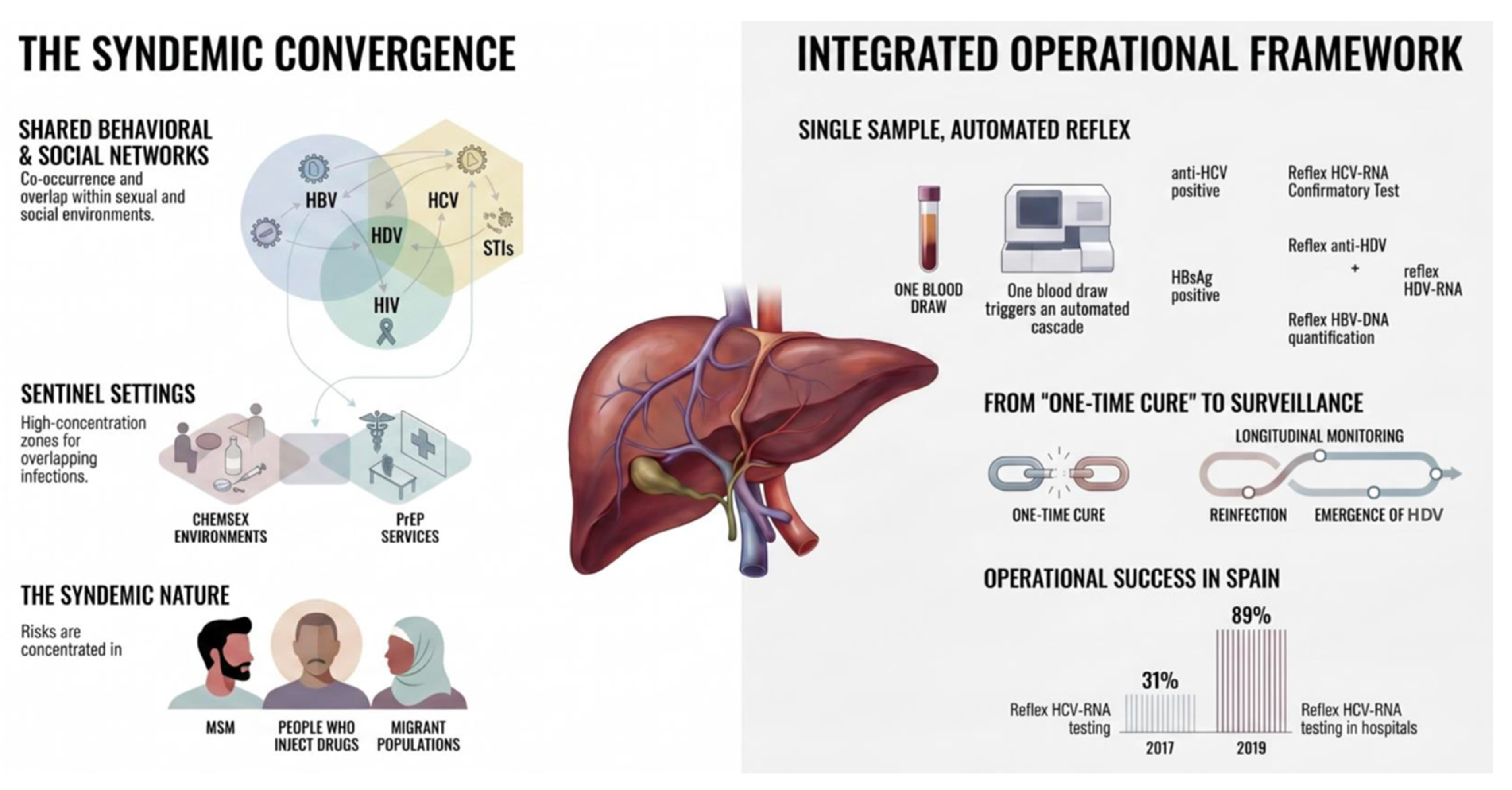
- Integrated diagnostic ecosystem. Reorganization of viral hepatitis and HIV testing around shared epidemiological risk and the patient’s healthcare trajectory rather than around isolated pathogens, combining serological screening, reflex molecular confirmation, vaccination, prevention, and linkage-to-care within a single clinical workflow.
- Reflex testing. Automated laboratory algorithm that performs a confirmatory or complementary test on the same specimen following a positive screening result (e.g., reflex HCV-RNA after positive anti-HCV; reflex anti-HDV after positive HBsAg; reflex HDV-RNA after positive anti-HDV), eliminating the need for an additional patient encounter.
- Microelimination. Targeted elimination strategies focused on defined subpopulations or healthcare environments (e.g., HIV/PrEP services, prisons, addiction programs) where intensified integrated interventions can achieve measurable outcomes within shorter timeframes than nationwide elimination.
- Syndemic framework. Conceptual model in which HIV, viral hepatitis, STIs, substance use, mental health disorders, stigma, and structural vulnerability interact synergistically rather than additively, amplifying transmission and impairing engagement with care.
- Linkage-to-care. The capacity of healthcare systems to ensure that individuals successfully transition through the full continuum of evaluation and treatment after diagnosis, ideally through same-encounter or same-day pathways supported by EHR alerts, patient navigation, and decentralized care.
- Longitudinal surveillance. Repeated, periodic screening within services with recurrent patient contact (PrEP, STI, addiction, prison), enabling detection of HCV reinfection, HBV reactivation, HDV emergence, and incident HIV/STIs across follow-up.
2. Methods
3. Epidemiological Convergence Between Viral Hepatitis, HIV, and STI High-Risk Associated Populations
3.1. Sexually Transmitted HCV Among MSM and Reinfection After Cure
3.2. PrEP and Chemsex: Extending the Convergence to HIV-Negative MSM
3.3. HBV, HDV, and the Broader STI-Associated Risk Landscape
3.4. Convergent Settings Beyond Sexual Health
4. Integrated Diagnostic Models and Enabling Technologies
4.1. Rationale: Shared Exposure Ecosystems and Missed-Opportunity Testing
4.2. Reflex Testing
4.3. Multiplex Platforms, Point-of-Care Diagnostics, and DBS
4.4. Digital Integration: EHR Alerts and Emerging Analytics
4.5. Implementation Barriers
5. Linkage-to-Care, Retention, and Longitudinal Surveillance
5.1. Simplified Pathways, EHR Alerts, and Patient Navigation
5.2. Decentralization and Telemedicine
5.3. Beyond Cure: Longitudinal Surveillance and Reinfection Monitoring
6. HDV as the Stress Test of Diagnostic Fragmentation
6.1. Selective Testing Has Proven Insufficient
6.2. The Implementation Gap
6.3. Clinical Consequences and the Bulevirtide Era
6.4. HDV and the Limits of Pathogen-Centered Care
- Underestimated burden. Recent meta-analyses estimate higher HDV seroprevalence than historically assumed, with marked under-recognition among migrants, HIV-positive individuals, and people who inject drugs.
- Selective testing has failed. Risk-based strategies miss a substantial proportion of cases; systematic anti-HDV testing in all HBsAg-positive individuals is needed.
- Implementation, not technology, is the bottleneck. Reliable assays exist; the persistent gap is the absence of automated reflex algorithms in routine HBV care.
- Clinical stakes are high. HDV accelerates fibrosis, cirrhosis, decompensation, hepatocellular carcinoma, and mortality—and the bulevirtide era makes timely diagnosis clinically actionable.
- Operational solution. Mandatory reflex anti-HDV in every HBsAg-positive sample, with reflex HDV-RNA on positive samples, integrated within STI, HIV, prison, addiction, and migrant-health services.
- (Authors’ synthesis).
7. Microelimination and Implementation Experience
7.1. The Microelimination Framework
7.2. Sexual Health, HIV/PrEP, Prisons, and PWID as Platforms
7.3. Cost-Effectiveness and Adaptive System Redesign
8. A Practical Framework for STI-Based Integrated Viral Hepatitis Diagnosis
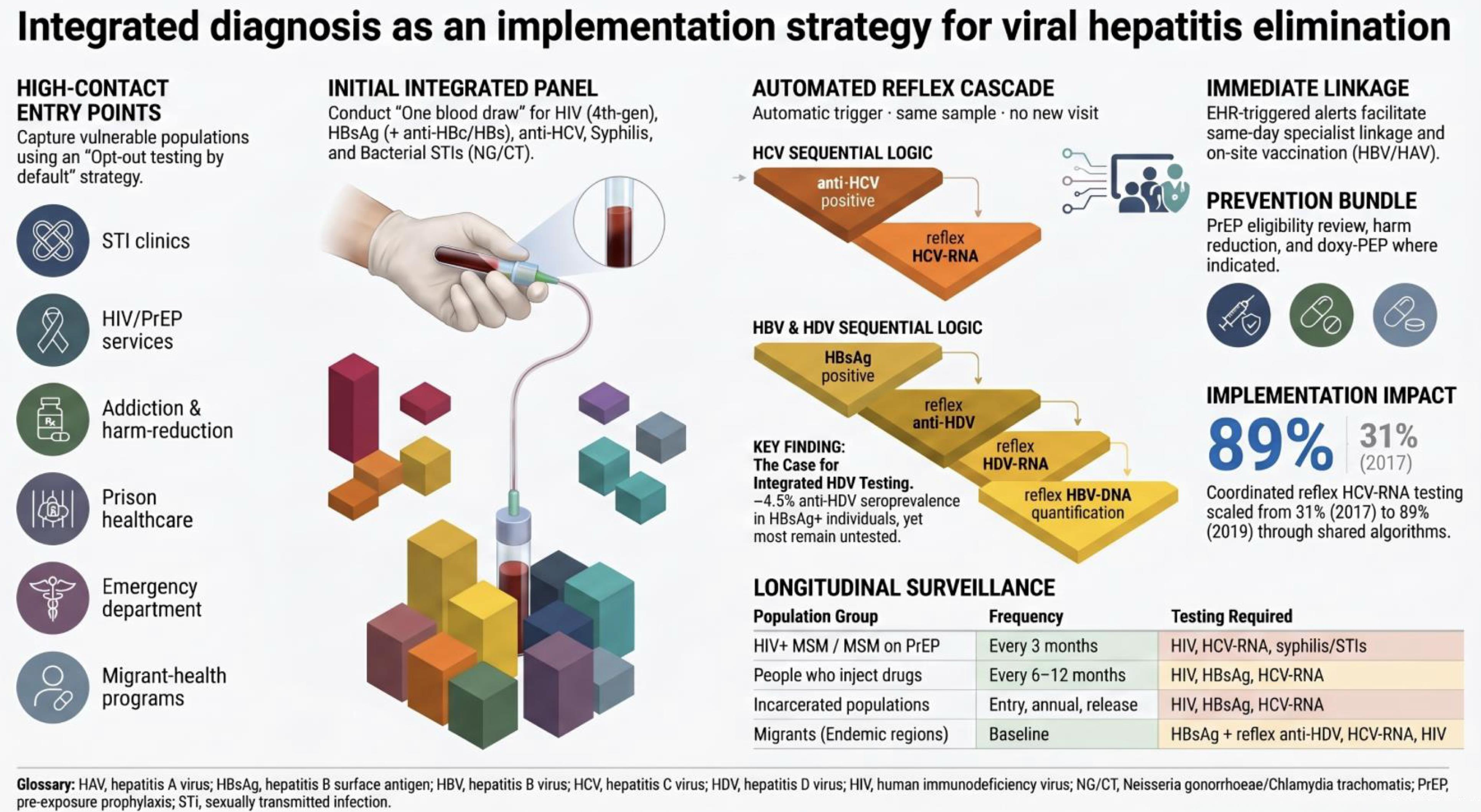
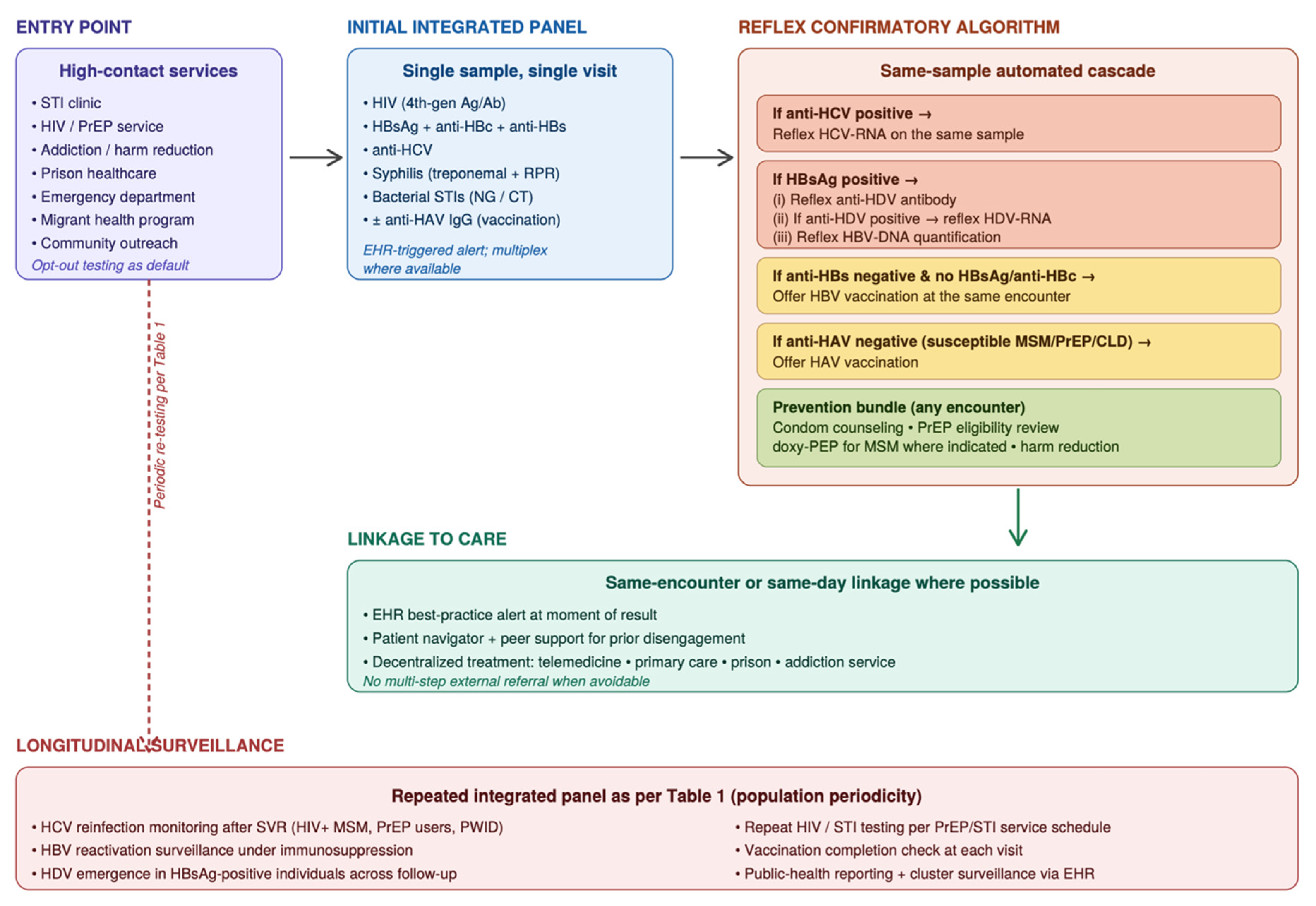
- Entry panel. Consider offering HIV (4th-gen Ag/Ab), HBsAg + anti-HBc + anti-HBs, anti-HCV, syphilis (treponemal + RPR), and bacterial STIs (NG/CT) at first contact in any STI, HIV/PrEP, addiction, prison, ED, migrant health, or community outreach service, on an opt-out basis where feasible.
- Reflex confirmation. Configure laboratory-side automated reflex algorithms: HCV-RNA after positive anti-HCV; anti-HDV after positive HBsAg; HDV-RNA after positive anti-HDV; HBV-DNA in newly diagnosed HBsAg-positive individuals—all on the same specimen.
- Vaccinate at point of care. Offer HBV vaccination to susceptible individuals (anti-HBs–negative without HBsAg or anti-HBc) at the same encounter; offer HAV vaccination to susceptible MSM, PrEP users, and individuals with chronic liver disease.
- Prevention bundle. Combine condom counseling, harm reduction, opioid substitution where indicated, PrEP eligibility review, and doxy-PEP for eligible individuals, integrated into the same visit.
- Periodicity by population (Table 1). 3-monthly testing in PrEP users; 3–6-monthly in HIV-positive MSM and active chemsex networks; 6–12-monthly in PWID; entry + annual + release in incarcerated populations; baseline in migrants from endemic regions.
- Same-encounter linkage. Use EHR alerts at the moment of result; deploy patient navigators and peer support for prior disengagement; avoid multi-step external referral whenever possible.
- Decentralize treatment. Enable HCV/HBV/HDV treatment within primary care, addiction services, prison healthcare, and via telemedicine, rather than restricting to hospital hepatology.
- Mandatory institutional reflex anti-HDV. Anti-HDV in every HBsAg-positive sample is the single most impactful change available to most laboratories without additional infrastructure.
- Longitudinal surveillance. Repeat the integrated panel per Table 1 across follow-up to detect HCV reinfection, HBV reactivation, HDV emergence, and incident HIV/STIs.
- Bundled reimbursement and EHR interoperability. Align financial structures with multi-pathogen panels; implement shared EHR alerts across STI, HIV, hepatology, ID, primary care, and microbiology services.
8.1. Entry Point and Initial Integrated Panel
8.2. Reflex Confirmatory and Complementary Testing
8.3. Vaccination, Prevention, and Harm Reduction at Point of Care
8.4. Population-Specific Testing Periodicity
8.5. Linkage, Treatment Access, and Longitudinal Surveillance
8.6. Anticipating Barriers
9. Future Perspectives
10. Limitations
11. Conclusions
Author Contributions
Funding
Institutional Review Board Statement
Informed Consent Statement
Data Availability Statement
Acknowledgments
Conflicts of Interest
References
- Polaris Observatory HCV Collaborators. Global change in hepatitis C virus prevalence and cascade of care between 2015 and 2020: A modelling study. Lancet Gastroenterol. Hepatol. 2022, 7, 396–415. [Google Scholar] [CrossRef] [PubMed]
- Polaris Observatory Collaborators. Global prevalence, cascade of care, and prophylaxis coverage of hepatitis B in 2022: A modelling study. Lancet Gastroenterol. Hepatol. 2023, 8, 879–907. [Google Scholar] [CrossRef] [PubMed]
- World Health Organization. Global Hepatitis Report 2026; World Health Organization: Geneva, Switzerland, 2026. [Google Scholar]
- Williamson, D.A.; Chen, M.Y. Emerging and reemerging sexually transmitted infections. N. Engl. J. Med. 2020, 382, 2023–2032. [Google Scholar] [CrossRef] [PubMed]
- Mitjà, O.; Padovese, V.; Folch, C.; Rossoni, I.; Marks, M.; Rodríguez IArias, M.A.; Telenti, A.; Ciuffi, A.; Blondeel, K.; Mårdh, O.; et al. Epidemiology and determinants of reemerging bacterial sexually transmitted infections (STIs) and emerging STIs in Europe. Lancet Reg. Health Eur. 2023, 34, 100742. [Google Scholar] [CrossRef] [PubMed] [PubMed Central]
- Cooke, G.S.; Andrieux-Meyer, I.; Applegate, T.L.; Atun, R.; Burry, J.R.; Cheinquer, H.; Dusheiko, G.; Feld, J.J.; Gore, C.; Griswold, M.G.; et al. Accelerating the elimination of viral hepatitis: A Lancet Gastroenterology & Hepatology Commission. Lancet Gastroenterol. Hepatol. 2019, 4, 135–184. [Google Scholar] [CrossRef] [PubMed]
- Razavi, H.A.; Buti, M.; Terrault, N.A.; Zeuzem, S.; Yurdaydin, C.; Tanaka, J.; Aghemo, A.; Akarca, U.S.; Al Masri, N.M.; Alalwan, A.M.; et al. Hepatitis D double reflex testing of all hepatitis B carriers in low-HBV- and high-HBV/HDV-prevalence countries. J. Hepatol. 2023, 79, 576–580. [Google Scholar] [CrossRef] [PubMed]
- Jin, F.; Dore, G.J.; Matthews, G.; Luhmann, N.; Macdonald, V.; Bajis, S.; Baggaley, R.; Mathers, B.; Verster, A.; Grulich, A.E. Prevalence and incidence of hepatitis C virus infection in men who have sex with men: A systematic review and meta-analysis. Lancet Gastroenterol. Hepatol. 2021, 6, 39–56. [Google Scholar] [CrossRef] [PubMed]
- Hosseini-Hooshyar, S.; Hajarizadeh, B.; Bajis, S.; Law, M.; Janjua, N.Z.; Fierer, D.S.; Chromy, D.; Rockstroh, J.K.; Martin, T.C.S.; Ingiliz, P.; et al. Risk of hepatitis C reinfection following successful therapy among people living with HIV: A global systematic review, meta-analysis, and meta-regression. Lancet HIV 2022, 9, e414–e427. [Google Scholar] [CrossRef] [PubMed]
- Singer, M.; Clair, S. Syndemics and public health: Reconceptualizing disease in biosocial context. Med. Anthropol. Q. 2003, 17, 423–441. [Google Scholar] [CrossRef] [PubMed]
- Tsai, A.C.; Burns, B.F.O. Syndemics of psychosocial problems and HIV risk: A systematic review of empirical tests of the disease interaction concept. Soc. Sci. Med. 2015, 139, 26–35. [Google Scholar] [CrossRef] [PubMed]
- Danta, M.; Brown, D.; Bhagani, S.; Pybus, O.G.; Sabin, C.A.; Nelson, M.; Fisher, M.; Johnson, A.M.; Dusheiko, G.M. Recent epidemic of acute hepatitis C virus in HIV-positive men who have sex with men linked to high-risk sexual behaviours. AIDS 2007, 21, 983–991. [Google Scholar] [CrossRef] [PubMed]
- van de Laar, T.; Pybus, O.; Bruisten, S.; Brown, D.; Nelson, M.; Bhagani, S.; Vogel, M.; Baumgarten, A.; Chaix, M.L.; Fisher, M.; et al. Evidence of a large, international network of HCV transmission in HIV-positive men who have sex with men. Gastroenterology 2009, 136, 1609–1617. [Google Scholar] [CrossRef] [PubMed]
- Hoornenborg, E.; Coyer, L.; Boyd, A.; Achterbergh, R.C.A.; Schim van der Loeff, M.F.; Bruisten, S.; de Vries, H.J.C.; Koopsen, J.; van de Laar, T.J.W.; Prins, M.; et al. High incidence of HCV in HIV-negative men who have sex with men using pre-exposure prophylaxis. J. Hepatol. 2020, 72, 855–864. [Google Scholar] [CrossRef] [PubMed]
- Castry, M.; Cousien, A.; Bellet, J.; Champenois, K.; Pialoux, G.; Yazdanpanah, Y.; Costagliola, D.; Grabar, S.; Deuffic-Burban, S. Hepatitis C virus (HCV) incidence among men who have sex with men (MSM) living with HIV: Results from the French Hospital Database on HIV (ANRS CO4-FHDH) cohort study, 2014 to 2017. Eurosurveillance 2021, 26, 2001321. [Google Scholar] [CrossRef] [PubMed]
- Ingiliz, P.; Martin, T.C.; Rodger, A.; Stellbrink, H.J.; Mauss, S.; Boesecke, C.; Mandorfer, M.; Bottero, J.; Baumgarten, A.; Bhagani, S.; et al. HCV reinfection incidence and spontaneous clearance rates in HIV-positive men who have sex with men in Western Europe. J. Hepatol. 2017, 66, 282–287. [Google Scholar] [CrossRef] [PubMed]
- Newsum, A.M.; Matser, A.; Schinkel, J.; van der Valk, M.; Brinkman, K.; van Eeden, A.; Lauw, F.N.; Rijnders, B.J.A.; van de Laar, T.J.W.; van de Kerkhof, M.; et al. Incidence of HCV Reinfection Among HIV-Positive MSM and Its Association With Sexual Risk Behavior: A Longitudinal Analysis. Clin. Infect. Dis. An. Off. Publ. Infect. Dis. Soc. Am. 2021, 73, 460–467. [Google Scholar] [CrossRef] [PubMed]
- Platt, L.; Easterbrook, P.; Gower, E.; McDonald, B.; Sabin, K.; McGowan, C.; Yanny, I.; Razavi, H.; Vickerman, P. Prevalence and burden of HCV co-infection in people living with HIV: A global systematic review and meta-analysis. Lancet Infect. Dis. 2016, 16, 797–808. [Google Scholar] [CrossRef] [PubMed]
- Dolan, K.; Wirtz, A.L.; Moazen, B.; Ndeffo-Mbah, M.; Galvani, A.; Kinner, S.A.; Courtney, R.; McKee, M.; Amon, J.J.; Maher, L.; et al. Global burden of HIV, viral hepatitis, and tuberculosis in prisoners and detainees. Lancet 2016, 388, 1089–1102. [Google Scholar] [CrossRef] [PubMed]
- Alarcon-Linares, M.E.; Torres-Cantero, A.; Subirá, C.; Ramirez, O.; Crespo, J.; Lazarus, J.V.; Requena-Méndez, A. Geographic analysis and estimation of hepatitis C cases in migrant populations living in Spain: Is a country-based screening strategy appropriate? Rev. Esp. Enferm. Dig. 2019, 111, 615–625. [Google Scholar] [CrossRef] [PubMed]
- Stockdale, A.J.; Kreuels, B.; Henrion, M.Y.R.; Giorgi, E.; Kyomuhangi, I.; de Martel, C.; Hutin, Y.; Geretti, A.M. The global prevalence of hepatitis D virus infection: Systematic review and meta-analysis. J. Hepatol. 2020, 73, 523–532. [Google Scholar] [CrossRef] [PubMed]
- Razavi-Shearer, D.; Child, H.; Razavi-Shearer, K.; Voeller, A.; Razavi, H.; Buti, M.; Tacke, F.; Terrault, N.; Zeuzem, S.; Abbas, Z.; et al. Adjusted estimate of the prevalence of hepatitis delta virus in 25 countries and territories. J. Hepatol. 2024, 80, 232–242. [Google Scholar] [CrossRef] [PubMed]
- Wedemeyer, H.; Aleman, S.; Brunetto, M.R.; Blank, A.; Andreone, P.; Bogomolov, P.; Chulanov, V.; Mamonova, N.; Geyvandova, N.; Morozov, V.; et al. A Phase 3, Randomized Trial of Bulevirtide in Chronic Hepatitis D. N. Engl. J. Med. 2023, 389, 22–32. [Google Scholar] [CrossRef] [PubMed]
- Tao, Y.; Tang, W.; Fajardo, E.; Cheng, M.; He, S.; Bissram, J.S.; Hiebert, L.; Ward, J.W.; Chou, R.; Rodriguez-Frias, F.; et al. Reflex Hepatitis C Virus Viral Load Testing Following an Initial Positive Hepatitis C Virus Antibody Test: A Global Systematic Review and Meta-analysis. Clin. Infect. Dis. An. Off. Publ. Infect. Dis. Soc. Am. 2023, 77, 1137–1156. [Google Scholar] [CrossRef] [PubMed]
- Lamoury, F.M.J.; Bajis, S.; Hajarizadeh, B.; Marshall, A.D.; Martinello, M.; Ivanova, E.; Catlett, B.; Mowat, Y.; Marks, P.; Amin, J.; et al. Evaluation of the Xpert HCV Viral Load Finger-Stick Point-of-Care Assay. J. Infect. Dis. 2018, 217, 1889–1896. [Google Scholar] [CrossRef] [PubMed]
- Konerman, M.A.; Thomson, M.; Gray, K.; Moore, M.; Choxi, H.; Seif, E.; Lok, A.S.F. Impact of an Electronic Health Record Alert in Primary Care on Increasing Hepatitis C Screening and Curative Treatment for Baby Boomers. Hepatology 2017, 66, 1805–1813. [Google Scholar] [CrossRef] [PubMed] [PubMed Central]
- Oru, E.; Trickey, A.; Shirali, R.; Kanters, S.; Easterbrook, P. Decentralisation, integration, and task-shifting in hepatitis C virus infection testing and treatment: A global systematic review and meta-analysis. Lancet Glob. Health 2021, 9, e431–e445. [Google Scholar] [CrossRef] [PubMed]
- Talal, A.H.; Markatou, M.; Liu, A.; Perumalswami, P.V.; Dinani, A.M.; Tobin, J.N.; Brown, L.S. Integrated Hepatitis C-Opioid Use Disorder Care Through Facilitated Telemedicine: A Randomized Trial. JAMA J. Am. Med. Assoc. 2024, 331, 1369–1378. [Google Scholar] [CrossRef] [PubMed] [PubMed Central]
- Crespo, J.; Díaz-González, Á.; Iruzubieta, P.; Llerena, S.; Cabezas, J. SARS-CoV-2 massive testing: A window of opportunity to catch up with HCV elimination. J. Hepatol. 2021, 74, 966–967. [Google Scholar] [CrossRef] [PubMed]
- Llaneras, J.; Ruiz-Cobo, J.C.; Rando-Segura, A.; Barreira-Díaz, A.; Domínguez-Hernández, R.; Rodríguez-Frías, F.; Campins, M.; Colom, J.; Casado, M.A.; Blanco-Grau, A.; et al. Integrating viral hepatitis management into the emergency department: A further step towards viral hepatitis elimination. JHEP Rep. 2024, 6, 100932. [Google Scholar] [CrossRef] [PubMed]
- Eckhardt, B.; Mateu-Gelabert, P.; Aponte-Melendez, Y.; Fong, C.; Kapadia, S.; Smith, M.; Edlin, B.R.; Marks, K.M. Accessible Hepatitis C Care for People Who Inject Drugs: A Randomized Clinical Trial. JAMA Intern. Med. 2022, 182, 494–502. [Google Scholar] [CrossRef] [PubMed]
- European Association for the Study of the Liver. EASL Clinical Practice Guidelines on hepatitis delta virus. J. Hepatol. 2023, 79, 433–460. [Google Scholar] [CrossRef] [PubMed]
- European AIDS Clinical Society. EACS Guidelines Version 13.0; European AIDS Clinical Society: Brussels, Belgium, 2023. [Google Scholar]
- Workowski, K.A.; Bachmann, L.H.; Chan, P.A.; Johnston, C.M.; Muzny, C.A.; Park, I.; Reno, H.; Zenilman, J.M.; Bolan, G.A. Sexually Transmitted Infections Treatment Guidelines, 2021. MMWR Recomm. Rep. 2021, 70, 1–187. [Google Scholar] [CrossRef] [PubMed]
- Arksey, H.; O’Malley, L. Scoping studies: Towards a methodological framework. Int. J. Soc. Res. Methodol. 2005, 8, 19–32. [Google Scholar] [CrossRef]
- Levac, D.; Colquhoun, H.; O’Brien, K.K. Scoping studies: Advancing the methodology. Implement. Sci. 2010, 5, 69. [Google Scholar] [CrossRef] [PubMed]
- Peters, D.H.; Adam, T.; Alonge, O.; Agyepong, I.A.; Tran, N. Implementation research: What it is and how to do it. BMJ 2013, 347, f6753. [Google Scholar] [CrossRef] [PubMed]
- Pufall, E.L.; Kall, M.; Shahmanesh, M.; Nardone, A.; Gilson, R.; Delpech, V.; Ward, H.; Positive Voices Study Group; Hart, G.; Anderson, J.; et al. Sexualized drug use (‘chemsex’) and high-risk sexual behaviours in HIV-positive men who have sex with men. HIV Med. 2018, 19, 261–270. [Google Scholar] [CrossRef] [PubMed]
- European Centre for Disease Prevention and Control. Public Health Guidance on HIV, Hepatitis B and C Testing in the EU/EEA: An Integrated Approach; European Centre for Disease Prevention and Control: Stockholm, Sweden, 2018. [Google Scholar]
- Schillie, S.; Wester, C.; Osborne, M.; Wesolowski, L.; Ryerson, A.B. CDC Recommendations for Hepatitis C Screening Among Adults-United States, 2020. MMWR Recomm. Rep. 2020, 69, 1–17. [Google Scholar] [CrossRef] [PubMed]
- European Association for the Study of the Liver. EASL Clinical Practice Guidelines on the management of hepatitis B virus infection. J. Hepatol. 2025, 83, 502–583. [Google Scholar] [CrossRef] [PubMed]
- European Association for the Study of the Liver. EASL recommendations on treatment of hepatitis C: Final update of the series. J. Hepatol. 2020, 73, 1170–1218. [Google Scholar] [CrossRef] [PubMed]
- Ghany, M.G.; Pan, C.Q.; Lok, A.S.; Feld, J.J.; Lim, J.K.; Wang, S.H.; Kim, A.Y.; Tang, A.S.; Nguyen, M.H.; Naggie, S.; et al. AASLD ISDA Practice Guideline on treatment of chronic hepatitis B. Hepatology 2026, 83, 974–997. [Google Scholar] [CrossRef] [PubMed]
- Bhattacharya, D.; Aronsohn, A.; Price, J.; Lo Re, V.; AASLD-IDSA HCV Guidance Panel. Hepatitis C Guidance 2023 Update: AASLD-IDSA Recommendations for Testing, Managing, and Treating Hepatitis C Virus Infection. Clin. Infect. Dis. 2023, 77, 1561–1582. [Google Scholar] [CrossRef] [PubMed]
- Crespo, J.; Albillos, A.; Buti, M.; Calleja, J.L.; Garcia Samaniego, J.; Hernandez Guerra, M.; Serrano, T.; Turnes, J.; Acin, E.; Berenguer, J.; et al. Elimination of hepatitis C. Positioning document of the Spanish Association for the Study of the Liver (AEEH). Rev. Esp. Enferm. Dig. 2019, 111, 862–873. [Google Scholar] [CrossRef] [PubMed]
- Crespo, J.; Cabezas, J.; Aguilera, A.; Berenguer, M.; Buti, M.; Forns, X.; Garcia, F.; Garcia-Samaniego, J.; Hernandez-Guerra, M.; Jorquera, F.; et al. Recommendations for the integral diagnosis of chronic viral hepatitis in a single analytical extraction. Gastroenterol. Hepatol. 2023, 46, 150–162. [Google Scholar] [CrossRef]
- Gotz, H.M.; van Doornum, G.; Niesters, H.G.; den Hollander, J.G.; Thio, H.B.; de Zwart, O. A cluster of acute hepatitis C virus infection among men who have sex with men—Results from contact tracing and public health implications. AIDS 2005, 19, 969–974. [Google Scholar] [CrossRef] [PubMed]
- Urbanus, A.T.; van de Laar, T.J.; Stolte, I.G.; Schinkel, J.; Heijman, T.; Coutinho, R.A.; Prins, M. Hepatitis C virus infections among HIV-infected men who have sex with men: An expanding epidemic. AIDS 2009, 23, F1–F7. [Google Scholar] [CrossRef] [PubMed]
- Schmidt, A.J.; Rockstroh, J.K.; Vogel, M.; An der Heiden, M.; Baillot, A.; Krznaric, I.; Radun, D. Trouble with bleeding: Risk factors for acute hepatitis C among HIV-positive gay men from Germany—A case-control study. PLoS ONE 2011, 6, e17781. [Google Scholar] [CrossRef] [PubMed]
- Nijmeijer, B.M.; Koopsen, J.; Schinkel, J.; Prins, M.; Geijtenbeek, T.B.H. Sexually transmitted hepatitis C virus infections: Current trends, and recent advances in understanding the spread in men who have sex with men. J. Int. AIDS Soc. 2019, 22, e25348. [Google Scholar] [CrossRef] [PubMed]
- Pineda, J.A.; Nunez-Torres, R.; Tellez, F.; Mancebo, M.; Garcia, F.; Merchante, N.; Perez-Perez, M.; Neukam, K.; Macias, J.; Real, L.M.; et al. Hepatitis C virus reinfection after sustained virological response in HIV-infected patients with chronic hepatitis C. J. Infect. 2015, 71, 571–577. [Google Scholar] [CrossRef] [PubMed]
- Sacks-Davis, R.; van Santen, D.K.; Boyd, A.; Young, J.; Stewart, A.; Doyle, J.S.; Rauch, A.; Mugglin, C.; Klein, M.; van der Valk, M.; et al. Changes in incidence of hepatitis C virus reinfection and access to direct-acting antiviral therapies in people with HIV from six countries, 2010-19: An analysis of data from a consortium of prospective cohort studies. Lancet HIV 2024, 11, e106–e116. [Google Scholar] [CrossRef] [PubMed]
- Martin, T.C.S.; Rauch, A.; Salazar-Vizcaya, L.; Martin, N.K. Understanding and Addressing Hepatitis C Virus Reinfection Among Men Who Have Sex with Men. Infect. Dis. Clin. N. Am. 2018, 32, 395–405. [Google Scholar] [CrossRef] [PubMed] [PubMed Central]
- Midgard, H.; Weir, A.; Palmateer, N.; Lo Re, V., 3rd; Pineda, J.A.; Macias, J.; Dalgard, O. HCV epidemiology in high-risk groups and the risk of reinfection. J. Hepatol. 2016, 65, S33–S45. [Google Scholar] [CrossRef] [PubMed]
- Fanciulli, C.; Berenguer, J.; Busca, C.; Vivancos, M.J.; Tellez, M.J.; Dominguez, L.; Domingo, P.; Navarro, J.; Santos, J.; Iribarren, J.A.; et al. Epidemiological trends of HIV/HCV coinfection in Spain, 2015–2019. HIV Med. 2022, 23, 705–716. [Google Scholar] [CrossRef] [PubMed]
- Hoornenborg, E.; Achterbergh, R.C.; van der Loeff, M.F.S.; Davidovich, U.; Hogewoning, A.; de Vries, H.J.; Schinkel, J.; Prins, M.; van de Laar, T.J.; Amsterdam PrEP Project team in the HIV Transmission Elimination AMsterdam Initiative and MOSAIC Study Group. MSM starting preexposure prophylaxis are at risk of hepatitis C virus infection. AIDS 2017, 31, 1603–1610. [Google Scholar] [CrossRef] [PubMed]
- Cornelisse, V.J.; Traeger, M.W.; Wright, E.J.; Murphy, D.; Stoove, M.; Hellard, M.; Sacks-Davis, R.; Asselin, J.; Fairley, C.K.; Doyle, J.; et al. Brief Report: Low Incidence of Hepatitis C Among a Cohort of HIV-Negative Gay and Bisexual Men Using HIV Pre-exposure Prophylaxis (PrEP) in Melbourne, Australia, and the Contribution of Sexual Transmission. J. Acquir. Immune Defic. Syndr. 2021, 87, 1011–1015. [Google Scholar] [CrossRef] [PubMed]
- Pradat, P.; Huleux, T.; Raffi, F.; Delobel, P.; Valantin, M.A.; Poizot-Martin, I.; Pugliese, P.; Reynes, J.; Rey, D.; Hoen, B.; et al. Incidence of new hepatitis C virus infection is still increasing in French MSM living with HIV. AIDS 2018, 32, 1077–1082. [Google Scholar] [CrossRef] [PubMed]
- Bourne, A.; Reid, D.; Hickson, F.; Torres-Rueda, S.; Weatherburn, P. Illicit drug use in sexual settings (‘chemsex’) and HIV/STI transmission risk behaviour among gay men in South London: Findings from a qualitative study. Sex. Transm. Infect. 2015, 91, 564–568. [Google Scholar] [CrossRef] [PubMed]
- Hegazi, A.; Lee, M.J.; Whittaker, W.; Green, S.; Simms, R.; Cutts, R.; Nagington, M.; Nathan, B.; Pakianathan, M.R. Chemsex and the city: Sexualised substance use in gay bisexual and other men who have sex with men attending sexual health clinics. Int. J. STD AIDS 2017, 28, 362–366. [Google Scholar] [CrossRef] [PubMed]
- Edmundson, C.; Heinsbroek, E.; Glass, R.; Hope, V.; Mohammed, H.; White, M.; Desai, M. Sexualised drug use in the United Kingdom (UK): A review of the literature. Int. J. Drug Policy 2018, 55, 131–148. [Google Scholar] [CrossRef] [PubMed]
- Sewell, J.; Miltz, A.; Lampe, F.C.; Cambiano, V.; Speakman, A.; Phillips, A.N.; Stuart, D.; Gilson, R.; Asboe, D.; Nwokolo, N.; et al. Poly drug use, chemsex drug use, and associations with sexual risk behaviour in HIV-negative men who have sex with men attending sexual health clinics. Int. J. Drug Policy 2017, 43, 33–43. [Google Scholar] [CrossRef] [PubMed]
- Del Pozo-Herce, P.; Baca-Garcia, E.; Martinez-Sabater, A.; Chover-Sierra, E.; Gea-Caballero, V.; Curto-Ramos, J.; Czapla, M.; Karniej, P.; Martinez-Tofe, J.; Sanchez-Barba, M.; et al. Descriptive study on substance uses and risk of sexually transmitted infections in the practice of Chemsex in Spain. Front. Public. Health 2024, 12, 1391390. [Google Scholar] [CrossRef] [PubMed] [PubMed Central]
- Alarcon Gutierrez, M.; Palma Diaz, D.; Forns Canton, M.L.; Fernandez-Lopez, L.; Garcia de Olalla, P.; Rius Gibert, C. Trends in Sexual Health of Gay, Bisexual, and Other Men Who Have Sex with Men, and Transgender Individuals: Apps Driven Testing Program for HIV and Other STIs in Barcelona, Spain (2016–2023). J. Community Health 2024, 49, 429–438. [Google Scholar] [CrossRef] [PubMed] [PubMed Central]
- ozo-Herce, P.D.; Martinez-Sabater, A.; Sanchez-Palomares, P.; Garcia-Boaventura, P.C.; Chover-Sierra, E.; Martinez-Pascual, R.; Gea-Caballero, V.; Saus-Ortega, C.; Ballestar-Tarin, M.L.; Karniej, P.; et al. Effectiveness of Harm Reduction Interventions in Chemsex: A Systematic Review. Healthcare 2024, 12, 1411. [Google Scholar] [CrossRef] [PubMed] [PubMed Central]
- Eustaquio, P.C.; Smyth, J.; Salisi, J.A. The Risks for HIV and Sexually Transmitted Infections Among Men Who Have Sex with Men Who Engage in Chemsex in Low- and Middle-Income Countries: A Mixed Methods Systematic Review and Meta-Analysis. AIDS Behav. 2024, 28, 3060–3079. [Google Scholar] [CrossRef] [PubMed]
- European Centre for Disease Prevention and Control. Systematic Review on Hepatitis B and C Prevalence in the EU/EEA; European Centre for Disease Prevention and Control: Stockholm, Sweden, 2016. [Google Scholar]
- Bachmann, L.H.; Barbee, L.A.; Chan, P.; Reno, H.; Workowski, K.A.; Hoover, K.; Mermin, J.; Mena, L. CDC Clinical Guidelines on the Use of Doxycycline Postexposure Prophylaxis for Bacterial Sexually Transmitted Infection Prevention, United States, 2024. MMWR Recomm. Rep. 2024, 73, 1–8. [Google Scholar] [CrossRef] [PubMed]
- Chen, H.Y.; Shen, D.T.; Ji, D.Z.; Han, P.C.; Zhang, W.M.; Ma, J.F.; Chen, W.S.; Goyal, H.; Pan, S.; Xu, H.G. Prevalence and burden of hepatitis D virus infection in the global population: A systematic review and meta-analysis. Gut 2019, 68, 512–521. [Google Scholar] [CrossRef] [PubMed]
- Stockdale, A.J.; Chaponda, M.; Beloukas, A.; Phillips, R.O.; Matthews, P.C.; Papadimitropoulos, A.; King, S.; Bonnett, L.; Geretti, A.M. Prevalence of hepatitis D virus infection in sub-Saharan Africa: A systematic review and meta-analysis. Lancet Glob. Health 2017, 5, e992–e1003. [Google Scholar] [CrossRef] [PubMed]
- Kushner, T.; Serper, M.; Kaplan, D.E. Delta hepatitis within the Veterans Affairs medical system in the United States: Prevalence, risk factors, and outcomes. J. Hepatol. 2015, 63, 586–592. [Google Scholar] [CrossRef] [PubMed]
- Miao, Z.; Zhang, S.; Ou, X.; Li, S.; Ma, Z.; Wang, W.; Peppelenbosch, M.P.; Liu, J.; Pan, Q. Estimating the Global Prevalence, Disease Progression, and Clinical Outcome of Hepatitis Delta Virus Infection. J. Infect. Dis. 2020, 221, 1677–1687. [Google Scholar] [CrossRef] [PubMed]
- Nakitanda, A.O.; Montanari, L.; Tavoschi, L.; Mozalevskis, A.; Duffell, E. Hepatitis C virus infection in EU/EEA and United Kingdom prisons: Opportunities and challenges for action. BMC Public Health 2020, 20, 1670. [Google Scholar] [CrossRef] [PubMed] [PubMed Central]
- Arnold, E.A.; Operario, D.; Cornwell, S.; Benjamin, M.; Dillard Smith, C.; Lockett, G.; Kegeles, S.M. The Development of a Counseling-Based HIV Prevention Intervention for African American Men Who Have Sex With Men and Women: The Bruthas Project. AIDS Educ. Prev. 2015, 27, 505–521. [Google Scholar] [CrossRef] [PubMed] [PubMed Central]
- Thomadakis, C.; Gountas, I.; Gountas, K.; Nuño, N.; Brime, B.; Sendino, R.; Albillos, A.; Buti, M.; Crespo, J.; Berenguer, J.; et al. Prevalence of Active HCV Infection in Spain in 2022 Using Multiparameter Evidence Synthesis. J. Viral. Hepat. 2026, 33, e70159. [Google Scholar] [CrossRef] [PubMed]
- Moreira, R.C.; Veras, M.; Amianti, C.; McCartney, D.J.; Silva, V.C.M.; Lemos, M.F.; Compri, A.P.; Oliveira, E.L.; Bassichetto, K.C.; Leal, A.F.; et al. Hepatitis A, B and C prevalence among transgender women and travestis in five Brazilian capitals between 2019–2021. Rev. Bras. Epidemiol. 2024, 27, e240005-supl. [Google Scholar] [CrossRef] [PubMed] [PubMed Central]
- Chiu, I.; Cano, D.; Leathers, M.; Turner, C.M.; Trujillo, D.; Sicro, S.; Arayasirikul, S.; Taylor, K.D.; Wilson, E.C.; McFarland, W. HIV and hepatitis C virus infection and co-infection among trans women in San Francisco, 2020. PLoS ONE 2024, 19, e0307990. [Google Scholar] [CrossRef] [PubMed] [PubMed Central]
- Wu, S.; Wang, J.; Guo, Q.; Lan, H.; Sun, Y.; Ren, M.; Liu, Y.; Wang, P.; Wang, L.; Su, R.; et al. Prevalence of human immunodeficiency virus, syphilis, and hepatitis B and C virus infections in pregnant women: A systematic review and meta-analysis. Clin. Microbiol. Infect. 2023, 29, 1000–1007. [Google Scholar] [CrossRef] [PubMed]
- Yang, R.; Yuan, R.; Gui, X.; Ke, H.; Zhuang, K.; Hu, H.; Li, L.; Feng, L.; Yu, X.; Yan, Y.; et al. Characteristics of Hepatitis B Virus, Hepatitis C Virus, and Syphilis Coinfection in People With HIV/AIDS Contracted Through Different Sources: Retrospective Study. JMIR Public Health Surveill. 2024, 10, e46750. [Google Scholar] [CrossRef] [PubMed] [PubMed Central]
- Beard, N.; Hill, A. Combined ‘Test and Treat’ Campaigns for Human Immunodeficiency Virus, Hepatitis B, and Hepatitis C: A Systematic Review to Provide Evidence to Support World Health Organization Treatment Guidelines. Open Forum Infect. Dis. 2024, 11, ofad666. [Google Scholar] [CrossRef] [PubMed] [PubMed Central]
- Cabezas, J.; Aguilera, A.; Garcia, F.; Dominguez-Hernandez, R.; Casado-Gomez, A.; Espinoza-Camac, N.; Casado, M.A.; Crespo, J.; Task Force Spanish Group for Comprehensive Hepatitis Diagnosis. Comprehensive Diagnosis of Viral Hepatitis in Spain: Bases for Implementation. Viruses 2025, 17, 667. [Google Scholar] [CrossRef] [PubMed]
- Crespo, J.; Cuadrado, A.; Perello, C.; Cabezas, J.; Llerena, S.; Llorca, J.; Cedillo, S.; Llop, E.; Escudero, M.D.; Hernandez Conde, M.; et al. Epidemiology of hepatitis C virus infection in a country with universal access to direct-acting antiviral agents: Data for designing a cost-effective elimination policy in Spain. J. Viral Hepat. 2020, 27, 360–370. [Google Scholar] [CrossRef] [PubMed]
- Crespo, J.; Calleja, J.L.; Cabezas, J.; García, F.; Aguilera, A.; Jorquera, F.; Lazarus, J.V. A call for the comprehensive diagnosis of viral hepatitis as a key step towards its elimination. Liver Int. 2023, 43, 1145–1147. [Google Scholar] [CrossRef] [PubMed]
- Crespo, J.; Lázaro, P.; Blasco, A.J.; Aguilera, A.; García-Samaniego, J.; Eiros, J.M.; Calleja, J.L.; García, F. Hepatitis C reflex testing in Spain in 2019: A story of success. Enferm. Infecc. Microbiol. Clin. 2021, 39, 119–126. [Google Scholar] [CrossRef] [PubMed]
- Crespo, J.; Lázaro de Mercado, P.; Blasco Bravo, A.J.; Aguilera Guirao, A.; García-Samaniego Rey, J.; Eiros Bouza, J.M.; Calleja Panero, J.L.; García, F. Diagnosis of hepatitis C virus infection in Spain: An opportunity to improve. Enferm. Infecc. Microbiol. Clin. 2019, 37, 231–238. [Google Scholar] [CrossRef] [PubMed]
- Crespo, J.; Cabezas, J.; Calleja, J.L.; Buti, M.; Lazarus, J.V. The path to successful hepatitis C elimination in Spain. Nat. Rev. Gastroenterol. Hepatol. 2023, 20, 689–690. [Google Scholar] [CrossRef] [PubMed]
- Calleja, J.L.; Aguilera, A.; Buti, M.; Crespo, J.; García, F.; Jorquera, F.; Morano, L.E.; Macias, J.; Lazarus, J.V. Ten steps to eliminating hepatitis C in hospitals. Nat. Rev. Gastroenterol. Hepatol. 2022, 19, 481–483. [Google Scholar] [CrossRef] [PubMed]
- Picchio, C.A.; Nicolas, A.; Duffell, E.; Martro, E.; Vickerman, P.; Dudareva, S.; Lens, S.; Vanderlinden, A.; Cabezas, J.; Forns, X.; et al. From targets to real world impact: A review of models of care for chronic HBV and HCV in Europe. Lancet Reg. Health Eur. 2026, 65, 101712. [Google Scholar] [CrossRef] [PubMed]
- Socías, M.E.; Karamouzian, M.; Parent, S.; Barletta, J.; Bird, K.; Ti, L. Integrated models of care for people who inject drugs and live with hepatitis C virus: A systematic review. Int. J. Drug Policy 2019, 72, 146–159. [Google Scholar] [CrossRef] [PubMed]
- Ford, M.M.; Jordan, A.E.; Johnson, N.; Rude, E.; Laraque, F.; Varma, J.K.; Hagan, H. Check Hep C: A Community-Based Approach to Hepatitis C Diagnosis and Linkage to Care in High-Risk Populations. J. Public. Health Manag. Pract. 2018, 24, 41–48. [Google Scholar] [CrossRef] [PubMed]
- Sasaki-Tanaka, R.; Kanda, T.; Yokoo, T.; Abe, H.; Hayashi, K.; Sakamaki, A.; Kamimura, H.; Terai, S. Hepatitis A and E Viruses Are Important Agents of Acute Severe Hepatitis in Asia: A Narrative Review. Pathogens 2025, 14, 454. [Google Scholar] [CrossRef] [PubMed]
- Haukoos, J.S.; Hopkins, E.; Conroy, A.A.; Silverman, M.; Byyny, R.L.; Eisert, S.; Thrun, M.W.; Wilson, M.L.; Hutchinson, A.B.; Forsyth, J.; et al. Routine opt-out rapid HIV screening and detection of HIV infection in emergency department patients. J. Am. Med. Assoc. 2010, 304, 284–292. [Google Scholar] [CrossRef] [PubMed]
- Orkin, C.; Flanagan, S.; Wallis, E.; Ireland, G.; Dhairyawan, R.; Fox, J.; Nandwani, R.; O’Connell, R.; Lascar, M.; Bulman, J.; et al. Incorporating HIV/hepatitis B virus/hepatitis C virus combined testing into routine blood tests in nine UK Emergency Departments: The “Going Viral” campaign. HIV Med. 2016, 17, 222–230. [Google Scholar] [CrossRef] [PubMed]
- O’Connell, S.; Lillis, D.; Cotter, A.; O’Dea, S.; Tuite, H.; Fleming, C.; Crowley, B.; Fitzgerald, I.; Dalby, L.; Barry, H.; et al. Opt-Out Panel Testing for HIV, Hepatitis B and Hepatitis C in an Urban Emergency Department: A Pilot Study. PLoS ONE 2016, 11, e0150546. [Google Scholar] [CrossRef] [PubMed]
- Galbraith, J.W.; Franco, R.A.; Donnelly, J.P.; Rodgers, J.B.; Morgan, J.M.; Viles, A.F.; Overton, E.T.; Saag, M.S.; Wang, H.E. Unrecognized chronic hepatitis C virus infection among baby boomers in the emergency department. Hepatology 2015, 61, 776–782. [Google Scholar] [CrossRef] [PubMed]
- Manteuffel, J.J.; Lee, M.S.; Bussa, R.M.; Sabagha, N.L.; Chaudhry, K.; Ross, J.E.; Cook, M.R.; Rammal, J.K.; Sridasyam, K.; Klausner, H.A.; et al. Hepatitis C Virus Reflex Testing Protocol in an Emergency Department. West. J. Emerg. Med. 2022, 23, 108–114. [Google Scholar] [CrossRef] [PubMed]
- Cabezas, J.; Aguilera, A.; García García, F.; Domínguez-Hernández, R.; Casado Gómez, A.; Espinoza-Cámac, N.; Casado, M.A.; Crespo, J.; Alcaraz Soriano, M.J.; on behalf of Task Force Spanish Group for Comprehensive Hepatitis Diagnosis. From recommendations to practice—Tracking the national rollout of comprehensive hepatitis diagnosis in Spain. Rev. Esp. Enferm. Dig. 2026, 118, 4–13. [Google Scholar] [CrossRef] [PubMed]
- Calleja, J.L.; Espin, J.; Kaushik, A.; Hernandez-Guerra, M.; Blissett, R.; Yehoshua, A.; Igloi-Nagy, A. The Efficiency of Increased HCV Testing and Treatment Strategies in Spain to Achieve Elimination Goals. Pharmacoecon Open 2024, 8, 221–233. [Google Scholar] [CrossRef] [PubMed] [PubMed Central]
- Tapp, H.; Ludden, T.; Shade, L.; Thomas, J.; Mohanan, S.; Leonard, M. Electronic medical record alert activation increase hepatitis C and HIV screening rates in primary care practices within a large healthcare system. Prev. Med. Rep. 2020, 17, 101036. [Google Scholar] [CrossRef] [PubMed] [PubMed Central]
- Strebe, J.; Rich, N.E.; Wang, L.; Singal, A.G.; McBryde, J.; Silva, M.; Jackson, V.; Fullington, H.; Villarreal, D.L.; Reyes, S.; et al. Patient Navigation Increases Linkage to Care and Receipt of Direct-acting Antiviral Therapy in Patients with Hepatitis C. Clin. Gastroenterol. Hepatol. 2023, 21, 988–994.e982. [Google Scholar] [CrossRef] [PubMed]
- Barter, L.; Cooper, C.L. The impact of electronic medical record system implementation on HCV screening and continuum of care: A systematic review. Ann. Hepatol. 2021, 24, 100322. [Google Scholar] [CrossRef] [PubMed]
- Coyle, C.; Viner, K.; Hughes, E.; Kwakwa, H.; Zibbell, J.E.; Vellozzi, C.; Holtzman, D.; Centers for Disease Control and Prevention (CDC). Identification and linkage to care of HCV-infected persons in five health centers—Philadelphia, Pennsylvania, 2012–2014. MMWR Morb. Mortal. Wkly Rep. 2015, 64, 459–463. [Google Scholar] [PubMed]
- Donnelly, J.P.; Franco, R.A.; Wang, H.E.; Galbraith, J.W. Emergency Department Screening for Hepatitis C Virus: Geographic Reach and Spatial Clustering in Central Alabama. Clin. Infect. Dis. An. Off. Publ. Infect. Dis. Soc. Am. 2016, 62, 613–616. [Google Scholar] [CrossRef] [PubMed]
- Generaal, E.; Bachour, Y.; Klijzing, S.; Cornelissen, A.; Toering, R.; Hoornenborg, E.; Op de Coul, E.; Hamdiui, N.; Meiberg, A.; Siedenburg, E.; et al. Integrating hepatitis B virus, hepatitis C virus and human immunodeficiency virus screening for migrants from endemic countries into travel-related and sexual health care in Amsterdam, the Netherlands. Front. Public Health 2025, 13, 1636918. [Google Scholar] [CrossRef] [PubMed]
- Hudson, A.G.; Huff, B.; Boote, J.; Pack, K.; Watkins, M.; White, H.; Wilson, S.; McBee, S. Hepatitis C Co-infection Among Pregnant Women With Syphilis in West Virginia, 2019–2023. Open Forum. Infect. Dis. 2025, 12, ofaf716. [Google Scholar] [CrossRef] [PubMed]
- Smout, E.; Ruf, M.; Buti, M.; Pinto, I.V.; Nebbia, G.; Hunter, L.; Aldersley, M.A.; Esteves, C.; Medina, D.; Llaneras, J.; et al. Blood-borne virus testing in European emergency departments: Current evidence and service considerations. Eur. J. Public Health 2025, 35, 766–773. [Google Scholar] [CrossRef] [PubMed]
- Cuadrado, A.; Llerena, S.; Cobo, C.; Pallas, J.R.; Mateo, M.; Cabezas, J.; Fortea, J.I.; Alvarez, S.; Pellon, R.; Crespo, J.; et al. Microenvironment Eradication of Hepatitis C: A Novel Treatment Paradigm. Am. J. Gastroenterol. 2018, 113, 1639–1648. [Google Scholar] [CrossRef] [PubMed]
- Alonso-Peña, M.; Cabezas, J.; Iruzubieta, P.; Cuadrado, A.; Crespo, J.; Cantabria Cohort Collaborators. Towards Eradicating Hepatitis C in Spain: Early Insights From the Cantabria Cohort Study. Gastro Hep Adv. 2024, 3, 1129–1131. [Google Scholar] [CrossRef] [PubMed]
- Nogales-Garcia, M.; Parraza Diez, N.; Vargas Axpe, A.; Velasco Garcia, R.; Larrabeiti-Etxebarria, A.; Roy Lopez-Cano, I.; Atrio Alvarez, I.; Lopez de Arcaute Trincado, A.; Fernandez Lopez de Vicuna, E.M.; Saez de Adana Arroniz, E.; et al. Elimination of hepatitis C virus in a prison: An 18-year experience. Enferm. Infecc. Microbiol. Clin. 2024, 42, 236–241. [Google Scholar] [CrossRef] [PubMed]
- Crespo, J.; Tejerina Puente, A.; Cuadrado, A.; Llerena, S.; Cabezas, J.; Grupo de Trabajo para la Eliminación de la Hepatitis C en Cantabria. Strategy for the Elimination of Hepatitis C in Cantabria. Rev. Esp. Enferm. Dig. 2020, 112, 565–570. [Google Scholar] [CrossRef] [PubMed]
- Cabezas, J.; Llerena, S.; Mateo, M.; Álvarez, R.; Cobo, C.; González, V.; Martró, E.; Cuadrado, A.; Crespo, J. Hepatitis C Micro-Elimination beyond Prison Walls: Navigator-Assisted Test-and-Treat Strategy for Subjects Serving Non-Custodial Sentences. Diagnostics 2021, 11, 877. [Google Scholar] [CrossRef] [PubMed]
- Dalgic, O.O.; Samur, S.; Spaulding, A.C.; Llerena, S.; Cobo, C.; Ayer, T.; Roberts, M.S.; Crespo, J.; Chhatwal, J. Improved Health Outcomes from Hepatitis C Treatment Scale-Up in Spain’s Prisons: A Cost-Effectiveness Study. Sci. Rep. 2019, 9, 16849. [Google Scholar] [CrossRef] [PubMed]
- Crespo, J.; Llerena, S.; Cobo, C.; Cabezas, J. Is HCV elimination possible in prison? Rev. Esp. Sanid. Penit. 2017, 19, 70–73. [Google Scholar] [CrossRef] [PubMed]
- Giuliani, R.; Casigliani, V.; Fornili, M.; Sebastiani, T.; Freo, E.; Arzilli, G.; Scardina, G.; Baglietto, L.; Tavoschi, L.; Ranieri, R. HCV micro-elimination in two prisons in Milan, Italy: A model of care. J. Viral Hepat. 2020, 27, 1444–1454. [Google Scholar] [CrossRef] [PubMed]
- Johnson, A.; Shearer, J.; Thompson, C.; Jelley, R.; Aldridge, J.; Allsop, C.; Kerry, J.; Jones, D.; McCullough, F.; Miller, C.; et al. Impact of 5 years of hepatitis C testing and treatment in the North East of England prisons. J. Viral Hepat. 2023, 30, 914–921. [Google Scholar] [CrossRef] [PubMed]
- Lucas, K.D.; Krawiec, A.; Wada, J.; Kanan, R.J. The hepatitis C care cascade in California state prisons: Screening and treatment scale-up and progress toward elimination, 2016–2023. Clin. Liver Dis. 2024, 23, e0117. [Google Scholar] [CrossRef] [PubMed]
- Farrell, C.M.; Pino, E.C. Hepatitis C Testing Protocols Across Massachusetts Jails, 2022-2023: An Opportunity for Intervention. Public Health Rep. 2025, 140, 358–364. [Google Scholar] [CrossRef] [PubMed] [PubMed Central]
- McNamara, M.; Furukawa, N.; Cartwright, E.J. Advancing Hepatitis C Elimination through Opt-Out Universal Screening and Treatment in Carceral Settings, United States. Emerg. Infect. Dis. 2024, 30, S80–S87. [Google Scholar] [CrossRef] [PubMed] [PubMed Central]
- Palom, A.; Rando-Segura, A.; Vico, J.; Pacín, B.; Vargas, E.; Barreira-Díaz, A.; Rodríguez-Frías, F.; Riveiro-Barciela, M.; Esteban, R.; Buti, M. Implementation of anti-HDV reflex testing among HBsAg-positive individuals increases testing for hepatitis D. JHEP Rep. 2022, 4, 100547. [Google Scholar] [CrossRef] [PubMed]
- Cossiga, V.; Brusa, S.; Montalti, R.; De Conte, A.; Jannuzzi, G.; Ranieri, L.; Sorrentino, R.; Vallefuoco, L.; Pignata, L.; Guarino, M.; et al. Anti-HDV reflex testing in HBsAg-positive subjects: An efficacious strategy to identify HDV infection. Liver Int. 2024, 44, 148–154. [Google Scholar] [CrossRef] [PubMed]
- Bernhard, J.; Schwarz, M.; Balcar, L.; Hofer, B.; Dominik, N.; Strassl, R.; Aberle, S.; Munda, P.; Mandorfer, M.; Trauner, M.; et al. Reflex testing for anti-HDV in HBsAg-positive patients offers high diagnostic yield in a large Central European tertiary care center. Sci. Rep. 2024, 14, 25921. [Google Scholar] [CrossRef] [PubMed]
- Fuentes, A.; Estevez-Escobar, M.; De Salazar, A.; Escolano, E.R.; Montiel, N.; Macias, M.; Alados, J.C.; Aguilar, J.C.; Perez, A.B.; Baena, P.B.; et al. Double reflex testing improves the efficacy and cost effectiveness of hepatitis delta diagnosis in southern Spain. Sci. Rep. 2025, 15, 15413. [Google Scholar] [CrossRef] [PubMed]
- Gianfrancesco, M.A.; Tamang, S.; Yazdany, J.; Schmajuk, G. Potential biases in machine learning algorithms using electronic health record data. JAMA Intern. Med. 2018, 178, 1544–1547. [Google Scholar] [CrossRef] [PubMed]
- Rajkomar, A.; Dean, J.; Kohane, I. Machine learning in medicine. N. Engl. J. Med. 2019, 380, 1347–1358. [Google Scholar] [CrossRef] [PubMed]
- Topol, E.J. High-performance medicine: The convergence of human and artificial intelligence. Nat. Med. 2019, 25, 44–56. [Google Scholar] [CrossRef] [PubMed]
- Esteva, A.; Robicquet, A.; Ramsundar, B.; Kuleshov, V.; DePristo, M.; Chou, K.; Cui, C.; Corrado, G.; Thrun, S.; Dean, J. A guide to deep learning in healthcare. Nat. Med. 2019, 25, 24–29. [Google Scholar] [CrossRef] [PubMed]
- Rajkomar, A.; Hardt, M.; Howell, M.D.; Corrado, G.; Chin, M.H. Ensuring Fairness in Machine Learning to Advance Health Equity. Ann. Intern. Med. 2018, 169, 866–872. [Google Scholar] [CrossRef] [PubMed] [PubMed Central]
- Kanda, T.; Sasaki-Tanaka, R.; Ishii, K.; Suzuki, R.; Inoue, J.; Tsuchiya, A.; Nakamoto, S.; Abe, R.; Fujiwara, K.; Yokosuka, O.; et al. Recent advances in hepatitis A virus research and clinical practice guidelines for hepatitis A virus infection in Japan. Hepatol. Res. 2024, 54, 4–23. [Google Scholar] [CrossRef] [PubMed]
- Thompson, L.A.; Fenton, J.; Charlton, C.L. HCV reflex testing: A single-sample, low-contamination method that improves the diagnostic efficiency of HCV testing among patients in Alberta, Canada. J. Assoc. Med. Microbiol. Infect. Dis. Can. 2022, 7, 97–107. [Google Scholar] [CrossRef] [PubMed] [PubMed Central]
- Cunningham, E.B.; Wheeler, A.; Hajarizadeh, B.; French, C.E.; Roche, R.; Marshall, A.D.; Fontaine, G.; Conway, A.; Valencia, B.M.; Bajis, S.; et al. Interventions to enhance testing, linkage to care, and treatment initiation for hepatitis C virus infection: A systematic review and meta-analysis. Lancet Gastroenterol. Hepatol. 2022, 7, 426–445. [Google Scholar] [CrossRef] [PubMed]
- Karellis, A.; Webster, D.; Boulanger, J.; Harland, K.; Feltmate, P.; Materniak, S.; Daunais-Laurin, G.; Mesa, C.; Vaikla, O.; Kim, J.; et al. Feasibility, Preference, and Impact of a Rapid Multiplexed Point-of-Care Digital Innovation (AideSmart!) to Expedite Screening of Sexually Transmitted Blood-Borne Infections in At-Risk Populations in Canada: Cross-Sectional Study. J. Med. Internet Res. 2024, 26, e55075. [Google Scholar] [CrossRef] [PubMed] [PubMed Central]
- Naeem, F.; Karellis, A.; Nair, S.; Routy, J.P.; Yansouni, C.P.; Kim, J.; Pai, N. Multiplexed technologies for sexually transmitted infections: Global evidence on patient-centered and clinical health outcomes. BMJ Glob. Health 2021, 6. [Google Scholar] [CrossRef] [PubMed] [PubMed Central]
- Tucker, J.D.; Bu, J.; Brown, L.B.; Yin, Y.P.; Chen, X.S.; Cohen, M.S. Accelerating worldwide syphilis screening through rapid testing: A systematic review. Lancet Infect. Dis. 2010, 10, 381–386. [Google Scholar] [CrossRef] [PubMed]
- Carty, P.G.; McCarthy, M.; O’Neill, S.M.; De Gascun, C.F.; Harrington, P.; O’Neill, M. Laboratory-based testing for hepatitis C infection using dried blood spot samples: A systematic review and meta-analysis of diagnostic accuracy. Rev. Med. Virol. 2022, 32, e2320. [Google Scholar] [CrossRef] [PubMed]
- Yufenyuy, E.L.; Vedapuri, S.; Zheng, A.; Cooley, G.; Danavall, D.; Mayur, S.; Kodani, M.; Chen, C.; Tun, Y.; Fakile, Y.F.; et al. Development of a Bead-Based Multiplex Assay for Use in Multianalyte Screening and Surveillance of HIV, Viral Hepatitis, Syphilis, and Herpes. J. Clin. Microbiol. 2022, 60, e0234821. [Google Scholar] [CrossRef] [PubMed]
- Pai, N.P.; Dhurat, R.; Potter, M.; Behlim, T.; Landry, G.; Vadnais, C.; Rodrigues, C.; Joseph, L.; Shetty, A. Will a quadruple multiplexed point-of-care screening strategy for HIV-related co-infections be feasible and impact detection of new co-infections in at-risk populations? Results from cross-sectional studies. BMJ Open 2014, 4, e005040. [Google Scholar] [CrossRef] [PubMed]
- Pauly, M.D.; Ganova-Raeva, L. Point-of-Care Testing for Hepatitis Viruses: A Growing Need. Life 2023, 13, 2271. [Google Scholar] [CrossRef] [PubMed]
- Grebely, J.; Lamoury, F.M.J.; Hajarizadeh, B.; Mowat, Y.; Marshall, A.D.; Bajis, S.; Marks, P.; Amin, J.; Smith, J.; Edwards, M.; et al. Evaluation of the Xpert HCV Viral Load point-of-care assay from venepuncture-collected and finger-stick capillary whole-blood samples: A cohort study. Lancet Gastroenterol. Hepatol. 2017, 2, 514–520. [Google Scholar] [CrossRef] [PubMed]
- Freiman, J.M.; Tran, T.M.; Schumacher, S.G.; White, L.F.; Ongarello, S.; Cohn, J.; Easterbrook, P.J.; Linas, B.P.; Denkinger, C.M. Hepatitis C Core Antigen Testing for Diagnosis of Hepatitis C Virus Infection: A Systematic Review and Meta-analysis. Ann. Intern. Med. 2016, 165, 345–355. [Google Scholar] [CrossRef] [PubMed]
- Solomon, S.S.; Wagner-Cardoso, S.; Smeaton, L.; Sowah, L.A.; Wimbish, C.; Robbins, G.; Brates, I.; Scello, C.; Son, A.; Avihingsanon, A.; et al. A minimal monitoring approach for the treatment of hepatitis C virus infection (ACTG A5360 [MINMON]): A phase 4, open-label, single-arm trial. Lancet Gastroenterol. Hepatol. 2022, 7, 307–317. [Google Scholar] [CrossRef] [PubMed]
- Lange, B.; Roberts, T.; Cohn, J.; Greenman, J.; Camp, J.; Ishizaki, A.; Messac, L.; Tuaillon, E.; van de Perre, P.; Pichler, C.; et al. Diagnostic accuracy of detection and quantification of HBV-DNA and HCV-RNA using dried blood spot (DBS) samples—A systematic review and meta-analysis. BMC Infect. Dis. 2017, 17, 693. [Google Scholar] [CrossRef] [PubMed]
- Soulier, A.; Poiteau, L.; Rosa, I.; Hézode, C.; Roudot-Thoraval, F.; Pawlotsky, J.M.; Chevaliez, S. Dried Blood Spots: A Tool to Ensure Broad Access to Hepatitis C Screening, Diagnosis, and Treatment Monitoring. J. Infect. Dis. 2016, 213, 1087–1095. [Google Scholar] [CrossRef] [PubMed]
- Saludes, V.; Antuori, A.; Folch, C.; Gonzalez, N.; Ibanez, N.; Majo, X.; Colom, J.; Matas, L.; Casabona, J.; Martro, E.; et al. Utility of a one-step screening and diagnosis strategy for viremic HCV infection among people who inject drugs in Catalonia. Int. J. Drug Policy 2019, 74, 236–245. [Google Scholar] [CrossRef] [PubMed]
- Not, A.; Saludes, V.; Galvez, M.; Miralpeix, A.; Bordoy, A.E.; Gonzalez, N.; Gonzalez-Gomez, S.; Muntane, L.; Reyes-Uruena, J.; Majo, X.; et al. Usefulness of dried blood spot samples for monitoring hepatitis C treatment outcome and reinfection among people who inject drugs in a test-and-treat program. J. Med. Virol. 2023, 95, e28544. [Google Scholar] [CrossRef] [PubMed]
- Doyle, O.M.; Leavitt, N.; Rigg, J.A. Finding undiagnosed patients with hepatitis C infection: An application of artificial intelligence to patient claims data. Sci. Rep. 2020, 10, 10521. [Google Scholar] [CrossRef] [PubMed] [PubMed Central]
- Da’Costa, A.; Teke, J.; Origbo, J.E.; Madla, C.; Osonuga, A.; Olawade, D.B. The role of artificial intelligence in blood-borne virus opt-out testing in emergency departments. Int. J. Med. Inform. 2025, 204, 106086. [Google Scholar] [CrossRef] [PubMed]
- Butaru, A.E.; Mămuleanu, M.; Streba, C.T.; Doica, I.P.; Diculescu, M.M.; Gheonea, D.I.; Oancea, C.N. Resource Management through Artificial Intelligence in Screening Programs—Key for the Successful Elimination of Hepatitis C. Diagnostics 2022, 12, 346. [Google Scholar] [CrossRef] [PubMed] [PubMed Central]
- Chen, M.L.; Li, W.M.; Liu, Q.; Gu, Y.; Wang, J.R. Revolutionizing viral hepatitis management: Artificial intelligence-assisted diagnosis and personalized treatment. Artif. Intell. Gastroenterol. 2025, 6, 107277. [Google Scholar] [CrossRef]
- Matičič, M.; Buti, M. Towards eliminating hepatitis C as a public health threat: Different speeds, different needs. Euro Surveill. 2024, 29, 2400462. [Google Scholar] [CrossRef] [PubMed] [PubMed Central]
- Safreed-Harmon, K.; Blach, S.; Aleman, S.; Bollerup, S.; Cooke, G.; Dalgard, O.; Dillon, J.F.; Dore, G.J.; Duberg, A.S.; Grebely, J.; et al. The Consensus Hepatitis C Cascade of Care: Standardized Reporting to Monitor Progress Toward Elimination. Clin. Infect. Dis. An. Off. Publ. Infect. Dis. Soc. Am. 2019, 69, 2218–2227. [Google Scholar] [CrossRef] [PubMed]
- Lazarus, J.V.; Villota-Rivas, M.; Fernandez, I.; Gea, F.; Ryan, P.; Lopez, S.A.; Guy, D.; Calleja, J.L.; Garcia-Samaniego, J. A cascade of care analysis on the elimination of hepatitis C from public hospitals in Madrid. Commun. Med. 2022, 2, 20. [Google Scholar] [CrossRef] [PubMed] [PubMed Central]
- Trooskin, S.B.; Poceta, J.; Towey, C.M.; Yolken, A.; Rose, J.S.; Luqman, N.L.; Preston, T.W.; Chan, P.A.; Beckwith, C.; Feller, S.C.; et al. Results from a Geographically Focused, Community-Based HCV Screening, Linkage-to-Care and Patient Navigation Program. J. Gen. Intern. Med. 2015, 30, 950–957. [Google Scholar] [CrossRef] [PubMed]
- Ford, M.M.; Johnson, N.; Desai, P.; Rude, E.; Laraque, F. From Care to Cure: Demonstrating a Model of Clinical Patient Navigation for Hepatitis C Care and Treatment in High-Need Patients. Clin. Infect. Dis. Off. Publ. Infect. Dis. Soc. Am. 2017, 64, 685–691. [Google Scholar] [CrossRef] [PubMed]
- Bajis, S.; Dore, G.J.; Hajarizadeh, B.; Cunningham, E.B.; Maher, L.; Grebely, J. Interventions to enhance testing, linkage-to-care and treatment uptake for hepatitis C virus infection among people who inject drugs: A systematic review. Int. J. Drug Policy 2017, 47, 34–46. [Google Scholar] [CrossRef] [PubMed]
- Crawford, S.; Bath, N. Peer support models for people with a history of injecting drug use undertaking assessment and treatment for hepatitis C virus infection. Clin. Infect. Dis. 2013, 57, S75–S79. [Google Scholar] [CrossRef] [PubMed]
- Arora, S.; Thornton, K.; Murata, G.; Deming, P.; Kalishman, S.; Dion, D.; Parish, B.; Burke, T.; Pak, W.; Dunkelberg, J.; et al. Outcomes of treatment for hepatitis C virus infection by primary care providers. N. Engl. J. Med. 2011, 364, 2199–2207. [Google Scholar] [CrossRef] [PubMed]
- Cuadrado, A.; Cobo, C.; Mateo, M.; Blasco, A.J.; Cabezas, J.; Llerena, S.; Fortea, J.I.; Lázaro, P.; Crespo, J. Telemedicine efficiently improves access to hepatitis C management to achieve HCV elimination in the penitentiary setting. Int. J. Drug Policy 2021, 88, 103031. [Google Scholar] [CrossRef] [PubMed]
- Martinello, M.; Carson, J.M.; Post, J.J.; Finlayson, R.; Baker, D.; Read, P.; Shaw, D.; Bloch, M.; Doyle, J.; Hellard, M.; et al. Control and Elimination of Hepatitis C Virus Among People With HIV in Australia: Extended Follow-up of the CEASE Cohort (2014-2023). Open Forum Infect. Dis. 2024, 11, ofae665. [Google Scholar] [CrossRef] [PubMed]
- Ryan, P.; Berenguer, J.; Ramos-Ruperto, L.; Vera, M.; Martin-Carbonero, L.; Perez-Latorre, L.; De Los Santos, I.; Pinto, A.; Vivancos, M.J.; Orviz, E.; et al. Epidemiology and Risk Factors for HCV Infection Among MSM With or at Risk of HIV in Madrid (2022–2024). Open Forum Infect. Dis. 2025, 12, ofaf678. [Google Scholar] [CrossRef] [PubMed]
- Chacon, F.; Morano, L.; Navarro, J.; Granados, R.; Llibre, J.M.; Ryan, P.; Aldamiz-Echevarria, T.; Carbonero, L.M.; Puigvehi, M.; Clotet-Codina, I.; et al. Rate of hepatitis C reinfection after successful direct-acting antivirals treatment among people who inject drugs in Spain: The LIVERate study. BMC Public Health 2024, 24, 3167. [Google Scholar] [CrossRef] [PubMed]
- Rizzetto, M. Hepatitis D virus: Introduction and epidemiology. Cold Spring Harb. Perspect. Med. 2015, 5, a021576. [Google Scholar] [CrossRef] [PubMed]
- Rizzetto, M.; Hamid, S.; Negro, F. The changing context of hepatitis D. J. Hepatol. 2021, 74, 1200–1211. [Google Scholar] [CrossRef] [PubMed]
- Wedemeyer, H. Hepatitis D revival. Liver Int. 2011, 31, 140–144. [Google Scholar] [CrossRef] [PubMed]
- Buti, M.; Domínguez-Hernández, R.; Palom, A.; Esteban, R.; Casado, M.Á. Impact of hepatitis D reflex testing on the future disease burden: A modelling analysis. Liver Int. 2023, 43, 2611–2614. [Google Scholar] [CrossRef] [PubMed]
- Fattovich, G.; Boscaro, S.; Noventa, F.; Pornaro, E.; Stenico, D.; Alberti, A.; Ruol, A.; Realdi, G. Influence of hepatitis delta virus infection on progression to cirrhosis in chronic hepatitis type B. J. Infect. Dis. 1987, 155, 931–935. [Google Scholar] [CrossRef] [PubMed]
- Palom, A.; Rodríguez-Tajes, S.; Navascués, C.A.; García-Samaniego, J.; Riveiro-Barciela, M.; Lens, S.; Rodríguez, M.; Esteban, R.; Buti, M. Long-term clinical outcomes in patients with chronic hepatitis delta: The role of persistent viraemia. Aliment. Pharmacol. Ther. 2020, 51, 158–166. [Google Scholar] [CrossRef] [PubMed]
- Wedemeyer, H.; Schoneweis, K.; Bogomolov, P.; Blank, A.; Voronkova, N.; Stepanova, T.; Sagalova, O.; Chulanov, V.; Osipenko, M.; Morozov, V.; et al. Safety and efficacy of bulevirtide in combination with tenofovir disoproxil fumarate in patients with hepatitis B virus and hepatitis D virus coinfection (MYR202): A multicentre, randomised, parallel-group, open-label, phase 2 trial. Lancet Infect. Dis. 2023, 23, 117–129. [Google Scholar] [CrossRef] [PubMed]
- Asselah, T.; Lampertico, P.; Aleman, S.; Bourliere, M.; Streinu-Cercel, A.; Bogomolov, P.; Morozov, V.; Stepanova, T.; Lazar, S.; Manuilov, D.; et al. Bulevirtide Monotherapy Is Safe and Well Tolerated in Chronic Hepatitis Delta: An Integrated Safety Analysis of Bulevirtide Clinical Trials at Week 48. Liver Int. 2025, 45, e16174. [Google Scholar] [CrossRef] [PubMed]
- Buti, M.; Wedemeyer, H.; Aleman, S.; Chulanov, V.; Morozov, V.; Sagalova, O.; Stepanova, T.; Gish, R.G.; Lloyd, A.; Kaushik, A.M.; et al. Patient-reported outcomes in chronic hepatitis delta: An exploratory analysis of the phase III MYR301 trial of bulevirtide. J. Hepatol. 2025, 82, 28–36. [Google Scholar] [CrossRef] [PubMed]
- Anolli, M.P.; Degasperi, E.; D’Offizi, G.; Rianda, A.; Loglio, A.; Viganò, M.O.; Ciancio, A.; Troshina, Y.; Brunetto, M.R.; Coco, B.; et al. Bulevirtide for patients with chronic Hepatitis D (CHD) in Italy: A multicenter prospective nationwide real-life study (D-Shield). Dig. Liver Dis. 2025, 57, S17. [Google Scholar] [CrossRef]
- de Ledinghen, V.; Fougerou-Leurent, C.; Le Pabic, E.; Pol, S.; Alfaiate, D.; Lacombe, K.; Hilleret, M.N.; Lascoux-Combe, C.; Minello, A.; Billaud, E.; et al. Treatment with bulevirtide in HIV-infected patients with chronic hepatitis D: ANRS HD EP01 BuleDelta and compassionate cohort. JHEP Rep. 2024, 6, 101057. [Google Scholar] [CrossRef] [PubMed]
- Degasperi, E.; Anolli, M.P.; Uceda Renteria, S.C.; Sambarino, D.; Borghi, M.; Perbellini, R.; Scholtes, C.; Facchetti, F.; Loglio, A.; Monico, S.; et al. Bulevirtide monotherapy for 48 weeks in patients with HDV-related compensated cirrhosis and clinically significant portal hypertension. J. Hepatol. 2022, 77, 1525–1531. [Google Scholar] [CrossRef] [PubMed]
- Degasperi, E.; Anolli, M.P.; Jachs, M.; Reiberger, T.; De Ledinghen, V.; Metivier, S.; D’Offizi, G.; di Maria, F.; Schramm, C.; Schmidt, H.; et al. Real-world effectiveness and safety of bulevirtide monotherapy for up to 96 weeks in patients with HDV-related cirrhosis. J. Hepatol. 2025, 82, 1012–1022. [Google Scholar] [CrossRef] [PubMed]
- Dietz-Fricke, C.; Tacke, F.; Zollner, C.; Demir, M.; Schmidt, H.H.; Schramm, C.; Willuweit, K.; Lange, C.M.; Weber, S.; Denk, G.; et al. Treating hepatitis D with bulevirtide—Real-world experience from 114 patients. JHEP Rep. 2023, 5, 100686. [Google Scholar] [CrossRef] [PubMed]
- Asselah, T.; Chulanov, V.; Lampertico, P.; Wedemeyer, H.; Streinu-Cercel, A.; Pantea, V.; Lazar, S.; Placinta, G.; Gherlan, G.S.; Bogomolov, P.; et al. Bulevirtide Combined with Pegylated Interferon for Chronic Hepatitis, D. N. Engl. J. Med. 2024, 391, 133–143. [Google Scholar] [CrossRef] [PubMed]
- Papatheodoridis, G.; Mimidis, K.; Manolakopoulos, S.; Triantos, C.; Vlachogiannakos, I.; Veretanos, C.; Deutsch, M.; Karatapanis, S.; Goulis, I.; Elefsiniotis, I.; et al. HERACLIS-HDV cohort for the factors of underdiagnosis and prevalence of hepatitis D virus infection in HBsAg-positive patients. Liver Int. 2023, 43, 1879–1889. [Google Scholar] [CrossRef] [PubMed]
- Wedemeyer, H.; Negro, F. Devil hepatitis D: An orphan disease or largely underdiagnosed? Gut 2019, 68, 381–382. [Google Scholar] [CrossRef] [PubMed]
- Lazarus, J.V.; Picchio, C.A.; Byrne, C.J.; Crespo, J.; Colombo, M.; Cooke, G.S.; Dore, G.J.; Grebely, J.; Ward, J.W.; Dillon, J.F. A Global Systematic Review of Hepatitis C Elimination Efforts through Micro-Elimination. Semin. Liver Dis. 2022, 42, 159–172. [Google Scholar] [CrossRef] [PubMed]
- Lazarus, J.V.; Safreed-Harmon, K.; Thursz, M.R.; Dillon, J.F.; El-Sayed, M.H.; Elsharkawy, A.M.; Hatzakis, A.; Jadoul, M.; Prestileo, T.; Razavi, H.; et al. The Micro-Elimination Approach to Eliminating Hepatitis C: Strategic and Operational Considerations. Semin. Liver Dis. 2018, 38, 181–192. [Google Scholar] [CrossRef] [PubMed]
- Martinez-Sanz, J.; Muriel, A.; Vivancos-Gallego, M.J.; Galan, J.C.; Romero, B.; Rodriguez-Sagrado, M.A.; Uranga, A.; Perez-Elias, P.; Barea, R.; Chamorro-Escobar, C.; et al. Prevalence of HCV infection in a health area of Madrid (Spain): The first step towards microelimination. Enferm. Infecc. Microbiol. Clin. 2020, 38, 317–322. [Google Scholar] [CrossRef] [PubMed]
- Crespo, J.; Calleja, J.L.; Ridruejo, E.; Alonso-Pena, M.; Cabezas, J.; Castro-Narro, G.E.; Hernandez, N.; Cheinquer, H.; Contreras, F.; Perello, C.; et al. Overcoming barriers to HCV screening in Latin America: From evidence to action. Ann. Hepatol. 2026, 31, 102189. [Google Scholar] [CrossRef] [PubMed]
- Kusejko, K.; Salazar-Vizcaya, L.; Shah, C.; Stockle, M.; Beguelin, C.; Schmid, P.; Ongaro, M.; Darling, K.; Bernasconi, E.; Rauch, A.; et al. Sustained Effect on Hepatitis C Elimination Among Men Who Have Sex With Men in the Swiss HIV Cohort Study: A Systematic Re-Screening for Hepatitis C RNA Two Years Following a Nation-Wide Elimination Program. Clin. Infect. Dis. Off. Publ. Infect. Dis. Soc. Am. 2022, 75, 1723–1731. [Google Scholar] [CrossRef] [PubMed]
- Garvey, L.J.; Cooke, G.S.; Smith, C.; Stingone, C.; Ghosh, I.; Dakshina, S.; Jain, L.; Waters, L.J.; Mahungu, T.; Ferro, F.; et al. Decline in Hepatitis C Virus (HCV) Incidence in Men Who Have Sex With Men Living With Human Immunodeficiency Virus: Progress to HCV Microelimination in the United Kingdom? Clin. Infect. Dis. Off. Publ. Infect. Dis. Soc. Am. 2021, 72, 233–238. [Google Scholar] [CrossRef] [PubMed]
- Cotte, L.; Hocqueloux, L.; Lefebvre, M.; Pradat, P.; Bani-Sadr, F.; Huleux, T.; Poizot-Martin, I.; Pugliese, P.; Rey, D.; Cabie, A.; et al. Microelimination or Not? The Changing Epidemiology of Human Immunodeficiency Virus-Hepatitis C Virus Coinfection in France 2012-2018. Clin. Infect. Dis. Off. Publ. Infect. Dis. Soc. Am. 2021, 73, e3266–e3274. [Google Scholar] [CrossRef] [PubMed]
- Schwarz, C.; Schubert, R.; Schwarz, M.; Schutz, A.; Jenke, A.; Bauer, D.; Steinwender, B.; Gutic, E.; Reiberger, T.; Haltmayer, H.; et al. CHIME—A tailored HCV microelimination project in Viennese people who inject drugs at drug centralized substitution centers. J. Virus Erad. 2023, 9, 100338. [Google Scholar] [CrossRef] [PubMed]
- Fraser, H.; Martin, N.K.; Brummer-Korvenkontio, H.; Carrieri, P.; Dalgard, O.; Dillon, J.; Goldberg, D.; Hutchinson, S.; Jauffret-Roustide, M.; Kaberg, M.; et al. Model projections on the impact of HCV treatment in the prevention of HCV transmission among people who inject drugs in Europe. J. Hepatol. 2018, 68, 402–411. [Google Scholar] [CrossRef] [PubMed]
- Mak, L.Y.; To, W.P.; Tsui, V.; Chung, M.S.; Hui, K.Y.; Wu, T.K.; Kwok, A.; Ko, K.L.; Wong, D.K.; Wong, S.Y.; et al. Pilot model of hepatitis C virus micro-elimination in high-risk populations in Hong Kong: Barriers and facilitators. Int. J. Drug Policy 2024, 132, 104568. [Google Scholar] [CrossRef] [PubMed]
- Mera, J.; Vellozzi, C.; Hariri, S.; Carabin, H.; Drevets, D.A.; Miller, A.; Reilley, B.; Essex, W.; Gahn, D.; Lyons, L.; et al. Identification and Clinical Management of Persons with Chronic Hepatitis C Virus Infection—Cherokee Nation, 2012–2015. MMWR. Morb. Mortal. Wkly. Rep. 2016, 65, 461–466. [Google Scholar] [CrossRef] [PubMed]
- Mazzilli, S.; Aslam, M.K.; Ahmed, M.; Wailly, Y.; Miazek, M.; Ashraf, S.; Ravji, A.; de Glanville, W.A.; Isaakidis, P. Decentralised Hepatitis C Management: A Simplified, Integrated Model of Care in a Primary Health Centre in Pakistan, August 2022-June 2023. J. Viral Hepat. 2026, 33, e70103. [Google Scholar] [CrossRef] [PubMed]
- Buti, M.; Domínguez-Hernández, R.; Casado, M.Á.; Sabater, E.; Esteban, R. Healthcare value of implementing hepatitis C screening in the adult general population in Spain. PLoS ONE 2018, 13, e0208036. [Google Scholar] [CrossRef] [PubMed]
- Toy, M.; Hutton, D.W.; Harris, A.M.; Nelson, N.P.; Salomon, J.A.; So, S. Cost-Effectiveness of 1-Time Universal Screening for Chronic Hepatitis B Infection in Adults in the United States. Clin. Infect. Dis. 2022, 74, 210–217. [Google Scholar] [CrossRef] [PubMed]
- Conners, E.E.; Panagiotakopoulos, L.; Hofmeister, M.G.; Spradling, P.R.; Hagan, L.M.; Harris, A.M.; Rogers-Brown, J.S.; Wester, C.; Nelson, N.P.; Contributors. Screening and Testing for Hepatitis B Virus Infection: CDC Recommendations—United States, 2023. MMWR Recomm. Rep. 2023, 72, 1–25. [Google Scholar] [CrossRef] [PubMed]
- Howell, J.; Pedrana, A.; Schroeder, S.E.; Scott, N.; Aufegger, L.; Atun, R.; Baptista-Leite, R.; Hirnschall, G.; t Hoen, E.; Hutchinson, S.J.; et al. A global investment framework for the elimination of hepatitis B. J. Hepatol. 2021, 74, 535–549. [Google Scholar] [CrossRef] [PubMed]
- Heffernan, A.; Cooke, G.S.; Nayagam, S.; Thursz, M.; Hallett, T.B. Scaling up prevention and treatment towards the elimination of hepatitis C: A global mathematical model. Lancet 2019, 393, 1319–1329. [Google Scholar] [CrossRef] [PubMed]
- Trickey, A.; Fraser, H.; Lim, A.G.; Walker, J.G.; Peacock, A.; Colledge, S.; Leung, J.; Grebely, J.; Larney, S.; Martin, N.K.; et al. Modelling the potential prevention benefits of a treat-all hepatitis C treatment strategy at global, regional and country levels: A modelling study. J. Viral Hepat. 2019, 26, 1388–1403. [Google Scholar] [CrossRef] [PubMed]
- Martin, N.K.; Vickerman, P.; Dore, G.J.; Hickman, M. The hepatitis C virus epidemics in key populations (including people who inject drugs, prisoners and MSM): The use of direct-acting antivirals as treatment for prevention. Curr. Opin. HIV AIDS 2015, 10, 374–380. [Google Scholar] [CrossRef] [PubMed] [PubMed Central]
- Weng, M.K.; Doshani, M.; Khan, M.A.; Frey, S.; Ault, K.; Moore, K.L.; Hall, E.W.; Morgan, R.L.; Campos-Outcalt, D.; Wester, C.; et al. Universal Hepatitis B Vaccination in Adults Aged 19-59 Years: Updated Recommendations of the Advisory Committee on Immunization Practices—United States, 2022. Morb. Mortal. Wkly. Rep. 2022, 71, 477–483. [Google Scholar] [CrossRef] [PubMed]
- Luetkemeyer, A.F.; Donnell, D.; Dombrowski, J.C.; Cohen, S.; Grabow, C.; Brown, C.E.; Malinski, C.; Perkins, R.; Nasser, M.; Lopez, C.; et al. Postexposure Doxycycline to Prevent Bacterial Sexually Transmitted Infections. N. Engl. J. Med. 2023, 388, 1296–1306. [Google Scholar] [CrossRef] [PubMed]
- Molina, J.M.; Bercot, B.; Assoumou, L.; Rubenstein, E.; Algarte-Genin, M.; Pialoux, G.; Katlama, C.; Surgers, L.; Bebear, C.; Dupin, N.; et al. Doxycycline prophylaxis and meningococcal group B vaccine to prevent bacterial sexually transmitted infections in France (ANRS 174 DOXYVAC): A multicentre, open-label, randomised trial with a 2 × 2 factorial design. Lancet Infect. Dis. 2024, 24, 1093–1104. [Google Scholar] [CrossRef] [PubMed]
- Tabll, A.A.; Sohrab, S.S.; Ali, A.A.; Petrovic, A.; Steiner Srdarevic, S.; Siber, S.; Glasnovic, M.; Smolic, R.; Smolic, M. Future Prospects, Approaches, and the Government’s Role in the Development of a Hepatitis C Virus Vaccine. Pathogens 2023, 13, 38. [Google Scholar] [CrossRef] [PubMed] [PubMed Central]



| Population | Dominant Risk | Infections to Screen | Suggested Periodicity | Preferred Technology | Evidence Basis | Source(s) |
|---|---|---|---|---|---|---|
| HIV-positive MSM | Sexual + chemsex | HCV-RNA, syphilis, NG/CT, HBV serology if susceptible | 3–6 months | Reflex HCV-RNA; multiplex STI | Guideline-aligned + cohort evidence | EACS v12.0 [33]; CDC STI Guidelines 2021 [34]; Hoornenborg et al. PrEP cohort [14] |
| HIV-negative MSM on PrEP | Sexual + chemsex | HIV, HCV-RNA, syphilis, NG/CT, HBV serology if susceptible | 3 months | Reflex HCV-RNA; doxy-PEP eligibility review | Guideline-aligned + cohort evidence | EACS v12.0 [33]; CDC STI Guidelines 2021 [34]; Hoornenborg et al. [14] |
| Active chemsex networks | Sexual + drug use | HIV, HCV-RNA, HBsAg, syphilis, NG/CT | 3–6 months | Multiplex POC where available; behavioral support | Cohort/implementation evidence | Lazarus et al. [65]; Cuadrado et al., Alonso-Peña et al. [89,90] |
| People who inject drugs | Parenteral + sexual | HIV, HBsAg + reflex anti-HDV, HCV-RNA, syphilis | 6–12 months | DBS/POC; harm reduction integration | Cohort/implementation evidence | refs. [65,89,90] |
| Incarcerated populations | Mixed structural | HIV, HBsAg + reflex anti-HDV, anti-HCV reflex RNA, syphilis | Entry + annual; release | Opt-out integrated panel; DBS feasible | Cohort evidence (entry/annual) + authors’ synthesis (release timing) | refs. [89,90]; release-testing interval not guideline-cited |
| Migrants from endemic regions | Endemic exposure | HBsAg + reflex anti-HDV, anti-HCV reflex RNA, HIV, syphilis | Baseline; risk-based repeat | Low-threshold community/migrant-health programs | Authors’ synthesis | |
| Sex workers | Sexual | HIV, HBsAg, anti-HCV reflex RNA, syphilis, NG/CT | 3–6 months | Multiplex; community outreach | Authors’ synthesis (general STI guidance) | CDC STI Guidelines 2021 [34] (general, not periodicity-specific) |
| ED attendees in high-prevalence catchments | Mixed/unknown | HIV opt-out, HBsAg, anti-HCV reflex RNA | Per attendance | EHR-triggered opt-out + reflex panel | Cohort/implementation evidence | Opt-out ED studies [91,92,93,94,95,96] |
| Technology | Utility | Advantage | Limitation | Ideal Scenario | Maturity |
|---|---|---|---|---|---|
| Conventional serology (HBsAg, anti-HCV, 4th-gen HIV) | Backbone screening | Highly accurate, scalable, low cost | Requires confirmatory visit if not coupled to reflex | Universal first-line | Established |
| Reflex HCV-RNA | Same-sample confirmation of active HCV | Eliminates 2nd visit; speeds linkage and treatment | Requires lab algorithm and informatics integration | Any anti-HCV–positive sample | Established |
| Reflex anti-HDV/HDV-RNA | Detection of HBV–HDV coinfection in HBsAg-positives | Addresses major HDV under-diagnosis without new technology | Limited adoption; reagent and workflow setup needed | All HBsAg-positive samples | Established |
| Multiplex serological/molecular panels | Simultaneous HIV/HBV/HCV/syphilis testing | Reduced patient burden; aligns with shared exposure | Cost; regulatory and platform availability | STI clinics, outreach | Established |
| Point-of-care assays (incl. finger-stick HCV-RNA) | Same-day diagnosis at first contact | Decentralization; suitable outside hospital labs | Some loss of analytical sensitivity vs. central lab | Outreach, ED, prison, addiction services | Established |
| Dried blood spot (DBS) | Capillary sampling for HCV-RNA/HBV-DNA | No phlebotomy or cold chain; remote settings | Pre-analytical variability; lower sensitivity at low VL | Prisons, harm reduction, mobile clinics | Established |
| EHR alerts and best-practice notifications | Trigger screening at point of care | Reduces missed opportunities; scalable | Alert fatigue if poorly designed | Primary care, ED | Established |
| Self-sampling/self-testing | Patient-initiated screening | Bypasses stigma and access barriers | Linkage and quality assurance challenges | Hard-to-reach populations | Emerging |
| AI/machine learning risk stratification | Identify undiagnosed at-risk individuals from EHR data | Augments guideline-based screening | Algorithmic bias, data quality, equity concerns | Future/supportive role | Experimental |
| Domain | Barrier | Proposed Solution | Recommendation Basis |
|---|---|---|---|
| Laboratory system | Reflex algorithms (especially anti-HDV/HDV-RNA) not configured; algorithms not audited | Standing institutional reflex protocols; periodic laboratory audit; double-reflex HDV pathway by default | Evidence-based—implementation tracking data [7,97] |
| Financing and reimbursement | Per-test billing favors fragmented testing; integrated panels not bundled | Bundled-panel reimbursement; cost-effectiveness modeling supports investment case | Evidence-based—cost-effectiveness studies [30,98] |
| Interoperability and EHR | Limited connectivity between STI clinics, hepatology, ID, primary care, microbiology | Shared EHR alerts and dashboards; linkage navigators with cross-service authority | Authors’ synthesis—no study tests this specific solution |
| Provider knowledge and workflow | Non-hepatology clinicians unfamiliar with HDV/reflex/elimination frameworks | Embedded best-practice alerts; brief structured training; clear responsibility for follow-up | Mixed—alerts evidence-based [26,99,100,101]; training component is authors’ synthesis |
| Stigma | Viral hepatitis associated with injection drug use, HIV, marginalized groups | Opt-out testing as default; STI- and PrEP-clinic-centered delivery; non-stigmatizing language | Evidence-based—opt-out testing literature [92,93,94,95,96,102,103,104,105,106] |
| Migration | Language, legal status, and access barriers limit specialist referral | Low-threshold community and migrant-health screening; cultural mediation; integrated linkage | Authors’ synthesis—refs [76,78] support the problem, not this specific solution |
| Prison settings | Short stays, fragmented continuity, variable infrastructure | Opt-out entry screening with reflex confirmation; in-prison treatment; coordinated post-release linkage | Evidence-based—prison implementation cohorts [107,108,109,110,111,112,113,114,115,116,117,118] |
| PrEP services | Variable integration of HBV/HCV/HDV testing alongside HIV and STIs | Standing reflex panels at every PrEP visit; periodicity per Table 1; HBV vaccination assessment | Mixed—PrEP cohort data supports periodicity; “standing panels” is authors’ synthesis |
| HDV-specific | Anti-HDV testing depends on individual clinician initiative | Mandatory institutional reflex anti-HDV in every HBsAg-positive sample; reflex HDV-RNA if positive | Evidence-based—reflex-implementation studies [97,119,120,121,122] |
| Equity and digital exclusion | AI/EHR-driven systems may exclude populations with poor digital footprint | Algorithm audit for bias; complementary outreach; preserve human navigation pathways | Authors’ synthesis—precautionary, general AI-bias literature [123,124,125,126,127] |
Disclaimer/Publisher’s Note: The statements, opinions and data contained in all publications are solely those of the individual author(s) and contributor(s) and not of MDPI and/or the editor(s). MDPI and/or the editor(s) disclaim responsibility for any injury to people or property resulting from any ideas, methods, instructions or products referred to in the content. |
© 2026 by the authors. Licensee MDPI, Basel, Switzerland. This article is an open access article distributed under the terms and conditions of the Creative Commons Attribution (CC BY) license.
Share and Cite
Cabezas, J.; Ridruejo, E.; Velarde-Ruiz Velasco, J.A.; Castro-Narro, G.; Cayón-González, L.; Jiménez, C.; Cheinquer, H.; Contreras, F.; Hernández, N.; Perelló, C.; et al. Integrated Diagnosis of Hepatitis B, C, and D Viruses and HIV in Populations Evaluated for Sexually Transmitted Infections: A Narrative Review and Operational Framework. Viruses 2026, 18, 861. https://doi.org/10.3390/v18080861
Cabezas J, Ridruejo E, Velarde-Ruiz Velasco JA, Castro-Narro G, Cayón-González L, Jiménez C, Cheinquer H, Contreras F, Hernández N, Perelló C, et al. Integrated Diagnosis of Hepatitis B, C, and D Viruses and HIV in Populations Evaluated for Sexually Transmitted Infections: A Narrative Review and Operational Framework. Viruses. 2026; 18(8):861. https://doi.org/10.3390/v18080861
Chicago/Turabian StyleCabezas, Joaquín, Ezequiel Ridruejo, José Antonio Velarde-Ruiz Velasco, Graciela Castro-Narro, Lorena Cayón-González, Carolina Jiménez, Hugo Cheinquer, Fernando Contreras, Nelia Hernández, Christie Perelló, and et al. 2026. "Integrated Diagnosis of Hepatitis B, C, and D Viruses and HIV in Populations Evaluated for Sexually Transmitted Infections: A Narrative Review and Operational Framework" Viruses 18, no. 8: 861. https://doi.org/10.3390/v18080861
APA StyleCabezas, J., Ridruejo, E., Velarde-Ruiz Velasco, J. A., Castro-Narro, G., Cayón-González, L., Jiménez, C., Cheinquer, H., Contreras, F., Hernández, N., Perelló, C., Calleja, J. L., & Crespo, J., on behalf of the REVIRAL Working Group. (2026). Integrated Diagnosis of Hepatitis B, C, and D Viruses and HIV in Populations Evaluated for Sexually Transmitted Infections: A Narrative Review and Operational Framework. Viruses, 18(8), 861. https://doi.org/10.3390/v18080861