Molecular Evolution of the Chikungunya Virus E1 Gene in Saudi Arabia: Predominance of Purifying Selection and ECSA/IOL Lineage Circulation


Abstract
1. Introduction
2. Materials and Methods
2.1. Study Design and Data Sources
2.2. Sequence Data Retrieval and Processing
2.3. Nucleotide and Amino Acid Sequence Analysis
2.4. Phylogenetic Analysis and Genotype Assignment
2.5. Assessment of Root-to-Tip Regression and Temporal Signal
2.6. Selection-Pressure Analysis
2.7. Protein Stability Prediction
3. Results
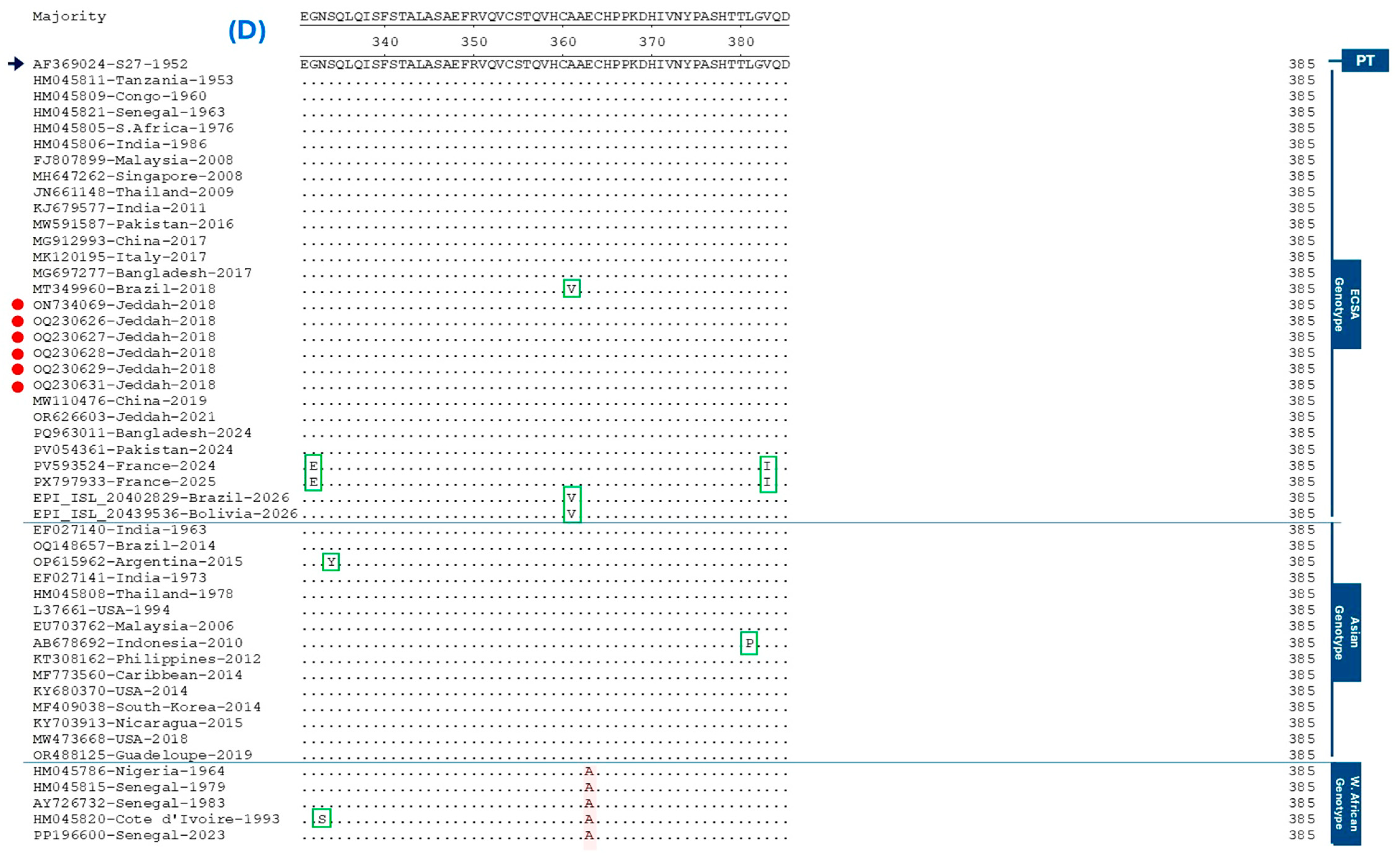
3.1. Nucleotide and Deduced Amino Acid Sequence Analysis of E1 Gene/Protein
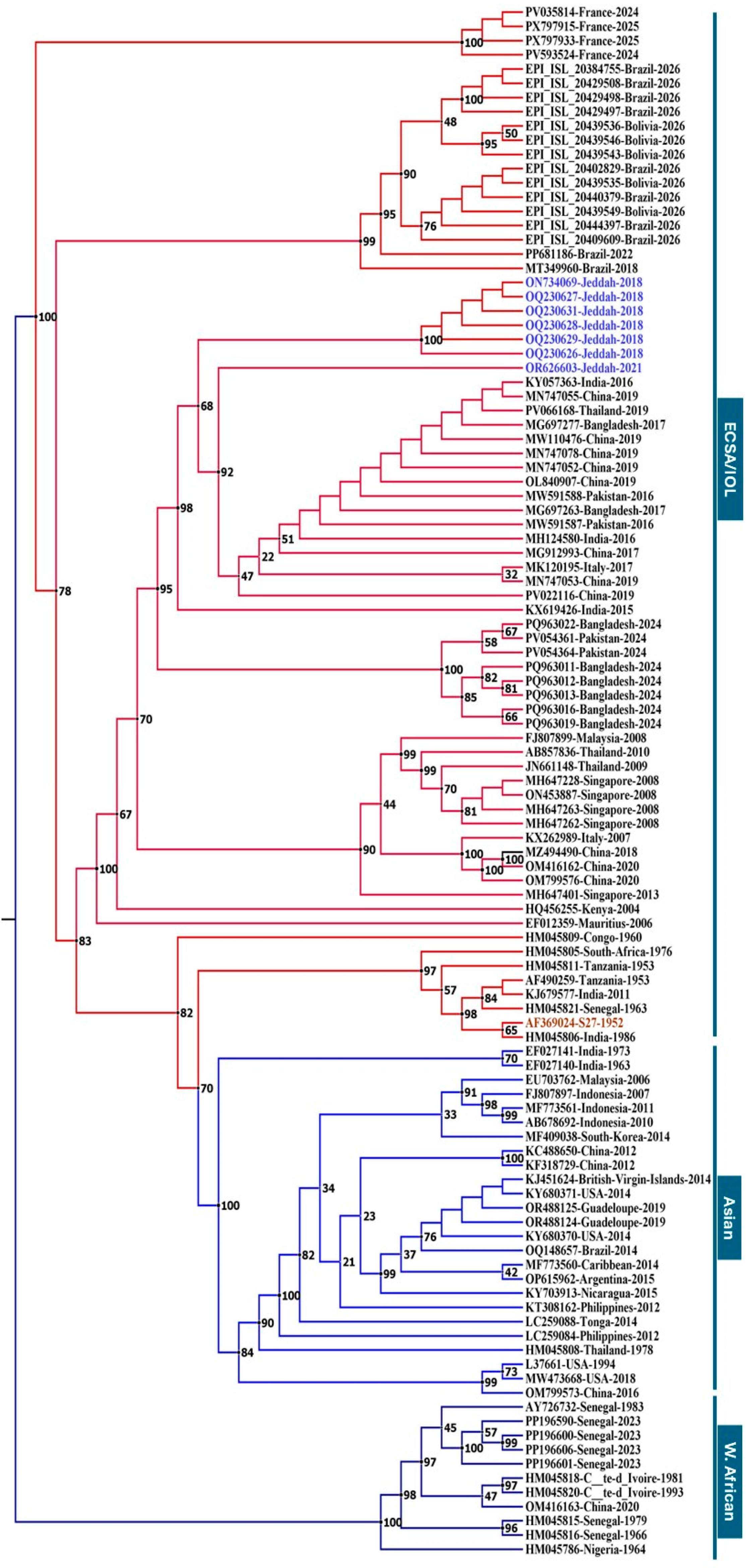
3.2. Phylogenetic Analysis and Genotype Assignment
3.3. Selection Pressure Analysis
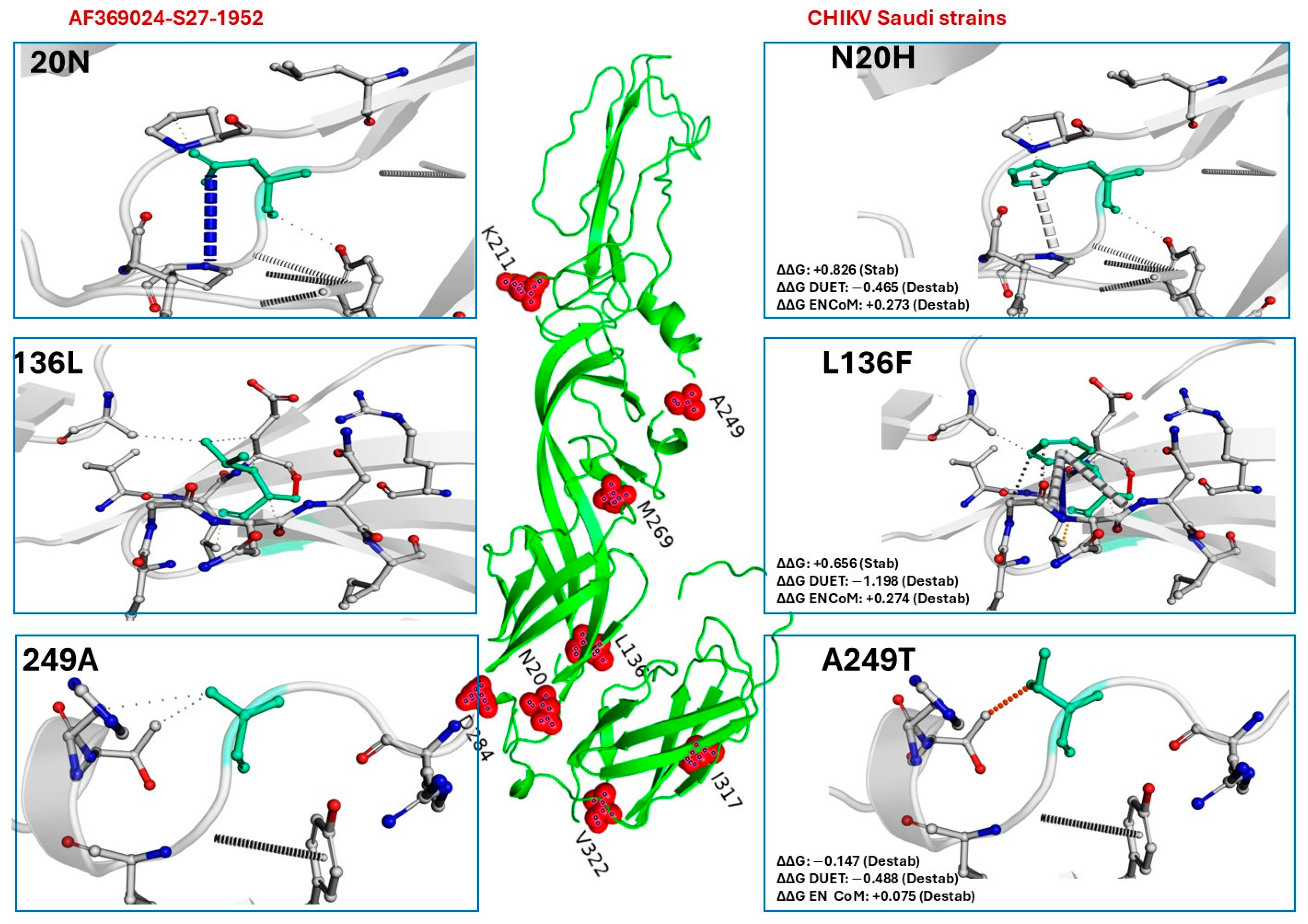
3.4. Predicted Stability Effects of Saudi-Unique E1 Mutations
4. Discussion
5. Conclusions
Supplementary Materials
Funding
Institutional Review Board Statement
Informed Consent Statement
Data Availability Statement
Acknowledgments
Conflicts of Interest
Abbreviations
| CHIKV | Chikungunya virus |
| E1 | Envelope glycoprotein 1 (class II fusion protein) |
| ECSA | East/Central/South African (genotype) |
| IOL | Indian Ocean lineage (sub-lineage of ECSA) |
| MEME | Mixed Effects Model of Evolution (detects episodic diversifying selection) |
| FEL | Fixed Effects Likelihood (detects pervasive selection) |
| SLAC | Single-Likelihood Ancestor Counting (detects pervasive selection) |
| FUBAR | Fast Unconstrained Bayesian AppRoximation (Bayesian estimate of pervasive selection) |
| BEAST | Bayesian Evolutionary Analysis Sampling Trees (software for divergence time analysis) |
| MCMC | Markov chain Monte Carlo (sampling method used in BEAST) |
| HPD | Highest Posterior Density (95% confidence interval for divergence time) |
| PP | Posterior probability (clade support in Bayesian tree) |
| dN/dS | Ratio of non-synonymous to synonymous substitutions (measure of selection pressure) |
| ΔΔG | Change in Gibbs free energy (kcal/mol; negative = destabilizing mutation) |
| DUET | Consensus structure-based predictor for mutation stability effects |
| ENCoM | Normal mode analysis-based stability score (part of DynaMut) |
| mCSM | Structure-based stability predictor (used in DUET consensus) |
| SDM | Structure-based stability predictor (used in DUET consensus) |
| NMA | Normal mode analysis (used to predict flexibility changes) |
References
- Martelossi-Cebinelli, G.; Carneiro, J.A.; Yaekashi, K.M.; Bertozzi, M.M.; Bianchini, B.H.S.; Rasquel-Oliveira, F.S.; Zanluca, C.; Duarte dos Santos, C.N.; Arredondo, R.; Blackburn, T.A.; et al. A Review of the Biology of Chikungunya Virus Highlighting the Development of Current Novel Therapeutic and Prevention Approaches. Pathogens 2025, 14, 1047. [Google Scholar] [CrossRef] [Scilit] [PubMed]
- Tanaka, A.; Suzuki, Y. Genome-Wide Approaches to Unravel the Host Factors Involved in Chikungunya Virus Replication. Front. Microbiol. 2022, 13, 866271. [Google Scholar] [CrossRef] [Scilit] [PubMed]
- Wang, M.; Wang, L.; Leng, P.; Guo, J.; Zhou, H. Drugs targeting structural and nonstructural proteins of the chikungunya virus: A review. Int. J. Biol. Macromol. 2024, 262, 129949. [Google Scholar] [CrossRef] [Scilit] [PubMed]
- Battini, L.; Thannickal, S.A.; Tejerina Cibello, M.; Bollini, M.; Stapleford, K.A.; Álvarez, D.E. Evolution of antiviral resistance captures a transient interdomain functional interaction between chikungunya virus envelope glycoproteins. mBio 2025, 16, e0253025. [Google Scholar] [CrossRef] [Scilit] [PubMed]
- Thannickal Sara, A.; Battini, L.; Spector Sophie, N.; Noval Maria, G.; Álvarez Diego, E.; Stapleford Kenneth, A. Changes in the chikungunya virus E1 glycoprotein domain II and hinge influence E2 conformation, infectivity, and virus-receptor interactions. J. Virol. 2024, 98, e00679-00624. [Google Scholar] [CrossRef] [Scilit] [PubMed]
- Mangala Prasad, V.; Blijleven, J.S.; Smit, J.M.; Lee, K.K. Visualization of conformational changes and membrane remodeling leading to genome delivery by viral class-II fusion machinery. Nat. Commun. 2022, 13, 4772. [Google Scholar] [CrossRef] [Scilit] [PubMed]
- Sun, S.; Xiang, Y.; Akahata, W.; Holdaway, H.; Pal, P.; Zhang, X.; Diamond, M.S.; Nabel, G.J.; Rossmann, M.G. Structural analyses at pseudo atomic resolution of Chikungunya virus and antibodies show mechanisms of neutralization. eLife 2013, 2, e00435. [Google Scholar] [CrossRef] [Scilit] [PubMed]
- Sahoo, B.; Gudigamolla Naresh, K.; Chowdary Tirumala, K. Acidic pH-Induced Conformational Changes in Chikungunya Virus Fusion Protein E1: A Spring-Twisted Region in the Domain I-III Linker Acts as a Hinge Point for Swiveling Motion of Domains. J. Virol. 2020, 94, e01561-20. [Google Scholar] [CrossRef] [Scilit] [PubMed]
- Chen, R.; Puri, V.; Fedorova, N.; Lin, D.; Hari Kumar, L.; Jain, R.; Rodas Juan, D.; Das Suman, R.; Shabman Reed, S.; Weaver Scott, C. Comprehensive Genome Scale Phylogenetic Study Provides New Insights on the Global Expansion of Chikungunya Virus. J. Virol. 2016, 90, 10600–10611. [Google Scholar] [CrossRef] [Scilit] [PubMed]
- Xiao, P.; Hao, Y.; Yuan, Y.; Ma, W.; Li, Y.; Zhang, H.; Li, N. Emerging West African Genotype Chikungunya Virus in Mosquito Virome. Virulence 2025, 16, 2444686. [Google Scholar] [CrossRef] [Scilit] [PubMed]
- Kalyanasundram, J.; Zawawi, Z.M.; Kamel, K.A.; Aroidoss, E.T.; Ellan, K.; Anasir, M.I.; Azizan, M.A.; Zulkifli, M.M.S.; Zain, R.M. Emergence of ECSA-IOL E1-K211E/E2-V264A Lineage of Chikungunya virus during Malaysian 2021 outbreak. BMC Infect. Dis. 2024, 24, 1199. [Google Scholar] [CrossRef] [Scilit] [PubMed]
- Phadungsombat, J.; Imad, H.; Rahman, M.; Nakayama, E.E.; Kludkleeb, S.; Ponam, T.; Rahim, R.; Hasan, A.; Poltep, K.; Yamanaka, A.; et al. A Novel Sub-Lineage of Chikungunya Virus East/Central/South African Genotype Indian Ocean Lineage Caused Sequential Outbreaks in Bangladesh and Thailand. Viruses 2020, 12, 1319. [Google Scholar] [CrossRef] [Scilit] [PubMed]
- Anggraeni, Y.M.; Garjito, T.A.; Prihatin, M.T.; Handayani, S.W.; Negari, K.S.; Yanti, A.O.; Hidajat, M.C.; Prastowo, D.; Satoto, T.B.T.; Manguin, S.; et al. Fast Expansion of the Asian-Pacific Genotype of the Chikungunya Virus in Indonesia. Front. Cell. Infect. Microbiol. 2021, 11, 631508. [Google Scholar] [CrossRef] [Scilit] [PubMed]
- Ramphal, Y.; Tegally, H.; San, J.E.; Reichmuth, M.L.; Hofstra, M.; Wilkinson, E.; Baxter, C.; Climade, C.; de Oliveira, T.; Moir, M. Understanding the Transmission Dynamics of the Chikungunya Virus in Africa. Pathogens 2024, 13, 605. [Google Scholar] [CrossRef] [Scilit] [PubMed]
- Wang, R.; Kain, K.C.; Xie, Z. The possibly neglected victims: Re-examining the involvement of children in the chikungunya epidemic. Pediatr. Investig. 2025, 9, 234–240. [Google Scholar] [CrossRef] [Scilit] [PubMed]
- de Souza, W.M.; Ribeiro, G.S.; de Lima, S.T.S.; de Jesus, R.; Moreira, F.R.R.; Whittaker, C.; Sallum, M.A.M.; Carrington, C.V.F.; Sabino, E.C.; Kitron, U.; et al. Chikungunya: A decade of burden in the Americas. Lancet Reg. Health Am. 2024, 30, 100673. [Google Scholar] [CrossRef] [Scilit] [PubMed]
- Phadungsombat, J.; Imad, H.A.; Nakayama, E.E.; Leaungwutiwong, P.; Ramasoota, P.; Nguitragool, W.; Matsee, W.; Piyaphanee, W.; Shioda, T. Spread of a Novel Indian Ocean Lineage Carrying E1-K211E/E2-V264A of Chikungunya Virus East/Central/South African Genotype across the Indian Subcontinent, Southeast Asia, and Eastern Africa. Microorganisms 2022, 10, 354. [Google Scholar] [CrossRef] [Scilit] [PubMed]
- European Centre for Disease Prevention and Control. Chikungunya Virus Disease Worldwide Overview. Available online: https://www.ecdc.europa.eu/en/chikungunya-monthly (accessed on 10 May 2026).
- de Roo, A.M.; Boer, M.; Vondeling, G.T.; Louwsma, T.; Sloof, A.C.; Postma, M.J.; Mores, C.N.; Christofferson, R.C.; van der Schans, J.; de Jong, L.A. Evaluating chikungunya outbreak size and emergency vaccination strategies in Miami: An exploratory modeling study. BMC Public Health 2025, 25, 3781. [Google Scholar] [CrossRef] [Scilit] [PubMed]
- Ribeiro dos Santos, G.; Jawed, F.; Mukandavire, C.; Deol, A.; Scarponi, D.; Mboera, L.E.G.; Seruyange, E.; Poirier, M.J.P.; Bosomprah, S.; Udeze, A.O.; et al. Global burden of chikungunya virus infections and the potential benefit of vaccination campaigns. Nat. Med. 2025, 31, 2342–2349. [Google Scholar] [CrossRef] [Scilit] [PubMed]
- Frumence, E.; Piorkowski, G.; Traversier, N.; Amaral, R.; Vincent, M.; Mercier, A.; Ayhan, N.; Souply, L.; Pezzi, L.; Lier, C.; et al. Genomic insights into the re-emergence of chikungunya virus on Réunion Island, France, 2024 to 2025. Euro Surveill. 2025, 30, 2500344. [Google Scholar] [CrossRef] [Scilit] [PubMed]
- Ning, X.; Xia, B.; Wang, J.; Gao, R.; Ren, H. Host-adaptive mutations in Chikungunya virus genome. Virulence 2024, 15, 2401985. [Google Scholar] [CrossRef] [Scilit] [PubMed]
- Zhang, P.; Pang, Z.; Zhu, S.; Xu, Q.; Fang, Q.; Yang, C.; Yao, X.; Zhang, B. Whole-genome phylogenetics of chikungunya virus from a clustered outbreak in China reveals IOL circulation. Virology 2026, 621, 110939. [Google Scholar] [CrossRef] [Scilit] [PubMed]
- Hussain, R.; Alomar, I.; Memish, Z.A. Chikungunya virus: Emergence of an arthritic arbovirus in Jeddah, Saudi Arabia. East. Mediterr. Health J. 2013, 19, 506–508. [Google Scholar] [CrossRef] [Scilit] [PubMed]
- Alguridi, H.I.; Alzahrani, F.; Altayb, H.N.; Almalki, S.; Zaki, E.; Algarni, S.; Assiri, A.; Memish, Z.A. The First Genomic Characterization of the Chikungunya Virus in Saudi Arabia. J. Epidemiol. Glob. Health 2023, 13, 191–199. [Google Scholar] [CrossRef] [Scilit] [PubMed]
- Alguridi, H.I.; Alzahrani, F.A.; Altayb, H.N. In-silico analysis of novel mutations identified in Chikungunya virus. Gene Rep. 2025, 38, 102118. [Google Scholar] [CrossRef] [Scilit]
- Alharbi, A.M. The increasing importance of Dengue virus infection in Saudi Arabia: A review. Virus Res. 2025, 351, 199510. [Google Scholar] [CrossRef] [Scilit] [PubMed]
- Humphrey, J.M.; Cleton, N.B.; Reusken, C.B.E.M.; Glesby, M.J.; Koopmans, M.P.G.; Abu-Raddad, L.J. Urban Chikungunya in the Middle East and North Africa: A systematic review. PLoS Neglected Trop. Dis. 2017, 11, e0005707. [Google Scholar] [CrossRef] [Scilit] [PubMed]
- Fischer, C.; de Lamballerie, X.; Drexler Jan, F. Enhanced Molecular Surveillance of Chikungunya Virus. mSphere 2019, 4, e00295-19. [Google Scholar] [CrossRef] [Scilit] [PubMed]
- Quiroz, J.A.; Malonis, R.J.; Thackray, L.B.; Cohen, C.A.; Pallesen, J.; Jangra, R.K.; Brown, R.S.; Hofmann, D.; Holtsberg, F.W.; Shulenin, S.; et al. Human monoclonal antibodies against chikungunya virus target multiple distinct epitopes in the E1 and E2 glycoproteins. PLoS Pathog. 2019, 15, e1008061. [Google Scholar] [CrossRef] [Scilit] [PubMed]
- Thompson, J.D.; Higgins, D.G.; Gibson, T.J. CLUSTAL W: Improving the sensitivity of progressive multiple sequence alignment through sequence weighting, position-specific gap penalties and weight matrix choice. Nucleic Acids Res. 1994, 22, 4673–4680. [Google Scholar] [CrossRef] [Scilit] [PubMed]
- Larsson, A. AliView: A fast and lightweight alignment viewer and editor for large datasets. Bioinformatics 2014, 30, 3276–3278. [Google Scholar] [CrossRef] [Scilit] [PubMed]
- Nguyen, L.T.; Schmidt, H.A.; von Haeseler, A.; Minh, B.Q. IQ-TREE: A fast and effective stochastic algorithm for estimating maximum-likelihood phylogenies. Mol. Biol. Evol. 2015, 32, 268–274. [Google Scholar] [CrossRef] [Scilit] [PubMed]
- Edgar, R.C. MUSCLE: Multiple sequence alignment with high accuracy and high throughput. Nucleic Acids Res. 2004, 32, 1792–1797. [Google Scholar] [CrossRef] [Scilit] [PubMed]
- Stecher, G.; Tamura, K.; Kumar, S. Molecular Evolutionary Genetics Analysis (MEGA) for macOS. Mol. Biol. Evol. 2020, 37, 1237–1239. [Google Scholar] [CrossRef] [Scilit] [PubMed]
- Afgan, E.; Baker, D.; Batut, B.; van den Beek, M.; Bouvier, D.; Čech, M.; Chilton, J.; Clements, D.; Coraor, N.; Grüning, B.A.; et al. The Galaxy platform for accessible, reproducible and collaborative biomedical analyses: 2018 update. Nucleic Acids Res. 2018, 46, W537–W544. [Google Scholar] [CrossRef] [Scilit] [PubMed]
- Weaver, S.; Shank, S.D.; Spielman, S.J.; Li, M.; Muse, S.V.; Kosakovsky Pond, S.L. Datamonkey 2.0: A Modern Web Application for Characterizing Selective and Other Evolutionary Processes. Mol. Biol. Evol. 2018, 35, 773–777. [Google Scholar] [CrossRef] [Scilit] [PubMed]
- Pond, S.L.K.; Frost, S.D.W.; Muse, S.V. HyPhy: Hypothesis testing using phylogenies. Bioinformatics 2005, 21, 676–679. [Google Scholar] [CrossRef] [Scilit] [PubMed]
- Murrell, B.; Wertheim, J.O.; Moola, S.; Weighill, T.; Scheffler, K.; Kosakovsky Pond, S.L. Detecting Individual Sites Subject to Episodic Diversifying Selection. PLoS Genet. 2012, 8, e1002764. [Google Scholar] [CrossRef] [Scilit] [PubMed]
- Rodrigues, C.H.M.; Pires, D.E.V.; Ascher, D.B. DynaMut2: Assessing changes in stability and flexibility upon single and multiple point missense mutations. Protein Sci. 2021, 30, 60–69. [Google Scholar] [CrossRef] [Scilit] [PubMed]
- Laiton-Donato, K.; Usme-Ciro, J.A.; Rico, A.; Pardo, L.; Martínez, C.; Salas, D.; Ardila, S.; Páez, A. Phylogenetic analysis of Chikungunya virus in Colombia: Evidence of purifying selection in the E1 gene. Biomedica 2015, 36, 25–34. [Google Scholar] [CrossRef] [Scilit] [PubMed]
- Kielian, M.; Chanel-Vos, C.; Liao, M. Alphavirus Entry and Membrane Fusion. Viruses 2010, 2, 796–825. [Google Scholar] [CrossRef] [Scilit] [PubMed]
- The Translational Research Consortia (TRC) for Chikungunya Virus in India. Current Status of Chikungunya in India. Front. Microbiol. 2021, 12, 695173. [CrossRef] [Scilit] [PubMed]
- Nasif, M.A.O.; Haider, N.; Muntasir, I.; Qayum, M.O.; Hasan, M.N.; Hassan, M.R.; Khan, M.H.; Sultana, S.; Ferdous, J.; Prince, K.T.P.; et al. The reappearance of Chikungunya virus in Bangladesh, 2024. IJID Reg. 2025, 16, 100664. [Google Scholar] [CrossRef] [Scilit] [PubMed]
- Sharif, N.; Khan, A.; Sharif, N.; Dey, S.K. Spatiotemporal dynamics and reemergence of chikungunya virus in Bangladesh from 2008 to 2025. Int. J. Infect. Dis. 2026, 166, 108529. [Google Scholar] [CrossRef] [Scilit] [PubMed]
- Pires, D.E.; Ascher, D.B.; Blundell, T.L. DUET: A server for predicting effects of mutations on protein stability using an integrated computational approach. Nucleic Acids Res. 2014, 42, W314–W319. [Google Scholar] [CrossRef] [Scilit] [PubMed]
- Gaur, M.; Mamidi, P.; Mishra, B.; Ray, A.; Chattopadhyay, S.; Rath, S.; Mohanty, M.; Subudhi, B.B. Computational Insights into the Structural Dynamics of the E Protein’s DIII Domain in Brazilian Yellow Fever Virus: Implications of Amino Acid Variations on Protein Plasticity and Potential Impact on Vaccine Efficacy. ACS Omega 2026, 11, 11068–11081. [Google Scholar] [CrossRef] [Scilit] [PubMed]
- Ks, S.; Nair, A.S. Insights on the interaction of SARS-CoV-2 variant B.1.617.2 with antibody CR3022 and analysis of antibody resistance. J. Genet. Eng. Biotechnol. 2023, 21, 35. [Google Scholar] [CrossRef] [Scilit] [PubMed]
- Khongwichit, S.; Chuchaona, W.; Korkong, S.; Wongsrisang, L.; Thongmee, T.; Poovorawan, Y. Chikungunya virus in Thailand (2020–2023): Epidemiology, clinical features, and genomic insights. PLoS Negl. Trop. Dis. 2025, 19, e0013548. [Google Scholar] [CrossRef] [Scilit] [PubMed]
- Agarwal, A.; Sharma, A.K.; Sukumaran, D.; Parida, M.; Dash, P.K. Two novel epistatic mutations (E1:K211E and E2:V264A) in structural proteins of Chikungunya virus enhance fitness in Aedes aegypti. Virology 2016, 497, 59–68. [Google Scholar] [CrossRef] [Scilit] [PubMed]
- Maljkovic Berry, I.; Eyase, F.; Pollett, S.; Konongoi, S.L.; Joyce, M.G.; Figueroa, K.; Ofula, V.; Koka, H.; Koskei, E.; Nyunja, A.; et al. Global Outbreaks and Origins of a Chikungunya Virus Variant Carrying Mutations Which May Increase Fitness for Aedes aegypti: Revelations from the 2016 Mandera, Kenya Outbreak. AM. J. Trop. Med. Hyg. 2019, 100, 1249–1257. [Google Scholar] [CrossRef] [Scilit] [PubMed]
- Agbodzi, B.; Yousseu, F.B.S.; Simo, F.B.N.; Kumordjie, S.; Yeboah, C.; Mosore, M.-T.; Bentil, R.E.; Prieto, K.; Colston, S.M.; Attram, N.; et al. Chikungunya viruses containing the A226V mutation detected retrospectively in Cameroon form a new geographical subclade. Int. J. Infect. Dis. 2021, 113, 65–73. [Google Scholar] [CrossRef] [Scilit] [PubMed]
- Tsetsarkin, K.A.; Chen, R.; Yun, R.; Rossi, S.L.; Plante, K.S.; Guerbois, M.; Forrester, N.; Perng, G.C.; Sreekumar, E.; Leal, G.; et al. Multi-peaked adaptive landscape for chikungunya virus evolution predicts continued fitness optimization in Aedes albopictus mosquitoes. Nat. Commun. 2014, 5, 4084. [Google Scholar] [CrossRef] [Scilit] [PubMed]
- Schuffenecker, I.; Iteman, I.; Michault, A.; Murri, S.; Frangeul, L.; Vaney, M.C.; Lavenir, R.; Pardigon, N.; Reynes, J.M.; Pettinelli, F.; et al. Genome microevolution of chikungunya viruses causing the Indian Ocean outbreak. PLoS Med. 2006, 3, e263. [Google Scholar] [CrossRef] [Scilit] [PubMed]
- Kaur, R.; Neetu; Mudgal, R.; Jose, J.; Kumar, P.; Tomar, S. Glycan-dependent chikungunya viral infection divulged by antiviral activity of NAG specific chi-like lectin. Virology 2019, 526, 91–98. [Google Scholar] [CrossRef] [Scilit] [PubMed]
- Kim, K.; Moon, S.Y.; Kim, S.; Ouh, I.-O.; Lee, Y.; Lim, H. Immunogenicity Analysis of Chikungunya Virus DNA Vaccine Based on Mutated Putative N-Linked Glycosylation Sites of the Envelope Protein. Vaccines 2024, 12, 1097. [Google Scholar] [CrossRef] [Scilit] [PubMed]
- Voss, J.E.; Vaney, M.C.; Duquerroy, S.; Vonrhein, C.; Girard-Blanc, C.; Crublet, E.; Thompson, A.; Bricogne, G.; Rey, F.A. Glycoprotein organization of Chikungunya virus particles revealed by X-ray crystallography. Nature 2010, 468, 709–712. [Google Scholar] [CrossRef] [Scilit] [PubMed]
- Hick, T.A.H.; Geertsema, C.; Henquet, M.G.L.; Martens, D.E.; Metz, S.W.; Pijlman, G.P. Secreted Trimeric Chikungunya Virus Spikes from Insect Cells: Production, Purification, and Glycosylation Status. Processes 2022, 10, 162. [Google Scholar] [CrossRef] [Scilit]
- Ren, T.; Liu, M.; Li, P.; Zhang, L.; Zhong, Z.; Zhou, L.; Qin, Y.; Ouyang, K.; Yin, Y.; Chen, Y.; et al. Defining the impact of Getah virus envelope protein glycosylation site mutations on viral replication, host adaptation, virulence, and immune evasion. PLoS Pathog. 2026, 22, e1014126. [Google Scholar] [CrossRef] [Scilit] [PubMed]
- Ribeiro-Filho, H.V.; Coimbra, L.D.; Cassago, A.; Rocha, R.P.F.; Guerra, J.V.d.S.; de Felicio, R.; Carnieli, C.M.; Leme, L.; Padilha, A.C.; Paes Leme, A.F.; et al. Cryo-EM structure of the mature and infective Mayaro virus at 4.4 Å resolution reveals features of arthritogenic alphaviruses. Nat. Commun. 2021, 12, 3038. [Google Scholar] [CrossRef] [Scilit] [PubMed]
- Alqurashi, S.I.; Alqahtani, S.M.; Alghamdi, K.M.S.; Sharawi, S.E.; Al-Solami, H.M.; Alghamdi, A.G.; Alyahya, H.S.; Al-Rashidi, H.S.; Mahyoub, J.A. Molecular insights into Aedes aegypti (L.) populations and vector surveillance in the urban areas of Jeddah and Jizan, Saudi Arabia. Front. Insect Sci. 2025, 5, 1638582. [Google Scholar] [CrossRef] [Scilit] [PubMed]
- Ebrahim, S.H.; Alahmed, B.; Ali, A.; Koya, S.F.; Memish, Z.A. Watch list of diseases and public health signals, Hajj-Umrah, 2025–2026. Mass. Gather. Med. 2025, 4, 100042. [Google Scholar] [CrossRef] [Scilit]
- Alghamdi, T.S.; Al Zahrani, M.; Gharsan, F.N.; Al Ghamdi, K.M.; Mahyoub, J.A. Identification of mosquito species and determination of population density in the Taif governorate, Saudi Arabia. J. Entomol. Acarol. Res. 2021, 53, 9303. [Google Scholar] [CrossRef] [Scilit]





| E1 Codon | MEME (p-Value) * | FEL (p-Value) | SLAC (P[dN/dS < 1]) | FUBAR (Post. Pr.) | Interpretation |
|---|---|---|---|---|---|
| 13 | 0.67 | 0.0016 | 0.030 | 0.999 | Strong purifying |
| 19 | 0.67 | 0.0020 | 0.019 | 0.998 | Strong purifying |
| 38 | 0.67 | 0.0079 | 0.037 | 0.990 | Strong purifying |
| 45 | 0.67 | 0.0090 | 0.023 | 0.992 | Strong purifying |
| 65 | 0.67 | 0.0092 | 0.051 | 0.980 | Strong purifying |
| 99 | 0.01 | 0.3571 | 0.625 | 0.400 | MEME-only signal |
| 112 | 0.67 | 0.0091 | 0.038 | 0.990 | Strong purifying |
| 135 | 0.67 | <0.001 | <0.001 | 1.000 | Strong purifying |
| 143 | 0.67 | 0.0008 | 0.004 | 0.999 | Strong purifying |
| 157 | 0.67 | 0.0031 | 0.012 | 0.996 | Strong purifying |
| 161 | 0.67 | 0.0039 | 0.022 | 0.992 | Strong purifying |
| 194 | 0.67 | 0.0009 | 0.003 | 0.998 | Strong purifying |
| 195 | 0.16 | 0.1807 | 1.000 | 0.022 | Purifying |
| 214 | 0.67 | 0.0002 | 0.003 | 0.999 | Strong purifying |
| 241 | 0.67 | 0.0021 | 0.004 | 0.998 | Strong purifying |
| 254 | 0.67 | 0.0004 | 0.003 | 0.999 | Strong purifying |
| 278 | 0.67 | 0.0126 | 0.105 | 0.993 | Purifying |
| 298 | 0.12 | 0.0937 | 1.000 | 0.187 | Purifying |
| 306 | 0.06 | 0.8383 | 0.704 | 0.550 | MEME-only signal |
| 307 | 0.67 | <0.001 | 0.002 | 1.000 | Strong purifying |
| 318 | 0.67 | 0.0037 | 0.012 | 0.996 | Strong purifying |
| 332 | 0.12 | 0.1000 | 1.000 | 0.201 | Purifying |
| 334 | 0.05 | 0.7646 | 0.556 | 0.674 | MEME-only signal |
| 344 | 0.67 | <0.001 | 0.003 | 1.000 | Strong purifying |
| 365 | 0.67 | 0.0009 | 0.010 | 0.998 | Strong purifying |
Disclaimer/Publisher’s Note: The statements, opinions and data contained in all publications are solely those of the individual author(s) and contributor(s) and not of MDPI and/or the editor(s). MDPI and/or the editor(s) disclaim responsibility for any injury to people or property resulting from any ideas, methods, instructions or products referred to in the content. |
© 2026 by the author. Licensee MDPI, Basel, Switzerland. This article is an open access article distributed under the terms and conditions of the Creative Commons Attribution (CC BY) license.
Share and Cite
Farrag, M.A. Molecular Evolution of the Chikungunya Virus E1 Gene in Saudi Arabia: Predominance of Purifying Selection and ECSA/IOL Lineage Circulation. Viruses 2026, 18, 791. https://doi.org/10.3390/v18070791
Farrag MA. Molecular Evolution of the Chikungunya Virus E1 Gene in Saudi Arabia: Predominance of Purifying Selection and ECSA/IOL Lineage Circulation. Viruses. 2026; 18(7):791. https://doi.org/10.3390/v18070791
Chicago/Turabian StyleFarrag, Mohamed A. 2026. "Molecular Evolution of the Chikungunya Virus E1 Gene in Saudi Arabia: Predominance of Purifying Selection and ECSA/IOL Lineage Circulation" Viruses 18, no. 7: 791. https://doi.org/10.3390/v18070791
APA StyleFarrag, M. A. (2026). Molecular Evolution of the Chikungunya Virus E1 Gene in Saudi Arabia: Predominance of Purifying Selection and ECSA/IOL Lineage Circulation. Viruses, 18(7), 791. https://doi.org/10.3390/v18070791