Analysis of Tonsillar NK Cell Markers in Pediatric Epstein–Barr Virus (EBV) Asymptomatic Infection and EBV-Associated Hodgkin Lymphoma

 ,
,  , ,
, , 
Abstract
1. Introduction
2. Materials and Methods
2.1. Patients and Samples
2.2. Serological Profile
2.3. Immunohistochemistry (IHC) for Viral Antigen Expression
2.4. IHC Immune Response Markers
2.5. Flow Cytometry (FC)
2.6. Statistical Analysis
3. Results
3.1. EBV Characterization
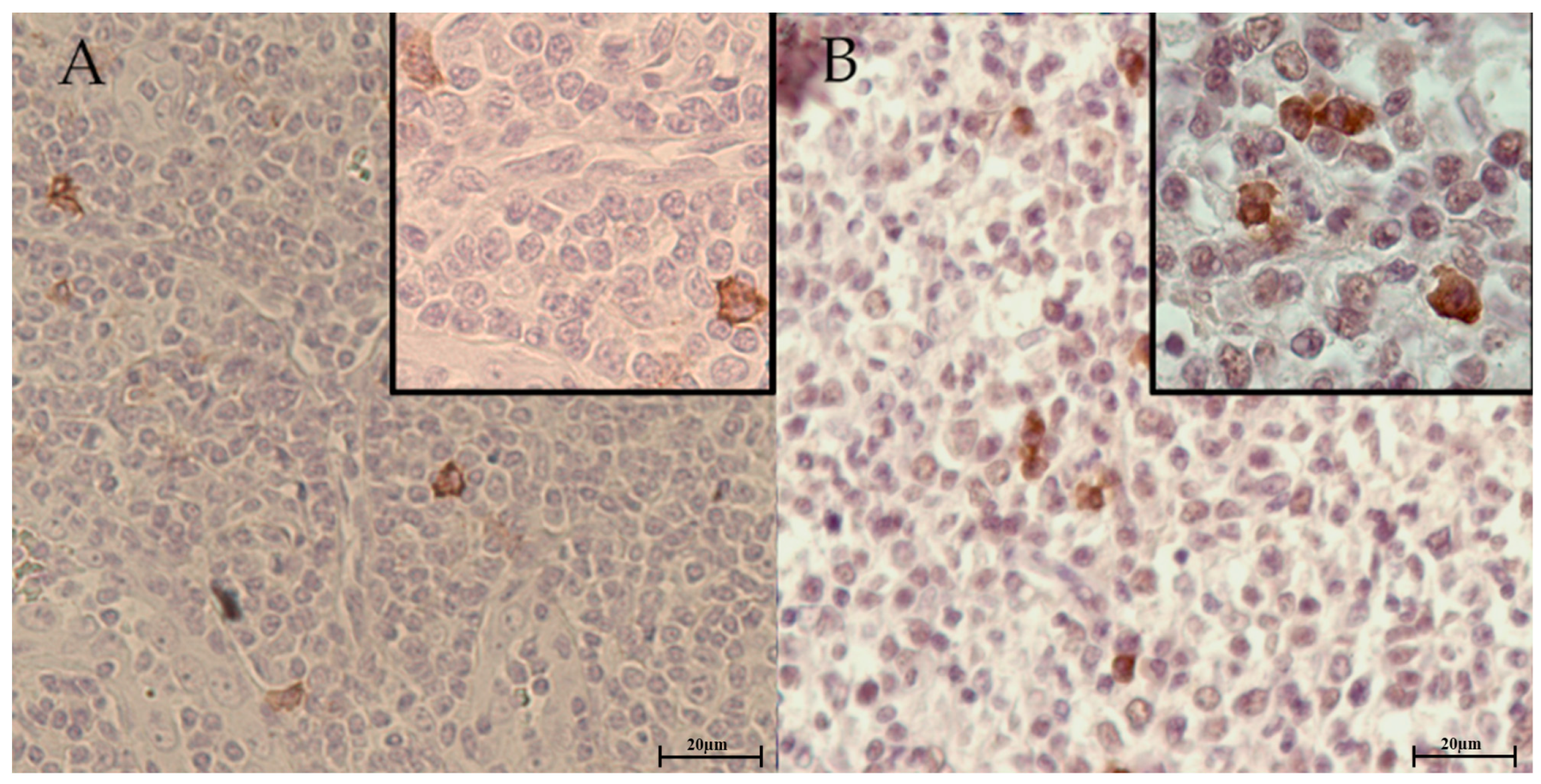
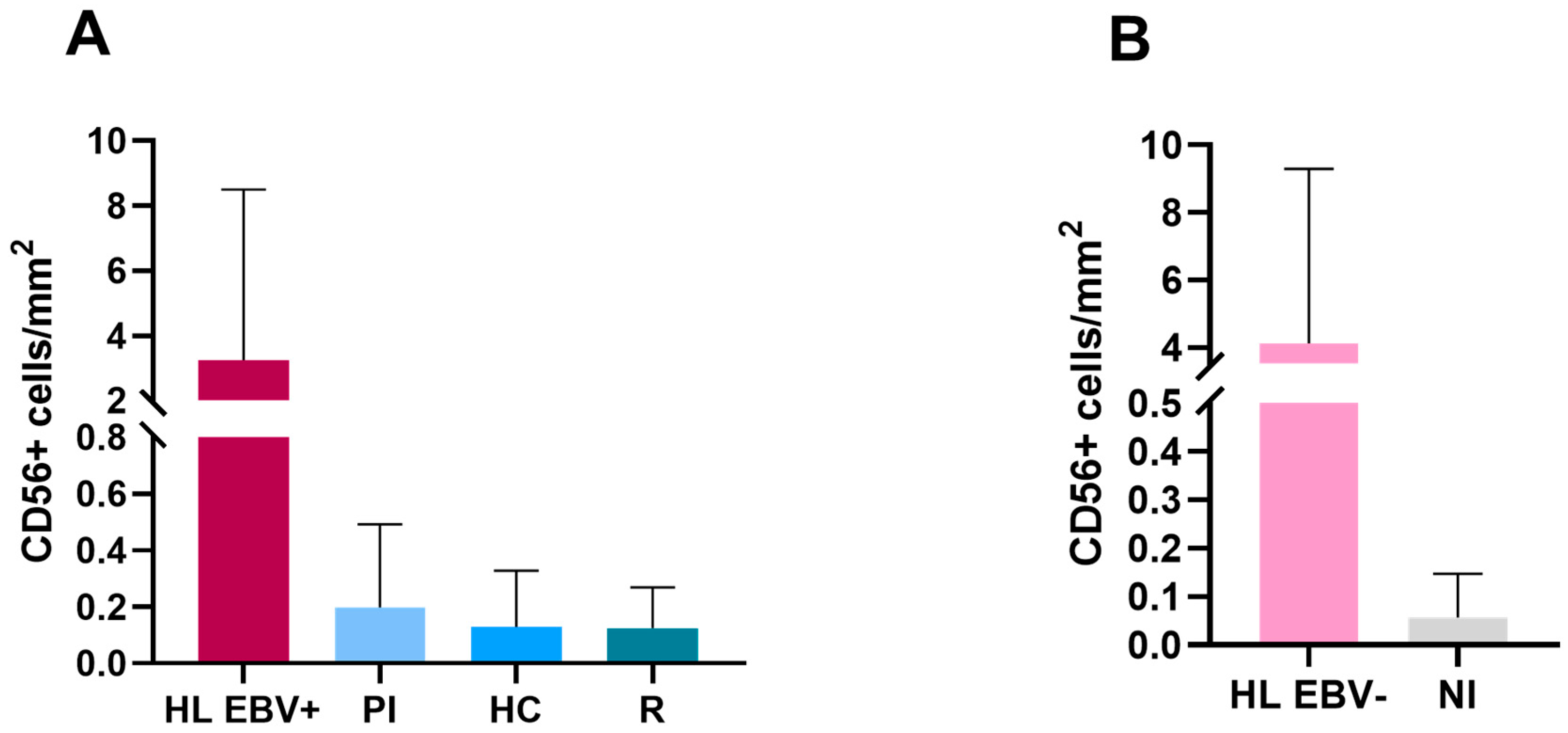
3.2. CD56 Expression in Relation to Immune Cell Markers
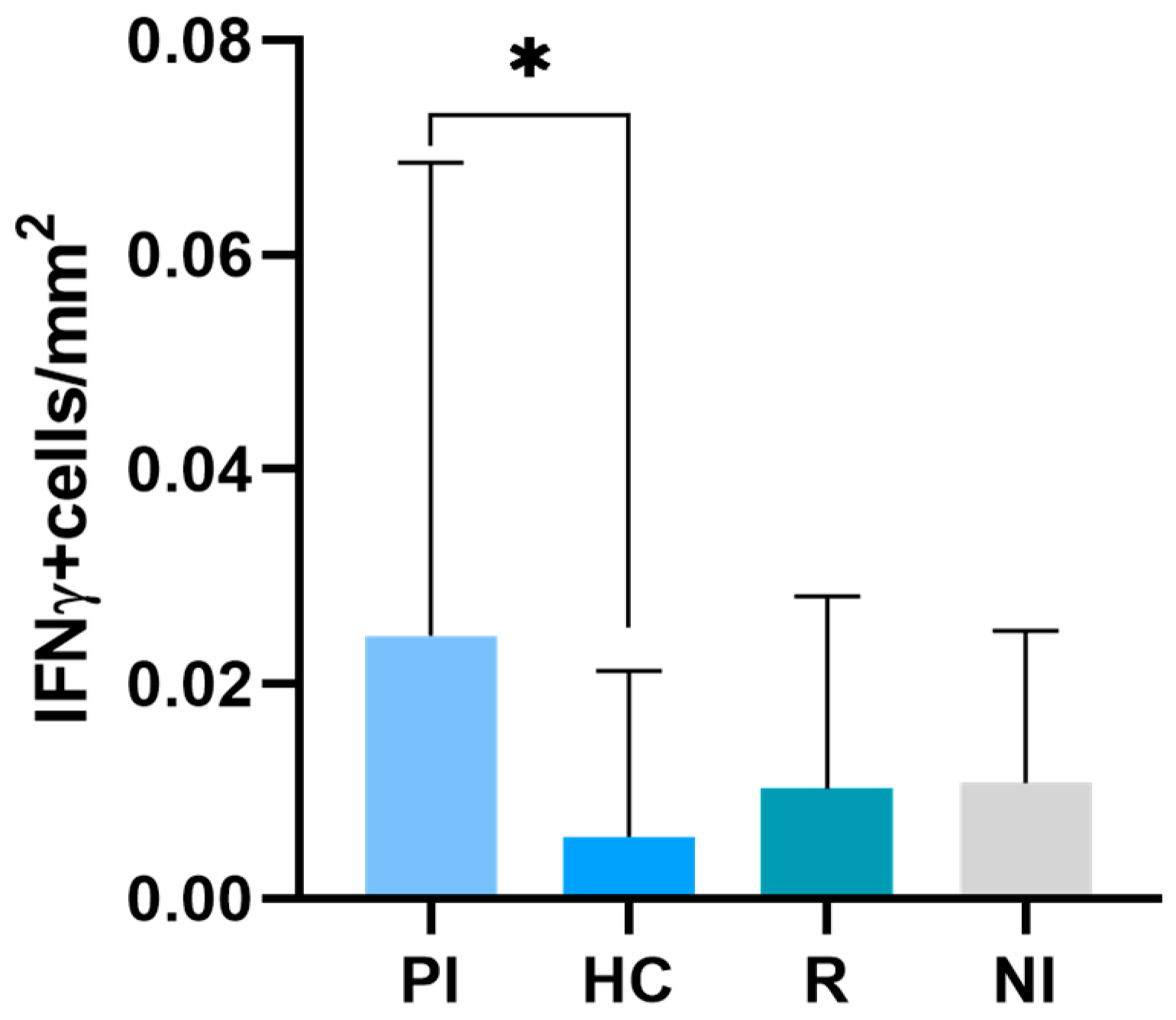
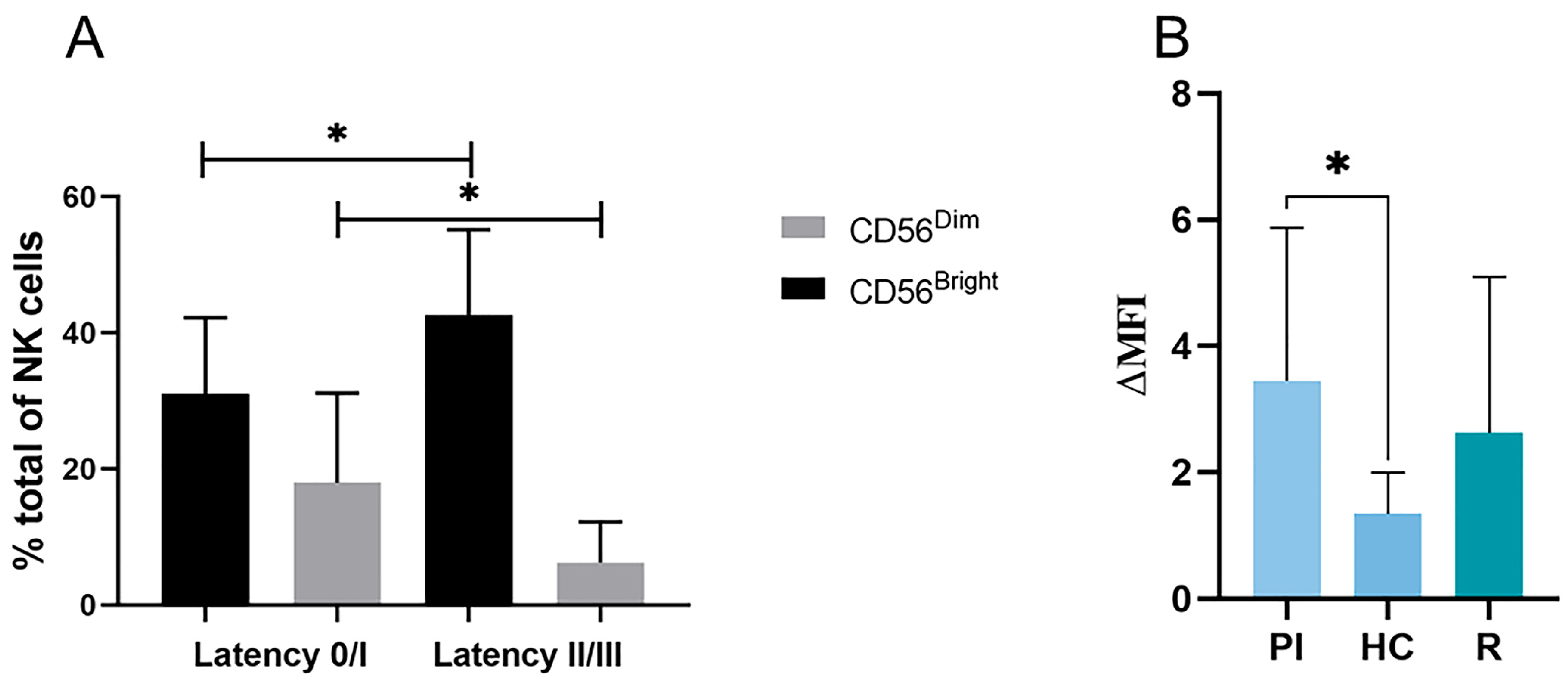
3.3. IFNγ Production by NK Cells
4. Discussion
5. Conclusions
Supplementary Materials
Author Contributions
Funding
Institutional Review Board Statement
Informed Consent Statement
Data Availability Statement
Acknowledgments
Conflicts of Interest
Abbreviations
| BL | Burkitt lymphoma |
| DLBCL | diffuse large B cell lymphoma |
| EA | early antigen |
| EBER | Epstein–Barr virus encoded RNA |
| EBNA | Epstein–Barr virus nuclear antigen |
| EBV | Epstein–Barr virus GzB: granzime B |
| HC | healthy carriers |
| HL | Hodgkin lymphoma |
| IHC | immunohistochemistry |
| IFN | interferon |
| IM | infectious mononucleosis |
| LMP | latent membrane protein |
| MFI | mean fluorescence intensity |
| NK | natural killer |
| PI | primary infection |
| R | reactivation |
| TMC | tonsillar mononuclear cells |
| TME | tumor microenvironment |
References
- Zhong, L.Y.; Xie, C.; Zhang, L.L.; Yang, Y.L.; Liu, Y.T.; Zhao, G.X.; Bu, G.L.; Tian, X.S.; Jiang, Z.Y.; Yuan, B.Y.; et al. Research landmarks on the 60th anniversary of Epstein-Barr virus. Sci. China Life Sci. 2025, 68, 354–380. [Google Scholar] [CrossRef] [PubMed]
- Shannon-Lowe, C.; Rickinson, A. The Global Landscape of EBV-Associated Tumors. Front. Oncol. 2019, 9, 713. [Google Scholar] [CrossRef]
- Münz, C. The Role of Lytic Infection for Lymphomagenesis of Human γ-Herpesviruses. Front. Cell. Infect. Microbiol. 2021, 11, 605258. [Google Scholar] [CrossRef]
- Thorley-Lawson, D.A. EBV persistence—Introducing the virus. Curr. Top. Microbiol. Immunol. 2015, 390, 151–209. [Google Scholar] [CrossRef]
- Rickinson, A.B.; Long, H.M.; Palendira, U.; Munz, C.; Hislop, A.D. Cellular immune controls over Epstein–Barr virus infection: New lessons from the clinic and the laboratory. Trends Immunol. 2014, 35, 159–169. [Google Scholar] [CrossRef] [PubMed]
- Long, H.M.; Taylor, G.S. The T Cell Response to Epstein-Barr Virus. Curr. Top. Microbiol. Immunol. 2026. Epub ahead of print. [Google Scholar] [CrossRef]
- Chijioke, O.; Müller, A.; Feederle, R.; Barros, M.H.; Krieg, C.; Emmel, V.; Marcenaro, E.; Leung, C.S.; Antsiferova, O.; Landtwing, V.; et al. Human natural killer cells prevent infectious mononucleosis features by targeting lytic Epstein-Barr virus infection. Cell Rep. 2013, 5, 1489–1498. [Google Scholar] [CrossRef]
- Mace, E.M.; Orange, J.S. Emerging insights into human health and NK cell biology from the study of NK cell deficiencies. Immunol. Rev. 2019, 287, 202–225. [Google Scholar] [CrossRef]
- Zhu, W.; Fan, C.; Zhao, Y.; Li, W.; Niu, J.; Dong, S.; Yang, Z.; Zhou, W. The role of NK cells in regulating tumorimmunity: Current state, challenges and future strategies. Cancer Cell Int. 2025, 25, 360. [Google Scholar] [CrossRef]
- Chiu, J.; Ernst, D.M.; Keating, A. Acquired Natural Killer Cell Dysfunction in the Tumor Microenvironment of Classic Hodgkin Lymphoma. Front. Immunol. 2018, 9, 267. [Google Scholar] [CrossRef] [PubMed]
- Wu, R.; Sattarzadeh, A.; Rutgers, B.; Diepstra, A.; van den Berg, A.; Visser, L. The microenvironment of classical Hodgkin lymphoma: Heterogeneity by Epstein–Barr virus presence and location within the tumor. Blood Cancer J. 2016, 6, e417. [Google Scholar] [CrossRef]
- Barros, M.H.M.; Vera-Lozada, G.; Segges, P.; Hassan, R.; Niedobitek, G. Revisiting the Tissue Microenvironment of Infectious Mononucleosis: Identification of EBV Infection in T Cells and Deep Characterization of Immune Profiles. Front. Immunol. 2019, 10, 146. [Google Scholar] [CrossRef]
- Vistarop, A.G.; Cohen, M.; Huaman, F.; Irazu, L.; Rodriguez, M.; De Matteo, E.; Preciado, M.V.; Chabay, P.A. The interplay between local immune response and Epstein-Barr virus-infected tonsillar cells could lead to viral infection control. Med. Microbiol. Immunol. 2018, 207, 319–327. [Google Scholar] [CrossRef]
- Chabay, P.A.; Preciado, M.V. EBV primary infection in childhood and its relation to B-cell lymphoma development: A mini-review from a developing region. Int. J. Cancer 2013, 133, 1286–1292. [Google Scholar] [CrossRef]
- Ferressini Gerpe, N.M.; Vistarop, A.G.; Moyano, A.; De Matteo, E.; Preciado, M.V.; Chabay, P.A. Distinctive EBV infection characteristics in children from a developing country. Int. J. Infect. Dis. 2020, 93, 139–145. [Google Scholar] [CrossRef]
- Moyano, A.; Ferressini Gerpe, N.M.; De Matteo, E.; Preciado, M.V.; Chabay, P. M1 Macrophage Polarization Prevails in Epstein-Barr Virus-Infected Children in an Immunoregulatory Environment. J. Virol. 2022, 96, e0143421. [Google Scholar] [CrossRef] [PubMed]
- Jimenez, O.; Mangiaterra, T.; Colli, S.; García Lombardi, M.; Preciado, M.V.; De Matteo, E.; Chabay, P. PD-1 and LAG-3 expression in EBV-associated pediatric Hodgkin lymphoma has influence on survival. Front. Oncol. 2022, 12, 957208. [Google Scholar] [CrossRef] [PubMed]
- Küppers, R. Advances in Hodgkin lymphoma research. Trends Mol. Med. 2025, 31, 326–343. [Google Scholar] [CrossRef]
- Strowig, T.; Brilot, F.; Arrey, F.; Bougras, G.; Thomas, D.; Muller, W.A.; Münz, C. Tonsilar NK cells restrict B cell transformation by the Epstein-Barr virus via IFN-gamma. PLoS Pathog. 2008, 4, e27. [Google Scholar] [CrossRef]
- Lunemann, A.; Vanoaica, L.D.; Azzi, T.; Nadal, D.; Munz, C. A distinct subpopulation of human NK cells restricts B cell transformation by EBV. J. Immunol. 2013, 191, 4989–4995. [Google Scholar] [CrossRef] [PubMed]
- Munz, C.; Chijioke, O. Natural killer cells in herpesvirus infections. F1000Research 2017, 6, 1231. [Google Scholar] [CrossRef]
- Ferrarini, I.; Rigo, A.; Visco, C.; Krampera, M.; Vinante, F. The Evolving Knowledge on T and NK Cells in Classic Hodgkin Lymphoma: Insights into Novel Subsets Populating the Immune Microenvironment. Cancers 2020, 12, 3757. [Google Scholar] [CrossRef] [PubMed]
- Carey, C.D.; Gusenleitner, D.; Lipschitz, M.; Roemer, M.G.M.; Stack, E.C.; Gjini, E.; Hu, X.; Redd, R.; Freeman, G.J.; Neuberg, D.; et al. Topological analysis reveals a PD-L1-associated microenvironmental niche for Reed-Sternberg cells in Hodgkin lymphoma. Blood 2017, 130, 2420–2430. [Google Scholar] [CrossRef]
- Barros, M.H.; Vera-Lozada, G.; Soares, F.A.; Niedobitek, G.; Hassan, R. Tumor microenvironment composition in pediatric classical Hodgkin lymphoma is modulated by age and Epstein-Barr virus infection. Int. J. Cancer 2012, 131, 1142–1152. [Google Scholar] [CrossRef] [PubMed]
- Barros, M.H.; Hassan, R.; Niedobitek, G. Tumor-associated macrophages in pediatric classical Hodgkin lymphoma: Association with Epstein-Barr virus, lymphocyte subsets, and prognostic impact. Clin. Cancer Res. 2012, 18, 3762–3771. [Google Scholar] [CrossRef]
- Jimenez, O.; Barros, M.H.; De Matteo, E.; Garcia Lombardi, M.; Preciado, M.V.; Niedobitek, G.; Chabay, P. M1-like macrophage polarization prevails in young children with classic Hodgkin Lymphoma from Argentina. Sci. Rep. 2019, 9, 12687. [Google Scholar] [CrossRef]
- Zhang, Y.; Huang, C.; Zhang, H.; Duan, Z.; Liu, Q.; Li, J.; Zong, Q.; Wei, Y.; Liu, F.; Duan, W.; et al. Characteristics of immunological events in Epstein-Barr virus infection in children with infectious mononucleosis. Front. Pediatr. 2023, 11, 1060053. [Google Scholar] [CrossRef]
- Schroder, K.; Hertzog, P.J.; Ravasi, T.; Hume, D.A. Interferon-γ: An overview of signals, mechanisms and functions. J. Leukoc. Biol. 2004, 75, 163–189. [Google Scholar] [CrossRef]
- Jud, A.; Kotur, M.; Berger, C.; Gysin, C.; Nadal, D.; Lünemann, A. Tonsillar CD56brightNKG2A+ NK cells restrict primary Epstein-Barr virus infection in B cells via IFN-γ. Oncotarget 2017, 8, 6130–6141. [Google Scholar] [CrossRef]
- Amarillo, M.E.; Lindl, K.; Lapido, V.; Rojas Campión, I.E.; Collado, M.S.; Speratti, J.; Valerio, A.; Baz, P.; De Matteo, E.; Billordo, L.A.; et al. Co-expression of PD1+ and HLA-DR+ in CD8+ T cells is increased in tonsils of children with EBV primary and persistent infection. Front. Immunol. 2025, 16, 1653165. [Google Scholar] [CrossRef] [PubMed]


Disclaimer/Publisher’s Note: The statements, opinions and data contained in all publications are solely those of the individual author(s) and contributor(s) and not of MDPI and/or the editor(s). MDPI and/or the editor(s) disclaim responsibility for any injury to people or property resulting from any ideas, methods, instructions or products referred to in the content. |
© 2026 by the authors. Licensee MDPI, Basel, Switzerland. This article is an open access article distributed under the terms and conditions of the Creative Commons Attribution (CC BY) license.
Share and Cite
Ferressini Gerpe, N.M.; Amarillo, M.E.; Jimenez, O.; Moyano, A.; Caldirola, M.S.; Gaillard, M.I.; De Matteo, E.; Chabay, P. Analysis of Tonsillar NK Cell Markers in Pediatric Epstein–Barr Virus (EBV) Asymptomatic Infection and EBV-Associated Hodgkin Lymphoma. Viruses 2026, 18, 667. https://doi.org/10.3390/v18060667
Ferressini Gerpe NM, Amarillo ME, Jimenez O, Moyano A, Caldirola MS, Gaillard MI, De Matteo E, Chabay P. Analysis of Tonsillar NK Cell Markers in Pediatric Epstein–Barr Virus (EBV) Asymptomatic Infection and EBV-Associated Hodgkin Lymphoma. Viruses. 2026; 18(6):667. https://doi.org/10.3390/v18060667
Chicago/Turabian StyleFerressini Gerpe, Natalia M., María E. Amarillo, Oscar Jimenez, Agustina Moyano, María S. Caldirola, María I. Gaillard, Elena De Matteo, and Paola Chabay. 2026. "Analysis of Tonsillar NK Cell Markers in Pediatric Epstein–Barr Virus (EBV) Asymptomatic Infection and EBV-Associated Hodgkin Lymphoma" Viruses 18, no. 6: 667. https://doi.org/10.3390/v18060667
APA StyleFerressini Gerpe, N. M., Amarillo, M. E., Jimenez, O., Moyano, A., Caldirola, M. S., Gaillard, M. I., De Matteo, E., & Chabay, P. (2026). Analysis of Tonsillar NK Cell Markers in Pediatric Epstein–Barr Virus (EBV) Asymptomatic Infection and EBV-Associated Hodgkin Lymphoma. Viruses, 18(6), 667. https://doi.org/10.3390/v18060667