Article

Hantavirus Seroprevalence in the Population of Saint Petersburg and the Leningrad Region, Russia

1
Saint Petersburg Pasteur Institute, 197101 Saint Petersburg, Russia
2
Izhevsk State Medical University, 426034 Izhevsk, Russia
3
Martsinovsky Institute of Medical Parasitology, Tropical and Vector Borne Diseases, Sechenov First Moscow State Medical University, 119048 Moscow, Russia
*
Author to whom correspondence should be addressed.
Viruses 2026, 18(6), 652; https://doi.org/10.3390/v18060652
Submission received: 13 May 2026 / Accepted: 2 June 2026 / Published: 6 June 2026
(This article belongs to the Special Issue Advances in Research on Emerging and Zoonotic Diseases)

Abstract

The aim of the study was to assess the seroprevalence of hantaviruses, the causative agents of hemorrhagic fever with renal syndrome (HFRS), and their distribution to socio-demographic characteristics among the populations of Saint Petersburg and the Leningrad Region. A total of 4464 samples were analyzed, including 2265 samples from residents of Saint Petersburg and 2199 samples from residents of the Leningrad Region. Blood plasma samples were tested for specific immunoglobulin G (IgG) antibodies using enzyme-linked immunosorbent assay (ELISA). Blood samples were collected in 2023 from randomly selected volunteers. Hantavirus seroprevalence in Saint Petersburg was 5.39%, while in the Leningrad Region, it was 8.55%. In both regions, the highest proportion of seropositive individuals was found among volunteers aged ≥70 years, whereas the lowest seroprevalence was observed in the 1–17-year age group (inclusive). Seroprevalence was significantly higher in men than in women in both regions. The seroprevalence values identified in this study are comparable to those reported in similar studies in areas with a high incidence of HFRS. These findings may indicate that the true incidence of HFRS may be significantly higher than officially registered in Saint Petersburg and the Leningrad Region.

1. Introduction

In Russia, hemorrhagic fever with renal syndrome (HFRS) is the most prevalent natural focal viral disease; vaccine development efforts are currently underway, although no officially approved vaccination against this disease is currently available [1,2]. HFRS pathogens belong to the order Bunyavirales, family Hantaviridae, which includes the genus Orthohantavirus. Hantaviruses exhibit high genetic diversity and their geographic distribution closely correlates with the ecological ranges of natural reservoirs (rodents) [2,3]. The primary transmission route for hantaviruses is airborne dust. Infection occurs via inhalation of aerosols containing excreta, saliva, or urine from infected rodents. Infection risk is particularly elevated in rural and suburban areas, where rodent contact is most likely [4,5,6]. The boundaries of HFRS natural foci are gradually expanding, encompassing regions previously considered free of hantavirus infection [7,8,9]. This may stem from climate change, urbanization, and increased anthropogenic pressure on murine rodent habitats [10].
Russia’s Northwestern Federal District (NWFD) ranks third in HFRS incidence after the Volga and Central Regions [11]. According to official statistics in the report “Information on Infectious Morbidity and Parasitic Diseases,” the mean annual incidence (HFRS) over the study period (2014–2024) was 1.17 per 100K population in the NWFD. In Saint Petersburg (SPb), 482 HFRS cases were reported in 2014–2024, and the mean annual incidence over the study period was 0.83 per 100K population. Regarding the Leningrad Region (LR), 74 HFRS cases were officially reported during 2014–2024; the mean annual incidence over the study period was 0.34 per 100K population. The LR directly borders Finland, an adjacent country with one of the highest reported HFRS incidence levels in Europe [12,13]. In Finland, the reported HFRS incidence ranges from 31 to 39 cases per 100K population annually [14]. Geographic characteristics of the LR may affect hantavirus circulation due to transboundary migration of rodent reservoir hosts, primarily Myodes glareolus (bank vole), which is widely distributed in Finland [14].
Bank voles serve as the primary reservoir of Puumala virus (PUUV) and are capable of migrating over considerable distances, thereby facilitating the spread of the pathogen to more remote areas [15]. Officially reported HFRS cases in the NWFD are associated with PUUV, with the exception of sporadic cases caused by Dobrava–Kurkino virus in the LR [16]. Similar climatic and environmental conditions in the NWFD and the Scandinavian countries, including the presence of temperate and boreal forest ecosystems, create favorable conditions to support stable rodent populations and the persistence of natural hantavirus foci. Evidence of hantavirus circulation in regions with a low reported incidence of hemorrhagic fever with renal syndrome (HFRS) is provided by previous serological studies reporting immunoglobulin G (IgG) antibodies in the population [17,18,19,20].
The existence of natural foci in regions characterized by intense socio-economic factors (urbanization, agricultural activity, globalization) highlights the need for coordinated cross-border programs focused on epidemiological surveillance, environmental research, and public health interventions. Such measures would contribute to reducing the risks associated with the expansion of hantavirus circulation within a shared ecological region or across transboundary ecosystems. Assessment of population immunity represents a key component of epidemiological surveillance. It enables assessment of both the risk and the magnitude of the epidemic threat posed by disease spread in Russian regions with endemic HFRS. The aim of this study was to determine hantavirus seroprevalence and its distribution according to socio-demographic characteristics among the population of the SPb and LR.

2. Materials and Methods

2.1. Study Design and Population

Blood samples were collected in September 2023 from randomly selected volunteers as part of the Rospotrebnadzor program “Assessment of collective immunity to vaccine-preventable and other relevant infections among residents of SPb and the LR” [21]. Participants were randomly selected using a web-based questionnaire, and randomization was performed according to clinical data age group and district. The questionnaire contained personal information, information about chronic diseases, blood transfusions and surgical interventions, vaccination status regarding vaccine-preventable and other relevant infections (with dates). Inclusion criteria were as follows: age > 1 year, individuals who had resided in SPb or the LR for more than one year and who were not undergoing treatment at the time of enrollment; no more than 30 people with the same affiliation (same industrial, educational, or healthcare institution, etc.). The exclusion criteria were the presence of any active infectious diseases (of any etiology) at the time of blood collection and persons with contraindications to blood sampling. All participants were informed about the aims of the study and provided written informed consent to participate in the study. The study protocol was approved by the Local Ethics Committee of the Saint Petersburg Pasteur Institute (protocol 86, 17 August 2023).
A total of 4464 samples were analyzed: 2265 samples from residents of SPb and 2199 from residents of the LR. Sample size was insufficient only in the Kronshtadtsky district (with 10 volunteers examined). In the remaining city districts, sample sizes ranged from 31 to 497 specimens. Among volunteers from the LR, residents of all districts were included (except the town of Sosnovy Bor); the sample size in individual districts ranged from 55 to 141 participants.
Participants were divided into seven age groups: 1–17 years, 18–29 years, 30–39 years, 40–49 years, 50–59 years, 60–69 years, and ≥70 years. The size of the age groups ranged from 270 to 362 individuals (Table 1). Among all participants, 1335 (29.91%) were male, and 3129 (70.09%) were female.

2.2. Serological Testing

To assess hantavirus seroprevalence in SPb and the LR, blood plasma was analyzed for the presence of hantavirus-specific IgG antibodies using a solid-phase enzyme immunoassay (ELISA) with the commercial VectoHantaIgG reagent kit (Vector-Best, Novosibirsk, Russia), which holds a registration certificate and is intended for the clinical laboratory diagnosis of hantavirus infection in human serum or plasma. Results were considered positive if the optical density in the sample exceeded the cut-off value calculated according to the formula provided in the manufacturer’s instructions. Blood sampling was performed from the cubital vein, with 3 mL collected into vacutainers containing K3EDTA. The vacutainers were centrifuged for 10 min at 1000 rpm at room temperature. Blood plasma was separated from cellular components, transferred into microcentrifuge tubes, and stored at 4 °C until testing.

2.3. Statistical Analysis

For the analysis of categorical variables and identification of statistically significant differences in seroprevalence between sex and age groups, the chi-square (χ2) test was applied [22]. Differences were considered statistically significant at p < 0.05 [23]. Correlation analysis was performed depending on data distributions using Spearman’s rank correlation coefficient (ρ). In addition, Pearson’s correlation coefficient (r) and the coefficient of determination (R2) were calculated to assess trend linearity and the proportion of explained variance. The strength of correlations was interpreted according to the Chaddock scale, which allows classification of the degree of association. Statistical significance was defined as p < 0.05. To quantitatively assess the association between sex and age groups, the odds ratio (OR) was calculated.
The correlation between seroprevalence estimates and incidence rates during 2014–2023 was evaluated using Spearman’s rank correlation coefficient. The analysis was based on data obtained from published studies as well as from the official federal statistical report “Information on Infectious and Parasitic Morbidity” [12,24,25,26]. The analysis included regions with stable diagnostic surveillance systems (Table 2). Data from the Udmurt Republic of Russia were excluded from the analysis because a statistical outlier (resulting from the combination of low Ab prevalence and high incidence) could have led to biased estimates and distortion of the final model [25]. Based on the remaining data, an average incidence-to-seroprevalence ratio across four regions was calculated. This averaged coefficient and the local seroprevalence values obtained for SPb and the LR allowed us to extrapolate incidence values.
Confidence intervals for proportions were calculated using the Wilson score interval with a 95% confidence level, which was preferred over the classical normal approximation (Wald interval) due to its greater robustness for moderate and low proportion values and for limited sample sizes in individual subgroups.
Statistical analyses were performed using the Python programming language (version 3.11.1) together with specialized libraries for statistical and mathematical computations, including SciPy (version 1.14.3), statsmodels (version 0.14.1), and pandas (version 2.2.3), which provide a comprehensive set of tools for data processing and analytical procedures.
Choropleth maps were generated using administrative boundary data. For the LR, boundary data were obtained from the GADM database (level 2). For SPb, an administrative boundary shapefile was manually constructed based on OpenStreetMap data. Data processing and visualization were conducted in the Python 3.10 environment using the GeoPandas (version 1.1.1) and Matplotlib (version 3.10.5) libraries. GADM data are distributed under the CC BY 4.0 license, and OpenStreetMap data are available under the ODbL 1.0 license.

3. Results

3.1. Seroprevalence of Hantaviruses in the Population of Saint Petersburg

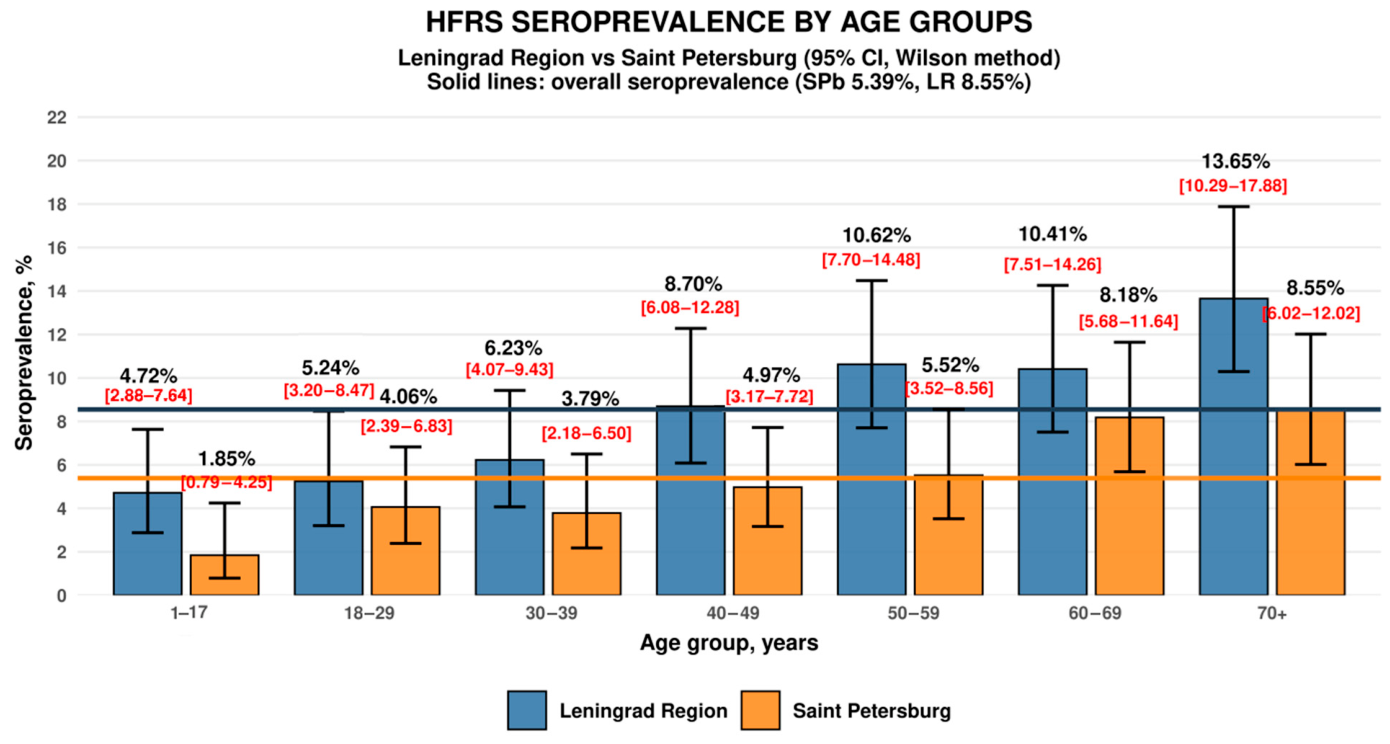
For samples from SPb, hantavirus-specific IgG antibodies were detected in 122 out of 2265 examined volunteers, corresponding to a seroprevalence of 5.39% (95% CI: 4.53–6.39). An age-related increase in the proportion of seropositive individuals was observed, reaching statistical significance (χ2 = 18.89, p < 0.05, df = 6). The lowest seroprevalence was recorded in the 1–17-year age group, with a seroprevalence of 1.85% (95% CI: 0.79–4.25). No statistically significant differences were observed among the pediatric subgroups aged 1–5 years (0/51), 6–11 years (1/123), and 12–17 years (4/96) (p > 0.05, χ2 = 4.52). Therefore, subsequent comparative analyses were performed for the combined pediatric age group “1–17 years”. The highest proportion of seropositive individuals was observed in the age group ≥70 years, reaching 8.55% (95% CI: 6.02–12.02) (Figure 1). Statistical analysis revealed a significant, positive linear association between age and seroprevalence (hantavirus-specific IgG antibodies), as confirmed by Spearman’s rank correlation coefficient (ρ = 0.964), Pearson’s correlation coefficient (r = 0.924), and the coefficient of determination (R2 = 0.854). It is worth noting that the scientific literature reports a trend of increasing morbidity with age among women, a finding corroborated by the results of an epidemiological analysis conducted in SPb [27].
Following age-stratified analysis, sex-related differences in seroprevalence were assessed. Seroprevalence among men reached 7.59% (95% CI: 5.90–9.71), which was 1.8-fold higher than that observed among women, 4.29% (95% CI: 3.38–5.44). Non-overlapping confidence intervals confirmed the significance of these differences (χ2 = 10.84, p < 0.01, df = 1, OR = 1.83) (Table 3).
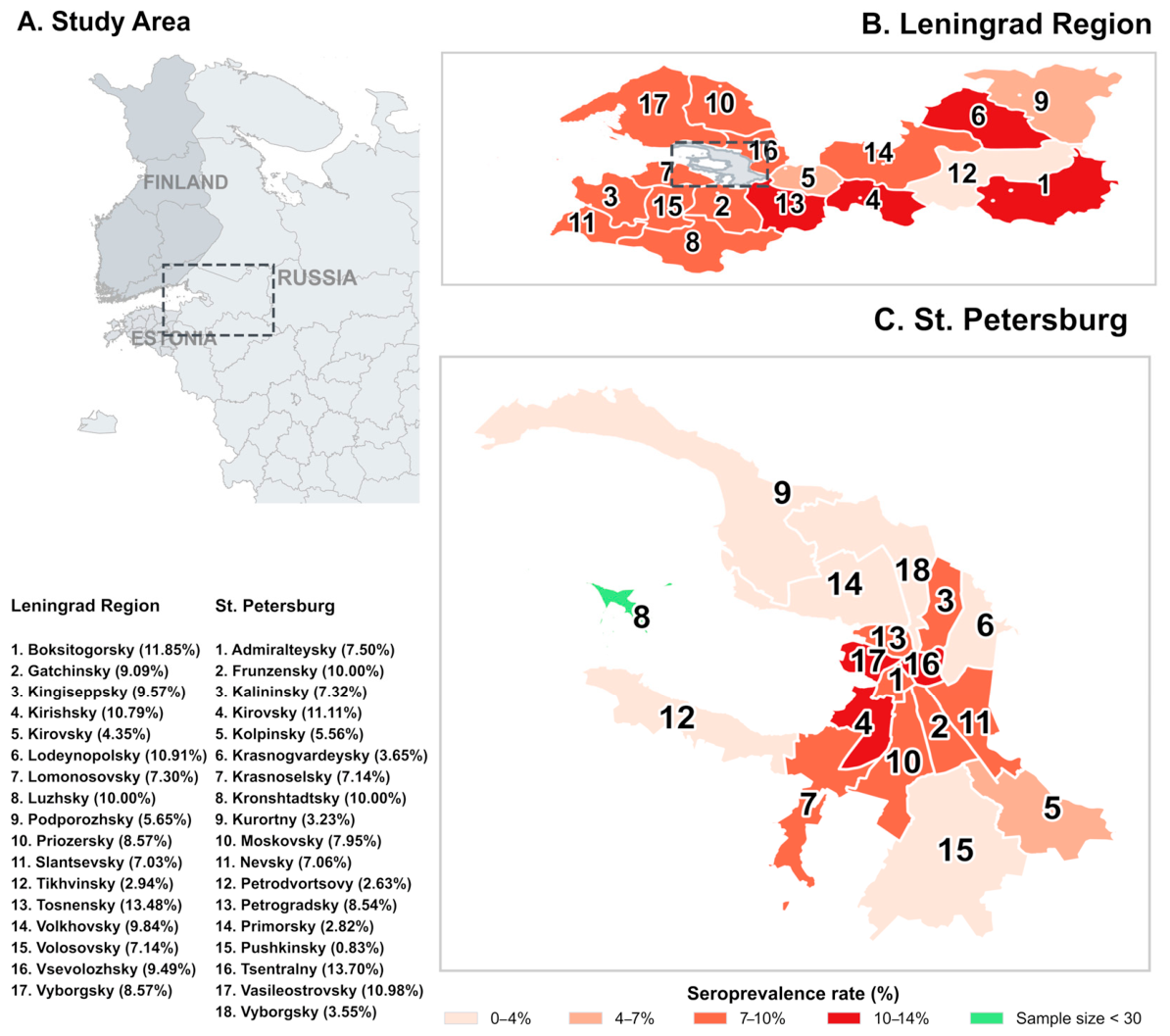
Spatial analysis of seroprevalence across SPb districts (excluding the Kronstadt district) revealed the lowest level in the Pushkinsky district (0.83%, 95% CI: 0.45–2.25) and the highest in the Central district (13.70%, 95% CI: 7.61–23.41) (Table S1, Figure 2). However, no significant differences were detected among districts with the highest seroprevalence levels (χ2 = 0.76, p > 0.05, df = 3).

3.2. Seroprevalence of Hantaviruses in the Population of the Leningrad Region

The LR featured a higher seroprevalence than SPb. Hantavirus-specific IgG antibodies were detected in 188 out of 2199 individuals, corresponding to 8.55% (95% CI: 7.45–9.79). A similar age-related increase in seroprevalence was observed. The lowest value was recorded in the age group 1–17 years (4.72%, 95% CI: 2.88–7.64), while the highest was observed among individuals aged ≥70 years (13.65%, 95% CI: 10.29–17.88) (Figure 1). No significant differences were found among pediatric subgroups aged 1–5 years (3/62), 6–11 years (7/101), and 12–17 years (5/155) (p > 0.05, χ2 = 1.87). Therefore, the pediatric cohort in the LR was also analyzed as a combined age group (1–17 years). Analysis across all age groups revealed significant differences in seroprevalence (χ2 = 21.65, p < 0.01, df = 6). A strong, positive linear relationship between age and seroprevalence was identified, as confirmed by Spearman’s rank correlation coefficient (ρ = 0.964), Pearson’s correlation coefficient (r = 0.976), and the coefficient of determination (R2 = 0.953). Seroprevalence among children did not differ significantly from that observed in the age group of 18–29 years (5.24%, 95% CI: 3.20–8.47) (χ2 = 0.08, p = 0.77, df = 1, OR = 1.12). Across LR districts, seroprevalence ranged from 2.94% (95% CI: 1.96–8.72) in the Tikhvinsky district to 13.48% (95% CI: 8.80–20.09) in the Tosnensky district (Table S2, Figure 2).
Sex-related differences were also observed in the LR. Seroprevalence among men was 11.13% (95% CI: 8.83–13.94), whereas among women, it was 7.62% (95% CI: 6.42–9.01). These differences were significant (χ2 = 6.89, p < 0.05, df = 1, OR = 1.52) (Table 3).

4. Discussion

Our results reflect a discrepancy between the low level of officially registered HFRS incidence and the widespread presence of hantavirus-specific antibodies in the population of the examined regions. A comparison of the two regions revealed that the seroprevalence in the population of SPb is lower than that in the LR: 5.39% and 8.55%, respectively. The odds ratios for residents of the LR compared to SPb are OR = 1.64 (95% CI: 1.29–2.08, p < 0.001). This pattern is expected insofar as the population of the LR, unlike that of SPb, predominantly resides in private suburban houses. Furthermore, the LR has a considerable amount of forested areas; these provide favorable conditions for the natural habitation of rodents. In both SPb and the LR, a consistent age-related increase in seroprevalence was observed, suggesting cumulative exposure to hantaviruses over time. Statistically significant differences between age-related manifestations may be due to children having less contact with natural environments than adults. Adults, particularly those employed in agriculture, are at higher risk of infection due to their professional activities. These may involve regular contact with potential sources of infection, including wild mouse-like rodents, a reservoir of infection. The odds ratio comparing the oldest age group (≥70 years) with the pediatric group (1–17 years) was higher in SPb (OR = 4.94) than in the LR (OR = 3.18). The observed sex-related differences in seroprevalence in both regions may be attributable to differences in occupational and behavioral exposure [5,6]. Data from official registries indicate that hemorrhagic fever with renal syndrome (HFRS) predominantly affects working-age males, specifically those between 30 and 59 years old [28]. Men are more likely to be employed in settings with increased contact with rodents, such as food storage and livestock facilities. They also more frequently engage in outdoor and suburban activities, including fishing and hunting, which may increase the risk of hantavirus exposure.
Despite the relatively low mean annual incidence over the study period (≤1.0 per 100K population), the observed seroprevalence levels in both regions were substantial. These findings are consistent with previously reported serological data from HFRS-endemic Russian regions. For example, seroprevalence levels of 9.3 ± 0.4% were reported in the Tatarstan Republic of Russia during 2012–2021 [24], while values ranging from 7% to 20% were observed in the Bashkortostan Republic of Russia (2019–2020, 2022), and approximately 10% has been reported in the Udmurt Republic of Russia (2019) [25]. In Finland, which reports on of the highest HFRS incidence in Europe, seroprevalence has been shown to reach up to 12.5% according to recent data [26]. Assuming a direct relationship between disease incidence and seroprevalence, a significant correlation between these indicators was identified (Spearman’s ρ = 0.75, p = 0.05). The incidence-to-seroprevalence ratio (averaged across the four regions mentioned above) was calculated (K = 2.11). This coefficient and the local seroprevalence values obtained (SPb, LR) allowed us to extrapolate incidence values of 11.4 and 18.1 cases per 100K population, respectively. Given the limited number of regions included in this analysis (=4), these estimates should be considered preliminary and require confirmation in larger datasets.
The discrepancy between low officially registered incidence and relatively high seroprevalence may also reflect the circulation of mild or subclinical forms of HFRS. These may present without pronounced disease-specific symptoms, and they may be misclassified as other natural focal infections. Considering the evidence for long-lasting post-infectious immunity, it can be hypothesized that a substantial level of accumulated population immunity has developed in SPb and the LR over an extended period [29,30,31]. The presence of mild clinical forms of HFRS, which complicate diagnosis and registration of the disease, may be associated with genetic variants of hantaviruses circulating in the Northwestern Federal District, which requires further study of their genetic diversity [32]. The aforementioned highlights the need for further investigation of hantavirus genetic diversity.

5. Limitations

We acknowledge that additional methodological approaches are required to obtain more accurate results, and we recognize this as an important direction for future research. In the present study, we used a commercially available diagnostic kit. However, the manufacturer’s instructions did not specify the exact antigen used or the hantavirus types targeted by the kit. Furthermore, the distribution of volunteers across residential districts was uneven, as we were unable to recruit an equal number of participants from each district. Nevertheless, we included these data for illustrative and comparative purposes, as we believe that the geographic distribution of seroprevalence may reflect regional differences within SPb and LR and could prove useful for future epidemiological investigations.

Supplementary Materials

The following supporting information can be downloaded at: https://www.mdpi.com/article/10.3390/v18060652/s1, Table S1: Hantavirus seroprevalence by Saint Petersburg district; Table S2: Hantavirus seroprevalence by Leningrad Region district.

Author Contributions

Conceptualization: T.A., V.D., A.T.; Methodology: T.A., V.D., A.T.; Software: D.N., R.B.; Visualization: D.N., R.B.; Data curation: S.E.; Formal Analysis: A.K., M.P., E.K., D.S., K.M., T.G.; Investigation: A.K., M.P., E.K., D.S., K.M., T.G.; Writing—original draft preparation: T.A.; Writing—review and editing: V.D., S.E., A.T.; Supervision: V.D., S.E., A.T.; Project administration: V.D. All authors have read and agreed to the published version of the manuscript.

Funding

This research received no external funding.

Institutional Review Board Statement

The study was conducted according to the guidelines of the Declaration of Helsinki. It was approved by the Ethics Committees of the Saint Petersburg Pasteur Institute (protocol code 86, date of approval 17 August 2023).

Informed Consent Statement

Informed consent was obtained from all subjects involved in the study.

Data Availability Statement

The original contributions presented in this study are included in the article/Supplementary Materials. Further inquiries can be directed to the corresponding author.

Conflicts of Interest

The authors declare no conflicts of interest.

References

  1. Tkachenko, E.; Dzagurova, T.; Galieva, G.; Ivanis, V.; Kurashova, S.; Tkachenko, P.; Balkina, A.; Trankvilevsky, D.; Ishmukhametov, A. Clinical Manifestations of Hemorrhagic Fever with Renal Syndrome, Various Nosologic Forms and Issues of Hantavirus Infections Terminology. Viruses 2025, 17, 578. [Google Scholar] [CrossRef] [PubMed]
  2. Garanina, S.B.; Platonov, A.E.; Zhuravlev, V.I.; Murashkina, A.N.; Yakimenko, V.V.; Korneev, A.G.; Shipulin, G.A. Genetic diversity and geographic distribution of hantaviruses in Russia. Zoonoses Public Health 2009, 56, 297–309. [Google Scholar] [CrossRef]
  3. Milholland, M.T.; Castro-Arellano, I.; Suzán, G.; Garcia-Peña, G.E.; Lee, T.E., Jr.; Rohde, R.E.; Alonso Aguirre, A.; Mills, J.N. Global Diversity and Distribution of Hantaviruses and Their Hosts. Ecohealth 2018, 15, 163–208. [Google Scholar] [CrossRef] [PubMed]
  4. Jonsson, C.B.; Figueiredo, L.T.; Vapalahti, O. A global perspective on hantavirus ecology, epidemiology, and disease. Clin. Microbiol. Rev. 2010, 23, 412–441. [Google Scholar] [CrossRef]
  5. Vapalahti, K.; Paunio, M.; Brummer-Korvenkontio, M.; Vaheri, A.; Vapalahti, O. Puumala Virus Infections in Finland: Increased Occupational Risk for Farmers. Am. J. Epidemiol. 1999, 149, 1142–1151. [Google Scholar] [CrossRef]
  6. Riccò, M.; Peruzzi, S.; Ranzieri, S.; Magnavita, N. Occupational Hantavirus Infections in Agricultural and Forestry Workers: A Systematic Review and Metanalysis. Viruses 2021, 13, 2150. [Google Scholar] [CrossRef]
  7. Yashina, L.N.; Smetannikova, N.A.; Zdanovskaya, N.I.; Poleshchuk, D.N.; Lapin, A.S.; Koval’sky, A.G. New Focus of Hantavirus Seoul in the Far East of Russia. Probl. Part. Danger. Infect. 2024, 3, 170–177. [Google Scholar] [CrossRef]
  8. Lõhmus, M.; Verner-Carlsson, J.; Borg, O.; Albihn, A.; Lundkvist, Å. Hantavirus in new geographic regions, Sweden. Infect. Ecol. Epidemiol. 2016, 6, 31465. [Google Scholar] [CrossRef]
  9. Tomljenovic, M.; Lakoseljac, D.; Knezevic, L.; Batista, M.; Vilibic-Cavlek, T.; Kaic, B.; Hansen, L.; Rode, O.Đ. Spread of Puumala Hantavirus to New Areas in a Large Croatian Outbreak of Hemorrhagic Fever with Renal Syndrome, 2021. Vector Borne Zoonotic Dis. 2024, 24, 773–783. [Google Scholar] [CrossRef]
  10. Jaime, G.M. Zoonoses in a changing world. BioScience 2023, 73, 711–720. [Google Scholar] [CrossRef] [PubMed]
  11. Savitskaya, T.A.; Ivanova, A.V.; Zubova, A.A.; Reshetnikova, I.D.; Isaeva, G.S.; Trifonov, V.A.; Magerramov, S.V.; Martsokha, K.S.; Trankvilevsky, D.V. Hantavirus Infections: Review of the Epidemiological Situation around the World. Analysis of the Epidemiological Situation on Hemorrhagic Fever with Renal Syndrome in the Russian Federation in 2023 and Forecast of Its Development for 2024. Probl. Part. Danger. Infect. 2024, 1, 113–124. [Google Scholar] [CrossRef]
  12. Hantavirus Infection—Annual Epidemiological Report for 2023. Available online: https://www.ecdc.europa.eu/en/publications-data/hantavirus-infection-annual-epidemiological-report-2023 (accessed on 7 March 2025).
  13. Mustonen, J.; Strandin, T.; Tietäväinen, J.; Pörsti, I.; Mäkelä, S.; Vaheri, A. Hantavirus Research in Finland. Viruses 2024, 16, 1591. [Google Scholar] [CrossRef]
  14. Vaheri, A.; Henttonen, H.; Mustonen, J. Hantavirus Research in Finland: Highlights and Perspectives. Viruses 2021, 13, 1452. [Google Scholar] [CrossRef]
  15. Guivier, E.; Galan, M.; Chaval, Y.; Xuéreb, A.; Salvador, R.A.; Poulle, M.L.; Voutilainen, L.; Henttonen, H.; Charbonnel, N.; Cosson, J.F. Landscape genetics highlights the role of bank vole metapopulation dynamics in the epidemiology of Puumala hantavirus. Mol. Ecol. 2011, 20, 3569–3583. [Google Scholar] [CrossRef] [PubMed]
  16. Salukhov, V.V.; Kan, E.A.; Kovalenko, A.N.; Rudakov, Y.V.; Sheloukhin, V.A.; Frolov, D.S.; Surzhikov, P.V. On the problem of orthohantavirus zoonotic infection in the world and in the North-West region of Russia. Treat. Prev. 2020, 10, 48–55. [Google Scholar]
  17. Bereznyak, E.A.; Trishina, A.V.; Pichurina, N.L.; Egiazaryan, L.A.; Simonova, I.R.; Dobrovolsky, O.P.; Liakh, O.V.; Kuznetsov, D.V.; Noskov, A.K. Epizootic and epidemiological situation of hemorrhagic fever with renal syndrome in the Rostov region (2020–2022). Med. Her. South Russ. 2023, 14, 73–81. [Google Scholar] [CrossRef]
  18. Tunik, T.V.; Arbatskaya, E.V.; Lyapunov, A.V.; Khasnatinov, M.A.; Petrova, I.V.; Manzarova, E.L.; Yashina, L.N.; Danchinova, G.A. To hantavirus infection in people and small mammals in baikal area. Acta Biomed. Sci. 2014, 2, 71–76. [Google Scholar]
  19. Vaheri, A.; Henttonen, H.; Voutilainen, L.; Mustonen, J.; Sironen, T.; Vapalahti, O. Hantavirus infections in Europe and their impact on public health. Rev. Med. Virol. 2013, 23, 35–49. [Google Scholar] [CrossRef]
  20. Riabiko, E.; Grechishkina, D.; Baimova, R.; Karmokov, I.; Buts, L.; Khalilov, E.; Lyzenko, I.; Tokarevich, N. Assessment of the Prevalence of Leptospiroses and Hemorrhagic Fever with Renal Syndrome in the Leningrad Region. Probl. Part. Danger. Infect. 2024, 3, 163–169. [Google Scholar] [CrossRef]
  21. Popova, A.; Egorova, S.; Smirnov, V.; Ezhlova, E.; Milichkina, A.; Melnikova, A.; Bashketova, N.; Istorik, O.; Buts, L.; Ramsay, E.; et al. Herd immunity to vaccine preventable infections in Saint Petersburg and the Leningrad Region: Serological status of measles, mumps, and rubella. Russ. J. Infect. Immun. 2024, 14, 1187–1208. [Google Scholar] [CrossRef]
  22. McHugh, M. The chi-square test of independence. Biochem. Med. 2013, 23, 143–149. [Google Scholar] [CrossRef]
  23. Wasserstein, R.; Lazar, N. The ASA Statement on p-Values: Context, Process, and Purpose. Am. Stat. 2016, 70, 129–133. [Google Scholar] [CrossRef]
  24. Savitskaya, T.; Trifonov, V.; Agafonova, E.; Isaeva, G.; Reshetnikova, I.; Petrova, D. Serological monitoring of collective immunity to hemorrhagic fever with renal syndrome in the Republic of Tatarstan and a number of subjects of the Russian Federation. Epidemiol. Infect. Dis. Curr. Issues 2023, 13, 14–19. [Google Scholar] [CrossRef]
  25. Savitskaya, T.; Isaeva, G.; Reshetnikova, I.; Trifonov, V.; Khusainova, R.; Agafonova, E.; Tyurin, Y.; Murzabaeva, R.; Valishin, D. Epidemiological and clinical aspects of hemorrhagic fever with renal syndrome at the present stage. Infect. Dis. News Opin. Train. 2024, 13, 59–67. [Google Scholar] [CrossRef]
  26. Latronico, F.; Mäki, S.; Rissanen, H.; Ollgren, J.; Lyytikäinen, O.; Vapalahti, O.; Sane, J. Population-based seroprevalence of Puumala hantavirus in Finland: Smoking as a risk factor. Epidemiol. Infect. 2018, 146, 367–371. [Google Scholar] [CrossRef]
  27. Nechaev, V.; Yarovaya, I.; Gorbunova, I.; Meo, O.; Fedunjk, I.; Chmir, A.; Litvinova, N.; Chinzeria, I.; Chunaeva, N. Epidemiological, ecological and clinico-laboratory characteristics of hemorrhagic fever with renal syndrome in Saint Petersburg and suburb. J. Infectology 2021, 13, 126–134. [Google Scholar] [CrossRef]
  28. State Report—On the State of Sanitary and Epidemiological Well-Being of the Population of the Russian Federation in 2024. Available online: https://rospotrebnadzor.ru/upload/iblock/b8a/u6lsxjabw032jkdf837nlaezxu3ue09m/GD_SEB.pdf (accessed on 1 June 2025).
  29. Shakirova, V.; Khaertynova, I.; Khaertynov, K.S. Monitoring the activity of antibodies to hantavirus in patients with hemorrhagic fever with renal syndrome. Kazan. Med. J. 2012, 9, 221–225. [Google Scholar] [CrossRef]
  30. Zheng, Y.; Wei, J.; Zhou, B.; Xu, Y.; Dong, J.; Guan, L.; Ma, P.; Yu, P.; Wang, J. Long-term persistence of anti-hantavirus antibodies in sera of patients undergoing hemorrhagic fever with renal syndrome and subjects vaccinated against the disease. Infect. Dis. 2016, 48, 262–266. [Google Scholar] [CrossRef] [PubMed]
  31. Latus, J.; Schwab, M.; Tacconelli, E.; Pieper, F.; Wegener, D.; Dippon, J.; Müller, S.; Zakim, D.; Segerer, S.; Kitterer, D.; et al. Clinical course and long-term outcome of hantavirus-associated nephropathia epidemica, Germany. Emerg. Infect. Dis. 2015, 21, 76–83. [Google Scholar] [CrossRef] [PubMed]
  32. Ivanov, D.; Timchenko, V.; Pavlova, E.; Pavlova, N.; Nazarova, A.; Chernova, T.; Savenkova, N.; Revnova, M.; Grafskaya, I.; Ya-kovleva, T.; et al. Hemorrhagic fever with renal syndrome in a child early age. J. Infectology 2020, 12, 152–158. [Google Scholar] [CrossRef]
Figure 1. Hantavirus seroprevalence by age group within the overall study region. Vertical black lines are confidence intervals. Solid horizontal lines represent overall regional seroprevalence values: 5.39% (95% CI: 4.53–6.39) for St. Petersburg and 8.55% (95% CI: 7.45–9.75) for the LR.
Viruses 18 00652 g001
Figure 2. Hantavirus seroprevalence by district. Panel (A) shows study area. Panel (B) shows the Leningrad Region. Panel (C) shows Saint Petersburg.
Viruses 18 00652 g002
Table 1. Age structure of the volunteer cohort.
Age Group, YearsNumber of Volunteers ExaminedTotal
Saint PetersburgLeningrad Region
1–17270318588 (13.17%)
subgroup1–55162113 (19.21%)
6–11123101224 (38.10%)
12–1796155251 (42.69%)
18–29320286606 (13.58%)
30–39317321638 (14.29%)
40–49362322684 (15.32%)
50–59326320646 (14.47%)
60–69330317647(14.49%)
≥70340315655 (14.67%)
Total226521994464 (100.00%)
Table 2. Summary of HFRS incidence and hantavirus seroprevalence data from recent studies in endemic regions. Data from publicly available sources over a multi-year period (2014–2023) are shown. The values listed were used for correlation analysis.
State/RegionMean HFRS Incidence (Annual)Seroprevalence, %
Finland23.8512.50
Kostromsky Region14.7710.00
Bashkortostan Republic35.2613.00
Tatarstan Republic18.629.30
Udmurt Republic56.8510.00
Table 3. Gender distribution of hantavirus seropositivity.
RegionResultsMaleFemale
Saint PetersburgIgG positive/total tested57/75165/1514
Seroprevalence, % (95% CI)7.59 (5.90–9.71)4.29 (3.38–5.44)
Leningrad RegionIgG positive/total tested65/584123/1615
Seroprevalence, % (95% CI)11.13 (8.83–13.94)7.62 (6.42–9.01)
TotalIgG positive/total tested122/1335188/3129
Seroprevalence, % (95% CI)9.14 (7.71–10.80)6.01 (5.23–6.90)
Disclaimer/Publisher’s Note: The statements, opinions and data contained in all publications are solely those of the individual author(s) and contributor(s) and not of MDPI and/or the editor(s). MDPI and/or the editor(s) disclaim responsibility for any injury to people or property resulting from any ideas, methods, instructions or products referred to in the content.