1. Introduction
Highly pathogenic avian influenza A viruses, particularly the H5 and H7 subtypes, continue to circulate and evolve rapidly in poultry, enabling efficient transmission through respiratory secretions and aerosolized particles and posing persistent threats to animal health, poultry production, and public health [
1,
2]. The emergence of human H7N9 infections since 2013 has further highlighted that avian epidemic strains not only cause substantial losses in the poultry industry but can also cross the species barrier and result in severe human disease [
3,
4,
5]. Accordingly, reducing infection establishment and viral shedding at the poultry level represents an important upstream intervention that may benefit both animal and public health.
Current influenza vaccines, particularly conventional intramuscular inactivated or subunit vaccines, are generally effective at inducing systemic IgG and hemagglutination inhibition (HI)-associated antibody responses, and HI has long been used as an established correlate of protection [
6]. However, such responses do not necessarily indicate the establishment of an adequate secretory IgA barrier or local mucosal immune memory at the respiratory mucosa, which is the primary portal of infection. In addition, mucosal and peripheral immune responses show a certain degree of compartmentalization, meaning that serum readouts cannot simply substitute for local mucosal immunity [
7]. By contrast, mucosal vaccination has the potential to induce secretory antibodies and tissue-resident T-cell responses at the site of pathogen entry, thereby blocking infection at an early stage and more closely aligning with the goal of reducing viral shedding and transmission [
8].
In practice, however, the development of mucosal subunit vaccines remains challenging because protein antigens are often weakly immunogenic and must overcome multiple barriers, including limited mucosal uptake and an immunoregulatory local microenvironment [
9]. Therefore, optimization of delivery strategies and establishment of more informative immune evaluation systems are particularly important for mucosal influenza vaccine development. Previous studies have shown that intranasal boosting with unadjuvanted HA protein can significantly enhance local respiratory immunity in mice and that nasal IgA levels are negatively associated with upper respiratory viral burden [
10]. These findings support a close relationship between mucosal IgA, viral shedding duration, and infection risk. Accordingly, for next-generation influenza vaccines intended to address both protection and transmission interruption, respiratory mucosal delivery strategies, including nasal administration and aerosol inhalation, together with combined evaluation of systemic and local immune readouts, are becoming increasingly important [
11,
12].
In the present study, full-length H7 hemagglutinin was expressed in the glycoengineered
Pichia pastoris X33-7 strain, and an antigen candidate, designated X33CLS-H7, was prepared in the form of clarified cell-lysate supernatant (CLS). This platform offers practical advantages for industrial production, including high-density fermentation, a relatively simple process, and lower manufacturing cost, while glycoengineering may help mitigate the potential impact of yeast-type high-mannose glycans on antigen conformation and consistency [
13]. Previous studies have shown that full-length HA7 expressed in glycoengineered
Pichia can undergo complex glycosylation, self-assemble into nanoparticle structures, induce HI activity, and confer protection in mice, thus providing a rationale for both the expression platform and antigen design used here [
14]. On this basis, we systematically compared intramuscular immunization with respiratory mucosal delivery, including nebulized inhalation and intranasal instillation, in mice and evaluated their effects on serum IgG, serum IgA, HI activity, and bronchoalveolar lavage fluid (BALF) IgG and IgA responses. Overall tolerability was also assessed to provide experimental evidence for further optimization of H7 mucosal subunit vaccines aimed at reducing viral shedding and transmission.
2. Materials and Methods
2.1. Glycoengineered Yeast Strain and Reagents
The
HA gene from A/Anhui/1/2013 (H7N9) was codon-optimized for yeast expression, cloned into the pPICZαA vector, and transformed into the glycoengineered
Pichia pastoris X33-7 strain [
15]. The HA construct retained its native transmembrane domain to facilitate membrane anchoring and help preserve relevant conformational and antigenic features.
The main materials and reagents used in this study were as follows. For yeast culture, yeast extract, agar, and peptone were purchased from OXOID (Basingstoke, UK), and NaCl was obtained from Sinopharm (Shanghai, China). Zeocin was purchased from Thermo Fisher Scientific (Waltham, MA, USA). Complete Freund’s adjuvant (CFA) and incomplete Freund’s adjuvant (IFA) were obtained from MedChemExpress LLC (Shanghai, China). AS03, an oil-in-water emulsion containing squalene and α-tocopherol, was used as an adjuvant. HRP-conjugated goat anti-mouse IgG and IgA were purchased from Abcam (Cambridge, UK). The anti-H7N9 hemagglutinin (HA) antibody and HRP-conjugated goat anti-rabbit IgG were obtained from Beijing Yiqiao Shenzhou Tech (Beijing, China).
2.2. Shake-Flask Induction and Preparation of X33CLS-H7 Antigen
Positive clones were first cultured in shake flasks containing YPD broth supplemented with 1 μg/mL Zeocin to expand biomass. The cultures were then diluted 1:20 (v/v) into buffered glycerol-complex medium (BMGY) for further cell growth. When the cultures reached the desired cell density, the cells were transferred to a methanol induction medium derived from BMGY and incubated at 25 °C with shaking for 48 h. To maintain induction, methanol was added every 24 h to a final concentration of 1% (v/v), for a total of two feeds.
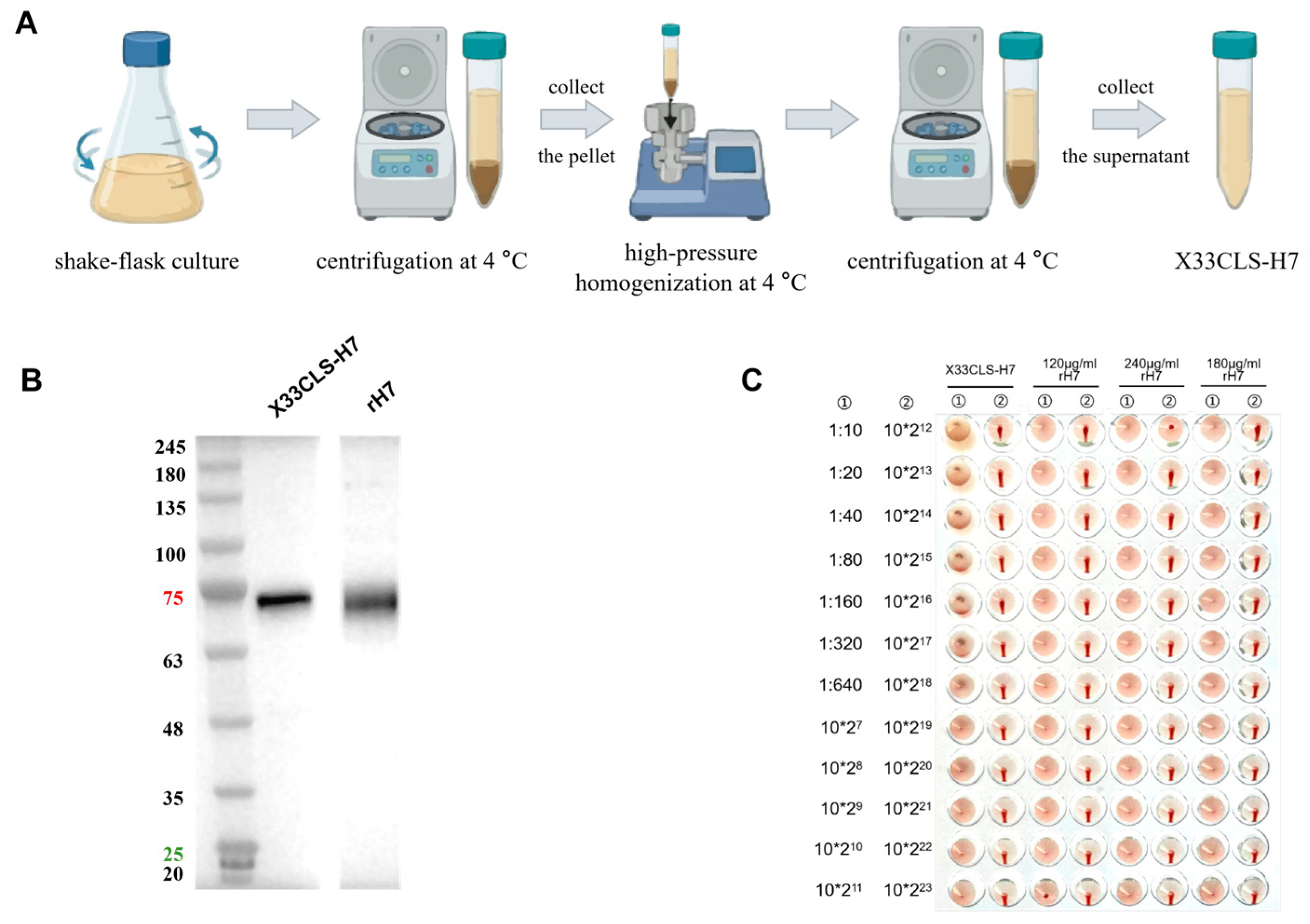
After induction, the cells were harvested by centrifugation (8500× g, 20 min, 4 °C) and resuspended in 5 mM EDTA at a volume equivalent to 20% of the original culture volume. The cells were lysed by high-pressure homogenization at >750 bar for three passes at 4 °C. The lysate was clarified by centrifugation (8500× g, 20 min, 4 °C), and the resulting supernatant was collected as the antigen stock and designated X33CLS-H7.
X33CLS-H7 was intentionally prepared as a clarified cell-lysate supernatant rather than as a purified recombinant HA preparation. Accordingly, the preparation may contain residual yeast-derived components in addition to the target HA7 antigen. All procedures were performed on ice to minimize proteolytic degradation. The antigen preparation was aliquoted and stored at −80 °C until use.
2.3. X33CLS-H7 Antigen Characterization and HA Activity
The hemagglutination activity of X33CLS-H7 was determined using a red blood cell (RBC) agglutination assay. Briefly, samples were subjected to two-fold serial dilutions starting at 1:10 in V-bottom 96-well plates. An equal volume of 1% chicken RBC suspension was added to each well, gently mixed, and incubated at room temperature for 30 min. The highest dilution that showed complete hemagglutination was recorded as the hemagglutination titer, expressed as hemagglutination units (HAU).
In the present study, HAU was used primarily as a functional normalization metric for batch comparison and dose matching rather than as a direct biochemical quantification of absolute HA protein concentration. Therefore, the reported X33CLS-H7 doses should be interpreted as estimated HA-equivalent inputs rather than as absolute purified HA mass.
Western blotting was performed to qualitatively verify antigen expression using anti-H7N9 HA antibodies. A specific band at the expected molecular weight of approximately 75 kDa was detected, confirming the presence of the target HA7 in the X33CLS-H7 preparation.
2.4. Experimental Design and Immunization Regimens
Female BALB/c mice (6–8 weeks old, specific pathogen-free [SPF]) were purchased from Beijing Vital River Laboratory Animal Technology Co., Ltd. (Beijing, China) and housed under SPF barrier conditions. All animal procedures were approved by the Institutional Animal Care and Use Committee (IACUC; approval no. IACUC-2024-042).
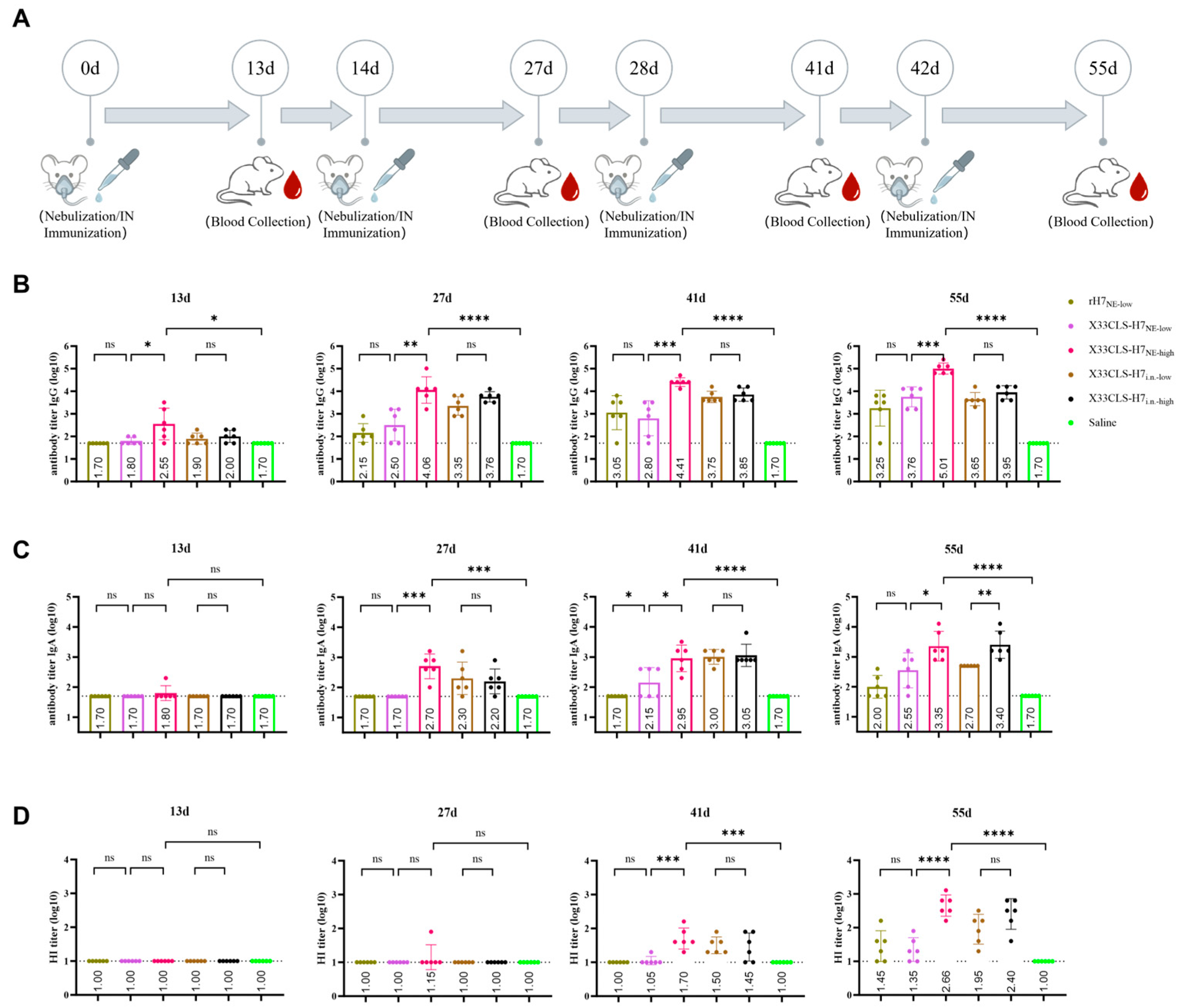
To evaluate the effects of different delivery routes on immune responses, mice were randomly assigned to the following groups (
n = 6 per group): X33CLS-H7
i.m. (intramuscular administration, two doses on days 0 and 14); X33CLS-H7
NE-high (high-dose nebulized inhalation, four doses on days 0, 14, 28, and 42); X33CLS-H7
NE-low (low-dose nebulized inhalation, four doses); rH7
NE-low (low-dose nebulized inhalation of purified rH7, four doses, with purified rH7 administered at an estimated HA-equivalent input matched to that of the X33CLS-H7
NE-low group); X33CLS-H7
i.n.-high (high-dose intranasal instillation, four doses); X33CLS-H7
i.n.-low (low-dose intranasal instillation, four doses); an intramuscular host-strain lysate control group (Control); and a nebulized saline control group (Saline). The vaccine dose and administration volume for each group are summarized in
Table 1.
For nebulized immunization, the stated dose refers to the amount loaded into the nebulizer system rather than a directly measured deposited respiratory dose. A higher nominal loading was used for nebulization because only a fraction of the aerosolized formulation is expected to be effectively inhaled and deposited in the respiratory tract owing to device dead volume, chamber retention, aerosol dispersion, and exhalation. For intranasal instillation, the high- and low-dose regimens were generated by administering different total volumes from the same antigen stock preparation. Thus, in the present design, dose and volume effects were not fully separable for the intranasal groups.
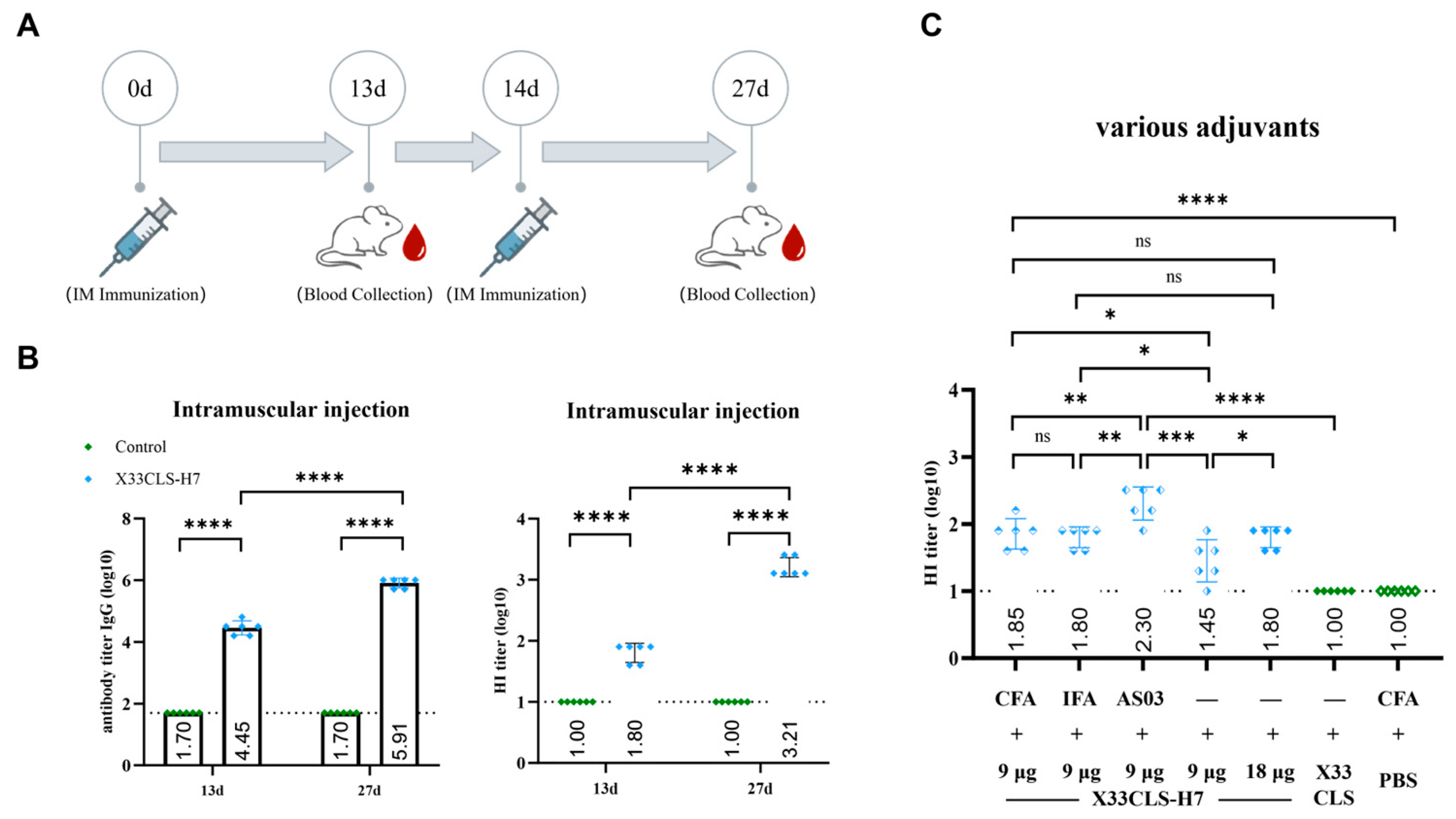
To assess the effects of different adjuvants under a single-dose intramuscular regimen, X33CLS-H7 was mixed 1:1 (
v/
v) with CFA, IFA, or AS03 and administered intramuscularly once. Because 1:1 mixing reduced the antigen dose by half, a 9 μg intramuscular no-adjuvant group was included as a dose-matched antigen control, while the 18 μg intramuscular group was included as a reference. In addition, a CFA-only control group without X33CLS-H7 was included to monitor adjuvant-associated background effects, because CFA was considered the most reactogenic adjuvant among those tested. Adjuvant-only controls were not established for every adjuvant in the present design. A concise summary of the experimental groups, immunization regimens, and principal evaluation readouts is provided in
Table 2.
Before immunization, the mice were acclimated and monitored to ensure good health status. For intramuscular injection, formulations were administered into the thigh muscle of the hind limb using a 0.5 mL syringe, and each injection was completed within approximately 10 s to minimize stress. Nebulized immunization was performed using a small-animal nebulizer (YLS-8B08; Beijing Yingze Tonghui Biotechnology, Beijing, China) set to level 2. Each mouse was placed individually in the chamber, and aerosolization was maintained for approximately 10 min per dose. For intranasal immunization, the indicated volume of antigen preparation was administered dropwise into the nostrils to allow spontaneous inhalation.
2.5. Hemagglutination Inhibition (HI) Assay
HI assays were performed according to the World Health Organization (WHO)-recommended microtiter protocol. Serum samples were treated with receptor-destroying enzyme (RDE) by mixing the serum with RDE at a 1:3 (v/v) ratio, followed by incubation at 37 °C overnight (16–18 h). The samples were then heat-inactivated at 56 °C for 30 min to inactivate complement.
Treated sera were subjected to two-fold serial dilutions starting at 1:10 in V-bottom 96-well plates. The diluted sera were then mixed with an equal volume of standardized antigen containing 4 HAU of HA7, incubated, and subsequently combined with 1% chicken erythrocytes. HA7 was a purified glycoengineered yeast-derived rH7 antigen derived from the same HA7 sequence as X33CLS-H7, namely A/Anhui/1/2013 (H7N9), and was used here as the standardized HI antigen.
The HI endpoint titer for each sample was defined as the highest serum dilution that completely inhibited hemagglutination. Individual HI endpoint titers were determined by conventional two-fold serial dilution, whereas group-level data are presented as geometric mean reciprocal titers (GMTs) calculated from the individual endpoint values. An HI titer of ≥1:40 was used as a reference threshold indicative of substantial hemagglutination-inhibiting antibody activity, consistent with previous reports [
16]. HI GMTs and corresponding 95% confidence intervals were calculated from log10-transformed individual HI endpoint titers and then back-transformed to the reciprocal titer scale. Samples with HI titers below the lower limit of detection were assigned a reciprocal titer of 10 for calculation.
2.6. ELISA for HA7-Specific IgG and IgA in Serum and BALF
High-binding ELISA plates (3590, Corning, NY, USA) were coated overnight at 4 °C with purified rH7 (2 μg/mL) in carbonate coating buffer (50 mmol/L, pH 9.6). Purified rH7 was prepared in our laboratory based on the same HA7 sequence as X33CLS-H7 (A/Anhui/1/2013 [H7N9]). This coating strategy was intended to facilitate detection of HA7-specific antibody binding while minimizing direct reactivity to residual components in the clarified lysate preparation. Purified rH7 therefore served as a standardized HA7-specific coating antigen in the ELISA. The plates were washed three times with PBST (PBS containing 0.05% Tween-20) and then blocked with 5% (w/v) non-fat milk in PBST for 1 h at 37 °C. To further reduce potential background reactivity to yeast-derived components, mouse serum samples were preincubated with X33 yeast lysate at 4 °C for 30 min before dilution. The samples were then serially diluted starting at 1:50, added to the plates, and incubated for 1 h at 37 °C. After three washes, HRP-conjugated goat anti-mouse IgG (1:5000) was added and incubated for 1 h at 37 °C. The plates were washed, developed with a one-component TMB substrate (PR1200, Solarbio, Beijing, China) for 4 min, stopped with 2 M H2SO4, and the absorbance at 450 nm was measured using a SpectraMax iD3 multimode microplate reader (Molecular Devices, Shanghai, China). The ELISA endpoint titer was defined as the highest reciprocal dilution yielding an OD450 value exceeding 2.1 × blank. Samples with titers below the starting dilution were assigned the reciprocal value of the starting dilution (1:50) for plotting and statistical analysis; accordingly, these samples appear as log10(50) = 1.70 in the graphs.
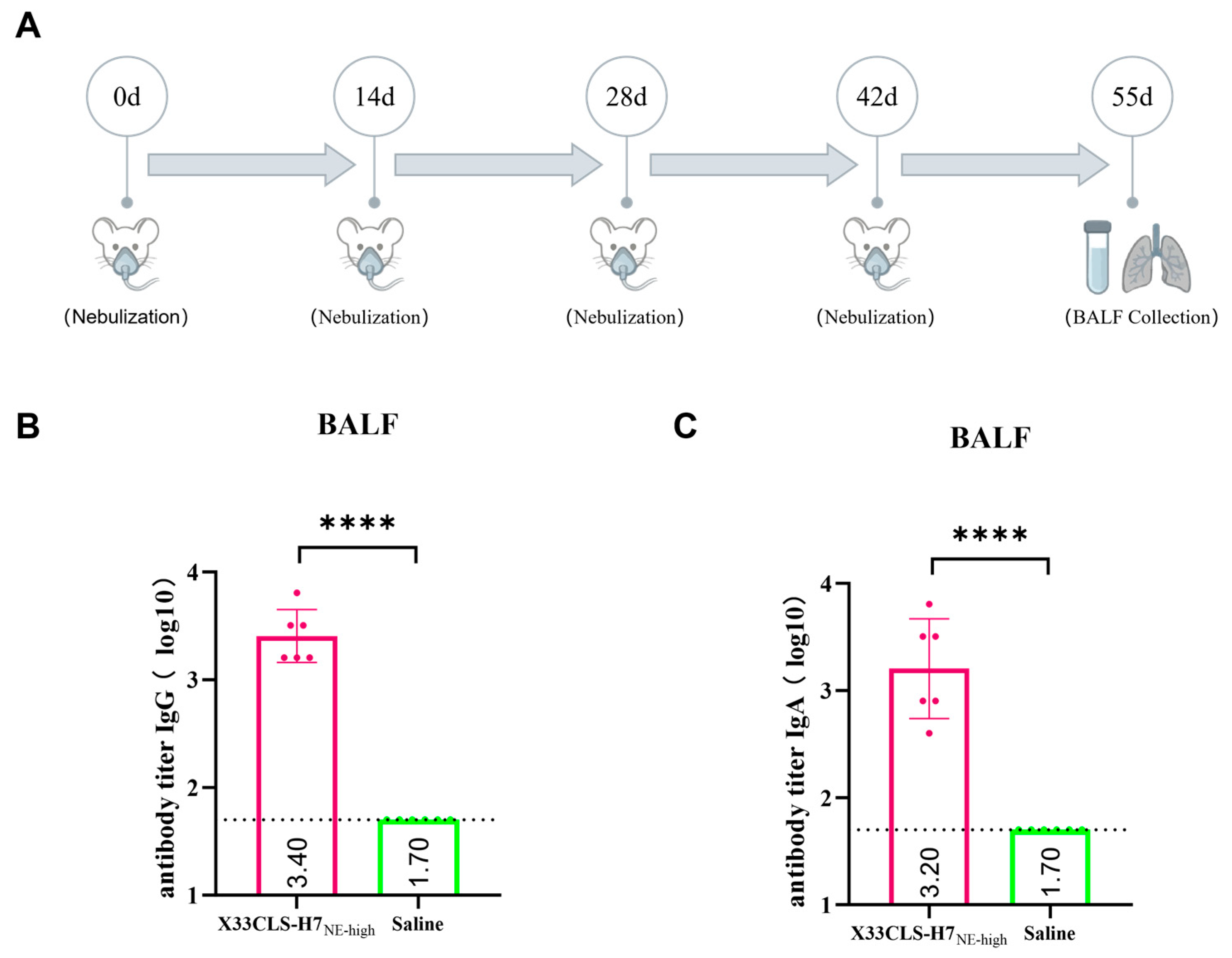
For IgA detection, the same procedure was followed except that HRP-conjugated goat anti-mouse IgA was used. In addition to serum antibody detection, bronchoalveolar lavage fluid (BALF) collected from the X33CLS-H7NE-high group and the saline control group two weeks after the final immunization was also analyzed for HA7-specific IgG and IgA. BALF analysis was restricted to the high-dose nebulized group because evaluation of lower-airway antibody induction under aerosol delivery was prioritized in the present study.
2.7. Pseudovirus Neutralization Assay
Neutralizing antibody activity against H7N9 was evaluated using an HIV-1-based H7N9 pseudovirus neutralization assay. Briefly, Influenza A H7N9 (A/Anhui/1/2013) pseudovirus (PSVD33; Sino Biological, Beijing, China), carrying a luciferase reporter gene, was activated with TPCK-treated trypsin at a concentration of 100 μg/mL and incubated at 37 °C for 1 h before use. Serum samples were heat-inactivated and serially diluted. Equal volumes of diluted sera and pseudovirus were mixed and incubated at 37 °C for 1 h to allow antibody–pseudovirus interaction.
The serum–pseudovirus mixtures were then added to 293T cells seeded in 96-well plates, with 50 μL pseudovirus used per well. After incubation at 37 °C for 48 h, luciferase activity was measured using a SpectraMax iD3 multimode microplate reader (Molecular Devices, Shanghai, China) to determine pseudovirus infection. Neutralization titers were expressed as the 50% neutralization titer (NT50), defined as the reciprocal serum dilution that reduced the luciferase signal by 50% relative to the virus-only control. NT50 values were log10-transformed for statistical analysis and graphical presentation.
2.8. Body Weight Monitoring and Post-Immunization Observations
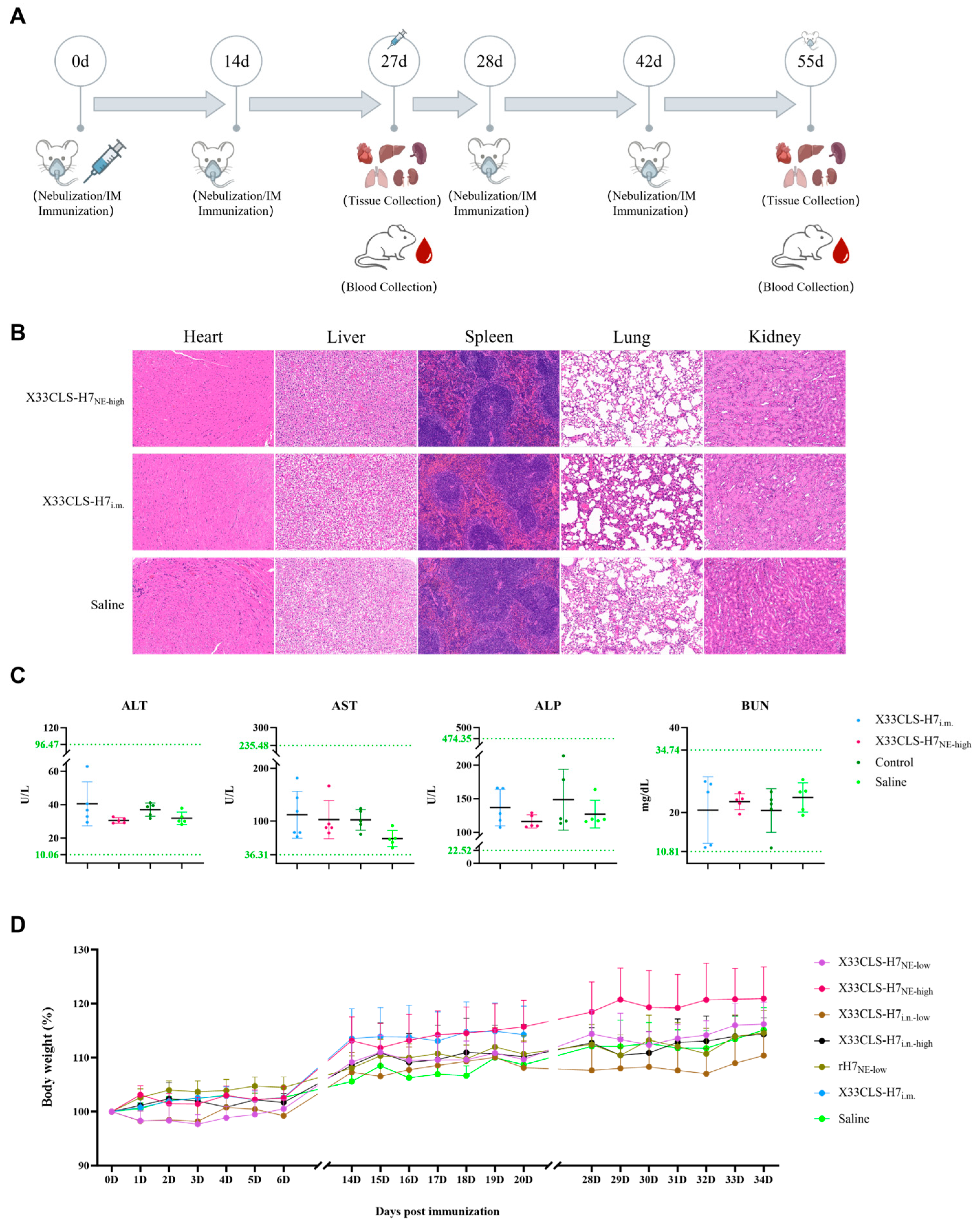
All mice were monitored daily for general health status and adverse events. Body weight was recorded longitudinally from baseline, and the percentage change from baseline was calculated to identify potential toxicity signals, such as weight loss or growth retardation, associated with the different formulations or delivery routes. Post-immunization observations included coat condition, activity level (e.g., lethargy or reduced activity), respiratory signs (e.g., nasal discharge, with particular attention to the NE and i.n. groups), and injection-site reactions in the i.m. groups (e.g., erythema, swelling, and induration). All abnormal findings were recorded with their corresponding time points.
2.9. Histopathology
To evaluate the potential local tissue effects of mucosal immunization, such as airway inflammation or injury, as well as the systemic effects of intramuscular immunization, mice in the X33CLS-H7i.m., X33CLS-H7NE-high, and saline control groups were euthanized two weeks after the final immunization for histopathological examination. The heart, liver, spleen, lung, and kidney were collected, fixed in 4% paraformaldehyde, and processed for hematoxylin and eosin (H&E) staining by a commercial service provider (Servicebio, Wuhan, China).
2.10. Serum Biochemistry
Two weeks after the final immunization, blood samples were collected from mice in the X33CLS-H7i.m., X33CLS-H7NE-high, and saline control groups for serum biochemistry analysis. Liver-associated markers, including AST, ALT, and ALP, as well as the renal marker BUN, were quantified using an automated biochemical analyzer to assess potential systemic toxicity and organ stress. The measured values were compared with those of the control mice.
2.11. Statistical Analysis
GraphPad Prism 10.1.2 (GraphPad Software, Boston, MA, USA) was used for data visualization and statistical analysis. Paired t-tests were used for within-group comparisons across different time points, and unpaired t-tests were used for between-group comparisons, as appropriate. Statistical significance was defined as follows: ns, p ≥ 0.05; * p < 0.05; ** p < 0.01; *** p < 0.001; and **** p < 0.0001. Data are presented as the mean ± standard deviation (SD).
4. Discussion
Establishing efficient immune protection against respiratory pathogens such as influenza A virus remains a major challenge in both veterinary and public health settings [
17]. In this present study, X33CLS-H7, a clarified cell-lysate supernatant prepared from glycoengineered
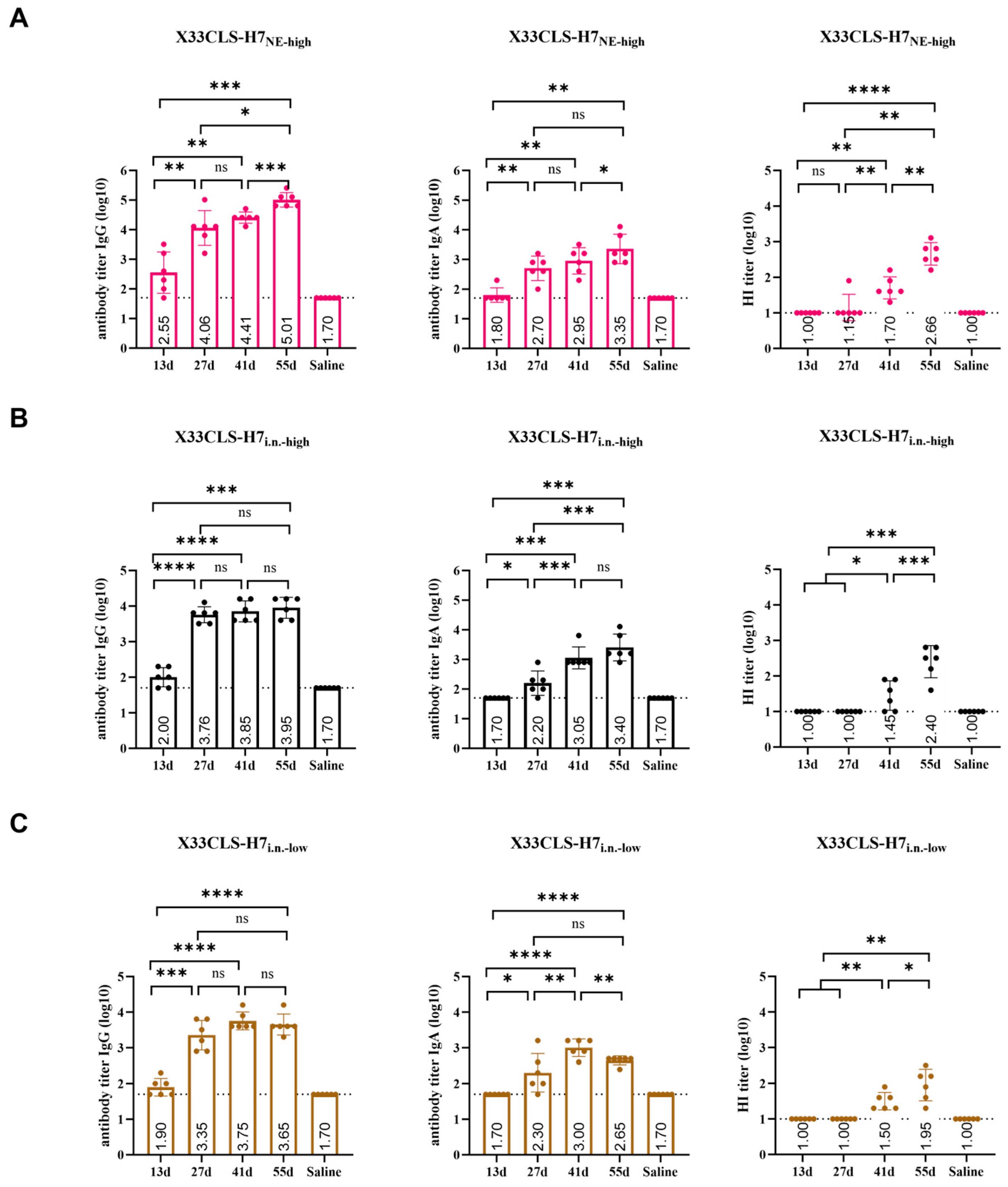
P. pastoris, retained H7-associated antigenicity and hemagglutination activity despite not being purified into a single recombinant HA protein. This was supported by Western blot detection of the target HA7 band and by measurable hemagglutination activity. Functionally, X33CLS-H7 induced antibody responses through multiple routes of administration. Two intramuscular immunizations rapidly elicited the strongest systemic responses, including high levels of serum HA7-specific IgG, robust HI activity, and detectable pseudovirus neutralizing antibodies. In contrast, respiratory mucosal delivery showed more route- and dose-dependent characteristics. The high-dose nebulized regimen induced the strongest systemic antibody profile among the respiratory delivery groups and generated detectable HA7-specific IgG and IgA responses in BALF, whereas intranasal instillation also induced serum IgG, IgA, and HI responses, although at lower overall magnitudes than high-dose nebulization. In parallel, body-weight monitoring, histopathology examination, and serum biochemistry analysis did not reveal overt local or systemic toxicity signals under the experimental conditions tested.
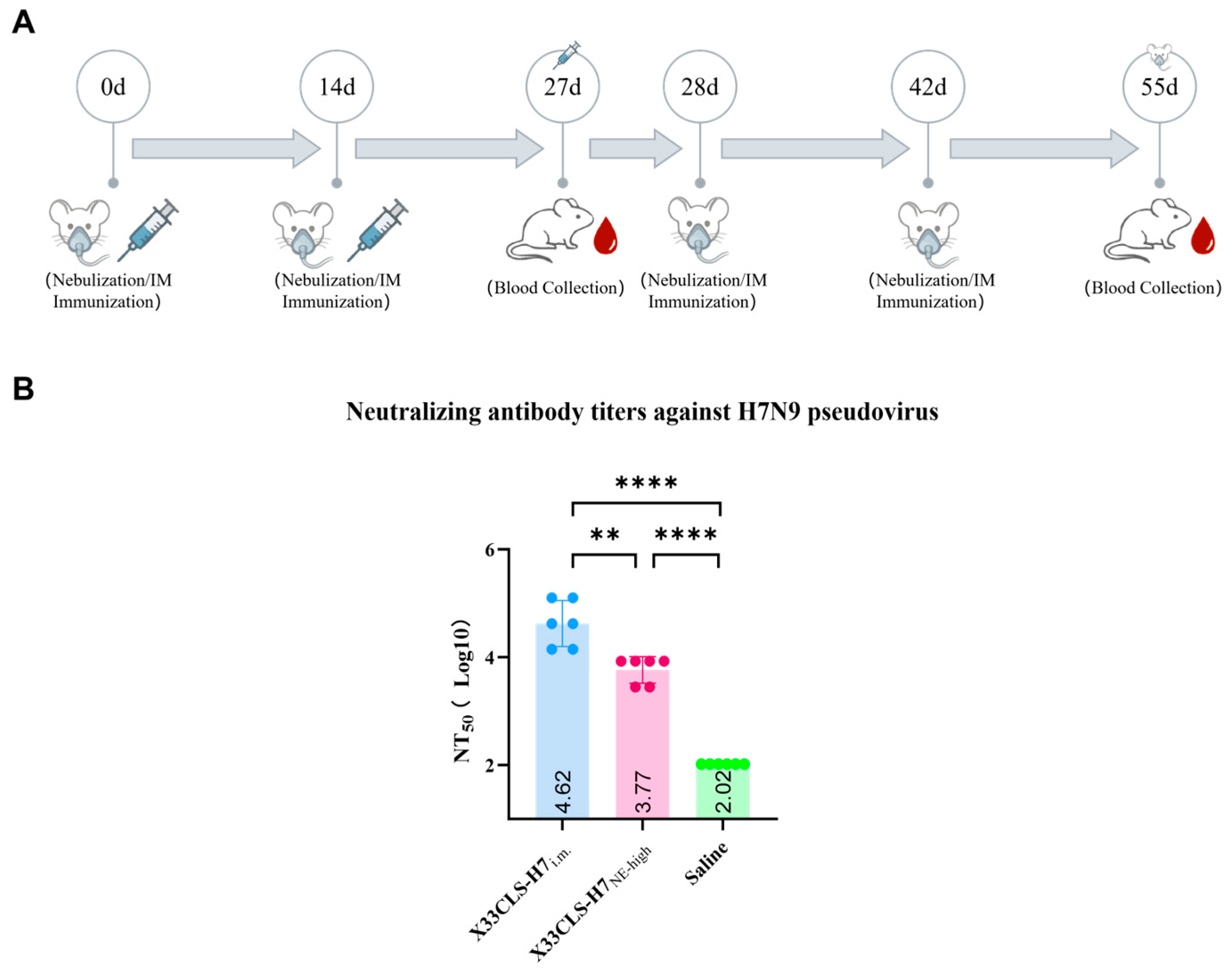
The H7N9 pseudovirus neutralization assay extends the chain of evidence from antibody binding and hemagglutination inhibition to a functional readout of viral entry inhibition. The intramuscular X33CLS-H7 group showed the highest log10 NT
50 value, while the high-dose nebulized group, although lower than the intramuscular group, still exhibited a significantly higher NT
50 value than the saline control group. These results indicate that antibodies induced by X33CLS-H7 were not limited to HA recognition or inhibition of hemagglutination, but were also capable of interfering with H7N9 pseudovirus entry into target cells. Importantly, HI activity and pseudovirus neutralization should not be interpreted as identical endpoints. HI primarily reflects antibody-mediated blockade of HA-receptor binding, whereas pseudovirus neutralization captures a broader functional outcome related to inhibition of viral entry. Previous H7N9 pseudovirus studies have shown that pseudovirus-based neutralization assays correlate with HI and live-virus microneutralization assays, supporting their use as practical functional serological endpoints for H7N9 vaccine evaluation [
18]. Nevertheless, because the intramuscular and high-dose nebulized groups differed in both immunization procedure and sampling schedule, the higher NT
50 value observed after intramuscular immunization should not be overinterpreted as definitive superiority of this route. Rather, the data suggest that both systemic injection and respiratory nebulization can induce functional antibody responses, with intramuscular administration being more efficient in generating serum neutralizing activity under the present experimental conditions.
A major finding of this study is that respiratory mucosal delivery induced not only systemic antibody responses but also detectable lower-airway IgA, particularly after high-dose nebulization. This observation is consistent with the established concept that mucosal immunization is well suited to generate local immune responses at the site of pathogen entry [
8]. Such responses are especially relevant for influenza control, because immunity at the respiratory mucosa may contribute more directly to limiting infection establishment and viral shedding than serum antibody responses alone. Human influenza challenge studies have shown that pre-existing nasal IgA is associated with reduced duration of viral shedding, and that mucosal and systemic immune responses can be partially compartmentalized [
19]. Similarly, studies using intramuscular inactivated influenza vaccines have indicated that strong systemic antibody responses do not necessarily translate into equally robust mucosal immunity [
20]. In this context, the stronger serum neutralization induced by intramuscular X33CLS-H7 and the detectable BALF IgG and IgA induced by high-dose nebulized X33CLS-H7 should be interpreted as evidence of route-dependent immune spatial organization rather than as mutually conflicting outcomes.
From a production perspective, X33CLS-H7 also has practical advantages. Conventional inactivated avian influenza vaccines require propagation and handling of live virus under appropriate containment conditions and are relatively labor- and cost-intensive to manufacture and administer [
21]. By contrast,
P. pastoris is a well-established recombinant protein expression platform with advantages in high-density fermentation, scalability, and process adaptability [
13]. Glycoengineering further improves its suitability for producing glycoprotein vaccine antigens by enabling more mammalian-like N-glycosylation patterns, which may favor structural stability and epitope presentation [
22]. Together with previous evidence showing that H7 expressed in glycoengineered
P. pastoris can preserve relevant epitopes and protect mice against H7N9 challenge [
14], our results support the possibility that a simplified clarified-lysate format can retain biologically relevant HA-associated immunogenicity while reducing downstream manufacturing complexity. The comparable endpoint IgG, IgA, and HI responses induced by purified rH7 and X33CLS-H7 under matched low-dose nebulized conditions further suggest that the CLS format did not compromise antigenicity under the tested conditions. Therefore, the primary value of X33CLS-H7 may lie not necessarily in achieving the highest serum antibody magnitude, but in its manufacturing simplicity, potential cost efficiency, and compatibility with respiratory mucosal delivery strategies.
However, the clarified lysate format also introduces important interpretive limitations. X33CLS-H7 was evaluated as a clarified cell-lysate antigen preparation rather than as purified HA, and residual yeast-derived components may have contributed to immunostimulation. Although the assay design and comparator analyses support predominantly HA7-directed immunogenicity, the specific contribution of host-derived components was not fully dissected in the present study. Future studies should therefore include direct comparisons among purified rH7, X33CLS-H7, and host-component-depleted preparations, together with batch-to-batch consistency testing and detailed characterization of residual yeast-derived components. These experiments will be essential for distinguishing the contribution of the H7 antigen itself from potential innate immune stimulation associated with the CLS matrix.
Several additional limitations should be acknowledged. First, this study was conducted in mice rather than in target avian species. Although the mouse model is useful for preliminary immunogenicity and safety evaluation, chickens and ducks are more relevant hosts for assessing the translational potential of avian influenza vaccine candidates. Second, although pseudovirus neutralization was included in the present study, the current dataset does not include live-virus microneutralization, challenge protection, viral shedding, or transmission outcomes, all of which are important endpoints for functional and translational evaluation of veterinary influenza vaccines [
21,
23]. Third, for nebulization, the nominal antigen amount reflected the dose loaded into the nebulizer rather than the directly quantified deposited respiratory dose. Device dead volume, aerosol dispersion, chamber retention, and exhalation may all influence the actual delivered dose. Fourth, for intranasal instillation, dose escalation was achieved by increasing the administered volume from the same antigen stock, so dose and volume effects could not be fully disentangled. Fifth, BALF antibodies were assessed only in the high-dose nebulized group because nebulization was prioritized as the principal mucosal route of practical interest. Consequently, lower-airway responses could not be directly compared between nebulized and intranasal delivery in the present study. Sixth, the present study focused mainly on humoral immune readouts and did not systematically evaluate the cellular components of the immune response. Therefore, the contribution of antigen-specific T-cell responses to immunogenicity and potential protection, particularly in local respiratory compartments, remains to be defined.
Future studies should evaluate X33CLS-H7 in chickens or ducks, with particular emphasis on challenge protection, viral load, shedding duration, and contact transmission. Quantitative analysis of aerosol particle size, delivery efficiency, and deposited respiratory dose will also be necessary to optimize nebulized administration. Spray-based mucosal immunization may be more compatible with mass poultry vaccination [
24], but its practical value will depend on whether group-level delivery can achieve consistent and sufficient respiratory exposure. Alternative prime-boost strategies, such as intramuscular priming followed by mucosal boosting, may further improve the balance between systemic HI/neutralizing responses and respiratory mucosal immunity [
25]. Ultimately, the value of this candidate will depend on whether the immunological advantages observed in the present mouse model can be translated into reduced infection, shedding, and transmission under relevant avian host conditions [
19].