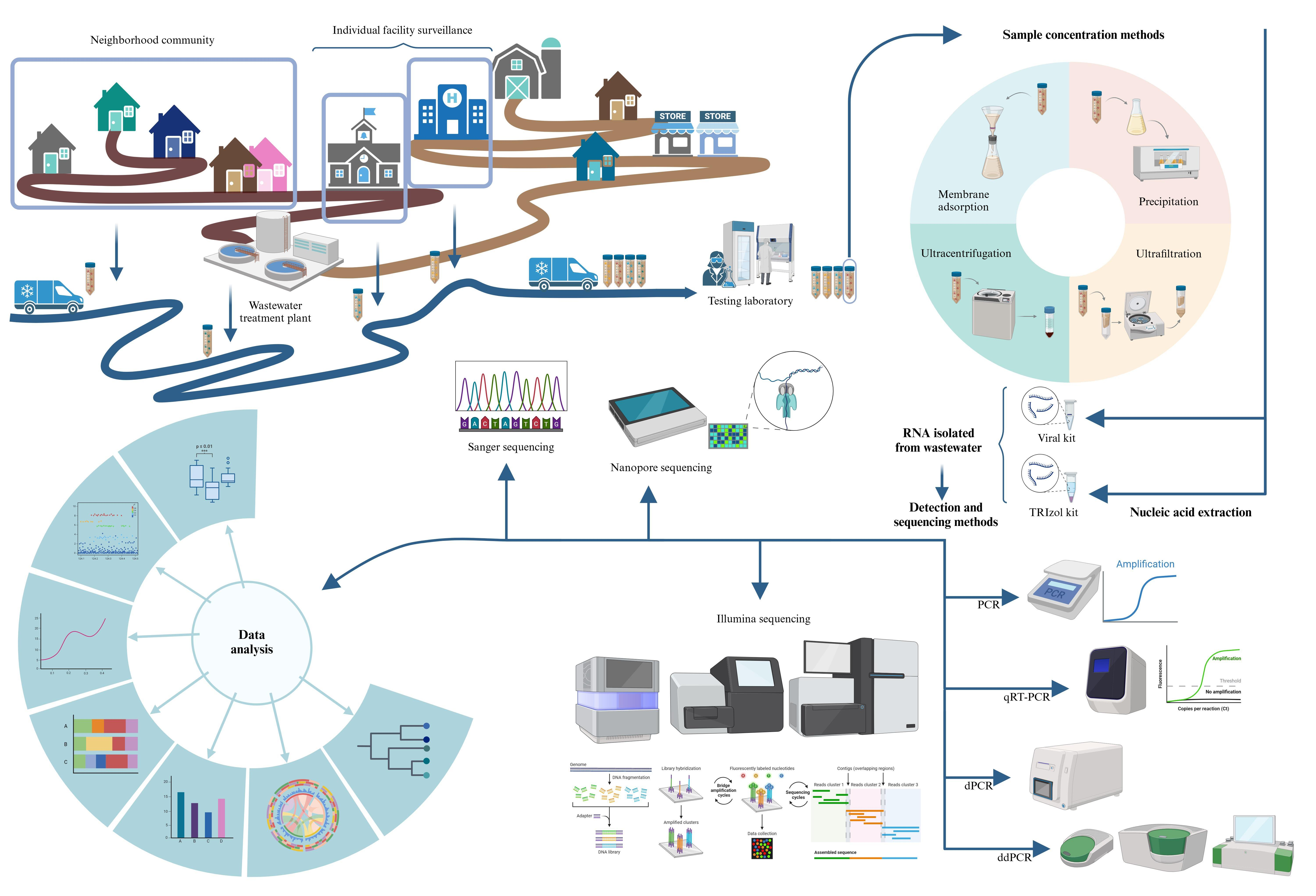
A Systematic Review of Methodological Approaches to SARS-CoV-2 Wastewater Surveillance


Abstract
1. Chronology of Events Since the First Cases of COVID-19 Were Identified to the Epidemiological Monitoring of Wastewater
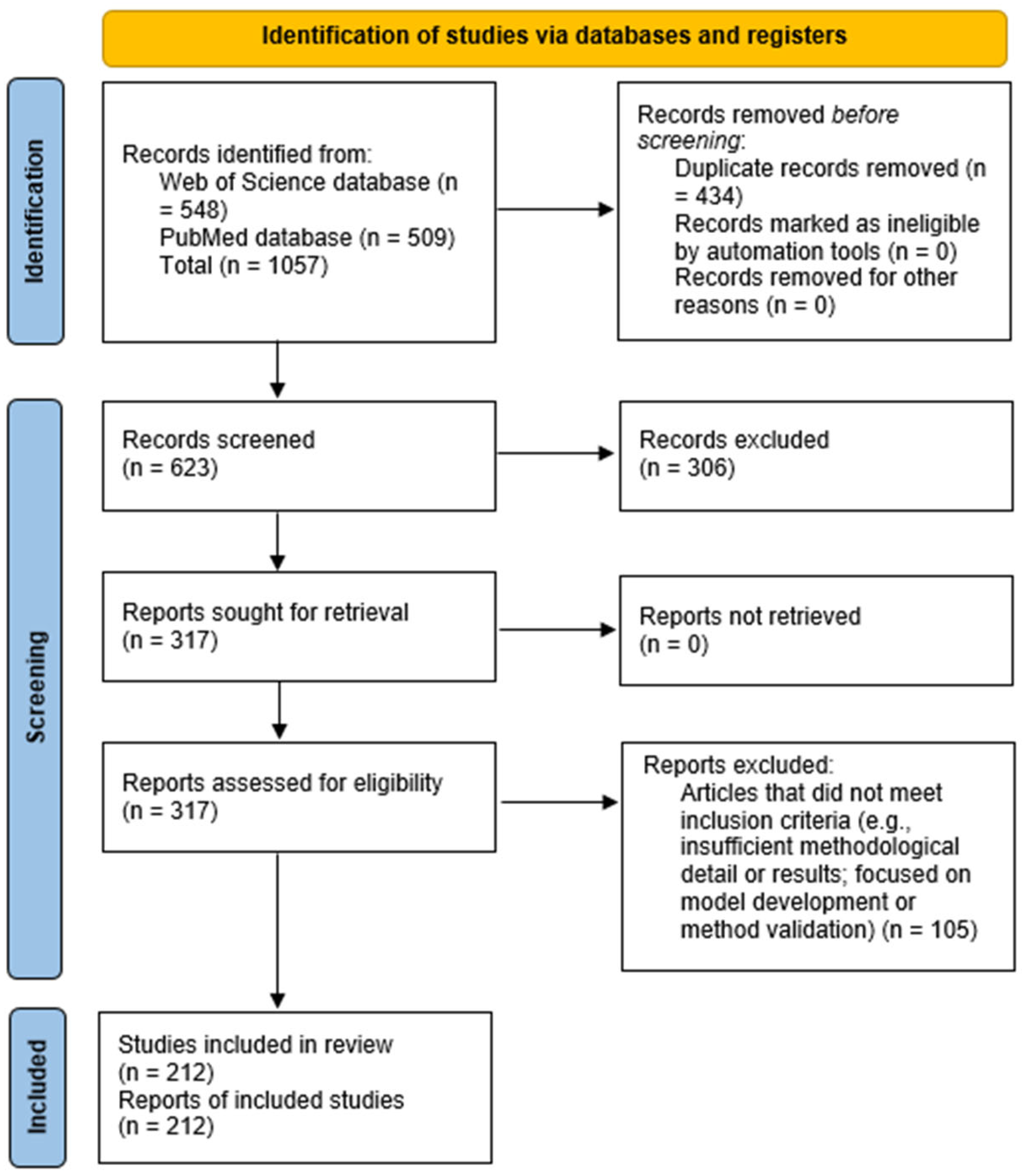
2. Materials and Methods
3. Results and Discussion
3.1. Overview of the General Characteristics in the Included Studies
3.2. Geographical Characteristics and Regional Differences in Global WBE Research
3.3. Normalisation Strategies for SARS-CoV-2 Data in WBE
3.4. Comparative Analysis of WBE Pipelines
3.5. Correlation Between Monitoring of SARS-CoV-2 in Wastewater and Clinical Data Using Predictive Models

| No. Crt. | Estimated Lag Period (Days) | Modeling Technique | References |
|---|---|---|---|
| 1. | 0 | Spearman correlation | [114] |
| 2. | 2 | Pearson’s correlation | [111] |
| 3. | 22–24 | Spearman correlation | [115] |
| 4. | 3 | Spearman correlation | [116] |
| 5. | 4 | Linear Regression model | [117] |
| 6. | 4–6 | Generalised Additive Models (GAMs) | [118] |
| 7. | 3–9 | Pearson, Spearman correlation | [119] |
| 8. | 5.5 | Susceptible-Exposed-Infectious-Recovered (SEIR) model with Gamma distribution | [109] |
| 9. | 6 | Poisson distribution | [120] |
| 10. | 6.2 | Approximate Bayesian computation | [121] |
| 11. | 3 | Cross correlation | [122] |
| 12. | 14 | Spearman correlation | [123] |
| 13. | 14 | Monte Carlo simulation | [63] |
| 14. | 14 | Regression models Simple Linear, Double Square Root, Square Root-Y | [124] |
| 15. | 14–21 | N.R. | [125] |
| 16. | 21 | Pearson correlation | [126] |
| 17. | 19–21 | N.R. | [127] |
| 18. | 28 | Pearson correlation | [108] |
| 19. | 2–7 | Pearson correlation | [107] |
| 20. | 4–7 | Pearson correlation | [128] |
| 21. | 7–14 | Spearman correlation | [129] |
| 22. | 5–9 | Pearson correlation | [130] |
| 23. | 6–8 | Linear Regression | [20] |
| 24. | 10 | Poisson distribution | [131] |
3.6. Standardisation Efforts and National Approaches in SARS-CoV-2 Wastewater Surveillance
4. Limitations
5. Conclusions
Supplementary Materials
Author Contributions
Funding
Institutional Review Board Statement
Informed Consent Statement
Data Availability Statement
Conflicts of Interest
References
- Zhu, N.; Zhang, D.; Wang, W.; Li, X.; Yang, B.; Song, J.; Zhao, X.; Huang, B.; Shi, W.; Lu, R.; et al. A Novel Coronavirus from Patients with Pneumonia in China, 2019. N. Engl. J. Med. 2020, 382, 727–733. [Google Scholar] [CrossRef]
- Wu, F.; Zhao, S.; Yu, B.; Chen, Y.-M.; Wang, W.; Song, Z.-G.; Hu, Y.; Tao, Z.-W.; Tian, J.-H.; Pei, Y.-Y.; et al. A new coronavirus associated with human respiratory disease in China. Nature 2020, 579, 265–269. [Google Scholar] [CrossRef]
- Mahdy, M.A.A.; Younis, W.; Ewaida, Z. An Overview of SARS-CoV-2 and Animal Infection. Front. Veter-Sci. 2020, 7, 596391. [Google Scholar] [CrossRef]
- Hu, B.; Guo, H.; Zhou, P.; Shi, Z.-L. Characteristics of SARS-CoV-2 and COVID-19. Nat. Rev. Microbiol. 2021, 19, 141–154. [Google Scholar] [CrossRef]
- Lai, C.-C.; Shih, T.-P.; Ko, W.-C.; Tang, H.-J.; Hsueh, P.-R. Severe acute respiratory syndrome coronavirus 2 (SARS-CoV-2) and coronavirus disease-2019 (COVID-19): The epidemic and the challenges. Int. J. Antimicrob. Agents 2020, 55, 105924. [Google Scholar] [CrossRef]
- He, F.; Deng, Y.; Li, W. Coronavirus disease 2019: What we know? J. Med. Virol. 2020, 92, 719–725. [Google Scholar] [CrossRef]
- Gorbalenya, A.E.; Baker, S.C.; Baric, R.S.; de Groot, R.J.; Drosten, C.; Gulyaeva, A.A.; Haagmans, B.L.; Lauber, C.; Leontovich, A.M.; Neuman, B.W.; et al. The species Severe acute respiratory syndrome-related coronavirus: Classifying 2019-nCoV and naming it SARS-CoV-2. Nat. Microbiol. 2020, 5, 536–544. [Google Scholar] [CrossRef]
- Cucinotta, D.; Vanelli, M. WHO Declares COVID-19 a Pandemic. Acta Biomed. Atenei Parm. 2020, 91, 157–160. [Google Scholar] [CrossRef]
- Park, S.E. Epidemiology, virology, and clinical features of severe acute respiratory syndrome -coronavirus-2 (SARS-CoV-2; Coronavirus Disease-19). Clin. Exp. Pediatr. 2020, 63, 119–124. [Google Scholar] [CrossRef]
- Zhu, H.; Zhang, H.; Xu, Y.; Laššáková, S.; Korabečná, M.; Neužil, P. PCR past, present and future. BioTechniques 2020, 69, 317–325. [Google Scholar] [CrossRef]
- Arya, R.; Kumari, S.; Pandey, B.; Mistry, H.; Bihani, S.C.; Das, A.; Prashar, V.; Gupta, G.D.; Panicker, L.; Kumar, M. Structural insights into SARS-CoV-2 proteins. J. Mol. Biol. 2021, 433, 166725. [Google Scholar] [CrossRef]
- V’kovski, P.; Kratzel, A.; Steiner, S.; Stalder, H.; Thiel, V. Coronavirus biology and replication: Implications for SARS-CoV-2. Nat. Rev. Microbiol. 2021, 19, 155–170. [Google Scholar] [CrossRef]
- Medema, G.; Heijnen, L.; Elsinga, G.; Italiaander, R.; Brouwer, A. Presence of SARS-Coronavirus-2 RNA in Sewage and Correlation with Reported COVID-19 Prevalence in the Early Stage of the Epidemic in The Netherlands. Environ. Sci. Technol. Lett. 2020, 7, 511–516. [Google Scholar] [CrossRef]
- Foladori, P.; Cutrupi, F.; Cadonna, M.; Manara, S. Coronaviruses and SARS-CoV-2 in sewerage and their removal: Step by step in wastewater treatment plants. Environ. Res. 2022, 207, 112204. [Google Scholar] [CrossRef]
- Asghar, H.; Diop, O.M.; Weldegebriel, G.; Malik, F.; Shetty, S.; El Bassioni, L.; Akande, A.O.; Al Maamoun, E.; Zaidi, S.; Adeniji, A.J.; et al. Environmental Surveillance for Polioviruses in the Global Polio Eradication Initiative. J. Infect. Dis. 2014, 210, S294–S303. [Google Scholar] [CrossRef]
- Singer, A.C.; Thompson, J.R.; Filho, C.R.M.; Street, R.; Li, X.; Castiglioni, S.; Thomas, K.V. A world of wastewater-based epidemiology. Nat. Water 2023, 1, 408–415. [Google Scholar] [CrossRef]
- European Commission. Commission Recommendation (EU) 2021/472 of 17 March 2021 on a Common Approach to Establish a Systematic Surveillance of SARS-CoV-2 and Its Variants in Wastewaters in the EU. 2021. Available online: https://eur-lex.europa.eu/legal-content/EN/TXT/PDF/?uri=CELEX:32021H0472 (accessed on 5 December 2023).
- Deák, G.; Matei, M.; Boboc, M.; Holban, E.; Airini, R. Development of a methodology for monitoring SARS-CoV-2 RNA in wastewater. Int. J. Conserv. Sci. 2022, 13, 973–980. [Google Scholar]
- Deák, G.; Prangate, R.; Croitoru, C.; Matei, M.; Boboc, M. The first detection of SARS-CoV-2 RNA in the wastewater of Bucharest, Romania. Sci. Rep. 2024, 14, 21730. [Google Scholar] [CrossRef]
- Peccia, J.; Zulli, A.; Brackney, D.E.; Grubaugh, N.D.; Kaplan, E.H.; Casanovas-Massana, A.; Ko, A.I.; Malik, A.A.; Wang, D.; Wang, M.; et al. Measurement of SARS-CoV-2 RNA in wastewater tracks community infection dynamics. Nat. Biotechnol. 2020, 38, 1164–1167. [Google Scholar] [CrossRef]
- Lodder, W.; De Roda Husman, A.M. SARS-CoV-2 in wastewater: Potential health risk, but also data source. Lancet Gastroenterol. Hepatol. 2020, 5, 533–534. [Google Scholar] [CrossRef]
- Ahmed, W.; Angel, N.; Edson, J.; Bibby, K.; Bivins, A.; O’Brien, J.W.; Choi, P.M.; Kitajima, M.; Simpson, S.L.; Li, J.; et al. First confirmed detection of SARS-CoV-2 in untreated wastewater in Australia: A proof of concept for the wastewater surveillance of COVID-19 in the community. Sci. Total Environ. 2020, 728, 138764. [Google Scholar] [CrossRef]
- Bar-Or, I.; Indenbaum, V.; Weil, M.; Elul, M.; Levi, N.; Aguvaev, I.; Cohen, Z.; Levy, V.; Azar, R.; Mannasse, B.; et al. National Scale Real-Time Surveillance of SARS-CoV-2 Variants Dynamics by Wastewater Monitoring in Israel. Viruses 2022, 14, 1229. [Google Scholar] [CrossRef]
- Crits-Christoph, A.; Kantor, R.S.; Olm, M.R.; Whitney, O.N.; Al-Shayeb, B.; Lou, Y.C.; Flamholz, A.; Kennedy, L.C.; Greenwald, H.; Hinkle, A.; et al. Genome Sequencing of Sewage Detects Regionally Prevalent SARS-CoV-2 Variants. mBio 2021, 12, e02703-20. [Google Scholar] [CrossRef]
- Khan, M.; Li, L.; Haak, L.; Payen, S.H.; Carine, M.; Adhikari, K.; Uppal, T.; Hartley, P.D.; Vasquez-Gross, H.; Petereit, J.; et al. Significance of wastewater surveillance in detecting the prevalence of SARS-CoV-2 variants and other respiratory viruses in the community—A multi-site evaluation. One Health 2023, 16, 100536. [Google Scholar] [CrossRef]
- Page, M.J.; McKenzie, J.E.; Bossuyt, P.M.; Boutron, I.; Hoffmann, T.C.; Mulrow, C.D.; Shamseer, L.; Tetzlaff, J.M.; Akl, E.A.; Brennan, S.E.; et al. The PRISMA 2020 statement: An updated guideline for reporting systematic reviews. BMJ 2021, 372, n71. [Google Scholar] [CrossRef]
- Perianes-Rodriguez, A.; Waltman, L.; van Eck, N.J. Constructing bibliometric networks: A comparison between full and fractional counting. J. Informetr. 2016, 10, 1178–1195. [Google Scholar] [CrossRef]
- Laicans, J.; Dejus, B.; Dejus, S.; Juhna, T. Precision and Accuracy Limits of Wastewater-Based Epidemiology—Lessons Learned from SARS-CoV-2: A Scoping Review. Water 2024, 16, 1220. [Google Scholar] [CrossRef]
- Corman, V.M.; Landt, O.; Kaiser, M.; Molenkamp, R.; Meijer, A.; Chu, D.K.; Bleicker, T.; Brünink, S.; Schneider, J.; Schmidt, M.L.; et al. Detection of 2019 novel coronavirus (2019-nCoV) by real-time RT-PCR. Eurosurveillance 2020, 25, 2000045. [Google Scholar] [CrossRef]
- Quer, J.; Colomer-Castell, S.; Campos, C.; Andrés, C.; Piñana, M.; Cortese, M.F.; González-Sánchez, A.; Garcia-Cehic, D.; Ibáñez, M.; Pumarola, T.; et al. Next-Generation Sequencing for Confronting Virus Pandemics. Viruses 2022, 14, 600. [Google Scholar] [CrossRef]
- Corpuz, M.V.A.; Buonerba, A.; Vigliotta, G.; Zarra, T.; Ballesteros, F.; Campiglia, P.; Belgiorno, V.; Korshin, G.; Naddeo, V. Viruses in wastewater: Occurrence, abundance and detection methods. Sci. Total Environ. 2020, 745, 140910. [Google Scholar] [CrossRef]
- Bofill-Mas, S.; Rusiñol, M. Recent trends on methods for the concentration of viruses from water samples. Curr. Opin. Environ. Sci. Health 2020, 16, 7–13. [Google Scholar] [CrossRef]
- Lu, D.; Huang, Z.; Luo, J.; Zhang, X.; Sha, S. Primary concentration—The critical step in implementing the wastewater based epidemiology for the COVID-19 pandemic: A mini-review. Sci. Total Environ. 2020, 747, 141245. [Google Scholar] [CrossRef]
- Fonseca, M.S.; Machado, B.A.S.; Rolo, C.D.A.; Hodel, K.V.S.; Almeida, E.D.S.; De Andrade, J.B. Evaluation of SARS-CoV-2 concentrations in wastewater and river water samples. Case Stud. Chem. Environ. Eng. 2022, 6, 100214. [Google Scholar] [CrossRef]
- Hasan, S.W.; Ibrahim, Y.; Daou, M.; Kannout, H.; Jan, N.; Lopes, A.; Alsafar, H.; Yousef, A.F. Detection and quantification of SARS-CoV-2 RNA in wastewater and treated effluents: Surveillance of COVID-19 epidemic in the United Arab Emirates. Sci. Total Environ. 2021, 764, 142929. [Google Scholar] [CrossRef]
- Kitajima, M.; Ahmed, W.; Bibby, K.; Carducci, A.; Gerba, C.P.; Hamilton, K.A.; Haramoto, E.; Rose, J.B. SARS-CoV-2 in wastewater: State of the knowledge and research needs. Sci. Total Environ. 2020, 739, 139076. [Google Scholar] [CrossRef]
- Alhama, J.; Maestre, J.P.; Martín, M.Á.; Michán, C. Monitoring COVID-19 through SARS-CoV-2 quantification in wastewater: Progress, challenges and prospects. Microb. Biotechnol. 2022, 15, 1719–1728. [Google Scholar] [CrossRef]
- Haramoto, E.; Malla, B.; Thakali, O.; Kitajima, M. First environmental surveillance for the presence of SARS-CoV-2 RNA in wastewater and river water in Japan. Sci. Total Environ. 2020, 737, 140405. [Google Scholar] [CrossRef]
- Farkas, K.; Mannion, F.; Hillary, L.S.; Malham, S.K.; Walker, D.I. Emerging technologies for the rapid detection of enteric viruses in the aquatic environment. Curr. Opin. Environ. Sci. Health 2020, 16, 1–6. [Google Scholar] [CrossRef]
- Ahmed, W.; Smith, W.J.M.; Metcalfe, S.; Jackson, G.; Choi, P.M.; Morrison, M.; Field, D.; Gyawali, P.; Bivins, A.; Bibby, K.; et al. Comparison of RT-qPCR and RT-dPCR Platforms for the Trace Detection of SARS-CoV-2 RNA in Wastewater. ACS EST Water 2022, 2, 1871–1880. [Google Scholar] [CrossRef]
- Ciannella, S.; González-Fernández, C.; Gomez-Pastora, J. Recent progress on wastewater-based epidemiology for COVID-19 surveillance: A systematic review of analytical procedures and epidemiological modeling. Sci. Total Environ. 2023, 878, 162953. [Google Scholar] [CrossRef]
- Chiara, M.; D’Erchia, A.M.; Gissi, C.; Manzari, C.; Parisi, A.; Resta, N.; Zambelli, F.; Picardi, E.; Pavesi, G.; Horner, D.S.; et al. Next generation sequencing of SARS-CoV-2 genomes: Challenges, applications and opportunities. Brief. Bioinform. 2021, 22, 616–630. [Google Scholar] [CrossRef]
- John, G.; Sahajpal, N.S.; Mondal, A.K.; Ananth, S.; Williams, C.; Chaubey, A.; Rojiani, A.M.; Kolhe, R. Next-Generation Sequencing (NGS) in COVID-19: A Tool for SARS-CoV-2 Diagnosis, Monitoring New Strains and Phylodynamic Modeling in Molecular Epidemiology. Curr. Issues Mol. Biol. 2021, 43, 845–867. [Google Scholar] [CrossRef]
- Tan, M.; Xia, J.; Luo, H.; Meng, G.; Zhu, Z. Applying the digital data and the bioinformatics tools in SARS-CoV-2 research. Comput. Struct. Biotechnol. J. 2023, 21, 4697–4705. [Google Scholar] [CrossRef]
- Lombardi, A.; Voli, A.; Mancusi, A.; Girardi, S.; Proroga, Y.T.R.; Pierri, B.; Olivares, R.; Cossentino, L.; Suffredini, E.; Rosa, G.L.; et al. SARS-CoV-2 RNA in Wastewater and Bivalve Mollusk Samples of Campania, Southern Italy. Viruses 2023, 15, 1777. [Google Scholar] [CrossRef]
- Ando, H.; Iwamoto, R.; Kobayashi, H.; Okabe, S.; Kitajima, M. The Efficient and Practical virus Identification System with ENhanced Sensitivity for Solids (EPISENS-S): A rapid and cost-effective SARS-CoV-2 RNA detection method for routine wastewater surveillance. Sci. Total Environ. 2022, 843, 157101. [Google Scholar] [CrossRef]
- Aziz, M.A.; Norman, S.; Mohamed Zaid, S.; Simarani, K.; Sulaiman, R.; Mohd Aris, A.; Chin, K.B.; Mohd Zain, R. Environmental surveillance of SARS-CoV-2 in municipal wastewater to monitor COVID-19 status in urban clusters in Malaysia. Arch. Microbiol. 2023, 205, 76. [Google Scholar] [CrossRef]
- Lott, M.E.J.; Norfolk, W.A.; Dailey, C.A.; Foley, A.M.; Melendez-Declet, C.; Robertson, M.J.; Rathbun, S.L.; Lipp, E.K. Direct wastewater extraction as a simple and effective method for SARS-CoV-2 surveillance and COVID-19 community-level monitoring. FEMS Microbes 2023, 4, xtad004. [Google Scholar] [CrossRef]
- Brighton, K.; Fisch, S.; Wu, H.; Vigil, K.; Aw, T.G. Targeted community wastewater surveillance for SARS-CoV-2 and Mpox virus during a festival mass-gathering event. Sci. Total Environ. 2024, 906, 167443. [Google Scholar] [CrossRef]
- Feng, S.; Roguet, A.; McClary-Gutierrez, J.S.; Newton, R.J.; Kloczko, N.; Meiman, J.G.; McLellan, S.L. Evaluation of Sampling, Analysis, and Normalization Methods for SARS-CoV-2 Concentrations in Wastewater to Assess COVID-19 Burdens in Wisconsin Communities. ACS EST Water 2021, 1, 1955–1965. [Google Scholar] [CrossRef]
- Gallardo-Escárate, C.; Valenzuela-Muñoz, V.; Núñez-Acuña, G.; Valenzuela-Miranda, D.; Benaventel, B.P.; Sáez-Vera, C.; Urrutia, H.; Novoa, B.; Figueras, A.; Roberts, S.; et al. The wastewater microbiome: A novel insight for COVID-19 surveillance. Sci. Total Environ. 2021, 764, 142867. [Google Scholar] [CrossRef]
- de Sousa, A.R.V.; Silva, L.D.C.; de Curcio, J.S.; da Silva, H.D.; Anunciação, C.E.; Izacc, S.M.S.; Neto, F.O.S.; de Paula Silveira Lacerda, E. “pySewage”: A hybrid approach to predict the number of SARS-CoV-2-infected people from wastewater in Brazil. Environ. Sci. Pollut. Res. 2022, 29, 67260. [Google Scholar] [CrossRef]
- Toledo, D.M.; Robbins, A.A.; Gallagher, T.L.; Hershberger, K.C.; Barney, R.E.; Salmela, S.M.; Pilcher, D.; Cervinski, M.A.; Nerenz, R.D.; Szczepiorkowski, Z.M.; et al. Wastewater-Based SARS-CoV-2 Surveillance in Northern New England. Microbiol. Spectr. 2022, 10, e0220721. [Google Scholar] [CrossRef]
- Brumfield, K.D.; Leddy, M.; Usmani, M.; Cotruvo, J.A.; Tien, C.-T.; Dorsey, S.; Graubics, K.; Fanelli, B.; Zhou, I.; Registe, N.; et al. Microbiome Analysis for Wastewater Surveillance during COVID-19. mBio 2022, 13, e0059122. [Google Scholar] [CrossRef]
- Padilla-Reyes, D.A.; Álvarez, M.M.; Mora, A.; Cervantes-Avilés, P.A.; Kumar, M.; Loge, F.J.; Mahlknecht, J. Acquired insights from the long-term surveillance of SARS-CoV-2 RNA for COVID-19 monitoring: The case of Monterrey Metropolitan Area (Mexico). Environ. Res. 2022, 210, 112967. [Google Scholar] [CrossRef]
- National Wastewater Surveillance System. Wastewater Surveillance Testing Methods; CDC: Atlanta, GA, USA, 2023. Available online: https://archive.cdc.gov/#/details?url=https://www.cdc.gov/nwss/testing.html (accessed on 25 September 2023).
- Herold, M.; d’Hérouël, A.F.; May, P.; Delogu, F.; Wienecke-Baldacchino, A.; Tapp, J.; Walczak, C.; Wilmes, P.; Cauchie, H.-M.; Fournier, G.; et al. Genome Sequencing of SARS-CoV-2 Allows Monitoring of Variants of Concern through Wastewater. Water 2021, 13, 3018. [Google Scholar] [CrossRef]
- Burnet, J.-B.; Cauchie, H.-M.; Walczak, C.; Goeders, N.; Ogorzaly, L. Persistence of endogenous RNA biomarkers of SARS-CoV-2 and PMMoV in raw wastewater: Impact of temperature and implications for wastewater-based epidemiology. Sci. Total Environ. 2023, 857, 159401. [Google Scholar] [CrossRef]
- Murni, I.K.; Oktaria, V.; McCarthy, D.T.; Supriyati, E.; Nuryastuti, T.; Handley, A.; Donato, C.M.; Wiratama, B.S.; Dinari, R.; Laksono, I.S.; et al. Wastewater-based epidemiology surveillance as an early warning system for SARS-CoV-2 in Indonesia. PLoS ONE 2024, 19, e0307364. [Google Scholar] [CrossRef]
- Randazzo, W.; Cuevas-Ferrando, E.; Sanjuán, R.; Domingo-Calap, P.; Sánchez, G. Metropolitan wastewater analysis for COVID-19 epidemiological surveillance. Int. J. Hyg. Environ. Health 2020, 230, 113621. [Google Scholar] [CrossRef]
- Hayase, S.; Katayama, Y.A.; Hatta, T.; Iwamoto, R.; Kuroita, T.; Ando, Y.; Okuda, T.; Kitajima, M.; Natsume, T.; Masago, Y. Near full-automation of COPMAN using a LabDroid enables high-throughput and sensitive detection of SARS-CoV-2 RNA in wastewater as a leading indicator. Sci. Total Environ. 2023, 881, 163454. [Google Scholar] [CrossRef]
- Kolarević, S.; Micsinai, A.; Szántó-Egész, R.; Lukács, A.; Kračun-Kolarević, M.; Lundy, L.; Kirschner, A.K.T.; Farnleitner, A.H.; Djukic, A.; Čolić, J.; et al. Detection of SARS-CoV-2 RNA in the Danube River in Serbia associated with the discharge of untreated wastewaters. Sci. Total Environ. 2021, 783, 146967. [Google Scholar] [CrossRef]
- Claro, I.C.M.; Cabral, A.D.; Augusto, M.R.; Duran, A.F.A.; Graciosa, M.C.P.; Fonseca, F.L.A.; Speranca, M.A.; Bueno, R.D.F. Long-term monitoring of SARS-COV-2 RNA in wastewater in Brazil: A more responsive and economical approach. Water Res. 2021, 203, 117534. [Google Scholar] [CrossRef]
- Chai, X.; Liu, S.; Liu, C.; Bai, J.; Meng, J.; Tian, H.; Han, X.; Han, G.; Xu, X.; Li, Q. Surveillance of SARS-CoV-2 in wastewater by quantitative PCR and digital PCR: A case study in Shijiazhuang city, Hebei province, China. Emerg. Microbes Infect. 2024, 13, 2324502. [Google Scholar] [CrossRef]
- Martins, R.M.; Carvalho, T.; Bittar, C.; Quevedo, D.M.; Miceli, R.N.; Nogueira, M.L.; Ferreira, H.L.; Costa, P.I.; Araújo, J.P.; Spilki, F.R.; et al. Long-Term Wastewater Surveillance for SARS-CoV-2: One-Year Study in Brazil. Viruses 2022, 14, 2333. [Google Scholar] [CrossRef]
- Lambisia, A.W.; Mohammed, K.S.; Makori, T.O.; Ndwiga, L.; Mburu, M.W.; Morobe, J.M.; Moraa, E.O.; Musyoki, J.; Murunga, N.; Mwangi, J.N.; et al. Optimization of the SARS-CoV-2 ARTIC Network V4 Primers and Whole Genome Sequencing Protocol. Front. Med. 2022, 9, 836728. [Google Scholar] [CrossRef]
- Plitnick, J.; Griesemer, S.; Lasek-Nesselquist, E.; Singh, N.; Lamson, D.M.; St George, K. Whole-Genome Sequencing of SARS-CoV-2: Assessment of the Ion Torrent AmpliSeq Panel and Comparison with the Illumina MiSeq ARTIC Protocol. J. Clin. Microbiol. 2021, 59, e0064921. [Google Scholar] [CrossRef]
- Jahn, K.; Dreifuss, D.; Topolsky, I.; Kull, A.; Ganesanandamoorthy, P.; Fernandez-Cassi, X.; Bänziger, C.; Devaux, A.J.; Stachler, E.; Caduff, L.; et al. Early detection and surveillance of SARS-CoV-2 genomic variants in wastewater using COJAC. Nat. Microbiol. 2022, 7, 1151–1160. [Google Scholar] [CrossRef]
- Izquierdo-Lara, R.; Elsinga, G.; Heijnen, L.; Munnink, B.B.O.; Schapendonk, C.M.E.; Nieuwenhuijse, D.; Kon, M.; Lu, L.; Aarestrup, F.M.; Lycett, S.; et al. Monitoring SARS-CoV-2 Circulation and Diversity through Community Wastewater Sequencing, the Netherlands and Belgium. Emerg. Infect. Dis. 2021, 27, 1405–1415. [Google Scholar] [CrossRef]
- Hillary, L.S.; Farkas, K.; Maher, K.H.; Lucaci, A.; Thorpe, J.; Distaso, M.A.; Gaze, W.H.; Paterson, S.; Burke, T.; Connor, T.R.; et al. Monitoring SARS-CoV-2 in municipal wastewater to evaluate the success of lockdown measures for controlling COVID-19 in the UK. Water Res. 2021, 200, 117214. [Google Scholar] [CrossRef]
- Hassard, F.; Vu, M.; Rahimzadeh, S.; Castro-Gutierrez, V.; Stanton, I.; Burczynska, B.; Wildeboer, D.; Baio, G.; Brown, M.R.; Garelick, H.; et al. Wastewater monitoring for detection of public health markers during the COVID-19 pandemic: Near-source monitoring of schools in England over an academic year. PLoS ONE 2023, 18, e0286259. [Google Scholar] [CrossRef]
- Layton, B.A.; Kaya, D.; Kelly, C.; Williamson, K.J.; Alegre, D.; Bachhuber, S.M.; Banwarth, P.G.; Bethel, J.W.; Carter, K.; Dalziel, B.D.; et al. Evaluation of a Wastewater-Based Epidemiological Approach to Estimate the Prevalence of SARS-CoV-2 Infections and the Detection of Viral Variants in Disparate Oregon Communities at City and Neighborhood Scales. Environ. Health Perspect. 2022, 130, 067010. [Google Scholar] [CrossRef]
- Tangwangvivat, R.; Wacharapluesadee, S.; Pinyopornpanish, P.; Petcharat, S.; Hearn, S.M.; Thippamom, N.; Phiancharoen, C.; Hirunpatrawong, P.; Duangkaewkart, P.; Supataragul, A.; et al. SARS-CoV-2 Variants Detection Strategies in Wastewater Samples Collected in the Bangkok Metropolitan Region. Viruses 2023, 15, 876. [Google Scholar] [CrossRef]
- Amman, F.; Markt, R.; Endler, L.; Hupfauf, S.; Agerer, B.; Schedl, A.; Richter, L.; Zechmeister, M.; Bicher, M.; Heiler, G.; et al. Viral variant-resolved wastewater surveillance of SARS-CoV-2 at national scale. Nat. Biotechnol. 2022, 40, 1814–1822. [Google Scholar] [CrossRef]
- Adebisi, Y.A.; Jimoh, N.D.; Ogunkola, I.O.; Ilesanmi, E.A.; Elhadi, Y.A.M.; Lucero-Prisno, D.E. Addressing language inequities in global health science scholarly publishing. J. Med. Surg. Public Health 2024, 2, 100038. [Google Scholar] [CrossRef]
- Rashid, S.A.; Rajendiran, S.; Nazakat, R.; Mohammad Sham, N.; Khairul Hasni, N.A.; Anasir, M.I.; Kamel, K.A.; Muhamad Robat, R. A scoping review of global SARS-CoV-2 wastewater-based epidemiology in light of COVID-19 pandemic. Heliyon 2024, 10, e30600. [Google Scholar] [CrossRef]
- Grassly, N.C.; Shaw, A.G.; Owusu, M. Global wastewater surveillance for pathogens with pandemic potential: Opportunities and challenges. Lancet Microbe 2025, 6, 100939. [Google Scholar] [CrossRef]
- Keshaviah, A.; Diamond, M.B.; Wade, M.J.; Scarpino, S.V.; Ahmed, W.; Amman, F.; Aruna, O.; Badilla-Aguilar, A.; Bar-Or, I.; Bergthaler, A.; et al. Wastewater monitoring can anchor global disease surveillance systems. Lancet Glob. Health 2023, 11, e976–e981. [Google Scholar] [CrossRef]
- Maal-Bared, R.; Qiu, Y.; Li, Q.; Gao, T.; Hrudey, S.E.; Bhavanam, S.; Ruecker, N.J.; Ellehoj, E.; Lee, B.E.; Pang, X. Does normalization of SARS-CoV-2 concentrations by Pepper Mild Mottle Virus improve correlations and lead time between wastewater surveillance and clinical data in Alberta (Canada): Comparing twelve SARS-CoV-2 normalization approaches. Sci. Total Environ. 2023, 856, 158964. [Google Scholar] [CrossRef]
- Rogers, E. Variability and Uncertainty in SARS-CoV-2 Wastewater-Based Surveillance Normalization: A Systematic Review. Master's Thesis, University of Washington, Seattle, WA, USA, May 2025. [Google Scholar]
- Amereh, F.; Jahangiri-rad, M.; Mohseni-Bandpei, A.; Mohebbi, S.R.; Asadzadeh-Aghdaei, H.; Dabiri, H.; Eslami, A.; Roostaei, K.; Aali, R.; Hamian, P.; et al. Association of SARS-CoV-2 presence in sewage with public adherence to precautionary measures and reported COVID-19 prevalence in Tehran. Sci. Total Environ. 2022, 812, 152597. [Google Scholar] [CrossRef]
- Kantor, R.S.; Nelson, K.L.; Greenwald, H.D.; Kennedy, L.C. Challenges in Measuring the Recovery of SARS-CoV-2 from Wastewater. Environ. Sci. Technol. 2021, 55, 3514–3519. [Google Scholar] [CrossRef]
- Deák, G.; Prangate, R.; Noor, N.M.; Matei, M.; Boboc, M.; Lupu, L.; Holban, E.E.; Norazrin, R. Evaluating Recovery Control Concentrations of Bovine Coronavirus (EVAg 015V-02282) Used for SARS-CoV-2 Wastewater Surveillance. E3S Web. Conf. 2023, 437, 02011. [Google Scholar] [CrossRef]
- Djoulissa, L.-J.; Tandukar, S.; Schmitz, B.W.; Innes, G.K.; Gerba, C.P.; Pepper, I.L.; Sherchan, S.P. Abundance and possibilities of crAssphage and PMMoV as a viral indicator in raw sewage in wastewater treatment plants. Sci. Total Environ. 2025, 963, 178101. [Google Scholar] [CrossRef]
- Benefield, A.E.; Skrip, L.A.; Clement, A.; Althouse, R.A.; Chang, S.; Althouse, B.M. SARS-CoV-2 viral load peaks prior to symptom onset: A systematic review and individual-pooled analysis of coronavirus viral load from 66 studies. medRxiv 2020. [Google Scholar] [CrossRef]
- McSparron, C.; Bell, S.H.; Nejad, B.F.; Allen, D.M.; Reyne, M.I.; Lee, A.; Lock, J.; Levickas, A.; Fitzgerald, A.; Creevey, C.; et al. Wastewater Flow Estimation, Using Localised Rainfall Data, for SARS-CoV-2 Monitoring Via an Optimised High-Throughput Surveillance Platform. 2023. [Google Scholar] [CrossRef]
- Langeveld, J.; Schilperoort, R.; Heijnen, L.; Elsinga, G.; Schapendonk, C.E.M.; Fanoy, E.; de Schepper, E.I.T.; Koopmans, M.P.G.; de Graaf, M.; Medema, G. Normalisation of SARS-CoV-2 concentrations in wastewater: The use of flow, electrical conductivity and crAssphage. Sci. Total Environ. 2023, 865, 161196. [Google Scholar] [CrossRef] [PubMed]
- Sabar, M.A.; Honda, R.; Haramoto, E. CrAssphage as an indicator of human-fecal contamination in water environment and virus reduction in wastewater treatment. Water Res. 2022, 221, 118827. [Google Scholar] [CrossRef]
- Mazumder, P.; Dash, S.; Honda, R.; Sonne, C.; Kumar, M. Sewage surveillance for SARS-CoV-2: Molecular detection, quantification, and normalization factors. Curr. Opin. Environ. Sci. Health 2022, 28, 100363. [Google Scholar] [CrossRef]
- D’Aoust, P.M.; Mercier, E.; Montpetit, D.; Jia, J.-J.; Alexandrov, I.; Neault, N.; Baig, A.T.; Mayne, J.; Zhang, X.; Alain, T.; et al. Quantitative analysis of SARS-CoV-2 RNA from wastewater solids in communities with low COVID-19 incidence and prevalence. Water Res. 2021, 188, 116560. [Google Scholar] [CrossRef]
- Rainey, A.L.; Liang, S.; Bisesi, J.H.; Sabo-Attwood, T.; Maurelli, A.T. A multistate assessment of population normalization factors for wastewater-based epidemiology of COVID-19. PLoS ONE 2023, 18, e0284370. [Google Scholar] [CrossRef]
- Hsu, S.-Y.; Bayati, M.; Li, C.; Hsieh, H.-Y.; Belenchia, A.; Klutts, J.; Zemmer, S.A.; Reynolds, M.; Semkiw, E.; Johnson, H.-Y.; et al. Biomarkers selection for population normalization in SARS-CoV-2 wastewater-based epidemiology. Water Res. 2022, 223, 118985. [Google Scholar] [CrossRef]
- Pellett, C.; Farkas, K.; Williams, R.C.; Wade, M.J.; Weightman, A.J.; Jameson, E.; Cross, G.; Jones, D.L. Multi-factor normalisation of viral counts from wastewater improves the detection accuracy of viral disease in the community. Environ. Technol. Innov. 2024, 36, 103720. [Google Scholar] [CrossRef]
- Verani, M.; Federigi, I.; Angori, A.; Pagani, A.; Marvulli, F.; Valentini, C.; Atomsa, N.T.; Conte, B.; Carducci, A. Evaluating Population Normalization Methods Using Chemical Data for Wastewater-Based Epidemiology: Insights from a Site-Specific Case Study. Viruses 2025, 17, 672. [Google Scholar] [CrossRef] [PubMed]
- Pino, N.J.; Rodriguez, D.C.; Cano, L.C.; Rodriguez, A. Detection of SARS-CoV-2 in wastewater is influenced by sampling time, concentration method, and target analyzed. J. Water Health 2021, 19, 775–784. [Google Scholar] [CrossRef] [PubMed]
- Barril, P.A.; Pianciola, L.A.; Mazzeo, M.; Ousset, M.J.; Jaureguiberry, M.V.; Alessandrello, M.; Sánchez, G.; Oteiza, J.M. Evaluation of viral concentration methods for SARS-CoV-2 recovery from wastewaters. Sci. Total Environ. 2021, 756, 144105. [Google Scholar] [CrossRef] [PubMed]
- Flood, M.T.; D’Souza, N.; Rose, J.B.; Aw, T.G. Methods Evaluation for Rapid Concentration and Quantification of SARS-CoV-2 in Raw Wastewater Using Droplet Digital and Quantitative RT-PCR. Food Environ. Virol. 2021, 13, 303–315. [Google Scholar] [CrossRef]
- Pérez-Cataluña, A.; Cuevas-Ferrando, E.; Randazzo, W.; Falcó, I.; Allende, A.; Sánchez, G. Comparing analytical methods to detect SARS-CoV-2 in wastewater. Sci. Total Environ. 2021, 758, 143870. [Google Scholar] [CrossRef]
- Länsivaara, A.; Lehto, K.-M.; Hyder, R.; Janhonen, E.S.; Lipponen, A.; Heikinheimo, A.; Pitkänen, T.; Oikarinen, S.; WastPan Study Group. Comparison of Different Reverse Transcriptase–Polymerase Chain Reaction–Based Methods for Wastewater Surveillance of SARS-CoV-2: Exploratory Study. JMIR Public Health Surveill. 2024, 10, e53175. [Google Scholar] [CrossRef]
- Donia, A.; Furqan Shahid, M.; Hassan, S.; Shahid, R.; Ahmad, A.; Javed, A.; Nawaz, M.; Yaqub, T.; Bokhari, H. Integration of RT-LAMP and Microfluidic Technology for Detection of SARS-CoV-2 in Wastewater as an Advanced Point-of-Care Platform. Food Environ. Virol. 2022, 14, 364–373. [Google Scholar] [CrossRef]
- Gazu, N.T.; Morrin, A.; Fuku, X.; Mamba, B.B.; Feleni, U. Recent Technologies for the Determination of SARS-CoV-2 in Wastewater. ChemistrySelect 2025, 10, e202404698. [Google Scholar] [CrossRef]
- Munteanu, V.; Saldana, M.A.; Dreifuss, D.; Ouyang, W.O.; Ferdous, J.; Mohebbi, F.; Roseberry, J.S.; Ciorba, D.; Bostan, V.; Gordeev, V.; et al. SARS-CoV-2 wastewater genomic surveillance: Approaches, challenges, and opportunities. Genome Biol. 2026, 27, 1. [Google Scholar] [CrossRef]
- Gordeev, V.; Hölzer, M.; Desirò, D.; Goraichuk, I.V.; Knyazev, S.; Solo-Gabriele, H.; Skums, P.; Karthikeyan, S.; Evans, A.; Agrawal, S.; et al. Leveraging wastewater sequencing to strengthen global public health surveillance. BMC Glob. Public Health 2025, 3, 23. [Google Scholar] [CrossRef]
- Paden, C.R.; Tao, Y.; Queen, K.; Zhang, J.; Li, Y.; Uehara, A.; Tong, S. Rapid, Sensitive, Full-Genome Sequencing of Severe Acute Respiratory Syndrome Coronavirus 2. Emerg. Infect. Dis. J. 2020, 26, 2401–2405. [Google Scholar] [CrossRef] [PubMed]
- Arana, C.; Liang, C.; Brock, M.; Zhang, B.; Zhou, J.; Chen, L.; Cantarel, B.; SoRelle, J.; Hooper, L.V.; Raj, P. A short plus long-amplicon based sequencing approach improves genomic coverage and variant detection in the SARS-CoV-2 genome. PLoS ONE 2022, 17, e0261014. [Google Scholar] [CrossRef] [PubMed]
- Karthikeyan, S.; Levy, J.I.; De Hoff, P.; Humphrey, G.; Birmingham, A.; Jepsen, K.; Farmer, S.; Tubb, H.M.; Valles, T.; Tribelhorn, C.E.; et al. Wastewater sequencing reveals early cryptic SARS-CoV-2 variant transmission. Nature 2022, 609, 101–108. [Google Scholar] [CrossRef] [PubMed]
- Aberi, P.; Arabzadeh, R.; Insam, H.; Markt, R.; Mayr, M.; Kreuzinger, N.; Rauch, W. Quest for Optimal Regression Models in SARS-CoV-2 Wastewater Based Epidemiology. Int. J. Environ. Res. Public Health 2021, 18, 10778. [Google Scholar] [CrossRef]
- Acosta, N.; Bautista, M.A.; Waddell, B.J.; McCalder, J.; Beaudet, A.B.; Man, L.; Pradhan, P.; Sedaghat, N.; Papparis, C.; Bacanu, A.; et al. Longitudinal SARS-CoV-2 RNA wastewater monitoring across a range of scales correlates with total and regional COVID-19 burden in a well-defined urban population. Water Res. 2022, 220, 118611. [Google Scholar] [CrossRef]
- Fernandez-Cassi, X.; Scheidegger, A.; Bänziger, C.; Cariti, F.; Tuñas Corzon, A.; Ganesanandamoorthy, P.; Lemaitre, J.C.; Ort, C.; Julian, T.R.; Kohn, T. Wastewater monitoring outperforms case numbers as a tool to track COVID-19 incidence dynamics when test positivity rates are high. Water Res. 2021, 200, 117252. [Google Scholar] [CrossRef]
- Sherchan, S.; Thakali, O.; Ikner, L.A.; Gerba, C.P. Survival of SARS-CoV-2 in wastewater. Sci. Total Environ. 2023, 882, 163049. [Google Scholar] [CrossRef]
- Swift, C.L.; Isanovic, M.; Correa Velez, K.E.; Norman, R.S. SARS-CoV-2 concentration in wastewater consistently predicts trends in COVID-19 case counts by at least two days across multiple WWTP scales. Environ. Adv. 2023, 11, 100347. [Google Scholar] [CrossRef]
- Kroon, E.; Chottanapund, S.; Buranapraditkun, S.; Sacdalan, C.; Colby, D.J.; Chomchey, N.; Prueksakaew, P.; Pinyakorn, S.; Trichavaroj, R.; Vasan, S.; et al. Paradoxically Greater Persistence of HIV RNA-Positive Cells in Lymphoid Tissue When ART Is Initiated in the Earliest Stage of Infection. J. Infect. Dis. 2022, 225, 2167–2175. [Google Scholar] [CrossRef]
- Barber, C.A.; Chien, L.-C.; Labus, B.; Crank, K.; Papp, K.; Gerrity, D.; Collins, C.; Oh, E.C.; Zhang, L.; Mangla, A.T.; et al. Application of joinpoint regression to SARS-CoV-2 wastewater-based epidemiology in Las Vegas, Nevada, USA. Epidemiol. Infect. 2025, 153, e68. [Google Scholar] [CrossRef]
- Reynolds, L.J.; Gonzalez, G.; Sala-Comorera, L.; Martin, N.A.; Byrne, A.; Fennema, S.; Holohan, N.; Kuntamukkula, S.R.; Sarwar, N.; Nolan, T.M.; et al. SARS-CoV-2 variant trends in Ireland: Wastewater-based epidemiology and clinical surveillance. Sci. Total Environ. 2022, 838, 155828. [Google Scholar] [CrossRef]
- Sangsanont, J.; Rattanakul, S.; Kongprajug, A.; Chyerochana, N.; Sresung, M.; Sriporatana, N.; Wanlapakorn, N.; Poovorawan, Y.; Mongkolsuk, S.; Sirikanchana, K. SARS-CoV-2 RNA surveillance in large to small centralized wastewater treatment plants preceding the third COVID-19 resurgence in Bangkok, Thailand. Sci. Total Environ. 2022, 809, 151169. [Google Scholar] [CrossRef] [PubMed]
- Wurtzer, S.; Waldman, P.; Levert, M.; Cluzel, N.; Almayrac, J.L.; Charpentier, C.; Masnada, S.; Gillon-Ritz, M.; Mouchel, J.M.; Maday, Y.; et al. SARS-CoV-2 genome quantification in wastewaters at regional and city scale allows precise monitoring of the whole outbreaks dynamics and variants spreading in the population. Sci. Total Environ. 2022, 810, 152213. [Google Scholar] [CrossRef] [PubMed]
- Markt, R.; Endler, L.; Amman, F.; Schedl, A.; Penz, T.; Büchel-Marxer, M.; Grünbacher, D.; Mayr, M.; Peer, E.; Pedrazzini, M.; et al. Detection and abundance of SARS-CoV-2 in wastewater in Liechtenstein, and the estimation of prevalence and impact of the B.1.1.7 variant. J. Water Health 2022, 20, 114–125. [Google Scholar] [CrossRef] [PubMed]
- Wong, Y.H.M.; Lim, J.T.; Griffiths, J.; Lee, B.; Maliki, D.; Thompson, J.; Wong, M.; Chae, S.-R.; Teoh, Y.L.; Ho, Z.J.M.; et al. Positive association of SARS-CoV-2 RNA concentrations in wastewater and reported COVID-19 cases in Singapore—A study across three populations. Sci. Total Environ. 2023, 902, 166446. [Google Scholar] [CrossRef]
- Ai, Y.; Davis, A.; Jones, D.; Lemeshow, S.; Tu, H.; He, F.; Ru, P.; Pan, X.; Bohrerova, Z.; Lee, J. Wastewater SARS-CoV-2 monitoring as a community-level COVID-19 trend tracker and variants in Ohio, United States. Sci. Total Environ. 2021, 801, 149757. [Google Scholar] [CrossRef]
- Rodríguez Rasero, F.J.; Moya Ruano, L.A.; Rasero Del Real, P.; Cuberos Gómez, L.; Lorusso, N. Associations between SARS-CoV-2 RNA concentrations in wastewater and COVID-19 rates in days after sampling in small urban areas of Seville: A time series study. Sci. Total Environ. 2022, 806, 150573. [Google Scholar] [CrossRef]
- Xiao, A.; Wu, F.; Bushman, M.; Zhang, J.; Imakaev, M.; Chai, P.R.; Duvallet, C.; Endo, N.; Erickson, T.B.; Armas, F.; et al. Metrics to relate COVID-19 wastewater data to clinical testing dynamics. Water Res. 2022, 212, 118070. [Google Scholar] [CrossRef]
- Li, J.; Ahmed, W.; Metcalfe, S.; Smith, W.J.M.; Tscharke, B.; Lynch, P.; Sherman, P.; Vo, P.H.N.; Kaserzon, S.L.; Simpson, S.L.; et al. Monitoring of SARS-CoV-2 in sewersheds with low COVID-19 cases using a passive sampling technique. Water Res. 2022, 218, 118481. [Google Scholar] [CrossRef]
- Bagutti, C.; Alt Hug, M.; Heim, P.; Maurer Pekerman, L.; Ilg Hampe, E.; Hübner, P.; Fuchs, S.; Savic, M.; Stadler, T.; Topolsky, I.; et al. Wastewater monitoring of SARS-CoV-2 shows high correlation with COVID-19 case numbers and allowed early detection of the first confirmed B.1.1.529 infection in Switzerland: Results of an observational surveillance study. Swiss Med. Wkly. 2022, 152, w30202. [Google Scholar] [CrossRef]
- Krivoňáková, N.; Šoltýsová, A.; Tamáš, M.; Takáč, Z.; Krahulec, J.; Ficek, A.; Gál, M.; Gall, M.; Fehér, M.; Krivjanská, A.; et al. Mathematical modeling based on RT-qPCR analysis of SARS-CoV-2 in wastewater as a tool for epidemiology. Sci. Rep. 2021, 11, 19456. [Google Scholar] [CrossRef]
- Ahmed, W.; Tscharke, B.; Bertsch, P.M.; Bibby, K.; Bivins, A.; Choi, P.; Clarke, L.; Dwyer, J.; Edson, J.; Nguyen, T.M.H.; et al. SARS-CoV-2 RNA monitoring in wastewater as a potential early warning system for COVID-19 transmission in the community: A temporal case study. Sci. Total Environ. 2021, 761, 144216. [Google Scholar] [CrossRef]
- Karthikeyan, S.; Ronquillo, N.; Belda-Ferre, P.; Alvarado, D.; Javidi, T.; Longhurst, C.A.; Knight, R. High-Throughput Wastewater SARS-CoV-2 Detection Enables Forecasting of Community Infection Dynamics in San Diego County. mSystems 2021, 6, e00045-21. [Google Scholar] [CrossRef]
- Saguti, F.; Magnil, E.; Enache, L.; Churqui, M.P.; Johansson, A.; Lumley, D.; Davidsson, F.; Dotevall, L.; Mattsson, A.; Trybala, E.; et al. Surveillance of wastewater revealed peaks of SARS-CoV-2 preceding those of hospitalized patients with COVID-19. Water Res. 2021, 189, 116620. [Google Scholar] [CrossRef] [PubMed]
- Rezaeitavabe, F.; Rezaie, M.; Modayil, M.; Pham, T.; Ice, G.; Riefler, G.; Coschigano, K.T. Beyond linear regression: Modeling COVID-19 clinical cases with wastewater surveillance of SARS-CoV-2 for the city of Athens and Ohio University campus. Sci. Total Environ. 2024, 912, 169028. [Google Scholar] [CrossRef] [PubMed]
- Kumar, M.; Joshi, M.; Jiang, G.; Yamada, R.; Honda, R.; Srivastava, V.; Mahlknecht, J.; Barcelo, D.; Chidambram, S.; Khursheed, A.; et al. Response of wastewater-based epidemiology predictor for the second wave of COVID-19 in Ahmedabad, India: A long-term data Perspective. Environ. Pollut. 2023, 337, 122471. [Google Scholar] [CrossRef] [PubMed]
- Galani, A.; Aalizadeh, R.; Kostakis, M.; Markou, A.; Alygizakis, N.; Lytras, T.; Adamopoulos, P.G.; Peccia, J.; Thompson, D.C.; Kontou, A.; et al. SARS-CoV-2 wastewater surveillance data can predict hospitalizations and ICU admissions. Sci. Total Environ. 2022, 804, 150151. [Google Scholar] [CrossRef]
- Omori, R.; Miura, F.; Kitajima, M. Age-dependent association between SARS-CoV-2 cases reported by passive surveillance and viral load in wastewater. Sci. Total Environ. 2021, 792, 148442. [Google Scholar] [CrossRef]
- Paracchini, V.; Petrillo, M.; Arcot Rajashekar, A.; Robuch, P.; Vincent, U.; Corbisier, P.; Tavazzi, S.; Raffael, B.; Suffredini, E.; La Rosa, G.; et al. EU surveys insights: Analytical tools, future directions, and the essential requirement for reference materials in wastewater monitoring of SARS-CoV-2, antimicrobial resistance and beyond. Hum. Genom. 2024, 18, 72. [Google Scholar] [CrossRef]
- Adams, C.; Bias, M.; Welsh, R.M.; Webb, J.; Reese, H.; Delgado, S.; Person, J.; West, R.; Shin, S.; Kirby, A. The National Wastewater Surveillance System (NWSS): From inception to widespread coverage, 2020–2022, United States. Sci. Total Environ. 2024, 924, 171566. [Google Scholar] [CrossRef]
- WHO. COVID-19 Wastewater. WHO COVID-19 Dashboard. Available online: https://data.who.int/dashboards/covid19/wastewater (accessed on 25 February 2025).
- Lee, K.-S.; Eom, J.K. Systematic literature review on impacts of COVID-19 pandemic and corresponding measures on mobility. Transportation 2024, 51, 1907–1961. [Google Scholar] [CrossRef]
- Girón-Guzmán, I.; Sánchez, G.; Pérez-Cataluña, A. Tracking epidemic viruses in wastewaters. Microb. Biotechnol. 2024, 17, e70020. [Google Scholar] [CrossRef]
- Jarvie, M.M.; Nguyen, T.N.T.; Southwell, B.; Wright, D. Leveraging wastewater surveillance to actively monitor Covid-19 community dynamics in rural areas with reduced reliance on clinical testing. Appl. Res. 2024, 3, e202400012. [Google Scholar] [CrossRef]
- McClary-Gutierrez, J.S.; Aanderud, Z.T.; Al-faliti, M.; Duvallet, C.; Gonzalez, R.; Guzman, J.; Holm, R.H.; Jahne, M.A.; Kantor, R.S.; Katsivelis, P.; et al. Standardizing data reporting in the research community to enhance the utility of open data for SARS-CoV-2 wastewater surveillance. Environ. Sci. Water Res. Technol. 2021, 9, 1545–1551. [Google Scholar] [CrossRef] [PubMed]
- Oyervides-Muñoz, M.A.; Aguayo-Acosta, A.; De Los Cobos-Vasconcelos, D.; Carrillo-Reyes, J.; Espinosa-García, A.C.; Campos, E.; Driver, E.M.; Lucero-Saucedo, S.L.; Armenta-Castro, A.; De La Rosa, O.; et al. Inter-institutional laboratory standardization for SARS-CoV-2 surveillance through wastewater-based epidemiology applied to Mexico City. IJID Reg. 2024, 12, 100429. [Google Scholar] [CrossRef] [PubMed]
- dos Santos, M.C.; Silva, A.C.C.; dos Reis Teixeira, C.; Prazeres, F.P.M.; dos Santos, R.F.; de Araújo Rolo, C.; de Souza Santos, E.; da Fonseca, M.S.; Valente, C.O.; Hodel, K.V.S.; et al. Wastewater surveillance for viral pathogens: A tool for public health. Heliyon 2024, 10, e33873. [Google Scholar] [CrossRef]
- Viviani, L.; Vecchio, R.; Pariani, E.; Sandri, L.; Binda, S.; Ammoni, E.; Cereda, D.; Carducci, A.; Pellegrinelli, L.; Odone, A. Wastewater-based epidemiology of influenza viruses: A systematic review. Sci. Total Environ. 2025, 986, 179706. [Google Scholar] [CrossRef]
- Geissler, M.; Berndt, H.; Herberger, E.; Wilms, K.; Dumke, R. Methodic aspects of influenza and respiratory syncytial virus detection in raw wastewater and presence in treatment plants in southeastern Germany. Sci. Rep. 2025, 15, 28194. [Google Scholar] [CrossRef]
- Lehto, K.-M.; Länsivaara, A.; Hyder, R.; Luomala, O.; Lipponen, A.; Hokajärvi, A.-M.; Heikinheimo, A.; Pitkänen, T.; Oikarinen, S. Wastewater-based surveillance is an efficient monitoring tool for tracking influenza A in the community. Water Res. 2024, 257, 121650. [Google Scholar] [CrossRef]
- Walker, D.I.; Witt, J.; Rostant, W.; Burton, R.; Davison, V.; Ditchburn, J.; Evens, N.; Godwin, R.; Heywood, J.; Lowther, J.A.; et al. Piloting wastewater-based surveillance of norovirus in England. Water Res. 2024, 263, 122152. [Google Scholar] [CrossRef]
- Bonanno Ferraro, G.; Brandtner, D.; Mancini, P.; Veneri, C.; Iaconelli, M.; Suffredini, E.; La Rosa, G. Eight Years of Norovirus Surveillance in Urban Wastewater: Insights from Next-Generation. Viruses 2025, 17, 130. [Google Scholar] [CrossRef] [PubMed]
- Carducci, A.; Federigi, I.; Lauretani, G.; Muzio, S.; Pagani, A.; Atomsa, N.T.; Verani, M. Critical Needs for Integrated Surveillance: Wastewater-Based and Clinical Epidemiology in Evolving Scenarios with Lessons Learned from SARS-CoV-2. Food Environ. Virol. 2024, 16, 38–49. [Google Scholar] [CrossRef] [PubMed]
- Contreras, V.; Georgeff, V.; Iglesias-Mendoza, G.; Nicklay, T.; Rutherford, M.; Lorenzon, N.; Miller, K.; Watamura, S.; Lengsfeld, C.; Danielson, P. Integrating wastewater analysis and targeted clinical testing for early disease outbreak detection and an enhanced public health response. Environ. Sci. Water Res. Technol. 2025, 11, 317–327. [Google Scholar] [CrossRef]
- Daniel, R.F.; Kannan, S.K.; Daroch, N.; Ganesan, S.; Mozaffer, F.; Srikantaiah, V.; Shashidhara, L.S.; Mishra, R.; Ishtiaq, F. Identifying bellwether sewershed sites for sustainable disease surveillance in Bengaluru, India: A longitudinal study. Lancet Reg. Health—Southeast Asia 2025, 39, 100619. [Google Scholar] [CrossRef]
- Tang, H.; Zhuo, Y.; Chen, J.; Zhang, R.; Zheng, M.; Huang, X.; Chen, Y.; Huang, M.; Zeng, Z.; Huang, X.; et al. Immune evasion, infectivity, and membrane fusion of the SARS-CoV-2 JN.1 variant. Virol. J. 2025, 22, 162. [Google Scholar] [CrossRef]
- O’Reilly, K.; Wade, M.; Farkas, K.; Amman, F.; Lison, A.; Munday, J.; Bingham, J.; Mthombothi, Z.; Fang, Z.; Brown, C.; et al. Analysis insights to support the use of wastewater and environmental surveillance data for infectious diseases and pandemic preparedness. Epidemics 2025, 51, 100825. [Google Scholar] [CrossRef]
- La Rosa, G.; Iaconelli, M.; Mancini, P.; Bonanno Ferraro, G.; Veneri, C.; Bonadonna, L.; Lucentini, L.; Suffredini, E. First detection of SARS-CoV-2 in untreated wastewaters in Italy. Sci. Total Environ. 2020, 736, 139652. [Google Scholar] [CrossRef]
- Baldovin, T.; Amoruso, I.; Fonzo, M.; Buja, A.; Baldo, V.; Cocchio, S.; Bertoncello, C. SARS-CoV-2 RNA detection and persistence in wastewater samples: An experimental network for COVID-19 environmental surveillance in Padua, Veneto Region (NE Italy). Sci. Total Environ. 2021, 760, 143329. [Google Scholar] [CrossRef]
- Triggiano, F.; Giglio, O.D.; Apollonio, F.; Brigida, S.; Fasano, F.; Mancini, P.; Ferraro, G.B.; Veneri, C.; Rosa, G.L.; Suffredini, E.; et al. Wastewater-based Epidemiology and SARS-CoV-2: Variant Trends in the Apulia Region (Southern Italy) and Effect of Some Environmental Parameters. Food Environ. Virol. 2023, 15, 331. [Google Scholar] [CrossRef]
- Castiglioni, S.; Schiarea, S.; Pellegrinelli, L.; Primache, V.; Galli, C.; Bubba, L.; Mancinelli, F.; Marinelli, M.; Cereda, D.; Ammoni, E.; et al. SARS-CoV-2 RNA in urban wastewater samples to monitor the COVID-19 pandemic in Lombardy, Italy (March–June 2020). Sci. Total Environ. 2022, 806, 150816. [Google Scholar] [CrossRef]
- Giglio, O.D.; Triggiano, F.; Apollonio, F.; Diella, G.; Fasano, F.; Stefanizzi, P.; Lopuzzo, M.; Brigida, S.; Calia, C.; Pousis, C.; et al. Potential Use of Untreated Wastewater for Assessing COVID-19 Trends in Southern Italy. Int. J. Environ. Res. Public Health 2021, 18, 10278. [Google Scholar] [CrossRef] [PubMed]
- Verani, M.; Pagani, A.; Federigi, I.; Lauretani, G.; Atomsa, N.T.; Rossi, V.; Viviani, L.; Carducci, A. Wastewater-Based Epidemiology for Viral Surveillance from an Endemic Perspective: Evidence and Challenges. Viruses 2024, 16, 482. [Google Scholar] [CrossRef] [PubMed]
- Morecchiato, F.; Coppi, M.; Niccolai, C.; Antonelli, A.; Di Gloria, L.; Calà, P.; Mancuso, F.; Ramazzotti, M.; Lotti, T.; Lubello, C.; et al. Evaluation of different molecular systems for detection and quantification of SARS-CoV-2 RNA from wastewater samples. J. Virol. Methods. 2024, 328, 114956. [Google Scholar] [CrossRef] [PubMed]
- Brian, I.; Manuzzi, A.; Dalla Rovere, G.; Giussani, E.; Palumbo, E.; Fusaro, A.; Bonfante, F.; Bortolami, A.; Quaranta, E.G.; Monne, I.; et al. Molecular Monitoring of SARS-CoV-2 in Different Sewage Plants in Venice and the Implications for Genetic Surveillance. ACS EST Water 2022, 2, 1953–1963. [Google Scholar] [CrossRef]
- Prado, T.; Fumian, T.M.; Mannarino, C.F.; Resende, P.C.; Motta, F.C.; Eppinghaus, A.L.F.; Chagas do Vale, V.H.; Braz, R.M.S.; de Andrade, J.d.S.R.; Maranhão, A.G.; et al. Wastewater-based epidemiology as a useful tool to track SARS-CoV-2 and support public health policies at municipal level in Brazil. Water Res. 2021, 191, 116810. [Google Scholar] [CrossRef]
- Mondelli, G.; Silva, E.R.; Claro, I.C.M.; Augusto, M.R.; Duran, A.F.A.; Cabral, A.D.; De Moraes Bomediano Camillo, L.; Dos Santos Oliveira, L.H.; De Freitas Bueno, R. First case of SARS-CoV-2 RNA detection in municipal solid waste leachate from Brazil. Sci. Total Environ. 2022, 824, 153927. [Google Scholar] [CrossRef]
- Aschidamini Prandi, B.; Mangini, A.T.; Santiago Neto, W.; Jarenkow, A.; Violet-Lozano, L.; Campos, A.A.S.; Colares, E.R.d.C.; Buzzetto, P.R.d.O.; Azambuja, C.B.; Trombin, L.C.d.B.; et al. Wastewater-based epidemiological investigation of SARS-CoV-2 in Porto Alegre, Southern Brazil. Sci. One Health 2023, 1, 100008. [Google Scholar] [CrossRef]
- de Freitas Abreu, M.A.; Lopes, B.C.; Assemany, P.P.; dos Reis Souza, A.; Siniscalchi, L.A.B. COVID-19 cases, vaccination, and SARS-CoV-2 in wastewater: Insights from a Brazilian municipality. J. Water Health. 2024, 22, 268–277. [Google Scholar] [CrossRef]
- Dutra, L.B.; Stein, J.F.; da Rocha, B.S.; Berger, A.; de Souza, B.A.; Prandi, B.A.; Mangini, A.T.; Jarenkow, A.; Campos, A.A.S.; Fan, F.M.; et al. Environmental monitoring of SARS-CoV-2 in the metropolitan area of Porto Alegre, Rio Grande do Sul (RS), Brazil. Environ. Sci. Pollut. Res. 2024, 31, 2129–2144. [Google Scholar] [CrossRef]
- de Freitas Bueno, R.; Claro, I.C.M.; Augusto, M.R.; Duran, A.F.A.; de Moraes Bomediano Camillo, L.; Cabral, A.D.; Sodré, F.F.; Brandão, C.C.S.; Vizzotto, C.S.; Silveira, R.; et al. Wastewater-based epidemiology: A Brazilian SARS-COV-2 surveillance experience. J. Environ. Chem. Eng. 2022, 10, 108298. [Google Scholar] [CrossRef]
- Augusto, M.R.; Claro, I.C.M.; Siqueira, A.K.; Sousa, G.S.; Caldereiro, C.R.; Duran, A.F.A.; de Miranda, T.B.; Bomediano Camillo, L.d.M.; Cabral, A.D.; de Freitas Bueno, R. Sampling strategies for wastewater surveillance: Evaluating the variability of SARS-COV-2 RNA concentration in composite and grab samples. J. Environ. Chem. Eng. 2022, 10, 107478. [Google Scholar] [CrossRef]
- Ou, G.; Tang, Y.; Niu, S.; Wu, L.; Li, S.; Yang, Y.; Wang, J.; Peng, Y.; Huang, C.; Hu, W.; et al. Wastewater surveillance and an automated robot: Effectively tracking SARS-CoV-2 transmission in the post-epidemic era. Natl. Sci. Rev. 2023, 10, nwad089. [Google Scholar] [CrossRef]
- Tang, L.; Guo, Z.; Lu, X.; Zhao, J.; Li, Y.; Yang, K. Wastewater multiplex PCR amplicon sequencing revealed community transmission of SARS-CoV-2 lineages during the outbreak of infection in Chinese Mainland. Heliyon 2024, 10, e35332. [Google Scholar] [CrossRef]
- Xu, X.; Zheng, X.; Li, S.; Lam, N.S.; Wang, Y.; Chu, D.K.W.; Poon, L.L.M.; Tun, H.M.; Peiris, M.; Deng, Y.; et al. The first case study of wastewater-based epidemiology of COVID-19 in Hong Kong. Sci. Total Environ. 2021, 790, 148000. [Google Scholar] [CrossRef]
- Reynolds, L.J.; Sala-Comorera, L.; Khan, M.F.; Martin, N.A.; Whitty, M.; Stephens, J.H.; Nolan, T.M.; Joyce, E.; Fletcher, N.F.; Murphy, C.D.; et al. Coprostanol as a Population Biomarker for SARS-CoV-2 Wastewater Surveillance Studies. Water 2022, 14, 225. [Google Scholar] [CrossRef]
- Farkas, K.; Kevill, J.L.; Adwan, L.; Garcia-Delgado, A.; Dzay, R.; Grimsley, J.M.S.; Lambert-Slosarska, K.; Wade, M.J.; Williams, R.C.; Martin, J.; et al. Near-source passive sampling for monitoring viral outbreaks within a university residential setting. Epidemiol. Infect. 2024, 152, e31. [Google Scholar] [CrossRef]
- Scorza, L.C.T.; Cameron, G.J.; Murray-Williams, R.; Findlay, D.; Bolland, J.; Cerghizan, B.; Campbell, K.; Thomson, D.; Corbishley, A.; Gally, D.; et al. SARS-CoV-2 RNA levels in Scotland’s wastewater. Sci. Data 2022, 9, 713. [Google Scholar] [CrossRef]
- Bertrand, I.; Challant, J.; Jeulin, H.; Hartard, C.; Mathieu, L.; Lopez, S.; Schvoerer, E.; Courtois, S.; Gantzer, C. Epidemiological surveillance of SARS-CoV-2 by genome quantification in wastewater applied to a city in the northeast of France: Comparison of ultrafiltration- and protein precipitation-based methods. Int. J. Hyg. Environ. Health. 2021, 233, 113692. [Google Scholar] [CrossRef]
- Viveros, M.L.; Azimi, S.; Pichon, E.; Roose-Amsaleg, C.; Bize, A.; Durandet, F.; Rocher, V. Wild type and variants of SARS-COV-2 in Parisian sewage: Presence in raw water and through processes in wastewater treatment plants. Environ. Sci. Pollut. Res. 2022, 29, 67442–67449. [Google Scholar] [CrossRef]
- Wurtzer, S.; Marechal, V.; Mouchel, J.; Maday, Y.; Teyssou, R.; Richard, E.; Almayrac, J.; Moulin, L. Evaluation of lockdown effect on SARS-CoV-2 dynamics through viral genome quantification in waste water, Greater Paris, France, 5 March to 23 April 2020. Eurosurveillance 2020, 25, 2000776. [Google Scholar] [CrossRef]
- El soufi, G.; Di Jorio, L.; Gerber, Z.; Cluzel, N.; Van Assche, J.; Delafoy, D.; Olaso, R.; Daviaud, C.; Loustau, T.; Schwartz, C.; et al. Highly efficient and sensitive membrane-based concentration process allows quantification, surveillance, and sequencing of viruses in large volumes of wastewater. Water Res. 2024, 249, 120959. [Google Scholar] [CrossRef]
- Chaqroun, A.; El Soufi, G.; Gerber, Z.; Loutreul, J.; Cluzel, N.; Delafoy, D.; Sandron, F.; Di Jorio, L.; Raffestin, S.; Maréchal, V.; et al. Definition of a concentration and RNA extraction protocol for optimal whole genome sequencing of SARS-CoV-2 in wastewater (ANRS0160). Sci. Total Environ. 2024, 952, 175823. [Google Scholar] [CrossRef]
- Radu, E.; Masseron, A.; Amman, F.; Schedl, A.; Agerer, B.; Endler, L.; Penz, T.; Bock, C.; Bergthaler, A.; Vierheilig, J.; et al. Emergence of SARS-CoV-2 Alpha lineage and its correlation with quantitative wastewater-based epidemiology data. Water Res. 2022, 215, 118257. [Google Scholar] [CrossRef]
- Aydoğdu, S.; Karasartova, D.; Savcı, Ü.; Güreser, A.S.; Arslan Akveran, G.; Aktı, M.; Gürel, B.; Kocaman, Ç.; Acar, A.; Koşar, N.; et al. Detection of SARS-CoV-2 RNA with a Simple Concentration Method in Wastewater in Turkey: A Pilot Study in Çorum. Flora J. Infect. Dis. Clin. Microbiol. 2021, 26, 620–627. [Google Scholar] [CrossRef]
- Calderón-Franco, D.; Orschler, L.; Lackner, S.; Agrawal, S.; Weissbrodt, D.G. Monitoring SARS-CoV-2 in sewage: Toward sentinels with analytical accuracy. Sci. Total Environ. 2022, 804, 150244. [Google Scholar] [CrossRef]
- Ahmed, W.; Bivins, A.; Simpson, S.L.; Bertsch, P.M.; Ehret, J.; Hosegood, I.; Metcalfe, S.S.; Smith, W.J.M.; Thomas, K.V.; Tynan, J.; et al. Wastewater surveillance demonstrates high predictive value for COVID-19 infection on board repatriation flights to Australia. Environ. Int. 2022, 158, 106938. [Google Scholar] [CrossRef]
- Zhang, S.; Li, X.; Shi, J.; Sivakumar, M.; Luby, S.; O’Brien, J.; Jiang, G. Analytical performance comparison of four SARS-CoV-2 RT-qPCR primer-probe sets for wastewater samples. Sci. Total Environ. 2022, 806, 150572. [Google Scholar] [CrossRef]
- Gerrity, D.; Papp, K.; Stoker, M.; Sims, A.; Frehner, W. Early-pandemic wastewater surveillance of SARS-CoV-2 in Southern Nevada: Methodology, occurrence, and incidence/prevalence considerations. Water Res. X 2021, 10, 100086. [Google Scholar] [CrossRef]
- Li, Y.; Ash, K.T.; Joyner, D.C.; Williams, D.E.; Alamilla, I.; McKay, P.J.; Iler, C.; Hazen, T.C. Evaluating various composite sampling modes for detecting pathogenic SARS-CoV-2 virus in raw sewage. Front. Microbiol. 2023, 14, 1305967. [Google Scholar] [CrossRef]
- Sharkey, M.E.; Kumar, N.; Mantero, A.M.A.; Babler, K.M.; Boone, M.M.; Cardentey, Y.; Cortizas, E.M.; Grills, G.S.; Herrin, J.; Kemper, J.M.; et al. Lessons learned from SARS-CoV-2 measurements in wastewater. Sci. Total Environ. 2021, 798, 149177. [Google Scholar] [CrossRef]
- Sherchan, S.P.; Shahin, S.; Ward, L.M.; Tandukar, S.; Aw, T.G.; Schmitz, B.; Ahmed, W.; Kitajima, M. First detection of SARS-CoV-2 RNA in wastewater in North America: A study in Louisiana, USA. Sci. Total Environ. 2020, 743, 140621. [Google Scholar] [CrossRef]
- Vo, V.; Tillett, R.L.; Chang, C.-L.; Gerrity, D.; Betancourt, W.Q.; Oh, E.C. SARS-CoV-2 variant detection at a university dormitory using wastewater genomic tools. Sci. Total Environ. 2022, 805, 149930. [Google Scholar] [CrossRef]
- Li, L.; Uppal, T.; Hartley, P.D.; Gorzalski, A.; Pandori, M.; Picker, M.A.; Verma, S.C.; Pagilla, K. Detecting SARS-CoV-2 variants in wastewater and their correlation with circulating variants in the communities. Sci. Rep. 2022, 12, 16141. [Google Scholar] [CrossRef]
- Kim, S.; Boehm, A.B. Wastewater monitoring of SARS-CoV-2 RNA at K-12 schools: Comparison to pooled clinical testing data. PeerJ 2023, 11, e15079. [Google Scholar] [CrossRef]
- Roldan-Hernandez, L.; Oost, C.V.; Boehm, A.B. Solid–liquid partitioning of dengue, West Nile, Zika, hepatitis A, influenza A, and SARS-CoV-2 viruses in wastewater from across the USA. Environ. Sci. Water Res. Technol. 2024, 11, 88–99. [Google Scholar] [CrossRef]
- Li, B.; Di, D.Y.W.; Saingam, P.; Jeon, M.K.; Yan, T. Fine-Scale Temporal Dynamics of SARS-CoV-2 RNA Abundance in Wastewater during A COVID-19 Lockdown. Water Res. 2021, 197, 117093. [Google Scholar] [CrossRef]
- Wu, F.; Xiao, A.; Zhang, J.; Moniz, K.; Endo, N.; Armas, F.; Bushman, M.; Chai, P.R.; Duvallet, C.; Erickson, T.B.; et al. Wastewater surveillance of SARS-CoV-2 across 40 U.S. States from February to June 2020. Water Res. 2021, 202, 117400. [Google Scholar] [CrossRef]
- Wu, F.; Xiao, A.; Zhang, J.; Gu, X.; Lee, W.; Kauffman, K.; Hanage, W.; Matus, M.; Ghaeli, N.; Endo, N.; et al. SARS-CoV-2 titers in wastewater are higher than expected from clinically confirmed cases. mSystems 2020, 5, e00614-20. [Google Scholar] [CrossRef]
- Wolken, M.; Sun, T.; McCall, C.; Schneider, R.; Caton, K.; Hundley, C.; Hopkins, L.; Ensor, K.; Domakonda, K.; Kalvapalle, P.; et al. Wastewater surveillance of SARS-CoV-2 and influenza in preK-12 schools shows school, community, and citywide infections. Water Res. 2023, 231, 119648. [Google Scholar] [CrossRef]
- Sellers, S.C.; Gosnell, E.; Bryant, D.; Belmonte, S.; Self, S.; McCarter, M.S.; Kennedy, K.; Norman, R.S. Building-level wastewater surveillance of SARS-CoV-2 is associated with transmission and variant trends in a university setting. Environ. Res. 2022, 215, 114277. [Google Scholar] [CrossRef]
- Grube, A.M.; Coleman, C.K.; LaMontagne, C.D.; Miller, M.E.; Kothegal, N.P.; Holcomb, D.A.; Blackwood, A.D.; Clerkin, T.J.; Serre, M.L.; Engel, L.S.; et al. Detection of SARS-CoV-2 RNA in wastewater and comparison to COVID-19 cases in two sewersheds, North Carolina, USA. Sci. Total Environ. 2023, 858, 159996. [Google Scholar] [CrossRef]
- Nagarkar, M.; Keely, S.P.; Jahne, M.; Wheaton, E.; Hart, C.; Smith, B.; Garland, J.; Varughese, E.A.; Braam, A.; Wiechman, B.; et al. SARS-CoV-2 monitoring at three sewersheds of different scales and complexity demonstrates distinctive relationships between wastewater measurements and COVID-19 case data. Sci. Total Environ. 2022, 816, 151534. [Google Scholar] [CrossRef]
- Rainey, A.L.; Buschang, K.; O’Connor, A.; Love, D.; Wormington, A.M.; Messcher, R.L.; Loeb, J.C.; Robinson, S.E.; Ponder, H.; Waldo, S.; et al. Retrospective Analysis of Wastewater-Based Epidemiology of SARS-CoV-2 in Residences on a Large College Campus: Relationships between Wastewater Outcomes and COVID-19 Cases across Two Semesters with Different COVID-19 Mitigation Policies. ACS EST Water 2023, 3, 16–29. [Google Scholar] [CrossRef]
- Vo, V.; Tillett, R.L.; Papp, K.; Shen, S.; Gu, R.; Gorzalski, A.; Siao, D.; Markland, R.; Chang, C.-L.; Baker, H.; et al. Use of wastewater surveillance for early detection of Alpha and Epsilon SARS-CoV-2 variants of concern and estimation of overall COVID-19 infection burden. Sci. Total Environ. 2022, 835, 155410. [Google Scholar] [CrossRef]
- Scott, L.C.; Aubee, A.; Babahaji, L.; Vigil, K.; Tims, S.; Aw, T.G. Targeted wastewater surveillance of SARS-CoV-2 on a university campus for COVID-19 outbreak detection and mitigation. Environ. Res. 2021, 200, 111374. [Google Scholar] [CrossRef]
- Innes, G.K.; Schmitz, B.W.; Brierley, P.E.; Guzman, J.; Prasek, S.M.; Ruedas, M.; Sanchez, A.; Bhattacharjee, S.; Slinski, S. Wastewater-Based Epidemiology Mitigates COVID-19 Outbreaks at a Food Processing Facility near the Mexico–U.S. Border—November 2020–March 2022. Viruses 2022, 14, 2684. [Google Scholar] [CrossRef]
- Li, Y.; Miyani, B.; Zhao, L.; Spooner, M.; Gentry, Z.; Zou, Y.; Rhodes, G.; Li, H.; Kaye, A.; Norton, J.; et al. Surveillance of SARS-CoV-2 in nine neighborhood sewersheds in Detroit Tri-County area, United States: Assessing per capita SARS-CoV-2 estimations and COVID-19 incidence. Sci. Total Environ. 2022, 851, 158350. [Google Scholar] [CrossRef]
- Zhao, L.; Geng, Q.; Corchis-Scott, R.; McKay, R.M.; Norton, J.; Xagoraraki, I. Targeting a free viral fraction enhances the early alert potential of wastewater surveillance for SARS-CoV-2: A methods comparison spanning the transition between delta and omicron variants in a large urban center. Front. Public Health. 2023, 11, 1140441. [Google Scholar] [CrossRef]
- Barua, V.B.; Juel, M.A.I.; Blackwood, A.D.; Clerkin, T.; Ciesielski, M.; Sorinolu, A.J.; Holcomb, D.A.; Young, I.; Kimble, G.; Sypolt, S.; et al. Tracking the temporal variation of COVID-19 surges through wastewater-based epidemiology during the peak of the pandemic: A six-month long study in Charlotte, North Carolina. Sci. Total Environ. 2022, 814, 152503. [Google Scholar] [CrossRef]
- Welling, C.M.; Singleton, D.R.; Haase, S.B.; Browning, C.H.; Stoner, B.R.; Gunsch, C.K.; Grego, S. Predictive values of time-dense SARS-CoV-2 wastewater analysis in university campus buildings. Sci. Total Environ. 2022, 835, 155401. [Google Scholar] [CrossRef]
- Godinez, A.; Hill, D.; Dandaraw, B.; Green, H.; Kilaru, P.; Middleton, F.; Run, S.; Kmush, B.L.; Larsen, D.A. High Sensitivity and Specificity of Dormitory-Level Wastewater Surveillance for COVID-19 during Fall Semester 2020 at Syracuse University, New York. Int. J. Environ. Res. Public Health 2022, 19, 4851. [Google Scholar] [CrossRef]
- Acer, P.T.; Kelly, L.M.; Lover, A.A.; Butler, C.S. Quantifying the Relationship between SARS-CoV-2 Wastewater Concentrations and Building-Level COVID-19 Prevalence at an Isolation Residence: A Passive Sampling Approach. Int. J. Environ. Res. Public Health 2022, 19, 11245. [Google Scholar] [CrossRef]
- Mondal, S.; Feirer, N.; Brockman, M.; Preston, M.A.; Teter, S.J.; Ma, D.; Goueli, S.A.; Moorji, S.; Saul, B.; Cali, J.J. A direct capture method for purification and detection of viral nucleic acid enables epidemiological surveillance of SARS-CoV-2. Sci. Total Environ. 2021, 795, 148834. [Google Scholar] [CrossRef]
- Haak, L.; Delic, B.; Li, L.; Guarin, T.; Mazurowski, L.; Dastjerdi, N.G.; Dewan, A.; Pagilla, K. Spatial and temporal variability and data bias in wastewater surveillance of SARS-CoV-2 in a sewer system. Sci. Total Environ. 2022, 805, 150390. [Google Scholar] [CrossRef]
- Thakali, O.; Shahin, S.; Sherchan, S.P. Wastewater Surveillance of SARS-CoV-2 RNA in a Prison Facility. Water 2024, 16, 570. [Google Scholar] [CrossRef]
- Al-Duroobi, H.; Moghadam, S.V.; Phan, D.C.; Jafarzadeh, A.; Matta, A.; Kapoor, V. Wastewater surveillance of SARS-CoV-2 corroborates heightened community infection during the initial peak of COVID-19 in Bexar County, Texas. FEMS Microbes 2021, 2, xtab015. [Google Scholar] [CrossRef]
- O’Brien, M.; Rundell, Z.C.; Nemec, M.D.; Langan, L.M.; Back, J.A.; Lugo, J.N. A comparison of four commercially available RNA extraction kits for wastewater surveillance of SARS-CoV-2 in a college population. Sci. Total Environ. 2021, 801, 149595. [Google Scholar] [CrossRef]
- Al-Duroobi, H.; Kumar Vadde, K.; Phan, D.C.; Moghadam, S.V.; Jafarzadeh, A.; Matta, A.; Giacomoni, M.; Kapoor, V. Wastewater-based surveillance of COVID-19 and removal of SARS-CoV-2 RNA across a major wastewater treatment plant in San Antonio, Texas. Environ. Sci. Adv. 2023, 2, 709–720. [Google Scholar] [CrossRef]
- Silva, C.S.; Tryndyak, V.P.; Camacho, L.; Orloff, M.S.; Porter, A.; Garner, K.; Mullis, L.; Azevedo, M. Temporal dynamics of SARS-CoV-2 genome and detection of variants of concern in wastewater influent from two metropolitan areas in Arkansas. Sci. Total Environ. 2022, 849, 157546. [Google Scholar] [CrossRef]
- Davis, A.; Keely, S.P.; Brinkman, N.E.; Bohrer, Z.; Ai, Y.; Mou, X.; Chattopadhyay, S.; Hershey, O.; Senko, J.; Hull, N.; et al. Evaluation of intra- and inter-lab variability in quantifying SARS-CoV-2 in a state-wide wastewater monitoring network. Environ. Sci. Water Res. Technol. 2023, 9, 1053–1068. [Google Scholar] [CrossRef]
- Vigil, K.; D’Souza, N.; Bazner, J.; Cedraz, F.M.-A.; Fisch, S.; Rose, J.B.; Aw, T.G. Long-term monitoring of SARS-CoV-2 variants in wastewater using a coordinated workflow of droplet digital PCR and nanopore sequencing. Water Res. 2024, 254, 121338. [Google Scholar] [CrossRef]
- Pasha, A.B.T.; Kotlarz, N.; Holcomb, D.; Reckling, S.; Kays, J.; Bailey, E.; Guidry, V.; Christensen, A.; Berkowitz, S.; Engel, L.S.; et al. Monitoring SARS-CoV-2 RNA in wastewater from a shared septic system and sub-sewershed sites to expand COVID-19 disease surveillance. J. Water Health. 2024, 22, 978–992. [Google Scholar] [CrossRef]
- Harrington, A.; Vo, V.; Moshi, M.A.; Chang, C.-L.; Baker, H.; Ghani, N.; Itorralba, J.Y.; Papp, K.; Gerrity, D.; Moser, D.; et al. Environmental Surveillance of Flood Control Infrastructure Impacted by Unsheltered Individuals Leads to the Detection of SARS-CoV-2 and Novel Mutations in the Spike Gene. Environ. Sci. Technol. Lett. 2024, 11, 410–417. [Google Scholar] [CrossRef]
- Li, Y.; Ash, K.; Alamilla, I.; Joyner, D.; Williams, D.E.; McKay, P.J.; Green, B.; DeBlander, S.; North, C.; Kara-Murdoch, F.; et al. COVID-19 trends at the University of Tennessee: Predictive insights from raw sewage SARS-CoV-2 detection and evaluation and PMMoV as an indicator for human waste. Front. Microbiol. 2024, 15, 1379194. [Google Scholar] [CrossRef]
- Robbins, A.A.; Gallagher, T.L.; Toledo, D.M.; Hershberger, K.C.; Salmela, S.M.; Barney, R.E.; Szczepiorkowski, Z.M.; Tsongalis, G.J.; Martin, I.W.; Hubbard, J.A.; et al. Analytical validation of a semi-automated methodology for quantitative measurement of SARS-CoV-2 RNA in wastewater collected in northern New England. Microbiol. Spectr. 2024, 12, e01122-23. [Google Scholar] [CrossRef]
- Wolfe, M.K.; Topol, A.; Knudson, A.; Simpson, A.; White, B.; Vugia, D.J.; Yu, A.T.; Li, L.; Balliet, M.; Stoddard, P.; et al. High-Frequency, High-Throughput Quantification of SARS-CoV-2 RNA in Wastewater Settled Solids at Eight Publicly Owned Treatment Works in Northern California Shows Strong Association with COVID-19 Incidence. mSystems 2021, 6, e00829-21. [Google Scholar] [CrossRef]
- Baldwin, W.M.; Dayton, R.D.; Bivins, A.W.; Scott, R.S.; Yurochko, A.D.; Vanchiere, J.A.; Davis, T.; Arnold, C.L.; Asuncion, J.E.T.; Bhuiyan, M.A.N.; et al. Highly socially vulnerable communities exhibit disproportionately increased viral loads as measured in community wastewater. Environ. Res. 2023, 222, 115351. [Google Scholar] [CrossRef]
- Saingam, P.; Li, B.; Nguyen Quoc, B.; Jain, T.; Bryan, A.; Winkler, M.K.H. Wastewater surveillance of SARS-CoV-2 at intra-city level demonstrated high resolution in tracking COVID-19 and calibration using chemical indicators. Sci. Total Environ. 2023, 866, 161467. [Google Scholar] [CrossRef]
- Cha, G.; Graham, K.E.; Zhu, K.J.; Rao, G.; Lindner, B.G.; Kocaman, K.; Woo, S.; D’amico, I.; Bingham, L.R.; Fischer, J.M.; et al. Parallel deployment of passive and composite samplers for surveillance and variant profiling of SARS-CoV-2 in sewage. Sci. Total Environ. 2023, 866, 161101. [Google Scholar] [CrossRef]
- Vo, V.; Tillett, R.L.; Papp, K.; Chang, C.-L.; Harrington, A.; Moshi, M.; Oh, E.C.; Gerrity, D. Detection of the Omicron BA.1 Variant of SARS-CoV-2 in Wastewater from a Las Vegas Tourist Area. JAMA Netw. Open. 2023, 6, e230550. [Google Scholar] [CrossRef]
- Holm, R.H.; Mukherjee, A.; Rai, J.P.; Yeager, R.A.; Talley, D.; Rai, S.N.; Bhatnagar, A.; Smith, T. SARS-CoV-2 RNA abundance in wastewater as a function of distinct urban sewershed size. Environ. Sci. Water Res. Technol. 2022, 8, 807–819. [Google Scholar] [CrossRef]
- Ibrahim, C.; Hammami, S.; Khelifi, N.; Hassen, A. Detection of Enteroviruses and SARS-CoV-2 in Tunisian Wastewater. Food Environ. Virol. 2023, 15, 224–235. [Google Scholar] [CrossRef]
- Othman, I.; Bisseux, M.; Helmi, A.; Hamdi, R.; Nahdi, I.; Slama, I.; Mastouri, M.; Bailly, J.L.; Aouni, M. Tracking SARS-CoV-2 and its variants in wastewater in Tunisia. J. Water Health. 2024, 22, 1347–1356. [Google Scholar] [CrossRef]
- Jmii, H.; Gharbi-Khelifi, H.; Assaoudi, R.; Aouni, M. Detection of SARS-CoV-2 in the sewerage system in Tunisia: A promising tool to confront COVID-19 pandemic. Future Virol. 2021, 16, 751–759. Available online: https://www.tandfonline.com/doi/full/10.2217/fvl-2021-0050 (accessed on 25 February 2025). [CrossRef]
- Lara-Jacobo, L.R.; Islam, G.; Desaulniers, J.-P.; Kirkwood, A.E.; Simmons, D.B.D. Detection of SARS-CoV-2 Proteins in Wastewater Samples by Mass Spectrometry. Environ. Sci. Technol. 2022, 56, 5062–5070. [Google Scholar] [CrossRef]
- Kumblathan, T.; Liu, Y.; Qiu, Y.; Pang, L.; Hrudey, S.E.; Le, X.C.; Li, X.-F. An efficient method to enhance recovery and detection of SARS-CoV-2 RNA in wastewater. J. Environ. Sci. 2023, 130, 139–148. [Google Scholar] [CrossRef]
- Li, Q.; Lee, B.E.; Gao, T.; Qiu, Y.; Ellehoj, E.; Yu, J.; Diggle, M.; Tipples, G.; Maal-Bared, R.; Hinshaw, D.; et al. Number of COVID-19 cases required in a population to detect SARS-CoV-2 RNA in wastewater in the province of Alberta, Canada: Sensitivity assessment. J. Environ. Sci. 2023, 125, 843–850. [Google Scholar] [CrossRef]
- Pang, X.; Gao, T.; Ellehoj, E.; Li, Q.; Qiu, Y.; Maal-Bared, R.; Sikora, C.; Tipples, G.; Diggle, M.; Hinshaw, D.; et al. Wastewater-Based Surveillance Is an Effective Tool for Trending COVID-19 Prevalence in Communities: A Study of 10 Major Communities for 17 Months in Alberta. ACS EST Water 2022, 2, 2243–2254. [Google Scholar] [CrossRef]
- Qiu, Y.; Yu, J.; Pabbaraju, K.; Lee, B.E.; Gao, T.; Ashbolt, N.J.; Hrudey, S.E.; Diggle, M.; Tipples, G.; Maal-Bared, R.; et al. Validating and optimizing the method for molecular detection and quantification of SARS-CoV-2 in wastewater. Sci. Total Environ. 2022, 812, 151434. [Google Scholar] [CrossRef]
- Hayes, E.K.; Gouthro, M.T.; LeBlanc, J.J.; Gagnon, G.A. Simultaneous detection of SARS-CoV-2, influenza A, respiratory syncytial virus, and measles in wastewater by multiplex RT-qPCR. Sci. Total Environ. 2023, 889, 164261. [Google Scholar] [CrossRef]
- Hayes, E.K.; Sweeney, C.; Stoddart, A.K.; Gagnon, G.A. Detection of Omicron variant in November 2021: A retrospective analysis through wastewater in Halifax, Canada. Environ. Sci. Water Res. Technol. 2024, 11, 100–113. [Google Scholar] [CrossRef]
- Acosta, N.; Bautista, M.A.; Hollman, J.; McCalder, J.; Beaudet, A.B.; Man, L.; Waddell, B.J.; Chen, J.; Li, C.; Kuzma, D.; et al. A multicenter study investigating SARS-CoV-2 in tertiary-care hospital wastewater. viral burden correlates with increasing hospitalized cases as well as hospital-associated transmissions and outbreaks. Water Res. 2021, 201, 117369. [Google Scholar] [CrossRef]
- Corchis-Scott, R.; Geng, Q.; Seth, R.; Ray, R.; Beg, M.; Biswas, N.; Charron, L.; Drouillard, K.D.; D’Souza, R.; Heath, D.D.; et al. Averting an Outbreak of SARS-CoV-2 in a University Residence Hall through Wastewater Surveillance. Microbiol. Spectr. 2021, 9, e00792-21. [Google Scholar] [CrossRef] [PubMed]
- Avgeris, M.; Adamopoulos, P.G.; Galani, A.; Xagorari, M.; Gourgiotis, D.; Trougakos, I.P.; Voulgaris, N.; Dimopoulos, M.-A.; Thomaidis, N.S.; Scorilas, A. Novel Nested-Seq Approach for SARS-CoV-2 Real-Time Epidemiology and In-Depth Mutational Profiling in Wastewater. Int. J. Mol. Sci. 2021, 22, 8498. [Google Scholar] [CrossRef] [PubMed]
- Pechlivanis, N.; Tsagiopoulou, M.; Maniou, M.C.; Togkousidis, A.; Mouchtaropoulou, E.; Chassalevris, T.; Chaintoutis, S.C.; Petala, M.; Kostoglou, M.; Karapantsios, T.; et al. Detecting SARS-CoV-2 lineages and mutational load in municipal wastewater and a use-case in the metropolitan area of Thessaloniki, Greece. Sci. Rep. 2022, 12, 2659. [Google Scholar] [CrossRef] [PubMed]
- Monteiro, S.; Rente, D.; Cunha, M.V.; Gomes, M.C.; Marques, T.A.; Lourenço, A.B.; Cardoso, E.; Álvaro, P.; Silva, M.; Coelho, N.; et al. A wastewater-based epidemiology tool for COVID-19 surveillance in Portugal. Sci. Total Environ. 2022, 804, 150264. [Google Scholar] [CrossRef]
- Murni, I.K.; Oktaria, V.; Handley, A.; McCarthy, D.T.; Donato, C.M.; Nuryastuti, T.; Supriyati, E.; Putri, D.A.D.; Sari, H.M.; Laksono, I.S.; et al. The feasibility of SARS-CoV-2 surveillance using wastewater and environmental sampling in Indonesia. PLoS ONE 2022, 17, e0274793. [Google Scholar] [CrossRef]
- Sanjuán, R.; Domingo-Calap, P. Reliability of Wastewater Analysis for Monitoring COVID-19 Incidence Revealed by a Long-Term Follow-Up Study. Front. Virol. 2021, 1, 776998. [Google Scholar] [CrossRef]
- de Llanos, R.; Cejudo-Marín, R.; Barneo, M.; Pérez-Cataluña, A.; Barberá-Riera, M.; Rebagliato, M.; Bellido-Blasco, J.; Sánchez, G.; Hernández, F.; Bijlsma, L. Monitoring the evolution of SARS-CoV-2 on a Spanish university campus through wastewater analysis: A pilot project for the reopening strategy. Sci. Total Environ. 2022, 845, 157370. [Google Scholar] [CrossRef]
- Randazzo, W.; Truchado, P.; Cuevas-Ferrando, E.; Simón, P.; Allende, A.; Sánchez, G. SARS-CoV-2 RNA in wastewater anticipated COVID-19 occurrence in a low prevalence area. Water Res. 2020, 181, 115942. [Google Scholar] [CrossRef]
- de Alba, Á.E.M.; Morán-Diez, M.E.; García-Prieto, J.C.; García-Bernalt Diego, J.; Fernández-Soto, P.; Serrano León, E.; Monsalvo, V.; Casao, M.; Rubio, M.B.; Hermosa, R.; et al. SARS-CoV-2 RNA Detection in Wastewater and Its Effective Correlation with Clinical Data during the Outbreak of COVID-19 in Salamanca. Int. J. Mol. Sci. 2024, 25, 8071. [Google Scholar] [CrossRef]
- Trigo-Tasende, N.; Vallejo, J.A.; Rumbo-Feal, S.; Conde-Pérez, K.; Nasser-Ali, M.; Tarrío-Saavedra, J.; Barbeito, I.; Lamelo, F.; Cao, R.; Ladra, S.; et al. Building-Scale Wastewater-Based Epidemiology for SARS-CoV-2 Surveillance at Nursing Homes in A Coruña, Spain. Environments 2023, 10, 189. [Google Scholar] [CrossRef]
- Barberá-Riera, M.; de Llanos, R.; Barneo-Muñoz, M.; Bijlsma, L.; Celma, A.; Comas, I.; Gomila, B.; González-Candelas, F.; Goterris-Cerisuelo, R.; Martínez-García, F.; et al. Wastewater monitoring of a community COVID-19 outbreak in a Spanish municipality. J. Environ. Expo. Assess. 2023, 2, 16. [Google Scholar] [CrossRef]
- Rusiñol, M.; Zammit, I.; Itarte, M.; Forés, E.; Martínez-Puchol, S.; Girones, R.; Borrego, C.; Corominas, L.l.; Bofill-Mas, S. Monitoring waves of the COVID-19 pandemic: Inferences from WWTPs of different sizes. Sci. Total Environ. 2021, 787, 147463. [Google Scholar] [CrossRef]
- Hemalatha, M.; Kiran, U.; Kuncha, S.K.; Kopperi, H.; Gokulan, C.G.; Mohan, S.V.; Mishra, R.K. Surveillance of SARS-CoV-2 spread using wastewater-based epidemiology: Comprehensive study. Sci. Total Environ. 2021, 768, 144704. [Google Scholar] [CrossRef]
- Nkambule, S.; Johnson, R.; Mathee, A.; Mahlangeni, N.; Webster, C.; Horn, S.; Mangwana, N.; Dias, S.; Sharma, J.R.; Ramharack, P.; et al. Wastewater-based SARS-CoV-2 airport surveillance: Key trends at the Cape Town International Airport. J. Water Health. 2023, 21, 402–408. [Google Scholar] [CrossRef]
- Amoah, I.D.; Abunama, T.; Awolusi, O.O.; Pillay, L.; Pillay, K.; Kumari, S.; Bux, F. Effect of selected wastewater characteristics on estimation of SARS-CoV-2 viral load in wastewater. Environ. Res. 2022, 203, 111877. [Google Scholar] [CrossRef]
- Ngqwala, B.; Msolo, L.; Ebomah, K.E.; Nontongana, N.; Okoh, A.I. Distribution of SARS-CoV-2 Genomes in Wastewaters and the Associated Potential Infection Risk for Plant Workers in Typical Urban and Peri-Urban Communities of the Buffalo City Region, South Africa. Viruses 2024, 16, 871. [Google Scholar] [CrossRef]
- Tambe, L.A.M.; Mathobo, P.; Matume, N.D.; Munzhedzi, M.; Edokpayi, J.N.; Viraragavan, A.; Glanzmann, B.; Tebit, D.M.; Mavhandu-Ramarumo, L.G.; Street, R.; et al. Molecular epidemiology of SARS-CoV-2 in Northern South Africa: Wastewater surveillance from January 2021 to May 2022. Front. Public Health 2023, 11, 1309869. [Google Scholar] [CrossRef]
- Wadi, V.S.; Daou, M.; Zayed, N.; AlJabri, M.; Alsheraifi, H.H.; Aldhaheri, S.S.; Abuoudah, M.; Alhammadi, M.; Aldhuhoori, M.; Lopes, A.; et al. Long-term study on wastewater SARS-CoV-2 surveillance across United Arab Emirates. Sci. Total Environ. 2023, 887, 163785. [Google Scholar] [CrossRef]
- Wilhelm, A.; Agrawal, S.; Schoth, J.; Meinert-Berning, C.; Bastian, D.; Orschler, L.; Ciesek, S.; Teichgräber, B.; Wintgens, T.; Lackner, S.; et al. Early Detection of SARS-CoV-2 Omicron BA.4 and BA.5 in German Wastewater. Viruses 2022, 14, 1876. [Google Scholar] [CrossRef] [PubMed]
- Wilhelm, A.; Schoth, J.; Meinert-Berning, C.; Agrawal, S.; Bastian, D.; Orschler, L.; Ciesek, S.; Teichgräber, B.; Wintgens, T.; Lackner, S.; et al. Wastewater surveillance allows early detection of SARS-CoV-2 omicron in North Rhine-Westphalia, Germany. Sci. Total Environ. 2022, 846, 157375. [Google Scholar] [CrossRef] [PubMed]
- Rubio-Acero, R.; Beyerl, J.; Muenchhoff, M.; Roth, M.S.; Castelletti, N.; Paunovic, I.; Radon, K.; Springer, B.; Nagel, C.; Boehm, B.; et al. Spatially resolved qualified sewage spot sampling to track SARS-CoV-2 dynamics in Munich—One year of experience. Sci. Total Environ. 2021, 797, 149031. [Google Scholar] [CrossRef] [PubMed]
- Dumke, R.; Geissler, M.; Skupin, A.; Helm, B.; Mayer, R.; Schubert, S.; Oertel, R.; Renner, B.; Dalpke, A.H. Simultaneous Detection of SARS-CoV-2 and Influenza Virus in Wastewater of Two Cities in Southeastern Germany, January to May 2022. Int. J. Environ. Res. Public Health 2022, 19, 13374. [Google Scholar] [CrossRef] [PubMed]
- de la Cruz Barron, M.; Kneis, D.; Geissler, M.; Dumke, R.; Dalpke, A.; Berendonk, T.U. Evaluating the sensitivity of droplet digital PCR for the quantification of SARS-CoV-2 in wastewater. Front. Public Health 2023, 11, 1271594. [Google Scholar] [CrossRef]
- Schmiege, D.; Kraiselburd, I.; Haselhoff, T.; Thomas, A.; Doerr, A.; Gosch, J.; Schoth, J.; Teichgräber, B.; Moebus, S.; Meyer, F. Analyzing community wastewater in sub-sewersheds for the small-scale detection of SARS-CoV-2 variants in a German metropolitan area. Sci. Total Environ. 2023, 898, 165458. [Google Scholar] [CrossRef]
- Bartel, A.; Grau, J.H.; Bitzegeio, J.; Werber, D.; Linzner, N.; Schumacher, V.; Garske, S.; Liere, K.; Hackenbeck, T.; Rupp, S.I.; et al. Timely Monitoring of SARS-CoV-2 RNA Fragments in Wastewater Shows the Emergence of JN.1 (BA.2.86.1.1, Clade 23I) in Berlin, Germany. Viruses 2024, 16, 102. [Google Scholar] [CrossRef]
- Hata, A.; Hara-Yamamura, H.; Meuchi, Y.; Imai, S.; Honda, R. Detection of SARS-CoV-2 in wastewater in Japan during a COVID-19 outbreak. Sci. Total Environ. 2021, 758, 143578. [Google Scholar] [CrossRef]
- Kitamura, K.; Sadamasu, K.; Muramatsu, M.; Yoshida, H. Efficient detection of SARS-CoV-2 RNA in the solid fraction of wastewater. Sci. Total Environ. 2021, 763, 144587. [Google Scholar] [CrossRef]
- Angga, M.S.; Malla, B.; Raya, S.; Kitano, A.; Xie, X.; Saitoh, H.; Ohnishi, N.; Haramoto, E. Development of a magnetic nanoparticle-based method for concentrating SARS-CoV-2 in wastewater. Sci. Total Environ. 2022, 848, 157613. [Google Scholar] [CrossRef]
- Shrestha, S.; Malla, B.; Angga, M.S.; Sthapit, N.; Raya, S.; Hirai, S.; Rahmani, A.F.; Thakali, O.; Haramoto, E. Long-term SARS-CoV-2 surveillance in wastewater and estimation of COVID-19 cases: An application of wastewater-based epidemiology. Sci. Total Environ. 2023, 896, 165270. [Google Scholar] [CrossRef] [PubMed]
- Zhu, Y.; Oishi, W.; Maruo, C.; Bandara, S.; Lin, M.; Saito, M.; Kitajima, M.; Sano, D. COVID-19 case prediction via wastewater surveillance in a low-prevalence urban community: A modeling approach. J. Water Health. 2022, 20, 459–470. [Google Scholar] [CrossRef] [PubMed]
- Raya, S.; Malla, B.; Thakali, O.; Angga, M.S.; Haramoto, E. Development of highly sensitive one-step reverse transcription-quantitative PCR for SARS-CoV-2 detection in wastewater. Sci. Total Environ. 2024, 907, 167844. [Google Scholar] [CrossRef] [PubMed]
- Torii, S.; Oishi, W.; Zhu, Y.; Thakali, O.; Malla, B.; Yu, Z.; Zhao, B.; Arakawa, C.; Kitajima, M.; Hata, A.; et al. Comparison of five polyethylene glycol precipitation procedures for the RT-qPCR based recovery of murine hepatitis virus, bacteriophage phi6, and pepper mild mottle virus as a surrogate for SARS-CoV-2 from wastewater. Sci. Total Environ. 2022, 807, 150722. [Google Scholar] [CrossRef]
- Tanimoto, Y.; Ito, E.; Miyamoto, S.; Mori, A.; Nomoto, R.; Nakanishi, N.; Oka, N.; Morimoto, T.; Iwamoto, T. SARS-CoV-2 RNA in Wastewater Was Highly Correlated with the Number of COVID-19 Cases During the Fourth and Fifth Pandemic Wave in Kobe City, Japan. Front. Microbiol. 2022, 13, 892447. [Google Scholar] [CrossRef]
- Kuroita, T.; Yoshimura, A.; Iwamoto, R.; Ando, H.; Okabe, S.; Kitajima, M. Quantitative analysis of SARS-CoV-2 RNA in wastewater and evaluation of sampling frequency during the downward period of a COVID-19 wave in Japan. Sci. Total Environ. 2024, 906, 166526. [Google Scholar] [CrossRef]
- Kadoya, S.; Maeda, H.; Katayama, H. Correspondence of SARS-CoV-2 genomic sequences obtained from wastewater samples and COVID-19 patient at long-term care facilities. Sci. Total Environ. 2024, 916, 170103. [Google Scholar] [CrossRef]
- Thongpradit, S.; Prasongtanakij, S.; Srisala, S.; Kumsang, Y.; Chanprasertyothin, S.; Boonkongchuen, P.; Pitidhammabhorn, D.; Manomaipiboon, P.; Somchaiyanon, P.; Chandanachulaka, S.; et al. A Simple Method to Detect SARS-CoV-2 in Wastewater at Low Virus Concentration. J. Environ. Public Health. 2022, 2022, 4867626. [Google Scholar] [CrossRef]
- Carrillo-Reyes, J.; Barragán-Trinidad, M.; Buitrón, G. Surveillance of SARS-CoV-2 in sewage and wastewater treatment plants in Mexico. J. Water Process Eng. 2020, 40, 101815. [Google Scholar] [CrossRef]
- Rosiles-González, G.; Carrillo-Jovel, V.H.; Alzate-Gaviria, L.; Betancourt, W.Q.; Gerba, C.P.; Moreno-Valenzuela, O.A.; Tapia-Tussell, R.; Hernández-Zepeda, C. Environmental Surveillance of SARS-CoV-2 RNA in Wastewater and Groundwater in Quintana Roo, Mexico. Food Environ. Virol. 2021, 13, 457. [Google Scholar] [CrossRef]
- González-Reyes, J.R.; Hernández-Flores, M.d.l.L.; Paredes-Zarco, J.E.; Téllez-Jurado, A.; Fayad-Meneses, O.; Carranza-Ramírez, L. Detection of SARS-CoV-2 in Wastewater Northeast of Mexico City: Strategy for Monitoring and Prevalence of COVID-19. Int. J. Environ. Res. Public Health 2021, 18, 8547. [Google Scholar] [CrossRef] [PubMed]
- Sosa-Hernández, J.E.; Oyervides-Muñoz, M.A.; Melchor-Martínez, E.M.; Driver, E.M.; Bowes, D.A.; Kraberger, S.; Lucero-Saucedo, S.L.; Fontenele, R.S.; Parra-Arroyo, L.; Holland, L.A.; et al. Extensive Wastewater-Based Epidemiology as a Resourceful Tool for SARS-CoV-2 Surveillance in a Low-to-Middle-Income Country through a Successful Collaborative Quest: WBE, Mobility, and Clinical Tests. Water 2022, 14, 1842. [Google Scholar] [CrossRef]
- Shaheen, M.N.F.; Elmahdy, E.M.; Shahein, Y.E. The first detection of SARS-CoV-2 RNA in urban wastewater in Giza, Egypt. J. Water Health. 2022, 20, 1212–1222. [Google Scholar] [CrossRef] [PubMed]
- Pasalari, H.; Ataei-Pirkooh, A.; Gholami, M.; Azhar, I.R.; Yan, C.; Kachooei, A.; Farzadkia, M. Is SARS-CoV-2 a concern in the largest wastewater treatment plant in middle east? Heliyon 2023, 9, e16607. [Google Scholar] [CrossRef]
- Rafiee, M.; Isazadeh, S.; Mohseni-Bandpei, A.; Mohebbi, S.R.; Jahangiri-rad, M.; Eslami, A.; Dabiri, H.; Roostaei, K.; Tanhaei, M.; Amereh, F. Moore swab performs equal to composite and outperforms grab sampling for SARS-CoV-2 monitoring in wastewater. Sci. Total Environ. 2021, 790, 148205. [Google Scholar] [CrossRef]
- Islam, M.A.; Rahman, M.A.; Jakariya, M.; Bahadur, N.M.; Hossen, F.; Mukharjee, S.K.; Hossain, M.S.; Tasneem, A.; Haque, M.A.; Sera, F.; et al. A 30-day follow-up study on the prevalence of SARS-COV-2 genetic markers in wastewater from the residence of COVID-19 patient and comparison with clinical positivity. Sci. Total Environ. 2022, 858, 159350. [Google Scholar] [CrossRef]
- Amin, N.; Haque, R.; Rahman, M.Z.; Rahman, M.Z.; Mahmud, Z.H.; Hasan, R.; Islam, M.d.T.; Sarker, P.; Sarker, S.; Adnan, S.D.; et al. Dependency of sanitation infrastructure on the discharge of faecal coliform and SARS-CoV-2 viral RNA in wastewater from COVID and non-COVID hospitals in Dhaka, Bangladesh. Sci. Total Environ. 2023, 867, 161424. [Google Scholar] [CrossRef]
- Haque, R.; Hossain, M.E.; Miah, M.; Rahman, M.; Amin, N.; Rahman, Z.; Islam, M.d.S.; Rahman, M.Z. Monitoring SARS-CoV-2 variants in wastewater of Dhaka City, Bangladesh: Approach to complement public health surveillance systems. Hum. Genom. 2023, 17, 58. [Google Scholar] [CrossRef]
- Tharak, A.; Kopperi, H.; Hemalatha, M.; Kiran, U.; Gokulan, C.G.; Moharir, S.; Mishra, R.K.; Mohan, S.V. Longitudinal and Long-Term Wastewater Surveillance for COVID-19: Infection Dynamics and Zoning of Urban Community. Int. J. Environ. Res. Public Health 2022, 19, 2697. [Google Scholar] [CrossRef]
- Chakraborty, P.; Pasupuleti, M.; Jai Shankar, M.R.; Bharat, G.K.; Krishnasamy, S.; Dasgupta, S.C.; Sarkar, S.K.; Jones, K.C. First surveillance of SARS-CoV-2 and organic tracers in community wastewater during post lockdown in Chennai, South India: Methods, occurrence and concurrence. Sci. Total Environ. 2021, 778, 146252. [Google Scholar] [CrossRef]
- Kumar, M.; Joshi, M.; Patel, A.K.; Joshi, C.G. Unravelling the early warning capability of wastewater surveillance for COVID-19: A temporal study on SARS-CoV-2 RNA detection and need for the escalation. Environ. Res. 2021, 196, 110946. [Google Scholar] [CrossRef]
- Kumar, M.; Patel, A.K.; Shah, A.V.; Raval, J.; Rajpara, N.; Joshi, M.; Joshi, C.G. First proof of the capability of wastewater surveillance for COVID-19 in India through detection of genetic material of SARS-CoV-2. Sci. Total Environ. 2020, 746, 141326. [Google Scholar] [CrossRef] [PubMed]
- Arora, S.; Nag, A.; Rajpal, A.; Tyagi, V.K.; Tiwari, S.B.; Sethi, J.; Sutaria, D.; Rajvanshi, J.; Saxena, S.; Shrivastava, S.K.; et al. Imprints of Lockdown and Treatment Processes on the Wastewater Surveillance of SARS-CoV-2: A Curious Case of Fourteen Plants in Northern India. Water 2021, 13, 2265. [Google Scholar] [CrossRef]
- Desai, D.; Desai, N.; Wani, H.; Menon, S.; Bhathena, Z.; Rose, J.B.; Shrivastava, S. Assessing the prevalence of FRNA bacteriophages and their correlation with SARS-CoV-2 RNA in the wastewater of Mumbai city. J. Water Health. 2024, 22, 1180–1194. [Google Scholar] [CrossRef]
- Tandukar, S.; Sthapit, N.; Thakali, O.; Malla, B.; Sherchan, S.P.; Shakya, B.M.; Shrestha, L.P.; Sherchand, J.B.; Joshi, D.R.; Lama, B.; et al. Detection of SARS-CoV-2 RNA in wastewater, river water, and hospital wastewater of Nepal. Sci. Total Environ. 2022, 824, 153816. [Google Scholar] [CrossRef] [PubMed]
- Shempela, D.M.; Muleya, W.; Mudenda, S.; Daka, V.; Sikalima, J.; Kamayani, M.; Sandala, D.; Chipango, C.; Muzala, K.; Musonda, K.; et al. Wastewater Surveillance of SARS-CoV-2 in Zambia: An Early Warning Tool. Int. J. Mol. Sci. 2024, 25, 8839. [Google Scholar] [CrossRef]
- Dinssa, D.A.; Gebremicael, G.; Mengistu, Y.; Hull, N.C.; Chalchisa, D.; Berhanu, G.; Gebreegziabxier, A.; Norberg, A.; Snyder, S.; Wright, S.; et al. Longitudinal wastewater-based surveillance of SARS-CoV-2 during 2023 in Ethiopia. Front Public Health 2024, 12, 1394798. [Google Scholar] [CrossRef]
- Ali, S.; Gudina, E.K.; Gize, A.; Aliy, A.; Adankie, B.T.; Tsegaye, W.; Hundie, G.B.; Muleta, M.B.; Chibssa, T.R.; Belaineh, R.; et al. Community Wastewater-Based Surveillance Can Be a Cost-Effective Approach to Track COVID-19 Outbreak in Low-Resource Settings: Feasibility Assessment for Ethiopia Context. Int. J. Environ. Res. Public Health 2022, 19, 8515. [Google Scholar] [CrossRef]
- Duker, E.O.; Obodai, E.; Addo, S.O.; Kwasah, L.; Mensah, E.S.; Gberbi, E.; Anane, A.; Attiku, K.O.; Boakye, J.; Agbotse, G.D.; et al. First Molecular Detection of SARS-CoV-2 in Sewage and Wastewater in Ghana. BioMed Res. Int. 2024, 2024, 9975781. [Google Scholar] [CrossRef]
- Boogaerts, T.; Jacobs, L.; De Roeck, N.; Van Den Bogaert, S.; Aertgeerts, B.; Lahousse, L.; Van Nuijs, A.L.N.; Delputte, P. An alternative approach for bioanalytical assay optimization for wastewater-based epidemiology of SARS-CoV-2. Sci. Total Environ. 2021, 789, 148043. [Google Scholar] [CrossRef]
- Otero, M.C.B.; Murao, L.A.E.; Limen, M.A.G.; Caalim, D.R.A.; Gaite, P.L.A.; Bacus, M.G.; Acaso, J.T.; Miguel, R.M.; Corazo, K.; Knot, I.E.; et al. Multifaceted Assessment of Wastewater-Based Epidemiology for SARS-CoV-2 in Selected Urban Communities in Davao City, Philippines: A Pilot Study. Int. J. Environ. Res. Public Health 2022, 19, 8789. [Google Scholar] [CrossRef]
- Dejus, B.; Cacivkins, P.; Gudra, D.; Dejus, S.; Ustinova, M.; Roga, A.; Strods, M.; Kibilds, J.; Boikmanis, G.; Ortlova, K.; et al. Wastewater-based prediction of COVID-19 cases using a random forest algorithm with strain prevalence data: A case study of five municipalities in Latvia. Sci. Total Environ. 2023, 891, 164519. [Google Scholar] [CrossRef] [PubMed]
- Reno, U.; Regaldo, L.; Ojeda, G.; Schmuck, J.; Romero, N.; Polla, W.; Kergaravat, S.V.; Gagneten, A.M. Wastewater-Based Epidemiology: Detection of SARS-CoV-2 RNA in Different Stages of Domestic Wastewater Treatment in Santa Fe, Argentina. Water Air Soil Pollut. 2022, 233, 372. [Google Scholar] [CrossRef] [PubMed]
- Cruz, M.C.; Sanguino-Jorquera, D.; Aparicio González, M.; Irazusta, V.P.; Poma, H.R.; Cristóbal, H.A.; Rajal, V.B. Sewershed surveillance as a tool for smart management of a pandemic in threshold countries. Case study: Tracking SARS-CoV-2 during COVID-19 pandemic in a major urban metropolis in northwestern Argentina. Sci. Total Environ. 2023, 862, 160573. [Google Scholar] [CrossRef] [PubMed]
- Giraud-Billoud, M.; Cuervo, P.; Altamirano, J.C.; Pizarro, M.; Aranibar, J.N.; Catapano, A.; Cuello, H.; Masachessi, G.; Vega, I.A. Monitoring of SARS-CoV-2 RNA in wastewater as an epidemiological surveillance tool in Mendoza, Argentina. Sci. Total Environ. 2021, 796, 148887. [Google Scholar] [CrossRef]
- Masachessi, G.; Castro, G.; Cachi, A.M.; de los Ángeles Marinzalda, M.; Liendo, M.; Pisano, M.B.; Sicilia, P.; Ibarra, G.; Rojas, R.M.; López, L.; et al. Wastewater based epidemiology as a silent sentinel of the trend of SARS-CoV-2 circulation in the community in central Argentina. Water Res. 2022, 219, 118541. [Google Scholar] [CrossRef]
- Lipponen, A.; Kolehmainen, A.; Oikarinen, S.; Hokajärvi, A.-M.; Lehto, K.-M.; Heikinheimo, A.; Halkilahti, J.; Juutinen, A.; Luomala, O.; Smura, T.; et al. Detection of SARS-COV-2 variants and their proportions in wastewater samples using next-generation sequencing in Finland. Sci. Rep. 2024, 14, 7751. [Google Scholar] [CrossRef]
- Tiwari, A.; Lipponen, A.; Hokajärvi, A.-M.; Luomala, O.; Sarekoski, A.; Rytkönen, A.; Österlund, P.; Al-Hello, H.; Juutinen, A.; Miettinen, I.T.; et al. Detection and quantification of SARS-CoV-2 RNA in wastewater influent in relation to reported COVID-19 incidence in Finland. Water Res. 2022, 215, 118220. [Google Scholar] [CrossRef]
- Tiwari, A.; Lehto, K.-M.; Paspaliari, D.K.; Al-Mustapha, A.I.; Sarekoski, A.; Hokajärvi, A.-M.; Länsivaara, A.; Hyder, R.; Luomala, O.; Lipponen, A.; et al. Developing wastewater-based surveillance schemes for multiple pathogens: The WastPan project in Finland. Sci. Total Environ. 2024, 926, 171401. [Google Scholar] [CrossRef]
- Zdenkova, K.; Bartackova, J.; Cermakova, E.; Demnerova, K.; Dostalkova, A.; Janda, V.; Jarkovsky, J.; Lopez Marin, M.A.; Novakova, Z.; Rumlova, M.; et al. Monitoring COVID-19 spread in Prague local neighborhoods based on the presence of SARS-CoV-2 RNA in wastewater collected throughout the sewer network. Water Res. 2022, 216, 118343. [Google Scholar] [CrossRef]
- Lopez Marin, M.A.; Zdenkova, K.; Bartackova, J.; Cermakova, E.; Dostalkova, A.; Demnerova, K.; Vavruskova, L.; Novakova, Z.; Sykora, P.; Rumlova, M.; et al. Monitoring COVID-19 spread in selected Prague’s schools based on the presence of SARS-CoV-2 RNA in wastewater. Sci. Total Environ. 2023, 871, 161935. [Google Scholar] [CrossRef]
- Sovová, K.; Vašíčková, P.; Valášek, V.; Výravský, D.; Očenášková, V.; Juranová, E.; Bušová, M.; Tuček, M.; Bencko, V.; Mlejnková, H.Z. SARS-CoV-2 wastewater surveillance in the Czech Republic: Spatial and temporal differences in SARS-CoV-2 RNA concentrations and relationship to clinical data and wastewater parameters. Water Res. X 2024, 23, 100220. [Google Scholar] [CrossRef] [PubMed]
- Ansari, N.; Kabir, F.; Khan, W.; Khalid, F.; Malik, A.A.; Warren, J.L.; Mehmood, U.; Kazi, A.M.; Yildirim, I.; Tanner, W.; et al. Environmental surveillance for COVID-19 using SARS-CoV-2 RNA concentration in wastewater—A study in District East, Karachi, Pakistan. Lancet Reg. Health—Southeast Asia 2024, 20, 100299. [Google Scholar] [CrossRef] [PubMed]
- Sharif, S.; Ikram, A.; Khurshid, A.; Salman, M.; Mehmood, N.; Arshad, Y.; Ahmed, J.; Safdar, R.M.; Rehman, L.; Mujtaba, G.; et al. Detection of SARs-CoV-2 in wastewater using the existing environmental surveillance network: A potential supplementary system for monitoring COVID-19 transmission. PLoS ONE 2021, 16, e0249568. [Google Scholar] [CrossRef] [PubMed]
- Băicuș, A.; Cherciu, C.M.; Lazăr, M. Identification of SARS-CoV-2 and Enteroviruses in Sewage Water—A Pilot Study. Viruses 2021, 13, 844. [Google Scholar] [CrossRef]
- Gonçalves, J.; Koritnik, T.; Mioč, V.; Trkov, M.; Bolješič, M.; Berginc, N.; Prosenc, K.; Kotar, T.; Paragi, M. Detection of SARS-CoV-2 RNA in hospital wastewater from a low COVID-19 disease prevalence area. Sci. Total Environ. 2021, 755, 143226. [Google Scholar] [CrossRef]
- dos Santos, M.M.; Caixia, L.; Snyder, S.A. Evaluation of wastewater-based epidemiology of COVID-19 approaches in Singapore’s ‘closed-system’ scenario: A long-term country-wide assessment. Water Res. 2023, 244, 120406. [Google Scholar] [CrossRef]
- Wardi, M.; Belmouden, A.; Aghrouch, M.; Lotfy, A.; Idaghdour, Y.; Lemkhente, Z. Wastewater genomic surveillance to track infectious disease-causing pathogens in low-income countries: Advantages, limitations, and perspectives. Environ. Int. 2024, 192, 109029. [Google Scholar] [CrossRef]
- Róka, E.; Khayer, B.; Kis, Z.; Kovács, L.B.; Schuler, E.; Magyar, N.; Málnási, T.; Oravecz, O.; Pályi, B.; Pándics, T.; et al. Ahead of the second wave: Early warning for COVID-19 by wastewater surveillance in Hungary. Sci. Total Environ. 2021, 786, 147398. [Google Scholar] [CrossRef]
- El-Malah, S.S.; Saththasivam, J.; Arun, K.K.; Jabbar, K.A.; Gomez, T.A.; Wahib, S.; Lawler, J.; Tang, P.; Mirza, F.; Al-Hail, H.; et al. Leveraging wastewater surveillance for managing the spread of SARS-CoV-2 and concerned pathogens during FIFA World Cup Qatar 2022. Heliyon 2024, 10, e30267. [Google Scholar] [CrossRef]
- El-Malah, S.S.; Saththasivam, J.; Jabbar, K.A.; Kk, A.; Gomez, T.A.; Ahmed, A.A.; Mohamoud, Y.A.; Malek, J.A.; Abu Raddad, L.J.; Abu Halaweh, H.A.; et al. Application of human RNase P normalization for the realistic estimation of SARS-CoV-2 viral load in wastewater: A perspective from Qatar wastewater surveillance. Environ. Technol. Innov. 2022, 27, 102775. [Google Scholar] [CrossRef]
- Hong, P.-Y.; Rachmadi, A.T.; Mantilla-Calderon, D.; Alkahtani, M.; Bashawri, Y.M.; Al Qarni, H.; O’Reilly, K.M.; Zhou, J. Estimating the minimum number of SARS-CoV-2 infected cases needed to detect viral RNA in wastewater: To what extent of the outbreak can surveillance of wastewater tell us? Environ. Res. 2021, 195, 110748. [Google Scholar] [CrossRef]
- Wang, T.; Wang, C.; Myshkevych, Y.; Mantilla-Calderon, D.; Talley, E.; Hong, P.-Y. SARS-CoV-2 wastewater-based epidemiology in an enclosed compound: A 2.5-year survey to identify factors contributing to local community dissemination. Sci. Total Environ. 2023, 875, 162466. [Google Scholar] [CrossRef]
- Herrera-Uribe, J.; Naylor, P.; Rajab, E.; Mathews, B.; Coskuner, G.; Jassim, M.S.; Al-Qahtani, M.; Stevenson, N. Long term detection and quantification of SARS-CoV-2 RNA in wastewater in Bahrain. J. Hazard. Mater. Adv. 2022, 7, 100082. [Google Scholar] [CrossRef]
- González-Aravena, M.; Galbán-Malagón, C.; Castro-Nallar, E.; Barriga, G.P.; Neira, V.; Krüger, L.; Adell, A.D.; Olivares-Pacheco, J. Detection of SARS-CoV-2 in Wastewater Associated with Scientific Stations in Antarctica and Possible Risk for Wildlife. Microorganisms 2024, 12, 743. [Google Scholar] [CrossRef]

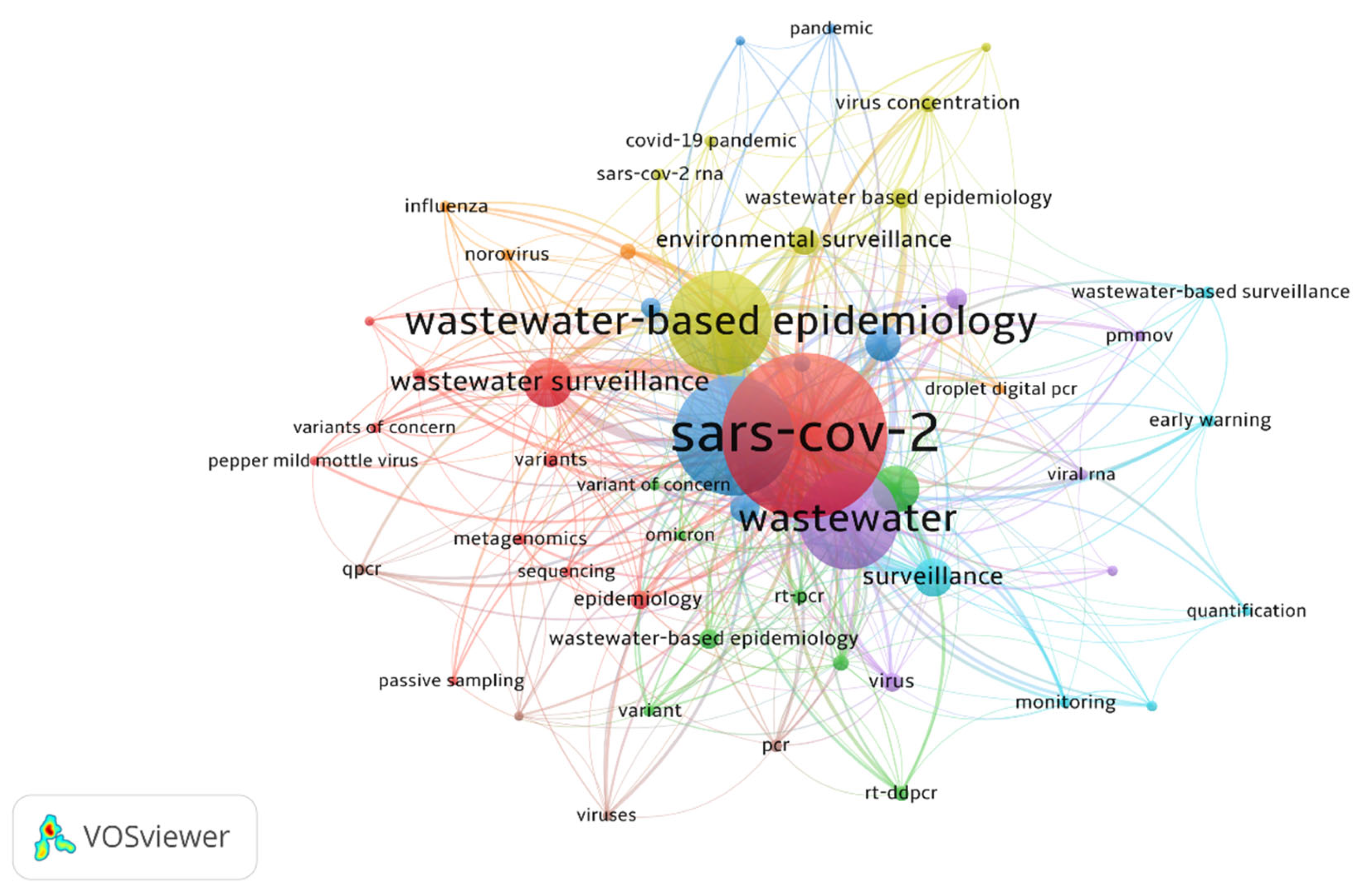
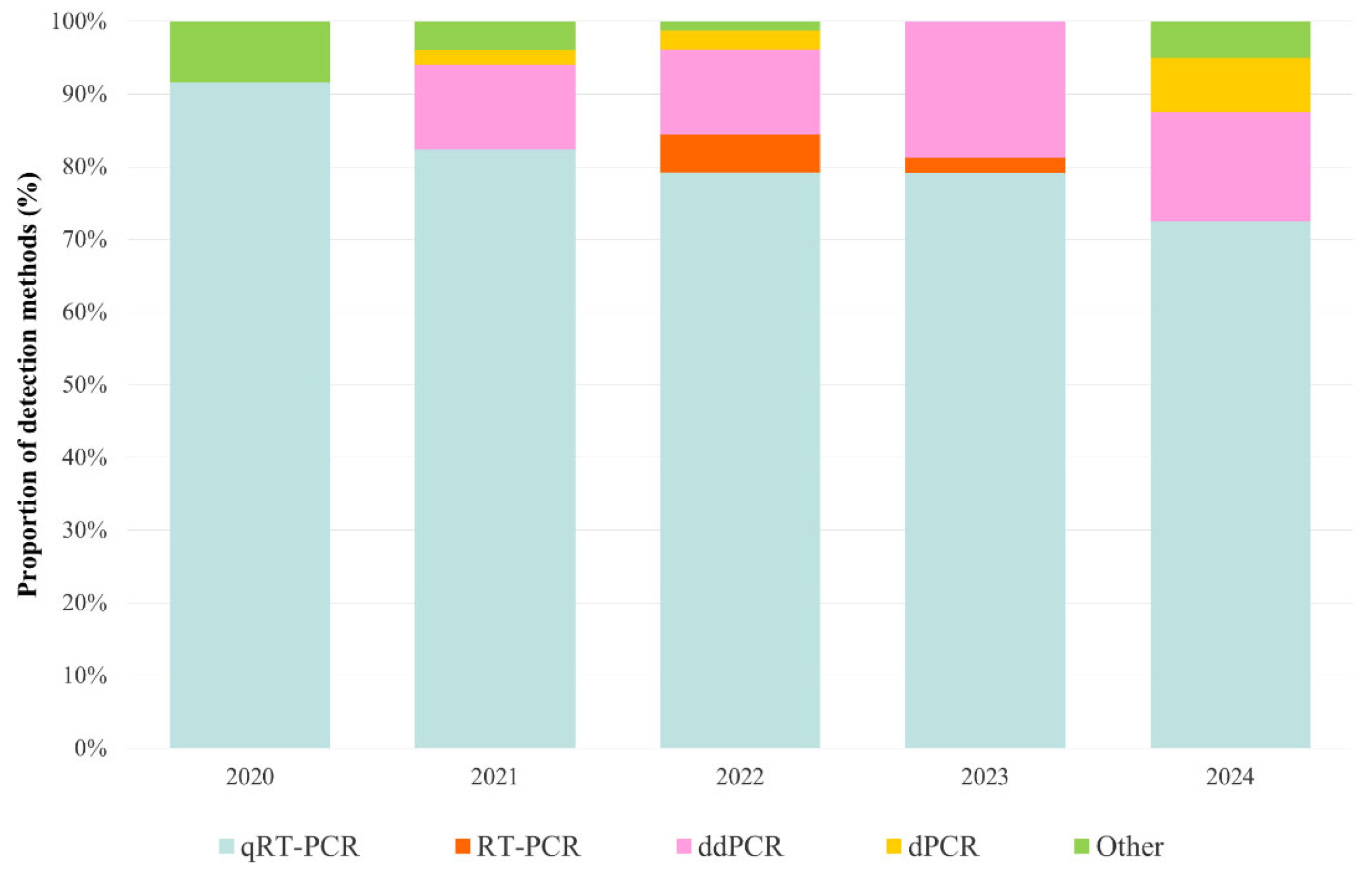
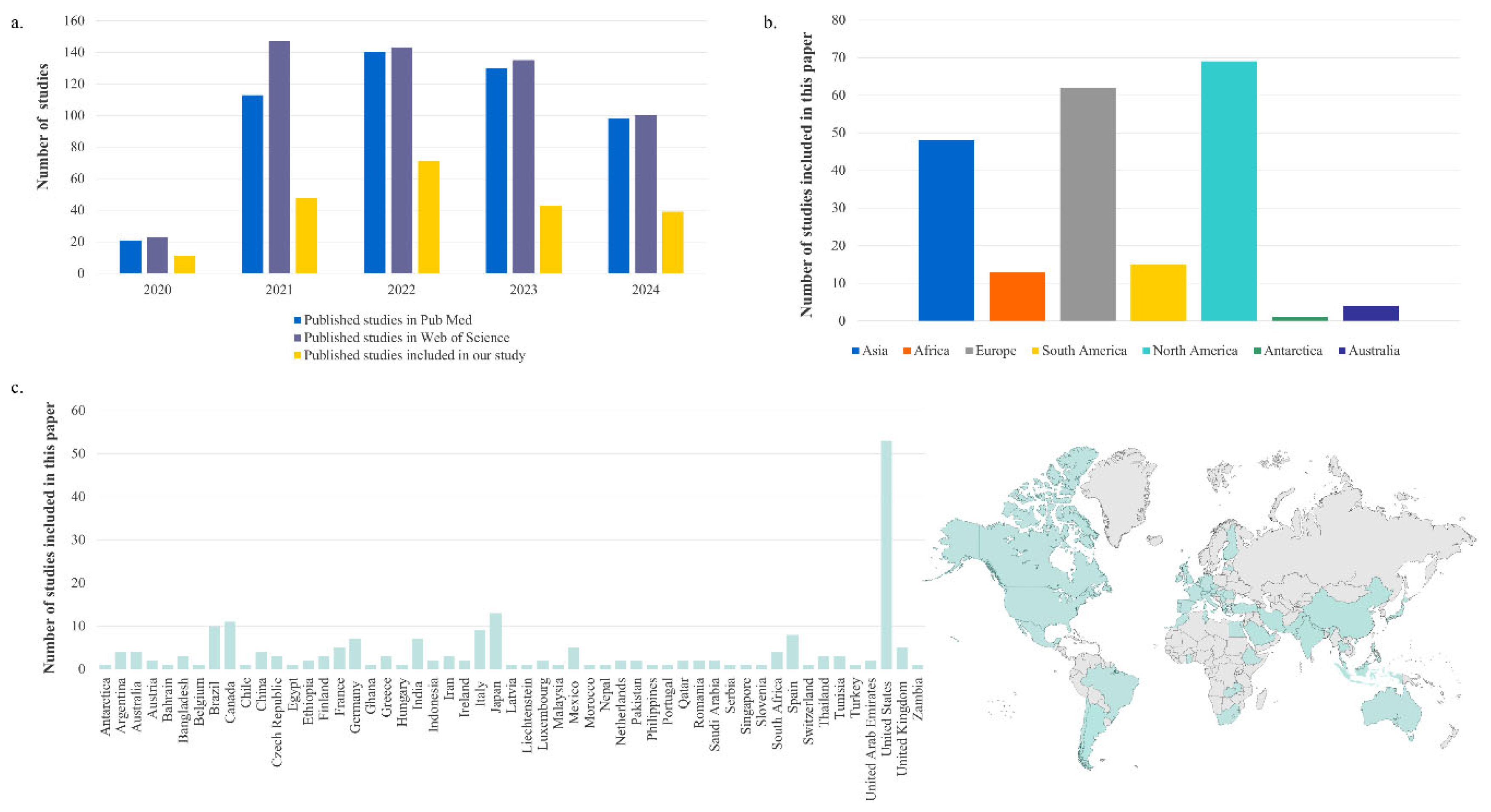
| Criteria | Query | No. of Results in WoS | No. of Results in PubMed |
|---|---|---|---|
| 1 | (“waste water” OR “wastewater” OR “wastewater treatment plant” OR “WWTP” OR “untreated wastewater” OR “sewerage system” OR “sewage” OR “river” OR “untreated wastewater”) NOT (review) | 261,384 | 84,167 |
| 2 | (“Human Coronavirus” OR “SARS Virus” OR “Severe acute respiratory syndrome” OR “SARS-CoV-2” OR “COVID-19” OR “COVID19” OR “2019-nCoV” OR “SARS-CoV” OR “severe acute respiratory syndrome coronavirus 2” OR “HCoV” OR “nCoV” OR “Novel coronavirus 2019” OR “2019 novel coronavirus” OR “Wuhan coronavirus” OR “novel coronavirus” OR “coronavirus 2019” OR “novel coronavirus disease”) NOT (review) | 393,065 | 370,210 |
| 3 | (“detection” OR “quantification” OR “RT-PCR” OR “qRT-PCR” OR “dPCR” OR “PCR” OR “Polymerase Chain Reaction”) NOT (review) | 881,717 | 511,099 |
| 4 | (“WBE” OR “monitoring” OR “surveillance” OR “monitoring system” OR “surveillance system” OR “wastewater-based epidemiology” OR “wastewater-based epidemiology surveillance” OR “wastewater-based epidemiology” OR “environmental monitoring” OR “wastewater-based”) NOT (review) | 474,040 | 318,545 |
| 5 | (“RNA” OR “ribonucleic acid” OR “nucleic acid” OR “viable particles”) NOT (review) | 243,758 | 277,156 |
| 1 AND 2 AND 3 AND 4 AND 5(“waste water” OR “wastewater” OR “wastewater treatment plant” OR “WWTP” OR “untreated wastewater” OR “sewerage system” OR “sewage” OR “river” OR “untreated wastewater”) AND (“Human Coronavirus” OR “SARS Virus” OR “Severe acute respiratory syndrome” OR “SARS-CoV-2” OR “COVID-19” OR “COVID19” OR “2019-nCoV” OR “SARS-CoV” OR “severe acute respiratory syndrome coronavirus 2” OR “HCoV” OR “nCoV” OR “Novel coronavirus 2019” OR “2019 novel coronavirus” OR “Wuhan coronavirus” OR “novel coronavirus” OR “coronavirus 2019” OR “novel coronavirus disease”) AND (“detection” OR “quantification” OR “RT-PCR” OR “qRT-PCR” OR “dPCR” OR “PCR” OR “Polymerase Chain Reaction”) AND (“WBE” OR “monitoring” OR “surveillance” OR “monitoring system” OR “surveillance system” OR “wastewater-based epidemiology” OR “wastewater-based epidemiology surveillance” OR “wastewater-based epidemiology” OR “environmental monitoring” OR “wastewater-based”) AND (“RNA” OR “ribonucleic acid” OR “nucleic acid” OR “viable particles”) NOT (review) | 548 | 509 |
| Implementation Level | Objective | Matrix Type | Sampling Method | Extraction Strategy | Detection & Analysis |
|---|---|---|---|---|---|
| BASIC | Early warning | Raw influent | Grab or composite | Standard commercial viral RNA kits | qRT-PCR |
| STANDARD | Trend monitoring | Primary sludge (or influent) | 24 h composite | Robust kits with enhanced inhibitor removal | dPCR/ddPCR (Superior for high-inhibition matrices) |
| ADVANCED | Genomic surveillance | Raw influent | 24 h composite | High-purity extraction | NGS (Illumina/Nanopore) and bioinformatics |
| Method | Sensitivity | Feasibility | Specificity | Advantages | Disadvantages |
|---|---|---|---|---|---|
| qRT-PCR | High | High Extensive accessibility | High | This product is widely used, delivering rapid results with quantifiable outcomes | Affected by PCR inhibitors |
| dPCR | Very high | Moderate Specialised equipment is necessary for this process | High | It offers higher precision and absolute quantification | Higher cost. The processing time is longer, and the workflow is complex |
| ddPCR | Very high | Moderate: This process requires specialised equipment | High | It offers higher precision and absolute quantification | Higher cost The processing time is longer, and the workflow is complex |
| Sanger Sequencing | Moderate | Low | High | This technology is accurate for specific genes and cost-effective for small-scale studies | This system has two main limitations: low throughput and limited ability to detect multiple variants simultaneously. As a result, it is not suitable for variant discovery |
| Illumina Sequencing | High | Low This field requires a high level of expertise in bioinformatics | High | The system is characterised by its high throughput capacity and its ability to detect variants with a high degree of accuracy | The process is both costly and time-consuming due to the necessity of complex library preparation techniques. Furthermore, the utilisation of short reads imposes limitations on the comprehensive assembly of genomes |
| Oxford Nanopore Sequencing | High | Moderate Portable alternatives | High | This technology is characterised by its mobility, the capacity for real-time sequencing, and the capability to generate long reads | The implementation of bioinformatics expertise is essential, and the necessity for error correction has been identified |
Disclaimer/Publisher’s Note: The statements, opinions and data contained in all publications are solely those of the individual author(s) and contributor(s) and not of MDPI and/or the editor(s). MDPI and/or the editor(s) disclaim responsibility for any injury to people or property resulting from any ideas, methods, instructions or products referred to in the content. |
© 2026 by the authors. Licensee MDPI, Basel, Switzerland. This article is an open access article distributed under the terms and conditions of the Creative Commons Attribution (CC BY) license.
Share and Cite
Deák, G.; Lupu, L.; Prangate, R. A Systematic Review of Methodological Approaches to SARS-CoV-2 Wastewater Surveillance. Viruses 2026, 18, 205. https://doi.org/10.3390/v18020205
Deák G, Lupu L, Prangate R. A Systematic Review of Methodological Approaches to SARS-CoV-2 Wastewater Surveillance. Viruses. 2026; 18(2):205. https://doi.org/10.3390/v18020205
Chicago/Turabian StyleDeák, György, Laura Lupu, and Raluca Prangate. 2026. "A Systematic Review of Methodological Approaches to SARS-CoV-2 Wastewater Surveillance" Viruses 18, no. 2: 205. https://doi.org/10.3390/v18020205
APA StyleDeák, G., Lupu, L., & Prangate, R. (2026). A Systematic Review of Methodological Approaches to SARS-CoV-2 Wastewater Surveillance. Viruses, 18(2), 205. https://doi.org/10.3390/v18020205