Article

Vaccinia Virus Vector Bivalent Norovirus Vaccine

1
School of Life Science and Biopharmaceutics, Shenyang Pharmaceutical University, Shenyang 110016, China
2
State Key Laboratory of Drug Regulatory Science, Institute for Biological Product Control, National Institutes for Food and Drug Control (NIFDC), Division of HIV/AIDS and Sexually Transmitted Virus Vaccines, Beijing 102629, China
*
Authors to whom correspondence should be addressed.
These authors contributed equally to this work.
Viruses 2025, 17(2), 237; https://doi.org/10.3390/v17020237
Submission received: 24 December 2024 / Revised: 31 January 2025 / Accepted: 1 February 2025 / Published: 9 February 2025
(This article belongs to the Section Viral Immunology, Vaccines, and Antivirals)

Abstract

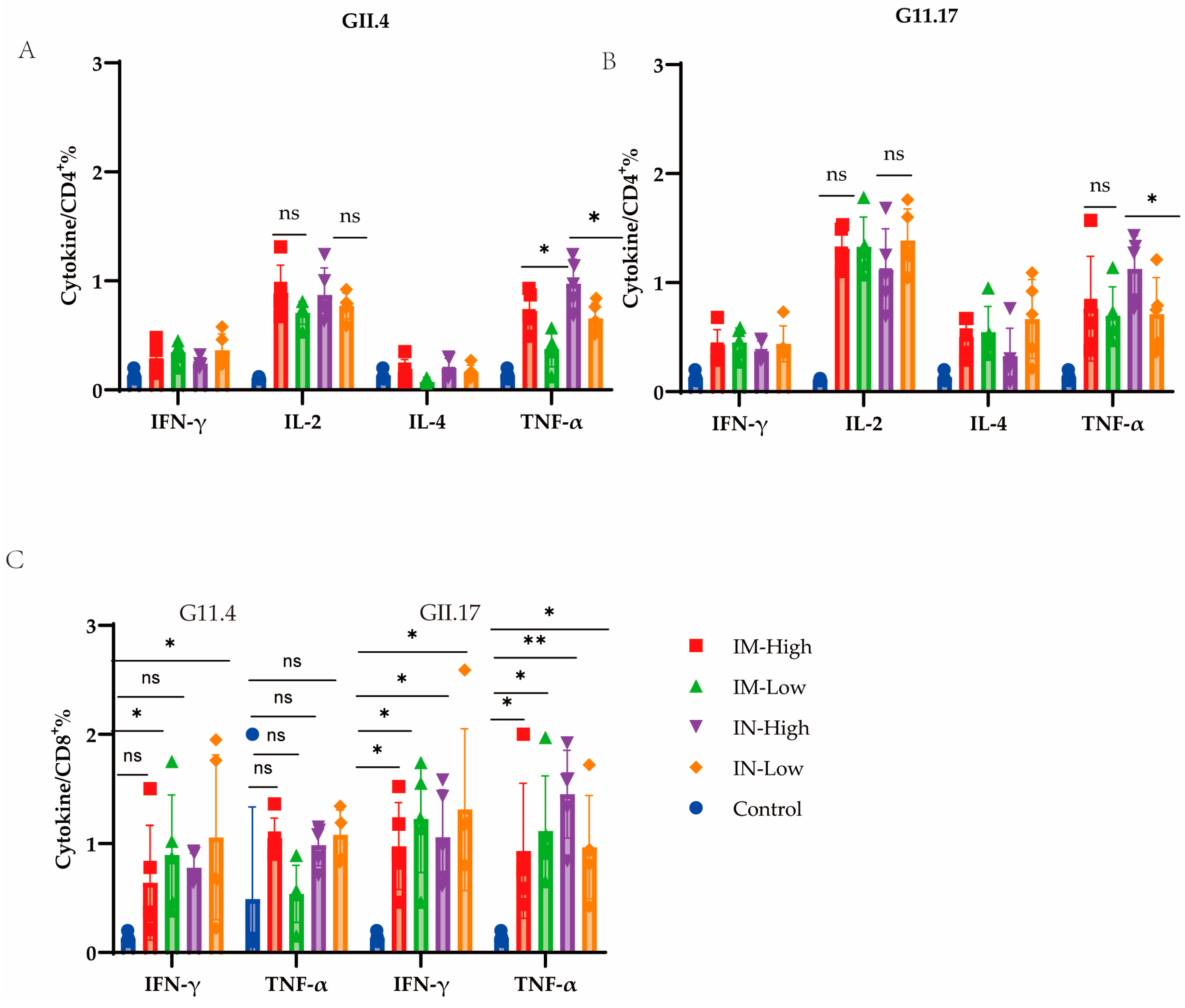
Norovirus is a major etiological agent of nonbacterial gastroenteritis around the world. Due to its in vitro culture complexity, high genome diversity, and the lack of cross-reactive immunity between genogroups, there is an unmet urgent need for polyvalent norovirus vaccines that provide broad-spectrum protection, and no vaccine has gained global approval to date. In this study, we constructed a bivalent norovirus vaccine, based on the highly attenuated poxvirus [strain VG9] vector, expressing the major capsid protein VP1 from genotypes GII.4 and GII.17. VG9-NOR exhibited a comparable replication ability to the authentic virus while preserving good safety. After the intramuscular and intranasal immunization of mice, VG9-NOR induced high IgG- and IgA-binding antibody (Ab) titers against GII.4 and GII.17, increased the secretion of GII.4 and GII.17-specific HGBA-blocking antibodies, and enhanced GII.17-specific mucosal immunity. Furthermore, VG9-NOR also induced a Th1-mediated cellular response. These results demonstrate that the polyvalent poxvirus vector vaccine expressing VP1 variants from different subtypes is able to elicit effective protection. Our study highlights the VG9 vector as a highly promising candidate for the development of polyvalent norovirus vaccines.
Keywords: norovirus; poxvirus vector; bivalent vaccine; immune response norovirus; poxvirus vector; bivalent vaccine; immune response