AI-Powered Identification of Human Cell Surface Protein Interactors of the Hemagglutinin Glycoprotein of High-Pandemic-Risk H5N1 Influenza Virus



Abstract
1. Introduction
2. Materials and Methods
3. Results
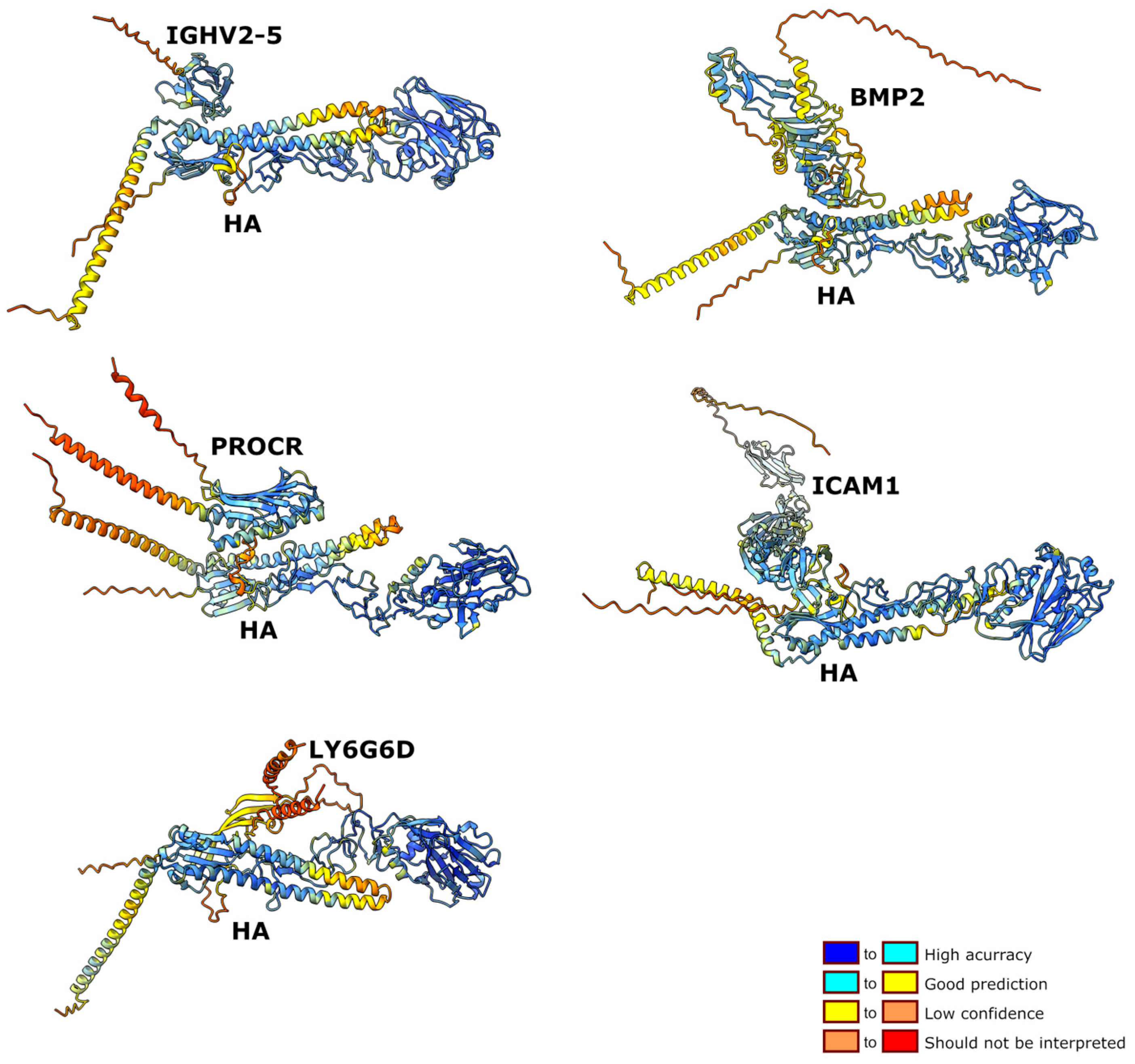
3.1. Identification of the Top 5 High-Confidence HA–Host Protein Interactions
3.2. The H5N1 HA-Interacting Proteins Form Six Functional Groups
3.3. Structural and Functional Annotation of the Remaining 26 Predicted Interactors
3.4. Subset of Predicted Interactors Overlaps with Known Influenza Host Factors
3.5. Localization Strengthens Biological Plausibility
4. Discussion
5. Conclusions
Author Contributions
Funding
Institutional Review Board Statement
Informed Consent Statement
Data Availability Statement
Acknowledgments
Conflicts of Interest
Abbreviations
| AF3 | AlphaFold 3 |
| AI | Artificial Intelligence |
| GO | Gene Ontology |
| HA | Hemagglutinin Protein |
| Ig | Immunoglobulin |
| IL | Interleukin |
| LIA | Local Interface Area |
| LIS | Local Interaction Score |
| MHC | Major Histocompatibility Complex |
| PPI | Protein–Protein Interaction |
References
- Claas, E.C.J.; Osterhaus, A.D.M.E.; van Beek, R.; De Jong, J.C.; Rimmelzwaan, G.F.; Senne, D.A.; Krauss, S.; Shortridge, K.F.; Webster, R.G. Human influenza A H5N1 virus related to a highly pathogenic avian influenza virus. Lancet 1998, 351, 472–477. [Google Scholar] [CrossRef] [PubMed]
- Subbarao, K.; Klimov, A.; Katz, J.; Regnery, H.; Lim, W.; Hall, H.; Perdue, M.; Swayne, D.; Bender, C.; Huang, J.; et al. Characterization of an avian influenza A (H5N1) virus isolated from a child with a fatal respiratory illness. Science 1998, 279, 393–396. [Google Scholar] [CrossRef] [PubMed]
- WHO. Human Infection caused by Avian Influenza A(H5N1)—Chile. Disease Outbreak News. 21 April 2023. Available online: https://www.who.int/emergencies/disease-outbreak-news/item/2023-DON461 (accessed on 9 November 2025).
- UK Health Security Agency. Avian Influenza (H5N1) Confirmed in UK; UKHSA Technical Briefing; UK Health Security Agency: London, UK, 2023. [Google Scholar]
- Garg, S.; Reed, C.; Davis, C.T.; Uyeki, T.M.; Behravesh, C.B.; Kniss, K.; Budd, A.; Biggerstaff, M.; Adjemian, J.; Barnes, J.R.; et al. Outbreak of Highly Pathogenic Avian Influenza A(H5N1) Viruses in U.S. Dairy Cattle and Detection of Two Human Cases-United States, 2024. MMWR Morb. Mortal. Wkly. Rep. 2024, 73, 501–505. [Google Scholar] [CrossRef]
- Agüero, M.; Monne, I.; Sánchez, A.; Zecchin, B.; Fusaro, A.; Ruano, M.J.; del Valle Arrojo, M.; Fernández-Antonio, R.; Suoto, A.M.; Tordable, P.; et al. Highly pathogenic avian influenza A(H5N1) virus infection in farmed minks, Spain, October 2022. Euro Surveill. 2023, 28, 2300009. [Google Scholar] [CrossRef]
- Puryear, W.; Sawatzki, K.; Hill, N.; Foss, A.; Stone, J.; Doughty, L.; Walk, D.; Gilbert, K.; Murray, M.; Cox, E.; et al. Outbreak of highly pathogenic avian influenza H5N1 in New England seals. Nature 2023, 619, 440–445. [Google Scholar]
- National Veterinary Services Laboratories (NVSL). Detection of Highly Pathogenic Avian Influenza A(H5N1) in Dairy Cattle—United States; National Veterinary Services Laboratories: Ames, IA, USA, 2024. [Google Scholar]
- WHO. Avian Influenza A(H5N1): Situation Update; WHO: Geneva, Switzerland, 2024. [Google Scholar]
- Skehel, J.J.; Wiley, D.C. Receptor binding and membrane fusion in virus entry: The influenza hemagglutinin. Annu. Rev. Biochem. 2000, 69, 531–569. [Google Scholar] [CrossRef]
- Russell, C.J.; Hu, M.; Okda, F.A. Influenza hemagglutinin protein stability, activation, and pandemic risk. Trends Microbiol. 2018, 26, 841–853. [Google Scholar] [CrossRef] [PubMed]
- Herfst, S.; Schrauwen, E.J.A.; Linster, M.; Chutinimitkul, S.; de Wit, E.; Munster, V.J.; Sorrell, E.M.; Bestebroer, T.M.; Burke, D.F.; Smith, D.J.; et al. Airborne transmission of influenza A/H5N1 virus between ferrets. Science 2012, 336, 1534–1541. [Google Scholar] [CrossRef]
- Yang, H.; Carney, P.J.; Chang, J.C.; Villanueva, J.M.; Stevens, J. Structure and receptor binding preferences of recombinant hemagglutinins from avian and human H5N1 influenza viruses. J. Virol. 2015, 89, 4612–4623. [Google Scholar] [CrossRef]
- Wang, J.; Yang, P.; Zhang, Y.; Li, H.; Zhu, W.; Liu, L.; Wang, Q.; Chen, Y.; Gao, R.; Shu, Y.; et al. A single HA mutation switches receptor specificity of bovine H5N1 toward human-like sialylated glycans. Science 2024, 384, eadt0180. [Google Scholar]
- Benton, D.J.; Gamblin, S.J.; Skehel, J.J. Structural insights into influenza virus HA–glycan interactions. Structure 2025, 33, 1–13. [Google Scholar]
- Fu, Y.; Zhang, Y.; Gu, H.; Qin, C.; Hu, Y.; Chen, Y.; Wang, J.; Yang, W.; Liu, J.; Gao, G.F.; et al. Binding of influenza A (H5N1) virus hemagglutinin to human γδ T cells. PLoS ONE 2014, 9, e98176. [Google Scholar]
- Liu, S.; Liu, X.; Wu, N.C.; Das, S.R.; McBride, R.; He, J.; Xu, R.; Wilson, I.A.; Paulson, J.C.; Ward, A.B.; et al. Multivalent glycan-mediated binding of influenza HA filaments enhances avidity. Nat. Commun. 2024, 15, 1509. [Google Scholar]
- Watanabe, T.; Watanabe, S.; Kawaoka, Y. Influenza virus–host interactions: Mechanisms of viral pathogenesis. Nat. Rev. Microbiol. 2010, 8, 267–278. [Google Scholar]
- Tripathi, S.; Batra, J.; Lal, S.K. Interplay between influenza A virus and host factors: Targets for antiviral intervention. Front. Microbiol. 2017, 8, 739. [Google Scholar] [CrossRef] [PubMed]
- Jumper, J.; Evans, R.; Pritzel, A.; Green, T.; Figurnov, M.; Ronneberger, O.; Tunyasuvunakool, K.; Bates, R.; Žídek, A.; Potapenko, A.; et al. Highly accurate protein structure prediction with AlphaFold. Nature 2021, 596, 583–589. [Google Scholar] [CrossRef]
- Bryant, P.; Pozzati, G.; Elofsson, A. Improved prediction of protein–protein interactions using AlphaFold2. Nat. Commun. 2022, 13, 1265. [Google Scholar] [CrossRef]
- Gao, W.; Zhao, J.; Wang, L.; Li, X.; Chen, H.; Zhang, Y.; Liu, Y.; Sun, Z.; Zhou, X.; Li, Y.; et al. AI-based prediction of virus–host protein interactions. Brief. Bioinform. 2024, 25, bbae034. [Google Scholar]
- Rao, R.; Liu, J.; Verkuil, R.; Meier, J.; Canny, J.; Abbeel, P.; Sercu, T.; Rives, A.; Marks, D.S.; Hopkins, M.; et al. Computational prediction of protein complexes with AlphaFold-Multimer. Science 2022, 375, 780–785. [Google Scholar]
- Li, B.; Li, X.; Li, X.; Wang, L.; Lu, J.; Wang, J. Predicting influenza A virus–human protein–protein interactions using machine learning. PeerJ 2024, 12, e18863. [Google Scholar]
- Wang, H.; Lin, Y.; Luo, Z.; Sun, Y.; Chen, J.; Zhang, Y.; Li, X.; Zhao, Y.; Liu, H.; Zhou, Y.; et al. Host tropism prediction for influenza viruses based on HA and NA sequences using deep learning. Front. Immunol. 2022, 13, 834617. [Google Scholar]
- Yang, C.; Chen, J.; Luo, F.; Li, H.; Zhang, Y.; Wang, J.; Liu, X.; Zhou, Y.; Sun, Z.; Li, Y.; et al. Multi-channel neural networks for influenza virus classification. Bioinformatics 2021, 37, 4012–4020. [Google Scholar]
- Abramson, J.; Adler, J.; Dunger, J.; Evans, R.; Green, T.; Pritzel, A.; Ronneberger, O.; Willmore, L.; Ballard, A.J.; Bambrick, J.; et al. Accurate structure prediction of biomolecular interactions with AlphaFold 3. Nature 2024, 630, 493–500. [Google Scholar] [CrossRef]
- Kim, A.R.; Hu, Y.; Comjean, A.; Rodiger, J.; Mohr, S.E.; Perrimon, N. Enhanced protein–protein interaction discovery via AlphaFold-Multimer. bioRxiv 2024. preprint. [Google Scholar] [CrossRef]
- Lefranc, M.-P.; Giudicelli, V.; Ginestoux, C.; Jabado-Michaloud, J.; Folch, G.; Bellahcene, F.; Wu, Y.; Gemrot, E.; Brochet, X.; Lane, J.; et al. IMGT®, the international ImMunoGeneTics information system®. Nucleic Acids Res. 2009, 37, D1006–D1012. [Google Scholar] [CrossRef]
- Jelkmann, W. Regulation of erythropoietin production. Physiol. Rev. 2012, 92, 449–489. [Google Scholar] [CrossRef]
- de Beaucoudrey, L.; Puel, A.; Filipe-Santos, O.; Cobat, A.; Ghandil, P.; Chrabieh, M.; Feinberg, J.; von Bernuth, H.; Samarina, A.; Jannière, L.; et al. Mutations in STAT3 and IL12RB1 impair the development of human IL-17–producing T cells. Semin. Immunol. 2007, 19, 331–340. [Google Scholar] [CrossRef]
- Waldmann, T.A. The biology of interleukin-15: Implications for cancer therapy and immune regulation. Nat. Rev. Immunol. 2006, 6, 595–601. [Google Scholar] [CrossRef]
- Wang, Z.; Shen, D.; Parsons, D.W.; Bardelli, A.; Sager, J.; Szabo, S.; Ptak, J.; Silliman, N.; Peters, B.A.; van der Heijden, M.S.; et al. Mutational analysis of the tyrosine phosphatome in colorectal cancers. Science 2004, 304, 1164–1166. [Google Scholar] [CrossRef] [PubMed]
- Rhodes, D.A.; Reith, W.; Trowsdale, J. Regulation of immunity by butyrophilins. J. Immunol. 2005, 174, 3045–3052. [Google Scholar] [CrossRef] [PubMed]
- de Wit, J.; Ghosh, A. Specification of synaptic connectivity by cell surface interactions. Nat. Rev. Neurosci. 2016, 17, 22–35. [Google Scholar] [CrossRef] [PubMed]
- Poon, I.K.H.; Patel, K.K.; Davis, D.S.; Parish, C.R.; Hulett, M.D. Histidine-rich glycoprotein: The Swiss Army knife of mammalian plasma. J. Thromb. Haemost. 2011, 9, 203–213. [Google Scholar] [CrossRef] [PubMed]
- Kong, Y.-Y.; Yoshida, H.; Sarosi, I.; Tan, H.-L.; Timms, E.; Capparelli, C.; Morony, S.; Oliveira-dos-Santos, A.J.; Van, G.; Itie, A.; et al. OPGL is a key regulator of osteoclastogenesis, lymphocyte development and lymph-node organogenesis. Nature 1999, 397, 315–323. [Google Scholar] [CrossRef]
- Magnuson, B.; Ekim, B.; Fingar, D.C. Regulation and function of ribosomal protein S6 kinase (S6K) within mTOR signalling networks. Cell Metab. 2012, 15, 283–297. [Google Scholar] [CrossRef]
- Mullighan, C.G.; Collins-Underwood, J.R.; Phillips, L.A.; Loudin, M.G.; Liu, W.; Zhang, J.; Ma, J.; Coustan-Smith, E.; Harvey, R.C.; Willman, C.L.; et al. Rearrangement of CRLF2 in B-progenitor– and Down syndrome–associated acute lymphoblastic leukemia. Nat. Genet. 2009, 41, 1243–1246. [Google Scholar] [CrossRef]
- Kuespert, K.; Pils, S.; Hauck, C.R. CEACAMs: Their role in physiology and pathophysiology. Nat. Rev. Microbiol. 2006, 4, 611–621. [Google Scholar] [CrossRef]
- Südhof, T.C. Neuroligins and neurexins link synaptic function to cognitive disease. Nature 2008, 455, 903–911. [Google Scholar] [CrossRef]
- Kurima, K.; Peters, L.M.; Yang, Y.; Riazuddin, S.; Ahmed, Z.M.; Naz, S.; Arnaud, D.; Drury, S.; Mo, J.; Makishima, T.; et al. Dominant and recessive deafness caused by mutations of TMC1. Nat. Genet. 2002, 30, 277–284. [Google Scholar] [CrossRef]
- Imai, Y.; Soda, M.; Takahashi, R. Parkin suppresses unfolded protein stress-induced cell death through its E3 ubiquitin-protein ligase activity. J. Neurochem. 2000, 75, 2513–2520. [Google Scholar] [CrossRef]
- Wright, G.J.; Cherwinski, H.; Foster-Cuevas, M.; Brooke, G.; Puklavec, M.J.; Bigler, M.; Song, Y.; Jenmalm, M.; Gorman, D.; McClanahan, T.; et al. Characterization of the CD200 receptor family in mice and humans. Immunology 2009, 128, 1–13. [Google Scholar]
- Lanier, L.L.; Chang, C.; Phillips, J.H. Human NKR-P1: A C-type lectin superfamily member expressed by a subset of NK and T lymphocytes. J. Immunol. 1993, 150, 458–468. [Google Scholar]
- Wright, S.D.; Ramos, R.A.; Tobias, P.S.; Ulevitch, R.J.; Mathison, J.C. CD14, a receptor for complexes of lipopolysaccharide (LPS) and LPS-binding protein. Science 1990, 249, 1431–1433. [Google Scholar] [CrossRef] [PubMed]
- Maxson, J.E.; Gotlib, J.; Pollyea, D.A.; Fleischman, A.G.; Agarwal, A.; Eide, C.A.; Bottomly, D.; Wilmot, B.; McWeeney, S.K.; Tognon, C.E.; et al. Oncogenic CSF3R mutations in chronic neutrophilic leukemia and atypical CML. N. Engl. J. Med. 2013, 368, 1781–1790. [Google Scholar] [CrossRef] [PubMed]
- Chuang, P.T.; McMahon, A.P. Vertebrate Hedgehog signalling modulated by induction of a Hedgehog-binding protein. Nature 1999, 397, 617–621. [Google Scholar] [CrossRef]
- Tatsuo, H.; Ono, N.; Tanaka, K.; Yanagi, Y. SLAM (CDw150) is a cellular receptor for measles virus. Nature 2000, 406, 893–897. [Google Scholar] [CrossRef]
- Weisel, J.W. Fibrinogen and fibrin. Adv. Protein Chem. 2005, 70, 247–299. [Google Scholar] [CrossRef]
- Park, S.G.; Ewalt, K.L.; Kim, S. Functional expansion of aminoacyl-tRNA synthetases and their interacting factors: New perspectives on housekeepers. Trends Biochem. Sci. 2005, 30, 569–574. [Google Scholar] [CrossRef] [PubMed]
- Pinto, R.M.; Bakshi, S.; Lytras, S.; Zakaria, M.K.; Swingler, S.; Worrell, J.C.; Herder, V.; Hargrave, K.E.; Varjak, M.; Cameron-Ruiz, N.; et al. BTN3A3 evasion promotes the zoonotic potential of influenza A viruses. Nature 2023, 619, 338–347. [Google Scholar] [CrossRef]
- Othumpangat, S.; Timour, M.S.; Verma, V.; Piedimonte, G. Influenza virus infection increases expression of adhesion molecules in bronchial epithelial cells. Virology 2016, 496, 1–10. [Google Scholar]
- Ye, Z.-W.; Yuan, S.; Chan, J.F.-W.; Zhang, A.J.; Yu, C.-Y.; Ong, C.P.; Chan, K.-H.; Yuen, K.-Y.; Kok, K.-H.; Jin, D.-Y.; et al. CEACAM1 regulates cytokine responses in primary human alveolar epithelial cells infected with H5N1 influenza virus. Sci. Rep. 2018, 8, 16924. [Google Scholar] [CrossRef]
- McGrath, J.C.; Fajardo, I.; Guven, N.; Shan, M.; Wong, C.; Daigneault, A.; Chen, Y.; Kotas, M.E.; McNagny, K.M.; Hogg, J.C.; et al. Neutrophil-driven alveolar barrier disruption in influenza requires CSF3–CSF3R signaling. Eur. Respir. J. 2022, 59, 2102977. [Google Scholar]
- Shirey, K.A.; Lai, W.; Scott, A.J.; Lipsky, M.; Mistry, P.; Pletneva, L.M.; Karp, C.L.; McAlees, J.; Gioannini, T.L.; Weiss, J.; et al. The TLR4 antagonist Eritoran protects mice from lethal influenza infection. Nature 2013, 497, 498–502. [Google Scholar] [CrossRef] [PubMed]
- Poon, I.K.H.; Patel, K.K.; Davis, D.S.; Parish, C.R.; Hulett, M.D. Histidine-rich glycoprotein: The Swiss Army knife of mammalian plasma. Blood 2011, 117, 2093–2101. [Google Scholar] [CrossRef] [PubMed]
- Gordon, D.E.; Jang, G.M.; Bouhaddou, M.; Xu, J.; Obernier, K.; White, K.M.; O’Meara, M.J.; Rezelj, V.V.; Guo, J.Z.; Swaney, D.L.; et al. A SARS-CoV-2 protein interaction map reveals targets for drug repurposing. Nature 2020, 583, 459–468. [Google Scholar] [CrossRef]
- Haas, K.M.; McGregor, M.J.; Bouhaddou, M.; Polacco, B.J.; Kim, E.-Y.; Nugyan, T.T.; Newton, B.W.; Urbanowski, M.; Kim, H.; Williams, M.A.P.; et al. Proteomic and genetic analyses of influenza A viruses identify pan-viral host targets. Nat. Commun. 2023, 14, 6030. [Google Scholar] [CrossRef]


| Group | Representative Proteins | Functional Axis | H5N1 Connection |
|---|---|---|---|
| Immune/Inflammatory | ICAM1, IL12RB1, IL15, SLAMF1, KLRB1 | Cytokine and immune signaling | Cytokine storm, immune modulation |
| Surface/Adhesion | PROCR, CEACAM19, LY6G6D | Viral entry and cell binding | Potential alternative HA interactions |
| Growth Factors | BMP2, AIMP1, EPO | Tissue repair, host growth regulation | Host remodeling post infection |
| Neural/Synaptic | LRFN2, GPR37 | Neurotropic or cross-reactive pathways | Potential neurological sequelae |
| Signaling Enzymes | RPS6KB1, PTPRT | Intracellular signaling regulation | Virus-induced signaling reprogramming |
| Plasma/Structural | FGB, HRG, CSF3R | Coagulation, barrier integrity | Vascular leakage, sepsis-like features |
| Symbol | Function/Role | Disease Links | Expression | Localization | Structural Notes | Key Reference |
|---|---|---|---|---|---|---|
| IGHV1-3 | Immunoglobulin heavy variable segment shaping antigen specificity. | Autoimmunity, infection, B-cell malignancy. | B cells/plasma cells | Plasma membrane/secreted | Ig V-domain; CDR loops define binding. | [29] |
| IGHV3-30-3 | Ig heavy variable segment (antigen binding). | As above. | B-cell lineage | Plasma membrane/secreted | Ig V-domain | [29] |
| EPO | Cytokine driving erythropoiesis via EPOR. | Anemia, polycythemia, CKD; tumors. | Kidney interstitial cells; secreted to plasma | Secreted | 4-helix bundle cytokine | [30] |
| IGHV3-30 | Ig heavy variable segment. | As above. | B-cell lineage | Plasma membrane/secreted | Ig V-domain | [29] |
| IGHV3-30-5 | Ig heavy variable segment. | As above. | B-cell lineage | Plasma membrane/secreted | Ig V-domain | [29] |
| IL12RB1 | IL-12/23 receptor β1 subunit; Th1/NK signaling. | MSMD immunodeficiency. | T cells, NK cells, DCs | Plasma membrane (type I receptor) | FN3 domains | [31] |
| IL15 | NK and CD8 T-cell homeostasis; transpresentation by IL15RA. | Autoimmunity, inflammation, cancer. | APCs, stromal and epithelial cells | Secreted | 4-helix bundle cytokine | [32] |
| PTPRT | Receptor-type tyrosine phosphatase; tumor suppressor. | CRC, brain tumors. | Neuronal and epithelial | Plasma membrane (Ig/FN3 ectodomain) | Dual PTP domains | [33] |
| BTN3A3 | Butyrophilin family immune modulator. | Viral and tumor immunity. | APCs, epithelia | Plasma membrane (Ig-like ectodomain) | B30.2/PRY-SPRY domain | [34] |
| LRFN2 | Synaptic adhesion; excitatory synapse assembly. | Neurodevelopmental disorders. | Neurons | Plasma membrane (LRR/FN3) | TM, short tail | [35] |
| HRG | Histidine-rich glycoprotein; coagulation/immunity. | Sepsis, thrombosis, cancer. | Liver plasma protein | Secreted | Cystatin-like domains; Zn2+ | [36] |
| TNFRSF11A (RANK) | RANK receptor; bone and immune signaling. | Osteopetrosis, Paget’s disease, metastasis. | Osteoclast precursors, DCs, epithelia | Plasma membrane (TNFR) | Cysteine-rich domains | [37] |
| RPS6KB1 | p70S6K; mTORC1 effector. | Cancer (oncogenic activation). | Broad, high in proliferating cells | Cytosolic | Ser/Thr kinase (Thr389) | [38] |
| CRLF2 | TSLP receptor subunit; B-cell development. | B-ALL; allergy. | Hematopoietic progenitors, thymic stroma | Plasma membrane | Type I cytokine receptor | [39] |
| CEACAM19 | CEACAM family adhesion molecule. | Epithelial cancers. | Epithelium (predicted) | Plasma membrane | Ig-like ectodomains | [40] |
| LRFN5 | Synaptic adhesion; neuronal connectivity. | Neurodevelopmental traits. | Neurons | Plasma membrane (LRR) | TM | [41] |
| TMC1 | Mechanotransduction channel component. | DFNB7/11 deafness. | Cochlear hair cells | Multi-pass membrane | Channel-like protein | [42] |
| GPR37 | GPCR in neuronal/myelin biology; parkin substrate. | Parkinson’s, leukodystrophy. | Oligodendrocytes, neurons | Plasma membrane (GPCR) | Class A, 7TM | [43] |
| CD200R1L | CD200 receptor-like immune modulator. | Immune regulation. | Myeloid lineage (pred.) | Plasma membrane | Ig-like ectodomains; TM | [44] |
| KLRB1 | C-type lectin-like NK/T-cell receptor. | Autoimmunity, infections, cancer. | NK, NKT, CD4/CD8 T-cells | Plasma membrane (type II) | CTLR homodimer | [45] |
| LBP | LPS-binding protein for TLR4 signaling. | Sepsis, infection susceptibility. | Liver, plasma; GI epithelia | Secreted | Lipid-binding protein | [46] |
| CSF3R | G-CSF receptor; granulopoiesis. | CNL/AML; neutropenia. | Myeloid progenitors, neutrophils | Plasma membrane (type I receptor) | Cytokine receptor | [47] |
| HHIP | Hedgehog-interacting protein. | COPD, cancer, development. | Lung, cartilage | Secreted | Hh-binding protein | [48] |
| SLAMF1 | SLAM-family lymphocyte activator. | Measles entry receptor; immune regulation. | Activated T/B cells, DCs, macrophages | Plasma membrane (IgV/IgC) | ITSM motifs | [49] |
| FGB | Fibrinogen β-chain. | Dysfibrinogenemia, thrombosis, CVD. | Liver → plasma | Secreted | Fibrinogen domains | [50] |
| AIMP1 | tRNA synthetase scaffold; secreted stress cytokine-like factor. | Inflammation, angiogenesis, cancer. | Ubiquitous; stress secretion | Secreted/cytosolic | Adaptor; extracellular processed | [51] |
| Protein | Localization | Influenza-Related Evidence | Key Reference |
|---|---|---|---|
| BTN3A3 | Plasma membrane | Primate-specific antiviral restriction factor inhibiting avian IAV replication; expressed in human airway cells. | [52] |
| ICAM1 | Plasma membrane | Upregulated in influenza-infected airway epithelial cells; modulates viral survival and cytokine responses. | [53] |
| CEACAM19 (via CEACAM1) | Plasma membrane | CEACAM1 highly induced in H5N1-infected alveolar type II cells; enhances inflammatory signaling. | [54] |
| CSF3R | Plasma membrane | CSF3–CSF3R axis drives neutrophilic lung injury and barrier disruption in influenza. | [55] |
| LBP | Secreted/plasma | TLR4–LBP pathway mediates lethal influenza-induced acute lung injury; Eritoran protection in vivo. | [56] |
| HRG | Secreted/plasma | Regulates coagulation, vascular integrity, and immune responses—pathways disrupted in severe influenza. | [57] |
Disclaimer/Publisher’s Note: The statements, opinions and data contained in all publications are solely those of the individual author(s) and contributor(s) and not of MDPI and/or the editor(s). MDPI and/or the editor(s) disclaim responsibility for any injury to people or property resulting from any ideas, methods, instructions or products referred to in the content. |
© 2025 by the authors. Licensee MDPI, Basel, Switzerland. This article is an open access article distributed under the terms and conditions of the Creative Commons Attribution (CC BY) license (https://creativecommons.org/licenses/by/4.0/).
Share and Cite
Poitras, C.; Coulombe, B. AI-Powered Identification of Human Cell Surface Protein Interactors of the Hemagglutinin Glycoprotein of High-Pandemic-Risk H5N1 Influenza Virus. Viruses 2025, 17, 1638. https://doi.org/10.3390/v17121638
Poitras C, Coulombe B. AI-Powered Identification of Human Cell Surface Protein Interactors of the Hemagglutinin Glycoprotein of High-Pandemic-Risk H5N1 Influenza Virus. Viruses. 2025; 17(12):1638. https://doi.org/10.3390/v17121638
Chicago/Turabian StylePoitras, Christian, and Benoit Coulombe. 2025. "AI-Powered Identification of Human Cell Surface Protein Interactors of the Hemagglutinin Glycoprotein of High-Pandemic-Risk H5N1 Influenza Virus" Viruses 17, no. 12: 1638. https://doi.org/10.3390/v17121638
APA StylePoitras, C., & Coulombe, B. (2025). AI-Powered Identification of Human Cell Surface Protein Interactors of the Hemagglutinin Glycoprotein of High-Pandemic-Risk H5N1 Influenza Virus. Viruses, 17(12), 1638. https://doi.org/10.3390/v17121638