Article

Nondestructive Characterization of Dry Heat-Treated Fir (Abies Alba Mill.) Timber in View of Possible Structural Use


Biotechnical Faculty, University of Ljubljana, Jamnikarjeva 101, 1000 Ljubljana, Slovenia
*
Author to whom correspondence should be addressed.
Forests 2018, 9(12), 776; https://doi.org/10.3390/f9120776
Submission received: 14 November 2018 / Revised: 4 December 2018 / Accepted: 11 December 2018 / Published: 15 December 2018
(This article belongs to the Special Issue Wood Properties and Processing)

Abstract

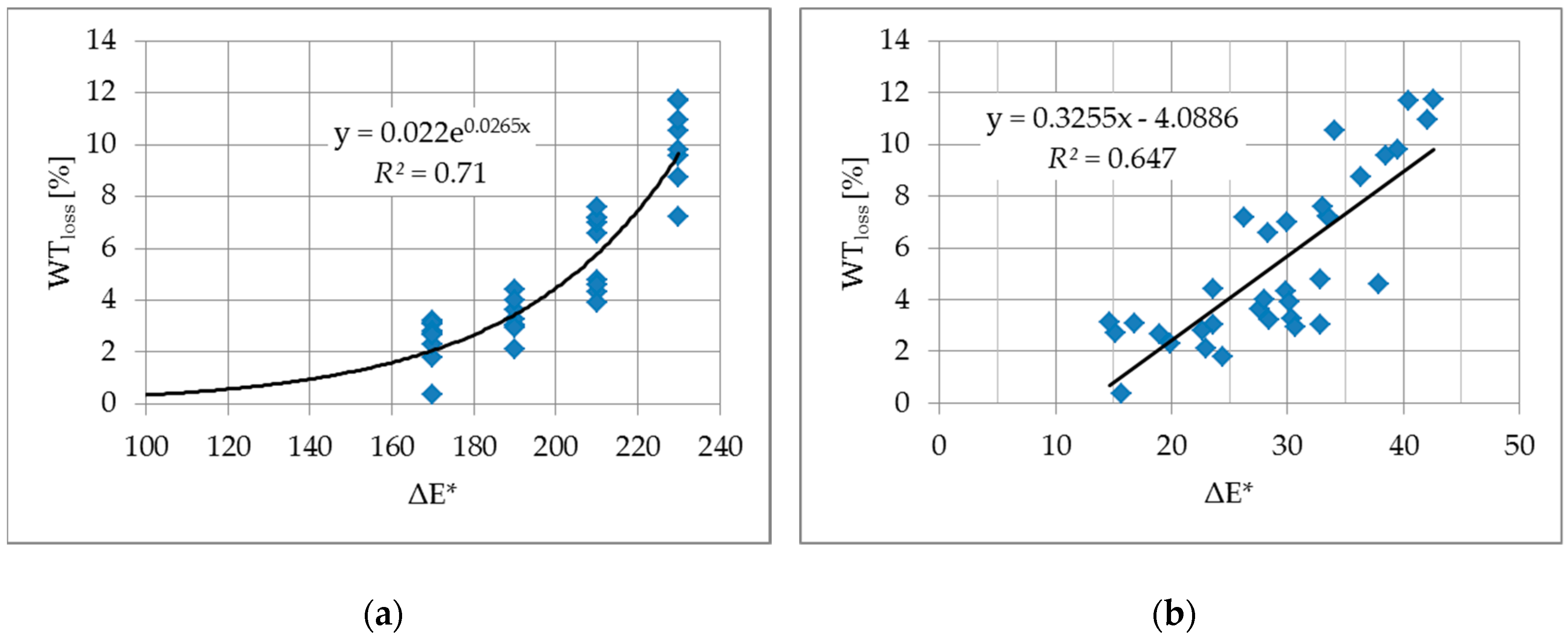
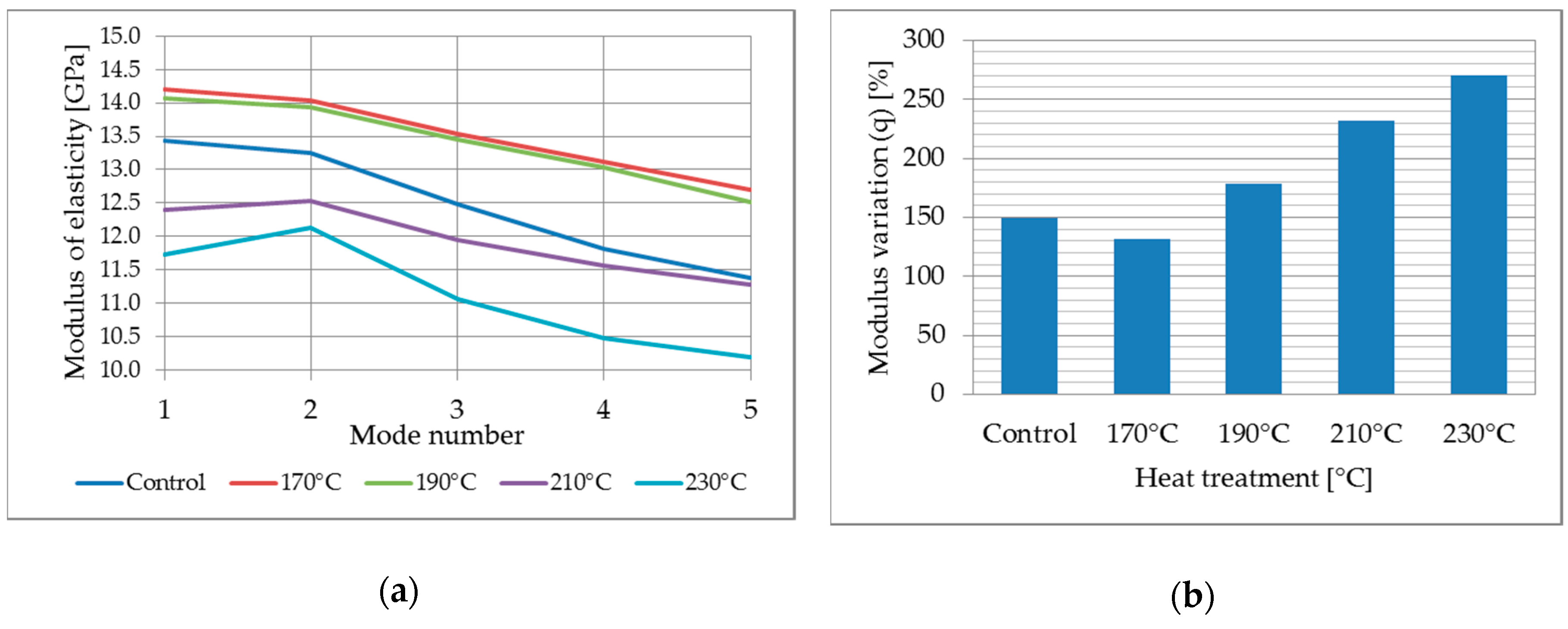
The use of heat-treated timber for building with wood is of increasing interest. Heat treatment improves the durability and dimensional stability of wood; however, it needs to be optimized to keep wood’s mechanical properties in view of the possible structural use of timber. Therefore, dry vacuum heat treatment varying the maximum temperature between 170 °C and 230 °C was used on fir (Abies alba Mill.) structural timber, visually top graded according to EN 338, to analyze its final weight loss, hygroscopicity, CIELAB color, and dynamic elastomechanical properties. It turned out that weight loss and total color difference of wood positively correlates with the increasing intensity of the heat treatment. The maximum 40% reduction of the hygroscopicity of wood was already reached at 210 °C treatment temperature. The moduli of elasticity in longitudinal and radial direction of wood, determined by ultrasound velocity, increased initially up to the treatment temperature of 210 °C, and decreased at higher treatment temperature. Equally, the Euler-Bernoulli modulus of elasticity from free-free flexural vibration of boards in all five vibration modes increased with the rising treatment temperature up to 190 °C, and decreased under more intensive treatment conditions. The Euler-Bernoulli model was found to be valid only in the 1st vibration mode of heat-treated structural timber due to the unsteady decrease in the evaluated moduli of elasticity related to the increasing mode number.
Keywords: heat treatment; wood; structural changes; nondestructive testing; ultrasound; Euler-Bernoulli; modulus of elasticity heat treatment; wood; structural changes; nondestructive testing; ultrasound; Euler-Bernoulli; modulus of elasticity