Abstract
Species in Phellinus s.s. are some of the most important wood-decaying fungal pathogens in northern temperate forests, yet data on species incidence in North America remains limited. Therefore, phylogenetic analyses were performed using four loci (ITS, nLSU, tef1 and rpb2) with isolates representing 13 species. Results of phylogenetic analyses using maximum likelihood and Bayesian inference revealed that eight species of Phellinus s.s. occur in North America, and include: P. alni, P. arctostaphyli, P. betulinus, P. lundellii, P. nigricans, P. tremulae and two undescribed species, P. NA1 and P. NA2. Meanwhile, P. tuberculosus, P. igniarius s.s., P. populicola, P. laevigatus s.s. and P. orienticus were not detected and appear restricted to Europe and/or Asia. The tef1 dataset outperformed all other loci used and was able to discriminate among all 13 of the currently known Phellinus s.s. species with significant statistical support. The internal transcribed spacer (ITS) region performed well but a high level of intraspecific variation could lead to inflated taxa recognition. Phellinus alni exhibited the broadest host range, as demonstrated previously, and appears to be the most common species in northern hardwood (Acer-Betula-Fagus), northern floodplain (Fraxinus-Populus-Ulmus) and coastal alder (Alnus) forests of North America.
1. Introduction
Based on several independent studies that utilized the morphological, biological and phylogenetic species concepts, it is clear that Phellinus sensu stricto (s.s.) is composed of a limited number of species that cause a delignifying trunk rot of deciduous hardwoods, with minor exceptions [1,2,3,4,5,6,7,8,9,10,11,12]. Numerous other species previously classified as Phellinus [13] are now members of various segregate genera (e.g., Fomitiporia, Fuscoporia, Inonotus, Onnia, Phellinidium and Porodaedalea, among others) [7,8,9].
White trunk rot of hardwoods, caused by Phellinus s.s., has been described as the single most important rot of hardwoods in North America [14]. Boyce ([15] p. 413) noted: “The false tinder fungus causes more loss than any other wood destroyer of hardwoods”. In North America, Phellinus s.s. is known to be most destructive in northern hardwood (Acer-Betula-Fagus) and aspen (Populus) forest types [14,15,16]. The presence of a single basidiocarp on the trunk of an infected tree can indicate a column of decay approximately 2 m in length for American beech (Fagus grandifolia) and sugar maple (Acer saccharum), and nearly 3 m in length for yellow birch (Betula alleghaniensis) [17]. Phellinus tremulae, one of the first species to be distinguished from the P. igniarius sensu lato (s.l.) complex [18], acts as an aggressive pathogen of aspen (Populus; especially P. tremuloides) and has been shown to cause significant losses of merchantable timber in the U.S. Lake States and Intermountain West [19,20].
For decades, white trunk rot of hardwoods was attributed to the actions of a single species, P. igniarius, even though several varieties or types were described [21,22]. While still referred to as the “P. igniarius group”, there are up to nine species of Phellinus s.s. known or suspected to occur in North America, and include: P. alni, P. acrtostaphyili, P. igniarius s.s., P. laevigatus, P. lundellii, P. nigricans, P. populicola, P. tremulae, P. tuberculosus [8,9,16,23,24]. There are additional species still described as “Phellinus” in North America (P. bicuspidatus and P. spiculosus, for example) that prior studies have shown are not members of Phellinus s.s. [8,10]. Ironically, it has been hypothesized that P. igniarius s.s. is a European species restricted to Salix [6,9]. However, a broader survey of species incidence by Tomšovský et al. [12] demonstrated that while P. igniarius s.s. is most common on Salix, it also occurs on Populus and Malus in Europe and Asia, signifying this species could potentially occur on all members of the Salicaceae and Rosaceae growing in northern temperate regions. An additional Phellinus species found only on Populus, P. populicola, is genetically similar to P. igniarius s.s. and is present throughout northern Europe and Asia [6,12]. To date, it remains unclear if either P. igniarius s.s. or P. populicola occur in North America.
Phylogenetic analyses have vastly improved the ability to discriminate genera and species in Phellinus s.l., yet most studies that include Phellinus s.s. have primarily utilized isolates collected from Europe [6,7,8,9,12], leaving North American researchers to speculate about species distribution and host specificity. The goals of this study were to determine the incidence and host distribution of Phellinus s.s. species using isolates that originated from northern temperate forests in North America. It was hypothesized that eight species of Phellinus s.s. occur in North America: P. alni, P. arctostaphyli, P. nigricans, P. laevigatus, P. lundellii, P. populicola, P. tremulae and P. tuberculosus.
2. Experimental Section
2.1. Isolates Used, DNA Extraction, PCR, and DNA Sequencing
A total of 57 isolates, representing eight presumed species from northern North America, Europe and Asia were chosen for this study and include: P. alni, P. arctostaphyli, P. nigricans, P. laevigatus, P. lundellii, P. populicola, P. tremulae and P. tuberculosus. In addition, isolates representing segregate genera in Phellinus s.l. and known to infect deciduous hardwoods were also used and include: Fuscoporia spp., Inocutis dryophila, Inonotus vaninii and Phellinopsis conchata. Fomes fomentarius was chosen to represent the outgroup. Most isolates were either field-collected by the author or obtained from the USDA Forest Service, Center for Forest Mycology Research (CFMR) herbarium. Isolates from the CFMR herbarium where chosen based on presumed species, geographic disparity and host diversity from northern North American forests that encompass the northern hardwood, aspen and alder forest types, among others (Table 1).
DNA extraction and PCR protocols have been described previously [25]. To generate PCR amplicons, the following primer pairs were used: ITS1-F and ITS4 [26] for the internal transcribed spacer (ITS); LR0R [27] and LR5 [28] the nuclear large subunit (nLSU) domains one to three; EF595F and EF1160R for partial elongation factor 1-alpha (tef1) [29]; and bRPB2-6F and bRPB2-7.1R [30] for partial RNA polymerase II, second largest subunit (rpb2) sequences. PCR products were visualized on 1% agarose gels stained with SYBR Safe (Life Technologies, Carlsbad, CA, USA) to ensure the presence of single amplicons. After visualizing the tef1 amplicons, six of the ten P. alni isolates chosen for study failed to amplify using the EF595F/EF1160R primer pair. Additional tef1 primers frequently used in phylogenetic studies of Basidiomycetes (983F/2218R) [31] were then used in the following combination to generate amplicons: (i) 983F/1160R; and (ii) EF595F/2218R. The first primer pair again failed, while the second primer pair produced single amplicons, approximately 1120 bp in size. The sequence analysis (described below) showed that isolates of P. alni can have two C/T mismatches in the EF1160R priming region, preventing successful annealing.
Prior to sequencing, PCR products were purified using ExoSAP-IT (USB, Cleveland, OH, USA). Isolates were sequenced using the Big Dye Sequencing Kit v. 3.1 on an ABI 3130xl capillary sequencer (Applied Biosystems, Foster City, CA, USA) at the Genomics Resource Laboratory, University of Massachusetts, Amherst. GenBank accession numbers are listed in Table 1.
2.2. Sequence Alignment and Phylogenetic Analysis

Raw sequences were edited using CodonCode v. 4.0.4 (CodonCode Corporation, Dedham, MA) and aligned with MAFFT v. 7 using the L-INS-i option for ITS sequences and the FFT-INS-i option for the remaining datasets [32]. Phylogenetic reconstructions were performed using maximum likelihood (ML) and Bayesian inference (BI). For ML and BI, the best-fit nucleotide substitution model was chosen using log-likelihood (-lnL) scores generated using jModelTest v. 2 [33,34]. For all data sets, the model that produced the highest -lnL score was the general time reversible (GTR) substitution model [35]. Sequences generated in this study were combined with data from previous studies [7,9,12,36,57]. Information for these isolates is provided in Table 1.
Table 1.
Information and GenBank accession numbers for isolates of Phellinus s.s..
| Species & Code | Host | State/Province | Country | Reference | GenBank Accession Nos. | |||
|---|---|---|---|---|---|---|---|---|
| ITS | nLSU | rpb2 | tef1 | |||||
| Phellinus alni | ||||||||
| DLL2009-140 | Acer rubrum | MN | USA | This study | KU139159 | KU139211 | KU139282 | KU139331 |
| NJB2011-SM1 | Acer rubrum | MA | USA | This study | KU139161 | KU139217 | KU139279 | KU139324 |
| NJB2011-SM4 | Acer rubrum | MA | USA | This study | KU139163 | KU139219 | KU139284 | KU139326 |
| NJB2011-SM3 | Acer saccharum | MA | USA | This study | KU139162 | KU139218 | KU139286 | KU139325 |
| FP-134638-Sp | Alnus sp. | ID | USA | This study | KU139167 | KU139213 | KU139280 | KU139330 |
| HHB-15085-Sp | Alnus sp. | AK | USA | This study | KU139160 | KU139216 | KU139285 | KU139328 |
| NJB2011-WEN2 | Betula lenta | MA | USA | This study | KU139164 | KU139220 | KU139283 | KU139327 |
| FP-125027-T | Betula papyrifera | NH | USA | This study | KU139166 | KU139212 | KU139281 | KU139329 |
| FP-70831-T | Fagus grandifolia | MI | USA | This study | KU139165 | KU139214 | KU139278 | KU139322 |
| NJB2011-GR3 | Fagus grandifolia | MA | USA | This study | KU139168 | KU139215 | KU139287 | KU139323 |
| BRNM 714864 | Alnus incana | Mikkeli, Kakriala | Finland | [12] | GQ383775 | GQ383821 | ||
| BRNM 714865 | Alnus incana | Červený Kláštor | Slovakia | [12] | GQ383730 | GQ383840 | ||
| BRNM 714891 | Betula sp. | Vyborg | Russia | [12] | GQ383770 | GQ383853 | ||
| MJ 51/96 | Fagus sylvatica | Havlíčkův Brod | Czech Republic | [12] | GQ383756 | GQ383831 | ||
| BRNM 714881 | Sorbus cf. intermedia | Uppsala | Sweden | [12] | GQ383732 | GQ383848 | ||
| TN3301 | Betula sp. | n/a | Finland | [9] | AY340040 | |||
| TW-162 | Laburnum anagyroides | n/a | Germany | [7] | AF311025 | |||
| Phellinus arctostaphyli | ||||||||
| FP-94140-R | Arctostaphylos manzanita | OR | USA | This study | KU139143 | KU139250 | KU139264 | KU139348 |
| FP-94186-R | Arctostaphylos patula | CA | USA | This study | KU139145 | KU139252 | KU139266 | KU139350 |
| M-92-2 | Arctostaphylos patula | OR | USA | This study | KU139144 | KU139251 | KU139265 | KU139349 |
| Phellinus laevigatus s.l. P. betulinus | ||||||||
| FP-105325-Sp | Betula alleghaniensis | WV | USA | This study | KU139154 | KU139239 | KU139312 | KU139369 |
| DLL2009-143 | Betula alleghaniensis | MN | USA | This study | KU139146 | KU139236 | KU139308 | KU139371 |
| DVB-Betula | Betula nigra | VA | USA | This study | KU139151 | KU139246 | KU139314 | KU139365 |
| NJB2009-FpG | Betula papyrifera | MA | USA | This study | KU139153 | KU139248 | KU139311 | KU139368 |
| NJB2009-FpE | Betula papyrifera | MA | USA | This study | KU139152 | KU139247 | KU139307 | KU139370 |
| DLL2009-175 | Betula papyrifera | MN | USA | This study | KU139155 | KU139237 | KU139309 | KU139367 |
| RLG-5835-T | Betula papyrifera | MT | USA | This study | KU139150 | KU139240 | KU139306 | KU139364 |
| RLG-645-T | Betula papyrifera | MT | USA | This study | KU139147 | KU139238 | KU139313 | KU139366 |
| P. laevigatus s.s. | ||||||||
| NJB2011-PLa1-F | Betula pubescens | Hame | Finland | This study | KU139148 | KU139241 | KU139305 | KU139372 |
| NJB2011-PLa2-F | Betula pubescens | Hame | Finland | This study | KU139149 | KU139242 | KU139310 | KU139373 |
| BRNM 714875 | Betula sp. | Bohemian Forest | Czech Republic | [12] | GQ383779 | GQ383857 | ||
| BRNM 714867 | Betula sp. | Bohemian Forest | Czech Republic | [12] | GQ383778 | GQ383856 | ||
| BRNM 714877 | Betula sp. | Uppsala | Sweden | [12] | GQ383777 | GQ383855 | ||
| TN-3260 | Betula pubescens | n/a | Finland | [7] | AF311034 | |||
| P. orienticus | ||||||||
| TN-6392 | Betula sp. | Jilin | China | This study | KU139156 | KU139243 | KU139374 | |
| TN-6432 | Betula costa | Jilin | China | This study | KU139158 | KU139245 | KU139376 | |
| TN-6425 | Betula sp. | Jilin | China | This study | KU139157 | KU139244 | KU139375 | |
| Phellinus lundellii | ||||||||
| NJB2011-SM2 | Betula alleghaniensis | MA | USA | This study | KU139184 | KU139235 | KU139299 | KU139335 |
| NJB2011-WEN1 | Betula alleghaniensis | MA | USA | This study | KC551835 | KC551859 | KU139302 | KC551884 |
| DLL2011-321 | Betula alleghaniensis | MI | USA | This study | KU139181 | |||
| NJB2011-GR1 | Betula lenta | MA | USA | This study | KU139182 | KU139232 | KU139301 | KU139336 |
| JJW-694 | Betula sp. | NY | USA | This study | KU139183 | KU139233 | KU139298 | KU139334 |
| NJB2011-PLu-F | Betula pubescens | Hame | Finland | This study | KU139185 | KU139234 | KU139300 | KU139337 |
| BRNU 604719 | Betula carpatica | Jeseníky Mountains | Czech Republic | [12] | GQ383704 | |||
| Phellinus nigricans | ||||||||
| HHB-15513-T | Betula nana | AK | USA | This study | KU139171 | KU139226 | KU139295 | KU139347 |
| FP-62186-T | Betula occidentalis | WA | USA | This study | KU139176 | KU139227 | KU139290 | KU139343 |
| FP-140068-T | Betula papyrifera | MN | USA | This study | KU139175 | KU139225 | KU139292 | KU139345 |
| DMR-94-13 | Betula papyrifera | MN | USA | This study | KU139173 | KU139221 | KU139291 | KU139344 |
| FP-135209-R | Betula papyrifera | MI | USA | This study | KU139174 | KU139224 | KU139293 | KU139346 |
| OKM-3356 | Betula papyrifera | ID | USA | This study | KU139178 | KU139228 | KU139288 | KU139342 |
| HHB-12617-T | Betula papyrifera | AK | USA | This study | KU139172 | KU139230 | KU139294 | KU139338 |
| RLG-5844-Sp | Betula sp. | MT | USA | This study | KU139177 | KU139229 | KU139289 | KU139341 |
| NJB2011-PA1-F | Betula pubescens | Hame | Finland | This study | KU139169 | KU139222 | KU139297 | KU139340 |
| NJB2011-PA2-F | Betula pubescens | Hame | Finland | This study | KU139170 | KU139223 | KU139296 | KU139339 |
| MJ 557/94 | Betula sp. | Rondane | Norway | [12] | GQ383724 | GQ383801 | ||
| BRNM 714879 | Betula sp. | Uppsala | Sweden | [12] | GQ383721 | GQ383803 | ||
| BRNM 714883 | Betula sp. | Vyborg | Russia | [12] | GQ383719 | GQ383851 | ||
| 85-917 | Betula pubescens | n/a | Germany | [7] | AF311027 | |||
| Phellinus populicola | ||||||||
| TN-526 (1) (ATCC 36122; CBS 638.75) | Populus tremula | Uusimaa | Finland | This study | KU139179 | KU139231 | KU139303 | KU139333 |
| BRNM 714885 | Populus tremula | Uppsala | Sweden | [12] | GQ383706 | GQ383785 | ||
| BRNM 714890 | Populus tremula | Uppsala | Sweden | [12] | GQ383707 | GQ383786 | ||
| MJ 92/96 | Populus alba | Lanžhot | Czech Republic | [12] | GQ383705 | GQ383787 | ||
| 84-61 | Populus alba | n/a | Germany | [7] | AF311038 | |||
| Phellinus igniarius s.s. | ||||||||
| MJ 19/94 | Populus nigra | Jihlava | Czech Republic | [12] | GQ383718 | GQ383793 | ||
| BRNM 714866 | Populus nigra | Zábřeh | Czech Republic | [12] | GQ383710 | GQ383792 | ||
| BRNM 714889 | Salix alba | Brno | Czech Republic | [12] | GQ383709 | GQ383791 | ||
| MJ 40/07 | Salix caprea | Jihlava | Czech Republic | [12] | GQ383712 | GQ383790 | ||
| BRNM 714884 | Salix caprea | Uppsala | Sweden | [12] | GQ383715 | GQ383795 | ||
| 83-1110a | Salix fragilis | n/a | Germany | [7] | AF311033 | |||
| Phellinus tremulae | ||||||||
| FP-135820-T | Populus grandidentata | WI | USA | This study | KU139136 | KU139206 | KU139274 | KU139363 |
| FP-59023-T | Populus tremuloides | NH | USA | This study | KU139135 | KU139205 | KU139270 | KU139358 |
| FP-135202-T | Populus tremuloides | MI | USA | This study | KU139134 | KU139207 | KU139271 | KU139359 |
| FP-140050-T | Populus tremuloides | MN | USA | This study | KU139131 | KU139204 | KU139272 | KU139362 |
| A-17 | Populus tremuloides | CO | USA | This study | KU139137 | KU139200 | KU139273 | KU139361 |
| FP-105919-R | Populus tremuloides | SD | USA | This study | KU139130 | KU139203 | KU139275 | KU139360 |
| NJB2011-PT1-F | Populus tremula | Hame | Finland | This study | KU139132 | KU139201 | KU139276 | KU139357 |
| NJB2011-PT2-F | Populus tremula | Hame | Finland | This study | KU139133 | KU139202 | KU139277 | KU139356 |
| MJ 45/07 | Populus tremula | Havlíčkův Brod | Czech Republic | [12] | GQ383782 | GQ383860 | ||
| BRNM 714886 | Populus tremula | Třeboň | Czech Republic | [12] | GQ383780 | GQ383862 | ||
| MJ 32/07 | Populus tremula | Jihlava | Czech Republic | [12] | GQ383781 | GQ383861 | ||
| Dai2352 | Populus sp. | n/a | China | [9] | AY340063 | |||
| 89-826c | Populus tremula | n/a | Estonia | [7] | AF311042 | |||
| Dai-Pt | n/a | n/a | China | Unpublished | HQ328536 | |||
| Phellinus tuberculosus | ||||||||
| TN-449 (ATCC 38666) | Prunus domestica | Nauvo | Finland | This study | KU139142 | KU139254 | KU139263 | KU139352 |
| TN-236 (ATCC 38665) | Prunus insititia | Tammisaari | Finland | This study | KU139141 | KU139253 | KU139262 | KU139351 |
| MJ 47/07 | Prunus domestica | Havlíčkův Brod | Czech Republic | [12] | GQ383784 | GQ383859 | ||
| MJ 44/07 | Prunus spinosa | Havlíčkův Brod | Czech Republic | [12] | GQ383783 | GQ383858 | ||
| Phellinus NA1 | ||||||||
| OKM-4173 | Populus tremuloides | ID | USA | This study | KU139180 | KU139249 | KU139304 | KU139332 |
| Phellinus NA2 | ||||||||
| SRM-158-Sp | Prunus americana | NE | USA | This study | KU139140 | KU139210 | KU139267 | KU139353 |
| FP-103293-R | Prunus angustifolia | SC | USA | This study | KU139138 | KU139208 | KU139268 | KU139355 |
| FP-105670-R | Prunus sp. | GA | USA | This study | KU139139 | KU139209 | KU139269 | KU139354 |
| Inonotus vaninii | ||||||||
| DMR-95-1-T | Populus tremuloides | MN | USA | This study | KU139198 | KU139258 | KU139318 | KU139380 |
| DLL2010-102 | Populus tremuloides | MN | USA | [57] | KU139197 | |||
| Inocutis dryophila | ||||||||
| DLL2012-001 | Quercus alba | WI | USA | This study | KU139186 | KU139255 | KU139317 | |
| Phellinopsis conchata | ||||||||
| DLL2009-149 | Acer sp. | MN | USA | [57] | KU139187 | KU139256 | KU139316 | KU139378 |
| L-7601 | Fraxinus nigra | NY | USA | This study | KU139188 | KU139257 | KU139315 | KU139377 |
| 89-1014 | Salix sp. | — | Germany | [7] | AF311028 | |||
| Fuscoporia ferrea | ||||||||
| FP-133592-Sp | Alnus sp. | OR | USA | This study | KU139189 | KU139259 | KU139319 | KU139379 |
| DLL2009-035 | Populus tremuloides | MN | USA | [57] | KU139190 | |||
| Fuscoporia gilva | ||||||||
| DLL2011-109 | Acer saccharum | WI | USA | [36] | KU139195 | |||
| DLL2011-147 | Acer saccharum | WI | USA | [36] | KU139196 | |||
| Fuscoporia sp. 1 | ||||||||
| DLL2009-025 | Populus tremuloides | MN | USA | [57] | KU139193 | |||
| DLL2011-211 | Prunus serotina | WI | USA | [36] | KU139194 | |||
| Fuscoporia sp. 2 | ||||||||
| DLL2011-140 | Acer saccharum | WI | USA | [36] | KU139192 | |||
| DLL2011-256 | Ostrya virginiana | WI | USA | [36] | KU139191 | |||
| Fomes fomentarius | ||||||||
| NJB2011-KD3 | Fagus grandifolia | MA | USA | This study | KU139199 | KU139260 | KU139320 | KU139382 |
| NJB2011-GR2 | Populus grandidentata | MA | USA | This study | KU139261 | KU139321 | KU139381 | |
(1) Type specimen.
ML analyses were carried out in MEGA v. 6.06 [37] using the GTR+I+G substitution model with the subtree-pruning-regrafting (SPR level 5) heuristic search method and the branch swap filter set to “moderate”. The gamma shape parameter value was estimated directly from the data within MEGA. Significance was assessed over 1000 bootstrap replicates and clades with BS values ≥70% were considered significant. BI of phylogenies was determined using MrBayes 3.2.4 [38]. The analyses were performed using the GTR substitution model with gamma distributed rate variation and a proportion of invariable sites (invgamma). Posterior probability distributions were obtained with two independent runs of Markov Chain Monte Carlo (MCMC), each with four chains (three heated and one cold) for 10,000,000 generations and a sampling frequency every 1000th generation. Posterior probability (PP) values were calculated after excluding 25% (burn-in) of the trees produced during the MCMC analysis. Estimated Sample Size (ESS) values for the parameters were then assessed in Tracer v. 1.6.0 (http://tree.bio.ed.ac.uk/software/tracer/) to assure convergence. Sufficient sampling was accomplished if ESS values >200. Trees sampled after convergence of the two runs (when average standard deviation of split frequencies <0.01 and average potential scale reduction factor for parameter values >1) were used to reconstruct a 50% majority rule consensus tree and obtain PP values. Trees were viewed in FigTree v. 1.4.0 (http://tree.bio.ed.ac.uk/software/figtree/) and clades supported by PP values ≥0.95 were considered significant.
The disparity index (ID) test of pattern heterogeneity [39] was performed to determine if significant differences in substitution rates existed among the chosen loci. Only the isolates for which all datasets were available (ITS, nLSU, tef1 and rpb2) were used. The test was performed using 1000 Monte-Carlo replications with significance assessed at p = 0.05. Pairwise analysis of all sequences in each dataset determined that two sets of loci evolved with similar substitution rates: (i) ITS and tef1; and (ii) nLSU and rpb2. However, phylogenetic reconstructions carried out separately for each dataset highlighted significant differences in tree topology (BS values ≥70% and PP values ≥0.95 at the nodes; see Results). Therefore, none of the individual datasets were concatenated for further phylogenetic analysis.
3. Results
3.1. Phylogenetic Analysis and Species Identification
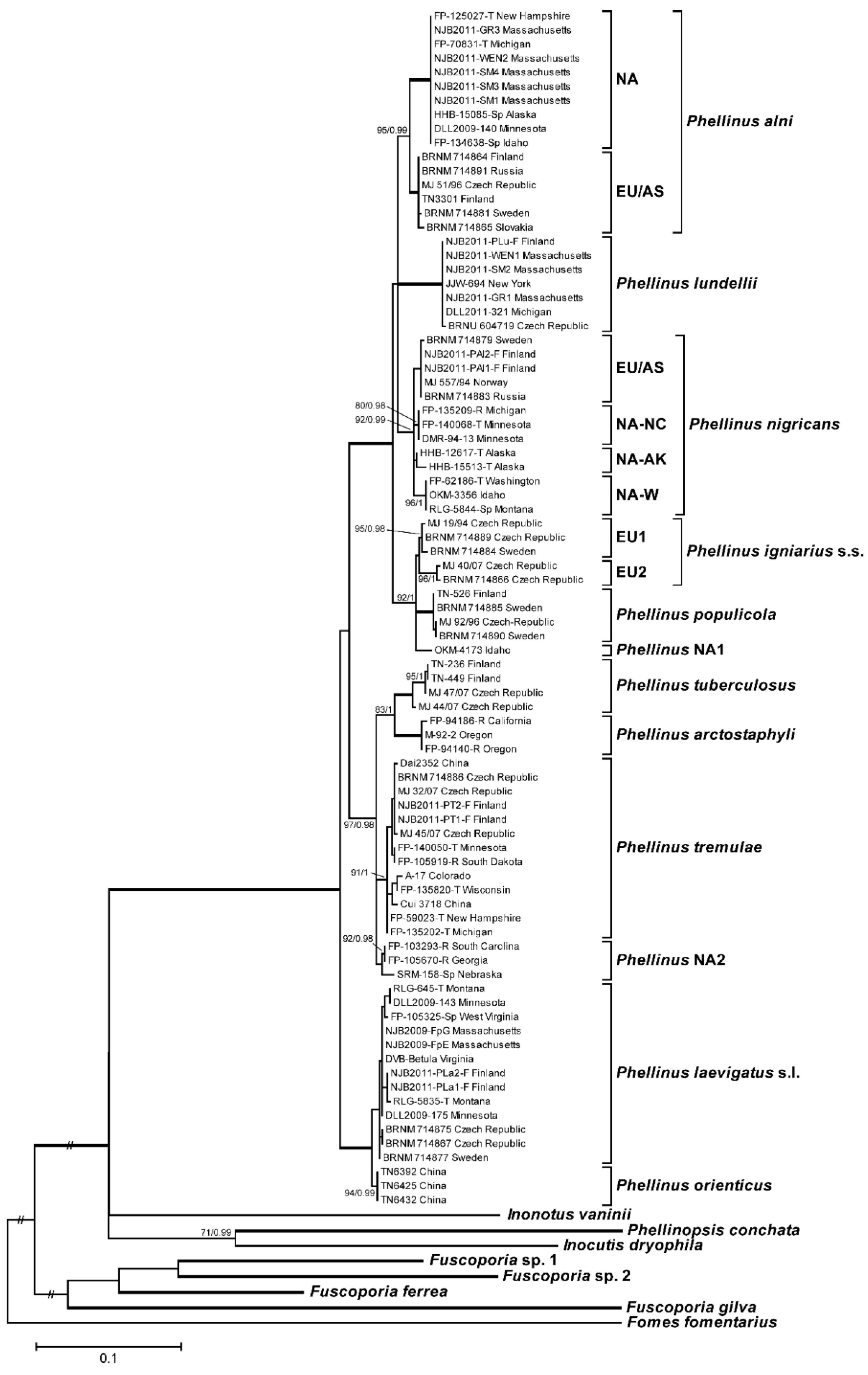
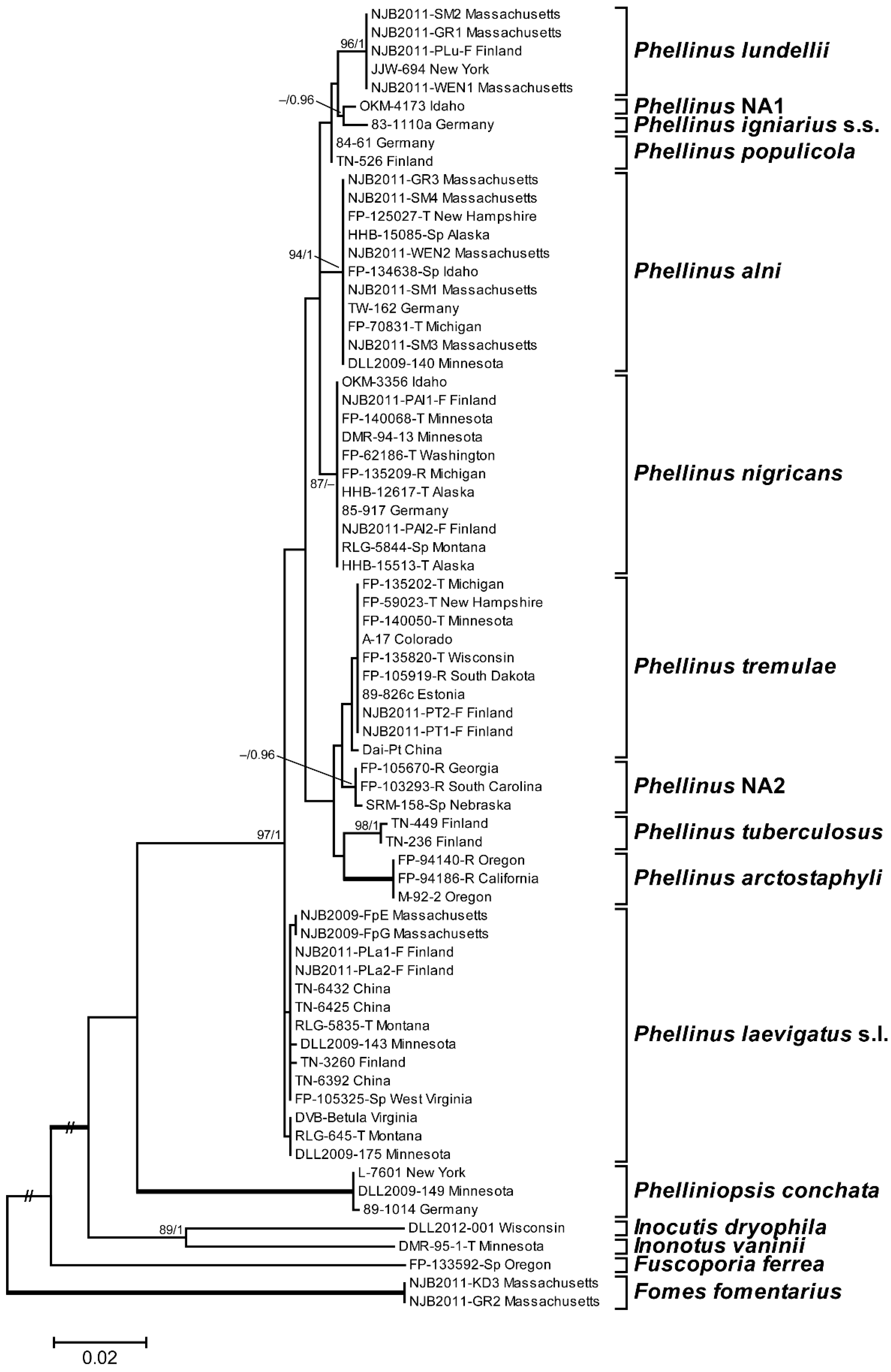
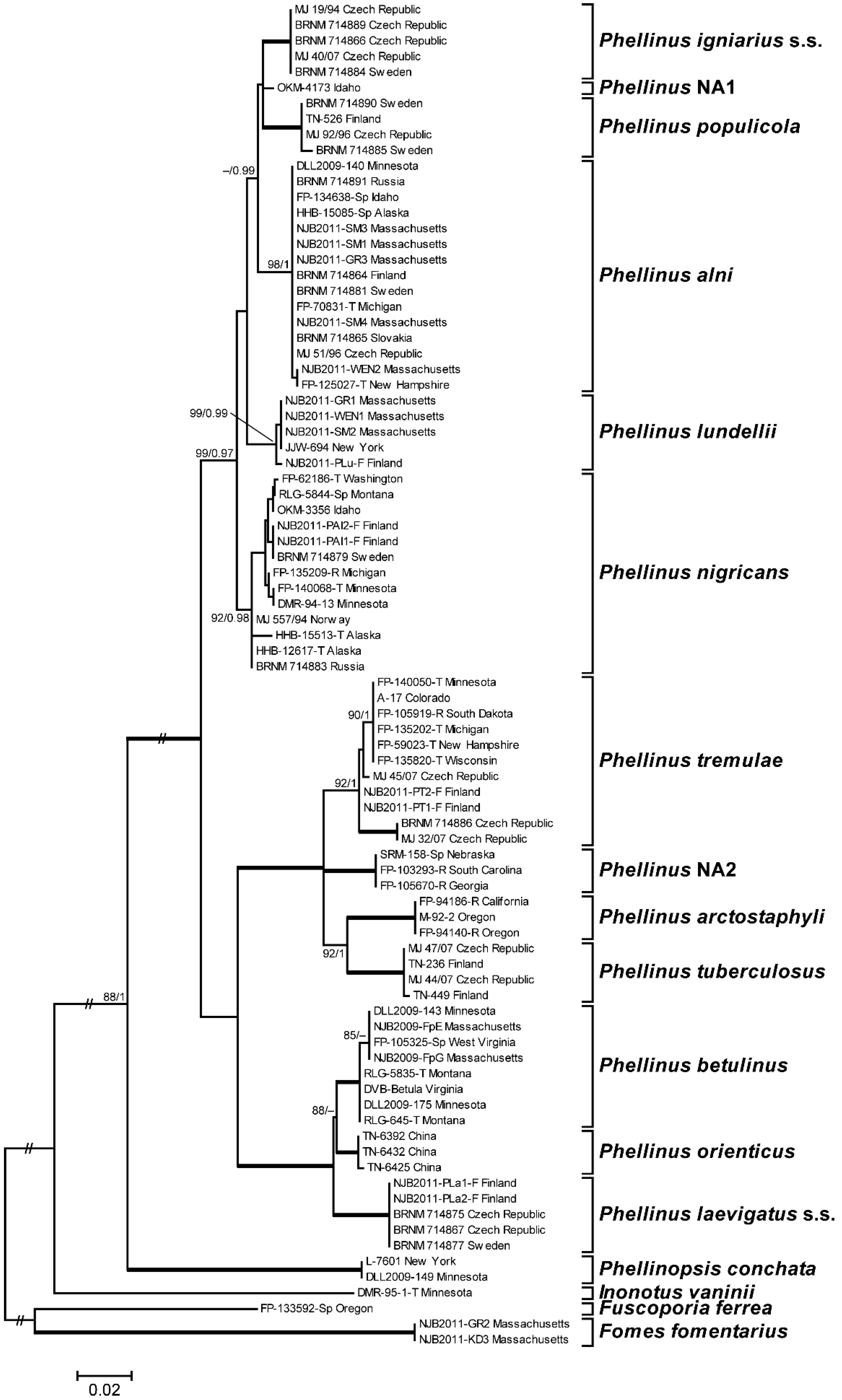
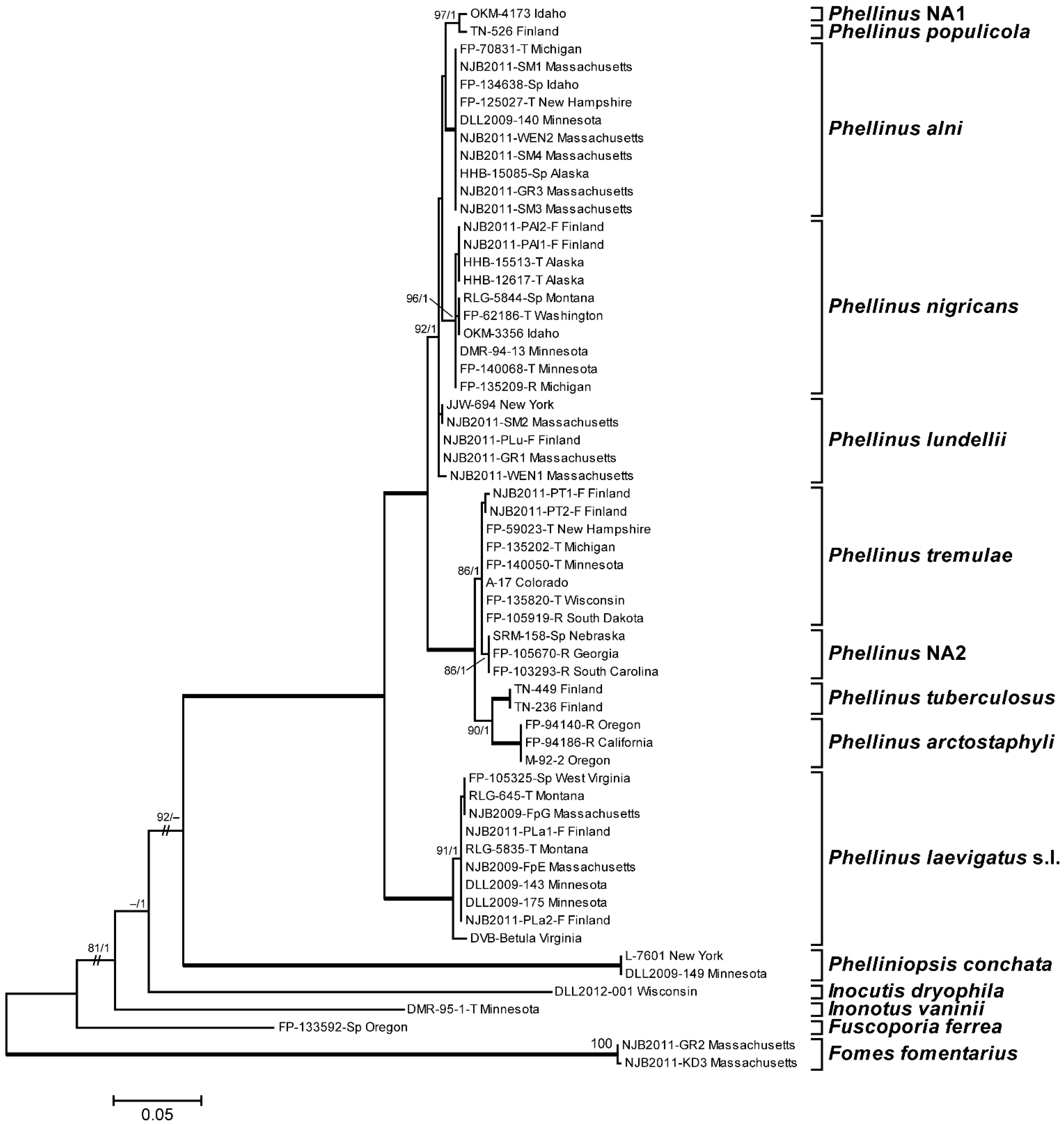
Successful amplification and sequencing was achieved for nearly all isolates used in this study.For certain isolates representing segregate genera in Phellinus s.l., only ITS sequences were generated (Table 1). Based on the results of the analyses performed here, 13 phylogenetic species in Phellinus s.s. were differentiated from isolates that originated from northern North America, Europe and Asia (Table 1; Figure 1, Figure 2, Figure 3 and Figure 4). Of these 13 species, eight are present in North America, and include: P. alni, P. arctostaphyli, P. betulinus, P. lundellii, P. nigricans, P. tremulae and two undescribed species, hereafter referred to as P. NA1 and P. NA2 (Figure 1, Figure 2, Figure 3 and Figure 4).
Figure 1.
Maximum likelihood tree based on rDNA ITS sequences of Phellinus s.s. species. Bootstrap support values ≥70% and PP values ≥0.95 are shown next to the nodes. Thickened branches represent BS/PP values ≥99%/1. Intraspecific variation by geographic origin is defined by the following codes: NA, North America; EU, Europe; AS, Asia; NA-NC, north-central North America; NA-AK, Alaska; NA-W, western North America.
Figure 2.
Maximum likelihood tree based on nLSU sequences of Phellinus s.s. species. Bootstrap support values ≥70% and PP values ≥0.95 are shown next to the nodes. Thickened branches represent BS/PP values ≥99%/1.
Figure 3.
Maximum likelihood tree based on rpb2 sequences of Phellinus s.s. species. Bootstrap support values ≥70% and PP values ≥0.95 are shown next to the nodes. Thickened branches represent BS/PP values ≥99%/1.
Figure 4.
Maximum likelihood tree based on tef1 sequences of Phellinus s.s. species. Bootstrap support values ≥70% and PP values ≥0.95 are shown next to the nodes. Thickened branches represent BS/PP values ≥99%/1.
The results demonstrate that three species suspected of having a Holarctic distribution are, based on this dataset, restricted to Europe and Asia with a sister species present in North America. Specifically, P. laevigatus s.s., P. populicola and P. tuberculosus were not detected from North America (Table 1; Figure 1, Figure 2, Figure 3 and Figure 4). In their place, P. betulinus, P. NA1 and P. NA2 occur with the same host preference: Betula, Populus and Prunus (Table 1; Figure 1, Figure 2, Figure 3 and Figure 4). Based on the tef1 dataset, P. laevigatus s.l. is composed of three unique phylogenetic species (P. betulinus, P. orienticus and P. laevigatus s.s.) (Figure 4). The remaining three loci were unable to fully discriminate the P. laevigatus s.l. complex, although the ITS dataset did distinguish P. orienticus as distinct from P. betulinus and P. laevigatus s.s. (Figure 1, Figure 2 and Figure 3). Finally, P. igniarius s.s. was not detected from the North American dataset, although one of its primary hosts in Europe (Salix) was not analyzed here. However, a closely-related species, P. NA1, was discovered but is represented by only a single isolate (Figure 1, Figure 2, Figure 3 and Figure 4).
Overall, the four loci used produced similar tree topologies with one significant difference. Trees reconstructed using the ITS, nLSU and rpb2 datasets all grouped isolates representing the P. laevigatus s.l. complex distal to all other Phellinus s.s. species (Figure 1, Figure 2 and Figure 3). Only the tef1 dataset was not in agreement (Figure 4), grouping P. laevigatus s.l. in a superclade with P. tremulae, P. NA2, P. tuberculosus and P. arctostaphyli. Additionally, all four loci demonstrated a close relationship between two sets of species: (i) P. tremulae and P. NA2 and; (ii) P. tuberculosus and P. arctostaphyli. These four species consistently grouped together regardless of locus or analysis method (Figure 1, Figure 2, Figure 3 and Figure 4).
3.2. Phylogenetic Relationships by Locus
The four loci used in this study (ITS, nLSU, rpb2 and tef1) had varying levels of utility in discriminating Phellinus s.s. species. The ITS dataset was the most extensive in the number of sequences available from different geographic regions and hosts (Table 1; Figure 1). While ITS sequences demonstrated an ability to differentiate most Phellinus s.s. species, this dataset also exhibited high intraspecific variation. For example, isolates representing P. alni, P. nigricans and P. igniarius s.s. were divided into subclades with significant statistical support based on their geographic origin (Figure 1). In other cases, ITS provided only limited utility in differentiating several closely-related species groups, such as P. igniarius s.s.-P. populicola-P. NA1 and P. tremulae-P. NA2 (Figure 1). The ITS dataset was able to distinguish P. orienticus as a unique phylogenetic species from the P. laevigatus s.l. group but could not differentiate between P. betulinus and P. laevigatus s.s. (Figure 1).
Much like the ITS dataset, the 5′ region of the nLSU is able to differentiate among most Phellinus species, but support for some clades was weak with both ML and BI (Figure 2). As expected, there was limited intraspecific variation in the nLSU compared to the ITS region, but closely-related species are once again undifferentiated (Figure 2). Sequences from domains six to seven in the rpb2 gene comprised the lowest number of total sequences due to the lack of additional data in public databases (Figure 3). This dataset provided higher BS and PP values compared to the ITS and nLSU datasets but again, lacked resolution among closely-related species (Figure 3).
The tef1 dataset was superior to all other loci used in this study (Figure 4). Nearly all of the species analyzed were supported with significant BS and PP values with most supported with very high confidence (BS ≥ 99% and PP = 1). In conjunction with sequences generated by Tomšovský et al. [12], tef1 grouped Phellinus s.s. species into two main superclades (Figure 4). The tef1 dataset was also able to discriminate members among the closely-related P. laevigatus s.l. complex (P. betulinus, P. laevigatus s.s. and P. orienticus) with strong statistical support (Figure 4). Despite the high overall resolution, this dataset, like all others, failed to differentiate P. igniarius s.s., P. populicola and P. NA1 with consistent, significant support (Figure 4).
3.3. Phylogenetic Relationships by Host
The results show that most Phellinus s.s. species primarily infect a single host genus (Table 2). Five species (P. betulinus, P. laevigatus s.s., P. orienticus, P. lundellii and P. nigricans) are specific to Betula and three (P. betulinus, P. lundellii and P. nigricans) have overlapping host ranges in North America. Prunus has two associated species (P. tuberculosus and P. NA2) while Populus has three (P. populicola, P. tremulae and P. NA1). Lastly, P. arctostaphyli is known only from the woody shrub genus Arctostaphylos. Two remaining Phellinus species, meanwhile, are notable exceptions to this trend: (i) P. alni, which has a broad host range that includes Acer, Alnus, Betula and Fagus and in this particular study; and (ii) P. igniarius s.s., which is still unconfirmed from North America.
Table 2.
Known range, host genera and host families of Phellinus s.s. species.
| Phellinus Species | Known Range | Known Host Genera | Known Host Families |
|---|---|---|---|
| P. alni | Holarctic | Acer, Alnus, Betula, Carpinus, Corylus, Fagus, Fraxinus, Juglans, Laburnum, Malus, Padus, Prunus and Sorbus | Betulaceae, Fagaceae, Juglandaceae, Oleaceae, Rosaceae, Sapindaceae & Ulmaceae |
| P. lundellii | Holarctic | Betula | Betulaceae |
| P. nigricans | Holarctic | Betula | Betulaceae |
| P. tremulae | Holarctic | Populus | Salicaceae |
| P. arctostaphyli | North America | Arctostaphylos | Ericaceae |
| P. betulinus | North America | Betula | Betulaceae |
| P. NA1 | North America | Populus | Salicaceae |
| P. NA2 | North America | Prunus | Rosaceae |
| P. igniarius s.s. | Europe | Populus, Salix and Malus | Salicaceae and Rosaceae |
| P. populicola | Europe & Asia | Populus | Salicaceae |
| P. tuberculosus | Europe & Asia | Prunus | Rosaceae |
| P. laevigatus s.s. | Europe & West Asia | Betula | Betulaceae |
| P. orienticus | East Asia | Betula | Betulaceae |
4. Discussion
The primary objective of this study was to better understand the assemblage of Phellinus s.s. species present in North America using a multilocus dataset composed of isolates representing a broad geographic area. As hypothesized, at least eight species of Phellinus s.s. occur in North America, yet the specific species assemblage was not accurately predicted. Up to this point, nearly all of the work aimed at elucidating the species in Phellinus s.s. has been performed in Europe, albeit with some isolates originating from North America [4,6,7,8,9,12,40]. While some Phellinus s.s. species have Holarctic distributions, the results of this study demonstrate clear differences in the North American assemblage that were not previously known.
In North America, P. alni has the widest host range of any Phellinus s.s. species, occurring on Acer, Alnus, Betula and Fagus. Including its known host range in Europe, P. alni inhabits at least 14 host genera, including Fraxinus, Juglans, Prunus and Ulmus [6,12]. This broad host range is unique within the genus, as most members of Phellinus s.s. exhibit a very narrow host range (see Table 2). Considering this, P. alni is likely the most common species found in northern hardwood (Acer-Betula-Fagus), northern floodplain (Fraxinus-Populus-Ulmus) and coastal Alnus forests in North America. It is most likely widespread in Quercus-dominated forests as well, since many of the minor tree species in the Quercus forest types are hosts for P. alni [41]. Phylogenetically, all four loci grouped P. alni with P. lundellii, P. igniarius s.s., P. NA1, P. nigricans and P. populicola. Of this group, P. igniarius s.s., P. NA1 and P. populicola are known only from woody plants in the Salicaceae and Rosaceae. Interestingly, both Fischer [6] and Tomšovský et al. [12] found that P. alni does not infect members of the Salicaceae in Europe and this trend was observed in North America as well. Yet, Populus was the only member of Salicaceae examined in this study and more targeted sampling of Salix and Populus species is necessary to conclude if P. alni can attack these hosts. Additionally, this targeted sampling will help to conclude if P. igniarius s.s. and P. populicola are indeed present in North America. At present, these two species are known only from Europe and Asia. Attempts to utilize “Phellinus” specimens from the CFMR herbarium that were collected from Salix proved these isolates belong to segregate genera such as Fuscoporia (results not shown).
Based on variations in morphological characters, Parmasto [40] proposed that P. laevigatus s.l. is composed of two species: P. laevigatus s.s. from Europe and P. betulinus from North America and Asia. Furthermore, Parmasto believed that P. betulinus can be further divided into two subspecies: ssp. betulinus from North America and ssp. orienticus from Asia. The results presented here show that P. laevigatus s.s., P. betulinus and P. orienticus each represent a unique phylogenetic species. While this assertion is supported by only one dataset (tef1), prior studies have shown tef1 to be the only marker capable of discriminating between very closely-related species in basidiomycete genera like Armillaria and Trametes [42,43,44]. Additionally, the ITS dataset was able to discriminate P. orienticus from P. betulinus-P. laevigatus s.s. with a high level of support (BS/PP = 99/1). Thus, the results presented here support the elevation of P. orienticus and P. betulinus to species status. Phellinus orienticus has been previously treated as a distinct species based solely on morphological characters [45]. Additionally, Wagner and Fisher [8] treated P. orienticus as a unique species in their study to deconstruct Phellinus s.l. using nLSU sequences. In this study, nLSU sequences were unable to discriminate among members of P. laevigatus s.l.
Isolates collected from Prunus in North America that were thought to represent P. tuberculosus were instead shown to be a separate phylogenetic species, referred to here as P. NA2. What is perhaps more interesting is that each locus examined in this study showed that P. NA2 is more closely-related to P. tremulae than to P. tuberculosus. Meanwhile, the results also reveal a close genetic relationship between P. tuberculosus and P. arctostaphyli. Regardless of its closest relative, the results suggest that P. tuberculosus is restricted to Europe and Asia and that P. NA2 requires formal description as a new North American species. Overholts [22] (pp. 64–65) did note that specimens of P. tuberculosus from Europe had larger basidiospores compared to specimens from North America and that: “The American plant should perhaps be designated as a distinct variety”. Basidiospore variation between P. NA2 and P. tuberculosus was also confirmed by Niemelä [46] and Gilbertson and Ryvarden [5].
The first recognized description of Phellinus from Prunus was performed by Baumgarten, who described the species as Boletus tuberculosus [47]. This name was soon forgotten though, in favor of the epithet B. pomaceus, which appeared in the literature less than a decade later [48]. Both of these early descriptions utilized European strains of the pathogen. Numerous, subsequent descriptions of this species were made in North America and Europe, all using Phellinus pomaceus [5,22,46,49,50] until it was determined to be a synonym of P. tuberculosus, with the latter having precedence [51]. After this point, Riffle and Conway [52] adopted the use of P. tuberculosus while Ryvarden and Gilbertson [53] preferred use of the well-established P. pomaceus. Phylogenetic studies of Phellinus s.l. have consistently used P. tuberculosus over P. pomaceus [7,8,10,12], but the use of P. pomaceus still continues, albeit infrequently [54,55]. Adding to the confusion is the fact that P. alni can also be found on Prunus [6] along with Fomitiporia prunicola [56].
One of the most fascinating aspects of Phellinus s.s. is that five species are known to occur primarily on Betula (P. betulinus, P. laevigatus s.s., P. lundellii, P. nigricans, and P. orienticus). Three of these species (P. betulinus, P. lundellii and P. nigricans) are present in North American forests and have overlapping host ranges. Not only do these three species occupy the same geographic area but they appear to occupy the same ecological niche, with no apparent preference for a particular species of Betula. Clearly, these species represent an interesting model for studies on sympatric speciation. At the same time, P. nigricans and P. lundellii were somewhat partitioned in their distribution in North America, with P. nigricans present in western and north-central North America while P. lundellii was identified from north-central and eastern North America. Because their ranges do overlap in the Lake States region and Betula species occur contiguously across northern North America, it’s most likely both species are present across the continent as well.
A single isolate collected from Idaho in 1966 by Orson Miller, and presumed to be P. tremulae, represents a sister species to P. igniarius s.s. and P. populicola. This species, P. NA1, remains undescribed here pending further study on its distribution and host range. While white trunk rot of aspen is primarily the result of infection by P. tremulae, this study shows that P. NA1 must be considered as an additional causal agent. Further, Inonotus vaninii (formerly Phellinus vaninii) can also be found on Populus [57]. Even if P. NA1 and I. vaninii are uncommon on Populus compared to P. tremulae, a complex of Phellinus s.l. species should now be considered to cause white trunk rot of aspen.
It is entirely reasonable to believe that Phellinus s.s. species described here as host-specific may, at times, be found on non-preferred hosts. Because of decades of confusion and misinterpretation in the taxonomy of Phellinus s.s. [13], numerous reports exist of exceptions in the host-specificity reported here and in previous studies [6,12]. Yet, these reports of incidence on non-preferred hosts should be carefully scrutinized as future studies shed further light on the incidence and host range of Phellinus s.s. across northern temperate forests.
Acknowledgments
I am grateful to Daniel Lindner and Tuomo Niemelä for their assistance in obtaining isolates used in this study. Funding was provided, in part, by the USDA Forest Service, Center for Forest Mycology Research.
Conflicts of Interest
The author declares no conflict of interest.
References
- Niemelä, T. On Fennoscandian Polypores. II. Phellinus laevigatus (Fr.) Bourd. & Galz. and P. lundellii Niemelä, n. sp. Ann. Bot. Fennici 1972, 9, 41–59. [Google Scholar]
- Niemelä, T. On Fennoscandian Polypores. III. Phellinus tremulae (Bond.) Bond. & Borisov. Ann. Bot. Fennici 1974, 11, 202–215. [Google Scholar]
- Niemelä, T. On Fennoscandian Polypores. IV. Phellinus igniarius, P. nigricans and P. populicola, n. sp. Ann. Bot. Fennici 1975, 12, 93–122. [Google Scholar]
- Fiasson, J.; Niemelä, T. The Hymenochaetales: A revision of the European poroid taxa. Karstenia 1984, 24, 14–28. [Google Scholar]
- Gilbertson, R.L.; Ryvarden, L. North American Polypores; Fungiflora: Oslo, Norway, 1987. [Google Scholar]
- Fischer, M. Phellinus igniarius and its closest relatives in Europe. Mycol. Res. 1995, 99, 735–744. [Google Scholar] [CrossRef]
- Wagner, T.; Fischer, M. Natural groups and a revised system for the European poroid Hymenochaetales (Basidiomycota) supported by nLSU rDNA sequence data. Mycol. Res. 2001, 105, 773–782. [Google Scholar] [CrossRef]
- Wagner, T.; Fischer, M. Proceedings towards a natural classification of the worldwide taxa Phellinus s.l. and Inonotus s.l., and phylogenetic relationships of allied genera. Mycologia 2002, 94, 998–1016. [Google Scholar] [CrossRef] [PubMed]
- Fischer, M.; Binder, M. Species recognition, geographic distribution and host-pathogen relationships: A case study in a group of lignicolous basidiomycetes, Phellinus s.l. Mycologia 2004, 96, 799–811. [Google Scholar] [CrossRef] [PubMed]
- Larsson, K.H.; Parmasto, E.; Fischer, M.; Langer, E.; Nakasone, K.K.; Redhead, S.A. Hymenochaetales: A molecular phylogeny for the hymenochaetoid clade. Mycologia 2006, 98, 926–936. [Google Scholar] [CrossRef] [PubMed]
- Sell, I. Taxonomy of the species in the Phellinus igniarius group. Mycotaxon 2008, 104, 337–347. [Google Scholar]
- Tomšovský, M.; Vampola, P.; Sedlák, P.; Byrtusová, Z.; Jankovský, L. Delimitation of central and northern European species of the Phellinus igniarius group (Basidiomycota, Hymenochaetales) based on analysis of ITS and translation elongation factor 1 alpha DNA sequences. Mycol. Prog. 2010, 9, 431–445. [Google Scholar] [CrossRef]
- Larsen, M.J.; Cobb-Poulle, L.A. Phellinus (Hymenochaetaceae): A Survey of the World Taxa; Fungiflora: Oslo, Norway, 1990. [Google Scholar]
- Ohman, J.H.; Kessler, K.J. White Trunk Rot of Hardwoods; USDA Forest Service: Fort Collins, CO, USA, 1964.
- Boyce, J.S. Forest Pathology, 3rd ed.; John Wiley and Sons Inc.: New York, NY, USA, 1961. [Google Scholar]
- Sinclair, W.A.; Lyon, H.H. Diseases of Trees and Shrubs, 2nd ed.; Cornell University Press: Ithaca, NY, USA, 2005; pp. 306–308. [Google Scholar]
- Silverborg, S. Northern Hardwoods Cull Manual; Bulletin No. 31; State University of New York: Syracuse, NY, USA, 1954; pp. 4–5. [Google Scholar]
- Bondartsev, A.S. The Polyporaceae of the European USSR and Caucasia; Israel Program for Scientific Translations: Jerusalem, Israel, 1953; p. 358. [Google Scholar]
- Jones, A.C.; Ostry, M.E. Estimating white trunk rot in aspen stands. North. J. Appl. For. 1998, 15, 33–36. [Google Scholar]
- Worrall, J.J.; Fairweather, M.L. Decay and Discoloration of Aspen; USDA Forest Service: Fort Collins, CO, USA, 2009.
- Verrall, A.F. Variation in Fomes igniarius (L.) Gill; Minnesota Agricultural Experiment Station: MN, USA, 1937. [Google Scholar]
- Overholts, L.O. The Polyporaceae of the United States, Alaska, and Canada; University of Michigan Press: Ann Arbor, MI, USA, 1953. [Google Scholar]
- Worrall, J.J.; Lee, T.D.; Harrington, T.C. Forest dynamics and agents that initiate and expand canopy gaps in Picea—Abies forests of Crawford Notch, New Hampshire, USA. J. Ecol. 2005, 93, 178–190. [Google Scholar] [CrossRef]
- Lindner, D.L.; Burdsall, H.H., Jr.; Stanosz, G.R. Species diversity of polyporoid and corticioid fungi in northern hardwood forests with differing management histories. Mycologia 2006, 98, 195–217. [Google Scholar] [CrossRef] [PubMed]
- Brazee, N.J.; Lindner, D.L. Unraveling the Phellinus pini s.l. complex in North America: A multilocus phylogeny and differentiation analysis of Porodaedalea. For. Pathol. 2013, 43, 132–143. [Google Scholar] [CrossRef]
- Gardes, M.; Bruns, T.D. ITS primers with enhanced specificity for basidiomycetes—Application to the identification of mycorrhizae and rusts. Mol. Ecol. 1993, 2, 113–118. [Google Scholar] [CrossRef] [PubMed]
- Rehner, S.; Samuels, G. Taxonomy and phylogeny of Gliocladium analysed from nuclear large subunit ribosomal DNA sequences. Mycol. Res. 1994, 98, 625–634. [Google Scholar] [CrossRef]
- Hopple, J.S.; Vilgalys, R. Phylogenetic relationships in the mushroom genus Coprinus and dark-spored allies based on sequence data from the nuclear gene coding for the large ribosomal subunit RNA: Divergent domains, outgroups and monophyly. Mol. Phylogenet. Evol. 1999, 13, 1–19. [Google Scholar] [CrossRef] [PubMed]
- Kauserud, H.; Schumacher, T. Outcrossing or inbreeding: DNA markers provide evidence for type of reproductive mode in Phellinus nigrolimitatus. Mycol. Res. 2001, 105, 676–683. [Google Scholar] [CrossRef]
- Matheny, P.B. Improving phylogenetic inference of mushrooms with RPB1 and RPB2 nucleotide sequences (Inocybe; Agaricales). Mol. Phylogenet. Evol. 2005, 35, 1–20. [Google Scholar] [CrossRef] [PubMed]
- Rehner, S.A.; Buckley, E. A Beauveria phylogeny inferred from nuclear ITS and EF1-α sequences: Evidence for cryptic diversification and links to Cordyceps teleomorphs. Mycologia 2005, 97, 84–98. [Google Scholar] [CrossRef] [PubMed]
- Katoh, K.; Standley, D.M. MAFFT multiple sequence alignment software version 7: Improvements in performance and usability. Mol. Biol. Evol. 2013, 30, 772–780. [Google Scholar] [CrossRef] [PubMed]
- Darriba, D.; Taboada, G.L.; Doallo, R.; Posada, D. jModelTest 2: More models, new heuristics and parallel computing. Nat. Methods 2012, 9, 772. [Google Scholar] [CrossRef] [PubMed]
- Guindon, S.; Gascuel, O. A simple, fast and accurate method to estimate large phylogenies by maximum-likelihood. Syst. Biol. 2003, 52, 696–704. [Google Scholar] [CrossRef] [PubMed]
- Tavaré, S. Some probabilistic and statistical problems on the analysis of DNA sequences. Lect. Math. Life Sci. 1986, 17, 57–86. [Google Scholar]
- Brazee, N.J.; Lindner, D.L.; D’Amato, A.W.; Fraver, S.; Forrester, J.A.; Mladenoff, D.J. Disturbance and diversity of wood-inhabiting fungi: Effects of canopy gaps and downed woody debris. Biodivers. Conserv. 2014, 23, 2155–2172. [Google Scholar] [CrossRef]
- Tamura, K.; Stecher, G.; Peterson, D.; Filipski, A.; Kumar, S. MEGA6: Molecular evolutionary genetics analysis version 6.0. Mol. Biol. Evol. 2013, 30, 2725–2729. [Google Scholar] [CrossRef] [PubMed]
- Ronquist, F.; Teslenko, M.; van der Mark, P.; Ayres, D.L.; Darling, A.; Höhna, S.; Larget, B.; Liu, L.; Suchard, M.A.; Huelsenbeck, J.P. MrBayes 3.2: Efficient Bayesian phylogenetic inference and model choice across a large model space. Syst. Biol. 2012, 61, 539–542. [Google Scholar] [CrossRef] [PubMed]
- Kumar, S.; Gadagkar, S.R. Disparity Index: A simple statistic to measure and test the homogeneity of substitution patterns between molecular sequences. Genetics 2001, 158, 1321–1327. [Google Scholar] [PubMed]
- Parmasto, E. Phellinus laevigatus s. l. (Hymenochaetales): A ring species. Folia Cryptogam. Estonica 2007, 43, 39–49. [Google Scholar]
- Eyre, F.H. Forest Cover Types of the United States and Canada; Society of American Foresters: Washington, DC, USA, 1980. [Google Scholar]
- Brazee, N.J.; Hulvey, J.P.; Wick, R.L. Evaluation of partial tef1, rpb2, and nLSU sequences for identification of isolates representing Armillaria calvescens and Armillaria gallica from northeastern North America. Fungal Biol. 2011, 115, 741–749. [Google Scholar] [CrossRef] [PubMed]
- Ross-Davis, A.L.; Hanna, J.W.; Kim, M.-S.; Klopfenstein, N.B. Advances toward DNA-based identification and phylogeny of North American Armillaria species using elongation factor-1 alpha gene. Mycoscience 2012, 53, 161–165. [Google Scholar] [CrossRef]
- Carlson, A.L.; Justo, A.; Hibbett, D.S. Species delimitation in Trametes: A comparison of ITS, RPB1, RPB2 and TEF1 gene phylogenies. Mycologia 2014, 106, 735–745. [Google Scholar] [CrossRef] [PubMed]
- Ming-Xiao, D.; Yu-Lian, W.; Yue, G. Three species of Phellinus (Basidiomycota, Hymenochaetaceae) new to China. Mycosystema 2012, 31, 940–946. [Google Scholar]
- Niemelä, T. On Fennoscandian polypores 5, Phellinus pomaceus. Karstenia 1977, 17, 77–86. [Google Scholar]
- Baumgarten, J.C.G. Flora Lipsiensis; Leipzig: Saxony, Germany, 1790; p. 635. [Google Scholar]
- Persoon, C.H. Observationes Mycologicae; Leipzig: Saxony, Germany, 1799; Volume 2, p. 5. [Google Scholar]
- Nobles, M.K. Studies in forest pathology VI. Identification of cultures of wood-rotting fungi. Can. J. Res. 1948, 26, 281–431. [Google Scholar] [CrossRef] [PubMed]
- Gilbertson, R.L. The genus Phellinus (Aphyllophorales: Hymenochaetaceae) in western North America. Mycotaxon 1979, 9, 51–89. [Google Scholar]
- Niemelä, T. Taxonomic notes on the polypore genera Antrodiella, Daedaleopsis, Fibuloporia and Phellinus. Karstenia 1982, 22, 11–12. [Google Scholar]
- Riffle, J.W.; Conway, K.E. Phellinus stem decays of hardwoods. In Diseases of Trees in the Great Plants; Riffle, J.W., Peterson, G.W., Eds.; USDA Forest Service: Fort Collins, CO, USA, 1986; pp. 83–85. [Google Scholar]
- Ryvarden, L.; Gilbertson, R.L. European Polypores, part 2; Fungiflora: Oslo, Norway, 1994; p. 507. [Google Scholar]
- Nam, B.-H.; Lee, J.-Y.; Kim, G.-Y.; Jung, H.-H.; Park, H.-S.; Kim, C.-Y.; Jo, W.-S.; Jeong, S.-J.; Lee, T.-H.; Lee, J.-D. Phylogenetic analysis and rapid detection of genus Phellinus using the nucleotide sequences of 18S ribosomal RNA. Mycobiology 2003, 31, 133–138. [Google Scholar] [CrossRef]
- Schmidt, O.; Gaiser, O.; Dujesiefken, D. Molecular identification of decay fungi in the wood of urban trees. Eur. J. For. Res. 2012, 131, 885–891. [Google Scholar] [CrossRef]
- Overholts, L.O. Diagnoses of American polypores—III. Some additional brown species, with a key to the common brown species of the United States and Canada. Mycologia 1931, 23, 117–129. [Google Scholar] [CrossRef]
- Brazee, N.J.; Lindner, D.L.; Fraver, S.; D’Amato, A.W.; Milo, A.M. Wood-inhabiting, polyporoid fungi in aspen-dominated forests managed for biomass in the U.S. Lake States. Fungal Ecol. 2012, 5, 600–609. [Google Scholar] [CrossRef]
© 2015 by the author; licensee MDPI, Basel, Switzerland. This article is an open access article distributed under the terms and conditions of the Creative Commons Attribution license (http://creativecommons.org/licenses/by/4.0/).