

The Sign and Strength of Plant-Soil Feedback for the Invasive Shrub, Lonicera maackii, Varies in Different Soils

Abstract
1. Introduction
2. Methods
2.1. Soil Sources
2.2. Plant Species
2.3. Soil Conditioning
2.4. Feedback Experiment
2.5. Soil Chemical Properties
2.6. Community Level Physiological Profiles (CLPP) Using Biolog® EcoPlateTM
3. Results
3.1. Effects of Soil Type and Conditioning on Soil Properties

| Soil variables | Loamy soil | Sandy soil | |||||||||
|---|---|---|---|---|---|---|---|---|---|---|---|
| DL | FP | LM | UN | DL | FP | LM | UN | ||||
| pH | 7.9 | 7.8 | 8.0 | 7.4 | 7.0 | 6.9 | 7.1 | 6.1 | |||
| Organic matter (%) | 1.3 | 1.8 | 1.5 | 1.9 | 1.3 | 1.6 | 1.2 | 1.4 | |||
| Total N (%) | 0.2 | 0.55 | 0.14 | 0.21 | 0.37 | 0.29 | 0.24 | 0.40 | |||
| NH4 (ppm) | 20 | 8 | 7 | 1 | 7 | 9 | 4 | 8 | |||
| NO3 (ppm) | 7 | 9 | 8 | 43 | 5 | 48 | 6 | 65 | |||
| Available P (ppm) | 37 | 34 | 30 | 46 | 4 | 3 | 3 | 3 | |||
| Exchangeable K (ppm) | 104 | 103 | 84 | 163 | 44 | 64 | 48 | 62 | |||
| Exchangeable Mg (ppm) | 285 | 286 | 258 | 368 | 205 | 257 | 252 | 192 | |||
| Exchangeable Ca (ppm) | 3451 | 3549 | 3779 | 3010 | 1163 | 1559 | 1535 | 1010 | |||
| CEC | 15.3 | 15.6 | 16.2 | 14.3 | 6.9 | 9.2 | 8.5 | 5.3 | |||
| K (% BS) | 1.5 | 1.4 | 1.1 | 2.4 | 1.4 | 1.5 | 1.2 | 2.5 | |||
| Mg (% BS) | 13.7 | 13.4 | 11.6 | 18.8 | 21.9 | 20.5 | 21.8 | 26.4 | |||
| Ca (% BS) | 84.8 | 85.2 | 87.2 | 78.7 | 63.6 | 63.5 | 67.9 | 71.1 | |||
| Phenolics (mg g−1 soil) | 0.206 | 0.180 | 0.158 | 0.173 | 0.181 | 0.125 | 0.165 | 0.126 | |||
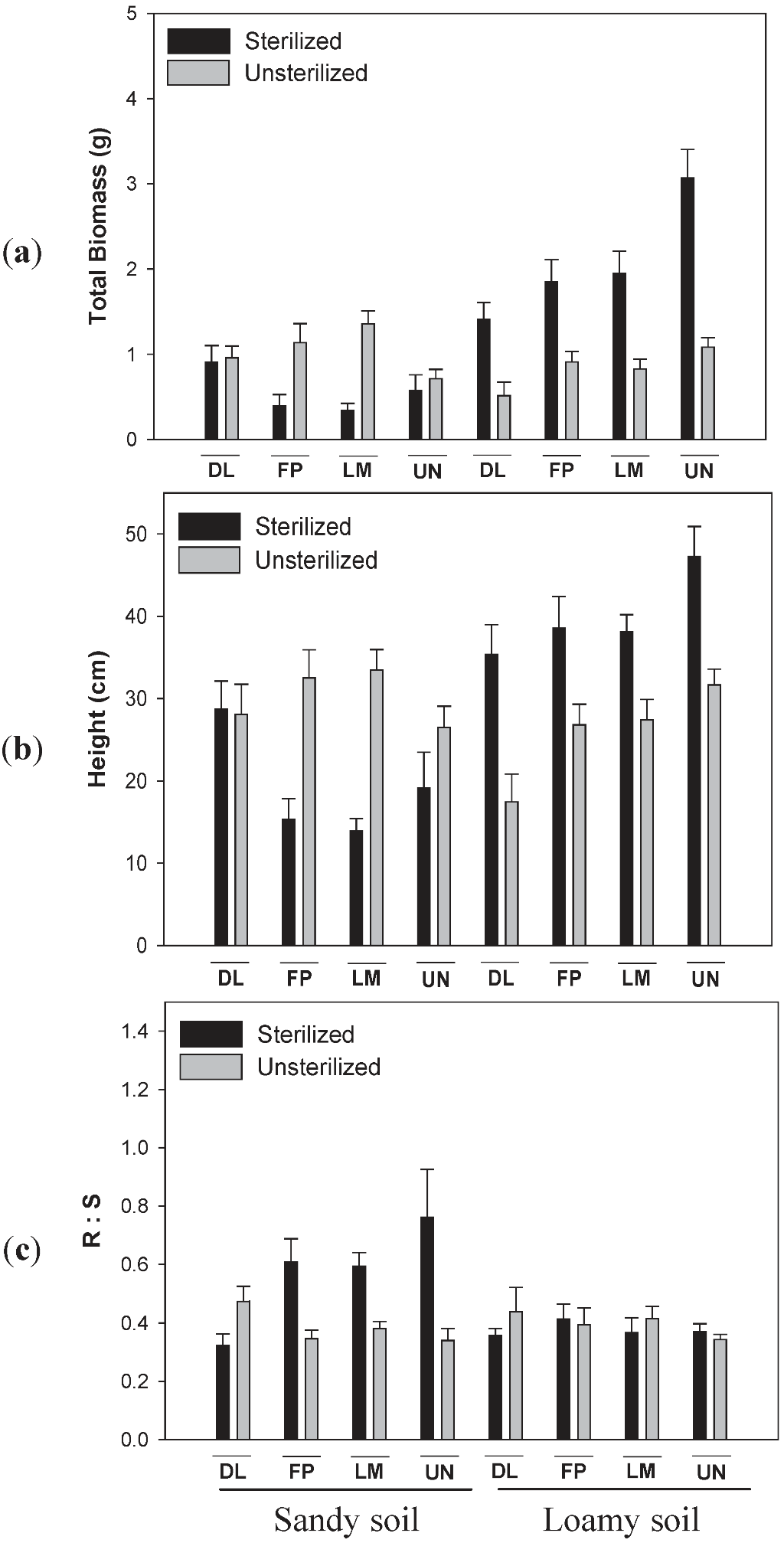
3.2. Effects of Soil Type and Conditioning on Biomass of Lonicera
| Factors | df | Total biomass | Height | Root/Shoot | |||
|---|---|---|---|---|---|---|---|
| F | p | F | p | F | p | ||
| Soil Type (T) | 1 | 47.14 | <0.0001 | 23.89 | <0.0001 | 8.65 | 0.004 |
| Condition (C) | 3 | 1.81 | 0.1480 | 0.65 | 0.5874 | 0.58 | 0.6278 |
| T × C | 3 | 8.52 | <0.0001 | 6.19 | 0.0006 | 1.45 | 0.2316 |
| Sterilization (S) | 1 | 6.68 | 0.0101 | 0.08 | 0.7730 | 7.01 | 0.0093 |
| T × S | 1 | 87.05 | <0.0001 | 57.86 | <0.0001 | 11.00 | 0.0012 |
| C × S | 3 | 3.60 | 0.0150 | 5.69 | <0.0001 | 5.92 | 0.0009 |
| T × C × S | 3 | 1.57 | 0.2000 | 0.82 | 0.4873 | 2.76 | 0.0457 |
| Error | 112 | - | |||||
| Factors | df | Lonicera maackii | Diervilla lonicera | ||||
|---|---|---|---|---|---|---|---|
| W | F | p | W | F | p | ||
| Time | 6 | 0.047 | 354.94 | <0.0001 | 0.013 | 1252.34 | <0.0001 |
| Time × Soil Type (T) | 6 | 0.692 | 7.92 | <0.0001 | 0.701 | 2.13 | 0.0054 |
| Time × Condition (C) | 6 | 0.778 | 1.56 | 0.0701 | 0.701 | 2.13 | 0.0054 |
| Time × T × C | 18 | 0.816 | 1.25 | 0.2201 | 0.621 | 2.91 | <0.0001 |
| Time × Sterilization (S) | 6 | 0.717 | 7.01 | <0.0001 | 0.451 | 20.47 | <0.0001 |
| Time × T × S | 6 | 0.666 | 8.92 | <0.0001 | 0.810 | 3.94 | 0.0014 |
| Time × C × S | 18 | 0.729 | 1.99 | 0.0101 | 0.548 | 3.76 | <0.0001 |
| Time × T × C × S | 18 | 0.807 | 1.32 | 0.1739 | 0.831 | 1.07 | 0.3819 |
| Error | 106 | - | |||||
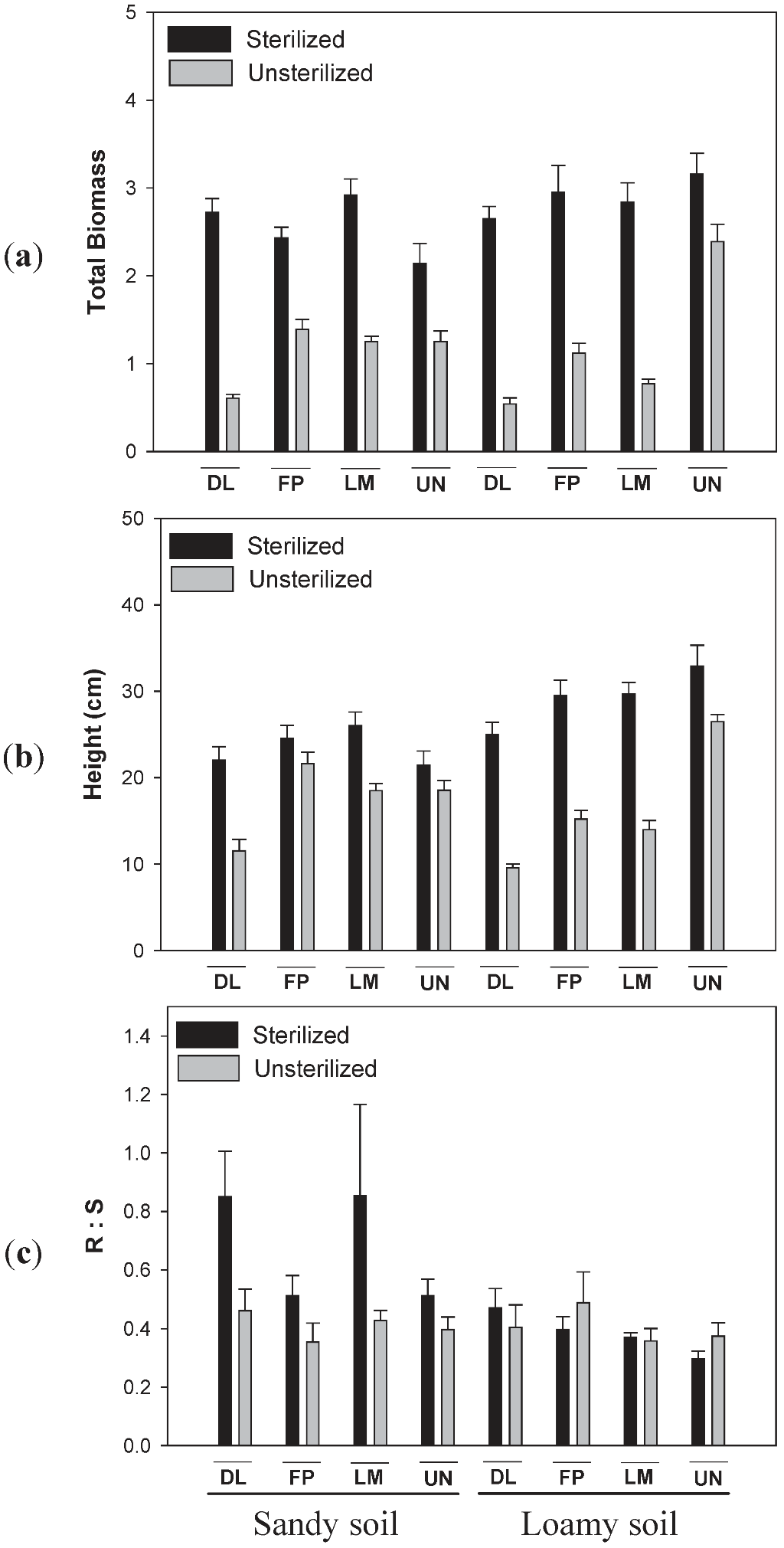
3.3. Effects of Soil Type and Conditioning on Biomass of Diervilla lonicera
| Factors | df | Total biomass | Height | Root/Shoot | |||
|---|---|---|---|---|---|---|---|
| F | p | F | p | F | p | ||
| Soil Type (T) | 1 | 2.76 | 0.0998 | 2.99 | 0.0867 | 10.55 | 0.0016 |
| Condition (C) | 3 | 15.73 | <0.0001 | 32.69 | <0.0001 | 2.05 | 0.1112 |
| T × C | 3 | 15.58 | <0.0001 | 13.74 | <0.0001 | 1.52 | 0.2127 |
| Sterilization (S) | 1 | 426.27 | <0.0001 | 222.11 | <0.0001 | 6.59 | 0.0117 |
| T × S | 1 | 3.02 | 0.0854 | 26.75 | <0.0001 | 9.01 | 0.0033 |
| C × S | 3 | 20.87 | <0.0001 | 16.52 | <0.0001 | 1.18 | 0.3197 |
| T × C × S | 3 | 2.53 | 0.0614 | 2.59 | 0.0564 | 0.04 | 0.9881 |
| Error | 106 | - | |||||
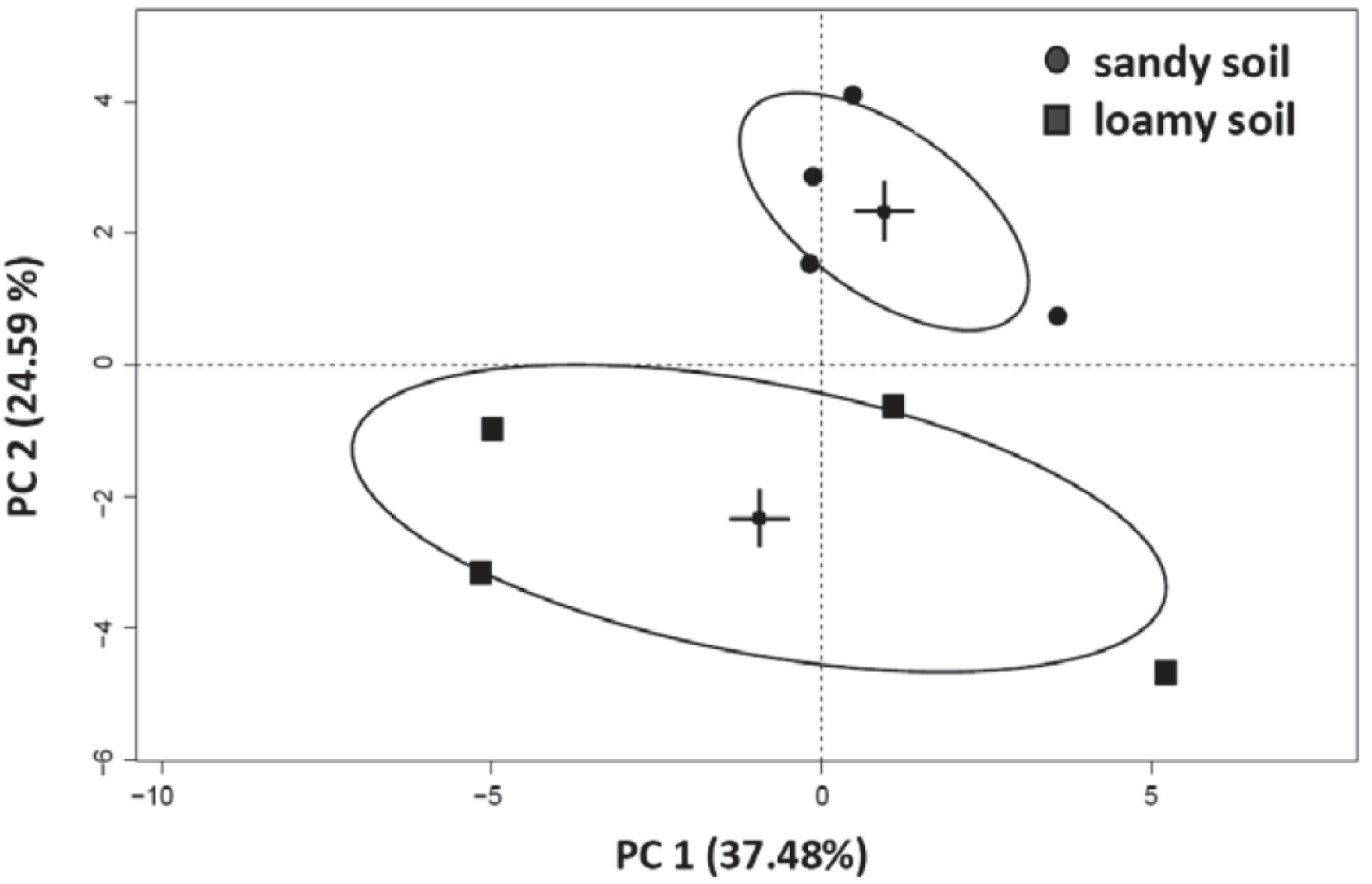
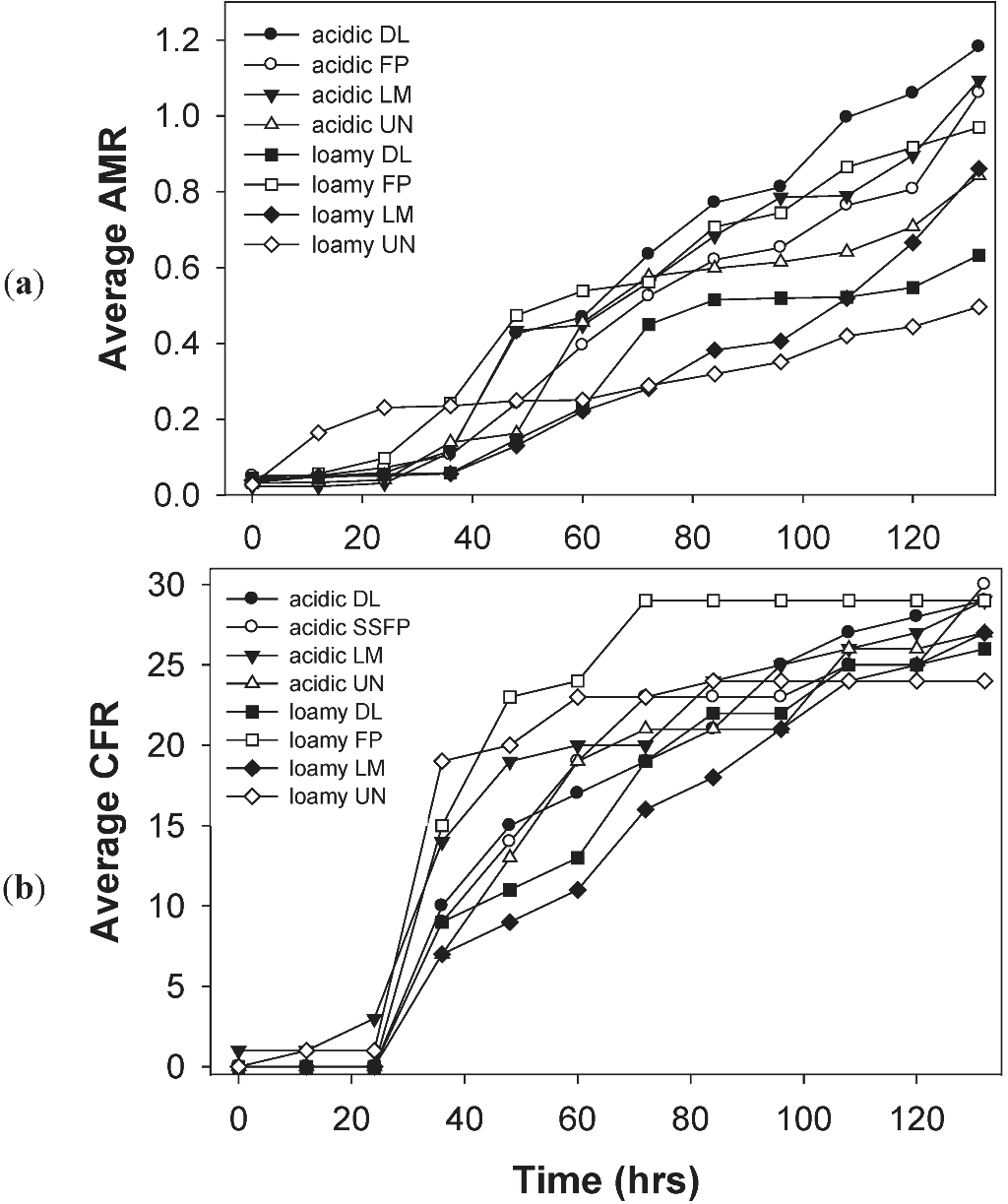
3.4. Effects of Soil Type and Conditioning on the Soil Microbial Community
4. Conclusions
4.1. Effects of Soil Type and Sterilization on Plant-Soil Feedbacks
4.2. Effects of Soil Type and Sterilization on Root/Shoot Ratios
4.3. Conspecific versus Heterospecific Feedbacks and Allelopathy
5. Future Research
Acknowledgments
Conflict of Interest
References
- Klironomos, J. Feedback with soil biota contributes to plant rarity and invasiveness in communities. Nature 2002, 417, 67–70. [Google Scholar] [CrossRef]
- Agrawal, A. Enemy release? An experiment with congeneric plant pairs and diverse above- and below-ground enemies. Ecology 2005, 86, 2979–2989. [Google Scholar] [CrossRef]
- Hawkes, C.; Wren, I.; Herman, D.; Fireston, M. Plant invasion alters nitrogen cycling by modifying the soil nitrifying community. Ecol. Lett. 2005, 8, 976. [Google Scholar] [CrossRef]
- Ehrenfeld, J.G. A potential source of information for screening and monitoring the impact of exotic plants on ecosystems. Biol. Invasions 2006, 8, 1511–1521. [Google Scholar] [CrossRef]
- Stinson, K.; Campbell, S.; Powell, J.; Wolfe, B.; Callaway, R.; Thelen, G.; Hallett, S.; Prata, D.; Klironimos, J. Invasive plant suppresses the growth of native tree seedlings by disrupting belowground mutualisms. PLoS Biol. 2006, 4, e140:1–e140:5. [Google Scholar]
- Cipollini, K.; McClain, G.; Cipollini, D. Separating above- and belowground effects of Alliaria petiolata and Lonicera maackii on the performance of Impatiens capensis. Am. Midl. Nat. 2008, 160, 117–128. [Google Scholar] [CrossRef]
- Cipollini, K.; Schradin, K. Guilty in the court of public opinion: Testing presumptive impacts and allelopathic potential of Ranunculus ficaria. Am. Midl. Nat. 2002, 166, 63–74. [Google Scholar] [CrossRef]
- Callaway, R.; Aschehoug, E. Invasive plant versus their new and old neighbors: A mechanism for exotic invasion. Science 2000, 290, 521–523. [Google Scholar] [CrossRef]
- Callaway, R.; Thelen, G.; Rodriguez, A.; Holben, W. Soil biota and exotic plant invasion. Nature 2004, 427, 731–733. [Google Scholar] [CrossRef]
- Mangan, S.A. Specificity between 91 Neotropical tree seedlings and their fungal mutualists leads to plant-soil feedback. Ecology 2010, 91, 2594–2603. [Google Scholar] [CrossRef]
- Kueffer, C.; Schumacher, E.; Fleishmann, K.; Edwards, P.; Dietz, H. Strong below-ground competition shapes tree regeneration in invasive Cinnamomum verum forests. J. Ecol. 2007, 95, 273–282. [Google Scholar] [CrossRef]
- Mangan, S.; Schnitzer, A.; Herre, E.; Keenan, M.; Valencia, M.; Sanchez, E.; Bever, J. Negative plant-soil feedback predicts tree-species relative abundance in a tropical forest. Nature 2010, 466, 752–755. [Google Scholar] [CrossRef]
- Beckstead, J.; Parker, I. Invasiveness of Ammophila arenaria: Release from soil-borne pathogens? J. Ecol. 2003, 84, 2824–2831. [Google Scholar] [CrossRef]
- Reinhart, K.; Callaway, R. Soil biota facilitate exotic Acer invasions in Europe and North America. Ecol. Appl. 2004, 14, 1737–1745. [Google Scholar] [CrossRef]
- Ehrenfeld, J.G. Effects of exotic plant invasions onsoil nutrient cycling processes. Ecosystems 2003, 6, 503–523. [Google Scholar] [CrossRef]
- Rodgers, V.; Wolfe, B.; Werden, L.; Finzi, A. The invasive species Alliaria petiolata (garlic mustard) increases soil nutrient availability in northern hardwood-conifer forests. Oecologia 2008, 157, 459–471. [Google Scholar] [CrossRef]
- Cipollini, D.; Dorning, M. Direct and indirect effects of conditioned soils and tissue extracts of the invasive shrub, Lonicera maackii, on plant performance. Castanea 2008, 73, 166–176. [Google Scholar] [CrossRef]
- Cipollini, D.; Stevenson, R.; Cipollini, K. Contrasting direct and indirect effects of allelochemicals from two invasive plants on the performance of a non-mycorrhizal plant. Int. J. Plant Sci. 2008, 169, 371–375. [Google Scholar] [CrossRef]
- Inderjit. Soil microorganisms: An important determinant of allelopathic activity. Plant Soil 2005, 274, 227–236. [CrossRef]
- Kulmatiski, A.; Beard, K.; Stevens, J.; Cobbold, S. Plant-soil feedbacks: A meta-analytical review. Ecol. Lett. 2006, 11, 980–992. [Google Scholar]
- Dakshini, K.M.M. Inderjit. Allelopathic effect of Pluchea lanceolata (Asteraceae) on characteristics of four soils and tomato and mustard growth. Am. J. Bot. 1994, 81, 799–804. [Google Scholar] [CrossRef]
- Callaway, R.M.; Cipollini, D.; Barto, K.; Thelen, G.; Hallett, S.; Prati, D.; Stinson, K.; Klironomos, J. Novel Weapons: Invasive plant suppresses fungal mutualists in America but not in its native Europe. Ecology 2008, 89, 1043–1055. [Google Scholar] [CrossRef]
- Pollock, J.; Kogan, L.; Thorpe, A.S.; Holben, W. (±)-Catechin, a root exudate of the invasive Centaurea Stoebe Lam. (spotted knapweed) exhibits bacteriostatic activity against multiple soil bacterial populations. J. Chem. Ecol. 2011, 37, 1044–1053. [Google Scholar] [CrossRef]
- Callaway, R.M.; Ridenour, W.M. Novel weapons: Invasive success and the evolution of increased competitive ability. Front. Ecol. Environ. 2004, 2, 436–443. [Google Scholar] [CrossRef]
- Dorning, M.; Cipollini, D. Leaf extracts of the invasive shrub, Lonicera maackii inhibit seed germination of three herbs with no autotoxic effects. Plant Ecol. 2006, 184, 287–296. [Google Scholar] [CrossRef]
- Cipollini, D.; Stevenson, R.; Enright, S.; Eyles, A.; Bonello, P. Phenolic metabolites in leaves of the invasive shrub, Lonicera maackii, and their potential phytotoxic and anti-herbivore effects. J. Chem. Ecol. 2008, 34, 144–152. [Google Scholar] [CrossRef]
- Hudson, B.D. Soil organic matter and available water capacity. J. Soil Water Conserv. 1994, 49, 189–194. [Google Scholar]
- Hutchinson, T.F.; Vankat, J.L. Invasibility and effect of Amur honeysuckle in southwestern Ohio. Conserv. Biol. 1997, 11, 1117–1124. [Google Scholar]
- Collier, M.H.; Vankat, J.L.; Hughes, M.R. Diminished plant richness and abundance below Lonicera maackii, an invasive shrub. Am. Midl. Nat. 2011, 147, 60–71. [Google Scholar]
- US Department of Agriculture, the PLANTS Database. Available online: http://plants.usda.gov (accessed on 8 October 2012).
- Gee, G.; Bauder, J. Particle-size analysis. In Methods of Soil Analysis. Part 1, 2nd; Klute, A.S., Ed.; ASA (American Society of Agronomy) and SSSA (Soil Science Society of America): Madison, WI, USA, 1986; pp. 383–411. [Google Scholar]
- Ohio Department of Natural Resources, Division of Soil and Water Resources–Soil Regions. Available online: http://www.dnr.state.oh.us/ (accessed on 8 October 2012).
- US Department of Agriculture Soil Conservation Service, Soil Survey of Scioto County, Ohio. Available online: http://soildatamart.nrcs.usda.gov/ (accessed on 8 October 2012).
- Jacobs, B. Evolution of fruit and seed characters in the Diervilla and Lonicera clades (Caprifoliaceae, Dipsacales). Ann. Bot. 2009, 104, 253–276. [Google Scholar] [CrossRef]
- Trevors, J. Sterilization and inhibition of microbial activity in soil. J. Microbiol. Method 1996, 26, 53–59. [Google Scholar] [CrossRef]
- Wolf, D.C.; Dao, T.H.; Scott, H.D.; Lavy, T.L. Influence of sterilization methods on selected soil microbiological, physical and chemical properties. J. Environ. Qual. 1989, 18, 39–44. [Google Scholar]
- Hidayati, S.; Baskin, J.; Baskin, C. Dormancy-breaking and germination requirements for seeds of four Lonicera species (Caprifoliaceae) with underdeveloped spatulate embryos. Seed Sci. Res. 2000, 10, 459–469. [Google Scholar]
- Scharfy, D. Invasion of Solidago gigantea in contrasting experimental plant communities: Effects on soil microbes, nutrients and plant-soil feedbacks. J. Ecol. 2010, 98, 1379–1388. [Google Scholar] [CrossRef]
- Stefanowicz, A. The Biolog Plates technique as a tool in ecological studies of microbial communities. Pol. J. Environ. Stud. 2006, 15, 669–676. [Google Scholar]
- Hitzl, W.; Ranggera, A.; Sharma, S.; Insam, H. Separation power of 95 substrates of the biology system determined in various soils. FEMS Microbiol. Ecol. 1997, 22, 167–174. [Google Scholar] [CrossRef]
- McCewan, R.; Arthur, M.; Alverson, S. Throughfall chemistry and soil nutrient effects of the invasive shrub Lonicera maackii in deciduous forests. Am. Midl. Nat. 2012, 168, 43–55. [Google Scholar]
- Kardol, P.; Bezemer, T.; van der Putten, W. Temporal variation in plant-soil feedback controls succession. Ecol. Lett. 2006, 9, 1080–1088. [Google Scholar] [CrossRef]
- Troelstra, S.; Wagenaar, R.; Smant, W.; Peters, B. Interpretation of bioassays in the study of interactions between soil organisms and plants: Involvement of nutrient factors. New Phytol. 2001, 150, 697–706. [Google Scholar] [CrossRef]
- Beest, M.; Stevens, N.; Olff, H.; van der Putten, W.H. Plant-soil feedback induces shifts in biomass allocation in the invasive plant Chromolaena odorata. J. Ecol. 2009, 97, 1281–1290. [Google Scholar] [CrossRef]
- Luken, J.O.; Kuddes, L.M.; Tholemeier, T.C.; Haller, D.M. Comparative responses of Lonicera maackii (Amur Honeysuckle) and Lindera benzoin (Spicebush) to increased light. Am. Midl. Nat. 1997, 138, 331–343. [Google Scholar] [CrossRef]
- Luken, J.O. Population structure and biomass allocation of naturalized shrub Lonicera maackii (Rupr.) Maxim. in forest and open habitats. Am. Midl. Nat. 1988, 119, 258–267. [Google Scholar] [CrossRef]
- Davidson, A.M.; Jennions, M.; Nicotra, A.B. Do invasive species show higher phenotypic plasticity than native species and, if so, is it adaptive? A meta-analysis. Ecol. Lett. 2011, 14, 419–431. [Google Scholar] [CrossRef]
- Flamini, G.; Braca, A.; Cioni, P.J.; Morelli, I. Three new flavonoids and other constituents from Lonicera implexa. J. Nat. Prod. 1997, 60, 449–452. [Google Scholar] [CrossRef]
- Daskalaki, D.; Kefi, G.; Kotsiou, K.; Tasioula-Margari, M. Evaluation of phenolic compounds degradation in virgin olive oil during storage and heating. J. Food Nutr. 2009, 48, 31–41. [Google Scholar]
- Cipollini, D.; Wang, Q.; Whitehill, J.G.A.; Powell, J.; Bonello, P.; Herms, D. Distinguishing defensive characteristics in the phloem of ash species resistant and susceptible to the Emerald Ash Borer. J. Chem. Ecol. 2011, 37, 450–459. [Google Scholar] [CrossRef]
- Csiszár, Á. Allelopathic effects of invasive woody plant species in Hungary. Acta Silv. Lignaria Hung. 2009, 5, 9–17. [Google Scholar]
© 2012 by the authors; licensee MDPI, Basel, Switzerland. This article is an open-access article distributed under the terms and conditions of the Creative Commons Attribution license (http://creativecommons.org/licenses/by/3.0/).
Share and Cite
Schradin, K.; Cipollini, D. The Sign and Strength of Plant-Soil Feedback for the Invasive Shrub, Lonicera maackii, Varies in Different Soils. Forests 2012, 3, 903-922. https://doi.org/10.3390/f3040903
Schradin K, Cipollini D. The Sign and Strength of Plant-Soil Feedback for the Invasive Shrub, Lonicera maackii, Varies in Different Soils. Forests. 2012; 3(4):903-922. https://doi.org/10.3390/f3040903
Chicago/Turabian StyleSchradin, Kelly, and Don Cipollini. 2012. "The Sign and Strength of Plant-Soil Feedback for the Invasive Shrub, Lonicera maackii, Varies in Different Soils" Forests 3, no. 4: 903-922. https://doi.org/10.3390/f3040903
APA StyleSchradin, K., & Cipollini, D. (2012). The Sign and Strength of Plant-Soil Feedback for the Invasive Shrub, Lonicera maackii, Varies in Different Soils. Forests, 3(4), 903-922. https://doi.org/10.3390/f3040903


