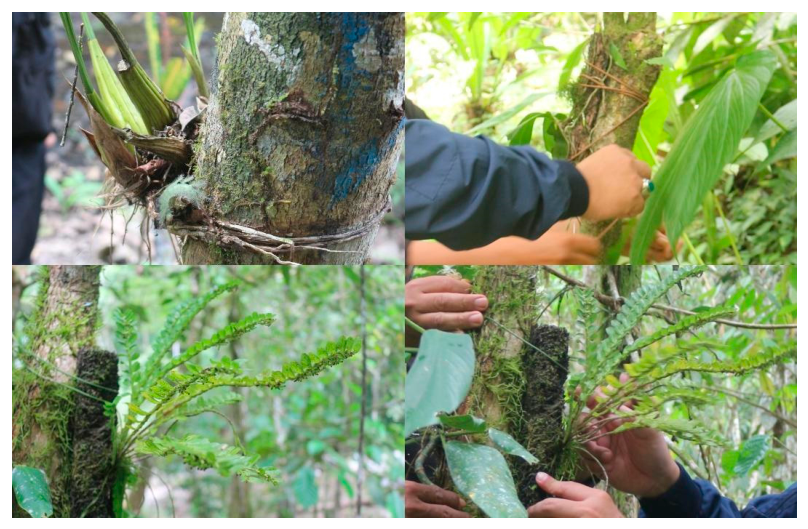
Co-Creating Governance for Community-Based Forest Orchid Cultivation and Ecotourism: Lessons from Lore Lindu National Park, Indonesia

 , and
, and
Abstract
1. Introduction
1.1. Co-Creation and Institutional Support in Local Conservation
1.2. Research Context
2. Materials and Methods
2.1. Study Area
2.2. Research Design and Theoretical Framework
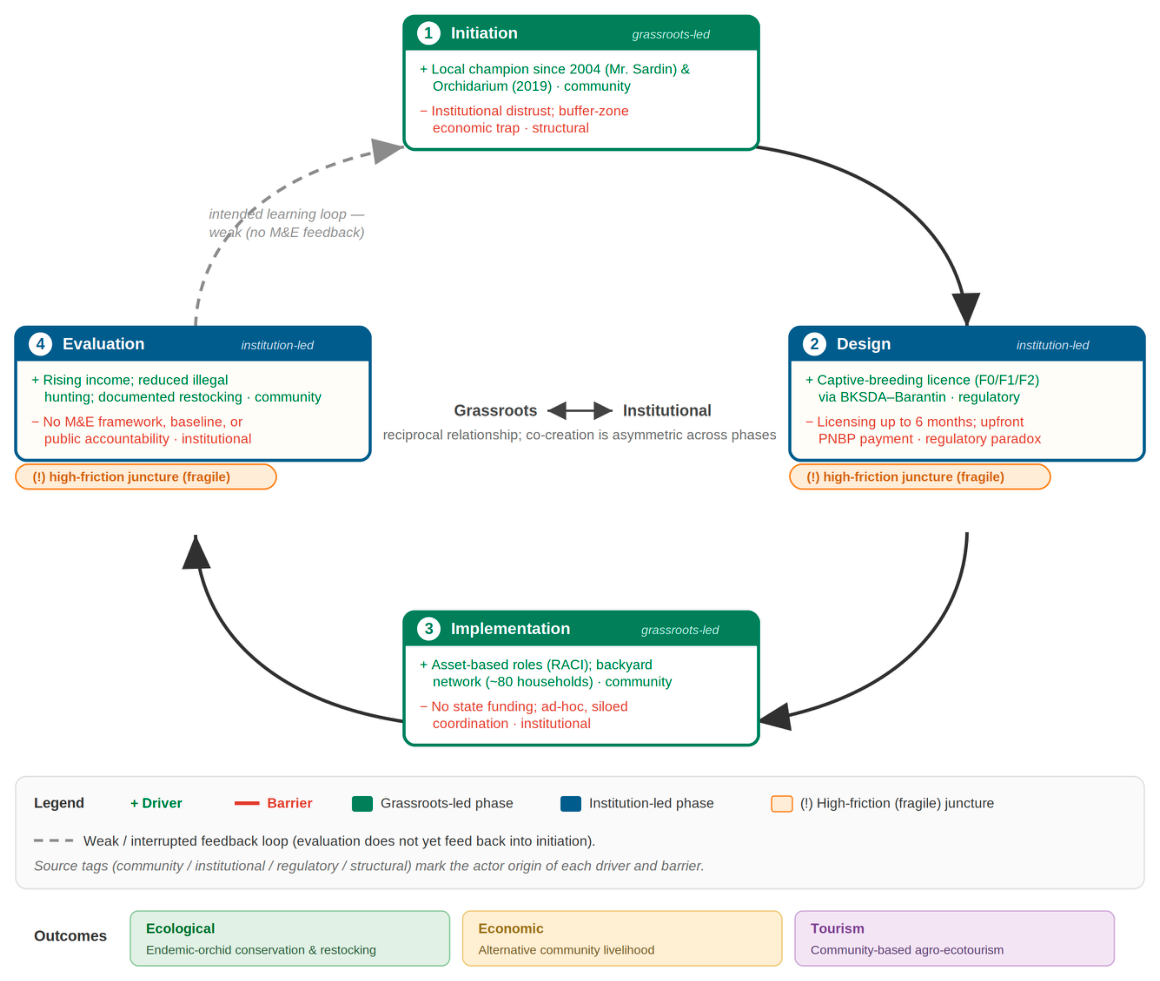
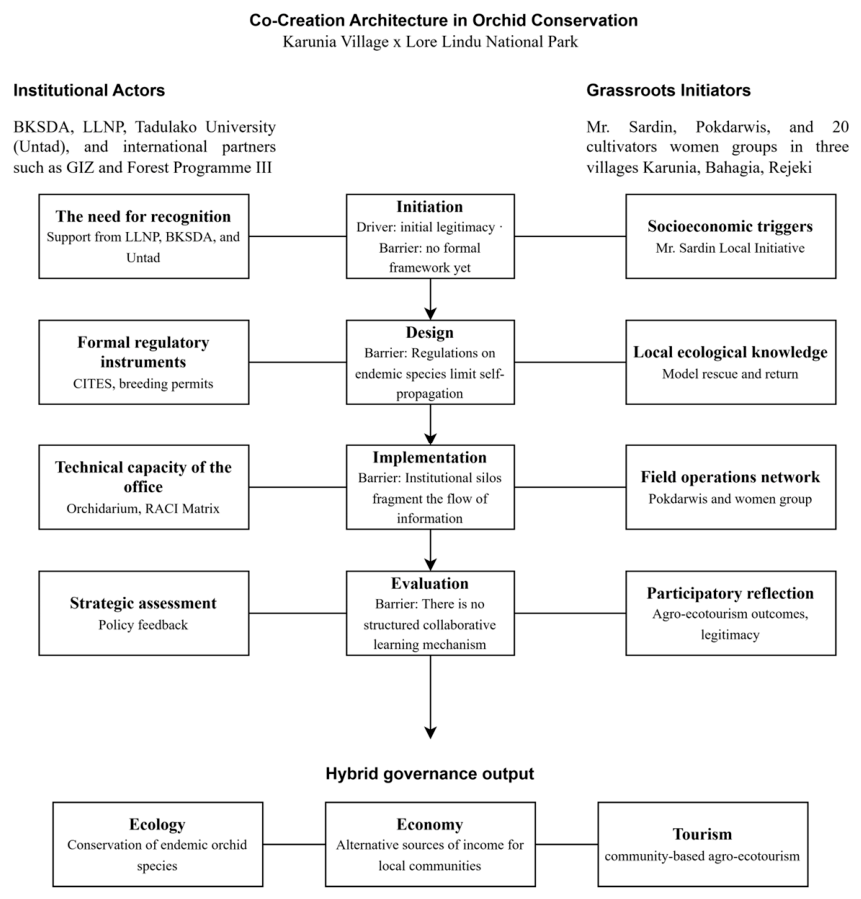
- Initiation: In Karunia village co-creation began not with a formal program but with a local champion, as Mr. Sardin chairman of the Kelompok Sadar Wisata (Pokdarwis), brought together growers, orchid enthusiasts, and women’s groups around a shared problem; trust economic trap, in which the low returns of legal orchid sales discouraged compliance.
- Design: In this phase, actors jointly explored the problem and tested a legal pathway, developing the Captive-Breeding Licence scheme (F0/F1/F2) through consultation with Natural Resources Conservation Agency (BKSDA) and Indonesian Quarantine Agency (Barantin); the prototype nonetheless exposed structural barriers, namely licensing procedures of up to six months and upfront Non-Tax State Revenue (PNBP) payments that strained community capacity.
- Implementation: During the implementation phase, actors coordinated roles through an asset based (RACI) division of labor and consolidated a backyard cultivation network of roughly eighty households; yet the effort proceeded without state funding and relied on ad hoc, siloed coordination rather than an institutionalized forum, limiting the pace of consolidation.
- Evaluation: In this final phase, early outcomes were observed—rising household income, reduced illegal hunting, and documented restocking—but they remained largely anecdotal, as the initiative still lacked any monitoring and evaluation framework, baseline data, or public-accountability mechanism to systematically measure impact or enable dissemination.
2.3. Data Collection
2.4. Data Analysis
2.5. Declaration and Ethics
3. Results
3.1. Initiation
3.1.1. Identifying Problems and Communicating Solution Ideas
3.1.2. Engaging and Mobilizing Relevant Actors
3.1.3. Building Trust and Facilitating Collaboration
3.2. Design
3.2.1. Joint Problem Exploration and Redefinition
3.2.2. Developing a Shared Vision and Seeking Solutions
3.2.3. Building and Testing Prototypes in the Field
3.3. Implementation
3.3.1. Securing Funding
3.3.2. Coordinating Actions
3.3.3. Consolidating Solutions
3.4. Evaluation
3.4.1. Measuring Outputs and Outcomes
3.4.2. Public Accountability
3.4.3. Disseminating Solutions
3.5. Co-Creation Architecture in Orchid Conservation at Karunia Village, Lore Lindu National Park
4. Discussion
4.1. Institutional and Community Approach Shaped Hybrid Co-Creation
4.2. Challenges and Contingencies of Co-Creation Through Community-Based Orchid Conservation
5. Conclusions
Author Contributions
Funding
Data Availability Statement
Acknowledgments
Conflicts of Interest
Abbreviations
| ADWI | Anugerah Desa Wisata Indonesia (Indonesian Tourism Village Awards) |
| Barantin | Badan Karantina Indonesia (Indonesian Quarantine Agency) |
| BBTNLL | Balai Besar Taman Nasional Lore Lindu (Lore Lindu National Park Authority) |
| BKSDA | Balai Konservasi Sumber Daya Alam (Natural Resource Conservation Agency) |
| BPP | Balai Penyuluhan Pertanian (Agricultural Extension Office) |
| BUMDes | Badan Usaha Milik Desa (Village-Owned Enterprise) |
| Gampiri | Startup Incubator in Sigi |
| CITES | Convention on International Trade in Endangered Species |
| GIZ | Deutsche Gesellschaft für Internationale Zusammenarbeit (German Agency for International Cooperation) |
| IDR | Indonesian Rupiah |
| KBLI | Klasifikasi Baku Lapangan Usaha Indonesia (Indonesian Standard Industrial Classification) |
| KSDAE | Konservasi Sumber Daya Alam dan Ekosistem (Natural Resources and Ecosystem Conservation) |
| KTP | Kartu Tanda Penduduk (Indonesian Identity Card) |
| LLNP | Lore Lindu National Park |
| M&E | Monitoring and Evaluation |
| NGO | Non-Governmental Organization |
| NPG | New Public Governance |
| NPM | New Public Management |
| NPWP | Nomor Pokok Wajib Pajak (Taxpayer Identification Number |
| NTFP | Non-Timber Forest Product |
| PAI | Pencinta Anggrek Indonesia (Indonesian Orchid Lovers Community) |
| PETI | Pertambangan Emas Tanpa Izin (Illegal Gold Mining) |
| PNBP | Penerimaan Negara Bukan Pajak (Non-Tax State Revenue) |
| Pokdarwis | Kelompok Sadar Wisata (Tourism Awareness Group) |
| RACI | Responsible, Accountable, Consulted, Informed |
| RKT | Rencana Kerja Tahunan (Annual Work Plan) |
| SATS-DN | Surat Angkut Tumbuhan dan Satwa Liar Dalam Negeri (Domestic Transport Permit for Wild Plants and Animals) |
| SOP | Standard Operating Procedure |
| TPA | Traditional Public Administration |
| OSS | Online Single Submission |
| UI | Universitas Indonesia |
| UNESCO | United Nations Educational, Scientific and Cultural Organization |
References
- Hood, C. A public management for all seasons? Public Adm. 1991, 69, 3–19. [Google Scholar] [CrossRef] [Scilit]
- Osborne, S.P. The new public governance? Public Manag. Rev. 2006, 8, 377–387. [Google Scholar] [CrossRef] [Scilit]
- Pollitt, C.; Bouckaert, G. Public Management Reform: A Comparative Analysis—Into the Age of Austerity, 4th ed.; Oxford University Press: Oxford, UK, 2017. [Google Scholar]
- Torfing, J.; Andersen, L.B.; Greve, C.; Klausen, K.K. Public Governance Paradigms: Competing and Co-Existing; Edward Elgar Publishing: Cheltenham, UK, 2020. [Google Scholar]
- Torfing, J.; Triantafillou, P. What’s in a name? Grasping new public governance as a political-administrative system. Int. Rev. Public Adm. 2013, 18, 9–25. [Google Scholar] [CrossRef] [Scilit]
- Braga, A.; Sancino, A. Il New Public Management in alcuni paesi in via di sviluppo tra eterogenesi dei fini e managerial fashion. Riv. Ital. Ragioneria Econ. Aziend. 2013, 113, 695–708. [Google Scholar]
- Ongaro, E. Philosophy and Public Administration: An Introduction; Edward Elgar Publishing: Cheltenham, UK, 2017. [Google Scholar]
- Armitage, D.; Plummer, R.; Berkes, F.; Arthur, R.I.; Charles, A.T.; Davidson-Hunt, I.J.; Diduck, A.P.; Doubleday, N.C.; Johnson, D.S.; Marschke, M.; et al. Adaptive co-management for social-ecological complexity. Front. Ecol. Environ. 2009, 7, 95–102. [Google Scholar] [CrossRef] [Scilit]
- Berkes, F. Evolution of co-management: Role of knowledge generation, bridging organizations and social learning. J. Environ. Manag. 2009, 90, 1692–1702. [Google Scholar] [CrossRef] [Scilit] [PubMed]
- Rhodes, R.A.W. Understanding Governance: Policy Networks, Governance, Reflexivity and Accountability; Open University Press: Buckingham, UK, 1997. [Google Scholar]
- Ansell, C.; Gash, A. Collaborative governance in theory and practice. J. Public Adm. Res. Theory 2008, 18, 543–571. [Google Scholar] [CrossRef] [Scilit]
- Emerson, K.; Nabatchi, T.; Balogh, S. An integrative framework for collaborative governance. J. Public Adm. Res. Theory 2012, 22, 1–29. [Google Scholar] [CrossRef] [Scilit]
- Termeer, C.J.A.M.; Dewulf, A.; van Lieshout, M. Disentangling scale approaches in governance research: Comparing monocentric, multilevel, and adaptive governance. Ecol. Soc. 2010, 15, 29. [Google Scholar] [CrossRef] [Scilit]
- Primavera, J.H.; Esteban, J.M.A. A review of mangrove rehabilitation in the Philippines: Successes, failures and future prospects. Wetl. Ecol. Manag. 2008, 16, 345–358. [Google Scholar] [CrossRef] [Scilit]
- Datta, D.; Chattopadhyay, R.N.; Guha, P. Community based mangrove management: A review on status and sustainability. J. Environ. Manag. 2012, 107, 84–95. [Google Scholar] [CrossRef] [Scilit] [PubMed]
- López-Portillo, J.; Lewis, R.R., III; Saenger, P.; Rovai, A.; Koedam, N.; Dahdouh-Guebas, F.; Agraz-Hernández, C.; Rivera-Monroy, V.H. Mangrove forest restoration and rehabilitation. In Mangrove Ecosystems: A Global Biogeographic Perspective; Rivera-Monroy, V.H., Lee, S.Y., Kristensen, E., Twilley, R.R., Eds.; Springer: Cham, Switzerland, 2017; pp. 301–345. [Google Scholar] [CrossRef] [Scilit]
- Lovelock, C.E.; Brown, B.M. Land tenure considerations are key to successful mangrove restoration. Nat. Ecol. Evol. 2019, 3, 1135. [Google Scholar] [CrossRef] [Scilit] [PubMed]
- Ansell, C.; Torfing, J. Public Governance as Co-Creation: A Strategy for Revitalizing the Public Sector and Rejuvenating Democracy; Cambridge University Press: Cambridge, UK, 2021. [Google Scholar]
- Ansell, C.; Torfing, J. Co-creation: The new kid on the block in public governance. Policy Politics 2021, 49, 211–230. [Google Scholar] [CrossRef] [Scilit]
- Timis-Gansac, V.; Dinca, L.; Tudose, N.C.; Constandache, C.; Murariu, G.; Cheregi, G.; Moțiu, P.T.; Derecichei, L.M. Community-based conservation in mountain forests: Patterns, challenges, and policy implications. Trees For. People 2025, 22, 101041. [Google Scholar] [CrossRef] [Scilit]
- Brooks, J.S.; Waylen, K.A.; Borgerhoff Mulder, M. How national context, project design, and local community characteristics influence success in community-based conservation projects. Proc. Natl. Acad. Sci. USA 2012, 109, 21265–21270. [Google Scholar] [CrossRef] [Scilit] [PubMed]
- Armitage, D.; Mbatha, P.; Muhl, E.K.; Rice, W.; Sowman, M. Governance principles for community-centered conservation in the post-2020 global biodiversity framework. Conserv. Sci. Pract. 2020, 2, e160. [Google Scholar] [CrossRef] [Scilit]
- Ostrom, E. Governing the Commons: The Evolution of Institutions for Collective Action; Cambridge University Press: Cambridge, UK, 1990. [Google Scholar]
- Torfing, J.; Sørensen, E.; Røiseland, A. Transforming the public sector into an arena for co-creation: Barriers, drivers, benefits, and ways forward. Adm. Soc. 2021, 51, 795–825. [Google Scholar] [CrossRef] [Scilit]
- Ansell, C.; Sørensen, E.; Torfing, J. The democratic quality of co-creation: A theoretical exploration. Public Policy Adm. 2024, 39, 149–170. [Google Scholar] [CrossRef] [Scilit]
- Foster, S.R.; Iaione, C. Ostrom in the city: Design principles and practices for the urban commons. In Routledge Handbook of the Study of the Commons; Hudson, B., Rosenbloom, J., Cole, D., Eds.; Routledge: London, UK, 2019; pp. 235–255. [Google Scholar]
- Morrison, T.H.; Adger, W.N.; Brown, K.; Lemos, M.C.; Huitema, D.; Phelps, J.; Evans, L.; Cohen, P.; Song, A.M.; Turner, R.; et al. The black box of power in polycentric environmental governance. Glob. Environ. Change 2020, 57, 101934. [Google Scholar] [CrossRef] [Scilit]
- Andersson, K.P.; Ostrom, E. Analyzing decentralized resource regimes from a polycentric perspective. Policy Sci. 2008, 41, 71–93. [Google Scholar] [CrossRef] [Scilit]
- Folke, C.; Jansson, Å.; Rockström, J.; Olsson, P.; Carpenter, S.R.; Chapin, F.S., III; Crépin, A.-S.; Daily, G.; Danell, K.; Ebbesson, J.; et al. Reconnecting to the biosphere. Ambio 2011, 40, 719–738. [Google Scholar] [CrossRef] [Scilit] [PubMed]
- Gómez-Baggethun, E.; Corbera, E.; Reyes-García, V. Traditional ecological knowledge and global environmental change: Research findings and policy implications. Ecol. Soc. 2013, 18, 72. [Google Scholar] [CrossRef] [Scilit] [PubMed]
- Direktorat Jenderal Konservasi Sumber Daya Alam dan Ekosistem (KSDAE), Kawasan Konservasi. Kementerian Kehutanan Republik Indonesia. Available online: https://ksdae.kehutanan.go.id/kawasan-konservasi/100245040/ (accessed on 18 May 2026).
- Agroforestry Indonesia. Ini Adalah Fakta tentang Lore Lindu. Available online: https://agroforestry.id/news/ini-adalah-fakta-tentang-lore-lindu (accessed on 18 May 2026).
- Kompas. Budidaya Anggrek, Upaya Pelestarian Flora Endemik di Sulawesi Tengah [Orchid Cultivation, Efforts to Preserve Endemic Flora in Central Sulawesi]. KompasTV, 11 June 2020. Available online: https://www.kompas.tv/klik360/86205/budidaya-anggrek-upaya-pelestarian-flora-endemik-di-sulawesi-tengah (accessed on 18 May 2026).
- Balai Besar Taman Nasional Lore Lindu, Flora. Directorate General of Natural Resources and Ecosystem Conservation, Ministry of Forestry of the Republic of Indonesia. Available online: https://bbtnlorelindu.ksdae.kehutanan.go.id/index.php/flora/ (accessed on 18 May 2026).
- Nasrun, M.S.; Gailea, R.; Aminah, S. Exploration and characterization of host trees and orchid epiphyte zones in Lore Lindu National Park, Central Sulawesi. J. Sylva Lestari 2024, 12, 418–434. [Google Scholar] [CrossRef] [Scilit]
- Susanto, H. Menyibak Desa Karunia, Kawasan Pelestari Anggrek di Taman Nasional Lore Lindu [Uncovering Karunia Village, an Orchid Conservation Area in Lore Lindu National Park]. Liputan6, 12 June 2020. Available online: https://www.liputan6.com/regional/read/4275959/menyibak-desa-karunia-kawasan-pelestari-anggrek-di-taman-nasional-lore-lindu (accessed on 18 May 2026).
- Ansell, C.; Sørensen, E.; Torfing, J. Co-Creation for Sustainability: The UN SDGs and the Power of Local Partnerships; Emerald Publishing: Bingley, UK, 2022. [Google Scholar]
- Project Management Institute. A Guide to the Project Management Body of Knowledge (PMBOK Guide), 6th ed.; Project Management Institute: Newtown Square, PA, USA, 2017. [Google Scholar]
- Stojanović, D.V.; Cvetković, T.; Kuzmanović, N.; Lakušić, D.; Tomović, G.; Niketić, M. Establishment of the first orchidarium in Serbia: Strategy for sustainable management of native orchid genetic resources. J. Zool. Bot. Gard. 2025, 6, 37. [Google Scholar] [CrossRef] [Scilit]
- Ostrom, E. Beyond markets and states: Polycentric governance of complex economic systems. Am. Econ. Rev. 2010, 100, 641–672. [Google Scholar] [CrossRef] [Scilit]
- Brondizio, E.S.; Ostrom, E.; Young, O.R. Connectivity and the governance of multilevel social-ecological systems: The role of social capital. Annu. Rev. Environ. Resour. 2009, 34, 253–278. [Google Scholar] [CrossRef] [Scilit]
- Folke, C.; Hahn, T.; Olsson, P.; Norberg, J. Adaptive governance of social-ecological systems. Annu. Rev. Environ. Resour. 2005, 30, 441–473. [Google Scholar] [CrossRef] [Scilit]
- Kumar, M. Setting Up an Orchid Conservatory for the Species Found in the Western Ghats. LinkedIn, 2020. Available online: https://www.linkedin.com/pulse/setting-up-orchid-conservatory-species-found-western-ghats-kumar- (accessed on 18 May 2026).
- Seaton, P.T.; Hu, H.; Perner, H.; Pritchard, H.W. Ex situ conservation of orchids in a warming world. Bot. Rev. 2010, 76, 193–203. [Google Scholar] [CrossRef] [Scilit]
- Rasmussen, F.N.; Petersen, G. On the “Seidenfaden collection” and the multiple roles botanical gardens can play in orchid conservation. Lankesteriana 2018, 18, 1–12. [Google Scholar] [CrossRef] [Scilit]
- Hasman, H. BTNLL: Hutan di Sulteng Rusak Karena Pembalakan dan Penambangan Liar [BTNLL: Forests in Central Sulawesi Damaged by Illegal Logging and Mining]. ANTARA News, 21 March 2022. Available online: https://www.antaranews.com/berita/2772705/btnll-hutan-di-sulteng-rusak-karena-pembalakan-dan-penambangan-liar (accessed on 18 May 2026).
- Government of the Republic of Indonesia. Government Regulation No. 7/1999 on Conservation of Plant and Animal Species (Peraturan Pemerintah Republik Indonesia Nomor 7 Tahun 1999 tentang Pengawetan Jenis Tumbuhan dan Satwa); State Secretariat of the Republic of Indonesia: Jakarta, Indonesia, 1999.
- Minister of Environment and Forestry of the Republic of Indonesia. Minister of Environment and Forestry Regulation No. P.106/MENLHK/SETJEN/KUM.1/12/2018 on Protected Plant and Animal Species; Ministry of Environment and Forestry of the Republic of Indonesia: Jakarta, Indonesia, 2018.
- Sofyan, I. Implementasi Kebijakan Konservasi Hutan di Taman Nasional Lore Lindu Provinsi Sulawesi Tengah [Implementation of Forest Conservation Policy in Lore Lindu National Park, Central Sulawesi Province]. Ph.D. Thesis, Universitas Padjadjaran, Bandung, Indonesia, 2004. [Google Scholar]
- Hofstad, H. Co-creation challenges to public leadership: Tensions, dilemmas and coping mechanisms. In Advancing Co-Creation in Local Governance: The Role of Coping Strategies and Constructive Hybridization; Røiseland, A., Sørensen, E., Torfing, J., Eds.; Edward Elgar Publishing: Cheltenham, UK, 2024; pp. 150–177. [Google Scholar] [CrossRef] [Scilit]
- Ospina, S.M. Collective leadership and context in public administration: Bridging public leadership research and leadership studies. Public Adm. Rev. 2017, 77, 275–287. [Google Scholar]
- Van Wart, M. Lessons from leadership theory and the contemporary challenges of leaders. Public Adm. Rev. 2013, 73, 553–565. [Google Scholar] [CrossRef] [Scilit]
- Bryson, J.; Crosby, B.; Sørensen, E. How public leaders can promote public value through co-creation. Policy Politics 2021, 49, 267–286. [Google Scholar] [CrossRef] [Scilit]
- Hofstad, H.; Sørensen, E.; Torfing, J.; Vedeld, T. Leading co-creation for the green shift. Public Money Manag. 2023, 43, 357–366. [Google Scholar] [CrossRef] [Scilit]
- Ryzki, A. Hampir Satu Dekade, Deforestasi Hutan Lore Lindu Mencapai 7.923 Hektar [Nearly a Decade, Deforestation in Lore Lindu Forest Reaches 7,923 Hectares]. Trilogi.co.id, 19 June 2019. Available online: https://trilogi.co.id/hampir-satu-dekade-deforestasi-hutan-lore-lindu-mencapai-7923-hektar/ (accessed on 18 May 2026).
- Salam, M. BBTNLL: Sebagian Besar PETI di Kawasan Konservasi Sudah Ditutup [BBTNLL: Most Illegal Mining Sites in Conservation Areas Have Been Closed]. ANTARA News, 24 August 2025. Available online: https://www.antaranews.com/berita/5060549/bbtnll-sebagian-besar-peti-di-kawasan-konservasi-sudah-ditutup (accessed on 18 May 2026).



| Phase | Key Tasks [37] | Empirical Findings | Phase-Specific Drivers/Barriers |
|---|---|---|---|
| Initiation | Problem identification; actor mobilization; trust building | 20-year grassroots movement led by Mr. Sardin; Pokdarwis formation; ADWI 2024 recognition | Driver: Local champions and social capital. Barrier: Institutional distrust. |
| Design | Problem redefinition; shared vision; prototyping | BKSDA—Barantin pathway mapped; two-orchid pilot shipment; Captive Breeding License scheme | Driver: Multi-actor dialog. Barrier: PNBP costs and 6-month verification. |
| Implementation | Securing funding; coordinating actions; consolidating solutions | Backyard cultivation network; asset-based role distribution; RACI Matrix | Driver: Community asset proximity. Barrier: Multi-scalar silos and funding limits. |
| Evaluation | measuring outcomes; public accountability; disseminating solutions | Dual-function outcome (production + ecotourism); reactive Barantin assessment | Driver: Emergent agro-ecotourism. Barrier: Absence of M&E framework. |
| Activity | Local Government/Dinas (Macro) | Transition Agencies, Incubators, and NGOs | BUMDes/Cooperative (Village) | Farmer Groups/Pokdarwis | Local Entrepreneurs/Producers |
|---|---|---|---|---|---|
| Regulation and Policy Formulation | R/A | C | I | C | C |
| Market Research and Global Partnerships | I | R/A | C | I | C |
| Technical Standards Development (Cultivation/Conservation) | C | R/A | I | C | C |
| Commodity Production (Orchid Breeding) | I | C | I | R/A | R/A |
| Sorting, Initial QC, and Aggregation | I | C | A | R | R |
| Post-Harvest Processing and Value Addition | I | C | R/A | I | R |
| Logistics and Distribution (Karantina Compliance) | I | R | A | I | I |
| Monitoring and Evaluation (M&E) | A | R | C | C | C |
Disclaimer/Publisher’s Note: The statements, opinions and data contained in all publications are solely those of the individual author(s) and contributor(s) and not of MDPI and/or the editor(s). MDPI and/or the editor(s) disclaim responsibility for any injury to people or property resulting from any ideas, methods, instructions or products referred to in the content. |
© 2026 by the authors. Licensee MDPI, Basel, Switzerland. This article is an open access article distributed under the terms and conditions of the Creative Commons Attribution (CC BY) license.
Share and Cite
Kurniawan, T.; Afra, S.A.; Wahyudi, E.; Ebiantari, Y.; Fajri, I.; Siringoringo, R. Co-Creating Governance for Community-Based Forest Orchid Cultivation and Ecotourism: Lessons from Lore Lindu National Park, Indonesia. Forests 2026, 17, 837. https://doi.org/10.3390/f17070837
Kurniawan T, Afra SA, Wahyudi E, Ebiantari Y, Fajri I, Siringoringo R. Co-Creating Governance for Community-Based Forest Orchid Cultivation and Ecotourism: Lessons from Lore Lindu National Park, Indonesia. Forests. 2026; 17(7):837. https://doi.org/10.3390/f17070837
Chicago/Turabian StyleKurniawan, Teguh, Syifa Amania Afra, Ega Wahyudi, Yohani Ebiantari, Imam Fajri, and Raynilda Siringoringo. 2026. "Co-Creating Governance for Community-Based Forest Orchid Cultivation and Ecotourism: Lessons from Lore Lindu National Park, Indonesia" Forests 17, no. 7: 837. https://doi.org/10.3390/f17070837
APA StyleKurniawan, T., Afra, S. A., Wahyudi, E., Ebiantari, Y., Fajri, I., & Siringoringo, R. (2026). Co-Creating Governance for Community-Based Forest Orchid Cultivation and Ecotourism: Lessons from Lore Lindu National Park, Indonesia. Forests, 17(7), 837. https://doi.org/10.3390/f17070837