Article

Regional Comparison of Atlantic Forest Physiognomies Using GEDI-Derived Structural Metrics

1
Department of Geography, University of São Paulo, São Paulo 05508-000, SP, Brazil
2
Center for Environmental Studies and Research, University of Campinas, Campinas 13083-867, SP, Brazil
3
Center for Nature Sciences, Federal University of São Carlos, Lagoa do Sino, Buri 18290-000, SP, Brazil
*
Author to whom correspondence should be addressed.
Forests 2026, 17(6), 720; https://doi.org/10.3390/f17060720 (registering DOI)
Submission received: 14 May 2026 / Revised: 15 June 2026 / Accepted: 16 June 2026 / Published: 20 June 2026

Abstract

Remote sensing contributes to characterizing forest structure across heterogeneous tropical regions, yet structural parameters used to compare Atlantic Forest phytophysiognomies remain limited, especially in fragmented landscapes affected by multiple drivers of forest loss and degradation. This study used Global Ecosystem Dynamics Investigation (GEDI) data to compare the structure of old-growth candidate forest polygons in four Brazilian Atlantic Forest phytophysiognomies: Dense Ombrophilous Forest (DOF), Mixed Ombrophilous Forest (MOF), Seasonal Semideciduous Forest (SSdF), and Seasonal Deciduous Forest (SDF). We analyzed canopy height (H), canopy cover (COVER), foliage height diversity (FHD), plant area index (PAI), and aboveground biomass density (AGBD) from GEDI L2B and L4A footprints acquired between 2019 and 2024. Structural differences among phytophysiognomies were significant for all variables (Kruskal–Wallis, p < 0.001), with small-to-moderate effect sizes (ε2 ≈ 0.05–0.15). The strongest pairwise contrasts occurred for SDF–SSdF and SSdF–DOF, whereas MOF showed greater overlap with the other groups. Across variables, AGBD and H were the most consistent discriminators, and polygon-level summaries strengthened among-group separation. These findings show that GEDI-derived polygon-level metrics can support regional comparisons of forest structure among Atlantic Forest phytophysiognomies and help identify the strongest contrasts in fragmented landscapes.

1. Introduction

Plant biodiversity underpins ecosystem functioning and the provision of ecosystem services, yet tropical forests, a major component of global forest resources, remain under strong pressure from land use change, fragmentation, and climate-related disturbance [1,2,3]. In the Brazilian Atlantic Forest [4], one of the world’s major biodiversity hotspots [5,6], only a small fraction of the original vegetation remains, and a substantial share of the current native cover is relatively young, while older forests continue to be lost or degraded [7]. This context highlights the importance of identifying old-growth forest remnants as references for conservation and restoration.
Because forest structure is closely linked to habitat quality, biodiversity, and ecosystem functioning, structural attributes are increasingly used as ecological indicators in forest assessment. This perspective is consistent with studies highlighting the ecological importance of forest structure, stand heterogeneity, and remote sensing-derived information for understanding biodiversity patterns and forest functioning [8,9,10]. Remote sensing has therefore become central to forest ecology, management, and condition assessment [11,12], although platform, sensor, and application-specific limitations remain [13,14].
LiDAR (Light Detection and Ranging) is an active remote sensing technology that measures the timing and intensity of laser returns, enabling direct characterization of the vertical structure of vegetation. Because it samples the three-dimensional distribution of vegetation elements, LiDAR is particularly well suited to estimating canopy height, vertical complexity, and biomass-related attributes, offering clear advantages over passive optical approaches for structural forest assessment. Airborne LiDAR has repeatedly demonstrated strong utility for characterizing forest structure [15,16] and estimating biomass-related attributes [17,18], although broad-scale acquisitions remain operationally demanding and costly [19]. In the Atlantic Forest, airborne studies have likewise shown the value of LiDAR-derived metrics for biomass estimation, structural characterization, and mapping in environmentally heterogeneous landscapes [20,21], as well as for distinguishing forest types in restored tropical landscapes [22].
Among spaceborne approaches, the Global Ecosystem Dynamics Investigation (GEDI) mission, a NASA spaceborne LiDAR mission mounted on the International Space Station [23], has expanded the capacity to quantify canopy height, canopy cover, plant area index, foliage height diversity, and aboveground biomass density across broad spatial gradients [24,25,26]. However, GEDI-derived metrics remain sensitive to geolocation uncertainty, acquisition conditions, and complex terrain [27,28,29], and their usefulness for differentiating forest types across heterogeneous tropical landscapes at a regional scale still requires further evaluation [30].
Old-growth forests are irreplaceable for biodiversity conservation because many species depend on older, less altered, and structurally more developed habitats to persist in human-modified landscapes [31,32]. They are generally understood as primary or secondary forest stands in which structures and species normally associated with old primary forests have sufficiently accumulated to form a forest ecosystem distinct from younger age classes [33]. In this study, the term old-growth candidate forest is used operationally, referring to forest remnants selected by temporal stability, internal homogeneity, minimum-area, and visual quality control criteria, rather than by direct field-based stand age or floristic validation.
This study evaluates structural differences among old-growth candidate forest phytophysiognomies in the Atlantic Forest at a regional scale using GEDI-derived metrics and polygon-based inference. The central question is whether GEDI-derived polygon-level metrics can detect consistent structural differences among Dense Ombrophilous Forest (DOF), Mixed Ombrophilous Forest (MOF), Seasonal Deciduous Forest (SDF), and Seasonal Semideciduous Forest (SSdF) in a highly fragmented tropical biome. The analysis focuses on canopy height (H), canopy cover (COVER), foliage height diversity (FHD), plant area index (PAI), and aboveground biomass density (AGBD).

2. Materials and Methods

2.1. Study Area and Phytophysiognomies

This study was conducted in the Brazilian Atlantic Forest [5], a highly fragmented tropical biome characterized by strong climatic, topographic, and geomorphological heterogeneity [34,35,36]. Over time, the biome has been heavily transformed by roads, urban expansion, and agricultural land use, leading to fragmentation and changes in ecosystem functioning and landscape dynamics [37,38]. Despite this, it retains high floristic diversity, complex vertical stratification, and substantial structural variation along environmental gradients.
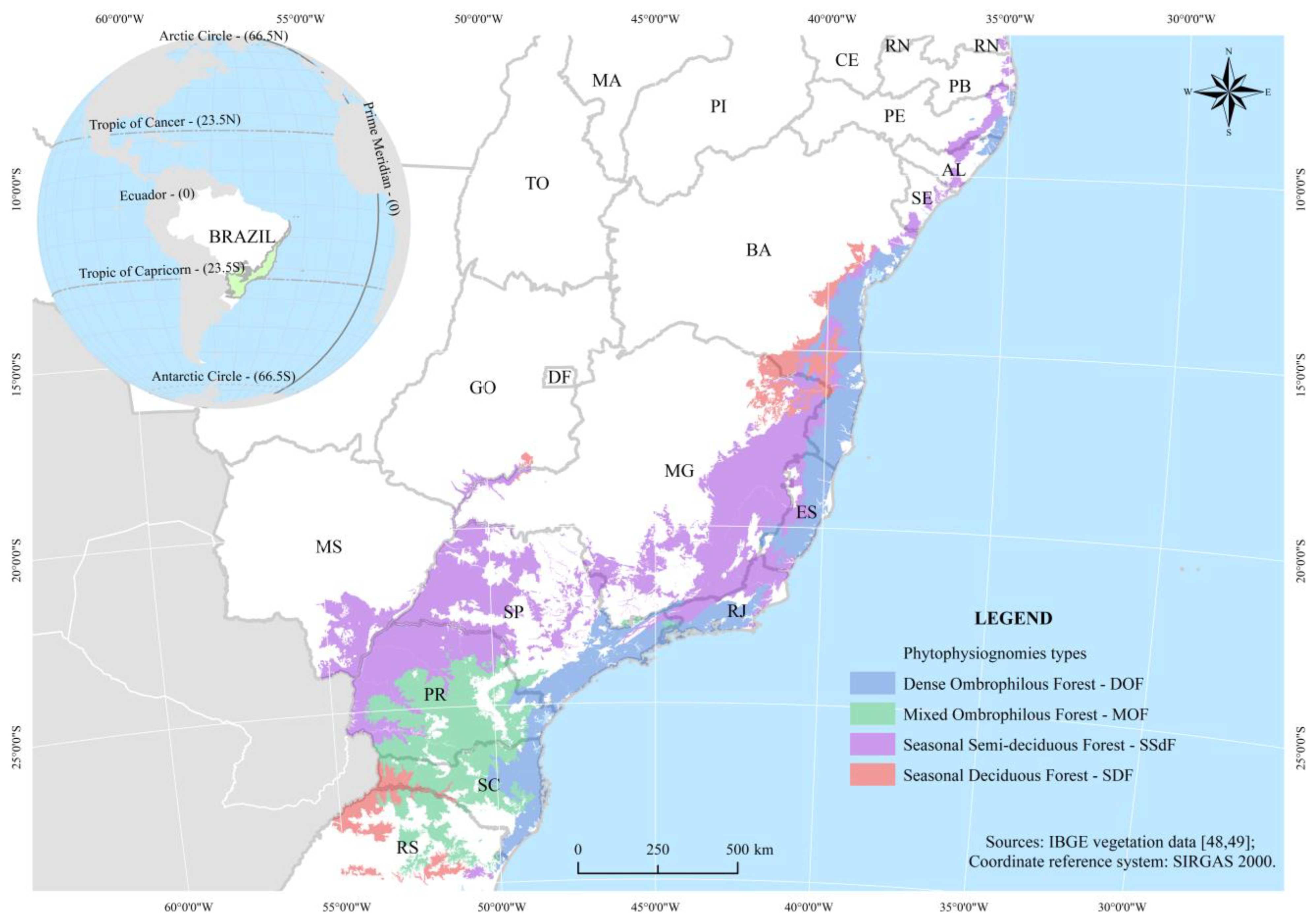
The analysis focused on four major Atlantic Forest phytophysiognomies: Dense Ombrophilous Forest (DOF), Mixed Ombrophilous Forest (MOF), Seasonal Deciduous Forest (SDF), and Seasonal Semideciduous Forest (SSdF). These groups were examined at a regional scale, an intermediate extent between local and national assessments, which is relevant because scale mismatches can bias ecological inference in remote sensing studies [39].
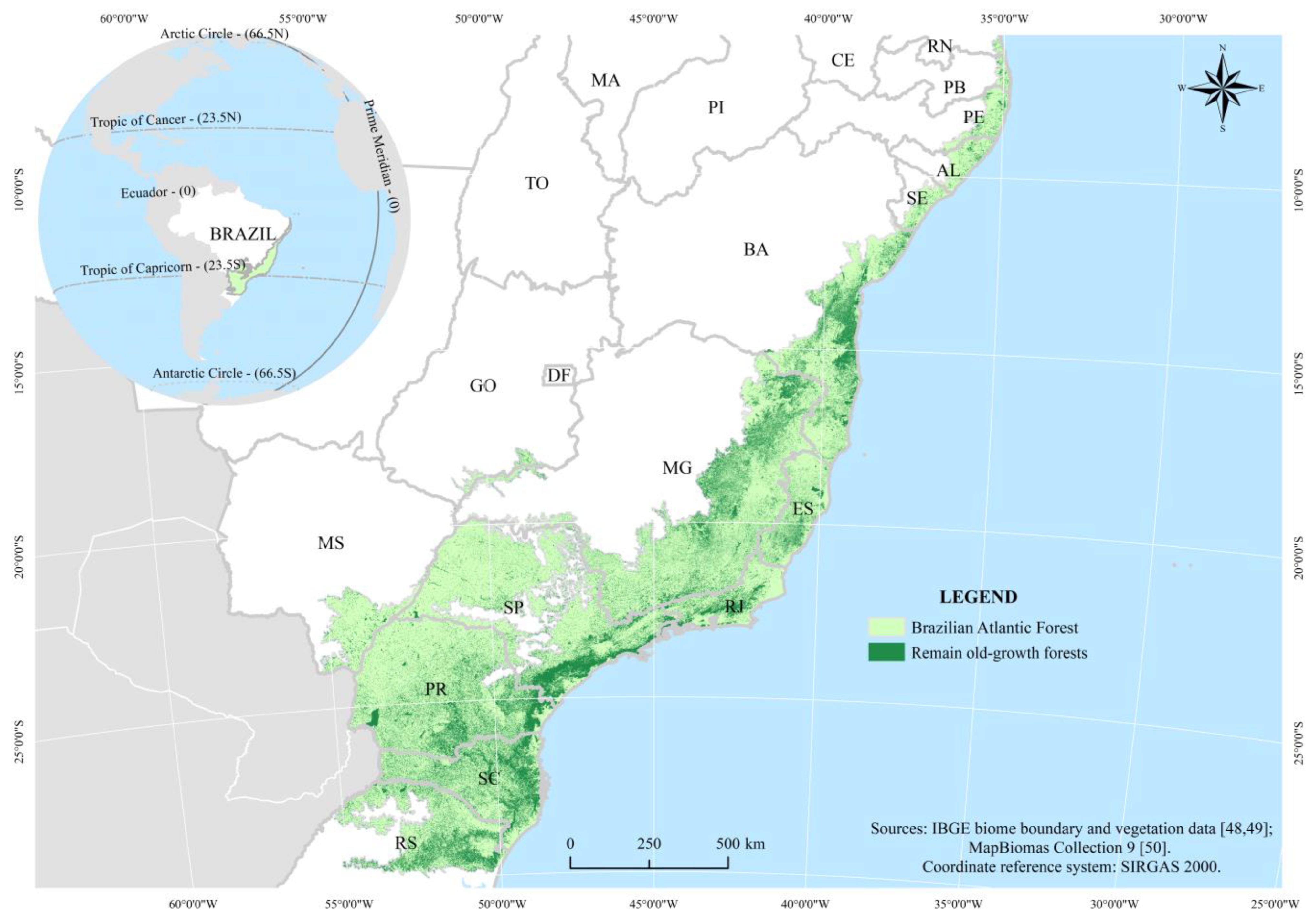
Figure 1 presents the extent of the biome and the spatial distribution of the old-growth candidate polygons used in this study, whereas Figure 2 depicts the study area and the distribution of the analyzed phytophysiognomies.

2.2. GEDI Data and Products

The Global Ecosystem Dynamics Investigation (GEDI), mounted on the International Space Station, is a spaceborne LiDAR mission designed to sample the vertical structure of vegetation using footprints of approximately 25 m in diameter [23,40]. The GEDI provides products relevant to forest structural assessment, including relative height metrics (L2A), canopy cover (COVER), and vertical structure variables such as foliage height diversity (FHD) and plant area index (PAI) from L2B, as well as footprint-scale aboveground biomass density (AGBD) from L4A. GEDI and related spaceborne structural datasets [14] are increasingly used to characterize forest structure across broad heterogeneous landscapes [24,25,26], including applications in canopy height estimation [30], biomass assessment [41,42,43], biodiversity-related analyses [44], structural complexity assessment [45], and vegetation mapping [46,47]. In this study, GEDI L2B and L4A products were used as the source of all structural variables analyzed.

2.3. Polygon Delineation and Sampling Design

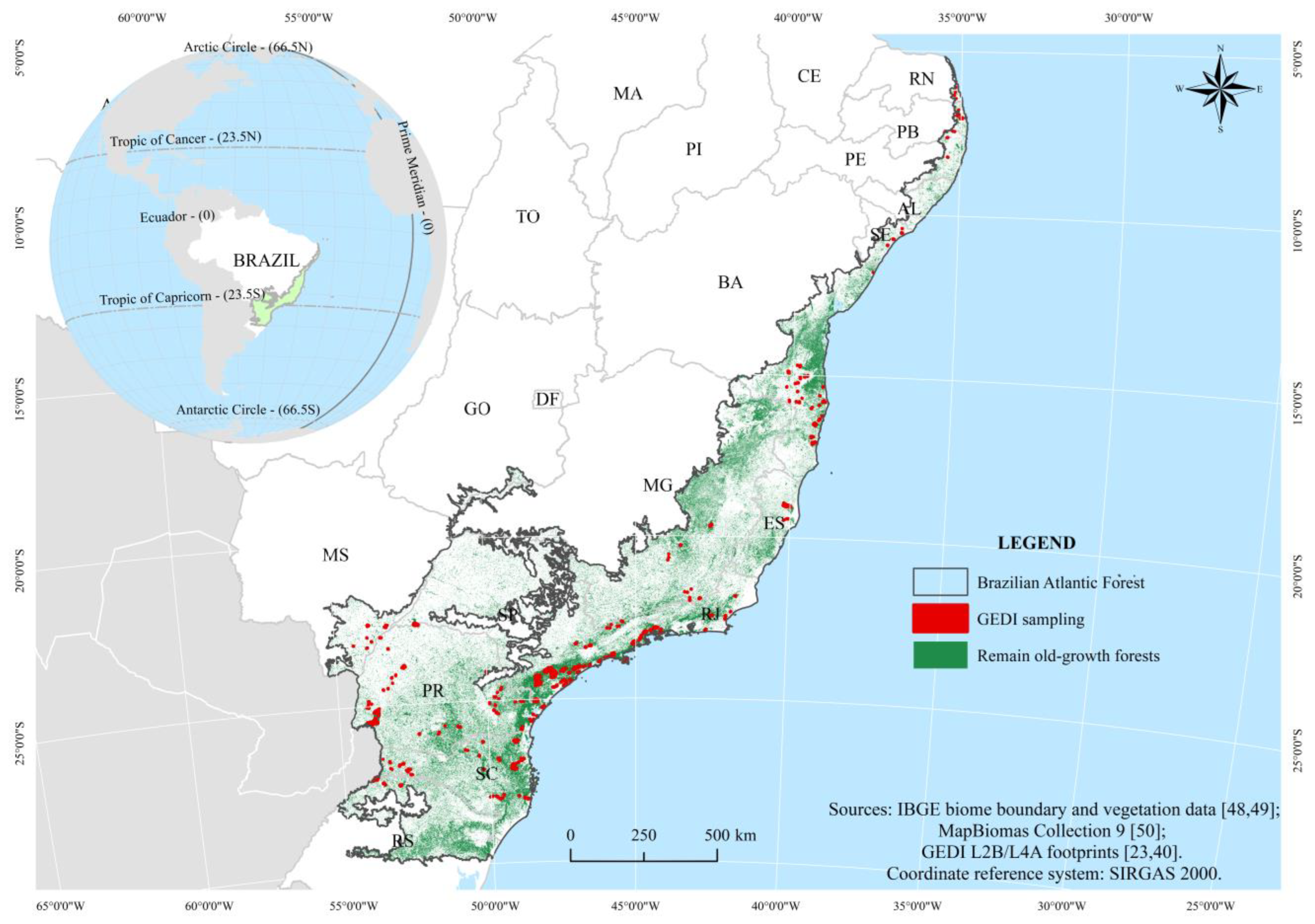
Sampling comprised candidate old-growth forest polygons distributed across the Brazilian Atlantic Forest (Figure 3). These remnants were identified from areas mapped as Forest formation in the MapBiomas annual land cover and land use series and subsequently screened for temporal stability and spatial consistency. Candidate polygons were delineated through a reproducible GIS workflow combining the official Brazilian Institute of Geography and Statistics (IBGE) phytophysiognomic framework and the corresponding 1:250,000 vegetation layer for physiognomy attribution [48,49], with the MapBiomas annual land cover and land use series (Collection 9) used for temporal stability screening [50].
IBGE and MapBiomas were therefore used only as ancillary classificatory and land cover datasets in the sampling workflow, whereas all structural variables analyzed in this study were derived directly from the GEDI. Neither dataset was used to calibrate or validate GEDI structural measurements. The IBGE 1:250,000 vegetation layer was used only for regional phytophysiognomic attribution, not for fine-scale validation of polygon boundaries or footprint-level structural metrics. Polygon consistency was further controlled by MapBiomas temporal screening, internal homogeneity criteria, minimum-area filtering, the 60 m internal edge buffer, and visual quality assurance/quality control using CBERS-4A/WPM imagery.
The same operational criteria were applied to all phytophysiognomies to define old-growth candidate polygons. Polygons were required to show high internal homogeneity (≥90% forest formation in 2023), no transition to anthropogenic classes during the screening period, a minimum area of 1.045 ha, and a non-empty core area after internal buffering. The temporal criterion was based on the persistence of the forest formation class in the MapBiomas annual land cover and land use series, supported by its official accuracy assessment [50,51]. Forest age was not directly estimated in the field; therefore, comparability among forest types was based on the same temporal stability and spatial consistency criteria. Expanded delineation details are provided in Supplementary Methods S2.
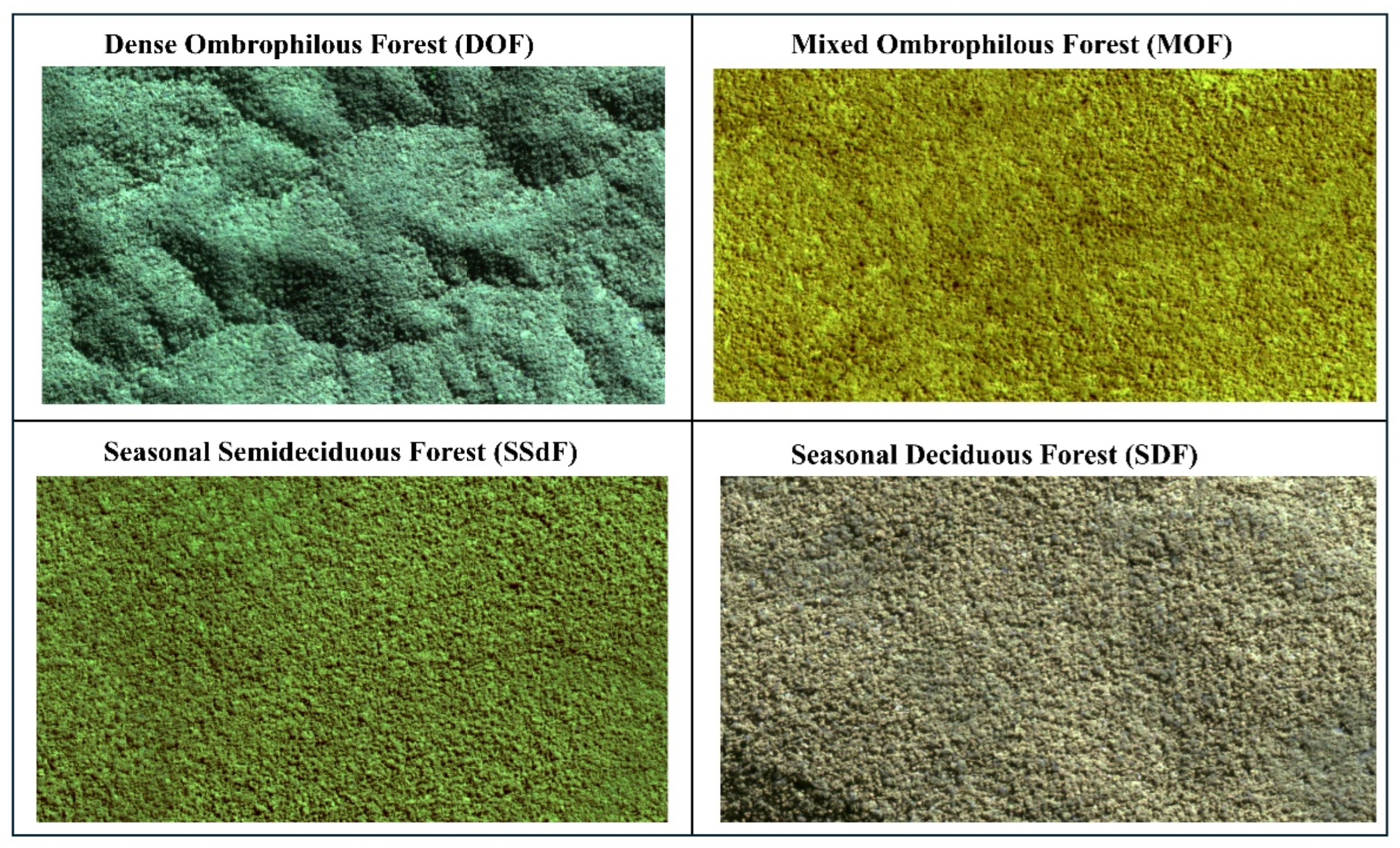
Visual quality assurance/quality control (QA/QC) was conducted using CBERS-4A/WPM Level-4 pan-sharpened imagery (2 m) to verify polygon integrity and exclude recent clearings, roads, and pronounced edge effects or intrusion from adjacent non-forest areas. Visual interpretation considered canopy texture and roughness, crown size distribution, shadow patterns, within-patch heterogeneity, and visible evidence of recent anthropogenic disturbance. This procedure was used only to verify polygon integrity and recent disturbance signals, not to derive GEDI structural variables, validate GEDI-derived structural measurements, or serve as the primary basis for physiognomy attribution. Figure 4 presents the visual interpretation keys used to support polygon QA/QC; additional details are provided in Supplementary Methods S1.
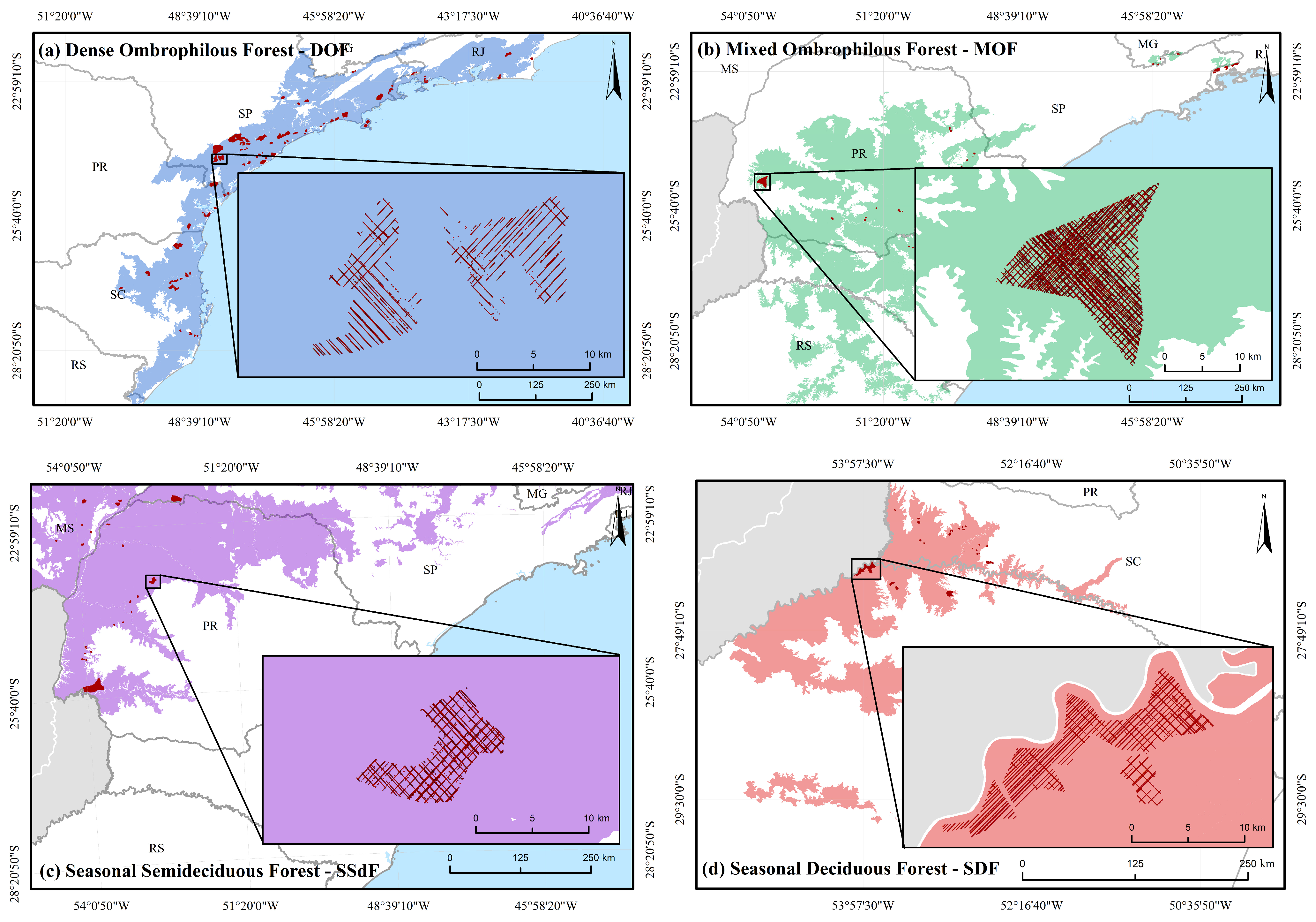
A total of 252,152 GEDI L2B and L4A footprints were analyzed, acquired between 18 April 2019 and 25 September 2024. GEDI footprints were treated as subsamples within polygons rather than as independent observations. After point-in-polygon assignment (>99.9% retained), primary inference was based on polygon-level summaries, with the polygon median as the main observation unit. This approach was adopted to reduce within-polygon dependence and to better align the analytical unit with the ecological unit of inference in a fragmented landscape. Figure 5 presents the GEDI-sampled subsets analyzed in this study for each phytophysiognomy.
Together, the four vegetation groups covered approximately 3696.60 km2. Before edge filtering, 252,152 GEDI L2B and L4A footprints were assigned to the candidate polygons. A 60 m internal buffer was then applied as a conservative spatial filter to reduce edge contamination in a highly fragmented landscape. This choice was intended to minimize the inclusion of footprints affected by boundary mixing, local edge effects, and potential geolocation uncertainty near polygon limits, while retaining a core area with greater internal homogeneity. Given the nominal GEDI footprint diameter (~25 m) and the irregular geometry of many Atlantic Forest remnants, the buffer should be understood as an operational and precautionary threshold rather than as an ecologically optimal distance. Applying this filter removed 13,191 footprints (5.23%), reducing the sample to 238,961 footprints. Table 1 summarizes the spatial sampling design, including the number of candidate polygons, total area by phytophysiognomy, and the impact of the 60 m edge filter on GEDI footprint retention. Because spatial differences among polygons may influence GEDI footprint availability and signal quality, the analysis combined product-level quality filters, visual polygon screening, the 60 m internal edge filter, polygon-level aggregation, and robustness checks under alternative quality control and acquisition scenarios.

2.4. Structural Variables and Quality Screening

The analysis used five GEDI-derived structural variables: canopy height (H), canopy cover (COVER), plant area index (PAI), foliage height diversity (FHD), and aboveground biomass density (AGBD). Canopy height was computed for each GEDI footprint as H = elev_highestreturn − elev_lowestmode_2b after quality screening. This canopy-top height proxy was derived from the highest return and ground mode to maintain consistency with the L2B/L4A-based workflow adopted in this study. Relative-height metrics from GEDI L2A are also valuable descriptors of canopy structure, but a full comparison among alternative GEDI height formulations was beyond the scope of the present regional assessment and should be addressed in future work.
Because the GEDI is a spaceborne waveform LiDAR mission, its structural metrics may be affected by geolocation uncertainty, terrain slope, waveform sensitivity, beam characteristics, acquisition conditions, canopy density, and uncertainty in ground-mode detection [52]. These factors may influence canopy height estimates and propagate to derived metrics such as FHD, PAI, and AGBD; therefore, quality filters and sensitivity scenarios were used to evaluate the stability of the main comparative patterns.
COVER represents the fraction of the footprint occupied by vegetation (%), PAI is the ratio of projected plant area to ground area (m2 m−2), AGBD estimates dry biomass above ground per hectare (Mg/ha), and FHD is a dimensionless descriptor of vertical structural complexity [53]. Because several GEDI metrics derive from the same waveform information, pairwise collinearity was quantified using Spearman correlations at both the footprint and polygon levels (Supplementary Figure S1, Table S1a,b), and these metrics are interpreted as complementary descriptors rather than independent observables. For the baseline analysis, GEDI L2B and L4A footprints were filtered by retaining observations with a product-specific quality flag equal to 1 and degradation flags equal to 0. To assess robustness, polygon-level inference was additionally evaluated under alternative quality control and acquisition subsets, including sensitivity thresholds, strong beams only, night-only acquisitions, and low-uncertainty AGBD subsets. These scenarios were designed to test whether the main phytophysiognomy-level contrasts were stable under plausible filtering choices, and their full definitions and outputs are provided in Supplementary Methods S3, Figure S2, and Tables S2a,b, S3a,b, and S4.

2.5. Statistical Analysis

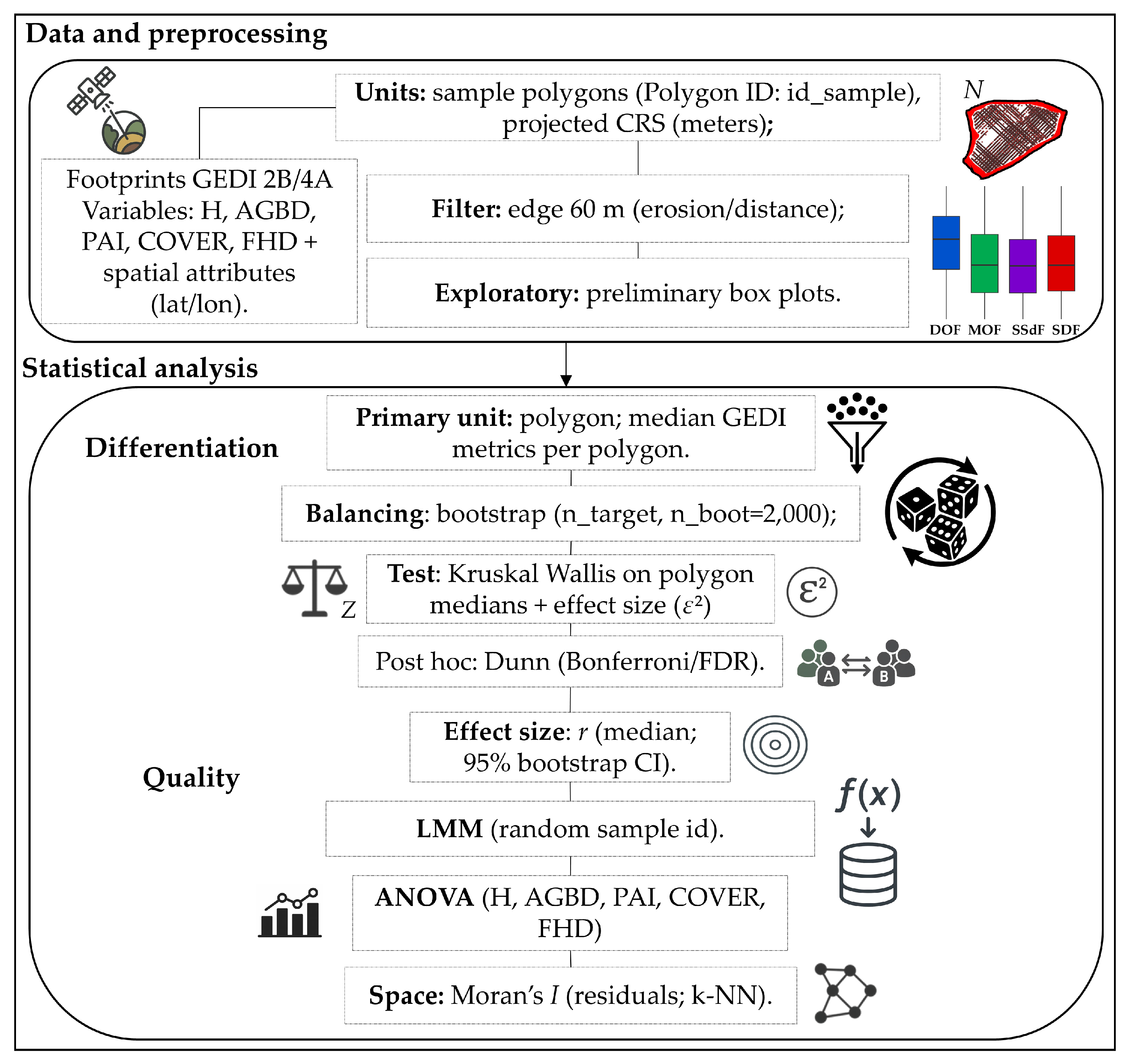
Differences among phytophysiognomies were evaluated using Kruskal–Wallis tests applied to the pooled dataset and polygon-level summaries, in which the polygon median was used as the primary observation unit [54]. In addition to p-values, the Kruskal–Wallis effect size (ε2) was reported [55]. Pairwise differences were evaluated using post hoc Dunn tests with Bonferroni and false discovery rate (FDR; Benjamini–Hochberg) adjustments [56,57]. The pairwise effect size r was estimated from the standardized z statistic of each pairwise comparison, as in Equation (1).
r = (|z|)/√N
where |z| is the standardized statistic and N is the total number of observations in the comparison. Effect sizes were interpreted following Cohen’s benchmarks [58].
To reduce pseudoreplication and account for the nested structure of GEDI footprints within polygons, linear mixed models (LMMs) were fitted for each variable with phytophysiognomy as a fixed effect and polygons as random intercepts [59,60], using Equation (2).
variable ~ phytophysiognomy + (1|polygon)
where variable is the structural metric, phytophysiognomy is the fixed effect, and (1|polygon) is the random intercept. Analysis of variance (ANOVA) applied to the mixed models was used to compare the discriminatory power of the structural variables after accounting for within-polygon dependence [61].
Bootstrap resampling of polygons with replacement (2000 iterations) was used to balance sample sizes among phytophysiognomies in the polygon-level analyses. Residual spatial autocorrelation was evaluated using Moran’s I on polygon-level residuals from the baseline mixed models, using an adaptive k-nearest-neighbor weights matrix [62,63]. Expanded details on bootstrap resampling and spatial autocorrelation analysis are provided in Supplementary Methods S4.
Figure 6 summarizes the workflow, including sampling and preprocessing, nonparametric group comparisons, mixed-model evaluation, and autocorrelation analysis.

3. Results

3.1. Descriptive Analysis

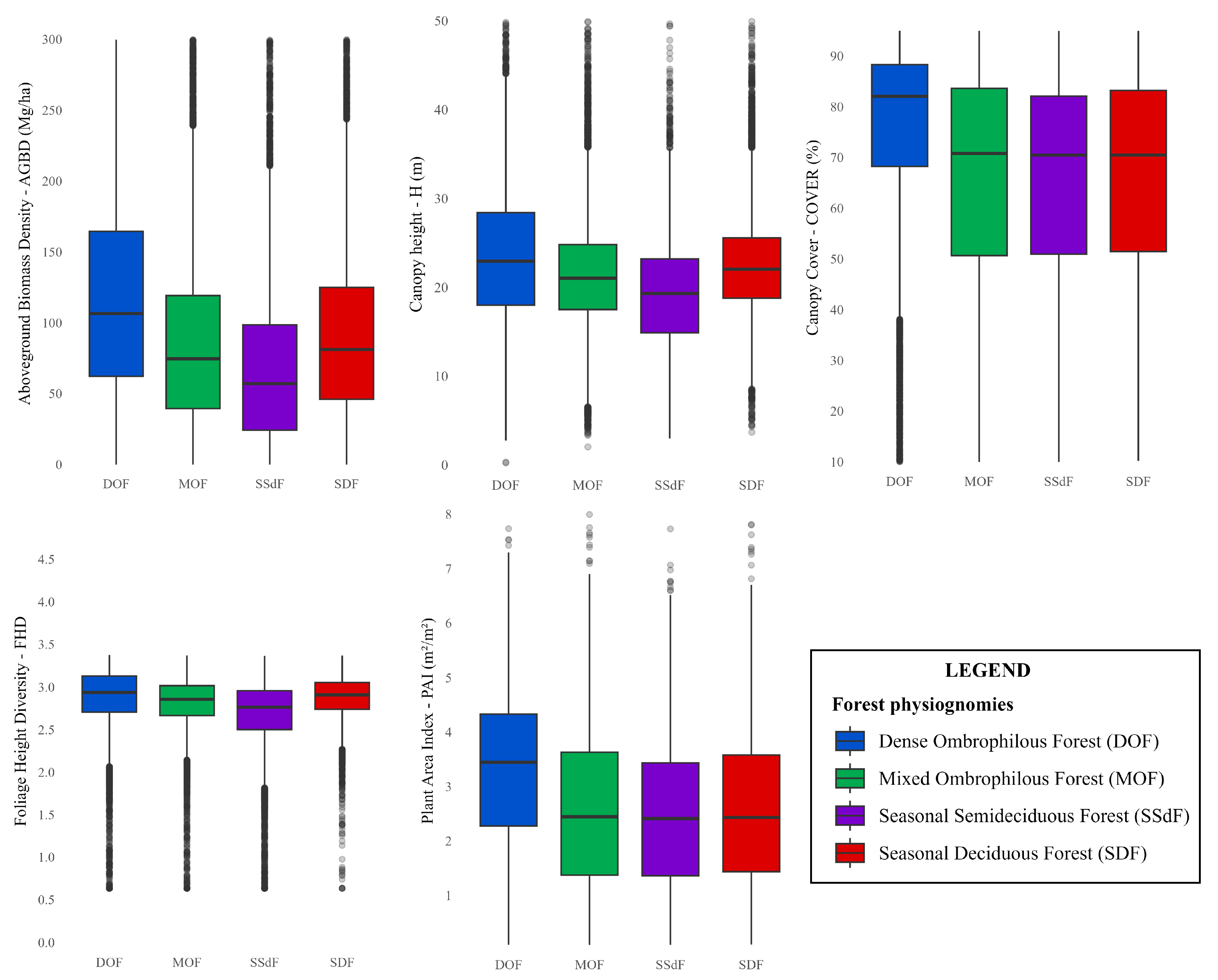
AGBD, H, COVER, FHD, and PAI captured structural variation across the studied phytophysiognomies (DOF, MOF, SDF, and SSdF). Table 2 and Figure 7 summarize the distributions of these variables after preprocessing. Overall, DOF showed the highest median values for the main structural metrics, including AGBD (113.6 Mg/ha), H (23.1 m), COVER (81.8%), FHD (2.9), and PAI (3.4). In contrast, SSdF generally showed the lowest medians for AGBD (58.6 Mg/ha), H (19.3 m), COVER (69.1%), FHD (2.8), and PAI (2.4), indicating lower univariate structural values for this group.
SDF and MOF occupied intermediate portions of the distributions, with partial overlap across several variables. SDF showed higher median AGBD (84.4 Mg/ha) and H (22.1 m) than MOF (77.6 Mg/ha and 21.1 m, respectively), whereas both groups showed similar median values for FHD (2.9), PAI (2.4), and COVER (70.2% for SDF and 70.0% for MOF). This pattern indicates that SDF and MOF were less clearly separated by individual structural metrics than the more contrasting DOF and SSdF groups.
The boxplots in Figure 7 reinforce these descriptive patterns. AGBD and H showed the clearest visual separation among phytophysiognomies, especially between DOF and SSdF, whereas FHD showed intermediate differentiation. COVER and PAI displayed broader overlap among groups, indicating weaker descriptive separation when evaluated individually. These descriptive results support the subsequent inferential analyses by showing that physiognomy-level differences were present but partially overlapping across the GEDI-derived structural metrics.
Together, Table 2 and Figure 7 indicate that the descriptive separation among phytophysiognomies was driven mainly by shifts in central tendency for AGBD and H, with FHD showing intermediate differentiation, whereas the broader interquartile overlap observed for COVER and PAI suggests lower univariate discriminatory capacity for these variables.

3.2. Nonparametric Testing

The pooled-footprint Kruskal–Wallis test indicated significant differences for all variables, with effect sizes (ε2) in the small range (≈0.052–0.076). When the analysis was repeated at the polygon level, using the polygon median as the primary observation unit, ε2 increased to 0.09–0.15 (Table 3). Thus, polygon-level summaries yielded stronger among-group separation than the pooled-footprint analysis. At the polygon level, AGBD and H showed the largest effect sizes, followed by FHD, whereas PAI and COVER showed comparatively lower differentiation. Phytophysiognomy accounted for approximately 9%–15% of the observed variability, depending on the metric. These global effect sizes should be distinguished from the pairwise patterns reported below, which highlight the consistency of specific contrasts across phytophysiognomies.

3.3. Pairwise Comparisons

Pairwise Dunn tests with Bonferroni and FDR adjustments indicated significant contrasts (p < 0.05) across bootstrap resamples (2000 iterations). In these pairwise comparisons, AGBD and H showed the strongest and most consistent separation, especially for the SSdF–DOF and SDF–SSdF contrasts, whereas MOF generally showed smaller effect sizes and greater overlap with the other phytophysiognomies (Table 4; Supplementary Table S4). FHD showed intermediate pairwise differentiation, whereas COVER and PAI contributed less to between-group separation. A general ordering pattern was observed in the polygon-level summaries: for H, AGBD, and FHD, median values tended to follow DOF > SDF > MOF > SSdF, whereas for PAI and COVER the pattern was DOF > SDF ≈ MOF > SSdF. These patterns represent comparative tendencies rather than discrete class boundaries. Across alternative QC and acquisition subsets, the main pairwise patterns remained broadly stable, with AGBD and H consistently showing the strongest contrasts at the polygon level.

3.4. ANOVA

ANOVA applied to linear mixed models, with polygon included as a random intercept, confirmed significant group differences for all variables. AGBD and PAI showed the highest F-values, followed by COVER, whereas H and FHD showed lower but still significant fixed-effect statistics (Table 5). These results are broadly consistent with the nonparametric analyses and indicate that among-group differences remain detectable after accounting for within-polygon dependence, although the relative ranking of variables differed somewhat between analytical approaches.

3.5. Spatial Autocorrelation Tests

Moran’s I indicated that some variables retained residual spatial structure after mixed-model adjustment (Table 6). H and AGBD showed the highest Moran’s I values (p < 0.01), indicating positive residual spatial autocorrelation, whereas PAI and FHD showed weaker but still significant spatial dependence, and COVER showed no significant spatial autocorrelation. These results indicate that the random effect structure captured part, but not all, of the spatial organization present in the polygon-level summaries.

4. Discussion

4.1. Main Structural Contrasts Among Phytophysiognomies

The results indicate that GEDI-derived structural metrics can detect regional differences among Atlantic Forest phytophysiognomies, although these contrasts are modest to moderate and occur alongside overlap among some groups. At pooled-footprint level, differentiation was detectable across all evaluated variables, but polygon-level analyses showed stronger separation than pooled-footprint analyses, with ε2 increasing from 0.052–0.076 in the pooled-footprint analysis to 0.087–0.151 when polygon medians were used as the primary observation unit. In the pairwise comparisons, AGBD and canopy height showed the strongest and most consistent contrasts, whereas FHD contributed intermediate differentiation and COVER and PAI were generally weaker. This pattern is consistent with the ecological continuity and internal heterogeneity of Atlantic Forest formations, as well as with the reported behavior of GEDI [23] in structurally complex tropical forests [28,29,64].
A key result is that AGBD emerged as the most consistently informative metric across analytical approaches, while canopy height remained one of the clearest descriptors of regional structural contrast. Together, these variables appear to capture broad differences in stature, biomass distribution, and canopy organization that are more informative at a regional scale than single canopy descriptor metrics alone. This is particularly relevant in the Atlantic Forest, where phytophysiognomies may partially overlap in height while still differing in biomass distribution and structural complexity. FHD contributed additional, though more moderate, separation, whereas PAI and COVER appear to play a more complementary role in the present framework. At the same time, the ranking of variables was not identical across all analytical approaches: in the polygon-level Kruskal–Wallis analysis, AGBD and H showed the largest overall effect sizes, followed by FHD, whereas the mixed-model ANOVA showed the highest F-values for AGBD and PAI. This difference among analytical approaches suggests that GEDI metrics captured distinct components of structural variation among phytophysiognomies.

4.2. Methodological Implications of Polygon-Based Inference

The polygon-based framework strengthened the comparative signal detected by the GEDI. By aggregating footprints within polygons, applying a 60 m internal buffer, balancing sample sizes by bootstrap resampling, and accounting for within-polygon dependence through random intercepts, the analysis reduced the influence of edge contamination, local heterogeneity, and pseudoreplication [59]. The increase in effect sizes from pooled footprint to polygon-level analyses supports the view that regional structural differentiation is more reliably detected when the sampling unit is aligned with the ecological unit of inference. Because GEDI footprints are sensitive to positional uncertainty near polygon boundaries and to acquisition and terrain-related effects, this design reduced boundary mixing and spatial misalignment in polygon-level summaries [27,28,52].

4.3. Uncertainty, Limitations, and Future Validation

Residual spatial autocorrelation in some variables, particularly H and AGBD, suggests that part of the observed variation reflects ecological gradients not fully captured by the current model structure. Rather than invalidating the results, this indicates that structural differentiation among phytophysiognomies is partly embedded in broader spatial organization, potentially linked to topography, fragmentation, or regional environmental variation [65].
This point is especially relevant in the Atlantic Forest, where relief and environmental heterogeneity are strong. However, the analyses were not stratified by topographic setting. This limitation is particularly relevant for canopy height (H), because relief may influence both forest structure and GEDI waveform behavior, including ground-mode detection and canopy height estimation.
This pattern is consistent with studies showing that GEDI-derived structural heterogeneity is linked to biodiversity patterns and that repeated GEDI observations can detect disturbance and recovery trajectories in tropical forests [66,67]. Future work should integrate the GEDI with airborne LiDAR datasets, local forest measurements, and topographic predictors such as elevation, slope, and terrain position.

5. Conclusions

This study evaluated structural differences among old-growth candidate forest phytophysiognomies in the Brazilian Atlantic Forest using GEDI-derived metrics and polygon-based inference. The analysis included 397 candidate polygons covering 3696.60 km2 and 238,961 GEDI L2B/L4A footprints retained after the 60 m internal edge filter. The results showed significant regional structural differences among DOF, MOF, SDF, and SSdF for all evaluated variables. Effect sizes increased from the pooled-footprint analysis (ε2 = 0.052–0.076) to the polygon-level analysis (ε2 = 0.087–0.151), indicating stronger among-group separation when polygon medians were used as the primary observation unit. AGBD and canopy height were the most consistent indicators of between-group separation, while FHD showed intermediate differentiation and PAI and COVER contributed weaker contrasts. The strongest pairwise contrasts occurred for SDF–SSdF and SSdF–DOF, with medium effects in the most consistent comparisons (r ≈ 0.35–0.45).
Polygon-level summaries strengthened among-group separation and reduced the influence of footprint-level dependence in the analysis. These findings show that GEDI-derived polygon-level metrics captured regional structural differences among Atlantic Forest phytophysiognomies, especially through aboveground biomass density and height-related variables. The polygon-based approach provided a consistent basis for comparing forest structure across fragmented and heterogeneous remnants.

Supplementary Materials

The following supporting information can be downloaded at https://www.mdpi.com/article/10.3390/f17060720/s1. Supplementary Methods S1: visual interpretation key for polygon quality assurance/quality control; Supplementary Methods S2: polygon delineation and filtering criteria; Supplementary Methods S3: GEDI quality control and acquisition scenarios; Supplementary Methods S4: bootstrap resampling and spatial autocorrelation analysis. Figure S1: polygon-level Spearman correlation heatmap for GEDI-derived structural metrics; Figure S2: changes in Kruskal–Wallis effect size across quality control and acquisition scenarios relative to the baseline scenario; Table S1a: polygon-level collinearity assessment under the baseline scenario; Table S1b: collinearity stability across quality control and acquisition scenarios; Table S2a: sample sizes retained under each quality control and acquisition scenario; Table S2b: scenario definitions and redundancy among quality control and acquisition scenarios; Table S3a: polygon-level Kruskal–Wallis results by variable and scenario; Table S3b: changes in Kruskal–Wallis effect size relative to the baseline scenario; Table S4: pairwise Dunn test robustness across quality control and acquisition scenarios.

Author Contributions

Conceptualization, M.C.S.B.; methodology, M.C.S.B., H.T.S., M.R.R. and P.G.M.; software, M.C.S.B.; formal analysis, M.C.S.B.; investigation, M.C.S.B.; data curation, M.C.S.B. and H.T.S.; writing—original draft preparation, M.C.S.B.; writing—review and editing, M.C.S.B. and A.P.Q.; visualization, M.C.S.B.; supervision, A.P.Q.; funding acquisition, A.P.Q. All authors have read and agreed to the published version of the manuscript.

Funding

This research was funded by the Coordination for the Improvement of Higher Education Personnel—CAPES, grant number 88887.920446/2023-00. The APC was funded by the Brazilian National Council for Scientific and Technological Development—CNPq, grant number 307438/2023-6.

Data Availability Statement

The derived datasets, spatial sampling files, R scripts, metadata, complete scenario-wise outputs, and supplementary outputs supporting the results of this study are openly available in the public repository Data and code for: Regional comparison of Atlantic Forest physiognomies using GEDI-derived structural metrics at https://doi.org/10.5281/zenodo.20722314 [68].

Acknowledgments

We thank the Coordination for the Improvement of Higher Education Personnel (CAPES) for scholarship support and the Brazilian National Council for Scientific and Technological Development (CNPq) for support associated with the APC.

Conflicts of Interest

The authors declare no conflicts of interest.

References

  1. Macdicken, K. Forest Resources Assessment Working Paper—FRA Terms and Definitions; Food and Agriculture Organization of the United Nations: Rome, Italy, 2012; pp. 1–32. Available online: https://www.fao.org/4/ap862e/ap862e00.pdf (accessed on 13 May 2026).
  2. De Frenne, P.; Lenoir, J.; Luoto, M.; Scheffers, B.R.; Zellweger, F.; Aalto, J.; Ashcroft, M.B.; Christiansen, D.M.; Decocq, G.; De Pauw, K.; et al. Forest microclimates and climate change: Importance, drivers and future research agenda. Glob. Change Biol. 2021, 27, 2279–2297. [Google Scholar] [CrossRef] [PubMed]
  3. Hua, F.; Bruijnzeel, L.A.; Meli, P.; Martin, P.A.; Zhang, J.; Nakagawa, S.; Miao, X.; Wang, W.; McEvoy, C.; Pena-Arancibia, J.L.; et al. The biodiversity and ecosystem service contributions and trade-offs of forest restoration approaches. Science 2022, 376, 839–844. [Google Scholar] [CrossRef] [PubMed]
  4. Ribeiro, M.C.; Metzger, J.P.; Martensen, A.C.; Ponzoni, F.J.; Hirota, M.M. The Brazilian Atlantic Forest: How much is left, and how is the remaining forest distributed? Implications for conservation. Biol. Conserv. 2009, 142, 1141–1153. [Google Scholar] [CrossRef]
  5. Joly, C.A.; Metzger, J.P.; Tabarelli, M. Experiences from the Brazilian Atlantic Forest: Ecological findings and conservation initiatives. New Phytol. 2014, 204, 459–473. [Google Scholar] [CrossRef] [PubMed]
  6. Rezende, C.L.; Scarano, F.R.; Assad, E.D.; Joly, C.A.; Metzger, J.P.; Strassburg, B.B.N.; Tabarelli, M.; Fonseca, G.A.; Mittermeier, R.A. From hotspot to hopespot: An opportunity for the Brazilian Atlantic Forest. Perspect. Ecol. Conserv. 2018, 16, 208–214. [Google Scholar] [CrossRef]
  7. Rosa, M.R.; Brancalion, P.H.S.; Crouzeilles, R.; Tambosi, L.R.; Piffer, P.R.; Lenti, F.E.B.; Hirota, M.; Santiami, E.; Metzger, J.P. Hidden destruction of older forests threatens Brazil’s Atlantic Forest and challenges restoration programs. Sci. Adv. 2021, 7, eabc4547. [Google Scholar] [CrossRef] [PubMed]
  8. Muller, J.; Moning, C.; Bassler, C.; Heurich, M.; Brandl, R. Using airborne laser scanning to model potential abundance and assemblages of forest passerines. Basic Appl. Ecol. 2009, 10, 671–681. [Google Scholar] [CrossRef]
  9. Schall, P.; Schulze, E.D.; Fischer, M.; Ayasse, M.; Ammer, C. Relations between forest management, stand structure and productivity across different types of Central European forests. Basic Appl. Ecol. 2018, 32, 39–52. [Google Scholar] [CrossRef]
  10. Heidrich, L.; Brandl, R.; Ammer, C.; Bae, S.; Bassler, C.; Doerfler, I.; Fischer, M.; Gossner, M.M.; Heurich, M.; Heibl, C.; et al. Effects of heterogeneity on the ecological diversity and redundancy of forest fauna. Basic Appl. Ecol. 2023, 73, 72–79. [Google Scholar] [CrossRef]
  11. Lechner, A.M.; Foody, G.M.; Boyd, D.S. Applications in remote sensing to forest ecology and management. One Earth 2020, 2, 405–412. [Google Scholar] [CrossRef]
  12. Fassnacht, F.E.; Latifi, H.; Stereńczak, K.; Modzelewska, A.; Lefsky, M.; Waser, L.T.; Straub, C.; Ghosh, A. Remote sensing in forestry: Current challenges, considerations and directions. Forestry 2024, 97, 11–37. [Google Scholar] [CrossRef]
  13. Dupuis, C.; Lejeune, P.; Michez, A.; Fayolle, A. How can remote sensing help monitor tropical moist forest degradation?—A systematic review. Remote Sens. 2020, 12, 1087. [Google Scholar] [CrossRef]
  14. Potapov, P.; Li, X.; Hernandez-Serna, A.; Tyukavina, A.; Hansen, M.C.; Kommareddy, A.; Pickens, A.; Turubanova, S.; Tang, H.; Silva, C.E.; et al. Mapping global forest canopy height through integration of GEDI and Landsat data. Remote Sens. Environ. 2021, 253, 112165. [Google Scholar] [CrossRef]
  15. Drake, J.B.; Dubayah, R.O.; Clark, D.B.; Knox, R.G.; Blair, J.B.; Hofton, M.A.; Chazdon, R.L.; Weishampel, J.F.; Prince, S. Estimation of tropical forest structural characteristics, using large-footprint lidar. Remote Sens. Environ. 2002, 79, 305–319. [Google Scholar] [CrossRef]
  16. Drake, J.B.; Dubayah, R.O.; Knox, R.G.; Clark, D.B.; Blair, J.B. Sensitivity of large-footprint lidar to canopy structure and biomass in a neotropical rainforest. Remote Sens. Environ. 2002, 81, 378–392. [Google Scholar] [CrossRef]
  17. Hyde, P.; Dubayah, R.; Peterson, B.; Blair, J.B.; Hofton, M.; Hunsaker, C.; Knox, R.; Walker, W. Mapping forest structure for wildlife habitat analysis using waveform lidar: Validation of montane ecosystems. Remote Sens. Environ. 2005, 96, 427–437. [Google Scholar] [CrossRef]
  18. Dubayah, R.O.; Sheldon, S.L.; Clark, D.B.; Hofton, M.A.; Blair, J.B.; Hurtt, G.C.; Chazdon, R.L. Estimation of tropical forest height and biomass dynamics using lidar remote sensing at La Selva, Costa Rica. J. Geophys. Res. Biogeosci. 2010, 115, G00E09. [Google Scholar] [CrossRef]
  19. Dittmann, S.; Thiessen, E.; Hartung, E. Applicability of different non-invasive methods for tree mass estimation: A review. For. Ecol. Manag. 2017, 398, 208–215. [Google Scholar] [CrossRef]
  20. Leitold, V.; Keller, M.; Morton, D.C.; Cook, B.D.; Shimabukuro, Y.E. Airborne lidar-based estimates of tropical forest structure in complex terrain: Opportunities and trade-offs for REDD+. Carbon Balance Manag. 2015, 10, 10. [Google Scholar] [CrossRef] [PubMed]
  21. Martins-Neto, R.P.; Tommaselli, A.M.G.; Imai, N.N.; David, H.C.; Miltiadou, M.; Honkavaara, E. Identification of significative LiDAR metrics and comparison of machine learning approaches for estimating stand and diversity variables in heterogeneous Brazilian Atlantic Forest. Remote Sens. 2021, 13, 2444. [Google Scholar] [CrossRef]
  22. Scheeres, J.; Jong, J.; Brede, B.; Brancalion, P.H.S.; Broadbent, E.N.; Zambrano, A.M.A.; Gorgens, E.B.; Silva, C.A.; Valbuena, R.; Molin, P.; et al. Distinguishing forest types in restored tropical landscapes with UAV-borne LIDAR. Remote Sens. Environ. 2023, 290, 113533. [Google Scholar] [CrossRef]
  23. Dubayah, R.; Blair, J.B.; Goetz, S.; Fatoyinbo, L.; Hansen, M.; Healey, S.; Hofton, M.; Hurtt, G.; Kellner, J.; Luthcke, S.; et al. The Global Ecosystem Dynamics Investigation: High-resolution laser ranging of the Earth’s forests and topography. Sci. Remote Sens. 2020, 1, 100002. [Google Scholar] [CrossRef]
  24. Schneider, F.D.; Ferraz, A.; Hancock, S.; Duncanson, L.I.; Dubayah, R.O.; Pavlick, R.P.; Schimel, D.S. Towards mapping the diversity of canopy structure from space with GEDI. Environ. Res. Lett. 2020, 15, 115006. [Google Scholar] [CrossRef]
  25. de Conto, T.; Armston, J.; Dubayah, R. Characterizing the structural complexity of the Earth’s forests with spaceborne lidar. Nat. Commun. 2024, 15, 8116. [Google Scholar] [CrossRef] [PubMed]
  26. Wang, Z.; Cai, H.; Yang, X. A new method for mapping vegetation structure parameters in forested areas using GEDI data. Ecol. Indic. 2024, 164, 112157. [Google Scholar] [CrossRef]
  27. Roy, D.P.; Kashongwe, H.B.; Armston, J. The impact of geolocation uncertainty on GEDI tropical forest canopy height estimation and change monitoring. Sci. Remote Sens. 2021, 4, 100024. [Google Scholar] [CrossRef]
  28. Lahssini, K.; Baghdadi, N.; Maire, G.; Fayad, I. Influence of GEDI acquisition and processing parameters on canopy height estimates over tropical forests. Remote Sens. 2022, 14, 6264. [Google Scholar] [CrossRef]
  29. Ngo, Y.-N.; Ho Tong Minh, D.; Baghdadi, N.; Fayad, I. Tropical forest top height by GEDI: From sparse coverage to continuous data. Remote Sens. 2023, 15, 975. [Google Scholar] [CrossRef]
  30. Dwiputra, A.; Coops, N.C.; Schwartz, N.B. GEDI waveform metrics in vegetation mapping—A case study from a heterogeneous tropical forest landscape. Environ. Res. Lett. 2023, 18, 015007. [Google Scholar] [CrossRef]
  31. Gibson, L.; Lee, T.M.; Koh, L.P.; Brook, B.W.; Gardner, T.A.; Barlow, J.; Peres, C.A.; Bradshaw, C.J.A.; Laurance, W.F.; Lovejoy, T.E.; et al. Primary forests are irreplaceable for sustaining tropical biodiversity. Nature 2011, 478, 378–381. [Google Scholar] [CrossRef] [PubMed]
  32. Brancalion, P.H.S.; Niamir, A.; Broadbent, E.; Crouzeilles, R.; Barros, F.S.M.; Zambrano, A.M.A.; Baccini, A.; Aronson, J.; Goetz, S.; Reid, J.L.; et al. Global restoration opportunities in tropical rainforest landscapes. Sci. Adv. 2019, 5, eaav3223. [Google Scholar] [CrossRef] [PubMed]
  33. Convention on Biological Diversity (CBD). Definitions: Forest Biodiversity; Secretariat of the Convention on Biological Diversity: Montreal, QC, Canada, 2006; Available online: https://www.cbd.int/forest/definitions.shtml (accessed on 21 April 2026).
  34. Ab’Saber, A.N. Os Domínios de Natureza no Brasil: Potencialidades Paisagísticas, 1st ed.; Ateliê Editorial: São Paulo, Brazil, 2003; pp. 45–63. [Google Scholar]
  35. Alvares, C.A.; Stape, J.L.; Sentelhas, P.C.; de Moraes Goncalves, J.L.; Sparovek, G. Koppen’s climate classification map for Brazil. Meteorol. Z. 2013, 22, 711–728. [Google Scholar] [CrossRef] [PubMed]
  36. Ross, J.L.S.; Moroz, I.C. Mapa geomorfológico do Estado de São Paulo. Rev. Dep. Geogr. 1996, 10, 41–58. [Google Scholar] [CrossRef]
  37. Freitas, S.R.; Hawbaker, T.J.; Metzger, J.P. Effects of roads, topography, and land use on forest cover dynamics in the Brazilian Atlantic Forest. For. Ecol. Manag. 2010, 259, 410–417. [Google Scholar] [CrossRef]
  38. Lima, G.T.N.P.; Hackbart, V.C.S.; Bertolo, L.S.; Santos, R.F. Identifying driving forces of landscape changes: Historical relationships and the availability of ecosystem services in the Atlantic Forest. Ecosyst. Serv. 2016, 22, 11–17. [Google Scholar] [CrossRef]
  39. Gamon, J.A.; Wang, R.; Gholizadeh, H.; Zutta, B.; Townsend, P.A.; Cavender-Bares, J. Consideration of scale in remote sensing of biodiversity. In Remote Sensing of Plant Biodiversity; Cavender-Bares, J., Gamon, J.A., Townsend, P.A., Eds.; Springer: Cham, Switzerland, 2020; pp. 425–447. [Google Scholar] [CrossRef]
  40. GEDI Science Team. Global Ecosystem Dynamics Investigation: Mission Overview; Instrument & Products. Available online: https://gedi.umd.edu/ (accessed on 13 May 2026).
  41. Bergen, K.M.; Goetz, S.J.; Dubayah, R.O.; Henebry, G.M.; Hunsaker, C.T.; Imhoff, M.L.; Nelson, R.F.; Parker, G.G.; Radeloff, V.C. Remote sensing of vegetation 3-D structure for biodiversity and habitat: Review and implications for lidar and radar spaceborne missions. J. Geophys. Res. Biogeosci. 2009, 114, G00E06. [Google Scholar] [CrossRef]
  42. Kacic, P.; Thonfeld, F.; Gessner, U.; Kuenzer, C. Forest structure characterization in Germany: Novel products and analysis based on GEDI, Sentinel-1 and Sentinel-2 data. Remote Sens. 2023, 15, 1969. [Google Scholar] [CrossRef]
  43. Mandl, L.; Stritih, A.; Seidl, R.; Ginzler, C.; Senf, C. Spaceborne LiDAR for characterizing forest structure across scales in the European Alps. Remote Sens. Ecol. Conserv. 2023, 9, 599–614. [Google Scholar] [CrossRef]
  44. Kacic, P.; Gessner, U.; Hakkenberg, C.R.; Holzwarth, S.; Muller, J.; Pierick, K.; Seidel, D.; Thonfeld, F.; Torresani, M.; Kuenzer, C. Characterizing local forest structural complexity based on multi-platform and sensor derived indicators. Ecol. Indic. 2025, 170, 113085. [Google Scholar] [CrossRef]
  45. Liu, X.; Moudry, V.; Schuldt, B.; Forkel, M. GEDI reveals decline in overstorey and increase in understorey canopy cover of protected forests in Central Europe since 2019. For. Ecol. Manag. 2025, 597, 123155. [Google Scholar] [CrossRef]
  46. Qi, W.; Armston, J.; Choi, C.; Stovall, A.; Saarela, S.; Pardini, M.; Fatoyinbo, L.; Papathanassiou, K.; Pascual, A.; Dubayah, R. Mapping large-scale pantropical forest canopy height by integrating GEDI lidar and TanDEM-X InSAR data. Remote Sens. Environ. 2025, 318, 114534. [Google Scholar] [CrossRef]
  47. Sun, M.; Cui, L.; Park, J.; García, M.; Zhou, Y.; Silva, C.A.; He, L.; Zhang, H.; Zhao, K. Evaluation of NASA’s GEDI Lidar Observations for Estimating Biomass in Temperate and Tropical Forests. Forests 2022, 13, 1686. [Google Scholar] [CrossRef]
  48. Instituto Brasileiro de Geografia e Estatística (IBGE). Manual Técnico da Vegetação Brasileira: Sistema Fitogeográfico, Inventário das Formações Florestais e Campestres, Técnicas e Manejo de Coleções Botânicas, Procedimentos para Mapeamentos, 2nd ed.; IBGE: Rio de Janeiro, Brazil, 2012. Available online: https://biblioteca.ibge.gov.br/index.php/biblioteca-catalogo?id=263011&view=detalhes (accessed on 13 May 2026).
  49. IBGE. Vegetação 1:250.000. Available online: https://www.ibge.gov.br/geociencias/informacoes-ambientais/vegetacao/22453-cartas-1-250-000.html (accessed on 13 May 2026).
  50. MapBiomas Project. Collection 9 of the Annual Land Cover and Land Use Maps of Brazil (1985–2023); Plataforma MapBiomas Brasil: Sao Paulo, Brazil, 2024. [Google Scholar] [CrossRef]
  51. MapBiomas Project. Algorithm Theoretical Basis Document (ATBD): Collection 9, Version 2; MapBiomas: Sao Paulo, Brazil, 2024; Available online: https://brasil.mapbiomas.org/wp-content/uploads/sites/4/2025/02/ATBD-Collection-9-versao2-v2.pdf (accessed on 13 May 2026).
  52. Chen, R.; Wang, X.; Liu, X.; Wang, S. Optimizing GEDI Canopy Height Estimation and Analyzing Error Impact Factors Under Highly Complex Terrain and High-Density Vegetation Conditions. Forests 2024, 15, 2024. [Google Scholar] [CrossRef]
  53. MacArthur, R.H.; MacArthur, J.W. On bird species diversity. Ecology 1961, 42, 594–598. [Google Scholar] [CrossRef]
  54. Kruskal, W.H.; Wallis, W.A. Use of ranks in one-criterion variance analysis. J. Am. Stat. Assoc. 1952, 47, 583–621. [Google Scholar] [CrossRef]
  55. Tomczak, M.; Tomczak, E. The need to report effect size estimates revisited: An overview of some recommended measures of effect size. Trends Sport Sci. 2014, 21, 19–25. [Google Scholar]
  56. Dunn, O.J. Multiple comparisons using rank sums. Technometrics 1964, 6, 241–252. Available online: https://www.stat.cmu.edu/technometrics/59-69/VOL-06-03/v0603241.pdf (accessed on 13 May 2026). [CrossRef]
  57. Benjamini, Y.; Hochberg, Y. Controlling the false discovery rate: A practical and powerful approach to multiple testing. J. R. Stat. Soc. Ser. B 1995, 57, 289–300. [Google Scholar] [CrossRef]
  58. Cohen, J. Statistical Power Analysis for the Behavioral Sciences, 2nd ed.; Lawrence Erlbaum Associates: New York, NY, USA, 1988. [Google Scholar] [CrossRef]
  59. Hurlbert, S.H. Pseudoreplication and the design of ecological field experiments. Ecol. Monogr. 1984, 54, 187–211. [Google Scholar] [CrossRef]
  60. Bates, D.; Machler, M.; Bolker, B.; Walker, S. Fitting Linear Mixed-Effects Models using lme4. J. Stat. Softw. 2015, 67, 1–48. [Google Scholar] [CrossRef]
  61. Conover, W.J. Practical Nonparametric Statistics, 3rd ed.; Wiley: New York, NY, USA, 1999. [Google Scholar]
  62. Moran, P.A.P. Notes on continuous stochastic phenomena. Biometrika 1950, 37, 17–23. [Google Scholar] [CrossRef]
  63. Bivand, R.S.; Pebesma, E.; Gomez-Rubio, V. Applied Spatial Data Analysis with R, 2nd ed.; Springer: New York, NY, USA, 2013. [Google Scholar] [CrossRef]
  64. Doyle, E.L.; Graham, H.A.; Boulton, C.A.; Lenton, T.M.; Feldpausch, T.R.; Cunliffe, A.M. Evaluating GEDI for quantifying forest structure across a gradient of degradation in Amazonian rainforests. Environ. Res. Lett. 2025, 20, 054016. [Google Scholar] [CrossRef]
  65. Dormann, C.F.; McPherson, J.M.; Araujo, M.B.; Bivand, R.; Bolliger, J.; Carl, G.; Davies, R.G.; Hirzel, A.; Jetz, W.; Kissling, W.D.; et al. Methods to account for spatial autocorrelation in the analysis of species distributional data: A review. Ecography 2007, 30, 609–628. [Google Scholar] [CrossRef]
  66. Torresani, M.; Rocchini, D.; Alberti, A.; Moudry, V.; Heym, M.; Thouverai, E.; Kacic, P.; Tomelleri, E. LiDAR GEDI derived tree canopy height heterogeneity reveals patterns of biodiversity in forest ecosystems. Ecol. Inform. 2023, 76, 102082. [Google Scholar] [CrossRef] [PubMed]
  67. Holcomb, A.; Burns, P.; Keshav, S.; Coomes, D.A. Repeat GEDI footprints measure the effects of tropical forest disturbances. Remote Sens. Environ. 2024, 308, 114174. [Google Scholar] [CrossRef]
  68. Bandoria, M.C.S.; Seixas, H.T.; Rosa, M.R.; Molin, P.G.; Queiroz, A.P. Data and code for: Regional comparison of Atlantic Forest physiognomies using GEDI-derived structural metrics, version v1.0.3. Zenodo, 2026. [CrossRef]
Figure 1. Extent of Brazilian Atlantic Forest showing old-growth candidate forests.
Forests 17 00720 g001
Figure 2. Study area and distribution of analyzed phytophysiognomies.
Forests 17 00720 g002
Figure 3. Distribution of sampling across old-growth forests.
Forests 17 00720 g003
Figure 4. Visual interpretation keys for the main phytophysiognomies.
Forests 17 00720 g004
Figure 5. GEDI sampling within old-growth candidate forest polygons by phytophysiognomy: (a) DOF; (b) MOF; (c) SSdF; and (d) SDF. Note: The colored highlights follow the phytophysiognomy color scheme used in Figure 2, and the red points represent GEDI L2B/L4A footprints retained for analysis. Candidate polygons were derived from IBGE phytophysiognomic attribution and MapBiomas forest formation temporal screening. Data sources: IBGE vegetation data [48,49], MapBiomas Collection 9 [50], and GEDI L2B/L4A footprints [23,40]. Coordinate reference system: SIRGAS 2000.
Forests 17 00720 g005
Figure 6. Research flowchart.
Forests 17 00720 g006
Figure 7. Boxplot of GEDI-derived structural variables by phytophysiognomy.
Forests 17 00720 g007
Table 1. Spatial sampling summary and 60 m edge filter impact by phytophysiognomy.
PhytophysiognomyCandidate Polygons (n)Total Area (km2)GEDI Footprints Before 60 m BufferGEDI Footprints After 60 m BufferFootprints Removed (n)Removed (%)
DOF1522353.44146,351139,59167604.62
MOF61439.9133,89632,10117955.30
SSdF122752.2257,94854,82931195.38
SDF62151.0313,95712,440151710.87
Total3973696.60252,152238,96113,1915.23
Note: Candidate polygons were defined using the IBGE phytophysiognomic framework and MapBiomas temporal screening. GEDI footprints were assigned by point-in-polygon intersection. The 60 m internal buffer was applied as a conservative edge filter to reduce boundary mixing, local edge effects, and potential geolocation uncertainty near polygon limits. IBGE and MapBiomas were used only for polygon delineation and temporal screening; all structural variables analyzed in the study were derived directly from GEDI.
Table 2. Descriptive statistics by phytophysiognomy.
PhytophysiognomyVariableSample
Size (N)
MeanStandard Deviation25th
Percentile
Median75th
Percentile
DOFAGBD12,402138.3112.965.2113.6180.7
H12,44023.89.318.123.128.8
COVER12,44073.521.566.781.888.2
FHD12,4402.90.42.72.93.1
PAI12,4403.21.42.23.44.3
MOFAGBD12,42298.391.940.977.6125.2
H12,43921.56.717.521.124.9
COVER12,44063.823.548.370.083.4
FHD12,4402.80.32.72.93.0
PAI12,4402.51.41.32.43.6
SDFAGBD12,402107.9102.547.684.4132.9
H12,44022.87.118.822.125.7
COVER12,44065.221.550.970.283.2
FHD12,4402.90.32.72.93.1
PAI12,4402.51.41.42.43.6
SSdFAGBD12,43474.875.825.058.6101.7
H12,44019.26.514.919.323.3
COVER12,44061.624.946.369.181.6
FHD12,4402.70.42.52.83.0
PAI12,4402.41.41.22.43.4
Table 3. Pooled-footprint and polygon-level Kruskal–Wallis effect sizes.
VariablePooled Footprint (ε2)Polygon Level (ε2)
AGBD0.075580.15115
H0.052500.14853
FHD0.052220.14181
PAI0.052020.08735
COVER0.051830.08729
Table 4. Post hoc pairwise comparisons among phytophysiognomies by variable.
VariableComparisonsFrequency (p < 0.05)Pairwise Effect Size (r)Interpretation
AGBDSSdF–DOF, SDF–SSdF, DOF–MOF0.90–0.990.35–0.43Consistent differences, medium effect.
SDF–MOF, SSdF–MOF, SDF–DOF≤0.070.07–0.08Weak differences, structural overlap.
HSDF–SSdF, SSdF–DOF0.95–0.990.39–0.45Clear, robust differences.
SDF–MOF0.84–0.940.32Moderate, consistent difference.
SSdF–MOF, SDF–DOF≤0.070.07–0.13Non-significant differences.
FHDSDF–SSdF, SSdF–DOF0.93–0.990.39–0.44Robust differences, medium effect.
SDF–MOF0.71–0.870.29Moderate, but less consistent.
Comparisons with MOF (or SDF–DOF)≤0.070.07–0.15Non-significant differences.
COVERSSdF–DOF, SDF–DOF0.90–0.980.35–0.43Stable and relevant differences.
Comparisons with MOF0.60–0.770.27Small to moderate differences.
SDF–MOF, SDF–SSdF≤0.080.08Very small differences.
PAISSdF–DOF, SDF–DOF0.91–0.970.35–0.42Robust differences, medium effect.
DOF–MOF0.62–0.780.28Moderate difference.
SSdF–MOF, SDF–MOF, SDF–SSdF≤0.080.07–0.15Weak differences.
Table 5. ANOVA results.
VariableDegrees of FreedomSum of SquaresMean SquareF-Valuep-ValueInterpretation
AGBD3383,043.36127,681.1216.24<0.001Greater discriminatory power
PAI385.6928.5616.13<0.001Greater discriminatory power
COVER318,932.026310.6713.53<0.001High discrimination
H31636.88545.6312.71<0.001Moderate discrimination
FHD 33.61.212.57<0.001Moderate discrimination
Table 6. Residual spatial autocorrelation.
VariableMoran’s Ip-ValueInterpretation
H0.1611.18 × 10−9Significant spatial autocorrelation; residuals are not fully independent.
AGBD0.1467.06 × 10−9Significant spatial autocorrelation; residuals are not fully independent.
PAI0.0675.00 × 10−3Weak but still significant autocorrelation.
COVER0.0291.17 × 10−1No significant residual spatial autocorrelation.
FHD0.0732.00 × 10−3Weak but significant residual spatial autocorrelation.
Disclaimer/Publisher’s Note: The statements, opinions and data contained in all publications are solely those of the individual author(s) and contributor(s) and not of MDPI and/or the editor(s). MDPI and/or the editor(s) disclaim responsibility for any injury to people or property resulting from any ideas, methods, instructions or products referred to in the content.