Article

Global Warming Drives Adaptive Distribution Dynamics and Habitat Fragmentation of Castanea seguinii in China

1
Research Center for Engineering Ecology and Nonlinear Science, North China Electric Power University, Beijing 102206, China
2
Theoretical Ecology and Engineering Ecology Research Group, School of Life Sciences, Shandong University, Qingdao 250100, China
*
Author to whom correspondence should be addressed.
Forests 2026, 17(6), 684; https://doi.org/10.3390/f17060684
Submission received: 22 April 2026 / Revised: 27 May 2026 / Accepted: 5 June 2026 / Published: 8 June 2026
(This article belongs to the Section Forest Biodiversity)

Abstract

Castanea seguinii Dode is ecologically and economically significant in China, and its potential as a carbon sink and ability to adapt to varying climates have garnered considerable interest. In light of global warming, the geographical distribution of Castanea seguinii is experiencing notable changes. This study employs the Maximum Entropy (MaxEnt) model to forecast both present and future potential habitats conducive to the survival of Castanea seguinii across four emission scenarios (SSP126, SSP245, SSP370, and SSP585) and utilizes Fragstats 4.2 to analyze fragmentation in its most suitable regions. Findings reveal that current habitats that support adaptation are chiefly located in southern China, covering around 12.7% of the total land area of the country. Key factors affecting this distribution are precipitation levels during the driest month, average temperatures recorded in the driest quarter, precipitation rates in the wettest quarter, isothermality, and elevation, with climate-related variables exerting the greatest influence. As carbon emissions vary, a general trend of habitat contraction is observed for Castanea seguinii, especially in regions that are highly adaptive. The populations of Castanea seguinii are shifting northwestward into areas at higher latitudes and altitudes. This upward movement reflects pronounced nonlinear traits as the intensity of carbon emissions changes. An increase in carbon emissions leads to greater fragmentation in regions that are most adaptable, with the lowest and low fragmentation levels falling to a minimum by 2090 under the SSP585 scenario. The reduction in highly adaptive habitats will contribute to increasing fragmentation. These results offer vital scientific insights for the conservation and management of Castanea seguinii forest resources amid climate change and the pursuit of carbon neutrality.

1. Introduction

Forests play a crucial role in terrestrial ecosystems and are vital for carbon storage [1,2,3,4]. The warming of the global climate significantly influences the geographical distribution of forest vegetation [5,6]. For example, certain heat-loving tree species are moving northward, whereas others are adjusting their adaptive ranges to greater elevations [7,8]. In light of the challenges presented by climate change, determining the distribution patterns of adaptive habitats for tree species and enhancing forest carbon sequestration management have become key concerns in the field of forest ecology research.
Castanea seguinii Dode (Fagaceae, Castanea) constitutes an essential element of forest flora, extensively found in temperate and subtropical forest ecosystems throughout China [9]. These trees are crucial for preserving biodiversity and improving ecosystem services [10,11]. Their nuts hold significant economic importance, while the trees demonstrate a remarkable ability for carbon sequestration [12]. Additionally, as Castanea seguinii trees mature, their capacity for carbon storage increases [13], and the biomass along with carbon levels in various organs shows consistent carbon sequestration across different growth phases. However, global warming is altering the geographic ranges of species globally, with many temperate tree species clearly shifting their distribution to higher latitudes and elevations [14,15,16,17]. At present, it is imperative to conduct further research on the distribution status of Castanea seguinii in light of global climate change.
Species distribution modeling serves as a crucial technique in the field of ecological research. Among the many methods at researchers’ disposal, the Maximum Entropy Model (MaxEnt) is frequently employed to forecast the potential geographic distribution of species, thanks to its impressive predictive accuracy and minimal requirements for sample data [18]. This model relies on statistical principles to combine records of species occurrences with datasets of environmental variables, which allows for precise simulations of potential distribution ranges. It has proven effective in predicting the future distributions of tree species like Pinus massoniana Lamb [19], Platycladus orientalis Franco [20], and Cinnamomum camphora J. Presl [21] under various climate change scenarios. Additionally, Fragstats 4.2, a popular software tool for landscape analysis, provides a wide array of indices that can be examined at three distinct levels of landscape patterns [22,23]. Its integrated moving-window technique enhances the visualization of landscape indices, allowing for an effective assessment of spatial variability. This method has been widely applied to analyze landscape fragmentation [24,25]. The integration of species distribution models and landscape index calculation software establishes a framework for evaluating the contribution and spread of potential habitats for species, along with assessing habitat fragmentation.
Drawing on the distribution data of Castanea seguinii throughout China, this research combines various environmental factors-such as soil characteristics, climatic conditions, and topographical elements-and utilizes both the Maximum Entropy Model and Fragstats 4.2 to analyze their adaptive distribution patterns and assess fragmentation. The goals of this study are as follows: (1) to evaluate the existing adaptive distribution characteristics and pinpoint the primary driving forces affecting Castanea seguinii amidst current climatic conditions; (2) to explore the dynamics of habitat expansion and contraction in response to different future climate scenarios; (3) to uncover the trends in the migration of distribution centroids alongside related altitudinal variation patterns; and (4) to assess the current and prospective fragmentation levels of the adaptive distribution of Castanea seguinii across various scenarios. This research intends to offer scientific insights into the conservation and sustainable use of Castanea seguinii resources, as well as to provide theoretical backing for enhancing forest ecosystem management and protection.

2. Materials and Methods

2.1. Data Screening and Processing

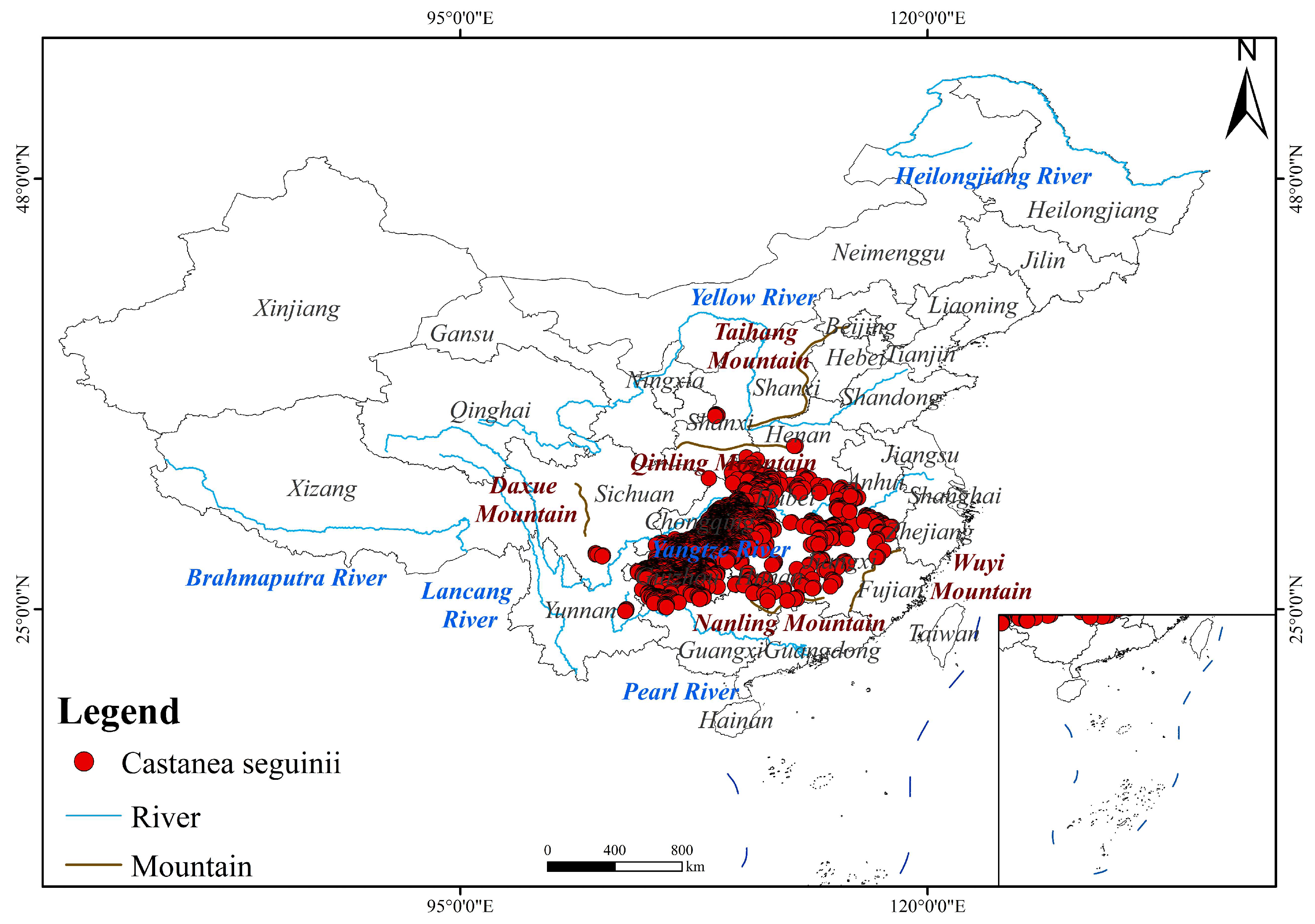
The administrative boundary map data for China used in this research were acquired from the Resources and Environmental Science Data Center associated with the Chinese Academy of Sciences (https://www.resdc.cn, accessed in 20 November 2025). The distribution records for the species Castanea seguinii, which include the Castanea seguinii Dode-Quercus serrata var. brevipetiolata A. Camus-Platycarya strobilacea Siebold & Zucc forest and the Castanea seguinii Dode-Quercus fabri Hance shrubland, were collected from the Vegetation Atlas of China (1:1,000,000 scale). Using ArcGIS 10.8, the distribution data underwent processes such as spatial registration, vector digitization, and raster processing, leading to an initial compilation of 31,570 occurrence points for Castanea seguinii at a spatial resolution of 1 km. To address issues of bias stemming from redundant and clustered records, a buffer analysis with a radius of 5 km was performed for spatial filtering. In the end, 1873 valid occurrence points were retained for the final research dataset (Figure 1). The latitude and longitude coordinates of these filtered points were then extracted and saved in CSV format to support subsequent model simulations.
In this study, we selected 38 environmental variables, which included 19 climatic factors, 16 soil characteristics, and three topographical elements. The climatic and elevation information was obtained from the WorldClim website (https://www.worldclim.org, accessed in 10 December 2025), featuring a spatial resolution of 5 km. Soil information was sourced from the HWSD database (https://www.fao.org, accessed in 10 December 2025) with a resolution of 1 km. Slope and aspect datasets were generated from the elevation data by employing surface analysis techniques in ArcGIS 10.8.
Future climate projections were sourced from the BCC-CSM2-MR global climate model, developed independently by the National (Beijing) Climate Center. This model demonstrates reliable capabilities in simulating patterns of temperature and precipitation throughout China and has been extensively used for forecasting species distributions within the country [26]. Four emission scenarios modeled by this system were chosen: SSP126, SSP245, SSP370, and SSP585. These scenarios represent progressively increasing greenhouse gas emission levels [27]. Three future time frames were examined: 2041–2060, 2061–2080, and 2081–2100. All data sets were standardized to a spatial resolution of 5 km.
All environmental variables underwent preprocessing with ArcGIS software. A mask extraction method was employed to trim the datasets to align with the geographic borders of China. Following this, the resampling tool was used to ensure that all data adhered to a spatial resolution of 5 km, aligning with the locations where species were observed. This procedure created a consistent basis for the modeling that followed.

2.2. Identification of Driving Variables and Calculation of Ranges

To address multicollinearity among the environmental variables, a process for variable screening was implemented to enhance the model’s accuracy and reliability. Initially, all 38 environmental factors were integrated into the MaxEnt model, with those showing a contribution rate of zero being eliminated [28]. Following this, ENMTools (version 1.1.2) was utilized to compute the correlation coefficients between the factors. If the correlation coefficient between any pair of factors surpassed 0.8, the factor with the lesser contribution was removed [29]. This screening resulted in the selection of a final set of 10 environmental variables for model construction, which included seven climatic factors, one topographic factor, and two soil factors.
The ten environmental factors that were screened, along with the data on community distribution, were imported back into MaxEnt. To assess the contribution rates of variables and their permutation importance across various emission scenarios, the jackknife method was utilized. This approach aided in evaluating the relative significance of each variable. The five most significant variables, based on both contribution and permutation importance, were determined to be the main factors driving the distribution of Castanea seguinii. Response curves were created using the regularized training gain of each specific variable. The ecological ranges deemed optimal for Castanea seguinii communities were identified as those ranges leading to a survival probability exceeding 0.5.

2.3. Computational Model

In this research, the Maximum Entropy model (MaxEnt) was employed to simulate the distribution of the Castanea seguinii tree species. A total of 1873 community distribution points, along with environmental variables that were pre-processed, were input into the MaxEnt. For model calibration, 75% of the distribution data was randomly chosen, while the remaining 25% served for validation. Moreover, pseudo-absence points from the research area were used as samples for calibration [30,31,32,33]. The model was run ten times [34,35,36]. When predicting future scenarios, it was assumed that topographic and soil conditions would remain constant and not undergo significant changes due to climate change [37].
The receiver operating characteristic (ROC) curve was utilized to evaluate predictive accuracy, with the area beneath the curve (AUC) acting as the main criterion for assessment [38,39,40]. AUC values span from 0 to 1, where results closer to 1 indicate a model’s exceptional performance. Generally, an AUC of 0.9 or higher is considered indicative of outstanding predictive accuracy [41,42,43,44].

2.4. Calculation of the Adaptive Distribution

The MaxEnt model’s output was imported into ArcGIS. Utilizing the reclassification feature within the spatial analysis module, habitats suitable for the Castanea seguinii species were classified into four distinct levels based on their habitat suitability values: non-adaptive distribution (0–0.06), minimally adaptive distribution (0.06–0.22), moderately adaptive distribution (0.22–0.43), and highly adaptive distribution (0.43–1.00). Following this classification, a standardized visualization process was implemented. The raster calculator in ArcGIS was employed to assess the number of raster cells linked to each suitability level across varying climate scenarios, and the actual area for each category was then computed.
Current and anticipated habitat distribution layers for the Castanea seguinii species across different time frames were loaded into ArcGIS. By examining changes in the overall adaptive habitat area, the spatial evolutionary patterns were categorized into three types: expansion zones, stable zones, and contraction zones. An overlay analysis was performed to evaluate the patterns of suitability distribution in the present and future across multiple periods. The alterations in habitat distribution, in relation to the baseline scenario, were measured to clarify the characteristics of expansion [45] and contraction of adaptive habitats for the Castanea seguinii species amid climate change.

2.5. Calculation of Centroid Migration and Altitude Changes

To examine the migration trends of the adaptive habitats associated with the Castanea seguinii species, the tools for reclassification and mean centering in ArcGIS were utilized to determine the centroid locations of these habitats across different emission scenarios [46,47]. By employing the Merge and general data management functions, the centroid information was transformed into linear features, thereby creating migration paths for the distribution centroids. A computational geometry tool was then used to calculate the migration distances for these centroids, based on the geographic coordinates of each raster cell located within the suitable regions. Simultaneously, spatial analysis tools were applied to obtain the average elevation for each centroid. By combining the migration pathways of the centroids with trends in elevation variation, the horizontal and vertical distribution patterns of Castanea seguinii communities were further clarified [48].

2.6. Calculation of Fragmentation for Highly Adaptive Distribution

The distribution area, which is highly adaptable, serves as the most appropriate habitat for a species; therefore, the degree of habitat fragmentation in this region directly indicates the species’ living conditions. Important aspects of habitat fragmentation encompass marginalization, effects of isolation, and variations in patch area. As a result, this research chose three landscape pattern metrics for quantitative evaluation: Edge Density (ED), Patch Density (PD), and Mean Patch Area (MPA) [49].
According to forecasts made by the MaxEnt model, this research concentrates on the highly adaptable habitat of Castanea seguinii. By employing the moving-window technique in Fragstats 4.2, we assessed the spatial distributions of three landscape indices in these locations, considering both current and anticipated climate scenarios. To establish a comprehensive fragmentation exponent, the three targets were initially normalized using a dimensionless approach within ArcGIS 10.8. Following this, an extreme deviation normalization method was utilized to depict the spatial characteristics of habitat fragmentation across various timeframes and climate conditions. Ultimately, the obtained data were categorized into five fragmentation levels using the equal interval method: 0–0.2 (highest fragmentation), 0.2–0.4 (high fragmentation), 0.4–0.6 (moderate fragmentation), 0.6–0.8 (low fragmentation), and 0.8–1 (lowest fragmentation).

3. Results

3.1. Adaptive Distribution and Driving Variables

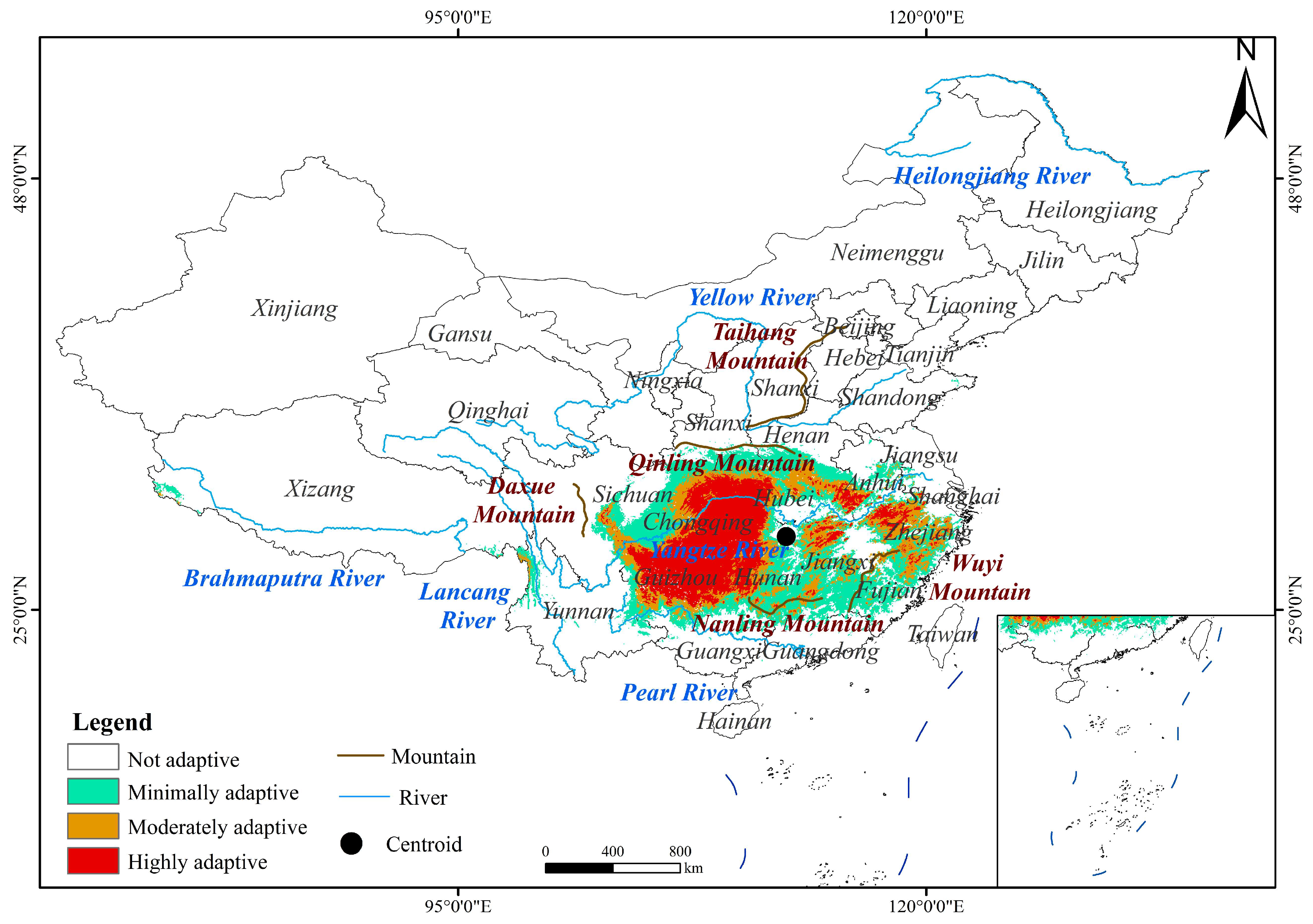
In the context of current climate conditions, the Castanea seguinii tree species mainly finds its adaptive habitats in the southern regions of China, covering about 12.7% of the nation’s overall land area (Figure 2). Regions with high adaptability are primarily found in Guizhou Province, northern Chongqing, western Hunan, and western Hubei, which collectively constitute 3.8% of the country’s land area. Areas deemed moderately adaptive can be found in Sichuan, Guangxi, Guizhou, Hunan, Hubei, Anhui, Zhejiang, and Jiangxi provinces, making up approximately 3.3% of the total area. Areas with minimal suitability are the most widespread, representing approximately 5.6% of the total land area.
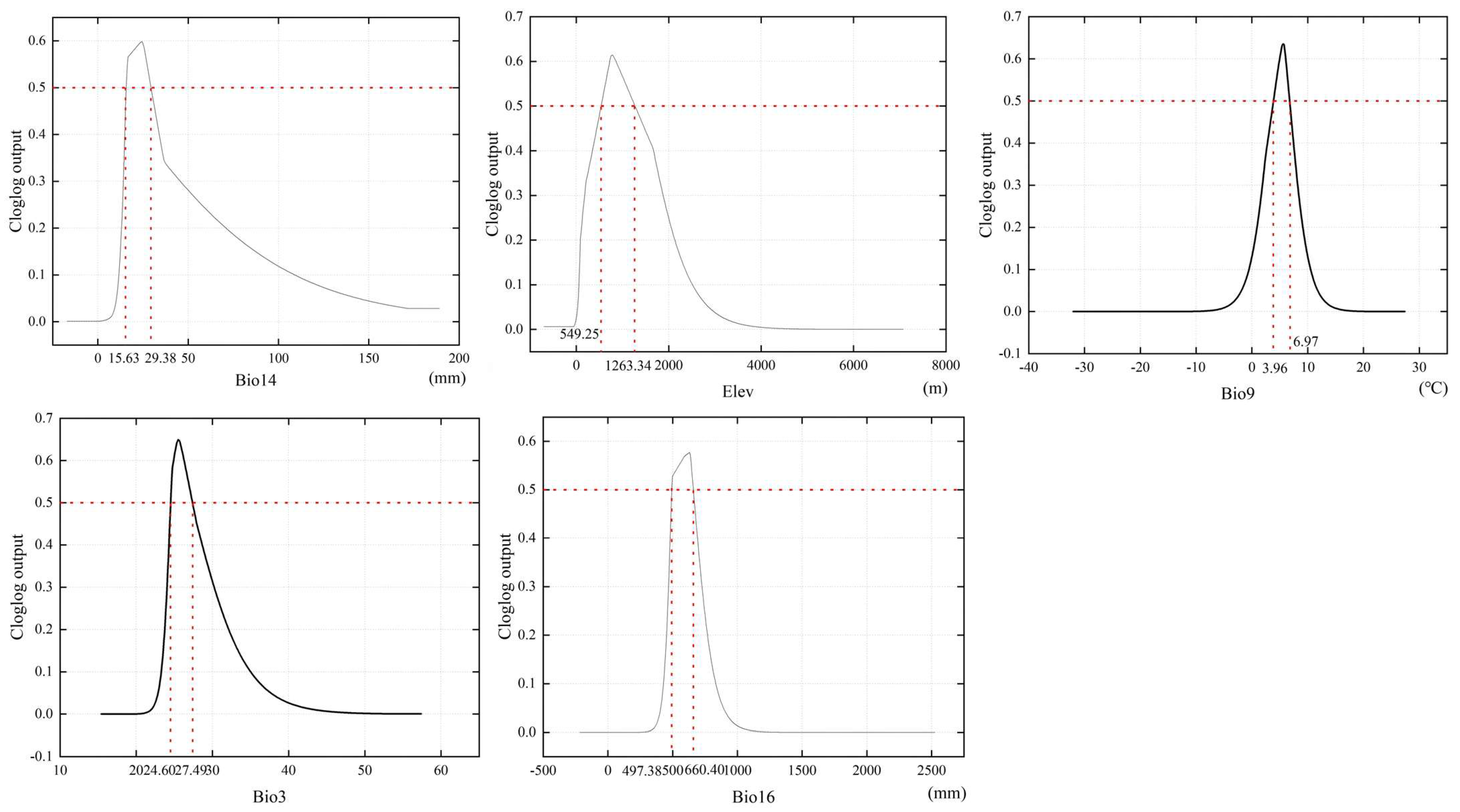
The primary factors influencing the adaptive habitats of the Castanea seguinii species are climatic conditions, which contribute a total of 89.1%. Factors related to precipitation account for 76.2% of this contribution, greatly exceeding the 12.9% attributed to temperature-related elements. The impact of soil factors is relatively minimal, while topographic elements are mainly associated with elevation, contributing 10.7%. Key driving factors that determine the adaptive distribution of Castanea seguinii include the precipitation during the driest month, the mean temperature of the driest quarter, isothermality, precipitation in the wettest quarter, and elevation (Table 1).
The optimal ranges of the key driving factors influencing the growth of Castanea seguinii have been established as follows: precipitation levels in the driest month (Bio14) vary between 15.63 and 29.38 mm; elevation ranges from 549.25 to 1263.34 m; the mean temperature during the driest quarter (Bio9) falls between 3.96 and 6.97 °C; isothermality (Bio3) spans from 24.60 to 27.49; and the precipitation in the wettest quarter (Bio16) ranges from 497.38 to 660.40 mm (Figure 3).

3.2. Expansion and Contraction of the Adaptive Distribution

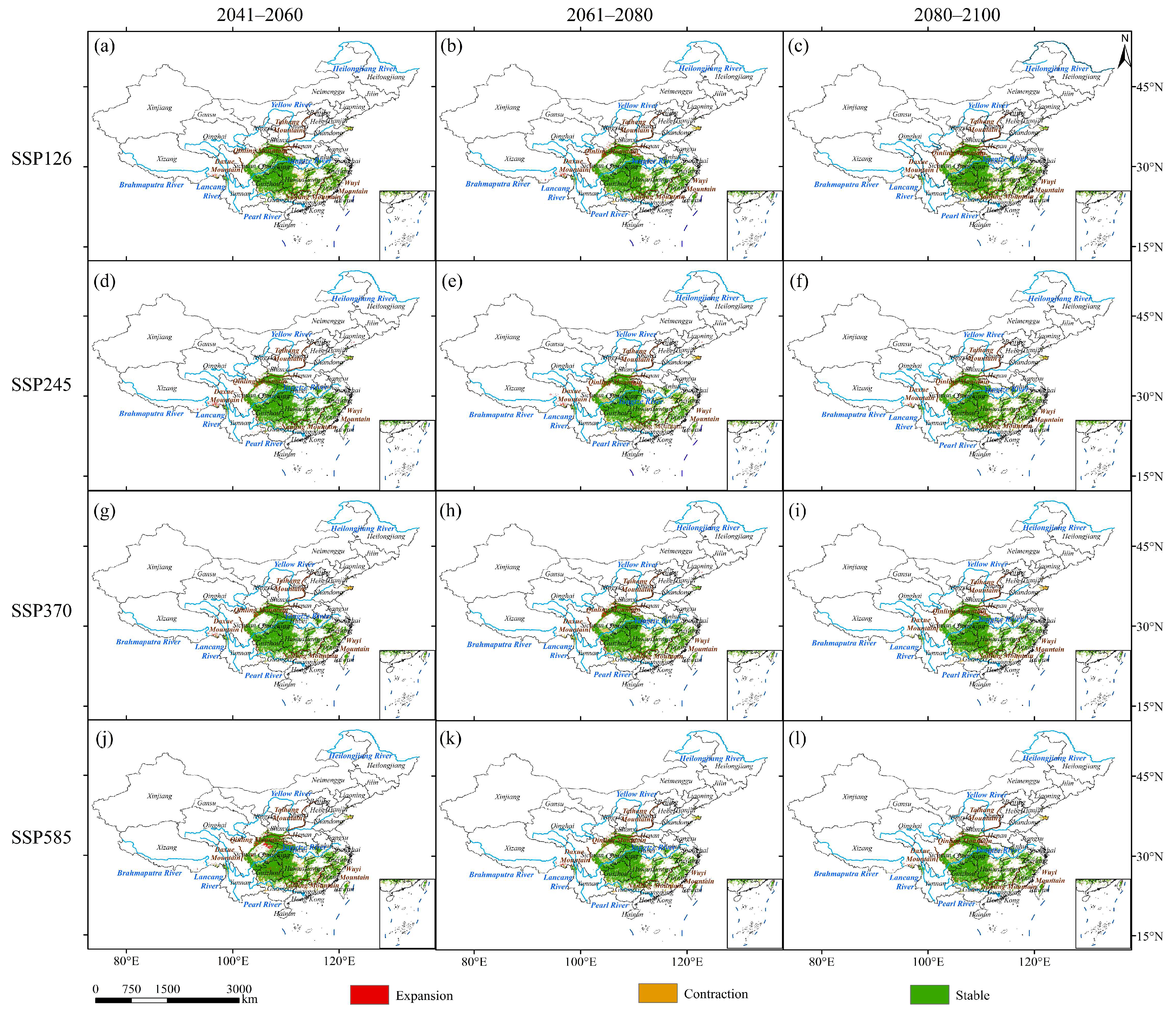
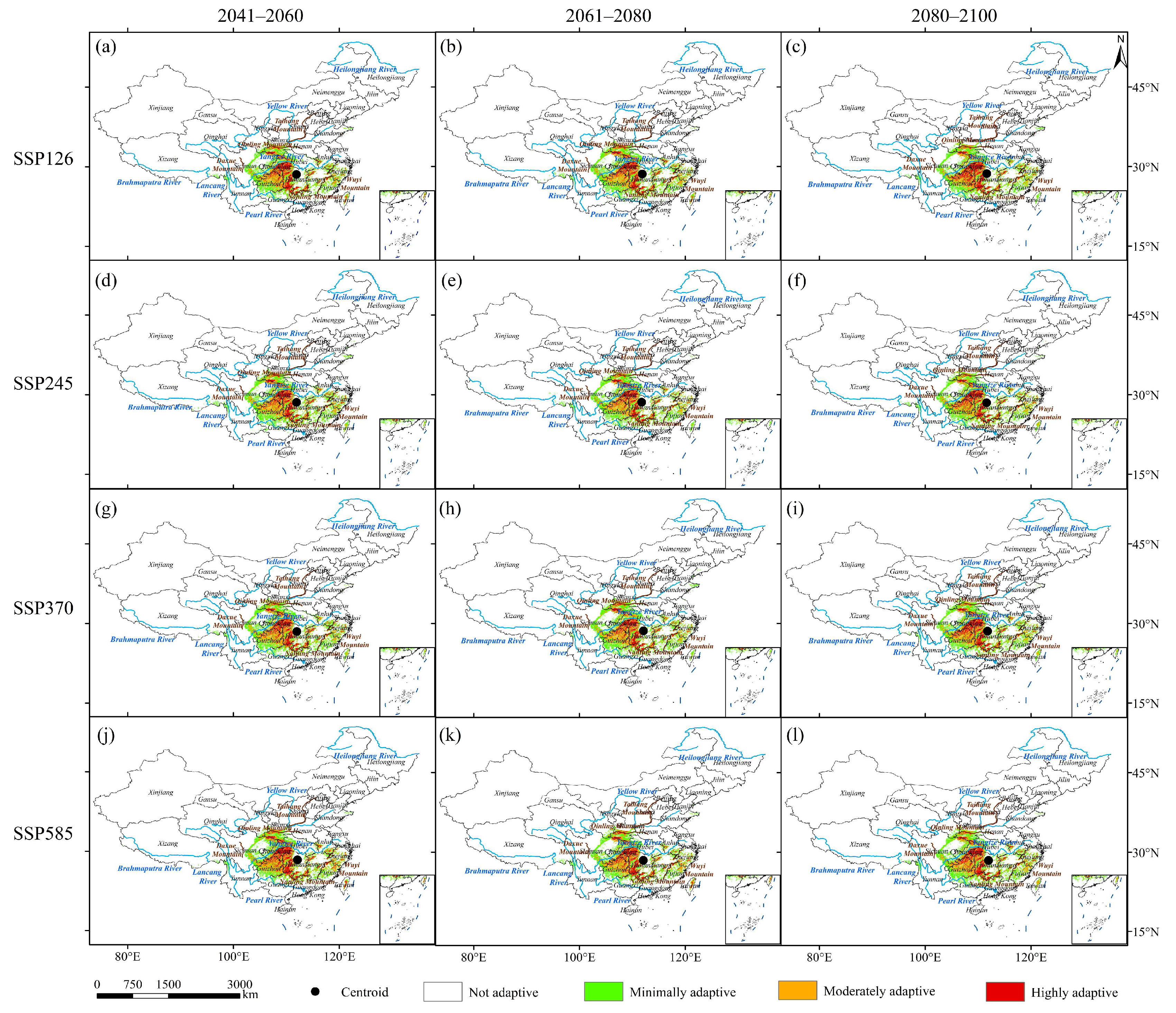
Global warming significantly influences the patterns of expansion and contraction within the adaptive distribution zones of the Castanea seguinii species. Based on four carbon-emission scenarios (SSP126, SSP245, SSP370, and SSP585), the adaptive habitat distribution changes to varying degrees. Future adaptive habitats for Castanea seguinii will predominantly remain in southern China; however, the total adaptive area exhibits a shrinking trend. Under projected future environmental conditions, the distribution pattern is expected to remain relatively stable by 2070. Vegetation is anticipated to expand into Taiwan under SSP245 by 2090, under SSP370 by both 2050 and 2090, and under SSP585 by 2070. The response of adaptive habitats to carbon emissions varies across different time periods. In 2050, the most significant expansion occurs under SSP585, while the most pronounced contraction is observed under SSP370. By 2070, the greatest expansion is noted under SSP126, with the most significant contraction occurring under SSP585. In 2090, the largest expansion is projected under SSP370, while the most pronounced contraction is expected under SSP245. As carbon emission intensity increases, contraction areas continue to expand along the borders between Chongqing and Sichuan Province, Hunan and Hubei Provinces, and Hunan and Jiangxi Provinces, as well as around the Nanling Mountains and the Wuyi Mountains. Stable areas are primarily concentrated in Chongqing, Guizhou Province, northwestern Hunan Province, and southwestern Hubei Province. However, this stable region also shows a shrinking trend with increasing carbon emissions (Figure 4).
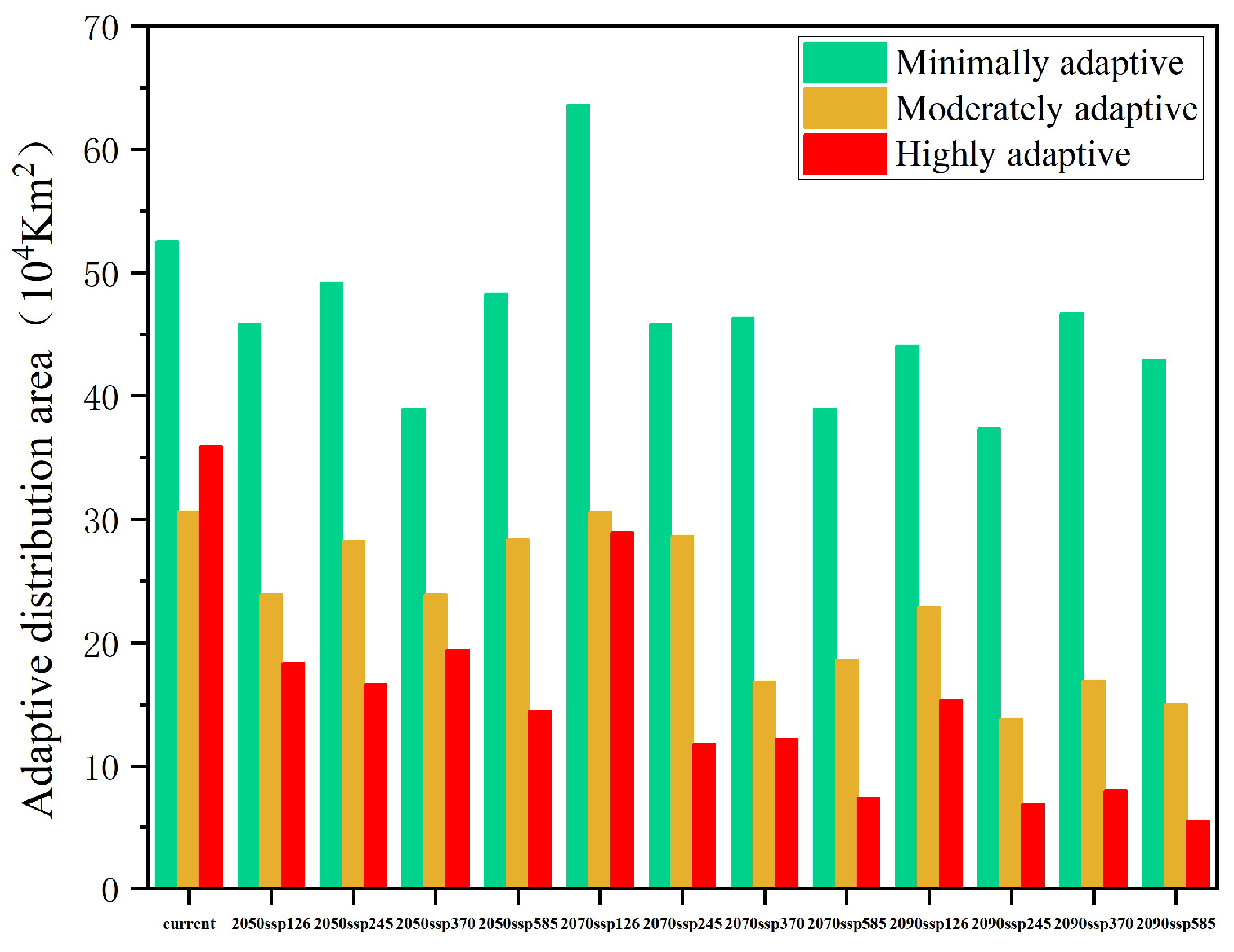
Under future climate scenarios, climatic factors will remain the primary determinants of the distribution of Castanea seguinii, contributing between 89.3% and 90.7% to the overall variance. The areas classified as highly, moderately, and minimally adaptive are projected to change significantly (Figure 5). By 2050, as carbon emission intensity increases, the total adaptive area is expected to initially rise, then fall, and subsequently rise again, peaking under the SSP245 scenario. In comparison to the current period, the highly adaptive areas are anticipated to contract by 45.87% to 59.80%, with the smallest area observed under SSP585. By 2070, the total adaptive area will continuously decline with increasing emission intensity; however, it will expand relative to the present only under the low-carbon SSP126 scenario. The highly adaptive areas will contract by 19.39% to 79.39%, with the most significant contraction occurring under SSP585. Under SSP126, the total adaptive area will be the largest, while under SSP585, the highly adaptive areas will be the smallest. In 2090, as emission intensity rises, the total adaptive area will first decline, then increase, and decline again, resulting in a net contraction of 11.47% to 29.47%. The total adaptive area will be smallest under SSP245, and the highly adaptive areas will be smallest under SSP585. By 2090, both the total and highly adaptive areas for Castanea seguinii will reach their lowest values across all future scenarios (Figure 6).

3.3. Centroid Migration and Altitude Change

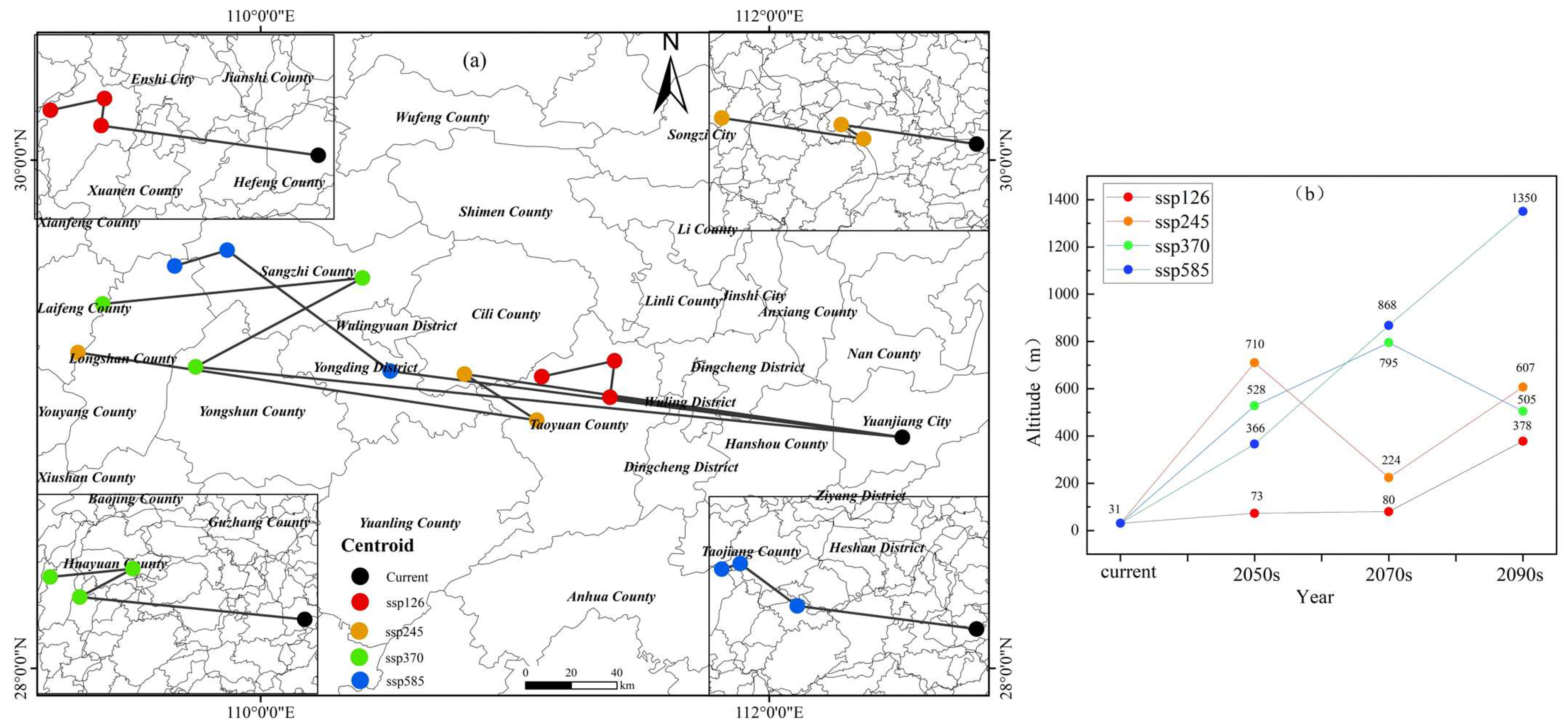
The phenomenon of global warming causes a notable northwestward shift in the distribution centroid of the Castanea seguinii species, along with significant changes in elevation. At present, this centroid is positioned in Yuanjiang City, Hunan Province. Various carbon-emission scenarios predict a continual northwestward shift in the centroid, despite distinct variations observed between the scenarios (Figure 7a). Under the low-carbon SSP126 scenario, the centroid ultimately migrates to Taoyuan County, Hunan Province, with the migration distance first decreasing and then increasing. Under SSP245, the centroid moves to Laifeng County on the Hunan-Hubei border, with the distance initially shortening and then lengthening, demonstrating relatively pronounced fluctuations. Under SSP370, the centroid also ends up in Laifeng County, following a similar trend of first decreasing and then increasing migration distance. Under the high-carbon SSP585 scenario, the centroid ultimately migrates to Longshan County, with a continuously decreasing migration distance.
Under various carbon-emission scenarios, the centroid of adaptive habitats for Castanea seguinii exhibits an overall increasing trend. Currently, the centroid elevation stands at 31 m, with the elevational changes following a pronounced nonlinear pattern (Figure 7b). Under SSP126, the centroid elevation continues to rise. In contrast, under SSP245, it first increases, then decreases, and ultimately rises again. For SSP370, the centroid elevation initially increases before declining. Under SSP585, the centroid elevation steadily climbs, reaching a peak of 1350 m by 2090.

3.4. Climate-Change-Driven Fragmentation of High Adaptive Areas

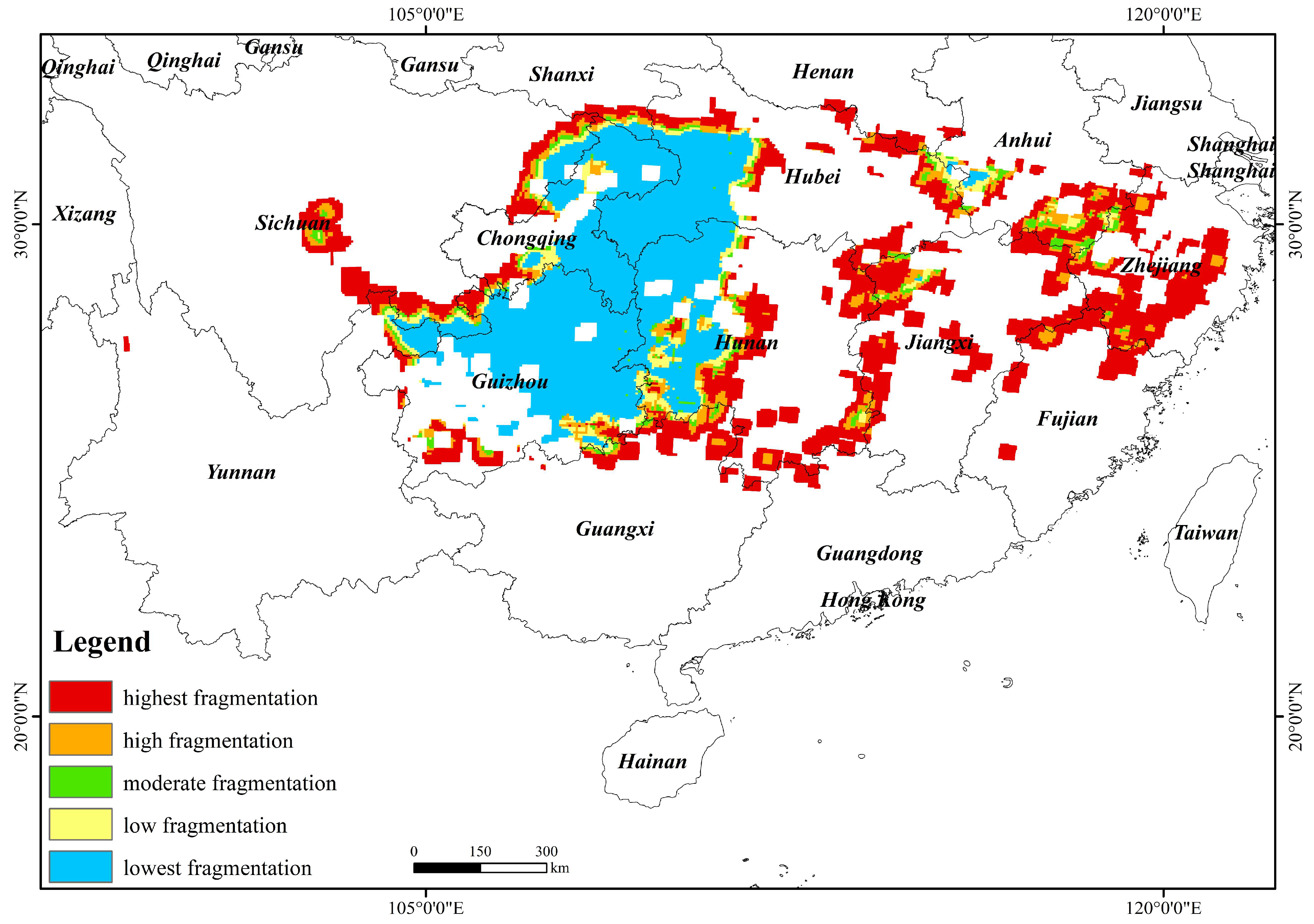
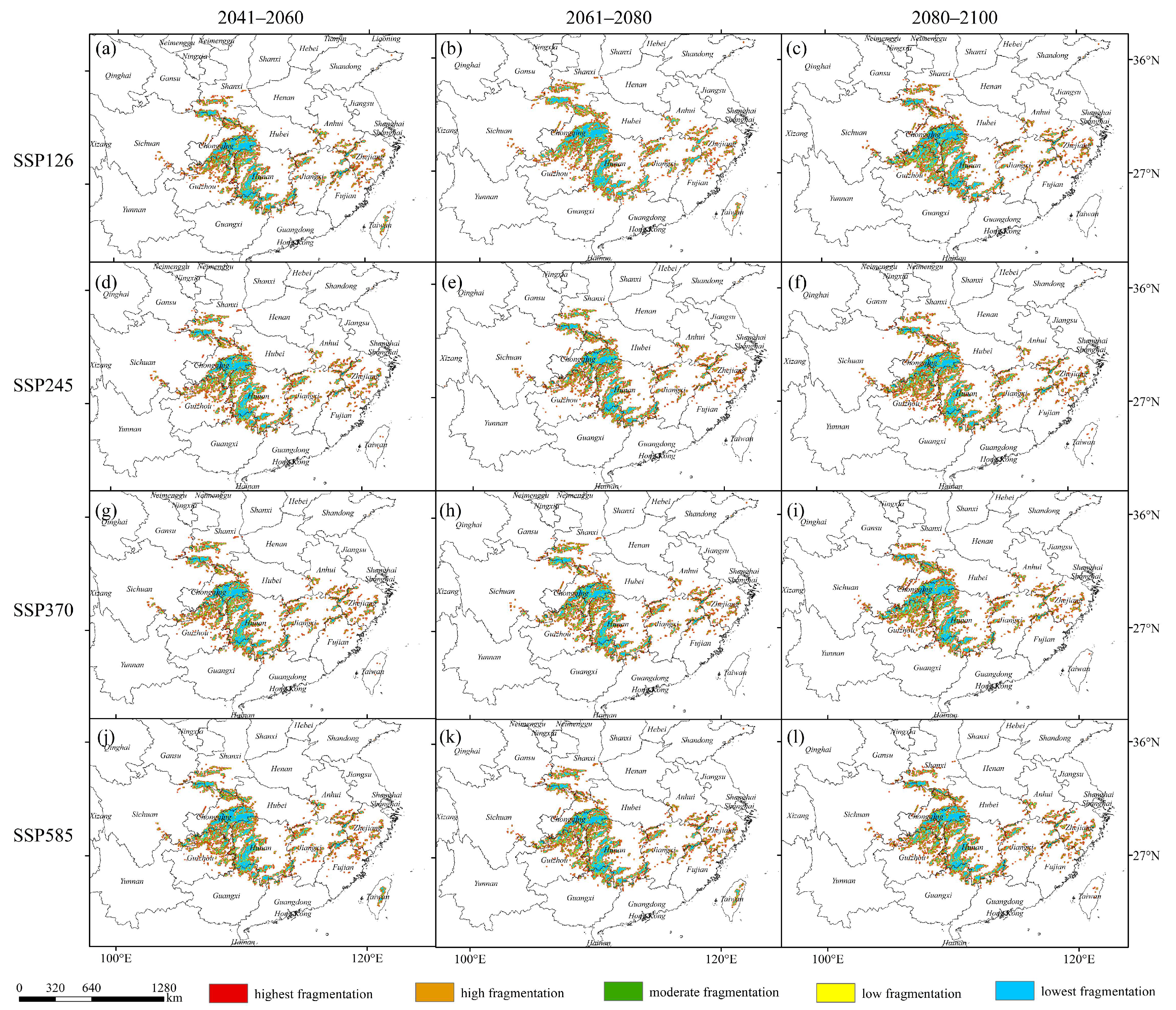
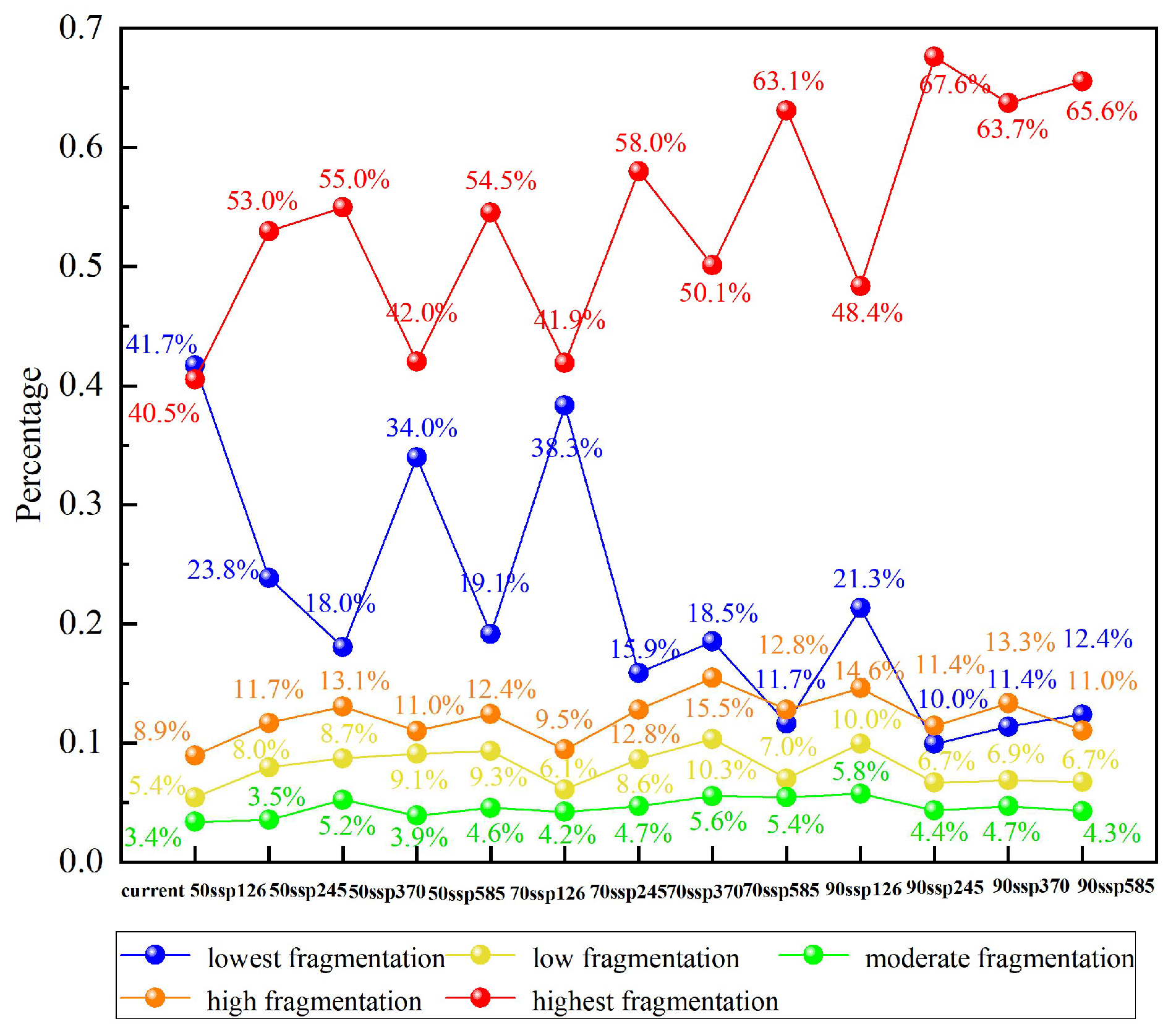
The highly adaptive distribution of Castanea seguinii has been continuously shrinking in response to climate change. To better assess habitat quality, this study analyzes the fragmentation of the species’ highly adaptive areas under different climate scenarios (Figure 8). The spatial results indicate that, under current conditions, significant fragmentation primarily occurs at the edges of the suitable region, while the interior remains relatively stable. The highest fragmentation accounts for 40.5% of the area, followed by high fragmentation at 8.9% and moderate fragmentation at 3.4%. These findings suggest a relatively high degree of overall fragmentation.
Increasing carbon emissions result in a reduction in highly adaptive habitats and a significant rise in fragmentation (Figure 9). By 2050, fragmentation is most severe under the SSP245 scenario, where the combined proportions of highest, high, and moderate fragmentation reach 73.24%, representing an increase of 20.44% compared to current levels. Under the SSP585 scenario, the area classified as low or lowest fragmentation is the smallest, contracting by 64.29% relative to current levels. In 2070, the most severe fragmentation occurs under SSP585, with the total share of highest, high, and moderate fragmentation reaching 81.34%, an increase of 28.54% from the current proportion. Under the same scenario, the area of low and lowest fragmentation contracts by 85.26% compared to the present. By 2090, fragmentation peaks under SSP245, with the combined proportions of highest, high, and moderate fragmentation reaching 83.39%, an increase of 30.59% from current levels. Under SSP585, the area of low and lowest fragmentation is again the smallest, decreasing by 87.93% from current levels (Figure 10). Among the five fragmentation levels, the highest fragmentation level accounts for the largest proportion, while the moderate fragmentation level accounts for the smallest proportion. As highly suitable areas shrink, the degree of fragmentation intensifies.

4. Discussion

In this research, we combined distribution data for the Castanea seguinii tree species with various environmental factors to forecast their potential distribution regions employing the Maximum Entropy (MaxEnt) model. The evaluation of prediction accuracy was effectively conducted using the Area Under the Curve (AUC) metric. Following this, the MaxEnt model was utilized to project distribution patterns across four climate scenarios from 2041 to 2100. The model attained an AUC value exceeding 0.92 [50,51], significantly surpassing the high-accuracy benchmark of 0.9, which suggests that the predicted suitable habitats for Castanea seguinii are both precise and dependable. Subsequently, we used Fragstats 4.2 to perform a fragmentation analysis on the highly suitable distribution of Castanea seguinii.
The spatial distribution of tree species is greatly affected by climatic conditions [52,53,54], which are essential in determining the patterns of forest vegetation [55,56,57]. In this research, climatic elements are recognized as the main factors influencing the range of Castanea seguinii, with an overall contribution rate of 89.1%. Among these climatic conditions, factors related to precipitation (76.2%) have a significantly greater impact compared to those related to temperature (12.9%). The suitable habitat of Castanea seguinii is primarily located in the humid areas south of the Qinling Mountains, indicating that precipitation has a substantial impact on its distribution. Specifically, the precipitation of the driest month (Bio14, 74.4%) represents the lower limit of water availability during the most water-scarce period of the year, determining whether the plants can survive the dry season and serving as a critical threshold for species persistence [58,59]. Conversely, the precipitation of the wettest quarter (Bio16, 1.5%) reflects water supply during the most abundant period, thereby influencing the intensity of the growing season and annual productivity [60,61]. Within the suitable precipitation range, adequate water promotes physiological processes such as photosynthesis, thereby favoring the growth and range expansion of Castanea seguinii. However, excessive precipitation can lead to waterlogging and root hypoxia, while insufficient precipitation restricts water supply—effects that are particularly pronounced during seedling establishment [62]. Global warming may exacerbate precipitation fluctuations in the distribution areas of Castanea seguinii [63]; causing precipitation in some regions to fall outside the suitable range and thereby constraining growth and distribution. The mean temperature of the driest quarter (Bio9, 10%) reflects the temperature conditions during the dry season and the combined stress of drought and heat. This metric determines the growth status of Castanea seguinii—whether it is in dormancy, shedding leaves, or continuing to grow—during the dry season, significantly influencing its phenological rhythms [64,65]. Isothermality (Bio3, 2.3%) indicates the relative relationship between diurnal and annual temperature ranges, affecting the balance between photosynthesis and respiration in Castanea seguinii; thereby constraining its growth and biomass accumulation [66].
In addition to climate, soil and topography significantly influence plant growth and distribution by regulating moisture, nutrients, temperature, and light [67,68,69]. Altitude, contributing 10.7%, is another key factor affecting the distribution of the Castanea seguinii genus. The suitable altitude range is between 550 and 1264 m, which generally aligns with the projected future altitudinal distribution of Castanea seguinii. Unlike the suitable altitude range—which serves as an environmental threshold based on ecological requirements—the centroid altitude acts as a spatial ‘average point’ rather than an ecological ‘optimum’. It represents a statistical measure centered on geographic space. The inconsistency between the two indicates that species distribution is not determined by altitude alone [30]. The fact that the centroid altitude does not always fall within the suitable range suggests an asymmetric spatial distribution of adaptive habitats, in which extensive high-altitude areas elevate the centroid position.
In this study, when predicting the suitable distribution of Castanea seguinii under future climate scenarios, we assumed that soil and topographic factors remain constant. This assumption is primarily based on the slower rate of soil change relative to climate change. However, the following limitations still exist: (1) Natural soil evolution is ignored. Future climate change can drive changes in soil properties through feedback mechanisms such as increased organic matter decomposition due to warming and pH fluctuations caused by precipitation changes, which cannot be overlooked in long-term simulations. (2) Uncertainty from human activities. Land use changes, fertilization, acidification amendments, and other measures can significantly alter key soil limiting factors in the short term, and fixing soil variables fails to capture these anthropogenic impacts. (3) Lack of interactions. There are synergistic or antagonistic effects between soil and climate (e.g., drought combined with soil sandification). Fixing soil variables would underestimate the risk of suitable habitat contraction under extreme adverse scenarios. Based on the above, this study has certain limitations. However, because topographic changes are a slow, long-term process, and the Castanea seguinii populations studied mostly grow in wild areas with limited human disturbance, we assume that topographic and soil factors remain unchanged under future climate conditions.
Global climate warming is a key driver of the expansion or contraction of species’ adaptive habitats [70,71,72]. Affected by global warming, species adapted to cold mountain climates are expected to face a substantial reduction in their distribution ranges [73,74,75,76]. An assessment of the impacts of climate change on 2632 plant species across all major mountain ranges in Europe indicates that by 2070–2100, 31%–51% of subalpine species and 19%–46% of montane species will lose more than 80% of their suitable habitats [77], which aligns with the findings of this study. In this study, the adaptive habitat area for the Castanea seguinii genus exhibited an overall contraction trend across various carbon-emission scenarios. Under the low-emission SSP126 scenario, this contraction is relatively limited. However, as carbon emission intensity increases, the contraction becomes significantly more pronounced, particularly in southwestern and northwestern regions, including Sichuan, Hunan, and Jiangxi provinces. Under SSP126, the total adaptive habitat area for Castanea seguinii peaks in 2070; nevertheless, the area of highly adaptive habitats declines during the same period. Under the high-emission SSP585 scenario, the contraction rate of highly adaptive habitats ranges from 59.80% to 84.69%, reaching its minimum by 2090. These results indicate that high carbon emissions profoundly affect the highly adaptive habitats of Castanea seguinii forests. Previous studies have demonstrated that elevated CO2 concentrations can enhance plant carbon sequestration capacity within a certain range [78]. However, the present study found that under high CO2 concentrations, the highly adaptive habitats of Castanea seguinii were significantly reduced. Given that these areas represent the core regions for biomass and carbon storage in Castanea seguinii forests [79,80,81], their reduction is likely to directly diminish the carbon sequestration capacity of these forests. Furthermore, this reduction may indirectly affect the carbon sink function of forest ecosystems by altering ecosystem stability and biodiversity.
Climate change generally prompts tree species to move to higher latitudes and elevations in search of favorable adaptive-habitat conditions [82,83,84]. This research validates a widespread trend of northwestward migration for the adaptive habitats of the Castanea seguinii genus. According to the SSP126 scenario, the centroid of distribution shifts toward Taoyuan County in Hunan Province, suggesting a relatively short migration distance. Under SSP245, the centroid moves to Laifeng County, located on the border between Hubei and Hunan provinces. By 2050, the centroid shifts 193.37 km to Cili County; by 2070, it moves 37.48 km to Taoyuan County; and by 2090, it shifts 202.79 km to Longshan County, indicating relatively pronounced changes. Under SSP370, the centroid shifts to Laifeng County. By 2050, it moves 310.47 km to Yongshun County; by 2070, it shifts 82.67 km to Sangzhi County; and by 2090, it moves 114.19 km back to Laifeng County. Under SSP585, the centroid shifts to Longshan County. By 2050, the distribution center moves 225.80 km to the Yongding District; by 2070, it shifts 88.71 km to Sangzhi County; and by 2090, it moves 23.97 km back to Longshan County, with migration distances showing a decreasing trend. Overall, the distribution centroid of the Castanea seguinii genus gradually migrates northwestward over time, with greater migration distances observed under low-emission scenarios. The research findings are consistent with the previously mentioned trend of warm-adapted vegetation migrating to higher altitudes and latitudes.
This study reveals that the altitudinal migration of the Castanea seguinii genus exhibits significant nonlinear patterns. Under the SSP126 and SSP585 scenarios, altitude shows a gradual upward trend, with maximum elevations reaching 378 m and 1350 m, respectively. In contrast, under SSP245, altitude initially increases, then decreases, and rises again, peaking at 710 m in 2050. Similarly, under SSP370, altitude rises before declining, reaching a peak of 795 m in 2070, followed by a sharp drop as emissions continue to rise. This nonlinearity likely results from differences in temperature-precipitation dynamics across scenarios. While temperature and precipitation remain relatively stable under SSP126 and SSP585, they fluctuate more markedly under SSP245 and SSP370. In the early stages of climate change, high-elevation conditions favor the growth of Castanea seguinii. However, the increasing frequency of extreme climate events leads to persistent declines in regional water availability, forcing Castanea seguinii to migrate to lower elevations in search of more stable moisture and temperature conditions [85]. Accordingly, conservation and restoration efforts for Castanea seguinii forests should account for these nonlinear altitudinal shifts and develop targeted management strategies.
Habitat fragmentation serves as a critical factor contributing to the decline in biodiversity [86]. As human activities continue to exert pressure on natural ecosystems and climate change modifies the environments where species reside, the issue of habitat fragmentation becomes increasingly evident. Nevertheless, many of the existing studies evaluate fragmentation primarily through landscape types, whereas research concentrating on the morphological attributes of species habitats is still limited [87]. In this research, we utilized a moving window approach to combine various landscape metrics and analyze the spatial fragmentation of habitats that are highly adaptable to Castanea seguinii. This method offers a more precise representation of true habitat fragmentation compared to evaluations that rely on a single metric. The findings suggest that, even in the present circumstances, the highly adaptable regions for Castanea seguinii already display a considerable level of fragmentation [49]. Highly fragmented areas are primarily located at the edges of the adaptive range, whereas low-fragmentation areas are found in the interior. As carbon emissions increase, previously continuous distribution areas become fragmented due to the loss of suitability in certain regions, further intensifying the fragmentation of highly adaptive areas. Under the SSP126 scenario, the highly adaptive distribution of Castanea seguinii remains relatively stable until 2070; under the SSP245, SSP370, and SSP585 scenarios, it remains stable by 2050. However, with rising carbon emissions, the highly adaptive area undergoes significant changes. Studies have shown that high carbon emissions can lead to climate instability, which in turn affects the stability of vegetation habitats [88]. Under the SSP585 scenario in 2090, the highly adaptive area reaches its minimum, as does the combined area of low and lowest fragmentation, indicating that habitat contraction leads to increased fragmentation and that the edges of the adaptive range are more strongly affected by climate change [89]. Analysis of the fragmentation of highly suitable areas reveals that under future climate scenarios, the highly suitable areas for Castanea seguinii not only contract severely but also become significantly more fragmented. This underscores the urgent need for action to prevent this trend and secure a stable habitat for the species.
In the coming years, it is anticipated that suitable adaptive environments for the species Castanea seguinii will be chiefly found in northern and high-altitude areas. Moreover, four prospective locations have been recognized within the western and southeastern parts of the Tibet Autonomous Region, as well as eastern Shandong Province and northwestern Yunnan Province, where current populations of Castanea seguinii are lacking. The lack of Castanea seguinii in these areas is likely attributable to limited seed dispersal capacity, whether by wind or animals, which hinders the species from colonizing these potential habitats. Proactive planning and conservation efforts should be implemented in these regions, including human-assisted interventions to optimize community structure, facilitate natural range expansion, and enhance carbon sink capacity. During the declining phase of altitudinal migration, particular attention should be directed to areas experiencing habitat contraction. Establishing ecological protection buffer zones is essential to reduce human disturbance, strengthen pest and disease control, and mitigate further habitat loss. Furthermore, as an economically significant forest tree species in China, Castanea seguinii produces nuts with high edible value. Ensuring the long-term stability and sustainable development of Castanea seguinii forest resources through scientific planning and efficient management will not only improve forest ecosystem services but also help alleviate pressure on China’s food supply.

5. Conclusions

Castanea seguinii exhibits robust natural regeneration capacity and significant potential as a carbon sink; however, its suitable distribution areas are markedly influenced by global climate warming. This study integrates multi-source data, including climate, soil, and topography, and employs the maximum entropy (MaxEnt) model to analyze the current and future distributions and trends of suitable habitats for Castanea seguinii communities. Additionally, it assesses the ecological fragmentation of the species using landscape fragmentation indices. The main conclusions are as follows: (1) The contribution rate of precipitation factors to Castanea seguinii is greater than that of temperature factors, with Bio14 identified as the most critical factor. (2) Currently, Castanea seguinii is predominantly distributed in southern China, where its total suitable area constitutes approximately 12.7% of the national land area. Potential suitable areas for this tree species include the eastern part of Shandong, western and southeastern Tibet, northwestern Yunnan, and central Taiwan. (3) Under future climate scenarios, the suitable area for Castanea seguinii is anticipated to contract overall and shift northwestward, with a particularly pronounced reduction in highly suitable areas. (4) An assessment of habitat fragmentation in highly suitable areas for Castanea seguinii reveals that the degree of habitat fragmentation intensifies with increasing carbon emissions.
This study elucidates the dynamic variations in the adaptive distributions of the Chinese Castanea seguinii species in the context of global warming. The findings provide reliable data support and theoretical references for targeted conservation, scientific management, and climate-adaptive governance of Castanea seguinii forest resources. Future research should integrate the physiological and ecological traits of Castanea seguinii through field-controlled experiments to further validate model predictions, thereby formulating more precise strategies to enhance the climate resilience of Castanea seguinii forests.

Author Contributions

Conceptualization, H.Z. and W.M.; methodology, H.Z. and W.M.; software, H.Z. and W.M.; validation, H.Z. and W.M.; formal analysis, W.M.; investigation, W.M.; resources, W.M.; data curation, W.M.; writing—original draft preparation, W.M.; writing—review and editing, H.Z. and W.M.; visualization, W.M.; supervision, W.M.; project administration, W.M.; funding acquisition, H.Z. All authors have read and agreed to the published version of the manuscript.

Funding

This research was funded by the National Water Pollution Control and Treatment Science and Technology Major Project (2017ZX07101) and the Discipline Construction Program of Huayong Zhang, Distinguished Professor of Shandong University, School of Life Sciences (61200082363001).

Data Availability Statement

All links to input data are reported in the manuscript, and all output data are available upon request to the authors.

Conflicts of Interest

The authors declare no conflicts of interest.

References

  1. Ullah, S.; Wu, J.; Shah, J.A.; Wang, X.; Lyu, Y.; Guo, Z.; Ali, K.; Chen, D.; Sun, H. Tree diversity drives understory carbon storage rather than overstory carbon storage across forest types. J. For. Res. 2024, 35, 125. [Google Scholar] [CrossRef]
  2. Wu, F.; Jia, J.W.; Li, C.; Cao, Y.; Zhao, J.F.; Yan, X.D.; Cui, X.F. Climate changes have alleviated constraints on forest carbon storage capacity since 1970 in most of the Northern Hemisphere. Ecol. Indic. 2024, 169, 112925. [Google Scholar] [CrossRef]
  3. Zhang, Y.Q.; Fei, X.H.; Liu, F.; Chen, J.X.; You, X.L.; Huang, S.J.; Wang, M.H.; Dong, J.W. Advances in forest management research in the context of carbon neutrality: A bibliometric analysis. Forests 2022, 13, 1810. [Google Scholar] [CrossRef]
  4. Canadell, J.G.; Raupach, M.R. Managing forests for climate change mitigation. Science 2008, 320, 1456–1457. [Google Scholar] [CrossRef] [PubMed]
  5. Urban, M.C. Climate change extinctions. Science 2024, 386, 1123–1128. [Google Scholar] [CrossRef] [PubMed]
  6. Xi, Y.B.; Zhang, W.M.; Wei, F.L.; Fang, Z.X.; Fensholt, R. Boreal tree species diversity increases with global warming but is reversed by extremes. Nat. Plants 2024, 10, 1473–1483. [Google Scholar] [CrossRef] [PubMed]
  7. Zhao, Y.H.; Xu, L.; Zhang, Y.; Wen, Y.F.; Zhang, D.L. Climate-change impacts on distribution, habitats, sustainability and cultivation planning of two economically and ecologically important forest trees (China fir and Masson pine) in China. Glob. Ecol. Conserv. 2025, 57, e03349. [Google Scholar] [CrossRef]
  8. Yong, J.; Duan, G.S.; Chen, S.Z.; Lei, X.D. Environmental response of tree species distribution in Northeast China with the joint species distribution model. Forests 2024, 15, 1026. [Google Scholar] [CrossRef]
  9. Nie, X.; Zhang, Y.; Chu, S.; Yu, W.; Liu, Y.; Yan, B.; Zhao, S.; Gao, W.; Li, C.; Shi, X.; et al. New insights into the evolution and local adaptation of the genus Castanea in east Asia. Hortic. Res. 2024, 11, uhae147. [Google Scholar] [CrossRef]
  10. Mellano, M.G.; Beccaro, G.L.; Donno, D.; Marinoni, D.T.; Boccacci, P.; Canterino, S.; Cerutti, A.K.; Bounous, G. Castanea spp. biodiversity conservation: Collection and characterization of the genetic diversity of an endangered species. Genet. Resour. Crop Evol. 2012, 59, 1727–1741. [Google Scholar] [CrossRef]
  11. Wang, Y.; Liu, C.; Fang, Z.; Wu, Q.; Xu, Y.; Gong, B.; Jiang, X.; Lai, J.; Fan, J. A review of the stress resistance, molecular breeding, health benefits, potential food products, and ecological value of Castanea mollissima. Plants 2022, 11, 2111. [Google Scholar] [CrossRef] [PubMed]
  12. Freitas, T.R.; Santos, J.A.; Silva, A.P.; Fraga, H. Influence of climate change on chestnut trees: A review. Plants 2021, 10, 1463. [Google Scholar] [CrossRef] [PubMed]
  13. Jacobs, D.F.; Selig, M.F.; Severeid, L.R. Aboveground carbon biomass of plantation-grown American chestnut (Castanea dentata) in absence of blight. For. Ecol. Manag. 2009, 258, 288–294. [Google Scholar] [CrossRef]
  14. Aitken, S.N.; Yeaman, S.; Holliday, J.A.; Wang, T.; Curtis-McLane, S. Adaptation, migration or extirpation: Climate change outcomes for tree populations. Evol. Appl. 2008, 1, 95–111. [Google Scholar] [CrossRef]
  15. Beauregard, F. Potential for Northern Range Expansion of the Understory Flora of Temperate Québec: Edaphic, Climatic and Biotic Factors. Ph.D. Thesis, McGill University, Montreal, QC, Canada, 2016. [Google Scholar]
  16. Lenoir, J.; Gégout, J.C.; Marquet, P.A.; de Ruffray, P.; Brisse, H. A significant upward shift in plant species optimum elevation during the 20th century. Science 2008, 320, 1768–1771. [Google Scholar] [CrossRef]
  17. Dyderski, M.K.; Paź, S.; Frelich, L.E.; Jagodziński, A.M. How much does climate change threaten European forest tree species distributions? Glob. Chang. Biol. 2018, 24, 1150–1163. [Google Scholar] [CrossRef] [PubMed]
  18. Phillips, S.J.; Anderson, R.P.; Schapire, R.E. Maximum entropy modeling of species geographic distributions. Ecol. Model. 2006, 190, 231–259. [Google Scholar] [CrossRef]
  19. He, Y.; Ma, J.; Chen, G. Potential geographical distribution and its multi-factor analysis of Pinus massoniana in China based on the maxent model. Ecol. Indic. 2023, 154, 110790. [Google Scholar] [CrossRef]
  20. Li, G.; Du, S.; Wen, Z. Mapping the climatic suitable habitat of oriental arborvitae (Platycladus orientalis) for introduction and cultivation at a global scale. Sci. Rep. 2016, 6, 30009. [Google Scholar] [CrossRef]
  21. Zhang, L.; Jing, Z.; Li, Z.; Liu, Y.; Fang, S. Predictive modeling of suitable habitats for Cinnamomum Camphora (L.) presl using maxent model under climate change in China. Int. J. Environ. Res. Public Health 2019, 16, 3185. [Google Scholar] [CrossRef]
  22. Yao, Y.; Cheng, T.; Sun, Z.; Li, L.; Chen, D.; Chen, Z.; Wei, J.; Guan, Q. VecLI: A framework for calculating vector landscape indices considering landscape fragmentation. Environ. Model. Softw. 2022, 149, 105325. [Google Scholar] [CrossRef]
  23. Kupfer, J.A. Landscape ecology and biogeography: Rethinking landscape metrics in a post-FRAGSTATS landscape. Prog. Phys. Geogr. 2012, 36, 400–420. [Google Scholar] [CrossRef]
  24. Wang, X.; Sun, Y.; Jia, W.; Wang, H.; Zhu, W. Coupling of Forest Carbon Densities with Landscape Patterns and Climate Change in the Lesser Khingan Mountains, Northeast China. Sustainability 2023, 15, 14981. [Google Scholar] [CrossRef]
  25. Roy, P.S.; Murthy, M.S.R.; Roy, A.; Kushwaha, S.P.S.; Singh, S.; Jha, C.S.; Behera, M.D.; Joshi, P.K.; Jagannathan, C.; Karnatak, H.C.; et al. Forest fragmentation in India. Curr. Sci. 2013, 105, 774–780. [Google Scholar]
  26. Liu, Y.W.; Zhao, L.; Tan, G.R.; Shen, X.Y.; Nie, S.P.; Li, Q.Q.; Zhang, L. Evaluation of multidimensional simulations of summer air temperature in China from CMIP5 to CMIP6 by the BCC models: From trends to modes. Adv. Clim. Chang. Res. 2022, 13, 28–41. [Google Scholar] [CrossRef]
  27. Wu, T.; Lu, Y.; Fang, Y.; Xin, X.; Li, L.; Li, W.; Jie, W.; Zhang, J.; Liu, Y.; Zhang, L.; et al. The Beijing climate center climate system model (BCC-CSM): The main progress from CMIP5 to CMIP6. Geosci. Model Dev. 2019, 12, 1573–1600. [Google Scholar] [CrossRef]
  28. Shamloo, N.; Sattari, M.T.; Kamran, K.V.; Apaydin, H. An integrated artificial intelligence-deep learning approach for vegetation canopy assessment and monitoring through satellite images. Stoch. Environ. Res. Risk Assess. 2025, 39, 1623–1645. [Google Scholar] [CrossRef]
  29. Díaz-Vallejo, M.; Peña-Peniche, A.; Mota-Vargas, C.; Piña-Torres, J.; Valencia-Rodríguez, D.; Rangel-Rivera, C.E.; Gaviria-Hernández, J.; Rojas-Soto, O. Analyses of the variable selection using correlation methods: An approach to the importance of statistical inferences in the modelling process. Ecol. Model. 2024, 498, 110893. [Google Scholar] [CrossRef]
  30. Elith, J.; Phillips, S.J.; Hastie, T.; Dudík, M.; Chee, Y.E.; Yates, C.J. A statistical explanation of MaxEnt for ecologists. Divers. Distrib. 2011, 17, 43–57. [Google Scholar] [CrossRef]
  31. Warren, D.L.; Seifert, S.N. Ecological niche modeling in Maxent: The importance of model complexity and the performance of model selection criteria. Ecol. Appl. 2011, 21, 335–342. [Google Scholar] [CrossRef]
  32. Merow, C.; Smith, M.J.; Silander, J.A., Jr. A practical guide to MaxEnt for modeling species’ distributions: What it does, and why inputs and settings matter. Ecography 2013, 36, 1058–1069. [Google Scholar] [CrossRef]
  33. Gao, M.; Zhao, G.; Zhang, S.; Wang, Z.; Wen, X.; Liu, L.; Zhang, C.; Tie, N.; Sa, R. Priority conservation area of Larix gmelinii under climate change: Application of an ensemble modeling. Front. Plant Sci. 2023, 14, 1177307. [Google Scholar] [CrossRef]
  34. Hou, J.; Xiang, J.; Li, D.; Liu, X. Prediction of potential suitable distribution areas of Quasipaa spinosa in China based on MaxEnt optimization model. Biology 2023, 12, 366. [Google Scholar] [CrossRef] [PubMed]
  35. de Oliveira Sousa, J.B.; de Sousa Conceição Benathar, I.; Ebling, A.A.; Kohler, S.V.; de Oliveira, X.M.; de Paula Protásio, T.; Rodrigues, M.; Goulart, S.L. Using maximum entropy modeling to predict the potential distributions of genus Copaifera L. in a conservation unit in the Brazilian Amazon. Plant Ecol. 2025, 226, 185–196. [Google Scholar] [CrossRef]
  36. Zhong, X.; Zhang, L.; Zhang, J.; He, L.; Sun, R. Maxent modeling for predicting the potential geographical distribution of Castanopsis carlesii under various climate change scenarios in China. Forests 2023, 14, 1397. [Google Scholar] [CrossRef]
  37. Koldasbayeva, D.; Tregubova, P.; Gasanov, M.; Zaytsev, A.; Petrovskaia, A.; Burnaev, E. Challenges in data-driven geospatial modeling for environmental research and practice. Nat. Commun. 2024, 15, 10700. [Google Scholar] [CrossRef]
  38. Rong, Z.; Zhao, C.; Liu, J.; Gao, Y.; Zang, F.; Guo, Z.; Mao, Y.; Wang, L. Modeling the effect of climate change on the potential distribution of Qinghai spruce (Picea crassifolia Kom.) in Qilian Mountains. Forests 2019, 10, 62. [Google Scholar] [CrossRef]
  39. Deng, F.; Li, X.B.; Wang, H.; Zhang, M.; Li, X.; Li, R.H. The suitability of geographic distribution and the dominant factors of alfalfa based on MaxEnt model in Xilin Gol. Pratacult. Sci. 2014, 31, 1840–1847. [Google Scholar]
  40. Zhang, Y.B.; Liu, Y.L.; Qin, H.; Meng, Q.X. Prediction on spatial migration of suitable distribution of Elaeagnus mollis under climate change conditions in Shanxi Province, China. Ying Yong Sheng Tai Xue Bao J. Appl. Ecol. 2019, 30, 496–502. [Google Scholar]
  41. Yang, G.; Liu, N.; Zhang, X.; Zhou, H.; Hou, Y.; Wu, P.; Zhang, X. Prediction of the potential distribution of Chimonobambusautilis (Poaceae, Bambusoideae) in China, based on the MaxEnt model. Biodivers. Data J. 2024, 12, e126620. [Google Scholar] [CrossRef]
  42. Mahmoud, A.R.; Farahat, E.A.; Hassan, L.M.; Halmy, M.W.A. Towards optimizing conservation planning: A performance evaluation of modeling techniques for predicting Mediterranean native species distribution. J. Nat. Conserv. 2024, 82, 126733. [Google Scholar] [CrossRef]
  43. Morales, N.S.; Fernández, I.C. Land-cover classification using MaxEnt: Can we trust in model quality metrics for estimating classification accuracy? Entropy 2020, 22, 342. [Google Scholar] [CrossRef] [PubMed]
  44. Wang, Y.; Liu, H.; Xu, J.; Yu, S.; Huang, Y.; Zhang, Y.; He, X.; Chen, W. Prediction of suitable planting areas of Rubia cordifolia in China based on a species distribution model and analysis of specific secondary metabolites. Ind. Crops Prod. 2023, 206, 117651. [Google Scholar] [CrossRef]
  45. Lv, Z.; Jiu, S.; Wang, L.; Xu, Y.; Wang, J.; Liu, X.; Xu, J.; Wang, Y.; Haider, M.S.; Liu, R.; et al. Climate change affects the suitability of Chinese cherry (Prunus pseudocerasus Lindl.) in China. Mol. Hortic. 2025, 5, 26. [Google Scholar] [CrossRef]
  46. Zhang, F.G.; Zhang, S.; Wu, K.; Zhao, R.; Zhao, G.; Wang, Y. Potential habitat areas and priority protected areas of Tilia amurensis Rupr in China under the context of climate change. Front. Plant Sci. 2024, 15, 1365264. [Google Scholar] [CrossRef]
  47. Jin, S.; Chi, Y.; Li, X.; Shu, P.; Zhu, M.; Yuan, Z.; Liu, Y.; Chen, W.; Han, Y. Predicting the response of three common subtropical tree species in China to climate change. Front. For. Glob. Chang. 2023, 6, 1299120. [Google Scholar] [CrossRef]
  48. Liang, J.; Peng, Y.; Zhu, Z.; Li, X.; Xing, W.; Li, X.; Yan, M.; Yuan, Y. Impacts of changing climate on the distribution of migratory birds in China: Habitat change and population centroid shift. Ecol. Indic. 2021, 127, 107729. [Google Scholar] [CrossRef]
  49. Ma, J.; Li, J.; Wu, W.; Liu, J. Global forest fragmentation change from 2000 to 2020. Nat. Commun. 2023, 14, 3752. [Google Scholar] [CrossRef]
  50. Rubenstein, M.A.; Weiskopf, S.R.; Bertrand, R.; Carter, S.L.; Comte, L.; Eaton, M.J.; Johnson, C.G.; Lenoir, J.; Lynch, A.J.; Miller, B.W.; et al. Climate change and the global redistribution of biodiversity: Substantial variation in empirical support for expected range shifts. Environ. Evid. 2023, 12, 7. [Google Scholar] [CrossRef]
  51. Hamann, A.; Wang, T. Potential effects of climate change on ecosystem and tree species distribution in British Columbia. Ecology 2006, 87, 2773–2786. [Google Scholar] [CrossRef]
  52. Shi, J.; Xia, M.; He, G.; Gonzalez, N.C.T.; Zhou, S.; Lan, K.; Yang, L.; Shen, X.; Jiang, X.; Cao, F.; et al. Predicting Quercus gilva distribution dynamics and its response to climate change induced by GHGs emission through MaxEnt modeling. J. Environ. Manag. 2024, 357, 120841. [Google Scholar] [CrossRef]
  53. McDowell, W.G.; Benson, A.J.; Byers, J.E. Climate controls the distribution of a widespread invasive species: Implications for future range expansion. Freshw. Biol. 2014, 59, 847–857. [Google Scholar] [CrossRef]
  54. Yuan, Y.; Zuo, J.; Zhang, H.; Tang, X.; Zu, M. Climate change on potential suitable areas for typical Pinaceae species on the Western Sichuan Plateau. Geocarto Int. 2022, 37, 14739–14757. [Google Scholar] [CrossRef]
  55. Feeley, K.J.; Zuleta, D. Changing forests under climate change. Nat. Plants 2022, 8, 984–985. [Google Scholar] [CrossRef] [PubMed]
  56. Zhao, D.; Wu, S. Responses of vegetation distribution to climate change in China. Theor. Appl. Climatol. 2014, 117, 15–28. [Google Scholar] [CrossRef]
  57. Bai, M.; Dong, Z.; Chen, D.; Zheng, H.; Zhou, F.; Cao, X.; Ou, T.; Fang, K. Different responses of the radial growth of the planted and natural forests to climate change in humid subtropical China. Geogr. Ann. Ser. A Phys. Geogr. 2020, 102, 235–246. [Google Scholar] [CrossRef]
  58. O’Donnel, M.S.; Ignizio, D.A. Bioclimatic Predictors for Supporting Ecological Applications in the Conterminous United States; US Geological Survey: Reston, VA, USA, 2012. [Google Scholar]
  59. Kriticos, D.J.; Webber, B.L.; Leriche, A.; Ota, N.; Macadam, I.; Bathols, J.; Scott, J.K. CliMond: Global high-resolution historical and future scenario climate surfaces for bioclimatic modelling. Methods Ecol. Evol. 2012, 3, 53–64. [Google Scholar] [CrossRef]
  60. Stephenson, N. Actual evapotranspiration and deficit: Biologically meaningful correlates of vegetation distribution across spatial scales. J. Biogeogr. 1998, 25, 855–870. [Google Scholar] [CrossRef]
  61. Bede-Fazekas, Á.; Somodi, I. Precipitation and temperature timings underlying bioclimatic variables rearrange under climate change globally. Glob. Change Biol. 2024, 30, e17496. [Google Scholar] [CrossRef]
  62. Li, W.X.; Liu, S.B. Large scaled cedar DBH growth models including climatic variables. J. Cent. South Universlity For. Technol. 2015, 3, 74–77. [Google Scholar]
  63. Li, W.; Zhang, H.; Xin, Q.; Gu, X.; Ma, H.; Cao, H.; Bao, Z.; Ye, L.; Huai, X. Analysis of extreme precipitation under nonstationary conditions in the Yangtze River Basin. J. Hydrol. Eng. 2025, 30, 05024025. [Google Scholar] [CrossRef]
  64. Crivova, O. Spatio-temporal analysis of temperature’s variability on the example of mean temperature of the wettest and driest quarter for Republic of Moldova’s territory. In Proceedings of the Integrare Prin Cercetare și Inovare, Chișinău, Moldova, 9–10 November 2023; pp. 151–159. [Google Scholar]
  65. Gao, C.; Liu, F.; Zhang, C.; Feng, D.; Li, K.; Cui, K. Germination responses to water potential and temperature variation among provenances of Pinus yunnanensis. Flora 2021, 276, 151786. [Google Scholar] [CrossRef]
  66. Zhang, X.; Rademacher, T.; Liu, H.; Wang, L.; Manzanedo, R.D. Fading regulation of diurnal temperature ranges on drought-induced growth loss for drought-tolerant tree species. Nat. Commun. 2023, 14, 6916. [Google Scholar] [CrossRef]
  67. Wang, Q.; Wang, C.J.; Wan, J.Z. Relationships between topographic variation and plant functional trait distribution across different biomes. Flora 2022, 293, 152116. [Google Scholar] [CrossRef]
  68. Giuliani, L.M.; Hallett, P.D.; Loades, K.W. Effects of soil structure complexity to root growth of plants with contrasting root architecture. Soil Tillage Res. 2024, 238, 106023. [Google Scholar] [CrossRef]
  69. Gxasheka, M.; Gajana, C.S.; Dlamini, P. The role of topographic and soil factors on woody plant encroachment in mountainous rangelands: A mini literature review. Heliyon 2023, 9, e20615. [Google Scholar] [CrossRef] [PubMed]
  70. Yao, W.; Wang, Z.; Fan, Y.; Liu, D.; Ding, Z.; Zhou, Y.; Hu, S.; Zhang, W.; Ou, J. Prediction of potential habitat distributions and climate change impacts on the rare species Woonyoungia septentrionalis (Magnoliaceae) in China based on MaxEnt. Plants 2024, 14, 86. [Google Scholar] [CrossRef] [PubMed]
  71. Ao, Q.; Li, H.; Yang, L.; Li, Q.; Long, F.; Xiao, Y.; Zuo, W. Projecting the global potential distribution of nine Rhododendron Subgenus Hymenanthes species under different climate change scenarios. Sci. Rep. 2025, 15, 3459. [Google Scholar] [CrossRef] [PubMed]
  72. Dyderski, M.K.; Paź-Dyderska, S.; Jagodziński, A.M.; Puchałka, R. Shifts in native tree species distributions in Europe under climate change. J. Environ. Manag. 2025, 373, 123504. [Google Scholar] [CrossRef]
  73. Thomas, C.D.; Cameron, A.; Green, R.E.; Bakkenes, M.; Beaumont, L.J.; Collingham, Y.C.; Erasmus, B.F.N.; de Siqueira, M.F.; Grainger, A.; Hannah, L.; et al. Extinction risk from climate change. Nature 2004, 427, 145–148. [Google Scholar] [CrossRef]
  74. Wang, W.J.; Thompson, F.R., III; He, H.S.; Fraser, J.S.; Dijak, W.D.; Jones-Farrand, J. Climate change and tree harvest interact to affect future tree species distribution changes. J. Ecol. 2019, 107, 1901–1917. [Google Scholar] [CrossRef]
  75. Román-Palacios, C.; Wiens, J.J. Recent responses to climate change reveal the drivers of species extinction and survival. Proc. Natl. Acad. Sci. USA 2020, 117, 4211–4217. [Google Scholar] [CrossRef] [PubMed]
  76. Braunisch, V.; Coppes, J.; Arlettaz, R.; Suchant, R.; Zellweger, F.; Bollmann, K. Temperate mountain forest biodiversity under climate change: Compensating negative effects by increasing structural complexity. PLoS ONE 2014, 9, e97718. [Google Scholar] [CrossRef] [PubMed]
  77. Engler, R.; Randin, C.F.; Thuiller, W.; Dullinger, S.; Zimmermann, N.E.; Araujo, M.B.; Pearman, P.B. 21st century climate change threatens mountain flora unequally across Europe. Glob. Change Biol. 2011, 17, 2330–2341. [Google Scholar] [CrossRef]
  78. Tang, X.; Zhao, J.; Zhou, J.; Zhu, Q.; Sheng, X.; Yue, C. Elevated CO2 shifts photosynthetic constraint from stomatal to biochemical limitations during induction in Populus tomentosa and Eucalyptus robusta. Plants 2024, 14, 47. [Google Scholar] [CrossRef]
  79. Chang-Sheng, L.; Tao, L.; Rui-wen, Z.; Chao, W.; Xing-le, Q.; Da-qing, L. Growth characteristics and biomass model of Cupressus gigantea sapling. Trees 2024, 38, 27–35. [Google Scholar] [CrossRef]
  80. Lyu, J.; Wang, J.; Chen, M. Effects of Heat Treatment on the Chemical Composition and Microstructure of Cupressus funebris Endl. Wood. Forests 2024, 15, 1370. [Google Scholar] [CrossRef]
  81. Yang, J.; Wu, Q.; Dakhil, M.A.; Halmy, M.W.A.; Bedair, H.; Fouad, M.S. Towards forest conservation planning: How temperature fluctuations determine the potential distribution and extinction risk of cupressus funebris conifer trees in China. Forests 2023, 14, 2234. [Google Scholar] [CrossRef]
  82. Xu, W.; Rhemtulla, J.M.; Luo, D.; Wang, T. Common drivers shaping niche distribution and climate change responses of one hundred tree species. J. Environ. Manag. 2024, 370, 123074. [Google Scholar] [CrossRef]
  83. Zhu, K.; Song, Y.; Lesage, J.C.; Luong, J.C.; Bartolome, J.W.; Chiariello, N.R.; Dudney, J.; Field, C.B.; Hallett, L.M.; Hammond, M.; et al. Rapid shifts in grassland communities driven by climate change. Nat. Ecol. Evol. 2024, 8, 2252–2264. [Google Scholar] [CrossRef]
  84. Chakraborty, D.; Ciceu, A.; Ballian, D.; Garzón, M.B.; Bolte, A.; Bozic, G.; Buchacher, R.; Čepl, J.; Cremer, E.; Ducousso, A.; et al. Assisted tree migration can preserve the European forest carbon sink under climate change. Nat. Clim. Chang. 2024, 14, 845–852. [Google Scholar] [CrossRef]
  85. Kumar, S.; Khanduri, V.P. Impact of climate change on the Himalayan alpine treeline vegetation. Heliyon 2024, 10, e40797. [Google Scholar] [CrossRef]
  86. Wilson, M.C.; Chen, X.Y.; Corlett, R.T.; Didham, R.K.; Ding, P.; Holt, R.D.; Holyoak, M.; Hu, G.; Hughes, A.C.; Jiang, L.; et al. Habitat fragmentation and biodiversity conservation: Key findings and future challenges. Landsc. Ecol. 2016, 31, 219–227. [Google Scholar] [CrossRef]
  87. Bruna, E.M.; Fiske, I.J.; Trager, M.D. Habitat fragmentation and plant populations: Is what we know demographically irrelevant? J. Veg. Sci. 2009, 20, 569–576. [Google Scholar] [CrossRef]
  88. Lemordant, L.; Gentine, P. Vegetation response to rising CO2 impacts extreme temperatures. Geophys. Res. Lett. 2019, 46, 1383–1392. [Google Scholar] [CrossRef]
  89. Masuda, K.; Setoguchi, H.; Nagasawa, K.; Ishihara, M.I.; Sawa, K.; Horie, K.; Tsuboi, H.; Fukumoto, S.; Tango, T.; Sakaguchi, S. Rear-edge daylily populations show legacies of habitat fragmentation due to the holocene climate warming. J. Biogeogr. 2023, 50, 551–563. [Google Scholar] [CrossRef]
Figure 1. The distribution of the Castanea seguinii species in China.
Forests 17 00684 g001
Figure 2. The adaptive distribution of Castanea seguinii species under the current climate conditions.
Forests 17 00684 g002
Figure 3. Response curves of driving variables.
Forests 17 00684 g003
Figure 4. Contraction and expansion of the adaptive distribution of Castanea seguinii. (a) 2041–2060: ssp126, (b) 2061–2080: ssp126, (c) 2081–2100: ssp126, (d) 2041–2060: ssp245, (e) 2061–2080: ssp245, (f) 2081–2100: ssp245, (g) 2041–2060: ssp370, (h) 2061–2080: ssp370, (i) 2081–2100: ssp370, (j) 2041–2060: ssp585, (k) 2061–2080: ssp585, (l) 2081–2100: ssp585.
Forests 17 00684 g004
Figure 5. Adaptive distribution of Castanea seguinii species under future climate scenarios. (a) 2041–2060: ssp126, (b) 2061–2080: ssp126, (c) 2081–2100: ssp126, (d) 2041–2060: ssp245, (e) 2061–2080: ssp245, (f) 2081–2100: ssp245, (g) 2041–2060: ssp370, (h) 2061–2080: ssp370, (i) 2081–2100: ssp370, (j) 2041–2060: ssp585, (k) 2061–2080: ssp585, (l) 2081–2100: ssp585.
Forests 17 00684 g005
Figure 6. Adaptive distribution areas of the Castanea seguinii species under different climate scenarios.
Forests 17 00684 g006
Figure 7. (a) Centroid migration. (b) Altitude change.
Forests 17 00684 g007
Figure 8. Spatial distribution of fragmentation of highly suitable areas for Castanea seguinii under current climatic conditions.
Forests 17 00684 g008
Figure 9. Spatial distribution of fragmentation in the highly adaptive area of Castanea seguinii under different future climate scenarios. (a) 2041–2060: ssp126, (b) 2061–2080: ssp126, (c) 2081–2100: ssp126, (d) 2041–2060: ssp245, (e) 2061–2080: ssp245, (f) 2081–2100: ssp245, (g) 2041–2060: ssp370, (h) 2061–2080: ssp370, (i) 2081–2100: ssp370, (j) 2041–2060: ssp585, (k) 2061–2080: ssp585, (l) 2081–2100: ssp585.
Forests 17 00684 g009
Figure 10. Percentage of fragmentation at each level under different scenarios.
Forests 17 00684 g010
Table 1. Contribution rates and permutation importances of environmental variables.
VariableEnvironment VariableUnitePercent ContributePermutation Importance
Bio14Precipitation of the driest monthmm74.436.1
ElevAltitudem10.715.8
Bio9Mean temperature of driest quarter°C1015.3
Bio3Isothermality-2.33.9
Bio16Precipitation of the wettest quartermm1.514.3
Bio2Mean diurnal range°C0.44.8
Bio15Precipitation seasonality%0.36.3
Bio4Temperature seasonality-0.23.2
T_cec_clayCation exchange capacity of cohesive layer soilcmol/kg0.10.1
T_bsBasic saturation%0.10.1
Disclaimer/Publisher’s Note: The statements, opinions and data contained in all publications are solely those of the individual author(s) and contributor(s) and not of MDPI and/or the editor(s). MDPI and/or the editor(s) disclaim responsibility for any injury to people or property resulting from any ideas, methods, instructions or products referred to in the content.