Article

New Approaches to Tracking Southern Pine Health: Forecasting Southern Pine Beetle Outbreaks Using Pheromone-Baited Traps, Detection Surveys and a Hazard Rating Model


1
Forest Health Protection, USDA Forest Service, 1720 Peachtree St. NW, Atlanta, GA 30309, USA
2
Forest Health Protection, USDA Forest Service, 200 WT Weaver Blvd, Asheville, NC 28804, USA
3
Ecosystems, Sustainability, and Justice, Maryland Institute College of Art, 1300 W Mount Royal Ave, Baltimore, MD 21217, USA
4
Department of Biological Sciences, Dartmouth College, 78 College Street, Hanover, NH 03755, USA
5
National Forest System—Natural Resources, USDA Forest Service, Bldg. E, 2150 Centre Ave., Fort Collins, CO 80526, USA
6
Forest Health Technology Enterprise Team, USDA Forest Service, Bldg. A, 2150 Centre Ave., Fort Collins, CO 80526, USA
7
Southern Research Station, USDA Forest Service, 200 WT Weaver Blvd, Asheville, NC 28804, USA
8
Forest Health Protection, USDA Forest Service, 2500 Shreveport Highway, Pineville, LA 71360, USA
9
Georgia Forestry Commission, 5645 Riggins Mill Rd, Dry Branch, GA 31020, USA
*
Author to whom correspondence should be addressed.
Retired author.
Forests 2026, 17(6), 679; https://doi.org/10.3390/f17060679
Submission received: 24 April 2026 / Revised: 29 May 2026 / Accepted: 2 June 2026 / Published: 4 June 2026

Abstract

The southern pine beetle (SPB) is a serious pest of pine forests from Central America to the eastern United States, with a recent range expansion into the northeastern United States. Efforts to detect and monitor SPB activity began in 1960 as part of an overall integrated pest management system to limit its impact to southern pine forests. The ubiquity of SPB’s pine hosts in the southern United States, in the form of plantations and natural mixed stands, along with the regular occurrence of SPB outbreaks over a vast region, makes SPB a leading driver of overall forest health across this region. We review the past and current methodology for collecting SPB-related pine mortality and outbreak data using aerial and ground survey techniques and remote sensing via satellite imagery. We show how historical and ongoing measurements of SPB abundance, from pheromone-baited traps and aerial surveys, are used to forecast near-term probabilities of outbreaks with a statistical model (actualized through a public URL) that captures the natural tendency of SPB populations to be very high or very low. Insect forecasts can also be combined with maps of the host distributions to generate predictions of short-term regional risks and longer-term tree mortality forecasts via the US Forest Service’ National Insect and Disease Risk Map (NIDRM). Because the measurements of insect abundance and impact outcomes have become part of continuing forest management operations, statistical models can continue to be improved and there is self-reinforcing feedback between models and management. Improved understanding and monitoring of prominent insect pests that impact abundant tree species is a pathway to managing forest health more broadly.

1. Introduction

The southern pine beetle (SPB; Dendroctonus frontalis Zimmermann) (Coleoptera: Curculionidae) has been a major disturbance agent across southern pine forests since at least the late 1800s [1,2,3]. It has a range from Central America through the southern United States, with a recent range expansion into the northeastern United States [4,5]. Although all species of Pinus (Pinales: Pinaceae) within the SPB range can be susceptible, primary impacts are to loblolly pine (Pinus taeda L.) in plantations or natural (i.e., oak–pine) stands of loblolly and/or shortleaf pine (Pinus echinata Mill.) in the Piedmont and Coastal Plain of the southeastern United States; and species found throughout the Appalachian or other mountainous uplands such as Virginia (P. virginiana Mill.), eastern white (P. strobus L.) and pitch (P. rigida Mill.) pines. SPB is a cambial-feeding, pulse-eruptive insect species that can cause landscape-altering disturbances when it reaches outbreak levels [1]. Population growth and dispersal dynamics are strongly influenced by aggregation pheromones, resulting in discrete “spots”, or groups of infested trees that can expand in one or more directions from the initial infestation [4]. Southern pine beetle spots can vary in size from a few trees to many hectares by the time they are detected. Most spots are less than 0.1 ha at the time of detection, but without active suppression, spots can expand, proliferate and coalesce to affect hundreds and even thousands of hectares if weather conditions or natural barriers to spread do not disrupt expansion [4].
During peak outbreak years, documented impacts from SPB have included over 400,000 ha of pine plantations and natural mixed pine–hardwood stands, resulting in $1.5 billion in economic losses [6]. Another impact assessment estimated about 15% of the gross annual growth of southern pine was lost to mortality, much of which was attributed to SPB and other bark beetle species [7]. With pure pine and mixed pine–hardwood forest representing a significant fraction of southern forestland cover types [8], pine mortality from SPB is an indicator of forest health, whether “forest health” is defined using economic or environmental bases [9]. During a major outbreak, the disturbance footprint can include trees killed by SPB outright, plus additional trees lost to pre-emptive harvesting when “cut-and-leave” or “cut-and-remove” tactics are implemented to minimize spot growth and spread [1,4].
Insects that produce widespread tree mortality can be classified into several categories. Some insect pests persist at high population levels because they are non-native and lack native predators or experience host trees that lack competent defenses [10]. Others, both native and non-native, display outbreak dynamics with episodes of outbreaks interspersed with periods of low abundance. Of these, some exhibit cyclical outbreaks at regular time intervals, while others show fluctuations with less predictable cycles. Among these categories, irregular outbreak species pose the greatest challenge for resource managers due to the difficulty in predicting when outbreaks will occur [4].
Early work in SPB dynamics described cycles of approximately 7–9 years due to delayed density dependence from predator–prey dynamics [11,12]. Later analyses with additional data found that the statistical signal of cycles had greatly weakened and that various exogenous factors affecting population growth, but independent of pest abundance, played a stronger role than previously thought [13,14]. Interactions between tree defenses and the mass-attack behavior of SPB were also recognized, i.e., more SPB yields more rapid depletion of tree defenses, which yields higher per capita reproductive success by SPB, which yields even more SPB [15]. This suggested the possibility of a system of population regulation with two approximately stable equilibria (alternate attractors) separated by an unstable equilibrium (escape threshold). Martinson et al. (2013; [16]) found that the dynamics of SPB across the southeastern U.S. was distinctly bimodal and as predicted by a model of alternate attractors. The theoretical possibility of alternate attractors in SPB was anticipated much earlier [17].
Fluctuations in the abundance of insect pests have been related to density dependence in the pest, natural enemies, resource availability and suitability, and weather [18,19,20,21,22]. Some models of insect population dynamics range from simple predator–prey models [23,24] to more complex models that can include alternate stable states or equilibria [25,26,27,28,29,30]. Models that represent alternate stable states in abundance seem like a good conceptual fit to insects with irruptive dynamics, but they have rarely been tested in nature [31]. This is partly because complex models can be difficult to parameterize with empirical data and are therefore impractical for use by resource managers. Technical approaches to predicting insect pest abundance now include N-mixture models [32], machine learning [33,34,35], and remote sensing combined with transfer functions [36,37]. Our approach to modeling SPB abundance aimed to develop simple statistical models that would benefit from growing time data series, provide insight into the ecology of SPB outbreaks, and serve as a basis for future modeling efforts targeted toward decision-making processes, particularly as SPB expands northward into the forests of the Eastern U.S. and Canada [5].
In 1960, efforts to systematically document the annual impacts of SPB on southern forest landscapes began [38]. There has since been growth in the quality and quantity of data collected for monitoring and managing SPB. Outbreak status has been historically defined as greater than 1 spot per 400 ha of susceptible host type in the county or ranger district [38]. Since 1978, infestation levels have been further categorized as “low” (0.1 to 0.99 spots per 400 ha of susceptible host type), “middle” (1.0 to 2.99 spots per 400 ha) and “high” (>3.0 spots per 400 ha), with the middle and high categories being considered “outbreak” status. Since 1960, measurements of SPB spot size and location have vastly improved.
SPB spot data are primarily collected from aerial surveys. Aerial detection was initially achieved by manual “sketch-mapping” using hand-held paper maps or aerial photos and has evolved into mobile maps on electronic tablets. More recently, digital systems for aerial and ground surveys, along with high-resolution, satellite remote sensing, have afforded great improvements in data quality and uniformity. Satellite remote sensing’s strengths and limitations reinforce the critical role of aerial and ground surveys, and when used in concert with these field-based survey techniques, streaming satellite data provides cost-efficient documentation of the onset, extent, and progression of SPB outbreaks. Past, present, and future methodologies for mapping and measuring spots on the landscape are discussed in much greater detail below.
Before SPB spot development begins each year, spring trapping surveys can help identify areas of concern. In 1987, a south-wide spring trapping survey for SPB was initiated (across the states of Alabama, Arkansas, Georgia, Florida, Louisiana, Mississippi, North Carolina, South Carolina, Tennessee, Texas, and Virginia) to forecast or predict current year SPB population trends (declining, static, increasing) and infestation levels (low, moderate, high, severe, outbreak) [39]. These forecasts have since been used by federal and state forestry agencies to plan and gather resources for potential summer SPB suppression efforts. Sullivan et al. (2021; [40]) describe improvements to the system that have arisen from a growing understanding of the pheromone biology of SPB. The basic approach continues to be 12-unit Lindgren funnel traps deployed for 4–6 weeks in early spring and baited with host volatiles (alpha- and beta-pinene, 70:30 by vol.) and synthetic SPB pheromone (frontalin). Initially, steam-distilled southern pine turpentine was used as the source of the host volatiles; this has since been replaced with an ultra-high-release polyethylene sleeve containing a mix of alpha- and beta-pinene [40,41]. Beginning in 2017, SPB trapping efficacy was improved by about 10-fold with the addition of another SPB pheromone (endo-brevicomin) to the lure combination (but positioned 4–6 m from the trap) [40]. Since their initial formulation, the lures have also been very effective at trapping a clerid beetle (Thanasimus dubius F.), an important and abundant predator of SPB. The number of SPB and clerids captured and their ratio have been used to forecast annual population trends and infestation levels. Generally, three traps are deployed per management unit (county or national forest ranger district). Even this modest number of traps has provided statistically reliable measures of average beetle abundance in the area. Martinson et al. (2013; [16]) found with this sampling design that 78% of the variation in SBP captures was among management units and years, with the modest remainder representing replicate traps within management units. Traps are currently deployed early in the spring, coinciding with the blossoming of eastern redbud (Cercis canadensis L.) at the trapping location [42]. Historically, traps were deployed at a time coincident with the blooming of flowering dogwood (Cornus florida L.) [41]. Improvements and modifications in the spring survey and the forecasting of current year SPB populations with new analysis tools are discussed below.
In this study, we describe three geospatial datasets that may serve as indicators of pine mortality from SPB: (1) annual SPB spot maps compiled from aerial survey, ground survey and satellite imagery (1998–present); (2) annual SPB spring pheromone trap survey results (1988–present); and (3) an SPB county-level hazard map forecasting where future mortality is anticipated over the coming 15 years. We evaluated whether the combination of these data can produce reliable forecasts of where pine mortality is most likely to occur year-to-year. We also describe how the monitoring system and forecasts have evolved and improved over time, particularly with the development of a forecast model that combines pheromone-trapping data with spot data. The forecast model, available as an interactive web map at https://www.spbpredict.com, makes annual risk predictions based on current SPB abundance and can be combined with the hazard rating map (available at www.fs.usda.gov/science-technology/data-tools-products/fhp-mapping-reporting/southern-pine-beetle-county-hazard-rating-maps (accessed on 6 February 2026)), which assesses risks based on relatively slow-moving measures of hectares of susceptible stands in the management area. Some of the strategies developed for SPB management may be of value for other forest management challenges that involve pests. Finally, we link southern pine health indicators to a wider effort by the USDA Forest Service to forecast host mortality from multiple forest pests and diseases collectively via the National Insect and Disease Risk Map [43,44].

2. Materials and Methods

2.1. Southern Pine Beetle Detection and Monitoring Approaches 1960–2025

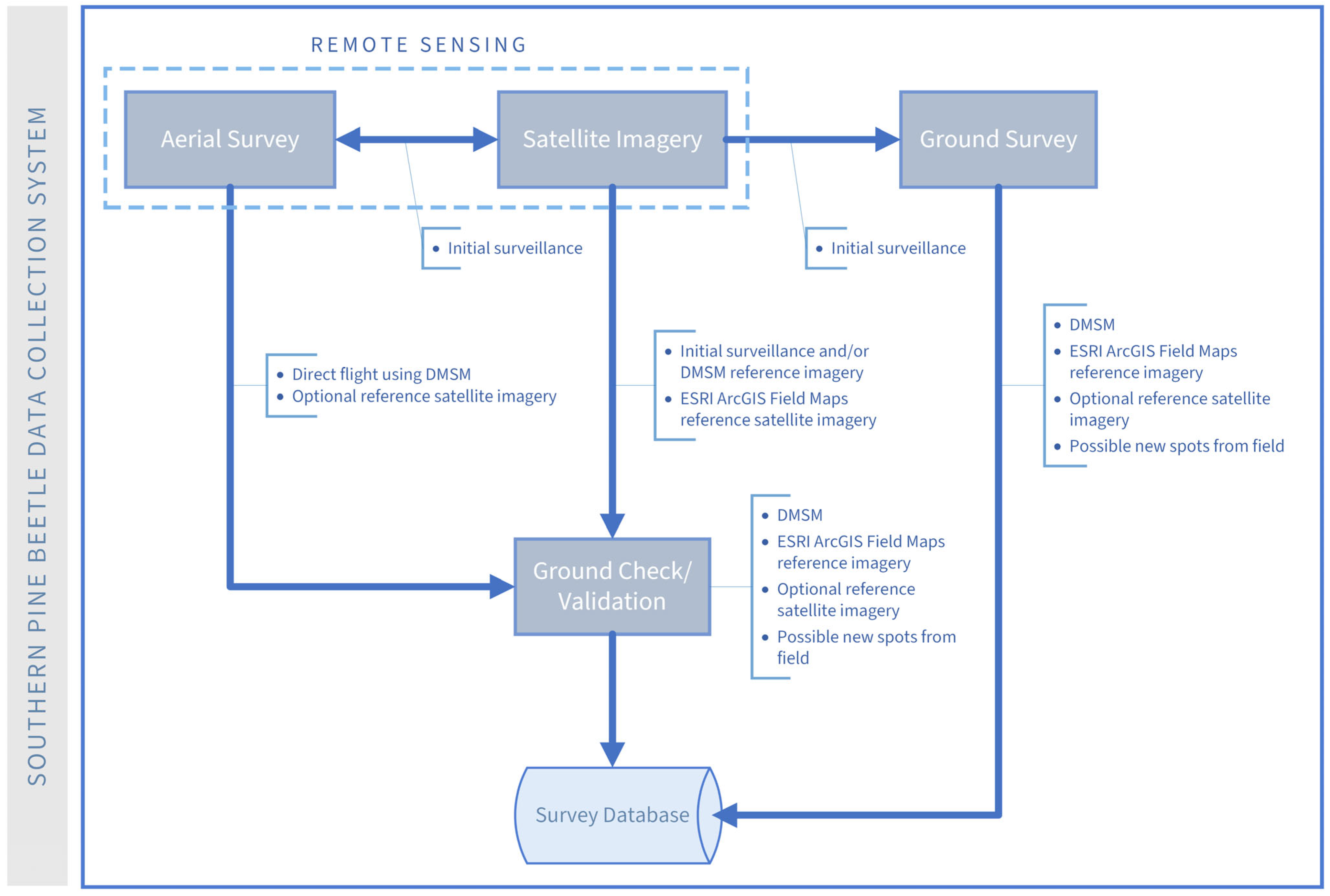
Approximately 87% of forestland in the Southern Region of the U.S. is privately owned [45]; thus, a majority of past and present SPB survey work was conducted by state forestry agencies with support from the United States Department of Agriculture (USDA) Forest Service, Division of Forest Health Protection. USDA Forest Service entomologists have likewise been primarily responsible for documenting SPB on National Forest System (NFS) lands, which make up approximately 6% of forestland across the U.S. Southern Region [8]. An organized system of spot detection and reporting across southern states and the USDA Forest Service began in 1960 and has relied on a combination of aerial survey and some ground surveillance that continues to this day [38,46]. High-resolution imagery from satellites or low-level imagery flights is playing an increasingly important role in spot detection and evaluation and will likely replace manual aerial survey techniques in the future, hence our extended treatment of the subject below; however, for now, it remains impractical to apply these methods at expansive scales (see Section 2.1.3 below). A detailed workflow diagram on how these three approaches to SPB monitoring and mapping are integrated is provided in Figure A1 (See Appendix A).

2.1.1. Aerial Survey

Aerial spot detection using a knowledgeable and experienced surveyor in a Cessna or similarly small aircraft has been and continues to be the most efficient and cost-effective approach to evaluating SPB damage and impact at state and regional scales [47,48]. During locally severe outbreaks, when new spots continue to appear in the landscape throughout the summer months, the use of helicopters to conduct spot detection surveys has doubled the efficiency of ground reconnaissance and spot evaluation crews due to the increased accuracy provided by hovering directly over spots to obtain their coordinates. Forest industry has utilized helicopters for SPB detection flights during outbreaks since the 1990s. National Forests began utilizing helicopters for operational SPB detection flights during 2012, but by 2016 escalating costs and safety concerns mostly curtailed their use on NFS lands. An experienced aerial surveyor marks an approximate latitude and longitude for each SPB spot and obtains a visual estimate of the spot size by counting the number of trees associated with each spot. This includes trees within a spot that are in various stages of visible decline, from actively infested trees with yellowish needles that contain developing eggs and larvae, to trees with reddish needles that contain developing pupae and adults or where emergence has already occurred, to long-vacated trees that have a grayish appearance due to further needle discoloration and/or needle loss [49]. Recently infested trees that are still green make up a portion of actively expanding spots but cannot be detected from the air. Thus, the size of actively growing SPB spots tends to be underestimated from aircraft-based surveys. If a spot is too large for tree counts to be feasible or efficient, a polygon may be drawn around the spot perimeter with an area-estimate of the spot obtained.

2.1.2. Ground Survey

Ground surveys are sometimes used to fill data gaps left by the absence of aerial surveys, particularly when SPB spots are relatively rare. The purposes of a ground survey include evaluating whether a spot is due to SPB, Ips bark beetles, or something else (ground truth); assessing beetle activity and the potential need for suppression measures; obtaining more accurate spatial coordinates and size estimates for actively spreading spots; or documenting new spots that appeared after the last aerial survey. Because the USDA Forest Service is tasked with managing NFS lands, there is often more accurate information on SPB spot location, size, expansion rate and potential for further growth, which facilitates decision-making on management priorities and suppression tactics. By the end of each growing season, most spot infestations die out on their own before exceeding 0.1 ha in size or >25 trees [50]. Spots that are most likely to spread and are candidates for suppression tactics usually require a thorough ground evaluation by an experienced crew [42].
For years, the individual attributes of each SPB spot from ground evaluations on NFS lands were organized into a computerized database known as the Southern Pine Beetle Information System (SPBIS). Originating in the late 1970s, SPBIS has served as the database for all SPB activities for NFS lands in the Southern Region of the USDA Forest Service [51]. SPBIS underwent numerous software updates and other improvements from the 1980s until it was officially retired in March of 2018. Since then, SPB spot data and associated activities have been collected on mobile devices (tablets and smart phones) in conjunction with the ESRI ArcGIS® Online (AGOL) platform (February 2026 Update Release). The most current version of the SPB database for NFS lands utilizes ESRI ArcGIS® Field Maps for data collection and display on mobile devices in the field, in conjunction with the AGOL platform (for government practitioners only and not accessible to the public). This system provides a near real-time and spatially explicit record of SPB activity and associated suppression needs and treatment activities. Utilizing the AGOL platform enables affected NFS lands to be overlayed onto other GIS information (roads, property lines, tribal lands, topography, stand data, water features, endangered species habitat, etc.) needed to inform timely decision-making and planning regarding spot suppression and other possible actions. The system also provides a standardized and consistent format for communicating and reporting across the Southern Region, as well as nationally, where the data is used to support risk and hazard modeling in efforts such as NIDRM (see below).

2.1.3. Satellite Imagery

In time, direct satellite imagery-based mapping of SPB will likely become more practical over larger landscapes than the more labor-intensive practice of aerial survey from small aircraft, hence the extensive section on this topic. Like observations from aerial surveys, high-resolution satellite data provide a way to map SPB-induced tree stress and mortality at scale. While aerial observers rely on foliage coloration that is indicative of stress or mortality to the human eye, remote sensing typically exploits a broader and more selective range of reflected light, including vegetation-sensitive near-infrared wavelengths [52,53]. Routine landscape coverage and this spectral power are strengths. A third major advantage of satellite remote sensing is how easy it is to track progressive beetle mortality in conifers. With deep stacks of archived digital maps to draw from, baseline conditions can be defined with respect to some recent condition, that of a year earlier, or some pre-outbreak state to document cumulative effects [54,55]. This temporal flexibility is particularly useful for SPB monitoring in the southeastern US, where there is a need for timely support for aerial flights and documentation of SPB’s progression over months to years for reporting and planning purposes.
The systematic integration of satellite imagery in an SPB monitoring program brings challenges that are common to remote sensing and others that are specific to SPB in the southeastern US. Frequent cloud cover can be especially problematic in this humid region, but this obstacle is reduced through reliance on satellites with a high revisitation period. Governmental satellite imagery with value for detecting moderate to large patches of pine mortality includes Landsat 8 and 9 (8-day frequency at 30 m) and Sentinel-2 (2- to 5-day frequency at 10 m). Some commercial satellite imagery has a much higher grid resolution, ranging from sub-meters to a few meters, and this precision is more likely to more accurately capture small SPB spot occurrences and early signs of stress than is possible at 10 or 30 m resolution. Operationally, this greater spatial precision is typically offset by its higher cost, patchy coverage, and more complicated computational requirements. For extensive outbreaks, the coordinated use of both open-source and commercial imagery may be justified, with higher-resolution imagery reserved for the higher-value or most impacted areas.
Spatial coverage and precision are long-recognized tradeoffs in systematic forest health monitoring efforts involving satellites, and technology affects the satellite and spectral options that are available for SPB-monitoring. Relevant visible and near-infrared bands of Landsat’s Operational Land Imager 2 (OLI-2) are at 30 m, but Sentinel-2’s Multispectral Instrument (MSI) provides visible and near-infrared bands at 10 m. These spectral constraints increase the value of certain derived indices, such as the Normalized Difference Vegetation Index (NDVI), as it can be formulated at 10 m with Sentinel-2. This need for high spatial resolution may counter the benefit of higher frequency from Sentinel-2 and Landsat data fusion. In an ideal SPB monitoring system, spectral anomalies would reveal newly emerging SPB spots as soon as trees show stress. But even at 1 m, the spectral attributes of recently infested versus healthy pines can be weak and obscured by normal spectral variation [56]. Thus, background variation and delayed or complex tree responses can make early stress detection at scale difficult, even with very high-resolution imagery.
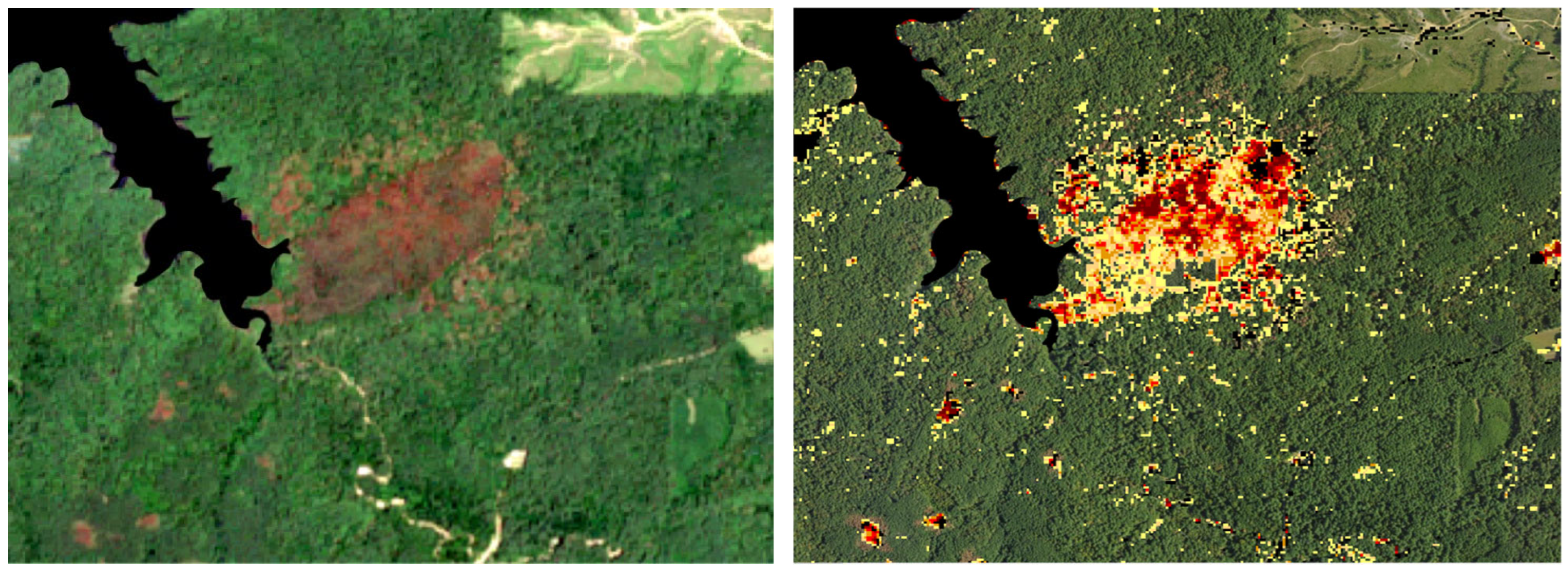
The distinctive red needle phase that pines undergo upon death from bark beetles is particularly easy to resolve using remote sensing as reflectance differs strongly from those of a healthy tree and the red phase can persist for months. During the early 2000s, researchers isolated this phase using 30 m Landsat imagery for pine forests of the West [57,58]. Other researchers mapped SPB infestations in New York using the Normalized Difference Moisture Index (NDMI) and Tasseled Cap Greenness with Landsat imagery by targeting the red phase [59]. While moderate and larger spots are readily captured, the red phase largely develops after the beetles have moved on. This lag in intelligence prevents forest managers from intervening along a spreading SPB front as effectively as they otherwise might. Once SPB spots are established, both visual bands and the change in NDVI readily resolve progressive spot behavior. Similar to what aerial surveyors observe visually, “true color” imagery shows color gradations from healthy dark green, to lime green, to yellow, to red, and then to gray after needle fall. The earliest indication of infestation is typically the lime-green-to-yellow phase, known as chlorosis, and SPB-infested stands often show all phases of decline at once (Figure 1, left). Analysis of sequential NDVI declines can isolate recent from prior SPB decline (Figure 1, right).
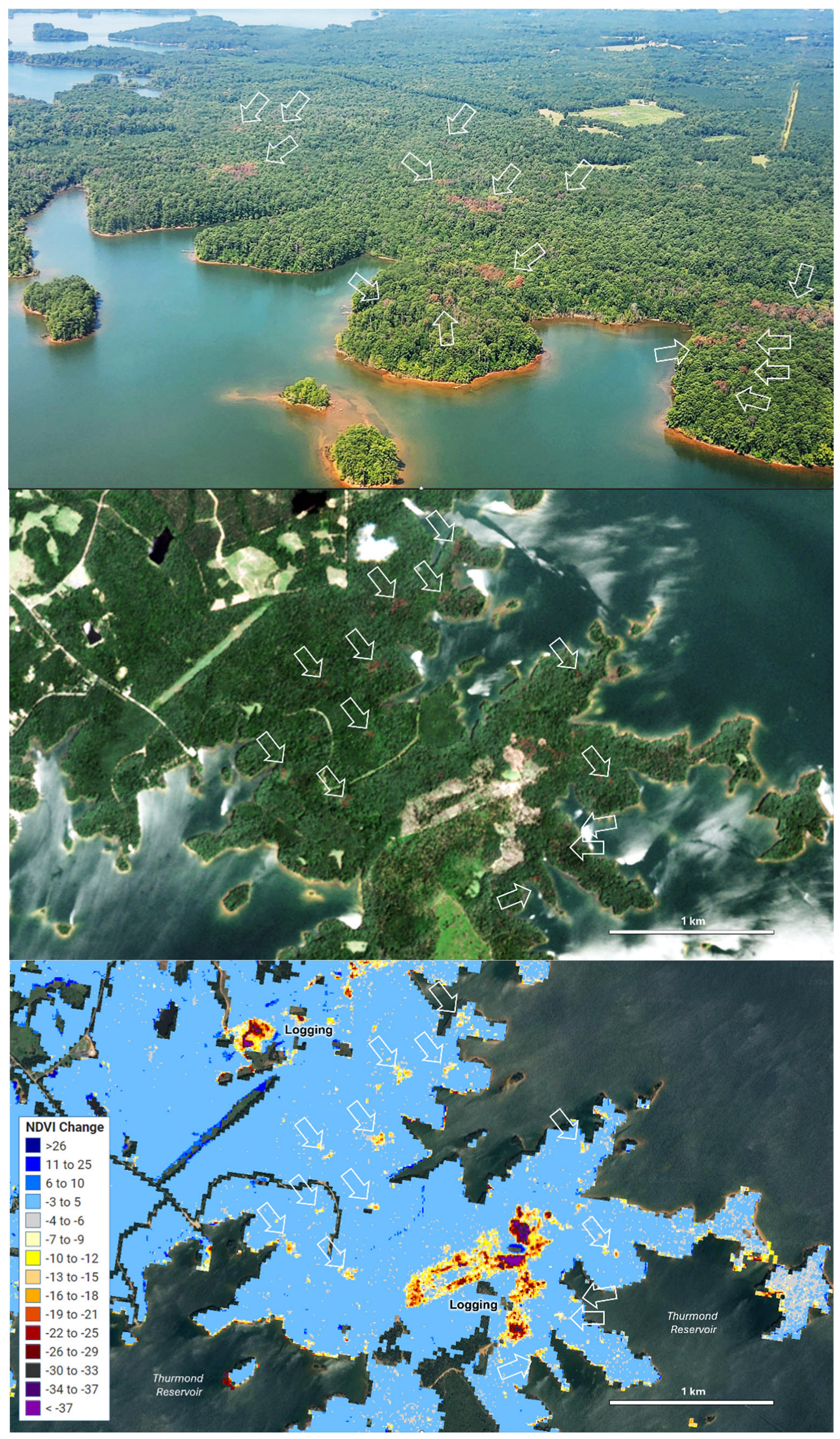
In the southern US, SPB spots are typically larger than those caused by pine engraver beetles (Ips spp.), but Sentinel-2 imagery has proven useful for mapping pine mortality during at least two Ips outbreaks occurring during severe drought [60,61]. Small SPB or Ips spots with one or a few trees are often missed at 10 m, but comparisons with oblique photographs taken by aerial surveyors indicate a high correspondence overall (Figure 2). Small spot detections are particularly challenging in mixed pine–hardwood stands of the southeastern US [58,59].
Causal attribution is a persistent challenge for remote sensing and it is best performed in concert with aerial and ground surveys. Change analyses that rely on a single spectral index do not reliably discriminate between the various causes of disturbance, which in the Southern U.S. include a range of insects and diseases, fire, logging, thinning and storm damage in addition to drought. Non-targeted disturbances need to be systematically attributed and removed (Figure 2). In the future, machine learning may provide ways to efficiently distinguish beetle-associated tree stress and mortality from other forest changes [62].
Prior to surveys, imagery can suggest areas for prioritization. After confirmation, imagery can refine the delineation of impacts, while providing a means to track the progression of spots weeks to months into the future. Satellite data are permanently archived and are collected regardless of restrictions put on aerial flight or field surveys, as occurred during the COVID-19 pandemic in 2020 [41]. Additionally, satellite imagery can document outbreaks uniformly across borders regardless of the intensity or timing of aerial flights or field surveys. In principle, this capability can reduce state or jurisdictional artifacts and inconsistencies [63]. To be realized, these varied benefits of satellite imagery for SPB monitoring require programmatic integration.

2.2. Development of a Pheromone Trap-Based Prediction System

2.2.1. Implementing Survey123 for Online Data Collection

In the mid-2010s, Federal and State agencies and university researchers began collaborating on two fronts to improve the efficiency of the pheromone trap prediction system: (1) digitizing annual spring trapping survey data; and (2) creating statistical models that use both historical and contemporary spot infestation data to provide annual predictions for all participating locations. Both efforts would also include a real-time online display of the resulting output.
In 2018, in coordination with the USDA Forest Service, the Georgia Forestry Commission began a pilot program using AGOL with ArcGIS® Survey123 for deploying and monitoring SPB traps. This technology allows users to hang traps, record their location on a map, and store data digitally in the cloud. The field application also allows offline data collection with a mobile device. Using the USDA Forest Service SPB prediction trapping spreadsheet as a template, the Survey123 form was built and published. In addition, a web mapping application using ESRI’s ArcGIS® Web App Builder was created to display trap locations and data on an interactive map (for practitioners only and not accessible to the public, but the raw trapping data displayed on this platform is available to all in tabular format at spbpredict.com). In 2019, a vote from a group of federal and southern state partners approved and adopted the pilot program as the official method for reporting SPB trap results.
The new SPB trapping program using Survey123 officially began in the spring of 2019 with the southern states (see above) and has since grown to include states in the Mid-Atlantic (PA, NJ) and even New England (NY, CT, MA, NH, ME). As technology has evolved, so has the Survey123 form. New enhancements help to better preserve data integrity and security. In addition, the graphical user interface for viewing trap locations now includes an interactive dashboard (developed using ESRI ArcGIS® Dashboards). Partnering with this program, the Digital Applied Learning and Innovation (DALI) Lab at Dartmouth College built the pine beetle prediction website, https://www.spbpredict.com, described below. Data entered into Survey123 is instantly transferred to the website for analysis to generate outbreak predictions. As of December 2023, 18 states were using a Survey123-based system to report results from about 2900 trap deployments.

2.2.2. Developing the Statistical Model for SPB Prediction

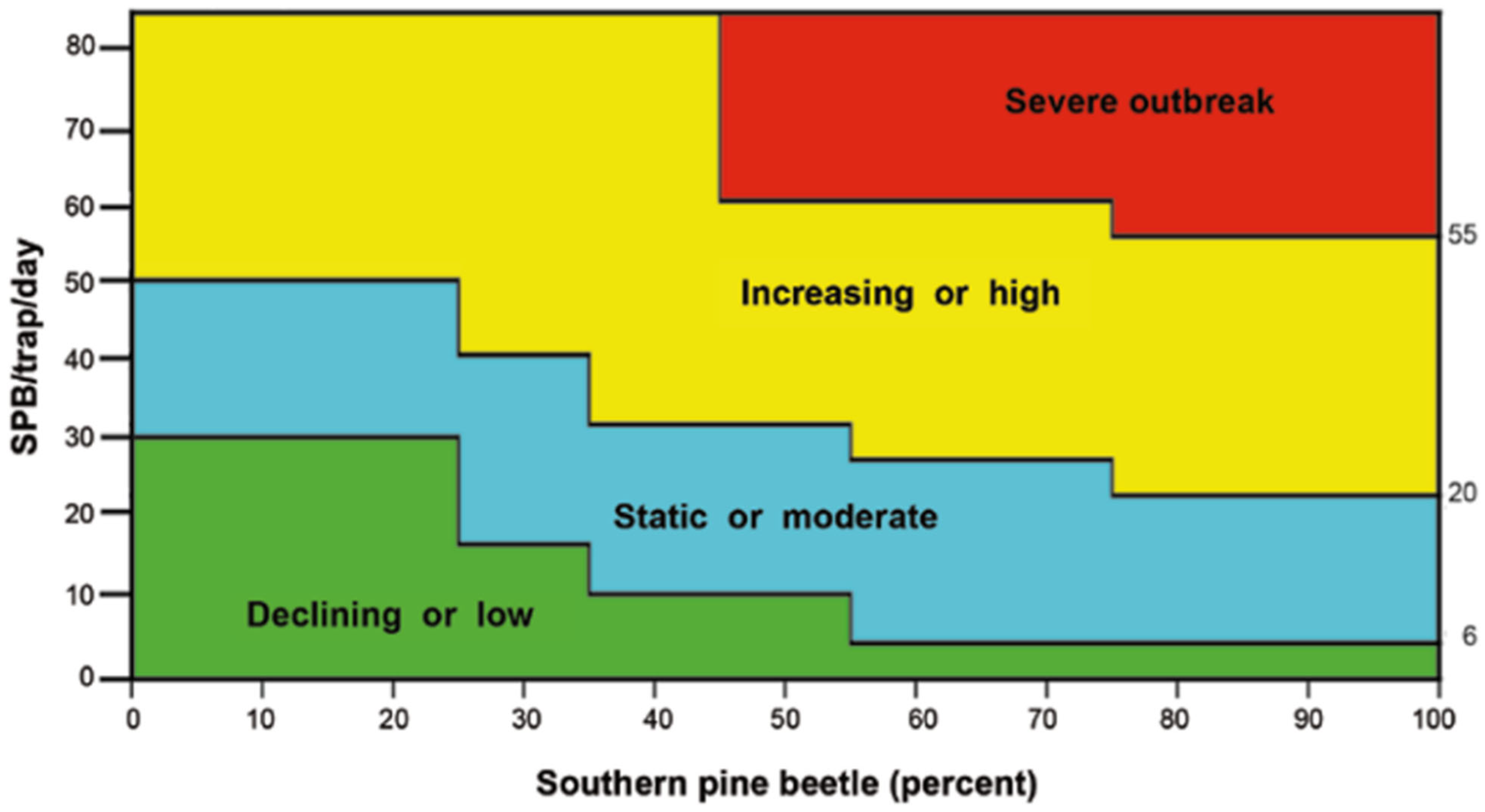
The current statistical prediction model is available at www.spbpredict.com. The prediction method in use from 1987 to 2017 was a graphical model (Figure 3) that portrayed SPB outbreak risk in terms of two input variables that could be obtained from the standardized, pheromone-based, trapping of SPB and their clerid predator [41]. High abundance of SPB and relatively low abundance of clerids were taken as predictors of high outbreak risk. This model was used by generations of forest health professionals in the southeastern U.S., but it had limitations. Most notably, there was no mathematical representation of Figure 3 and thus no way to leverage the accumulating data to generate statistical estimates of model coefficients or statistically compare alternative possible forms of the prediction model (e.g., whether the abundance of predators last year is more or less important than the number of predators this year—as one would expect under a model of predator–prey cycles).
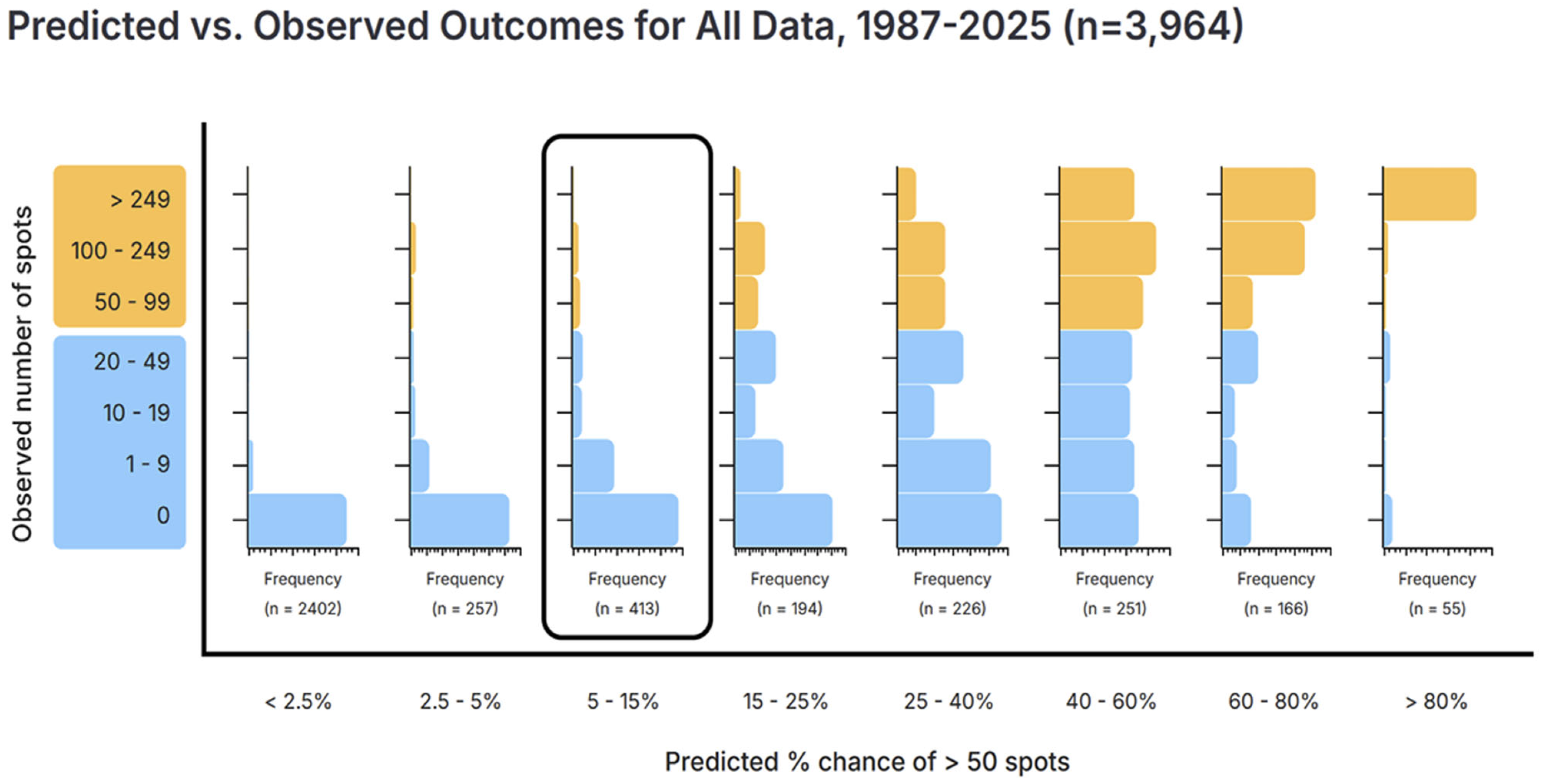
To reconcile the need for both operational practicality and statistical rigor, we developed a new statistical model that retained the use of springtime abundance of SPB and their predators as predictors and used the resulting number of spots that year as the response variable. An initial challenge was the large number of zeros in the historical data. In most locations and in most years, SPB are rare and there are zero spots. This produces a bimodal, highly non-normal, over-dispersed distribution of the data (Figure 4). Recent advances in statistics and computation now permit the analysis of count data with generalized linear models [64,65,66]. These methods require no transformation, instead utilizing an appropriate discrete probability distribution, such as the Poisson or negative binomial [67]. In some systems, including SPB abundance, these models alone are insufficient to deal with the large numbers of zeros. In these cases, mixture models, which combine two probability distributions, can be utilized to separate the zeros from the non-zero counts. These models have been employed in ecological research involving a variety of data from diverse study systems [68,69,70].
In a mixture model for count data, a binomial distribution is used to model the zeros as in a logistic regression, while the Poisson or negative binomial distribution models the counts. The count process may be handled in one of two ways: modeling the counts to exclude zero (sometimes referred to as a zero-altered or hurdle models), and modeling the counts to include zero, referred to as a zero-inflated model. In the latter case, zeros may arise in both the binomial and the count process [70].
Using SPB, clerid, and spot data collected as described above, a dataset was compiled using all forest–years that were complete for six potential predictor variables from the pheromone-baited traps (SPB count, SPB count the year before, clerid beetle count, clerid beetle count the year before, the ratio of SPB to clerids, and the ratio of SPB to clerids the year before) and the response variable was the number of SPB spots that appeared in that forest subsequent to the spring trapping. The candidate predictor variables also drew on the aerial surveys to include spots the year before and spots two years previous. All independent variables were centered and scaled prior to analysis. The number of spots was log-transformed to compensate for the extremely long tail in the distribution. None of the numerous coefficients from the fit model (Table 1) are directly interpretable for a forest manager (or almost anyone), but they made it possible to calculate the predicted probability of >0 spots, >10 spots, >50 spots, etc. These predicted probabilities are all highly correlated with each other for any specified input variables. We chose to highlight the “probability of >50 spots” as a metric for use by resource managers, because this seemed to be about the abundance at which SPB transitions from a nuisance to a serious management issue at the scale of counties or federal ranger districts, and it remains easy for managers to make response decisions to match their situation, based on the predicted risk. Further details of univariate distribution and model selection are in Aoki (2017; [71]). Based on multi-model comparisons, the final model based on data from 1987 to 2010 included four predictor variables for estimating outbreak risk in the summer of interest: SPB abundance in spring of the current year, clerids the prior year, and spots from each of the previous two years. We compared several possible structural forms for the model and found that a zero-inflated Poisson model provided the best combination of fit and interpretability.
Since then, an additional 11 years of data have become available, so we re-fit the model using the same approach but with an expanded sample size of n = 3284 (each representing one county or ranger district in one year). This resulted in the simplification of the model to just two variables: SPB count this year and spots last year (Table 1 and Table 2). Compared to our best understanding, 30 years ago, we now no longer found support for including any metric of predator abundance, indicating little or no role for predator–prey dynamics in prediction outcomes. However, we recommend that clerids still be counted and recorded (which is easy given their size and distinctive coloration) to maintain the data stream for future modeling.
In addition to the model selection methods described above, we also split the data into training and test datasets, such that the model would be validated on out-of-sample data. Model validation is particularly critical when models are used for prediction, as opposed to exploration or inference [72]. We performed a random split, where the 3284 observations, each representing one county or ranger district, were split (7:3) into training and test data. The model was fitted to the training data and then evaluated against the test data (Table 3). Model performance was very good, with the test data fitting nearly as well as the training data. The model now in use in the online prediction system is the model described in Table 1, fit to the full data. While developing the statistical model, efforts were also dedicated to developing an online resource for managers to see the results of the model in real time.

2.3. SPB Hazard Rating Map Development

2.3.1. Hazard Model Overview

The SPB hazard rating system was originally developed and derived from the 2013–2027 National Insect and Disease Risk Map [43,44,73]. The 2013–2027 NIDRM included three SPB hazard models for the southeastern U.S.: one for eastern white pine, a second for longleaf pine, and a third for a southern pine group (loblolly, pitch, pond, slash, shortleaf and Virginia pines). The three models are very similar in structure, but of the three, the most significant is the model for the southern pine group because these constitute the predominant SPB hosts. Furthermore, the maximum mortality setting for the southern pine group model (35%) is higher than the eastern white and longleaf pine maximum mortality model settings (25%). Due to the recent expansion of SPB activity into the northeastern U.S. over the last couple of decades, a fourth SPB model for pitch pine also encompasses the areas around Long Island, New York and the New Jersey Pine Barrens, where pitch pine is the primary host [5].

2.3.2. Updating Hazard Model Predictions

The 2013–2027 NIDRM was recently updated to account for the growth, mortality, and stand-replacing disturbance that has occurred since 2012. The SPB models in the new 2024–2038 NIDRM are unchanged from Krist et al. (2014; [43]) and utilize the same modeling methods as Krist and Sapio (2010; [73]), but the input data (predictors) were updated to 2018–2024 conditions (depending on data source, below), resulting in a new 15-year hazard outlook. One key predictor is the number of annual SPB outbreaks by county, which is calculated from the USDA Forest Service National Insect and Disease Survey (IDS) Database [74]. While the 2013–2027 NIDRM calculated this for 1960–2009, the 2024–2038 NIDRM calculated this over the 1988–2019 time period due to some inconsistencies in the pre-1988 data. The remaining SPB model predictors included host basal area (BA), host stand density index (SDI) [75], and host quadratic mean diameter (QMD), which were derived from the USDA Forest Service, Forest Inventory and Analysis (FIA), national forest inventory data (https://research.fs.usda.gov/programs/fia (accessed on 6 February 2026)).
We modeled host BA and SDI (QMD was calculated separately; see below) for the conterminous U.S. at 240 m spatial resolution, using FIA plot measurements as the training data, where plots were restricted to measurement year 2018–2022 with live trees of at least one inch in diameter. All remaining terrestrial plots during the same measurement years, but lacking hosts, were retained as absence data for the models. The southern pine group was modeled after first calculating totals from FIA, rather than modeling each species individually and combining the model outputs. To account for possible stand replacing disturbance having occurred after a plot was measured, we removed plots from the training data if they experienced forest loss between 2018 and 2023, according to “lossyear” in Global Forest Change (GFC) [76].
Standard predictors used in the host BA and SDI models included soil drainage and productivity indices [77] updated using soil data through 2023, global forest canopy height [78] based on 2019 data, GFC loss-year [76] through 2023, mean annual precipitation 1991–2020 [79], and ecoregions [80]. Models also included short-wave infrared (SWIR) bands 1 and 2, derived from Continuous Change Detection and Classification (CCDC) [81,82] run on Landsat Collection 2 Surface Reflectance and processed on Earth Engine for the year 2023 [83]. We used CCDC-derived SWIR-1 and -2 bands because we found the harmonic-fitted surfaces yielded far fewer spectral artifacts in our models compared to composites and mosaics of the raw imagery. Lastly, models included the corresponding host parameter model prediction used in the previous 2013–2027 NIDRM [84,85]; these were included because the SPB hazard models were unchanged from the previous NIDRM and we needed to ensure the new host models and predictions were as comparable as possible to reflect true intervening growth and mortality, rather than methodological changes or artifacts.
The host BA and SDI models were run using R version 4.0.5 (2021-03-31), RandomForest 4.6-14 (using regression mode with 500 trees and node size of 5), with the predict function set to type = “response”. Bias corrections were applied after regressing the plot measurements on predictions and using the resulting equations to re-scale model predictions; this helped ensure predicted values were in range with the observations. Any non-zero model predictions in ecoregions [80] where the species were not recorded by FIA were set to zero. Using the BA and SDI outputs generated from the models run using the full set of FIA data as training data, host QMD was calculated as [75]:
BA/SDI2.532 × 46.403.

2.3.3. Hazard Model Outputs

The four SPB models (for longleaf, eastern white, pitch, and southern pines) were combined to create a cumulative SPB BA loss estimate hazard map for all hosts, with hazard being characterized as the amount of expected loss of BA from SPB over the next 15 years (through 2038). This was achieved by first dividing BA loss by the BA of all modeled SPB hosts to calculate the percentage of host BA loss. We then summed the area of moderate and high hazard (≥11% host basal area to SPB) by county, as well as total host area or extent. Finally, we calculated the percentage of each county (with host) that had medium to high hazard status.

3. Results and Discussion

3.1. SPB Spot Detection and Annual Mapping of Damage

Regardless of whether an SPB spot is detected early in its development or at an advanced stage, counting individual spots across counties to assess whether populations have reached ‘outbreak’ status is the standard used across the U.S. South since 1960 [38,86]. A minimum threshold of one spot per 400 ha of host type per county is used to declare a county as being in ‘outbreak’ status. ‘Host type’ is considered as all combined acres of loblolly–shortleaf or oak–pine forest types, as defined and quantified by the USDA Forest Service, Forest Inventory and Analysis Program [8]. Though somewhat arbitrary, this standardized metric has been a useful and convenient way to summarize SPB population status at landscape and regional scales for over 60 years and, for the sake of consistency, is still in use today.
From 1960 to 1990 across the U.S. Southern Region, the SPB database consists of binary (outbreak/non-outbreak) county threshold determination alone. In other words, most of the SPB spot counts for determining whether a county was in outbreak or not were documented on paper records by state forestry agencies or the USDA Forest Service and were not systematically preserved or digitized. Thus, the key data used to determine outbreak county status since 1960 are mostly lost or otherwise have not been officially documented. This is concerning from a historical records standpoint since we cannot verify, using spot count data, the basis for labeling a particular county as being in outbreak status or not from 1960 to 1990, and such county designations need to be taken at face value. That said, there is a very large volume of the professional and gray literature that supports the regional-scale outbreak status from year to year during this period and high confidence that the very worst outbreak years were, at regional scales, accurately represented by the database to within an order of magnitude [1,4,38,87]. From 1991 to 1997, SPB spot data by county were preserved but precise spot coordinates were not, so these data, while useful for confirming outbreak/non-outbreak county status, were not spatially explicit.
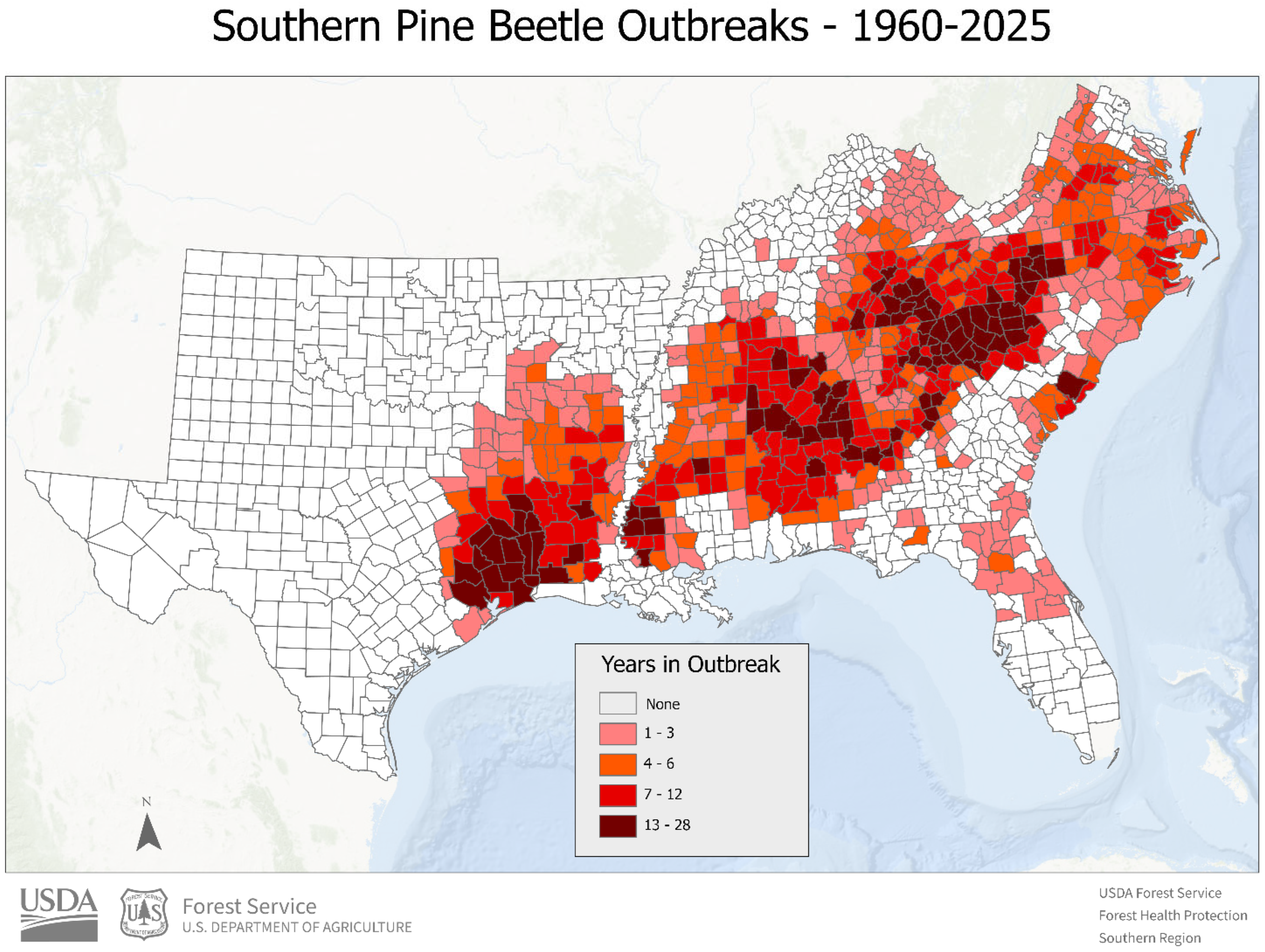
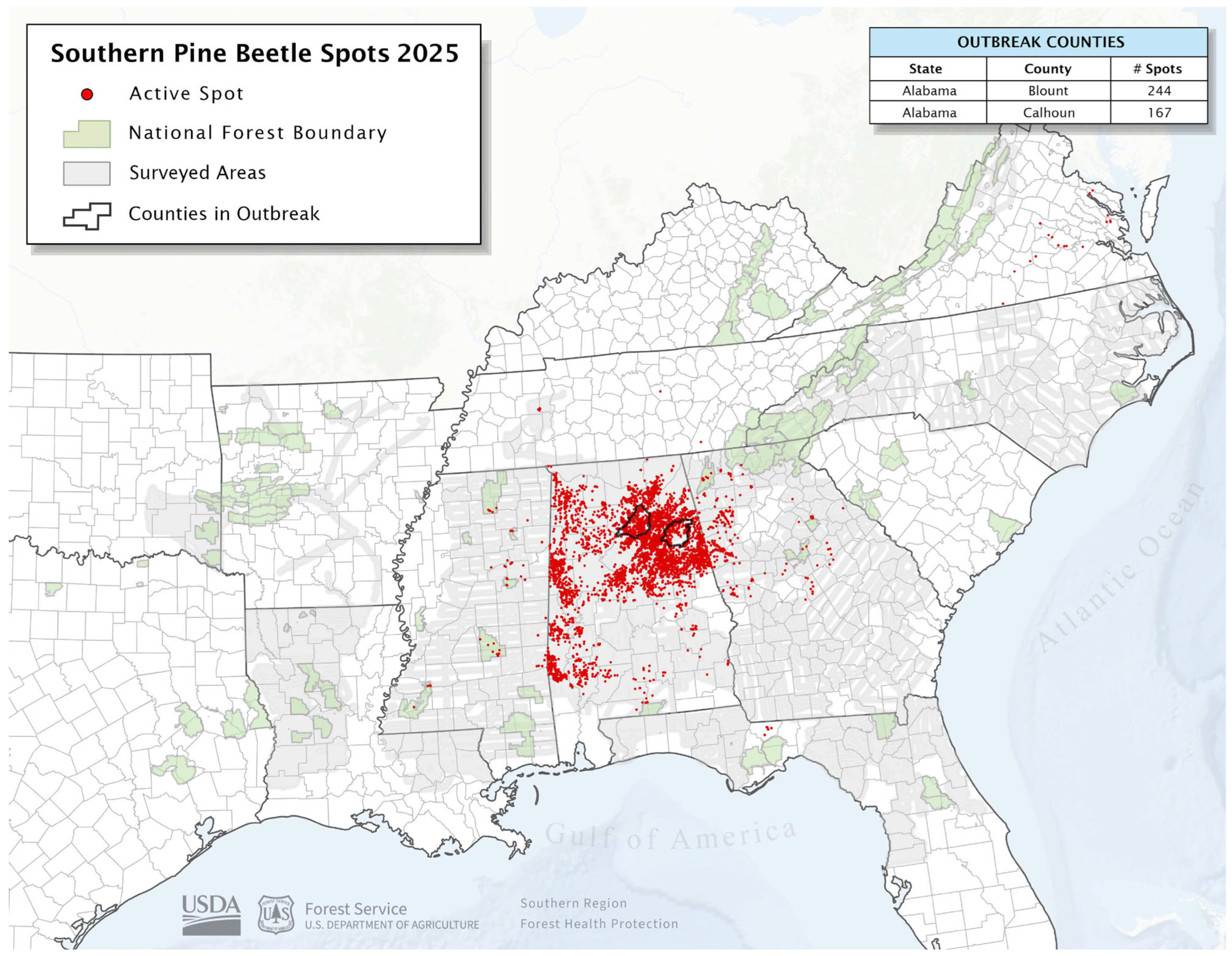
As early as 1998, southern states began reporting precise coordinates for each SPB spot, thus beginning an era of spatially explicit spot data that carries through to the present day. The last 25 years of SPB data, therefore, have allowed for visualization of the overall ‘footprint’ of SPB activity across the Southern Region (Figure 5 and Figure 6). Given that most spots that develop remain <0.1 ha in size, it would be unreasonable to assume that every single spot across such a vast region is accounted for in a given survey year, even across areas with nearly full aerial survey coverage. However, aerial survey efforts have been highly effective at identifying where clusters of moderate to heavy tree mortality due to SPB have occurred relative to areas where levels of tree mortality due to SPB are insignificant. The use of computer tablets to aid in the aerial surveillance of SPB has occurred since the early 2000s, but the systematic use of specialized software (Digital Mobile Sketch Mapping or DMSM, Version 3.16) and Android®-based tablets by most state and federal surveyors has greatly increased survey coverage, surveyed area estimation, and data quality, accuracy, and precision. A summary of these developments in the SPB database is provided in Table A1 (see Appendix B). While most spots are mapped with aerial survey, since 2018 about 15% have been documented directly from the ground because flights do not occur everywhere for various reasons, and some spots materialize well after an area has been surveyed from the air. Ground surveys, therefore, should be distinguished from a ground check, which is a verification of the causal agent of a disturbance that is mapped remotely (via aircraft or satellite).
Some caveats should be noted when interpreting these data: (1) Spot coordinates could vary in precision depending on whether data was derived from satellite imagery or ground or aerial surveys, with the latter resulting only in estimated spot locations that, unless subsequently ground-checked, cannot otherwise be verified for spatial precision post hoc (although it should be noted that this is pretty typical of most insect and disease aerial survey data). (2) From 1998 to 2007, counties in which spot counts reached a certain threshold (deemed ‘too numerous to count’) would often display the spots spatially in a ‘dot-density matrix’ that is representative of a large number of spots, but spots were not geolocated to their ‘true’ positions for practical reasons. (3) Until 2008, aerial survey coverage was not documented spatially or precisely quantified, whereas from 2008 on, surveyors began to document flight lines with GPS. Flight lines are then ‘buffered’ to represent clear-line-of-site coverage of the disturbance on either side of the aircraft. A typical flight line buffer is 2.5 miles per side, or 5 miles in total width. Total buffered flight line acreage is now a standard metric for determining aerial survey ‘coverage’ (see Figure 5). (4) Serial detection flights for SPB may occur at different times of the year, both within and between states, and rarely are the same areas flown over more than once throughout the survey season. (5) To date, very little SPB spot data has been mapped outright using satellite imagery. This practice began on a limited basis in 2018 and, to date, about 10% of all SPB spots reported since 2018 were mapped directly from imagery. This can only be done with confidence when field verification of SPB occurs on the ground. The primary application of imagery has been the more complete surveillance and detection of pine mortality hotspots, which can greatly improve the efficiency of aerial and ground survey efforts by isolating areas of greatest interest.
Earlier flights (e.g., before July 1) may detect more SPB spots close to their time of establishment, resulting in smaller spots being reported. Later flights (e.g., after July 1) often detect older spots that could be more expanded and, where spots were initially clustered, may reflect initially isolated spots that have subsequently coalesced. In addition, SPB outbreaks are often managed quickly, particularly on industrial or non-industrial private forestland, via spot-suppression harvests (cut-and-remove) and pre-salvage spot-disruption treatments (cut-and-leave with later return for salvage), so surveying too late in the year may miss some spots. Therefore, an assessment of SPB ‘damage’ may not precisely match its overall ‘impact’ when non-damaged timber that is harvested preemptively is not considered or when damaged timber is not documented before it is harvested. As with most insect damage survey data, annual SPB spot maps are best thought of as a ‘footprint’ of SPB’s impact on the landscape rather than a precise accounting of every spot, along with their eventual fate (growth, stagnation, disruption, or harvest). Despite these shortcomings, the SPB database continues to be one of the most comprehensive of any forest insect in the world. With improvements in technology and techniques, this database will continue to get better and improve our understanding of SPB dynamics, impacts, and interactions with other stressors and disturbances.

3.2. Pheromone Trapping Model Prediction

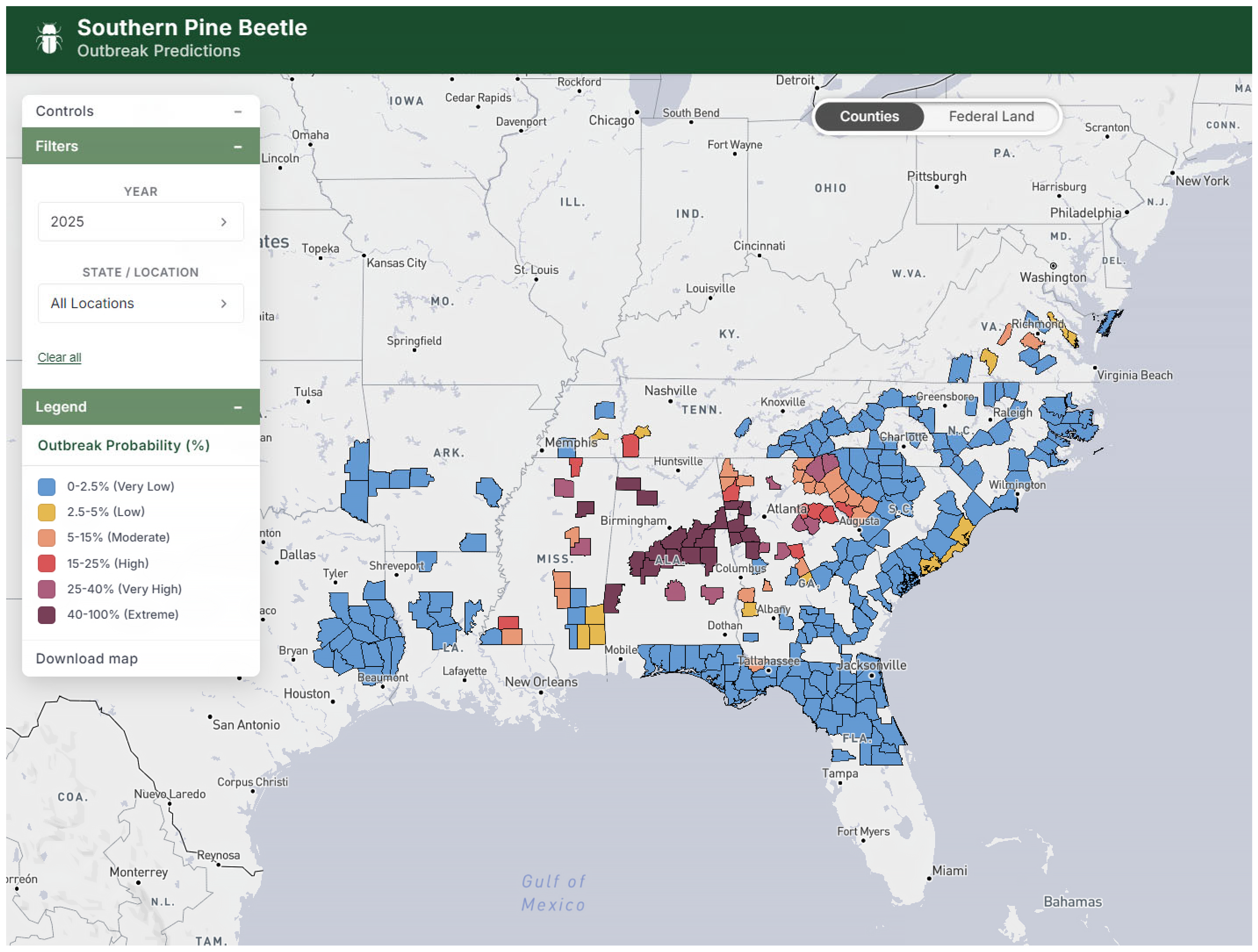
Collaboration among the DALI Lab (http://dali.dartmouth.edu), university researchers, and federal and state forestry agency partners resulted in the creation of SPB Predict (https://www.spbpredict.com/). This platform pulls spring trapping data directly from the Survey123 system described above and produces a prediction in real-time for any given location once the 4–6-week trapping efforts are complete. Results are displayed both as color-coded maps and as numerical outputs by county or USDA Forest Service ranger district (Figure 7). Users can also access all historical trapping and spot data on the site, as well as past years’ predictions. As SPB populations expand in the northeastern United States, new trapping and spot data are being integrated into the prediction system from these locales.

3.3. SPB Hazard Mapping

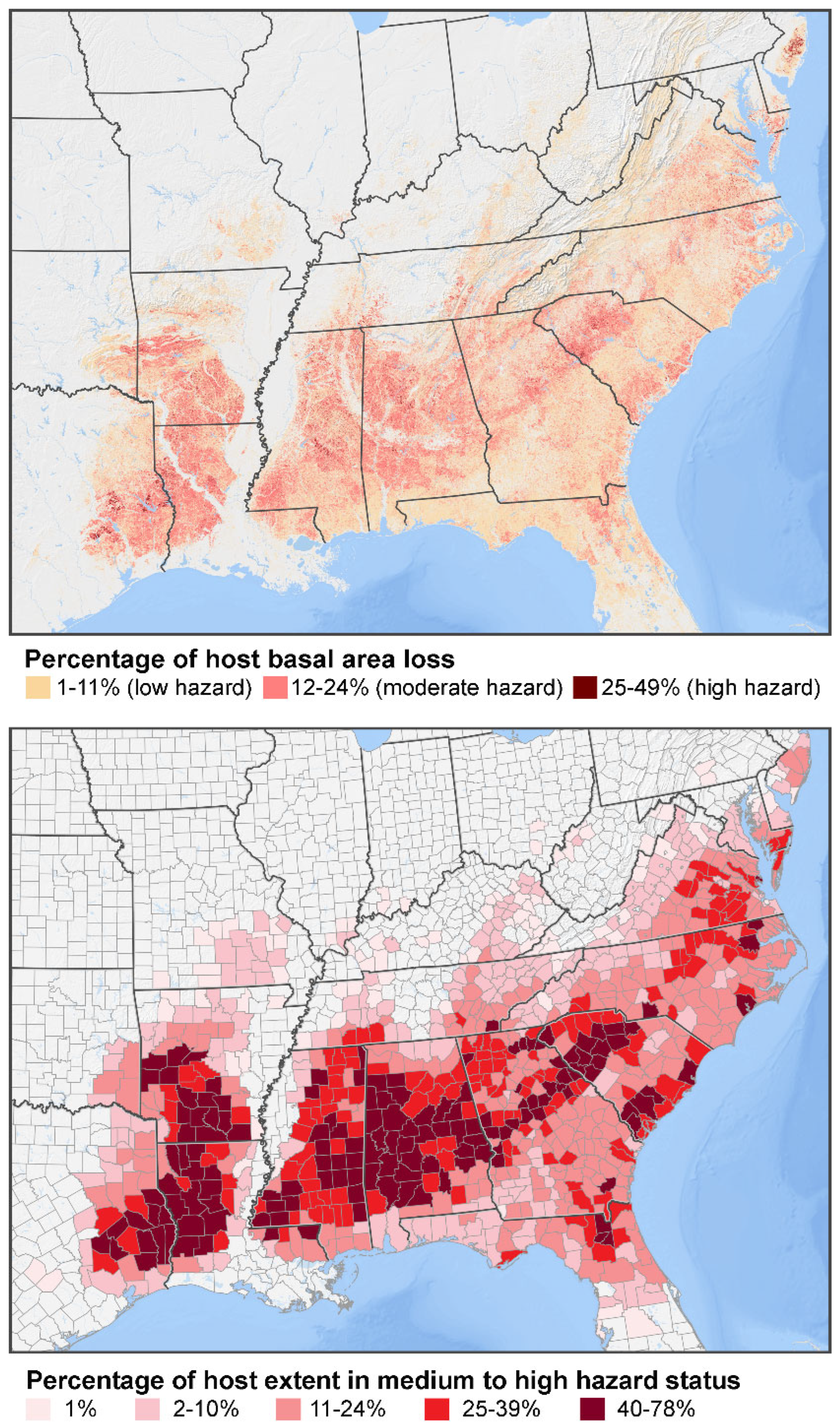
Based on the latest 2024–2038 hazard models for SPB, 9.8 km2 is anticipated to experience mortality resulting in at least 1% of host basal area loss. Of that area, 49% is considered to be a moderate hazard (11–24% host basal area loss), and 2% is high hazard (≥25% host basal area loss) (Figure 8, top). At the county level, 234 counties are expected to lose between 25 and 49% of pine host due to SPB mortality occurring through 2038, and an additional 80 counties are expected to lose at least 50% of the host over the same time span (Figure 8, bottom).
Most of the high-hazard counties reside within the Piedmont or Coastal Plain physiographic provinces across the Southern Region, where loblolly pine plantations are most abundant; however, one notable highland area with elevated hazard is the Ouachita Mountains region of southwest Arkansas, where high volumes of shortleaf pine in plantations and mixed stands exist. Pine volume across the Appalachian Region of multiple states (Alabama, Georgia, North Carolina, South Carolina, Virginia, and Tennessee) is significantly less than across the Piedmont and Coastal Plain, and while plantations exist in some areas, they are generally scattered and disjunct across a mostly hardwood landscape. Furthermore, pine volumes have declined in the Appalachians over the years due to past SPB outbreaks and Littleleaf Disease combined with natural stand succession that favors hardwood trees, particularly when burning occurs with less frequency [6]. Therefore, while small SPB infestations in the Appalachian Region of the Southern U.S. do sometimes materialize, they generally are not considered to be highly hazardous for SPB outbreak development and are less so now than they were during the latter half of the 20th century.
Host basal area is known to be a leading indicator for pest and disease prevalence generally [88] and is a major input variable for constructing the National Insect and Disease Risk Map [43,44]. Specifically, host trees growing in dense conditions compete for light, water, and nutrients and are prone to natural self-thinning due to these resource limitations. When resources are additionally limited due to environmental stressors, such as extended drought, tree chemical defenses are compromised and pines become more vulnerable to attack by insects such as bark beetles. Likewise, longer distances between pine trees or stands have a negative impact on SPB spot establishment and spread. Therefore, high stand density and contiguity, at a landscape scale, create hazardous conditions for the pine resource relative to bark beetle attack success and spread [4,89]. This is reflected in the SPB Hazard Map.

3.4. Putting It All Together: SPB Indices and Host Density as Forest Health Indicators

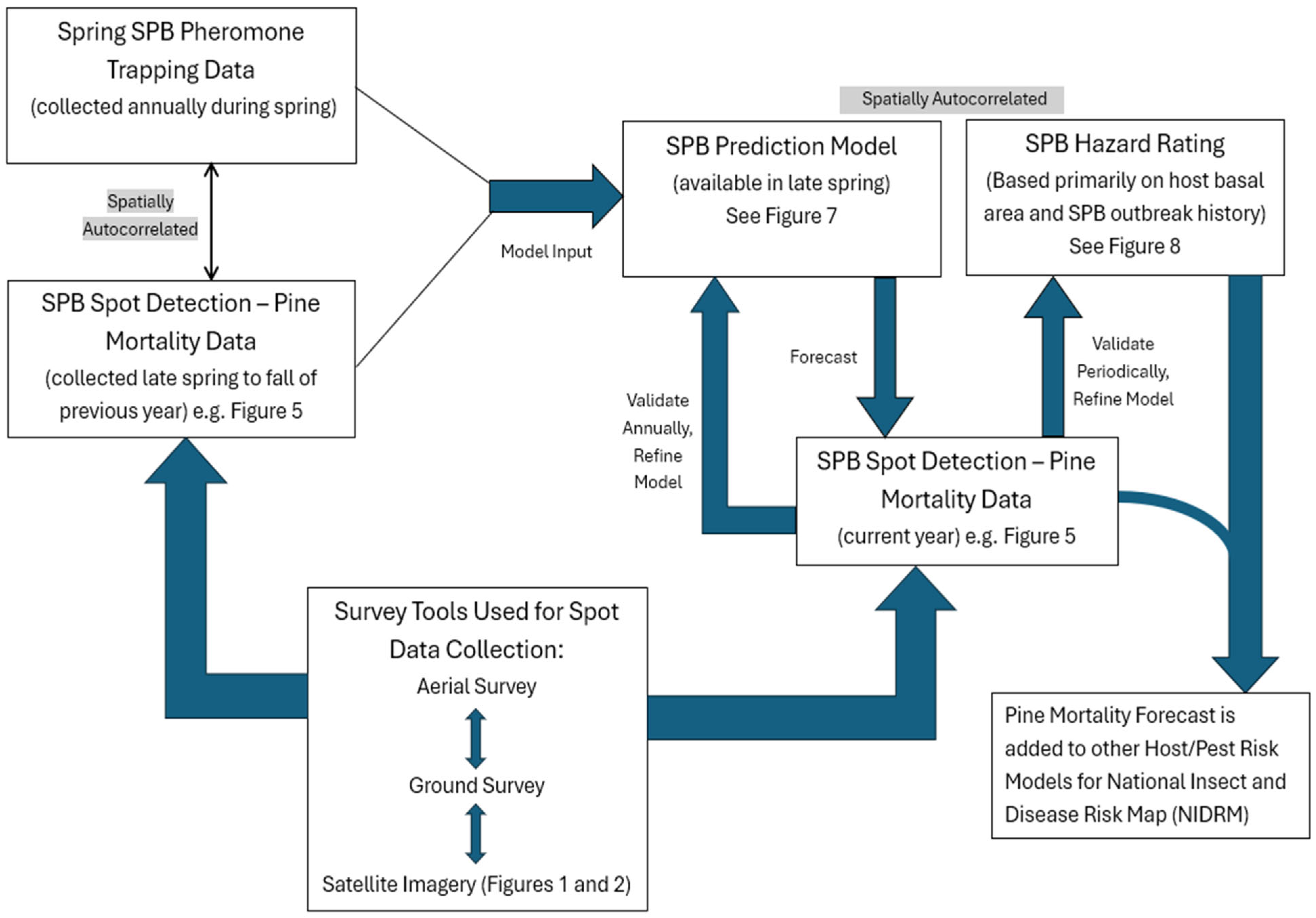
Although measurement of spatial autocorrelation among host density, pheromone trap data and SPB spot or outbreak records is well beyond the scope of this study, such associations are self-evident since each set of data is currently used to model and/or validate the other. Specifically, spot data from the previous year, in conjunction with spring pheromone trapping data from the current year, are used to forecast current year spot and/or outbreak potential. Likewise, the current year spot/outbreak information is used to validate and refine the pheromone trap model on a continual, annual basis as additional data becomes available. Finally, the SPB hazard map utilizes regularly updated satellite imagery, FIA data and historical SPB outbreak data. Therefore, a feedback loop exists among these multiple datasets as annual data is continually collected and updated, and, over time, establishes stronger spatial autocorrelations (Figure 9).
In this study, it was demonstrated that annual spring pheromone trapping data for SPB could be used to make reasonable forecasts of the likelihood of spot abundance and/or the potential for outbreak conditions during the season ahead. Further, a retrospective analysis of past spot and outbreak occurrence combined with the most current analysis of host distribution and density can be used to forecast the risk for pine forest mortality over a decade into the future. Key metrics such as host basal area and contiguity, SPB abundance in traps, and SPB spot abundance and concentration are therefore leading indicators of forest health among the abundant pine and mixed pine–hardwood forests of the Southern United States.
The southern pine beetle, along with other important members the southern pine bark beetle guild (several species of the genus Ips), are important disturbance agents whose collective damage is included in pest models used to develop the National Insect and Disease Risk Map [43] (Figure 9). The threat of SPB is so great that it has warranted its own US Forest Service program, the Southern Pine Beetle Prevention and Restoration Program, which has been in existence since 2003 and funds management practices that help prevent and mitigate bark beetle impacts [90]. Although the SPB is responsible for the bulk of the forecast risk to southern pine species within the NIDRM, it is likely that pine mortality is greatly underestimated in some years due to a lack of reliable indicator data (trapping and spot data) on southern Ips species, which are particularly problematic during long periods of hotter drought [61]. Therefore, degrees of drought in association with bark beetles can be another important forest health indicator of pine forest mortality that warrants further examination; however, for a successful analysis to occur, stronger and more consistent datasets on the southern Ips species and their annual population abundance are needed.
Population data for SPB as a major, recurring pest on hosts that are extremely abundant was demonstrated to be useful as a broad-scale forest health indicator. The unusually long time-series of replicated measurements of SPB abundance and impact made it easier to model and forecast near-term outbreak probabilities with reasonable accuracy. However, any pest for which there are historical abundance data might be amenable to similar approaches. Whenever measurements of pest abundance and impact outcomes become part of operational forest management, the data available for prediction models will grow, and the models can become increasingly effective with increasing use.
The spongy moth (Lymantria dispar L.) is another forest pest with a long and spatially extensive history of monitoring. The National Slow-the-Spread (STS) Program is dedicated to slowing the spread of spongy moth, an invasive species, throughout the United States. The STS Program is part of the USDA’s integrated pest management (IPM) program and national strategy for spongy moth management. Slow-the-Spread efforts are coordinated by a chartered, non-profit foundation that coordinates the operations of the program and facilitates the movement of funding between federal (USDA Forest Service and APHIS) and state agencies. Slow-the-Spread is one of the world’s largest and most successful integrated pest management programs, utilizing a sophisticated pheromone trapping network to monitor moths and forecast areas of high population buildup [91,92]. In turn, areas forecast to see significant defoliation and spread of the spongy moth are targeted for suppression and eradiation using spray applications of Btk, a bacterial toxin of moths that is non-toxic to humans and other wildlife [93]. As with the southern pine beetle, decades of aerial survey data of spongy moth defoliation shows strong associations with the prevalence of oak-dominant forests, because oaks are strongly preferred among a wide range of spongy moth hosts [94]. Further, combining spongy moth defoliation data with other stressors common to oak-dominant forests [95] such as drought, high elevations associated with lower site quality, boring insects, and root diseases such as Armillaria, has allowed for the effective modeling of oak decline as a major disturbance that is also part of the NIDRM effort. For the Southern Region as a whole, the NIDRM predicted that pine bark beetles and oak decline combined would contribute over 90% of forest mortality over the next 15 years [43,44].

4. Summary and Conclusions

Population data for insect pests in various forms (trapping data, tree damage and mortality, etc.), if regularly and systematically collected, can serve as valuable indicators of regional forest health when combined with host density and other site and disturbance metrics. From both an economic and environmental perspective, SPB will continue to be a serious forest pest in the United States, especially with its range expansion into the Northeastern states. The newer tools and techniques discussed herein have improved our ability to detect, monitor, and forecast SPB outbreaks in the 21st century compared to the 20th century. Advancements in aerial and ground survey data collection using new technology, along with the greater use of satellite imagery and improved forecasting and risk models, will continue to produce SPB outbreak forecasts of greater accuracy, precision, and timeliness, enhancing our ability to respond to SPB population eruptions with appropriate mitigation tactics.
Pines remain a ubiquitous resource across most of the southern United States whether in plantations or natural settings. Several tree species, such as longleaf and shortleaf pine, are also important in restoring forest systems to a more natural condition [90]. Therefore, SPB and other pine bark beetle species will continue to be pests of great concern in the 21st century, representing both an economic and environmental threat. Fortunately, we have well-tested and effective prevention and suppression tactics, if implemented in a robust and timely manner. More importantly, having a good spatial and temporal database for SPB provides greater insights into effective preventative measures [89,90], which can be more cost-effective and environmentally sound than active suppression of outbreaks.

Author Contributions

Conceptualization, C.S.A. and J.T.N.; methodology, C.S.A., J.T.N., C.A., M.P.A., W.B.M., F.J.K.J., M.T. and A.E.; software, C.A., M.P.A., W.B.M., M.T. and A.E.; validation, M.P.A., C.A., W.B.M., F.J.K.J., S.P.N. and A.E.; formal analysis, C.A., M.P.A., W.B.M., F.J.K.J., S.P.N. and A.E.; investigation, C.S.A., J.T.N., C.A., M.P.A., W.B.M., F.J.K.J., S.P.N., M.T. and A.E.; resources, C.S.A., J.T.N., C.A., M.P.A., W.B.M., F.J.K.J., S.P.N., J.R.M., M.T. and A.E.; data curation, C.A., W.B.M., F.J.K.J., S.P.N., M.T. and A.E.; writing—original draft preparation, C.S.A., J.T.N., C.A., M.P.A., W.B.M., S.P.N. and J.R.M.; writing—review and editing, C.S.A., J.T.N., C.A., M.P.A., W.B.M. and S.P.N.; visualization, C.S.A. and J.T.N.; supervision, C.S.A. and J.T.N.; project administration, C.S.A. and J.T.N. All authors have read and agreed to the published version of the manuscript.

Funding

This research received no external funding.

Data Availability Statement

All data sources are publicly available and cited in the article.

Acknowledgments

We would like to thank David Coyle, Clemson University and Christopher J. Fettig, USDA Forest Service Pacific Southwest Research Station, for valuable feedback on an earlier version of the manuscript.

Conflicts of Interest

The authors declare no conflicts of interest.

Abbreviations

The following abbreviations are used in this manuscript:
AGOLArcGIS® Online
BABasal Area
DMSMDigital Mobile Sketch Mapping
NDMINormalized Difference Moisture Index
NDVINormalized Difference Vegetation Index
NIDRMNational Insect and Disease Risk Map
QMDQuadratic Mean Diameter
SDIStand Density Index
SPBSouthern Pine Beetle
UAVUnmanned Aerial Vehicle
USDAUnited States Department of Agriculture

Appendix A

Figure A1. Survey tools used in the SPB Spot Data Collection System. Spot data collection is a flexible process carried out by many different practitioners across a large region. SPB spots can be added to the SPB Survey Database in several ways—through remote sensing with aerial survey or satellite imagery, and directly from ground surveys. Ground survey information goes directly into the database, whereas, when using remote sensing (aerial survey or satellite imagery) to map pine mortality, ground validation or ground checks are needed to verify the damage-causing agent is southern pine beetle. Satellite imagery is often used for general surveillance and in support of aerial or ground surveys, improving efficiency by directing surveys to specific areas of concern. When aerial surveys cannot be conducted, satellite imagery is not available, or more precise information is needed, ground surveys occur.
Forests 17 00679 g0a1

Appendix B

Table A1. A historical summary of southern pine beetle population information/outbreak status, data formats and sources across the U.S. Southern Region (Source: USDA Forest Service, Division of Forest Health Protection, Southern Region).
Time PeriodData FormatsSourcesKey References
Pre-1960Narrative, mostly anecdotal, some county-level dataState and Federal (USDA Forest Service) government reports, gray literature, scientific literature[1,83]
1960–1990Binary outbreak/non-outbreak county data only, records of numbers of spots by county mostly absentState and Federal (USDA Forest Service) government reports and publications[4,38,86]
1991–1997County outbreak status and spot count by county data State and Federal (USDA Forest Service) government reports and publications[4,38]
1998–presentSpatially explicit spot data available. Use of digital tablets for data collection—digital aerial sketch mapper (DASM), later replaced by digital mobile sketch mapping (DMSM) (see below). USDA Forest Service, Forest Health Protection in partnership with state forestry agencieshttps://www.fs.usda.gov/science-technology/data-tools-products/fhp-mapping-reporting/detection-surveys (accessed on 6 February 2026)
https://spb.clemson.edu
2008–presentSpatially explicit documentation of aerial survey coverage using buffered flight lines; greater use of computer tablets for surveys. USDA Forest Service, Forest Health Protection in partnership with state forestry agencies https://www.fs.usda.gov/science-technology/data-tools-products/fhp-mapping-reporting/detection-surveys (accessed on 6 February 2026)
https://spb.clemson.edu
2016–presentDMSM replaces DASM as the primary aerial sketch mapping software used by the surveyor community. DMSM was specially designed for forest health surveys by USDA Forest Service, Forest Health Protection.USDA Forest Service, Forest Health Protection in partnership with state forestry agencieshttps://www.fs.usda.gov/science-technology/data-tools-products/fhp-mapping-reporting/detection-surveys (accessed on 6 February 2026)
https://spb.clemson.edu
2018–presentStarting in 2018, satellite imagery was used beyond just a surveillance tool to explicitly map SPB spots. Documentation of spots mapped directly from the ground also began to occur.USDA Forest Service, Forest Health Protection in partnership with state forestry agencieshttps://www.fs.usda.gov/science-technology/data-tools-products/fhp-mapping-reporting/detection-surveys (accessed on 6 February 2026)
https://spb.clemson.edu

References

  1. Clarke, S.R.; Riggins, J.J.; Stephen, F.M. Forest management and southern pine beetle outbreaks: A historical perspective. For. Sci. 2016, 62, 166–180. [Google Scholar] [CrossRef]
  2. Hopkins, A.D. Notes on a destructive forest scolytid. Science 1892, 20, 64–65. [Google Scholar] [CrossRef] [PubMed][Green Version]
  3. Hopkins, A.D. Report on Investigations to Determine the Cause of Unhealthy Conditions of Spruce and Pine from 1880–1893; West Virginia Agricultural Experiment Station Bulletins; West Virginia University: Morgantown, WV, USA, 1899; 461p. [Google Scholar]
  4. Coulson, R.N.; Klepzig, K. Southern Pine Beetle II; Gen. Tech. Rep. SRS-140; Southern Research Station, USDA Forest Service: Asheville, NC, USA, 2011; 512p.
  5. Dodds, K.J.; Aoki, C.F.; Arango-Velez, A.; Cancelliere, J.; D’Amato, A.W.; DiGirolomo, M.F.; Rabaglia, R.J. Expansion of southern pine beetle into northeastern forests: Management and impact of a primary bark beetle in a new region. J. For. 2018, 116, 178–191. [Google Scholar] [CrossRef]
  6. Nowak, J.T.; Klepzig, K.D.; Coyle, D.R.; Carothers, W.A.; Gandhi, K.J.K. Southern Pine Beetles in Central Hardwood Forests: Frequency, Spatial Extent, and Changes to Forest Structure. In Managing Forest Ecosystems: Natural Disturbances and Historic Range of Variation; Greenberg, C., Collins, B., Eds.; Springer: Cham, Switzerland, 2016; Volume 32, pp. 73–88. [Google Scholar] [CrossRef]
  7. USDA Forest Service. Chapter 3: Projected Changes in the Timber Resource. In The South’s Fourth Forest: Alternatives for the Future; Forest Res. Rep. No. 24; USDA Forest Service: Washington DC, USA, 1988; pp. 83–195. [Google Scholar]
  8. Oswalt, S.N.; Smith, W.B.; Miles, P.D.; Pugh, S.A. Forest Resources of the United States, 2017: A Technical Document Supporting the Forest Service 2020 RPA Assessment; Gen. Tech. Rep. WO-97; US Department of Agriculture, Forest Service, Washington Office: Washington, DC, USA, 2019; 223p. [CrossRef]
  9. Castello, J.D.; Teale, S.A. Forest Health: An Integrated Perspective; Cambridge University Press: Cambridge, UK, 2011. [Google Scholar]
  10. Lockwood, J.L.; Hoopes, M.F.; Marchetti, M.P. Invasion Ecology; John Wiley and Sons: Hoboken, NJ, USA, 2013. [Google Scholar]
  11. Reeve, J.D.; Turchin, P. Evidence for predator-prey cycles in a bark beetle. In Population Cycles: The Case for Trophic Interactions; Berryman, A.A., Ed.; Oxford University Press: Oxford, UK, 2002; pp. 92–108. [Google Scholar]
  12. Turchin, P.; Taylor, A.D.; Reeve, J.D. Dynamical Role of Predators in Population Cycles of a Forest Insect: An Experimental Test. Science 1999, 285, 1068–1071. [Google Scholar] [CrossRef]
  13. Hofstetter, R.W.; Cronin, J.T.; Klepzig, K.D.; Moser, J.C.; Ayres, M.P. Antagonisms, mutualisms and commensalisms affect outbreak dynamics of the southern pine beetle. Oecologia 2006, 147, 679–691. [Google Scholar] [CrossRef]
  14. Weed, A.S.; Ayres, M.P.; Liebhold, A.M.; Billings, R.F. Spatio-temporal dynamics of a tree-killing beetle and its predator. Ecography 2017, 40, 221–234. [Google Scholar] [CrossRef]
  15. Martinson, S.J.; Hofstetter, R.W.; Ayres, M.P. Why does longleaf pine have low susceptibility to southern pine beetle? Can. J. For. Res. 2007, 37, 1966–1977. [Google Scholar] [CrossRef]
  16. Martinson, S.J.; Ylioja, T.; Sullivan, B.T.; Billings, R.F.; Ayres, M.P. Alternate attractors in the population dynamics of a tree-killing bark beetle. Pop. Ecol. 2013, 55, 95–106. [Google Scholar] [CrossRef]
  17. Mawby, W.D.; Hain, F.P.; Doggett, C.A. Endemic and epidemic populations of southern pine beetle: Implications of the two-phase model for forest managers. For. Sci. 1989, 35, 1075–1087. [Google Scholar] [CrossRef]
  18. Barbosa, P.; Letourneau, D.; Agrawal, A. Insect Outbreaks Revisited; Wiley-Blackwell: Hoboken, NJ, USA, 2012. [Google Scholar]
  19. Barbosa, P.; Shultz, J. Insect Outbreaks; Academic Press: Cambridge, MA, USA, 1987. [Google Scholar]
  20. Hu, G.; Lu, M.H.; Reynolds, D.R.; Wang, H.K.; Chen, X.; Liu, W.C.; Zhu, F.; Wu, X.W.; Xia, F.; Xie, M.C.; et al. Long-term seasonal forecasting of a major migrant insect pest: The brown planthopper in the Lower Yangtze River Valley. J. Pest Sci. 2019, 92, 417–428. [Google Scholar] [CrossRef] [PubMed]
  21. Rosselló, N.B.; Rossini, L.; Speranza, S.; Garone, E. Towards pest outbreak predictions: Are models supported by field monitoring the new hope? Ecol. Inform. 2023, 78, 102310. [Google Scholar] [CrossRef]
  22. Ndjomatchoua, F.T.; Gilligan, C.A. Modelling and geospatial mapping of whitefly Bemisia tabaci population dynamics in cassava-growing areas of Sub-Saharan Africa in response to climate change. Agric. For. Meteorol. 2026, 380, 111059. [Google Scholar] [CrossRef]
  23. Lotka, A. The growth of mixed populations: Two species competing for a common food supply. J. Wash. Acad. Sci. 1932, 22, 461–469. [Google Scholar]
  24. Volterra, V. Variazioni e fluttuazioni del numero d’individui in specie animali conviventi. Mem. R. Accad. Dei Lincei 1926, 6, 31–113. [Google Scholar]
  25. Holling, C.S. Resilience and Stability of Ecological Systems. Ann. Rev. Ecol. Syst. 1973, 4, 1–23. [Google Scholar] [CrossRef]
  26. May, R.M. Thresholds and breakpoints in ecosystems with a multiplicity of stable states. Nature 1977, 269, 471–477. [Google Scholar] [CrossRef]
  27. Southwood, T.R.E.; Comins, H.N. A Synoptic Population Model. J. Anim. Ecol. 1976, 45, 949–965. [Google Scholar] [CrossRef]
  28. Takahashi, F. Reproduction curve with two equilibrium points: A consideration on the fluctuation of insect population. Res. Pop. Ecol. 1964, 6, 28–36. [Google Scholar] [CrossRef]
  29. Sturtevant, B.R.; Cooke, B.J.; James, P.M.A. Of clockwork and catastrophes: Advances in spatiotemporal dynamics of forest Lepidoptera. Curr. Opin. Insect Sci. 2023, 55, 101005. [Google Scholar] [CrossRef] [PubMed]
  30. Soukhovolsky, V.; Kovalev, A.; Akhanaev, Y.; Kurenshchikov, D.; Ponomarev, V.; Tarasova, O.; Caroulle, F.; Inoue, M.N.; Martemyanov, V. An Autoregulatory Model of Forest Insect Population Dynamics and Forest Stand Damage Dynamics in Different Habitats: An Example of Lymantria dispar L. Forests 2024, 15, 1098. [Google Scholar] [CrossRef]
  31. Ives, A.R.; Einarsson, A.; Jansen, V.; Gardarsson, A. High-amplitude fluctuations and alternative dynamical states of midges in Lake Myvatn. Nature 2008, 452, 84–87. [Google Scholar] [CrossRef]
  32. Liu, H.P.; Julian, J.T. N-mixture models for population estimation: Application in spotted lanternfly egg mass survey. Curr. Res. Insect Sci. 2024, 5, 100078. [Google Scholar] [CrossRef] [PubMed]
  33. Istchuk, A.N.; Farias, E.S.; Foresti, J.; Santana, P.A., Jr.; Pereira, R.R.; Ishizuka, T.K.; da Silva, P.R.; Schwertner, M.H.; Pietrowski, V. Forewarning the seasonal dynamics of corn leafhopper and mollicutes through neural networks. Int. J. Biometeorol. 2025, 69, 1383–1394. [Google Scholar] [CrossRef]
  34. Palma, G.R.; Mello, R.F.; Godoy, W.A.C.; Engel, E.; Lau, D.; Markham, C.; Moral, R.A. Forecasting insect abundance using time series embedding and machine learning. Ecol. Inform. 2025, 85, 102934. [Google Scholar] [CrossRef]
  35. Yanchenko, E.; Reich, B.J.; Kennedy, G.G.; Huseth, A.S. Predicting Helicoverpa zea (Lepidoptera: Noctuidae) populations in the southern United States. Environ. Entomol. 2026, 55, nvaf127. [Google Scholar] [CrossRef]
  36. Hu, G.; Stefanescu, C.; Oliver, T.H.; Roy, D.B.; Brereton, T.; Van Swaay, C.; Reynolds, D.R.; Chapman, J.W. Environmental drivers of annual population fluctuations in a trans-Saharan insect migrant. Proc. Natl. Acad. Sci. USA 2021, 118, e2102762118. [Google Scholar] [CrossRef] [PubMed]
  37. Jepsen, J.U.; Vindstad, O.P.L.; Paulsen, I.M.G.; Ek, M. Developing transfer functions for impact-abundance relationships in defoliating geometrid moths. For. Ecol. Manag. 2026, 613, 123781. [Google Scholar] [CrossRef]
  38. Pye, J.M.; Price, T.S.; Clarke, S.R.; Huggett, S.R., Jr. A History of Southern Pine Beetle Outbreaks in the Southeastern United States; Southern Research Station, USDA Forest Service: Asheville, NC, USA, 2004.
  39. Billings, R.F. Forecasting southern pine beetle infestation trends with pheromone traps. In Integrated Control of Scolytid Bark Beetles, Proceedings of the 17th International Congress of Entomology; Payne, T.L., Saarenmaa, H., Eds.; International Congress of Entomology: Vancouver, BC, Canada, 1988; pp. 295–305. [Google Scholar]
  40. Sullivan, B.T.; Shepherd, W.P.; Nowak, J.T.; Clarke, S.R.; Merten, P.R.; Billings, R.F.; Upton, W.W.; Riggins, J.J.; Brownie, C. Alternative formulations of trap lures for operational detection, population monitoring, and outbreak forecasting of southern pine beetle in the United States. J. Econ. Entom. 2021, 114, 1189–1200. [Google Scholar] [CrossRef]
  41. Billings, R.F.; Upton, W.W. A methodology for assessing annual risk of southern pine beetle outbreaks across the southern region using pheromone traps. In Advances in Threat Assessment and Their Application to Forest and Rangeland Management; Pye, J.M., Rauscher, H.M., Sands, Y., Lee, D.C., Beatty, J.S., Eds.; Gen. Tech. Rep. PNW-GTR-802; Pacific Northwest and Southern Research Stations, USDA Forest Service: Portland, OR, USA, 2010; pp. 73–85. [Google Scholar]
  42. Thomason, J.W.; Clarke, S.; Riggins, J.J. Evaluation of phenological indicators for optimizing spring southern pine beetle (Coleoptera: Curculionidae: Scolytinae) trapping surveys. Fla. Entom. 2020, 3, 444–451. [Google Scholar] [CrossRef]
  43. Krist, F.J., Jr.; Ellenwood, J.R.; Woods, M.E.; McMahan, A.J.; Cowardin, J.P.; Ryerson, D.E.; Sapio, F.J.; Zweifler, M.O.; Romero, S.A. 2013–2027 National Insect and Disease Forest Risk Assessment; FHTET-14-01; Forest Health Technology Enterprise Team, USDA Forest Service: Fort Collins, CO, USA, 2014; 199p.
  44. Krist, F.J., Jr.; Ellenwood, J.R.; Woods, M.E.; McMahan, A.J.; Cowardin, J.P.; Ryerson, D.E.; Sapio, F.J.; Zweifler, M.O.; Romero, S.A. Chapter 6: 2013–2027 National Insect and Disease Forest Risk Assessment: Summary and data access. In Forest Health Monitoring: National Status, Trends and Analysis, 2014; Potter, K.M., Conkling, B.L., Eds.; Gen. Tech. Rep. SRS-209; Southern Research Station, USDA Forest Service: Asheville, NC, USA, 2015; pp. 87–92. [Google Scholar]
  45. USDA Forest Service. Future of America’s Forest and Rangelands: Forest Service 2020 Resources Planning Act Assessment; Gen. Tech. Rep. WO-102; USDA Forest Service: Washington, DC, USA, 2023. [CrossRef]
  46. Price, T.S.; Doggett, C.; Pye, J.M.; Smith, B. A History of Southern Pine Beetle Outbreaks in the Southeastern United States; Georgia Forestry Commission: Macon, GA, USA, 1998; 70p.
  47. Coleman, T.W.; Graves, A.D.; Heath, Z.; Flowers, R.W.; Hanavan, R.P.; Cluck, D.R.; Ryerson, D. Accuracy of aerial detection surveys for mapping insect and disease disturbances in the United States. For. Ecol. Manag. 2018, 430, 321–336. [Google Scholar] [CrossRef]
  48. Hanavan, R.P.; Kamoske, A.G.; Schaaf, A.N.; Eager, T.; Fisk, H.; Ellenwood, J.; Warren, K.; Asaro, C.; Vanderbilt, B.; Hutten, K.; et al. Supplementing the Forest Health National Aerial Survey Program with Remote Sensing during the COVID-19 Pandemic: Lessons Learned from a Collaborative Approach. J. For. 2022, 120, 125–132. [Google Scholar] [CrossRef]
  49. Billings, R.F.; Pase, H.A., III. A Field Guide for Ground Checking Southern Pine Beetle Spots; Agric. Handb. 558; U.S. Department of Agriculture: Washington, DC, USA, 1979; 19p.
  50. Porterfield, R.L.; Rowell, C.E. Characteristics of southern pine beetle infestations southwide. In Site, Stand, and Host Characteristics of Southern Pine Beetle Infestations; Coster, J.E., Searcy, J.L., Eds.; Tech. Bull. 1612; U.S. Department of Agriculture: Washington, DC, USA, 1981; pp. 87–110. [Google Scholar]
  51. Peacher, V. Chapter 20: Southern pine beetle information system. In Southern Pine Beetle II; Coulson, R.N., Klepzig, K.D., Eds.; Gen. Tech. Rep. SRS-140; Southern Research Station, USDA Forest Service: Asheville, NC, USA, 2011; pp. 279–287. [Google Scholar]
  52. Abdullah, H.; Skidmore, A.K.; Darvishzadeh, R.; Heurich, M. Timing of Red-Edge and Shortwave Infrared Reflectance Critical for Early Stress Detection Induced by Bark Beetle (Ips typographus, L.) Attack. Int. J. Appl. Earth Obs. Geoinf. 2019, 82, 101900. [Google Scholar] [CrossRef]
  53. Zhan, Z.; Yu, L.; Li, Z.; Ren, L.; Gao, B.; Wang, L.; Luo, Y. Combining GF-2 and Sentinel-2 images to detect tree mortality caused by red terpentine beetle during the early outbreak stage in north China. Forests 2020, 11, 172. [Google Scholar] [CrossRef]
  54. Liang, L.; Chen, Y.; Hawbaker, T.J.; Zhu, Z.; Gong, P. Mapping mountain pine beetle mortality through growth trend analysis of time series Landsat data. Remote Sens. 2014, 6, 5696–5716. [Google Scholar] [CrossRef]
  55. Spruce, J.P.; Hicke, J.A.; Hargrove, W.W.; Grulke, N.E.; Meddens, A.J.H. Use of MODIS NDVI products to map tree mortality levels in forests affected by mountain pine beetle outbreaks. Forests 2019, 10, 811. [Google Scholar] [CrossRef]
  56. Carter, G.A.; Seal, M.R.; Haley, T. Airborne detection of southern pine beetle damage using key spectral bands. Can. J. For. Res. 1998, 28, 1040–1045. [Google Scholar] [CrossRef]
  57. Franklin, S.; Wulder, M.; Skakun, R.; Carroll, A. Mountain pine beetle red attack damage classification using stratified Landsat TM data in British Columbia, Canada. Photogramm. Eng. Remote Sens. 2003, 69, 283–288. [Google Scholar] [CrossRef]
  58. White, J.; Wulder, M.; Brooks, D.; Reich, R.; Wheate, R. Detection of red attack stage mountain pine beetle infestation with high spatial resolution satellite imagery. Remote Sens. Environ. 2005, 96, 340–351. [Google Scholar] [CrossRef]
  59. Meng, R.; Gao, R.; Zhao, F.; Huang, C.; Sun, R.; Zhengang, L.; Huang, Z. Landsat-based monitoring of southern pine beetle infestation severity and severity change in a temperate mixed forest. Remote Sens. Environ. 2022, 269, 112847. [Google Scholar] [CrossRef]
  60. Gomez, D.F.; Ritger, H.M.W.; Pearce, C.; Eickwort, J.; Hulcr, J. Ability of remote sensing systems to detect bark beetle spots in the Southeastern US. Forests 2020, 11, 1167. [Google Scholar] [CrossRef]
  61. Norman, S.P.; Christie, W.M.; Asaro, C. Chapter 2: Mapping the 2023-2024 pine mortality event in Mississippi and Louisiana driven by an extreme hot-drought, pine bark beetle outbreaks, and wildfire. In Forest Health Monitoring: National Status, Trends, and Analysis 2024; Pandit, K., Lim-Hing, S., Eds.; Gen. Tech. Rep. WO-109; USDA Forest Service: Washington DC, USA, 2026; pp. 17–32. [Google Scholar]
  62. Andresini, G.; Appice, A.; Malerba, D. SILVIA: An eXplainable framework to map bark beetle infestation in Sentinel-2 images. IEEE J. Sel. Top. Appl. Earth Obs. Remote Sens. 2023, 16, 10050–10066. [Google Scholar] [CrossRef]
  63. Housman, I.W.; Chastain, R.A.; Finco, M.V. An evaluation of forest health insect and disease survey data and satellite-based remote sensing forest change detection methods: Case studies in the United States. Remote Sens. 2018, 10, 1184. [Google Scholar] [CrossRef]
  64. Bolker, B. Ecological Models and Data in R; Princeton University Press: Princeton, NJ, USA, 2008. [Google Scholar]
  65. McCullagh, P.; Nelder, J. Generalized Linear Models; Chapman and Hall: London, UK, 1989. [Google Scholar]
  66. Nelder, J.A.; Wedderburn, R.W.M. Generalized Linear Models. J. R. Stat. Soc. A 1972, 135, 370–384. [Google Scholar] [CrossRef]
  67. O’Hara, R.B.; Kotze, D.J. Do not log-transform count data. Methods Ecol. Evol. 2010, 1, 118–122. [Google Scholar] [CrossRef]
  68. Kery, M. Introduction to WinBUGS for Ecologists: Bayesian Approach to Regression, ANOVA, Mixed Models and Related Analyses; Academic Press: Cambridge, MA, USA, 2010. [Google Scholar]
  69. Martin, T.G.; Wintle, B.A.; Rhodes, J.R.; Kuhnert, P.M.; Field, S.A.; Low-Choy, S.J.; Tyre, A.J.; Possingham, H.P. Zero tolerance ecology: Improving ecological inference by modeling the source of zero observations. Ecol. Lett. 2005, 8, 1235–1246. [Google Scholar] [CrossRef] [PubMed]
  70. Zuur, A.; Ieno, E.; Walker, N.; Saveliev, A.; Smith, G. Mixed Effects Models and Extensions in Ecology with R; Springer: New York, NY, USA, 2009. [Google Scholar]
  71. Aoki, C.F. Forest Risk and Irruptive Insect Pests: Ecology for Management in Changing Times. Ph.D. Thesis, Dartmouth College, Hanover, NH, USA, 2017. [Google Scholar]
  72. Tredennick, A.T.; Hooker, G.; Ellner, S.P.; Adler, P.B. A practical guide to selecting models for exploration, inference, and prediction in ecology. Ecology 2021, 102, e03336. [Google Scholar] [CrossRef]
  73. Krist, F.J., Jr.; Sapio, F.J. A multicriteria framework for producing local, regional, and national insect and disease risk maps. In Advances in Threat Assessment and Their Application to Forest and Rangeland Management; Pye, J.M., Rauscher, H.M., Sands, Y., Lee, D.C., Beatty, J.S., Eds.; Gen. Tech. Rep. PNW-802; Pacific Northwest and Southern Research Stations, USDA Forest Service: Portland, OR, USA, 2010; pp. 621–636. [Google Scholar]
  74. Forest Health Protection (FHP). Insect and Disease Detection Survey (IDS) Data Downloads; Forest Health Technology Enterprise Team, USDA Forest Service: Fort Collins, CO, USA, 2019.
  75. Reineke, L.H. Perfecting a stand-density index for even-aged forests. J. Agric. Res. 1933, 46, 627–638. [Google Scholar]
  76. Hansen, M.C.; Potapov, P.V.; Moore, R.; Hancher, M.; Turubanova, S.A.; Tyukavina, A.; Thau, D.; Stehman, S.V.; Goetz, S.J.; Loveland, T.R.; et al. High-resolution global maps of 21st-century forest cover change. Science 2013, 342, 850–853. [Google Scholar] [CrossRef]
  77. Schaetzl, R.J.; Krist, F.J., Jr.; Miller, B.A. A taxonomically based ordinal estimate of soil productivity for landscape-scale analyses. Soil Sci. 2012, 177, 288–299. [Google Scholar] [CrossRef]
  78. Potapov, P.; Li, X.; Hernandez-Serna, A.; Tyukavina, A.; Hansen, M.C.; Kommareddy, A.; Pickens, A.; Turubanova, S.; Tang, H.; Silva, C.E.; et al. Mapping global forest canopy height through integration of GEDI and Landsat data. Remote Sens. Environ. 2021, 253, 112165. [Google Scholar] [CrossRef]
  79. PRISM Climate Group. PRISM 30-Year Normals 1991–2020; Oregon State University: Corvallis, OR, USA, 2020. [Google Scholar]
  80. Bailey, R.G.; Avers, P.; King, T.; McNab, W.H. Ecoregions and Subregions of the United States; USGS Report; U.S. Geological Survey: Washington, DC, USA, 1994; p. 111.
  81. Zhu, Z.; Woodcock, C.E. Continuous change detection and classification of land cover using all available Landsat data. Remote Sens. Environ. 2014, 144, 152–171. [Google Scholar] [CrossRef]
  82. Gorelick, N.; Yang, Z.; Arévalo, P.; Bullock, E.L.; Insfrán, K.P.; Healey, S.P. A global time series dataset to facilitate forest greenhouse gas reporting. Environ. Res. Lett. 2023, 18, 084001. [Google Scholar] [CrossRef]
  83. Gorelick, N.; Hancher, M.; Dixon, M.; Ilyushchenko, S.; Thau, D.; Moore, R. Google Earth Engine: Planetary-scale geospatial analysis for everyone. Remote Sens. Environ. 2017, 202, 18–27. [Google Scholar] [CrossRef]
  84. Ellenwood, J.R.; Krist, F. Building a nationwide 30-meter forest parameter dataset for forest health risk assessments. In Proceedings of the ForestSat 2007 Conference, Forests, Remote Sensing and GIS: Methods and Operational Tools; ENGREF: Montpellier, France, 2007; pp. 5–7. [Google Scholar]
  85. Ellenwood, J. Roaming through ranges: The evolution of tree species distribution maps in the United States. Arnoldia 2019, 76, 14–27. [Google Scholar] [CrossRef]
  86. Asaro, C.; Nowak, J.T.; Elledge, A. Why have southern pine beetle outbreaks declined in the southeastern U.S. with the expansion of intensive pine silviculture? A brief review of hypotheses. For. Ecol. Manag. 2017, 391, 338–348. [Google Scholar] [CrossRef]
  87. Thatcher, R.C.; Searcy, J.L.; Coster, J.E.; Hertel, G.D. The Southern Pine Beetle; Expanded Southern Pine Beetle Research and Applications Program, Tech. Bull. 1631; USDA Forest Service: Washington, DC, USA, 1980; 266p.
  88. Asaro, C.; Koch, F.H.; Potter, K.M. Denser forests across the USA experience more damage from insects and pathogens. Sci. Rep. 2023, 13, 3666. [Google Scholar] [CrossRef]
  89. Nowak, J.T.; Meeker, J.R.; Coyle, D.R.; Steiner, C.A.; Brownie, C. Southern pine beetle infestations in relation to forest stand conditions, previous thinning, and prescribed burning: Evaluation of the southern pine beetle prevention program. J. For. 2015, 113, 454–462. [Google Scholar] [CrossRef]
  90. Nowak, J.T.; Asaro, C.; Klepzig, K.; Billings, R.F. The Southern Pine Beetle Prevention Initiative: Working for healthier forests. J. For. 2008, 106, 261–267. [Google Scholar] [CrossRef]
  91. Sharov, A.A.; Leonard, D.; Liebhold, A.M.; Roberts, E.A.; Dickerson, W. Slow The Spread: A National Program to Contain the Gypsy Moth. J. For. 2002, 100, 30–36. [Google Scholar] [CrossRef]
  92. Coleman, T.W.; Liebhold, A.M. Slow the Spread: A 20-Year Reflection on the National Lymantria Dispar Integrated Pest Management Program; Gen. Tech. Rep. NRS-212; USDA Forest Service, Northern Research Station: Madison, WI, USA, 2023; 130p.
  93. Blackburn, L.M.; Leonard, D.S.; Tobin, P.C. The Use of Bacillus Thuringiensis Kurstaki for Managing Gypsy Moth Populations Under the Slow the Spread Program, 1996–2010, Relative to the Distributional Range of Threatened and Endangered Species; Research Pap. NRS-18; USDA Forest Service, Northern Research Station: Newtown Square, PA, USA, 2011; pp. 1–20.
  94. Davidson, C.B.; Gottschalk, K.W.; Johnson, J.E. Tree mortality following defoliation by the European gypsy moth (Lymantria dispar L.) in the United States: A review. For. Sci. 1999, 45, 74–84. [Google Scholar] [CrossRef]
  95. Stump, A.J.; Bershing, K.; Bal, T.L.; Kuelheim, C. Current and Future Insect Threats to Oaks of the Midwest, Great Lakes, and Northeastern United States and Canada. Forests 2024, 15, 1361. [Google Scholar] [CrossRef]
Figure 1. (Left) This large southern pine beetle outbreak in the Homochitto National Forest, Mississippi, began in early 2022. The 10 m Sentinel-2 natural color rendering from July 2023 shows various phases of decline and mortality. (Right) Yellow to red colors show the extent of a one-year change in NDVI for late July 2023. Black indicates where NDVI decline has been most intense over the five days prior to 24 July 2023.
Forests 17 00679 g001
Figure 2. (Top) This oblique aerial photo shows southern pine beetle spots (white arrows) in Lincoln County, Georgia, July 2023. Photo credit: Kenny Frick, USDA Forest Service, Forest Health Protection. (Middle) True-color 10 m resolution Sentinel-2 imagery shows numerous SPB spots in the red phase. (Bottom) These SPB spots and all other forest disturbances from logging or fire over the prior year are captured by the 1-year change in NDVI for 30 July 2023.
Forests 17 00679 g002
Figure 3. The southern pine beetle (SPB) prediction model that was in use from 1987 to 2017. The highest risks of outbreak during the upcoming summer were predicted to be associated with high capture of SPB in spring (y axis), and relatively low capture of their predators (high values on the x-axis for number of SPB/(number of SPB + clerid predators)). Reproduced from Billings and Upton (2010; [41]).
Forests 17 00679 g003
Figure 4. A visualization of predicted versus observed outcomes for 3964 annual outcomes management units (usually counties or National Forest ranger districts) over the stated time period. The x-axis shows bins of low to high predicted chances of >50 “spots” (individual SPB infestations detectable from aerial surveys within a management unit). The y-axis shows bins of outcomes, ranging from zero spots, which were frequent, to increasingly high numbers of spots. SPB management typically becomes an urgent priority when there are >50 spots in one year in one management unit. This chart is a screenshot from spbpredict.com for the Homochitto National Forest in 2025. The user first selects the year of interest and then whether county or federal land is desired. After selecting the county or National Forest within a state, the user is directed to the set of historical outcomes in the histogram in the center left (corresponding to a predicted risk of 6% that there would be more than 50 spots in the summer of 2025). The distribution of historical outcomes indicates that there might be zero spots, and there is about a 94% chance that there will be less than 50 spots. On the other hand, the user can note the frequent cases where there were hundreds of spots, which typically represents a crisis requiring a management response.
Forests 17 00679 g004
Figure 5. An example of an annual southern pine beetle ‘spot’ map for the 2023 survey season. While most reported spots are less than 0.1 ha, some can be many hectares in size. At this scaling, each spot is represented spatially by an equal-sized red dot. Where extensive spot clustering occurs, individual spots cannot be clearly distinguished. Significant spot clustering and outbreak counties (indicated by bold black boundaries) often coincide with areas within the National Forest System boundary where there are large contiguous areas of overstocked loblolly pine. Areas covered by aerial survey are shown as buffered flight lines and are highlighted in light gray.
Forests 17 00679 g005
Figure 6. Outbreak history of the southern pine beetle, derived by summing the number of years a county was listed as being in ‘outbreak’ status since 1960.
Forests 17 00679 g006
Figure 7. Southern pine beetle prediction tool display for 2025 at www.spbpredict.com (accessed on 6 February 2026). Counties highlighted on the map are all those in which SPB pheromone traps were deployed. Counties with a 40–100% probability of having over 50 spots are most likely to reach ‘outbreak’ status (≥1 spot per 400 ha of host type per county).
Forests 17 00679 g007
Figure 8. (Top): Southern pine beetle hazard model predictions at 240 m resolution, classified to highlight areas with moderate and high SPB hazard. High-hazard pixels are expected to lose at least 25% of basal area by 2038, while moderate-hazard pixels are expected to lose at least 11% of basal area over the same time span. (Bottom): Southern pine beetle county hazard rating map; each county reports the percentage of host extent that is rated moderate to high hazard.
Forests 17 00679 g008
Figure 9. Information workflow regarding southern pine beetle outbreak forecasts. In the ‘Survey Tools’ box, double arrows between aerial survey, ground survey/verification and satellite imagery suggest these tools are used collectively to generate spot maps through direct mapping with one of these approaches or for validation, such as ground-checking spots mapped with aerial survey or satellite imagery. A workflow for SPB spot data collection is provided in Appendix A. Areas of recurring outbreaks are spatially autocorrelated with spikes in pine forest mortality, with elevated spring pheromone trap catch and high pine basal area acting as key indicators of forest health risk for the near-term and longer-term, respectively. The Southern Pine Beetle Hazard Rating Model and historical database of annual outbreaks (SPB Risk) are ultimately added to other pest/host models to construct the National Insect and Disease Risk Map (NIDRM).
Forests 17 00679 g009
Table 1. Parameter estimates for the current southern pine beetle prediction model (zero-inflated Poisson) as of 2024.
TermZero-Inflation ModelCount Model
EstimateSEZ-ValueEstimateSEZ-Value
(Intercept)0.6370.04115.40 (p < 0.001) 1.0340.06815.23 (p < 0.001)
SPB0.3110.0339.43 (p < 0.001)−1.2230.07416.50 (p < 0.001)
Spotst−10.2200.01712.81 (p < 0.001)−1.0250.07014.57 (p < 0.001)
Table 2. Comparison of observed spot counts and expected counts from the current model version. Due to the long right tail of the original spot data, both response and predictor variables were log-transformed prior to model fitting. The spot counts below are shown in bins of rounded numbers representing the original, untransformed counts.
No. of Spots01–34–78–2021–5051–150151–400401–1100>1100
Observed2340186162159168177794325
Modeled2340166205194156111724425
Table 3. Performance of the SPB prediction model when fit to the training data (67% of randomly selected cases) and tested against test data (33% of cases). Each observation represents one county or ranger district in one year. Number of SPB spots per county or ranger district in one year = ex − 1, where x = bins shown below.
Observed vs. Predicted Number of Cases in Each of 9 Bins of Ascending Damage from SPB
Training data012345678
Observed1812135120109118124462717
Predicted181112014813810875482816
Test data012345678
Observed746634951525333167
Predicted758546763493421126
Disclaimer/Publisher’s Note: The statements, opinions and data contained in all publications are solely those of the individual author(s) and contributor(s) and not of MDPI and/or the editor(s). MDPI and/or the editor(s) disclaim responsibility for any injury to people or property resulting from any ideas, methods, instructions or products referred to in the content.