Article

Impact of Fire Severity and Vegetation Cover on Soil Biogeochemistry in Mediterranean Holm Oak Forests


by
María Belén Hinojosa
* and
Antonio Parra
Departamento de Ciencias Ambientales, Universidad de Castilla-La Mancha, 45071 Toledo, Spain
*
Author to whom correspondence should be addressed.
Forests 2026, 17(6), 664; https://doi.org/10.3390/f17060664 (registering DOI)
Submission received: 19 April 2026 / Revised: 27 May 2026 / Accepted: 28 May 2026 / Published: 30 May 2026
(This article belongs to the Special Issue Forest Responses to Fires)

Abstract

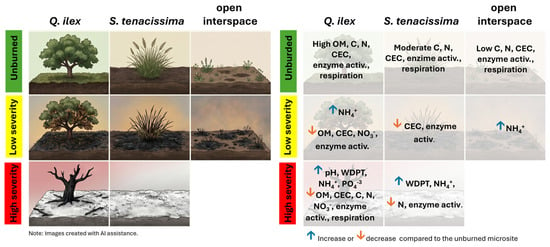
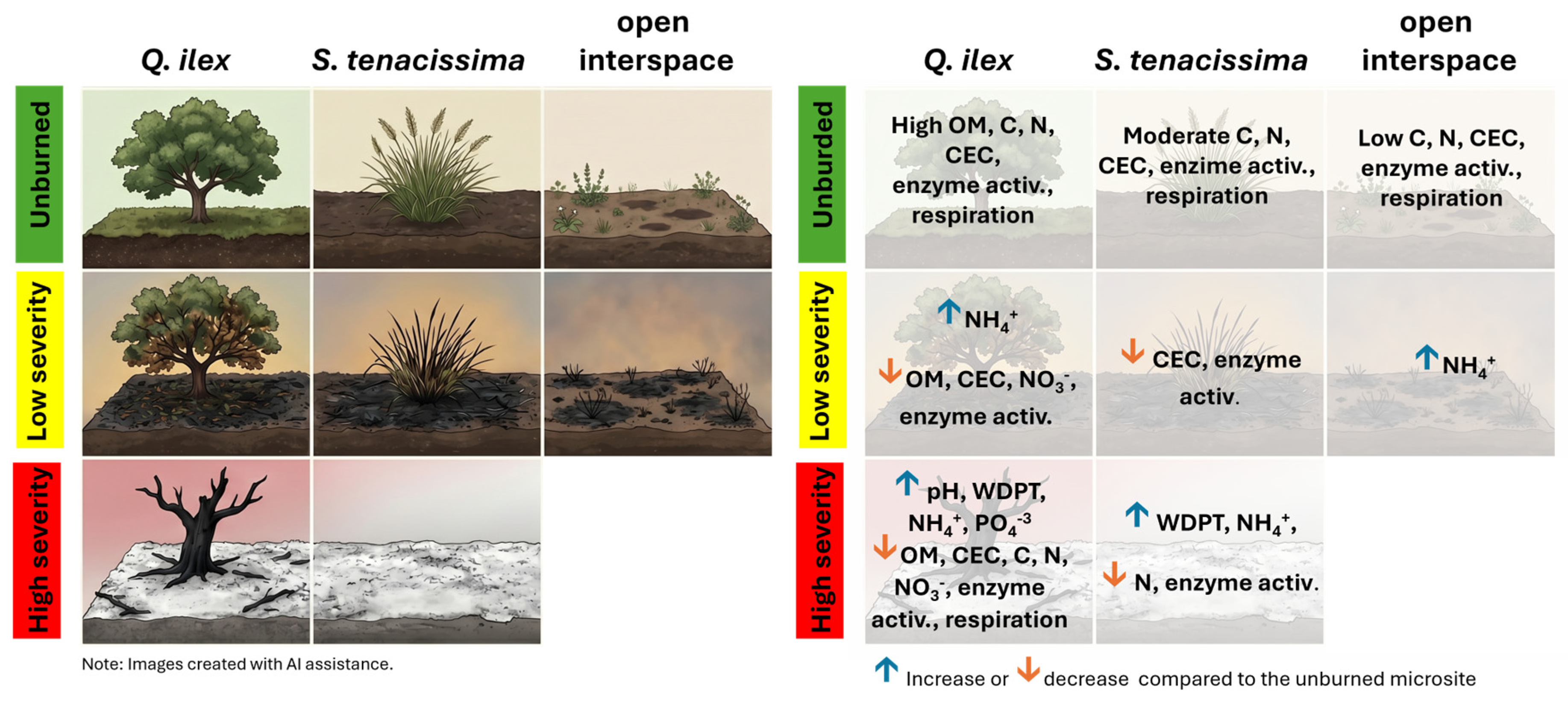
Wildfires are increasing in frequency and severity across Mediterranean ecosystems. However, the immediate soil biogeochemical responses that determine shortly post-fire resilience remain poorly understood. This study assessed how contrasting fire severity levels influence soil physicochemical, nutrient, and biochemical properties in ecologically relevant vegetation microsites—beneath Quercus ilex L. canopy, Stipa tenacissima L. tussock, and open interspaces—in a Mediterranean holm oak woodland in central Spain. Soils were sampled early after a wildfire and analyzed for organic matter, nutrient pools, water repellency, microbial respiration, nitrogen mineralization, and enzyme activities. Fire severity was the dominant driver of immediate post-fire soil responses. High-severity fire reduced soil organic matter, cation exchange capacity, total C and N, nitrate, microbial respiration, and all measured enzyme activities, with the most pronounced losses occurring beneath Q. ilex canopy. In contrast, ammonium, labile phosphorus, pH and soil water repellency increased under high severity, mainly in this microsite. Low-severity fire generally preserved biological functioning, with values comparable to unburned soils. Microsite identity modulated the magnitude of fire effects, with soils beneath Q. ilex cover microsite showing the greatest sensitivity, and open interspaces the least. The microsite × severity interaction detected for key nutrients and biochemical variables suggests that high-severity fire might destroy the microsite-specific fertility islands that constitute the functional core of Mediterranean woodland soils. These findings should be considered in management strategies prioritizing their monitoring and protection.

Graphical Abstract

1. Introduction

Wildfires are a major disturbance process in terrestrial ecosystems worldwide, shaping vegetation structure, biogeochemical cycles, and soil properties across a wide range of biomes [1]. However, the nature, magnitude, and persistence of fire effects on soils vary markedly across climatic zones, largely due to differences in vegetation type, organic matter content, fire regime characteristics, and the mineralogical and structural properties of the dominant soil units [2,3,4,5]. Despite this cross-biome variability, Mediterranean-type ecosystems are particularly vulnerable to the combined effects of summer drought, high temperatures, fire-prone sclerophyllous vegetation, and shallow, poorly developed soils, all of which fosters conditions for large and intense fires [6,7], while simultaneously limiting post-fire recovery capacity of both vegetation and soil biological communities [8]. In addition, climate projections for the Mediterranean Basin indicate a an increased frequency of heatwaves and prolonged droughts, which are expected to increase wildfire risk and modify post-fire recovery trajectories, potentially exceeding ecosystem resilience thresholds [9,10,11].
Fire effects on vegetation and soils are tightly interconnected, and post-fire ecosystem resilience is largely mediated byplant–soil feedbacks [6,7]. However, although fire effects on vegetation have been extensively documented, far less is known about how fire-altered soils affect ecosystem resilience [6]. Soil plays a pivotal role in ecosystem function, regulating organic matter storage, nutrient cycling, water retention, and carbon sequestration—processes critical for vegetation recovery [12,13]. The interaction between fire and soil is highly complex: fires modify physical and chemical soil properties and alter microbial abundance, activity, and diversity. Fire can drastically affect soil structure, organic matter, nutrient availability, and hydrological properties [5,14,15]. It also reshapes soil microbial communities, reducing their biomass and diversity while altering functional groups essential for ecosystem recovery [16,17,18,19]. However, these responses depend strongly on pre-fire soil conditions, fire severity, and site-specific environmental factors. Low-severity fires may cause limited damage or even enhance certain soil attributes, whereas high-severity fires often lead to substantial losses of.of soil organic matter, nutrient pools, and microbial functioning [15,20,21].
In addition, pre-existing spatial heterogeneity in soil and vegetation further modulates post-fire outcomes. Vegetation creates fine-scale variability in organic matter, root distributions, and microclimate, influencing baseline nutrient stocks and microbial communities [22,23]. Thus, soils beneathperennial plant canopies often act as biogeochemical “fertility islands” and/or “hotspots”, whereas open interspaces tend to support distinct microbial assemblages and accumulate smaller quantity of organic matter [24,25]. In this context, biogeochemical hotspots are microsites where process rates such as mineralization, respiration, or nutrient cycling are substantially elevated relative to surrounding soils, often due to localized increases in moisture and organic inputs. By contrast, fertility islands, emphasize resource distribution and refer to zones of resource accumulation, where organic matter, nutrients, and microbial biomass concentrate over time.
Fire interacts with this heterogeneity in complex ways. Fire transforms the spatial distribution of soil properties that, under unburned conditions, typically exhibit marked heterogeneity between under-canopy and bare soil microsites [26,27]. While combustion reduces significant portions of these organic inputs and biological activity beneath vegetation, it simultaneously deposits pyrogenic carbon and ash, often generating pulses of inorganic nitrogen and other nutrients in areas where pre-fire fuel loads were high [15]. Despite these localized inputs, numerous studies indicate that fire, particularly when recurrent, acts as a homogenizing agent, diminishing pre-fire contrasts in soil carbon, nitrogen, and aggregation across microsites [27,28]. Over time, post-fire leaching and erosion further redistribute nutrients from canopy patches into inter-canopy spaces, while critical biological indicators may remain altered for longer periods in high-severity burns [29,30]. The magnitude of this redistribution may be modulated by fire severity [31].
Despite growing recognition of vegetation-driven soil variability, most post-fire studies assess severity effects at broad scales, overlooking microsite-specific dynamics [32]. Consequently, the interplay between fire severity and plant cover in shaping soil nutrient cycling and microbial functional resilience remains poorly understood, particularly in Mediterranean ecosystems with pronounced fine-scale heterogeneity.
Additionally, critical knowledge gaps persist in the temporal dimension of post-fire studies. Most research focuses on medium- or long-term recovery, neglecting the immediate post-fire period when biogeochemical pulses and microbial community reorganization are most pronounced [33,34,35]. This early post-fire stage is crucial because transient changes in soil nutrient concentrations, mineralization, and enzymatic activity can significantly influence future plant regeneration and competitive dynamics.
In this context, this study aimed to evaluate the immediate soil biogeochemical responses to contrasting fire severity levels under different plant covers in a Mediterranean forest ecosystem in central Spain. We assessed changes in soil physicochemical and biogeochemical properties related to nutrient cycling beneath plant cover and open interspaces affected by contrasting wildfire severity levels.
By explicitly integrating fire severity and vegetation-driven microsite heterogeneity within the critical early post-fire period, this study seeks to advance mechanistic understanding of soil functional responses and to inform post-fire management strategies in Mediterranean forests facing increasingly severe wildfire regimes.

2. Materials and Methods

2.1. Study Site

The study was conducted in a Mediterranean holm oak woodland located in the central Iberian Peninsula (39°50′ N, 4°05′ W), within the municipality of Toledo (central Spain). This area was affected by a wildfire that burned approximately 1600 ha in June 2019. Elevation across the study area ranges from approximately 500 to 700 m a.s.l. Within this range, the sampling area was selected on relatively homogeneous terrain at elevations between 689 and 694 m a.s.l., with gentle slopes and similar topographic conditions.
The regional climate is classified as continental Mediterranean, characterized by pronounced seasonality. According to data from the Toledo meteorological station (39°53′ N, 4°02′ W), mean annual temperature is 15.8 °C and mean annual precipitation is approximately 342 mm, with a pronounced summer drought [36]. Seasonal temperature fluctuations are strong, with winter averages around 6 °C and summer averages temperatures exceeding 26 °C. From a bioclimatic perspective, the area belongs to the mesomediterranean belt with a dry ombrotype [37].
Vegetation is composed of Mediterranean sclerophyllous woodland dominated by Quercus ilex L. subsp. rotundifolia (Lam.) O. Schwarz, typically forming low forests or shrub-like stands due to historical anthropogenic disturbances. Secondary communities associated with holm oak forest degradation stages include Retama sphaerocarpa (L.) Boiss. and Stipa tenacissima L. Other shrub species present at lower abundance are Juniperus oxycedrus L., Pistacia terebinthus L., Rhamnus lycioides L., and Daphne gnidium L., together with variable cover of annual herbaceous species [38].
Geologically, the site is located on the Toledo Anatectic Complex within the crystalline basement of the central Iberian Massif [39]. The parent material consists mainly of pre-Hercynian igneous rocks, including glandular orthogneisses and biotitic leucogneisses, as well as Hercynian formations such as leucocratic migmatites, granitoids, stromatic migmatites, and leucogranites [40]. Soils are predominantly mineral and strongly influenced by both the parent material and the arid Mediterranean climate. Regosols and Calcisols are common, shaped by topographic constraints and limited precipitation [41]. Although the crystalline plateau is predominantly siliceous and would generally favor the development of acidic soils, semi-arid climatic conditions promote limited leaching and the accumulation of secondary carbonates, resulting in soils with a relatively alkaline pH [42].

2.2. Experimental Design and Soil Sampling

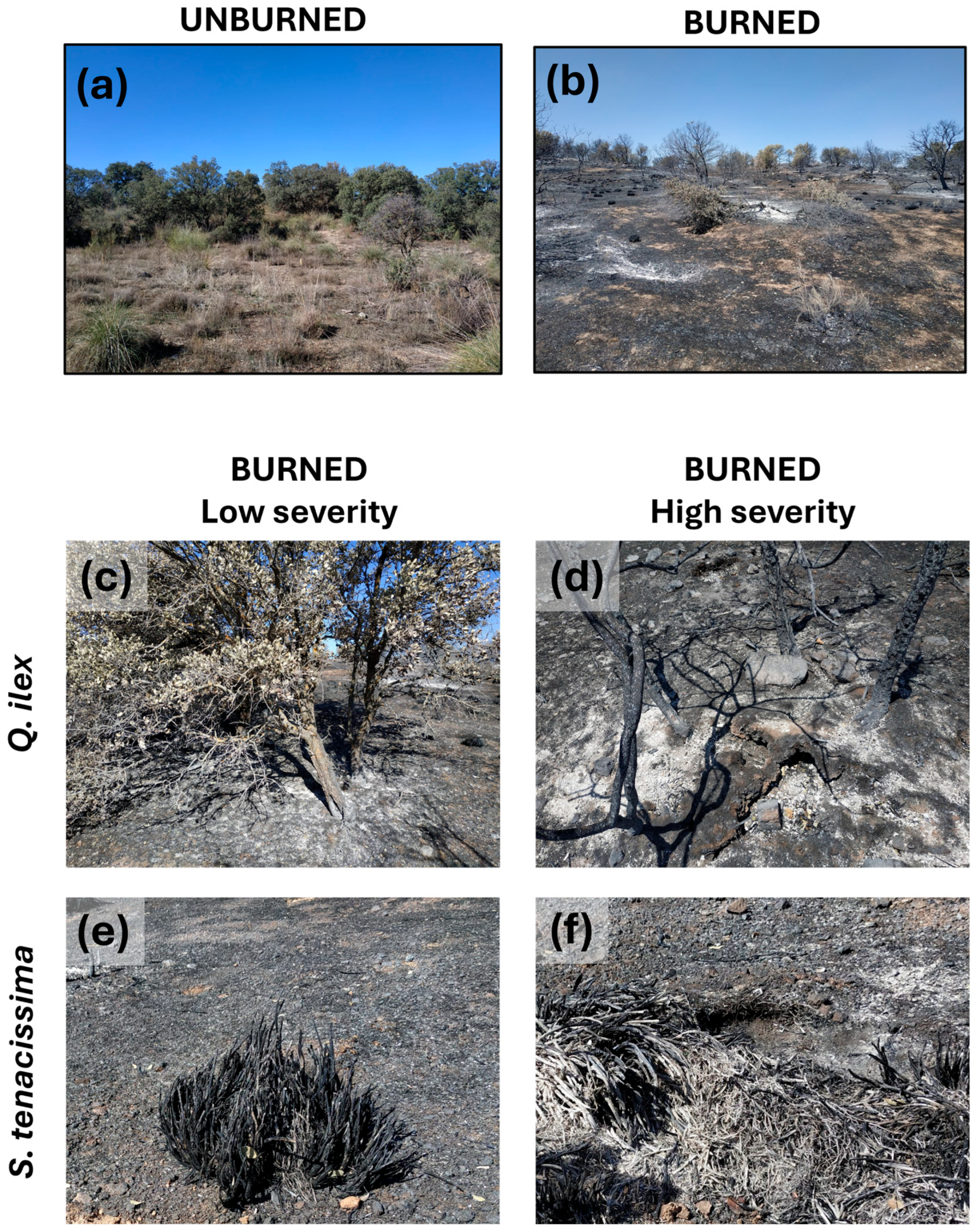
To evaluate the immediate effects of fire severity on soil properties across different microsites, an observational study design was established in the study area using two dominant plant species: Quercus ilex and Stipa tenacissima. For each species, three fire conditions were considered: high-severity fire (HS), low-severity fire (LS), and unburned control (UB). Fire severity was determined by visual inspection of burned vegetation and ash characteristics following established methodologies [43,44]. While this approach is widely used in field-based fire ecology studies, it does not capture soil temperature dynamics directly, and interpretations regarding thermal effects on soil properties should be interpreted within this methodological framework. Individuals affected by high-severity fire were characterized by the complete combustion of their aboveground biomass and the soil was covered with white ash. In the case of Q. ilex, only charred basal stems remained, whereas S. tenacissima tussocks were almost completely reduced to ash. Individuals affected by low-severity fire showed partial scorching of the aboveground biomass, with many branches and stems remaining intact, in the case of Q. ilex, and the soil was covered with black ash. Control individuals consisted of plants of both species located in nearby areas not affected by the fire (Figure 1). Eight individuals were selected for each species and fire condition, resulting in a total of 48 plant individuals. This design operates at the scale of individual plants and their immediately surrounding soils, hereafter referred to as microsites, and is not intended to characterize stand- or community-level vegetation units.
Soil sampling was carried out on 5 July 2019, seven days after fire occurrence. For each Q. ilex individual, four topsoil subsamples (7 cm diameter and 5 cm depth cores) were collected at the cardinal directions (N, E, S, W) along a 0.5 m radius circumference centered on the base of Q. ilex stems. In the case of S. tenacissima tussocks, the subsamples were collected along a 0.2 m radius circumference centered on their base.
In addition, in both burned and unburned areas, soil samples were collected from eight open interspaces, consisting of sparsely vegetated areas dominated by ephemeral annual herbs, with very low vegetation cover. Thus, at each sampling point, four subsamples were collected from four quadrants (N, E, S, W) within 1 m diameter circular plots located in sparsely vegetated areas at least 2 m from the nearest stem or tussock.
Sampling was restricted to surface soils (0–5 cm depth) because the direct thermal effects of wildfire on soil properties are predominantly confined to the uppermost centimeters of the mineral soil. Due to the inherently low thermal conductivity of soil—particularly when dry, as is typical in Mediterranean summer conditions—heat generated at the surface during combustion is rapidly attenuated with depth and rarely penetrates beyond a few centimeters under most wildfire conditions [15,21]. According to Badía-Villas et al. [45], sampling beyond surface layers may hinder the identification of soil changes directly attributable to fire. In addition, the sampled interval (0–5 cm) concentrates the bulk of soil organic matter inputs, microbial biomass, and extracellular enzyme activity, and is therefore the most functionally relevant layer for the biogeochemical processes under study [15].
Overall, 64 composite soil samples were obtained during this sampling campaign: 48 composite samples from plant-associated microsites (two species × three fire conditions × eight replicates) and 16 composite samples from open interspaces. Composite samples were placed in polypropylene bags and stored in a cooler.
On the same day, they were transported to the laboratory, where they were immediately sieved through a 2 mm mesh to remove coarse fragments and roots, following standard preparation procedures for soil biogeochemical studies. The coarse fraction (>2 mm) was discarded, as all physicochemical and biochemical analyses were conducted on the fine earth fraction, which is conventionally used in soil studies as it contains most of the reactive mineral surfaces and the majority of biologically and chemically active components of the soil [46]. An aliquot was stored at 4 °C for biological analyses and the remaining soil was air-dried for subsequent physicochemical analyses.

2.3. Laboratory Analysis

Soil texture was determined by pipette method [47] on the fine fraction, after dispersion of 10 g of soil with a sodium hexametaphosphate and sodium carbonate solution.
Soil pH was determined in a slurry with CaCl2 (soil:CaCl2 1:1) following McLean [48], a method chosen because it minimizes the variability associated with the fluctuating ionic strength and soluble salt content characteristic of these semi-arid soils [49]. Soil organic matter (OM) was measured by weight loss on ignition (550 °C for 2 h) [50]. To assess soil water repellency (SWR), a 15 g aliquot of each soil sample was placed in individual 50 mm diameter plastic dishes and equilibrated under controlled laboratory conditions (20 °C; ~35% relative humidity) for one week. Subsequently, the water drop penetration time (WDPT) test [51] was performed. This involved placing three drops of distilled water (~0.05 mL) on the sample surface and recording the times required for their complete penetration. The average time for triplicate measurements is reported as the WDPT value of each soil sample. Cation exchange capacity (CEC) was analyzed by saturation with NaOAc [52]. Total carbon (C) and nitrogen (N) content were determined in ground samples using a LECO TruSpec CN analyzer (LECO Corp, St. Joseph, MI, USA). Soil ammonium (NH4+-N) and nitrate (NO3-N) were analyzed by spectrophotometry after 2 M KCl extraction, following Mulvaney [53] and Keeney and Nelson [54], respectively. Labile phosphate (PO43−-P) was extracted in 0.5 M NaHCO3 (pH 8.5) extracts [55] and quantified by the colorimetric method of John [56]. Soil C mineralization rate (or soil basal respiration rate) was determined by the alkali-trap method [57] on soil samples incubated at 65% water holding capacity (WHC) for 28 days at 24 °C in the dark and under aerobic conditions. Potential N mineralization rate was estimated by the method outlined by Keeney and Nelson [54] on 65% WHC soil samples, incubated in aerobic conditions for 28 days at 24 °C. In order to evaluate the dynamics of available inorganic N, soil subsamples were taken from each experimental unit after 0 and 28 days of incubation. Net N mineralization was calculated as the net increase in NH4+-N and NO3-N over the incubation period. Soil enzyme activities were analyzed and used as soil functional proxies. Acid phosphatase (EC 3.1.3.2, orthophosphoric-monoester phosphohydrolase, acid optimum), β-glucosidase (EC 3.2.1.21, β-d-glucoside glucohydrolase) and arylsulfatase (EC 3.1.6.1, arylsulfate sulfohydrolase) activities were determined on 1 g soil aliquots incubated at 37 °C for 1 h, using the methods described by Tabatabai [58]. The substrates used were p-nitrophenyl phosphate, p-nitrophenyl-β-d-glucoside and p-nitrophenyl sulfate, respectively. Control assays were performed in all cases by adding the substrate after the reaction was stopped and before filtration of the soil suspension. The criterion for selecting these enzymes was their relative importance in nutrient cycling and the fact that they had previously been shown to be good indicators of fire impact in soil functionality [59]. However, the relationship between these indicators and total microbial biomass cannot be established from the present dataset due to the absence of direct microbial biomass measurements.

2.4. Statistical Analysis

Principal component analysis (PCA) was used to explore the main patterns of variability in the soil dataset, including all the studied soil properties. Then, we calculated the mean and the standard deviation of the first two axes along vegetation patch and fire severity for interpretation and visualization purposes. We then tested whether there were statistically significant differences in soil properties across the studied microsites, defined by vegetation patches (Q. ilex cover and S. tenacisima tussock) and fire severity (HS, LS, and UB) through a permutational multivariate analysis of variance (PERMANOVA). This analysis was based on 9999 permutations, and the Bray–Curtis distance measure of dissimilarity for untransformed and unstandardized data.
The effect of all studied microsites, considering both plant cover and fire severity, was evaluated using one-way ANOVA.
To evaluate the independent and interactive effects of microsite and fire severity on soil properties beneath plant canopies, we performed an additional two-way ANOVA including only the Q. ilex cover and S. tenacissima tussock microsites. This subset of the dataset formed a complete factorial design (2 microsites × 3 fire severity levels: HS, LS, UB). Interspace samples were excluded from this analysis because the HS condition was absent in this microsite, preventing a balanced design and the estimation of interaction terms. For each variable, we tested the main effects of microsite and fire severity, as well as their interaction. When significant effects were detected, post hoc Tukey tests were applied to compare levels within each factor. All analyses were conducted using PAST Version 5.2 [60], with significance set at p < 0.05.

3. Results

3.1. Responses of Overall Soil Properties Across Vegetation Patches Under Different Fire Severity Levels

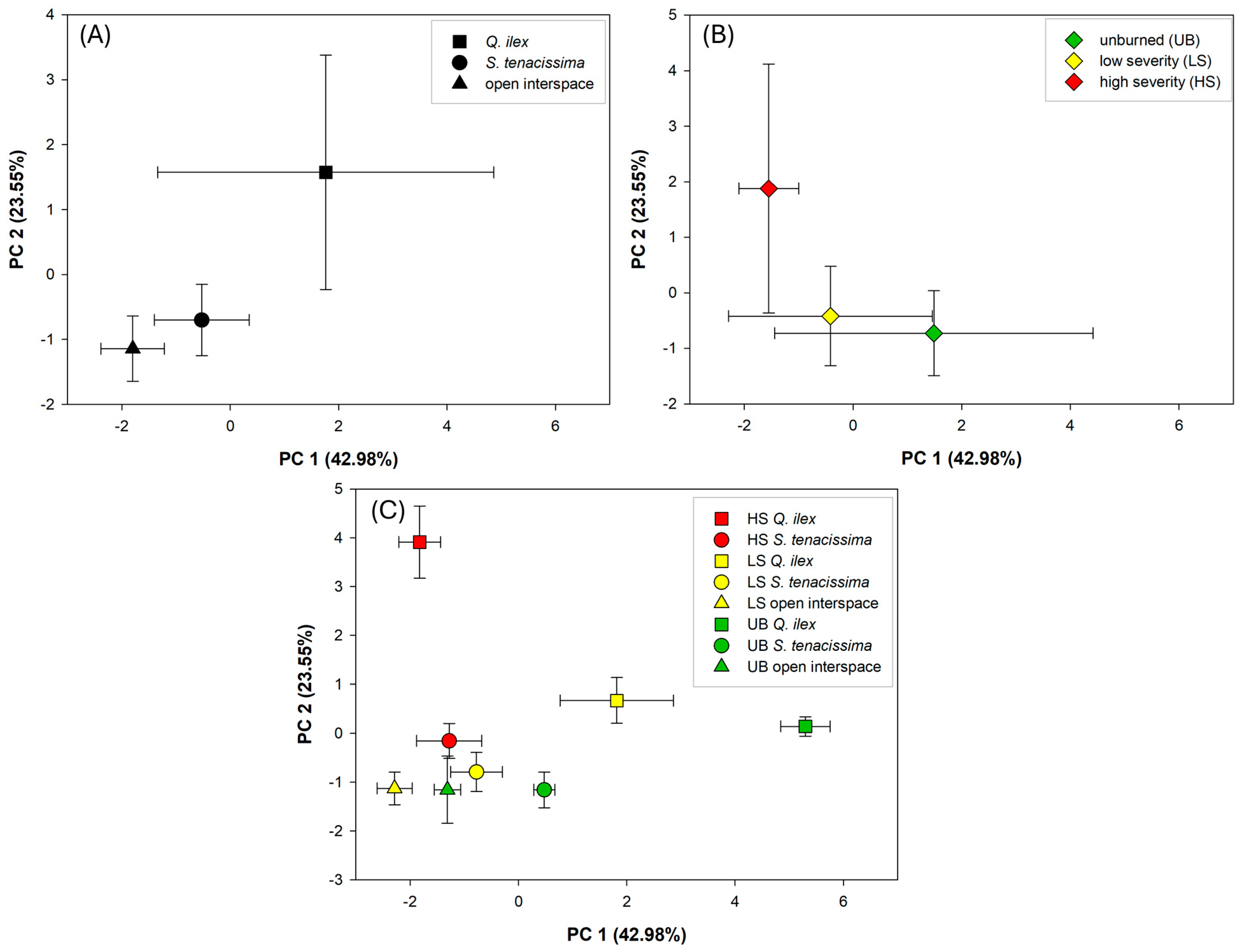
PCA revealed clear multivariate patterns in soil properties across vegetation patches and fire severity levels. The first two components (PC1 and PC2) accounted for 66.53% of the total variance in the data, with PC1 explaining 42.98% and PC2 explaining 23.55% of the variability (Table 1). PC1 reflects a gradient of soil functional capacity, driven by variables related to organic matter dynamics, nutrient cycling, and microbial enzymatic activity. Higher PC1 scores indicate soils with greater functional potential for decomposition and nutrient turnover. In contrast, PC2 captures variation in nutrient availability and chemical conditions regulating nutrient solubility and accessibility (ammonium, phosphate, pH and SWR).
The ordination patterns showed a partial separation of microsites (Figure 2). Unburned soils beneath Q. ilex cover tended to cluster towards higher PC1 scores, reflecting greater microbial activity and nutrient content. In contrast unburned soils beneath S. tenacissima tussock and open interspaces were positioned toward lower PC1 scores (Figure 2A). Fire severity also influenced the multivariate structure (Figure 2B): unburned (UB) sites were generally associated with higher PC1 values, while high-severity (HS) sites shifted toward lower PC1 values but higher PC2 scores, suggesting that increasing fire severity diminishes soil biochemical functioning but promotes greater nutrient availability. This pattern was particularly pronounced beneath Q. ilex cover (Figure 2C), indicating that soils beneath this woody species experienced stronger fire-induced alterations in their biochemical and nutrient-related properties.
The PERMANOVA analysis detected statistically significant differences in the multivariate soil properties among the microsites defined by vegetation patch and fire severity (F = 5.24, p < 0.001). This result confirms that the combined effects of vegetation type and fire severity significantly structured the soil properties matrix, consistent with the patterns observed in the PCA ordination.

3.2. Responses of Specific Soil Properties to Fire Severity Across Diferent Microsites

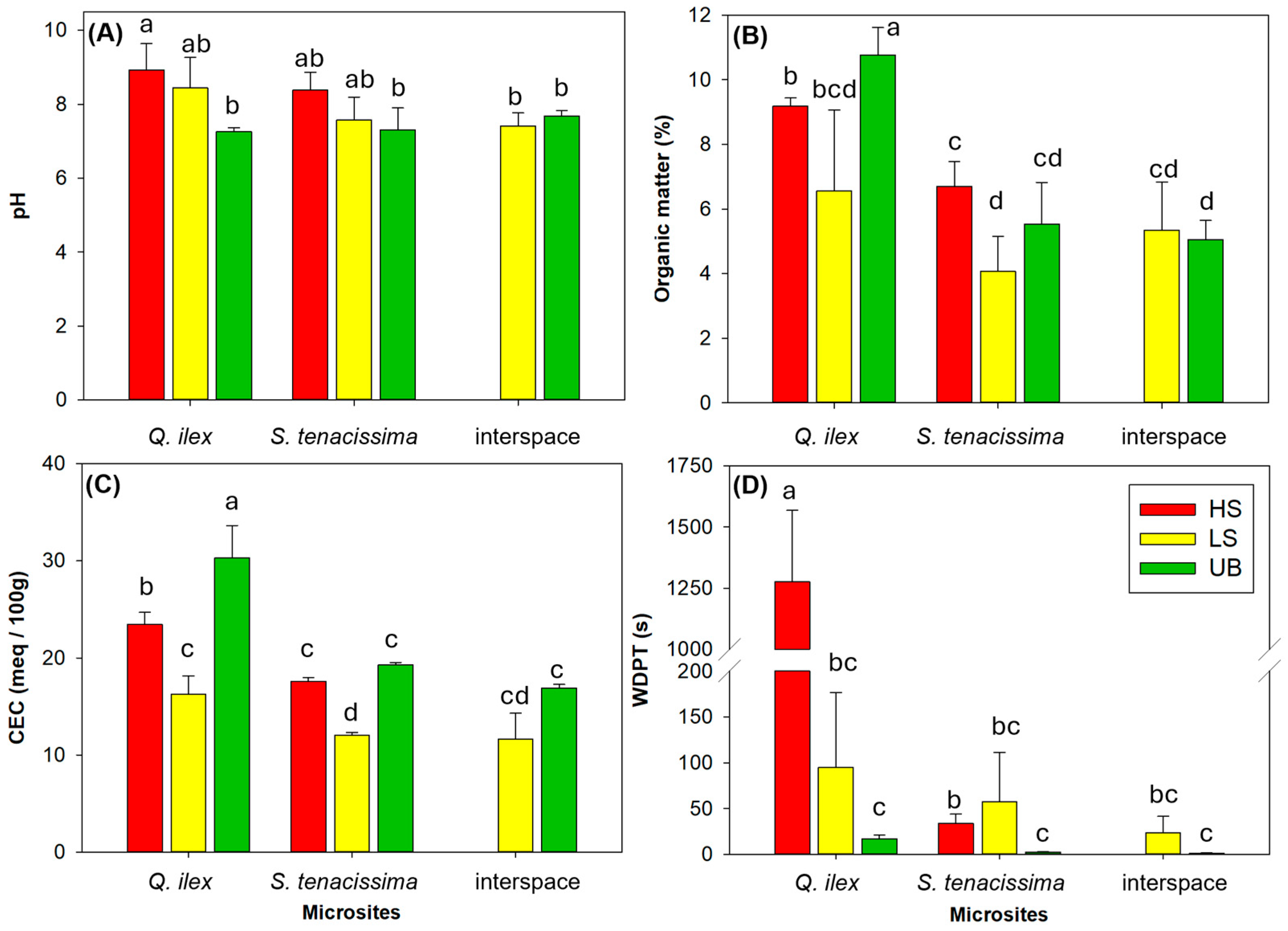
Soil pH tended to increase steadily with fire severity across all microsites previously covered by plants (Table 2, Figure 3). This alkalinization was particularly pronounced beneath Q. ilex cover, where HS soils differed significantly from unburned (UB) soils. After burning, the content of soil organic matter (OM) significantly declined in soil beneath Q. ilex cover, which initially showed the highest values (Table 2, Figure 3). Cation exchange capacity (CEC) followed a similar trend to that of OM. Burned soils displayed a decrease in their CEC values, with soils affected by low-severity fire showing the strongest reductions across microsites. Soil water repellency estimated by water drop penetration time (WDPT) increased with fire. The effect was most pronounced beneath Q. ilex cover, where HS soils exhibited significantly longer WDPT values than LS and UB soils. Beneath S. tenacissima tussocks and in open interspaces, burned soils also showed elevated repellency, although differences between LS and UB were less marked (Table 2, Figure 3).
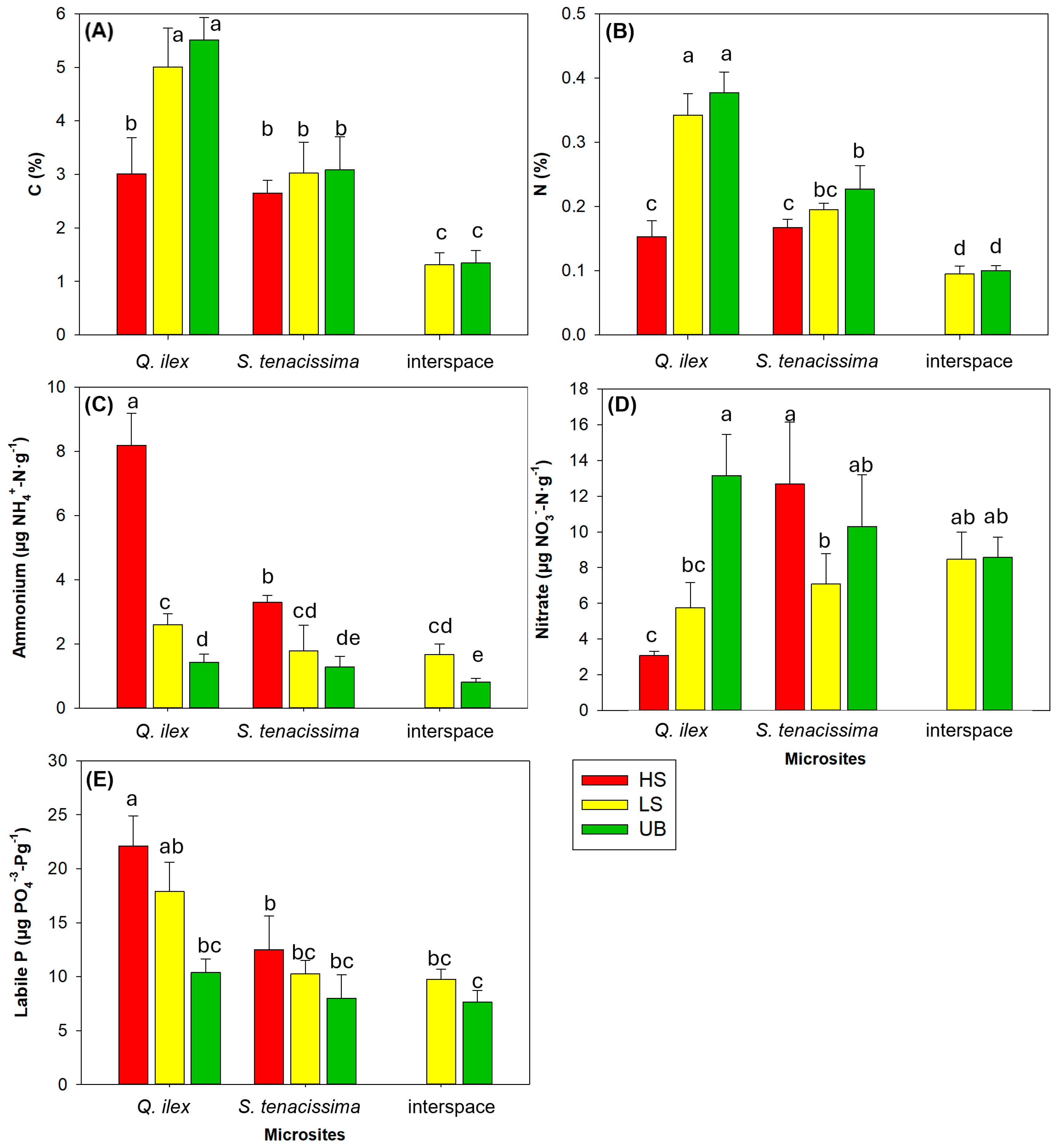
Fire severity significantly altered soil nutrient pools across different microsites (Table 2, Figure 4). Soil C and N concentrations decreased under HS conditions beneath Q. ilex cover. In soil beneath S. tenacissima tussocks, the reduction was marginal, and open interspace soils exhibited uniformly low C and N values regardless of fire condition. A similar trend was observed for nitrate (NO3-N) concentrations, where the range of values was generally low. The highest reduction was observed beneath Q. ilex cover microsite under high-severity fire conditions. In contrast, ammonium (NH4+-N) and labile phosphorus concentrations increased under HS burning conditions, particularly beneath Q. ilex cover. UB soils showed the lowest levels of ammonium and phosphate.
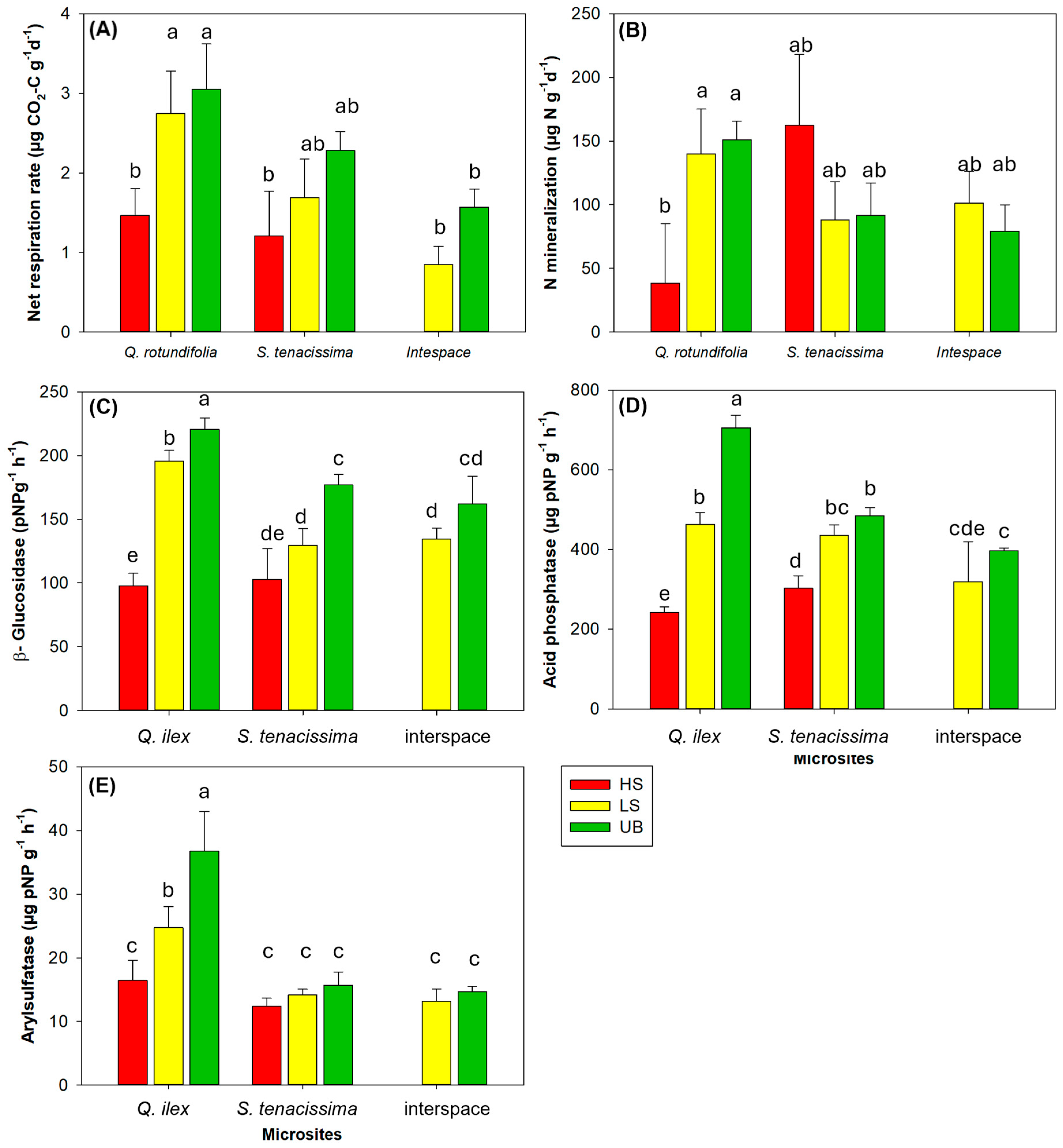
Soil microbial net respiration rate decreased under HS fire conditions across all microsites (Table 2, Figure 5A). The greatest reduction occurred beneath the Q. ilex cover microsites, where soils affected by HS fire conditions showed significantly lower activity than LS and UB soils. Soils affected by LS burning conditions maintained their activity levels comparable to those of the UB soils. Nitrogen mineralization rate was similarly reduced by HS fire conditions beneath Q. ilex cover, whereas UB soils maintained the highest activity. For both S. tenacissima tussocks and open interspace microsites, the effect of burning was not significant.
Enzyme activities associated with C, P, and S cycling were highly sensitive to fire severity (Table 2, Figure 5). β-glucosidase and acid phosphatase activities declined significantly under HS fire conditions beneath both plant species cover. Arylsulfatase activity showed its greatest reduction beneath Q. ilex cover microsites with no significant fire effect beneath S. tenacissima tussock or open interspace microsites.

3.3. Two-Way ANOVA: Effects of Microsite, Fire Severity, and Their Interaction

The two-way ANOVA restricted to Q. ilex cover and S. tenacissima tussock microsites confirmed the dominant role of fire severity in shaping post-fire soil responses. Results showed that fire severity exerted consistent effects on most soil physicochemical variables (pH, SOM, CEC, soil water repellency), nutrient variables (total C, total N, NH4+-N) respiration rate and, and all enzyme activities (Table A1, p < 0.05). The microsite also had significant main effects on several variables, including SOM, CEC, total C, total N, NH4+-N, PO43−-P, respiration rate, and all three enzymes (Table A1, p < 0.05), with generally higher values beneath Q. ilex cover than beneath S. tenacissima tussocks.
In addition, a significant microsite × fire severity interaction emerged for SOM, total N, NH4+-N, PO43−-P, N mineralization, β-glucosidase, and acid phosphatase, indicating that the magnitude and direction of fire-induced changes differed between the two microsites associated with plant species.
Overall, these results demonstrate that both the nature of the plant cover and the severity of burning jointly modulated post-fire soil properties, with severity driving broad changes across most variables and microsite modulating the intensity of these effects for key nutrient and biochemical processes.

4. Discussion

4.1. Fire Severity as a Dominant but Not Exclusive Driver

The results of this study demonstrate that fire severity was the dominant driver of fire effect on soil biogeochemical responses in a Mediterranean holm oak woodland. This finding is in line with the broad consensus in the literature indicating that the intensity of thermal disturbance is the primary determinant of both the magnitude and direction of soil changes following fire [15,21,61]. It should be noted that the findings reported here refer to microsite-level dynamics, defined at the scale of individual plant canopies and their immediately associated soils, and should not be directly extrapolated to the stand or vegetation-community level, where additional factors such as topographic variability, canopy closure, or landscape-scale fuel heterogeneity may further modulate post-fire soil responses. Beyond the overriding influence of fire severity, this study demonstrates that vegetation-driven microsite heterogeneity also modulated fire-induced soil changes.
In unburned conditions, the higher values of soil organic matter (OM), total nitrogen (N), and enzyme activities beneath Q. ilex cover confirm the existence of “fertility islands” or biogeochemical hotspots, typical of Mediterranean open woodlands [22,23,24,27]. However, our study shows that high-severity (HS) fires act as a homogenizing agent, a phenomenon consistent with the “fertility island destruction” effect documented in the fire ecology literature [27,28]. The pronounced reduction in PC1 scores (representing functional capacity) and the significant loss of OM and total C and N beneath Q. ilex cover suggest that these microsites are particularly vulnerable. The higher fuel load associated with woody canopies likely led to higher soil temperatures during the fire, resulting in a more drastic combustion of accumulated organic pools compared to the S. tenacissima tussock microsite or interspace microsites [15,16].
Soils beneath S. tenacissima tussock displayed intermediate responses, with smaller changes in most properties under both fire severity levels relative to the Q. ilex cover microsite. This difference can be attributed to the lower pre-fire organic matter content and microbial biomass beneath the grass tussocks compared to the tree canopy, resulting in a lower thermal load during combustion and a comparatively reduced pool of labile substrates subject to volatilization or destruction [15]. Open interspace soils, which showed uniformly low C and N concentrations regardless of fire condition, were the least affected by burning, consistent with their sparse organic inputs. This result supports the view that soils with lower organic matter content are inherently less responsive to fire disturbance, as there is less substrate to be altered by combustion [16,17,21].
High-severity fire induced a consistent alkalinization of soil pH across all microsites, a well-documented response attributed to the deposition of alkaline ash compounds—predominantly calcium oxide and potassium oxide—released during the combustion of aboveground biomass and organic matter [62]. This ash-bed effect can temporarily raise soil pH, altering ion exchange dynamics, phosphate solubility, and microbial community functioning [14,15].
After fire, mainly beneath Quercus ilex cover, organic matter (OM) and cation exchange capacity (CEC) declined markedly, reflecting the combustion of litter and thermally sensitive soil organic fractions responsible for cation retention [21]. This pattern agrees with Mediterranean studies reporting negative relationships between fire severity and soil organic carbon, as severe fires remove both aboveground organic inputs and biologically active surface horizons [15,29,63]. Under unburned conditions, continuous Q. ilex litter inputs promote the formation of stable organo-mineral complexes that enhance cation retention and soil structural stability [63,64]. In these siliceous, coarse-textured soils, CEC depends primarily on humified and microbially processed organic fractions rather than clay minerals [65], explaining its close relationship with OM depletion. Fire disrupts this pedogenic pathway by rapidly mineralizing labile organic fractions and shifting soil organic matter toward more recalcitrant pyrogenic forms that contribute less to aggregate stability and ion exchange [14,15,66]. Thermal alteration of clay minerals at temperatures above 300–500 °C may further contribute to CEC reduction C [15].
Soil water repellency, estimated by WDPT, increased with fire severity, particularly beneath Q. ilex cover. This response is attributable to the volatilization of hydrophobic organic compounds at high temperatures and their subsequent condensation at shallower depths in the soil profile, forming a discrete water-repellent layer [67,68]. The amplification of SWR under high-severity fire has well-known hydrological consequences, including reduced water infiltration, enhanced surface runoff, and increased erosion risk, all of which can further compromise soil integrity and vegetation recovery in the immediate post-fire period [29]. While low-severity fire also produced some degree of repellency relative to unburned conditions, the differences were substantially smaller, suggesting a threshold relationship between thermal input and the degree of hydrophobic layer formation [14].
Under unburned conditions, nutrient cycling within the upper horizon is regulated by tightly coupled mineralization and immobilization processes mediated by microbial biomass and enzyme activity [12]. However, high-severity fire, mainly beneath Quercus ilex cover, disrupts this equilibrium by reducing microbial communities and destroying enzyme–humus complexes, while simultaneously releasing inorganic N and P from combusted organic substrates from the surface horizon [15,33,69]. In contrast, ammonium and labile phosphorus increased, likely due to rapid mineralization and ash-mediated release of inorganic nutrients during burning [33]. These short-term post-fire nutrient pulses, commonly described as “ash-bed effects”, have been widely reported in Mediterranean ecosystems and may temporarily enhance nutrient availability [69,70]. On the other hand, the observed decline in nitrate is consistent with the high thermal sensitivity of nitrifying microorganisms and the depletion of organic N substrates available for further transformation [18]. Consequently, the post-fire increase in ammonium and labile P should not be interpreted as improved soil fertility, but rather as evidence of a temporary breakdown in biological nutrient regulation that may increase nutrient losses through post-fire leaching [29,33,71]. As noted by Pellegrini et al. [70], in the long term, high-severity fires might deplete the total nitrogen capital of the soil, potentially limiting the recovery of Mediterranean forests where N is often a limiting factor.
Another finding of this study is that biochemical soil properties—microbial respiration, N mineralization rate, and extracellular enzyme activities (β-glucosidase, acid phosphatase, and arylsulfatase)—exhibited greater sensitivity to fire severity than physicochemical properties. Under high-severity fire, all measured enzyme activities decreased markedly across microsites, with the most pronounced reductions occurring beneath Q. ilex cover, where the highest pre-fire biological activity was recorded. This pattern agrees with results from meta-analyses demonstrating that fire, and particularly high-severity fire, significantly reduces hydrolytic enzyme activities involved in C, N, and P acquisition by approximately 20%–30% globally [5,19]. Soil enzymes are susceptible to thermal denaturation at temperatures that soil surfaces routinely reach during intense wildfires, and their activity is also indirectly impaired through the destruction of the organic substrate pool that sustains microbial communities and provides the physical protection of enzyme–humus complexes [16,17].
The strong decline in β-glucosidase, acid phosphatase and arylsulfatase activities under high-severity burning is particularly significant from a functional standpoint, as these enzymes are key regulators of carbon, phosphorus and sulfur mobilization, respectively, and are widely recognized as sensitive bioindicators of soil quality and fire impact [19,71,72]. These results indicate a broad disruption of nutrient cycling functions across element cycles. Soil basal respiration and N mineralization rates followed analogous patterns, with high-severity fire substantially reducing microbial metabolic activity beneath Q. ilex, while the effects were non-significant beneath S. tenacissima tussock and open interspaces. This differential sensitivity may reflect the greater pre-fire microbial biomass and activity beneath the tree canopy, which, paradoxically, also represents a greater pool of thermally vulnerable organic substrate [22,27].

4.2. Microsite Identity Modulates the Magnitude of Fire Effects

Mediterranean evergreen oak woodlands, including those dominated by Q. ilex cover, accumulate substantial and persistent litter layers [73]. Experimental studies on broadleaf and Quercus litter demonstrate that higher litter bulk density increases fire residence time and enhances soil heating during combustion [74]. These conditions intensify organic matter losses, nutrient volatilization, and microbial mortality, explaining the strong declines observed in this microsite. In contrast, S. tenacissima tussocks burn rapidly with lower residence times [75], producing less severe soil heating and therefore more moderate changes. Open interspaces, characterized by sparse herbaceous cover and minimal litter, often experience the lowest fire intensity and thus the weakest soil alterations [76].
These contrasting responses across microsites can be understood in terms of the differential pedogenic legacy of each vegetation type. Beneath Q. ilex canopies, decades of litter accumulation and rhizosphere activity have driven the development of a comparatively enriched A horizon, characterized by higher organic matter content, greater microbial biomass, and more abundant enzyme–humus complexes [23,77]. This pedogenic differentiation represents a long-term investment of biological activity in the surface horizon that, paradoxically, also increases its vulnerability under high-severity fire. The greater the organic legacy, the greater the thermal load during combustion and the more severe the disruption of horizon functionality. Beneath S. tenacissima, the rapid combustion of grass tussocks with shorter residence times [75] generates less sustained soil heating, limiting the depth and intensity of thermal impact on the incipient Ah horizon. Open interspaces, where pedogenic development is effectively arrested by the absence of sustained organic inputs, show minimal fire-induced changes precisely because there is limited biogeochemical functionality to disrupt. Fire thus acts as a leveling agent across the pedogenic gradient established by vegetation, erasing the biogeochemical differentiation accumulated over decades [27].
The significant interaction between microsite and severity for most biochemical variables suggests that the “fertility island” or “hotspot” effect usually provided by plant canopies is lost under high-severity fire regimes. Nevertheless, low-severity fires maintain microbial activity levels similar to those of unburned controls, supporting the idea that Mediterranean soils are adapted to low-severity fire whereas high-severity fires exceed the potential resilience thresholds of the soil microbiota [78].
In contrast, certain physicochemical properties such as pH and soil water repellency showed less microsite-specific variation and responded more uniformly to fire severity, regardless of the vegetation type present. This suggests that the physicochemical response to fire might be primarily governed by the combustion temperature and residual ash composition—factors that operate more independently of the pre-existing biological state of the soil, whereas biochemical responses are mediated by the biotic legacy of the vegetation cover [15,79]. From an ecosystem functioning perspective, these fire-induced changes in biological regulation may temporarily limit vegetation recruitment by affecting plant–soil feedback processes [6,7,59].
This study, conducted just seven days after fire occurrence, captured the immediate biogeochemical state of the soil before post-fire redistribution processes—such as erosion, leaching, and early plant re-colonization—substantially alter the initial fire-induced signal. This early post-fire window is recognized as a critical period for ecosystem recovery trajectories, yet it remains comparatively understudied relative to medium- and long-term post-fire dynamics [80,81]. Our results provide mechanistic insights into the immediate soil functional legacy of different fire severities across ecologically relevant microsites, filling an important gap in the understanding of fire impacts on Mediterranean ecosystem resilience. However, this sampling, which captures the immediate post-fire state, does not allow inferences about temporal dynamics or recovery trajectories.

4.3. Post-Fire Management Implications

From a management perspective, the pronounced sensitivity of biochemical properties to high-severity fire, combined with the strong interaction with plant cover microsite, has important implications for post-fire restoration strategies. The reduction in enzyme and microbial activity in soils beneath Q. ilex cover under high-severity conditions suggests that these microsites, which constitute the primary foci of biogeochemical functioning in the unburned landscape, may require priority attention in restoration planning, particularly under the increasingly severe wildfire regimes projected for the Mediterranean Basin under climate change scenarios [11,82]. The contrasting response of low-severity fire, which in most cases maintained enzyme activities and basal respiration rates comparable to unburned conditions, underscores the importance of fire management strategies aimed at reducing burn severity, such as prescribed burning under controlled conditions and fuel management programs, as tools for preserving soil microbial functionality [16,83].
These findings underscore the importance of considering fine-scale spatial heterogeneity when assessing fire impacts and planning post-fire restoration. Microsites dominated by woody species such as Q. ilex may act as hotspots of severe soil alteration and could require targeted monitoring or intervention. Conversely, S. tenacissima tussocks and open interspace microsites may function as refugia for soil microbial communities and nutrient cycling processes, facilitating early recovery [78]. Future research should examine whether the immediate patterns documented here translate into divergent recovery trajectories across microsites over longer post-fire timescales, and whether the loss of soil fertility islands under high-severity fire has lasting consequences for vegetation re-establishment and long-term ecosystem resilience. In addition, our sampling focused on the topsoil (0–5 cm) represents the primary zone of direct fire-induced change in these shallow soils. This design does not encompass potential indirect fire effects on subsurface horizons, where fire-mobilized nutrients may accumulate through leaching and preferential flow over the weeks to months following a fire [14,15,29]. The characterization of morphological features—such as changes in horizon differentiation, aggregate stability, or the formation of pyrogenic organo-mineral assemblages—would provide complementary insights into the structural legacy of fire severity beyond the biochemical indicators assessed here [15,84,85].
In addition, recent evidence from central Spain shows that Q. ilex can regenerate rapidly after high-severity fire, displaying higher water potential, shoot growth, and carbon assimilation than low-severity or unburned individuals during the first post-fire year [86]. However, this fast recovery relies on a less conservative water-use strategy, which may increase vulnerability under the more frequent extreme droughts expected with climate change [86]. This contrast between rapid aboveground regeneration and the strong belowground functional impairment observed in our study highlights the need for management approaches that jointly consider vegetation responses and soil biogeochemical resilience.

5. Conclusions

The results of this study provide mechanistic insights into the immediate soil biogeochemical legacy of wildfire in a Mediterranean holm oak woodland, extending beyond the generalized assumption expectation that fire uniformly degrades soil quality. generalized assumption that fire uniformly degrades soil quality.
Fire severity proved to be a dominant structuring force of post-fire soil responses, but its effects were strongly mediated by the pre-existing biogeochemical legacy associated with vegetation cover. Soils beneath Q. ilex canopies—which functioned as fertility islands under unburned conditions, concentrating the highest values of organic matter, total C and N, CEC, and enzyme activities—experienced the highest fire-induced losses under high-severity fire conditions, with enzyme activities declining significantly relative to unburned controls. This reflect the destruction of the organic-rich surface horizon that sustains both the cation retention capacity and the microbial functional organization of these soils. In contrast, soils beneath S. tenacissima tussocks and open interspaces, characterized by lower pre-fire organic matter stocks and less developed incipient A horizons, showed comparatively attenuated responses, confirming that the magnitude of fire-induced soil degradation is closely linked to the pedogenic legacy of the overlying vegetation.
High-severity fire induced consistent alkalinization of soil pH and increased soil water repellency across all microsites, driven by ash deposition and condensation of hydrophobic compounds at the soil surface, respectively. These physicochemical responses were more uniform across microsites than biochemical responses, indicating that they are primarily governed by combustion temperature and residual ash composition rather than by the pre-existing biological state of the soil.
Paradoxically, high-severity fire increased ammonium and labile phosphorus concentrations, particularly beneath Q. ilex cover, associated with transient ash-mediated nutrient pulses. However, these inorganic nutrient flushes occurred simultaneously with the near-complete suppression of the microbial and enzymatic machinery responsible for sustained nutrient cycling, suggesting that short-term nutrient availability may mask a deeper functional impairment of the soils to support vegetation recovery.
Low-severity fire largely preserved soil biological activity, maintaining enzyme activities and basal respiration rates comparable to unburned controls across microsites. This finding indicates that low-severity fire remains within the resilience thresholds of the soil microbiota in these Mediterranean systems.
Overall, these results demonstrate that high-severity wildfire disrupts the microsite-specific biogeochemical heterogeneity that constitute the functional core of Mediterranean woodland soils, effectively homogenizing the spatial heterogeneity of soil properties that develops over decades of plant–soil interaction. Post-fire restoration strategies should therefore prioritize the monitoring and protection of Q. ilex microsites as the primary foci of soil functional impairment, while recognizing S. tenacissima patches and open interspaces as potential refugia for microbial communities and nutrient cycling processes during early recovery.

Author Contributions

Conceptualization, M.B.H. and A.P.; methodology, M.B.H. and A.P.; investigation, A.P. and M.B.H.; formal analysis, M.B.H.; writing—original draft preparation, M.B.H.; writing—review and editing, M.B.H. and A.P.; visualization, M.B.H. and A.P. All authors have read and agreed to the published version of the manuscript.

Funding

This research was funded by the University of Castilla-La Mancha, through the 2023-GRIN 34447 and 2025-GRIN-38581 projects.

Data Availability Statement

Data supporting the findings of this study are available from the corresponding author upon reasonable request.

Acknowledgments

The authors would like to thank the technical staff of the Regional Operations Center of Castilla-La Mancha Government (COR), for facilitating the geographical information and fire severity mapping of the study fire event. We thank J. Quesada for his support during soil sampling. We also thank V. Blázquez for his appreciated help with the laboratory work.

Conflicts of Interest

The authors declare no conflicts of interest.

Abbreviations

The following abbreviations are used in this manuscript:
CECcation exchange capacity
HShigh-severity fire
LSlow-severity fire
OMsoil organic matter
PCprincipal component
PCAprincipal component analysis
UBunburned
WDPTwater drop penetration time
WHCwater holding capacity
SWRwater repellency

Appendix A

Table A1. Two-way ANOVA results for the effects of microsite (Q. ilex cover vs. S. tenacissima tussock) and fire severity (HS, LS, UB) on soil physicochemical, nutrient, and biochemical variables. Significant p-values (p < 0.05) are shown in bold (N = 48).
VariableFactordfFp
pHMicrosite (M)13.990.061
Severity (S)211.41<0.001
M × S20.9490.4086
SOMM125.210.008
S28.510.003
M × S24.700.022
CECM114.560.001
S212.33<0.001
M × S20.720.4986
SWR (log WDPT)M13.860.065
S25.330.015
M × S20.030.9687
Total CM117.10<0.001
S26.400.008
M × S22.440.1158
Total NM131.93<0.001
S228.090.029
M × S211.43<0.001
NH4+-NM171.34<0.001
S2143.62<0.001
M × S240.21<0.001
NO3-NM12.510.131
S23.310.060
M × S23.490.052
PO43−-PM159.980.038
S234.290.072
M × S23.920.037
RespirationM112.380.002
S214.46<0.001
M × S21.450.2617
N mineralizationM10.770.391
S20.620.547
M × S210.90<0.001
β-GlucosidaseM121.71<0.001
S267.65<0.001
M × S29.370.002
Acid phosphataseM15.330.033
S278.83<0.001
M × S211.73<0.001
ArylsulfataseM119.29<0.001
S26.810.006
M × S22.320.126

References

  1. Bowman, D.M.J.S.; Kolden, C.A.; Abatzoglou, J.T.; Johnston, F.H.; van der Werf, G.R.; Flannigan, M. Vegetation fires in the Anthropocene. Nat. Rev. Earth Environ. 2020, 1, 500–515. [Google Scholar] [CrossRef]
  2. Cheng, Y.; Luo, P.; Yang, H.; Li, H.; Luo, C.; Jia, H.; Huang, Y. Fire effects on soil carbon cycling pools in forest ecosystems: A global meta-analysis. Sci. Total Environ. 2023, 895, 165001. [Google Scholar] [CrossRef]
  3. Gui, H.; Wang, J.; Hu, M.; Zhou, Z.; Wan, S. Impacts of fire on soil respiration and its components: A global meta-analysis. Agric. For. Meteorol. 2023, 336, 109496. [Google Scholar] [CrossRef]
  4. Li, J.; Pei, J.; Liu, J.; Wu, J.; Li, B.; Fang, C.; Nie, M. Spatiotemporal variability of fire effects on soil carbon and nitrogen: A global meta-analysis. Glob. Change Biol. 2021, 27, 4196–4206. [Google Scholar] [CrossRef]
  5. Zhou, G.; Eisenhauer, N.; Du, Z.; Lucas-Borja, M.E.; Zhai, K.; Berdugo, M.; Duan, H.; Wu, H.; Liu, S.; Revillini, D.; et al. Fire-driven disruptions of global soil biochemical relationships. Nat. Commun. 2025, 16, 1190. [Google Scholar] [CrossRef]
  6. Pellegrini, A.; Certini, G.; García-Carmona, M.; Sánchez-García, C. A bottom-up perspective on how fire changes ecosystem biogeochemistry via plant-soil interactions. Plant Soil 2025, 517, 1–9. [Google Scholar] [CrossRef]
  7. Johnstone, J.F.; Allen, C.D.; Franklin, J.F.; Frelich, L.E.; Harvey, B.J.; Higuera, P.E.; Mack, M.C.; Meentemeyer, R.K.; Metz, M.R.; Perry, G.L. Changing disturbance regimes, ecological memory, and forest resilience. Front. Ecol. Environ. 2016, 14, 369–378. [Google Scholar] [CrossRef]
  8. Pausas, J.G.; Fernández-Muñoz, S. Fire regime changes in the Western Mediterranean Basin: From fuel-limited to drought-driven fire regime. Clim. Change 2012, 110, 215–226. [Google Scholar] [CrossRef]
  9. Granata, F.; Zhu, S.; Di Nunno, F. Hydrological extremes in the Mediterranean basin: Interactions, impacts, and adaptation in the face of climate change. Reg. Environ. Change 2025, 25, 100. [Google Scholar] [CrossRef]
  10. Russo, S.; Sillmann, J.; Fischer, E.M. Top ten European heatwaves since 1950 and their occurrence in the coming decades. Environ. Res. Lett. 2015, 10, 124003. [Google Scholar] [CrossRef]
  11. Turco, M.; Rosa-Cánovas, J.J.; Bedia, J.; Jerez, S.; Montávez, J.P.; Llasat, M.C.; Provenzale, A. Exacerbated fires in Mediterranean Europe due to anthropogenic warming projected with non-stationary climate-fire models. Nat. Commun. 2018, 9, 3821. [Google Scholar] [CrossRef]
  12. Bardgett, R.D.; Van Der Putten, W.H. Belowground biodiversity and ecosystem functioning. Nature 2014, 515, 505–511. [Google Scholar] [CrossRef]
  13. Lal, R. Soil carbon sequestration impacts on global climate change and food security. Science 2004, 304, 1623–1627. [Google Scholar] [CrossRef] [PubMed]
  14. González-Pérez, J.A.; González-Vila, F.J.; Almendros, G.; Knicker, H. The effect of fire on soil organic matter—A review. Environ. Int. 2004, 30, 855–870. [Google Scholar] [CrossRef] [PubMed]
  15. Certini, G. Effects of fire on properties of forest soils: A review. Oecologia 2005, 143, 1–10. [Google Scholar] [CrossRef] [PubMed]
  16. Pressler, Y.; Moore, J.C.; Cotrufo, M.F. Belowground community responses to fire: Meta-analysis reveals contrasting responses of soil microorganisms and mesofauna. Oikos 2019, 128, 309–327. [Google Scholar] [CrossRef]
  17. Certini, G.; Moya, D.; Lucas-Borja, M.E.; Mastrolonardo, G. The impact of fire on soil-dwelling biota: A review. For. Ecol. Manag. 2021, 488, 118989. [Google Scholar] [CrossRef]
  18. Zhou, Y.; Biro, A.; Wong, M.Y.; Batterman, S.A.; Staver, A.C. Fire decreases soil enzyme activities and reorganizes microbially mediated nutrient cycles: A meta-analysis. Ecology 2022, 103, e3807. [Google Scholar] [CrossRef]
  19. Pei, J.; Wan, J.; Wang, H.; Fang, C.; Nie, M.; Li, J. Changes in the activity of soil enzymes after fire. Geoderma 2023, 437, 116599. [Google Scholar] [CrossRef]
  20. Alcañiz, M.; Outeiro, L.; Francos, M.; Úbeda, X. Effects of prescribed fires on soil properties: A review. Sci. Total Environ. 2018, 613, 944–957. [Google Scholar] [CrossRef]
  21. Agbeshie, A.A.; Abugre, S.; Atta-Darkwa, T.; Awuah, R. A review of the effects of forest fire on soil properties. J. For. Res. 2022, 33, 1419–1441. [Google Scholar] [CrossRef]
  22. Schlesinger, W.H.; Raikes, J.A.; Hartley, A.E.; Cross, A.F. On the spatial pattern of soil nutrients in desert ecosystems. Ecology 1996, 77, 364–374. [Google Scholar] [CrossRef]
  23. Kuzyakov, Y.; Blagodatskaya, E. Microbial hotspots and hot moments in soil: Concept & review. Soil Biol. Biochem. 2015, 83, 184–199. [Google Scholar] [CrossRef]
  24. Eldridge, D.J.; Ding, J.; Dorrough, J.; Delgado-Baquerizo, M.; Sala, O.; Gross, N.; Le Bagousse-Pinguet, Y.; Mallen-Cooper, M.; Saiz, H.; Asensio, S. Hotspots of biogeochemical activity linked to aridity and plant traits across global drylands. Nat. Plants 2024, 10, 760–770. [Google Scholar] [CrossRef] [PubMed]
  25. Ding, J.; Eldridge, D.J. The fertile island effect varies with aridity and plant patch type across an extensive continental gradient. Plant Soil 2021, 459, 173–183. [Google Scholar] [CrossRef]
  26. González-Pelayo, O.; Andreu, V.; Gimeno-García, E.; Campo, J.; Rubio, J.L. Effects of fire and vegetation cover on hydrological characteristics of a Mediterranean shrubland soil. Hydrol. Process. 2010, 24, 1504–1513. [Google Scholar] [CrossRef]
  27. Hinojosa, M.B.; Albert-Belda, E.; Gomez-Munoz, B.; Moreno, J.M. High fire frequency reduces soil fertility underneath woody plant canopies of Mediterranean ecosystems. Sci. Total Environ. 2021, 752, 141877. [Google Scholar] [CrossRef]
  28. López-Poma, R.; Bautista, S. Plant regeneration functional groups modulate the response to fire of soil enzyme activities in a Mediterranean shrubland. Soil Biol. Biochem. 2014, 79, 5–13. [Google Scholar] [CrossRef]
  29. Neary, D.G.; Klopatek, C.C.; DeBano, L.F.; Ffolliott, P.F. Fire effects on belowground sustainability: A review and synthesis. For. Ecol. Manag. 1999, 122, 51–71. [Google Scholar] [CrossRef]
  30. Ibáñez, M.; Manjón-Cabeza, J.; Chowdhury, S.; Broncano, M.J.; Plaixats, J.; Canals, R.M.; Sebastià, M.T. Prescribed burning modifies soil fertility and microbial biomass mediated by vegetation in Mediterranean mountain rangelands. Plant Soil 2025, 517, 91–106. [Google Scholar] [CrossRef]
  31. Fernández-Guisuraga, J.M.; Fernandes, P.M.; Tárrega, R.; Beltrán-Marcos, D.; Calvo, L. Vegetation recovery drivers at short-term after fire are plant community-dependent in mediterranean burned landscapes. For. Ecol. Manag. 2023, 539, 121034. [Google Scholar] [CrossRef]
  32. Morgan, P.; Keane, R.E.; Dillon, G.K.; Jain, T.B.; Hudak, A.T.; Karau, E.C.; Sikkink, P.G.; Holden, Z.A.; Strand, E.K. Challenges of assessing fire and burn severity using field measures, remote sensing and modelling. Int. J. Wildland Fire 2014, 23, 1045–1060. [Google Scholar] [CrossRef]
  33. Wan, S.; Hui, D.; Luo, Y. Fire effects on nitrogen pools and dynamics in terrestrial ecosystems: A meta-analysis. Ecol. Appl. 2001, 11, 1349–1365. [Google Scholar] [CrossRef]
  34. Knelman, J.E.; Graham, E.B.; Ferrenberg, S.; Lecoeuvre, A.; Labrado, A.; Darcy, J.L.; Nemergut, D.R.; Schmidt, S.K. Rapid Shifts in Soil Nutrients and Decomposition Enzyme Activity in Early Succession Following Forest Fire. Forests 2017, 8, 347. [Google Scholar] [CrossRef]
  35. Honeyman, A.S.; Fegel, T.S.; Peel, H.F.; Masters, N.A.; Vuono, D.C.; Kleiber, W.; Rhoades, C.C.; Spear, J.R. Statistical Learning and Uncommon Soil Microbiota Explain Biogeochemical Responses after Wildfire. Appl. Environ. Microbiol. 2022, 88, e0034322. [Google Scholar] [CrossRef]
  36. AEMET. Agencia Estatal de Meteorología—Datos Abiertos—AEMET OpenData. Available online: https://opendata.aemet.es/centrodedescargas/inicio (accessed on 9 June 2025).
  37. Martínez, S.R. Pisos bioclimáticos de España. Lazaroa 1983, 5, 33–44. [Google Scholar]
  38. Quinto Canas, R.; Cano-Ortiz, A.; Musarella, C.M.; del Río, S.; Raposo, M.; Fuentes, J.C.P.; Gomes, C.P. Quercus rotundifolia Lam. Woodlands of the Southwestern Iberian Peninsula. Land 2021, 10, 268. [Google Scholar] [CrossRef]
  39. Barbero, L.; Glasmacher, U.A.; Villaseca, C.; López García, J.A.; Martín-Romera, C. Long-term thermo-tectonic evolution of the Montes de Toledo area (Central Hercynian Belt, Spain): Constraints from apatite fission-track analysis. Int. J. Earth Sci. 2005, 94, 193–203. [Google Scholar] [CrossRef]
  40. Mediavilla, R.; Pérez González, A.; Rubio, F.J. Hoja 629 Toledo del Mapa Geológico Nacional a escala (MAGNA50); Instituto Geológico y Minero de España: Madrid, Spain, 1999. [Google Scholar]
  41. Instituto Geográfico Nacional. Mapa de Suelos de España. 2001. Available online: https://atlasnacional.ign.es/index.php?title=Archivo:Espana_Mapa-de-suelos_2001_mapa_15220_spa.jpg&mobileaction=toggle_view_desktop (accessed on 18 June 2025).
  42. Batool, M.; Cihacek, L.J.; Alghamdi, R.S. Soil Inorganic Carbon Formation and the Sequestration of Secondary Carbonates in Global Carbon Pools: A Review. Soil Syst. 2024, 8, 15. [Google Scholar] [CrossRef]
  43. Pereira, P.; Jordán, A.; Cerdà, A.; Martin, D. The role of ash in fire-affected ecosystems. Catena 2015, 135, 337–339. [Google Scholar] [CrossRef]
  44. Úbeda, X.; Pereira, P.; Outeiro, L.; Martin, D.A. Effects of fire temperature on the physical and chemical characteristics of the ash from two plots of cork oak (Quercus suber). Land Degrad. Dev. 2009, 20, 589–608. [Google Scholar] [CrossRef]
  45. Badía-Villas, D.; González-Pérez, J.A.; Aznar, J.M.; Arjona-Gracia, B.; Martí-Dalmau, C. Changes in water repellency, aggregation and organic matter of a mollic horizon burned in laboratory: Soil depth affected by fire. Geoderma 2014, 213, 400–407. [Google Scholar] [CrossRef]
  46. Van Reeuwijk, L. Procedures for Soil Analysis; Technical Report 9; International Soil Reference and Information Centre: Wageningen, The Netherlands, 2002. [Google Scholar]
  47. Gee, G.W.; Bauder, J.W. Particle-size analysis. In Methods of Soil Analysis: Part 1 Physical and Mineralogical Methods; American Society of Agronomy: Madison, WI, USA, 1986; Volume 5, pp. 383–411. [Google Scholar]
  48. McLean, E. Soil pH and lime requirement. In Methods of Soil Analysis: Part 2 Chemical and Microbiological Properties; American Society of Agronomy: Madison, WI, USA, 1982; Volume 9, pp. 199–224. [Google Scholar]
  49. Minasny, B.; McBratney, A.B.; Brough, D.M.; Jacquier, D. Models relating soil pH measurements in water and calcium chloride that incorporate electrolyte concentration. Eur. J. Soil Sci. 2011, 62, 728–732. [Google Scholar] [CrossRef]
  50. Nelson, D.W.; Sommers, L.E. Total carbon, organic carbon, and organic matter. In Methods of Soil Analysis: Part 3 Chemical Methods; American Society of Agronomy: Madison, WI, USA, 1996; Volume 5, pp. 961–1010. [Google Scholar]
  51. Wessel, A.T. On using the effective contact angle and the water drop penetration time for classification of water repellency in dune soils. Earth Surf. Process. Landf. 1988, 13, 555–561. [Google Scholar] [CrossRef]
  52. Rhoades, J.D. Cation Exchange Capacity. In Methods of Soil Analysis: Part 2 Chemical and Microbiological Properties; American Society of Agronomy: Madison, WI, USA, 1982; Volume 9, pp. 149–157. [Google Scholar]
  53. Mulvaney, R.L. Nitrogen—Inorganic forms. In Methods of Soil Analysis: Part 3 Chemical Methods; American Society of Agronomy: Madison, WI, USA, 1996; Volume 5, pp. 1123–1184. [Google Scholar]
  54. Keeney, D.R.; Nelson, D.W. Nitrogen—Inorganic forms. In Methods of Soil Analysis: Part 2 Chemical and Microbiological Properties; American Society of Agronomy: Madison, WI, USA, 1982; Volume 9, pp. 643–698. [Google Scholar]
  55. Olsen, S.; Sommers, L. Phosphorus. In Methods of Soil Analysis Part 2 Chemical and Microbiological Properties; Page, A.L., Ed.; American Society of Agronomy: Madison, WI, USA, 1983; pp. 403–427. [Google Scholar]
  56. John, M.K. Colorimetric determination of phosphorus in soil and plant materials with ascorbic acid. Soil Sci. 1970, 109, 214–220. [Google Scholar] [CrossRef]
  57. Anderson, J.P. Soil respiration. In Methods of Soil Analysis: Part 2 Chemical and Microbiological Properties; American Society of Agronomy: Madison, WI, USA, 1982; Volume 9, pp. 831–871. [Google Scholar]
  58. Tabatabai, M. Soil enzymes. In Methods of Soil Analysis: Part 2 Chemical and Microbiological Properties; American Society of Agronomy: Madison, WI, USA, 1994; Volume 5, pp. 775–833. [Google Scholar]
  59. Hinojosa, M.B.; Parra, A.; Laudicina, V.A.; Moreno, J.M. Post-fire soil functionality and microbial community structure in a Mediterranean shrubland subjected to experimental drought. Sci. Total Environ. 2016, 573, 1178–1189. [Google Scholar] [CrossRef]
  60. Hammer, Ø.; Harper, D.A.; Ryan, P.D. PAST: Paleontological statistics software package for education and data analysis. Palaeontol. Electron. 2001, 4, 9. [Google Scholar]
  61. El Mazi, M.; Bouhlal, A.; Saber, E.-R.; Hmamouchi, M.; Mohamed, B. Effects of wildfire severity on the soil properties of Mediterranean forests. Euro-Mediterr. J. Environ. Integr. 2025, 10, 5189–5201. [Google Scholar] [CrossRef]
  62. Bodí, M.B.; Martin, D.A.; Balfour, V.N.; Santín, C.; Doerr, S.H.; Pereira, P.; Cerdà, A.; Mataix-Solera, J. Wildland fire ash: Production, composition and eco-hydro-geomorphic effects. Earth-Sci. Rev. 2014, 130, 103–127. [Google Scholar] [CrossRef]
  63. Schmidt, M.W.; Torn, M.S.; Abiven, S.; Dittmar, T.; Guggenberger, G.; Janssens, I.A.; Kleber, M.; Kögel-Knabner, I.; Lehmann, J.; Manning, D.A. Persistence of soil organic matter as an ecosystem property. Nature 2011, 478, 49–56. [Google Scholar] [CrossRef]
  64. Lehmann, J.; Hansel, C.M.; Kaiser, C.; Kleber, M.; Maher, K.; Manzoni, S.; Nunan, N.; Reichstein, M.; Schimel, J.P.; Torn, M.S. Persistence of soil organic carbon caused by functional complexity. Nat. Geosci. 2020, 13, 529–534. [Google Scholar] [CrossRef]
  65. Brady, N.C.; Weil, R.R. Elements of the Nature and Properties of Soils, 3rd ed.; Pearson: Upper Saddle River, NJ, USA, 2008. [Google Scholar]
  66. Knicker, H. How does fire affect the nature and stability of soil organic nitrogen and carbon? A review. Biogeochemistry 2007, 85, 91–118. [Google Scholar] [CrossRef]
  67. DeBano, L.F. The role of fire and soil heating on water repellency in wildland environments: A review. J. Hydrol. 2000, 231, 195–206. [Google Scholar] [CrossRef]
  68. Doerr, S.H.; Shakesby, R.A.; Walsh, R.P.D. Soil water repellency: Its causes, characteristics and hydro-geomorphological significance. Earth-Sci. Rev. 2000, 51, 33–65. [Google Scholar] [CrossRef]
  69. Nave, L.E.; Vance, E.D.; Swanston, C.W.; Curtis, P.S. Fire effects on temperate forest soil C and N storage. Ecol. Appl. 2011, 21, 1189–1201. [Google Scholar] [CrossRef] [PubMed]
  70. Pellegrini, A.F.; Ahlström, A.; Hobbie, S.E.; Reich, P.B.; Nieradzik, L.P.; Staver, A.C.; Scharenbroch, B.C.; Jumpponen, A.; Anderegg, W.R.; Randerson, J.T. Fire frequency drives decadal changes in soil carbon and nitrogen and ecosystem productivity. Nature 2018, 553, 194–198. [Google Scholar] [CrossRef]
  71. Hinojosa, M.B.; Parra, A.; Ramírez, D.A.; Carreira, J.A.; García-Ruiz, R.; Moreno, J.M. Effects of drought on soil phosphorus availability and fluxes in a burned Mediterranean shrubland. Geoderma 2012, 191, 61–69. [Google Scholar] [CrossRef]
  72. Hinojosa, M.B.; Laudicina, V.A.; Parra, A.; Albert-Belda, E.; Moreno, J.M. Drought and its legacy modulate the post-fire recovery of soil functionality and microbial community structure in a Mediterranean shrubland. Glob. Change Biol. 2019, 25, 1409–1427. [Google Scholar] [CrossRef] [PubMed]
  73. Martín, A.; Gallardo, J.; Santa Regina, I. Aboveground litter production and bioelement potential return in an evergreen oak (Quercus rotundifolia) woodland near Salamanca (Spain). In Annales des Sciences Forestières; EDP Sciences: London, UK, 1996; pp. 811–818. [Google Scholar]
  74. Yang, J.; Xu, J.; Wu, X.; Wang, H. Smoldering ignition and transition to flaming combustion of pine needle fuel beds: Effects of bulk density and heat supply. Fire 2024, 7, 383. [Google Scholar] [CrossRef]
  75. Martínez-Sánchez, J.J.; Herranz, J.M.; Guerra, J.; Trabaud, L. Influence of fire on plant regeneration in a Stipa tenacissima L. community in the Sierra Larga mountain range (SE Spain). Isr. J. Plant Sci. 1997, 45, 309–316. [Google Scholar] [CrossRef]
  76. Pausas, J.G.; Bradstock, R.A. Fire persistence traits of plants along a productivity and disturbance gradient in mediterranean shrublands of south-east Australia. Glob. Ecol. Biogeogr. 2007, 16, 330–340. [Google Scholar] [CrossRef]
  77. Schlesinger, W.H.; Pilmanis, A.M. Plant-soil interactions in deserts. Biogeochemistry 1998, 42, 169–187. [Google Scholar] [CrossRef]
  78. Pausas, J.G.; Keeley, J.E. Evolutionary ecology of resprouting and seeding in fire-prone ecosystems. New Phytol. 2014, 204, 55–65. [Google Scholar] [CrossRef]
  79. Mataix-Solera, J.; Cerdà, A.; Arcenegui, V.; Jordán, A.; Zavala, L. Fire effects on soil aggregation: A review. Earth-Sci. Rev. 2011, 109, 44–60. [Google Scholar] [CrossRef]
  80. Hart, S.C.; DeLuca, T.H.; Newman, G.S.; MacKenzie, M.D.; Boyle, S.I. Post-fire vegetative dynamics as drivers of microbial community structure and function in forest soils. For. Ecol. Manag. 2005, 220, 166–184. [Google Scholar] [CrossRef]
  81. Holden, S.R.; Treseder, K.K. A meta-analysis of soil microbial biomass responses to forest disturbances. Front. Microbiol. 2013, 4, 163. [Google Scholar] [CrossRef] [PubMed]
  82. Madiba, S.; Boshoff, D.; Dlamini, M. Wildfire burn severity in the mediterranean biome: A systematic review. Discov. Sustain. 2026, 7, 251. [Google Scholar] [CrossRef]
  83. Fontúrbel, T.; Carrera, N.; Vega, J.A.; Fernández, C. The effect of repeated prescribed burning on soil properties: A review. Forests 2021, 12, 767. [Google Scholar] [CrossRef]
  84. Certini, G. Fire as a Soil-Forming Factor. Ambio 2014, 43, 191–195. [Google Scholar] [CrossRef]
  85. Dymov, A.A.; Gabov, D.N. Pyrogenic alterations of Podzols at the North-east European part of Russia: Morphology, carbon pools, PAH content. Geoderma 2015, 241, 230–237. [Google Scholar] [CrossRef]
  86. Parra, A.; Hinojosa, M.B. Burn severity effect on the short-term functional response of Quercus ilex after fire. Fire 2023, 6, 286. [Google Scholar] [CrossRef]
Figure 1. Unburned (a) and burned (b) Mediterranean sclerophyllous woodland dominated by Quercus ilex L. subsp. rotundifolia. Details of plant-associated microsites affected by differential fire severity in the burned area, located beneath Q. ilex cover (c,d) and S. tenacissima tussock (e,f) of individuals affected by low and high severity, respectively.
Forests 17 00664 g001
Figure 2. Ordination of soil samples in the space defined by the PC1 and PC2 axis of the PCA carried out with physicochemical and biochemical soil properties. Each point on the plot and the associated error bars correspond to the mean and the SD of (A) plant cover (Q. ilex, S. tenacissima or open interspace), (B) fire severity (unburned, low and high severity) and (C) microsites considering both plant cover and fire severity.
Forests 17 00664 g002
Figure 3. Soil physicochemical properties measured across the three microsites (Q. ilex cover, S. tenacissima tussock, and open interspace) under high-severity fire (HS), low-severity fire (LS), and unburned (UB) conditions. (A) pH, (B) organic matter, (C) cation exchange capacity, and (D) soil water repellency (WDPT). Bars represent mean ± SE. Different letters indicate significant differences among treatments (p < 0.05).
Forests 17 00664 g003
Figure 4. Soil nutrient pools across the three microsites (Q. ilex cover, S. tenacissima tussock, and open interspace) under high-severity fire (HS), low-severity fire (LS), and unburned (UB) conditions. (A) Soil C, (B) soil N, (C) ammonium, (D) nitrate, and (E) labile phosphorus. Bars represent mean ± SE. Different letters indicate significant differences among treatments (p < 0.05).
Forests 17 00664 g004
Figure 5. Soil biochemical activities across the three microsites (Q. ilex cover, S. tenacissima tussock, and open interspace) under high-severity fire (HS), low-severity fire (LS), and unburned (UB) conditions. (A) Net respiration rate, (B) nitrogen mineralization, (C) β-glucosidase activity, (D) acid phosphatase activity, and (E) arylsulfatase activity. Bars represent mean ± SE. Different letters indicate significant differences among treatments (p < 0.05).
Forests 17 00664 g005
Table 1. Loading factors and total variance (%) in the first two principal components (PC1 and PC2) resulting from principal components analysis (PCA) for the studied soil variables. Bold: Statistically significant (p ≤ 0.05).
Soil VariablesPC1 (42.98%)PC2 (23.55%)
pH−0.1050.390
OM0.2830.246
CEC0.2450.229
SWR−0.0590.264
Total C0.3390.205
Total N0.3700.107
NH4+-N−0.1340.497
NO3-N0.141−0.216
PO43−-P−0.0450.498
Respiration0.3520.075
N mineralization0.199−0,071
β-Glucosidase0.342−0.150
Acid phosphatase0.372−0.161
Arylsulfatase0.3670.108
Table 2. One-way ANOVA testing the effect of differential fire severity under several microsites (df = 7, n = 64).
Soil VariablesFp
pH5.46<0.001
OM29.65<0.001
CEC12.50<0.001
SWR4.160.004
Total C 35.69<0.001
Total N77.30<0.001
NH4+-N87.28<0.001
NO3-N2.700.033
PO43−-P24.00<0.001
Respiration13.11<0.001
N mineralization0.770.041
β-Glucosidase38.21<0.001
Acid phosphatase137.50<0.001
Arylsulfatase31.09<0.001
Disclaimer/Publisher’s Note: The statements, opinions and data contained in all publications are solely those of the individual author(s) and contributor(s) and not of MDPI and/or the editor(s). MDPI and/or the editor(s) disclaim responsibility for any injury to people or property resulting from any ideas, methods, instructions or products referred to in the content.