


Abstract
Fertilization is widely used in managed Moso bamboo (Phyllostachys edulis (Carrière) J.Houz.) forests in subtropical China, but its short-term effects on soil properties and microbiomes remain uncertain. In this study, we conducted a field experiment with four treatments: no fertilization (NF), compound fertilizer (CF), sheep manure organic fertilizer plus compound fertilizer (SOCF), and a biochar-based sheep manure organic fertilizer combined with compound fertilizer (BSOCF). Surface soils samples were collected approximately one year after the initial application, and soil properties were measured together with bacterial and fungal communities using high-throughput sequencing. Results showed that fertilization mainly affected soil chemical properties rather than overall microbial community structure. Compared with CF, BSOCF significantly increased soil pH (4.56 ± 0.10 vs. 4.30 ± 0.05) and resulted in the highest available phosphorus (AP, 6.38 ± 1.10 mg kg−1) and available potassium (AK, 128.16 ± 17.56 mg kg−1) contents. Microbial responses were comparatively limited. Bacterial richness remained stable, fungal alpha diversity showed only a weak increasing trend, and both beta diversity and phylum-level composition changed little among treatments. Variation in treatment-enriched taxa was associated mainly with soil pH and nutrient availability. Overall, the results indicate that biochar-based sheep manure organic fertilizer can improv soil fertility and partially alleviated soil acidity, while causing only limited short-term shifts in the overall microbial community structure. These findings suggest that BSOCF may be a suitable fertilization strategy for enhancing nutrient availability in Moso bamboo forests with relatively low short-term disturbance to soil microbial assemblages.
1. Introduction
Moso bamboo (Phyllostachys edulis (Carrière) J.Houz.) forests constitute an important component of forest ecosystems in subtropical China, and play important roles in timber and edible shoot production, rural livelihoods, and regional ecological functioning [1]. Because of the species’ rapid growth, high biomass accumulation, and intensive management, soil nutrient consumption is substantial, making the maintenance of soil fertility essential for sustaining long-term productivity in managed Moso bamboo forests [2]. In practice, fertilization has become one of the most common management measures used to maintain yield and economic return in these systems. However, fertilization not only affects plant nutrition and productivity, but may also alter soil acidity, nutrient availability, organic matter dynamics, and belowground ecological processes [3]. A clearer understanding of how different fertilization regimes influence both soil properties and soil microbial communities is therefore important for optimizing nutrient management and promoting the sustainable management of Moso bamboo forest.
Soil microorganisms are central drivers of organic matter decomposition, nutrient cycling, and soil ecological stability, and they are highly sensitive to changes in soil chemical conditions and resource availability [4]. Fertilization can alter soil pH, nutrient status, and substrate inputs, thereby influencing microbial diversity, community composition and potential ecological functions [5,6]. In forest ecosystems, such microbial responses are especially important because they can regulate nutrient turnover and mediate the long-term effects of management on soil quality. At the same time, bacterial and fungal communities may not respond identically to fertilization, because they differ in ecological strategies, substrate preferences, and sensitivity to environmental change [7]. Bacteria are often considered more responsive to shifts in readily available nutrients and soil pH [8]. Whereas, fungi may be more closely associated with the decomposition of complex organic substrates and more resistant to short-term environmental fluctuations [7]. Therefore, evaluating both bacterial and fungal communities is necessary for a more comprehensive understanding of fertilization effects on forest soil microbiota.
Among fertilization strategies, the combined application of organic and mineral fertilizers has been widely regarded as a promising approach for improving soil fertility, because it can integrate the rapid nutrient supply of mineral fertilizer with the organic matter input and buffering capacity provided by organic amendments [9,10]. Conventional manure-based organic fertilizers can increase soil organic matter and nutrient availability, and in some cases partially alleviate soil acidification caused by long-term mineral fertilization [11]. However, reported microbial responses to organic fertilization are not always consistent, and may depend on ecosystem type, amendment characteristics, and duration of application [12].
In recent years, biochar-based organic fertilizers have attracted increasing attention as a potentially improved alternative to conventional organic fertilizers [13,14]. Biochar is characterized by a porous structure, high specific surface area, and considerable adsorption capacity, and these properties may enhance nutrient retention, regulate nutrient release, and modify soil microhabitats after application [15]. As a result, biochar-based organic fertilizers may exert effects on soil pH, soil organic matter, and nutrient availability that differ from those of conventional manure-based fertilizers, which could in turn influence microbial community assembly and stability [16]. Previous studies have shown that biochar amendments can improve soil physicochemical properties and, in some cases, affect microbial diversity and community composition; however, these effects are often variable and context dependent [17]. In many cases, biochar has a stronger and more consistent effect on soil chemical properties than on overall microbial diversity, particularly in the short term [18]. Moreover, most existing studies have focused on agricultural soils or on the effects of biochar alone, whereas relatively few have examined biochar-based organic fertilizers in managed field-based evidence from managed forest ecosystems [19,20].
For managed Moso bamboo forests in particular, studies comparing different fertilization regimes have mainly emphasized soil nutrients, bamboo growth, or carbon dynamics, while the short-term responses of soil microbial communities remain less well under-stood [21]. In addition, direct comparisons between conventional sheep manure-based organic fertilizer and biochar-based sheep manure organic fertilizer under the same mineral fertilizer background are still scarce. Thus, it remains unclear whether the incorporation of biochar into sheep manure organic fertilizer can improve soil nutrient status and alleviate soil acidity without causing marked short-term disturbance to bacterial and fungal communities. This represents an important knowledge gap for sustainable fertilization management in Moso bamboo forests.
Accordingly, this study focused on short-term effects of different fertilization regimes on soil physicochemical properties and soil microbial communities in a managed Moso bamboo forest. We addressed the following scientific questions: (1) Do different fertilization regimes differentially affect soil acidity and nutrient availability? (2) Do bacterial and fungal communities show distinct short-term responses to these fertilization treatments ? (3) Does biochar-based sheep manure organic fertilizer differ from conventional sheep manure-based organic fertilizer in its effects on soil properties and associated microbial communities? Based on these questions, we hypothesized that (1) different fertilization regimes would produce different effects on soil physicochemical properties, particularly soil pH and nutrient availability; (2) bacterial and fungal communities would exhibit different response patterns because of their contrasting ecological traits; and (3) biochar-based sheep manure organic fertilizer would be more effective than conventional sheep manure-based organic fertilizer in improving soil conditions, while causing only limited short-term changes in overall microbial community structure. The novelty of this study is the direct comparison of conventional and biochar-based sheep manure organic fertilizers under the same compound fertilizer background, while jointly assessing soil properties and bacterial and fungal communities in a managed Moso bamboo forest. These results provide a basis for understanding the short-term ecological effects of alternative fertilization practices and for developing more sustainable nutrient management strategies in Moso bamboo forest ecosystems.
2. Materials and Methods
2.1. Study Site
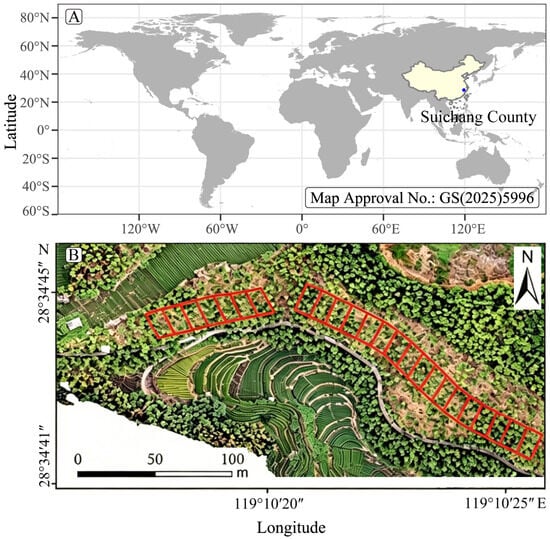
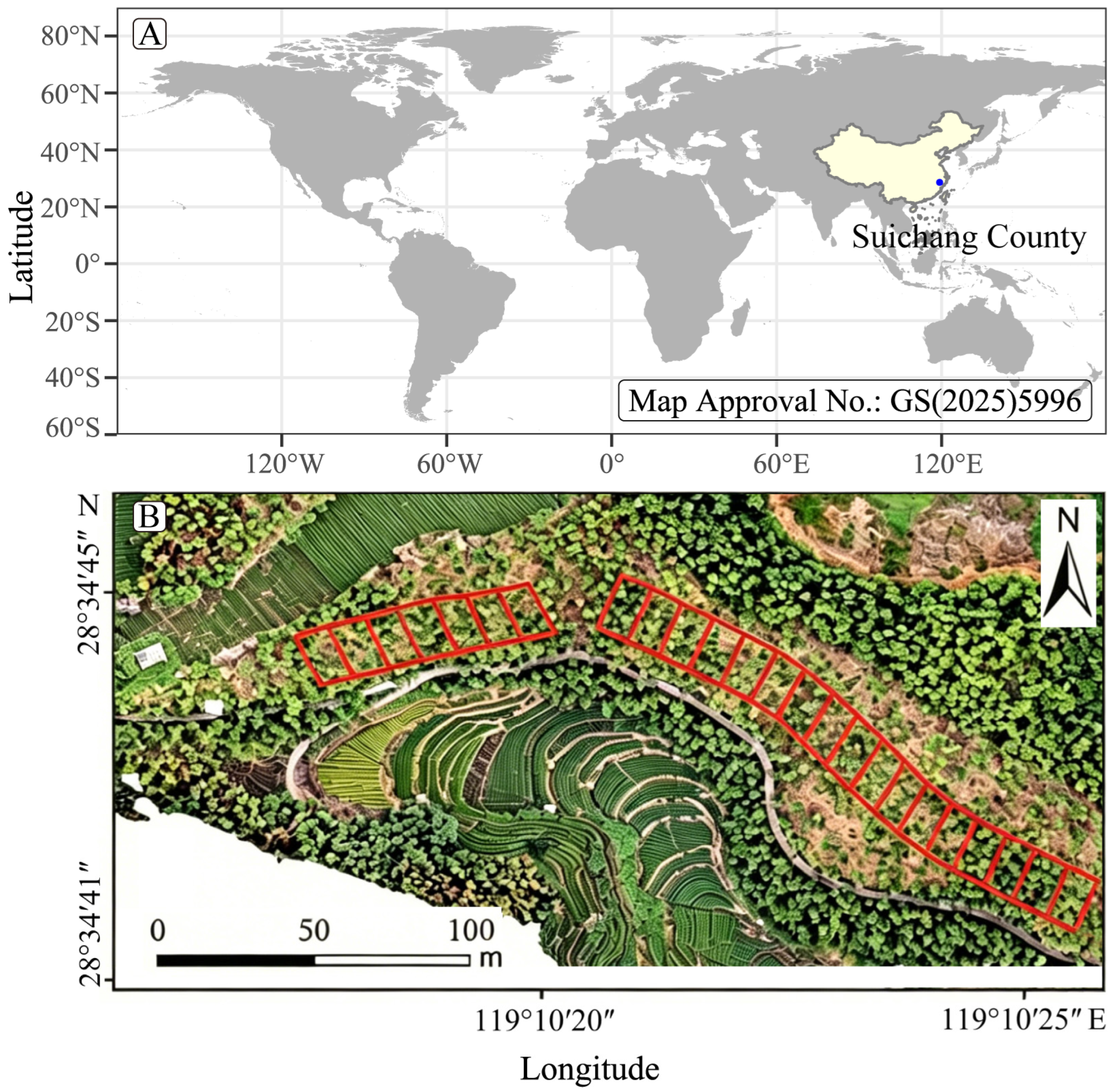
The field experiment was conducted in a managed Moso bamboo forest in Sanren Township, Suichang County, Lishui City, Zhejiang Province, China (28°13′~28°49′ N, 118°41′~119°30′ E). The experimental layout and representative field photographs are shown in Figure 1. The study area is characterized by a mid-subtropical monsoon climate. Based on meteorological observations from the Suichang Meteorological Station during the last ten years, the mean annual temperature is 16.8 °C, the mean annual precipitation is 1510 mm, the number of precipitation days is 172, and the frost-free period is 251 days. According to the soil survey of Suichang County and Chinese Soil Taxonomy, the zonal soil is classified as yellow soil, which corresponds to Udalfs in the USDA Soil Taxonomy.
Figure 1.
Location of the study area of field experimental plots. (A) Geographic location of Suijiang County, China. China is highlighted in light yellow, and the blue dot marks the location of Suijiang County. (B) Spatial layout of the field experimental plots, with red rectangles representing individual plots.
2.2. Experimental Design and Fertilization Treatments
A randomized block design was used with four fertilization treatments and six replicates per treatment, resulting in a total of 24 plots. Each plot measured 10 m × 20 m. The Moso bamboo stands were managed without tillage. The four treatments were: no fertilization (NF), compound fertilizer (CF), sheep manure organic fertilizer combined with compound fertilizer (SOCF), and biochar-based sheep manure organic fertilizer combined with compound fertilizer (BSOCF).
The compound fertilizer (N–P2O5–K2O = 15–15–15) was obtained from Shandong Wonongchun Fertilizer Co., Ltd. (Qingzhou, Shandong, China). The bamboo biochar and sheep manure-based organic fertilizer were supplied by Suichang Lujin Organic Fertilizer Co., Ltd. (Suichang, Lishui, Zhejiang, China). The sheep manure-based organic fertilizer contained 1.33% total N, 2.13% P2O5, and 1.82% K2O. The bamboo biochar had a pH of 8.0, total carbon content of 753 g kg−1, total nitrogen of 9.1 g kg−1, total phosphorus of 5.3 g kg−1, total potassium of 34.7 g kg−1, an ash content of 3%, and a specific surface area of 385 m2 g−1. In the BSOCF treatment, sheep manure-based organic fertilizer and bamboo biochar were mixed at a mass ratio of 70:30 and applied together with compound fertilizer. The bamboo biochar was produced from mature Moso bamboo culms or bamboo-processing residues (bamboo chips/sawdust) derived from stands older than 5 years, and was prepared by pyrolysis at 500 °C under oxygen-limited to nearly oxygen-free conditions.
Fertilization was applied twice in 2024. The first application was conducted on 14 May 2024, with N input standardized across fertilized treatments at 112.5 kg N ha−1. The application rates were as follows: NF, no fertilizer; CF, 750 kg ha−1 compound fertilizer; SOCF, 375 kg ha−1 compound fertilizer plus 4230 kg ha−1 sheep manure organic fertilizer; and BSOCF, 375 kg ha−1 compound fertilizer plus 6040 kg ha−1 of sheep manure organic fertilizer–biochar mixture. A second topdressing was applied on 30 September 2024, with N input standardized across fertilized treatments at 30.375 kg N ha−1. The application rates were: NF, no fertilizer; CF, 203 kg ha−1 compound fertilizer; SOCF, 101 kg ha−1 compound fertilizer plus 1142 kg ha−1 sheep manure organic fertilizer; and BSOCF, 101 kg ha−1 compound fertilizer plus 1631 kg ha−1 of the sheep manure organic fertilizer–biochar mixture.
To reflect common local fertilization practices, three of six replicate plots in each fertilized treatment received fertilizer by hole application, whereas the other three received fertilizer by furrow application. Fertilization method was used only as a field implementation practice and was not treated as an independent experimental factor in this study. In the hole application treatment, fertilizer holes (~10 cm in diameter and 20 cm in depth) were randomly dug at intervals of 2.0–2.5 m, with approximately 1800 holes ha−1, while avoiding bamboo stumps, rhizomes, and large stones. In the furrow application treatment, furrows were opened along the contour lines, with a width and depth of 20 cm and a spacing of 2.5 m. Fertilizer was applied into the furrows and then covered with soil.
2.3. Soil Sampling and Physicochemical Analyses
Soil samples were collected on 22 July 2025, approximately 14 months after the initial fertilization. In each plot, soil was sampled from the top 20 cm soil layer using a 5 cm-diameter stainless-steel auger. This depth was selected because it corresponds to the topsoil where the applied fertilizers were amendments, and where most root activity and nutrient transformations occur. Along an S-shaped transect within each plot, 10–15 cores were collected and combined to form one composite sample per plot. After removing visible roots, litter, and stones, each composite sample was homogenized and divided into two subsamples. One subsample further divided into two portions. One portion was placed in a sealed container and stored at 4 °C for the determination of alkali-hydrolyzable nitrogen (AHN), whereas the other portion was air-dried for the remaining physicochemical analyses. The second subsample was stored at −80 °C for DNA extraction and sequencing [22].
The measured soil physicochemical properties included soil pH, soil organic matter (SOM), total nitrogen (TN), total phosphorus (TP), total potassium (TK), AHN, available phosphorus (AP), and available potassium (AK), following standard procedures described by Bao [23]. Soil pH was measured in a 1:2.5 soil-to-water suspension using a glass electrode (FE28, METTLER TOLEDO, Columbus, OH, USA). Soil organic carbon (SOC) was determined by potassium dichromate oxidation with external heating, and a digital bottle-top burette (Titrette 50 mL, Brand GmbH + Co KG, Wertheim, Germany), and SOM was calculated as SOC × 1.724. Total N was determined by the Kjeldahl method using a Kjeldahl nitrogen analyzer (KN-520, Alva, Jinan, China) after H2SO4 digestion. Total P and total K were determined after NaOH fusion, with P measured by the molybdenum–antimony colorimetric method, using a full-wavelength microplate reader (SpectraMax 190, Molecular Devices, San Jose, CA, USA), and K by flame photometry (FP6450, XinYi Instrument, Shanghai, China). AHN was determined by the alkali diffusion method. AP was extracted with NH4F–HCl solution and determined by the molybdenum–antimony colorimetric method, and AK was extracted with NH4OAc and determined by flame photometry.
2.4. DNA Extraction, PCR Amplification, and Illumina MiSeq Sequencing
Total genomic DNA was extracted from 0.5 g fresh soil using the FastDNA Spin Kit for Soil (MP Biomedicals, Cleveland, OH, USA) according to the manufacturer’s instructions. DNA concentration and purity were determined using an ND-1000 UV–Vis spectrophotometer (NanoDrop ND-1000, NanoDrop Technologies, Wilmington, DE, USA). Qualified DNA samples were stored at −20 °C prior to PCR amplification.
For bacterial community analysis, the V4–V5 region of the 16S rRNA gene was amplified using the universal primers 515F (5′-GTGCCAGCMGCCGCGGTAA-3′) and 907R (5′-CCGTCAATTCCTTTGAGTTT-3′) [24]. Each 20 μL PCR reaction contained 4 μL of 5× FastPfu buffer, 2 μL of 2.5 mmol L−1 dNTPs, 0.8 μL of each primer (5 μmol L−1), 0.4 μL of FastPfu polymerase, 0.2 μL of BSA (10 mg mL−1), 10 ng of template DNA, and nuclease-free water to volume. The thermocycling program consisted of an initial denaturation at 95 °C for 3 min, followed by 35 cycles of 95 °C for 30 s, 55 °C for 30 s, and 72 °C for 60 s, with a final extension at 72 °C for 2 min. For fungal community analysis, the ITS1 region was amplified using the universal primers ITS1F (5′-CTTGGTCATTTAGAGGAAGTAA-3′) and ITS2 (5′-GCTGCGTTCTTCATCGATGC-3′) [25]. Each 20 μL PCR reaction contained 2 μL of 10× buffer, 2 μL of 2.5 mmol L−1 dNTPs, 0.8 μL of each primer (5 μmol L−1), 0.2 μL of rTaq polymerase, 0.2 μL of BSA (10 mg mL−1), 10 ng of template DNA, and nuclease-free water to volume. The thermocycling program consisted of an initial denaturation at 95 °C for 3 min, followed by 25 cycles of 95 °C for 30 s, 55 °C for 30 s, and 72 °C for 60 s, with a final extension at 72 °C for 10 min.
After barcode addition, PCR products were purified using nucleic acid purification magnetic beads, quantified, and pooled at equimolar concentrations. The resulting libraries were sequenced on an Illumina MiSeq PE250 platform (Illumina, San Diego, CA, USA) using a 2 × 250 bp paired-end sequencing strategy.
2.5. Sequence Processing and Taxonomic Annotation
Raw sequencing data were processed using QIIME 2 version 2024.5.1. Quality filtering, denoising, chimera removal, and amplicon sequence variant (ASV) inference were performed using DADA2 (version 2024.5.0) within the QIIME 2 pipeline [26]. Representative bacterial and fungal sequences were taxonomically assigned using the feature-classifier plugin (version 2024.5.0) against the SILVA database (release 138.2; http://www.arb-silva.de; accessed on 8 October 2025) and the UNITE database (version 9.0; https://unite.ut.ee/repository.php; accessed on 8 October 2025), respectively. For downstream analyses, only ASVs occurring in at least 20% of the samples and having a total sequence count of ≥2 were retained. After filtering, a total of 3984 bacterial ASVs and 921 fungal ASVs were obtained.
2.6. Statistical Analysis
All statistical analyses were performed in R version 4.4.1 (R Core Team, 2024), and graphical visualization was mainly conducted using the ggplot2 (v3.5.2) [27] and microeco (v1.15.0) packages [28]. Differences among treatments were analyzed using one-way ANOVA for normally distributed variables, followed by Tukey’s honestly significant difference (HSD) test for multiple comparisons. Variables that did not meet the assumption of normality were analyzed using the Kruskal–Wallis test, followed by Dunn’s test for post hoc multiple comparisons. Statistical significance was set at p < 0.05. Data are presented as mean ± standard error (SE).
Alpha diversity was assessed using the observed ASVs, Chao1, Shannon, and Simpson indices. Beta diversity was calculated based on Bray–Curtis dissimilarity [29], visualized using non-metric multidimensional scaling (NMDS), and tested among treatments using permutational multivariate analysis of variance (PERMANOVA; [30]). Pairwise PERMANOVA was further used for between-treatment comparisons. The homogeneity of multivariate dispersion among treatments was tested using betadisper [31]. Taxonomic composition was summarized at the phylum level for both bacterial and fungal communities. To further identify treatment-responsive taxa, LEfSe (linear discriminant analysis effect size) was used as a supplementary analysis with an LDA score threshold of 2.0 [32]. Spearman correlation analysis was used to assess the relationships between LEfSe-identified bacterial and fungal biomarkers and soil physicochemical properties. Fungal ecological guilds were inferred using FUNGuild [33], and the relative abundances of predicted plant pathogens and arbuscular mycorrhizal fungi (AMF) were compared among treatments. Relationships between soil physicochemical properties and microbial communities were explored using distance-based redundancy analysis (dbRDA; [34]) and Mantel tests [35]. In the Mantel analysis, soil variables were related to bacterial and fungal alpha diversity (Shannon index) and to LEfSe-identified bacterial and fungal biomarkers. For permutation-based analyses, significance was assessed using 999 permutations where applicable.
3. Results
3.1. Soil Physicochemical Properties Under Different Fertilization Treatments
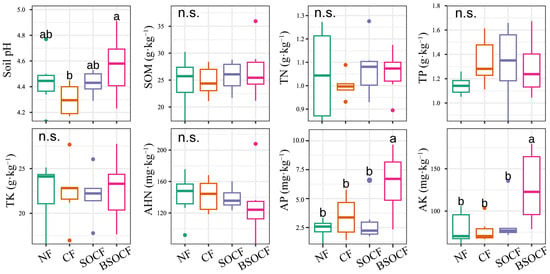
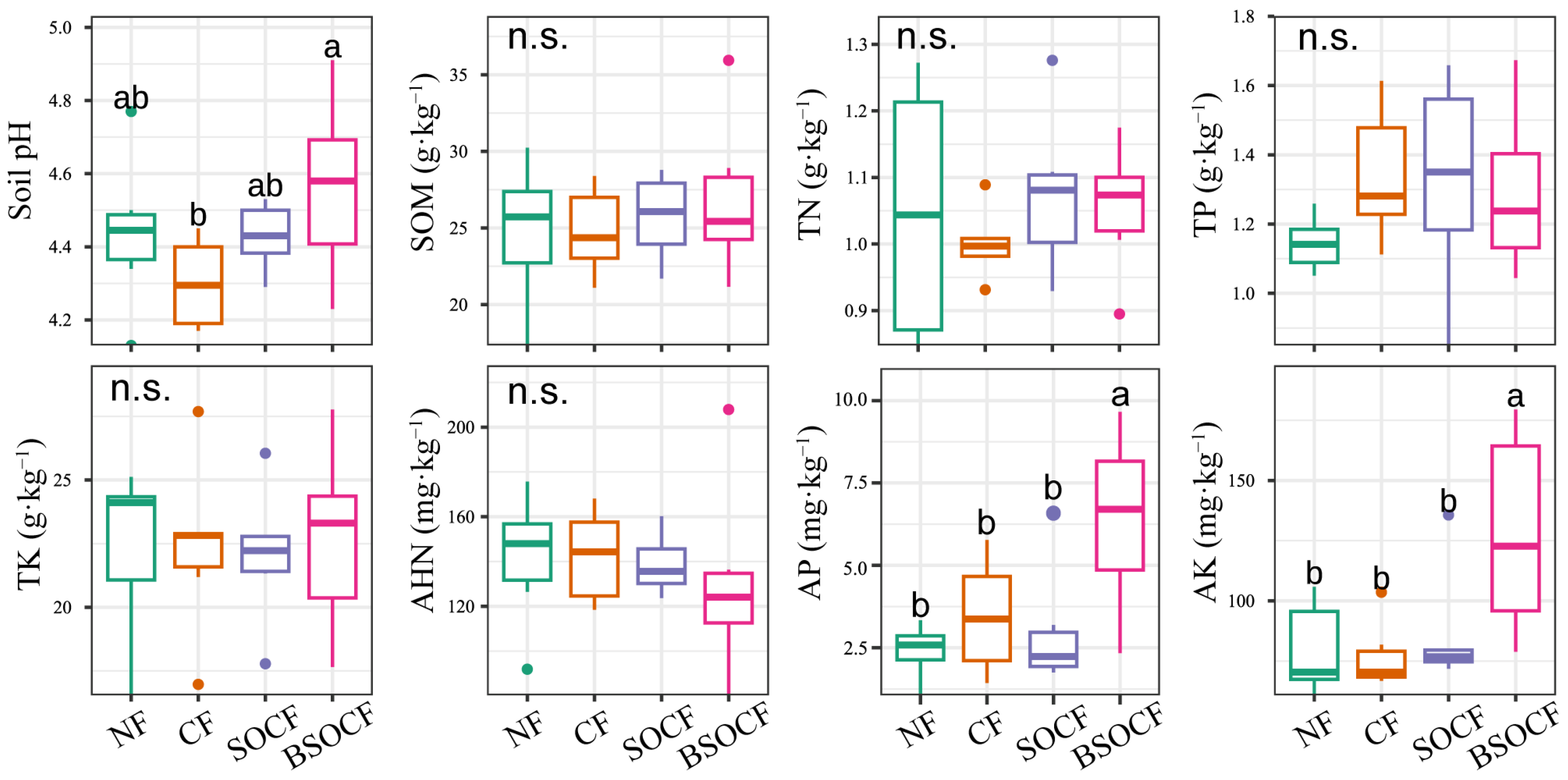
Approximately one year after the initial fertilization, soil physicochemical properties responded differently to the four fertilization treatments (Figure 2). Significant treatment effects were detected for soil pH, available phosphorus (AP), and available potassium (AK), whereas soil organic matter (SOM), total nitrogen (TN), total phosphorus (TP), total potassium (TK), and alkali-hydrolyzable nitrogen (AHN) did not differ significantly among treatments.
Figure 2.
Boxplots showing the effects of different fertilization treatments on soil physicochemical properties. The different colored dots in the figure indicate outliers. NF, no fertilization; CF, compound fertilizer; SOCF, sheep manure organic fertilizer plus compound fertilizer; BSOCF, biochar-based sheep manure organic fertilizer plus compound fertilizer. SOM, soil organic matter; TN, total nitrogen; TP, total phosphorus; TK, total potassium; AHN, alkali-hydrolyzable nitrogen; AP, available phosphorus; AK, available potassium. Groups with the same lowercase letter indicate no significant differences among treatments at p < 0.05, and “n.s.” indicates non-significance (p ≥ 0.05).
Soil pH ranged from 4.30 ± 0.05 to 4.56 ± 0.10 and was significantly higher under BSOCF than under CF, while NF and SOCF showed intermediate values. AP and AK showed a similar pattern, with the highest values observed under BSOCF (6.38 ± 1.10 and 128.16 ± 17.56 mg kg−1, respectively), both of which were significantly higher than those under NF, CF, and SOCF. Overall, BSOCF was associated with higher soil pH, AP, and AK than the other treatments.
3.2. Diversity Patterns of Soil Bacterial and Fungal Communities
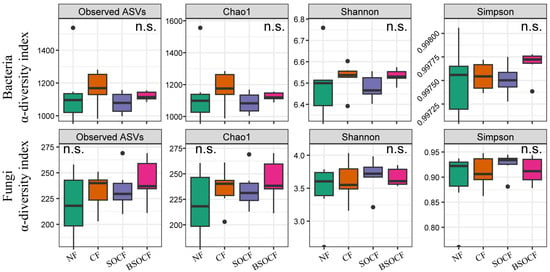
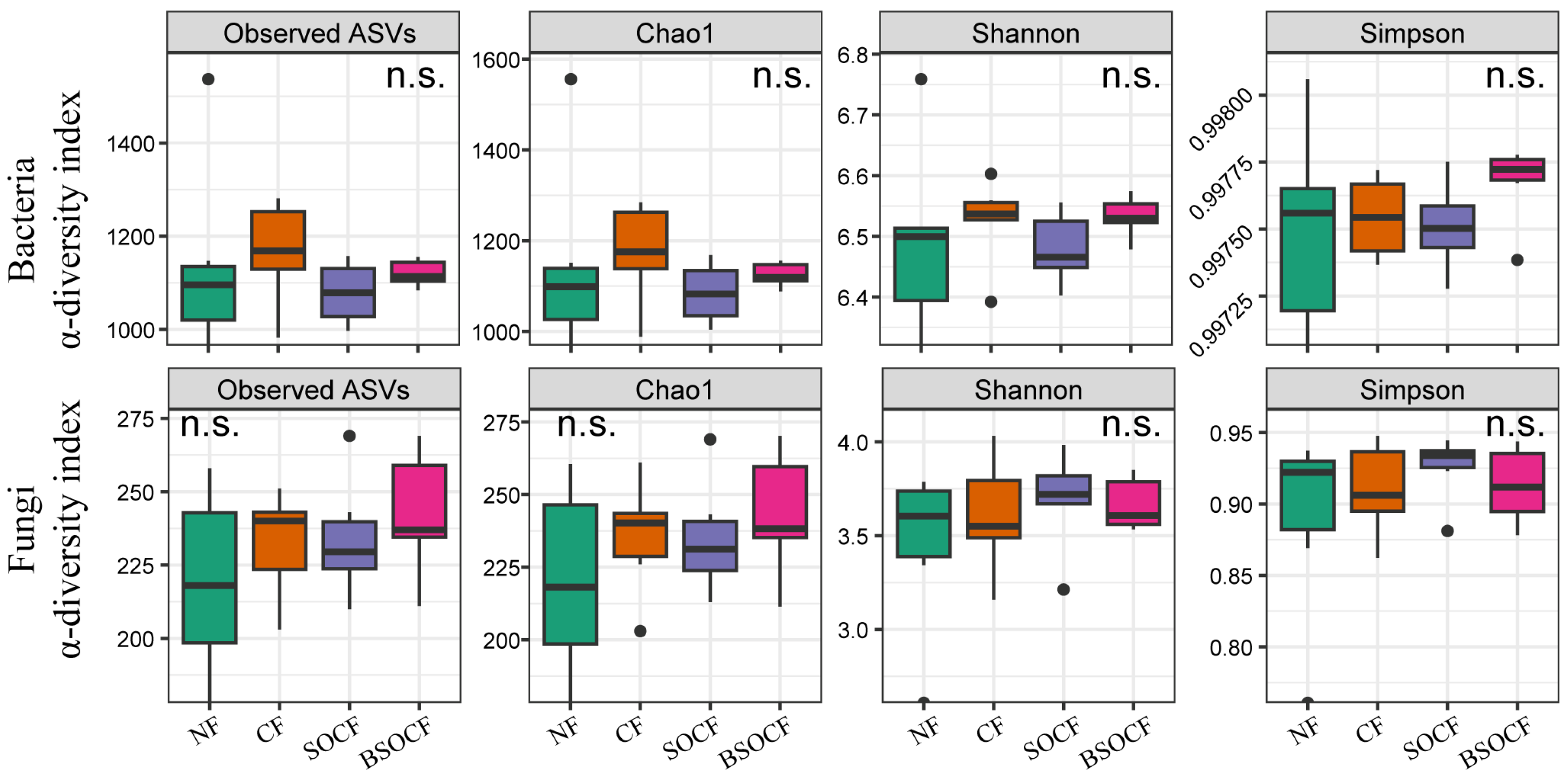
One year after fertilization, alpha diversity did not differ significantly among treatments for either bacterial or fungal communities (Figure 3). No significant differences were detected among NF, CF, SOCF, and BSOCF for any of the alpha diversity indices, including Observed ASVs, Chao1, Shannon, and Simpson indices (p > 0.05). Overall, alpha diversity remained relatively stable across treatments for both communities.
Figure 3.
Boxplots showing the effects of different fertilization treatments on the alpha diversity of soil bacterial and fungal communities. The black dots in the figure indicate outliers. NF, no fertilization; CF, compound fertilizer; SOCF, sheep manure organic fertilizer plus com-pound fertilizer; BSOCF, biochar-based sheep manure organic fertilizer plus compound fertilizer. Groups sharing the same lowercase letter do not differ significantly at p < 0.05, and “n.s.” indicates non-significance (p ≥ 0.05).
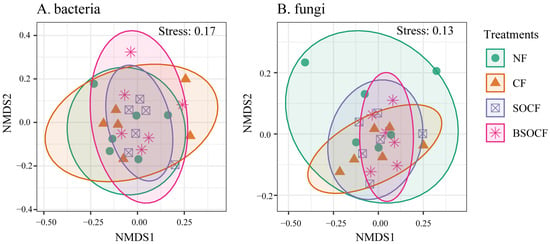
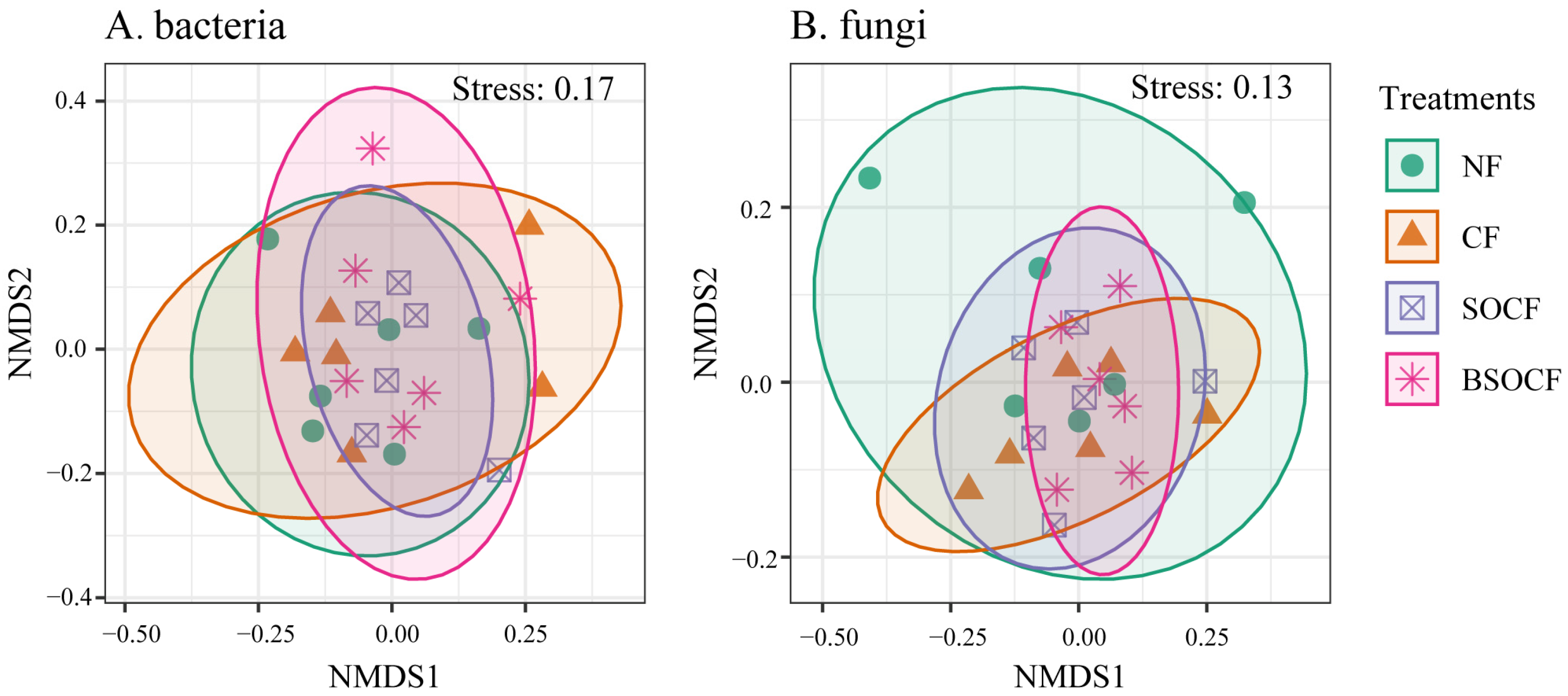
Bray–Curtis-based NMDS ordination showed substantial overlap in both bacterial and fungal community compositions among the four fertilization treatments (Figure 4). Consistent with the ordination patterns, PERMANOVA revealed no significant treatment effect on bacterial community composition (F = 0.791, R2 = 0.106, p = 0.983) or fungal community composition (F = 0.817, R2 = 0.109, p = 0.884) (Table S1A). Pairwise comparisons among treatments were also not significant after p-value adjustment (Table S1B). In addition, betadisper analysis indicated no significant differences in multivariate dispersion among treatments for either bacteria (F = 0.284, p = 0.824) or fungi (F = 1.256, p = 0.321) (Table S1C). Together, these results indicate that fertilization did not significantly alter the beta diversity of soil bacterial or fungal communities during the observation period. Detailed PERMANOVA (Table S1A), pairwise PERMANOVA results (Table S1B), and betadisper results (Table S1C) are provided in Supplemental Materials.
Figure 4.
NMDS ordination of Bray–Curtis dissimilarities showing the beta diversity of soil bacterial (A) and fungal communities (B) under different fertilization treatments. NF, no fertilization; CF, compound fertilizer; SOCF, sheep manure organic fertilizer plus com-pound fertilizer; BSOCF, biochar-based sheep manure organic fertilizer plus compound fertilizer. Each point represents one replicate sample (n = 6). Ellipses represent the 95% confidence interval for each treatment group.
3.3. Taxonomic Composition of Bacterial and Fungal Communities
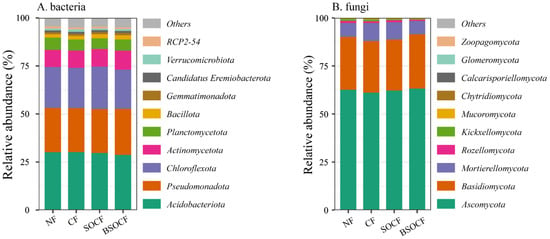
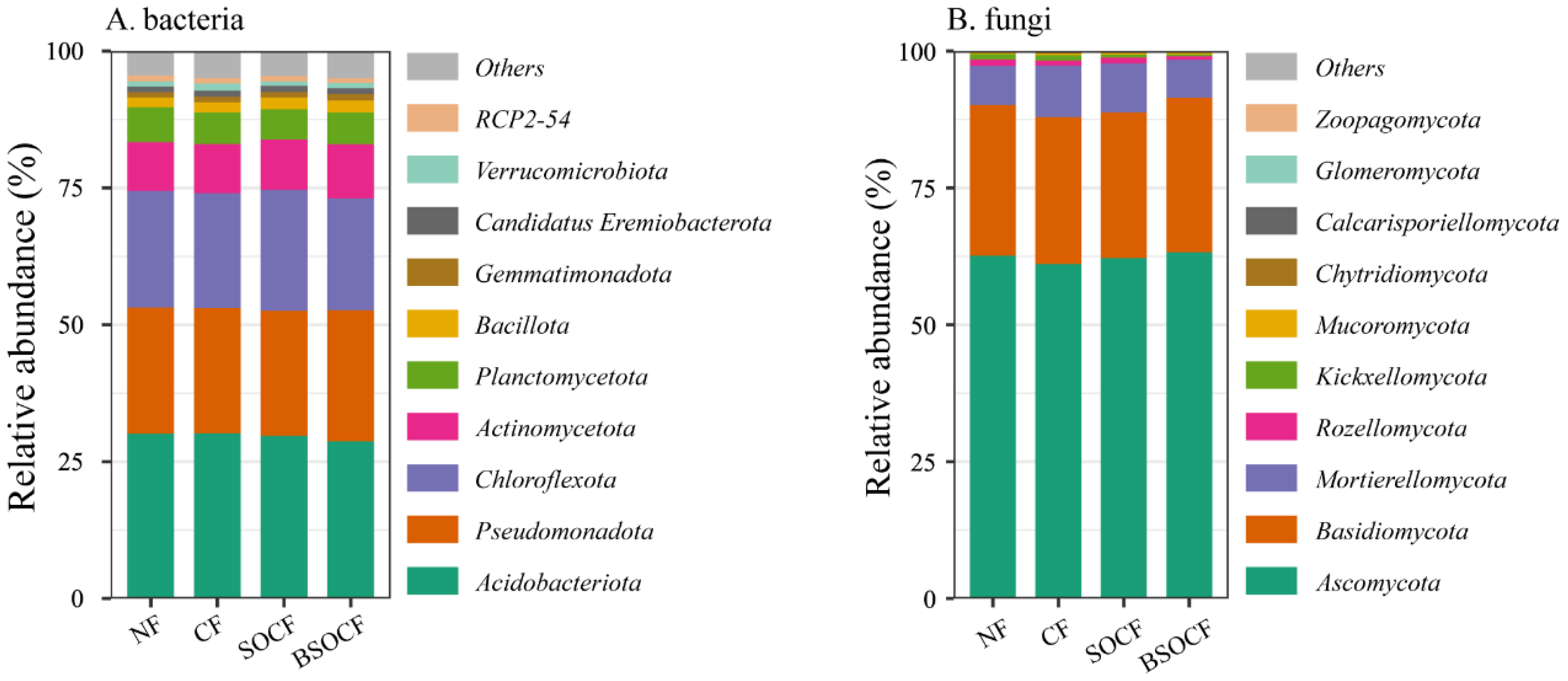
At the phylum level, the bacterial community was dominated by Acidobacteriota, Pseudomonadota, Chloroflexota, Actinomycetota, and Planctomycetota across all treatments (Figure 5A). Acidobacteriota was the most abundant phylum, with relative abundances ranging from 28.71 ± 1.19% to 30.16 ± 0.81%, followed by Pseudomonadota (22.83 ± 0.61% to 23.89 ± 0.66%) and Chloroflexota (20.44 ± 1.76% to 22.09 ± 0.60%). Actinomycetota and Planctomycetota accounted for 8.90 ± 0.38% to 9.91 ± 0.60% and 5.51 ± 0.29% to 6.34 ± 0.28%, respectively.
Figure 5.
Stacked bar plots showing the relative abundances of the dominant phyla in soil bacterial (A) and fungal communities (B). NF, no fertilization; CF, compound fertilizer; SOCF, sheep manure organic fertilizer plus com-pound fertilizer; BSOCF, biochar-based sheep manure organic fertilizer plus compound fertilizer.
The fungal community was mainly composed of Ascomycota, Basidiomycota, and Mortierellomycota (Figure 5B), with relative abundances ranging from 61.11 ± 3.48% to 63.21 ± 3.64%, 26.63 ± 2.58% to 28.25 ± 2.75%, and 6.91 ± 1.10% to 9.42 ± 1.50%, respectively. The remaining fungal phyla occurred at low abundances and were grouped as “Others” in the stacked bar plot. Overall, the phylum-level composition of both bacterial and fungal communities differed only slightly among treatments. Detailed relative abundances, together with the corresponding statistical analyses, for the bacterial and fungal phyla shown in Figure 5 are presented in Table S2A and S2B, respectively. Although variation at the phylum level was limited, LEfSe analysis identified several treatment-specific bacterial and fungal biomarkers (Figures S1A and S2A). For bacteria, NF was enriched in Micrococcales, Micrococcaceae, Arthrobacter, and Ramlibacter; CF in several norank_p__RCP2-54 taxa; and SOCF in Comamonadaceae, Sphingomonas, Ktedonobacterales_bacterium_W12, and several norank_o__C0119 taxa. For fungi, NF was enriched in Agaricales, Pleuroascaceae, and Kickxellomycota; CF in Humicola_brevis; SOCF in Trichosphaeriales, Aspergillus chlamydosporus, and Apiospora_jiangxiensis; and BSOCF in Rhamphoriaceae and Xyloniella.
3.4. Relationships Between Soil Properties and Microbial Communities
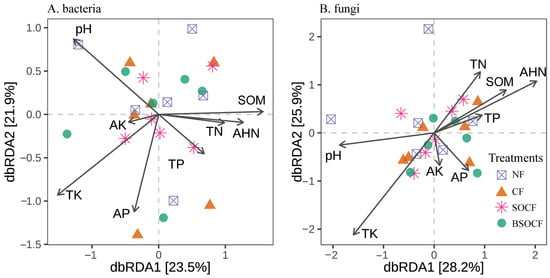
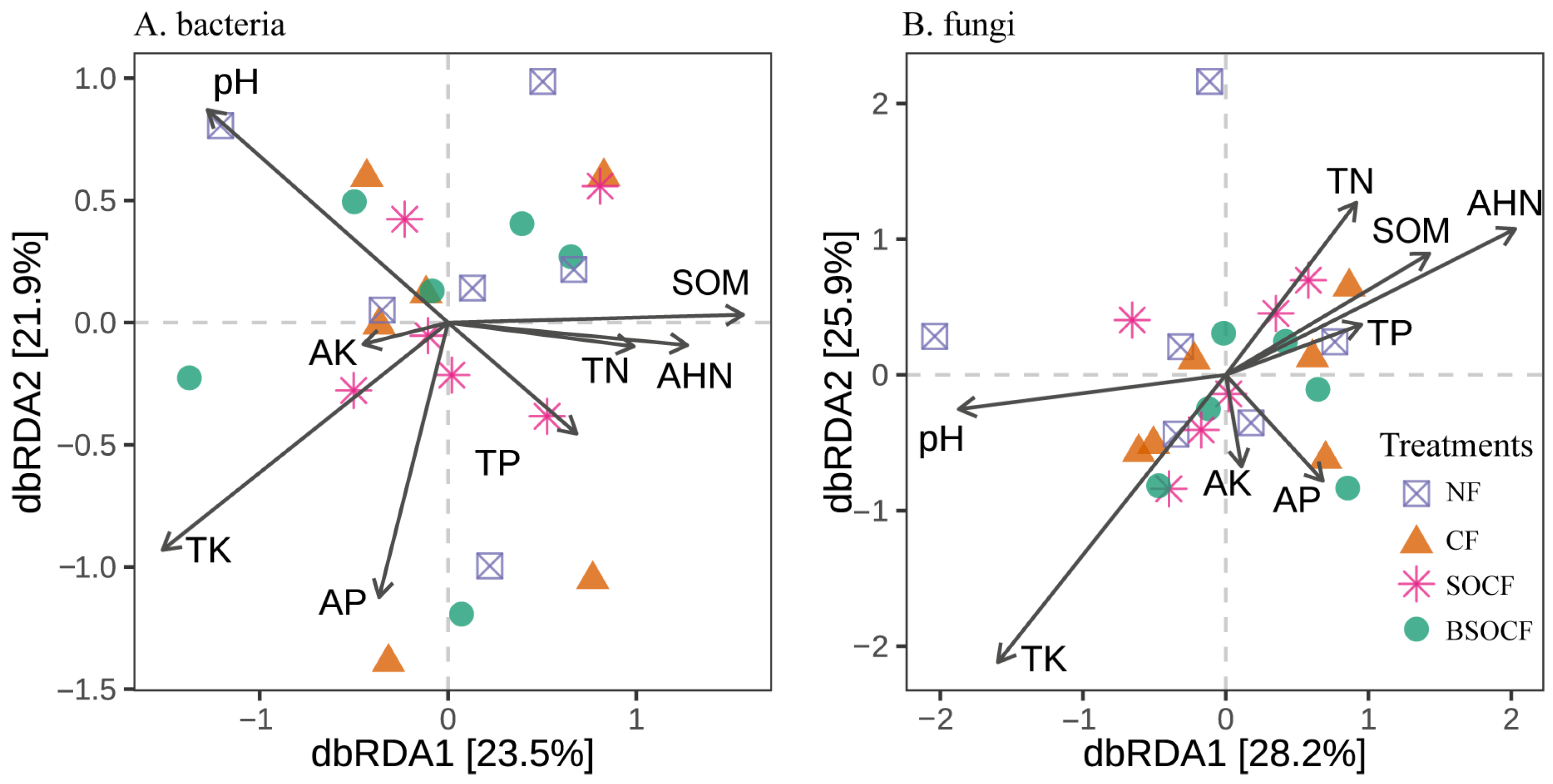
dbRDA indicated that soil physicochemical properties were associated with variation in both bacterial and fungal communities (Figure 6). For bacteria, dbRDA1 and dbRDA2 accounted for 23.5% and 21.9% of the variation represented in the ordination, respectively, whereas for fungi the corresponding values were 28.2% and 25.9%. In the bacterial community, SOM, AHN, and TN were positively associated with dbRDA1, whereas pH and TK were negatively associated with this axis. In the fungal community, TN, SOM, AHN, and TP were positively associated with dbRDA1, whereas pH and TK were negatively associated with dbRDA1.
Figure 6.
Distance-based redundancy analysis (dbRDA) of the relationships between soil physicochemical properties and bacterial (A) and fungal communities (B). Arrows indicate the direction and relative strength of the correlations between soil variables and community variation. NF, no fertilization; CF, compound fertilizer; SOCF, sheep manure organic fertilizer plus com-pound fertilizer; BSOCF, biochar-based sheep manure organic fertilizer plus compound fertilizer. SOM, soil organic matter; TN, total nitrogen; TP, total phosphorus; TK, total potassium; AHN, alkali-hydrolyzable nitrogen; AP, available phosphorus; AK, available potassium.
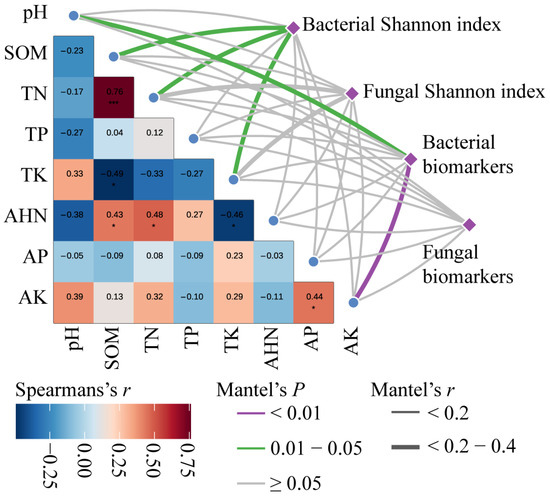
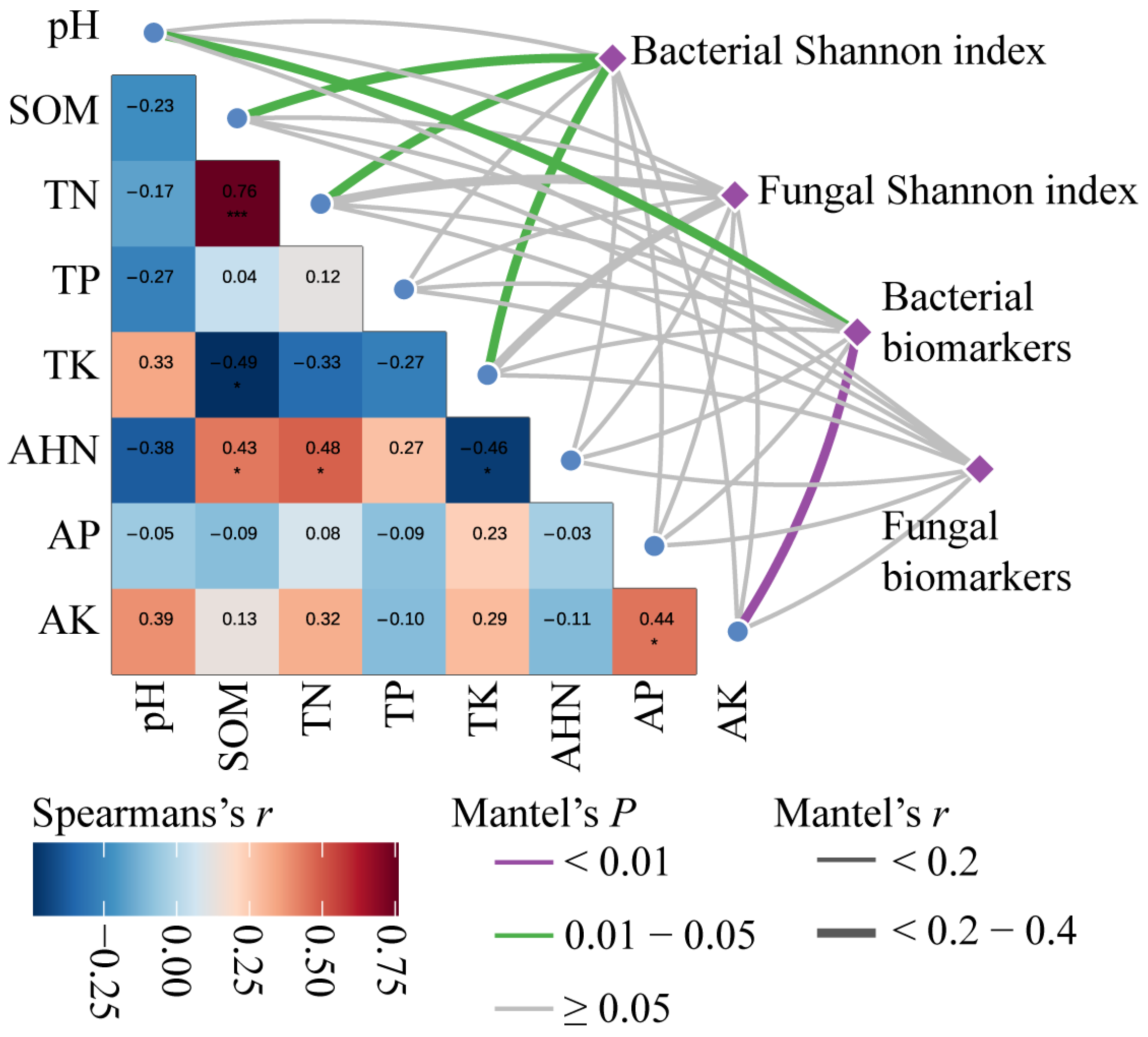
Spearman correlation analysis revealed several significant relationships among soil physicochemical properties (Figure 7). Specifically, SOM was positively correlated with TN (r = 0.76, p < 0.001) and AHN (r = 0.43, p < 0.05), whereas TK was negatively correlated with AHN (r = −0.46, p < 0.05). In addition, AP was positively correlated with AK (r = 0.44, p < 0.05). Mantel tests further showed that several soil properties were significantly associated with bacterial and fungal Shannon diversity, as well as bacterial biomarkers, whereas no significant association was detected for fungal biomarkers. Among these relationships, AK showed the strongest association with bacterial biomarkers (p < 0.01). Together, these results suggest that short-term variation in soil chemical properties was associated with microbial diversity patterns and treatment-enriched microbial taxa.
Figure 7.
Pairwise correlations among soil physicochemical properties are shown, with the color gradient representing Spearman’s correlation coefficients. Soil bacterial and fungal alpha diversity (Shannon index) and bacterial and fungal biomarkers were related to individual soil properties using Mantel tests. Edge width corresponds to Mantel’s r statistic for the corresponding distance correlations, and edge color denotes statistical significance based on 999 permutations. SOM, soil organic matter; TN, total nitrogen; TP, total phosphorus; TK, total potassium; AHN, alkali-hydrolyzable nitrogen; AP, available phosphorus; AK, available potassium. Significance levels are indicated as * p < 0.05, *** p < 0.001.
Supplementary analyses further supported the patterns detected by dbRDA and Mantel tests. LEfSe-based correlation analyses showed that the bacterial biomarkers LEfSe-based correlation analysis showed that the bacterial biomarkers enriched in the CF treatment, particularly members of the phylum p_RCP2-54, were negatively correlated with AK and AP, whereas biomarkers enriched in the other treatments, including Arthrobacter, Micrococcaceae, and Comamonadaceae, were positively correlated with these variables (Figure S1B). In contrast, fungal biomarkers showed fewer and weaker correlations with soil variables, although some taxa were significantly associated with TK, AK, AP, and pH (Figure S2B). FUNGuild prediction further indicated that the relative abundance of plant pathogens was significantly higher in CF than in SOCF and BSOCF. However, no significant differences were detected in the relative abundance of arbuscular mycorrhizal fungi (AMF) among treatments (Figure S3).
4. Discussion
4.1. Short-Term Responses of Soil Properties to Fertilization
Short-term fertilization in the Moso bamboo forest primarily affected relatively labile soil properties, with significant changes detected only in pH, AP, and AK, while SOM, TN, TP, TK, and AHN remained unchanged. This suggests that, over the present time scale, fertilization effects were expressed mainly in labile chemical properties rather than in total nutrient pools, which generally show slower turnover and stronger buffering in forest soils [36].
The lower pH under CF than under BSOCF suggests that mineral fertilization alone promoted soil acidification, whereas the biochar-based organic fertilizer partly buffered this effect. Similar responses have been widely reported for biochar-containing amendments, which can increase soil buffering capacity through alkaline ash inputs, surface functional groups, and cation retention [37,38,39]. However, the magnitude of the pH response was limited. This suggests that the acidification-mitigating effect of the biochar-based amendment was detectable but still modest after one year.
BSOCF also produced the highest AP and AK values, indicating a stronger effect on P and K availability than CF or SOCF. This response may reflect improved nutrient retention and gradual nutrient release associated with the biochar component, which can reduce leaching losses and enhance the retention of exchangeable cations and phosphate in soil [40,41]. In contrast, the absence of short-term changes in SOM and total nutrient pools is consistent with the relatively slow response of stable organic matter and bulk nutrient stocks in forest soils to recent management inputs [42,43,44]. Taken together, these results indicate that the biochar-based treatment primarily affected nutrient availability and acidity status rather than inducing a broad shift in soil nutrient stocks.
4.2. Responses of Bacterial and Fungal Communities to Fertilization
Bacterial and fungal communities responded only weakly to short-term fertilization, with no significant changes in alpha diversity among treatments (Figure 3). Similarly, beta-diversity analyses showed substantial overlap in bacterial and fungal community composition across treatments, suggesting that fertilization did not cause clear shifts in overall community structure at the plot scale (Figure 4). These findings indicate that both bacterial and fungal communities were relatively stable under the short-term field conditions examined here. Such stability may reflect the buffering capacity of forest soils, where microbial communities are shaped by long-term soil properties, organic matter availability, and plant–soil interactions [45].
In addition, the relatively weak microbial response observed here may also be partly related to the localized mode of fertilizer application and the plot-level composite sampling strategy [46]. The limited response may also be related to the localized placement of fertilizers, which likely caused treatment effects to occur mainly at the microsite scale. In addition, the use of composite soil samples may have diluted these local signals and reduced the detectability of treatment effects. Therefore, the limited short-term responses observed in bacterial and fungal communities may reflect both ecological resistance and the reduced detectability of localized fertilization effects in bamboo forest soils.
4.3. Soil Properties as Potential Drivers of Selective Microbial Responses
Multivariate analyses suggest that the limited microbial variation observed during the study period was associated with shifts in soil physicochemical properties. In the dbRDA ordinations, SOM, AHN, and TN were aligned with bacterial variation, whereas TN, SOM, AHN, and TP were more closely associated with fungal variation (Figure 6). Mantel tests further showed significant associations of several soil properties with bacterial Shannon diversity, fungal Shannon diversity, and bacterial biomarkers, with AK showing the strongest association with bacterial biomarkers (Figure 7). These results indicate that the modest microbial responses detected here were related to coordinated changes in multiple soil variables rather than to a single dominant factor [46,47,48].
Among the measured variables, soil pH, AP, and AK appear particularly relevant. Soil pH is a well-known ecological filter for microorganisms because it influences nutrient solubility, enzyme activity, membrane transport, and competitive interactions, and has repeatedly been identified as a major predictor of soil microbial community composition across spatial scales [8,49]. In this study, these variables were linked to overall patterns of microbial variation, suggesting that shifts in soil chemical conditions may have influenced the responses of specific taxa. Although these relationships do not demonstrate direct causal effects, they suggest that variation in P and K availability deserves greater attention in studies of fertilized bamboo forest soils [50,51].
The significant correlations among SOM, TN, and AHN further indicate that fertilization altered a set of interrelated soil properties. Such co-varying variables may jointly influence microbial habitats by modifying substrate supply, nutrient availability, and local chemical conditions [22,52]. This interpretation is consistent with the supplementary LEfSe results and biomarker–soil correlation heatmaps, which showed that bacterial biomarkers such as members of Micrococcales, Arthrobacter, and Ramlibacter, as well as fungal biomarkers including Trichosphaeriales, Rhamphoriaceae, and Xylolentia, were associated with pH, AP, or AK (Figures S1B and S2B). Thus, although the overall microbial community did not show strong treatment separation, the variation in selected taxa appears to have been environmentally structured.
The supplementary FUNGuild results should be interpreted with caution. CF showed a significantly higher relative abundance of predicted plant pathogens than SOCF and BSOCF, whereas arbuscular mycorrhizal fungi did not differ significantly among treatments. Because these guild assignments are inference-based, they do not provide direct evidence of functional change [33]. Overall, the results indicate that short-term fertilization in the Moso bamboo forest was associated with changes in selected soil chemical properties and with subtle, taxon-specific microbial variation rather than with strong whole-community reorganization.
4.4. Implications, Limitations, and Future Perspectives
Overall, our results indicate that one year of fertilization did not lead to strong plot-scale reorganization of soil bacterial or fungal communities in the Moso bamboo forest. Instead, fertilization effects were relatively weak and were mainly reflected in changes in selected soil chemical properties and in the relative abundance of specific microbial taxa. This pattern suggests that short-term microbial responses in bamboo forest soils are likely to be subtle and environmentally structured rather than expressed as clear whole-community shifts.
A further consideration is the spatially localized nature of fertilization in bamboo plantations. Because fertilizers were applied in holes or trenches and the soil was not tilled, nutrient inputs were likely unevenly distributed within plots, with stronger effects near fertilization points. Under these conditions, composite sampling along an S-shaped route may have averaged localized responses with less affected soil, thereby reducing the detectability of treatment effects at the plot scale. The weak short-term differences observed here may therefore reflect both ecological resistance of forest soil microbial communities and the patchy spatial expression of fertilization effects.
Future studies should combine longer-term experiments with spatially explicit sampling around fertilization points. This would better distinguish localized responses from broader plot-scale changes. Increasing the sampling frequency would also provide more information over time and help detect changes that may otherwise be missed. Integrating taxonomic analyses with direct measurements of microbial function would also help determine whether the selective microbial shifts observed in this study have ecological consequences for nutrient cycling and bamboo forest soil management.
5. Conclusions
Different fertilization regimes induced selective short-term changes in soil physicochemical properties and associated microbial communities in the Moso bamboo forest. Soil pH, available phosphorus, and available potassium were the responsive variables, and biochar-based sheep manure organic fertilizer showed the strongest effect. Bacterial and fungal communities responded differently to fertilization. Fungal alpha diversity was more sensitive, whereas bacterial richness remained relatively stable. In contrast, overall community composition changed only slightly among treatments. Overall, these findings are broadly consistent with our hypotheses, indicating that fertilization regimes differentially affected soil properties and microbial responses, and that biochar-based sheep manure organic fertilizer was more effective than conventional organic fertilizer in improving soil conditions without strongly altering overall microbial community structure. Because this study was based on a single sampling event about one year after the initial fertilization, longer-term studies are needed to test the persistence and functional significance of these effects.
Supplementary Materials
The following supporting information can be downloaded at: https://www.mdpi.com/article/10.3390/f17060659/s1, Table S1: Results of PERMANOVA (A), pairwise PERMANOVA (B), and tests for homogeneity of multivariate dispersion (betadisper) results (C) for bacterial and fungal communities under different fertilization treatments; Table S2: Relative abundances (%) of the bacterial (A) and fungal phyla (B) shown in Figure 5 under different fertilization treatments; Figure S1: LEfSe-identified bacterial biomarkers and their correlations with soil physicochemical properties under different fertilization treatments in a moso bamboo forest; Figure S2: LEfSe-identified fungal biomarkers and their correlations with soil physicochemical properties under different fertilization treatments in a moso bamboo forest; Figure S3: Relative abundances of FUNGuild-predicted plant pathogens and arbuscular mycorrhizal fungi (AMF) under different fertilization treatments in a moso bamboo forest.
Author Contributions
Conceptualization, X.L., Q.Z. and A.J.; Methodology, D.C. and Q.Z.; Validation, D.C., W.Q. and L.H.; Formal analysis, Z.C. and D.C.; Investigation, D.C., W.Q. and L.H.; Resources, Z.C., D.C., W.Q. and L.H.; Data curation, D.C.; Writing—original draft, Z.C.; Writing—review & editing, Z.C., D.C. and X.L.; Visualization, Z.C. All authors have read and agreed to the published version of the manuscript.
Funding
This research was funded by the Sui-chang County Forestry Carbon Sequestration Pilot Project for Enhancing Carbon Sink Capacity, grant number HXA-2024046, and the Research on the Mechanism for Realization of Bamboo Forest Ecological Product Value, grant number FGLS202212. The APC was funded by the Sui-chang County Forestry Carbon Sequestration Pilot Project for Enhancing Carbon Sink Capacity (HXA-2024046).
Data Availability Statement
Data will be made available on request.
Acknowledgments
We gratefully acknowledge Researcher Yongxin Liu for his assistance with microbiome data analysis.
Conflicts of Interest
The authors declare no conflicts of interest.
References
- Zheng, Y.; Feng, Y.; Fan, S.; Zhang, M.; Zhang, X.; Zhou, X.; Guan, F. Effects of Different Harvesting Methods on Aboveground Nutrient Pools of Moso Bamboo (Phyllostachys edulis) Forest in China. Forests 2022, 13, 2138. [Google Scholar] [CrossRef] [Scilit]
- Ni, H.J.; Su, W.H. Spatial distribution of fine root traits in relation to soil properties and aggregate stability of intensively managed Moso bamboo (Phyllostachys edulis) plantations in subtropical China. Plant Soil 2024, 498, 487–503. [Google Scholar] [CrossRef] [Scilit]
- Liu, Y.H.; Nessa, A.; Zheng, Q.Y.; Hu, D.N.; Zhang, W.Y.; Zhang, M.Y. Inoculations of phosphate-solubilizing bacteria alter soil microbial community and improve phosphorus bioavailability for moso bamboo (Phyllostachys edulis) growth. Appl. Soil Ecol. 2023, 189, 104911. [Google Scholar] [CrossRef] [Scilit]
- Philippot, L.; Chenu, C.; Kappler, A.; Rillig, M.C.; Fierer, N. The interplay between microbial communities and soil properties. Nat. Rev. Microbiol. 2024, 22, 226–239. [Google Scholar] [CrossRef] [Scilit]
- Cao, Y.S.; Zhao, F.L.; Zhao, R.D.; Ren, J.S.; Zhu, T.B.; Zhang, F. Impact of nitrogen addition on soil organic carbon across ecosystems: Microbial roles and environmental regulation. Geoderma 2025, 461, 117501. [Google Scholar] [CrossRef] [Scilit]
- Wang, Y.F.; Chen, P.; Wang, F.H.; Han, W.X.; Qiao, M.; Dong, W.X.; Hu, C.S.; Zhu, D.; Chu, H.Y.; Zhu, Y.G. The ecological clusters of soil organisms drive the ecosystem multifunctionality under long-term fertilization. Environ. Int. 2022, 161, 107133. [Google Scholar] [CrossRef] [Scilit]
- Wang, C.Q.; Kuzyakov, Y. Mechanisms and implications of bacterial-fungal competition for soil resources. ISME J. 2024, 18, wrae073. [Google Scholar] [CrossRef] [Scilit]
- Yavitt, J.B.; Roco, C.A.; Debenport, S.J.; Barnett, S.E.; Shapleigh, J.P. Community Organization and Metagenomics of Bacterial Assemblages Across Local Scale pH Gradients in Northern Forest Soils. Microb. Ecol. 2021, 81, 758–769. [Google Scholar] [CrossRef] [Scilit]
- Wang, J.F.; Yang, X.Y.; Huang, S.M.; Wu, L.; Cai, Z.J.; Xu, M.G. Long-term combined application of organic and inorganic fertilizers increases crop yield sustainability by improving soil fertility in maize-wheat cropping systems. J. Integr. Agric. 2025, 24, 290–305. [Google Scholar] [CrossRef] [Scilit]
- Yang, J.K.; Ren, Y.N.; Jia, M.K.; Huang, S.M.; Guo, T.F.; Liu, B.Y.; Liu, H.E.; Zhao, P.; Wang, L.; Jie, X.L. Improving soil quality and crop yield of fluvo-aquic soils through long-term organic-inorganic fertilizer combination: Promoting microbial community optimization and nutrient utilization. Environ. Technol. Innov. 2025, 37, 104050. [Google Scholar] [CrossRef] [Scilit]
- Qaswar, M.; Jing, H.; Ahmed, W.; Li, D.C.; Liu, S.J.; Lu, Z.; Cai, A.D.; Liu, L.S.; Xu, Y.M.; Gao, J.S.; et al. Yield sustainability, soil organic carbon sequestration and nutrients balance under long-term combined application of manure and inorganic fertilizers in acidic paddy soil. Soil Tillage Res. 2020, 198, 104569. [Google Scholar] [CrossRef] [Scilit]
- Yuan, Y.H.; Zhang, J.C.; Feng, Z.R.; Zhang, Q.; Zhao, Z.H.; Li, Q.; Zhang, S.Q.; Wei, G.H.; Han, X.H.; Xu, M.G.; et al. Microbial traits mediate the functional components of soil organic carbon under long-term fertilization. Appl. Soil Ecol. 2026, 219, 106798. [Google Scholar] [CrossRef] [Scilit]
- Zhu, S.F.; Liang, P.L.; Yang, L.P.; Wei, B.H.; Han, S.J.; Wu, M.Y.; He, X.Y.; Zeng, W.C.; He, Z.L.; Xiao, J.M.; et al. Effects of Biochar-Based Fertilizers on Fenlong-Ridging Soil Physical Properties, Nutrient Activation, Enzyme Activity, Bacterial Diversity, and Sugarcane Yield. Agronomy 2025, 15, 1594. [Google Scholar] [CrossRef] [Scilit]
- Hu, W.; Zhang, Y.P.; Rong, X.M.; Fei, J.C.; Peng, J.W.; Luo, G.W. Coupling amendment of biochar and organic fertilizers increases maize yield and phosphorus uptake by regulating soil phosphatase activity and phosphorus-acquiring microbiota. Agric. Ecosyst. Environ. 2023, 355, 108582. [Google Scholar] [CrossRef] [Scilit]
- Joseph, S.; Cowie, A.L.; Van Zwieten, L.; Bolan, N.; Budai, A.; Buss, W.; Cayuela, M.L.; Graber, E.R.; Ippolito, J.A.; Kuzyakov, Y.; et al. How biochar works, and when it doesn’t: A review of mechanisms controlling soil and plant responses to biochar. GCB Bioenergy 2021, 13, 1731–1764. [Google Scholar] [CrossRef] [Scilit]
- Luo, P.Y.; Zhang, W.K.; Xiao, D.; Hu, J.J.; Li, N.; Yang, J.F. Biochar-Based Fertilizers: Advancements, Applications, and Future Directions in Sustainable Agriculture—A Review. Agronomy 2025, 15, 1104. [Google Scholar] [CrossRef] [Scilit]
- Deshoux, M.; Sadet-Bourgeteau, S.; Gentil, S.; Prévost-Bouré, N.C. Effects of biochar on soil microbial communities: A meta-analysis. Sci. Total Environ. 2023, 902, 166079. [Google Scholar] [CrossRef] [Scilit] [PubMed]
- Xie, N.H.; Fan, Y.C.; Duan, N.; Yang, L.; Radosevich, M.; Zhang, Y.; Wang, Y.F.; Wang, J.K.; Liang, X.L. Interactive effects of straw and biochar amendments on soil organic carbon stabilization and bacterial community dynamics. Biol. Fertil. Soils 2025, 61, 1423–1437. [Google Scholar] [CrossRef] [Scilit]
- Cao, X.Q.; Liu, J.L.; Zhang, L.L.; Mao, W.J.; Li, M.; Wang, H.; Sun, W.L. Response of soil microbial ecological functions and biological characteristics to organic fertilizer combined with biochar in dry direct-seeded paddy fields. Sci. Total Environ. 2024, 948, 174844. [Google Scholar] [CrossRef] [Scilit]
- Zhang, S.B.; Li, Y.F.; Singh, B.P.; Wang, H.L.; Cai, X.Q.; Chen, J.H.; Qin, H.; Li, Y.C.; Chang, S.X. Contrasting short-term responses of soil heterotrophic and autotrophic respiration to biochar-based and chemical fertilizers in a subtropical Moso bamboo plantation. Appl. Soil Ecol. 2021, 157, 103758. [Google Scholar] [CrossRef] [Scilit]
- Chu, H.Y.; Su, W.H.; Zhou, Y.Q.; Wang, Z.Y.; Long, Y.M.; Sun, Y.T.; Fan, S.H. Enzyme Activity Stoichiometry Suggests That Fertilization, Especially Nitrogen Fertilization, Alleviates Nutrient Limitation of Soil Microorganisms in Moso Bamboo Forests. Forests 2024, 15, 1040. [Google Scholar] [CrossRef] [Scilit]
- Ding, Z.L.; Gong, L.; Zhu, H.Q.; Tang, J.H.; Li, X.C.; Zhang, H. Changes in Soil Microbial Communities under Mixed Organic and Inorganic Nitrogen Addition in Temperate Forests. Forests 2023, 14, 21. [Google Scholar] [CrossRef] [Scilit]
- Bao, S.D. Soil Agricultural Chemical Analysis, 3rd ed.; China Agricultural Press: Beijing, China, 2000; pp. 265–267. [Google Scholar]
- Biddle, J.F.; Fitz-Gibbon, S.; Schuster, S.C.; Brenchley, J.E.; House, C.H. Metagenomic signatures of the Peru Margin subseafloor biosphere show a genetically distinct environment. Proc. Natl. Acad. Sci. USA 2008, 105, 10583–10588. [Google Scholar] [CrossRef] [Scilit] [PubMed]
- Bokulich, N.A.; Mills, D.A. Improved Selection of Internal Transcribed Spacer-Specific Primers Enables Quantitative, Ultra-High-Throughput Profiling of Fungal Communities. Appl. Environ. Microbiol. 2013, 79, 2519–2526. [Google Scholar] [CrossRef] [Scilit] [PubMed]
- Callahan, B.J.; McMurdie, P.J.; Rosen, M.J.; Han, A.W.; Johnson, A.J.A.; Holmes, S.P. DADA2: High-resolution sample inference from Illumina amplicon data. Nat. Methods 2016, 13, 581–583. [Google Scholar] [CrossRef] [Scilit] [PubMed]
- Ginestet, C. ggplot2: Elegant Graphics for Data Analysis. J. R. Stat. Soc. Ser. A-Stat. Soc. 2011, 174, 245. [Google Scholar] [CrossRef] [Scilit]
- Liu, C.; Cui, Y.; Li, X.; Yao, M. microeco: An R package for data mining in microbial community ecology. FEMS Microbiol. Ecol. 2021, 97, fiaa255. [Google Scholar] [CrossRef] [Scilit]
- Bray, J.R.; Curtis, J.T. An ordination of the upland forest communities of southern wisconsin. Ecol. Monogr. 1957, 27, 326–349. [Google Scholar] [CrossRef] [Scilit]
- Anderson, M.J. A new method for non-parametric multivariate analysis of variance. Austral. Ecol. 2001, 26, 32–46. [Google Scholar] [CrossRef] [Scilit]
- Anderson, M.J. Distance-based tests for homogeneity of multivariate dispersions. Biometrics 2006, 62, 245–253. [Google Scholar] [CrossRef] [Scilit]
- Segata, N.; Izard, J.; Waldron, L.; Gevers, D.; Miropolsky, L.; Garrett, W.S.; Huttenhower, C. Metagenomic biomarker discovery and explanation. Genome Biol. 2011, 12, R60. [Google Scholar] [CrossRef] [Scilit] [PubMed]
- Nguyen, N.H.; Song, Z.W.; Bates, S.T.; Branco, S.; Tedersoo, L.; Menke, J.; Schilling, J.S.; Kennedy, P.G. FUNGuild: An open annotation tool for parsing fungal community datasets by ecological guild. Fungal Ecol. 2016, 20, 241–248. [Google Scholar] [CrossRef] [Scilit]
- Legendre, P.; Anderson, M.J. Distance-based redundancy analysis: Testing multispecies responses in multifactorial ecological experiments. Ecol. Monogr. 1999, 69, 1–24. [Google Scholar] [CrossRef]
- Mantel, N. Detection of disease clustering and a generalized regression approach. Cancer Res. 1967, 27, 209–220. [Google Scholar]
- Wang, X.D.; Wu, A.Q.; Chen, F.S.; Fang, X.M.; Wang, H.M.; Wang, F.C. Contrasting Effects of Nitrogen Deposition and Phosphorus Addition on Soil Organic Carbon in a Subtropical Forest: Physical Protection versus Chemical Stability. Forests 2024, 15, 385. [Google Scholar] [CrossRef] [Scilit]
- Feng, X.Q.; Xia, W.L.; Tang, L.Z.; Qian, Z.Z. Effects of Co-Application of Calcium Peroxide and Biochar on Soil Properties and Bamboo Belowground Biomass Under Mulching Condition. Land Degrad. Dev. 2026, in press. [Google Scholar] [CrossRef] [Scilit]
- Zhou, J.S.; Zhang, S.B.; Lv, J.Y.; Tang, C.X.; Zhang, H.B.; Fang, Y.Y.; Tavakkoli, E.; Ge, T.D.; Luo, Y.; Cai, Y.J.; et al. Maize straw increases while its biochar decreases native organic carbon mineralization in a subtropical forest soil. Sci. Total Environ. 2024, 939, 173606. [Google Scholar] [CrossRef] [Scilit]
- Liang, B.; Lehmann, J.; Solomon, D.; Kinyangi, J.; Grossman, J.; O’Neill, B.; Skjemstad, J.O.; Thies, J.; Luizao, F.J.; Petersen, J.; et al. Black Carbon increases cation exchange capacity in soils. Soil Sci. Soc. Am. J. 2006, 70, 1719–1730. [Google Scholar] [CrossRef] [Scilit]
- Ma, D.N.; Wang, Y.F.; Zheng, T.; Zhou, Q.X.; Sheng, J.D. Synergy of Biochar and Organic Fertilizer Reduces Phosphorus Leaching. Agronomy 2025, 15, 2528. [Google Scholar] [CrossRef] [Scilit]
- He, W.; Zhang, J.; Gao, W.C.; Chen, Y.F.; Wei, Z. Enhancing phosphorus availability and dynamics in acidic soils through Rice straw biochar application: A sustainable alternative to chemical fertilizers. Front. Sustain. Food Syst. 2025, 9, 1506609. [Google Scholar] [CrossRef] [Scilit]
- Doetterl, S.; Berhe, A.A.; Heckman, K.; Lawrence, C.; Schnecker, J.; Vargas, R.; Vogel, C.; Wagai, R. A landscape-scale view of soil organic matter dynamics. Nat. Rev. Earth Environ. 2025, 6, 67–81. [Google Scholar] [CrossRef] [Scilit]
- Turner, B.L.; Yavitt, J.B.; Harms, K.E.; Garcia, M.N.; Wright, S.J. Seasonal changes in soil organic matter after a decade of nutrient addition in a lowland tropical forest. Biogeochemistry 2015, 123, 221–235. [Google Scholar] [CrossRef] [Scilit]
- Hicks, L.C.; Meir, P.; Nottingham, A.T.; Reay, D.S.; Stott, A.W.; Salinas, N.; Whitaker, J. Carbon and nitrogen inputs differentially affect priming of soil organic matter in tropical lowland and montane soils. Soil Biol. Biochem. 2019, 129, 212–222. [Google Scholar] [CrossRef] [Scilit]
- Herre, M.; Heitkötter, J.; Heinze, S.; Rethemeyer, J.; Preusser, S.; Kandeler, E.; Marschner, B. Differences in organic matter properties and microbial activity between bulk and rhizosphere soil from the top- and subsoils of three forest stands. Geoderma 2022, 409, 115589. [Google Scholar] [CrossRef] [Scilit]
- Liu, Z.K.; Zhang, L.G.; Ma, X.Z.; Chen, W.D.; Chang, Y.H.; Zhao, Y.; Hao, X.Y.; Shi, S.J.; Shen, J.P. Response of abundant and rare microbial species to 40-year long-term fertilization practices irrespective of bulk and rhizosphere soils. Environ. Res. 2025, 275, 121448. [Google Scholar] [CrossRef] [Scilit]
- Jing, X.; Chen, X.; Fang, J.Y.; Ji, C.J.; Shen, H.H.; Zheng, C.Y.; Zhu, B. Soil microbial carbon and nutrient constraints are driven more by climate and soil physicochemical properties than by nutrient addition in forest ecosystems. Soil Biol. Biochem. 2020, 141, 107657. [Google Scholar] [CrossRef] [Scilit]
- Niu, Y.; Zhang, M.Y.; Bai, S.H.; Xu, Z.H.; Liu, Y.Q.; Chen, F.S.; Guo, X.M.; Zhang, L.; Luo, H.D.; Zhang, Q. Mineral fertilization and soil depth slightly affected aggregate structures despite significantly altered microbial properties in surface forest soils. J. Soils Sediments 2020, 20, 3615–3626. [Google Scholar] [CrossRef] [Scilit]
- Eilers, K.G.; Debenport, S.; Anderson, S.; Fierer, N. Digging deeper to find unique microbial communities: The strong effect of depth on the structure of bacterial and archaeal communities in soil. Soil Biol. Biochem. 2012, 50, 58–65. [Google Scholar] [CrossRef] [Scilit]
- Li, Z.; Guan, F.Y.; Zhou, X.; Liu, L.Y.; Fu, D.W.; Zhang, X.; Li, M.K. Effect of Fertilization on Soil Fertility and Individual Stand Biomass in Strip Cut Moso Bamboo (Phyllostachys edulis) Forests. Forests 2024, 15, 252. [Google Scholar] [CrossRef] [Scilit]
- Zhang, Q.C.; Wang, J.W.; Wang, G.H.; Shamsi, I.H.; Wang, X.Q. Site-specific nutrient management in a bamboo forest in Southeast China. Agric. Ecosyst. Environ. 2014, 197, 264–270. [Google Scholar] [CrossRef] [Scilit]
- Dong, L.Z.; Yao, X.D.; Zhang, H.J.; Deng, Y.Y.; Hu, T.; Baquerizo, M.D.; Wang, W. Microbial diversity is especially important for supporting soil function in low nitrogen ecosystems. Soil Biol. Biochem. 2024, 194, 109442. [Google Scholar] [CrossRef] [Scilit]
Disclaimer/Publisher’s Note: The statements, opinions and data contained in all publications are solely those of the individual author(s) and contributor(s) and not of MDPI and/or the editor(s). MDPI and/or the editor(s) disclaim responsibility for any injury to people or property resulting from any ideas, methods, instructions or products referred to in the content. |
© 2026 by the authors. Licensee MDPI, Basel, Switzerland. This article is an open access article distributed under the terms and conditions of the Creative Commons Attribution (CC BY) license.