Decoding the “Green Premium”: A Systematic Review of Multidimensional Economic Value Drivers from Urban Forests and Green Spaces



Abstract
1. Introduction
2. Materials and Methods
3. Results
3.1. Diverse Value Embodiments of UFGSs in Housing Price
3.2. Impact of UFGSs on Housing Price
3.3. Key Drivers of UFGSs on Housing Price
3.3.1. UFGS Proximity and Impact Distance
3.3.2. UFGS Quantity, Quality, and Associated Attributes
3.3.3. Composite Variables and Integrated Indices
3.3.4. UFGS Type
3.4. Equity Issues in UFGS-Driven Housing Price
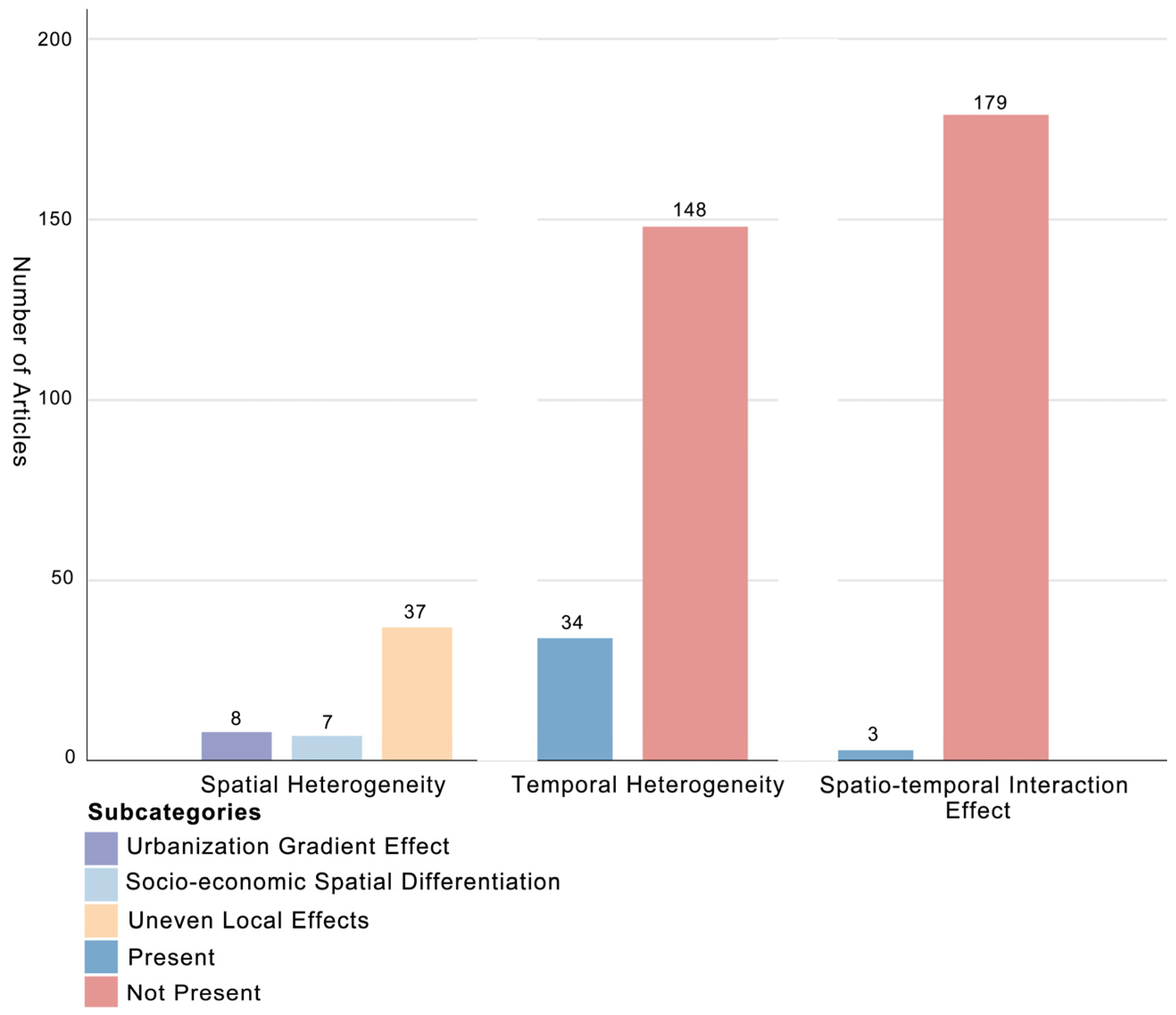
3.5. Spatio-Temporal Heterogeneity of UFGSs on Housing Price
4. Discussion
4.1. Interpreting Key Findings and Implications
4.2. Policy Implications and Development Insights
4.3. Research Innovations, Limitations, and Outlook
4.3.1. Methodological Evolution: From Correlation to Causal Inference
4.3.2. Future Thematic Directions: Depth, Dynamics, and Equity
5. Conclusions
Supplementary Materials
Author Contributions
Funding
Data Availability Statement
Acknowledgments
Conflicts of Interest
References
- Yang, Z.; Fang, H.; Wei, G.; Mo, J.; Gao, X.; Zhang, S. An assessment of urban park accessibility using multi-source data in Hefei, China: A social equity perspective. Land Degrad. Dev. 2024, 35, 3627–3641. [Google Scholar] [CrossRef]
- Zhuang, Y.; Xie, D.; Yu, X. Urban Tree Canopy and Environmental Justice: Examining the Distributional Equity of Urban Tree Canopy in Guangzhou, China. Int. J. Environ. Res. Public Health 2023, 20, 4050. [Google Scholar] [CrossRef]
- Zang, B.; Lv, P.; Warren, C.M.J. Housing prices, rural–urban migrants’ settlement decisions and their regional differences in China. Habitat Int. 2015, 50, 149–159. [Google Scholar] [CrossRef]
- Lan, F.; Zhang, Y. Spatial Autoregressive Model of Commodity Housing Price and Empirical Research. Syst. Eng. Procedia 2011, 1, 206–212. [Google Scholar] [CrossRef]
- Wu, G.; Yang, D.; Niu, X.; Mi, Z. The Impact of Park Green Space Areas on Urban Vitality: A Case Study of 35 Large and Medium-Sized Cities in China. Land 2024, 13, 1560. [Google Scholar] [CrossRef]
- Li, H.; Wu, Z.F.; Yang, X.R.; An, X.L.; Ren, Y.; Su, J.Q. Urban greenness and plant species are key factors in shaping air microbiomes and reducing airborne pathogens. Environ. Int. 2021, 153, 106539. [Google Scholar] [CrossRef]
- Yang, X.; Ye, Q.; Peng, Y.; Liu, S.; Feng, T. Effects of Urban Parks on Housing Prices in the Post-COVID-19 Pandemic Era in China. Land 2024, 13, 519. [Google Scholar] [CrossRef]
- Kovacs, K.F. Integrating property value and local recreation models to value ecosystem services from regional parks. Landsc. Urban Plan. 2012, 108, 79–90. [Google Scholar] [CrossRef]
- Wen, H.; Zhang, Y.; Zhang, L. Assessing amenity effects of urban landscapes on housing price in Hangzhou, China. Urban For. Urban Green. 2015, 14, 1017–1026. [Google Scholar] [CrossRef]
- Tuffery, L. Preferences for forest proximity and recreational amenities revealed by the random bidding model. Landsc. Urban Plan. 2019, 189, 181–188. [Google Scholar] [CrossRef]
- Lee, J.-W.; Lee, S.-W.; Kim, H.G.; Jo, H.-K.; Park, S.-R. Green Space and Apartment Prices: Exploring the Effects of the Green Space Ratio and Visual Greenery. Land 2023, 12, 2069. [Google Scholar] [CrossRef]
- Zhang, Y.; Zhang, T.; Zeng, Y.; Yu, C.; Zheng, S. The rising and heterogeneous demand for urban green space by Chinese urban residents: Evidence from Beijing. J. Clean. Prod. 2021, 313, 127781. [Google Scholar] [CrossRef]
- Feng, S.; Zhuo, Y.; Xu, Z.; Chen, Y.; Li, G.; Wang, X. Nature’s Neighborhood: The Housing Premium of Urban Parks in Dense Cities. Land 2024, 13, 1686. [Google Scholar] [CrossRef]
- Rosen, S. Hedonic prices and implicit markets: Product differentiation in pure competition. J. Political Econ. 1974, 82, 34–55. [Google Scholar] [CrossRef]
- Waltert, F.; Schläpfer, F. Landscape amenities and local development: A review of migration, regional economic and hedonic pricing studies. Ecol. Econ. 2010, 70, 141–152. [Google Scholar] [CrossRef]
- Chen, K.; Lin, H.; You, S.; Han, Y. Review of the impact of urban parks and green spaces on residence prices in the environmental health context. Front. Public Health 2022, 10, 993801. [Google Scholar] [CrossRef]
- Chen, Y.; Jones, C.A.; Dunse, N.A.; Li, E.; Liu, Y. Housing Prices and the Characteristics of Nearby Green Space: Does Landscape Pattern Index Matter? Evidence from Metropolitan Area. Land 2023, 12, 496. [Google Scholar] [CrossRef]
- Belcher, R.N.; Chisholm, R.A. Tropical Vegetation and Residential Property Value: A Hedonic Pricing Analysis in Singapore. Ecol. Econ. 2018, 149, 149–159. [Google Scholar] [CrossRef]
- Li, X.; He, Q.; Huang, W.; Tsim, S.-T.; Qiu, J.-W. Valuation of Urban Parks Under the Three-Level Park System in Shenzhen: A Hedonic Analysis. Land 2025, 14, 182. [Google Scholar] [CrossRef]
- Jaung, W.; Carrasco, L.R. Travel cost analysis of an urban protected area and parks in Singapore: A mobile phone data application. J. Environ. Manag. 2020, 261, 110238. [Google Scholar] [CrossRef]
- Wu, D.; Wang, S. Environment damage assessment: A literature review using social network analysis. Hum. Ecol. Risk Assess. Int. J. 2017, 24, 904–924. [Google Scholar] [CrossRef]
- Duan, L.; Niu, X.; Wang, B. The Urban Park Green Spaces Landscape Premium Functional Value Accounting System: Construction and Application. Sustainability 2024, 16, 612. [Google Scholar] [CrossRef]
- Cheung, L.; Fernandez, M.A. Close enough: Housing price effects of urban parks, reserves and volcanic parks in Auckland, New Zealand. Int. J. Hous. Mark. Anal. 2020, 14, 987–1003. [Google Scholar] [CrossRef]
- Melichar, J.; Kaprova, K. Revealing preferences of Prague’s homebuyers toward greenery amenities: The empirical evidence of distance-size effect. Landsc. Urban Plan. 2013, 109, 56–66. [Google Scholar] [CrossRef]
- Jim, C.Y.; Chen, W.Y. Value of scenic views: Hedonic assessment of private housing in Hong Kong. Landsc. Urban Plan. 2009, 91, 226–234. [Google Scholar] [CrossRef]
- Chen, D.; Long, X.; Li, Z.; Liao, C.; Xie, C.; Che, S. Exploring the Determinants of Urban Green Space Utilization Based on Microblog Check-In Data in Shanghai, China. Forests 2021, 12, 1783. [Google Scholar] [CrossRef]
- Chen, S.; Zhang, L.; Huang, Y.; Wilson, B.; Mosey, G.; Deal, B. Spatial impacts of multimodal accessibility to green spaces on housing price in Cook County, Illinois. Urban For. Urban Green. 2022, 67, 127370. [Google Scholar] [CrossRef]
- Vuletic, D.; Benko, M.; Dubravac, T.; Krajter, S.; Novotny, V.; Indir, K.; Balenovic, I. Review of nonmarket forest goods and services evaluation methods. Period. Biol. 2009, 111, 515–521. [Google Scholar]
- Reeves, T.; Mei, B.; Bettinger, P.; Siry, J. Review of the Effects of Conservation Easements on Surrounding Property Values. J. For. 2018, 116, 555–562. [Google Scholar] [CrossRef]
- Ewane, E.B.; Bajaj, S.; Velasquez-Camacho, L.; Srinivasan, S.; Maeng, J.; Singla, A.; Luber, A.; de-Miguel, S.; Richardson, G.; Broadbent, E.N.; et al. Influence of urban forests on residential property values: A systematic review of remote sensing-based studies. Heliyon 2023, 9, e20408. [Google Scholar] [CrossRef]
- Yoo, S.; Wagner, J.E. A review of the hedonic literatures in environmental amenities from open space: A traditional econometric vs. spatial econometric model. Int. J. Urban Sci. 2016, 20, 141–166. [Google Scholar] [CrossRef]
- Crompton, J.L.; Nicholls, S. The Impact of Park Views on Property Values. Leis. Sci. 2022, 44, 1099–1111. [Google Scholar] [CrossRef]
- Tian, S.-F.; Lin, C.-W.; Wang, J.-C.; Zhong, B.-Y.; Jiang, J.-A.; Wu, Y.-F.; Leu, S.-W.; Nee, T.-E. Lie symmetry analysis of the effects of urban infrastructures on residential property values. PLoS ONE 2021, 16, e0255233. [Google Scholar] [CrossRef]
- Zhang, L.; Zhou, T.; Mao, C. Does the Difference in Urban Public Facility Allocation Cause Spatial Inequality in Housing Prices? Evidence from Chongqing, China. Sustainability 2019, 11, 6096. [Google Scholar] [CrossRef]
- Bark, R.H.; Osgood, D.E.; Colby, B.G.; Halper, E.B. How Do Homebuyers Value Different Types of Green Space? J. Agric. Resour. Econ. 2011, 36, 395–415. [Google Scholar]
- Kovacs, K.; Holmes, T.P.; Englin, J.E.; Alexander, J. The Dynamic Response of Housing Values to a Forest Invasive Disease: Evidence from a Sudden Oak Death Infestation. Environ. Resour. Econ. 2011, 49, 445–471. [Google Scholar] [CrossRef]
- Liu, L.B.; Yu, H.C.; Zhao, J.; Wu, H.; Peng, Z.H.; Wang, R. Multiscale Effects of Multimodal Public Facilities Accessibility on Housing Prices Based on MGWR: A Case Study of Wuhan, China. ISPRS Int. J. Geo-Inf. 2022, 11, 57. [Google Scholar] [CrossRef]
- Donovan, G.H.; Landry, S.; Winter, C. Urban trees, house price, and redevelopment pressure in Tampa, Florida. Urban For. Urban Green. 2019, 38, 330–336. [Google Scholar] [CrossRef]
- Heckert, M.; Mennis, J. The economic impact of greening urban vacant land: A spatial difference-in-differences analysis. Environ. Plan. A 2012, 44, 3010–3027. [Google Scholar] [CrossRef]
- Tong, D.; Shen, Y.; Wang, X.; Sun, Y.; MacLachlan, I.; Li, X. From Proximity to Quality: The Capitalization of Public Facilities into Housing Prices. Ann. Am. Assoc. Geogr. 2023, 113, 2435–2455. [Google Scholar] [CrossRef]
- Lancaster, K.J. A New Approach to Consumer Theory. J. Political Econ. 1966, 74, 132–157. [Google Scholar] [CrossRef]
- Lautrup, M.; Panduro, T.E.; Olsen, J.V.; Pedersen, M.F.; Jacobsen, J.B. Is there more to trees than timber? Estimating the private amenity value of forests using a hedonic land model for combined agricultural properties. For. Policy Econ. 2023, 146, 102867. [Google Scholar] [CrossRef]
- Czembrowski, P.; Kronenberg, J.; Czepkiewicz, M. Integrating non-monetary and monetary valuation methods—SoftGIS and hedonic pricing. Ecol. Econ. 2016, 130, 166–175. [Google Scholar] [CrossRef]
- Dell’Anna, F.; Bravi, M.; Bottero, M. Urban Green infrastructures: How much did they affect property prices in Singapore? Urban For. Urban Green. 2022, 68, 127475. [Google Scholar] [CrossRef]
- Du, X.J.; Huang, Z.H. Spatial and temporal effects of urban wetlands on housing prices: Evidence from Hangzhou, China. Land Use Policy 2018, 73, 290–298. [Google Scholar] [CrossRef]
- Hu, Z.W.; Kobori, H.; Swallow, B.; Qiu, F. Willingness to pay for multiple dimensions of green open space: Applying a spatial hedonic approach. Can. J. Agr. Econ. 2022, 70, 179–201. [Google Scholar] [CrossRef]
- Laszkiewicz, E.; Czembrowski, P.; Kronenberg, J. Can proximity to urban green spaces be considered a luxury? Classifying a non-tradable good with the use of hedonic pricing method. Ecol. Econ. 2019, 161, 237–247. [Google Scholar] [CrossRef]
- Wen, H.Z.; Li, S.Y.; Hui, E.C.M.; Jia, S.J.; Cui, W.J. Purchase Motivation, Landscape Preference, and Housing Prices: Quantile Hedonic Analysis in Guangzhou, China. J. Urban Plan. Dev. 2021, 147, 04021033. [Google Scholar] [CrossRef]
- Xiao, Y.; Lu, Y.; Guo, Y.; Yuan, Y. Estimating the willingness to pay for green space services in Shanghai: Implications for social equity in urban China. Urban For. Urban Green. 2017, 26, 95–103. [Google Scholar] [CrossRef]
- Zhang, T.; Zeng, Y.; Zhang, Y.; Song, Y.; Li, H. The Heterogenous Demand for Urban Parks between Home Buyers and Renters: Evidence from Beijing. Sustainability 2020, 12, 9058. [Google Scholar] [CrossRef]
- Zhou, K.H.; Song, Y.; Tan, R.H. Public perception matters: Estimating homebuyers’ willingness to pay for urban park quality. Urban For. Urban Green. 2021, 64, 127275. [Google Scholar] [CrossRef]
- Hiebert, J.; Allen, K. Valuing Environmental Amenities across Space: A Geographically Weighted Regression of Housing Preferences in Greenville County, SC. Land 2019, 8, 147. [Google Scholar] [CrossRef]
- Panduro, T.E.; Jensen, C.U.; Lundhede, T.H.; von Graevenitz, K.; Thorsen, B.J. Eliciting preferences for urban parks. Reg. Sci. Urban. Econ. 2018, 73, 127–142. [Google Scholar] [CrossRef]
- Jensen, C.U.; Panduro, T.E.; Lundhede, T.H.; von Graevenitz, K.; Thorsen, B.J. Who demands peri-urban nature? A second stage hedonic house price estimation of household’s preference for peri-urban nature. Landsc. Urban Plan. 2021, 207, 104016. [Google Scholar] [CrossRef]
- Ramírez-Juidías, E.; Amaro-Mellado, J.-L.; Leiva-Piedra, J.L. Influence of the Urban Green Spaces of Seville (Spain) on Housing Prices through the Hedonic Assessment Methodology and Geospatial Analysis. Sustainability 2022, 14, 6613. [Google Scholar] [CrossRef]
- Roebeling, P.; Saraiva, M.; Palla, A.; Gnecco, I.; Teotónio, C.; Fidelis, T.; Martins, F.; Alves, H.; Rocha, J. Assessing the socio-economic impacts of green/blue space, urban residential and road infrastructure projects in the Confluence (Lyon): A hedonic pricing simulation approach. J. Environ. Plan. Manag. 2016, 60, 482–499. [Google Scholar] [CrossRef]
- Jia, J.; Zhang, X.Q. A human-scale investigation into economic benefits of urban green and blue infrastructure based on big data and machine learning: A case study of Wuhan. J. Clean. Prod. 2021, 316, 128321. [Google Scholar] [CrossRef]
- Ma, Y.X.; Gopal, S. Geographically Weighted Regression Models in Estimating Median Home Prices in Towns of Massachusetts Based on an Urban Sustainability Framework. Sustainability 2018, 10, 1026. [Google Scholar] [CrossRef]
- Wu, C.; Du, Y.; Li, S.; Liu, P.; Ye, X. Does visual contact with green space impact housing pricesʔ An integrated approach of machine learning and hedonic modeling based on the perception of green space. Land Use Policy 2022, 115, 106048. [Google Scholar] [CrossRef]
- Parton, L.C. Measuring the effects of public land use change: An analysis of greenways in Raleigh, North Carolina. Land Use Policy 2023, 131, 106689. [Google Scholar] [CrossRef]
- Tuofu, H.; Qingyun, H.; Xiao, O. The Capitalization Effect of Natural Amenities on Housing Price in Urban China: New Evidence From Changsha. Front. Environ. Sci. 2022, 10, 833831. [Google Scholar] [CrossRef]
- Liu, T.; Hu, W.Y.; Song, Y.; Zhang, A.L. Exploring spillover effects of ecological lands: A spatial multilevel hedonic price model of the housing market in Wuhan, China. Ecol. Econ. 2020, 170, 106568. [Google Scholar] [CrossRef]
- Mei, Y.D.; Sohngen, B.; Babb, T. Valuing urban wetland quality with hedonic price model. Ecol. Indic. 2018, 84, 535–545. [Google Scholar] [CrossRef]
- Pandit, R.; Polyakov, M.; Sadler, R. Valuing public and private urban tree canopy cover. Aust. J. Agric. Resour. Econ. 2014, 58, 453–470. [Google Scholar] [CrossRef]
- Chen, L.J.; Yao, X.J.; Liu, Y.L.; Zhu, Y.J.; Chen, W.; Zhao, X.Z.; Chi, T.H. Measuring Impacts of Urban Environmental Elements on Housing Prices Based on Multisource Data-A Case Study of Shanghai, China. ISPRS Int. J. Geo-Inf. 2020, 9, 106. [Google Scholar] [CrossRef]
- Lin, D.S.; Jensen, S.T.; Wachter, S.M. The price effects of greening vacant lots: How neighborhood attributes matter. Real Estate Econ. 2022, 51, 573–610. [Google Scholar] [CrossRef]
- Bajari, P.; Benkard, C.L. Demand Estimation with Heterogeneous Consumers and Unobserved Product Characteristics: A Hedonic Approach. J. Political Econ. 2005, 113, 1239–1276. [Google Scholar] [CrossRef]
- Trojanek, R.; Gluszak, M.; Tanas, J. The Effect of Urban Green Spaces on House Prices in Warsaw. Int. J. Strateg. Prop. Manag. 2018, 22, 358–371. [Google Scholar] [CrossRef]
- Tapsuwan, S.; MacDonald, D.H.; King, D.; Poudyal, N. A combined site proximity and recreation index approach to value natural amenities: An example from a natural resource management region of Murray-Darling Basin. J. Environ. Manag. 2012, 94, 69–77. [Google Scholar] [CrossRef]
- Anthon, S. The value of urban afforestation: A hedonic pricing case. Recent Accompl. Appl. For. Econ. Res. 2003, 74, 81–90. [Google Scholar]
- Turner, T.M.; Seo, Y. House Prices, Open Space, and Household Characteristics. J. Real Estate Res. 2021, 43, 204–225. [Google Scholar] [CrossRef]
- Fan, Q.; Hansz, J.A.; Yang, X.M. The Pricing Effects of Open Space Amenities. J. Real Estate Financ. Econ. 2016, 52, 244–271. [Google Scholar] [CrossRef]
- Daams, M.N.; Sijtsma, F.J.; Veneri, P. Mixed monetary and non-monetary valuation of attractive urban green space: A case study using Amsterdam house prices. Ecol. Econ. 2019, 166, 106430. [Google Scholar] [CrossRef]
- Troy, A.; Grove, J.M. Property values, parks, and crime: A hedonic analysis in Baltimore, MD. Landsc. Urban Plan. 2008, 87, 233–245. [Google Scholar] [CrossRef]
- Soltani, A.; Zali, N.; Mirzaei, R.; Heydari, M.; Rahimi, A.; Hamidi, A. Multilevel Impacts of Urban Amenities on Housing Price in Tehran, Iran. J. Urban Plan. Dev. 2023, 149, 05023028. [Google Scholar] [CrossRef]
- Tsai, H.; Huang, W.J.; Li, Y. The Impact of Tourism Resources on Tourism Real Estate Value. Asia Pac. J. Tour. Res. 2016, 21, 1114–1125. [Google Scholar] [CrossRef]
- Leonard, T.; Zhang, L.; Hoehner, C. Variations in Park Facility Valuations across Neighborhoods. Appl. Spat. Anal. Policy 2015, 8, 45–67. [Google Scholar] [CrossRef]
- Du, M.B.; Zhang, X.L. Urban greening: A new paradox of economic or social sustainability? Land Use Policy 2020, 92, 104487. [Google Scholar] [CrossRef]
- Walls, M.; Kousky, C.; Chu, Z.Y. Is What You See What You Get? The Value of Natural Landscape Views. Land Econ. 2015, 91, 1–19. [Google Scholar] [CrossRef]
- Zhu, J.; Gong, Y.; Liu, C.; Du, J.; Song, C.; Chen, J.; Pei, T. Assessing the Effects of Subjective and Objective Measures on Housing Prices with Street View Imagery: A Case Study of Suzhou. Land 2023, 12, 2095. [Google Scholar] [CrossRef]
- Sylla, M.; Lasota, T.; Szewranski, S. Valuing Environmental Amenities in Peri-Urban Areas: Evidence from Poland. Sustainability 2019, 11, 570. [Google Scholar] [CrossRef]
- Xu, L.Y.; You, H.; Li, D.H.; Yu, K.J. Urban green spaces, their spatial pattern, and ecosystem service value: The case of Beijing. Habitat Int. 2016, 56, 84–95. [Google Scholar] [CrossRef]
- Kim, J.H.; Li, W.; Newman, G.; Kil, S.H.; Park, S.Y. The influence of urban landscape spatial patterns on single-family housing prices. Environ. Plan. B-Urban Anal. City Sci. 2018, 45, 26–43. [Google Scholar] [CrossRef]
- Kong, F.; Yin, H.; Nakagoshi, N. Using GIS and landscape metrics in the hedonic price modeling of the amenity value of urban green space: A case study in Jinan City, China. Landsc. Urban Plan. 2007, 79, 240–252. [Google Scholar] [CrossRef]
- Li, H.; Wei, Y.D.; Yu, Z.; Tian, G. Amenity, accessibility and housing values in metropontan USA: A study of salt Lake county, utah. Cities 2016, 59, 113–125. [Google Scholar] [CrossRef]
- Wu, J.S.; Wang, M.J.; Li, W.F.; Peng, J.; Huang, L. Impact of Urban Green Space on Residential Housing Prices: Case Study in Shenzhen. J. Urban Plan. Dev. 2015, 141, 05014023. [Google Scholar] [CrossRef]
- Netusil, N.R.; Levin, Z.; Shandas, V.; Hart, T. Valuing green infrastructure in Portland, Oregon. Landsc. Urban Plan. 2014, 124, 14–21. [Google Scholar] [CrossRef]
- Sharma, V.R. Forest proximity and residential land values. J. For. Econ. 2013, 19, 78–86. [Google Scholar] [CrossRef]
- Liu, L.; Meng, L.; Zhang, R. Does Easy Accessibility to Urban Parks Always Raise Home Values? J. Hous. Econ. 2024, 63, 101981. [Google Scholar] [CrossRef]
- Xiao, Y.; Hui, E.C.M.; Wen, H.Z. Effects of floor level and landscape proximity on housing price: A hedonic analysis in Hangzhou, China. Habitat Int. 2019, 87, 11–26. [Google Scholar] [CrossRef]
- Votsis, A. Planning for green infrastructure: The spatial effects of parks, forests, and fields on Helsinki’s apartment prices. Ecol. Econ. 2017, 132, 279–289. [Google Scholar] [CrossRef]
- Payton, S.B.; Ottensmann, J.R. The implicit price of urban public parks and greenways: A spatial-contextual approach. J. Environ. Plan. Manag. 2015, 58, 495–512. [Google Scholar] [CrossRef]
- Sachs, A.L.; Boag, A.E.; Troy, A. Valuing urban trees: A hedonic investigation into tree canopy influence on property values across environmental and social contexts in Baltimore, Maryland. Urban For. Urban Green. 2023, 80, 127829. [Google Scholar] [CrossRef]
- Xiao, Y.; Li, Z.; Webster, C. Estimating the mediating effect of privately-supplied green space on the relationship between urban public green space and property value: Evidence from Shanghai, China. Land Use Policy 2016, 54, 439–447. [Google Scholar] [CrossRef]
- Saphores, J.D.; Li, W. Estimating the value of urban green areas: A hedonic pricing analysis of the single family housing market in Los Angeles, CA. Landsc. Urban Plan. 2012, 104, 373–387. [Google Scholar] [CrossRef]
- Holt, J.R.; Borsuk, M.E. Using Zillow data to value green space amenities at the neighborhood scale. Urban For. Urban Green. 2020, 56, 126794. [Google Scholar] [CrossRef]
- Fernandez, L.; Mukherjee, M.; Scott, T. The effect of conservation policy and varied open space on residential property values: A dynamic hedonic analysis. Land Use Policy 2018, 73, 480–487. [Google Scholar] [CrossRef]
- Tian, D.; Wang, J.; Xia, C.; Zhang, J.; Zhou, J.; Tian, Z.; Zhao, J.; Li, B.; Zhou, C. The relationship between green space accessibility by multiple travel modes and housing prices: A case study of Beijing. Cities 2024, 145, 104694. [Google Scholar] [CrossRef]
- Tuffery, L. The recreational services value of the nearby periurban forest versus the regional forest environment. J. For. Econ. 2017, 28, 33–41. [Google Scholar] [CrossRef]
- Wu, L.; Rowe, P.G. Green space progress or paradox: Identifying green space associated gentrification in Beijing. Landsc. Urban Plan. 2022, 219, 104321. [Google Scholar] [CrossRef]
- Jim, C.Y.; Chen, W.Y. Impacts of urban environmental elements on residential housing prices in Guangzhou (China). Landsc. Urban Plan. 2006, 78, 422–434. [Google Scholar] [CrossRef]
- Wu, C.; Ye, X.; Du, Q.; Luo, P. Spatial effects of accessibility to parks on housing prices in Shenzhen, China. Habitat Int. 2017, 63, 45–54. [Google Scholar] [CrossRef]
- Soltani, A.; Pettit, C.J.; Heydari, M.; Aghaei, F. Housing price variations using spatio-temporal data mining techniques. J. Hous. Built Environ. 2021, 36, 1199–1227. [Google Scholar] [CrossRef]
- Jiao, L.M.; Liu, Y.L. Geographic Field Model based hedonic valuation of urban open spaces in Wuhan, China. Landsc. Urban Plan. 2010, 98, 47–55. [Google Scholar] [CrossRef]
- Glaesener, M.L.; Caruso, G. Neighborhood green and services diversity effects on land prices: Evidence from a multilevel hedonic analysis in Luxembourg. Landsc. Urban Plan. 2015, 143, 100–111. [Google Scholar] [CrossRef]
- Czembrowski, P.; Laszkiewicz, E.; Kronenberg, J.; Engstrom, G.; Andersson, E. Valuing individual characteristics and the multifunctionality of urban green spaces: The integration of sociotope mapping and hedonic pricing. PLoS ONE 2019, 14, e0212277. [Google Scholar] [CrossRef]
- Liang, X.J.; Liu, Y.L.; Qiu, T.Q.; Jing, Y.; Fang, F.G. The effects of locational factors on the housing prices of residential communities: The case of Ningbo, China. Habitat Int. 2018, 81, 1–11. [Google Scholar] [CrossRef]
- Ardeshiri, A.; Ardeshiri, M.; Radfar, M.; Shormasty, O.H. The values and benefits of environmental elements on housing rents. Habitat Int. 2016, 55, 67–78. [Google Scholar] [CrossRef]
- Panduro, T.E.; Veie, K.L. Classification and valuation of urban green spaces—A hedonic house price valuation. Landsc. Urban Plan. 2013, 120, 119–128. [Google Scholar] [CrossRef]
- Zhang, Y.L.; Dong, R.C. Impacts of Street-Visible Greenery on Housing Prices: Evidence from a Hedonic Price Model and a Massive Street View Image Dataset in Beijing. ISPRS Int. J. Geo-Inf. 2018, 7, 104. [Google Scholar] [CrossRef]
- Zhang, Y.; Fu, X.; Lv, C.; Li, S. The Premium of Public Perceived Greenery: A Framework Using Multiscale GWR and Deep Learning. Int. J. Environ. Res. Public Health 2021, 18, 6809. [Google Scholar] [CrossRef] [PubMed]
- Peng, C.C.; Xiang, Y.; Chen, L.X.; Zhang, Y.Y.; Zhou, Z.X. The Impact of the Type and Abundance of Urban Blue Space on House Prices: A Case Study of Eight Megacities in China. Land 2023, 12, 865. [Google Scholar] [CrossRef]
- Mansfield, C.; Pattanayak, S.K.; McDow, W.; McDonald, R.; Halpin, P. Shades of Green: Measuring the value of urban forests in the housing market. J. For. Econ. 2005, 11, 177–199. [Google Scholar] [CrossRef]
- Cho, S.H.; Kim, S.G.; Roberts, R.K.; Jung, S. Amenity values of spatial configurations of forest landscapes over space and time in the Southern Appalachian Highlands. Ecol. Econ. 2009, 68, 2646–2657. [Google Scholar] [CrossRef]
- Cho, S.H.; Kim, T.; Roberts, R.K.; Hellwinckel, C.; Kim, S.G.; Wilson, B. Developing an amenity value calculator for urban forest landscapes. Comput. Environ. Urban Syst. 2014, 43, 34–41. [Google Scholar] [CrossRef]
- Mandic, A.; Petric, L. The impacts of location and attributes of protected natural areas on hotel prices: Implications for sustainable tourism development. Environ. Dev. Sustain. 2021, 23, 833–863. [Google Scholar] [CrossRef]
- Yasumoto, S.; Jones, A.; Shimizu, C. Longitudinal trends in equity of park accessibility in Yokohama, Japan: An investigation into the role of causal mechanisms. Environ. Plan. A-Econ. Space 2014, 46, 682–699. [Google Scholar] [CrossRef]
- Cui, N.N.; Gu, H.Y.; Shen, T.Y.; Feng, C.C. The Impact of Micro-Level Influencing Factors on Home Value: A Housing Price-Rent Comparison. Sustainability 2018, 10, 4343. [Google Scholar] [CrossRef]
- Jun, M.J.; Kim, H.J. Measuring the effect of greenbelt proximity on apartment rents in Seoul. Cities 2017, 62, 10–22. [Google Scholar] [CrossRef]
- Jiang, L.; Hagen-Zanker, A.; Kumar, P.; Pritchard, J. Equity in job accessibility and environmental quality in a segmented housing market: The case of Greater London. J. Transp. Geogr. 2021, 90, 102908. [Google Scholar] [CrossRef]
- Chen, Y.; Yue, W.; La Rosa, D. Which communities have better accessibility to green space? An investigation into environmental inequality using big data. Landsc. Urban Plan. 2020, 204, 103919. [Google Scholar] [CrossRef]
- Seo, Y. Varying Effects of Urban Tree Canopies on Residential Property Values across Neighborhoods. Sustainability 2020, 12, 4331. [Google Scholar] [CrossRef]
- Li, W.; Saphores, J.D.M.; Gillespie, T.W. A comparison of the economic benefits of urban green spaces estimated with NDVI and with high-resolution land cover data. Landsc. Urban Plan. 2015, 133, 105–117. [Google Scholar] [CrossRef]
- Tuofu, H.; Qingyun, H.; Dongxiao, Y.; Xiao, O.Y. Evaluating the Impact of Urban Blue Space Accessibility on Housing Price: A Spatial Quantile Regression Approach Applied in Changsha, China. Front. Environ. Sci. 2021, 9, 696626. [Google Scholar] [CrossRef]
- Li, H.; Wei, Y.D.; Wu, Y.Y.; Tian, G. Analyzing housing prices in Shanghai with open data: Amenity, accessibility and urban structure. Cities 2019, 91, 165–179. [Google Scholar] [CrossRef]
- Liebelt, V.; Bartke, S.; Schwarz, N. Revealing Preferences for Urban Green Spaces: A Scale-sensitive Hedonic Pricing Analysis for the City of Leipzig. Ecol. Econ. 2018, 146, 536–548. [Google Scholar] [CrossRef]
- Sander, H.A.; Haight, R.G. Estimating the economic value of cultural ecosystem services in an urbanizing area using hedonic pricing. J. Environ. Manag. 2012, 113, 194–205. [Google Scholar] [CrossRef] [PubMed]
- Gibbons, S.; Mourato, S.; Resende, G.M. The Amenity Value of English Nature: A Hedonic Price Approach. Environ. Resour. Econ. 2014, 57, 175–196. [Google Scholar] [CrossRef]
- Albouy, D.; Christensen, P.; Sarmiento-Barbieri, I. Unlocking amenities: Estimating public good complementarity. J. Public. Econ. 2020, 182, 104110. [Google Scholar] [CrossRef]
- Doll, C.; Polyakov, M.; Pannell, D.J.; Burton, M.P. Rethinking urban park irrigation under climate change. J. Environ. Manag. 2022, 314, 115012. [Google Scholar] [CrossRef]
- Schlapfer, F.; Waltert, F.; Segura, L.; Kienast, F. Valuation of landscape amenities: A hedonic pricing analysis of housing rents in urban, suburban and periurban Switzerland. Landsc. Urban Plan. 2015, 141, 24–40. [Google Scholar] [CrossRef]
- Li, H.; Chen, P.; Grant, R. Built environment, special economic zone, and housing prices in Shenzhen, China. Appl. Geogr. 2021, 129, 102429. [Google Scholar] [CrossRef]
- Zhang, Y.T.; Wang, S.M.; Ma, Y.W.; Peng, C.; Qu, M.P.; Xu, A.; Xing, X.J.; Yin, W.D. Value-added Benefits of Green Space: A Systematic Analysis of the Relationship between Urban Green Space and Commercial House Prices in Beijing Based on Remote Sensing Technology. Sens. Mater. 2022, 34, 4247–4262. [Google Scholar] [CrossRef]
- Su, S.; He, S.; Sun, C.; Zhang, H.; Hu, L.; Kang, M. Do landscape amenities impact private housing rental prices? A hierarchical hedonic modeling approach based on semantic and sentimental analysis of online housing advertisements across five Chinese megacities. Urban For. Urban Green. 2021, 58, 126968. [Google Scholar] [CrossRef]
- Cho, S.H.; Bowker, J.M.; Park, W.M. Measuring the contribution of water and green space amenities to housing values; An application and comparison of spatially weighted hedonic models. J. Agric. Resour. Econ. 2006, 31, 485–507. [Google Scholar]
- Wang, B.; He, S.K.; Ma, W.W. Does Park Size Affect Green Gentrification? Insights from Chongqing, China. Sustainability 2022, 14, 9916. [Google Scholar] [CrossRef]
- Jung, E.; Choi, Y.; Yoon, H. The impact of the Gyeongui Line Park project on residential property values in Seoul, Korea. Habitat Int. 2016, 58, 108–117. [Google Scholar] [CrossRef]
- Xu, H.Y.; Fu, F.; Miao, M. What Is the Effect of Cultural Greenway Projects in High-Density Urban Municipalities? Assessing the Public Living Desire near the Cultural Greenway in Central Beijing. Int. J. Environ. Res. Public Health 2022, 19, 2147. [Google Scholar] [CrossRef]
- Yoon, H. When and where do we see the proximity effect of a new park?-A case study of the Dream Forest in Seoul, Korea. J. Environ. Plan. Manag. 2018, 61, 1113–1136. [Google Scholar] [CrossRef]
- Kim, H.-S.; Lee, G.-E.; Lee, J.-S.; Choi, Y. Understanding the local impact of urban park plans and park typology on housing price: A case study of the Busan metropolitan region, Korea. Landsc. Urban Plan. 2019, 184, 1–11. [Google Scholar] [CrossRef]
- Black, K.J.; Richards, M. Eco-gentrification and who benefits from urban green amenities: NYC’s high Line. Landsc. Urban Plan. 2020, 204, 103900. [Google Scholar] [CrossRef]
- Tapsuwan, S.; Polyakov, M. Correctly Specifying Environmental Assets in Spatial Hedonic Pricing Models. Soc. Nat. Resour. 2016, 29, 233–249. [Google Scholar] [CrossRef]
- Kim, J.; Park, J.; Yoon, D.K.; Cho, G.H. Amenity or hazard? The effects of landslide hazard on property value in Woomyeon Nature Park area, Korea. Landsc. Urban Plan. 2017, 157, 523–531. [Google Scholar] [CrossRef]
- Kuroda, Y.; Sugasawa, T. The Value of Scattered Greenery in Urban Areas: A Hedonic Analysis in Japan. Environ. Resour. Econ. 2023, 85, 523–586. [Google Scholar] [CrossRef]
- Irwin, N.B.; Klaiber, H.A.; Irwin, E.G. Do Stormwater Basins Generate co-Benefits? Evidence from Baltimore County, Maryland. Ecol. Econ. 2017, 141, 202–212. [Google Scholar] [CrossRef]
- Glaeser, E.L.; Gyourko, J. Urban decline and durable housing. J. Political Econ. 2005, 113, 345–375. [Google Scholar] [CrossRef]


Disclaimer/Publisher’s Note: The statements, opinions and data contained in all publications are solely those of the individual author(s) and contributor(s) and not of MDPI and/or the editor(s). MDPI and/or the editor(s) disclaim responsibility for any injury to people or property resulting from any ideas, methods, instructions or products referred to in the content. |
© 2026 by the authors. Licensee MDPI, Basel, Switzerland. This article is an open access article distributed under the terms and conditions of the Creative Commons Attribution (CC BY) license.
Share and Cite
Zhou, Y.; Zhou, Q.; Li, W.; Liang, H. Decoding the “Green Premium”: A Systematic Review of Multidimensional Economic Value Drivers from Urban Forests and Green Spaces. Forests 2026, 17, 650. https://doi.org/10.3390/f17060650
Zhou Y, Zhou Q, Li W, Liang H. Decoding the “Green Premium”: A Systematic Review of Multidimensional Economic Value Drivers from Urban Forests and Green Spaces. Forests. 2026; 17(6):650. https://doi.org/10.3390/f17060650
Chicago/Turabian StyleZhou, Ying, Qingqing Zhou, Wuyao Li, and Huilin Liang. 2026. "Decoding the “Green Premium”: A Systematic Review of Multidimensional Economic Value Drivers from Urban Forests and Green Spaces" Forests 17, no. 6: 650. https://doi.org/10.3390/f17060650
APA StyleZhou, Y., Zhou, Q., Li, W., & Liang, H. (2026). Decoding the “Green Premium”: A Systematic Review of Multidimensional Economic Value Drivers from Urban Forests and Green Spaces. Forests, 17(6), 650. https://doi.org/10.3390/f17060650