Advances in Fire Retardant Technologies for Bamboo-Based Materials



Abstract
1. Introduction
2. Structure and Pyrolysis Mechanism of Bamboo
2.1. Molecular Composition and Reaction Pathways
2.2. Pyrolysis Kinetics and Mathematical Modeling
3. Flame-Retardant Strategies, Mechanisms, and Performance Evaluation of Bamboo-Based Materials
3.1. Flame-Retardant Strategies
3.2. Flame-Retardant Mechanisms
3.3. Standard Codes and Methods of Evaluation
4. Flame-Retardant Systems for Bamboo-Based Materials
4.1. Phosphorus-Based Flame Retardants
4.1.1. Ammonium Polyphosphate (APP)-Based Systems
4.1.2. Phosphorus-Based Synergized Flame-Retardant Systems
4.2. Nitrogen-Based Flame Retardants
4.3. Boron-Based Flame Retardants
4.4. Nanomaterial-Based Flame Retardants
4.5. Metal-Based Flame Retardants
4.6. Bio-Based Flame Retardants
4.6.1. Phytic Acid
4.6.2. Tannic Acid
4.6.3. Chitosan
4.7. Sustainability and End-of-Life Considerations of Flame-Retardant Systems
5. Conclusions and Future Perspectives
- (1)
- Future flame-retardant systems should be designed according to the hierarchical and anisotropic structure of bamboo. Factors such as grain direction, vascular bundle distribution, porosity, density, permeability, and adhesive distribution should be considered when interpreting fire behavior and optimizing flame-retardant penetration, fixation, and char formation.
- (2)
- Moisture sensitivity and leaching remain major obstacles for many phosphorus-, boron-, and bio-based flame-retardant systems. Future studies should evaluate flame-retardant performance after water immersion, humidity aging, washing, or repeated wet–dry cycling. Chemical fixation, metal-ion complexation, in situ hybridization, polymeric encapsulation, and hydrophobic sealing are promising strategies for improving long-term durability.
- (3)
- Evaluation of flame-retardant bamboo-based materials should rely on complementary test methods rather than a single indicator. Existing standard fire tests remain useful, but their results should be interpreted together with bamboo-specific factors such as grain direction, density, thickness, adhesive type, and moisture condition. In addition to ignitability and heat release, smoke/toxic gas emissions, char integrity, flame spread, mechanical retention after treatment, and structural fire resistance should also be considered.
- (4)
- Future development should focus on durable, low-toxicity, and practically scalable flame-retardant systems. At the same time, sustainability should be evaluated from a life-cycle perspective. While emerging bio-based or nanostructured FR systems may currently incur higher initial synthesis costs than conventional treatments, their ultimate value lies in their end-of-life environmental benefits. By eliminating persistent toxic chemicals, suppressing hazardous combustion emissions, and facilitating eco-friendly disposal routes. These sustainable FR systems can significantly reduce the overall environmental burden, paving the way for the scalable adoption of green, fire-resilient bamboo-based materials.
Author Contributions
Funding
Data Availability Statement
Conflicts of Interest
References
- Wei, B.; Wei, Y.; Lin, Y.; Wang, G.; Zhang, Y. Compressive performance of bamboo scrimber and concrete-filled steel tube columns. Eng. Struct. 2024, 300, 117192. [Google Scholar] [CrossRef]
- Nkeuwa, W.N.; Zhang, J.; Semple, K.E.; Chen, M.; Xia, Y.; Dai, C. Bamboo-based composites: A review on fundamentals and processes of bamboo bonding. Compos. Part B Eng. 2022, 235, 109776. [Google Scholar] [CrossRef]
- Huang, Y.; Ji, Y.; Yu, W. Development of bamboo scrimber: A literature review. J. Wood Sci. 2019, 65, 25. [Google Scholar] [CrossRef]
- Xiao, Y.; Ma, J. Fire simulation test and analysis of laminated bamboo frame building. Constr. Build. Mater. 2012, 34, 257–266. [Google Scholar] [CrossRef]
- Liu, D.; Song, J.; Anderson, D.P.; Chang, P.R.; Hua, Y. Bamboo fiber and its reinforced composites: Structure and properties. Cellulose 2012, 19, 1449–1480. [Google Scholar] [CrossRef]
- Ou, J.; Luo, J.; Long, W.; Chen, D.; Zhang, Y.; Chen, Z.; Peng, L. Experimental investigation on the charring behavior of bamboo scrimber and glued laminated bamboo under standard fire exposure. Constr. Build. Mater. 2025, 500, 144107. [Google Scholar] [CrossRef]
- Hernandez-Mena, L.E.; Pécoraa, A.A.; Beraldob, A.L. Slow pyrolysis of bamboo biomass: Analysis of biochar properties. Chem. Eng. 2014, 37, 115–120. [Google Scholar]
- Tang, L.; Liu, Y. Effects of elevated temperature on the shear properties and chemical composition of glued laminated bamboo. Structures 2025, 82, 110553. [Google Scholar] [CrossRef]
- Wu, M.; Wang, L.; Zhang, R.; Zhang, Z.; Wu, M.; Wang, Y.; Zhou, L. Elucidate the difference of molecular structure of lignin from small-diameter bamboo. Ind. Crops Prod. 2026, 243, 123046. [Google Scholar] [CrossRef]
- Yu, H.; Zheng, H.; Zhan, M.; Zhang, W.; Wang, J.; Pan, X.; Zhuang, X. Surface characterization and biodegradability of sodium hydroxide-treated Moso bamboo substrates. Eur. J. Wood Wood Prod. 2021, 79, 443–451. [Google Scholar] [CrossRef]
- Dasari, A.; Yu, Z.Z.; Cai, G.P.; Mai, Y.W. Recent developments in the fire retardancy of polymeric materials. Prog. Polym. Sci. 2013, 38, 1357–1387. [Google Scholar] [CrossRef]
- Su, J.; Chen, Z.; Le, L.; Liu, M.; Li, C. An overview of the multifunctional research progress and sustainable development trends in bamboo-based composites. Sustain. Mater. Technol. 2025, 46, e01665. [Google Scholar] [CrossRef]
- Zheng, Z.; Yan, N.; Lou, Z.; Jiang, X.; Zhang, X.; Chen, S.; Xu, R.; Liu, C.; Xu, L. Modification and application of bamboo-based materials: A review—Part I: Modification methods and mechanisms. Forests 2023, 14, 2219. [Google Scholar] [CrossRef]
- Özer, M.S.; Gaan, S. Recent developments in phosphorus based flame retardant coatings for textiles: Synthesis, applications and performance. Prog. Org. Coat. 2022, 171, 107027. [Google Scholar] [CrossRef]
- Jiang, P.; Gu, X.; Zhang, S.; Wu, S.; Zhao, Q.; Hu, Z. Synthesis; characterization, and utilization of a novel phosphorus/nitrogen-containing flame retardant. Ind. Eng. Chem. Res. 2015, 54, 2974–2982. [Google Scholar] [CrossRef]
- Zhang, C.; Guo, H.; Zhou, X.; Yu, L.; Li, H.; Yang, Z. Effects of differrent boron-based flame retardants on the combustibility of bamboo filaments. Wood Res. 2022, 67, 221–230. [Google Scholar] [CrossRef]
- Li, J.; Zhao, H.; Liu, H.; Sun, J.; Wu, J.; Liu, Q.; Zheng, Y.; Zheng, P. Recent advances in metal-family flame retardants: A review. RSC Adv. 2023, 13, 22639–22662. [Google Scholar] [CrossRef] [PubMed]
- He, W.; Song, P.; Yu, B.; Fang, Z.; Wang, H. Flame retardant polymeric nanocomposites through the combination of nanomaterials and conventional flame retardants. Prog. Mater. Sci. 2020, 114, 100687. [Google Scholar] [CrossRef]
- Wang, M.; Yin, G.Z.; Yang, Y.; Fu, W.; Palencia, J.L.D.; Zhao, J.; Wang, N.; Jiang, Y.; Wang, D.Y. Bio-based flame retardants to polymers: A review. Adv. Ind. Eng. Polym. Res. 2023, 6, 132–155. [Google Scholar] [CrossRef]
- Oyedun, A.O.; Gebreegziabher, T.; Hui, C.W. Mechanism and modelling of bamboo pyrolysis. Fuel Process. Technol. 2013, 106, 595–604. [Google Scholar] [CrossRef]
- Yang, C.; Gan, J.; Yu, W.; Huang, Y.; Pan, D.; Zhang, Y. Interfacial strategy of phenolic resin/bamboo composite system under cross-linking degree regulation. Compos. Part B Eng. 2025, 311, 113220. [Google Scholar] [CrossRef]
- Akinbade, Y.; Harries, K.A. Is the rule of mixture appropriate for assessing bamboo material properties? Constr. Build. Mater. 2021, 267, 120955. [Google Scholar] [CrossRef]
- Jiang, T.; Feng, X.; Xia, Z.; Deng, S.; Wang, X. Gradient variation and correlation analysis of physical and mechanical properties of Moso bamboo (Phyllostachys edulis). Materials 2024, 17, 2069. [Google Scholar] [CrossRef]
- Chang, C.W.; Chang, F.C. Comprehensive review of the elastic constants of bamboo. Eur. J. Wood Wood Prod. 2024, 82, 1739–1754. [Google Scholar] [CrossRef]
- He, L.; Chen, L.; Shao, H.; Qi, J.; Jiang, Y.; Xiao, H.; Chen, Y.; Huang, X.; Xie, J. Microstructure and physicochemical properties of the anisotropic moso bamboo (Phyllostachys pubescens) surface. Eur. J. Wood Wood Prod. 2022, 80, 277–288. [Google Scholar] [CrossRef]
- Naim, A.; Soo Yun Tan, C. Thermal Properties of Bamboo Cellulose Isolated from Bamboo Culms and Shoots. BioResources 2022, 17, 4806. [Google Scholar] [CrossRef]
- Cui, Z.; Xu, M.; Shen, Y.; Tu, L. The impact of temperature variations on the thermal and charring characteristics of laminated bamboo lumber. Eur. J. Wood Wood Prod. 2024, 82, 1159–1169. [Google Scholar] [CrossRef]
- Shah, D.U.; Konnerth, J.; Ramage, M.H.; Gusenbauer, C. Mapping thermal conductivity across bamboo cell walls with scanning thermal microscopy. Sci. Rep. 2019, 9, 16667. [Google Scholar] [CrossRef]
- Jiang, Z.; Liu, Z.; Fei, B.; Cai, Z.; Yu, Y.; Liu, X. The pyrolysis characteristics of moso bamboo. J. Anal. Appl. Pyrolysis 2012, 94, 48–52. [Google Scholar] [CrossRef]
- Liang, Z.; Jiang, H.; Tan, Y. A review of thermal treatment for bamboo and its composites. Green Process. Synth. 2024, 13, 20230263. [Google Scholar] [CrossRef]
- Wang, B.; Ren, X.; Dong, J.; Li, S.; Liu, X. Comparative study of pyrolysis characteristics, kinetics and gaseous products between bamboo parenchyma cells and fiber cells. Ind. Crops Prod. 2024, 216, 118745. [Google Scholar] [CrossRef]
- Yeh, C.H.; Yang, T.C. Utilization of waste bamboo fibers in thermoplastic composites: Influence of the chemical composition and thermal decomposition behavior. Polymers 2020, 12, 636. [Google Scholar] [CrossRef]
- Cui, Z.; Xu, M.; Tang, S.; Shen, Y.; Tu, L. Experimental study on the combustion properties of four common engineered bamboo and wood composites. Polym. Compos. 2023, 44, 8962–8973. [Google Scholar] [CrossRef]
- Zhao, R.; Wang, X.; Liu, L.; Li, P.; Tian, L. Slow pyrolysis characteristics of bamboo subfamily evaluated through kinetics and evolved gases analysis. Bioresour. Technol. 2019, 289, 121674. [Google Scholar] [CrossRef]
- Alvarado Flores, J.J.; Alcaraz Vera, J.V.; Ávalos Rodríguez, M.L.; López Sosa, L.B.; Rutiaga Quiñones, J.G.; Pintor Ibarra, L.F.; Márquez Montesino, F.; Aguado Zarraga, R. Analysis of pyrolysis kinetic parameters based on various mathematical models for more than twenty different biomasses: A review. Energies 2022, 15, 6524. [Google Scholar] [CrossRef]
- Starink, M.J. A new method for the derivation of activation energies from experiments performed at constant heating rate. Thermochim. Acta 1996, 288, 97–104. [Google Scholar] [CrossRef]
- Koga, N.; Vyazovkin, S.; Burnham, A.K.; Favergeon, L.; Muravyev, N.V.; Pérez-Maqueda, L.A.; Saggese, C.; Sánchez-Jiménez, P.E. ICTAC Kinetics Committee recommendations for analysis of thermal decomposition kinetics. Thermochim. Acta 2023, 719, 179384. [Google Scholar] [CrossRef]
- Vyazovkin, S. Misinterpretation of thermodynamic parameters evaluated from activation energy and preexponential factor determined in thermal analysis experiments. Thermo 2024, 4, 373–381. [Google Scholar] [CrossRef]
- Tong, W.; Cai, Z.; Liu, Q.; Ren, S.; Kong, M. Effect of pyrolysis temperature on bamboo char combustion: Reactivity, kinetics and thermodynamics. Energy 2020, 211, 118736. [Google Scholar] [CrossRef]
- Jiang, M.; Yang, J.; Lin, X.; Kong, L.; Zhang, W.; Tu, D.; Ma, H. High performance engineered bamboo scrimber manufacturing by vacuum-pressure impregnation method. Eur. J. Wood Wood Prod. 2026, 84, 36. [Google Scholar] [CrossRef]
- Li, W.; Bai, Q.; Xie, G.; Cao, Y.; Gao, J. The influence of impregnation methods and curing conditions on the physical and multiscale mechanical properties of furfurylated bamboo. Forests 2023, 14, 970. [Google Scholar] [CrossRef]
- Li, J.; Lai, Q.; Hu, C.; Lin, X.; Li, W.; Hou, X.; Yun, H.; Zhang, W. Bamboo modification with Glycidyl methacrylate (GMA) microemulsion through in-situ polymerization and cross-linking. Int. J. Biol. Macromol. 2025, 332, 148734. [Google Scholar] [CrossRef]
- Yang, H.; Zhang, X.; Li, H.; Yin, C.; Huang, T.; Wan, J.; Ni, K.; Du, G.; Yang, L. High-performance glued-bamboo through activation of chemical bonding interface. Colloids Surf. A Physicochem. Eng. Asp. 2024, 701, 134874. [Google Scholar] [CrossRef]
- Zhu, Y.; Xu, M.; Cui, Z.; Ou, J.; Zhu, J. Experimental and numerical investigation on fire resistance of laminated bamboo lumber beams under standard fire exposure. J. Build. Eng. 2025, 118, 115010. [Google Scholar] [CrossRef]
- Chen, D.; Liu, D.; Zhang, H.; Chen, Y.; Li, Q. Bamboo pyrolysis using TG–FTIR and a lab-scale reactor: Analysis of pyrolysis behavior, product properties, and carbon and energy yields. Fuel 2015, 148, 79–86. [Google Scholar] [CrossRef]
- Kumar, R.; Chauhan, S. Effect of ammonium polyphosphate as synergist with nano silica dioxide on flammability of boron compound pretreated bamboo flour-HDPE composite. Fire Saf. J. 2022, 133, 103647. [Google Scholar] [CrossRef]
- Wang, W.; Yuen, A.C.Y.; Long, H.; Yang, W.; Li, A.; Song, L.; Hu, Y.; Yeoh, G.Y. Random nano-structuring of PVA/MXene membranes for outstanding flammability resistance and electromagnetic interference shielding performances. Compos. Part B Eng. 2021, 224, 109174. [Google Scholar] [CrossRef]
- Lee, Y.X.; Wang, W.; Lei, Y.; Xu, L.; Agarwal, V.; Wang, C.; Yeoh, G.H. Flame-retardant coatings for wooden structures. Prog. Org. Coat. 2025, 198, 108903. [Google Scholar] [CrossRef]
- Lazar, S.T.; Kolibaba, T.J.; Grunlan, J.C. Flame-retardant surface treatments. Nat. Rev. Mater. 2020, 5, 259–275. [Google Scholar] [CrossRef]
- Wang, Z.; Yang, S.; Liu, Z.; Ding, F.; Wu, Y. Tung oil-based phosphorus-containing polyol as a flame retardant for bamboo. Constr. Build. Mater. 2023, 366, 130240. [Google Scholar] [CrossRef]
- Wang, S.; Zhang, L.; Semple, K.; Zhang, M.; Zhang, W.; Dai, C. Development of biodegradable flame-retardant bamboo charcoal composites, part ii: Thermal degradation, gas phase, and elemental analyses. Polymers 2020, 12, 2238. [Google Scholar] [CrossRef]
- Li, Y.; Yuan, Z.; Li, M.; Gu, S.; Wang, C.; Cheng, H. Replacing plastic automotive interiors with bamboo: A study on the mechanical and flame-retardant properties of melamine polyphosphate-modified bamboo fiber-reinforced composites. J. Mater. Sci. 2024, 59, 21721–21734. [Google Scholar] [CrossRef]
- Mhlabeni, T.L.; Chemere, E.B.; Jamiru, T.; Mhike, W. Flame retardancy of biopolymers enhanced by bio-based flame retardants: A review. J. Fire Sci. 2025, 43, 79–114. [Google Scholar] [CrossRef]
- Verma, S.; Hashmi, S.A.R.; Mili, M.; Hada, V.; Prashant, N.; Naik, A.; Rathore, S.K.S.; Srivastava, A.K. Extraction and applications of lignin from bamboo: A critical review. Eur. J. Wood Wood Prod. 2021, 79, 1341–1357. [Google Scholar] [CrossRef]
- Li, X.; Ji, S.; Mou, Q.; Chen, Z.; Li, X. Evaluation of flammability for bamboo products treated with water-soluble flame retardants. Wood Mater. Sci. Eng. 2024, 19, 302–310. [Google Scholar] [CrossRef]
- Wang, R.; Liang, F.; Jiang, C.; Jiang, Z.; Wang, J.; Fei, B.; Nan, N.; Liu, Z. Pyrolysis kinetics of moso bamboo. Wood Fiber Sci. 2018, 50, 77–87. [Google Scholar] [CrossRef]
- ISO 4589:1984; Plastics-Determination of Flammability by Oxygen Index. International Organization for Standardization: Geneva, Switzerland, 1984.
- ASTM D3801-20a; Standard Test Method for Measuring the Comparative Burning Characteristics of Solid Plastics in a Vertical Position. ICC Evaluation Service: Brea, CA, USA, 2020.
- ISO 5660-1:2015; Reaction-to-Fire Tests-Heat Release, Smoke Production and Mass Loss Rate-Part 1: Heat Release Rate (Cone Calorimeter Method) and Smoke Production Rate (Dynamic Measurement). International Organization for Standardization: Geneva, Switzerland, 2015.
- ASTM E1354:2023; Standard Test Method for Heat and Visible Smoke Release Rates for Materials and Products Using and Oxygen Consumption Calorimeter. ASTM Standards: Conshohocken, PA, USA, 2023.
- ASTM E131:08; Standard Test Method for Compositional Analysis by Thermogravimetry. ASTM Standards: Conshohocken, PA, USA, 2014.
- ISO 1358-1:2022; Plastics: Thermogravimetry (TG) of Polymers: Part 1, General Principles. International Organization for Standardization: Geneva, Switzerland, 2022.
- Yan, D.; Chen, D.; Tan, J.; Yuan, L.; Huang, Z.; Zou, D.; Sun, P.; Tao, Q.; Deng, J.; Hu, Y. Synergistic flame retardant effect of a new NP flame retardant on poplar wood density board. Polym. Degrad. Stab. 2023, 211, 110331. [Google Scholar] [CrossRef]
- Wei, W.; Wu, Z.; Li, D.; Wang, X.A.; Wei, Q.; Xie, Y. Polymerized hierarchical vertical lamellar aluminophosphate as ecofriendly inorganic flame retardant for highly smoke-suppression bamboo scrimber. Ind. Crops Prod. 2025, 226, 120735. [Google Scholar] [CrossRef]
- Peng, R.; Yang, F.; Yin, W.; Du, C.; Liu, C.; Chen, S.; Shan, Y.; Shao, Y.; Wang, Y. Facile preparation, pyrolysis and pilot production a bamboo scrimber with halogen-free, flame-resistance and low-smoke. Ind. Crops Prod. 2023, 204, 117358. [Google Scholar] [CrossRef]
- Liu, Z.; Yang, S.; Wang, Z.; Ji, N.; Qing, Y. Leach-resistant modified bamboo with fire-retardant and anti-mildew properties via in situ synthesis. Constr. Build. Mater. 2024, 427, 136249. [Google Scholar] [CrossRef]
- Fang, Y.; Chen, K.; Xu, L.; Zhang, Y.; Xiao, Y.; Yuan, Y.; Wang, W. Advances in Wood Processing, Flame-Retardant Functionalization, and Multifunctional Applications. Polymers 2025, 17, 2677. [Google Scholar] [CrossRef] [PubMed]
- Zhang, L.; Chen, Y.; Qiu, R.; Sakai, E.; Qiu, J.; Liu, W. Development of flame-retardant bamboo particleboards using bio-based adhesives and ammonium polyphosphate. Colloids Surf. A Physicochem. Eng. Asp. 2025, 733, 139351. [Google Scholar] [CrossRef]
- Zhao, W.; Zhao, Y.; Zhang, W.; Zhang, J.; Wang, J. Bamboo fiber composites with enhanced flame retardant properties for automotive interior applications. Cellulose 2025, 32, 7257–7278. [Google Scholar] [CrossRef]
- Nie, S.; Fang, C.; Xu, Y.; Dong, X.; Yang, J.; Kong, F.; Han, C. Water resistance; flame retardancy, and thermal properties of hydrophobic polypropylene/bamboo fiber composites. J. Therm. Anal. Calorim. 2022, 147, 12547–12559. [Google Scholar] [CrossRef]
- Chen, F.; Cui, Z.; Xu, M.; Tu, L.; Ou, J. Flame-retardant treatment effects on flexural behavior of glued laminated bamboo beams: Experimental and theoretical analysis. Structures 2025, 82, 110516. [Google Scholar] [CrossRef]
- Chai, G.; Cui, Z.; Xu, M.; Tu, L.; Ou, J. Influence of Flame-Retardant Treatments on the Combustion Behavior and Mechanical Performance of Laminated Bamboo Lumber. Polym. Compos. 2025, 47, 5404–5416. [Google Scholar] [CrossRef]
- Hussain, A.; Landry, V.; Blanchet, P.; Hoang, D.T.; Dagenais, C. Fire performance of intumescent waterborne coatings with encapsulated APP for wood constructions. Coatings 2021, 11, 1272. [Google Scholar] [CrossRef]
- Li, Y.; Cao, C.F.; Chen, Z.Y.; Liu, S.C.; Bae, J.; Tang, L.C. Waterborne intumescent fire-retardant polymer composite coatings: A review. Polymers 2024, 16, 2353. [Google Scholar] [CrossRef]
- Jian, H.; Wang, H.; Wen, M.; Shi, J.; Park, H.J. High-performance flame-retardant; waterproof, and abrasion-resistant waterborne polyurethane-based transparent coatings for wood protection. Ind. Crops Prod. 2024, 222, 119804. [Google Scholar] [CrossRef]
- Xu, J.; Wang, Q.; Yang, Y.; Feng, D.; Li, R.; Lu, K.; Cao, Y. Study on extinguishing wood crib fires using ammonium polyphosphate-modified dry water. Powder Technol. 2026, 474, 122261. [Google Scholar] [CrossRef]
- Ding, T.; Cheng, Y.; Jiang, T. Preparation and characterization of heat-treated douglas fir wood with core–shell structure. Forests 2022, 13, 825. [Google Scholar] [CrossRef]
- Jiang, B.; Wu, J.; Huang, Y.; Yu, W.; Zhang, S.; Zhang, Y. Producing high-performance flame-retardant composite from bamboo via a facile approach. Chem. Eng. J. 2025, 521, 166541. [Google Scholar] [CrossRef]
- Leng, W.; Zhang, X.; Wang, J.; He, S.; Li, Y.; Chen, H.; Xiao, Y.; Hafez, I. Investigation of pathways to impart hydrophobicity and flame retardancy in bamboo fiber-based foams. Polymer 2026, 349, 129745. [Google Scholar] [CrossRef]
- Yang, J.; Lu, Y.; Zhang, J.; Hua, Y.; Guo, G.; Tang, W.; Zheng, M.; Li, L.; Zhang, S. Introducing borate ester network to improve the flame retardancy, mechanical performance, anti-UV aging, and mildew resistance of bamboo-polypropylene composites. Chem. Eng. J. 2025, 526, 171179. [Google Scholar] [CrossRef]
- Zeng, R.; Wei, W.; Xiao, W.; Ma, H.; Li, Q. A green and efficient deep eutectic solvent strategy for flame retardancy in bamboo. Ind. Crops Prod. 2026, 245, 123280. [Google Scholar] [CrossRef]
- Yang, F.; Ran, Y.; Bao, Q.; Tao, P.; Ding, J.; Zhang, S.; Zhu, J.; Du, C. An artificial mud brick structural coating endows bamboo with excellent flame retardant, smoke suppression and reliable fire warning performance. J. Clean. Prod. 2025, 492, 144884. [Google Scholar] [CrossRef]
- Zhang, S.; Zhang, Y.; Huang, Y.; Zhao, X.; Yu, W. High performance flame-retardant bamboo scrimber via a core-shell synergistic strategy. Ind. Crops Prod. 2025, 225, 120472. [Google Scholar] [CrossRef]
- Liu, Y.; Yu, Z.; Li, R.; Wang, X.; Qiao, Y. Ammonium polyphosphate modified epoxy–polyurethane system for high-performance bamboo composites with improved fire safety. Mater. Today Commun. 2026, 51, 114726. [Google Scholar] [CrossRef]
- Feng, Y.; Song, Y.; Li, W.; Guo, Z.; Jiang, Z.; Ruan, L.; Cheng, W.; Song, W. Flame retardancy and thermal and mechanical properties of ternary composites comprising polylactic acid, polyethylene glycol, and bamboo fiber. Polymer 2025, 330, 128533. [Google Scholar] [CrossRef]
- Ma, L.; Zhao, Y.; Zhang, T.; Li, Y. Functionalized flattened bamboo board: In-situ immersion assembly of flame-retardant, waterproof and anti-mold composite coatings. Int. J. Biol. Macromol. 2024, 278, 134881. [Google Scholar] [CrossRef]
- He, Y.; Jin, X.; Li, J.; Qin, D. Mechanical and fire properties of flame-retardant laminated bamboo lumber glued with phenol formaldehyde and melamine urea formaldehyde adhesives. Polymers 2024, 16, 781. [Google Scholar] [CrossRef]
- Lods, L.; Richmond, T.; Dandurand, J.; Dantras, E.; Lacabanne, C.; Durand, J.M.; Sherwood, E.; Hochstetter, G.; Ponteins, P. Continuous bamboo fibers/fire-retardant polyamide 11: Dynamic mechanical behavior of the biobased composite. Polymers 2022, 14, 299. [Google Scholar] [CrossRef]
- Deng, C.; Ji, Y.; Zhu, M.; Liang, Y.; Jian, H.; Yan, Z.; Wen, M.; Park, H. Preparation of organic-inorganic phosphorus-nitrogen-based flame retardants and their application to plywood. Polymers 2023, 15, 3112. [Google Scholar] [CrossRef] [PubMed]
- Dan, S.; Kumar, R. Development of nitrogen-phosphorous and nano-SiO2-based fire retardant system for improved thermal, mechanical, and flame retardant properties in wood. Constr. Build. Mater. 2025, 485, 141786. [Google Scholar] [CrossRef]
- Tondi, G.; Haurie, L.; Wieland, S.; Petutschnigg, A.; Lacasta, A.; Monton, J. Comparison of disodium octaborate tetrahydrate-based and tannin-boron-based formulations as fire retardant for wood structures. Fire Mater. 2014, 38, 381–390. [Google Scholar] [CrossRef]
- Rodriguez-Melendez, D.; Vest, N.A.; Kolibaba, T.J.; Quan, Y.; Zhang, Z.; Iverson, E.T.; Wang, Q.; Grunlan, J.C. Boron-based polyelectrolyte complex nanocoating for fire protection of engineered wood. Cellulose 2024, 31, 3083–3094. [Google Scholar] [CrossRef]
- Xue, X.; Wang, F. Effects of borides on flame retardant and decay resistance properties of resin modified wood. Constr. Build. Mater. 2025, 489, 142279. [Google Scholar] [CrossRef]
- Guo, W.; Kalali, E.N.; Wang, X.; Xing, W.; Zhang, P.; Song, L.; Hu, Y. Processing bulk natural bamboo into a strong and flame-retardant composite material. Ind. Crops Prod. 2019, 138, 111478. [Google Scholar] [CrossRef]
- Zhang, Y.; Chen, H.; Bai, M.; Zhang, A.; Zhang, Z.; Dong, Y.; Kang, H.; Li, J. Convert bamboo into high-performance, long-time durability, and fire-retardant with hyperbranched polyethylene glycol and boron. Chem. Eng. J. 2024, 491, 152107. [Google Scholar] [CrossRef]
- Roy, S.; Zhang, X.; Puthirath, A.B. Structure, properties and applications of two-dimensional hexagonal boron nitride. Adv. Mater. 2021, 33, 2101589. [Google Scholar] [CrossRef]
- Zheng, Z.; Cox, M.; Li, B. Surface modification of hexagonal boron nitride nanomaterials: A review. J. Mater. Sci. 2018, 53, 66–99. [Google Scholar] [CrossRef]
- Li, G.; Yu, Y.; Yuan, S.; Zhang, W.; Wang, X. Flame-retardant and smoke-suppression properties of bamboo scrimber coated with hexagonal boron nitride. Forests 2023, 14, 2105. [Google Scholar] [CrossRef]
- Park, H.; Jeong, T.; Yeo, S.; Nguyen, D.V.; Yoon, S.; Kang, S. Effect of Pressure Impregnation with a Boron-Phenolic Composite Flame Retardant on the Combustion Performance and Mechanical Properties of Plywood. BioResources 2026, 21, 2047. [Google Scholar] [CrossRef]
- Sharma, V.; Agarwal, S.; Mathur, A.; Singhal, S.; Wadhwa, S. Advancements in nanomaterial based flame-retardants for polymers: A comprehensive overview. J. Ind. Eng. Chem. 2024, 133, 38–52. [Google Scholar] [CrossRef]
- Lin, W.; Yuan, Y.; Xu, L.; Wang, W. Recent progress in two-dimensional nanomaterials for flame retardance and fire-warning applications. Molecules 2024, 29, 1858. [Google Scholar] [CrossRef]
- Fei, P.; Chen, X.; Xiong, H.; Zia-ud-Din; Chen, L.; Cai, J. Synthesis of H2Ti2O3· H2O nanotubes and their effects on the flame retardancy of bamboo fiber/high-density polyethylene composites. Compos. Part A Appl. Sci. Manuf. 2016, 90, 225–233. [Google Scholar] [CrossRef]
- Zhang, Z.; Pan, H.; Ma, W.; Liang, J.; Shen, Q.; Zhu, Q.; Yang, X. Synthesis of CeO2-loaded titania nanotubes and its effect on the flame retardant property of epoxy resin. Polym. Adv. Technol. 2019, 30, 2136–2142. [Google Scholar] [CrossRef]
- Fei, P.; Guo, Z.; Ye, C.; Teng, Z.; Chen, Q.; Zhang, G.; Zhuang, Y.; Lai, W.; Xiong, H.; Cai, J. The enhancement of the flame retardance of bamboo fibre/HDPE composites: Cerium doped H2Ti2O5· H2O nanotubes effects. Constr. Build. Mater. 2019, 201, 728–735. [Google Scholar] [CrossRef]
- Mei, T.; He, Y.; Guan, C.; Su, Z.; Ning, L.; Xu, H. A Heterogeneous Porous Bamboo Fiber/CNTs/Fe3O4@ MTMS Composite with Excellent Electromagnetic Interference Shielding and Flame Retardancy. J. Alloys Compd. 2026, 1059, 187118. [Google Scholar] [CrossRef]
- Xue, Y.; Feng, J.; Huo, S.; Song, P.; Yu, B.; Liu, L.; Wang, H. Polyphosphoramide-intercalated MXene for simultaneously enhancing thermal stability, flame retardancy and mechanical properties of polylactide. Chem. Eng. J. 2020, 397, 125336. [Google Scholar] [CrossRef]
- Yang, F.; Bao, Q.; Du, C.; Zhu, J.; Wang, Y.; Shao, Y.; Ran, Y. Intelligent bamboo: A splendid flame retardant, fire warning and photothermal sterilization nanocoating via low-temperature evaporation induced self-assembly. Chem. Eng. J. 2023, 477, 146951. [Google Scholar] [CrossRef]
- Hu, A.; Du, C.; Hua, Y.; Hua, Y.; Shan, Y.; Liu, C.; Chen, S.; Li, Q.; Yu, H. Preparation and flame retardant properties of calcium–aluminium hydrotalcite with root cutting silicate layers as bamboo flame retardants. Materials 2021, 14, 7319. [Google Scholar] [CrossRef]
- Ran, Y.; Hu, A.; Yang, F.; Du, C.; Zhu, J.; Shao, Y.; Wang, Y.; Bao, Q. Preparation of PO43−-Intercalated Calcium–Aluminum Hydrotalcites via Coprecipitation Method and Its Flame-Retardant Effect on Bamboo Scrimber. Molecules 2023, 28, 4093. [Google Scholar] [CrossRef]
- Yang, F.; Hu, A.; Du, C.; Zhu, J.; Wang, Y.; Shao, Y.; Bao, Q.; Ran, Y. Preeminent flame-retardant and smoke suppression properties of PCaAl-LDHs nanostructures on bamboo scrimber. Molecules 2023, 28, 4542. [Google Scholar] [CrossRef]
- Cai, W.; Wang, D.Y. Nano Flame Retardants for Polymer Composites: A 20-Year Journey from Fundamental Discoveries to Emerging Frontiers. Acc. Mater. Res. 2026. [Google Scholar] [CrossRef]
- Massaguni, M.; Djafar, Z.; Zulkifli, R.; Arma, L.H. Enhancing mechanical strength of bamboo parring (Gigantochloa Atter) fiber with alkaline treatment for flame-retardant composite. Discov. Mater. 2025, 5, 136. [Google Scholar] [CrossRef]
- Liu, B.W.; Zhao, H.B.; Wang, Y.Z. Advanced flame-retardant methods for polymeric materials. Adv. Mater. 2022, 34, 2107905. [Google Scholar] [CrossRef]
- Morgan, A.B.; Gilman, J.W. An overview of flame retardancy of polymeric materials: Application, technology, and future directions. Fire Mater. 2013, 37, 259–279. [Google Scholar] [CrossRef]
- He, L.; Bao, G.; Jin, X.; Zhang, R.; Qin, D. Eco-friendly in-situ mineralization of bamboo for flame retardancy. Ind. Crops Prod. 2023, 197, 116644. [Google Scholar] [CrossRef]
- He, L.; Bao, G.; Zhang, X.; Yue, X.; He, Y.; Qin, D. An inorganic hydrophobic layer connected by rivets endows the bamboo with high fire retardant, mechanical, and mold-proof properties. Ind. Crops Prod. 2023, 202, 117110. [Google Scholar] [CrossRef]
- Zhang, W.; Zhao, W.; Zhang, J.; Zhao, Y.; Wang, J.; Wu, A.; Zheng, J. Optimization of Flame Retardant System For Bamboo Fiber Composites: Effect of Flame Retardant Content. J. Nat. Fibers 2025, 22, 2512007. [Google Scholar] [CrossRef]
- Han, J.; Liang, G.; Gu, A.; Ye, J.; Zhang, Z.; Yuan, L. A novel inorganic–organic hybridized intumescent flame retardant and its super flame retarding cyanate ester resins. J. Mater. Chem. A 2013, 1, 2169–2182. [Google Scholar] [CrossRef]
- Wang, X.; Yang, G.; Guo, H. Tannic acid as biobased flame retardants: A review. J. Anal. Appl. Pyrolysis 2023, 174, 106111. [Google Scholar] [CrossRef]
- Zhao, Q.; Cheng, X.; Kang, J.; Kong, L.; Zhao, X.; He, X.; Li, J. Polyvinyl alcohol flame retardant film based on halloysite nanotubes, chitosan and phytic acid with strong mechanical and anti-ultraviolet properties. Int. J. Biol. Macromol. 2023, 246, 125682. [Google Scholar] [CrossRef]
- Cheng, X.W.; Guan, J.P.; Yang, X.H.; Tang, R.C.; Yao, F. A bio-resourced phytic acid/chitosan polyelectrolyte complex for the flame retardant treatment of wool fabric. J. Clean. Prod. 2019, 223, 342–349. [Google Scholar] [CrossRef]
- Jin, X.; Xiang, E.; Zhang, R.; Qin, D.; Jiang, M.; Jiang, Z. Halloysite nanotubes immobilized by chitosan/tannic acid complex as a green flame retardant for bamboo fiber/poly (lactic acid) composites. J. Appl. Polym. Sci. 2021, 138, 49621. [Google Scholar] [CrossRef]
- Yang, Y.; Haurie, L.; Wang, D.Y. Bio-based materials for fire-retardant application in construction products: A review. J. Therm. Anal. Calorim. 2022, 147, 6563–6582. [Google Scholar] [CrossRef]
- Mokhena, T.C.; Sadiku, E.R.; Ray, S.S.; Mochane, M.J.; Matabola, K.P.; Motloung, M. Flame retardancy efficacy of phytic acid: An overview. J. Appl. Polym. Sci. 2022, 139, e52495. [Google Scholar] [CrossRef]
- Liu, Y.; Zhang, A.; Cheng, Y.; Li, M.; Cui, Y.; Li, Z. Recent advances in biomass phytic acid flame retardants. Polym. Test. 2023, 124, 108100. [Google Scholar] [CrossRef]
- Shan, J.; Liu, G.; Wu, J.; Yang, C.; Zhou, Y.; Zhang, Y.; Lin, Q.; Yu, W. Development of mechanically robust and flame-retardant epoxy/bamboo composites utilising cable-like phytic acid–Cu2+ layer-by-layer structures on bamboo fibres. Constr. Build. Mater. 2025, 489, 142418. [Google Scholar] [CrossRef]
- Lin, P.; Xu, Y.; Hou, J.; Zhang, X.; Ma, L.; Che, W.; Yu, Y. Improving the flame retardancy of bamboo slices by coating with melamine–phytate via layer-by-layer assembly. Front. Mater. 2021, 8, 690603. [Google Scholar] [CrossRef]
- Lin, P.; Jiang, Y.; Ru, X.; Che, W.; Zhang, X.; Ma, L.; Hou, J.; Yu, Y. Evaluating the flame retardancy of shaving super bamboo layer by layer self-assembly with phytic acid-polyethyleneimine. Front. Mater. 2021, 8, 697732. [Google Scholar] [CrossRef]
- Li, P.; Xu, J.; Pan, A.; Jiang, M.; Xu, Y.; Zhang, X. Preparation of a strong, mildew resistant, flame-retardant, and smoke suppressing bamboo scrimber through a sustainable method. Eur. J. Wood Wood Prod. 2025, 83, 89. [Google Scholar] [CrossRef]
- Yu, X.; He, L.; Zhang, X.; Bao, G.; Zhang, R.; Jin, X.; Qin, D. Eco-friendly flame-retardant bamboo fiber/polypropylene composite based on the immobilization of halloysite nanotubes by tannic acid-Fe3+ complex. Int. J. Biol. Macromol. 2024, 265, 130894. [Google Scholar] [CrossRef]
- Wang, R.; Huang, Q.; Hong, G.; Liu, Y.; Liu, C.; Li, J.; Li, L.; Qu, Q. Eco-friendly versatile shielding revolution: Tannin tailored bamboo waste composite with wave-absorbing, flame retardancy, and antibacterial abilities. Int. J. Biol. Macromol. 2024, 277, 134162. [Google Scholar] [CrossRef]
- Li, L.; Liu, X.; Shao, X.; Jiang, L.; Huang, K.; Zhao, S. Synergistic effects of a highly effective intumescent flame retardant based on tannic acid functionalized graphene on the flame retardancy and smoke suppression properties of natural rubber. Compos. Part A Appl. Sci. Manuf. 2020, 129, 105715. [Google Scholar] [CrossRef]
- Yu, X.; Jin, X.; He, Y.; He, L.; Bao, G.; Zhang, R.; Qin, D. Eco-friendly bamboo pulp foam enabled by chitosan and phytic acid interfacial assembly of halloysite nanotubes: Toward flame retardancy, thermal insulation, and sound absorption. Int. J. Biol. Macromol. 2024, 260, 129393. [Google Scholar] [CrossRef]
- Jin, X.; Xiang, E.; Zhang, R.; Qin, D.; Jiang, M.; Wu, Z.; Jiang, Z. An eco-friendly and effective approach based on bio-based substances and halloysite nanotubes for fire protection of bamboo fiber/polypropylene composites. J. Mater. Res. Technol. 2022, 17, 3138–3149. [Google Scholar] [CrossRef]
- Chalapathi, K.V.; Prabhakar, M.N.; Song, J.I. Impact of surface treatments and hybrid flame retardants on flammability, and thermal performance of bamboo paper composites. J. Nat. Fibers 2022, 19, 2152–2162. [Google Scholar] [CrossRef]
- Uddin, M.; Kiviranta, K.; Suvanto, S.; Alvila, L.; Pakkanen, T.T.; Vuorinen, J.; Haapala, A. Casein-magnesium composite as an intumescent fire retardant coating for wood. Fire Saf. J. 2020, 112, 102943. [Google Scholar] [CrossRef]
- Kalali, E.N.; Zhang, L.; Shabestari, M.E.; Croyal, J.; Wang, D.Y. Flame-retardant wood polymer composites (WPCs) as potential fire safe bio-based materials for building products: Preparation, flammability and mechanical properties. Fire Saf. J. 2019, 107, 210–216. [Google Scholar] [CrossRef]
- Prabhakar, M.N.; Venakat Chalapathi, K.; Atta Ur Rehman, S.; Song, J.I. Effect of a synthesized chitosan flame retardant on the flammability, thermal properties, and mechanical properties of vinyl ester/bamboo nonwoven fiber composites. Cellulose 2021, 28, 11625–11643. [Google Scholar] [CrossRef]
- Peng, C.; Zhong, J.; Ma, X.; Huang, A.; Chen, G.; Luo, W.; Zeng, B.; Yuan, C.; Xu, Y.; Dai, L. Transparent, hard-wearing and bio-based organic/silica hybrid coating for bamboo with enhanced flame retardant and antifungal properties. Prog. Org. Coat. 2022, 167, 106830. [Google Scholar]


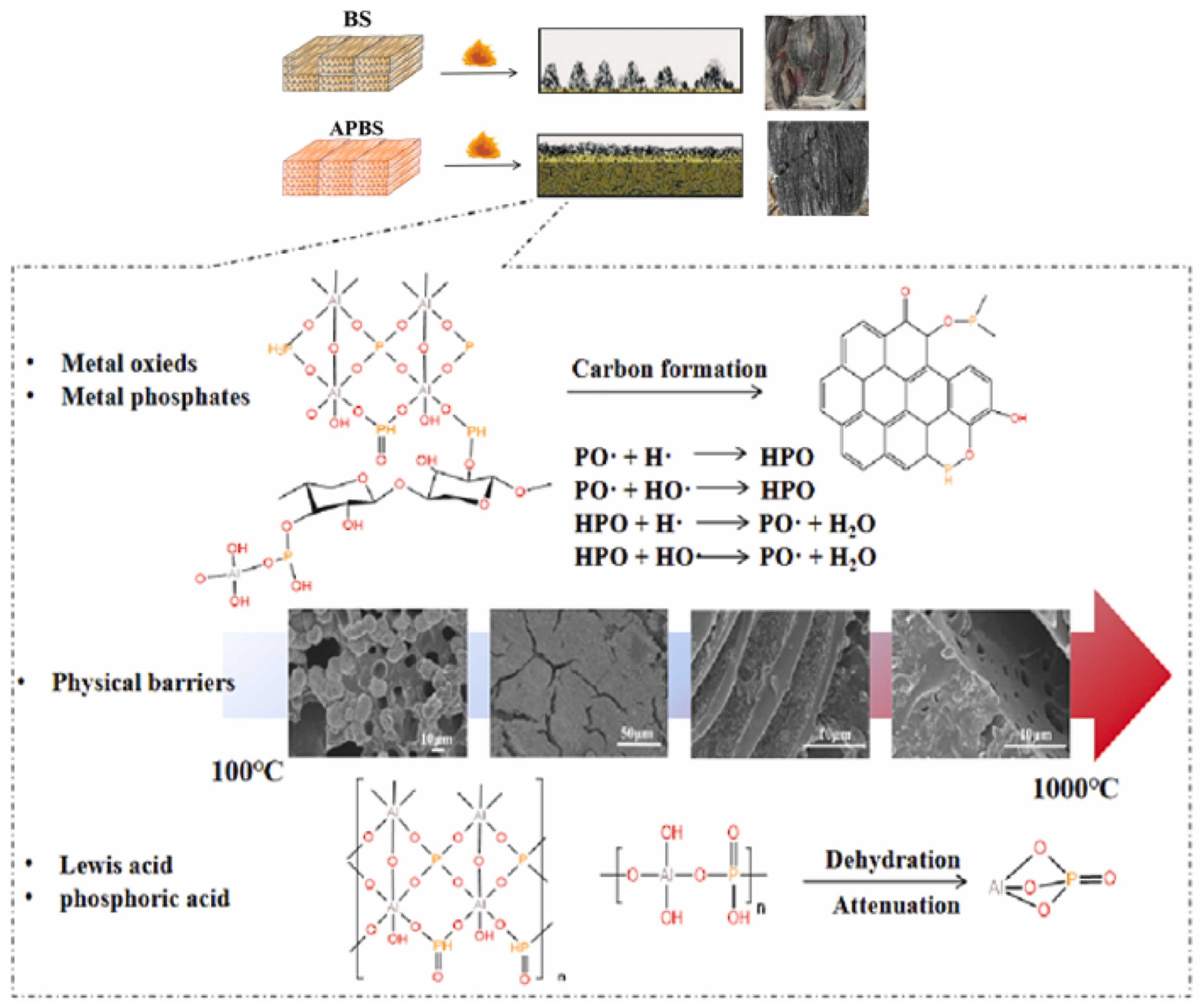


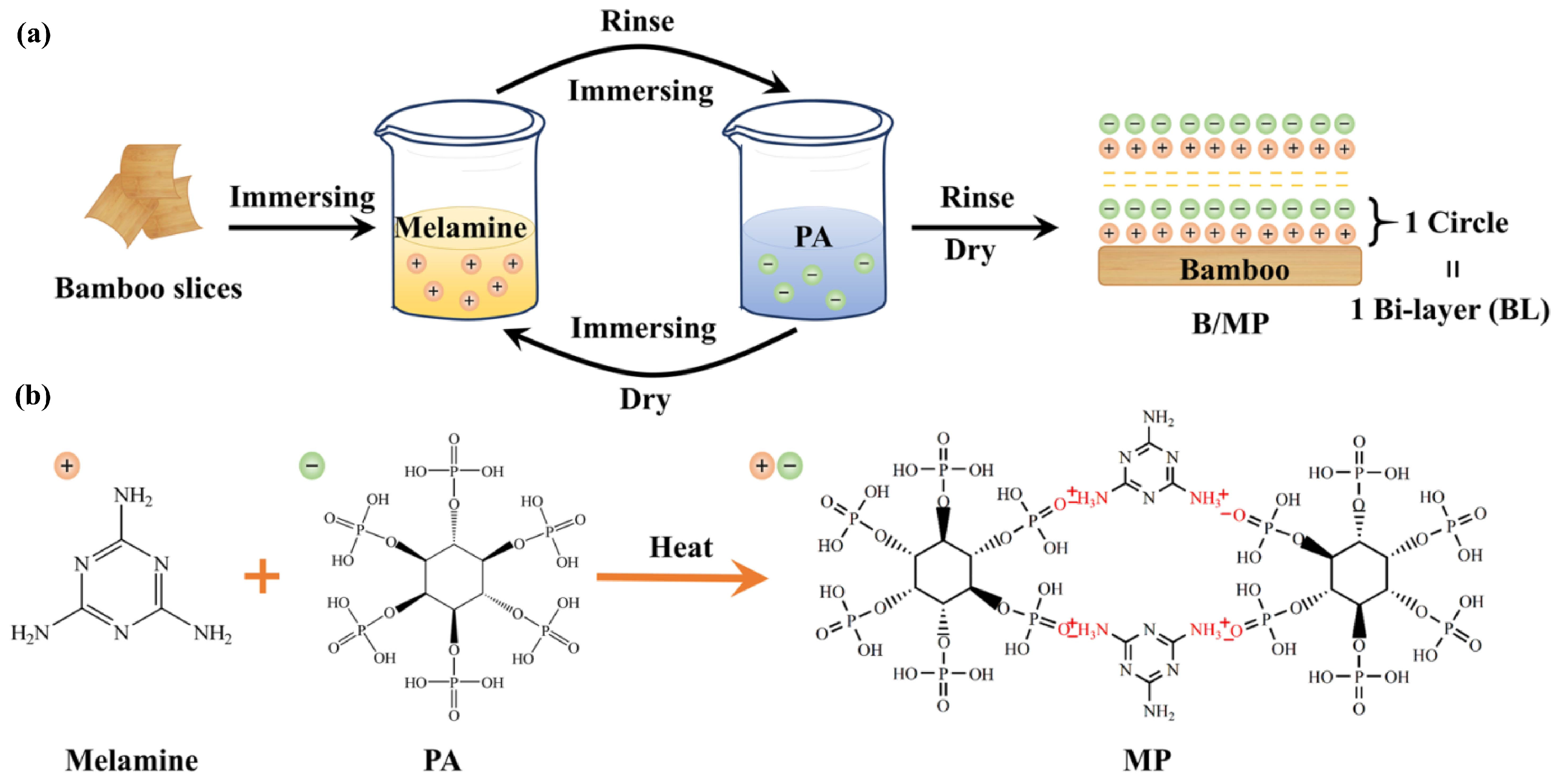

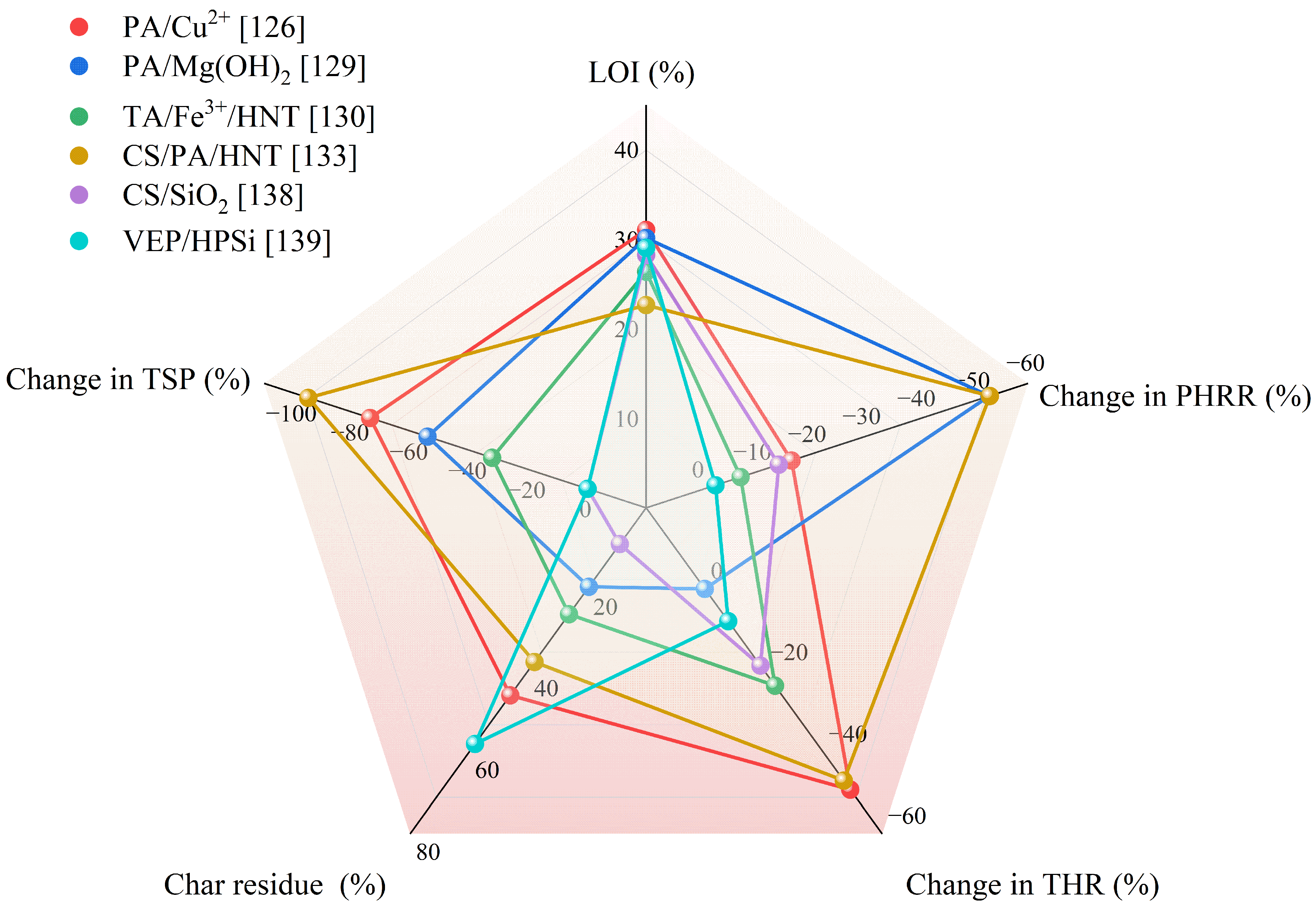

| System | Preparation Method | LOI (%) | PHRR (KW/m2) | THR (MJ/m2) | Ref |
|---|---|---|---|---|---|
| APP | Coating | 32.48 | 320.31(−44.9%) | 56.83(−33.1%) | [68] |
| APP/melamine formaldehyde | Melt blending | 25.5 | 344.3(−66%) | 58.8(−41.6%) | [70] |
| APP/NMH | Impregnation | 40.11 | 109.17(−21.9%) | 24.24(−25.7%) | [69] |
| APP/MXene | Impregnation | 36.06 | 166.51(−45.5%) | - | [82] |
| APP/STB/SSep | Impregnation | 50 | 119.60(−73%) | 43.8(−61.8%) | [83] |
| APP/STB/HSL | Impregnation | 59.5 | 103.50(−76.7%) | 15.0(−91%) | [78] |
| APP/MMT/VTMS | Impregnation | 29.83 | 57.49(−65.13%) | 0.5(−75.47%) | [79] |
| APP/TPU | Impregnation | 34.4 | 293.1(−36.6%) | 34.7(−36.6%) | [84] |
| MTTO/melamine | Coating | 38.7 | 321.34(−50.6%) | 92.56(−42.1%) | [62] |
| PW/AG | Situ synthesis | 37.9 | 227.26(−48.2%) | 46.46(−16.1%) | [66] |
| MAP/BA/SiO2 | Impregnation | - | 140.92(−48%) | 112.6(−9%) | [65] |
| TA/Borax/PAPP | Melt blending | 25.6 | 128(−65%) | 61(−48.7%) | [80] |
Disclaimer/Publisher’s Note: The statements, opinions and data contained in all publications are solely those of the individual author(s) and contributor(s) and not of MDPI and/or the editor(s). MDPI and/or the editor(s) disclaim responsibility for any injury to people or property resulting from any ideas, methods, instructions or products referred to in the content. |
© 2026 by the authors. Licensee MDPI, Basel, Switzerland. This article is an open access article distributed under the terms and conditions of the Creative Commons Attribution (CC BY) license.
Share and Cite
Zhu, Y.; Cui, Z.; Huang, Y.; Zhao, E.; Xu, M. Advances in Fire Retardant Technologies for Bamboo-Based Materials. Forests 2026, 17, 630. https://doi.org/10.3390/f17060630
Zhu Y, Cui Z, Huang Y, Zhao E, Xu M. Advances in Fire Retardant Technologies for Bamboo-Based Materials. Forests. 2026; 17(6):630. https://doi.org/10.3390/f17060630
Chicago/Turabian StyleZhu, Yu, Zhaoyan Cui, Yujie Huang, Ernian Zhao, and Ming Xu. 2026. "Advances in Fire Retardant Technologies for Bamboo-Based Materials" Forests 17, no. 6: 630. https://doi.org/10.3390/f17060630
APA StyleZhu, Y., Cui, Z., Huang, Y., Zhao, E., & Xu, M. (2026). Advances in Fire Retardant Technologies for Bamboo-Based Materials. Forests, 17(6), 630. https://doi.org/10.3390/f17060630