Review

Advances in Fire Retardant Technologies for Bamboo-Based Materials

1
National Engineering Research Center of Biomaterials, Nanjing Forestry University, Nanjing 210037, China
2
Key Laboratory of Concrete and Prestressed Concrete Structures of Ministry of Education, Southeast University, Nanjing 211189, China
3
Key Laboratory of Building Structural Retrofitting and Underground Space Engineering (Shandong Jianzhu University), Ministry of Education, Jinan 250101, China
*
Author to whom correspondence should be addressed.
Forests 2026, 17(6), 630; https://doi.org/10.3390/f17060630
Submission received: 17 April 2026 / Revised: 15 May 2026 / Accepted: 19 May 2026 / Published: 22 May 2026

Abstract

Bamboo, as a rapidly renewable and sustainable material, has gained increasing attention in the construction, furniture, automotive interiors, and packaging industries due to its excellent mechanical properties, light weight, and environmental friendliness. However, the inherent flammability of bamboo, characterized by its porous structure and high hemicellulose content, poses a significant fire hazard that severely limits its wide application. This review systematically synthesizes recent advances in the fire performance and flame-retardant modification of bamboo-based materials. First, the thermal degradation behavior and combustion mechanisms of bamboo are discussed in relation to its primary chemical constituents, including cellulose, hemicellulose, and lignin. Subsequently, various flame-retardant strategies are reviewed, including inorganic flame retardants, phosphorus–nitrogen systems, nanomaterial-based additives, and bio-based flame-retardant approaches. The effectiveness of different modification techniques, such as impregnation treatment, adhesive modification, and surface coating, is also analyzed. Future research directions are proposed, emphasizing the development of environmentally friendly flame-retardant systems, multifunctional modification strategies, and the design of high-performance flame-retardant bamboo-based materials. This review aims to provide a comprehensive framework for advancing the fire safety design and sustainable application of bamboo-based materials.

1. Introduction

The transition toward low-carbon and renewable materials has stimulated increasing interest in bamboo and bamboo-based composites. Bamboo grows rapidly, has a high strength-to-weight ratio, and can be processed into structural or decorative products with relatively low material consumption [1,2]. Compared with natural round culms, engineered bamboo, including laminated bamboo and bamboo scrimber, reduces the variability of the raw culm and provides standardized sections for construction, furniture, interior decoration, transportation, and packaging applications [3]. These advantages make bamboo an important candidate for sustainable material systems. However, the wider use of bamboo-based materials is still constrained by fire safety, especially in buildings and enclosed indoor environments where ignition resistance, heat release, smoke production, and toxic gas emission are critical requirements [4].
The flammability of bamboo originates from its chemical composition and anatomical structure. Like other lignocellulosic materials, bamboo is mainly composed of cellulose, hemicellulose, and lignin. These components undergo dehydration, depolymerization, volatilization, oxidation, and carbonization during heating [5,6]. Hemicellulose decomposes at relatively low temperatures, and cellulose contributes strongly to volatile release and rapid mass loss, while lignin degrades over a wider temperature range and participates in char formation. Studies on bamboo pyrolysis have shown that these degradation processes are strongly related to the formation of combustible gases, smoke, and residual char [7]. More importantly, bamboo cannot be treated simply as a uniform lignocellulosic solid. Its culm wall has a typical gradient structure, in which vascular bundles and parenchyma cells are unevenly distributed. This heterogeneous structure affects density, permeability, heat transfer, oxygen diffusion, and the migration of pyrolysis products [8]. During combustion, the porous tissue can facilitate the transport of heat and volatile products, while the dense outer region and oriented fiber bundles may lead to anisotropic flame spread and non-uniform carbonization. These structural characteristics make bamboo different from many wood-based materials and create specific difficulties for flame-retardant treatment. A flame retardant that performs well on the surface may not penetrate effectively into bamboo tissues, while a penetrated additive may still suffer from uneven distribution or poor fixation [9,10].
To mitigate these risks, the incorporation of flame retardants has been widely explored. Flame-retardant additives used for bamboo materials mainly act by changing the pyrolysis pathway, promoting protective char formation, reducing combustible volatile release, or forming physical barriers against heat and oxygen transfer [11,12,13]. Phosphorus-containing additives, including phosphate salts, ammonium polyphosphate, organophosphorus compounds, and phytic-acid-based systems, are among the most widely studied because they can catalyze dehydration and carbonization of cellulose- and hemicellulose-rich structures. However, many phosphorus-containing systems are hydrophilic or acidic, which may increase moisture absorption, affect dimensional stability, or weaken interfacial bonding [14,15]. Boron-containing additives, represented by boric acid, borax, and zinc borate, are also frequently applied to bamboo because they can suppress smoldering, promote char stabilization, and reduce heat release. Their main limitation is poor leaching resistance, especially when the treated bamboo is exposed to humid environments [16]. Inorganic additives, including expandable graphite, layered silicates, metal hydroxides, metal oxides, and mineralized particles, can improve thermal stability and barrier effects, but excessive loading may reduce processability, surface quality, or mechanical strength [17].
Alongside these conventional systems, emerging flame-retardant materials have gained increasing attention. Nanomaterials offer unique advantages, such as high surface area, tunable interfaces, and strong barrier effects, enabling efficient flame retardancy at a very low loading level [18]. Meanwhile, bio-based flame retardants derived from renewable resources, such as phytic acid, lignin, chitosan, and tannins, have been actively explored because of their environmental compatibility, intrinsic char-forming ability, and functional versatility. These novel systems not only improve flame retardancy but also impart multifunctional properties, including antibacterial activity, UV resistance, and improved interfacial bonding [19]. Nevertheless, their flame-retardant efficiency, composition stability, water resistance, and compatibility with bamboo substrates still vary greatly among different systems.
The effectiveness of these additives depends not only on their chemical flame-retardant mechanisms but also on how they are introduced into bamboo [20]. Impregnation is useful for delivering water-soluble salts or reactive flame retardants into the porous bamboo structure, yet the radial gradient and low permeability of dense regions often lead to uneven distribution. Coatings can form an external protective layer and are effective in delaying ignition and heat transfer, but coating adhesion, cracking, abrasion resistance, and moisture durability strongly affect their long-term performance. Adhesive compounding is more suitable for bamboo-based panels and recombined bamboo products because flame retardants can be incorporated during manufacturing; however, additives may interfere with resin curing, bonding strength, and formaldehyde emission behavior [21]. More recent approaches, including layer-by-layer assembly, in situ mineralization, and chemical grafting, attempt to improve additive fixation and interfacial compatibility, but their preparation complexity and scalability remain uncertain. To make these approaches comparable and practically meaningful, their fire performance should be evaluated using recognized testing standards and consistent experimental conditions. Standards issued by ASTM, ISO, EN, and other organizations provide the basis for assessing ignitability, flame spread, heat release, smoke production, and thermal stability.
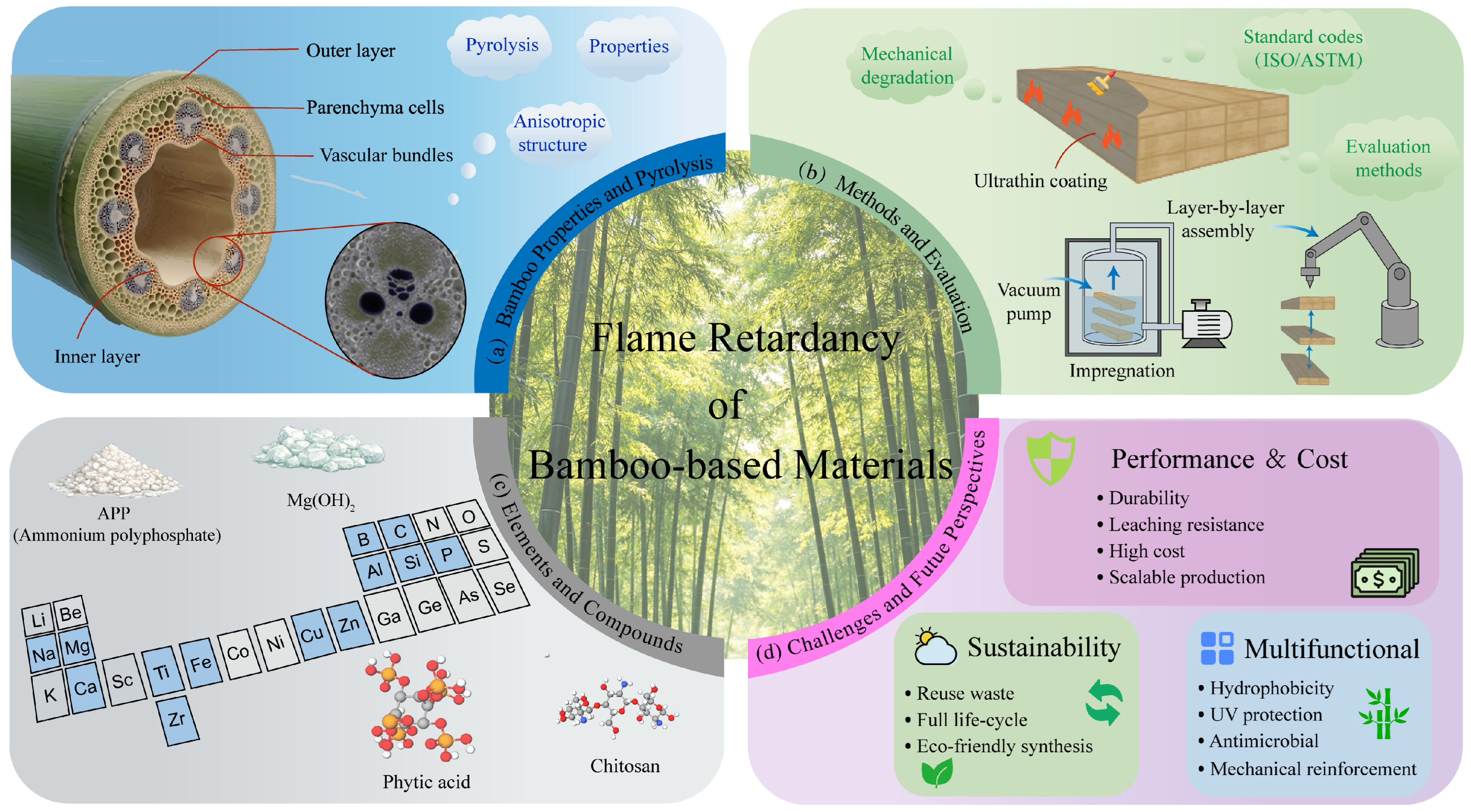
This review aims to provide a comprehensive state-of-the-art analysis of the flame retardancy of bamboo-based materials. In the subsequent sections, several key topics relevant to the fire safety of bamboo-based materials are outlined in Figure 1. First, the thermal degradation behavior and combustion mechanisms of bamboo are discussed in relation to its chemical composition and pyrolysis characteristics. Subsequently, different flame-retardant strategies, including phosphorus-nitrogen systems, inorganic additives, nanomaterial-based flame retardants, and bio-based approaches, are critically reviewed. In addition, the effectiveness of various modification techniques and fire testing methods is analyzed to provide a comparative understanding of the fire performance of treated bamboo materials. Finally, current research challenges and future perspectives are highlighted to promote the development of safer and more sustainable bamboo-based materials.

2. Structure and Pyrolysis Mechanism of Bamboo

Bamboo exhibits a highly anisotropic and hierarchical architecture, comprising three fundamental tissues: the epidermis, vascular bundles, and parenchyma ground tissue [22]. The epidermis is a smooth and dense layer that contains cellulose, silica particles, and stomata and acts as a water and mechanical barrier. The vascular bundles are the longitudinal tissues that support the culm, whereas the ground parenchyma occupies the rest of the culm section. Along the radial direction of the bamboo wall, the vascular bundle area percentage gradually increases from the inner bamboo yellow layer to the outer bamboo green layer. This gradient distribution is strongly and positively correlated with mechanical properties, resulting in higher tensile strength, bending strength, and modulus near the epidermal side [23]. Such radial heterogeneity also affects heat and mass transfer during combustion; the fiber-rich outer region generally exhibits higher density and provides preferential pathways for heat transport because fiber cells have higher thermal conductivity than parenchyma cells. In contrast, the parenchyma-rich inner region, with lower thermal conductivity and higher porosity, may facilitate oxygen penetration and the release of combustible volatiles during heating. In addition, bamboo shows anisotropic thermal transport, with heat being transferred more efficiently along the fiber axis than in the transverse direction due to the orientation of cellulose microfibrils in multilayered fiber cell walls. Therefore, the gradient structure of bamboo regulates combustion behavior through coupled heat and mass transfer processes, including heat penetration, volatile transport, oxygen diffusion, char formation, and flame spread [24,25]. In bamboo-based materials, mechanical processing (e.g., crushing, fiberization, and densification) and adhesive impregnation alter the native structure. The redistribution of fibers and partial collapse of parenchyma cells reduce porosity but increase density and interfacial bonding. Densification and adhesive impregnation can reduce open porosity and increase thermal inertia, which may delay ignition under certain heat-flux conditions. However, densification alone does not necessarily improve overall fire safety. First, a denser structure contains more combustible lignocellulosic substance per unit volume and can accumulate heat during external thermal exposure. Second, engineered bamboo usually contains polymeric adhesives, which introduce additional thermal degradation pathways and may contribute to volatile release, smoke generation, and toxic gas formation. Third, fire safety depends not only on time to ignition but also on heat release rate, mass loss rate, smoke production, toxic gas emission, char integrity, and flame spread.

2.1. Molecular Composition and Reaction Pathways

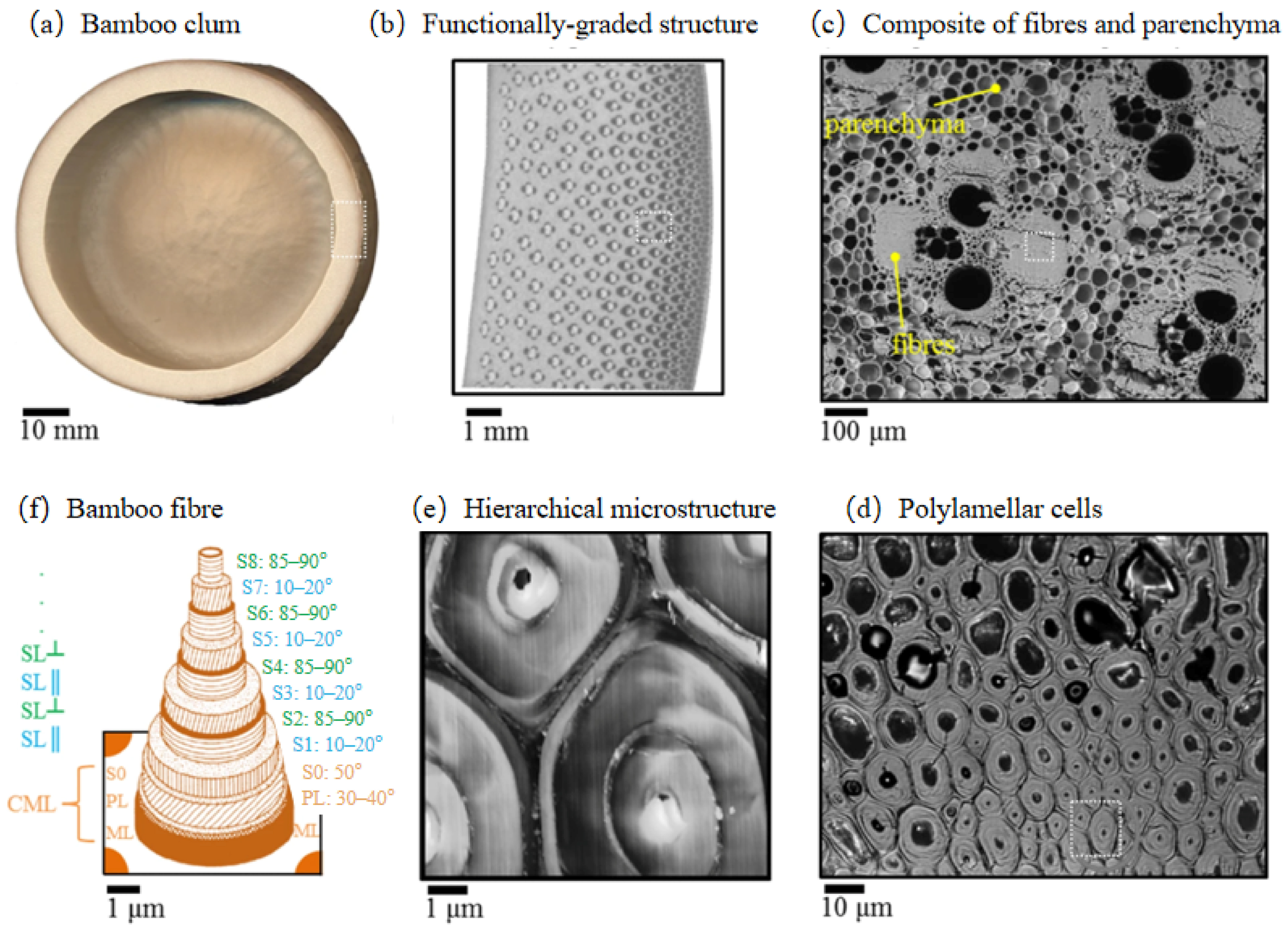
The hierarchical structure of bamboo is presented in Figure 2. At the molecular level, bamboo-based materials are primarily composed of three biopolymers: cellulose (40%–50%), hemicellulose (22%), and lignin (21%–25%), which together form a complex structural network. Cellulose in bamboo fibers exists in both crystalline and amorphous regions, forming a semicrystalline structure. It is a linear macromolecule composed of β-(1→4)-linked D-glucose units with a high degree of polymerization. Extensive intra- and intermolecular hydrogen bonding within cellulose chains leads to the formation of highly ordered crystalline regions, which contribute significantly to the mechanical stability of bamboo fibers, while the amorphous regions exhibit relatively lower thermal stability and are more susceptible to pyrolytic degradation [26]. Hemicellulose is a group of non-structural, low-molecular-weight, heterogeneous polysaccharides. Due to its low degree of polymerization and poor thermal stability, it decomposes at relatively low temperatures and serves as a primary source of volatile products during pyrolysis. Lignin, a complex cross-linked aromatic polymer, exhibits the highest thermal stability because of its high degree of aromaticity. During thermal decomposition, lignin undergoes complex bond cleavage and condensation reactions, resulting in the formation of a carbon-rich char residue [27].
Under a given heating rate and testing atmosphere, bamboo pyrolysis generally proceeds through three overlapping stages. The first stage, typically occurring below approximately 200 °C, is mainly associated with the evaporation of absorbed and bound water. The second stage, generally occurring in the range of approximately 200–380 °C, corresponds to the main decomposition stage, during which hemicellulose, cellulose, and part of lignin undergo rapid thermal degradation and release large amounts of combustible volatiles. The third stage, usually above approximately 380 °C, is mainly related to further lignin decomposition and carbonization [29]. However, these temperature intervals should be regarded as conditional rather than absolute, because the onset, peak, and termination temperatures of each decomposition stage are strongly affected by the heating rate. With increasing heating rate, the TG/DTG curves and decomposition peaks generally shift toward higher temperatures due to thermal lag and insufficient heat transfer within the bamboo matrix. During thermal degradation, significant microstructural transformations occur. The cell wall structure collapses due to the degradation of hemicellulose and cellulose, leading to the formation of pores and cracks. The resulting char layer is typically heterogeneous, consisting of partially carbonized fibers and residual inorganic components. Additionally, the anisotropic structure of bamboo influences flame spread behavior. Heat and mass transfer are more rapid along the longitudinal direction of fibers, leading to preferential flame propagation pathways [28]. This anisotropy must be considered in fire performance evaluation and material design.
During the thermal decomposition and combustion of bamboo-based materials, the main pyrolysis gases include CO, CO2, CH4, and H2, accompanied by water vapor, smoke particles, tar-like compounds, and partially oxidized organic volatiles. Their relative contents are strongly dependent on pyrolysis temperature, external heat flux, oxygen availability, and combustion stage [30]. At relatively low temperatures, approximately 250–350 °C, CO2 and CO are the dominant gaseous products, mainly resulting from the cleavage, condensation, and rearrangement of oxygen-containing functional groups, such as C=O and C-O-C, in hemicellulose and cellulose. With increasing temperature, the CO2 fraction decreases rapidly, whereas the CO fraction gradually increases. When the temperature exceeds approximately 450 °C, condensation and rearrangement reactions of lignin aromatic structures promote H2 release. At higher temperatures, secondary cracking of volatiles further increases the formation of CO and H2, while CH4 is mainly generated through demethylation reactions of methyl-containing side chains. Therefore, the gas and smoke release behavior of bamboo-based materials should be interpreted as a temperature-, heat-flux-, and stage-dependent process [31,32]. Compared with wood, bamboo-based materials exhibit distinct smoke and gas emission characteristics. Although the average CO2 yield of bamboo is slightly lower than that of wood, both the average smoke production rate within the first 180 s after ignition and the total smoke production throughout the entire combustion process are significantly higher. Moreover, the average CO yield of bamboo is higher than that of wood. These findings suggest that bamboo poses a greater smoke-related fire risk, particularly during the early stages of fire development, when elevated CO concentrations and rapid smoke generation can significantly increase toxicity and reduce visibility [33]. Therefore, in addition to heat release characteristics, smoke and toxic gas emissions must be considered critical parameters in evaluating the fire performance of bamboo-based materials.

2.2. Pyrolysis Kinetics and Mathematical Modeling

Bamboo pyrolysis should be understood as a multistep and overlapping degradation process rather than a simple single-stage reaction. This complexity originates from the different thermal stabilities and chemical structures of hemicellulose, cellulose, lignin, and, in engineered bamboo, polymeric adhesives. Thermogravimetric studies have shown that hemicellulose decomposes at relatively low temperatures, cellulose degrades rapidly in the main devolatilization region, and lignin decomposes over a much broader temperature range. Therefore, the TG/DTG profile of bamboo should be regarded as the superposition of multiple component reactions.
In bamboo pyrolysis studies, model-free methods such as Flynn–Wall–Ozawa [34], Kissinger–Akahira–Sunose [35], and Starink methods [36] can be used to estimate apparent activation energy within selected conversion intervals or relatively well-defined decomposition stages, but they should not be treated as a single global kinetic model for the entire multistage pyrolysis process. However, using a single reaction model to describe the entire devolatilization stage is insufficient, because several bond-cleavage, depolymerization, condensation, and recombination reactions occur simultaneously within a narrow temperature interval [37]. It should also be noted that Gibbs free energy, enthalpy, and entropy of the overall pyrolysis reaction cannot be directly calculated from activation energy and the pre-exponential factor obtained from thermal analysis. Such quantities, if estimated from transition-state-type equations, refer to activated-complex formation rather than to the thermodynamics of converting reactants into products [38]. The hierarchical structure of bamboo further affects its pyrolysis kinetics. Fiber-rich vascular bundles may provide preferential pathways for heat transport, whereas parenchyma-rich regions and pores facilitate volatile release. In engineered bamboo, densification, fiber redistribution, resin impregnation, and adhesive curing can further alter heat transfer, mass transport, and char evolution [39]. Flame-retardant modification can also change the pyrolysis pathway by promoting dehydration and carbonization, reducing mass-loss rate, increasing char yield, and restricting heat and volatile transport.

3. Flame-Retardant Strategies, Mechanisms, and Performance Evaluation of Bamboo-Based Materials

3.1. Flame-Retardant Strategies

To address the inherent flammability of bamboo-based materials, a variety of flame-retardant strategies have been developed. These strategies can be broadly categorized into three types based on their implementation approaches: impregnation, surface coating, in situ modification, and adhesive compounding. The vacuum-pressure impregnation method utilizes the longitudinal vascular bundles as natural micro-channels; consequently, aqueous FR solutions are forced into the deep parenchyma tissue. Researchers [40] compared the physical and mechanical properties of bamboo scrimber produced through vacuum-pressure impregnation with those prepared using traditional methods. The results indicated that vacuum-pressure impregnation requires a lower solid content of phenol-formaldehyde (PF) resin than traditional impregnation to achieve the same resin content in the bamboo scrimber. Furthermore, bamboo and wood produced via vacuum-pressure impregnation exhibited superior dimensional stability and mechanical properties. Surface coatings, such as intumescent coatings and layer-by-layer assemblies, primarily act at the material interface, forming protective barriers under fire exposure. The method offers the advantages of ease of application and processability [41].
Compared with impregnation and surface coating methods, in situ modification and adhesive compounding offer superior durability and integration, rendering them preferable for structural applications of bamboo-based materials. In situ modification entails the incorporation and reaction of flame retardants within the bamboo matrix during material processing, enabling the formation of chemically or physically integrated flame-retardant systems. Unlike conventional impregnation, which primarily relies on physical deposition within cell lumens, in situ approaches promote interactions at the cell wall level or within the polymer network. In contrast, adhesive compounding is a widely used strategy in engineered bamboo, where flame retardants are incorporated into the adhesive system prior to composite fabrication. This approach is particularly suitable for materials such as bamboo scrimber and laminated bamboo lumber, in which adhesives play a critical role in structural integrity [42,43,44]. However, challenges remain, including potential impacts on resin curing kinetics, mechanical integrity, and processing parameters. Therefore, careful optimization of formulation and processing parameters is required to achieve a balance between fire safety and structural performance.

3.2. Flame-Retardant Mechanisms

The flame-retardant mechanisms of bamboo-based materials are intrinsically linked to their lignocellulosic composition and hierarchical structure and typically involve synergistic actions in both the condensed and gas phases. During thermal exposure, untreated bamboo undergoes rapid pyrolysis dominated by the decomposition of hemicellulose and cellulose, yielding flammable volatiles, most notably levoglucosan, which significantly contributes to flame propagation. In contrast, effective flame-retardant systems alter this degradation pathway by promoting dehydration, suppressing depolymerization, and enhancing char formation [45].
Within the condensed phase, the primary mechanism comprises the catalytic dehydration and carbonization of bamboo biopolymers (cellulose and hemicellulose). For instance, phosphorus-based flame-retardants, such as ammonium polyphosphate (APP), decompose at temperatures lower than the onset of bamboo pyrolysis to release polyphosphoric acid. This acid acts as a potent dehydrating agent, promoting the formation of a dense, cross-linked, and thermally stable graphitic char layer. This char layer acts as a protective barrier, limiting heat transfer and oxygen diffusion while suppressing the release of combustible volatiles. With increasing temperature, this protective layer decomposes and restructures into a more stable char, thereby reinforcing the carbonaceous residue and retarding thermal transport and oxygen ingress [46]. Typical formulations leverage synergistic combinations of phosphorus, boron, silicon, and metal compounds. Most bio-based flame-retardants, including those containing lignin, tannin, and phytate components, rely on this carbonaceous char mechanism for flame retardancy [47].
Simultaneously, gas-phase mechanisms contribute to flame inhibition via radical quenching and dilution effects. During combustion, the pyrolysis of cellulose, hemicellulose, lignin, and polymeric adhesives releases flammable volatiles, such as hydrocarbons, carbonyl compounds, aromatic compounds, and CO, which sustain flame propagation and contribute to heat release, smoke, and toxicity [48]. Phosphorus-containing flame retardants can generate PO·, HPO·, and related active species, which capture H· and OH· radicals in the flame zone and interrupt gas-phase chain reactions [49]. Nitrogen-containing compounds or phosphorus–nitrogen systems can release non-flammable gases, such as NH3, CO2, and H2O, thereby diluting oxygen and combustible volatiles. In addition, some flame-retardant systems can suppress the formation of pyrolysis-associated gases and flammable volatiles, as evidenced by reduced TG-FTIR absorbance intensities of CO, CO2, carbonyls, and aromatics in treated bamboo [50]. Therefore, gas-phase flame retardancy involves radical inhibition, inert-gas dilution, volatile suppression, smoke/toxic gas reduction, and flame-propagation control, which usually works together with condensed-phase char formation [51,52].
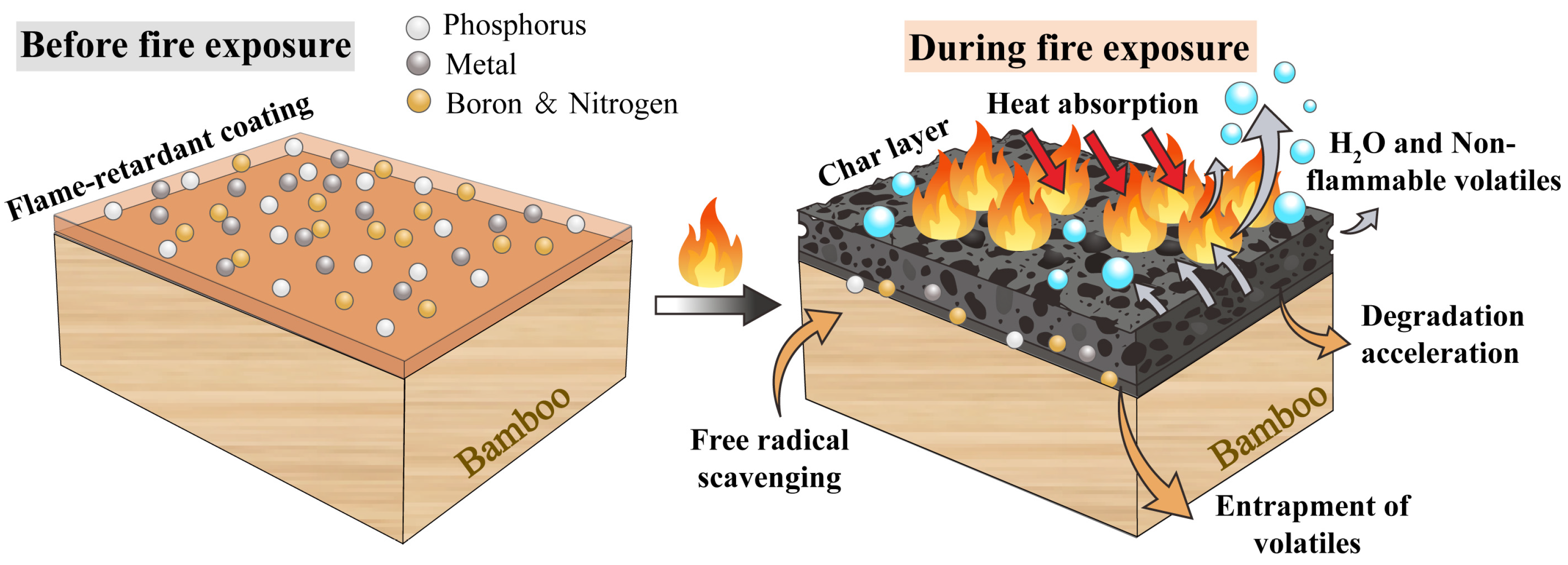
Importantly, as illustrated in Figure 3, the flame-retardant performance of bamboo is often governed by synergistic interactions among multiple components. Layered or inorganic additives can create tortuous diffusion pathways, while endothermic decomposition processes absorb heat and release inert gases such as water vapor. Collectively, these effects reduce the rate of thermal degradation and prolong the time-to-ignition (TTI), providing critical intervals for evacuation and firefighting [53]. Lignin, with its high aromaticity and inherent charring ability, functions as a supplemental carbon source that reinforces the char skeleton. When combined with inorganic synergists, these bio-sourced molecules facilitate the transition from a brittle, porous char to a robust, multicellular intumescent structure [54]. This integrated multiphase defense ensures that bamboo-based materials can maintain structural integrity and low fire growth indices in demanding structural applications [55].
From a kinetic perspective, these mechanisms collectively increase the activation energy (Ea) of thermal degradation and shift the pyrolysis pathway toward carbonization over volatile evolution. These alterations manifest as a reduced mass loss rate, retarded decomposition, and enhanced fire resistance [56]. Consequently, the flame-retardant behavior of bamboo-based materials can be understood as a multiscale process involving molecular-level reactions, microstructural evolution, and macroscopic heat and mass transfer phenomena.

3.3. Standard Codes and Methods of Evaluation

The fire performance of bamboo-based materials must be evaluated using standardized testing methods to ensure reliability, reproducibility, and inter-study comparability. The evaluation of flame-retardant bamboo materials should not rely on a single fire-test parameter. The limiting oxygen index (LOI) and vertical burning test (UL-94) are commonly used as preliminary screening methods because they can rapidly reflect the ignitability and self-extinguishing behavior of treated bamboo materials [57,58]. However, these tests are strongly affected by specimen size, thickness, density, moisture content, and testing direction, and they cannot fully represent real fire growth or smoke hazards. Therefore, increased LOI values or improved UL-94 ratings should be interpreted as initial indicators rather than direct evidence of practical fire safety. Cone calorimetry provides more comprehensive information on the combustion behavior of bamboo materials, including time to ignition, heat release rate, total heat release, smoke production, mass loss, and char residue [59,60]. These parameters are particularly important because bamboo combustion involves both volatile release and condensed-phase char formation. A lower peak heat release rate and a higher char residue usually indicate improved barrier protection, while reduced smoke production is essential for bamboo products used in indoor environments. Nevertheless, cone calorimetry results should be analyzed together with bamboo anatomy, density, treatment depth, additive distribution, and char morphology, because the porous and anisotropic structure of bamboo can influence heat transfer and volatile migration during combustion.
Thermal analysis, including TGA and differential scanning calorimetry (DSC), is useful for understanding how flame retardants affect bamboo pyrolysis. Changes in initial degradation temperature, maximum mass-loss rate, and residual char. However, TGA is usually conducted under simplified atmospheric and heating conditions and therefore cannot directly represent flaming combustion [61,62]. To clarify flame-retardant mechanisms, TGA should be combined with cone calorimetry, char-residue analysis, scanning electron microscopy (SEM), Fourier-transform infrared spectrum (FTIR), Raman spectroscopy, X-ray photoelectron spectroscopy (XPS), or pyrolysis gas chromatography mass spectrometry (Py-GC/MS). These combined methods can help connect thermal degradation behavior with char formation, volatile release, smoke production, and gas-phase products.
Recognized standards issued by ASTM, ISO, EN, and other organizations provide the basis for comparing flame-retardant performance under consistent testing conditions. However, for bamboo materials, standard test results should be interpreted together with material-specific factors, including bamboo species, culm position, density gradient, fiber orientation, moisture content, adhesive type, treatment method, and service environment. Therefore, the purpose of fire-performance evaluation is not simply to report standard test values but to establish a reliable relationship between flame-retardant treatment, bamboo structure, combustion behavior, and practical applicability. In addition, because bamboo-specific standards are still less comprehensive than those for timber and wood-based materials, some studies evaluate bamboo materials by referring to timber-related standards. Such interpretation should consider the structural differences between bamboo and wood, including radial density gradient, vascular bundle distribution, fiber orientation, and so on.

4. Flame-Retardant Systems for Bamboo-Based Materials

The development of flame-retardant systems for bamboo-based materials requires a multiscale understanding of thermal degradation, chemical interactions, and fire behavior. From a mechanistic perspective, the effectiveness of a flame-retardant system can be interpreted as its ability to redirect the pyrolysis pathway from volatile generation toward condensed-phase carbonization, while simultaneously suppressing flame propagation in the gas phase and limiting heat transfer across the material interface. Within this framework, diverse classes of flame retardants exert distinct yet synergistic roles.

4.1. Phosphorus-Based Flame Retardants

Phosphorus-based flame retardants are among the most efficacious and widely studied systems for lignocellulosic materials. On the one hand, they can capture free radicals in the gas phase; on the other hand, they promote carbonization in the condensed phase, which prevents the heat exchange and the release of pyrolysis volatiles [63].
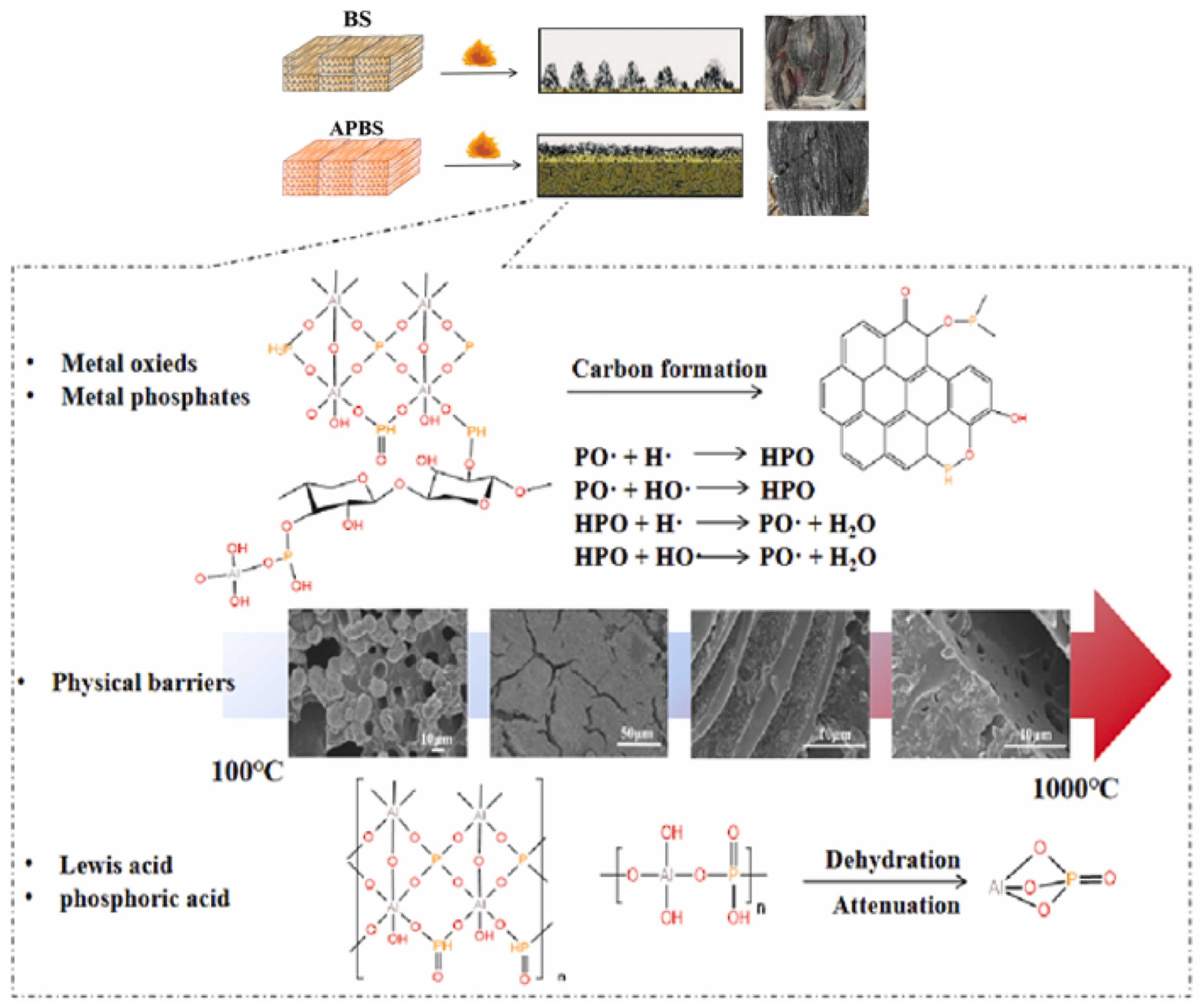
For instance, Wang et al. [50] synthesized a tung oil-based phosphorus-containing flame-retardant polyol (MTTO) and applied it to bamboo via an impregnation–coating process. The results demonstrated that MTTO exhibited a dual-action mechanism in both the gas and condensed phases. During combustion, phosphorus-containing groups generated phosphoric acid species that catalyzed dehydration and promoted the formation of a thermally stable phosphorus–oxygen crosslinked char layer. Simultaneously, the release of non-flammable gases and phosphorus-containing radicals contributed to flame inhibition in the gas phase. As a result, the limiting oxygen index (LOI) increased from 28.3% to 38.7%, accompanied by significant reductions in the PHRR and THR. To address the limitations of traditional flame-retardant technologies, which involve complex processes, intricate facilities, and the emission of hazardous substances during combustion from partially synthesized flame-retardant materials, Wei et al. [64] developed a flame-retardant bamboo scrimber by in situ hydrothermal synthesis of hierarchical lamellar aluminophosphate (AP), achieving a high LOI of 41.5% under optimized conditions. The AP significantly reduced heat and smoke release while promoting the formation of a dense char layer, thereby effectively suppressing volatile organic compounds (VOCs) and polycyclic aromatic hydrocarbons (PAHs) emissions. The flame-retardant and smoke-suppression mechanisms are illustrated in Figure 4. Furthermore, complex phosphorus–nitrogen–boron (P-N-B) formulations have demonstrated synergistic superiority. Peng et al. [65] immersed bamboo bundles in a P-N-B complex solution derived from halogen-free compounds without external pressure to obtain unique bamboo scrimber construction units, where the incorporation of P-N-B retardants effectively delayed the second heat release peak and reduced both heat and smoke release.
The resulting materials successfully met the B1 fire classification requirements, demonstrating strong potential for industrial applications. In addition to ex situ incorporation of flame retardants, in situ assembly strategies have emerged as a promising route for enhancing durability and multifunctionality. Liu et al. [66] reported the fabrication of phosphorus-containing organic–inorganic hybrid nanospheres within bamboo via the in situ self-assembly of phosphotungstic acid and silver ions. This nanostructured system not only reduced the PHRR by 48.2% but also exhibited exceptional leaching resistance and antifungal properties, attributed to strong interfacial interactions and nanoscale confinement effects that anchor the active components within the cell wall.

4.1.1. Ammonium Polyphosphate (APP)-Based Systems

Ammonium polyphosphate (APP) is one of the most extensively studied phosphorus-based flame retardants, valued for its high efficiency, low toxicity, and intumescent characteristics. Within bamboo-based materials, APP primarily functions within the condensed phase via the liberation of polyphosphoric acid, which catalyzes dehydration and promotes the formation of a protective char [67]. Zhang et al. [68] incorporated APP into a bio-based adhesive system to fabricate environmentally friendly bamboo particleboards. The interaction between phosphate groups and hydroxyl groups in the adhesive matrix enhanced interfacial bonding, while the filling effect of APP contributed to a denser core structure. With only 15 wt% APP loading, the composite achieved a UL-94 V-0 rating and an LOI value of 32.48%, while maintaining satisfactory mechanical properties. Despite these advantages, APP suffers from poor water resistance and limited compatibility with bamboo, which restrict its long-term performance. To address these issues, various modification strategies have been proposed. For example, Zhao et al. [69] combined APP with nanoscale magnesium hydroxide (NMH), leveraging the synergistic effects between condensed-phase charring (APP) and endothermic decomposition with water release (NMH). At an optimal ratio of 6:4, the PHRR and TSP were reduced by 45.65% and 59.68%, respectively. Moreover, Nie et al. [70] microencapsulated APP using melamine–formaldehyde resin (MFAPP) and simultaneously treated bamboo fibers to improve interfacial compatibility. The resulting composites exhibited significantly enhanced hydrophobicity, with water contact angles exceeding 119°, and maintained UL-94 V-0 performance even after prolonged water immersion at elevated temperatures. These results highlight the effectiveness of encapsulation strategies in improving both durability and flame-retardant performance. Notably, the main drawback of APP-based systems is their moisture sensitivity. APP can generate polyphosphoric acid during heating, which is beneficial for condensed-phase charring, but its hygroscopic nature and partial water solubility may lead to migration, leaching, and deterioration of flame-retardant performance during service. In addition, APP particles may show limited compatibility with hydrophobic polymer matrices or phenolic/urea-formaldehyde adhesive systems, causing aggregation and weak interfacial bonding. These issues can reduce stress transfer between bamboo fibers and adhesives and may impair bending strength or dimensional stability [71,72]. Microencapsulation, surface modification, hybridization with zeolite, silica, clay, or metal hydroxides, and incorporation into cross-linked adhesive networks are therefore commonly used to improve APP dispersion, water resistance, and durability [73,74].

4.1.2. Phosphorus-Based Synergized Flame-Retardant Systems

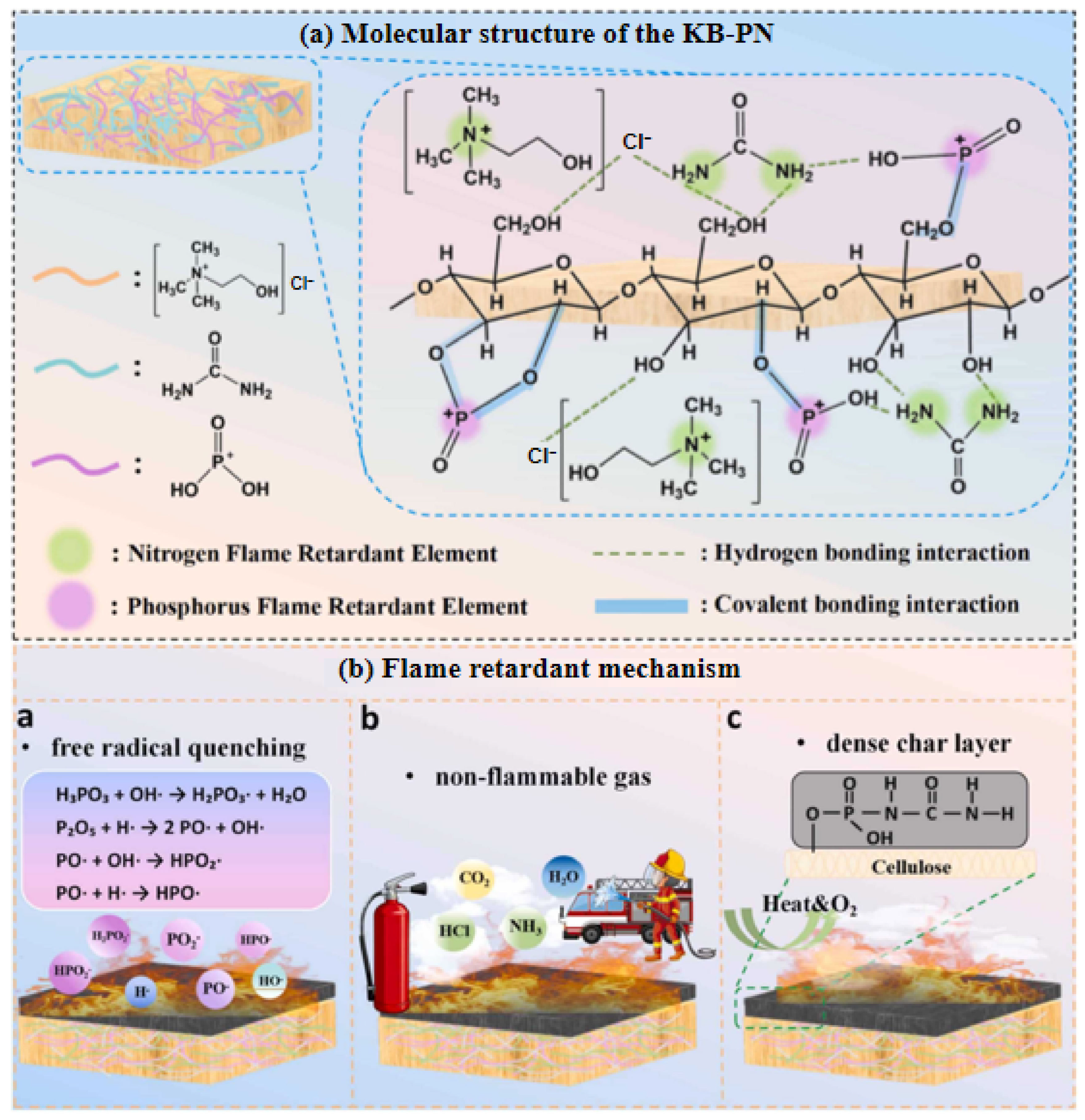
To achieve high flame-retardant efficiency while preserving mechanical integrity and environmental durability, synergistic systems integrating multiple components have been widely developed. One effective strategy involves constructing hierarchical core–shell structures [75,76,77]. Jiang et al. [78] designed a high-performance bamboo composite featuring a phosphorus-boron-treated bamboo fiber core and an outer hybrid shell composed of organosilicon-modified basalt fibers and phenolic resin. This architecture enabled strong synergistic interactions; the inner core promoted early-stage carbonization, while the outer shell formed a thermally stable barrier during combustion. Consequently, the TTI was extended to 1005 s, and the fire performance index (FPI) increased by approximately 60 times. Similarly, Leng et al. [79] constructed a P-Si system by incorporating APP, Montmorillonite (MMT), and vinyltrimethoxysilane (VTMS) into bamboo fiber foams. The combined effects of catalytic charring, physical barrier formation, and silicate network reinforcement led to a 65.13% reduction in PHRR and an LOI value of 29.83%. Beyond these systems, multifunctional hybrid designs based on dynamic chemical interactions have also shown significant promise. Yang et al. [80] developed a temperature-responsive borate ester network using tannic acid and borax, which was combined with piperazine pyrophosphate (PAPP). This system enhanced interfacial bonding after curing, while simultaneously improving flame retardancy, mechanical strength, and UV resistance. In addition, Zeng et al. [81] proposed a green flame-retardant modification strategy for bamboo based on a choline chloride–urea–phosphorous acid deep eutectic solvent (DES), enabling the stable incorporation of P and N elements via synergistic physical impregnation, P-O-C covalent bonding, and hydrogen-bonding interactions under mild conditions. The treated sample exhibited significantly enhanced fire safety (LOI 37.3%, UL-94 V-0) with reduced heat and smoke release, as presented in Figure 5, which is attributed to a gas–condensed phase synergistic mechanism involving radical quenching and inert gas dilution in the gas phase, as well as catalytic formation of a dense intumescent char layer in the condensed phase, while maintaining excellent mechanical integrity.
Collectively, phosphorus-based flame-retardant systems for bamboo have evolved from simple additive approaches to sophisticated multicomponent and multiscale designs. As summarized in Table 1, these synergistic systems significantly enhance fire performance while addressing critical limitations such as smoke toxicity and leaching resistance. Although phosphorus–nitrogen–boron and other multicomponent systems often show strong synergistic effects, their formulation complexity should not be overlooked. The simultaneous introduction of acid sources, carbon sources, and inorganic synergists may improve intumescence and smoke suppression, but it can also complicate processing, penetration uniformity, and interfacial compatibility in bamboo. High additive loading or uneven distribution may disturb adhesive curing, increase brittleness, and reduce mechanical reliability. Therefore, synergistic systems require careful optimization of component ratios, particle dispersion, penetration depth, and wet-aging durability. Future developments should prioritize the design of durable, bio-based phosphorus systems and the elucidation of the fundamental relationships between microstructural evolution and macroscopic fire behavior.

4.2. Nitrogen-Based Flame Retardants

Nitrogen-based flame retardants have been widely incorporated into bamboo-based materials through compounding, surface modification, and adhesive engineering. Among them, triazine-based compounds and phosphorus-nitrogen (P-N) synergistic systems represent the most extensively studied approaches. Melamine cyanurate (MCA) is an important nitrogen-based compound that exhibits a distinct mechanism within polymer-bamboo hybrid systems. The research shows MCA or aluminum diethylphosphinate (ADP), shows limited flame-retardant efficiency; however, their combination leads to a pronounced synergistic effect. At an optimal ratio (ADP/MCA = 10:10), the composite achieves a UL-94 V-0 classification and an LOI of 25.5% [85]. Surface modification represents another effective strategy for introducing nitrogen elements. Melamine-phytic acid (MEL/PA) polyelectrolyte complexes can be constructed on bamboo surfaces via in situ assembly, forming multifunctional coatings with flame-retardant, superhydrophobic, and antifungal properties. In these systems, the nitrogen component contributes to gas-phase dilution, while the phosphorus component catalyzes char formation, resulting in a dense protective layer. The treated bamboo exhibits a substantial increase in LOI, achieves UL-94 V-0 rating, and shows significant reductions in both PHRR and THR [86]. In addition, melamine-based systems are particularly effective due to their high nitrogen content and ability to release large amounts of inert gases during decomposition. In engineered bamboo, melamine is often used in conjunction with adhesives, where it can enhance both flame retardancy and crosslinking density. He et al. [87] investigated the effects of different adhesives, phenol formaldehyde (PF) and melamine urea formaldehyde (MUF), on the mechanical and fire properties of flame-retardant laminated bamboo lumber (LBL). As a result, laminated bamboo lumber bonded with MUF exhibits significantly lower heat and smoke release, with total smoke production reduced by over 40%. The above studies collectively indicate that the role of nitrogen in bamboo flame-retardant systems extends far beyond simple gas-phase dilution. Instead, its primary contribution lies in enabling multiscale synergistic interactions. Nitrogen-containing compounds promote the formation of expanded and continuous char layers through intumescence, and their interaction with phosphorus, silicon, and boron elements leads to integrated flame-retardant systems with improved efficiency and durability.
Despite their environmental friendliness and effectiveness in gas-phase flame inhibition, nitrogen-based flame retardants still face several critical limitations in bamboo-based materials. First, their relatively weak condensed-phase activity results in insufficient char strength and continuity, making them highly dependent on synergistic systems (e.g., phosphorus or silicon) to achieve stable fire protection. Second, poor interfacial compatibility with hydrophobic matrices or lignin-rich regions often leads to aggregation and non-uniform dispersion, which can compromise both flame-retardant efficiency and mechanical performance [88,89]. Third, the effectiveness of gas-phase dilution is sensitive to decomposition kinetics; rapid release of inert gases under high heat flux may not adequately suppress flame propagation without a robust barrier layer. In addition, some nitrogen-containing compounds exhibit water solubility, raising concerns regarding leaching and long-term durability in humid environments. Future research should prioritize augmenting the intrinsic char-forming capacity of nitrogen systems through molecular design and improving interfacial compatibility via reactive grafting [90].

4.3. Boron-Based Flame Retardants

Boron-based flame retardants play a distinct role in bamboo-based materials, primarily through condensed-phase mechanisms, specifically the formation of a vitreous layer, char stabilization, and smoke suppression. Unlike phosphorus- or nitrogen-based systems, boron compounds exhibit relatively weak gas-phase activity but are highly effective in modifying the structure and integrity of the char layer [91]. During thermal decomposition, boron-containing compounds (e.g., boric acid, borates) undergo dehydration reactions to form boron oxide (B2O3), which subsequently melts and forms a viscous glassy layer on the material surface. This layer acts as an effective barrier, limiting heat transfer, oxygen diffusion, and the release of combustible volatiles. At the same time, boron species can interact with hydroxyl groups in cellulose and hemicellulose to form B-O-C linkages, promoting crosslinking reactions and enhancing char stability. In addition, boron compounds are particularly effective in suppressing smoke production. Furthermore, boron compounds are particularly efficacious in smoke suppression; by facilitating the formation of a compact, low-porosity char, they reduce the release of incomplete combustion products such as CO and particulate matter [92,93].
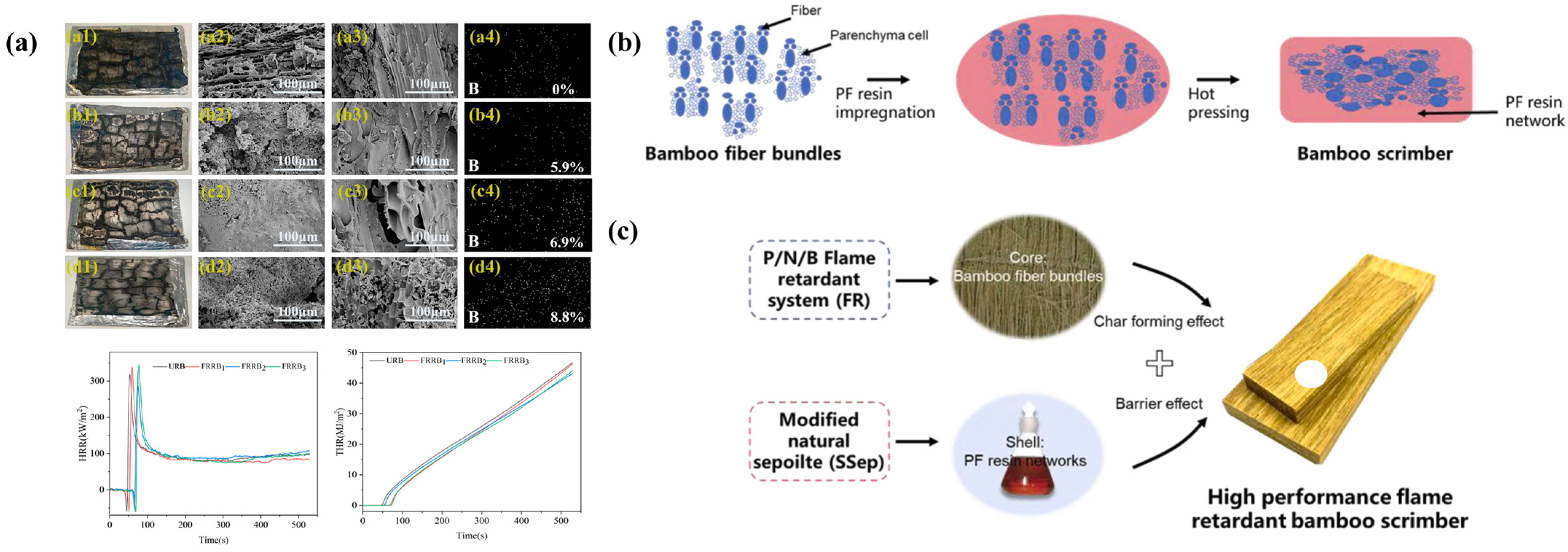
Guo et al. [94] delignified natural bamboo to retain a highly aligned cellulose scaffold, followed by surface modification using boric acid under alkaline conditions. Subsequently, epoxy resin was introduced via vacuum impregnation to form the composite material. The results demonstrated the formation of cross-linked structures between the hydroxyl groups of boric acid and the diol or carboxylic groups of the cellulose backbone. The resulting boric acid-modified bamboo/epoxy composite exhibited a limiting oxygen index (LOI) of 26.5%, representing a 29.3% increase compared to neat epoxy. Meanwhile, the peak heat release rate (PHRR) and total heat release (THR) were reduced by 63% and 7.2%, respectively. To mitigate the leaching susceptibility inherent to boron-based retardants, researchers have developed strategies for covalent anchoring. Zhang et al. [95] designed a hyperbranched polymer (HPB) with polyether as the backbone and phenylboronic acid as the binding group via epoxy ring-opening reactions with amino. The HPB-PBA network was covalently bonded to the bamboo cell wall via epoxy–hydroxyl reactions, while boronic acid groups formed borate ester linkages with cellulose, enabling efficient fixation of boron species. As a result, the boron retention reached as high as 60.6%, significantly exceeding that of most reported systems. Additionally, the hyperbranched polyether chains penetrated the cell wall, reducing swelling and shrinkage rates by 20.3% and 14.8%, respectively. Cone calorimetry results further showed that the second peak heat release rate and peak smoke production rate were reduced by 21.5% and 19.8%, respectively, indicating improved flame retardancy and smoke suppression. This study provides an effective molecular design strategy for anchoring boron within bamboo and mitigating leaching issues. Hexagonal boron nitride (h-BN), a two-dimensional layered material, has also attracted increasing attention for surface coating applications due to its excellent anisotropic thermal conductivity, thermal stability, and barrier properties [96,97]. Li et al. [98] developed flame-retardant coatings based on chitosan (CS) and polyvinyl alcohol (PVA), incorporating varying amounts of h-BN, and applied them onto bamboo scrimber surfaces via spraying. The results showed that the incorporation of h-BN significantly enhanced the thermal stability of the bamboo scrimber, with performance improving as the h-BN content increased. As shown in Figure 6a, cone calorimetry tests revealed that a coating containing 5 wt% h-BN extended the time to ignition (TTI) by 56%, while reducing PHRR, THR, and total smoke production (TSP) by 9.92%, 7.54%, and 32.35%, respectively.
Despite these intrinsic advantages, the practical deployment of traditional boron-based retardants in high-performance bamboo-based materials is hindered by several critical bottlenecks. The most prominent challenge is their high susceptibility to leaching; the lack of strong chemical bonding between inorganic borates and the hydroxyl-rich bamboo cell wall leads to poor durability in exterior or high-humidity environments [16]. Furthermore, while boron significantly improves the LOI and reduces smoke production, it often exhibits lower efficiency in suppressing the PHRR compared to phosphorus-based systems. To address these deficiencies, current studies are pivoting toward the synthesis of organic-inorganic hybrid boron flame retardants or the utilization of sol–gel and vacuum-pressure impregnation techniques to achieve in situ mineralization within the bamboo’s hierarchical pore structure, as illustrated in Figure 6b,c. A notable example is the phosphorus-boron (P-B) system combined with organosilicon-modified sepiolite (SSep) to construct a hierarchical core–shell structure [83]. In this architecture, the phosphorus–boron system promotes early-stage dehydration and charring within bamboo fiber bundles, while the SSep-reinforced outer shell enhances thermal stability and facilitates the formation of a more graphitized and compact char layer. The results showed that the total heat release of the treated bamboo scrimber decreased by 61.8% compared to untreated bamboo scrimber, and the LOI increased from 32.8% to 50%. These advanced strategies aim to anchor boron moieties within the cell wall, effectively reconciling the paradox between flame retardancy, leaching resistance, and the preservation of the bamboo’s natural aesthetic and mechanical properties [99].

4.4. Nanomaterial-Based Flame Retardants

Nanomaterial-based flame retardants have emerged as an effective strategy to enhance the fire performance of bamboo-based materials by bridging the gap between molecular-scale interactions and macroscopic fire behavior. Unlike conventional additives, nanomaterials typically exhibit a high specific surface area, unique interfacial activity, and tunable structural characteristics. These attributes enable them to function through diverse mechanisms, including physical barrier effects, catalytic charring, and the regulation of thermophysical transport [100,101]. In bamboo-based materials, where the hierarchical structure consists of aligned cellulose fibers, parenchyma cells, and vascular bundles, the introduction of nanostructures provides opportunities to modulate thermal degradation pathways and improve the integrity of the char layer [28].
Titanium-based nanomaterials demonstrate a remarkable ability to simultaneously regulate interfacial architecture and thermal degradation behavior. Due to their one-dimensional tubular structure and large specific area, H2Ti2O5H2O nanotubes (TNTs) can form interconnected networks within bamboo fiber-reinforced polymer matrices, thereby enhancing interfacial compatibility and restricting polymer chain mobility [102]. This structural confinement effect improves thermal stability and reduces heat release, as evidenced by significant reductions in PHRR and THR at relatively low loadings [103]. Further modification through Ce-doped TNTs introduces lattice defects and additional active sites, which enhance the adsorption of volatile degradation products and promote the formation of protective oxide layers [104]. Carbon nanotubes (CNTs), with their tubular structure, can act as a physical barrier during combustion, inhibiting heat and mass transfer and promoting the formation of a dense carbon layer, thereby imparting flame-retardant properties to bamboo-based materials. Mei et al. [105] fabricated a multifunctional bamboo fiber/carbon nanotubes/Fe3O4@methyltrimethoxysilane (BF/CNTs/Fe3O4@MTMS) composite. The synergistic effect between CNTs and magnetic Fe3O4 nanoparticles, combined with the hydrophobic MTMS coating, facilitates the formation of a robust carbonaceous shield that significantly suppresses heat release and oxygen diffusion during combustion (LOI of 47.7%). This strategy not only improves the thermal stability of bamboo fiber-based systems but also introduces self-cleaning and electromagnetic absorption capabilities.
More recently, two-dimensional nanomaterials such as Ti3C2Tx (Mxene) have introduced new functionalities beyond traditional flame retardancy [106]. Due to their layered structure and surface chemistry, MXene nanosheets can be strongly anchored onto bamboo substrates through hydrogen bonding and electrostatic interactions, forming continuous coatings. Yang et al. [107] constructed a multifunctional coating on bamboo surfaces via a low-temperature evaporation-induced self-assembly strategy. Hydrogen bonding, coordination complexes, van der Waals forces, and electrostatic forces can be formed between Mxene and the pre-treated bamboo substrate. The subsequent incorporation of APP led to the formation of a bilayer coating structure, in which MXene provided a continuous conductive and barrier framework, while APP contributed to condensed-phase charring and gas-phase flame inhibition. The results confirm the LOI value was 61.4%, and the vertical burning test reached the UL94 V-0 rating. In addition, the PHRR was decreased by 80.3%. Moreover, MXene generated rutile-type TiO2 with semiconductor properties at high temperatures, endowing bamboo with stable cycling warning capabilities. It can trigger an alarm within 5 s in case of a fire and is capable of cycling warnings for 10 cycles. The construction of porous, layered “brick-and-mortar” architectures further enhances smoke suppression by limiting the release of toxic gases. These findings indicate that nanostructured flame retardants can extend beyond passive fire protection toward intelligent and multifunctional systems [82].
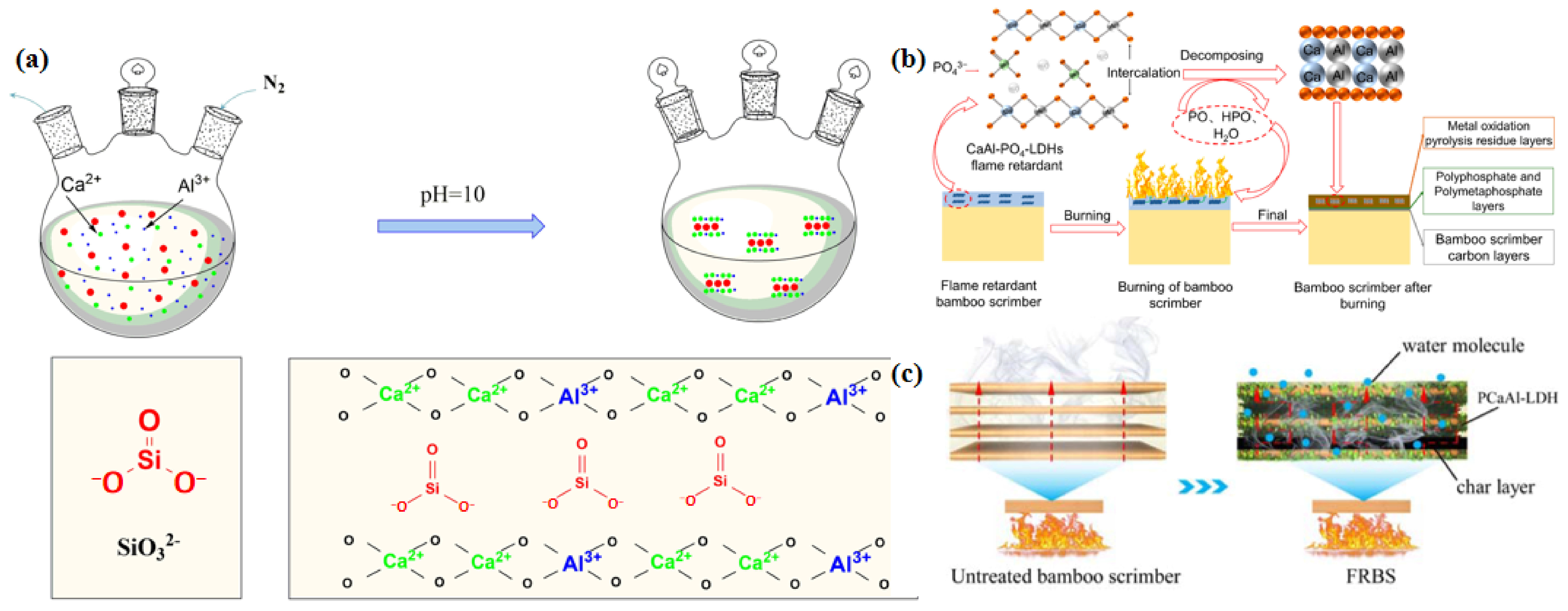
Layered double hydroxides (LDHs) are a class of two-dimensional layered nanomaterials that have been shown to offer excellent flame retardancy and smoke suppression properties due to their unique chemical composition and layered structure. Furthermore, the layer surface of flame-retardant LDHs is abundant in hydroxyl groups, which can form hydrogen bonds with the numerous hydroxyl groups in bamboo. Hu et al. [108] first synthesized calcium–aluminum layered double hydroxides with root-cutting silicate layers (CaAl-SiO3-LDHs) via a coprecipitation method and systematically optimized crystallization conditions (100 °C, 9 h, Ca2+ concentration of 0.33 mol/L), as shown in Figure 7a. CaAl-SiO3-LDH flame retardant treatment delayed the peak time of the heat release rate by 20 s and the ignition time by 77.78% and increased the carbon residue rate by 9.54%. Building on this, Ran et al. [109] introduced PO43− as an interlayer anion to fabricate CaAl-PO4-LDHs, which further improved flame retardancy, as presented in Figure 7b. At 1% and 2% loadings, the pHRR decreased by 16.62% and 34.46%, respectively, with significantly prolonged TTI and reduced CO/CO2 emissions. In a subsequent study, Yang et al. [110] developed PCaAl-LDHs for bamboo scrimber, achieving simultaneous enhancement in flame retardancy and smoke suppression, as evidenced by reductions in HRR and THR as well as remarkable decreases in TSR and SEA. These studies collectively demonstrate that LDHs function through a gas-condensed phase synergistic mechanism, as illustrated in Figure 7c, where the layered structure prolongs the diffusion path of volatiles, interlayer water release provides cooling and dilution effects, and in situ formed metal oxides catalyze the formation of a dense char layer, thereby effectively inhibiting heat transfer, oxygen diffusion, and smoke generation.
Nanomaterial-based flame retardants provide efficient barrier effects at relatively low loadings because they can create tortuous pathways for heat, oxygen, and volatile diffusion. However, their performance is highly dependent on dispersion and interfacial compatibility. Poorly dispersed nanosheets or nanoparticles can aggregate within bamboo pores or adhesive matrices, reducing the effective barrier effect and creating defects that weaken mechanical performance. Some nanomaterials also increase viscosity during impregnation or resin blending, making uniform penetration into bamboo-based materials difficult. In addition, the cost, scalability, and environmental persistence of nanomaterials remain important concerns [111]. Therefore, future work should pay more attention to scalable dispersion methods, interfacial design, and long-term durability.

4.5. Metal-Based Flame Retardants

Metal-based flame retardants, ranging from transition metal oxides and hydroxides to advanced metal–organic frameworks, have emerged as indispensable components in the flame-retardant modification of bamboo-based materials, primarily due to their dual-phase catalytic and inhibitory functions [112]. Traditional metal hydroxides, such as aluminum hydroxide (ATH) and magnesium hydroxide (MH), operate through an endothermic decomposition mechanism that liberates chemically bound water, thereby diluting combustible gases and cooling the bamboo substrate [17]. However, to meet the stringent requirements of high-performance engineering, recent research has pivoted toward transition metal oxides (e.g., Fe2O3, CuO, and ZnO) and their hybridized derivatives. These metallic species function as potent catalysts that promote the cross-linking of bamboo pyrolytic intermediates, promoting the transformation of aliphatic structures into stable, polycyclic aromatic char. This catalytic carbonization not only reinforces the structural integrity of the protective barrier but also effectively sequesters the underlying bamboo matrix from subsequent thermal degradation and oxidative ingress. Another critical role of metal-based flame retardants lies in their capacity to suppress smoke and toxic gas release. Metal oxides catalyze the oxidative conversion of incomplete combustion products, most notably CO, thereby reducing smoke density and toxicity. Additionally, certain metal species can interact with volatile organic compounds and free radicals, modifying gas-phase reactions and contributing to cleaner combustion. This aspect is especially relevant for bamboo-based materials, which are known to produce significant smoke density due to incomplete degradation of lignocellulosic components [113,114].
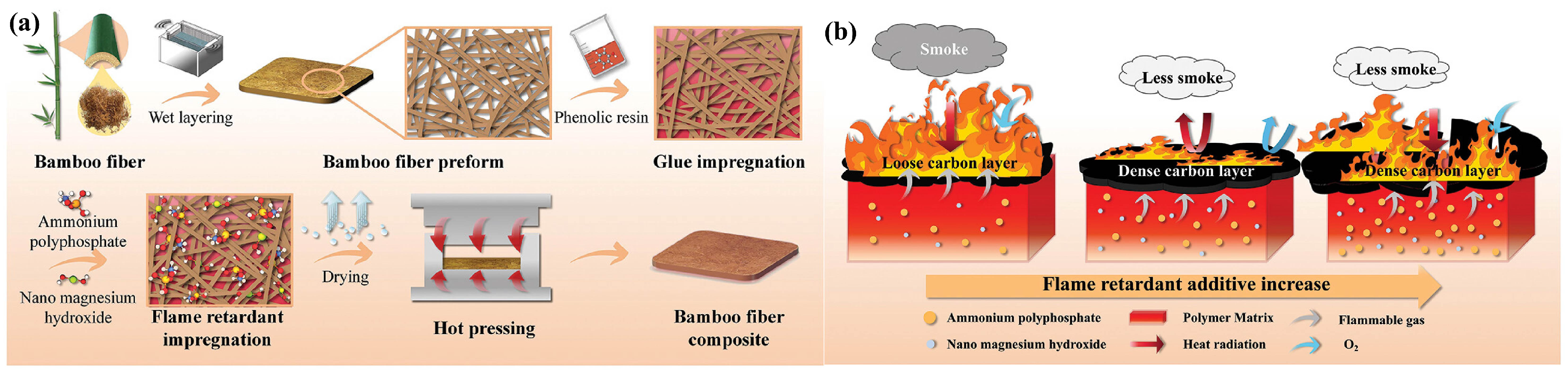
For instance, He et al. [115] explored an inorganic-organic structure including calcium carbonate (CaCO3) and bamboo via in situ mineralization. After five cycles of vacuum impregnation with CaCl2 and (NH4)2CO3, the mineralized bamboo exhibited a 48.8% reduction in PHRR and a 19.1% reduction in THR. CaCO3 deposited primarily in parenchyma cells with pits and multilayer cell walls during the mineralization process and contributed to a cross-linked structure in bamboo by binding negatively charged calcium ions with carboxyl groups. Crucially, the CaCO3 bonded with the bamboo cell wall, forming an inorganic-organic structure that strengthened the char layer and acted as a physical barrier, blocking heat and mass transfer. This was supported by XPS analysis, which showed a change in the O/C atomic ratio, indicating the successful integration of the mineral phase. Complementary studies by the same group further reported that the mineralization process could be optimized to yield a hydrophobic surface with a contact angle of 159°, concurrently improving flame retardancy, mechanical strength, and mold resistance [116]. Furthermore, as illustrated in Figure 8, Zhao et al. [117] systematically investigated the synergistic flame-retardant effect of APP and nano-magnesium hydroxide (NMH) in bamboo fiber composites (BFCs). While APP tends to generate considerable smoke during combustion and NMH requires high loadings (up to 60 wt%) to be effective, their combination enables efficient flame retardancy at reduced additive levels. When the flame retardants exceeded 15 wt%, the composites reached the noncombustible category and V-0 level, accompanied by a 45.65% reduction in pHRR and a 59.68% decrease in TSR compared to the untreated sample. Notably, flame-retardant content plays a decisive role in determining overall performance, with an optimal loading around 20 wt% achieving the best balance between fire safety and material integrity, while excessive addition leads to interfacial deterioration, agglomeration, and weakened char stability without further improvement in flame retardancy. Inorganic flame retardants, including metal hydroxides, metal oxides, aluminophosphates, and mineral fillers, can improve fire resistance through heat absorption, catalytic charring, smoke suppression, and physical barrier effects. However, their limitations are also evident. Metal hydroxides generally require relatively high loadings to achieve effective flame retardancy, which may increase density and deteriorate mechanical properties. Metal oxides and mineral particles may aggregate in bamboo cell lumens or adhesive matrices, leading to non-uniform protection and local stress concentration [118]. Therefore, inorganic systems should be evaluated not only by fire-performance enhancement but also by dispersion quality, mechanical retention, processing compatibility, durability, and end-of-life environmental impact.

4.6. Bio-Based Flame Retardants

In recent years, bio-based flame retardants have emerged as a promising and sustainable alternative to conventional halogen-free systems for bamboo-based materials. Propelled by escalating environmental concerns and the demand for green building materials, naturally derived compounds, such as phytic acid, chitosan, tannic acid, and bio-based polymers, have been extensively explored for their inherent flame-retardant functionalities [119,120,121]. The primary advantage of these materials lies in their exceptional environmental benignity, low toxicity, and intrinsic chemical compatibility with the bamboo cell wall. In contrast to inorganic salts, many biomass molecules are rich in hydroxyl, amino, and phenolic groups, allowing for the formation of robust hydrogen bonds or covalent linkages with the bamboo matrix. Furthermore, unlike traditional flame retardants that often rely on single mechanisms, bio-based systems typically exhibit multifunctional behavior, including catalytic charring, gas-phase dilution, radical scavenging, and barrier formation. The pursuit of bio-based flame retardants for enhancing the flame retardancy of bamboo-based materials is presently an active area of research. By combining multiple bio-based additives, researchers aim to develop high-performance bamboo composites [122,123].

4.6.1. Phytic Acid

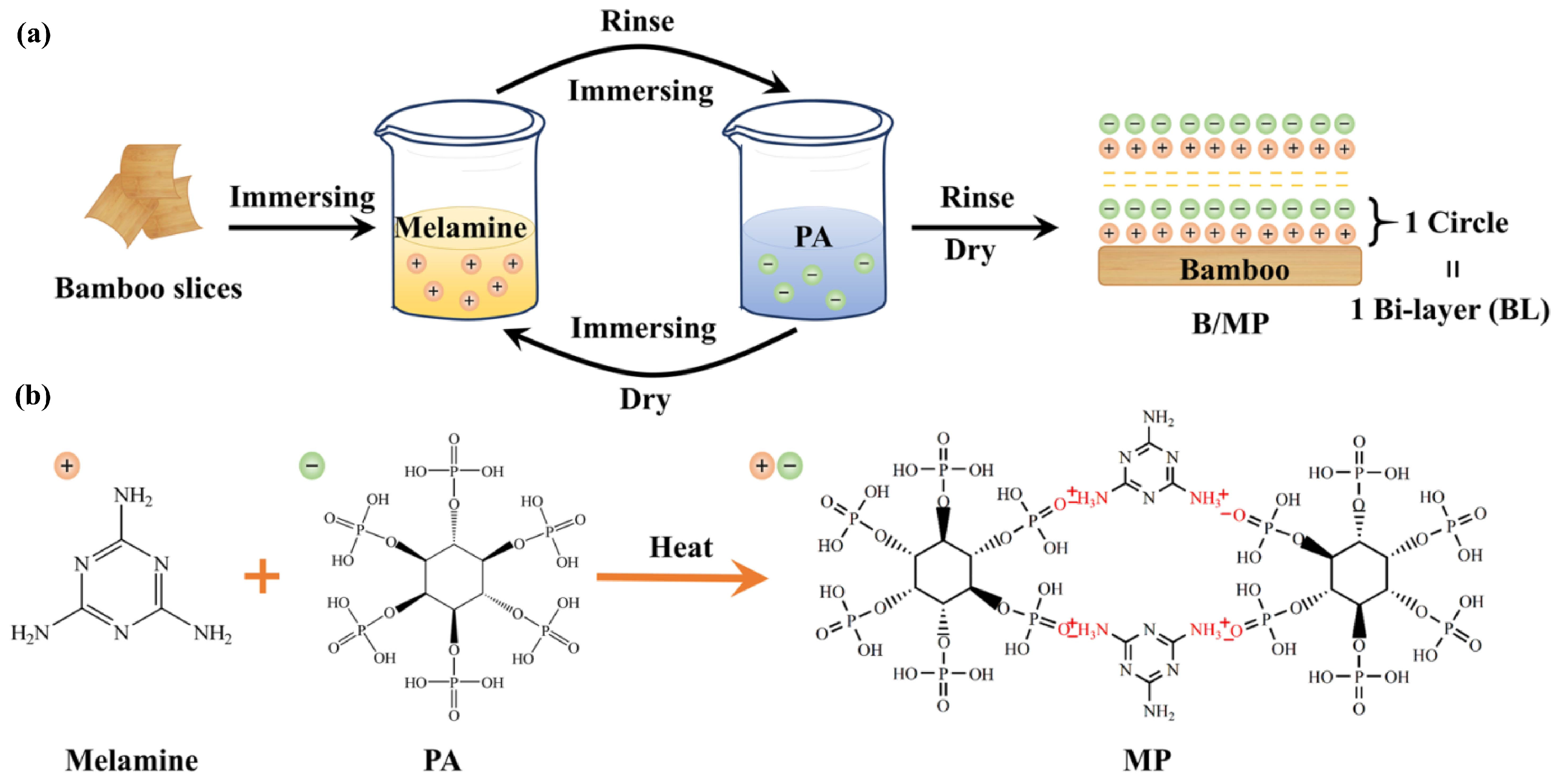
Phytic acid (PA), a naturally occurring phosphorus-rich compound widely found in grains and legumes, is one of the most prominent bio-based flame retardants for bamboo-based materials [124]. Owing to its high phosphorus content and strong acidity, phytic acid effectively catalyzes the dehydration reactions of cellulose and hemicellulose during thermal decomposition, promoting the formation of a stable, intumescent char layer. The phosphate groups in PA facilitate crosslinking with the hydroxyl groups of the bamboo cell wall, enhancing the thermal stability of the residual char. The multiple phosphate groups of phytic acid provide abundant reactive sites for catalytic dehydration, metal-ion coordination, and polyelectrolyte complexation, but its high acidity may negatively affect bamboo fiber integrity and mechanical properties if it is introduced in a free-acid form or at excessive loading. This is particularly important for bamboo fibers and engineered bamboo composites, where the preservation of fiber strength and interfacial bonding is essential. In addition, the hydrophilic and ionic nature of phytic acid can increase moisture sensitivity and potential leaching when the active species are mainly retained by physical adsorption or weak hydrogen bonding. Therefore, phytic acid is more suitable for bamboo-based materials when it is immobilized through metal-ion complexation, neutralization, polymeric complexation, or layer-by-layer assembly, rather than being used as a strongly acidic free molecule [125]. Shan et al. [126] developed a cable-inspired layer-by-layer flame-retardant structure on bamboo fibers by partially delignifying bamboo, followed by esterification to enhance copper ion-binding capacity. Coordination bonds served as crosslinking agents to anchored ammonium phytate (APA), forming a continuous and durable APA-Cu2+-bamboo-Cu2+-APA protective layer on parenchyma cells. The resulting bamboo/epoxy composite achieved an LOI of 31.1% and reduced THR and TSP by 49.2% and 74.0%, respectively, while maintaining an excellent flexural strength of 360.1 MPa and superhydrophilicity (contact angle 158.5°). The synergistic effect of copper ions and phytate promoted the formation of a continuous char layer that effectively blocked heat and oxygen transfer. Similarly, Lin et al. [127] constructed a melamine and phytic acid made into melamine–phytate (MP) for improving the flame-retardant performance of bamboo slices via LBL assembly technology, as shown in Figure 9, where positively charged melamine and negatively charged phytic acid formed two-dimensional nanosheet structures through electrostatic interactions and π-π stacking. The treated bamboo exhibited significant fire performance improvements, with reductions of 28.7% in pHRR, 30.6% in THR, and 73.5% in TSP. In another work performed by Lin et al. [128], they developed a phytic acid–polyethyleneimine (PA–PEI) system to construct a phosphorus–nitrogen intumescent flame-retardant network via LbL assembly. The pHRR and THR of bamboo self-assembly with 10 wt% PA and 10 wt% of PEI solution were reduced by 19.36% and 22.3%, respectively, along with increases of 35.56% in FPI and 480.70% in char residue. Li et al. [129] combined phytic acid with magnesium hydroxide to prepare a strong, mildew-resistant, and flame-retardant bamboo scrimber. An alkaline pretreatment process was used to remove some nutrients from bamboo to improve mildew resistance. The PA-Mg2+ complex formed a protective char layer during combustion. The modified bamboo scrimber showed a 33.7% increase in flexural strength, an LOI of 30.2%, and a 54.4% reduction in TSP, with the mold infection rate reduced to below 20% after 28 days.

4.6.2. Tannic Acid

Tannic acid (TA) is a natural catechol derivative, extensively recognized for its potent antioxidant properties and metal-chelating affinity [80]. Its abundant phenolic hydroxyl groups facilitate crosslinking reactions and promote the formation of thermally stable, graphitized carbon structures during pyrolysis. Moreover, TA enables the construction of robust metal-phenolic networks, enabling the construction of metal–phenolic networks that reinforce the char layer and enhance thermal stability. It has been established that the formation of homogeneous thin films on a variety of substrates by utilizing TA with Fe3+ is versatile and fast, broadening the application of TA in interfacial modification. Yu et al. [130] immobilized halloysite nanotubes (HNTs) on bamboo fiber/polypropylene composites using a tannic acid-Fe3+ complex as an interfacial bridging layer. The TA-Fe3+ complex improved HNT dispersion and interfacial adhesion, resulting in a 23.75% reduction in THR and a 32.44% reduction in TSP. The composite also exhibited enhanced flexural strength (78.74 MPa) and water resistance, with the mechanism attributed to both gas-phase dilution and condensed-phase char formation. Similarly, Wang et al. [131] developed an eco-friendly biocomposite from bamboo waste powder modified with a tannic acid/boric acid/polyvinyl alcohol hybrid coating, followed by MXene integration. The resulting composite achieved a char residue of 40.2 wt%. The tannic acid-based coating provided radical scavenging, char promotion, and antibacterial activity against both Gram-negative and Gram-positive bacteria, while also enhancing mechanical properties. When combined with boron- or nitrogen-containing compounds, tannic acid can form dynamic covalent networks (e.g., borate ester linkages), which not only enhance flame retardancy but also improve processability and mechanical properties through reversible bonding interactions. Yang et al. [82] constructed a temperature-responsive dynamic boronic ester network on bamboo powder using tannic acid and borax, which synergized with piperazine pyrophosphate (PAPP) to achieve UL-94 V-0 rating and 71.9% reduction in PHRR.
However, tannic acid-based systems also have several practical limitations. First, tannic acid is highly hydrophilic, and coatings or interfacial layers formed mainly through hydrogen bonding may be sensitive to water or high-humidity environments. Second, the strong complexation ability of tannic acid is beneficial for immobilizing inorganic fillers or metal ions, but the resulting performance strongly depends on the stability and uniformity of the metal-phenolic network. Insufficient complexation or uneven deposition may lead to non-uniform protection and reduced durability. Third, tannic acid has an intrinsically dark color and may affect the appearance of bamboo products, especially when transparent or decorative surfaces are required [132]. In addition, excessive tannic acid or highly cross-linked tannin-based coatings may increase brittleness or interfere with interfacial bonding if the formulation is not properly optimized. Therefore, tannic acid is often more effective when used as a coordination bridge, carbon source, or interfacial modifier in hybrid systems, such as TA-metal ion complexes, TA-borate networks, or TA-assisted nanofiller immobilization, rather than as a standalone additive.

4.6.3. Chitosan

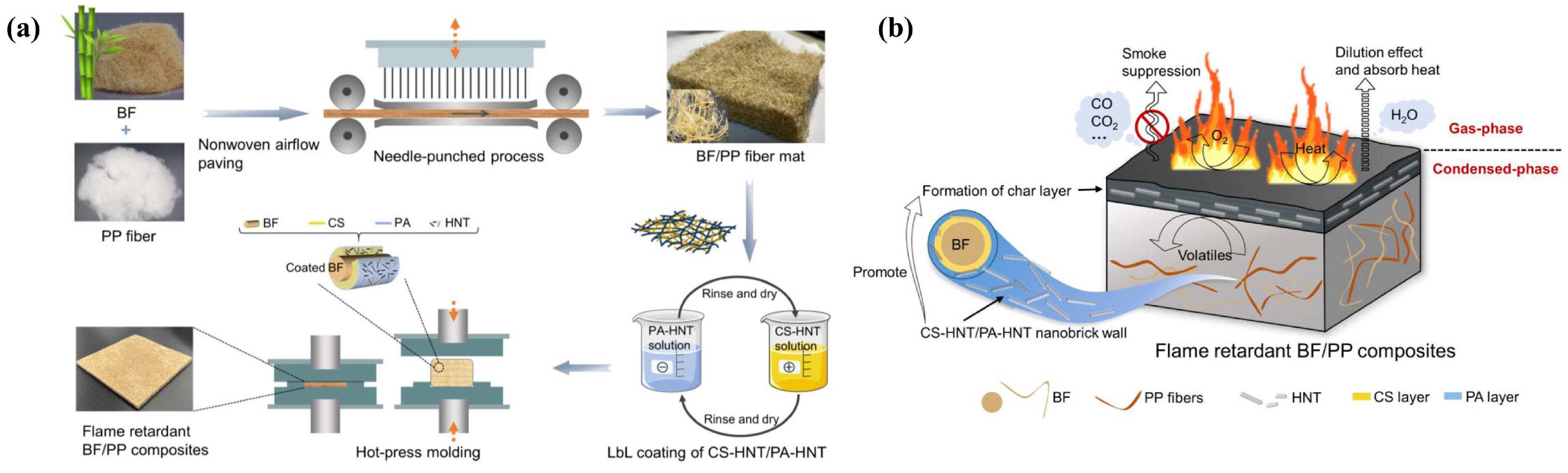
Chitosan, derived from crustacean shells, has also demonstrated significant potential as a bio-based flame retardant. Its high density of amine and hydroxyl moieties facilitates robust hydrogen bonding and electrostatic interactions with bamboo substrates, enabling the formation of uniform coatings or interpenetrating polymer networks. During combustion, chitosan undergoes thermal degradation to release non-flammable gases, primarily NH3, which dilute combustible volatiles in the gas phase [48]. Concurrently, it facilitates the formation of a nitrogen-enriched char layer in the condensed phase. The combination of chitosan with phosphorus-containing compounds, such as phytic acid, produces pronounced synergism via coupled gas- and condensed-phase mechanisms. For instance, Yu et al. [133] developed an eco-friendly bamboo pulp foam (BPF) decorated with halloysite nanotubes (HNTs) via layer-by-layer assembly of chitosan and phytic acid. The modified BPF exhibited exceptional flame retardancy, with a 47.05% reduction in THR and a 95.24% reduction in TSP, while maintaining high porosity and achieving a V-0 rating in the UL-94. Similarly, Jin et al. [134] developed a bio-based flame-retardant coating on bamboo fiber/polypropylene (BF/PP) composites via LbL assembly of CS and PA, incorporating HNTs, as shown in Figure 10a. At six bilayers, the composite exhibited significantly enhanced fire safety, with reductions of 45.3% in pHRR, 31.9% in THR, and 58.8% in TSP, along with an increased char yield. Moreover, three bilayers of CS-HNT/PA-HNT enabled the BF/PP composites to achieve higher mechanical strength and lower water absorption, whereas excessive HNT loading led to agglomeration and performance deterioration. Figure 10b illustrates the CS/PA/HNT promoted early char formation, with HNTs acting as a physical barrier and CS providing intumescent charring, resulting in self-extinguishing behavior upon flame removal. Furthermore, Chalapathi et al. [135] evaluated chitosan as part of a hybrid flame retardant system (chitosan/APP/zinc borate) in bamboo nonwoven fabric/vinyl ester composites. The optimal formulation (6% ZnB, 6% APP, 3% CS) reduced the horizontal burning rate from 0.52 mm/s to 0.17 mm/s, demonstrating the synergistic effect of chitosan as a charring agent in combination with intumescent and inorganic flame-retardants. Although chitosan can provide nitrogen and carbon sources and can form uniform coatings through hydrogen bonding or electrostatic interactions, its hydrophilicity and pH-dependent solubility may lead to swelling, moisture sensitivity, or reduced coating stability under humid conditions. Chitosan alone also has limited phosphorus content and moderate thermal stability, so its flame-retardant efficiency is usually insufficient without synergistic components such as phytic acid, polyphosphates, clay minerals, halloysite nanotubes, or graphene oxide. Therefore, chitosan is more suitable as a bio-based nitrogen source or polyelectrolyte component in hybrid flame-retardant systems.
Beyond the aforementioned acid- and polysaccharide-based systems, protein-derived bio-based flame retardants, including casein, soy protein, and keratin, have also attracted increasing attention in recent years [136]. These proteins possess inherent nitrogenous functional groups that serve as intrinsic nitrogen sources. Their complex secondary and tertiary structures allow for the construction of crosslinked hybrid networks when combined with phosphorus or polyphenols. However, compared to other bio-based systems, protein-based systems remain a relatively nascent field in bamboo research, and their fundamental structure–property relationships require further systematic investigation [137].
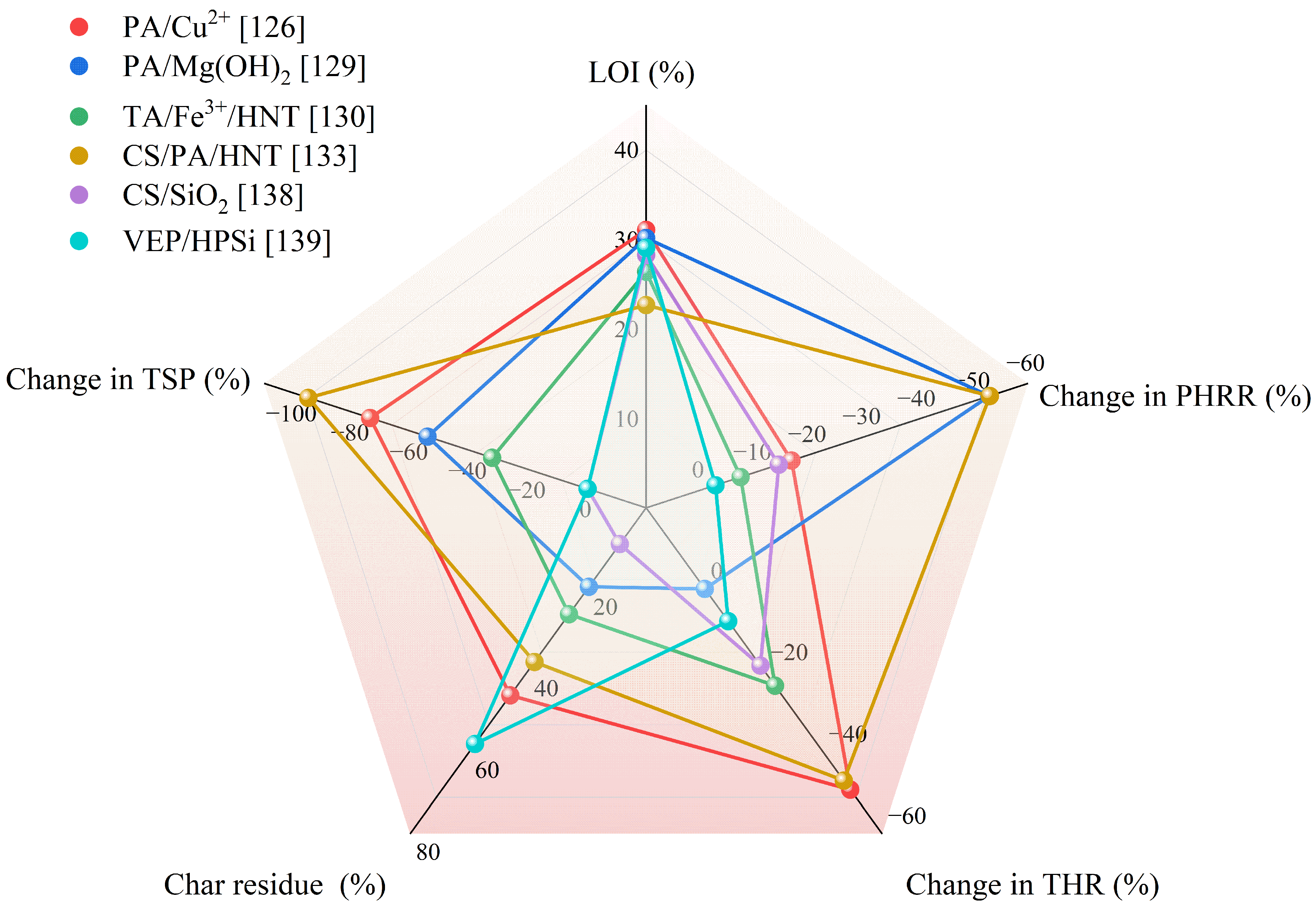
Figure 11 provides a comprehensive summary of the bio-based flame-retardant strategies for bamboo-based materials discussed in this review. Through chemical modification and the addition of synergists, the bamboo-based materials treated with bio-based flame retardants can achieve the purpose of flame retardancy. However, several critical bottlenecks persist. A primary challenge lies in their hydrophilic nature, which leads to moisture sensitivity and potential leaching of active components under humid conditions, thereby compromising long-term durability. Therefore, improving leaching resistance is essential for the practical application of flame retardants in bamboo-based materials. Many efficient flame retardants, such as borates, ammonium polyphosphate, phosphate salts, phytic-acid-based systems, and other small-molecule inorganic or bio-based additives, contain hydrophilic ionic groups or low-molecular-weight species. Under water immersion, high humidity, or repeated wet–dry cycles, the active flame-retardant species may gradually migrate from the cell wall or lumen, resulting in reduced flame-retardant efficiency, weaker smoke suppression, and unstable long-term performance. To address this issue, several strategies have been developed, including covalent grafting onto bamboo cell-wall polymers, ionic complexation with metal ions, in situ formation of insoluble organic–inorganic networks, polymeric encapsulation, and hydrophobic surface sealing. Among them, chemical fixation and in situ hybridization are particularly promising because they can immobilize flame-retardant components within the bamboo structure while maintaining their char-forming and gas-phase functions. However, the durability of these systems should be evaluated not only by initial LOI, UL-94, or cone calorimetry results, but also by the retention of fire performance after water immersion, accelerated humidity aging, and repeated wet–dry cycling. Furthermore, the low thermal stability of certain bio-derived compounds may induce premature thermal decomposition during fabrication, limiting their compatibility with high-temperature processing techniques. The inherent heterogeneity of chemical compositions, particularly in natural macromolecules such as lignin and proteins, exacerbates issues regarding performance consistency and reproducibility. Finally, attaining high flame-retardant efficiency often requires relatively high loadings, which can detrimentally impact mechanical integrity and dimensional stability while simultaneously increasing production costs.

4.7. Sustainability and End-of-Life Considerations of Flame-Retardant Systems

Although bamboo is a renewable and biodegradable lignocellulosic material, flame-retardant modification can alter its recyclability, biodegradability, and environmental impact at the end of service life. Therefore, the environmental friendliness of flame-retardant bamboo-based materials should not be judged only by whether the additives are bio-based or halogen-free. Phosphorus-based and intumescent systems are generally regarded as safer alternatives to halogenated flame retardants because they reduce the risk of corrosive and halogenated toxic gas release during combustion. However, some phosphate salts, ammonium polyphosphate, and phytic-acid-based systems may leach under humid conditions and increase environmental phosphorus loading if they are not effectively immobilized. Metal oxides and inorganic nanoparticles can improve thermal stability, char formation, and smoke suppression, but their persistence and possible accumulation in ash, soil, or water systems should be considered, especially when treated bamboo is used outdoors or exposed to moisture cycling.
From an end-of-life perspective, flame-retardant bamboo-based materials may follow several pathways, including reuse, mechanical recycling, energy recovery, landfilling, or biodegradation. Reuse and mechanical recycling are preferable when the structural integrity and bonding performance of engineered bamboo are retained. However, recycling can be complicated by adhesives, coatings, inorganic fillers, and flame-retardant residues. Biodegradation or composting of treated bamboo may be slower than that of untreated bamboo because cross-linked coatings, metal-containing additives, and char-promoting flame-retardant systems can form protective barriers that limit the access of microorganisms and enzymes to cellulose, hemicellulose, and lignin in the bamboo cell wall. Energy recovery through combustion or pyrolysis may be feasible, but combustion emissions, ash composition, and potential ecotoxicity should be carefully assessed.

5. Conclusions and Future Perspectives

This review summarizes recent progress in the fire-retardant modification of bamboo-based materials, with emphasis on bamboo structure, pyrolysis behavior, combustion characteristics, modification methods, and representative flame-retardant systems. Bamboo is a highly anisotropic lignocellulosic material. Its vascular bundles, parenchyma tissues, pores, and fiber orientation affect heat transfer, volatile release, char formation, smoke production, and flame spread. Therefore, fire-retardant design for bamboo-based materials should consider not only chemical composition but also structural anisotropy, density, permeability, and adhesive type.
Current studies show that phosphorus-, nitrogen-, boron-, inorganic-, nanomaterial-, and bio-based flame-retardant systems can improve the fire performance of bamboo-based materials through condensed-phase charring, gas-phase flame inhibition, inert-gas dilution, thermal shielding, and smoke suppression. However, each system has its own limitations, including moisture sensitivity, leaching, interfacial incompatibility, uneven distribution, processing difficulty, and possible trade-offs with mechanical properties. Similarly, different modification methods also involve specific challenges. Impregnation can introduce flame retardants into bamboo pores and vascular tissues, but uneven distribution and leaching remain major concerns. Surface coatings can provide efficient protection at the exposed surface, but their long-term performance depends on adhesion, cracking resistance, and stability under moisture exposure. Adhesive compounding is attractive for engineered bamboo, but flame-retardant additives may affect resin curing, bonding strength, and smoke release.
Based on the current research progress and remaining challenges, future studies on flame-retardant bamboo-based materials should focus on the following aspects:
(1)
Future flame-retardant systems should be designed according to the hierarchical and anisotropic structure of bamboo. Factors such as grain direction, vascular bundle distribution, porosity, density, permeability, and adhesive distribution should be considered when interpreting fire behavior and optimizing flame-retardant penetration, fixation, and char formation.
(2)
Moisture sensitivity and leaching remain major obstacles for many phosphorus-, boron-, and bio-based flame-retardant systems. Future studies should evaluate flame-retardant performance after water immersion, humidity aging, washing, or repeated wet–dry cycling. Chemical fixation, metal-ion complexation, in situ hybridization, polymeric encapsulation, and hydrophobic sealing are promising strategies for improving long-term durability.
(3)
Evaluation of flame-retardant bamboo-based materials should rely on complementary test methods rather than a single indicator. Existing standard fire tests remain useful, but their results should be interpreted together with bamboo-specific factors such as grain direction, density, thickness, adhesive type, and moisture condition. In addition to ignitability and heat release, smoke/toxic gas emissions, char integrity, flame spread, mechanical retention after treatment, and structural fire resistance should also be considered.
(4)
Future development should focus on durable, low-toxicity, and practically scalable flame-retardant systems. At the same time, sustainability should be evaluated from a life-cycle perspective. While emerging bio-based or nanostructured FR systems may currently incur higher initial synthesis costs than conventional treatments, their ultimate value lies in their end-of-life environmental benefits. By eliminating persistent toxic chemicals, suppressing hazardous combustion emissions, and facilitating eco-friendly disposal routes. These sustainable FR systems can significantly reduce the overall environmental burden, paving the way for the scalable adoption of green, fire-resilient bamboo-based materials.
Overall, the development of flame-retardant bamboo-based materials should move from single-performance improvement toward integrated optimization of fire safety, mechanical reliability, durability, and environmental sustainability.

Author Contributions

Y.Z.: Writing—original draft, Data curation, Investigation; Z.C.: Conceptualization, Supervision, Writing—review and editing, Funding acquisition; Y.H.: Investigation, Validation; E.Z.: Conceptualization, Supervision; M.X.: Conceptualization, Supervision. All authors have read and agreed to the published version of the manuscript.

Funding

This research was funded by the National Natural Science Foundation of China (52408186) and Qing Lan Project of Jiangsu Province of China.

Data Availability Statement

The data presented in this study are available on reasonable request from the corresponding author.

Conflicts of Interest

The authors declare no conflicts of interest.

References

  1. Wei, B.; Wei, Y.; Lin, Y.; Wang, G.; Zhang, Y. Compressive performance of bamboo scrimber and concrete-filled steel tube columns. Eng. Struct. 2024, 300, 117192. [Google Scholar] [CrossRef]
  2. Nkeuwa, W.N.; Zhang, J.; Semple, K.E.; Chen, M.; Xia, Y.; Dai, C. Bamboo-based composites: A review on fundamentals and processes of bamboo bonding. Compos. Part B Eng. 2022, 235, 109776. [Google Scholar] [CrossRef]
  3. Huang, Y.; Ji, Y.; Yu, W. Development of bamboo scrimber: A literature review. J. Wood Sci. 2019, 65, 25. [Google Scholar] [CrossRef]
  4. Xiao, Y.; Ma, J. Fire simulation test and analysis of laminated bamboo frame building. Constr. Build. Mater. 2012, 34, 257–266. [Google Scholar] [CrossRef]
  5. Liu, D.; Song, J.; Anderson, D.P.; Chang, P.R.; Hua, Y. Bamboo fiber and its reinforced composites: Structure and properties. Cellulose 2012, 19, 1449–1480. [Google Scholar] [CrossRef]
  6. Ou, J.; Luo, J.; Long, W.; Chen, D.; Zhang, Y.; Chen, Z.; Peng, L. Experimental investigation on the charring behavior of bamboo scrimber and glued laminated bamboo under standard fire exposure. Constr. Build. Mater. 2025, 500, 144107. [Google Scholar] [CrossRef]
  7. Hernandez-Mena, L.E.; Pécoraa, A.A.; Beraldob, A.L. Slow pyrolysis of bamboo biomass: Analysis of biochar properties. Chem. Eng. 2014, 37, 115–120. [Google Scholar]
  8. Tang, L.; Liu, Y. Effects of elevated temperature on the shear properties and chemical composition of glued laminated bamboo. Structures 2025, 82, 110553. [Google Scholar] [CrossRef]
  9. Wu, M.; Wang, L.; Zhang, R.; Zhang, Z.; Wu, M.; Wang, Y.; Zhou, L. Elucidate the difference of molecular structure of lignin from small-diameter bamboo. Ind. Crops Prod. 2026, 243, 123046. [Google Scholar] [CrossRef]
  10. Yu, H.; Zheng, H.; Zhan, M.; Zhang, W.; Wang, J.; Pan, X.; Zhuang, X. Surface characterization and biodegradability of sodium hydroxide-treated Moso bamboo substrates. Eur. J. Wood Wood Prod. 2021, 79, 443–451. [Google Scholar] [CrossRef]
  11. Dasari, A.; Yu, Z.Z.; Cai, G.P.; Mai, Y.W. Recent developments in the fire retardancy of polymeric materials. Prog. Polym. Sci. 2013, 38, 1357–1387. [Google Scholar] [CrossRef]
  12. Su, J.; Chen, Z.; Le, L.; Liu, M.; Li, C. An overview of the multifunctional research progress and sustainable development trends in bamboo-based composites. Sustain. Mater. Technol. 2025, 46, e01665. [Google Scholar] [CrossRef]
  13. Zheng, Z.; Yan, N.; Lou, Z.; Jiang, X.; Zhang, X.; Chen, S.; Xu, R.; Liu, C.; Xu, L. Modification and application of bamboo-based materials: A review—Part I: Modification methods and mechanisms. Forests 2023, 14, 2219. [Google Scholar] [CrossRef]
  14. Özer, M.S.; Gaan, S. Recent developments in phosphorus based flame retardant coatings for textiles: Synthesis, applications and performance. Prog. Org. Coat. 2022, 171, 107027. [Google Scholar] [CrossRef]
  15. Jiang, P.; Gu, X.; Zhang, S.; Wu, S.; Zhao, Q.; Hu, Z. Synthesis; characterization, and utilization of a novel phosphorus/nitrogen-containing flame retardant. Ind. Eng. Chem. Res. 2015, 54, 2974–2982. [Google Scholar] [CrossRef]
  16. Zhang, C.; Guo, H.; Zhou, X.; Yu, L.; Li, H.; Yang, Z. Effects of differrent boron-based flame retardants on the combustibility of bamboo filaments. Wood Res. 2022, 67, 221–230. [Google Scholar] [CrossRef]
  17. Li, J.; Zhao, H.; Liu, H.; Sun, J.; Wu, J.; Liu, Q.; Zheng, Y.; Zheng, P. Recent advances in metal-family flame retardants: A review. RSC Adv. 2023, 13, 22639–22662. [Google Scholar] [CrossRef] [PubMed]
  18. He, W.; Song, P.; Yu, B.; Fang, Z.; Wang, H. Flame retardant polymeric nanocomposites through the combination of nanomaterials and conventional flame retardants. Prog. Mater. Sci. 2020, 114, 100687. [Google Scholar] [CrossRef]
  19. Wang, M.; Yin, G.Z.; Yang, Y.; Fu, W.; Palencia, J.L.D.; Zhao, J.; Wang, N.; Jiang, Y.; Wang, D.Y. Bio-based flame retardants to polymers: A review. Adv. Ind. Eng. Polym. Res. 2023, 6, 132–155. [Google Scholar] [CrossRef]
  20. Oyedun, A.O.; Gebreegziabher, T.; Hui, C.W. Mechanism and modelling of bamboo pyrolysis. Fuel Process. Technol. 2013, 106, 595–604. [Google Scholar] [CrossRef]
  21. Yang, C.; Gan, J.; Yu, W.; Huang, Y.; Pan, D.; Zhang, Y. Interfacial strategy of phenolic resin/bamboo composite system under cross-linking degree regulation. Compos. Part B Eng. 2025, 311, 113220. [Google Scholar] [CrossRef]
  22. Akinbade, Y.; Harries, K.A. Is the rule of mixture appropriate for assessing bamboo material properties? Constr. Build. Mater. 2021, 267, 120955. [Google Scholar] [CrossRef]
  23. Jiang, T.; Feng, X.; Xia, Z.; Deng, S.; Wang, X. Gradient variation and correlation analysis of physical and mechanical properties of Moso bamboo (Phyllostachys edulis). Materials 2024, 17, 2069. [Google Scholar] [CrossRef]
  24. Chang, C.W.; Chang, F.C. Comprehensive review of the elastic constants of bamboo. Eur. J. Wood Wood Prod. 2024, 82, 1739–1754. [Google Scholar] [CrossRef]
  25. He, L.; Chen, L.; Shao, H.; Qi, J.; Jiang, Y.; Xiao, H.; Chen, Y.; Huang, X.; Xie, J. Microstructure and physicochemical properties of the anisotropic moso bamboo (Phyllostachys pubescens) surface. Eur. J. Wood Wood Prod. 2022, 80, 277–288. [Google Scholar] [CrossRef]
  26. Naim, A.; Soo Yun Tan, C. Thermal Properties of Bamboo Cellulose Isolated from Bamboo Culms and Shoots. BioResources 2022, 17, 4806. [Google Scholar] [CrossRef]
  27. Cui, Z.; Xu, M.; Shen, Y.; Tu, L. The impact of temperature variations on the thermal and charring characteristics of laminated bamboo lumber. Eur. J. Wood Wood Prod. 2024, 82, 1159–1169. [Google Scholar] [CrossRef]
  28. Shah, D.U.; Konnerth, J.; Ramage, M.H.; Gusenbauer, C. Mapping thermal conductivity across bamboo cell walls with scanning thermal microscopy. Sci. Rep. 2019, 9, 16667. [Google Scholar] [CrossRef]
  29. Jiang, Z.; Liu, Z.; Fei, B.; Cai, Z.; Yu, Y.; Liu, X. The pyrolysis characteristics of moso bamboo. J. Anal. Appl. Pyrolysis 2012, 94, 48–52. [Google Scholar] [CrossRef]
  30. Liang, Z.; Jiang, H.; Tan, Y. A review of thermal treatment for bamboo and its composites. Green Process. Synth. 2024, 13, 20230263. [Google Scholar] [CrossRef]
  31. Wang, B.; Ren, X.; Dong, J.; Li, S.; Liu, X. Comparative study of pyrolysis characteristics, kinetics and gaseous products between bamboo parenchyma cells and fiber cells. Ind. Crops Prod. 2024, 216, 118745. [Google Scholar] [CrossRef]
  32. Yeh, C.H.; Yang, T.C. Utilization of waste bamboo fibers in thermoplastic composites: Influence of the chemical composition and thermal decomposition behavior. Polymers 2020, 12, 636. [Google Scholar] [CrossRef]
  33. Cui, Z.; Xu, M.; Tang, S.; Shen, Y.; Tu, L. Experimental study on the combustion properties of four common engineered bamboo and wood composites. Polym. Compos. 2023, 44, 8962–8973. [Google Scholar] [CrossRef]
  34. Zhao, R.; Wang, X.; Liu, L.; Li, P.; Tian, L. Slow pyrolysis characteristics of bamboo subfamily evaluated through kinetics and evolved gases analysis. Bioresour. Technol. 2019, 289, 121674. [Google Scholar] [CrossRef]
  35. Alvarado Flores, J.J.; Alcaraz Vera, J.V.; Ávalos Rodríguez, M.L.; López Sosa, L.B.; Rutiaga Quiñones, J.G.; Pintor Ibarra, L.F.; Márquez Montesino, F.; Aguado Zarraga, R. Analysis of pyrolysis kinetic parameters based on various mathematical models for more than twenty different biomasses: A review. Energies 2022, 15, 6524. [Google Scholar] [CrossRef]
  36. Starink, M.J. A new method for the derivation of activation energies from experiments performed at constant heating rate. Thermochim. Acta 1996, 288, 97–104. [Google Scholar] [CrossRef]
  37. Koga, N.; Vyazovkin, S.; Burnham, A.K.; Favergeon, L.; Muravyev, N.V.; Pérez-Maqueda, L.A.; Saggese, C.; Sánchez-Jiménez, P.E. ICTAC Kinetics Committee recommendations for analysis of thermal decomposition kinetics. Thermochim. Acta 2023, 719, 179384. [Google Scholar] [CrossRef]
  38. Vyazovkin, S. Misinterpretation of thermodynamic parameters evaluated from activation energy and preexponential factor determined in thermal analysis experiments. Thermo 2024, 4, 373–381. [Google Scholar] [CrossRef]
  39. Tong, W.; Cai, Z.; Liu, Q.; Ren, S.; Kong, M. Effect of pyrolysis temperature on bamboo char combustion: Reactivity, kinetics and thermodynamics. Energy 2020, 211, 118736. [Google Scholar] [CrossRef]
  40. Jiang, M.; Yang, J.; Lin, X.; Kong, L.; Zhang, W.; Tu, D.; Ma, H. High performance engineered bamboo scrimber manufacturing by vacuum-pressure impregnation method. Eur. J. Wood Wood Prod. 2026, 84, 36. [Google Scholar] [CrossRef]
  41. Li, W.; Bai, Q.; Xie, G.; Cao, Y.; Gao, J. The influence of impregnation methods and curing conditions on the physical and multiscale mechanical properties of furfurylated bamboo. Forests 2023, 14, 970. [Google Scholar] [CrossRef]
  42. Li, J.; Lai, Q.; Hu, C.; Lin, X.; Li, W.; Hou, X.; Yun, H.; Zhang, W. Bamboo modification with Glycidyl methacrylate (GMA) microemulsion through in-situ polymerization and cross-linking. Int. J. Biol. Macromol. 2025, 332, 148734. [Google Scholar] [CrossRef]
  43. Yang, H.; Zhang, X.; Li, H.; Yin, C.; Huang, T.; Wan, J.; Ni, K.; Du, G.; Yang, L. High-performance glued-bamboo through activation of chemical bonding interface. Colloids Surf. A Physicochem. Eng. Asp. 2024, 701, 134874. [Google Scholar] [CrossRef]
  44. Zhu, Y.; Xu, M.; Cui, Z.; Ou, J.; Zhu, J. Experimental and numerical investigation on fire resistance of laminated bamboo lumber beams under standard fire exposure. J. Build. Eng. 2025, 118, 115010. [Google Scholar] [CrossRef]
  45. Chen, D.; Liu, D.; Zhang, H.; Chen, Y.; Li, Q. Bamboo pyrolysis using TG–FTIR and a lab-scale reactor: Analysis of pyrolysis behavior, product properties, and carbon and energy yields. Fuel 2015, 148, 79–86. [Google Scholar] [CrossRef]
  46. Kumar, R.; Chauhan, S. Effect of ammonium polyphosphate as synergist with nano silica dioxide on flammability of boron compound pretreated bamboo flour-HDPE composite. Fire Saf. J. 2022, 133, 103647. [Google Scholar] [CrossRef]
  47. Wang, W.; Yuen, A.C.Y.; Long, H.; Yang, W.; Li, A.; Song, L.; Hu, Y.; Yeoh, G.Y. Random nano-structuring of PVA/MXene membranes for outstanding flammability resistance and electromagnetic interference shielding performances. Compos. Part B Eng. 2021, 224, 109174. [Google Scholar] [CrossRef]
  48. Lee, Y.X.; Wang, W.; Lei, Y.; Xu, L.; Agarwal, V.; Wang, C.; Yeoh, G.H. Flame-retardant coatings for wooden structures. Prog. Org. Coat. 2025, 198, 108903. [Google Scholar] [CrossRef]
  49. Lazar, S.T.; Kolibaba, T.J.; Grunlan, J.C. Flame-retardant surface treatments. Nat. Rev. Mater. 2020, 5, 259–275. [Google Scholar] [CrossRef]
  50. Wang, Z.; Yang, S.; Liu, Z.; Ding, F.; Wu, Y. Tung oil-based phosphorus-containing polyol as a flame retardant for bamboo. Constr. Build. Mater. 2023, 366, 130240. [Google Scholar] [CrossRef]
  51. Wang, S.; Zhang, L.; Semple, K.; Zhang, M.; Zhang, W.; Dai, C. Development of biodegradable flame-retardant bamboo charcoal composites, part ii: Thermal degradation, gas phase, and elemental analyses. Polymers 2020, 12, 2238. [Google Scholar] [CrossRef]
  52. Li, Y.; Yuan, Z.; Li, M.; Gu, S.; Wang, C.; Cheng, H. Replacing plastic automotive interiors with bamboo: A study on the mechanical and flame-retardant properties of melamine polyphosphate-modified bamboo fiber-reinforced composites. J. Mater. Sci. 2024, 59, 21721–21734. [Google Scholar] [CrossRef]
  53. Mhlabeni, T.L.; Chemere, E.B.; Jamiru, T.; Mhike, W. Flame retardancy of biopolymers enhanced by bio-based flame retardants: A review. J. Fire Sci. 2025, 43, 79–114. [Google Scholar] [CrossRef]
  54. Verma, S.; Hashmi, S.A.R.; Mili, M.; Hada, V.; Prashant, N.; Naik, A.; Rathore, S.K.S.; Srivastava, A.K. Extraction and applications of lignin from bamboo: A critical review. Eur. J. Wood Wood Prod. 2021, 79, 1341–1357. [Google Scholar] [CrossRef]
  55. Li, X.; Ji, S.; Mou, Q.; Chen, Z.; Li, X. Evaluation of flammability for bamboo products treated with water-soluble flame retardants. Wood Mater. Sci. Eng. 2024, 19, 302–310. [Google Scholar] [CrossRef]
  56. Wang, R.; Liang, F.; Jiang, C.; Jiang, Z.; Wang, J.; Fei, B.; Nan, N.; Liu, Z. Pyrolysis kinetics of moso bamboo. Wood Fiber Sci. 2018, 50, 77–87. [Google Scholar] [CrossRef]
  57. ISO 4589:1984; Plastics-Determination of Flammability by Oxygen Index. International Organization for Standardization: Geneva, Switzerland, 1984.
  58. ASTM D3801-20a; Standard Test Method for Measuring the Comparative Burning Characteristics of Solid Plastics in a Vertical Position. ICC Evaluation Service: Brea, CA, USA, 2020.
  59. ISO 5660-1:2015; Reaction-to-Fire Tests-Heat Release, Smoke Production and Mass Loss Rate-Part 1: Heat Release Rate (Cone Calorimeter Method) and Smoke Production Rate (Dynamic Measurement). International Organization for Standardization: Geneva, Switzerland, 2015.
  60. ASTM E1354:2023; Standard Test Method for Heat and Visible Smoke Release Rates for Materials and Products Using and Oxygen Consumption Calorimeter. ASTM Standards: Conshohocken, PA, USA, 2023.
  61. ASTM E131:08; Standard Test Method for Compositional Analysis by Thermogravimetry. ASTM Standards: Conshohocken, PA, USA, 2014.
  62. ISO 1358-1:2022; Plastics: Thermogravimetry (TG) of Polymers: Part 1, General Principles. International Organization for Standardization: Geneva, Switzerland, 2022.
  63. Yan, D.; Chen, D.; Tan, J.; Yuan, L.; Huang, Z.; Zou, D.; Sun, P.; Tao, Q.; Deng, J.; Hu, Y. Synergistic flame retardant effect of a new NP flame retardant on poplar wood density board. Polym. Degrad. Stab. 2023, 211, 110331. [Google Scholar] [CrossRef]
  64. Wei, W.; Wu, Z.; Li, D.; Wang, X.A.; Wei, Q.; Xie, Y. Polymerized hierarchical vertical lamellar aluminophosphate as ecofriendly inorganic flame retardant for highly smoke-suppression bamboo scrimber. Ind. Crops Prod. 2025, 226, 120735. [Google Scholar] [CrossRef]
  65. Peng, R.; Yang, F.; Yin, W.; Du, C.; Liu, C.; Chen, S.; Shan, Y.; Shao, Y.; Wang, Y. Facile preparation, pyrolysis and pilot production a bamboo scrimber with halogen-free, flame-resistance and low-smoke. Ind. Crops Prod. 2023, 204, 117358. [Google Scholar] [CrossRef]
  66. Liu, Z.; Yang, S.; Wang, Z.; Ji, N.; Qing, Y. Leach-resistant modified bamboo with fire-retardant and anti-mildew properties via in situ synthesis. Constr. Build. Mater. 2024, 427, 136249. [Google Scholar] [CrossRef]
  67. Fang, Y.; Chen, K.; Xu, L.; Zhang, Y.; Xiao, Y.; Yuan, Y.; Wang, W. Advances in Wood Processing, Flame-Retardant Functionalization, and Multifunctional Applications. Polymers 2025, 17, 2677. [Google Scholar] [CrossRef] [PubMed]
  68. Zhang, L.; Chen, Y.; Qiu, R.; Sakai, E.; Qiu, J.; Liu, W. Development of flame-retardant bamboo particleboards using bio-based adhesives and ammonium polyphosphate. Colloids Surf. A Physicochem. Eng. Asp. 2025, 733, 139351. [Google Scholar] [CrossRef]
  69. Zhao, W.; Zhao, Y.; Zhang, W.; Zhang, J.; Wang, J. Bamboo fiber composites with enhanced flame retardant properties for automotive interior applications. Cellulose 2025, 32, 7257–7278. [Google Scholar] [CrossRef]
  70. Nie, S.; Fang, C.; Xu, Y.; Dong, X.; Yang, J.; Kong, F.; Han, C. Water resistance; flame retardancy, and thermal properties of hydrophobic polypropylene/bamboo fiber composites. J. Therm. Anal. Calorim. 2022, 147, 12547–12559. [Google Scholar] [CrossRef]
  71. Chen, F.; Cui, Z.; Xu, M.; Tu, L.; Ou, J. Flame-retardant treatment effects on flexural behavior of glued laminated bamboo beams: Experimental and theoretical analysis. Structures 2025, 82, 110516. [Google Scholar] [CrossRef]
  72. Chai, G.; Cui, Z.; Xu, M.; Tu, L.; Ou, J. Influence of Flame-Retardant Treatments on the Combustion Behavior and Mechanical Performance of Laminated Bamboo Lumber. Polym. Compos. 2025, 47, 5404–5416. [Google Scholar] [CrossRef]
  73. Hussain, A.; Landry, V.; Blanchet, P.; Hoang, D.T.; Dagenais, C. Fire performance of intumescent waterborne coatings with encapsulated APP for wood constructions. Coatings 2021, 11, 1272. [Google Scholar] [CrossRef]
  74. Li, Y.; Cao, C.F.; Chen, Z.Y.; Liu, S.C.; Bae, J.; Tang, L.C. Waterborne intumescent fire-retardant polymer composite coatings: A review. Polymers 2024, 16, 2353. [Google Scholar] [CrossRef]
  75. Jian, H.; Wang, H.; Wen, M.; Shi, J.; Park, H.J. High-performance flame-retardant; waterproof, and abrasion-resistant waterborne polyurethane-based transparent coatings for wood protection. Ind. Crops Prod. 2024, 222, 119804. [Google Scholar] [CrossRef]
  76. Xu, J.; Wang, Q.; Yang, Y.; Feng, D.; Li, R.; Lu, K.; Cao, Y. Study on extinguishing wood crib fires using ammonium polyphosphate-modified dry water. Powder Technol. 2026, 474, 122261. [Google Scholar] [CrossRef]
  77. Ding, T.; Cheng, Y.; Jiang, T. Preparation and characterization of heat-treated douglas fir wood with core–shell structure. Forests 2022, 13, 825. [Google Scholar] [CrossRef]
  78. Jiang, B.; Wu, J.; Huang, Y.; Yu, W.; Zhang, S.; Zhang, Y. Producing high-performance flame-retardant composite from bamboo via a facile approach. Chem. Eng. J. 2025, 521, 166541. [Google Scholar] [CrossRef]
  79. Leng, W.; Zhang, X.; Wang, J.; He, S.; Li, Y.; Chen, H.; Xiao, Y.; Hafez, I. Investigation of pathways to impart hydrophobicity and flame retardancy in bamboo fiber-based foams. Polymer 2026, 349, 129745. [Google Scholar] [CrossRef]
  80. Yang, J.; Lu, Y.; Zhang, J.; Hua, Y.; Guo, G.; Tang, W.; Zheng, M.; Li, L.; Zhang, S. Introducing borate ester network to improve the flame retardancy, mechanical performance, anti-UV aging, and mildew resistance of bamboo-polypropylene composites. Chem. Eng. J. 2025, 526, 171179. [Google Scholar] [CrossRef]
  81. Zeng, R.; Wei, W.; Xiao, W.; Ma, H.; Li, Q. A green and efficient deep eutectic solvent strategy for flame retardancy in bamboo. Ind. Crops Prod. 2026, 245, 123280. [Google Scholar] [CrossRef]
  82. Yang, F.; Ran, Y.; Bao, Q.; Tao, P.; Ding, J.; Zhang, S.; Zhu, J.; Du, C. An artificial mud brick structural coating endows bamboo with excellent flame retardant, smoke suppression and reliable fire warning performance. J. Clean. Prod. 2025, 492, 144884. [Google Scholar] [CrossRef]
  83. Zhang, S.; Zhang, Y.; Huang, Y.; Zhao, X.; Yu, W. High performance flame-retardant bamboo scrimber via a core-shell synergistic strategy. Ind. Crops Prod. 2025, 225, 120472. [Google Scholar] [CrossRef]
  84. Liu, Y.; Yu, Z.; Li, R.; Wang, X.; Qiao, Y. Ammonium polyphosphate modified epoxy–polyurethane system for high-performance bamboo composites with improved fire safety. Mater. Today Commun. 2026, 51, 114726. [Google Scholar] [CrossRef]
  85. Feng, Y.; Song, Y.; Li, W.; Guo, Z.; Jiang, Z.; Ruan, L.; Cheng, W.; Song, W. Flame retardancy and thermal and mechanical properties of ternary composites comprising polylactic acid, polyethylene glycol, and bamboo fiber. Polymer 2025, 330, 128533. [Google Scholar] [CrossRef]
  86. Ma, L.; Zhao, Y.; Zhang, T.; Li, Y. Functionalized flattened bamboo board: In-situ immersion assembly of flame-retardant, waterproof and anti-mold composite coatings. Int. J. Biol. Macromol. 2024, 278, 134881. [Google Scholar] [CrossRef]
  87. He, Y.; Jin, X.; Li, J.; Qin, D. Mechanical and fire properties of flame-retardant laminated bamboo lumber glued with phenol formaldehyde and melamine urea formaldehyde adhesives. Polymers 2024, 16, 781. [Google Scholar] [CrossRef]
  88. Lods, L.; Richmond, T.; Dandurand, J.; Dantras, E.; Lacabanne, C.; Durand, J.M.; Sherwood, E.; Hochstetter, G.; Ponteins, P. Continuous bamboo fibers/fire-retardant polyamide 11: Dynamic mechanical behavior of the biobased composite. Polymers 2022, 14, 299. [Google Scholar] [CrossRef]
  89. Deng, C.; Ji, Y.; Zhu, M.; Liang, Y.; Jian, H.; Yan, Z.; Wen, M.; Park, H. Preparation of organic-inorganic phosphorus-nitrogen-based flame retardants and their application to plywood. Polymers 2023, 15, 3112. [Google Scholar] [CrossRef] [PubMed]
  90. Dan, S.; Kumar, R. Development of nitrogen-phosphorous and nano-SiO2-based fire retardant system for improved thermal, mechanical, and flame retardant properties in wood. Constr. Build. Mater. 2025, 485, 141786. [Google Scholar] [CrossRef]
  91. Tondi, G.; Haurie, L.; Wieland, S.; Petutschnigg, A.; Lacasta, A.; Monton, J. Comparison of disodium octaborate tetrahydrate-based and tannin-boron-based formulations as fire retardant for wood structures. Fire Mater. 2014, 38, 381–390. [Google Scholar] [CrossRef]
  92. Rodriguez-Melendez, D.; Vest, N.A.; Kolibaba, T.J.; Quan, Y.; Zhang, Z.; Iverson, E.T.; Wang, Q.; Grunlan, J.C. Boron-based polyelectrolyte complex nanocoating for fire protection of engineered wood. Cellulose 2024, 31, 3083–3094. [Google Scholar] [CrossRef]
  93. Xue, X.; Wang, F. Effects of borides on flame retardant and decay resistance properties of resin modified wood. Constr. Build. Mater. 2025, 489, 142279. [Google Scholar] [CrossRef]
  94. Guo, W.; Kalali, E.N.; Wang, X.; Xing, W.; Zhang, P.; Song, L.; Hu, Y. Processing bulk natural bamboo into a strong and flame-retardant composite material. Ind. Crops Prod. 2019, 138, 111478. [Google Scholar] [CrossRef]
  95. Zhang, Y.; Chen, H.; Bai, M.; Zhang, A.; Zhang, Z.; Dong, Y.; Kang, H.; Li, J. Convert bamboo into high-performance, long-time durability, and fire-retardant with hyperbranched polyethylene glycol and boron. Chem. Eng. J. 2024, 491, 152107. [Google Scholar] [CrossRef]
  96. Roy, S.; Zhang, X.; Puthirath, A.B. Structure, properties and applications of two-dimensional hexagonal boron nitride. Adv. Mater. 2021, 33, 2101589. [Google Scholar] [CrossRef]
  97. Zheng, Z.; Cox, M.; Li, B. Surface modification of hexagonal boron nitride nanomaterials: A review. J. Mater. Sci. 2018, 53, 66–99. [Google Scholar] [CrossRef]
  98. Li, G.; Yu, Y.; Yuan, S.; Zhang, W.; Wang, X. Flame-retardant and smoke-suppression properties of bamboo scrimber coated with hexagonal boron nitride. Forests 2023, 14, 2105. [Google Scholar] [CrossRef]
  99. Park, H.; Jeong, T.; Yeo, S.; Nguyen, D.V.; Yoon, S.; Kang, S. Effect of Pressure Impregnation with a Boron-Phenolic Composite Flame Retardant on the Combustion Performance and Mechanical Properties of Plywood. BioResources 2026, 21, 2047. [Google Scholar] [CrossRef]
  100. Sharma, V.; Agarwal, S.; Mathur, A.; Singhal, S.; Wadhwa, S. Advancements in nanomaterial based flame-retardants for polymers: A comprehensive overview. J. Ind. Eng. Chem. 2024, 133, 38–52. [Google Scholar] [CrossRef]
  101. Lin, W.; Yuan, Y.; Xu, L.; Wang, W. Recent progress in two-dimensional nanomaterials for flame retardance and fire-warning applications. Molecules 2024, 29, 1858. [Google Scholar] [CrossRef]
  102. Fei, P.; Chen, X.; Xiong, H.; Zia-ud-Din; Chen, L.; Cai, J. Synthesis of H2Ti2O3· H2O nanotubes and their effects on the flame retardancy of bamboo fiber/high-density polyethylene composites. Compos. Part A Appl. Sci. Manuf. 2016, 90, 225–233. [Google Scholar] [CrossRef]
  103. Zhang, Z.; Pan, H.; Ma, W.; Liang, J.; Shen, Q.; Zhu, Q.; Yang, X. Synthesis of CeO2-loaded titania nanotubes and its effect on the flame retardant property of epoxy resin. Polym. Adv. Technol. 2019, 30, 2136–2142. [Google Scholar] [CrossRef]
  104. Fei, P.; Guo, Z.; Ye, C.; Teng, Z.; Chen, Q.; Zhang, G.; Zhuang, Y.; Lai, W.; Xiong, H.; Cai, J. The enhancement of the flame retardance of bamboo fibre/HDPE composites: Cerium doped H2Ti2O5· H2O nanotubes effects. Constr. Build. Mater. 2019, 201, 728–735. [Google Scholar] [CrossRef]
  105. Mei, T.; He, Y.; Guan, C.; Su, Z.; Ning, L.; Xu, H. A Heterogeneous Porous Bamboo Fiber/CNTs/Fe3O4@ MTMS Composite with Excellent Electromagnetic Interference Shielding and Flame Retardancy. J. Alloys Compd. 2026, 1059, 187118. [Google Scholar] [CrossRef]
  106. Xue, Y.; Feng, J.; Huo, S.; Song, P.; Yu, B.; Liu, L.; Wang, H. Polyphosphoramide-intercalated MXene for simultaneously enhancing thermal stability, flame retardancy and mechanical properties of polylactide. Chem. Eng. J. 2020, 397, 125336. [Google Scholar] [CrossRef]
  107. Yang, F.; Bao, Q.; Du, C.; Zhu, J.; Wang, Y.; Shao, Y.; Ran, Y. Intelligent bamboo: A splendid flame retardant, fire warning and photothermal sterilization nanocoating via low-temperature evaporation induced self-assembly. Chem. Eng. J. 2023, 477, 146951. [Google Scholar] [CrossRef]
  108. Hu, A.; Du, C.; Hua, Y.; Hua, Y.; Shan, Y.; Liu, C.; Chen, S.; Li, Q.; Yu, H. Preparation and flame retardant properties of calcium–aluminium hydrotalcite with root cutting silicate layers as bamboo flame retardants. Materials 2021, 14, 7319. [Google Scholar] [CrossRef]
  109. Ran, Y.; Hu, A.; Yang, F.; Du, C.; Zhu, J.; Shao, Y.; Wang, Y.; Bao, Q. Preparation of PO43−-Intercalated Calcium–Aluminum Hydrotalcites via Coprecipitation Method and Its Flame-Retardant Effect on Bamboo Scrimber. Molecules 2023, 28, 4093. [Google Scholar] [CrossRef]
  110. Yang, F.; Hu, A.; Du, C.; Zhu, J.; Wang, Y.; Shao, Y.; Bao, Q.; Ran, Y. Preeminent flame-retardant and smoke suppression properties of PCaAl-LDHs nanostructures on bamboo scrimber. Molecules 2023, 28, 4542. [Google Scholar] [CrossRef]
  111. Cai, W.; Wang, D.Y. Nano Flame Retardants for Polymer Composites: A 20-Year Journey from Fundamental Discoveries to Emerging Frontiers. Acc. Mater. Res. 2026. [Google Scholar] [CrossRef]
  112. Massaguni, M.; Djafar, Z.; Zulkifli, R.; Arma, L.H. Enhancing mechanical strength of bamboo parring (Gigantochloa Atter) fiber with alkaline treatment for flame-retardant composite. Discov. Mater. 2025, 5, 136. [Google Scholar] [CrossRef]
  113. Liu, B.W.; Zhao, H.B.; Wang, Y.Z. Advanced flame-retardant methods for polymeric materials. Adv. Mater. 2022, 34, 2107905. [Google Scholar] [CrossRef]
  114. Morgan, A.B.; Gilman, J.W. An overview of flame retardancy of polymeric materials: Application, technology, and future directions. Fire Mater. 2013, 37, 259–279. [Google Scholar] [CrossRef]
  115. He, L.; Bao, G.; Jin, X.; Zhang, R.; Qin, D. Eco-friendly in-situ mineralization of bamboo for flame retardancy. Ind. Crops Prod. 2023, 197, 116644. [Google Scholar] [CrossRef]
  116. He, L.; Bao, G.; Zhang, X.; Yue, X.; He, Y.; Qin, D. An inorganic hydrophobic layer connected by rivets endows the bamboo with high fire retardant, mechanical, and mold-proof properties. Ind. Crops Prod. 2023, 202, 117110. [Google Scholar] [CrossRef]
  117. Zhang, W.; Zhao, W.; Zhang, J.; Zhao, Y.; Wang, J.; Wu, A.; Zheng, J. Optimization of Flame Retardant System For Bamboo Fiber Composites: Effect of Flame Retardant Content. J. Nat. Fibers 2025, 22, 2512007. [Google Scholar] [CrossRef]
  118. Han, J.; Liang, G.; Gu, A.; Ye, J.; Zhang, Z.; Yuan, L. A novel inorganic–organic hybridized intumescent flame retardant and its super flame retarding cyanate ester resins. J. Mater. Chem. A 2013, 1, 2169–2182. [Google Scholar] [CrossRef]
  119. Wang, X.; Yang, G.; Guo, H. Tannic acid as biobased flame retardants: A review. J. Anal. Appl. Pyrolysis 2023, 174, 106111. [Google Scholar] [CrossRef]
  120. Zhao, Q.; Cheng, X.; Kang, J.; Kong, L.; Zhao, X.; He, X.; Li, J. Polyvinyl alcohol flame retardant film based on halloysite nanotubes, chitosan and phytic acid with strong mechanical and anti-ultraviolet properties. Int. J. Biol. Macromol. 2023, 246, 125682. [Google Scholar] [CrossRef]
  121. Cheng, X.W.; Guan, J.P.; Yang, X.H.; Tang, R.C.; Yao, F. A bio-resourced phytic acid/chitosan polyelectrolyte complex for the flame retardant treatment of wool fabric. J. Clean. Prod. 2019, 223, 342–349. [Google Scholar] [CrossRef]
  122. Jin, X.; Xiang, E.; Zhang, R.; Qin, D.; Jiang, M.; Jiang, Z. Halloysite nanotubes immobilized by chitosan/tannic acid complex as a green flame retardant for bamboo fiber/poly (lactic acid) composites. J. Appl. Polym. Sci. 2021, 138, 49621. [Google Scholar] [CrossRef]
  123. Yang, Y.; Haurie, L.; Wang, D.Y. Bio-based materials for fire-retardant application in construction products: A review. J. Therm. Anal. Calorim. 2022, 147, 6563–6582. [Google Scholar] [CrossRef]
  124. Mokhena, T.C.; Sadiku, E.R.; Ray, S.S.; Mochane, M.J.; Matabola, K.P.; Motloung, M. Flame retardancy efficacy of phytic acid: An overview. J. Appl. Polym. Sci. 2022, 139, e52495. [Google Scholar] [CrossRef]
  125. Liu, Y.; Zhang, A.; Cheng, Y.; Li, M.; Cui, Y.; Li, Z. Recent advances in biomass phytic acid flame retardants. Polym. Test. 2023, 124, 108100. [Google Scholar] [CrossRef]
  126. Shan, J.; Liu, G.; Wu, J.; Yang, C.; Zhou, Y.; Zhang, Y.; Lin, Q.; Yu, W. Development of mechanically robust and flame-retardant epoxy/bamboo composites utilising cable-like phytic acid–Cu2+ layer-by-layer structures on bamboo fibres. Constr. Build. Mater. 2025, 489, 142418. [Google Scholar] [CrossRef]
  127. Lin, P.; Xu, Y.; Hou, J.; Zhang, X.; Ma, L.; Che, W.; Yu, Y. Improving the flame retardancy of bamboo slices by coating with melamine–phytate via layer-by-layer assembly. Front. Mater. 2021, 8, 690603. [Google Scholar] [CrossRef]
  128. Lin, P.; Jiang, Y.; Ru, X.; Che, W.; Zhang, X.; Ma, L.; Hou, J.; Yu, Y. Evaluating the flame retardancy of shaving super bamboo layer by layer self-assembly with phytic acid-polyethyleneimine. Front. Mater. 2021, 8, 697732. [Google Scholar] [CrossRef]
  129. Li, P.; Xu, J.; Pan, A.; Jiang, M.; Xu, Y.; Zhang, X. Preparation of a strong, mildew resistant, flame-retardant, and smoke suppressing bamboo scrimber through a sustainable method. Eur. J. Wood Wood Prod. 2025, 83, 89. [Google Scholar] [CrossRef]
  130. Yu, X.; He, L.; Zhang, X.; Bao, G.; Zhang, R.; Jin, X.; Qin, D. Eco-friendly flame-retardant bamboo fiber/polypropylene composite based on the immobilization of halloysite nanotubes by tannic acid-Fe3+ complex. Int. J. Biol. Macromol. 2024, 265, 130894. [Google Scholar] [CrossRef]
  131. Wang, R.; Huang, Q.; Hong, G.; Liu, Y.; Liu, C.; Li, J.; Li, L.; Qu, Q. Eco-friendly versatile shielding revolution: Tannin tailored bamboo waste composite with wave-absorbing, flame retardancy, and antibacterial abilities. Int. J. Biol. Macromol. 2024, 277, 134162. [Google Scholar] [CrossRef]
  132. Li, L.; Liu, X.; Shao, X.; Jiang, L.; Huang, K.; Zhao, S. Synergistic effects of a highly effective intumescent flame retardant based on tannic acid functionalized graphene on the flame retardancy and smoke suppression properties of natural rubber. Compos. Part A Appl. Sci. Manuf. 2020, 129, 105715. [Google Scholar] [CrossRef]
  133. Yu, X.; Jin, X.; He, Y.; He, L.; Bao, G.; Zhang, R.; Qin, D. Eco-friendly bamboo pulp foam enabled by chitosan and phytic acid interfacial assembly of halloysite nanotubes: Toward flame retardancy, thermal insulation, and sound absorption. Int. J. Biol. Macromol. 2024, 260, 129393. [Google Scholar] [CrossRef]
  134. Jin, X.; Xiang, E.; Zhang, R.; Qin, D.; Jiang, M.; Wu, Z.; Jiang, Z. An eco-friendly and effective approach based on bio-based substances and halloysite nanotubes for fire protection of bamboo fiber/polypropylene composites. J. Mater. Res. Technol. 2022, 17, 3138–3149. [Google Scholar] [CrossRef]
  135. Chalapathi, K.V.; Prabhakar, M.N.; Song, J.I. Impact of surface treatments and hybrid flame retardants on flammability, and thermal performance of bamboo paper composites. J. Nat. Fibers 2022, 19, 2152–2162. [Google Scholar] [CrossRef]
  136. Uddin, M.; Kiviranta, K.; Suvanto, S.; Alvila, L.; Pakkanen, T.T.; Vuorinen, J.; Haapala, A. Casein-magnesium composite as an intumescent fire retardant coating for wood. Fire Saf. J. 2020, 112, 102943. [Google Scholar] [CrossRef]
  137. Kalali, E.N.; Zhang, L.; Shabestari, M.E.; Croyal, J.; Wang, D.Y. Flame-retardant wood polymer composites (WPCs) as potential fire safe bio-based materials for building products: Preparation, flammability and mechanical properties. Fire Saf. J. 2019, 107, 210–216. [Google Scholar] [CrossRef]
  138. Prabhakar, M.N.; Venakat Chalapathi, K.; Atta Ur Rehman, S.; Song, J.I. Effect of a synthesized chitosan flame retardant on the flammability, thermal properties, and mechanical properties of vinyl ester/bamboo nonwoven fiber composites. Cellulose 2021, 28, 11625–11643. [Google Scholar] [CrossRef]
  139. Peng, C.; Zhong, J.; Ma, X.; Huang, A.; Chen, G.; Luo, W.; Zeng, B.; Yuan, C.; Xu, Y.; Dai, L. Transparent, hard-wearing and bio-based organic/silica hybrid coating for bamboo with enhanced flame retardant and antifungal properties. Prog. Org. Coat. 2022, 167, 106830. [Google Scholar]
Figure 1. Overview of the topics discussed in this review on flame-retardants for bamboo-based materials. (a) Hierarchical structure, properties, and pyrolysis behavior of bamboo. (b) Flame-retardant modification methods and evaluation approaches. (c) Representative flame-retardant systems and major flame-retardant elements. (d) Challenges and future perspectives related to performance, cost, sustainability, and multifunctionality.
Forests 17 00630 g001
Figure 2. Hierarchical structure of bamboo across multiple scales. (a) Macroscopic structure of bamboo culm, characterized by a hollow cylindrical geometry. (b) Functionally graded distribution of vascular bundles within the culm wall, with increasing density toward the epidermis. (c) Cross-sectional microstructure showing vascular bundles embedded in parenchyma tissue. (d) Polylamellar cell wall structure of fibers, illustrating the multilayered organization. (e) Hierarchical microstructure of bamboo cells at the microscale. (f) Schematic representation of the bamboo fiber cell wall architecture, including primary wall (PL), secondary wall layers (SL), and compound middle lamella (CML) [28].
Forests 17 00630 g002
Figure 3. Schematic illustration of the flame-retardant mechanism for bamboo-based materials.
Forests 17 00630 g003
Figure 4. Schematic illustration of the flame-retardant and smoke-suppression mechanisms of aluminophosphate (AP) in bamboo scrimber [64].
Forests 17 00630 g004
Figure 5. Schematic illustration of the molecular structure and flame-retardant mechanism of the choline chloride–urea–phosphorous acid deep eutectic solvent (DES) system in bamboo. (a) Chemical structure of KB-PN. (b) a. Free radical quenching flame retardant mechanism; b. non-flammable gas flame retardant mechanism; c. expansion and dense char layer flame retardant mechanism [81].
Forests 17 00630 g005
Figure 6. Flame-retardant design of bamboo scrimber and the characterization of char residues. (a) Digital photographs and SEM images of the residual char after cone calorimeter tests for untreated and h-BN flame-retardant-treated bamboo scrimber with different loadings, including (a1a4) untreated sample, (b1b4) 1% h-BN, (c1c4) 5% h-BN, and (d1d4) 10% h-BN [98]. (b) Preparation process of bamboo scrimber via PF resin impregnation and hot pressing. “core–shell” synergistic flame-retardant strategy based on a P/N/B system [83]. (c) “core–shell” synergistic flame-retardant strategy based on a P/N/B system [83].
Forests 17 00630 g006
Figure 7. Schematic illustration of the synthesis, flame-retardant, and smoke-suppression mechanisms of CaAl-LDH-based systems in bamboo scrimber [108]. (a) Formation mechanism of CaAl–SiO3–LDHs via coprecipitation under alkaline conditions [109]. (b) Flammability and charring process of CaAl–PO4–LDH-treated bamboo scrimber. (c) Smoke suppression mechanism of flame-retardant bamboo scrimber (FRBS) incorporating PCaAl-LDHs [110].
Forests 17 00630 g007
Figure 8. Schematic illustration of the preparation and flame-retardant mechanism of the APP/NMH system in bamboo fiber composites (BFCs). (a) Fabrication and flame-retardant impregnation process; (b) Synergistic gas–condensed phase mechanism, where APP promotes the formation of a dense char layer, while NMH releases water vapor to dilute flammable gases and absorb heat. Increased flame-retardant content leads to a more compact char layer and reduced smoke release [117].
Forests 17 00630 g008
Figure 9. Diagrammatic illustration of LBL treatment of bamboo slices (a) Alternating immersion of bamboo in cationic melamine and anionic phytic acid solutions. (b) Formation of melamine-phytate (MP) complex via ionic attraction and π-π stacking [127].
Forests 17 00630 g009
Figure 10. The fabrication and flame-retardant mechanism of CS-HNT/PA-HNT-coated BF/PP composites. (a) LbL assembly process of CS and PA with incorporated HNTs. (b) Schematic illustration of the proposed flame retardant mechanism [134].
Forests 17 00630 g010
Figure 11. Comparative evaluation of bio-based flame retardants for bamboo-based materials [126,129,130,133,138,139]. Note: VEP and HPSi represent vanillin-derived epoxy and hyperbranched siloxane, respectively.
Forests 17 00630 g011
Table 1. Effect of phosphorus-based flame retardants on the fire performance of bamboo-based materials.
SystemPreparation MethodLOI (%)PHRR (KW/m2)THR (MJ/m2)Ref
APPCoating32.48320.31(−44.9%)56.83(−33.1%)[68]
APP/melamine formaldehydeMelt blending25.5344.3(−66%)58.8(−41.6%)[70]
APP/NMHImpregnation40.11109.17(−21.9%)24.24(−25.7%)[69]
APP/MXeneImpregnation36.06166.51(−45.5%)-[82]
APP/STB/SSepImpregnation50119.60(−73%)43.8(−61.8%)[83]
APP/STB/HSLImpregnation59.5103.50(−76.7%)15.0(−91%)[78]
APP/MMT/VTMSImpregnation29.8357.49(−65.13%)0.5(−75.47%)[79]
APP/TPUImpregnation34.4293.1(−36.6%)34.7(−36.6%)[84]
MTTO/melamineCoating38.7321.34(−50.6%)92.56(−42.1%)[62]
PW/AGSitu synthesis37.9227.26(−48.2%)46.46(−16.1%)[66]
MAP/BA/SiO2Impregnation-140.92(−48%)112.6(−9%)[65]
TA/Borax/PAPPMelt blending25.6128(−65%)61(−48.7%)[80]
Disclaimer/Publisher’s Note: The statements, opinions and data contained in all publications are solely those of the individual author(s) and contributor(s) and not of MDPI and/or the editor(s). MDPI and/or the editor(s) disclaim responsibility for any injury to people or property resulting from any ideas, methods, instructions or products referred to in the content.