Article

Roots Dynamics Assessed by Minirhizotron Is Affected by Phosphorus Fertilization and Correlates with Growth and Phosphorus Nutrition of Handroanthus heptaphyllus


by
Álvaro Luís Pasquetti Berghetti
1,
Matheus Severo de Souza Kulmann
2,
Juliana Hoepers Marchioro Tedesco
1,
Maristela Machado Araujo
3,
Lincon Oliveira Stefanello
4,
Jair Augusto Zanon
5,*,
Marcos Vinícius Miranda Aguilar
6,
Lucas Soares Miguez
1,
Marcos Gervasio Pereira
2,
Moreno Toselli
7,
Elena Baldi
7,
Renato Marques
5 and
Gustavo Brunetto
8
1
Department of Forest Sciences, Federal University of Paraná (UFPR), Curitiba 80210-170, PR, Brazil
2
Department of Soil Sciences, Federal Rural University of Rio de Janeiro (UFRRJ), Seropédica 23897-000, RJ, Brazil
3
Department of Forest Sciences, Federal University of Santa Maria (UFSM), Santa Maria 97105-900, RS, Brazil
4
Department of Agronomy, Federal University of Technology—Paraná (UTFPR), Santa Helena 85892-000, PR, Brazil
5
Department of Soil Science and Agricultural Engineering, Federal University of Parana (UFPR), Curitiba 80035-050, PR, Brazil
6
Department of Forest Sciences, State University of the Central West (UNICENTRO), Irati 84505-677, PR, Brazil
7
Department of Agricultural and Food Science, University of Bologna, 40126 Bologna, Italy
8
Department of Soil Sciences, Federal University of Santa Maria (UFSM), Santa Maria 97105-900, RS, Brazil
*
Author to whom correspondence should be addressed.
Forests 2026, 17(5), 613; https://doi.org/10.3390/f17050613
Submission received: 9 April 2026 / Revised: 8 May 2026 / Accepted: 14 May 2026 / Published: 19 May 2026
(This article belongs to the Section Forest Soil)

Abstract

Understanding how P availability affects root turnover and P redistribution within plants is essential for optimizing fertilization strategies and sustaining forest growth under low-P soils. This study evaluated the effects of P fertilization on root system dynamics, plant growth, and P nutrition of Handroanthus heptaphyllus, a flowering landscape tree, cultivated in a subtropical climate. Plants were grown under two soil P levels (low and high). Plant height, stem diameter, leaf P concentration, soil P availability, total numbers of living and dead fine roots, total fine root surface area, and fine root production rate were measured at 18, 24, 30, and 36 months after planting. Phosphate fertilization increased soil P availability during the first 24 months and resulted in significant gains in plant height, stem diameter, fine root production, total surface area, and the ratio between living and dead fine roots, indicating a higher proportion of living roots relative to dead ones. Under high P availability, the greatest fine root production and surface area of living fine roots occurred in the 0–20 cm soil layer, reflecting localized P application near the plants. High P availability enhanced root system development, promoted greater soil exploration, and improved P uptake. These results indicate that under P supplementation, plants strategically invest in root growth, improving nutrient acquisition efficiency and reducing dependence on external inputs. Increased phosphorus availability enhances root growth and increases fine root production and turnover. Minirhizotron monitoring effectively captured shifts in root system dynamics driven by P availability, including enhanced root growth, increased fine root production and turnover, and improved nutrient uptake under high P, as well as limited root activity under low P conditions, indicating a more conservative strategy with reduced investment in root production.

1. Introduction

Many tropical and subtropical soils are often acidic and exhibit high phosphorus (P) adsorption capacity [1,2], which limits P availability to plants. As a result, P fertilization at planting is commonly required to enhance soil P availability and support early plant development. However, the long-term effects of P fertilization on root system morphology and dynamics in forest species grown under subtropical conditions remain poorly understood, particularly regarding root turnover and spatial distribution [3,4,5].
The application of P fertilizer potentially stimulates the growth of root system traits, such as root length, area, and volume [4]. Thus, the root system may increase the volume of soil explored, and the likelihood of water and nutrient uptake, especially P, which has low mobility in tropical and subtropical soils due to its high reactivity with functional groups of reactive soil particles or ions in solution [6]. Despite these advances, it remains unclear whether the root system of Handroanthus heptaphyllus (Vell.) Mattos (Bignoniaceae), a native tree species widely distributed in South America and recognized for its ecological importance in forest restoration and urban landscaping, is predominantly concentrated in zones of localized P application or whether roots in these zones exhibit reduced lifespan over time [7]. This knowledge gap is particularly relevant because higher localized P availability may enhance the constant renewal of fine roots, accompanied by rapid senescence, thereby altering the root turnover dynamics [8,9]. Understanding these processes is essential to elucidate the balance between carbon investment in root growth and the maintenance costs associated with root turnover [10,11].
Phosphorus can stimulate plant growth, as evidenced in previous experiments in several plant species, including forest trees and perennial crops [12], where P fertilization induced an increase in shoot length and root biomass. Nevertheless, forest species can modify the chemical composition of soil when grown in soils with low P availability, especially in the rhizosphere, by exuding organic acids and changing pH [13,14] as well as promoting the solubilization of P, which can also be absorbed, transported, and in shoot organs [15]. After nutrient uptake, P is translocated to aerial organs with intense cell division, such as leaves and one-year-old shoots [9,12]. Moreover, part of the P present in the shoot can be redistributed late in the season to reserve organs, such as branches older than one year and roots [16,17], reducing the plant’s demand for P at spring bud sprout.
Despite the recognized importance of P fertilization, the temporal dynamics of soil P availability following fertilization and its effects on the growth and root system dynamics of Handroanthus heptaphyllus remain insufficiently characterized. Thus, this study aimed to evaluate the impact of P fertilization on the root dynamics, plant growth, and nutrition of Handroanthus heptaphyllus cultivated in a subtropical soil. We hypothesized that: (i) P fertilization increases root growth and alters root spatial distribution, leading to a greater concentration of roots in zones with higher P availability; (ii) high P availability initially stimulates fine root production but subsequently increases root mortality and reduces lifespan, resulting in higher root turnover compared to low P availability; and (iii) soil P availability decreases over time after fertilization due to plant uptake and adsorption processes, thereby influencing the root system dynamics and plant nutritional status.

2. Material and Methods

2.1. Study Site and Plant Material Description

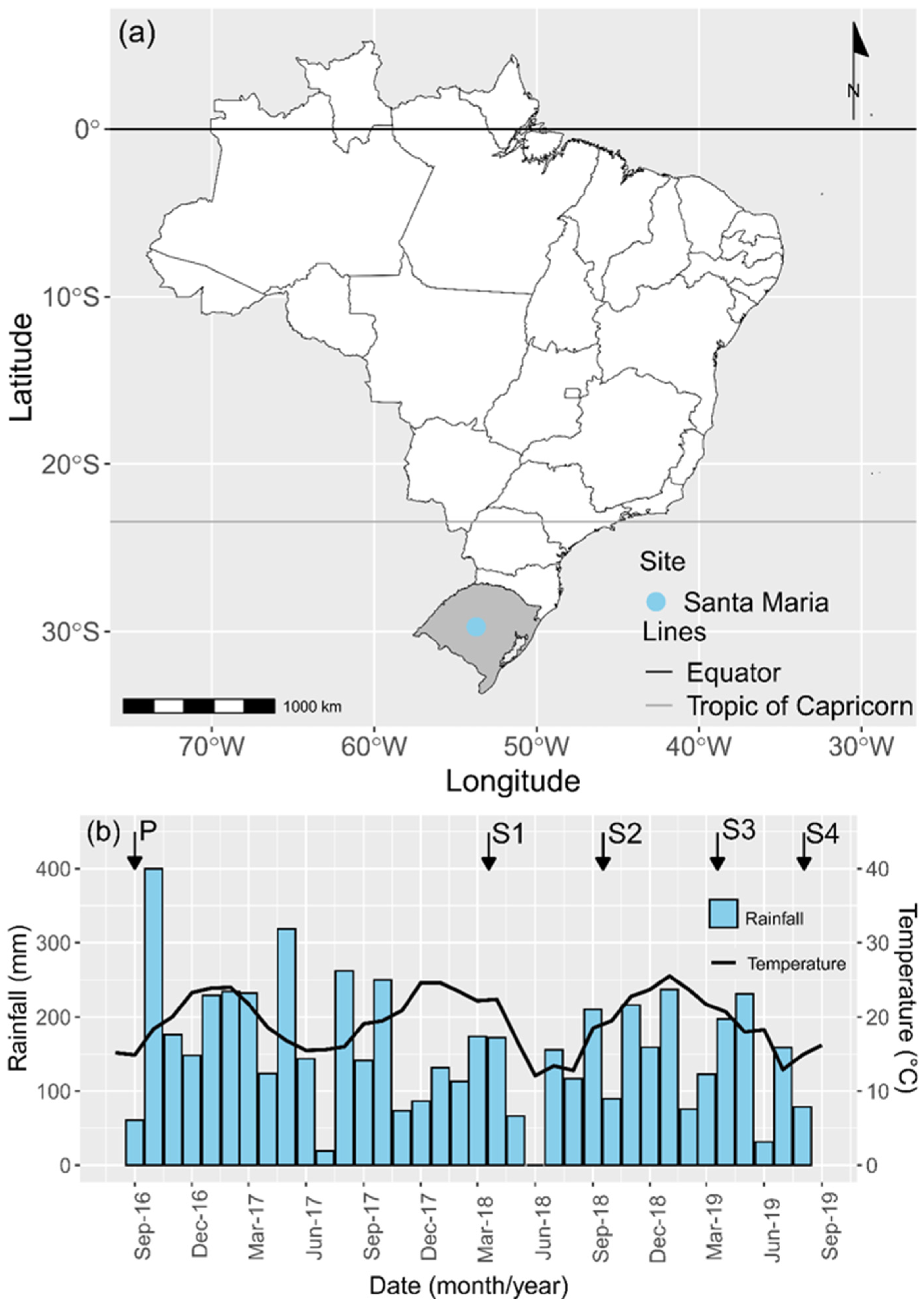
The study was performed from September 2016 to September 2019 in Santa Maria, Rio Grande do Sul state, Brazil (29°47′30″ S, 53°39′47″ W). The regional climate is humid subtropical (Cfa—Köppen classification), characterized by an average air temperature of the coldest month between −3 and 18 °C and an average air temperature of the hottest month above 22 °C, and has an average annual precipitation of 1769 mm, with rainfall well-distributed throughout the year [18]. The average monthly air temperature and precipitation during the study period were 21.4 °C and 161.1 mm, respectively (Figure 1). The soil (Table 1) was classified as a sandy, dystrophic Red Ultisol, corresponding to Ultisols according to the USDA Soil Taxonomy [19], and an Acrisol, according to the FAO soil classification [20].
Seedlings of H. heptaphyllus, a non-pioneer species of the Bignoniaceae family native to tropical and subtropical forests of South America, were produced in 180 cm3 polypropylene tube containers filled with a substrate based on Sphagnum peat and carbonized rice hulls (2:1, v:v ratio). Base fertilization consisted of 9 g L−1 of controlled-release fertilizer (NPK, 15-09-12). The tubes were placed in trays in an emergence and growth area, then moved to an area with 50% light for four months. After this period, the seedlings were taken to a hardening area for 30 days and then shipped for planting at an average height and stem diameter of 31.5 cm and 4.5 mm, respectively.

2.2. Silvicultural Practices, Experimental Design, and Treatments

To establish the experiment, the spontaneous vegetation in the planting area—composed predominantly of Desmodium incanum DC., Andropogon lateralis Nees, Axonopus affinis Chase, Aristida laevis (Nees) Kunth, and Paspalum plicatulum Michx.—was controlled using a non-selective systemic herbicide [glyphosate-N-(phosphonomethyl) glycine] applied at a rate of 4.5 L ha−1 three days before planting. Additionally, leaf-cutting ants of the genera Atta and Acromyrmex were controlled using granulated sulfuramide-based baits.
In September 2016, H. heptaphyllus seedlings were planted in 15 × 20 cm (diameter × depth) holes, manually dug using an articulated excavator, at a spacing of 2 × 2 m. The experimental design consisted of a randomized complete block design with a split-plot arrangement. The main plots consisted of two phosphorus levels (Low P—0 kg P2O5 ha−1 and High P—90 kg P2O5 ha−1). The subplots corresponded to plant age (18, 24, 30, and 36 months after planting), which were treated as repeated measurements over time within the same experimental units. Therefore, measurements taken at different ages were not independent, and temporal correlation among observations was accounted for in the statistical analysis. Three replicates were established for each treatment, and each experimental unit comprised 24 plants, with the eight central plants used for evaluation. Triple superphosphate (42% P2O5) was used as the phosphorus source, while all seedlings also received 90 kg N ha−1 and 45 kg K2O ha−1, supplied as urea (45% N) and potassium chloride—KCl (60% K2O), respectively. The doses of N, P2O5, and K2O represent 86 g plant−1 of triple superphosphate, 80 g plant−1 of urea, and 30 g plant−1 of KCl, respectively. The triple superphosphate and 50% of the urea and KCl doses were applied at planting in holes at a depth of 10 to 15 cm, approximately 15 cm from each seedling. The remaining urea and KCl were added three months after planting to the soil surface, without incorporation, and within the canopy projection of the plants (CQFS-RS/SC, 2016). The determination of N, P2O5, and K2O doses followed the recommendation for Eucalyptus spp. cultivation from the Liming and Fertilization Manual for the states of Rio Grande do Sul and Santa Catarina, prepared by the Soil Chemistry and Fertility Commission (CQFS-RS/SC, 2016), due to the lack of a fertilization recommendation for H. heptaphyllus. Weed control was performed by manual crowning and mowing.

2.3. Evaluation of Tree Growth and Leaf P Concentration, and Soil P Available Analysis

When the experiment reached 18, 24, 30, and 36 months after transplant, plant height was determined from the soil level to the apical bud using a ruler graduated in centimeters, and the stem diameter was determined using a digital caliper (0.01 mm accuracy) at the soil level. In the same periods, fully expanded leaves were collected from the upper third of the plants, washed in distilled water, and dried in a forced-air oven at 65 °C until constant weight. The tissue was ground in a Wiley mill, passed through a 20-mesh sieve, and subjected to sulfuric digestion. Tissue P concentration was determined by colorimetry, according to the methodology of [21], in a UV/VIS spectrophotometer (SF325NM, Bel Engineering, Italy), and expressed on a dry weight basis (g kg−1). Soil samples were collected using a gauge-auger in the 0–20 cm layer in March 2018 and September 2019. Eight subsamples were collected around the plants (≅25 cm) in each treatment. The soil was air-dried, passed through a 2-mm mesh sieve, and submitted to available P extraction (extracted by Mehlich−1). The 0–20 cm soil layer was selected because it corresponds to the diagnostic sampling depth recommended in the Fertilization and Liming Manual for Rio Grande do Sul and Santa Catarina (CQFS RS/SC, 2016), where soil P is routinely evaluated in the topsoil due to its low mobility.

2.4. Minirhizotron Installation and Image Collection

To measure the root system of H. heptaphyllus seedlings, minirhizotrons were installed in September 2017 (12 months after transplant). One hole per plant was drilled 0.5 m from the stem and at a 45° inclination to the soil surface in the seedling planting row. The holes for tube placement were made with a 70 mm diameter, 1.5 m long spiral drill, driven by a gasoline-powered soil auger (White, Bps 52). After drilling and removing the soil, one transparent acrylic tube per plant was inserted into the hole. The 7 cm external diameter, 105 cm long tube was used for future scans. The tubes were closed with 10 cm diameter polyvinyl chloride—PVC caps (Tigre, Brazil) to prevent light and/or moisture from entering (Supplementary Material S2). A reference point was marked on the upper center of each tube, which served as the basis for all subsequent image captures. Because the images had fixed dimensions of 21.6 × 19.6 cm, installing the tubes at a 45° inclination allowed us to capture four images along the tube. Due to the disturbance caused to the soil when opening the holes and inserting the tubes into the soil, we waited six months for the system to stabilize (soil–plant–tube) before beginning the scanning activities. The evaluations started 18 months after transplantation, at 6-month intervals, ending at 36 months of age.

2.5. Root Image Analysis

Images were acquired at 18, 24, 30, and 36 months after transplant using a CI-602 Narrow Gauge Root Imager scanner (CID Bio-Science, Inc., Camas, WA, USA) and analyzed with RootSnap® CI-690 software (version 1.3.2.25; CID Bio-Science, Inc., USA) (Supplementary Material S3), using digital images obtained at 600 DPI. The captured images (TIFF) were manually analyzed to identify fine roots (≤2 mm), which are considered sensitive indicators of plant responses to P availability. The images were separated according to soil depth and analyzed individually. Roots that were non-suberized and white-colored at first appearance were classified as new. Because fine roots may persist across successive observation periods, roots classified as “new” at first appearance were subsequently classified as living while they remained physiologically intact. Roots that remained white or light brown were classified as living roots, whereas roots showing dark coloration, suberization, wrinkling, or tissue degradation were classified as dead roots, following [22]. The following parameters were obtained from each image: (i) projected root area (SAR; mm2 tube−1); (ii) number of living roots; (iii) number of dead roots; and (iv) fine root production (FRP; mm tube−1 interval−1). SAR corresponds to the two-dimensional projected root area detected in the minirhizotron images and does not represent the actual three-dimensional root surface area.
The ratio of living to dead fine roots was calculated for each sampling date as LR/DR, where LR represents the total number of living roots and DR the total number of dead roots detected in each image [22]. The surface area density of living fine roots (SA; mm2 cm−2) was calculated as the ratio between SAR and the image area (A = 422.30 cm2), according to the equation SA = SAR/A. Fine root production (FRP; mm tube−1 interval−1) was determined as the sum of: (i) the length of newly emerged roots and (ii) the elongation of previously existing roots between two consecutive observation times [22,23]. For the first observation interval (18–24 months), FRP was calculated using the same procedure adopted for all subsequent intervals. FRP values were expressed per observation interval and calculated consistently across all sampling periods.

2.6. Statistical Analysis

All of the data obtained for root morphology parameters (total number of living fine roots, total number of dead fine roots, total surface area of living fine roots), fine roots growth rate (fine root length production rate) in the 0–20, 20–40, 40–60, and 60–80 cm soil depth, tree growth (height and stem diameter), leaf P concentration, and soil P available were subjected to analysis of variance (ANOVA), according to a split-plot design. The normality of the residuals and homogeneity of variance were tested using the Shapiro–Wilk and Bartlett tests, respectively. The results were considered statistically significant when p < 0.05. When the ANOVA showed a significant effect of treatments (P and time), means were compared through the Scott–Knott test. ANOVA was carried out using the “ExpDes.pt” package in R 1.2.2 [24] (Ferreira et al., 2018) and the Scott–Knott test by the “easyanova” package [25]. To verify the correlation effects between the response variables and treatment distribution, the data were subjected to principal component analysis (PCA), using “factoextra” [26] and “FactoMineR” packages [27] for PCA in R software [28].

3. Results

3.1. Handroanthus Heptaphyllus Growth Response

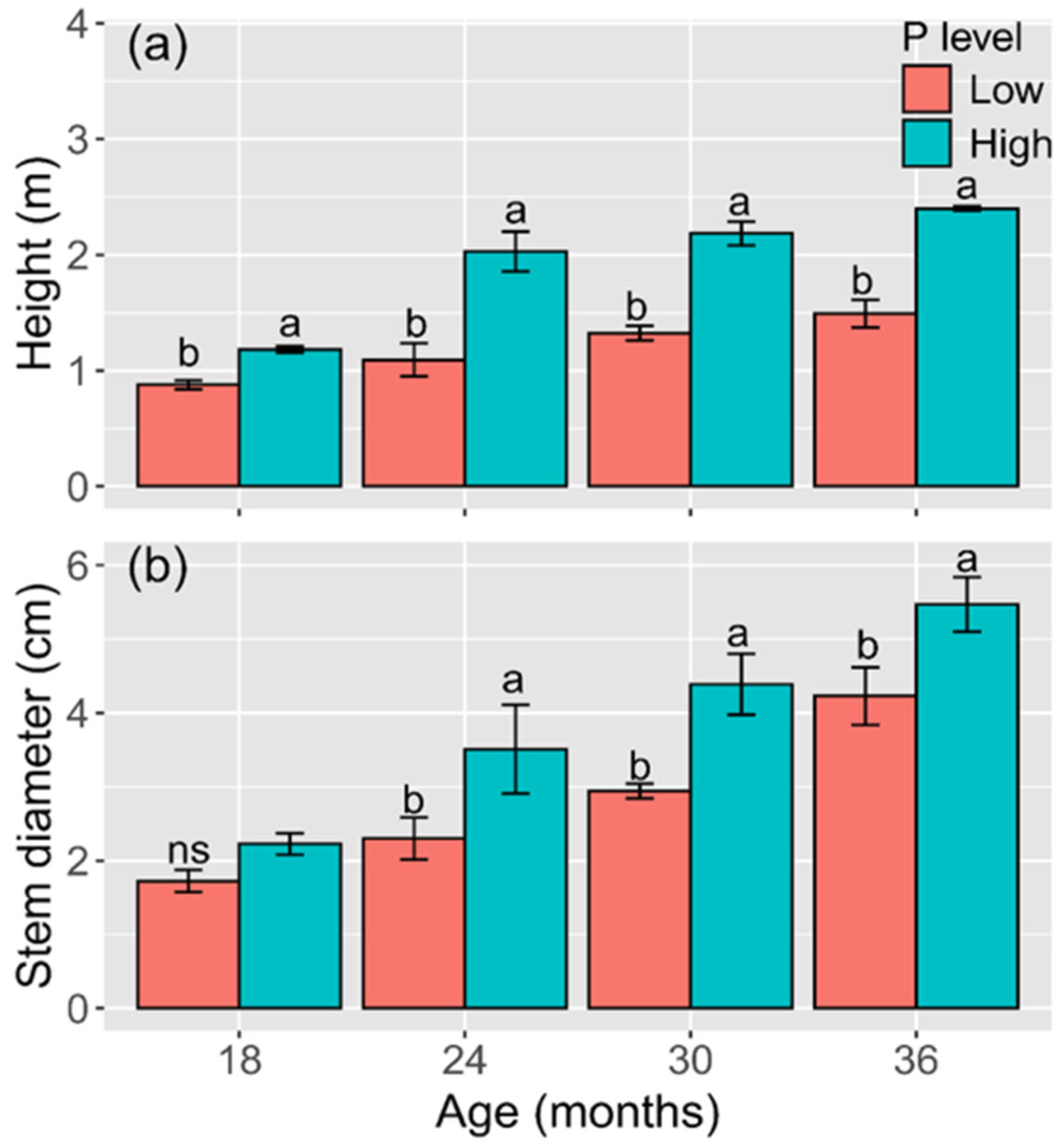
High P provided an increase of 34.8, 85.8, 65.1, and 60.7% in height values at 18 (118.2 m), 24 (202.8 m), 30 (218.5 m), and 36 (239.9 m) months after transplant, respectively, compared to Low P (Figure 2a). Notably, the greatest response occurred at 24 months, followed by a gradual attenuation over time. The increased P level resulted in gains of 52.6 (35.1 cm), 49.2 (43.9 cm), and 29.3% (54.7 cm) in stem diameter at 24, 30, and 36 months old, respectively, compared to Low P (Figure 2b), also indicating a peak response at 24 months with a subsequent decline in magnitude. P level did not significantly affect the stem diameter at 18 months old.

3.2. Leaf P Concentration and Soil P Available

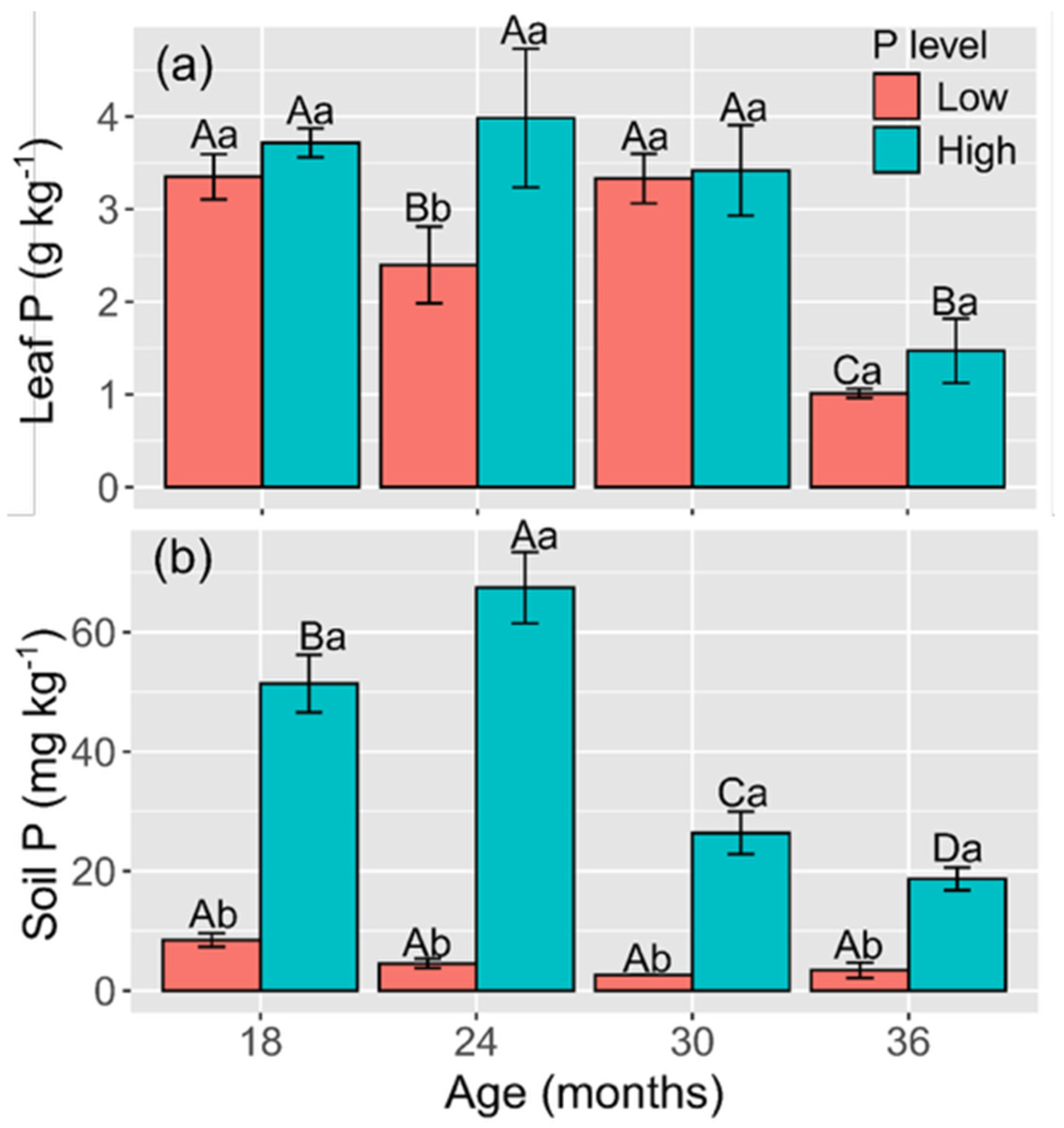
Leaf P concentration and soil P availability were significantly affected by P supply and plant age at 18, 24, 30, and 36 months after transplanting (p < 0.001) (Figure 3a,b; Supplementary Material S1). High P increased the leaf P concentration, with values of 3.72, 3.98, 3.42, and 1.47 mg dm−3 at 18, 24, 30, and 36 months, respectively, compared to Low P (3.35, 2.40, 3.33, and 1.01 mg dm−3), resulting in gains of 11.0, 66.1, 2.67, and 45.4%, respectively. (Figure 3a). High P provided an increase of 6.1, 14.9, 10.1 and 5.5 times in soil P availability at 18, 24, 30, and 36 months, respectively, compared to Low P (Figure 3b). The highest leaf P concentration values were found at 18, 24, and 30 months for High P (3.71 mg P kg−1) and at 18 and 30 months after planting for Low P (3.34 mg P kg−1) (Figure 3a). The lowest leaf P concentration values were observed in 36 month-old plants subjected to both High and Low P (1.24 mg P kg−1).
Phosphate fertilization markedly increased the soil P availability during the first 24 months, with a clear peak at 24 months followed by a decline until 36 months (Figure 3b), mirroring the temporal pattern observed for plant growth. Under Low P, soil P availability was not significantly affected over time.

3.3. Fine Root Morphological Parameters

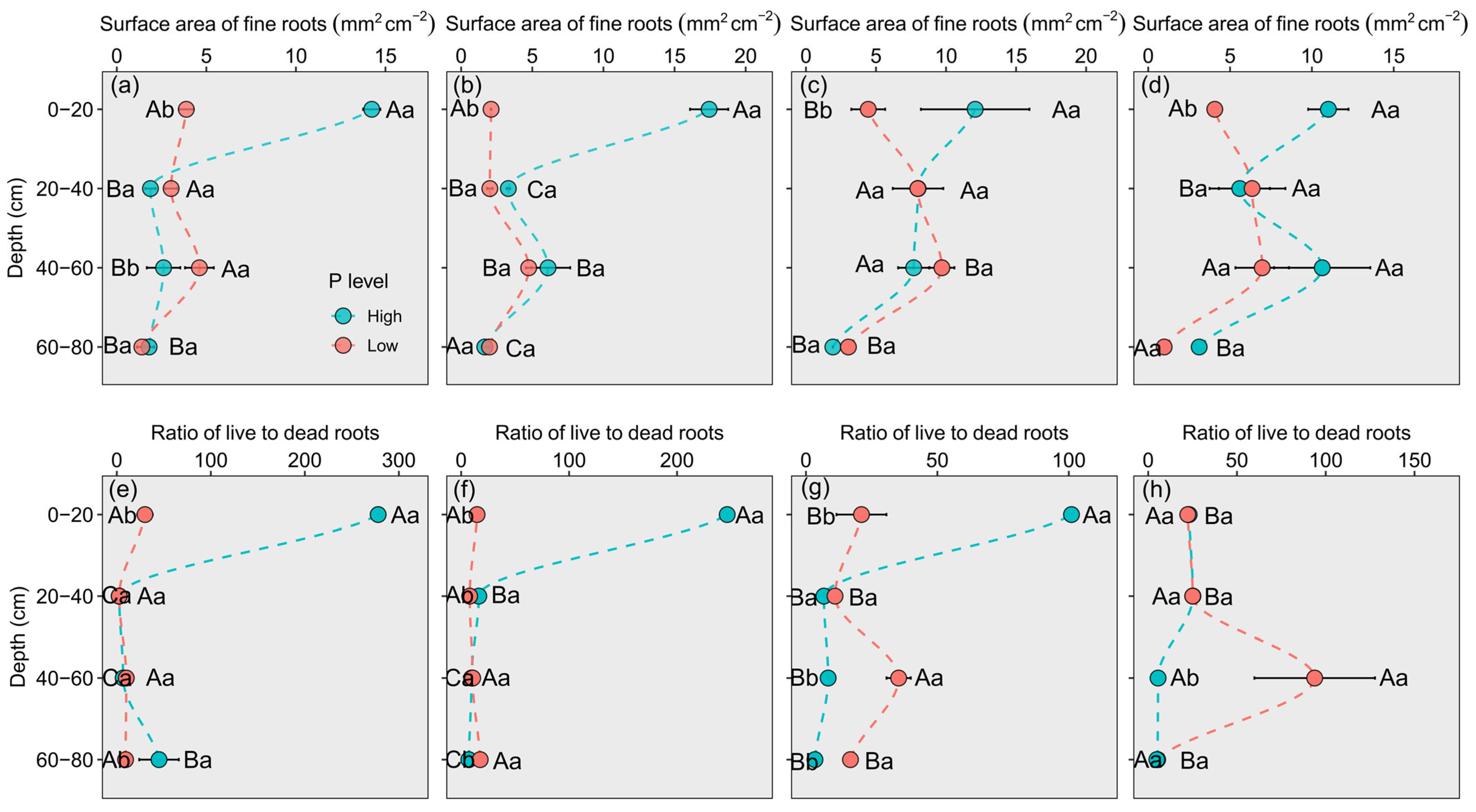
The total surface area of living fine roots and ratio between alive and dead roots were significantly affected by P fertilization and soil depth age (p < 0.001) (Figure 4a–h; Supplementary Material S1). High P increased the total surface area of living fine roots by 267, 729, 172, and 171% in the upper soil layer (0–20 cm) at 18, 24, and 36 months after transplant, respectively, compared to Low P (Figure 4a–d). The total surface area of living fine roots decreased with increasing soil depth (20 to 80 cm) at 18, 24, 30, and 36 months after planting for High P. In contrast, a slight increase in the total surface area of living fine roots was observed in the 40–60 cm soil layer at 18, 24, 30, and 36 months old for Low P. High P resulted in the highest living/dead root ratio in in the 0–20 cm soil layer, with values of 278, 247 and 101 at 18, 24 and 30 month old, respectively (Figure 4e,g). Under Low P, the ratio between living and dead roots was higher in the 40–60 cm soil layer, with values of 35 and 94 for the 24- and 30-month-old plants, respectively (Figure 4g,h).

3.4. Fine Roots Dynamics

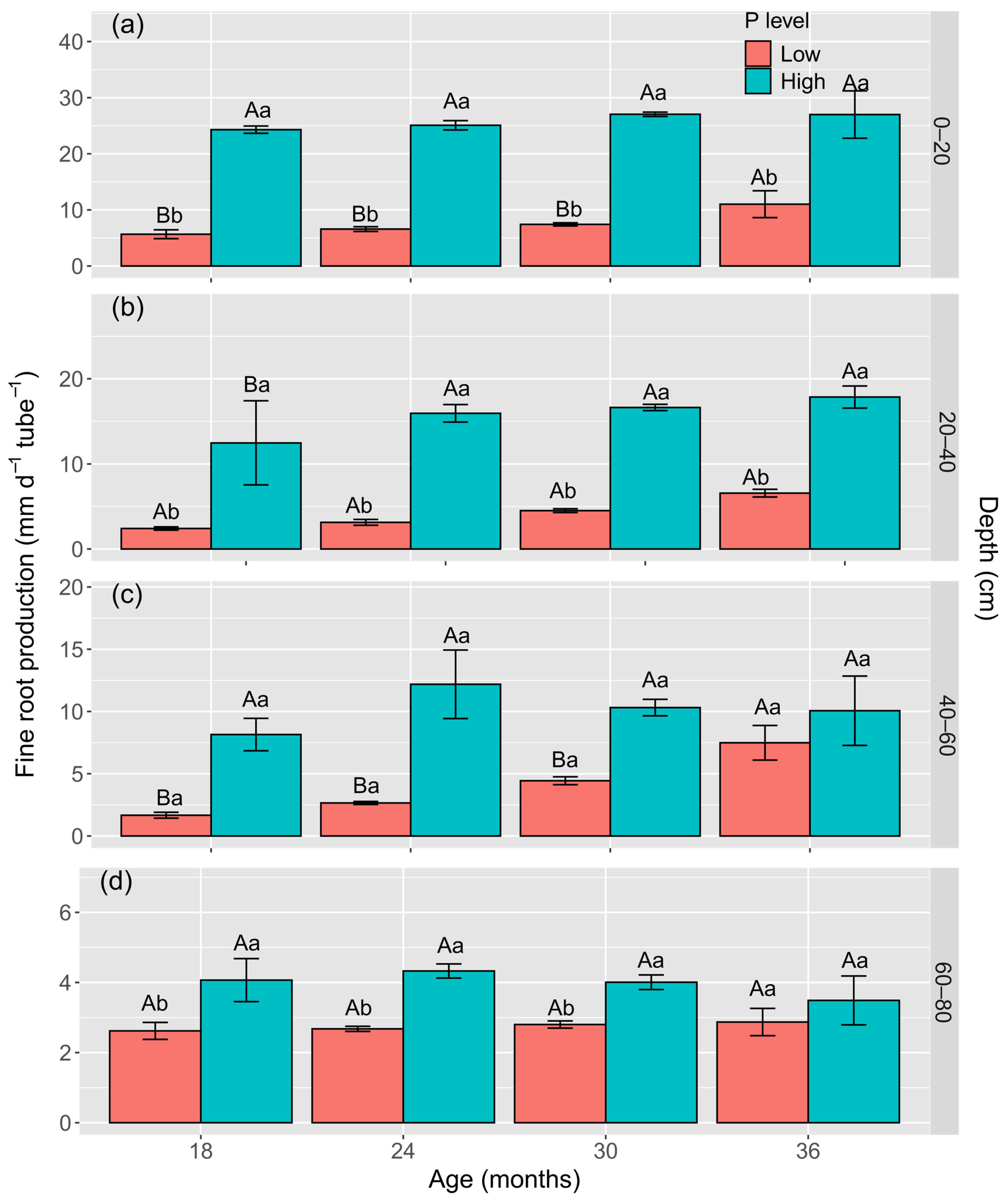
Fine root length production (FRP) rate was significantly affected by P supply and plant age (Figure 5a–d). The increased soil P levels provided the highest FRP rates at all soil depths in the evaluated period. High P provided an increase of 329, 281, 265, and 145% in FRP in the 0–20 cm and 417, 408.2, 268, and 172% in the 20–40 cm soil layer at 18, 24, 30, and 36 months after planting, respectively, compared to Low P (Figure 5a,b). In the 40–60 cm soil layer, increased soil P levels contributed with gains of 388, 359, and 132% FRP at 18, 24, and 30 months old, respectively, compared to Low P (Figure 5c). High P provided an increase of 1.5 fold on average in FRP in the deeper layer (60–80 cm) at 18, 24, and 30, and 36 months after planting, respectively, compared to Low P (Figure 5d). P fertilization did not significantly affect FRP in the 40–60 and 60–80 cm soil layers at 36 months old. Age slightly affected FRP in the soil layers within each P level. At 36 months under Low P, FRP increased by 68.1% and 156% in the 0–20 and 20–40 cm layers, respectively, compared to earlier ages. For High P, only the 20–40 soil layer showed lower FRP values (12.5 mm d−1 tube−1) at 18 months old compared to other evaluations (16.8 mm d−1 tube−1 on average).

3.5. Data Correlation Analysis

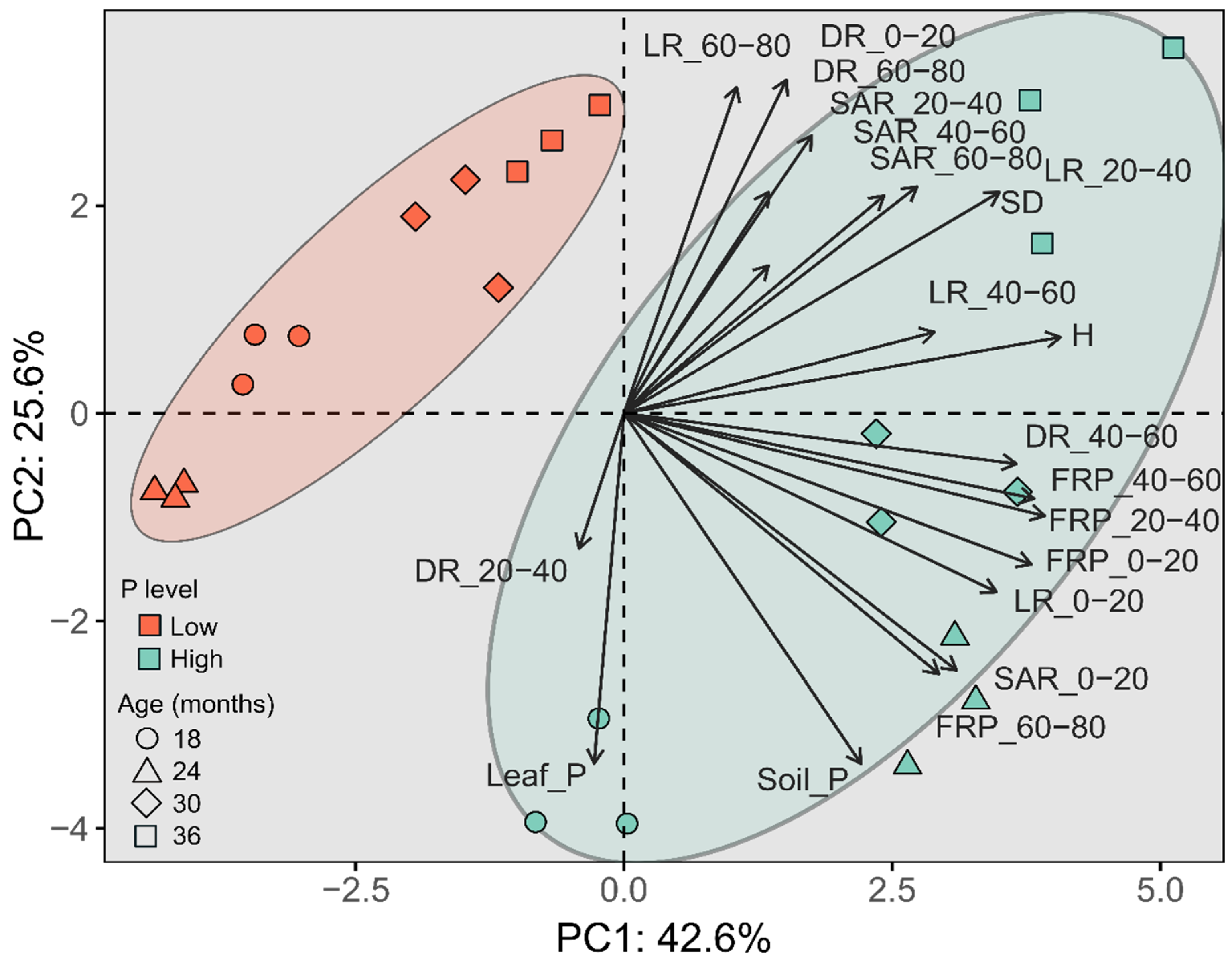
Principal component analysis (PCA) was performed by extracting the first two principal components (PCs). PC1 and PC2 together explained 68.2% of the total data variability (Figure 6). The PCA revealed a clear separation between treatments according to soil phosphorus (P) availability, forming two distinct clusters. The High P treatment was positioned on the right side of the ordination and showed a positive association with total number of living fine roots (LR), total number of dead fine roots (DR), total surface area of living fine roots (SAR), fine root length production rate (FRP) in the 0–20, 20–40, 40–60, and 60–80 cm soil depth, height (H), stem diameter (SD), leaf P concentration and soil P available. In contrast, the Low P treatment, located on the left side of the ordination, exhibited a negative relationship with these variables.
Thus, these results demonstrate that phosphorus availability drives shifts in root system strategy by influencing root turnover, spatial distribution, and the integration between belowground resource acquisition and aboveground growth. Under high P availability, plants adopt a more acquisitive strategy, characterized by rapid root production and renewal, enhancing nutrient uptake efficiency and supporting greater plant development. In contrast, low P availability promotes a more conservative strategy, with reduced root activity and growth, likely reflecting a limitation in resource acquisition and a greater reliance on root longevity. These findings highlight the central role of phosphorus in regulating not only plant nutrition, but also the functional dynamics of root systems in subtropical soils.

4. Discussion

The application of 90 kg P2O5 ha−1 increased the soil P concentration, and consequently, the likelihood of P reaching the outer surface of the roots and its uptake [29]. Some of the P present in the soil, with the addition of 90 kg P2O5 ha−1, was absorbed, as its content decreased over time. This increase in P availability promoted gains in plant height, stem diameter, fine root production, total leaf area, and the ratio between live and dead fine roots. However, plants grown in soil with low P also absorbed native soil P, as there was a tendency for its concentration to decrease over time. This happens because plants may have strategies to increase P availability in soils with low P levels. Plants can exude low molecular weight organic acids, which can contribute to the solubilization of compounds that have P in their composition [30,31,32].
Furthermore, organic acids can encapsulate the outer surface of reactive particles, decreasing the probability of adsorption of P forms present in the soil solution [29,33]. In addition, plants can release OH, which can increase the rhizospheric soil pH, which decreases the adsorption energy of P forms to functional groups of reactive inorganic soil particles [6,12].
Part of the P absorbed by the root systems over time in high and low P soil was transported to growing organs; however, no significant differences were observed between the two treatments. This could be because tissues of plants grown in low soil P have a smaller dry weight, which increases the P concentration in plant organs, especially those with intense cell division and elongation, such as young leaves [34]. Another explanation may be related to the possibility that plants grown in low-P soil may have strategies such as the secretion of organic acids and the activation of enzymes, as well as acid phosphatase (APase). This increases P solubilization in the soil and favors its uptake, increasing P uptake efficiency (Meng et al., 2021) [12,35]. In addition, we may expect a greater internal remobilization and more efficient use of P, which contributes to the maintenance of foliar concentrations even under low nutrient availability [29]. It is also worth noting that 36 months after planting, a decrease in leaf P concentration was observed in plants growing in both Low and High P soil concentrations. This could be due to the sampling time, which was in spring, the period of the greatest vegetative growth. Thus, with the growth of leaf area and other plant organs, nutrient dilution per unit mass likely occurred, and part of the P accumulated in fully expanded leaves may have been redistributed to young leaves and other organs such as branches and roots, as reported for other forest species such as Pinus taeda and Cordia trichotoma [15].
Moreover, the results of the principal component analysis confirm the dilution effect with plant growth, demonstrating a negative relationship between plant age and leaf P concentration. Thus, it can be inferred that there is a temporal trend of decreasing tissue P levels; that is, with plant age, P concentrations gradually decrease. These results are consistent with previous studies on forest species. For example, leaf P concentrations tend to decrease over time with increasing biomass accumulation, reflecting a dilution effect under contrasting soil P conditions [36]. Similarly, P allocation and concentration vary with developmental stage and canopy position, with lower concentrations observed in older tissues [37].
The higher fine root surface area observed in the 0–20 cm layer under High P supply is associated with greater P availability in this zone, as the fertilizer was applied at 15 cm depth and P has low mobility in the soil. Consistently, the highest fine root production was also observed under High P conditions across the 0–20, 20–40, and 40–60 cm layers throughout the experiment, indicating a positive effect of P availability on root growth [38,39]. Phosphorus plays a key role in cell division and elongation, as it is directly involved in energy transfer (ATP), which supports meristematic activity and stimulates the emission of fine roots [12,40]. In addition, due to the low mobility of P in the soil, its uptake depends on the root system’s ability to explore the soil volume, leading to morphological adjustments and increased root proliferation in nutrient-rich microsites [4]. Although roots were also observed in deeper layers with lower P availability, this pattern reflects a complementary strategy of soil exploration for water and other nutrients, rather than an indication of preferential growth under nutrient-poor conditions [4].
At the same time, a lower living-to-dead root ratio was observed in the 0–20 cm layer under High P supply, especially in months 18, 24, and 30, indicating a higher proportion of dead roots in this treatment. This may be related to the greater availability of P, which initially stimulates an intense emission of fine roots in response to increased meristematic activity and the supply of energy for growth [8,41]. Thus, the results suggest that P application stimulates root turnover, which is not always desirable, since plants need to invest more C for the growth of new roots [42]. Therefore, it is important to know the best dose of P to apply at the time of planting.
Principal component analysis suggests a structured pattern of variability in the dataset, with P availability acting as a major driver of the observed responses. The first principal component (PC1) was primarily associated with plant growth, nutritional status, and root morphological traits, contributing to the differentiation between High and Low P conditions. The second principal component (PC2) appears to reflect variation in root distribution along the soil profile, indicating that part of the root response may not be exclusively driven by P supply. Taken together, these patterns indicate that greater P availability is generally associated with increases in aboveground biomass and root exploration, while low P tends to constrain these responses, possibly associated with energy limitation and the activation of more conservative acquisition strategies, such as the exudation of organic acids and the activation of solubilizing enzymes [12,30,35].
From a functional perspective, phosphorus availability drives the shift in root system strategy, affecting turnover, spatial distribution, and root–shoot integration. Under higher P, plants tend to adopt a more acquisitive strategy, with faster root production and renewal, whereas under lower P, a more conservative strategy prevails, with reduced activity and greater reliance on root longevity. Root–shoot relationships indicate that root plasticity is closely linked to vegetative performance, suggesting that soil P availability influences both plant growth and resource allocation to root maintenance and renewal [8,9,42].
Some limitations of this study should be acknowledged. The experiment was conducted under a single soil type and climatic condition, which may limit the broader extrapolation of the results. Root assessments were restricted to the upper 80 cm of soil, potentially overlooking deeper rooting responses. In addition, measurements were taken at discrete sampling intervals, which may not have fully captured the short-term dynamics of root turnover and soil P availability. Despite these constraints, the study provides robust evidence of the P effects on root system dynamics under field conditions.

5. Conclusions

Phosphate fertilization increases soil P availability, especially up to 24 months after planting, resulting in greater growth in height, root collar diameter, fine root production, total surface area of living fine roots, and the ratio of living to dead roots. These responses were more expressive in the upper soil layer (0–20 cm), reflecting the localized effect of P application and its influence on root spatial distribution.
Our results demonstrate that increased P availability not only enhances root growth but also alters root system functioning, leading to higher fine root production and turnover. This results in greater nutrient uptake efficiency, which is reflected in higher leaf P concentration and improved aboveground development. In contrast, low P conditions limited root activity and plant growth, indicating a more conservative strategy with reduced investment in root production.
Overall, Handroanthus heptaphyllus responds to P fertilization by adopting a more acquisitive strategy, characterized by increased root exploration and nutrient uptake, thereby reducing its dependence on native soil P. These findings highlight the central role of phosphorus in regulating both the root system dynamics and whole-plant performance in subtropical soils.

Supplementary Materials

The following supporting information can be downloaded at: https://www.mdpi.com/article/10.3390/f17050613/s1, Supplementary Material S1: p-values of analysis of variance (ANOVA) for variables of Handroanthus heptaphyllus at different P levels, soil depths, and their interaction. Supplementary material S2: Steps of installation of root scanner access tubes. (A,B) drilling for tube installation using a motorized auger and a 45° inclination template; (C) insertion of the acrylic tube into the soil; (D) tube properly positioned in the soil; (E,F) tubes protected to prevent light and water entry. Supplementary material S3: Detailed description of root image acquisition using a root scanner. (A) overview of root system evaluation of H. heptaphyllus seedlings using a laptop, access tube, and scanner; (B) access tube inserted into the soil with the scanner capturing images; (C) images generated at 600 DPI resolution.

Author Contributions

Conceptualization: Á.L.P.B., M.S.d.S.K., L.O.S., R.M. and J.A.Z.; Data curation: M.S.d.S.K.; Formal analysis: Á.L.P.B., M.S.d.S.K. and L.O.S.; Funding Acquisition: R.M.; Investigation: Á.L.P.B., M.S.d.S.K., M.M.A. and G.B.; Methodology: Á.L.P.B., M.S.d.S.K., L.O.S., M.M.A. and G.B.; Project Administration: M.M.A.; Resources: R.M., M.M.A.; Software: Á.L.P.B.; Supervision: M.M.A. and G.B.; Writing—Original Draft Preparation: Á.L.P.B., M.S.d.S.K., J.H.M.T., J.A.Z., M.V.M.A., L.S.M., M.G.P., M.T. and E.B.; Writing—review & editing: Á.L.P.B., M.S.d.S.K., J.H.M.T., L.O.S., J.A.Z., M.V.M.A., L.S.M., M.G.P., M.T., E.B., M.M.A. and G.B. All authors have read and agreed to the published version of the manuscript.

Funding

This research received no external funding.

Data Availability Statement

Data are available from the corresponding author on a reasonable request.

Acknowledgments

We are grateful to the Conselho Nacional de Desenvolvimento Científico e Tecnológico (Brazilian National Council for Scientific and Technological Development)—CNPq (306146/2023-1), and the author Matheus Severo de Souza Kulmann is grateful to the Fundação de Amparo à Pesquisa do Estado do Rio de Janeiro (FAPERJ) for the Postdoc scholarship (No. 200.291/2024).

Conflicts of Interest

The authors declare no financial or other competing conflicts of interest.

References

  1. Alovisi, A.M.T.; Cassol, C.J.; Nascimento, J.S.; Soares, N.B.; Silva Junior, I.R.; Silva, R.S.; Silva, J.A.M. Soil factors affecting phosphorus adsorption in soils of the Cerrado, Brazil. Geoderma Reg. 2020, 22, e00298. [Google Scholar] [CrossRef]
  2. Fink, J.R.; Inda, A.V.; Bavaresco, J.; Barrón, V.; Torrent, J.; Bayer, C. Adsorption and desorption of phosphorus in subtropical soils. Soil Tillage Res. 2016, 155, 62–68. [Google Scholar] [CrossRef]
  3. Berghetti, Á.L.P.; Araujo, M.M.; Souza, L.; Moura, J.M.; Stefanello, L.O.; Brunetto, G. Critical phosphorus levels in Handroanthus heptaphyllus seedlings. Rev. Floresta 2024, 54, 1–10. [Google Scholar] [CrossRef]
  4. Brunetto, G.; Marchezan, C.; Berghetti, Á.L.P.; Kulmann, M.S.; Simão, D.G.; Silva, K.R.; Ceretta, C.A.; Toselli, M.; Baldi, E.; Carranca, C. Root morphology as soil fertility indicator. In Tópicos em Ciência do Solo; Brunetto, G., Rozane, D.E., Loss, A., Souza, H.A., Eds.; SBCS: Viçosa, Brazil, 2025; pp. 116–150. [Google Scholar]
  5. Viana, T.O.; Gama-Rodrigues, A.C.; Gama-Rodrigues, E.F.; Aleixo, S.; Moreira, R.V.S.; Sales, M.V.S.; Marques, J.R.B. Phosphorus transformations under different land uses in Atlantic Forest soils. Geoderma Reg. 2018, 14, e00184. [Google Scholar] [CrossRef]
  6. Joshi, S.R.; Tfaily, M.M.; Young, R.P.; McNear, D.H. Root exudates drive coupled carbon and phosphorus cycling. Plant Soil 2024, 498, 371–390. [Google Scholar] [CrossRef]
  7. Reis, L.C.; Piccolo, M.C.; Lambais, G.R.; Furlan, G.; Guerra, F.; Camargo, P.B.; Bieluczyk, W. Fine-root growth under preserved and restored Cerrado sites. J. Environ. Manag. 2025, 393, 126871. [Google Scholar] [CrossRef]
  8. Hu, G.; Zhang, Z.; Li, L. Stoichiometry of soil and fine roots during vegetation restoration. Front. Plant Sci. 2023, 14, 1181365. [Google Scholar] [CrossRef]
  9. Li, C.; He, H.; Zhang, X.; Ren, X.; Shi, L.; Zhang, L.; Xu, Q.; Zhang, M.; Zhang, Y. Long-term nitrogen and phosphorus dynamics in China’s forests. For. Ecosyst. 2025, 13, 100325. [Google Scholar] [CrossRef]
  10. Chen, B.; Feng, L.; Gu, H.; Zhang, M.; Chai, Z.; Feng, G. Critical shoot phosphorus concentrations driving root morphological changes in cotton. J. Plant Nutr. Soil Sci. 2023, 186, 130–140. [Google Scholar] [CrossRef]
  11. Shi, W.; Cao, T.; Yuan, Z.; Wang, Y.; Ying, Y. Phosphorus deficiency-induced root changes in Phyllostachys edulis. Plant Soil 2025, 514, 2367–2385. [Google Scholar] [CrossRef]
  12. Aguilar, M.V.M.; Kuinchtner, C.C.; Senhor, D.F.; Birck, T.P.; Lima, C.S.; Kulmann, M.S.S.; Araujo, M.M.; Berghetti, Á.L.P.; Brunetto, G.; Tabaldi, L.A. Selecting Eucalyptus spp. clones to enable higher phosphorus uptake efficiency. J. Plant Growth Regul. 2024, 43, 854–870. [Google Scholar] [CrossRef]
  13. Raghothama, K.G.; Karthikeyan, A.S. Phosphate acquisition. In Plant Nutrient Acquisition; Lambers, H., Colmer, T.D., Eds.; Springer: Dordrecht, The Netherlands, 2005; pp. 37–49. [Google Scholar] [CrossRef]
  14. Wang, Y.; Gao, M.; Wang, Z.; Huang, T.; Li, H. Organic acids and plant nitrogen and phosphorus uptake. J. Soil Sci. Plant Nutr. 2023, 23, 6048–6058. [Google Scholar] [CrossRef]
  15. Kulmann, M.S.S.; Berghetti, Á.L.P.; Pinto, C.B.; Costa, R.H.; Tabaldi, L.A.; Brunetto, G.; Schumacher, M.V. Impact of phosphorus omission fertilizer on growth, nutritional status, biochemical and physiological parameters in a Pinus taeda L. plantation. For. Ecol. Manag. 2024, 551, 121557. [Google Scholar] [CrossRef]
  16. Miatto, R.C.; Wright, I.J.; Batalha, M.A. Soil nutrient status and leaf trait relationships in Brazilian forests. Plant Soil 2016, 404, 13–33. [Google Scholar] [CrossRef]
  17. Yu, Z.; Wang, M.; Huang, Z.; Lin, T.; Vadeboncoeur, M.A.; Searle, E.B.; Chen, H.Y.H. Temporal changes in soil C:N:P stoichiometry in subtropical China. Glob. Change Biol. 2018, 24, 1308–1320. [Google Scholar] [CrossRef]
  18. Alvares, C.A.; Stape, J.L.; Sentelhas, P.C.; Gonçalves, J.L.M.; Sparovek, G. Köppen’s climate classification map for Brazil. Meteorol. Z. 2013, 22, 711–728. [Google Scholar] [CrossRef]
  19. Staff Soil Survey. Keys to Soil Taxonomy, 13th ed.; USDA-NRCS: Washington, DC, USA, 2022. [Google Scholar]
  20. WRB Group IUSS Working. World Reference Base for Soil Resources, 4th ed.; IUSS: Vienna, Austria, 2022. [Google Scholar]
  21. Murphy, J.; Riley, J.P. A modified single solution method for phosphorus determination. Anal. Chim. Acta 1962, 27, 31–36. [Google Scholar] [CrossRef]
  22. Wang, X.; Fujita, S.; Nakaji, T.; Watanabe, M.; Satoh, F.; Koike, T. Fine root turnover of Japanese white birch (Betula platyphylla var. japonica) grown under elevated CO2 in northern Japan. Trees 2016, 30, 363–374. [Google Scholar] [CrossRef]
  23. An, J.Y.; Park, B.B.; Chun, J.H.; Osawa, A. Litterfall production and fine root dynamics in cool-temperate forests. PLoS ONE 2017, 12, e0180126. [Google Scholar] [CrossRef]
  24. Ferreira, E.B.; Cavalcanti, P.P.; Nogueira, D.A. ExpDes: An R package for ANOVA and experimental designs. Appl. Math. 2018, 5, 295–310. [Google Scholar] [CrossRef]
  25. Arnhold, E. R Package, version 2024. easyanova: Analysis of variance and other important complementary analyses. R Foundation for Statistical Computing: Vienna, Austria, 2024.
  26. Kassambara, A.; Mundt, F. R Package, version 1.0.7. factoextra: Extract and visualize multivariate data analyses. R Foundation for Statistical Computing: Vienna, Austria, 2020.
  27. Lê, S.; Josse, J.; Husson, F. FactoMineR: An R package for multivariate analysis. J. Stat. Softw. 2008, 25, 1–18. [Google Scholar] [CrossRef]
  28. R Core Team. R: A Language and Environment for Statistical Computing; R Foundation for Statistical Computing: Vienna, Austria, 2025. [Google Scholar]
  29. Wang, J.; Wei, Z.; Zhao, Y.; Xia, X.; Cui, J.; Li, S. Strategies to improve phosphorus-use efficiency in plant cells. Soil Sci. Plant Nutr. 2025, 71, 53–60. [Google Scholar] [CrossRef]
  30. Baptist, F.; Aranjuelo, I.; Legay, N.; Lopez-Sangil, L.; Molero, G.; Rovira, P.; Nogués, S. Rhizodeposition of organic carbon by plants with contrasting resource-acquisition traits. Plant Soil 2015, 394, 391–406. [Google Scholar] [CrossRef]
  31. Liang, L.; An, T.; Liu, S.; Gao, Y.; Yu, M.; Xu, B.; Zhang, S.; Deng, X.; Bolan, N.; Siddique, K.H.M.; et al. Phosphorus efficiency and tolerance in maize genotypes with contrasting root systems. J. Plant Nutr. Soil Sci. 2023, 186, 286–297. [Google Scholar] [CrossRef]
  32. Mustonen, P.S.J.; Oelbermann, M. Organic acids, root traits and fungal interactions in phosphorus acquisition. Agrofor. Syst. 2025, 99, 43. [Google Scholar] [CrossRef]
  33. Wang, Y.; Luo, D.; Xiong, Z.; Wang, Z.; Gao, M. Rhizosphere phosphorus fractions influenced by organic acids. Soil Tillage Res. 2023, 225, 105543. [Google Scholar] [CrossRef]
  34. Paz, J.M.; Ramos, C.; Visconti, F. Critical nitrogen dilution curves for Mediterranean vegetables. Sci. Hortic. 2022, 303, 111194. [Google Scholar] [CrossRef]
  35. Meng, X.; Chen, W.; Wang, Y. Effects of phosphorus deficiency on nutrient absorption and antioxidant metabolism in Citrus grandis. PLoS ONE 2021, 16, e0246944. [Google Scholar] [CrossRef]
  36. Zavišić, A.; Polle, A. Phosphorus nutrition dynamics in young beech trees. Tree Physiol. 2018, 38, 37–53. [Google Scholar] [CrossRef]
  37. Talkner, U.; Meiwes, K.J.; Potočić, N.; Seletković, I.; Cools, N.; De Vos, B.; Rautio, P. Declining phosphorus nutrition of European beech forests. Ann. For. Sci. 2015, 72, 919–928. [Google Scholar] [CrossRef]
  38. Guilbeault-Mayers, X.; Lambers, H.; Laliberté, E. Coordination among leaf and fine-root traits along a soil fertility gradient. Plant Soil 2024. [Google Scholar] [CrossRef]
  39. Jia, L.; Jiang, Q.; Sun, J.; Robinson, D.; Yang, Z.; Yao, X.; Wang, X.; Dai, X.; Chen, T.; Wu, D.; et al. Depth-related fine-root plasticity under soil warming. J. Ecol. 2024, 112, 1058–1073. [Google Scholar] [CrossRef]
  40. Khan, F.; Siddique, A.B.; Shabala, S.; Zhou, M.; Zhao, C. Phosphorus-regulated physiological responses to abiotic stress. Plants 2023, 12, 2861. [Google Scholar] [CrossRef]
  41. Li, S.; Fisk, M.C.; Yanai, R.D.; Fahey, T.J. Co-limitation of fine-root growth by nitrogen and phosphorus. Ecosystems 2024, 27, 33–44. [Google Scholar] [CrossRef]
  42. Harish, M.N.; Choudhary, A.K.; Dass, A.; Singh, V.K.; Rajanna, G.A.; Bana, R.S.; Paramesh, V.; Varatharajan, T.; Bhupenchandra, I.; Sadhukhan, R.; et al. Double zero-tilled bed-planting and optimized P-fertilization in maize-wheat rotation: An empirical investigation on root architecture, carbon-phosphorus dynamics, and soil carbon pools. J. Environ. Manag. 2025, 392, 126668. [Google Scholar] [CrossRef]
Figure 1. Geographical location of the Handroanthus heptaphyllus plantation experimental site in Santa Maria municipality, Rio Grande do Sul state, southern Brazil (a), monthly accumulated precipitation (mm) and monthly average temperature (°C) (b) during the study (minirhizotron tube evaluations) from September 2016 to September 2019. Data obtained from the weather station (A803) in Santa Maria, Brazil. Source: (INMET, 2020). Letters with arrows indicate dates from: P—plantation (September 2016); S1, S2, S3, and S4—first, second, third, and fourth sampling of fine roots, at 18, 24, 30, and 36 months old, respectively.
Forests 17 00613 g001
Figure 2. Effect of P supply on height (a) and stem diameter (b) of H. heptaphyllus at 18, 24, 30, and 36 months. Low P = 0 kg P ha−1 and High P = 90 kg P ha−1. Bars show means ± standard deviation (n = 3 blocks). Different lowercase letters indicate significant differences between P levels at each age (Student’s t-test, p < 0.05). ns = not significant.
Forests 17 00613 g002
Figure 3. Effect of P supply on leaf P concentration (a) and soil available P (b) in the 0–20 cm soil layer at 18, 24, 30, and 36 months after the planting of H. heptaphyllus. Low P = 0 kg P ha−1 and High P = 90 kg P ha−1. Bars show means ± standard deviation (n = 3 blocks). Different uppercase letters indicate significant differences among ages within each P level, and different lowercase letters indicate significant differences between P levels at each age (Scott–Knott test, p < 0.05).
Forests 17 00613 g003
Figure 4. Effect of P supply on the total surface area of living fine roots at 18 (a), 24 (b), 30 (c), and 36 months (d) after planting, and on the ratio between live and dead roots at 18 (e), 24 (f), 30 (g), and 36 months (h) of H. heptaphyllus. Low P = 0 kg P ha−1 and High P = 90 kg P ha−1. Points represent means for each soil depth, and horizontal bars represent the standard deviation (n = 3 blocks). Different uppercase letters indicate significant differences among soil depths within each P level, and different lowercase letters indicate significant differences between P levels at each soil depth (Scott–Knott test, p < 0.05).
Forests 17 00613 g004
Figure 5. Effect of P supply on fine root length production rate at depths of 0–20 (a), 20–40 (b), 40–60 (c), and 60–80 cm (d) at 18, 24, 30, and 36 months after the planting of H. heptaphyllus. Low P = 0 kg P ha−1 and High P = 90 kg P ha−1. Bars show means ± standard deviation (n = 3 blocks). Different uppercase letters indicate significant differences among ages within each P level, and different lowercase letters indicate significant differences between P levels at each age (Scott–Knott test, p < 0.05).
Forests 17 00613 g005
Figure 6. Principal component analysis of root morphology parameters (total number of living fine roots (LR), total number of dead fine roots (DR), total surface area of living fine roots (SAR)); fine roots growth rate (fine root length production rate—FRP) in the 0–20 cm (0–20), 20–40 cm (20–40), 40–60 cm (40–60), and 60–80 cm (60–80) soil depth; tree growth (height (H) and stem diameter (SD)); and nutritional status (leaf P concentration (Leaf_P) and soil P available (Soil_P) of H. heptaphyllus submitted to soil P levels (Low—0 kg P ha−1 and High—90 kg P ha−1) at 18, 24, 30, and 36 months after planting.
Forests 17 00613 g006
Table 1. Main physical and chemical soil characteristics at the experimental site at a 0–0.20 m soil depth, before study installation.
Soil CharacteristicsUnitsValuesInterpretation *
Clay **%17.0Sandy loam
Silt13.0
Sand70.0
Organic matter0.8Low
Base saturation43.8
pH in water6.0Medium
Available Pmg dm−310.0Low
Exchangeable K48.0High
Exchangeable Cacmolc dm−31.2Low
Exchangeable Mg0.6Medium
Cation exchange capacity4.5Low
* Interpretation according to the CQFS-RS/SC (2016). ** Clay, silt, and sand determined by pipette method; organic matter by the Walkley–Black method; pH in water in ratio 1:1; P and K extracted by Mehlich−1; Ca, Mg, and cation exchange capacity extracted by KCl 1 mol L−1.
Disclaimer/Publisher’s Note: The statements, opinions and data contained in all publications are solely those of the individual author(s) and contributor(s) and not of MDPI and/or the editor(s). MDPI and/or the editor(s) disclaim responsibility for any injury to people or property resulting from any ideas, methods, instructions or products referred to in the content.