Article

Commercial Harvesters of Non-Wood Forest Products in Spain: An Exploratory Profiling

by
Elena Górriz-Mifsud
1,*,
Marc Rovellada Ballesteros
1,
Elisa Fernández Descalzo
2,
Adolfo Miravet
3,
Laura Ojalvo Ortega
2,
Ricardo Quiroga
4,
Aida Rodríguez-García
4 and
Mariola Sánchez-González
2
1
Forest Science and Technology Centre of Catalonia (CTFC), 25280 Solsona, Spain
2
Instituto de Ciencias Forestales (ICIFOR-INIA), Spanish National Research Council (CSIC), 28040 Madrid, Spain
3
Confederation of Organisations of Silviculturalists of Spain (COSE), Calle Cid 8, 28040 Madrid, Spain
4
Fundación Cesefor, Área Forestal y Gestión de Recursos Naturales, 42005 Soria, Spain
*
Author to whom correspondence should be addressed.
Forests 2026, 17(5), 587; https://doi.org/10.3390/f17050587 (registering DOI)
Submission received: 13 March 2026 / Revised: 22 April 2026 / Accepted: 5 May 2026 / Published: 12 May 2026
(This article belongs to the Section Forest Economics, Policy, and Social Science)

Abstract

Although Non-Wood Forest Products can offer interesting economic opportunities for rural communities, little is known about their commercial harvesters. Our work aims to shed light on the labour profiles, their accessibility to new entrants, and attractiveness for future green jobs. Through in-depth interviews, we explored the five-capitals profile of commercial resin, cork, mastic foliage, chestnut, pine nut, and wild mushroom harvesters in Spain. We found either freelance harvesters or entrepreneurs with a small gang. Our data show a typical male collector, who started the activity through his social networks (Social Capital), and whose origin depends on the product and Spanish region. Some commercial female harvesters were found in mushroom, chestnut and resin harvesting. Social constructs around the masculinization of these activities may explain their limited attractiveness for women. The ratio of non-Spanish commercial harvesters correlates with the weight of migrants in the analysed regions. Only a subgroup of resin harvesters devotes most of their year to this single activity. The rest complement NWFP income with a main forestry (cork and pinenut) or non-forestry occupation (mushroom, chestnut and mastic). For the latter products, access to Natural Capital was found to be crucial for job progress, as non-landowners require administrative and/or negotiation capacities to secure harvesting permits. Human Capital differs across NWFPs, from simpler skills such as recognising marketable produce and handling easy tools (mushroom, chestnuts, pine nut ground gathering and mastic), to complex abilities needed to balance efficiency with minimising tree damage (in resin tapping, pinenut shaking, and cork extraction). Such specialised tools and machinery (Built Capital) typically act as a barrier to entry and advancement. These profiles are expected to help decision-makers to design instruments promoting and regulating commercial harvesting, and tackle their risks: local landowners in allocating harvesting rights to external collectors; regional policymakers as competent authorities in forest legislation; and state-level administration concerning cultural, fiscal and labour-permit aspects.

1. Introduction

Non-Wood Forest Products (NWFPs)—also known as Non-Timber Forest Products, secondary products, or wild forest products—represent marketable assets from forest ecosystems and contribute to the livelihoods of some people. They constitute commercial forest goods that are distinct from the mainstream wood market and offer promising substitutes for plastic-derived products as well as sources of healthy natural foods [1]. Each bioproduct’s specific ecological requirements circumscribe its production to relatively localised areas. Where productivity is sufficiently high, economic activity may emerge in the gathering, processing and trading of those bioproducts.
To meet this market niche, it is estimated that around 6.5% of the European households harvest NWFPs for commercial purposes [2]. Combined self-consumption and commercial harvesting make NWFPs worth approximately 70.7% of the annual value of roundwood removals in Europe. Their localised nature provides opportunities for freelance collectors to operate as entrepreneurs. However, scientific evidence remains scarce regarding their socio-economic profiles in Europe, particularly with respect to their role in allowing rural inclusion among migrants and women.
With a growing shift towards a forest-based bioeconomy [3], robust evidence on the workforce is required to support its implementation. Existing academic work on the forestry workforce has focused primarily on highly educated professionals [4,5,6] with limited attention given to NWFP field workers, mostly in Anglo-Saxon contexts [7,8]. This gap is heightened by declining interest among younger generations in primary-sector occupations, climate-related business uncertainty for entrepreneurs, and increasing mechanisation in forestry. Yet, the forestry sector remains highly labour-intensive [9] and many NWFP harvesting activities cannot be easily mechanised. The seasonal, informal and spatially dispersed nature of these harvests renders this sector largely invisible in official statistics and to jobseekers. This invisibility can lead to conflicts and ill-adapted labour arrangements, and facilitates medium-term intersectoral labour transitions. Such workforce uncertainty constrains the development of a forest-based bioeconomy capable of sustainably harnessing natural resources to boost rural employment in forest-rich areas.
This study therefore addresses the following research questions: (RQ1) what business models underpin the labour structure of NWFP harvesting in Spain? (RQ2) which NWFP labour variables are associated with intersectional factors, such as origin (RQ2a) and gender (RQ2b)? And (RQ3) what factors facilitate or hinder access to and thriving in this activity? To this end, we first present the sociodemographic features and labour structure of the analysed NWFPs, and synthetise them through the five-capitals framework in the discussion.

2. Materials and Methods

2.1. Case Study Area: Spanish Non-Wood Forest Products

In Spain, non-wood forest products belong to the landowner (Forest Act 23/2003), meaning commercial harvesters require the landowner’s authorisation. Private forests span about 72% of all forest and woodland areas, which requires commercial harvesters to engage with landowners, directly or through intermediaries, to obtain the harvest permissions. Except for cork, NWFP annual harvests and their economic value are poorly known; for example, ministry statistics often contain no data or only estimates, and omit some products such as mastic or heather.
Spanish labour statistics also do not reflect NWFP harvesting a specific activity, instead subsuming it under the broader “agriculture and forestry” category. To date, only the resin harvester profile analysis in Castilla y León [10] aligns with our aims, while preliminary studies on pine nuts and cork harvesters [11,12] focused mainly on technical labour aspects or economic returns. Commercial NWFP pickers’ profiling in Western countries has been previously investigated mainly in the USA for floral greens [13,14] and mushrooms [15], in Wales for moss [16] and in Finland for berries [17] and mushroom pickers [18].
The selected case studies cover the range of NWFPs reported by the Spanish Annual Forestry Statistics, as they are considered the major NWFPs in Iberian Spain (Figure 1). We added mastic foliage due to its emerging interest and conflicting harvesting, even though it does not appear in the statistics. Due to resource constraints, we covered truffle and heather only for RQ2a.
Resin harvesting typically occurs in Pinus pinaster forests, mainly in Castilla y León and Castilla-La Mancha, with additional activity in Galicia, Andalusia, and Extremadura. A few primary-processing, small- or medium-size companies purchase the raw material, yet current harvest levels do not meet demand [19]. Prices are set by larger global players and are highly dependent on substitute raw materials, making the sector sensitive to Asian hydrocarbon resin markets [19]. An estimated 1000–1500 people worked in pine preparation and resin harvesting over an eight-month period in 2020 [20], declining to 600–800 in 2023 [21].
The Cork production (Quercus suber) is concentrated in Andalusia (48%), Extremadura (35%), Catalonia (10%) and other regions (7%, e.g., Castellón). Extremadura and Catalonia host the main industrial hubs. Spain is the second-largest global producer after Portugal. The cork value chain has been analysed from silvicultural and primary-processing perspectives [22,23], with limited attention to harvesters, except [11], which examined their ecological knowledge in Andalusia. Around 1000 direct jobs are estimated in this subsector, including harvesting and logistical roles [24].
Pine nut production concentrates in Pinus pinea forests of Castilla y León, Andalusia and Catalonia. Pine nuts are contained in pine cones, which constitute the product harvested by collectors. Cooperative harvesting initiatives in Andalusia [25] and Castilla y León [26] showcase business innovations in which harvesters were central to self-organisation and vertical integration. Between 200 and 600 harvesters operate during 4–5 month season [27].
Wild mushrooms grow across the Iberian Peninsula, but commercial gathering occurs in highly productive areas, chiefly Pinus sylvestris forests with high precipitation. Mushroom picking is a widespread recreational activity in Spain [28], particularly in Catalonia [29], the Basque Country [30], Andalusia [31] and Castilla y León [32]. Only a portion of collected mushrooms enters local or wholesale markets via commercial pickers. Despite recurrent conflicts with forest landowners, little is known about these harvesters.
Mastic (Pistacia lentiscus) is a shrub growing in Pinus halepensis forests. Its leaves are used by the floral industry and are strongly linked to the Dutch decorative market. No public studies exist, even though harvesting is increasing in Catalonia and causing conflicts with landowners.
Chestnut (Castanea sativa) harvesting is concentrated in Galician and Bierzo sotos, where chestnut stands are managed for fruit production. In other areas (Andalusia, Extremadura, Catalonia) chestnut forests are primarily managed for timber, with nuts as secondary products.

2.2. Analytical Framework: Harvesters’ Profile from a Five Capitals Framework

Traditional economic theories viewed economic production as dependent on land (Natural Capital), labour (Human Capital) and technical factors (Built Capital). Later, it became evident that Financial Capital for investments, as well as Social Capital (networks and trust) are key business development factors—the so-called Sustainable Livelihoods approach [33]. We employed this five-capitals conceptual framework and related variables (Table 1) to assess their relevance for NWFP harvesters in accessing work and prospering, understanding their position within the current labour structure, and identifying possible endowment differences by gender and origin. Human Capital encompassed the broadest range of variables, ranging from descriptors (e.g., number of workers, migrants) to skills, expertise, productivity, level of NWFP and forest knowledge, expectations, and the source of such knowledge (whether acquired through formal training or transmitted traditionally). Financial Capital covered aspects including income/salaries and expenditures, their complementarity with other jobs, interviewees’ position within the value chain (and the associated added value), and their negotiation power vis-à-vis buyers or employers. Natural Capital included ecological processes, such as yield or exposure to risks, as well as the norms governing access to NWFP rights. Finally, Social Capital included variables related to social connectedness and trustworthiness that underpin several of the previous variables.
Additionally, we analyse the factors that facilitate the presence of migrants as commercial NWFP harvesters. Migrant workers are often found in occupations less desired by locals, especially in the agricultural sector [34]. Their occupations range from regular to informal working conditions, with the latter being the most common arrangement in the forestry sector, particularly in the Global South [35]. Higher regulatory quality is related to a smaller informal economy [35,36], and less regulated occupations represent niches for migrants without labour permits [37]. In Spain, NWFP regulation and enforcement are carried out at the regional level, resulting in heterogeneity in norms and control across autonomous communities. At the same time, migrants tend to cluster geographically, following job opportunities and social networks [38]. The ratio of migrants in the general population differs across Spanish regions. We thus hypothesised that the penetration of migrants in different commercial harvesting activities depends, on the one hand, on the availability of migrant labour in the area, and on the other, on the ease with which migrants (particularly those in an irregular labour situation) can enter the market. The less regulated—or less controlled—NWFPs are, the easier it is for them to obtain a livelihood from the product. Regarding gender, we analysed potential self-selection [39] factors such as the need for physical strength, safety concerns, or cultural norms as potential explanatory variables for the presence of female NWFP harvesters.

2.3. Data Collection

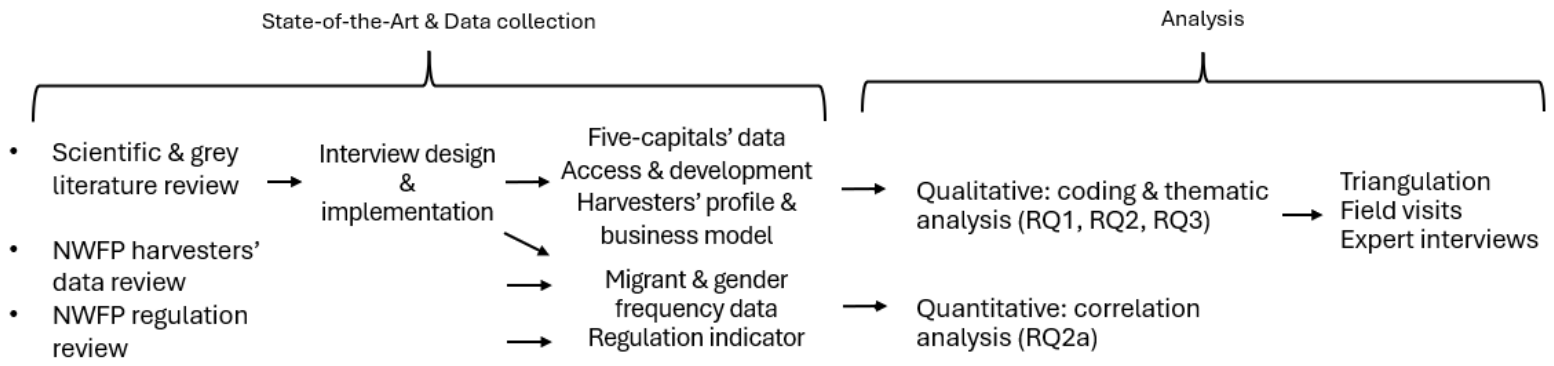
To respond to our first research question, we conducted a review of the scientific literature in SCOPUS ((TITLE-ABS-KEY (commercial) OR TITLE-ABS-KEY (professional) OR TITLE-ABS-KEY (market*) AND TITLE-ABS-KEY (picker*) OR TITLE-ABS-KEY (harvester*) AND TITLE-ABS-KEY (“non-timber forest product”) OR TITLE-ABS-KEY (“non-wood forest product”) OR TITLE-ABS-KEY (NTFP) OR TITLE-ABS-KEY (NWFP) OR TITLE-ABS-KEY (cork) OR TITLE-ABS-KEY (resin) OR TITLE-ABS-KEY (mastic) OR TITLE-ABS-KEY (mushroom*) OR TITLE-ABS-KEY (chestnut*) OR TITLE-ABS-KEY (pinenut*))), which retrieved 144 documents, of which only 11 referred to harvester profiling. When filtering for Spain, this number was reduced to two relevant articles. Including grey literature, we identified seven documents referring to commercial harvesters of the targeted NWFPs, while most additional resources focused on harvesting techniques rather than the harvesters themselves. Among these, only one centred explicitly on harvester profiles, with the remainder examining harvesting activity from anthropological, organisational or economic perspectives.
Applying an exploratory qualitative approach, the review provided the basis for developing interview guidelines for harvesters. They addressed RQ1, RQ2 and RQ3, thus covering sociodemographics, access to and previous experience in harvesting work, work dynamics, future expectations, economic aspects, the legal framework and suggestions for improvement. These interview guidelines consisted of semi-open questions and received ethical approval. The were slightly adapted when applied to experts.
Table 2 depicts our sample. The research protocol established a target of ten harvesters to be interviewed per product to identify preliminary trends within and across products. Despite our focus being on the harvesting stage, some collectors also perform other roles within the value chain, justifying their inclusion as part of the NWFP business model. The target aimed at a balance between women and men, and between nationals and migrants. Data collectors made particular efforts to identify commercial female harvesters, which led to their overrepresentation. The origin balance was not always feasible due to population distributions, as some NWFPs involved almost no migrants or no nationals. Occasionally, two people were interviewed together (e.g., father and son, one acting as a harvester and the other as a business manager), and some interviewees also undertook other roles within the value chain.
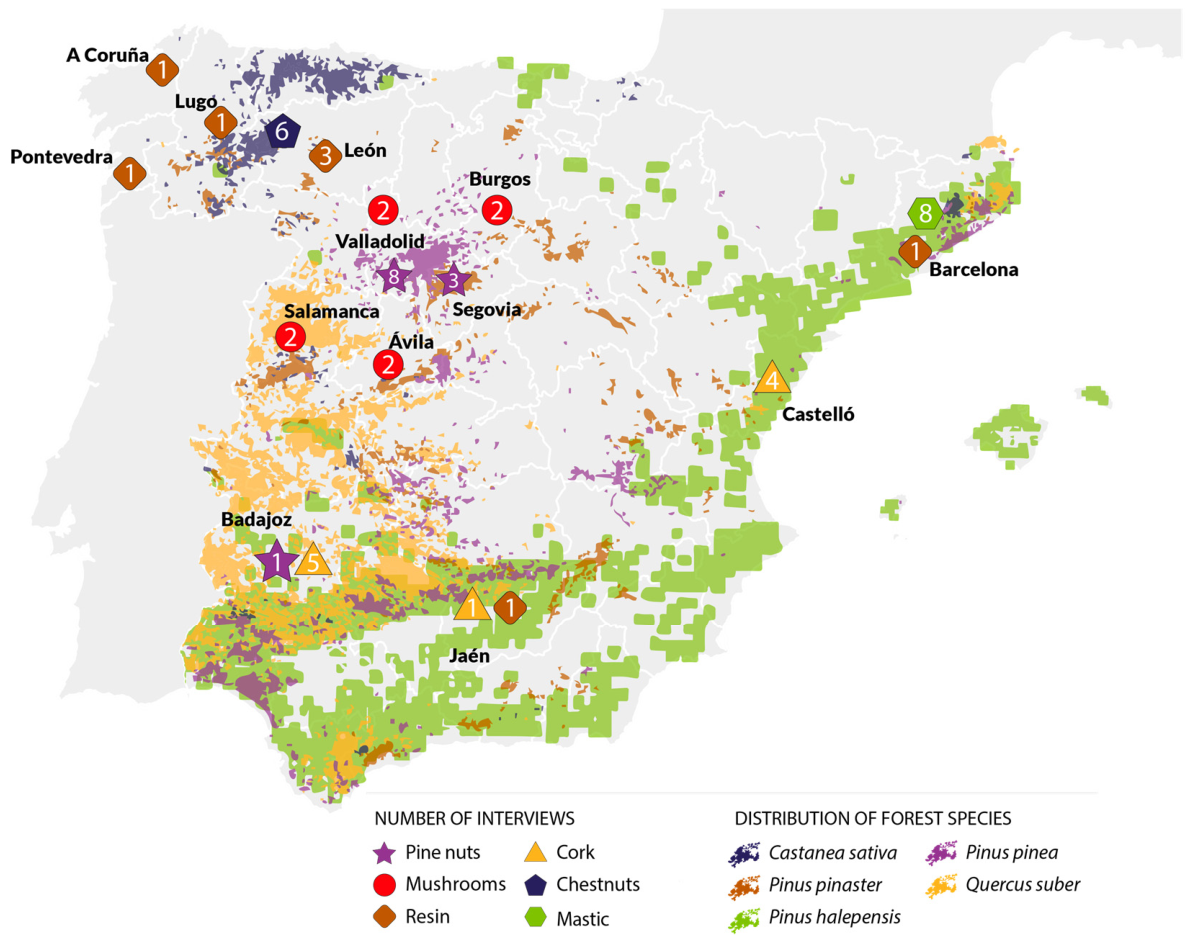
In total 53 interviews were conducted, capturing the experiences of 58 harvesters or employers in Extremadura, Castilla y León, Castilla-La Mancha, Galicia, Andalusia, the Valencian Community and Catalonia (Figure 2). In Catalonia, this evidence was complemented by an in-depth, multi-product interview with two experts, and additional consultations with key informants: two mushroom dealers, a private forest owner association representative (chestnut), the largest pine nut producer, the truffle producers’ association, and an official in charge of NWFP data.
The sampling strategy varied by product, reflecting interviewee accessibility in the absence of a comprehensive contact database. Some products did not reach the target due to stakeholder fatigue (resin and chestnut in Castilla y León), or language barriers and suspicion (in the case of mastic). Convenience sampling was used for mastic, snowball sampling for cork (in Extremadura) and pine nuts, and purposive sampling for cork (in Andalusia and Castellón), chestnut, mushrooms and resin. In Castilla y León—the main resin-producing region—recent SUSTFOREST project data enabled a focus on emerging resin-harvesting locations.
From an internal validity perspective, the use of different sampling strategies may limit cross-NWFP comparisons. To counteract this, analyses were conducted in two phases: first, at the product level, and later at the RQ level, systematically identifying which combinations of variables lead to similar outcomes. The occasional female over-representation complemented the available secondary data, which only contained findings from male harvesters. As a proxy to overcome gender gaps, we requested from the interviewees their (male) perception of reasons for the limited presence or lack of female harvesters in their subsector. Still, we acknowledge that gender findings are preliminary and more solid for those products where female harvesters were more accessible. Potential bias could occur in the resin findings, given that our interviewees working in new regions may face higher opportunity costs and a less supportive context. To reduce this bias, findings were cross-checked with resin secondary data from traditional areas. Bias could also emerge regarding migrant respondents, as we may have captured the most proactive and integrated individuals. Their information was therefore contrasted with that provided by experts, employers or intermediaries. The richness of responses was more limited among migrant interviewees, as reflected in the shorter interview duration (12.6 min) compared with nationals (39.6 min). Future research could be strengthened by using interviewers fluent in Romanian or Moroccan Arabic.
Interviewees provided informed consent and were anonymised. They were approached spontaneously in the Mataró marketplace (mastic) or contacted by phone to arrange meetings for the remaining products.
Given the exploratory nature of this study, we exercised caution in generalising the findings and attributed the resulting trends to the analysed populations. To strengthen validity, interview data were triangulated with scientific and grey literature sources, as well as with participant observation by the authors, namely: accompanying a forest guard controlling mastic pickers, accompanying cork harvesters, and conducting face-to-face interactions that enabled us to follow resin and chestnut pickers’ trajectories.
The only quantitative approach was used to examine migrant penetration (RQ2a). Gender and migrant ratios among commercial harvesters in each analysed region and NWFP were derived from interviews with harvesters and expert consultations (N = 11). We incorporated available secondary evidence—such as resin in León, Soria, Segovia and Extremadura [40], and from other NWFPs and harvesting regions—such as heather and truffle in Catalonia [41], and pinenuts in Andalusia [25], resulting in a final sample of N = 19. Based on the Annual Forest Statistics, this sample represents 68% of the total combination of regions and NFWPs in Spain; see Supplementary Material S4 for further details. Data on the migrant population per region (for April 2025) were gathered from the National Statistical Institute, and regional normative requirements for each NWFP were identified.
Future quantitative studies could test the qualitative findings through more homogeneous sampling and by expanding the sample across NWFPs and regions, while recognising challenges such as harvester turnover (mushrooms, mastic) and respondent fatigue in small populations.

2.4. Data Processing and Analysis

Interviews were transcribed verbatim. A thematic analysis was conducted in MaxQDA (v2022) using a deductive–inductive approach. Segments of the conversation were coded using deductive codes derived from the five-assets pentagon and their corresponding variables (as themes). A few additional inductive codes emerged as relevant for the interviewees, but were not predefined by the researchers. These were included when mentioned by a minimum of three interviewees, i.e., opportunity costs/alternative jobs, informal work, cultural affinity, or work–family conciliation. Although coding was carried out by one author, a second consistently reviewed coded segments and interpretations. In case of discrepancies, clarifications and contextualisation were discussed with interviewers to ensure coding accuracy. Through a comparative case study approach, codes were contrasted across NWFPs and linked to the research questions, and findings were cross-checked against available literature.
Using information on each NWFP’s level of regulation, we constructed a simple indicator aggregating regulatory dimensions, ranging from 0 (only the Spanish Civil Code and Forestry Law apply) to 6, increasing by one point with each additional requirement: landowner harvest permits, harvest notifications to the Forest Service, seasonal restrictions, technical harvesting rules, harvester registration, or annual harvest declarations. Given that the data were not normally distributed, we ran a Spearman correlation to test the hypotheses on migrant penetration using the migrant population ratio, and the regulation-level indicator.

3. Results

3.1. General Findings

Commercial harvesters of Non-Wood Forest Products in Spain are either freelance or entrepreneurs with small, temporary gangs. This activity is male-dominated, with variation in origin depending on the product and region. Family history and network connections (Social Capital) constitute the entry points to most NWFP commercial collection, apart from wild mushroom picking. Manufactured Capital (in terms of specialised machinery, transport means and tools) and Human Capital (skills) represent access barriers and sources of work role differentiation. This is less relevant for mushroom and mastic harvesters—where legal access to land and corresponding harvesting permits (Natural Capital rights) constitute the main source of conflict. For the vast majority (except for resin harvesters and those who combine pine nuts harvest and processing), NWFP harvesting constitutes only part of their income, and they combine this activity with other jobs or have other income sources within the household.
Self-employment occurs consistently among the interviewed chestnut harvesters and among most resin tappers. Our interviewed mushroom pickers were all self-employed, but there is also evidence of organised groups with an employer and day labourers. The latter is the typical structure for cork, pine nut and mastic harvesting businesses.
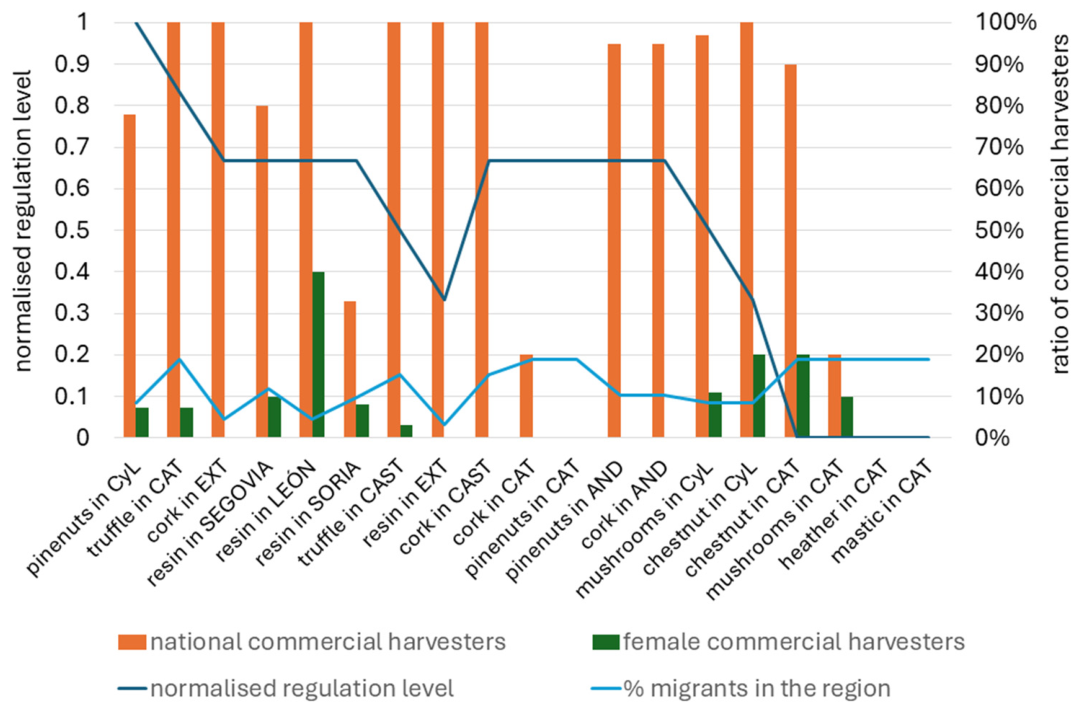
For all NWFPs, the interviews revealed profiles across very different age groups; thus apparently the activities are not age relevant. Gender-wise, women are more likely to be found in mushroom and chestnut picking, with a few also in the resin activity. Figure 3 shows that national commercial pickers tend to dominate for the analysed NWFPs, particularly in pine nut, cork and resin, except for Catalonia. Mastic gatherers constitute the most elusive group, composed mainly of young migrants. All the activities in which female harvesters were identified share the characteristic that they do not require working in a gang, allowing individuals to organise their schedules independently.
There are a few formal and scattered initiatives to enhance their labour-related knowledge, skills and bureaucracies (Human Capital): the cork harvester schools, the extension service for resin, chestnuts and pine nuts by CESEFOR, training for wild mushroom picking by CTFC, or some resin companies offering episodic training. These training sessions are typically project-funded, thus not continuous in time. A few interviewees reported that by being employed they got acquainted with the requirements, the locations, the practices and the tools, so that when they accumulated enough financial capital, they could become independent and start their own business and gang.
The presence of migrants does not correlate with the regulation level (Spearman’s rho: −0.1889, p-value (2-tailed): 0.4386). Instead, a larger presence of migrants in the analysed regions correlates positively with the presence of NWFP migrant harvesters (Spearman’s rho: 0.5779, p-value (2-tailed): 0.0095). As illustrated in Figure 4, Catalonia shows a larger migrant workforce, also beyond the forestry sector: 18.8% vs. 6.5% in Castilla y León or 4.5% in Extremadura—see 2025 data [42]. Within Castilla y León, substantial provincial differences exist (provincial-level 2022 data [43]). Segovia shows a higher ratio of migrants (11.8%), but maintains a strong tradition of resin harvesting among nationals, which constitutes an exception. In contrast, Soria, with an intermediate migrant share (9.9%), relies more on foreign labour despite also being a traditional resin-producing area. Meanwhile, in León, where the migrant population is relatively small (4.5%), resin harvesters are predominantly nationals.

3.2. Cork Harvest

Cork harvesting is a male-dominated work [11,44]. A few roles were traditionally assigned to women, which did not involve using the axe—indeed C7 was responsible for piling. Our interviewees ranged from 30 to 60 years old. We estimate around 2800 cork harvesters in Spain, mainly concentrated in Andalusia (over 1300), Extremadura (800), Catalonia (150–200), Castilla y León (around 20) and Castellón (5). All interviewees except one were Spanish nationals in Andalusia, Extremadura and Castellón. We found evidence that in Catalonia migrant harvesters predominate, with one migrant muleteer in Castellón. Formal collective organisation exists only in Andalusia (ACOAN) to homogenise wages. All interviewees combined cork harvesting with other agrarian or forestry work, yet despite its short duration, daily earnings are slightly higher than in regular forestry labour. However, the availability of forestry workers—including cork harvesters—depends on the labour demand in competing sectors.
A gang of typically five workers constitutes the basic labour unit: one boss, three harvesters, and one apprentice. The forestry entrepreneur usually provides the tools and liaises with landowners, industry (cork buyers), and the public administration. When the entrepreneur purchases the standing cork (e.g., C9), they must obtain harvesting permits. When cork is sold directly to the industry (C6–C8), the gang boss acts as a foreman, recruiting the team and supervising fieldwork to ensure efficiency and prevent tree damage, which is reflected in their higher wage.
Harvesters form the core of the workforce, responsible for removing cork from the oaks. They require skill, expertise and physical strength to strike accurately with the specialised axe and lever without damaging the trunk. Only recently have some adopted an electric cork saw and pliers which increase productivity and reduce physical strain, an innovation patented by the world’s largest cork company, which restricts its use to gangs supplying exclusively that company. Cork harvesters are considered as specialised workers and earn more than unskilled labourers. Some gangs include a collector who carries cork slabs to the truck and sorts the material [11]. This is physically demanding and usually the entry-level role for apprentices. Despite the harshness of the job, interviewees emphasised the generally good atmosphere within gangs. Harvesters in Extremadura and Castellón report relationships extending beyond professional ties. For many, a passion for cork harvesting motivates them beyond incentives and fosters continuity of gang membership across seasons.
Cork-gang workers are paid either per day or by the quantity harvested. Payment by weight encourages productivity but increases the risk of tree damage; thus, some landowners prefer daily rates once they trust the gang. All types of contractual arrangements were reported, including formal employment, freelance work, and—in Catalonia—some without proper contracts.
Learning the trade requires beginning as an apprentice. Some migrant harvesters already possess relevant skills from rural communities near North African cork oak forests. There is a European standard for cork harvesters (EFESC) and training is available. However, employers place little value on this training, and attending courses requires harvesters to sacrifice working days during the season. In Extremadura, the scarcity of trainees threatens course viability. According to C1, this lack of interest among younger generations is the sector’s main future challenge. Women represent only a minority of trainees (SUROCAT project data for Catalonia; C1 for Extremadura). Interviewees attribute their limited presence in harvesting operations to cultural tradition, physical demands, axe dexterity, and the early work schedule which complicates work–family balance. However, C7 reports no sense of discrimination and feels “like anyone else”.

3.3. Pine Nuts

The pine nut harvesting work starts with the entrepreneurs visually inspecting stone pine parcels in summer to estimate potential yield. Yield risk is intrinsic to the Pinus pinea alternate-bearing cycle, but recently the Leptoglossus pest affecting cones has also reduced the yield of commercially viable pine nuts. When harvesters find suitable forests, they negotiate harvesting rights with private landowners (around 60% of Spanish annual production), or participate in public-forests auctions (source for the remaining 40%). In public forests, entrepreneurs pay the harvesting price in advance plus a 5% deposit. In private forests, rights are often agreed by handshake, with payment sometimes partly in kind through a yield share.
Harvesting takes place in winter. In Catalonia, Andalusia and parts of Portugal, cones are collected by climbing and shaking branches with hooks, sometimes using crampons. The Andalusian cooperative ensures workers use appropriate protective equipment. Since 2000, harvesters in Castilla y León have used special vibration machines. Public-forest regulation limits vibration to 3 s per tree, a rule debated for its suitability given tree variation; private forests apply similar limits to safeguard productivity. After vibration, a crew of 3–5 labourers collect fallen pinecones into baskets or tractor blades. Pinecones are stored in private yards to prevent theft. Cones may be sold fresh, or left to open in summer temperatures. First processors use machinery to extract pine nuts from cones.
For 2013, the Castilla y León pine nuts operator inventory recorded 373 actors involved in the value chain: 33% harvesters and 58% combining pinecone harvesting with other roles. Over half (54%) were located in Valladolid, and 28% in Zamora. Activity is locally concentrated, with 34% in two towns. Interviewees reported an increasing presence of migrant harvesters, mainly from Eastern Europe, confirming the trend since 2003 [12].
Our interviewees operate in Castilla y León and one in Catalonia. All but one were male and all were born in Spain. They reported that local young people are largely uninterested in harvesting unless they come from sectoral families with production means. In Catalonia, most commercial harvesters are migrants working informally under poor conditions, except on a 100-hectare intensive plantation of grafted pines where one migrant is employed full-time and three more (including one woman) are hired during harvest weeks.
None of our interviewees worked exclusively as harvesters: one combined this with pine vibration, and the rest also processed and stored cones. All were entrepreneurs. Owning the vibrating machine is the main economic differentiator (20–40% higher wage). Only interviewee P4 received machinery-purchase subsidies. Given the seasonality of the work, interviewees noted that pickers usually complement their incomes with other forestry, primary-sector or construction jobs. Recruitment is mainly through word of mouth among townspeople and previous seasonal workers. Some mentioned a “facilitator” who recruits through personal networks. P7 suggested a classified job list as an alternative where such informal networks are absent.
Most interviewees believed they could continue earning a living from pine nuts despite global competition, arguing that Iberian pine nut quality is difficult to match. However, they noted that only those already established—with access to equipment and infrastructure—are likely to remain, due to high entry costs and low short-term profitability. Two interviewees (P4 and P12) observed emerging competition from larger firms bidding above real harvest prices to progressively push out smaller operators.

3.4. Resin Harvesters

Three trajectories were identified to entering the job: (i) family or acquaintance tradition where most harvesters are nationals in Segovia; (ii) migrants beginning in Soria, and (iii) other nationals who are newcomers in other Iberian zones. For both new national (6 out of 9) and migrant [10] harvesters training was crucial. It is well-known that the major of one Sorian town promoted resin harvesting to attract new inhabitants and address rural depopulation [45]. This contrasts with the areas of our interviewees, where only two knew migrant harvesters. Interviewees had previously held different jobs and had heterogeneous educational profiles. Although half of the sample were women, all agreed that men remained the majority.
Most interviewees work alone, though some work in pairs. Most are freelance, but some work or have worked as employees for resin companies or forestry communities. Resin was not their main income, as they stated that it is difficult to live solely from it. Some combined resin harvesting with other primary-sector jobs (e.g., forest fighting) or services. Although they consider the activity harsh, they value autonomy and contact with nature, while tolerance of climatic conditions varies.
An experienced full-time resin harvester usually works with 5000 to 7000 pines [46] (or about 2000 trees when the activity is complementary). Between March–April and October, the harvester prepares the trunk “face” and returns every 14 (R6) to 21 (R5) days to collect the resin. They also open a small upper incision for the next iteration, often applying a chemical stimulant [47]. The resin is transported manually until it reaches 200 kg drums, which are moved using a tractor. To ensure sustainability for 25 years, a different “face” is tapped every four to five years, adding a higher layer annually up to five heights [48]. The tools are artisanal, and thus costly. An innovative technique requires specialised drills and tubes that fill plastic bags [48]. Despite the higher resin quality, prices do not reflect this. When the resin- buying industry provides tools and permits, their cost is later deducted from the resin price.
Public or communal pine forests require a public auction to obtain harvest permits for a five-year period. Despite the more complex bureaucracy, 80% of Spain’s resin comes from public forests [49].
Income varies with climate and volatile international markets. Interviewees noted that rainier seasons yield more resin. Average yields range 2.5–2.7 kg/pine/year in León (Pinus pinaster) (R5, R7), and about 1.8 kg/pine in Catalonia (Pinus halepensis) (R3). Raw resin prices range from 0.89 to 1.5 €/kg, and they considered anything below 1.3 €/kg insufficient for a decent living. Reported annual revenues ranged from 13,000 to 27,000 €/year, with poor years around 9000 €. Interviewees expressed concern about low profitability due to the sustained decline in resin prices, and difficult relations with the industry. To cover the nearly four months without resin work, some provincial governments in Castilla y León offer financial aid for shrub management, though fiscal complexity limits uptake. The future is seen as uncertain, with some considering leaving the job if conditions do not improve. Higher living costs in Catalonia, combined with expected higher private-forests harvesting fees, were seen as key barriers to this activity’s development there.

3.5. Wild Mushroom Pickers

Interviewees came from diverse provinces of Castilla y León, where the MYCOCYL programme represents the most extensive system in Spain for issuing picking permits in predominantly public forests. Interviewees were contacted through this system and therefore all held the corresponding permit, although data collectors noted that a small number operate without one. In the 2024–2025 season, 42.7% (19,252) of all permits were for commercial harvesters, of whom 11.2% were women, and 2.9% were migrants. Our sample therefore oversampled both groups.
Our interviewed commercial pickers were mostly 50 years old and originally from Eastern Europe (Romania and Bulgaria). They generally collected in nearby forests, and mushroom sales provided complementary income alongside diverse main occupations (e.g., shepherding, household work, or public administration).
Their main target species were Lactarius deliciosus and Boletus edulis, along with other edible congeners. Skills were generally acquired informally, either through accompanying an experienced picker or from prior knowledge in their countries of origin. Equipment was minimal: a basket, a knife and a brush; a few also used a coin to check minimum sizes. None reported using rakes, although they noted that some unauthorised collectors do.
Permit fees and allowable quantities vary by zone, as set by forest owners (usually municipalities). Purchasers must request a permit to buy mushrooms, but sellers are not required to be registered as self-employed as long as their annual sales remain low.
Interviewees acknowledge the existence of organised groups of commercial pickers but provided no information on their operations, which may reflect the influence of annual media reports of forest guards intercepting vans carrying large quantities of mushrooms harvested without permits.

3.6. Chestnut Harvesters

Despite our sample being predominantly female, Bierzo interviewees reported a broadly balanced gender composition, with women tending to concentrate on harvesting and men on forest tending. In Catalonia, however, the local informant estimated that fewer than 20% of harvesters were women. In both Bierzo and among legally operating Catalan harvesters, the harvesters were born in, or had strong family ties to, the towns where the forests are located. Ages varied widely, up to 70 years.
In El Bierzo, chestnut harvesting is conceived as a family inheritance, rooted in childhood experience. Interviewees own parcels of chestnut forests or manage those of neighbours who cannot or do not wish to maintain them, in exchange for a share of the production or sales. No hired labour is used; work is done within the family. Chestnut harvesting also acts as a source of social cohesion, as neighbours often assist each other and share meals.
Chestnuts are harvested by shaking the trees with sticks. Fallen fruits are collected either by hand using wooden clamps or, increasingly, with vacuum machines for shelled fruit, although machinery can only be used when fruit maturity and soil and weather conditions permit. A tractor with a trailer is used for transport, and a shrub-brushing machine is used for forest maintenance.
In Bierzo, production is generally sold to a cooperative, which accepts all fruit qualities and quantities, facilitates transport, and manages invoicing. Interviewees expressed concerns about risk pooling—where lower-quality chestnuts delivered affect returns for all-, uncertainty over prices (set only at the end of the season), and unfair competition from black-market operators. Chestnut revenues are seasonal: in poor years harvesters may earn around 1000 €, rising to 8000 € in good years. Families typically complement this income with off-farm revenues. The absence of patent conflicts and the strong cultural identity attached to chestnuts contribute to a positive perception of this activity.
Chestnut forests in Bierzo are communal or private. Interviewees were uncertain about the future of chestnut harvesting, citing labour shortages—particularly for outdoor work—and declining yields due to chestnut canker. Three interviewees highlighted concerns about generational renewal, emphasising that tending is essential to maintain productivity. As selling land is not contemplated, proposed solutions include land banking or establishing forestry teams to outsource maintenance.
In Catalonia, by contrast, chestnut harvesting occurs in timber-oriented forests, where fruit collection provides a secondary but regular income for landowners. Despite many marking their boundaries with “Chestnut collection regulated. Do not pick”, around 50% of the yield is estimated to be harvested without permission, either for family consumption, or by commercial harvesters of Asian origin.

3.7. Mastic Branch Gatherers

The consistent profile across interviewees was that of a migrant male, mostly from the Maghreb and in an irregular administrative situation. They were between 18 and 50 years old, with a low educational level and precarious economic circumstances. Some had previously worked in the construction sector, often following trajectories marked by instability and the search for income in informal or less regulated contexts. Depending on the company, their salaries appears to correspond to the daily minimum wage or to piecework arrangements with the van driver, who is typically an experienced harvester acting as an intermediary with wholesalers. Most mastic is exported to the Dutch floral market.
Mastic is collected throughout the year, although demand peaks in the first quarter due to celebrations involving floral gifts. Early in the morning, the van driver transports a group of four to eight gatherers to the forest. During the day, harvesters cut mastic branches and group them in bunches of ten. The equipment required is minimal, consisting of scissors and elastic bands.
Interviewees described a progression from initial harvester, to van driver—when individuals with entrepreneurial motivation acquire market knowledge, obtain a driving licence and purchase a van—and eventually to wholesaler, once sufficiently skilled to start a trading business. One wholesaler interviewee reported attempting to work legally but facing increasing competition from incoming companies operating without formal labour contracts.
There are no official statistics on this activity. We conservatively estimate at least 180 harvesters in Catalonia, based around 15 companies, each operating with at least two vans mobilising around six harvesters per van. This activity started around the 2008–2009 economic crisis, and has generated conflicts with landowners, as harvesters—and particularly van drivers—often do not request explicit harvest permission. The Catalan Forest Guards recorded 61 infractions related to mastic collection between January 2022 and May 2025, all involving male offenders and 95% involving migrants. Reporting by private forest owners has increased during recent years, resulting in greater surveillance in key Aleppo pine forests. A specific landowners’ association was created in the early 2020s to address illegal mastic harvesting.

4. Discussion

4.1. Commercial NWFP Harvesters’ Profile

Our findings show a continuum of profiles across different dimensions of the NWFPs analysed: business model, origin, and gender. They are geographically concentrated in particular forested areas—as NWFPs represent very local and niche markets [13].

4.1.1. Business Model and Labour Structure

With regard to the relationship between the commercial harvesters and the business, we move from the harvesters that are vertically integrated, this is, also landowners (chestnuts), to employees (cork, pine nuts), independent entrepreneurial workers (resin, mushroom pickers in Castile and León), and grey-market (often unregistered) pickers (mushrooms and mastic in Catalonia).
Uncertainty in the analysed NWFP sector does not correspond to higher product prices or margins. Instead, the harvesters’ strategy rely on the complementary character of most of these activities. Therefore, for low-capital NWFPs (wild mushrooms, chestnuts and mastic) commercial harvesting seems to respond to opportunistic livelihood strategies, rather than to professionalised jobs. This could explain the less demanding harvesters’ employment conditions (informality, fewer safety measures by employers) and the limited revenues. As for some harvesters there are few alternatives for income generation, such low labour costs represent the opportunity costs of unpaid self- or family employment [50].
Access to the NWFPs market for pine nuts or cork, which requires stronger networks, capital investments and access to land, is facilitated by family ties [51]. Several common points are found between chestnut and black truffle producers: beyond the fact that both are mostly the landowners, there is a low rate of association membership and a shared character of secondary income [52]. Mastic-branch gatherers seem similar to heather (Erica spp.) gatherers, as per the study conducted in similar Catalan forests [41]. Heather is in demand for decorative purposes (basically, for fencing), and the work is conducted through small trucks purchasing heather bunches on the road, mostly from migrant harvesters at risk of social exclusion.
With pine nuts we find, on the one side, more formalised systems (Castilla y León, Andalusia) with landowners’ permits, commercial harvesters who are organised and even conduct some processing, whereas in Catalonia informal harvesters are similar to those involved in mastic gathering. Such a dichotomy may relate to the different relative values and the different shares of private land ownership. The social pressure associated with pine nuts as a community livelihood (businesses) and a component of local identity (e.g., museums) is evident in towns in Valladolid and Andalusia, where public harvest tenders exist for relatively large productions. In contrast, in Catalonia (with one important intensive plantation exception), private forest parcels are smaller and subject to less field control [27], and the concerned municipalities have other predominant livelihood sources (chiefly tourism or other services). As for cork harvesters, these are embedded in a consolidated value chain, whose dependence on exports entails regular controls and audits for sustainable forest management certification. Cork employers therefore have incentives to issue formal labour contracts.

4.1.2. Intersectionality: Harvesters’ Origin and Gender

Some NWFPs show a predominant migrant workforce, albeit with variation across Spanish regions. While migrantisation of the forestry sector already took place some decades ago in the USA [9,53], in Europe migrant workers are becoming increasingly key to the viability of the forestry sector—e.g., around 90% of the forestry workforce in Sweden, originates mainly from Eastern Europe (80%) [54,55], or a large portion of the Catalan forestry workforce [56]. In the case of NWFPs, evidence already existed in the 1990s of migrant harvesters in the USA wild mushroom subsector [13,15], as well as in the Finnish berry-picking subsectors [57]—often analysed in relation to conflicts over picking rights. Mushroom, mastic or heather harvesting, which require low capital, are often weakly regulated and lightly monitored subsectors, a situation that allows commercial harvesting to emerge as an opportunistic activity. Migrants searching for income opportunities may take advantage of such activities when there are limited alternatives in the area.
From a gender perspective, the forestry sector is typically perceived as a “male” occupation [58]. According to the criterion of [59], the analysed commercial harvesting of NWFPs is a masculinised occupation, given that the presence of males exceeds by more than 25% the 57.6% ratio of men employment in Spain. This reflects the large gender polarisation present in the Spanish labour market, where women tend to concentrate in feminised occupations to a greater extent than men enter feminised work [60]. Framing this phenomenon within the Identity Economy theory [61], we suggest a predominant “attraction effect”, whereby self-selection into alternative economic activities is shaped by prevailing social norms. According to our interviews, such norms seem to discourage women from considering commercial NWFP harvesting [62], chiefly due to concerns about personal safety in the forest, or perceptions of insufficient physical strength. Working independently allows a flexibility that supports family–work conciliation, this being a criterion that matches with female labour-decision factors. In contrast, concentrated seasonal campaigns (such as cork harvesting) require longer daily working hours in group settings.
Commercial NWFP harvesting allows economic independence and can act as an empowerment mechanism. However, the limited female presence also reinforces feelings of not belonging to this occupational sector [4]. Except for resin harvesters, the interviewed women supplemented NWFP harvesting with other forms of employment, therefore supporting the arguments of [60] regarding the greater heterogeneity of rural female labour. Feminisation of work has been observed in areas of the cork value chain where a university degree is valued—that is, not at the harvesting stage [44]. When considering the intersection of gender with origin, we find similarities with the findings of [58], namely that foreign women participate substantially less than foreign men. This is consistent with the general trend that migrant women are less present in the economically active population −77% for men versus 61.8% for women in early 2024 [63]. These findings resonate with Social Cognitive Career Theory [64], as they relate to self-efficacy beliefs (e.g., perceived ability, vicarious experience, social persuasion), outcome expectations (earnings, working conditions), and goals (e.g., work–family balance). Further research could investigate the applicability of this theoretical framework in the context of forestry labour.

4.2. Navigating the Five-Assets Pentagon to Access and Thrive as NWFP Commercial Harvester

Table 3 summarises the key findings regarding how to access, thrive, and thus make the sector attractive to new workers and entrepreneurs.
Our results show that Social Capital is important for getting to know the labour demand. Structural social capital in terms of bonding relationships [65] is fundamental to becoming aware of the employment opportunities [66] in pine nuts, cork and mastic, chiefly through family traditions or migrant networks. Relational social capital, in particular trust, also appears relevant for recommending acquaintances for the job. This keeps gangs within networks, as already observed in the USA among guest forestry workers [53]. While this may create “ghettos” or closed groups, it is positive for employers insofar as it reduces uncertainty regarding the reliability of their workers. In terms of migrant integration, however, this may not necessarily be the best channel, as it does not facilitate interaction with new national contacts. The trustworthiness of experienced harvesters becomes instrumental for their progression to becoming entrepreneurs and for initiating formal interactions with private forest owners. By working in these sectors, female harvesters become immersed in male-dominated networks, and this exposure offers them opportunities to learn how the respective value chains operate, get to know the actors, and thus access more options for future advancement.
These labour experiences contribute to their Human Capital. Individual skills determine the suitability of harvesters for each product, and these are typically learned after an apprenticeship period. The learning process seems to be facilitated by previous cultural backgrounds in the case of migrants [67,68], as Eastern Europeans are more familiar with commercial harvesting and show higher collection rates of a wider variety of NWFPs [2], while rural Maghrebi people have often been exposed to cork-harvesting cultures. This experience also eases their search for livelihoods based on these products. For migrant harvesters, commercial activity offers the opportunity to learn how the labour system functions in the host country. This experience enhances future employability, particularly when individuals learn from and interact with nationals, as seen in forestry [56]. Despite well-intentioned training initiatives, only those for resin appear effective in attracting new harvesters. The subsequent continuation in the sector among formal training participants (as expressed for cork and resin schools) remains a common challenge, similarly observed in other primary sector schools, such as shepherding. While these initiatives are essential for the long-term sustainability of the activity, their participants may contemplate a wider array of alternative income-generation sources (and hence higher opportunity costs) than heirs of families with strong roots in the sector. Therefore, strategies to attract and retain harvesters are largely context-dependent and should minimise inter-sectoral labour transitions by considering factors such as available workforce, the range of available jobs and their labour conditions, wages relative to living costs, and mobility.
Training remains crucial for offering external candidates the chance to familiarise themselves with the activity, explore a new lifestyle, and determine whether they identify a personal match or potential passion for the work. While didactic materials usually remain available online, this may not necessarily be the appropriate channel for reaching prospective commercial harvesters. Instead, demonstrative field visits may be more appreciated. Information about job demand (e.g., online job listings) could also help reach interested candidates. Decent job prospects emerged as an attractiveness factor, whereas passion for the activity emerged as a stabilising factor. Sector buyers (typically the industry) may have the capacity to offer better prices, assume more risk to reduce that of harvesters, provide adequate contracts or facilitate access to tools—but this will depend on the relative costs of alternative sources of raw material. Passion remains individually subjective; therefore, from a sectoral perspective, stronger social recognition is the most feasible means of support. Facilitating decent financial outcomes could also include reducing harvesting fees—particularly in public forests within municipalities aiming to combat rural depopulation.
Our findings on Financial and Build capital confirm the high value/low quantity and high volume/high variety models proposed by [69]. High volume applies to lower-priced products (mastic, mushrooms), which harvesters must combine with additional income sources, whereas higher-value products (pine nuts, cork or resin), despite being seasonal appear to represent a significant annual income share. Financial capital is needed as initial investment for resin harvesters. The natural progression within the pine nut, cork and mastic value chains is for harvesters to advance towards entrepreneurial roles. However, such progression requires Financial and Build Capital, whose relative importance differs across products, and the ability to save filters who can realistically reach such positions. Although no specific subsidies exist for pine-nut-harvesting machinery, European rural development subsidies for forestry equipment may be useful.
Regarding Natural Capital, two key aspects emerged: access to land—particularly to securing the harvesting rights in forests where the produce is more abundant—and biotic risks affecting productivity. In addition, we observe that unregulated or insufficiently controlled products (e.g., mastic, wild mushrooms or pine nuts in Catalonia) may not only affect the ecological status of the targeted species, but also shape the profile of their harvesters. Unregulated commercial harvesting typically operates within the grey economy, and harvesters often work in irregular conditions. Such a scenario facilitates the use of harvesters without labour permits, often in organised groups. This niche can provide a supplement that complements formal income (e.g., mushrooms for pensioners or the unemployed), and may also constitute a temporary livelihood source for some migrants during periods in which they are not formally permitted to work but still need to cover their living costs. However, harvesters in such situations may be subject to poorer work safety conditions, and weaker power positions with regard to their employer [70] or produce buyer. Such a situation calls into question the basic premises of decent work, particularly in terms of respecting workers’ rights of safety, organisation and remuneration [71].

4.3. Policy Recommendationas and Future Prospects

Ideally, a system with all NWFP transactions being recorded would make their contribution to the bioeconomy visible. However, smart policy design is needed to respect landowners’ rights and avoid the related transaction costs being borne by the weakest actor in the value chain: the harvester. Increasingly, competent authorities (e.g., Spanish regions and municipalities) are regulating current “grey” activities, driven by the need to reduce conflicts with landowners, ensure resource sustainability and bring hidden economies to light. Landowners (including municipalities) can, in principle, restrict harvesting operations on their properties, but enforcement in private forests remains unlikely without regional-level regulation. Further harvest requirements (licences, notifications, authorisations) would require additional institutional capacity in the regional administration and field controls.
Ref. [72] reflected on how race, ethnicity, low-income status, gender, resource-dependent livelihoods are considered when formulating and implementing NWFP policies. These vulnerable actors will rarely become regular freelancers or entrepreneurs [73]. From this environmental-justice perspective, and given the substantial proportion of vulnerable groups within NWFP commercial harvesting, mechanisms to enable their participation in formulating new governance arrangements would help surface design elements that meet their needs. Yet, their weak organisation precludes structured participation, thereby shifting reliance to intermediaries who may lack incentives to defend harvesters’ interests. However, intermediaries or buyers may have the capacity to absorb new transaction costs (financial capital) and to train harvesters in the new regulatory framework (human capital). Therefore, regulations can shift the burden to these actors, relying on their intrinsic interest in maintaining raw material supply—while avoiding full discouragement of regional economic activity. Otherwise, stronger regulations (e.g., introducing a permit or register) are expected to interact with harvesters’ opportunity costs. Harvesters currently operating in the grey market may consequently choose to move to alternative jobs, shift their activity to less regulated or less enforced areas (a leakage effect), operate in a riskier black market, or enter the formal market by complying with the rules. A harmonised regulatory approach across neighbouring regions may be required to minimise leakage. Moreover, state-level fiscal and work-permit regulations could be adapted to the reality of the vulnerable harvesters to reduce the informal economy. The Finnish tax-free NWFP gathering may serve as an inspirational example for the transparent declaration of transactions.
Finally, climate-driven uncertainties regarding biotic risks require economic buffer practices to increase commercial harvesters’ resilience. From an entrepreneur perspective, pine-nut productivity has been highly uncertain in recent years owing to the Leptoglossus pest—causing between 25 and 58% in losses [74]. This implies advancing annual costs chiefly for harvest permits and harvesters’ salaries, with unclear marketable harvest yields. Productivity risks are also borne by resin harvesters, who must ensure a minimum annual harvest payment during a five-year period in public auctions, whereas they do not have any stable price agreed with the industry. On the contrary, cork-related risks are mainly borne by the landowner and not by the harvesters, as they are paid per kilo or by the day, independently of the final marketable slab quality.
In addition, EU and national-level policies on gender equality could support the needed cultural shift to encourage more women to become NWFP harvesters, with narratives and greater visibility of NWFP harvesting as a safe activity that does not necessarily require significant physical strength.

5. Conclusions

NWFP represent valuable natural assets to be considered within the forest-based bioeconomy, but their integration into the market requires a workforce that is largely understudied in Europe. Through interviews with commercial NWFP harvesters in Spain, we identified preliminary trends regarding their sociodemographics—particularly regarding the gender and origin axes—their labour dynamics, and the factors facilitating or hindering engagement, structured across the five-capital pentagon.
NWFP harvesting is a predominantly male activity, and in some regions and for certain products, it is characterised by a high prevalence of migrant workers. The five-capitals analysis of the conditions to enter and thrive in this activity identified that (i) accessibility to the labour market depends on the individual’s Social Capital, particularly awareness of job opportunities and personal recommendations; (ii) Human Capital is key to perform the activity effectively and to distinguishing qualified harvesters; (iii) investments in machinery or tools (Build and Financial Capital) are required for those seeking to add value and participate in additional stages of the value chain; (iv) confirming previous studies, opportunity costs determine the revenues harvesters accept or justify their inter-sectoral labour transitions (Financial Capital); (v) securing resource-harvesting rights (Natural Capital) requires, in addition to fees, administrative skills for engaging with public forests and trusting connections with private landowners; and (vi) biotic and abiotic risks (Natural Capital) are not reflected in sale prices for entrepreneurs.
Female harvesters were identified in commercial harvesting activities that can be organised individually, facilitating work–family balance. Rural equity policies could help build new narratives and increase visibility to encourage more women to enter these subsectors.
Considering NWFP commercial harvesting as a livelihood source can be promoted as an outdoor, nature-connected activity that generates income for landowners. Measures to mitigate biotic and market uncertainties would enhance the attractiveness of NWFP harvesting. Harvesters need to overcome individualistic approaches and strengthen collective representation to address shared challenges. In some cases, NWFPs offer opportunities for an available workforce that is less demanding regarding working conditions—yet, decent work may be at stake. Stronger regulation, while bringing informal economies to light, may discourage formal harvesting. To overcome this, smart policy design requires involving harvesters and, when vulnerable profiles represent a relevant share, a fair distribution of new responsibilities and related burdens among them and more capable value-chain actors. Specific awareness-raising efforts are necessary among migrant harvesters, who are typically unfamiliar with the regional procedures for obtaining harvest rights.

Supplementary Materials

The following supporting information can be downloaded at: https://www.mdpi.com/article/10.3390/f17050587/s1. Refs. [75,76,77] are cited in Supplementary Materials.

Author Contributions

Conceptualization, E.G.-M. and M.R.B.; methodology, E.G.-M. and M.R.B.; formal analysis, E.G.-M. and M.R.B.; investigation, L.O.O., E.F.D., A.M., A.R.-G., R.Q. and M.R.B.; data curation, E.G.-M. and M.R.B.; writing—original draft preparation, E.G.-M. and M.R.B.; writing—review and editing, L.O.O., E.F.D., A.M., A.R.-G., M.S.-G. and M.R.B.; supervision, E.G.-M.; project administration, E.G.-M. and M.S.-G.; funding acquisition, E.G.-M. and M.S.-G. All authors have read and agreed to the published version of the manuscript.

Funding

This research was performed under the IMFOREST project funded by the Fundación Biodiversidad, grant nr. 2023/BF010.

Institutional Review Board Statement

The study was conducted in accordance with the Declaration of Helsinki, and approved by the Ethics Committee of the Autonomous University of Barcelona, project ref. UAB-CERec22, on 13 December 2024.

Informed Consent Statement

Informed consent was obtained from all subjects involved in the study.

Data Availability Statement

Transcribed interviews remain available upon reasonable request to the authors.

Acknowledgments

Authors are grateful to the interviewees, to the constructive suggestions of the anonymous reviewers, to Montserrat Ganado, and to the Montseny and Montnegre-Corredor Forest Owners’ Associations.

Conflicts of Interest

The authors declare no conflicts of interest. The funders had no role in the design of the study; in the collection, analyses, or interpretation of data; in the writing of the manuscript; or in the decision to publish the results.

Abbreviations

The following abbreviations are used in this manuscript:
NWFPNon-Wood Forest products
USAUnited States of America
CTFCForest Sciences and Technology Centre of Catalonia
CESEFORFundación Centro de Servicios y promoción Forestal y de su Industria de Castilla y León
EFESCEuropean Forestry and Environmental Skills Council
ACOANAssociation of Cork harvesters and Mule drivers of Andalucia

References

  1. Gorriz-Mifsud, E. NWFPs in a Bioeconomy Spectrum: Opening Opportunities for Cross-Sectoral Links. In Non-Wood Forest Products in Europe: Seeing the Forest Around the Trees. What Science Can Tell Us 10; Wolfslehner, B., Prokofieva, I., Mavsar, R., Eds.; European Forest Institute: Joensuu, Finland, 2019; pp. 100–103. ISBN 9789525980776. [Google Scholar]
  2. Lovrić, M.; Da Re, R.; Vidale, E.; Prokofieva, I.; Wong, J.; Pettenella, D.; Verkerk, P.J.; Mavsar, R. Non-Wood Forest Products in Europe—A Quantitative Overview. For. Policy Econ. 2020, 116, 102175. [Google Scholar] [CrossRef]
  3. European Commission. New EU Forest Strategy for 2030; European Commission: Brussels, Belgium, 2021.
  4. Chamlagain, K.; Larasatie, P.; Rubino, E.; Knowles, S. From Asking “Would I Be Ready?” To “Would I Belong?”: Preparedness Perceptions of Forest and Natural Resources University Students in the United States to Enter the Workforce. For. Policy Econ. 2025, 178, 103580. [Google Scholar] [CrossRef]
  5. Ramcilovic-Suominen, S.; Puentes Rodriguez, Y.; Kirongo, B.; Pitkänen, S. Higher Forestry Education in Kenya: Bridging the Gap between Educational Training and Job Market Competencies. Int. For. Rev. 2016, 18, 56–67. [Google Scholar] [CrossRef]
  6. Chamlagain, K.; Larasatie, P.; Pelkki, M.; Knowles, S.; Chhetri, S.G.; Rubino, E. What Drives Individuals to Pursue Careers in the Forest Sectors? J. For. 2026; early access. [CrossRef]
  7. Hansis, R.; Jones, E.T.; McLain, R.J. Recent Trends: Non-Timber Forest Product Pickers in the Pacific Northwest. In Non-Timber Forest Products: Medicinal Herbs, Fungi, Edible Fruits and Nuts, and Other Natural Products from the Forest; CRC Press: Boca Raton, FL, USA, 2001; pp. 141–146. [Google Scholar]
  8. McLain, R.J. Business As Usual: The Exclusion of Mushroom Pickers in Wild Mushroom Management in Oregon’s National Forests. In Nontimber Forest Products in the United States; Jones, E.T., McLain, R.J., Weigand, J., Eds.; University Press of Kansas: Lawrence, KS, USA, 2002; pp. 375–384. ISBN 9780700611652. [Google Scholar]
  9. McDaniel, J.; Casanova, V. Pines in Lines: Tree Planting, H2B Guest Workers, and Rural Poverty in Alabama. J. Rural. Soc. Sci. 2003, 19, 73–96. [Google Scholar]
  10. RESINLAB Estudio Socioeconómico y de Redes de Colaboración de Cada Living Lab 2021, 92. Available online: https://go-resinlab.com/wp-content/uploads/2023/04/1.ESTUDIO-SOCIOECONOMICO-web.pdf (accessed on 10 June 2025).
  11. Coca Pérez, A. Axes and Corks: Traditional Ecological Knowledge and Pasture in the South of Andalusia. Hist. Agrar. 2019, 79, 71–103. [Google Scholar] [CrossRef]
  12. Alonso Seco, C.M. Análisis Del Sector Del Piñón En España Desde Una Perspectiva Geográfica: Tradición, Producción y Comercialización Del Piñón En Pedrajas de San Esteban. Bachelor’s Thesis, Universidad de Valladolid, Valladolid, Spain, 2021. [Google Scholar]
  13. McLain, R.J.; Lynch, K.A. Managing Floral Greens in a Globalised Economy: Resource Tenure, Labour Relations and Immigration Policy in the Pacific Northwest, USA. In Wild Product Governance: Finding Policies That Work for Non-Timber Forest Products; Laird, S.A., Wynberg, R.P., McLain, R.J., Eds.; Earthscan: London, UK, 2010; pp. 265–286. [Google Scholar]
  14. Lynch, K.A.; McLain, R.J. Access, Labor, and Wild Floral Greens Management in Western Washington’s Forest; Pacific Northwest Research Station, Forest Service, US Department of Agriculture: Portland, OR, USA, 2003; pp. 1–60.
  15. McLain, R.J. Constructing a Wild Mushroom Panopticon: The Extension of Nation-State Control over the Forest Understory in Oregon, USA. Econ. Bot. 2008, 62, 343–355. [Google Scholar] [CrossRef]
  16. Górriz-Mifsud, E.; Rodríguez Fernández-Blanco, C.; Wong, J.; Prokofieva, I. Sustainable Moss Picking in Wales, UK: Socio-Ecological Analysis of Its Governance and Value Chain. Small-Scale For. 2026, 25, 37–59. [Google Scholar] [CrossRef]
  17. Richards, R.T.; Saastamoinen, O. NTFPs Policy Access to Markets and Labour Issues in Finland: Impacts of Regionalisation and Globalisation on the Wild Berry Industry. In Wild Product Governance: Finding Policies That Work for Non-Timber Forest Products; Laird, S.A., Wynberg, R.P., McLain, R.J., Eds.; Earthscan: London, UK, 2010; pp. 287–307. [Google Scholar]
  18. Cai, M.; Pettenella, D.; Vidale, E. Income Generation from Wild Mushrooms in Marginal Rural Areas. For. Policy Econ. 2011, 13, 221–226. [Google Scholar] [CrossRef]
  19. Ortuño Pérez, S.F.; Gómez Agrela, P. Balance Del Consumo de Miera, Colofonia y Aguarrás En España. Foresta 2023, 86, 30–33. [Google Scholar]
  20. Pinillos, F.M.; Rogero del Río, A.; Bragado, M.; Romero, A.; Sanz, A.; Picardo, Á. La Resina. In Los Productos Forestales No Madereros en España: Del Monte a la Industria; Sánchez-González, M., Calama, R., Bonet, J.A., Eds.; INIA, Ministerio de Ciencia e Innovación, Gobierno de España: Madrid, Spain, 2020; pp. 206–246. ISBN 978-84-7498-585-6. [Google Scholar]
  21. CESEFOR. Observatorio de Resinas Naturales. Available online: https://observatorioresinasnaturales.es/paneldedatos (accessed on 11 March 2026).
  22. Rangel Preciado, F.; Cruz Hidalgo, E. El Ciclo de Vida de La Industria Corchera Extremeña En El Contexto Nacional. Hist. Econ. 2019, 23, 117–140. [Google Scholar]
  23. Parejo Moruno, F.M.; Luján Linares, A.M. Del Distrito Industrial Al Ecosistema Industrial: Algunas Reflexiones Metodológicas a Partir Del Sector Corchero Extremeño. In Organización de la Producción, Instituciones y Cooperación Empresarial: Estudios Aplicados para el Desarrollo Rural; Parejo Moruno, F.M., Rangel Preciado, J.F., Linares Luján, A.M., Eds.; Torrossa: Florence, Italy, 2023; pp. 17–39. [Google Scholar]
  24. Sánchez-González, M.; González-Adrados, J.R.; El Corcho, C.P. Los Productos Forestales no Madereros en España: Del Monte a la Industria; Sánchez-González, M., Calama, R., Bonet, J.A., Eds.; INIA, Ministerio de Ciencia e Innovación, Gobierno de España: Madrid, Spain, 2020; pp. 65–103. ISBN 978-84-7498-585-6.
  25. Górriz Mifsud, E.; Marini Govigli, V.; Pelto, I.; Rodríguez Fernández-Blanco, C.; Montero Eseverri, E. Innovaciones Empresariales y de Economía Social En La Gestión Forestal En España. In Proceedings of the 8o Congreso Forestal Español; Sociedad Española de Ciencias Forestales: Lleida, Spain, 2022; p. 11. [Google Scholar]
  26. Mutke, S.; Pastor, A.; Martínez de San Vicente, L.; Pasalodos-Tato, M.; Ludvig, A. Innovación En PFNMs: Casos de Éxito. In Los Productos Forestales no Madereros en España: Del Monte a la Industria; Sánchez-González, M., Calama, R., Bonet, J.A., Eds.; INIA, Ministerio de Ciencia e Innovación, Gobierno de España: Madrid, Spain, 2020; pp. 473–488. ISBN 9788474985849. [Google Scholar]
  27. Calama, R.; Gordo, F.J.; Montero, G.; Piqué, M.; García-Nieto, O.; Pastor, A.; Herrero, J.; Arias, M.J.; Pardos, M.; Mutke, S. El Piñón Mediterráneo. In Los Productos Forestales No Madereros en España: Del Monte a la Industria; Sánchez-González, M., Calama, R., Bonet, J.A., Eds.; INIA, Ministerio de Ciencia e Innovación, Gobierno de España: Madrid, Spain, 2020; pp. 283–324. ISBN 978-84-7498-585-6. [Google Scholar]
  28. de Frutos, P.; Rodríguez-Prado, B.; Latorre, J.; Martínez-Peña, F. Environmental Valuation and Management of Wild Edible Mushroom Picking in Spain. For. Policy Econ. 2019, 100, 177–187. [Google Scholar] [CrossRef]
  29. Marini, V.; Górriz-Mifsud, E.; Varela, E. Zonal Travel Cost Approaches to Assess Recreational Wild Mushroom Picking Value: Trade-Offs between Online and Onsite Data Collection Strategies. For. Policy Econ. 2019, 102, 51–65. [Google Scholar] [CrossRef]
  30. de Román, M.; Boa, E. The Marketing of Lactarius Deliciosus in Northern Spain. Econ. Bot. 2006, 60, 284–290. [Google Scholar] [CrossRef]
  31. de Frutos, P.; Martinez-Peña, F.; Aldea, J.; Campos, P. A Model to Estimate Willingness to Pay for Harvest Permits for Wild Edible Mushrooms: Application to Andalusian Forests. Forests 2016, 7, 292. [Google Scholar] [CrossRef]
  32. de Frutos Madrazo, P.; Martínez-Peña, F.; Ortega-Martínez, P.; Esteban Laleona, S. Estimating the Social Benefits of Recreational Harvesting of Edible Wild Mushrooms Using Travel Cost Methods. Investig. Agrar. Sist. Recur. For. 2009, 18, 235–246. [Google Scholar]
  33. Norton, A.; Foster, M. The Potential of Using Sustainable Livelihoods Approaches in Poverty Reduction Strategy Papers; Overseas Development Institute: London, UK, 2001. [Google Scholar]
  34. Kasimis, C.; Papadopoulos, A.G.; Pappas, C. Gaining from Rural Migrants: Migrant Employment Strategies and Socioeconomic Implications for Rural Labour Markets. Sociol. Rural. 2010, 50, 258–276. [Google Scholar] [CrossRef]
  35. Lippe, R.S.; Ojeda Luna, T.; Katajamäki, W.; Schweinle, J. Labour Informality in Forestry: A Longitudinal (2009–2020) Cross-Country Analysis of Determinants in 70 Developing Countries. For. Policy Econ. 2023, 156, 103056. [Google Scholar] [CrossRef]
  36. Barra, C.; Papaccio, A. Does Regulatory Quality Reduce Informal Economy? A Theoretical and Empirical Framework. Soc. Indic. Res. 2024, 172, 543–567. [Google Scholar] [CrossRef]
  37. Bartolini, L.; Triandafyllidou, A. Irregular Migration and Irregular Work: A Chicken and Egg Dilemma. In Migrants with Irregular Status in Europe: Guidance for Municipalities; Spencer, S., Triandafyllidou, A., Eds.; SpringerOpen: Cham, Switzerland, 2020; pp. 139–163. ISBN 9783030343231. [Google Scholar]
  38. Jensen, L.; Portes, A. The Enclave and the Entrants: Patterns of Ethnic Enterprise in Miami Before and After Mariel. Am. Sociol. Rev. 1989, 54, 929–949. [Google Scholar] [CrossRef]
  39. Pager, D.; Pedulla, D.S. Race, Self-Selection, and the Job Search Process. Am. J. Sociol. 2015, 120, 1005–1054. [Google Scholar] [CrossRef]
  40. Ramos-Truchero, G. Informe de La Fase I de Estudio de La Población Resinera En España. Resultados de Las Entrevistas a Informantes Clave Del Sector. In Caracterización Socio Laboral de la Población de Resineros en el Espacio SUDOE; SUSTFOREST Plus Project: Soria, Spain, 2020; pp. 110–127. [Google Scholar]
  41. Guitart, L.; Ojosnegros, M.; Rosell, M.; Solanes, X. Bruc, Un Recurs Menystingut Amb Moltes Possibilitats. In Proceedings of the XXXVII Jornades Tècniques Silvícoles Emili Garolera; Tusell, J.M., Beltrán, M., Monserrate, A., Eds.; Consorci Forestal de Catalunya: Santa Coloma de Farners, Spain, 2020; p. 8. [Google Scholar]
  42. Instituto Nacional de Estadística. Población Residente Por Sexo, Grupo de Edad y Nacionalidad. Resultados Por Comunidades Autónomas; Instituto Nacional de Estadística: Madrid, Spain, 2025.
  43. Instituto Nacional de Estadística. Estadística Del Padrón Continuo. Porcentaje de Población Extranjera Por Comunidad Autónoma y Provincia; Instituto Nacional de Estadística: Madrid, Spain, 2022.
  44. Garcia Pereda, I. Mujeres Corcheras; EURONATURA: Lisbon, Portugal, 2014; ISBN 978-972-98932-8-5. [Google Scholar]
  45. Tejada-Guzmán, P.; Alonso-Fradejas, A. Los Pinares de Babel: Sociología Política de La Incorporación de Trabajadores Migrantes a La Bioeconomía Resinera. Rev. Esp. Sociol. 2026, 35, a287. [Google Scholar] [CrossRef]
  46. Pinillos, F.; Picardo, Á.; Allué-Andrade, M. La Resina: Herramienta de Conservación de Nuestros Pinares; CESEFOR: Soria, Spain, 2009; ISBN 9788473595797. [Google Scholar]
  47. Rubio Pérez, F.; Rodríguez-García, A.; Michavila, S.; Rodríguez, A.; Gil, L.; López, R. Toward Safer Resin Tapping: Assessing Alternative Chemical Stimulants for Pinus Pinaster. Forests 2025, 16, 849. [Google Scholar] [CrossRef]
  48. Pemán García, J. Tecnología de Las Operaciones Para La Extracción de Los Productos Forestales, 2nd ed.; Pemán García, J., Ed.; Edicions de la Universitat de Lleida: Lleida, Spain, 2023; ISBN 9788491444268. [Google Scholar]
  49. MITECO. Avance Anuario de Estadística Forestal 2023; MITECO: Madrid, Spain, 2025.
  50. Chamberlain, J.L.; Frey, G.E.; Ingram, C.D.; Jacobson, M.G.; Starbuck Downes, C.M. Forest Ecosystem Services: Provisioning of Non-Timber Forest Products. In Trees at Work: Economic Accounting for Forest Ecosystem Services in the U.S. South; Southern Research Station, Forest Service, U.S. Department of Agriculture: Asheville, NC, USA, 2017; pp. 65–93. [Google Scholar]
  51. Boehlje, M.; Thomas, K. Entry into Agriculture: Barriers and Policy Alternatives. J. ASFMRA 1979, 43, 20–25. [Google Scholar]
  52. Fernández-Manso, A.; Robles, J.Á.; Martínez, C.; Nespral, A.; Francés, O.; Suárez, L.; Arias, R. Análisis y Diagnóstico Territorial Del Castaño En La Comarca de El Bierzo (León). In Un Futuro para el Castaño: Estudios Sobre el Castaño en la Comarca de El Bierzo; Fernández-Manso, A., Martínez, C., Nespral, A., Eds.; Asociación A Morteira: Ponferrada, Spain, 2010; pp. 13–48. ISBN 9788461418077. [Google Scholar]
  53. McDaniel, J.; Casanova, V. Forest Management and the H2B Guest Worker Program in the Southeastern United States: An Assessment of Contractors and Their Crews. J. For. 2005, 103, 114–119. [Google Scholar] [CrossRef]
  54. FERN. Duped—The Exploitation of Migrant Workers in Sweden’s Forest Sector; FERN: New York, NY, USA, 2023. [Google Scholar]
  55. Olofsson, I. The Abscence of Labour in Sustainable Transitions: Migrant Workers and the Just Transitions in the Swedish Forestry Sector. For. Policy Econ. 2025, 178, 103569. [Google Scholar] [CrossRef]
  56. Feder, S.; Górriz, E.; Pecurul, M. Els Immigrants Al Sector Forestal. Silvicultura 2020, 81, 14–17. [Google Scholar]
  57. Peltola, R.; Hallikainen, V.; Tuulentie, S.; Naskali, A.; Manninen, O.; Similä, J. Social Licence for the Utilization of Wild Berries in the Context of Local Traditional Rights and the Interests of the Berry Industry. Barents Stud. Peoples Econ. Polit. 2014, 1, 24–49. [Google Scholar]
  58. Korhonen, J.; Panwar, R.; Henderson, J.; Fernholz, K.; Leggett, Z.; Meyer, E.; Bhuta, A.A.R.; Service, U.F.; Forest, I.; Service, U.F. Gaps in Diversity Representation and Data Insufficiencies in the U.S. Forest Sector Workforce Analysis. Trees For. People 2024, 15, 100486. [Google Scholar] [CrossRef]
  59. Hakim, C. Social Change and Innovation in the Labour Market; Oxford University Press: Oxford, UK, 1998; ISBN 9781383018530. [Google Scholar]
  60. Dueñas Fernández, D.; Iglesias Fernández, C.; Llorente Heras, R. ¿Por Qué Las Mujeres No Se Distribuyen de Forma Homogénea En El Mercado de Trabajo Español? El “Efecto Rechazo” y El “Efecto Atracción”. Trimest. Econ. 2016, 83, 339–369. [Google Scholar] [CrossRef]
  61. Akerlof, G.A.; Kranton, R.E. Economics and Identity. Q. J. Econ. 2000, 115, 715–753. [Google Scholar] [CrossRef]
  62. Delgado, T.S.; McCall, M.K.; López-Binnqüist, C. Non-Timber Forest Products: Small Matters, Big Significance, and the Complexity of Reaching a Workable Definition for Sustainability. Small-Scale For. 2023, 22, 37–68. [Google Scholar] [CrossRef]
  63. Ministerio de Trabajo y Economía Social. Informe Trimestral de Extranjeros y Mercado de Trabajo; Ministerio de Trabajo y Economía Social: Madrid, Spain, 2024.
  64. Brown, S.D.; Lent, R.W. Social Cognitive Career Theory. In Career Psychology: Models, Concepts, and Counseling for Meaningful Employment; Walsh, W.B., Flores, L.Y., Hartung, P.J., Leong, F.T.L., Eds.; American Psychological Association: Washington, DC, USA, 2023; pp. 37–57. [Google Scholar]
  65. Nahapiet, J.; Ghoshal, S. Social Capital, Intellectual Capital and the Organizational Advantage. Acad. Manag. Rev. 1998, 23, 242–266. [Google Scholar] [CrossRef] [PubMed]
  66. Matthews, R.; Pendakur, R.; Young, N. Social Capital, Labour Markets, and Job-Finding in Urban and Rural Regions: Comparing Paths to Employment in Prosperous Cities and Stressed Rural Communities in Canada. Sociol. Rev. 2009, 57, 306–330. [Google Scholar] [CrossRef]
  67. Hansis, R. A Political Ecology of Picking: Non-Timber Forest Products in the Pacific Northwest. Hum. Ecol. 1998, 26, 67–86. [Google Scholar] [CrossRef]
  68. Jones, E.T.; McLain, R.J.; Charnley, S.; Weigand, J. Preface to the Kansas Open Books Edition. In Nontimber Forest Products in the United States; Jones, E.T., McLain, R.J., Charnley, S., Weigand, J., Eds.; Kansas Open Books: Lawrence, KS, USA, 2023; pp. xiii–xlii. [Google Scholar]
  69. Shackleton, C.M.; Garekae, H.; Sardeshpande, M.; Sinasson Sanni, G.; Twine, W.C. Non-Timber Forest Products as Poverty Traps: Fact or Fiction? For. Policy Econ. 2024, 158, 103114. [Google Scholar] [CrossRef]
  70. Casanova, V.; Hamilton, J. Non-Timber Forest Products in the Southeastern United States: Implications for Worker Safety and Health. J. Agromed. 2019, 24, 121–124. [Google Scholar] [CrossRef]
  71. UN Economic and Social Council. The Right to Work: General Comment No. 18 on Article 6 of the International Covenant on Economic, Social and Cultural Rights; Committee on Economic, Social and Cultural Rights: Geneva, Switzerland, 2006; p. 15. [Google Scholar]
  72. Peet, R.; Watts, M. Liberation Ecologies: Environment, Development, Social Movements, 2nd ed.; Routledge: London, UK, 2004; ISBN 0203235096. [Google Scholar]
  73. Zhang, D. On Entrepreneurship in Forestry. For. Policy Econ. 2024, 162, 103200. [Google Scholar] [CrossRef]
  74. Calama, R.; Gordo, F.J.; Pardos, M.; Madrigal, G.; Pascual, S.; Raposo, R.; Elvira-Recuenco, M.; Mutke, S. Caídas En El Rendimiento En Piñón de Las Piñas de Pinus Pinea l. y Evidencias Acerca de La Causalidad de Leptoglossus Occidentalis. Foresta 2020, 78, 100–107. [Google Scholar]
  75. Soria, H.-D. de Tardelcuende Gana 40 Empadronados y Combate La Despoblación Gracias a La Resina 2022. Available online: https://www.heraldodiariodesoria.es/soria/provincia/220807/152638/tardelcuende-gana-40-empadronados-combate-despoblacion-gracias-resina.html (accessed on 4 May 2026).
  76. Rodríguez-García, A.; Antonio, J.; López, R.; Sanz, A.; Gil, L. Effect of Four Tapping Methods on Anatomical Traits and Resin Yield in Maritime Pine (Pinus Pinaster Ait.). Ind. Crops Prod. 2016, 86, 143–154. [Google Scholar] [CrossRef]
  77. Ministerio de Agricultura Pesca y Alimentación Estadísticas de Frutales de Fruto Seco. 7.10.4.1. Castaño Fruto: Análisis Provincial de Superficie, Árboles Diseminados, Rendimiento y Producción, 2021. 2022. Available online: https://www.mapa.gob.es/estadistica/pags/anuario/2021/TABLAS%20PDF/CAPITULO07/pdfc7_7.10.4.1.pdf (accessed on 4 May 2026).
Figure 1. Analysed Non-Wood Forest Products in Spain.
Forests 17 00587 g001
Figure 2. Methodological steps applied to address the research questions.
Forests 17 00587 g002
Figure 3. Location of main NWFP areas in Spain and the interviews per analysed product.
Forests 17 00587 g003
Figure 4. Harvesters’ ratio per gender (% women) and origin (% nationals) and normalised regulation level in different Spanish regions: AND: Andalusia, CAT: Catalonia, CyL: Castilla-and-Leon, EXT: Extremadura, CAST: Castellón.
Forests 17 00587 g004
Table 1. Five Capitals variables of NWFPs within the Sustainable Livelihoods approach.
Capital CategoriesAnalytical Variables (Codes)
Human CapitalWorkforce size
Gender and origin
Expertise, skills, labour productivity, ecological knowledge, and knowledge source (e.g., training, traditional)
Normative activity requirements
Possibilities to thrive, future perspectives
Built/Physical CapitalEquipment and machinery
Financial CapitalCosts (need for investments) and Revenues from NWFPs
Other livelihoods (outside the NWFP season, alternatives)
Market structure: negotiation power, value chain role
Natural CapitalAccess to land and to NWFP harvest rights
Yield, seasonality, environmental risks (e.g., pests)
Social CapitalFormal and informal networks, trust
Table 2. Interviewed harvesters and related stakeholders.
AcronymNWFPNr. IntervieweesWomenNationals
CkCork12111
RResin949
ChChestnut656
MWild mushrooms873
PPinenut13112
LMastic803
MtMultiproduct202
Total no. interviewees591846
Table 3. Key factors across the five-capitals according to the commercial harvester labour structure and NWFP. () refer to NWFP specificities.
Five
Capitals
Related NWFP FeaturesSelf-Employed Harvesters
(Resin, Chestnut, Mushrooms)
NWFP Harvesting Employers
(Typically Also Harvesters)
NWFP Employed Harvesters
(Cork, Pinenuts, Resin, Mastic)
Financial CapitalInternational competition (resin, pinenut, cork) vs. regionalised markets (mushrooms, chestnut)Risk in market revenues due to price uncertainties (resin) and pests (pine nuts)
If sustained high Opportunity Cost vis-à-vis effort and risk, then inter-sector labour transition (resin)
Risk in market revenues due to price uncertainties (resin) and pests (pine nuts)
Costs: salaries (all) + transport (mastic) + basic storage and first processing infrastructure (pinenuts)
Livelihoods. Low salaries in low investment and weakly controlled NWFPs (mastic).
If available income-generation alternatives (opportunity cost), then risk of inter-sector labour transition
Social Capital Informal networks for staying informed about prices and emerging market of technological opportunitiesRecruiting workers through informal channels (networks):Some workers in irregular situation (mastic, pinenuts in CAT)
Punctual demand Daily/punctual (mastic)Embeddedness in informal networks (trust as gatekeeper)
Seasonal market yieldSeasonal (resin, cork, pine nuts)Forestry workers all-year round
Human CapitalHarvesting knowledge
Administrative capacities
  • Individual work, self-organisation (family-work balance)
  • Multiple roles (bargaining, administrative, harvest, legal, storage…) and skills simultaneously
  • Cultural background, training or apprenticeship
Organisation of teams
Multiple roles (bargaining, administrative, legal, harvest, storage…) and skills simultaneously
(Cork) controls and audits vs. (resin, mastic, pine nuts in CAT) weak monitoring
Teams with role division
Unskilled (mastic, pinenuts, cork support)
Skilled (needed for cork)
Smart: able to thrive to higher roles or start own business
Available workforce with/out labour permit accepting low salaries
Built
Capital
Tool usage abilityTool investment (chestnut, resin) or provided by buyers (resin) Investment in machinery and tools (provision to employees: cork, pine nuts) or in transport and storage (mastic)Usage of tools, learning-by-doing and/or cultural background
Natural capitalUncertainties in yield
Harvest rights
Preference for an outdoor, nature-contact job
Access to harvesting permits depends on administrative capacity (in public forests) and trustworthiness (in private forests)
Passionate only for cork. Mere livelihood source (mastic, pine nuts)
Heterogeneous awareness on harvesting rights and legal framework
Disclaimer/Publisher’s Note: The statements, opinions and data contained in all publications are solely those of the individual author(s) and contributor(s) and not of MDPI and/or the editor(s). MDPI and/or the editor(s) disclaim responsibility for any injury to people or property resulting from any ideas, methods, instructions or products referred to in the content.