1. Introduction
The forest products industry remains a substantial contributor to the U.S. economy. In 2022, the sector directly employed approximately 1.3 million workers and generated over
$500 billion in output, while total economic effects exceeded 3.8 million jobs and
$1.1 trillion in output [
1]. The wood and furniture products manufacturing sector accounted for about 60% of industry employment, and the Pacific Coast region, including Oregon, contributed roughly 13% of total jobs [
1]. Because economic contributions vary across regions and depend on the structure and scale of regional economies, state-level accounting is essential for informing forest policy, guiding public investment, and supporting workforce development [
2].
Within this broader forest economy, mass timber has emerged as a rapidly growing segment whose economic footprint is not yet well captured in state-level accounts [
3]. Market activity in North America has accelerated over the past decade, with over 2746 mass timber projects built or in design across the United States as of March 2026 [
4]. This growth has been driven by building code reforms permitting tall-wood construction—most notably, the 2021 International Building Code, which introduced Types IV-A, IV-B, and IV-C allowing mass timber buildings up to 18 stories [
5]—increasing demand for carbon-storing building materials shown to substantially reduce embodied greenhouse gas emissions relative to concrete and steel alternatives [
6], and public-sector procurement initiatives such as the USDA Forest Service Wood Innovations Grant program [
7]. Prior state-level economic impact assessments in the Pacific Northwest [
8] and in Michigan [
3] have demonstrated the value of region-specific analysis, but consistent multi-year tracking across states remains limited.
International experience illustrates both the growth potential of mass timber and the heterogeneity of available evidence. Commercial adoption began in Central Europe, where Austria and Germany pioneered cross-laminated timber (CLT) production in the 1990s and developed integrated supply chains serving a broader European construction market. In Canada, policy support—including the Wood First initiative, provincial procurement preferences, and technical guidance such as the CLT Handbook—facilitated a transition from pilot projects to mainstream mid-rise construction within approximately a decade [
9]. In contrast, adoption in the United States has been more fragmented, with development concentrated in a limited number of states and accelerated by the 2021 International Building Code provisions allowing mass timber buildings up to 18 stories [
5].
Existing U.S. studies provide useful but non-comparable estimates due to differences in scope and methodology. Prospective facility-based analyses suggest that producing 12,429 m
3 of mass timber could support approximately 93 total jobs and
$12.52 million in output [
3], while a mid-sized CLT facility scenario (50 employees) has been associated with around 95 total jobs and
$20.3 million in output [
10]. Scenario-based analyses further indicate substantial variation depending on capacity assumptions, with direct state-level employment of 28 to 180 jobs and direct output of
$35.3 million to
$229.5 million across small-to-large production scales [
11]. At the project scale, an analysis-by-parts (ABP) approach has shown that locally produced CLT can generate higher regional economic benefits compared to functionally equivalent concrete structures [
8]. However, these studies differ in analytical focus (facility vs. project), modeling framework (industry contribution analysis (ICA) vs. ABP), and treatment of prices and capacity, limiting cross-study comparability and leaving state-level temporal dynamics largely unexplored.
Input–output models, particularly IMPLAN, are widely used for estimating economic contributions in the U.S. forest sector [
12,
13]. Comparative evidence indicates that alternative IMPLAN-based approaches—such as model customization and matrix inversion—produce similar total effects but differ in the allocation of direct, indirect, and induced impacts [
14]. Methodological variations across studies in the broader forest products literature have been documented [
15], but no research has simultaneously applied both ICA and ABP to the emerging mass timber industry to evaluate how custom production functions influence multiplier effects relative to default sector data. Moreover, longitudinal state-level assessments of mass timber contributions remain absent.
Oregon provides an appropriate context for addressing these gaps. The state hosts the first PRG-320-certified commercial CLT facility in the United States, implemented the first statewide tall-wood construction code pathway in 2018, and supports research and industry development through institutions such as the TallWood Design Institute (TDI) [
5]. Recent public investment, including the Oregon Mass Timber Coalition’s
$41.4 million Build Back Better Regional Challenge award, further underscores the state’s strategic role in mass timber production and adoption [
16].
Establishing a consistent multi-year record of mass timber economic contributions is important for several reasons. First, public investments require evaluation against realized economic outcomes, yet baseline benchmarks are currently lacking. Second, workforce development in design, manufacturing, and construction depends on credible employment trajectories rather than single point estimates. Third, forward-looking investment scenarios rely on historical data to ensure plausibility and policy relevance. These considerations motivate the present study.
This study has four objectives: (1) to compile and reconcile data from industry reports and peer-reviewed sources to estimate Oregon’s mass timber market value from 2018 to 2023 using both production- and demand-based approaches; (2) to estimate economic contributions for IMPLAN Sector 127, Engineered Wood Member and Truss Manufacturing, and mass timber activities using ICA; (3) to evaluate price sensitivity and methodological differences in 2022 by applying both ICA and ABP to identical direct values; and (4) to develop scenario projections for 2030 and 2035 by allocating projected U.S. demand to Oregon under transparent assumptions.
The remainder of the paper is structured as follows.
Section 2 defines the product scope, study area, and methodological framework.
Section 3 presents the results.
Section 4 discusses the findings in the context of the existing literature, and
Section 5 concludes.
2. Materials and Methods
This study develops a scenario-based input–output framework to estimate Oregon’s mass timber-related market value and associated economic contributions from 2018 to 2023, with forward-looking scenarios for 2030 and 2035. The empirical analysis proceeds in three steps. First, Oregon’s direct mass timber market value is estimated using two complementary valuation strategies: production-based approaches, which infer market value from facility capacity, market share, and product revenue; and demand-based approaches, which infer market value from harvest routing, building floor area, and projected U.S. demand. Second, the estimated direct values are entered into IMPLAN(v25) to estimate employment, labor income, value added, and output effects under ICA. Third, selected 2022 scenarios are re-estimated using ABP with a custom mass timber spending pattern to evaluate how methodological choices affect multiplier results. All monetary values are reported in constant 2022 dollars. Unit conversions are based on 1 m3 = 35.315 ft3 and 1 ft3 = 12 board feet.
2.1. Product Scope and Study Area
Mass timber refers to a family of engineered wood products used in large-format structural applications, including CLT, glued-laminated timber, nail-laminated timber, dowel-laminated timber, mass plywood panels (MPPs), and structural composite lumber products such as laminated veneer lumber, laminated strand lumber, and parallel strand lumber. Although this broader definition is used to frame the study, the empirical market-value calculations are based primarily on CLT- and MPP-related evidence because these products have the most consistently available Oregon-specific information on production capacity, prices, and plant activity. Other engineered wood products are reflected indirectly where they are embedded within the IMPLAN industry classification used in the analysis, but they are not separately valued due to limited product-specific price and production data.
The study area is the state of Oregon. Oregon is selected because it has played an early role in the U.S. mass timber sector, including commercial CLT and MPP panel production, code development, research infrastructure, and public investment in mass timber supply chain development. Because IMPLAN does not provide a standalone mass timber sector, the closest available industry classification is Engineered Wood Member and Truss Manufacturing. In the IMPLAN industry scheme, this corresponds to Sector 135 for 2018–2022 and Sector 127 beginning in 2023. Therefore, the results should be interpreted as scenario-based estimates of Oregon’s mass timber-related activity rather than a complete census of all mass timber products.
2.2. Production-Based Market Valuation
The production-based approach estimates Oregon’s mass timber market value from the supply side. Three production cases are used to reflect different levels of data availability and uncertainty.
2.2.1. Facility-Capacity Approach
When facility-level output or capacity information is available, Oregon’s production-based market value is estimated as follows:
where
is Oregon’s production-based mass timber market value in year
;
is the average mass timber panel price in year
;
is the annual output or practical capacity of facility
;
is the capacity-utilization rate; and
is the sellable-product yield. When facility-specific utilization or yield is not publicly observable, the baseline calculation assumes
and
. This assumption is used only to construct transparent scenarios and should not be interpreted as observed plant-level production.
2.2.2. Market-Share Revenue Approach
When total U.S. or North American mass timber market value is available, Oregon’s market value is estimated by applying an Oregon market-share parameter:
where
is Oregon’s estimated market value,
is Oregon’s assumed share of U.S. mass timber activity, and
is the U.S. market value. When U.S. market value is inferred from North American data, the U.S. share of North American production or demand is first used to approximate
.
Because plant-level annual production is not publicly available for all years, the baseline market-share approach uses the number of operating CLT/MPP panel plants as a proxy for Oregon’s share of U.S. panel production capacity. Oregon maintained two CLT/MPP panel plants during 2018–2023, while the U.S. plant count increased from four in 2018 to eight in 2019–2023 [
5,
9,
16,
17,
18,
19]. Under an equal-capacity and equal-utilization assumption, this implies an Oregon share of 50% in 2018 and 25% from 2019 onward. This assumption is not treated as an observed production share. Instead, it is used as a transparent scenario that is most reliable when plants are of comparable scale and utilization, and less reliable when capacities differ substantially across facilities.
2.2.3. CLT-Share Scaling Approach
When only CLT revenue is available, total mass timber market value is inferred using the estimated CLT share of the broader mass timber market:
where
is Oregon’s CLT-related market value and
is CLT’s share of the total mass timber market. This approach is used only when the source data explicitly refer to CLT, but the scenario requires an estimate of broader mass timber-related market activity. Because the CLT share may vary across years and product categories, results from this equation are interpreted as scenario estimates rather than precise observations.
2.3. Demand-Based Market Valuation
The demand-based approach estimates Oregon’s mass timber market value from the demand side. Three demand cases are used: harvest routing, building floor area, and U.S. demand allocation.
2.3.1. Harvest-Routing Approach
The first demand-based case allocates a share of Oregon’s softwood lumber production to mass timber production and converts the resulting volume into product value:
where
is Oregon’s demand-based market value;
is Oregon softwood lumber production or harvest-related lumber volume in year
;
is the assumed share of lumber routed to mass timber production;
is the conversion factor from lumber input to mass timber product volume; and
is the average panel price. The baseline routing share is based on reported regional estimates that approximately 1% of timber harvest is routed to mass timber production [
5] and on the lumber-to-CLT conversion factor reported in the Beck Group market analysis [
20]. Because this routing share is stylized and may change with market conditions, the resulting estimate is interpreted as a conservative lower-bound scenario.
2.3.2. Building-Floor-Area Approach
The second demand-based case estimates market value from mass timber building activity:
where
is total mass timber building floor area in year
,
is mass timber material use per square foot,
is the average panel price, and
is Oregon’s assumed share of the relevant supply or construction market. Following prior market-profile assumptions, one square foot of mass timber building area is assumed to require approximately one cubic foot of mass timber material [
21]. When floor-area data are available only for the United States (U.S.) or North America, Oregon’s share is used to allocate the relevant portion to Oregon.
2.3.3. U.S. Demand-Share Approach
The third demand-based case allocates projected or reported U.S. mass timber demand to Oregon:
where
is total U.S. mass timber demand in year
,
is Oregon’s assumed market share, and
is the average product price. This case is used for the 2022 price-sensitivity analysis and for the 2030 and 2035 forward scenarios. Because this approach does not fully net out imports or distinguish between Oregon production and Oregon consumption, it is interpreted as an upper-bound or capacity-feasible scenario rather than a baseline forecast.
2.4. Price Assumptions and Sensitivity Scenarios
Prices are based on a quarterly CLT price series for 2016Q1–2023Q4 [
22]. Annual mean prices were approximately
$30/ft
3 in 2018,
$33/ft
3 in 2019,
$40/ft
3 in 2020,
$50/ft
3 in 2021–2022, and
$40/ft
3 in 2023. Because consistent annual price series are unavailable for all mass timber products, the CLT panel price is used as a tracer price for CLT/MPP-related activity. This assumption does not imply that glulam, MPP, DLT, NLT, and other mass timber products have identical transaction prices. Rather, the CLT price is used as a transparent benchmark to construct comparable annual scenarios. To evaluate price uncertainty, the 2022 analysis uses three price scenarios:
$40,
$50, and
$60 per ft
3.
2.5. Economic Contribution Analysis with IMPLAN
Economic contributions are estimated using IMPLAN Cloud with Oregon as the study region. IMPLAN is an input–output model that traces transactions among industries, households, and institutions within a regional economy. Economic effects are reported as direct, indirect, induced, and total effects. Direct effects represent the initial mass timber-related activity in Oregon. Indirect effects represent supply chain purchases generated by direct activity. Induced effects represent household spending supported by labor income from direct and indirect effects [
3].
Four economic measures are reported: employment, labor income, value added, and output. Employment includes full-time, part-time, and self-employed jobs. Labor income includes employee compensation and proprietor income. Value added includes labor income, other property income, and taxes on production and imports net of subsidies. Output represents the total value of industry production [
23].
2.5.1. Industry Contribution Analysis
ICA is used to estimate the contribution of Oregon’s Engineered Wood Member and Truss Manufacturing sector and the mass timber-related direct values derived from the production- and demand-based valuation methods [
24]. Because IMPLAN does not provide a standalone mass timber industry, Sector 135 for 2018–2022 and Sector 127 for 2023 are used as the closest available sectors. For the historical analysis, the direct mass timber values estimated in
Section 2.2 and
Section 2.3 are entered as direct output. IMPLAN then estimates the associated direct, indirect, induced, and total effects.
ICA treats the embedded IMPLAN sector as the direct industry. This approach is appropriate for estimating the contribution of activity represented by an existing industry sector, but it relies on the default production structure embedded in IMPLAN. Therefore, ICA is used as the baseline contribution framework.
2.5.2. Analysis-by-Parts
ABP is used to evaluate whether a mass timber-specific spending pattern produces different multiplier effects than the default IMPLAN sector structure. In ABP, direct output, labor income, and employment are specified externally, while intermediate purchases are allocated through a customized spending pattern. The custom spending pattern is adapted from Thapa et al. [
11] and mapped from the 2018–2022 IMPLAN 546-industry scheme to the 2023 528-industry scheme following the IMPLAN bridge table [
25].
The ABP spending pattern allocates 62.87% of direct output to intermediate inputs. The remaining output is allocated to value-added components based on the structure of the Engineered Wood Member and Truss Manufacturing sector: 16.93% to employee compensation, 4.09% to proprietor income, 15.59% to other property income, and 0.52% to taxes on production and imports net of subsidies. Direct employment is calculated using output per worker (OPW):
where
is direct employment under ABP,
is direct mass timber output, and
is output per worker for the relevant IMPLAN sector. For 2022, the baseline OPW is
$458,924.67 per worker. To evaluate labor-productivity uncertainty, ABP employment is recalculated using OPW values equal to 80%, 100%, and 120% of the baseline.
2.6. Forward Scenario Construction for 2030 and 2035
Forward scenarios are developed for 2030 and 2035 using projected U.S. mass timber demand. Following Allan and Eaton [
9], U.S. mass timber demand is assumed to reach 2.9 million m
3 in 2030 and 5.1 million m
3 in 2035. Canadian producers are assumed to supply 25% of U.S. demand, and the remaining demand is allocated to U.S. production. Oregon’s share is then applied to the U.S. production portion to estimate Oregon’s direct market value:
where
is Oregon’s forward-scenario market value in year
,
is projected U.S. mass timber demand,
is the assumed Canadian supply share of U.S. demand,
is Oregon’s assumed share of U.S. production, and
is the assumed product price. The baseline forward scenarios use a price of
$50/ft
3 in constant 2022 dollars.
The resulting direct values are entered into both ICA and ABP using the 2022 IMPLAN structure. Spending patterns, labor-income shares, regional purchase coefficients, and OPW are held constant at their 2022 values. Therefore, the 2030 and 2035 estimates are not forecasts. They are conditional scenarios showing how economic contributions would scale under specified assumptions about U.S. demand, Oregon’s market share, price, productivity, and supply chain structure.
2.7. Data Sources and Key Assumptions
The analysis synthesizes product, capacity, price, construction, and input–output data from industry reports, academic studies, IMPLAN, and public datasets. Oregon’s CLT/MPP plant count is based on OFRI reports and Oregon mass timber industry sources [
17,
18,
19]. U.S. and North American mass timber market values are drawn from market reports and prior studies [
3,
9,
18,
26,
27,
28,
29,
30]. U.S. mass timber demand projections are taken from Allan and Eaton [
9]. CLT price data are obtained from the quarterly CLT price series [
19]. Oregon softwood lumber production is obtained from OFRI reports [
17,
18,
19]. The harvest-routing assumption and Oregon supply chain information are based on TDI and Business Oregon reports [
5]. Building floor-area assumptions are based on mass timber project data and market-profile estimates [
18,
31]. IMPLAN data for Oregon are used to estimate ICA and ABP effects for 2018–2023 [
32].
Two structural parameters are used across the production-based valuation cases:
, the share of CLT in the U.S. mass timber market, and
, the U.S. share of North American mass timber production. Both parameters are derived for 2022 from publicly available sources and are applied at their 2022 values to the full 2018–2023 study period because the underlying inputs needed for year-specific derivation are not consistently reported across all years. Specifically, paired U.S. CLT and total U.S. mass timber market values are needed to derive
, while paired North American and Canadian production volumes are needed to derive
. North America’s mass timber market was reported at
$347 million in 2021 nominal dollars [
3], with a projected annual growth rate of 29.1%. Applying this growth rate to 2022 and converting to 2022 constant dollars yields
$414.8 million. Allan and Eaton [
9] reported 2022 North American production of approximately 350,000 m
3, of which Canada produced about 200,000 m
3, leaving a U.S. residual of 150,000 m
3. The implied U.S. share is therefore
, and the implied U.S. 2022 mass timber market value is
$414.8 million × 0.4286 =
$177.8 million. With U.S. CLT revenue for 2022 reported at
$155.7 million [
26], the implied CLT share of the U.S. mass timber market is
. The Grand View Research figure covers cross-laminated timber only; MPP and other engineered mass timber products are not separately reported in publicly available market-value series with sufficient annual coverage, although MPP is widely recognized as the second-largest panelized mass timber product category in the U.S. market. Both parameters are held at these 2022 values across all years in
Table 1. This reflects a data-availability constraint; therefore, the resulting production-based estimates should be interpreted as scenario-based estimates rather than precise annual measurements of year-to-year variation in CLT’s share of mass timber or the U.S. share of North American production.
Two scope clarifications are important. First, the U.S. CLT/MPP plant count and the broader North American mass timber plant-capacity estimates refer to different geographic and product scopes. The U.S. plant count is used to approximate Oregon’s share of U.S. panel production capacity, whereas the North American plant-capacity figures are used only to describe broader market-capacity trends. These figures are therefore not used interchangeably. Second, the use of CLT prices reflects data availability rather than product equivalence across all mass timber assortments. For this reason, the results are best interpreted as scenario-based estimates centered on CLT/MPP-related activity and embedded engineered wood manufacturing, rather than precise transaction-based estimates for every mass timber product category.
3. Results
3.1. Oregon Mass Timber Market Value: Production and Demand Perspectives, 2018–2023
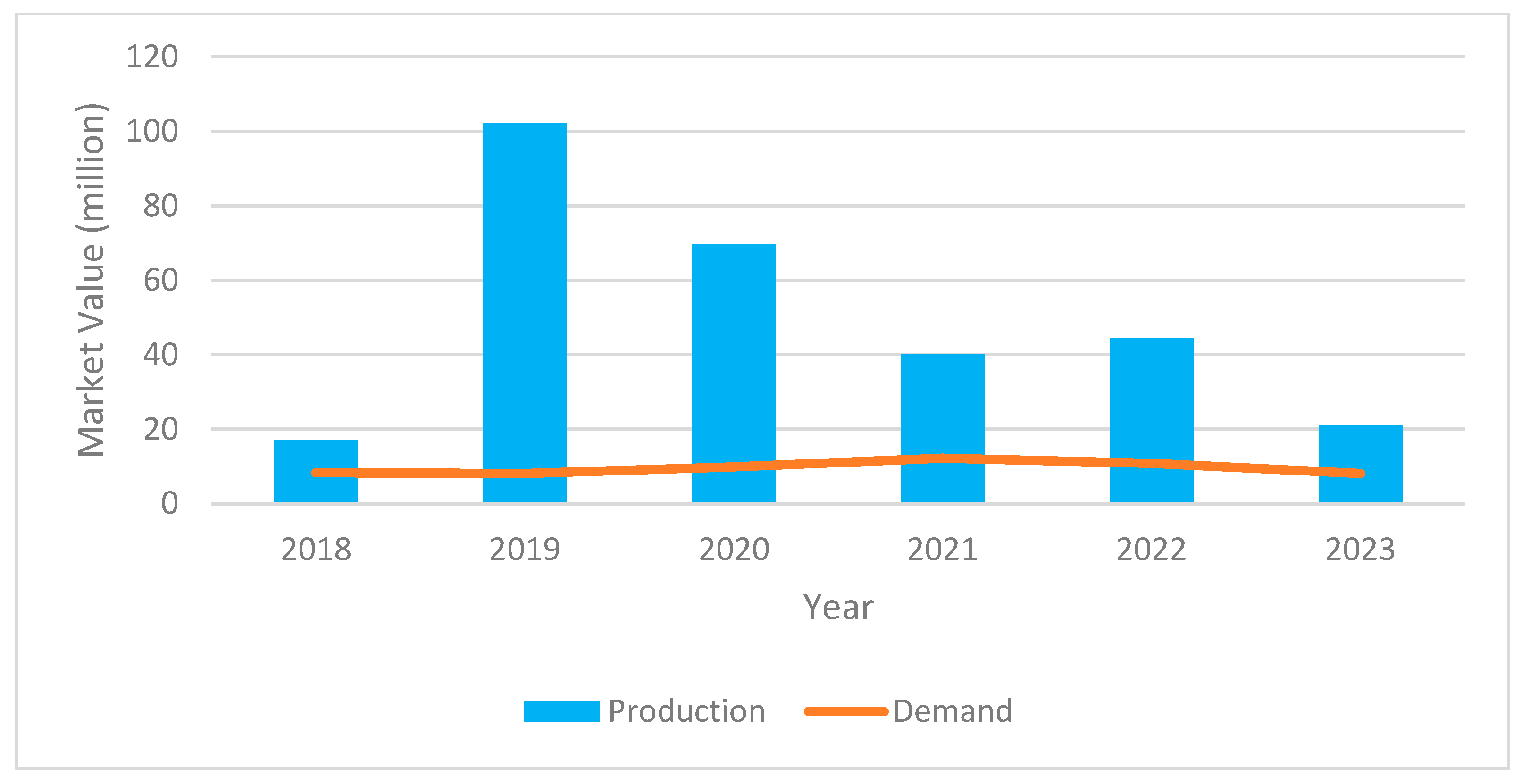
Table 1 reports Oregon’s mass timber-related market value from 2018 to 2023 under the two valuation strategies. The production-based estimates range from
$17.10 million in 2018 to
$102.11 million in 2019 and decline to
$21.07 million in 2023, with intermediate values of
$69.62 million in 2020,
$40.16 million in 2021, and
$44.45 million in 2022. As shown in the Method column of
Table 1, these estimates are derived from three equations across the study period, depending on the data available for each year: the facility-capacity approach (Equation (1)), anchored to Oregon’s combined plant capacity in 2019; the market-share revenue approach (Equation (2)), anchored to North American total mass timber market values in 2020, 2021, and 2022; and the CLT-share scaling approach (Equation (3)), anchored to North American CLT market values in 2018 and 2023. The 2019 estimate is markedly higher than the surrounding years because it reflects Oregon’s practical plant capacity under the assumed utilization and yield conditions, whereas the adjacent-year estimates are scaled from external North American market reports through Oregon’s inferred share of U.S. capacity. Year-to-year movements in the production-based column therefore partly reflect differences in source coverage and valuation method rather than only changes in market activity. For this reason, the production-based estimates are best interpreted as year-specific scenario estimates rather than a continuous time series.
The demand-based estimates range from $8.18 million to $12.28 million across the study period, rising from $8.34 million in 2018 to a peak of $12.28 million in 2021 and declining to $8.18 million in 2023. In contrast to the production-based column, the demand-based estimates are derived from a single consistent specification, the harvest-routing approach (Equation (4)), applied with fixed structural parameters across all years. The underlying inputs vary only through Oregon’s annual softwood lumber production and panel prices. The demand-based column therefore provides a more internally consistent time series, although it should still be interpreted as a conservative lower-bound estimate because the 1% routing assumption and the lumber-to-CLT conversion factor anchor the estimate to material flows rather than to market or capacity ceilings.
Read together, the two columns bracket a plausible range for Oregon’s mass timber-related market value. The demand-based pathway anchors a conservative lower bound tied to observed or assumed material flows, while the production-based pathway captures an upper range associated with Oregon’s production position, market share, and capacity-related assumptions. This bracketing approach is consistent with prior state-level mass timber assessments, which report wide ranges depending on production-share and capacity assumptions [
3,
11].
Figure 1 visualizes the production- and demand-based market-value estimates from 2018 to 2023. The production-based pathway shows a pronounced peak in 2019, when the facility-capacity approach (Equation (1)) was applied; the surrounding years, derived from market-share or CLT-share scaling using external North American sources, are substantially lower. The demand-based pathway, derived from a single consistent harvest-routing specification across all years, remains lower and more stable throughout the period. This pattern reinforces the interpretation that the two valuation pathways should be read as scenario bounds rather than alternative point estimates of the same quantity. It also shows that year-to-year differences within the production-based pathway partly reflect data sources and valuation methods rather than market dynamics alone.
3.2. Price-Sensitivity Scenarios for 2022 Market Value
Table 2 reports the 2022 market-value scenarios under three panel-price assumptions:
$40,
$50, and
$60 per ft
3. The results show that all price-exposed cases scale proportionally with the assumed panel price. Production Case 1 is unchanged across price scenarios because it is based on the market-share revenue approach rather than direct unit-price multiplication.
Under the production-based scenarios, the estimated market value ranges from $44.45 million to $334.94 million. Production Case 3, based on partial plant-capacity assumptions, generates the largest production-based values, increasing from $223.29 million at $40/ft3 to $334.94 million at $60/ft3. Under the demand-based scenarios, Demand Case 1 provides the lowest estimates, ranging from $8.69 million to $13.03 million, consistent with the conservative harvest-routing assumption. Demand Case 3 produces the largest demand-based values, ranging from $226.02 million to $339.02 million, because it allocates a share of U.S. demand to Oregon without fully netting out imports.
These results show that the direct market value depends strongly on both price assumptions and the valuation pathway. Therefore, the lower-bound harvest-routing case and the upper-bound demand-share or capacity cases should be interpreted as scenario boundaries rather than competing direct observations.
3.3. Industry Contribution of Oregon’s Engineered Wood Member and Truss Manufacturing Sector
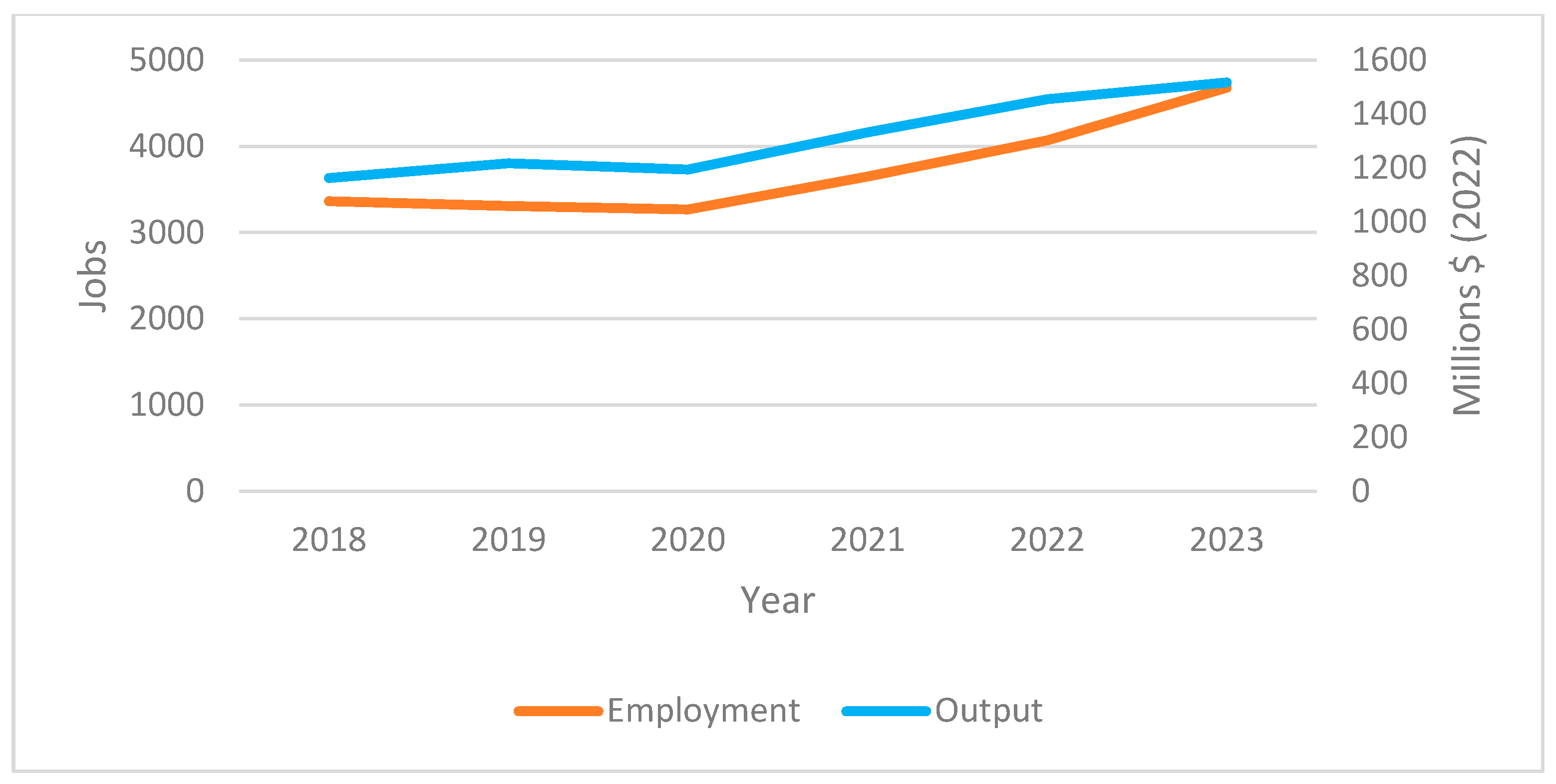
Table 3 presents the ICA results for Oregon’s Engineered Wood Member and Truss Manufacturing sector. This sector represents the closest available IMPLAN classification for mass timber-related activity. Total employment declined slightly from 3361.85 jobs in 2018 to 3267.85 jobs in 2020, then increased to 4681.24 jobs in 2023. The 2023 increase was driven primarily by higher indirect and induced employment, suggesting stronger supplier and household-spending linkages in that year.
Total output increased from
$1.16 billion in 2018 to
$1.52 billion in 2023. Direct output fluctuated over the period and reached its highest level in 2022 at
$901.89 million, before declining to
$824.02 million in 2023. However, total output continued to increase in 2023 because indirect and induced output rose substantially. This indicates that the sector’s broader economic contribution strengthened even though direct output declined after 2022. This pattern is consistent with broader U.S. forest products industry trends in 2022–2023, in which supply chain and household-spending linkages strengthened even as direct manufacturing output softened [
1].
Figure 2 summarizes the employment and output trajectories for Oregon’s Engineered Wood Member and Truss Manufacturing sector from 2018 to 2023. The figure shows that total employment and total output increased after 2020. The continued rise in total output despite the post-2022 decline in direct output reflects stronger indirect and induced linkages—a multiplier-structure shift that is less visually apparent from the table alone.
3.4. Industry Contribution of Oregon’s Mass Timber-Related Activity, 2018–2023
Table 4 maps the production- and demand-based mass timber market values from
Table 1 through the ICA framework. The production-based pathway generates a larger but more volatile economic contribution. Total employment reaches 408.42 jobs in 2019, then declines to 119.70 jobs by 2023. Total output follows the same pattern, peaking at
$150.15 million in 2019 and declining to
$38.78 million in 2023.
The demand-based pathway produces a smaller and more stable contribution. Total employment ranges from 32.72 jobs in 2019 to 53.24 jobs in 2021. Total output ranges from $12.03 million in 2019 to $19.42 million in 2021. The demand-based estimate therefore functions as a conservative lower-bound contribution estimate, while the production-based estimate reflects the upper range implied by Oregon’s capacity and market-share assumptions.
The final column of
Table 4 reports mass timber-related total output as a percentage of total Sector 127 output. Under the production-based pathway, the share peaks at 12.34% in 2019 and declines to 2.56% in 2023. Under the demand-based pathway, the share remains close to 1%–1.5% over the study period. This contrast highlights how strongly the estimated size of Oregon’s mass timber contribution depends on whether the analysis is anchored to production capacity or to observed demand-side material-flow assumptions.
Comparable state-level assessments report similarly wide ranges. Khanal et al. estimated approximately 93 total jobs and
$12.52 million in output for a Michigan mass timber facility producing 12,429 m
3 [
3]; Haynes et al. associated a 50-employee CLT facility scenario in Minnesota with about 95 total jobs and
$20.3 million in output [
10]; and Thapa et al. reported direct employment ranging from 28 to 180 jobs and direct output from
$35.3 million to
$229.5 million in Wisconsin scenarios [
11]. Oregon’s demand-based estimates fall toward the lower end of this range, while the production-based estimates extend into the upper range, reflecting Oregon’s existing CLT/MPP capacity and assumed market share.
3.5. 2022 ICA Results by Price and Valuation Scenario
Table 5 presents 2022 ICA results under the price and valuation scenarios shown in
Table 2. The results scale directly with the assumed market value. At
$50/ft
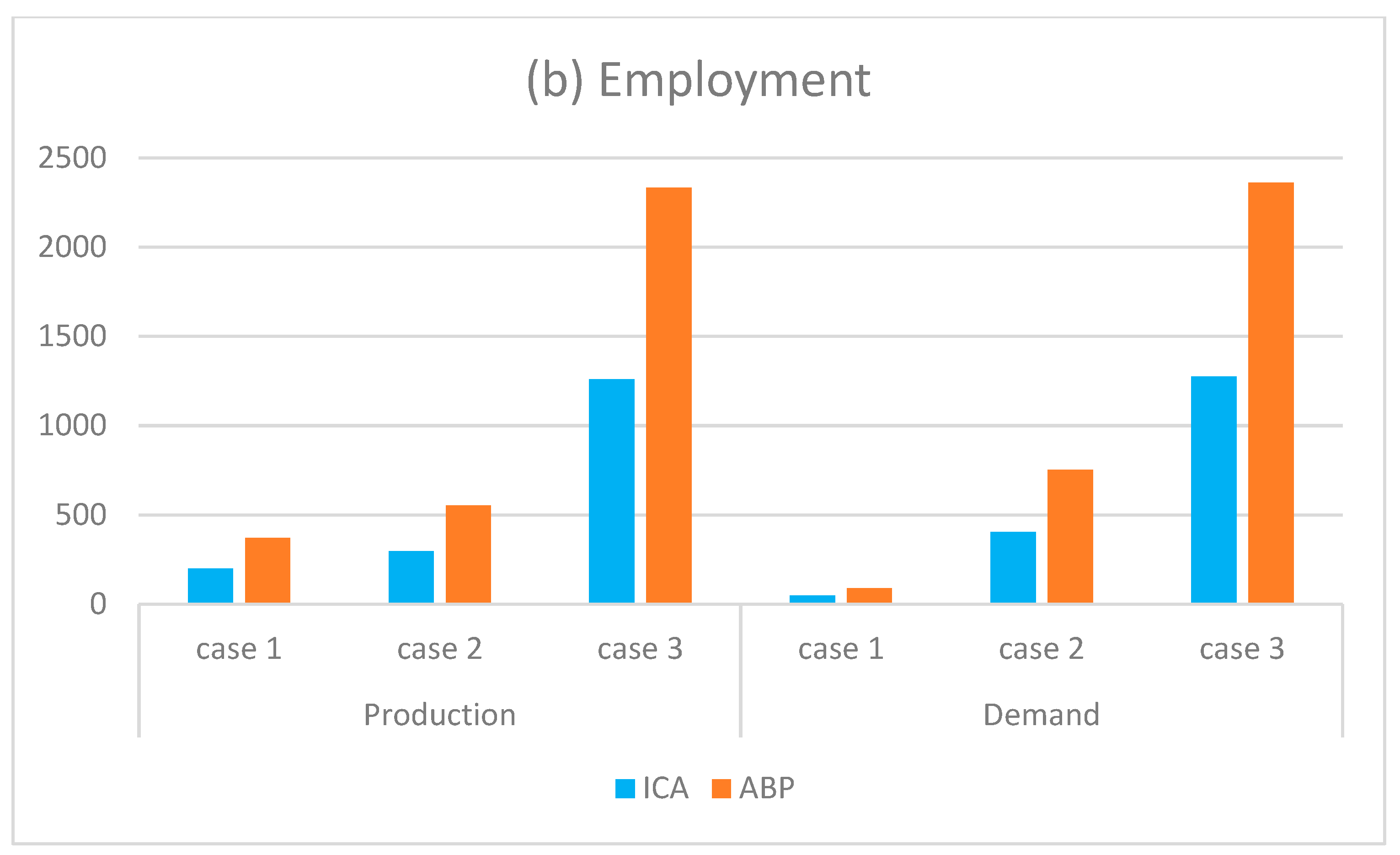
3, production-based total employment ranges from 200.45 jobs under Case 1 to 1258.67 jobs under Case 3. Total output ranges from
$71.69 million to
$450.18 million. On the demand side, total employment ranges from 48.97 jobs under Case 1 to 1274.00 jobs under Case 3, while total output ranges from
$17.52 million to
$455.66 million.
The price-exposed scenarios show proportional increases across direct, indirect, induced, and total effects. Moving from $40/ft3 to $50/ft3 increases the price-exposed values by 25%, while moving from $50/ft3 to $60/ft3 increases them by 20%. Production Case 1 is unchanged because it is based on observed or inferred revenue rather than a unit-price calculation.
3.6. ABP Spending Pattern and 2022 ABP Results
Table 6 reports the custom spending pattern used in the ABP model. The largest intermediate input category is dimension lumber, which accounts for 50.0% of within-pattern spending and 31.44% of total output. Adhesives are the second-largest input category, accounting for 15.0% of within-pattern spending and 9.43% of output. The total intermediate spending pattern accounts for 62.87% of output, while the remaining output is allocated to value-added components: employee compensation, proprietor income, other property income, and taxes on production and imports net of subsidies. The spending pattern is adapted from Thapa et al. [
11] and mapped between IMPLAN industry schemes using Nealy [
25].
Table 7 reports the ABP results for the
$50/ft
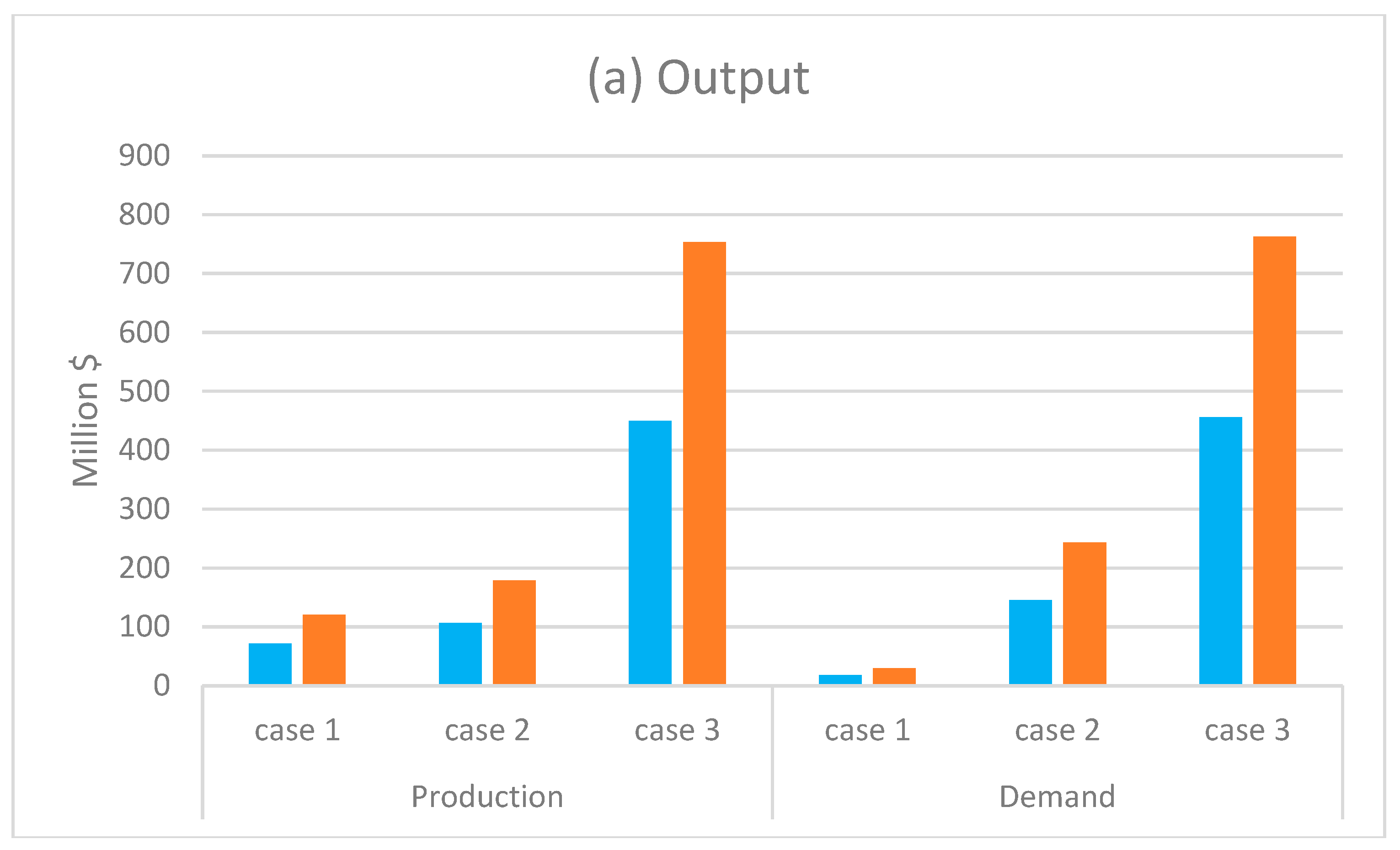
3 scenarios using the same direct output values as the ICA results. Under the production-based pathway, ABP total employment ranges from 371.51 jobs under Case 1 to 2332.48 jobs under Case 3. Total output ranges from
$139.98 million to
$753.55 million. Under the demand-based pathway, total employment ranges from 90.54 jobs under Case 1 to 2360.88 jobs under Case 3, while total output ranges from
$29.26 million to
$762.73 million.
Compared with ICA, ABP generates larger total effects for every comparable scenario. At
$50/ft
3, ABP total employment is approximately 1.85 times the ICA total employment in most cases, while ABP total output is approximately 1.67 times the ICA total output. The larger ABP effects are mainly driven by indirect effects because the custom spending pattern assigns a larger share of direct activity to upstream intermediate purchases. The direction of this difference is consistent with prior comparisons of ICA and ABP for U.S. forest-product industries, which have found that custom-pattern ABP typically generates larger indirect effects than default-sector ICA when applied to the same direct values [
14,
15].
Figure 3 compares ICA and ABP total output and total employment for the 2022
$50/ft
3 scenarios. Across all comparable scenarios, ABP produces larger total effects than ICA, mainly because the custom spending pattern assigns more activity to upstream intermediate purchases. This figure provides a visual summary of the main methodological comparison in the study.
3.7. OPW Sensitivity in the ABP Employment Estimates
Table 8 reports the sensitivity of ABP employment results to alternative OPW assumptions. Because ABP direct employment is calculated by dividing direct output by OPW, only direct employment changes when OPW changes. Indirect and induced employment remain unchanged because they are determined by the spending pattern, regional purchase coefficients, and household-spending effects.
Reducing OPW to 80% of the baseline increases direct employment by 25%, while increasing OPW to 120% of the baseline reduces direct employment by 16.7%. As a result, the direct share of total employment rises when OPW is lower and declines when OPW is higher. Across cases, the direct employment share is approximately 30.6% under the 80% OPW scenario, about 26.1% under the baseline OPW scenario, and about 22.7% under the 120% OPW scenario.
3.8. Forward Scenarios for 2030 and 2035
Table 9 reports the 2030 and 2035 conditional scenarios under ICA and ABP. Following the forward-scenario assumptions described in
Section 2.6, the implied direct Oregon market values are
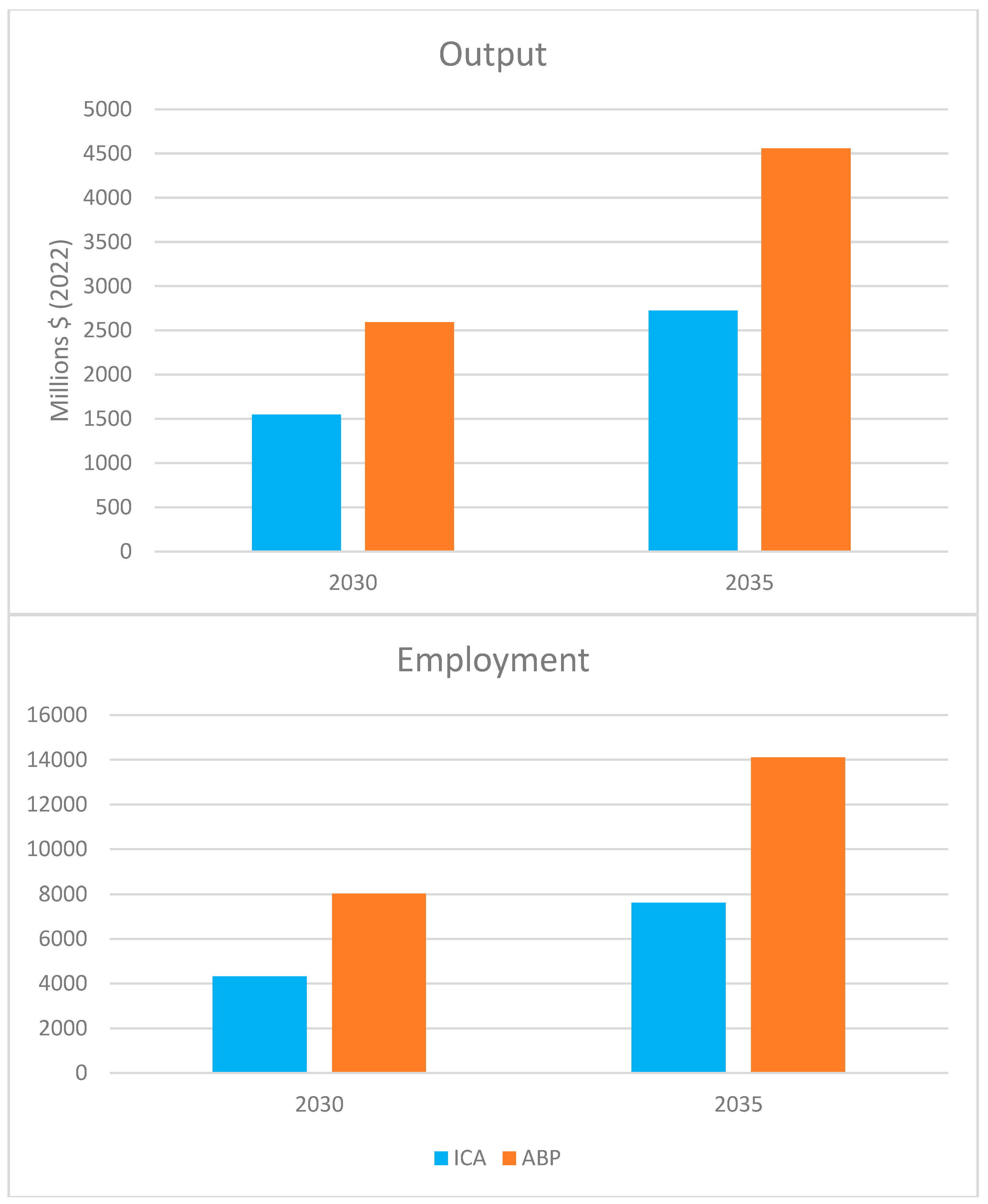
$960.13 million in 2030 and
$1.69 billion in 2035. With the 2022 OPW assumption, these direct values correspond to 2092.12 direct jobs in 2030 and 3679.25 direct jobs in 2035.
Under ICA, total employment reaches 4329.63 jobs in 2030 and 7614.16 jobs in 2035. Total output reaches $1.55 billion in 2030 and $2.72 billion in 2035. Under ABP, total employment reaches 8023.34 jobs in 2030 and 14,110.02 jobs in 2035, while total output reaches $2.59 billion in 2030 and $4.56 billion in 2035.
The difference between ICA and ABP is substantial in both years. ABP produces approximately 1.85 times the total employment and 1.67 times the total output of ICA. This reflects the same mechanism observed in the 2022 results: ABP allocates a larger share of direct output to upstream intermediate purchases, thereby increasing indirect effects. These estimates should be interpreted as conditional scenarios rather than forecasts because they depend on fixed 2022 spending patterns, regional purchase coefficients, OPW, the assumed Oregon market share, and the
$50/ft
3 price assumption. The U.S. demand projections used to construct these scenarios are taken from Allan and Eaton and the Canadian supply share assumption is consistent with continental-scale market analysis [
9].
Figure 4 presents the 2030 and 2035 forward scenarios under ICA and ABP. It shows that ABP generates substantially larger total employment and output than ICA in both years, consistent with the 2022 comparison. These differences reflect the fixed spending-pattern assumptions used in the forward scenarios and should be interpreted as conditional scenario outcomes rather than forecasts.
4. Discussion
This study provides a scenario-based assessment of Oregon’s mass timber-related market value and economic contribution. The results should be interpreted less as a single definitive estimate and more as a bounded accounting framework for an emerging sector where product-level prices, plant-level utilization, and trade-adjusted demand are incompletely observed. This framing is important because prior mass timber economic studies have used different analytical scopes, including facility feasibility analysis, project-level analysis, and state-level scenario analysis, making direct comparison difficult [
3,
8,
10,
11]. By estimating Oregon’s market value through both production- and demand-based approaches and then applying both ICA and ABP, this study makes the role of methodological choice explicit.
The production- and demand-based estimates describe different sides of the market. The production-based pathway captures Oregon’s potential role as a manufacturing state and is therefore more sensitive to assumptions about plant capacity, utilization, and Oregon’s share of U.S. production. In contrast, the demand-based pathway is tied to material-flow and construction-use assumptions and therefore produces a lower and more stable estimate. This divergence is consistent with the broader challenge identified in the mass timber literature: market potential is often much larger than currently observed throughput, especially where public investment, code reform, and supply chain development are occurring faster than consistent transaction data become available [
4,
5]. The value of the two-pathway approach is therefore not in identifying a single correct number, but in separating a conservative lower-bound estimate from a capacity-oriented upper-bound estimate.
The comparison between ICA and ABP is the main methodological contribution of the study. ICA is appropriate for estimating the contribution of an existing industry sector because it uses the default production structure of the relevant IMPLAN sector. This is consistent with standard forest-sector contribution studies that rely on IMPLAN to estimate direct, indirect, and induced effects [
12,
13]. However, mass timber is not a standalone IMPLAN sector; it is embedded within Engineered Wood Member and Truss Manufacturing. For this reason, relying only on ICA may obscure the procurement structure of mass timber production. ABP addresses this limitation by specifying a custom spending pattern and tracing upstream purchases separately. This difference explains why ABP produces larger total employment and output effects than ICA when the same direct output values are used.
This finding is consistent with prior methodological work showing that alternative IMPLAN approaches can produce similar aggregate estimates in some cases but differ in the allocation of direct, indirect, and induced effects [
14]. It is also consistent with broader reviews of forestry contribution studies, which emphasize that differences in sector definition, model construction, and treatment of direct effects can influence reported multipliers [
15]. In this study, the ABP results are larger primarily because the custom spending pattern assigns a larger share of activity to upstream inputs with local purchase potential. Therefore, ICA and ABP should not be interpreted as competing estimates of the same concept. ICA is better suited for describing the contribution of the existing embedded sector, whereas ABP is more useful for evaluating how a mass timber-specific procurement structure may affect upstream supplier activity.
The comparison with previous mass timber studies also clarifies the scale of Oregon’s estimates. Khanal et al. [
3] estimated the economic implications of potential mass timber processing facilities under facility-based assumptions, while Thapa et al. [
11] developed scenario-based estimates for different mass timber production scales. Haynes et al. [
10] provided an early Minnesota benchmark by associating a 50-employee CLT facility scenario with approximately 95 total jobs and
$20.3 million in output, which provides a useful benchmark because it represents a mid-sized facility configuration. Scouse et al. [
8] used an analysis-by-parts approach to compare locally produced CLT with a functionally equivalent concrete structure in Oregon. The present study differs from these prior studies in two ways. First, it tracks Oregon’s mass timber-related activity over multiple years rather than focusing only on one facility or one construction project. Second, it applies ICA and ABP to identical direct values, allowing the effect of modeling framework to be isolated from the effect of market-size assumptions.
The price-sensitivity results demonstrate that scenario estimates scale directly with assumed panel prices whenever the valuation pathway is price-exposed. This is analytically useful because it makes the framework easy to update as better transaction-price data become available. However, it also highlights an important limitation. The use of CLT prices as tracer prices is necessary because consistent annual price data are not available for all mass timber products, but this does not imply that CLT, MPP, glulam, and other engineered products have identical market values. The results should therefore be interpreted as CLT/MPP-centered mass timber-related estimates rather than precise product-by-product valuations. This interpretation is consistent with the revised product scope in
Section 2.
The OPW sensitivity analysis has direct implications for employment interpretation. In ABP, direct employment is derived from direct output divided by output per worker. Therefore, productivity assumptions affect direct jobs but do not change indirect or induced employment, which are governed by the spending pattern, regional purchase coefficients, and household-spending linkages. This means that employment estimates are not only a function of market expansion; they also depend on labor productivity, automation, process learning, and plant organization. As mass timber manufacturing matures, higher output per worker could reduce direct jobs per dollar of output while still increasing upstream supplier activity through larger production volumes.
The 2030 and 2035 estimates should be read as conditional scenarios, not forecasts. They are based on projected U.S. mass timber demand, an assumed Canadian supply share, an Oregon allocation share, a constant
$50/ft
3 price, and fixed 2022 IMPLAN relationships [
9]. The Allan and Eaton projections describe continental-scale demand growth, and the present study allocates the U.S. portion of that demand to Oregon under explicit production-share assumptions; therefore, Oregon’s implied activity is sensitive both to whether continental demand growth is realized and to whether Oregon captures its assumed share of U.S. production rather than ceding it to other states or to imports. Under these assumptions, ABP produces substantially larger employment and output totals than ICA because it routes more activity through upstream purchases. These forward estimates are useful for policy and workforce planning because they identify the scale of employment and output that could be associated with high-demand scenarios. However, they should not be interpreted as expected outcomes unless the underlying assumptions about demand growth, Oregon’s production share, import competition, plant utilization, and supply chain localization are realized.
From a policy perspective, the results suggest three implications. First, Oregon’s economic contribution from mass timber depends strongly on whether the state captures production activity rather than only construction demand. Public investment in supply chain coordination, workforce training, and manufacturing capacity may therefore influence whether capacity-feasible scenarios become realized activity. Second, local supplier development is central to regional retention because ABP shows that upstream purchasing can account for a large portion of total economic effects. This does not imply that specific technical parameters such as adhesive formulation or lumber dimensions should be changed; rather, it indicates that intermediate-input categories such as lumber, adhesives, transportation, machinery, and wholesale services (see
Table 6) are important channels through which mass timber production affects the regional economy. Third, workforce planning should account for both market growth and productivity change. A larger market does not translate mechanically into proportional direct employment if output per worker changes over time.
Several limitations remain. First, the market-value estimates rely on secondary data and scenario assumptions because plant-level production, utilization, and transaction prices are not fully public. Second, the empirical valuation is centered on CLT/MPP-related evidence, while the broader mass timber category includes additional products that are not separately valued. Third, the demand-share scenarios do not fully net out imports or distinguish Oregon production from Oregon consumption, making them more appropriate as upper-bound or capacity-feasible scenarios. Fourth, IMPLAN relationships, spending patterns, regional purchase coefficients, and OPW are held fixed in the forward scenarios. Future research could improve the estimates by collecting plant-level production and procurement data, developing product-specific price series, distinguishing panel products from beam-and-column products, and incorporating trade flows into demand allocation.
Overall, the findings show that Oregon’s mass timber-related economic contribution depends as much on methodological framing as on market size. The production- and demand-based approaches define the range of plausible direct values, while ICA and ABP show how the same direct values can generate different regional effects depending on how the production structure is represented. This distinction is important for interpreting economic contribution estimates in emerging industries where standard industrial classifications do not yet align cleanly with new products.
5. Conclusions
This study estimated Oregon’s mass timber-related market value and economic contribution from 2018 to 2023 and developed conditional scenarios for 2030 and 2035. Using production- and demand-based valuation approaches, the analysis shows that Oregon’s direct market value is best interpreted as a range rather than a single point estimate. The demand-based pathway provides a conservative lower-bound estimate tied to material-flow and construction-use assumptions, while the production-based pathway captures a higher and more variable estimate linked to market-share and capacity assumptions.
The comparison between ICA and ABP demonstrates that methodological choice materially affects estimated economic contributions. When identical direct output values are used, ABP produces larger total employment and output effects than ICA because the custom spending pattern routes more activity through upstream supplier industries. ICA is therefore most appropriate for describing the contribution of the existing embedded IMPLAN sector, while ABP is more appropriate for evaluating a mass timber-specific production structure.
The price and OPW sensitivity analyses further show that the framework is transparent and updateable. Price-exposed scenarios scale proportionally with assumed panel prices, while OPW affects only direct employment in the ABP framework. These findings are important for policy interpretation because employment estimates depend not only on market expansion but also on labor productivity and supply chain structure.
The forward scenarios suggest that, under high-demand assumptions and fixed 2022 model relationships, Oregon’s mass timber-related activity could support substantially larger employment and output by 2030 and 2035—reaching up to 14,110 total jobs and $4.56 billion in total output in 2035 under the ABP framework. However, these estimates are conditional scenarios, not forecasts. They depend on assumptions about U.S. demand growth, Oregon’s market share, Canadian supply, product prices, regional purchase coefficients, spending patterns, and output per worker.
The study contributes to the literature by providing a multi-year, Oregon-focused accounting framework and by directly comparing ICA and ABP for the same mass timber-related direct values. This is useful for emerging industries such as mass timber, where standard industrial classifications do not yet fully separate the target product category. The framework can be updated as better data become available, especially plant-level production, product-specific prices, procurement patterns, and trade-adjusted demand estimates.
Future work should prioritize three improvements: product-specific valuation for CLT, MPP, glulam, and other mass timber products; plant-level data on capacity utilization and procurement structure; and dynamic demand scenarios that incorporate imports, project pipelines, code adoption, and regional production capacity. These improvements would reduce uncertainty and allow future estimates to move from broad scenario ranges toward more precise market and policy evaluation.