Article

Vegetation-Cover Change Trends Across Different Lengths of Time Series Using NDVI: Contrasting Theil–Sen and Mann–Kendall with Piece-Wise Regression

1
Department of Forest Engineering, College of Transportation and Civil Engineering, Fujian Agricultural and Forestry University, Fuzhou 350002, China
2
Department of Transportation Engineering, Fujian Forestry Vocational Technical College, Nanping 353000, China
3
Forestry College, Fujian Agricultural and Forestry University, Fuzhou 350002, China
*
Authors to whom correspondence should be addressed.
Forests 2026, 17(5), 557; https://doi.org/10.3390/f17050557
Submission received: 30 March 2026 / Revised: 28 April 2026 / Accepted: 29 April 2026 / Published: 30 April 2026
(This article belongs to the Section Forest Inventory, Modeling and Remote Sensing)

Abstract

Quantifying vegetation dynamics has become a critical scientific imperative in the context of global ecosystem restoration initiatives targeting degraded forests. Previous studies have explored vegetation-cover change trends at different spatial scales worldwide using the Theil–Sen (TS) estimator and Mann–Kendall (MK) test, yet few have accounted for the uncertainty in resulting trends across time-series datasets of varying lengths. Taking the coastal zone of Fujian Province in Southeast China as a case study, we investigated the uncertainty of vegetation-cover change trends using normalized difference vegetation index (NDVI) datasets of different lengths (e.g., 20-year, 15-year, and 10-year) via the TS estimator and MK test. Additionally, piece-wise regression was employed to detect turning points and shifts in vegetation trends between 2001 and 2020. The results indicate significant discrepancies in trend estimation across datasets of different lengths, with consistency ratios ranging from 46.1% to 64.7% among the 20-year, 15-year, and 10-year series. The MK test is more sensitive to time-series length than the TS estimator, with areas of significant change decreasing by over 50% when transitioning from a 20-year to a 10-year dataset. The spatial distribution of trend shifts exhibits a distinct “coastal–inland” polarization pattern, with 2010 as the turning point. Eight modes of vegetation trend shifts were identified based on pre- and post-turning point dynamics. Furthermore, piece-wise regression improved trend accuracy by approximately 15%. This research advances the mechanistic understanding of spatiotemporal vegetation dynamics and supports adaptive ecosystem management strategies.

1. Introduction

Vegetation-cover change dynamics are central to understanding ecosystem degradation and restoration, particularly in the context of global greening and browning debates [1,2]. The study of vegetation-cover change dynamics is of paramount importance as efforts to restore degraded ecosystems continue [3,4]. It can help us to understand the complex interactions between the biosphere and the environment, thus contributing to policymakers and land managers making informed decisions to protect vulnerable habitats, mitigate the impacts of climate change, and promote sustainable land use [3,5]. However, the assessment of vegetation-cover change trends is fraught with uncertainty, influenced by various factors [6]. One significant aspect is the time scale effect. Time scales can have a profound impact on how we perceive and analyze vegetation restoration [7,8]. Short-term observations may not capture the full restoration process, while long-term studies can reveal otherwise overlooked patterns and dynamics [9]. Current analytical pipelines (long-term time series) conflate stationary states, transitional phases, and oscillatory regimes through uniform temporal decomposition frameworks. The length scale effects of time series on vegetation-cover change dynamics have not been fully explored, and our knowledge of uncertainty in vegetation change trends remains limited.
In recent years, remarkable progress has been made in understanding vegetation-cover change dynamics, particularly through the development and application of remote sensing technologies. Satellite imagery with high spatial and temporal resolution has enabled large-area, long-term monitoring in vegetation characteristics [10,11,12]. The integration of normalized difference vegetation index (NDVI) with climate data, soil information, and land-use maps has allowed for a more comprehensive understanding of the drivers of vegetation-cover change [13,14], providing valuable insights into spatiotemporal patterns at regional and global scales [10,15]. Moreover, contemporary methodologies now synergistically integrate field observations, controlled experiments, and process-explicit modeling through data-model fusion frameworks. Monitoring vegetation at fixed locations over extended periods provides detailed information on changes in biomass, growth rates, and environmental responses [16,17,18,19]. These studies have made great contributions to understanding vegetation change. However, they still have not fully considered the impact of dataset time-series length on vegetation-cover change trends.
NDVI has emerged as a powerful tool for studying vegetation-cover change dynamics. One key research area is the monitoring of long-term vegetation trends using NDVI time series with the Theil–Sen (TS) estimator and the Mann–Kendall (MK) test [20,21,22]. On a global scale, the TS estimator and MK test are widely used to study NDVI change trends [10], helping us to understand the impacts of climate change and human activities. In specific regions, such as arid areas, forest ecosystems, and agricultural areas, these two methods are also employed to assess vegetation-cover change dynamics and provide policy implications for ecological protection and restoration [7,15,23]. However, different time periods can be affected by different natural (e.g., climate, geography) and anthropogenic (e.g., deforestation, urbanization) factors. Consequently, the trend detected by the TS-MK approach can vary depending on the time period considered [8]. For example, Zhou et al. investigated the impacts of different time window sizes on the TS estimator and MK test, indicating that the TS slope is stable across averaging window sizes but the MK test results are not [8]. Nevertheless, research on the impact of different time periods on vegetation-cover change trend detection is still limited. For the TS estimator, a shorter time period may provide less data for accurate trend estimation [24], leading to less reliable slope estimates and greater uncertainty. A longer time period might capture more complex patterns and long-term trends but could also be influenced by early events that are not representative of current conditions [25]. For the MK test, a shorter time period may not provide enough data to detect a significant trend [8], especially if changes are relatively small or brief. It should also be noted that previous studies have demonstrated that time series generally contain turning points [12]. Yet most studies have focused on turning points at the regional scale [26], and few have quantitatively identified turning points for each pixel. These trend signals are often modeled as piece-wise linear [27], a method widely used to explore ecosystem changes [28]. However, few studies have compared the TS-MK method with piece-wise regression for evaluating vegetation-cover change trends. Therefore, future research should further explore the resulting uncertainty to more comprehensively understand vegetation-cover change dynamics at different temporal scales, with turning point detection being crucial for ecological protection and sustainable development.
Thus, we put forward the following hypotheses: (i) There is inconsistency among datasets of different time-series lengths when assessing vegetation-cover change trends. (ii) If turning points exist in the vegetation-cover change trend, the trend result obtained through piece-wise regression will be more reliable. To verify these hypotheses, by analyzing data from multiple time periods (2001–2020, 2006–2020, 2001–2010, and 2011–2020) and using a piece-wise regression model, we seek to provide insights into how different time frames can lead to varying interpretations of vegetation restoration success. Taking the coastal zone of Fujian Province in Southeast China as a case study, this paper delves into: (1) exploring and quantifying the time scale effects on the assessment of vegetation-cover change trends, to explain inconsistencies across different time-series datasets; (2) identifying the spatial distribution pattern of turning point years, exploring vegetation-cover change trends before and after turning points, and determining the modes of vegetation shifts; (3) comparing whether piece-wise regression or the TS estimator more objectively portrays vegetation-cover change trends. Through this research, we hope to contribute to a better understanding of the complex and ever-changing nature of vegetation and to pave the way for more effective restoration strategies and monitoring programs for vegetation recovery.

2. Materials and Methods

2.1. Study Area

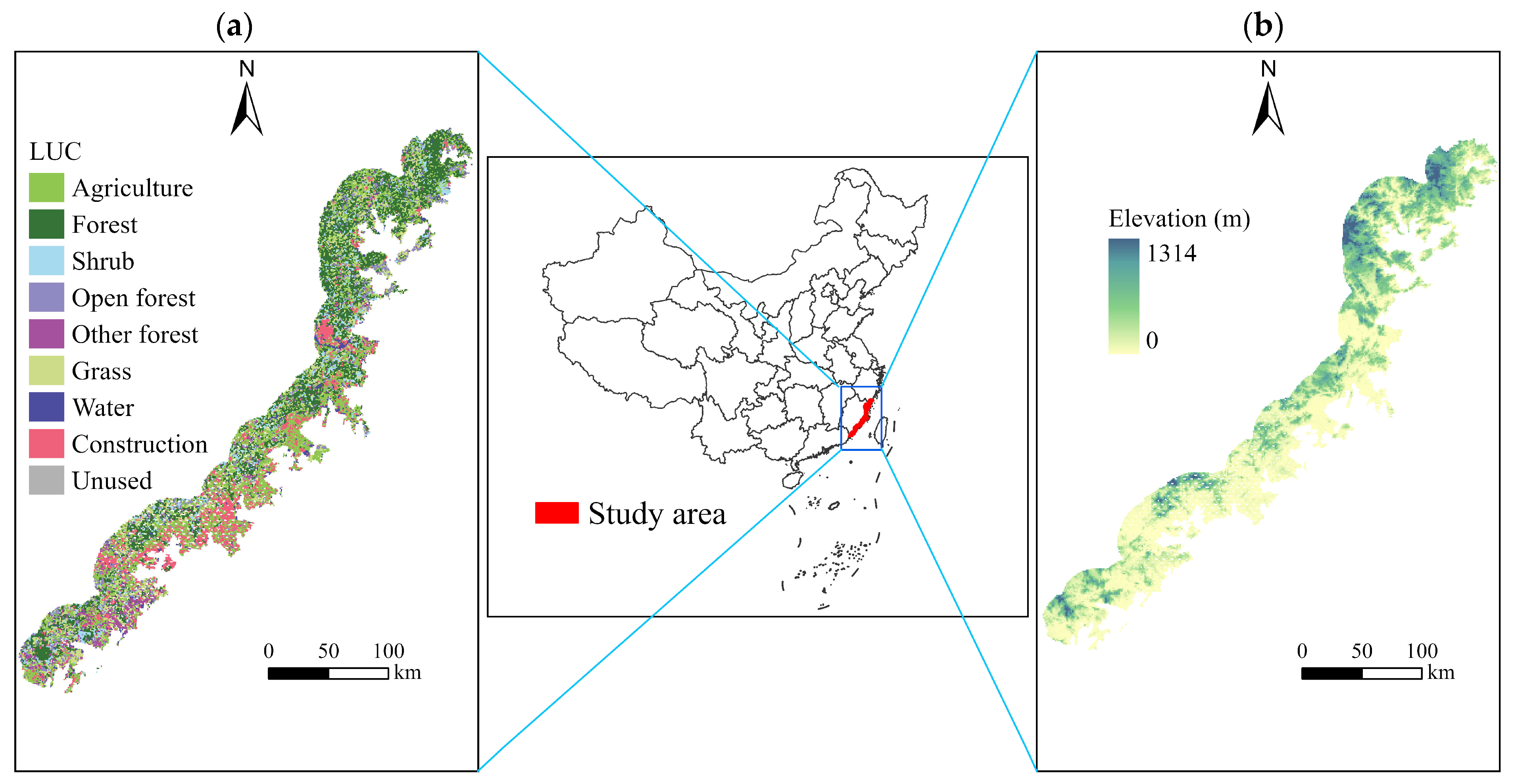
The study area is the coastal zone of Fujian Province, defined as the area within 30 km from the coastline (Figure 1). It covers approximately 48,573 km2, accounting for about 39% of Fujian’s total land area. The region has a subtropical maritime monsoon climate, with a mean annual temperature of 17–21 °C and annual precipitation of 1200–2200 mm. The terrain is predominantly mountainous and hilly, with forest, shrub, and grassland as the main vegetation types and a forest coverage exceeding 65%—the highest among Chinese provinces. During the study period (2001–2020), the coastal zone has experienced substantial anthropogenic pressures, including rapid urbanization, industrialization, and infrastructure development, leading to widespread conversion of agricultural land and natural vegetation to built-up areas. Concurrently, large-scale ecological restoration initiatives have been implemented, such as coastal shelterbelt afforestation, wetland and mangrove restoration projects, and the establishment of mangrove nature reserves. These combined pressures and restoration efforts directly influence vegetation dynamics, making the area suitable for investigating how time-series length affects vegetation trend detection. Moreover, the long-term availability of Landsat data (2001–2020) further supports this analysis.

2.2. Data Sources

The NDVI is a biophysically validated spectral index of photosynthetic activity, and has been derived through a multi-temporal compositing framework implemented on Google Earth Engine (GEE). The workflow comprises: (i) Multi-sensor data harmonization: Landsat TM/OLI/TIRS products (30 m spatial resolution; 2000–2020) were aggregated using a triennial moving window (target year ± 1) focusing on phenologically active periods (June–September) to mitigate cloud contamination. (ii) Data preprocessing pipeline: GEE’s native CFMask algorithm was applied for cloud/shadow removal, followed by median value compositing within annual bins. Radiometric normalization was achieved through COST atmospheric correction with terrain illumination adjustment. (iii) NDVI computation: Per-pixel calculation using (NIR − Red)/(NIR + Red), with subsequent annual median aggregation to minimize seasonal noise and outliers (2001–2020 temporal coverage).
The 30 m resolution land-use/cover change (LUCC) datasets (2000/2020) were acquired from the Resource and Environment Science Data Center (RESDC) of the Chinese Academy of Sciences (CAS) (http://www.resdc.cn/). This hierarchical classification system implements a two-tiered ontology: Level-1 categorizes landscapes into six cardinal classes (forestry land, agricultural land, grassland, water area, construction land, and unused land), while Level-2 includes 25 subclasses. Specifically, forestry land is categorized into forest land, shrub land, open forest land and other forest land. Vegetated lands were subsequently subjected to spatiotemporal trend analysis.
The Advanced Spaceborne Thermal Emission and Reflection Radiometer Global Digital Elevation Model Version 3 (ASTER GDEM V3) of 2019 with a spatial resolution of 30 m is available at https://www.gscloud.cn/. It was employed to generate elevation for the study area. According to the altitude distribution of the study area, it is divided into three types: plain (<500 m), hill (500–1000 m), and mountain (>1000 m). Then, they are used to statistically analyze the vegetation-cover change trend.
The Advanced Spaceborne Thermal Emission and Reflection Radiometer Global Digital Elevation Model Version 3 (ASTER GDEM V3; 30 m spatial resolution, 2019 acquisition) was acquired from the Geospatial Cloud Platform (https://www.gscloud.cn/). The study domain was segmented into three geomorphometric classes: plain (<500 m), hill (500–1000 m), and mountain (>1000 m).

2.3. Theil–Sen Estimator and Mann–Kendall Test

The TS estimator is a nonparametric quantile regression technique, which computes the median slopes across all temporal observation pairs. Coupled with the MK test, which evaluates trend significance through Kendall’s τ rank correlation statistic, this dual framework provides distribution-free detection of monotonic trends. The joint TS estimator and the MK test approach are both robust against outliers and do not require the data to follow a specific distribution, making it optimal for earth observation time series [29,30]. The TS estimator can be calculated by utilizing the following median function:
β = M e d i a n x j x i j i                           2001 < i < j < 2020
where xj/xi represent the NDVI values of the year jth/ith, respectively. β > 0 indicates an increasing trend and β < 0 represents a decreasing trend, while β = 0 reveals stable trend.
The MK test statistics are computed as:
S = i = 1 n 1 j = i + 1 n s g n x j x i
s g n x j x i =     1 ,                       x j x i > 0   0 ,                       x j x i = 0 1 ,                     x j x i < 0
When n is no less than 10, the S statistic approximately follows a normal distribution. Subsequently, S is standardized to Z, which is utilized for the significance test. The Z value is defined as follows:
Z = S 1 V A R S ,   S > 0 0 ,   S = 0 S + 1 V A R S ,   S < 0
V A R S = n n 1 2 n + 5 i = 1 m t i t i 1 2 t i + 5 18
Here, n represents the number of study years; m represents the number of tied groups; ti denotes the number of ties in group i. The significance level α is set to 0.05.
To assess the effect of time-series length (10, 15, and 20 years) on vegetation-cover change trends derived from the TS-MK method, four intervals were selected to enable a systematic comparison of vegetation trend detection across three different time-series lengths: 20 years (2001–2020), 15 years (2006–2020), and 10 years (2001–2010 and 2011–2020). The two 10-year periods (2001–2010 and 2011–2020) also allow us to examine whether the starting year of a decadal dataset influences the estimated trend, thereby providing a more robust assessment of length-dependent uncertainty.
In this study, analysis of the TS estimator and MK test was carried out at the pixel level by using the Python package ‘pyMannKendall’, version 1.2. Then, according to the NDVI-derived trends (i.e., positive/negative slope β with or without statistical significance Z), the vegetation-cover change trend is divided into five classes: significant recovery (β ≥ 0.0005, |Z| ≥ 1.96), slight recovery (β ≥ 0.0005, |Z| < 1.96), stable (−0.0005 < β < 0.0005), slight degradation (β ≤ −0.0005, |Z| < 1.96), significant degradation (β ≤ −0.0005, |Z| ≥ 1.96).

2.4. Piece-Wise Regression Model

To detect whether there is a turning point in the vegetation-cover change trend and how the trend shifts for each pixel in the study area, a piece-wise regression model with one turning point [11,31] was applied here:
y t = β 0 + β 1 t + ε ,                                                 t t i β 0 + β 1 t + β 2 t t i + ε ,   t > t i
where yt is an NDVI value in the time series t; Ti is the estimated turning year of the vegetation-cover change trend. β0, β1, and β2 are the intercept and coefficients of the piece-wise regression model; ε represents the residual. β1 and β1 + β2 are the change rates of vegetation trends before and after turning points, respectively. We also restricted ti within the period 2003–2018 to avoid linear regressions over a changing period with scarce data. The t-test was used to test the null hypothesis. At the p-value < 0.05 level, the difference in trends before and after turning points is considered statistically significant.
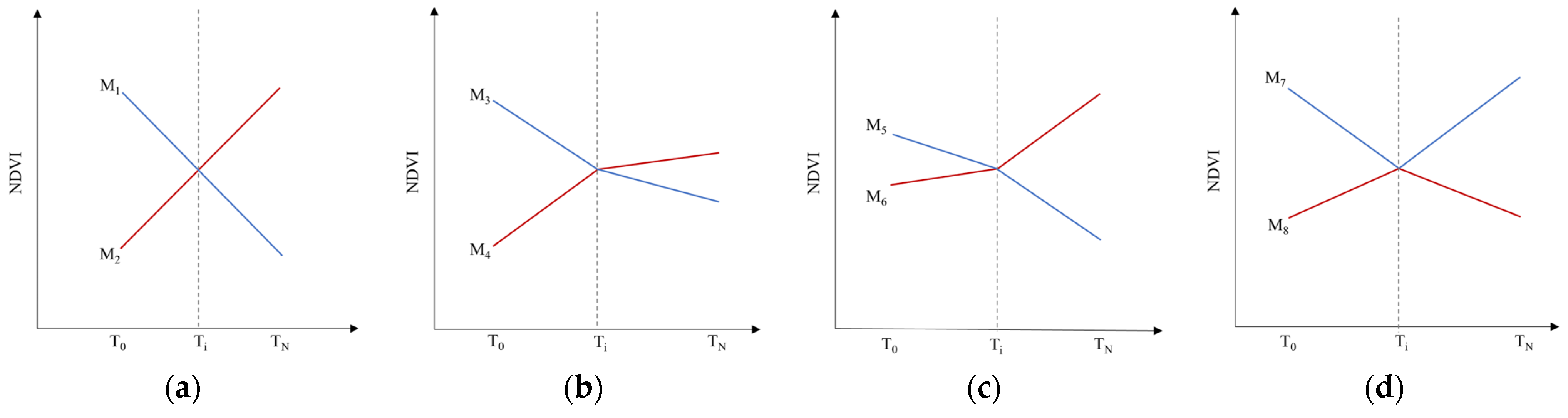
Piece-wise regression is a statistical method used to analyze whether there are structural turning points in the data, that is, why the data may show different linear relationships in different intervals. This method deals with nonlinear relationships in the data by fitting the data into multiple linear segments. The basic principle of piece-wise regression is that it can identify turning points or thresholds in the data and divide the data into different intervals at these points. The coefficients for different segments of the data may be different. According to the possible shift types of vegetation-cover change trends, we divide the shift types into eight modes (Figure 2). In this way, piece-wise regression can more accurately describe the nonlinear characteristics of the data series and provide a more accurate model fit than traditional linear regression. In this study, piece-wise regression was performed in the R package ‘segmented’. When the segmented package fits a piece-wise regression model for each time series, it provides two statistical tests: slope and curvature tests. A time series which passes the test indicates that a significant turning point has been found.

3. Results

3.1. Overall Trend of Vegetation-Cover Change

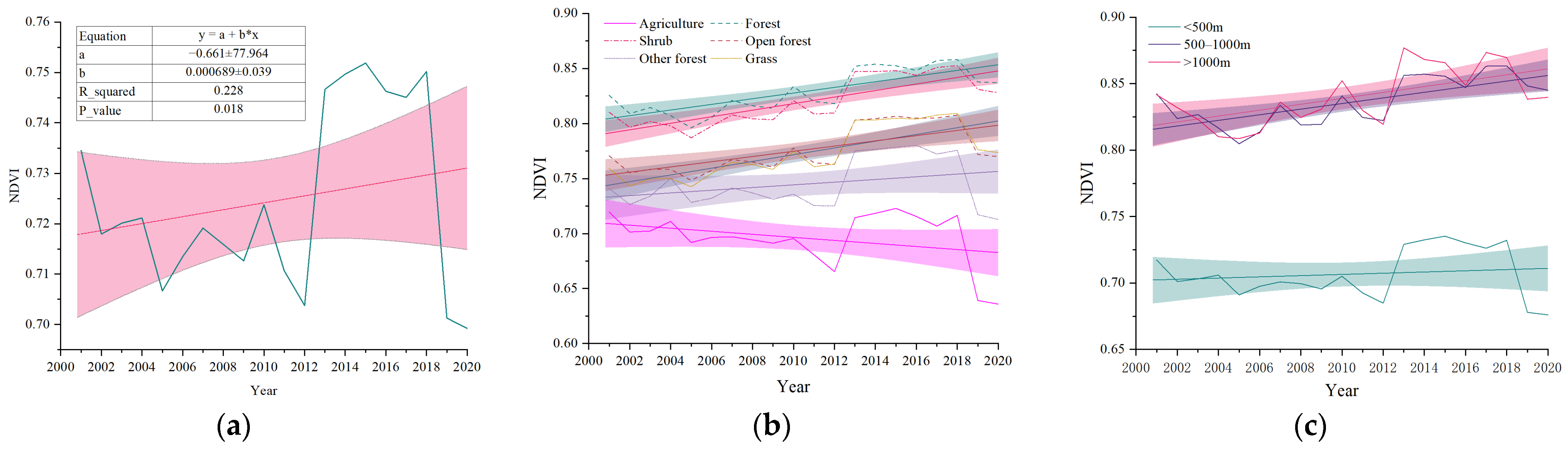
Figure 3a shows that although the curve for vegetation-cover change trend is relatively tortuous and fluctuating in the coastal zone of Fujian Province, it generally still follows a linearly increasing trend from 2001 to 2020 (p < 0.05). However, there are obvious differences in vegetation-cover change trends among different land types (Figure 3b). Among them, the mean NDVI values of forest land and shrub land are relatively high, and the growth slope is relatively large during the study period, followed by grassland and open forest land. The mean NDVI value of other forest land is relatively low, and the growth slope is small. However, the mean NDVI value of agricultural land is the smallest and gradually decreases with time. Our research also found that in higher-altitude areas (i.e., hill and mountain), the mean NDVI value and the growth rate are relatively high during the study period, while in low-altitude areas (i.e., plain), the mean NDVI value and the growth are relatively low (Figure 3c).

3.2. Vegetation-Cover Change Trends of Different Time Series

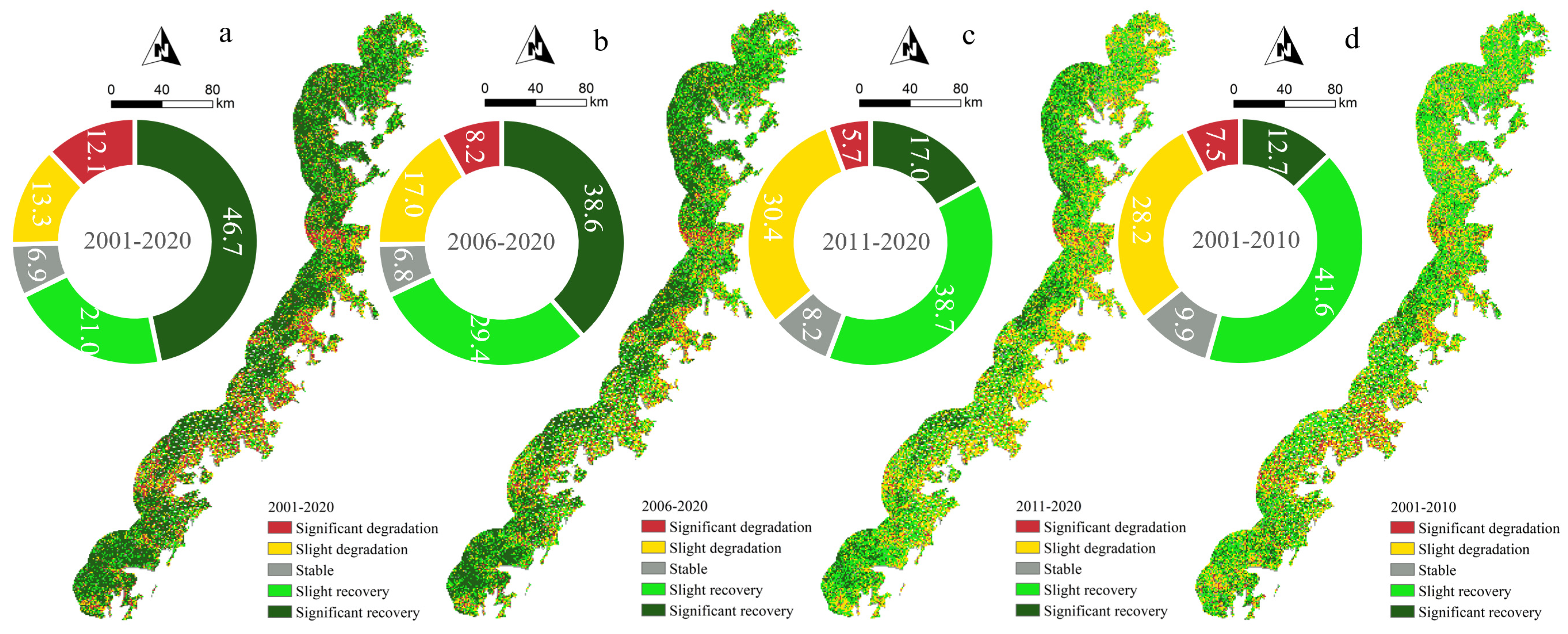
Datasets with different time-series lengths have a greater impact on the calculation results of the TS estimator and MK test (Figure 4). From a 20-year time series to a 10-year time series, the proportions of pixels with positive/negative TS slopes decreased/increased from approximately 68%/25% to 55%/36%. However, the proportion of pixels with a significant positive/negative TS slope (p < 0.05) both rapidly decreased from 46%/12% to 17%/6% or so, with the latter less than half of the former. These results indicate that the proportion of pixels with statistical significance (p < 0.05) in the results of longer time-series datasets (i.e., 20-year and 15-year) is significantly higher than that in the calculation results of shorter time-series datasets (i.e., 10-year).
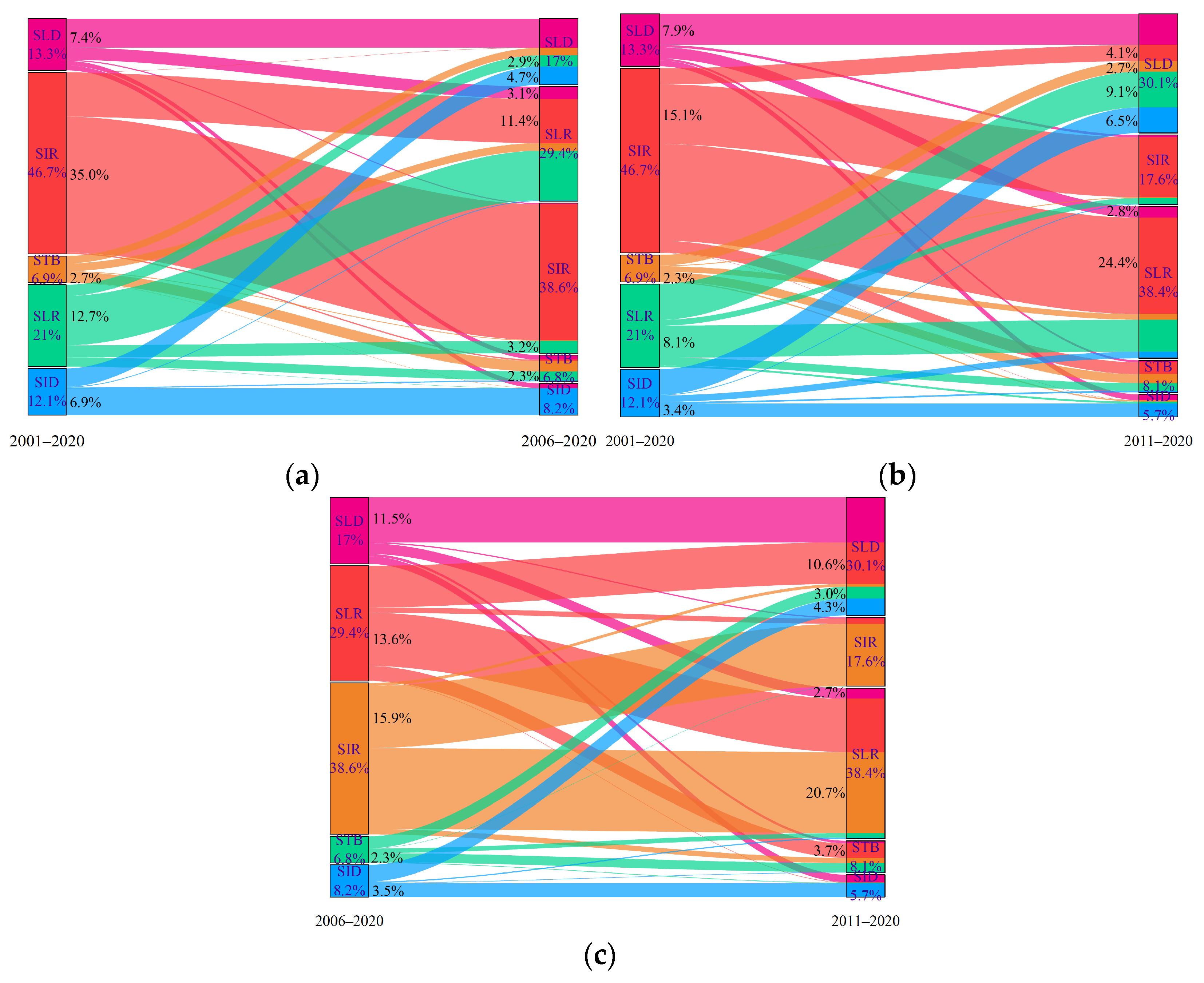
The consistency ratio of the evaluation results of the 20-year time series (2001–2020) and the 15-year time series (2006–2020) reaches 64.7%; the ratio is only 46.1% between the 20-year time series and the 10-year time series (2011–2020), and 46.8% between the 15-year time series and the 10-year time series (Figure 5). The inconsistency in the evaluation of different time series mainly comes from the fact that the proportion of significant change trends decreases notably as the length of the time series shortens and turns into an insignificant change trend. For example, from a 20-year time series to a 15-year time series, in 16.1% of places (11.4% for recovery and 4.7% for degradation), the significant change trend is evaluated as an insignificant change trend of their corresponding type. From a 20-year time series to a 10-year time series, this situation is even more prominent. For 24.4% of the restored areas and 6.5% of the degraded areas, the significant change trends are evaluated as the corresponding insignificant change trends, both exceeding half of their respective shares. In addition, it is worth noting that there is also 9.1% of slightly recovered areas evaluated as the opposite trend. The consistency and inconsistency situations from a 15-year time series to a 10-year time series are similar to those from a 20-year time series to a 10-year time series.
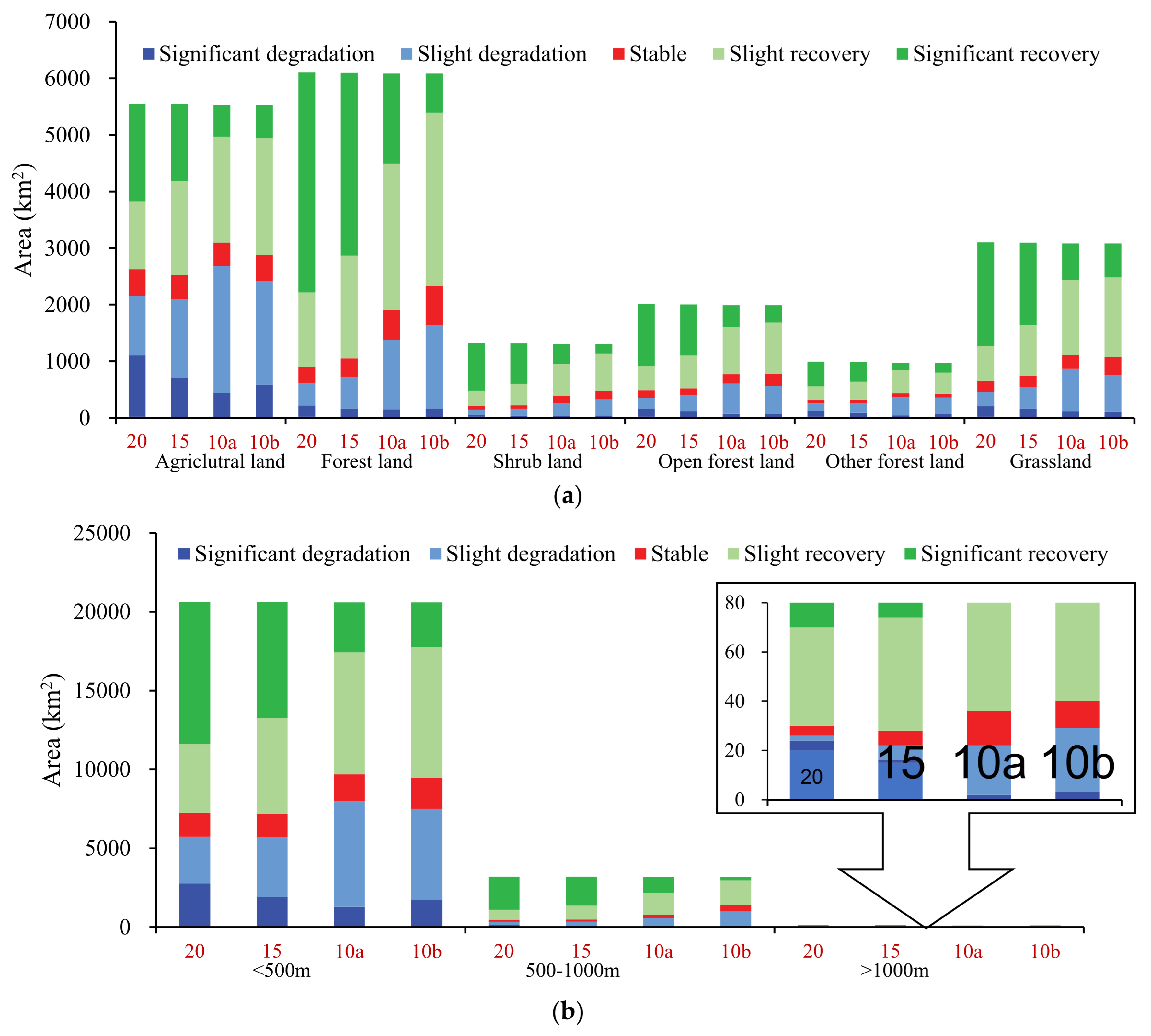
We further analyzed the distribution of different vegetation-cover change trend types obtained from different time-series lengths under different land covers and at different altitudes (Figure 6). The results show that whether there are different land covers or different altitudes, as the length of the series shortens, the proportion of pixels with significant change trends decreases. However, a notable feature is that the proportion of pixels with significant recovery trends in forest land and shrub land in the later stage (2011–2020) is significantly higher than that in the early stage (2001–2010). For other land types, the vegetation-cover change trend in the later stage (2011–2020) is not much different from that in the early stage (2001–2010). Similarly, in high-altitude areas (>500 m, i.e., hill and mountain), the proportion of pixels with significant recovery trends in the later stage (2011–2020) is significantly higher than that in the early stage (2001–2010), while in low-altitude areas (≤500 m, i.e., plain), the difference is not obvious.

3.3. Vegetation-Cover Change Trends Based on Piece-Wise Regression

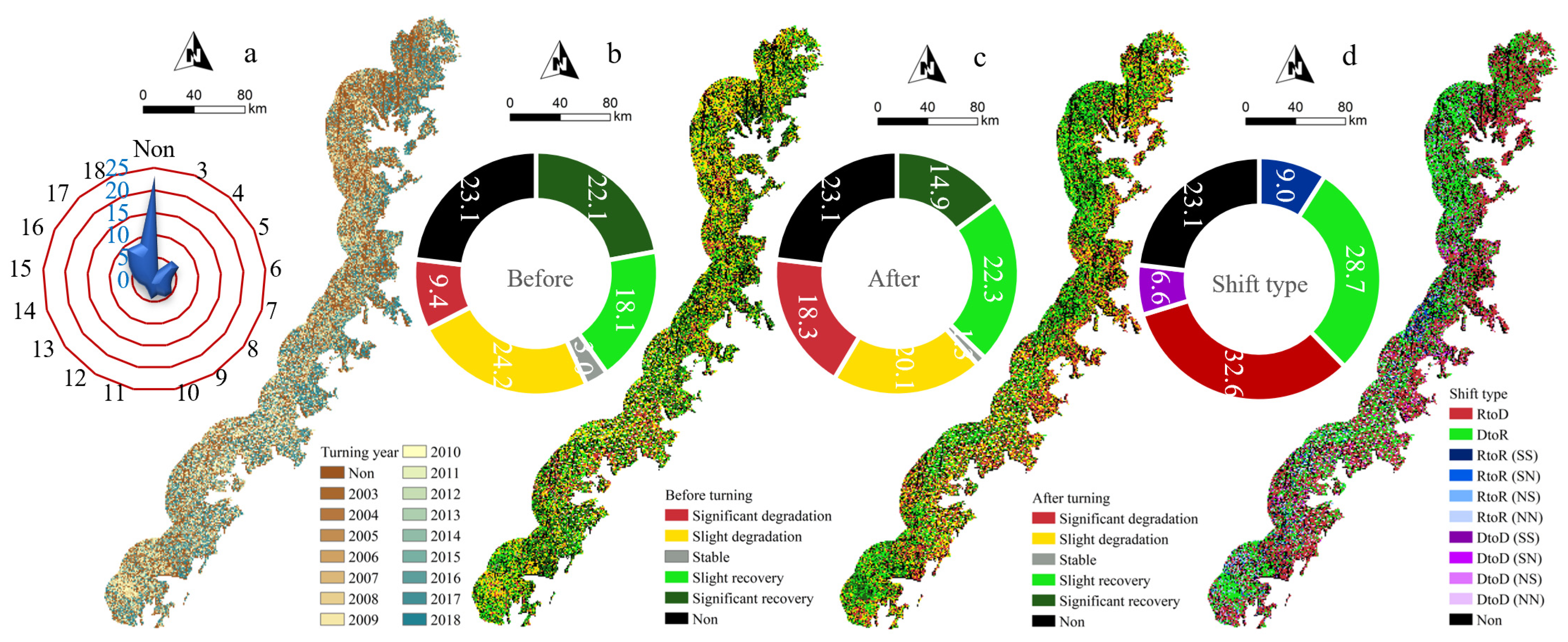
In addition to spatiotemporal change dynamics, we also detected the turning years of vegetation-cover changes and their trends before and after the turning years for each pixel during 2001–2020 (Figure 7). Our findings indicate that the years in which the turning points of vegetation-cover change trends emerged ranged from 2003 to 2018 and show heterogeneity throughout the study area (Figure 7a). From the perspective of time distribution, the proportion of turning points in years such as 2004–2005 and 2016–2018 are the highest (greater than 5%), and 2008–2009, 2011 and 2015 are relatively high (greater than 4%), while for other years, the proportions are all lower than 4%. The spatial distribution of the turning years had an obvious “coastal–inland” bipolar pattern. In areas closer to the coastline, the turning points mostly occur after 2010, while in areas farther from the coastline, the turning points mostly occur before 2010. Before the turning years, the area proportions of the significant recovery/degradation, the slight recovery/degradation and the stable scenario were 22.1%, 9.4%, 18.1%, 24.2%, and 3.0%, respectively; after the turning years, the area proportions of the significant recovery/degradation, the slight recovery/degradation and the stable scenario were 14.9%, 18.3%, 22.3%, 20.1%, and 1.3%, respectively (Figure 7b,c). After the turning years, the proportion of significantly recovered vegetation decreased significantly compared to that before the turning years; on the contrary, the proportion of significantly degraded vegetation increased significantly (Figure 7b,c).
Over the past 20 years, the shift type M1 accounts for 4.0% and type M2 accounts for 6.2% of the study area, respectively; the shift type M3 accounts for 1.1% and type M4 accounts for 2.2% of the study area, respectively; the shift type M5 accounts for 1.5% and type M6 accounts for 0.6% of the study area, respectively; it is notable that 28.7% of vegetation had experienced a shift from degradation to recovery trends (type M7), while 32.6% of vegetation had experienced a shift from recovery-to-degradation trends (type M8) (Figure 7d).

4. Discussion

4.1. Uncertainty of Vegetation-Cover Change Trend

Vegetation is a crucial component of the ecosystem, and understanding its changing trends is essential for environmental management and conservation. This study’s focus on the uncertainty of vegetation-cover change trends is timely and relevant. The assertion that vegetation is influenced by various factors and does not follow a linear trend is well-founded [32]. The ecological processes governing vegetation are indeed complex and nonlinear. This complexity makes it challenging to accurately predict and characterize the changes in vegetation. The use of a TS estimator and MK test in previous studies to estimate long-term vegetation trends is a common approach [11,17]. However, the finding that these methods have uncertainty in assessing vegetation-cover change trends is a valuable contribution [8,11]. It highlights the need for further research and the development of more accurate and reliable methods. The uncertainty is mainly manifested in the following three aspects:
First, the inconsistency of datasets with different time-series lengths in assessing vegetation-cover change trends is a significant issue. Vegetation-cover change is a complex process that unfolds over time. Different time-series lengths can lead to variations in the observed trends. This has been verified by our case; we find that the consistency ratios among different time series are between 46.1% to 64.7% (Figure 5). And we reveal that the inconsistency among the different time series mainly comes from the fact that the proportion of significant change trends decreases notably as the length of the time series shortens and turns into an insignificant change trend. This result can also be verified by this study, as we reveal that the datasets with different time-series lengths have a greater impact on the calculation results of the TS estimator and MK test (Figure 4). This is due to the fact that shorter time series may not capture long-term patterns or may be more susceptible to instant fluctuations and noise, while longer time series can provide a more comprehensive view but may also be influenced by historical events and changes that are not representative of current conditions [9,33]. Moreover, the evaluation results of the 20-year time series and the 15-year time series are relatively close. This indicates robustness for time series longer than 15 years. However, the evaluation result of the 10-year time series has greater uncertainty.
Second, our finding that using datasets of different time-series lengths has a greater impact on the MK test than on the TS estimator in assessing vegetation trends is an important observation. The MK test and TS estimator are commonly used methods for analyzing vegetation-cover change trends. We find that, from a 20-year time series to a 10-year time series, the difference in TS slope detection results is between 19% and 44% (Figure 4a–c). In particular, the inconsistency in the assessment of vegetation degradation is relatively large, reaching 44%. This is mainly due to the relatively low proportion of vegetation degradation in the study area (Figure 4c,d), and it is more sensitive to the assessment of time-series length. However, from a 20-year time series to a 10-year time series, the difference in MK test results is between 50% and 63% (Figure 4a–c). This is in line with a previous study regarding the impact of data scale on the TS estimator and MK test [8]. That study showed that the TS slope is stable across different time scales, but the result of the MK test is not.
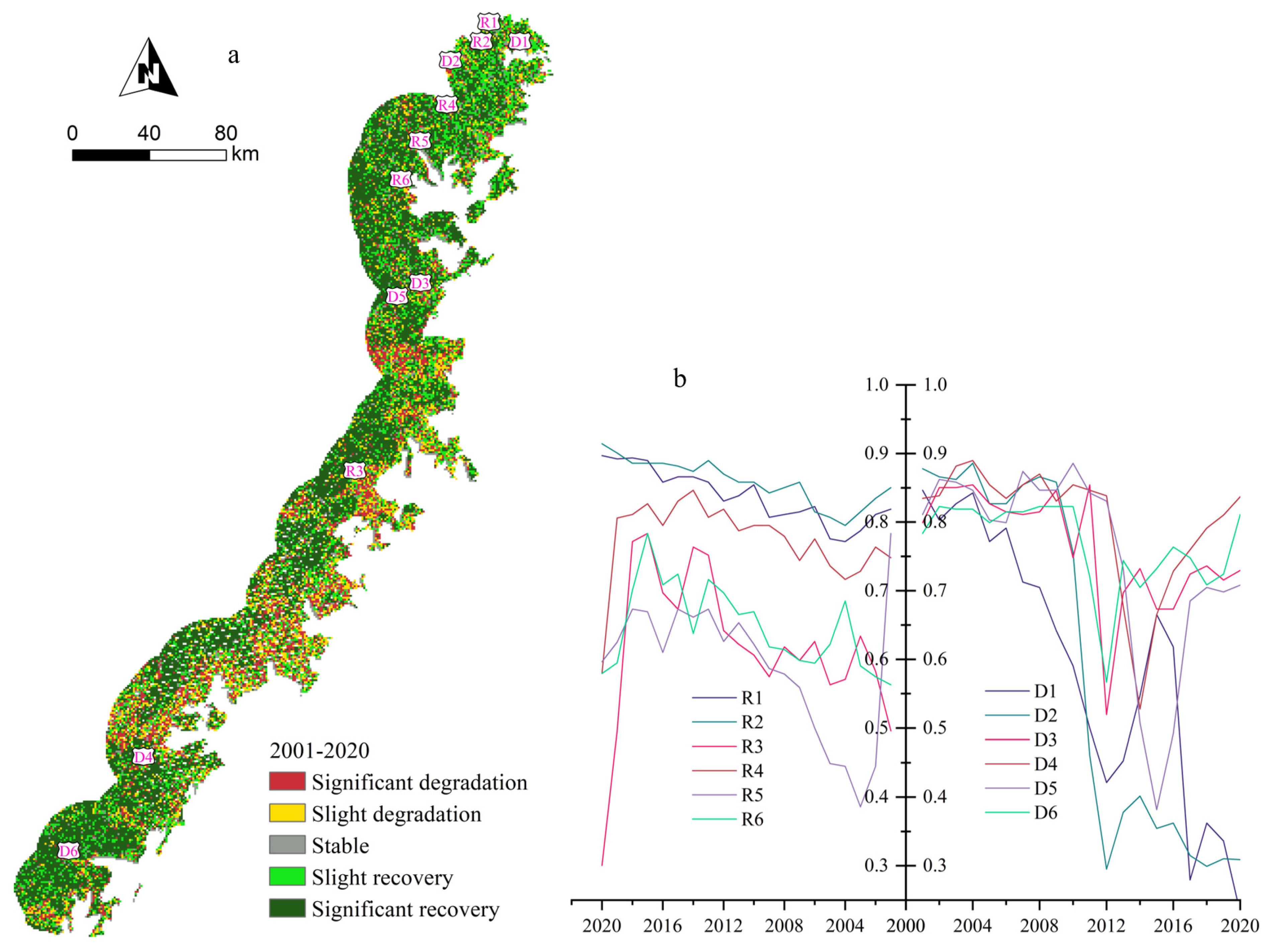
Third, the observation that datasets of the same time-series length are evaluated to have the same trend type yet their trend curves are very different or even opposite is a puzzling and significant finding (Figure 8). For example, the calculation results of the pixels (R1–R6) using the TS estimator and MK test methods suggest significant recovery, but there are obvious differences in their trend lines from 2001 to 2020. Except for R1 and R2, which show that their annual average NDVI values show a gradually increasing trend over time, for R3–R6, the annual average NDVI values show a gradually increasing trend over time from 2001 to 2016, but then show a significant downward trend from 2016 to 2020. Likewise, among the pixels with significant degradation in the calculation results using the TS estimator and MK test methods (D1–D6), there are also obvious differences in their trend lines. Except for D1 and D2, whose annual average NDVI values show a gradually decreasing trend over time, for D3–D6, the annual average NDVI values show a gradually decreasing trend over time from 2001 to 2012, but then show an obvious upward trend from 2013 to 2020. This phenomenon raises questions about the reliability and interpretation of trend analysis methods (i.e., the TS estimator and MK test). If data with the same time-series length are expected to show consistent trends, the occurrence of vastly different or opposite trend curves indicates potential issues with the methods used or the nature of the vegetation data itself. One possible explanation could be that the methods employed are sensitive to different aspects of the dataset or are influenced by noise and outliers in different ways. Another possibility is that there are underlying factors not accounted for in the analysis that are driving the differences in curves. This can be confirmed by our research results. For example, we found that the proportion of pixels with significant restoration trends in forest land, shrub land, and high-altitude areas is significantly higher (Figure 5). This is because most of the forest land and shrub land are distributed in higher-altitude areas and are less affected by human interference. Therefore, their change trends are relatively consistent, and the significance is relatively prominent.
The uncertainty in vegetation-cover change trends stems from multiple sources. Firstly, natural variability in climate, soil conditions, and disturbance events can lead to unpredictable changes in vegetation. For example, extreme weather events such as droughts, floods, and wildfires can have a significant impact on vegetation growth and survival, making it difficult to establish a clear trend. Secondly, human activities such as deforestation, land-use change, and urbanization can also contribute to uncertainty in vegetation-cover change [11]. These activities can alter the composition and structure of vegetation in complex ways, making it challenging to predict future trends.

4.2. Comparison of the Accuracy Between Piece-Wise Regression and TS-MK

The observed difference in the different time series by the TS estimator and MK test highlights the importance of method selection and data consideration in vegetation trend analysis. In this study, we adopt piece-wise regression instead to estimate the vegetation-cover change trends (Figure 7). We find that the vegetation shifts in these years, such as 2004–2005, 2008–2009, 2011, 2015, and 2016–2018, account for a relatively high proportion. This is completely in line with the overall vegetation-cover change trends (Figure 3). Moreover, the proportion of significantly recovered and degraded pixels obtained by piece-wise regression (after the turning points) is significantly higher than that of artificially evaluating the 10-year series dataset using the TS estimator and MK test methods. These show the robustness of the piece-wise regression method.
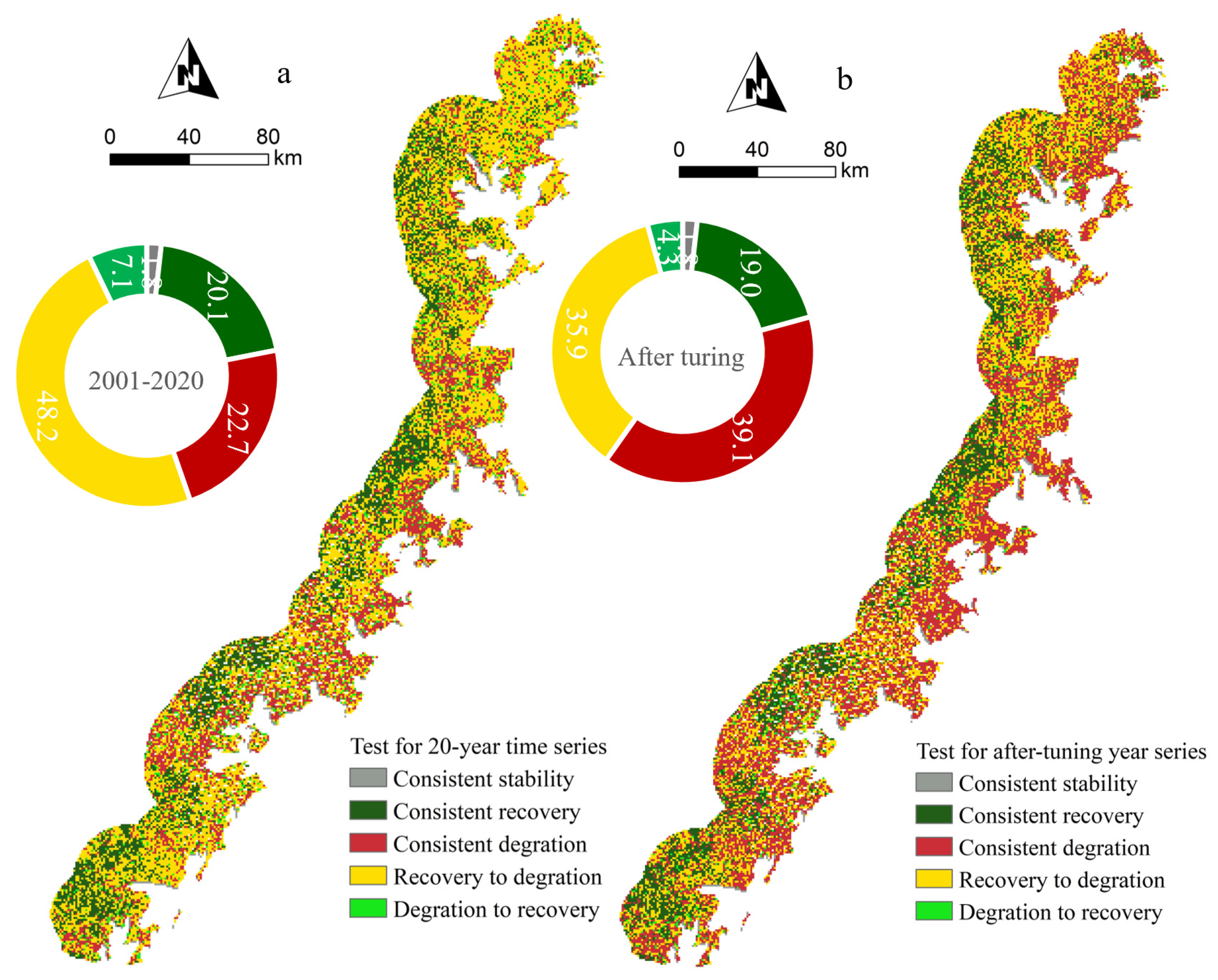
We further compare the results of estimating the vegetation-cover change trend of the 20-year time series using the TS estimator and MK test methods, and estimating the vegetation-cover change trend in the later period of the turning points using piece-wise regression, respectively, with the satellite-observed vegetation-cover change trends from 2018 to 2020, because the latest time series (2018–2020) can best represent the current vegetation-cover change dynamics. Then, we divided the test results into two major categories and five subcategories: consistent (unchanged type, same rising type, same falling type) and inconsistent (recovery-to-degradation type, degradation-to-recovery type) (Figure 9). The results show that the piece-wise regression is more in line with the current vegetation-cover change dynamics. The proportion of consistency is as high as nearly 60% for the piece-wise regression, while the proportion of consistency for the TS estimator and MK test using 20 years as the entire time series is less than 45%. The former is 15% more accurate than the latter. The types with large differences in the test results of the two methods are consistent degradation and recovery to degradation. The proportion of the consistent degradation type obtained by the TS estimator and MK test method is only 22.7%, while the proportion of the consistent degradation type obtained by the piece-wise regression method is as high as 39.1%. The proportion of the recovery-to-degradation type obtained by the TS estimator and MK test method is as high as 48.2%, while the proportion of the recovery-to-degradation type of the piece-wise regression method is only 35.9%. The difference between the two is about 15%. From this, it can be inferred that the use of the TS estimator and MK test method results in a serious underestimation of the vegetation degradation trend, which misjudges about 15% of the pixel vegetation degradation as vegetation recovery.
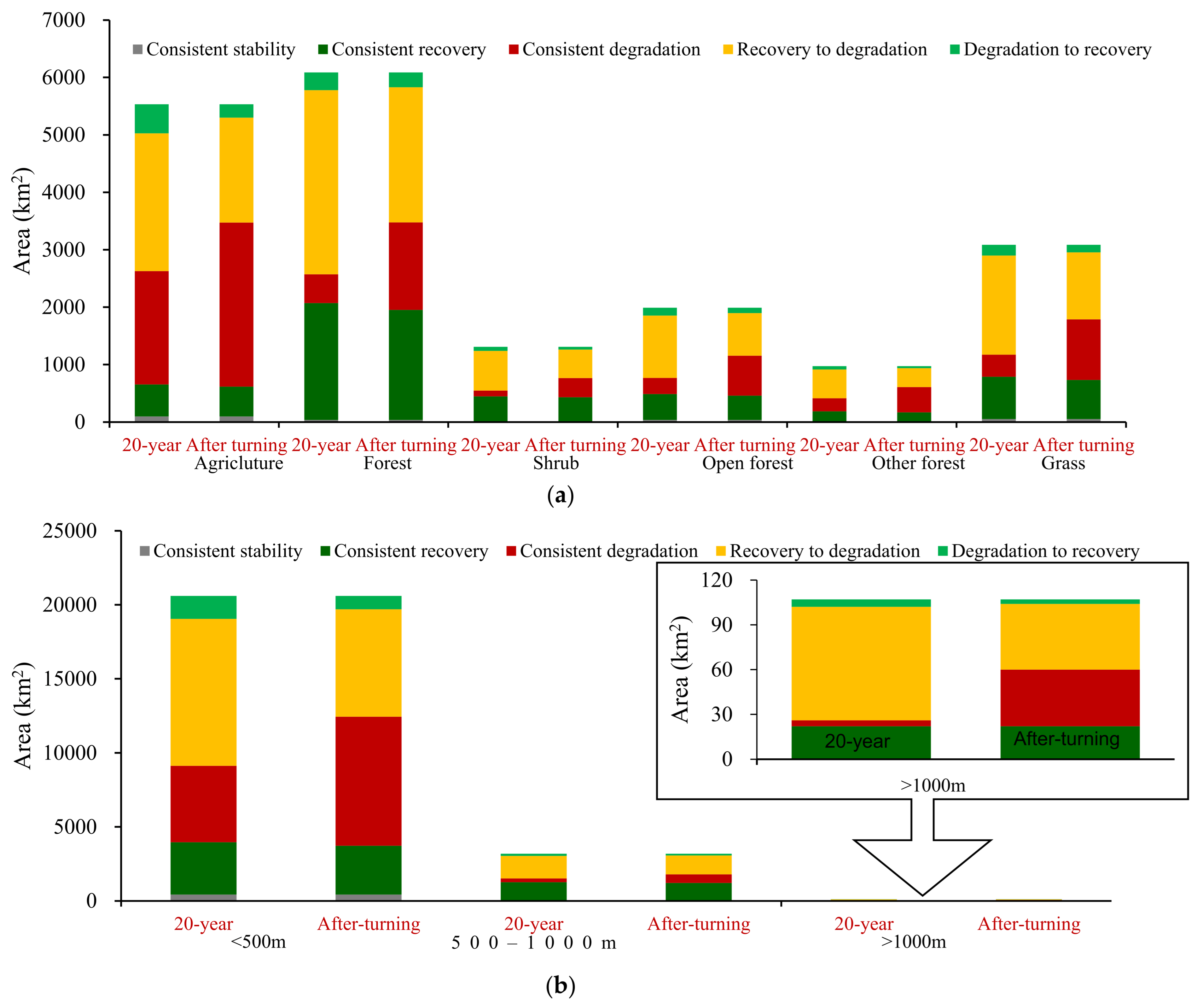
Statistics on the distribution of different test result types in different land-cover types and different altitudes show the following (Figure 10): In terms of different land-cover types, the differences between the two evaluation methods for agricultural land, forest land and shrub land are relatively small, while the differences between the two evaluation methods for open forest land, other forest land and grassland are relatively large. In terms of different altitudes, the differences between the two evaluation methods are relatively large in places with an altitude greater than 1000 m. In places with an altitude of less than 1000 m, especially in places with an altitude of 500–1000 m, the differences between the two evaluation methods are relatively small. This might indicate that these land-cover types, agricultural land, forest land, and shrub land have more stable vegetation characteristics or that the two methods perform relatively similarly on them. On the other hand, open forest land, other forest land, and grassland have relatively large differences. This could be due to the more complex vegetation dynamics and variations in these types, making it more challenging for the evaluation methods to consistently assess their changes. Regarding different altitudes, areas with an altitude greater than 1000 m or less than 500 m have larger differences between the two evaluation methods. This might be related to the harsher environmental conditions and a larger proportion of open forest land, other forest land and grassland located at higher-altitude areas (>1000 m) [34], and relatively more human interference below an altitude of 500 m, which could lead to more variable vegetation responses and make it more difficult for the methods to accurately capture the changes. This result is consistent with the above finding that there is a relatively high proportion of significantly restored vegetation pixels in forest land and shrub land (Figure 5). This also shows the robustness of our research results.

4.3. Implications and Limitations

In today’s rapidly changing world, understanding vegetation-cover change trends are of the utmost importance for ecological conservation and sustainable development. The observed uncertainty in vegetation-cover change trends highlights the importance of method selection and data consideration in analysis. This uncertainty poses challenges for researchers and decisionmakers. When analyzing vegetation-cover change trends, it is essential to consider the length of the time series and its potential impact on the results. It could be related to the statistical properties of the methods or the nature of the vegetation. Our case reveals that the consistency ratio of the evaluation results of the 20-year time series and the 15-year time series reaches 64.7%. However, the consistency of the evaluation results between the 20-year and 15-year time series and the 10-year time series is only about 46%. Moreover, from the 20-year and 15-year time series to the 10-year time series, there is about 10% of the slightly recovered areas evaluated as having the opposite trend (Figure 5). Therefore, standardizing the time-series length or utilizing appropriate statistical methods and aggregating them to account for differences could help to mitigate this issue [33].
Moreover, understanding the sources of uncertainty can lead to improved data collection and analysis methods. For example, identifying the factors that cause differences in trends between short and long time series can inform the selection of appropriate monitoring periods and data sources. The discovery of different or opposite trend curves for datasets of the same time-series length challenges our understanding of vegetation-cover change and calls for a more in-depth examination of trend analysis techniques and the factors that affect vegetation dynamics. By addressing this issue, we can enhance our understanding of vegetation dynamics and make more informed decisions for environmental management and conservation.
In addition, research on the drivers of vegetation-cover change has advanced significantly. First, research should be conducted to understand the interactions between climate and human activities and their combined effects on vegetation-cover change. Moreover, the role of biodiversity in vegetation-cover change dynamics is being increasingly recognized. Finally, efforts should be made to develop sustainable management strategies for vegetation, including strategies for restoring degraded vegetation, enhancing ecosystem integrity, and promoting sustainable land use.
However, there are still the following deficiencies in this study that deserve attention. First, our research initially found that different factors, such as land cover and topography, have an impact on the uncertainty of vegetation restoration trends. However, we failed to deeply discuss these driving force mechanisms in this study, which is a direction that should be worked on in the future. In addition, we used the latest time-series data from 2018 to 2020 to verify the reliability of the two methods, but we did not conduct extrapolation verification of the two methods either in time or in space, which also needs to be further confirmed. Third, we did not conduct a systematic comparison of NDVI with other vegetation indices under different time-series lengths. Nevertheless, our study still provides insights into how different time frames can lead to varying interpretations of vegetation restoration success, which is of great significance for deepening our understanding of global vegetation restoration dynamics.


5. Conclusions

Taking the coastal zone of Fujian Province in Southeast China as a case study, this paper delves into the uncertainty of vegetation-cover change trends with different time-series lengths using the combined method of a TS estimator and MK test and explores the applicability of the piece-wise regression. Our efforts verify the two hypotheses: (i) Different time-series datasets have obvious differences in the estimation results of vegetation-cover change trends by the TS estimator and MK test. (ii) There is a turning point in vegetation-cover changes in most of the study area (76.9%), and the change trend results obtained through piece-wise regression are more reliable than the TS estimator and MK test. The main conclusions are as follows:
(1)
Our quantitative assessment reveals, for the first time, the exact magnitude of inconsistency caused by time-series length. Pair-wise consistency ratios among 20-, 15-, and 10-year series range from 46.1% to 64.7%. Among them, the evaluation results of the 20-year time series and the 15-year time series are relatively consistent. Notably, the MK test is far more sensitive to series length than the TS estimator: reducing the series from 20 to 10 years reduces the area of statistically significant change by >50%.
(2)
The piece-wise regression model can objectively identify the shifts of the vegetation-cover change trend. The spatial distribution in the vegetation-cover change trend shifts is characterized by an obvious polarization pattern of “coastal–inland” with 2010 as the turning point. Eight modes of vegetation trend shifts were identified based on the changes before and after the turning points: consistent decreasing (M1), consistent increasing (M2), decreasing slowing down (M3), increasing slowing down (M4), accelerated decreasing (M5), accelerated increasing (M6), decreasing to increasing (M7), and increasing to decreasing (M8).
(3)
Compared with the combined method of a TS estimator and MK test, piece-wise regression increases the proportion of consistency between the evaluation and the measured result by about 15%. In places with less human disturbance at medium altitudes (i.e., hill) with superior natural conditions, mainly composed of forest land and shrub land, the robustness of the evaluation results of both methods is relatively high.

Author Contributions

Conceptualization, T.H. and X.H.; methodology, M.W., T.H. and X.H.; software, Z.H.; data curation, S.L. and Z.W.; writing—original draft preparation, M.W.; writing—review and editing, T.H. and X.H.; visualization, M.W.; supervision, T.H.; funding acquisition, X.H. All authors have read and agreed to the published version of the manuscript.

Funding

This work has been supported by the National Natural Science Foundation of China (31971639), Natural Science Foundation of Fujian Province, China (2023J01477), Special survey on basic scientific and technological resources of China (2019FY202100/2019FY202108).

Data Availability Statement

The data supporting the findings of this study are included within the article. Further data is available from the corresponding authors upon reasonable request.

Conflicts of Interest

The authors declare that they have no conflicts of interest.

References

  1. Cai, Y.; Zhang, F.; Duan, P.; Yung Jim, C.; Weng Chan, N.; Shi, J.; Liu, C.; Wang, J.; Bahtebay, J.; Ma, X. Vegetation cover changes in China induced by ecological restoration-protection projects and land-use changes from 2000 to 2020. CATENA 2022, 217, 106530. [Google Scholar] [CrossRef]
  2. Xue, Y.; Bai, X.; Zhao, C.; Tan, Q.; Li, Y.; Luo, G.; Wu, L.; Chen, F.; Li, C.; Ran, C.; et al. Spring photosynthetic phenology of Chinese vegetation in response to climate change and its impact on net primary productivity. Agric. For. Meteorol. 2023, 342, 109734. [Google Scholar] [CrossRef]
  3. Chen, C.; Park, T.; Wang, X.; Piao, S.; Xu, B.; Chaturvedi, R.K.; Fuchs, R.; Brovkin, V.; Ciais, P.; Fensholt, R.; et al. China and India lead in greening of the world through land-use management. Nat. Sustain. 2019, 2, 122–129. [Google Scholar] [CrossRef] [PubMed]
  4. Uscanga, A. Tracking vegetation changes with time series of satellite images. Nat. Rev. Earth Environ. 2023, 4, 513. [Google Scholar] [CrossRef]
  5. Reitalu, T.; Nogué, S. Functional vegetation change over millennia. Nat. Ecol. Evol. 2023, 7, 174–175. [Google Scholar] [CrossRef]
  6. Rokni, K.; Musa, T.A. Normalized difference vegetation change index: A technique for detecting vegetation changes using Landsat imagery. CATENA 2019, 178, 59–63. [Google Scholar] [CrossRef]
  7. Li, X.; Zhang, N.; Zhang, A.; Tang, J.; Li, Z.; Nie, Z. Changes in grassland vegetation based on spatiotemporal variation in vegetation growth and spatial configuration dynamics of bare lands. Ecol. Inform. 2024, 80, 102473. [Google Scholar] [CrossRef]
  8. Zhou, J.; Deitch, M.J.; Grunwald, S.; Screaton, E. Do the Mann-Kendall test and Theil-Sen slope fail to inform trend significance and magnitude in hydrology? Hydrol. Sci. J. 2023, 68, 1241–1249. [Google Scholar] [CrossRef]
  9. Godahewa, R.; Bandara, K.; Webb, G.I.; Smyl, S.; Bergmeir, C. Ensembles of localised models for time series forecasting. Knowl.-Based Syst. 2021, 233, 107518. [Google Scholar] [CrossRef]
  10. Du, R.; Wu, J.; Yang, J.; Tian, F.; Chen, M.; Mao, T. Global exacerbation of episodic local vegetation greenness decline since the 21st century. Sci. Total Environ. 2022, 840, 156411. [Google Scholar] [CrossRef] [PubMed]
  11. Qu, S.; Liu, J.; Li, B.; Zhao, L.; Li, X.; Zhang, Z.; Yuan, M.; Niu, Z.; Lin, A. Unveiling the driver behind China’s greening trend: Urban vs. rural areas. Environ. Res. Lett. 2023, 18, 84027. [Google Scholar] [CrossRef]
  12. Li, Y.; Wulder, M.A.; Zhu, Z.; Verbesselt, J.; Masiliūnas, D.; Liu, Y.; Bohrer, G.; Cai, Y.; Zhou, Y.; Ding, Z.; et al. DRMAT: A multivariate algorithm for detecting breakpoints in multispectral time series. Remote Sens. Environ. 2024, 315, 114402. [Google Scholar] [CrossRef]
  13. Smith, T.; Boers, N. Reliability of vegetation resilience estimates depends on biomass density. Nat. Ecol. Evol. 2023, 7, 1799–1808. [Google Scholar] [CrossRef] [PubMed]
  14. Bai, H.; Li, L.; Wu, Y.; Feng, G.; Gong, Z.; Sun, G. Identifying critical meteorological elements for vegetation coverage change in China. Front. Phys. 2022, 10, 834094. [Google Scholar] [CrossRef]
  15. Zhang, L.F.; Yan, H.W.; Qiu, L.S.; Cao, S.P.; He, Y.; Pang, G.J. Spatial and temporal analyses of vegetation changes at multiple time scales in the Qilian Mountains. Remote Sens. 2021, 13, 5046. [Google Scholar] [CrossRef]
  16. Maliniemi, T.; Huusko, K.; Muurinen, L.; Grytnes, J.; Tukiainen, H.; Virtanen, R.; Alahuhta, J. Temporal changes in boreal vegetation under 70 years of conservation. Biodivers. Conserv. 2023, 32, 4733–4751. [Google Scholar] [CrossRef]
  17. Verma, G.; Mehta, A.; Goswami, S. Trend and time series analysis of vegetation dynamics using Satellite data: A case study of Uttarakhand, India. Curr. J. Appl. Sci. Technol. 2022, 41, 14–26. [Google Scholar] [CrossRef]
  18. Vilanova, R.S.; Delgado, R.C.; Da Silva Abel, E.L.; Teodoro, P.E.; Silva Junior, C.A.; Wanderley, H.S.; Capristo-Silva, G.F. Past and future assessment of vegetation activity for the state of Amazonas-Brazil. Remote Sens. Appl. Soc. Environ. 2020, 17, 100278. [Google Scholar] [CrossRef]
  19. Zhang, P.; Li, Z.; Zhang, H.; Ding, J.; Zhang, X.; Peng, R.; Feng, Y. Simulation model of vegetation dynamics by combining static and dynamic data using the gated recurrent unit neural network-based method. Int. J. Appl. Earth Obs. Geoinf. 2022, 112, 102901. [Google Scholar] [CrossRef]
  20. Jeong, S.; Ryu, Y.; Gentine, P.; Lian, X.; Fang, J.; Li, X.; Dechant, B.; Kong, J.; Choi, W.; Jiang, C.; et al. Persistent global greening over the last four decades using novel long-term vegetation index data with enhanced temporal consistency. Remote Sens. Environ. 2024, 311, 114282. [Google Scholar] [CrossRef]
  21. Ren, Z.; Tian, Z.; Wei, H.; Liu, Y.; Yu, Y. Spatiotemporal evolution and driving mechanisms of vegetation in the Yellow River Basin, China during 2000–2020. Ecol. Indic. 2022, 138, 108832. [Google Scholar] [CrossRef]
  22. Zhou, S.; Wu, S.; Gao, J.; Liu, L.; Li, D.; Yan, R.; Wang, J. Increased stress from compound drought and heat events on vegetation. Sci. Total Environ. 2024, 949, 175113. [Google Scholar] [CrossRef] [PubMed]
  23. Lin, Z.; Liu, Y.; Wen, Z.; Chen, X.; Han, P.; Zheng, C.; Yao, H.; Wang, Z.; Shi, H. Spatial–temporal variation characteristics and driving factors of net primary production in the Yellow River Basin over multiple time scales. Remote Sens. 2023, 15, 5273. [Google Scholar] [CrossRef]
  24. Zhu, X.; Xu, Z.; Wang, Y.; Gao, X.; Hang, X.; Lu, H.; Liu, R.; Chen, Y.; Liu, H. Research on wind speed behavior prediction method based on multi-feature and multi-scale integrated learning. Energy 2023, 263, 125593. [Google Scholar]
  25. Chen, C.; Guo, J.; Zhang, L.; Wu, X.; Yang, Z. Robust multi-scale time series prediction for building carbon emissions with explainable deep learning. Energy Build. 2024, 312, 114159. [Google Scholar] [CrossRef]
  26. Hu, T.; Dong, J.; Hu, Y.; Qiu, S.; Yang, Z.; Zhao, Y.; Cheng, X.; Peng, J. Stage response of vegetation dynamics to urbanization in megacities: A case study of Changsha City, China. Sci. Total Environ. 2023, 858, 159659. [Google Scholar] [CrossRef]
  27. Zhu, Z.; Zhang, J.; Yang, Z.; Aljaddani, A.H.; Cohen, W.B.; Qiu, S.; Zhou, C. Continuous monitoring of land disturbance based on Landsat time series. Remote Sens. Environ. 2020, 238, 111116. [Google Scholar] [CrossRef]
  28. Magney, T.S.; Eitel, J.U.; Huggins, D.R.; Vierling, L.A. Proximal NDVI derived phenology improves in-season predictions of wheat quantity and quality. Agric. For. Meteorol. 2016, 217, 46–60. [Google Scholar] [CrossRef]
  29. Chen, J.; Xu, C.; Lin, S.; Wu, Z.; Qiu, R.; Hu, X. Is there spatial dependence or spatial heterogeneity in the distribution of vegetation greening and browning in Southeastern China? Forests 2022, 13, 840. [Google Scholar] [CrossRef]
  30. Zuo, X.; Li, J.; Zhang, L.; Wu, Z.; Lin, S.; Hu, X. Spatio-temporal variations in ecological quality and its response to topography and road network based on GEE: Taking the Minjiang River Basin as a case. Land 2023, 12, 1754. [Google Scholar] [CrossRef]
  31. Pan, N.; Feng, X.; Fu, B.; Wang, S.; Ji, F.; Pan, S. Increasing global vegetation browning hidden in overall vegetation greening: Insights from time-varying trends. Remote Sens. Environ. 2018, 214, 59–72. [Google Scholar] [CrossRef]
  32. Smith, T.; Traxl, D.; Boers, N. Empirical evidence for recent global shifts in vegetation resilience. Nat. Clim. Change 2022, 12, 477–484. [Google Scholar] [CrossRef]
  33. Neubauer, L.; Filzmoser, P. Improving forecasts for heterogeneous time series by “averaging”, with application to food demand forecasts. Int. J. Forecast. 2024, 40, 1622–1645. [Google Scholar] [CrossRef]
  34. Li, X.; Wu, P.; Guo, F.; Hu, X. A geographically weighted regression approach to detect divergent changes in the vegetation activity along the elevation gradients over the last 20 years. For. Ecol. Manag. 2021, 490, 119089. [Google Scholar] [CrossRef]
Figure 1. Location of study area in China, land use and land cover (LUCC) in 2020 (a), and elevation (b).
Forests 17 00557 g001
Figure 2. Schematic diagram of vegetation-cover changes modes. (ad) indicate four change modes before and after turning points. (a) M1 and M2 indicate consistent decreasing and increasing in the change trends before and after turning points. (b,c) indicate that the change trends before and after turning points are consistent, but the change rate changes from significant to insignificant (M3 and M4) or from insignificant to significant (M5 and M6). (c) indicates that the change trends before and after breaking points are opposite. M7 shows a trend of first decreasing and then increasing, while M8 shows a trend of first increasing and then decreasing.
Forests 17 00557 g002
Figure 3. Vegetation-cover change trends from 2001 to 2020. (a) Overall vegetation-cover change trends from 2001 to 2020 in the study area. (b) Vegetation-cover change trends from 2001 to 2020 under different land covers. (c) Vegetation-cover change trends from 2001 to 2020 at different levels of altitude.
Forests 17 00557 g003
Figure 4. Comparison of the vegetation-cover change trends for datasets with different time-series lengths. (ad) respectively represent the calculation results of datasets with time-series lengths of 2001–2020 (20 years), 2006–2020 (15 years), 2011–2020 (10 years), and 2001–2010 (10 years), respectively.
Forests 17 00557 g004
Figure 5. The consistency and inconsistency of the assessment results of vegetation-cover change trends among different time-series datasets. (a) represents the consistency between the time series from 2001 to 2020 and the time series from 2006 to 2020. (b) represents the consistency between the time series from 2001 to 2020 and the time series from 2011 to 2020. (c) represents the consistency between the time series from 2006 to 2020 and the time series from 2011 to 2020. SIR: significant recovery; SLR: slight recovery; SID: significant degradation; SLD: slight degradation; STB: stable. The vegetation-cover change trends of different time series are expressed in the parallel rectangular bars. The degree of consistency is indicated by the connecting lines. The width of these lines is usually proportional to the degree of consistency. The purple percentages in the rectangles are the proportions of different vegetation-cover change trend types. The black percentages in the connecting lines are the proportions of consistent (left) and inconsistent (right) assessment results among each vegetation-cover change trend type.
Forests 17 00557 g005
Figure 6. Distribution of different vegetation-cover change trend types obtained from different time series in different land covers (a) and at different altitudes (b). In the bar chart, the numbers in red font on the horizontal coordinate represent the time-series length. Among them, 10a represents 2011–2020, and 10b represents 2001–2010.
Forests 17 00557 g006
Figure 7. Spatial distribution of turning point years and vegetation-cover change trend before and after turning. (a) Spatial distribution of turning years. The radar chart represents the proportion of different turning years, with the numbers 3 to 18 representing the turning years 2003 to 2018 and the numbers 0 to 25 representing the proportions. (b) Vegetation-cover change trends before turning year. (c) Vegetation-cover change trends after turning year. (d) Spatial distribution of shift types of vegetation trend. R: recovery; D: degradation; S: significant; N: not significant (i.e., slight). Therefore, combined with Figure 2, DtoD (SS) and DtoD (NN) belong to the mode M1, RtoR (SS) and RtoR (NN) belong to the mode M2, DtoD (SN) belongs to the mode M3, RtoR (SN) belongs to the mode M4, DtoD (NS) belongs to the mode M5, RtoR (NS) the mode M6, DtoR belongs to the mode M7, and RtoD belongs to the mode M8. In the circular statistical chart (d), the blue and the purple represent the shift from recovery to recovery (including both significant and non-significant) and from degradation to degradation (including significant and non-significant), respectively; the green and the red represent the shift from degradation to recovery and from recovery to degradation, respectively; the black represents the absence of a turning point.
Forests 17 00557 g007
Figure 8. The change trend lines of NDVI for example pixels are significantly recovered and significantly degraded. R1–R6 indicate significant recovery pixels. D1–D6 indicate significant degradation pixels. (a) manifests the locations of the example pixels. (b) shows the trend curves of the vegetation example pixels.
Forests 17 00557 g008
Figure 9. Test for the TS estimator and MK test methods and the piece-wise regression. (a) for the TS estimator and MK test and (b) for the piece-wise regression.
Forests 17 00557 g009
Figure 10. Distribution of different consistent types obtained from different time-series lengths under different land covers (a) and at different altitudes (b). In the bar chart, the numbers in red font on the horizontal coordinate represent the time-series length.
Forests 17 00557 g010
Disclaimer/Publisher’s Note: The statements, opinions and data contained in all publications are solely those of the individual author(s) and contributor(s) and not of MDPI and/or the editor(s). MDPI and/or the editor(s) disclaim responsibility for any injury to people or property resulting from any ideas, methods, instructions or products referred to in the content.