Article

Solvent- and Catalyst-Free In Situ Esterification of Citric Acid and Mannitol: Synergistically Enhancing the Dimensional Stability and Mechanical Strength of Poplar Wood


1
Yunnan Provincial Key Laboratory of Wood and Bamboo Biomass Materials, Southwest Forestry University, Kunming 650224, China
2
College of Materials and Chemical Engineering, Southwest Forestry University, Kunming 650224, China
3
School of Chemical and Biomolecular Engineering, Georgia Institute of Technology, 311 Ferst Drive Northwest, Atlanta, GA 30332, USA
*
Author to whom correspondence should be addressed.
These authors contributed equally to this work.
Forests 2026, 17(5), 551; https://doi.org/10.3390/f17050551
Submission received: 24 March 2026 / Revised: 25 April 2026 / Accepted: 28 April 2026 / Published: 30 April 2026
(This article belongs to the Special Issue Advanced Research in Wood Composites)

Abstract

Wood is a sustainable material, but hygroscopicity can affect dimensional stability and mechanical durability. Recent research has increasingly focused on combining citric acid with various polyols as eco-friendly crosslinking systems to improve wood properties. Herein, a solvent-free and catalyst-free method was used to synthesize bio-based polyesters from citric acid and mannitol. In situ curing was carried out after vacuum-pressure impregnation of fast-growing poplar wood (Populus deltoides Marshall). Morphological characterization showed that the polyester filled the cell lumen and penetrated the cell wall structure. It was confirmed by Fourier Transform Infrared (FTIR) and cross-polarization/magic angle spinning (CP/MAS) 13C nuclear magnetic resonance (NMR) analysis that the polyester formed covalent ester bonds with wood hydroxyl groups, which indicated successful chemical grafting. The dimensional stability and mechanical properties of the modified wood were greatly improved. The parallel compressive strength of the grain reached 41.5 MPa, which was 41.7% higher than that of the untreated wood. This research adopted a citric acid–mannitol polyester, providing a sustainable, economical, and scalable approach for the development of high-performance, degradable wood composites for construction/furniture applications.

1. Introduction

Driven by global carbon neutrality goals and increasingly strict logging regulations for natural forests, biomass materials—especially wood—have emerged as highly attractive sustainable alternatives to energy-intensive building materials (such as concrete and gypsum). Wood offers excellent carbon sequestration ability, low embodied energy, and high specific strength, making it crucial for sustainable buildings [1]. In this context, the utilization of fast-growing tree species (e.g., poplar (Populus spp.), pine (Pinus spp.), and eucalyptus (Eucalyptus spp.)) has attracted significant attention [2]. Their short growth cycles, abundant availability, and excellent renewability can effectively ease the immense global timber shortage.
However, the industrial application of fast-growing wood faces notable challenges. These species typically exhibit macro-structural limitations such as low density and a high proportion of juvenile wood [3,4]. Furthermore, at the micro-level, the hierarchical porous structure and the abundant hydroxyl groups in the cell walls make the wood highly prone to moisture absorption [5,6]. These inherent defects lead to undesirable swelling, poor dimensional stability, and high susceptibility to biological degradation. Consequently, fluctuations in temperature and humidity exacerbate expansion and contraction, causing severe deterioration in mechanical properties. Such moisture-induced damage significantly reduces the load-bearing capacity of wood products, limiting their use in structural and furniture applications [7,8,9,10,11]. Therefore, developing effective modification strategies to overcome these inherent defects and upgrade fast-growing wood to high-value materials has become imperative.
To overcome these inherent physical limitations, physical and chemical modifications have emerged as an effective approach to alter the wood properties, thereby significantly enhancing its durability and expanding its application scope [12,13,14]. Engineered wood products can be used in harsh environments, from exterior wall facades and intelligent building structures to special bio-based reactors [15,16,17]. Among various modification strategies, thermal treatment is a common method to improve wood dimensional stability; however, the high temperatures typically cause the degradation of cell wall components, making mechanical embrittlement a major obstacle to its application [18,19,20,21,22].
Among various wood treatment strategies, chemical cross-linking has garnered substantial interest as a highly effective approach, largely due to its facile implementation, remarkable property enhancement, and long-lasting stability [23]. Related technologies include acetylation [24,25], resin impregnation [26,27], furfurylation [28,29], and polycarboxylic acid-mediated crosslinking [30,31]. Usually, these treatments improve the dimensional stability and durability of lignocellulosic materials. Through a substitution reaction, acetylation replaces available hydroxyl groups with acetyl groups, reducing the number of hydrophilic sites while concurrently providing a cell wall bulking effect, which together reduces hygroscopicity and improves dimensional stability [32,33,34]. This chemical blocking effect greatly improves dimensional stability and biological resistance and helps the commercial success of acetylated wood [35]. As an alternative strategy relying on the cell wall-filling mechanism, vacuum-pressure impregnation places resin into the cell walls of wood. Then, in situ polymerization is carried out to form a hydrophobic network, enabling the wood to have good dimensional stability, heat resistance, and corrosion resistance [36,37]. Utilizing in situ polymerization, furfurylation is another prominent technique for wood modification. Generally, this process involves impregnating the wood with furfuryl alcohol monomers, which then polymerize within the cellular structure. This treatment physically bulks the cell walls and reduces the available hydroxyl contact sites, ultimately restricting cell wall swelling and lowering the hygroscopicity of the wood [38]. Nevertheless, the production of furfurylated wood faces specific environmental problems, such as the emission of volatile organic compounds (VOCs) and the potential toxicity of unreacted chemicals, alongside high energy consumption due to the complicated multi-step process [39]. Therefore, there is an urgent need for low-carbon-emitting and sustainable chemical modification methods to maximize the value of fast-growing trees, such as poplars, for construction and furniture applications.
In the context of global sustainability, the development of eco-friendly wood modification techniques has become a crucial research focus. Various modification systems utilizing citric acid (CA) and low-molecular-weight bio-polyols have garnered considerable research interest [40,41]. Phosphorylated sucrose stearate can carry out an esterification reaction with CA, making wood have hydrophobic and flame-retardant properties [42]. Previous studies indicate that impregnating wood with a catalyzed CA-glycerol polymer network enhances its dimensional stability by over 50% [43]. The esterification reaction between sorbitol and CA effectively improves the dimensional stability and decay resistance of wood, while also making it more durable against marine borers and termites [44,45,46]. The formulation based on CA using environmentally friendly co-reactants may enable sustainable functionalization of wood. The current method relies on high-temperature curing (140–160 °C) [47,48,49,50], which, combined with the acidic nature of CA, leads to the acidic hydrolysis and thermal degradation of cell wall biopolymers (especially hemicellulose), thus weakening the wood [51]. Although catalysts can be used to lower the reaction temperature [48,52], their inclusion often introduces chemical complexity and increases processing costs.
CA is a well-known cost-effective and biocompatible cross-linker [53]. Similarly, mannitol is a typical bio-based sugar alcohol that is renewable, biodegradable, and environmentally sustainable [54]. Notably, it has been effectively used in the conservation of waterlogged archeological wood, demonstrating excellent performance in dimensional stabilization and reducing the hygroscopicity of wood [55,56].
This study makes use of the biodegradability and biocompatibility of CA and mannitol to develop a new solvent-free and catalyst-free wood modification system. A mild curing temperature of 120 °C was employed to minimize the thermal degradation of the lignocellulosic matrix, retain the mechanical properties, and avoid harmful by-products. The performance of the modified wood was evaluated through chemical, microstructural, mechanical, and thermal analysis. Using Raman spectroscopy and nuclear magnetic resonancetechnology (NMR), the esterification mechanism and interface interaction between in situ synthesized CA–mannitol polyester and wood cell wall components were elucidated. Ultimately, this approach incorporates hydrophobicity while retaining the intrinsic structural integrity of the wood, highlighting the CA–mannitol system as a promising candidate for next-generation sustainable wood composites.

2. Materials and Methods

2.1. Materials

Poplar wood (Populus deltoides Marshall) was obtained from Yunnan Province, China, and conditioned to an air-dried state with a moisture content of 10%–12%. Defect-free specimens were selected and machined into specific dimensions for different analyses: 20 mm × 20 mm × 20 mm (longitudinal × tangential × radial, L × T × R) for dimensional stability tests, and 30 mm × 20 mm × 20 mm (L × T × R) for compressive strength measurements. All specimen surfaces were sanded with 360-grit sandpaper and subsequently purged with a nitrogen stream to remove residual dust. Prior to modification, the specimens were oven-dried at 103 °C ± 2 °C until a constant mass was achieved. CA (analytical grade) and mannitol (analytical grade) were purchased from Shanghai Aladdin Biochemical Technology Co., Ltd. (Shanghai, China). Deionized water was prepared in the laboratory.

2.2. Synthesis of CA–Mannitol Polyester and Preparation of Modified Wood

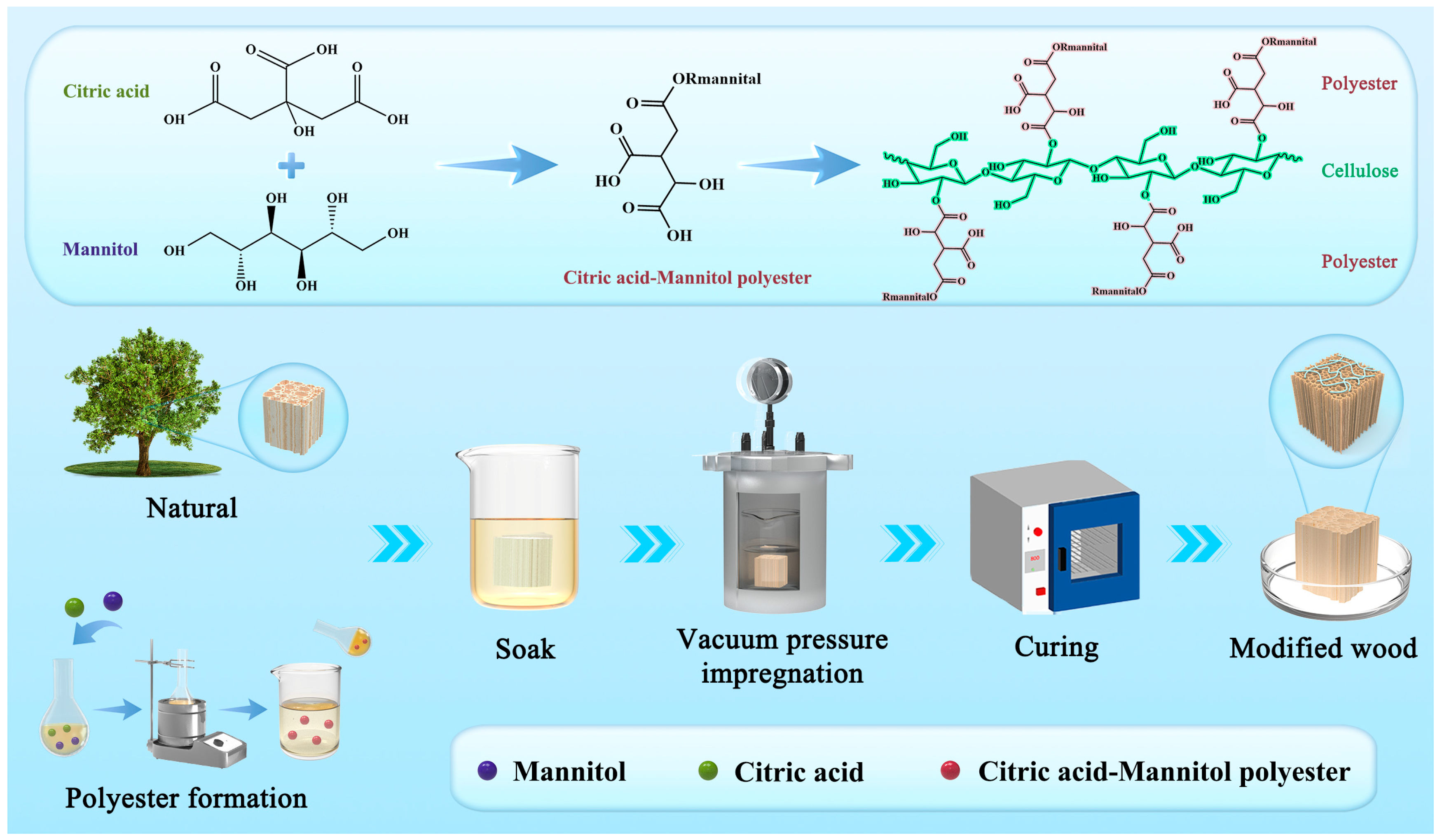
The chemical process for the wood modification is illustrated in Figure 1. A solvent-free esterification reaction was carried out between CA and mannitol in a 3:1 molar ratio. The solid mixture was mechanically stirred and heated to 130 °C to completely melt and start the synthesis. The reaction system was then kept at this temperature for 4 h. After the synthesis was completed, the melt was naturally cooled to below 50 °C. Finally, the calculated amount of deionized water was added to prepare the final homogeneous water-based treatment agents with solid contents of 20%, 30%, and 40%.
The wood samples were placed in a beaker and soaked with CA–mannitol polyester solutions of different concentrations. Then, the beaker was moved into a pressure tank. The poplar samples were first soaked in a vacuum environment of 0.06 MPa for 30 min, and then pressed under a pressure state of 0.6 MPa for 5 h. After impregnation was complete, the wooden blocks were removed from the tank, and absorbent paper was used to wipe off the excess solution. A two-stage thermal curing schedule was subsequently applied: pre-curing at 60 °C for 12 h, followed by final curing at 120 °C for 24 h.

2.3. Microstructure Characterization

2.3.1. Scanning Electron Microscope (SEM) Analysis

Surface characterization of the wood specimens was performed with a scanning electron microscope (MIRA LMS, TESCAN ORSAY HOLDING a.s., Brno, Czech Republic) operating at a 20 kV accelerating voltage. To secure sufficient electrical conductivity, a gold film was sputtered onto the materials beforehand. Concurrent with morphological imaging, elemental composition was determined via an integrated energy-dispersive X-ray (EDX) detector. All SEM observations were conducted on the modified wood samples prior to the leaching tests.

2.3.2. X-Ray Diffraction (XRD) Analysis

XRD analysis was performed on untreated and CA–mannitol polyester-modified wood samples using an X-ray diffractometer (Ultima IV, Rigaku Corporation, Tokyo, Japan). The diffractograms were recorded over a 2θ range of 5–80° at a scanning rate of 8° min−1.

2.4. Chemical Composition Characterization

2.4.1. Fourier Transform Infrared (FTIR) Spectroscopy Analysis

The Fourier transform infrared spectrometer (Tensor 27, Bruker Corporation, Ettlingen, Germany) was used to detect the changes in functional groups and chemical variables. The dried wood powder (control and treated) and KBr were ground at a mass ratio of 1:100 to make test sample tablets. Each final spectrum was obtained by 64 accumulative scans with a resolution of 4 cm−1 and a wavenumber range of 4000–500 cm−1.

2.4.2. CP/MAS 13C NMR Spectroscopy

Solid-state cross-polarization/magic angle spinning (CP/MAS) 13C NMR measurements were performed using a Bruker Avance Neo 400 WB spectrometer (Bruker Corporation, Ettlingen, Germany) operating at a 13C resonance frequency of 100.67 MHz, equipped with an H/X double resonance probe. The dried wood samples were ground into a fine powder, and approximately 100 mg of the powder was packed into a 4 mm zirconia (ZrO2) rotor and compacted. The MAS rotation speed was set to 8 kHz. The spectra were acquired using the CP technique with a contact time of 2 ms, a relaxation delay of 1 s, a pulse width of 3.13 μs, and 3000 scans per sample.

2.4.3. Raman Spectroscopy and Imaging Analysis

Cross-sections with a thickness of approximately 20 μm were prepared using a microtome ((Leica SM2000 R, Leica Microsystems, Wetzlar, Germany). The thin sections were placed on glass slides and analyzed using a high-resolution confocal laser Raman microscope (alpha300R, WITec GmbH, Ulm, Germany) equipped with a 532 nm diode laser. Raman measurements were performed using a Zeiss 100× objective lens (EC Epiplan-Neofluar DIC 100×/0.9, Carl Zeiss, Oberkochen, Germany). Spectral data were collected by mapping a 30 μm × 30 μm area. Raman spectra were acquired at a laser power of 20 mW with an integration time of 4 s per spectrum.

2.5. Wettability Analysis

2.5.1. Surface Wettability Measurement

The water contact angle (WCA) of the wettability of the surface of the treated material was measured using a JC2000D3R contact angle measuring instrument (Shanghai Zhongchen Digital Technology Equipment Co., Ltd., Shanghai, China). A 5 μL drop of deionized water was placed on the cross-section of the sample, and the dynamic wetting process was tracked within 300 s, and a photo was taken every 60 s. The average value was calculated by selecting 5 random points on each sample surface to ensure that the statistical results were stable and reliable.

2.5.2. Weight Percentage Gain (WPG) and Bulking Efficiency (BE)

The weight percentage gain and bulking efficiency of the wood specimens were calculated from oven-dry mass and volume measurements taken before and after the modification process. Ten replicate samples were tested for each treatment group to calculate the average WPG and BE. The corresponding calculations are given by Equations (1) and (2):
WPG = m 1 m 0 m 0 × 100 %
BE = V 1 V 0 V 0 × 1 00 %
where m0 and m1 are the oven-dry weights of the samples before and after treatment, respectively, and V0 and V1 are the oven-dried volumes of the samples before and after treatment, respectively.

2.5.3. Leaching Rate (LR)

Following drying, the modified wood samples (20 mm × 20 mm × 20 mm) were immersed in 1000 mL of deionized water for 168 h, with the water replaced every 12 h. The samples were retrieved and dried in an oven at 103 °C until a constant mass was attained. Five replicate samples per group were used for the leaching evaluation. The LR was then determined using Equation (3):
LR = m 1 m 2 m 1 m 0 × 100 %
where m0 represents the initial oven-dry weight of the wood before modification, m1 is the oven-dry weight of the modified wood, and m2 is the oven-dry weight of the wood after soaking for 168 h.

2.5.4. Water Uptake and Moisture Absorption Test

In accordance with the Chinese National Standard GB/T 1927.7–2021, all samples were oven-dried at 103 °C to obtain their initial dry mass prior to testing. For the water absorption test, the specimens were immersed to a depth of 50 mm in deionized water, and a stainless-steel mesh was used to press the samples down to ensure complete submersion throughout the 24 h test period. The mass and volume of the specimens were recorded at 1 h intervals during immersion.
Moisture absorption was evaluated by exposing the samples in a constant-climate chamber (HD-E702-100B40, Haida International Equipment Co., Ltd., Dongguan, China) maintained at 20 °C and 85% relative humidity. The sample mass was measured at 24 h intervals over a total exposure time of 192 h. Three replicate specimens per group were evaluated for water absorption and hygroscopicity tests. The water uptake or moisture absorption rate (W) in both tests was calculated using Equation (4).
W = m i m 0 m 0 × 100 %
where m0 is the initial mass of the oven-dried wood sample, and mi denotes the mass of the wood after immersion in water or exposure to moisture at the prescribed time.
The volume swelling coefficient was determined using Equation (5), with results reported to an accuracy of 0.1%:
S = V 0 V i V 0 × 100 %
where V0 is the initial volume of the oven-dried sample (cm3), and Vi is the volume after immersion in water or exposure to water vapor (cm3).
Dimensional stability was evaluated in terms of the anti-volume swelling coefficient (ASE), which was calculated based on Equation (6) and was reported to an accuracy of 0.1%:
ASE = S 0 S i S 0 × 100 %
where S0 and Si represent the swelling coefficients of the untreated and treated wood samples, respectively.

2.6. Mechanical Strength Analysis

Brinell Hardness Test. The Brinell hardness (HB) was measured in accordance with the European standard EN 1534 [57], with minor modifications following the method described by Rautkari et al. [58]. A universal testing machine (UTM5105, Shenzhen SUNS Technology Stock Co., Ltd., Shenzhen, China) equipped with a spherical indenter of 11.28 mm in diameter was used for the measurements. The load was increased to a maximum value of 1000 N within 15 s, held for 25 s, and then gradually released over 15 s. Three indentation points were tested on each of the three replicate specimens per group. Invalid measurements due to natural wood defects were excluded, and the final valid sample sizes (n) are detailed in Section 2.7. The HB was calculated using Equation (7).
HB = F π × D × h max
where F is the maximum loading force; D is the diameter of the indenter; and h is the maximum indentation depth.
Compressive strength tests. The compressive strength of the wood was measured to evaluate the effect of the modification on its mechanical properties. According to the Chinese National Standard GB/T 1927.11–2022, compression tests were conducted both parallel and perpendicular to the grain using specimens with dimensions of 30 mm × 20 mm × 20 mm (L × T × R). All mechanical tests were performed using a universal testing machine. Compressive tests were conducted with at least three replicate specimens per group to ensure statistical reliability. The exact sample sizes (n) for each structural direction and treatment group are explicitly specified in Section 2.7. The compression strength was calculated in accordance with the standard specifications, and the results are presented as mean values with standard deviations.

2.7. Statistical Analysis

Data are expressed as mean ± standard deviation (SD). Sample sizes ( n ) were as follows: n = 8 (control and 30% groups) or n = 4 (20% and 40% groups) for Brinell hardness; n = 4 (control and 30%) or n = 3 (20% and 40%) for longitudinal compressive strength; and n = 3 for radial and tangential compressive strength. Statistical analyses were performed using SPSS 29.0 (IBM, Armonk, NY, USA). Group differences were evaluated via one-way analysis of variance (ANOVA), followed by Fisher’s LSD or Tamhane’s T2 post hoc tests, depending on the homogeneity of variances assessed by Levene’s test. Significance was set at p < 0.05, denoted by different lowercase letters in the figures.

2.8. Thermostability Analysis

Thermogravimetric (TG) tests were carried out using a TG 209 F1 (NETZSCH-Geratebau GmbH, Selb, Germany) analyzer to determine thermal stability. Approximately 10 mg of the pulverized material was placed in an Al2O3 crucible before scanning. Thermal analysis was conducted under a dynamic N2 environment (purged at a flow rate of 20 mL min−1). The furnace temperature was raised from 50 °C to 800 °C at a rate of 10 °C min−1, and the weight loss was continuously recorded.

3. Results and Discussion

3.1. Microstructure Characterization

3.1.1. Scanning Electron Microscope Analysis

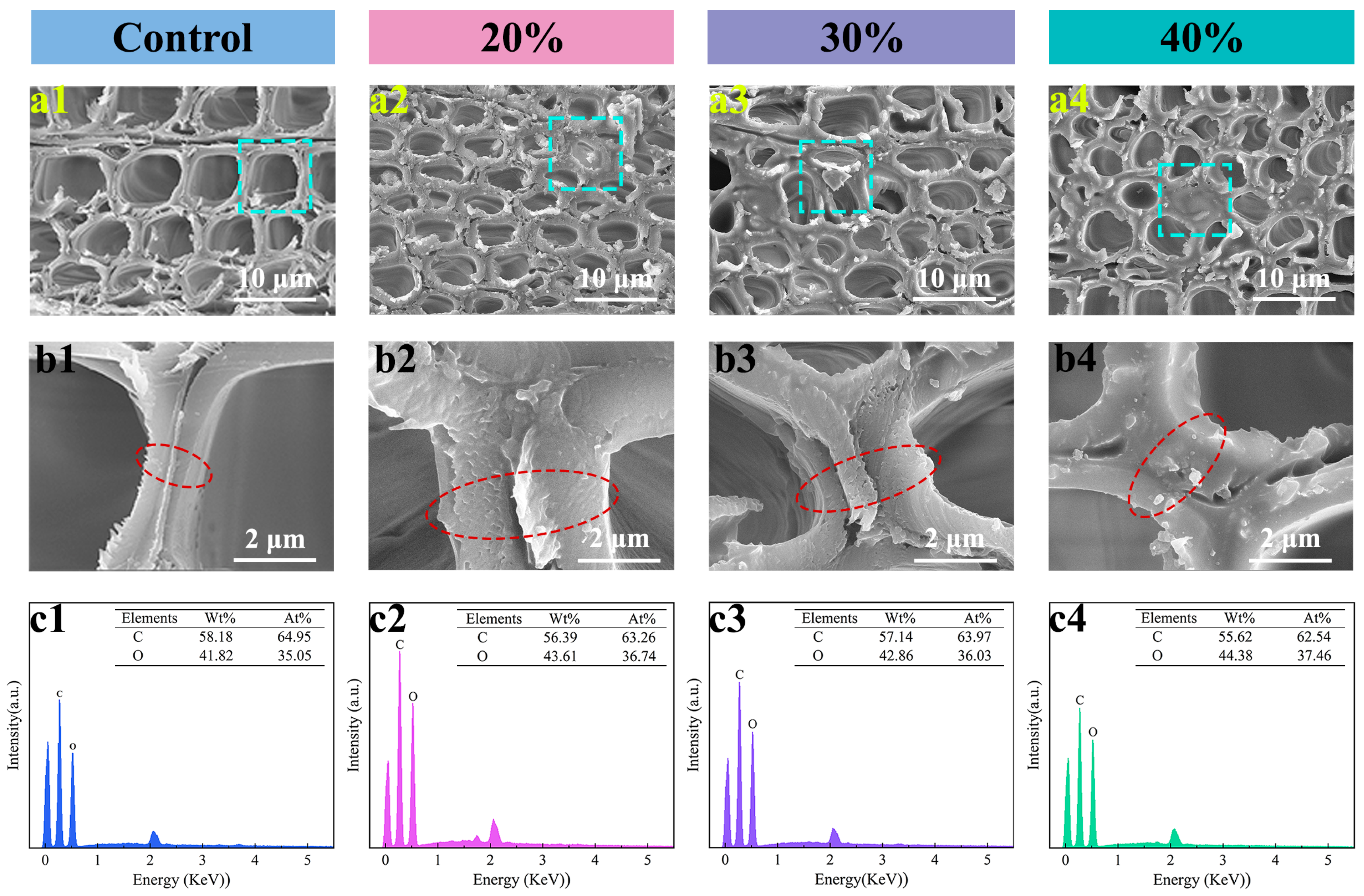
The microstructure of unmodified poplar wood and CA–mannitol-modified poplar wood was studied by SEM-EDX. The cell walls of the control wood in Figure 2(a1,b1) are relatively thin, and there are many voids. The cell walls of the modified wood Figure 2(a2–a4) are thickened, and there are fewer voids. This morphological alteration can be attributed to the bulking effect and the subsequent in situ polymerization of the CA–mannitol polyester within the cell wall structure. Such microstructural modifications suggest an increase in cell wall density and structural consolidation.
As shown in Figure 2(a2–b4), numerous CA–mannitol polyester deposits and local agglomerations were observed to be tightly adhered to the cell walls. Unlike the loose cutting residues occasionally seen in control samples, the presence of these polymers was chemically confirmed by the EDX results (Figure 2(c1–c4)), which show a noticeable increase in oxygen content (up to 44.38 wt%) due to the highly oxygenated nature of the CA–mannitol polyester. These polymer depositions formed a continuous coating, resulting in a noticeably textured and uneven surface morphology.

3.1.2. X-Ray Diffraction Analysis

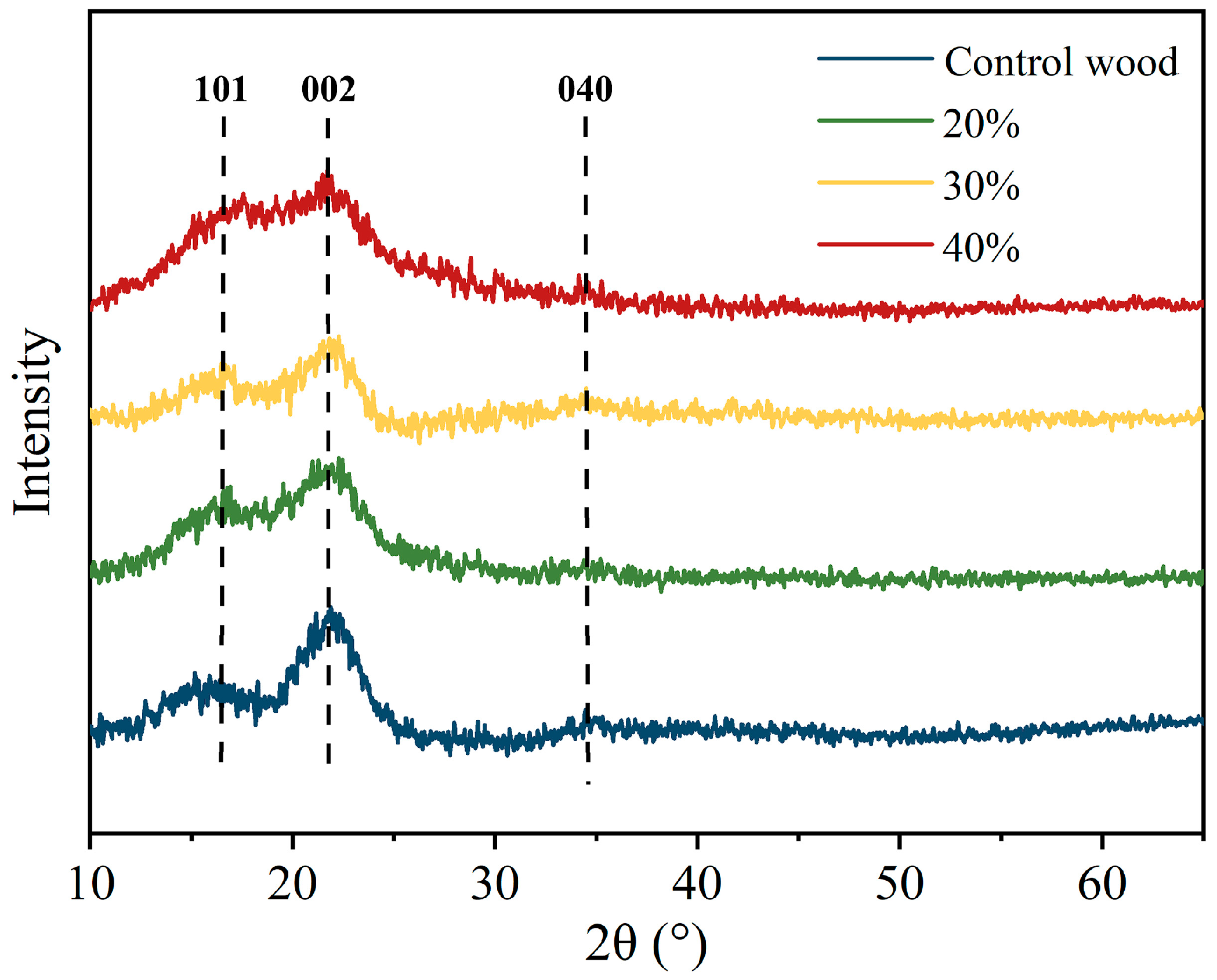
The XRD patterns shown in Figure 3 exhibit the characteristic diffraction peaks of cellulose Iβ (the dominant, naturally occurring, and thermodynamically stable crystalline phase of cellulose in higher plants, characterized by a monoclinic crystal structure) at approximately 15°, 22°, and 35° (2θ), corresponding to the (101), (002), and (040) crystallographic planes, respectively [59]. Across the treated groups, the characteristic diffraction angles exhibited no discernible shifts, confirming that the native crystalline framework of the wood remained predominantly intact. In contrast to the untreated reference, however, the specimens subjected to 20%, 30%, and 40% modification levels experienced a drop in their overall relative crystallinity. This decrease was evidenced by the noticeably weakened intensity of the 002 crystalline peak relative to the broader signal of the amorphous region around the 101 peak. The primary reason for this overall decrease is the successful deposition of the CA–mannitol polyester within the wood matrix. Because this newly formed polymer is non-crystalline (amorphous), its massive presence significantly increases the amorphous mass fraction of the bulk material, thereby diluting the relative proportion of crystalline cellulose [31]. Additionally, the esterification of accessible hydroxyl groups may weaken some intermolecular hydrogen bonds, partially disrupting the ordered arrangement of cellulose chains at the surfaces of crystalline regions, further contributing to the observed decrease [60].

3.2. Chemical Composition Characterization

3.2.1. Fourier Transform Infrared Spectroscopy Analysis

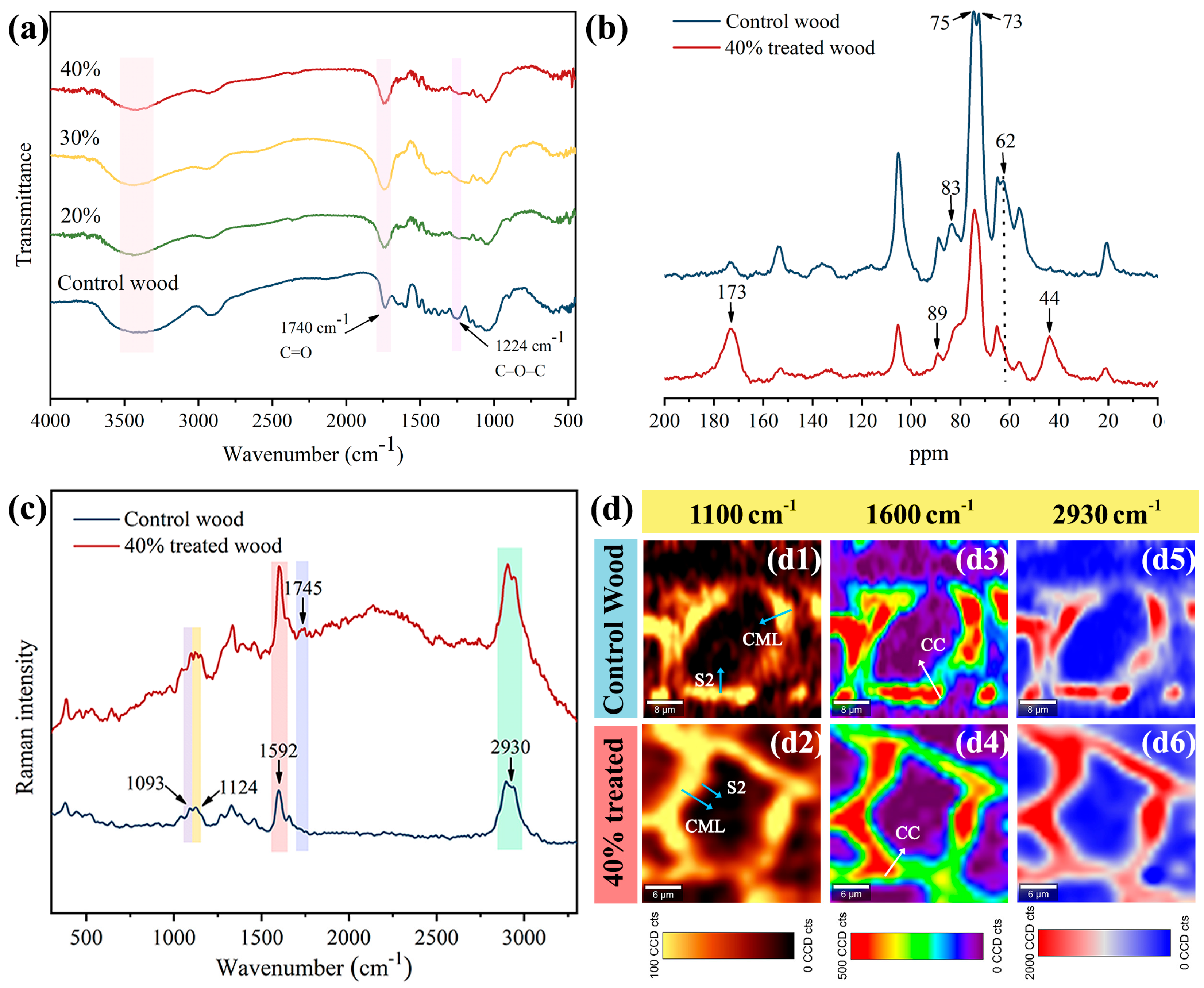
FTIR was used to explore the chemical interaction between CA–mannitol polyester and wood cell walls (Figure 4a). Compared with untreated wood, the absorption peak of modified poplar at 3300–3600 cm−1 was weaker, which is due to the stretching vibration of hydroxyl groups in cell wall polysaccharides [61]. The alteration of the hydroxyl absorption band suggests that the accessible wood hydroxyl groups actively participate in the esterification reactions. This improvement can reduce the hydrophilic functional groups in wood, reduce its water absorption, and improve the dimensional stability of the treated wood.
After impregnation, the absorption band at 1740 cm−1 for the C=O stretching vibration in the native hemicellulose and the ester bond of CA–mannitol polyester became stronger. The prominent absorption peak at 1740 cm−1 indicates the formation of ester bonds, confirming that the wood structure has been chemically modified. It is noteworthy that the intensity of this signal for the 40% modification was slightly lower than that for the 30% modification. This slight decrease in peak intensity can likely be attributed to natural structural variations inherent to the wood samples and minor fluctuations in the unnormalized spectra. The broadening of the band at 1224 cm−1 was due to the asymmetric C-O-C stretching vibration of the formed ester bonds [47]. The FTIR results confirm the abundant formation of ester bonds within the modified wood matrix. It should be noted that these ester linkages likely resulted from both the chemical cross-linking between the CA–mannitol system and the wood cell wall polymers, as well as the self-condensation of the polyester itself.

3.2.2. CP/MAS 13C NMR Spectroscopy Analysis

CP/MAS 13C NMR was used to study the key structures of wood polymers. This technique is widely used to analyze the cases of anhydride and polyol-modified wood [62]. As shown in Figure 4b, an obvious resonance peak at about 173 ppm was observed in the modified wood, which is characteristic of the ester carbonyl carbon, confirming the formation of the ester bond. This is consistent with the previous reports on CA-1-butanol polyester [63] and other CA-based wood modification systems [64,65].
The ester carbonyl signal at 173 ppm may come from (A) CA–mannitol polyesters formed within the cell wall that act as bulking agents, (B) the ester bond between CA and the natural wood polymer component, or (C) the CA–mannitol polyester covalently bound to the wood polymer [66]. The results show that the residual carboxyl groups of CA participated in extensive esterification reactions during modification, forming a chemically bonded network within the wood cell wall. This stable ester bond structure is expected to be the key to improving dimensional stability and reducing the hygroscopicity of modified wood.
A second resonance centered at approximately 44 ppm was observed in the spectrum of the modified wood. Since any low-molecular-weight by-products (such as methanol) generated during the chemical transformations would have been completely volatilized at the high curing temperatures, this signal cannot be attributed to residual methanol. A highly plausible interpretation proposed by Noordover et al. [63] assigns the resonance at approximately 44 ppm to the –CH2–COOH moiety of CA or its corresponding ester structures. This assignment is fully compatible with our citric-acid-based polyester system and strongly supports the presence of esterified CA species within the modified wood matrix. In addition, the modified wood exhibited a pronounced decrease in signal intensity at around 62 ppm, which is commonly associated with primary hydroxyl-bearing carbon environments in native wood polymers. This attenuation suggests the chemical involvement of these functional groups in esterification reactions with the introduced polyester. Such reactions are generally attributed to the aliphatic side chains of lignin [67] or the primary hydroxyl groups at the C-6 position of wood polysaccharides [68]. Overall, the NMR results provide strong complementary evidence to the FTIR and Raman analyses, further confirming the successful formation of ester linkages within the modified wood matrix.

3.2.3. Raman Spectroscopy and Imaging Analysis

This study aimed to elucidate modification-induced structural changes in wood cell walls following treatment with CA–mannitol polyester, with particular emphasis on assessing the formation of cross-links between the polyester and cell wall polymers. Confocal Raman microscopy was employed to obtain component-specific Raman spectra and corresponding chemical maps of selected cell wall regions, allowing high-resolution spatial visualization of the chemical modification effects.
Raman spectra of the wood cell wall polymers were extracted from the confocal Raman microspectroscopy dataset. As shown in Figure 4c, the bands at 1124 cm−1 and 1093 cm−1 are assigned to the symmetric and asymmetric stretching vibrations of C–O–C linkages in cellulose, respectively [69]. The band at 1592 cm−1 corresponds to the aromatic ring stretching vibration characteristic of lignin. In addition, the band at 2930 cm−1, attributed to CH2 stretching vibrations, originates from both cellulose and lignin [70]. The presence of these characteristic vibrational bands indicates that the intrinsic cell wall components were preserved after modification, while simultaneously interacting with the introduced CA–mannitol polyester. Raman images acquired by scanning the wood cross-section (Figure 4d) highlight the spatial distribution of cellulose- and lignin-associated peaks within the cell wall structure. Consistent with the FTIR findings, the Raman spectra provide further evidence for the existence of chemical bonding between the CA–mannitol polyester and the wood cell wall polymers.
Figure 4(d1–d4) shows that cellulose and lignin were evenly distributed in the cell wall, which suggests that the overall morphological integrity of the cell wall structure is largely maintained, with no severe macroscopic disruption observed during the CA–mannitol polyester impregnation [71]. Raman mapping of lignin, obtained by integrating the band at 1600 cm−1 (1550–1640 cm−1)—a characteristic aromatic vibration absent in the aliphatic CA–mannitol polyester-revealed a higher signal intensity in the cell corners (CC) and compound middle lamella (CML) of the modified wood compared with the control. This localized signal enhancement suggests the preferential accumulation of the polyester in these lignin-rich regions, which densifies the local structure and consequently intensifies the Raman scattering of the intrinsic lignin.
The cellulose distribution, visualized by integrating the 1090–1105 cm−1 band (Figure 4(d1,d2)), showed strong signals predominantly in the S2 (one of the three sublayers of the cell wall) layer and the middle region of the CML. After modification, the cellulose-related Raman signals became more homogeneous, while the enhanced overall signal intensity indicates an increased relative presence of the polyester within the cell wall matrix. In addition, the intensified CH2 stretching vibrations (2780–3060 cm−1) observed in the S2 layer suggest a denser molecular packing and improved structural consolidation of the cell wall following modification.

3.3. Wettability Analysis

3.3.1. Surface Wettability Measurement

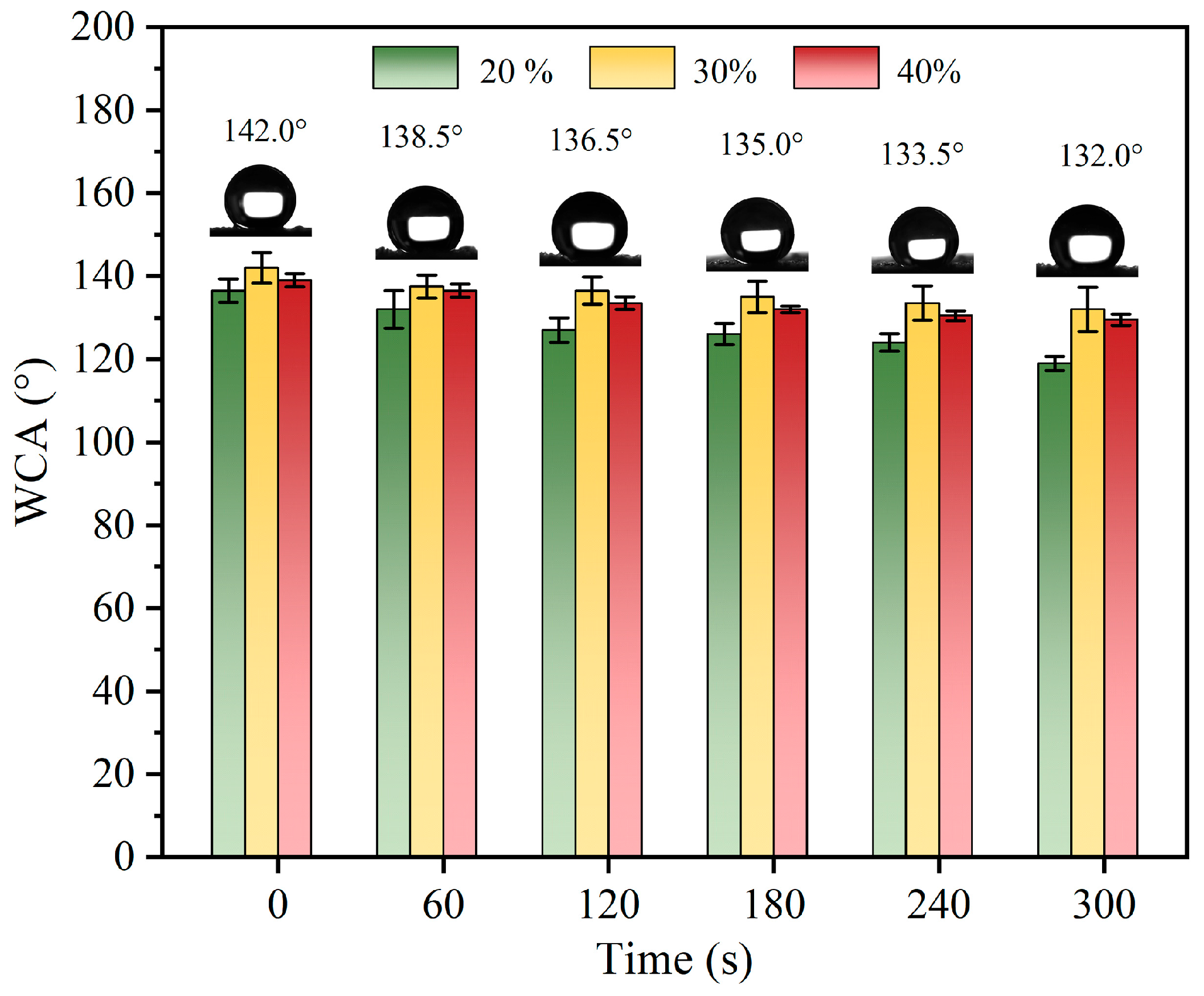
As shown in Figure 5, surface wettability was evaluated by WCA measurements. Wood exhibits inherent hydrophilicity owing to the abundant density of hydroxyl (–OH) groups in its primary constituents, such as cellulose and hemicellulose [72,73]. Therefore, untreated wood showed a low initial WCA of 65°, followed by complete water absorption within 20 s.
In contrast, wood treated with 20%, 30%, and 40% CA–mannitol polyester solutions exhibited WCAs exceeding 90° (136.5° ± 2.9°, 142.0° ± 3.7°, and 139.0° ± 1.6°, respectively), indicating a clear transition from hydrophilic to hydrophobic surface behavior. After 300 s, the WCAs of the polyester-treated samples remained high: 119.0° ± 1.7°, 132.0° ± 5.3°, and 129.5° ± 1.4° at increasing concentrations, respectively, demonstrating stable and persistent hydrophobicity.
The enhanced hydrophobicity can be attributed to the combined effects of chemical and structural modifications induced by the CA–mannitol polyester. FTIR analysis indicated a reduction in hydroxyl groups and the formation of ester linkages, as evidenced by the decreased intensity and narrowing of the broad –OH stretching vibrations, alongside the appearance of characteristic carbonyl C=O and C–O–C bands, which collectively decrease the wood surface polarity (Figure 4a).

3.3.2. Weight Percentage Gain and Bulking Efficiency

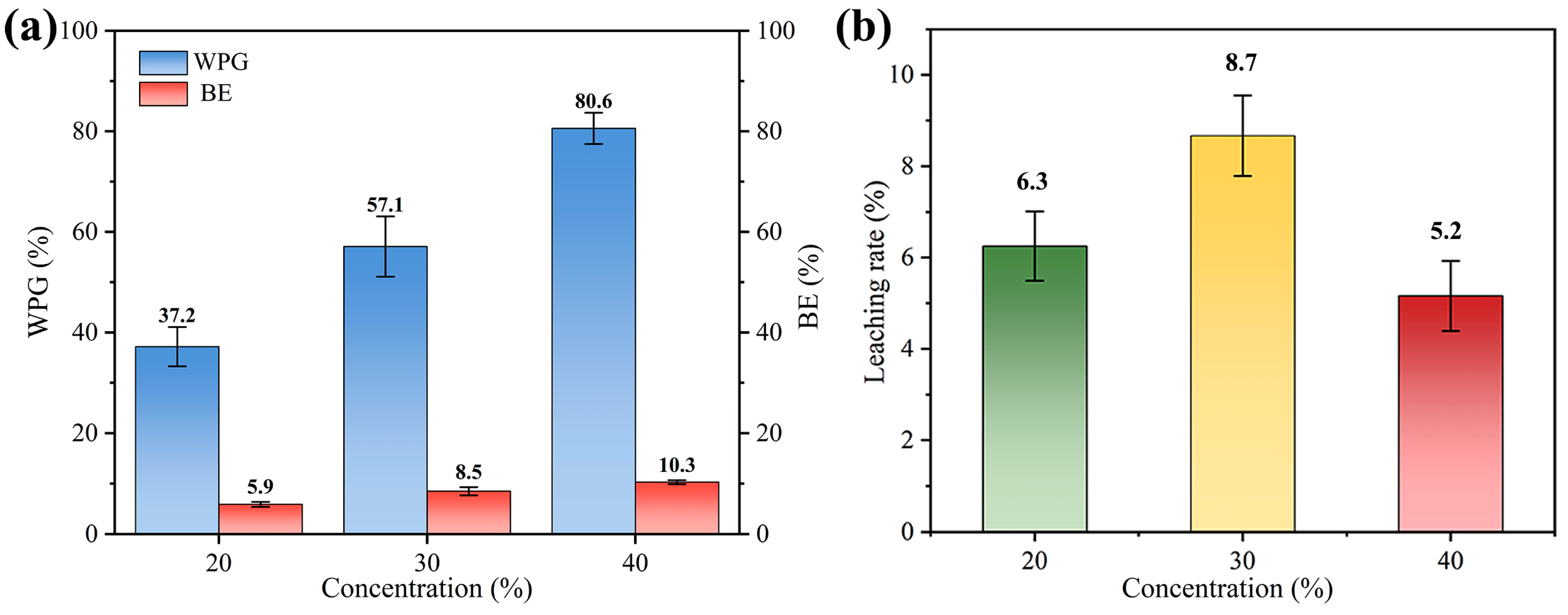
Figure 6a presents the WPG and BE of the wood specimens before and after modification. Both WPG and BE increased with higher modifier concentrations; however, the rate of increase in BE noticeably diminished at higher concentrations. This trend is consistent with the physical limitation of the wood cell wall, which approaches a saturation point as its void volume becomes gradually filled by the modifier. The simultaneous increase in WPG and BE indicates that a higher modifier concentration not only resulted in a greater mass increase but also induced a more pronounced cell wall expansion, demonstrating the effective incorporation of polyester within the wood matrix.

3.3.3. Leaching Rate

As shown in Figure 6b, after soaking in deionized water for 7 days, the LR of the modified wood treated with 20%, 30%, and 40% modifier concentrations were 6.3%, 8.7%, and 5.2%, respectively. Compared to a structurally similar citric acid/polyhydroxyl cross-linking system reported by He et al., which had an LR of approximately 15% [74], our CA–mannitol system exhibited a much lower LR, indicating a significant improvement in leaching resistance. The low LR value means that the CA–mannitol polyester was well fixed in the wood matrix and that the polyester network remained in the cell wall. This stable retention is expected to enhance the durability of the modification and thereby improve the long-term water resistance and dimensional stability of treated wood [75]. The peak leaching rate observed at the 30% concentration is likely primarily attributed to the larger absolute amount of unreacted monomers and the generation of water-soluble fragments from mild acid-catalyzed hydrolysis of hemicelluloses. Conversely, the significant drop in the leaching rate at 40% could possibly be explained by the hypothesis that the excessively high concentration may have triggered severe self-condensation, forming highly water-resistant macromolecular networks. These bulky self-polymers might have concentrated near the wood surface, potentially blocking the micro-pores and thereby restricting the outward leaching of internal water-soluble components.

3.3.4. Water Uptake and Moisture Absorption Test

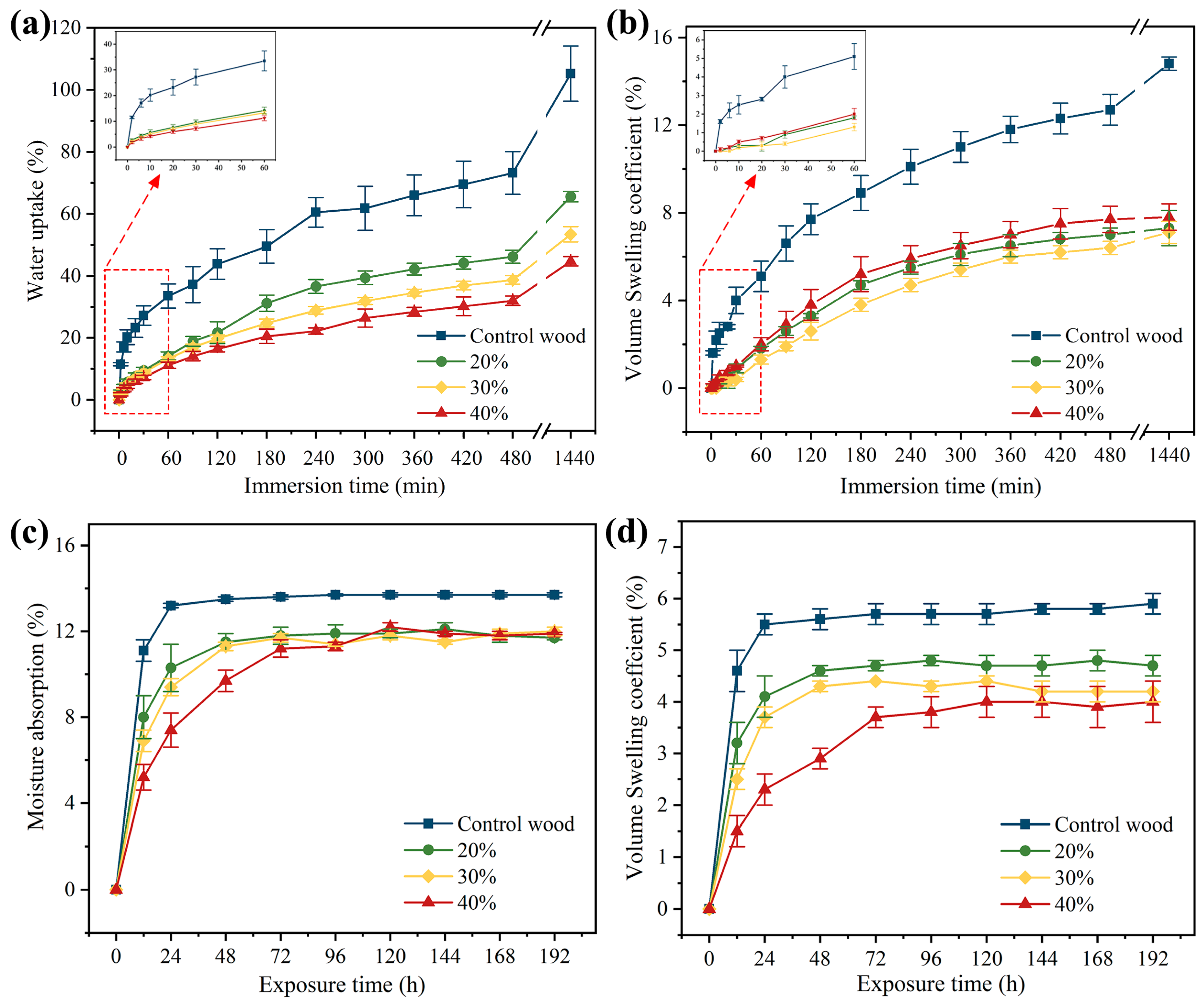
Figure 7a shows the water absorption of the control and modified wood samples at different concentrations over 24 h. In the first 30 min, the water absorption of all samples increased rapidly because water infiltrated into the porous wood by capillary action, and the cell wall matrix was permeable. After soaking for 24 h, the water absorption of the control wood reached 105%, while the water absorption of the modified samples treated with 20%, 30%, and 40% was 66%, 53%, and 45%, respectively.
Figure 7b shows the change in the volume swelling coefficient over time, which was used to monitor the dimensional stability during water absorption. After soaking for 24 h, the volume swelling rate of the control wood was 14.8%, which was much higher than that of the modified wood treated with 20%, 30%, and 40% modifier concentrations (7.3%, 7.1%, and 7.8%, respectively). When the wood modified concentration rates reach 20%, 30%, and 40%, the corresponding ASE values were observed to be 50.7%, 52.0%, and 47.3%, respectively. The results show that the CA–mannitol polyester modifier can limit the moisture absorption and swelling of wood, thereby improving the dimensional stability of the treated wood.
Figure 7c presents the correlation between wood moisture absorption kinetics and exposure time and modifier concentration. The moisture absorption rate was relatively fast in the first 12 h, and then it gradually approached the equilibrium state and became stable after about 48 h. A difference in equilibrium moisture content between the untreated sample and the modified samples was observed; the water absorption of all modified samples was lower than that of the control group. After 192 h of exposure, the modified wood reached a stable moisture content of about 12%, which was significantly lower than the 14% of the control group. Figure 7d compares the volumetric changes in wood during moisture absorption before and after modification. After 192 h of moisture exposure, the volumetric swelling of the control wood reached 5.9%, whereas the swelling values for the wood modified at 20%, 30%, and 40% were reduced to 4.7%, 4.2%, and 4.0%, respectively, corresponding to reductions of 20.3%, 28.8%, and 32.2%. Based on the moisture-induced volumetric swelling coefficients, the maximum ASE attained was 32.2%. Collectively, these results indicate that CA–mannitol polyester modification effectively suppresses moisture uptake and moisture-induced deformation, thereby enhancing the hygroscopic and dimensional stability of fast-growing poplar.
The observed reduction in water uptake and moisture absorption is primarily attributed to the stable incorporation of a cross-linked CA–mannitol polyester network within the wood microstructure. When water penetrates the cell wall, volumetric expansion occurs as water molecules occupy transient microcapillary pathways within the cell wall matrix [76]. Following polyester incorporation, the impregnated polyester precursors permeated the macroporous structure and cell walls and subsequently formed an in situ cross-linked network that physically occupies available free volume. This network hinders water transport within the cell wall and effectively restricts moisture-induced swelling. In addition, residual carboxyl groups from CA underwent esterification reactions with hydroxyl groups of the wood polymers during the curing process, thereby reducing the availability of hydrophilic hydroxyl sites and further limiting the water uptake capacity of the modified wood [77,78].

3.4. Mechanical Strength Analysis

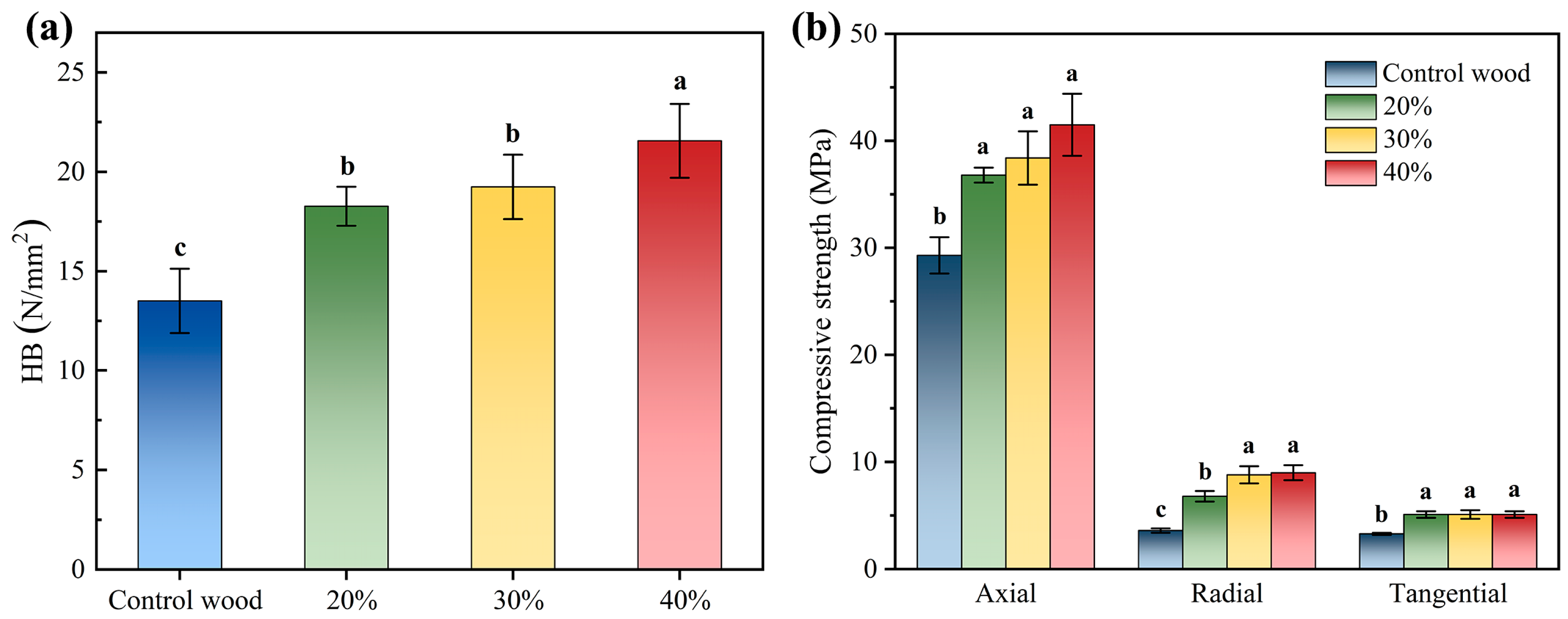
To systematically evaluate the influence of CA–mannitol polyester modification on the mechanical behavior of poplar, Brinell hardness and compressive strength tests were conducted to compare untreated and treated specimens. As shown in Figure 8a, the HB of the modified wood was higher than that of the control poplar. With the increasing concentration of CA–mannitol polyester solution, the HB value increased. The HB value of the control poplar was 13.5 N/mm2. For the treatment groups with modifier concentrations of 20%, 30%, and 40%, the HB values reached 18.3, 19.2, and 21.5 N/mm2, representing significant increases of 35.2%, 42.4%, and 59.6%, respectively. Statistical analysis revealed that while there was no significant difference between the 20% and 30% modified samples, the hardness peaked significantly at the 40% concentration. Fundamentally, this overall enhancement in hardness compared to the control is attributed to the cross-linking and filling of CA–mannitol polyester within the wood pores and cell walls, which increases the wood’s resistance to local deformation under load [79]. Furthermore, the compressive strengths in the three principal directions (longitudinal, radial, and tangential) were measured, as shown in Figure 8b.
The longitudinal (denoted as axial in Figure 8b) compressive strength of wood in the grain direction of the control group was 29.3 MPa. The compressive strengths in the grain direction of the samples treated with 20%, 30%, and 40% CA–mannitol polyester solutions reached 36.8, 38.4, and 41.5 MPa, respectively, and the increases were 25.6%, 31.1%, and 41.7%. The radial compressive strength was significantly improved, changing from 3.6 MPa (control group) to 6.8, 8.8, and 9.0 MPa. The compressive strength of the modified samples increased by 88.9%, 144.4%, and 150.0%, respectively. In addition, the tangential compressive strength of the modified wood was, on average, 54.5% higher than that of the control. Statistical analysis demonstrated that the modification significantly improved compressive strengths in all three directions (p < 0.05), with the maximum significant enhancement achieved at a 20% concentration for the longitudinal and tangential directions and at a 30% concentration for the radial direction.
The specific mean values and standard deviations of the compressive strengths in the three directions are summarized in Table 1. The more substantial improvements observed in the radial and tangential directions suggest that the CA–mannitol polyester modification is particularly effective in enhancing transverse compressive strength. The observed remarkable enhancement in compressive strength is primarily attributed to the successful impregnation and filling of the wood void spaces by the modifying agents, providing solid mechanical support, as strongly evidenced by the high WPG. During the pressure-driven impregnation, a large amount of the synthesized CA–mannitol polyester solidly filled the cell lumens and voids. While the formation of a cross-linked network within the cell walls provides secondary intrinsic reinforcement, this extensive physical filling acts as the primary driver for the mechanical improvement. The filled polymers function as robust internal scaffolds or physical “pillars” that effectively support the cellular architecture and prevent the cell walls from buckling under transverse load, thereby drastically improving the wood’s overall resistance to compressive deformation.

3.5. Thermostability Analysis

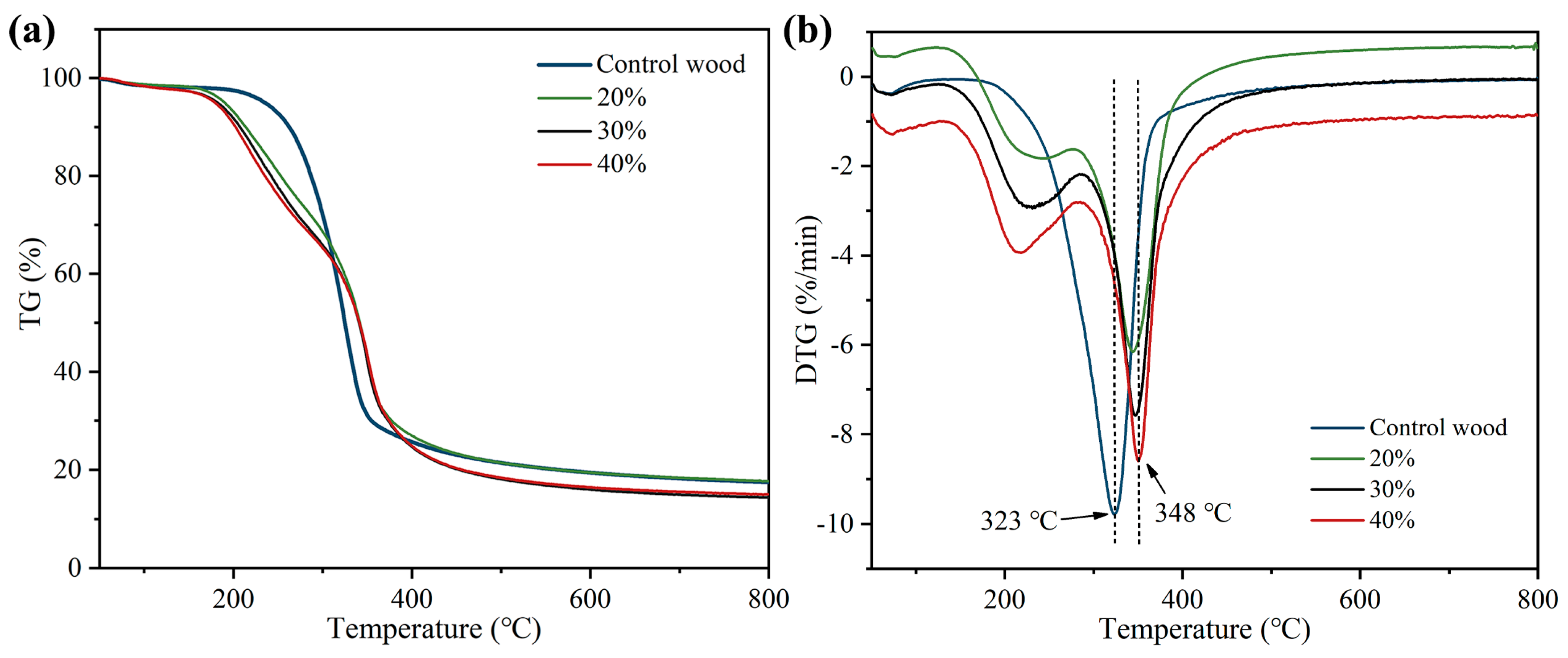
Figure 9a shows the thermogravimetric curves of the samples. At 50–100 °C, a slight initial weight loss was observed for all samples, which was mainly attributed to the evaporation of moisture in the wood samples. The key thermal parameters of untreated/treated materials, such as T50% and Tmax, are listed in Table 2. Compared with the original wood, the main thermal degradation stages of the modified wood shifted to higher temperatures, with an average upward shift of about 15.5 °C for T50% and 24.3 °C for Tmax. Overall, the thermogravimetric curves indicated a complex three-stage thermal degradation behavior. Following initial moisture evaporation, the treated specimens exhibited an earlier and more pronounced mass loss starting around 150–250 °C. This first stage of thermal degradation is primarily attributed to the thermal decomposition of the newly formed CA–mannitol polyester, alongside the degradation of the remaining unreacted solid precursors, which typically degrade in this lower temperature range as reported in other CA-polyol systems [43]. At higher temperatures, however, the barrier formed by the cross-linked structure acts as a thermal shield. This barrier blocks heat transfer and successfully slows down the decomposition of natural wood polymers. Specifically, as the temperature increased, the derivative thermogravimetry (DTG) curve showed the most obvious weight loss peak at about 345 °C (the second stage), where the cellulose chains underwent rapid thermal degradation. Meanwhile, lignin decomposed slowly, and its weight loss occurred over a wide range from about 300 °C to 500 °C (the third stage).
As shown in the DTG curves (Figure 9b), the pyrolysis rate of the untreated sample was faster, with a maximum weight-loss rate of −9.8%/min. In contrast, the decomposition peaks of the polymerized samples became weaker, and the maximum mass depletion velocities dropped to −6.68, −7.56, and −7.75%/min at impregnation concentrations of 20%, 30%, and 40%, respectively. This reduction in the peak degradation rate is the combined result of three factors. First, as discussed above, it is attributed to the fact that the added CA–mannitol mass had already decomposed at a lower temperature, leaving a smaller relative mass fraction to degrade at this main stage. Additionally, the pyrolysis of the remaining wood components was genuinely slowed down because a strong transesterification cross-linking structure is formed between the polyester network and the hydroxyl-rich lignocellulosic skeleton. Furthermore, the cured bulk polymer fills the cell pores, forming an effective physical barrier that restricts the thermal motion of polymer chains and prevents the outward diffusion of volatile degradation products. The final carbon residue of the treated matrix was slightly reduced compared with the unmodified reference sample. This is primarily due to the thermal properties of the modifier itself; specifically, the CA–mannitol polymer decomposes to a larger degree than the wood components, as the carbonization efficiency of the aliphatic chains in the mannitol-citrate system is lower than that of natural lignin. Additionally, the remaining unreacted carboxyl groups in CA may catalyze the premature dehydration or breakage of hemicellulose at high temperatures. The kinetic curves demonstrate that while initial degradation occurs earlier due to the polyester itself, the modification improves thermal stability during the main degradation stage by shifting key decomposition temperatures (T50% and Tmax) to higher ranges and reducing the maximum thermal decomposition rate.

4. Conclusions

In conclusion, this study successfully developed an entirely solvent- and catalyst-free strategy for wood functionalization, wherein the CA–mannitol prepolymers were impregnated into the wood and subsequently cured at 120 °C. This in situ-synthesized polyester significantly improved several properties of poplar. Microstructural and spectral analyses showed that the polyester successfully penetrated and cross-linked into the wood cell wall. Through NMR analysis, it was confirmed that ester bonds were formed. These modifications enhanced the hydrophobicity of the wood and improved its dimensional stability. Furthermore, the mechanical properties of the modified wood were effectively enhanced. Specifically, the Brinell hardness and the compressive strengths across all directions increased (e.g., the radial compressive strength increased by up to 150.0%). This structural reinforcement is primarily attributed to the physical filling of voids within the cell lumina and walls by the cured bulk polymer, which increases overall density, and is further supported by the cross-linked polyester network, which acts as an internal reinforcing scaffold.
The catalyst-free modification with CA–mannitol polyester greatly improved wood performance, providing an effective and sustainable approach to enhancing wood properties. The results indicated that CA–mannitol polyester has potential as a modifier for durable high-grade wood substrates and is suitable for structural and industrial applications. Future research should focus on optimizing the modification process and evaluating the long-term performance of modified wood under practical conditions so as to fully explore its commercial feasibility and potential for large-scale application.

Author Contributions

L.Y. and K.C.: writing—review and editing, writing—original draft, investigation, formal analysis, data curation, conceptualization. D.W.H.: writing—review and editing, supervision. L.Z.: formal analysis, validation. X.C.: methodology, supervision. K.X.: writing—review, and editing. L.X.: writing—review and editing, resources, funding acquisition, conceptualization. All authors have read and agreed to the published version of the manuscript.

Funding

This work was financially supported by the National Natural Science Foundation of China (No. 32360357), the Guangxi Key Research and Development Program (No. Guike AB25069381), and the 111 Project of the Ministry of Education of China (D21027).

Data Availability Statement

Data will be made available on request.

Conflicts of Interest

The authors declare no conflicts of interest.

References

  1. Churkina, G. Buildings as a global carbon sink. Nat. Sustain. 2020, 3, 269–276. [Google Scholar] [CrossRef]
  2. Payn, T.; Carnus, J.M.; Freer-Smith, P.; Kimberley, M.; Kollert, W.; Liu, S.; Orazio, C.; Rodriguez, L. Changes in planted forests and future global implications. For. Ecol. Manag. 2015, 352, 57–67. [Google Scholar] [CrossRef]
  3. Wang, Y.L. Review on China’s plantation development since the reform and opening up. For. Ecol. Manag. 2019, 1, 6–11. [Google Scholar] [CrossRef]
  4. Chang, F.Y.; Cao, Y.W.; Cu, M.M.; Wu, Z.H. Application of new materials in modern furniture design and manufacturing. Furniture 2015, 36, 31–37. [Google Scholar]
  5. Chen, H.; Montanari, C.; Shanker, R.; Marcinkevicius, S.; Berglund, L.A.; Sychugov, I. Photon walk in transparent wood: Scattering and absorption in hierarchically structured materials. Adv. Opt. Mater. 2022, 10, 2102732. [Google Scholar] [CrossRef]
  6. Brischke, C.; Alfredsen, G. Wood-water relationships and their role for wood susceptibility to fungal decay. Appl. Microbiol. Biotechnol. 2020, 104, 3781–3795. [Google Scholar] [CrossRef] [PubMed]
  7. Thybring, E.E.; Fredriksson, M. Wood modification as a tool to understand moisture in wood. Forests 2021, 12, 372. [Google Scholar] [CrossRef]
  8. Liu, L.; Huang, Y.; Kan, Z.; Yang, Y.; Wang, P.; Chen, Y.; Wei, D.; Lei, H.; Du, G.; Zhang, L. Organic-inorganic hybrid chitosan-based adhesive combined with Cu/ZIF-8 to construct wood composites with flame retardant properties. Int. J. Biol. Macromol. 2025, 320, 145727. [Google Scholar] [CrossRef]
  9. Chen, K.; Tan, Y.; Sun, F.; Zhu, J.; Peng, H.; Jiang, J.; Lyu, J.; Zhan, T. Influence of electrochemically deposited TiO2 on the anti-weathering properties of heat-treated wood. Wood Mater. Sci. Eng. 2023, 18, 801–809. [Google Scholar] [CrossRef]
  10. Shirmohammadi, M.; Leggate, W.; Redman, A. Effects of moisture ingress and egress on the performance and service life of mass timber products in buildings: A review. Constr. Build. Mater. 2021, 290, 123176. [Google Scholar] [CrossRef]
  11. Ma, J.; Sun, P.; Dong, F.; Liu, H.; Xu, X.; Huang, X. Enhancing fast-growing wood properties via rosin-modified cellulose: Superior hydrophobicity and dimensional stability. Int. J. Biol. Macromol. 2025, 320, 145948. [Google Scholar] [CrossRef]
  12. Karlsson, R.M.P.; Larsson, P.T.; Pettersson, T.; Wågberg, L. Swelling of cellulose-based fibrillar and polymeric networks driven by ion-induced osmotic pressure. Langmuir 2020, 36, 12261–12271. [Google Scholar] [CrossRef]
  13. Dong, Y.; Wang, K.; Li, J.; Zhang, S.; Shi, S.Q. Environmentally benign wood modifications: A review. ACS Sustain. Chem. Eng. 2020, 8, 3532–3540. [Google Scholar] [CrossRef]
  14. Samani, A.; Hom, S.K.; Bhoru, Y.U.; Ganguly, S. Dimensional stability of wood modified by citric acid. Ind. For. 2020, 146, 455–458. [Google Scholar] [CrossRef]
  15. Yang, Y.; Zhang, L.; Song, F.; Zhang, J.; Zhang, Z. Research progress on high value utilization of fast-growing wood in plantation. China For. Prod. Ind. 2020, 57, 53–55. [Google Scholar] [CrossRef]
  16. Xu, K.; Zhang, X.; Li, Z.; Zhou, C.; Lv, J.; Li, X.; Wu, Y. Research progress of wood low molecular weight resin impregnation modification and its drying. Mater. Rep. 2022, 36, 20110248-7. [Google Scholar] [CrossRef]
  17. Wei, X.; Niu, X. Recent advances in superhydrophobic surfaces and applications on wood. Polymers 2023, 15, 1682. [Google Scholar] [CrossRef] [PubMed]
  18. Srinivas, K.; Pandey, K.K. Effect of heat treatment on color changes, dimensional stability, and mechanical properties of wood. J. Wood Chem. Technol. 2012, 32, 304–316. [Google Scholar] [CrossRef]
  19. Bakar, B.F.A.; Hiziroglu, S.; Tahir, P.M. Properties of some thermally modified wood species. Mater. Des. 2013, 43, 348–355. [Google Scholar] [CrossRef]
  20. Priadi, T.; Hiziroglu, S. Characterization of heat treated wood species. Mater. Des. 2013, 49, 575–582. [Google Scholar] [CrossRef]
  21. Salca, E.A.; Hiziroglu, S. Evaluation of hardness and surface quality of different wood species as function of heat treatment. Mater. Des. 2014, 62, 416–423. [Google Scholar] [CrossRef]
  22. He, L.; Zhang, T.; Xie, W.; Zhao, X.; Wang, Z.; He, Z.; Yi, S. Improving structural integrity and dynamics of lignocellulosic polymers in heat-treated wood with tung oil. Int. J. Biol. Macromol. 2025, 305, 140949. [Google Scholar] [CrossRef]
  23. Hu, J.; Fu, Z.; Wang, X.; Chai, Y. Manufacturing and characterization of modified wood with in situ polymerization and cross-linking of water-soluble monomers on wood cell walls. Polymers 2022, 14, 3299. [Google Scholar] [CrossRef] [PubMed]
  24. Wang, Z.Y.; Xu, J.W.; Liu, J.W.; Hung, K.C.; Wu, T.L.; Chang, W.S.; Wu, J.H. Decay and termite resistance of wood modified by high-temperature vapour-phase acetylation (HTVPA), a simultaneous acetylation and heat treatment modification process. Polymers 2024, 16, 1601. [Google Scholar] [CrossRef]
  25. Beck, G.; Thybring, E.E.; Thygesen, L.G. Brown-rot fungal degradation and de-acetylation of acetylated wood. Int. Biodeter. Biodegr. 2018, 135, 62–70. [Google Scholar] [CrossRef]
  26. Luo, S.; Sun, Y.; Zhu, Y.; Liang, Z.; Yan, Q.; Yu, Y.; Zhang, S. A new strategy for the preparation of wood-epoxy resin composites reinforced with controllable osmotic interfaces. Chem. Eng. J. 2024, 484, 148880. [Google Scholar] [CrossRef]
  27. Zhong, J.; Huang, Y.S.; Chen, Y.T.; Li, L.P.; Guo, C.G. Synthesis of eugenol-modified epoxy resin and application on wood flame retardant coating. Ind. Crops Prod. 2022, 183, 114979. [Google Scholar] [CrossRef]
  28. Yang, T.; Mei, C.; Ma, E. Combined effects of multi-interfacial furfurylation and densification on mechanical-physical performances of fast-growing poplar wood. J. Mater. Sci. 2022, 57, 15340–15353. [Google Scholar] [CrossRef]
  29. Acosta, A.P.; Beltrame, R.; Missio, A.L.; de Avila Delucis, R.; Gatto, D.A. Juvenile and mature woods from pine subjected to in situ polymerization with furfuryl alcohol. Wood Mater. Sci. Eng. 2022, 17, 151–156. [Google Scholar] [CrossRef]
  30. Wang, X.; Kong, J.; Zhang, R.; Wang, M.; Cao, J. Tailoring polyester crosslinking networks for multifunctional wood composites. Chem. Eng. J. 2025, 521, 166562. [Google Scholar] [CrossRef]
  31. Dong, Y.M.; Gao, S.L.; Wang, K.L.; Zhan, X.X.; Li, Z.W.; Zhao, Y.F.; Wu, M.; Hughes, M. The effect mechanism and properties of poplar wood cross-linking modified with polyols and polycarboxylic acid. Wood Mater. Sci. Eng. 2023, 18, 1630–1640. [Google Scholar] [CrossRef]
  32. Zelinka, S.L.; Altgen, M.; Emmerich, L.; Guigo, N.; Keplinger, T.; Kymäläinen, M.; Thybring, E.E.; Thygesen, L.G. Review of wood modification and wood functionalization technologies. Forests 2022, 13, 1004. [Google Scholar] [CrossRef]
  33. Rowell, R.M. Vapor phase acetylation of southern pine, douglas-fir, and aspen wood flakes. J. Wood Chem. Technol. 1986, 6, 293–309. [Google Scholar] [CrossRef]
  34. Rowell, R.M.; Simonson, R.; Hess, S.; Plackett, D.V.; Cronshaw, D.; Dunningham, E. Acetyl distribution in acetylated whole wood and reactivity of isolated wood cell-wall components to acetic anhydride. Wood Fiber Sci. 1994, 26, 11–18. [Google Scholar] [CrossRef]
  35. Rowell, R.M.; Ibach, R.E.; McSweeny, J.; Nilsson, T. Understanding decay resistance, dimensional stability and strength changes in heat-treated and acetylated wood. Wood Mater. Sci. Eng. 2009, 4, 14–22. [Google Scholar] [CrossRef]
  36. Wang, D.; Ling, Q.; Nie, Y.; Zhang, Y.; Zhang, W.; Wang, H.; Sun, F. In-situ cross-linking of waterborne epoxy resin inside wood for enhancing its dimensional stability, thermal stability, and decay resistance. ACS Appl. Polym. Mater. 2021, 3, 6265–6273. [Google Scholar] [CrossRef]
  37. Altgen, M.; Altgen, D.; Klüppel, A.; Rautkari, L. Effect of curing conditions on the water vapor sorption behavior of melamine formaldehyde resin and resin-modified wood. J. Mater. Sci. 2010, 55, 11253–11266. [Google Scholar] [CrossRef]
  38. Yang, T.; Wang, J.; Xu, J.; Ma, E.; Cao, J. Hygroscopicity and dimensional stability of Populus euramericana Cv. modified by furfurylation combined with low hemicellulose pretreatment. J. Mater. Sci. 2019, 54, 13445–13456. [Google Scholar] [CrossRef]
  39. Liu, M.; Guo, F.; Wang, H.; Ren, W.; Cao, M.; Yu, Y. Highly stable wood material with low resin consumption via vapor phase furfurylation in cell walls. ACS Sustain. Chem. Eng. 2020, 8, 13924–13933. [Google Scholar] [CrossRef]
  40. Kurkowiak, K.; Emmerich, L.; Militz, H. Wood chemical modification based on bio-based polycarboxylic acid and polyols–status quo and future perspectives. Wood Mater. Sci. Eng. 2022, 17, 1040–1054. [Google Scholar] [CrossRef]
  41. Sivrikaya, H.; Wu, M.T.; Militz, H. Fire resistance of Scots pine modified with sorbitol, citric acid and fire retardants. Eur. J. Wood Wood Prod. 2025, 83, 127. [Google Scholar] [CrossRef]
  42. Dong, Y.; Xue, Q.; Fu, Z.; Yan, Y.; Lu, Y.; Liu, Y.; Li, J. Enhancing wood stability and fire retardancy through citric acid and phosphorylated sucrose stearate cross-linking modification. Constr. Build. Mater. 2023, 393, 131946. [Google Scholar] [CrossRef]
  43. Berube, M.A.; Schorr, D.; Ball, R.J.; Landry, V.; Blanchet, P. Determination of in situ esterification parameters of citric acid-glycerol based polymers for wood impregnation. J. Polym. Environ. 2018, 26, 970–979. [Google Scholar] [CrossRef]
  44. Treu, A.; Nunes, L.; Larnøy, E. Microbiological degradation of esterified wood with sorbitol and citric acid. Forests 2020, 11, 776. [Google Scholar] [CrossRef]
  45. Beck, G. Leachability and decay resistance of wood polyesterified with sorbitol and citric acid. Forests 2020, 11, 650. [Google Scholar] [CrossRef]
  46. Belt, T.; Kyyrö, S.; Kilpinen, A.T. Relationship between decay resistance and moisture properties in wood modified with phenol formaldehyde and sorbitol-citric acid. J. Mater. Sci. 2023, 58, 13678–13690. [Google Scholar] [CrossRef]
  47. Mubarok, M.; Militz, H.; Dumarçay, S.; Gérardin, P. Beech wood modification based on in situ esterification with sorbitol and citric acid. Wood Sci. Technol. 2020, 54, 479–502. [Google Scholar] [CrossRef]
  48. Essoua, G.G.; Landry, V.; Beauregard, R.; Blanchet, P. Pine wood treated with a citric acid and glycerol mixture: Biomaterial performance improved by a bio-byproduct. BioResources 2016, 11, 3049–3072. [Google Scholar] [CrossRef]
  49. L’Hostis, C.; Thévenon, M.F.; Fredon, E.; Gérardin, P. Improvement of beech wood properties by in situ formation of polyesters of citric and tartaric acid in combination with glycerol. Holzforschung 2018, 72, 291–299. [Google Scholar] [CrossRef]
  50. Kurkowiak, K.; Wu, M.; Emmerich, L.; Militz, H. Fire-retardant properties of wood modified with sorbitol, citric acid and a phosphorous-based system. Holzforschung 2023, 77, 38–44. [Google Scholar] [CrossRef]
  51. Keralta, A.; Karthäuser, J.; Winninger, J.; Chamberland, J.; Ogawa, Y.; Nishiyama, Y.; Dumont, M.J.; Landry, V.; Militz, H. Effect of temperature on wood modification with citric acid. Holzforschung 2026, 80, 231–242. [Google Scholar] [CrossRef]
  52. Feng, X.; Xiao, Z.; Sui, S.; Wang, Q.; Xie, Y. Esterification of wood with citric acid: The catalytic effects of sodium hypophosphite (SHP). Holzforschung 2014, 68, 427–433. [Google Scholar] [CrossRef]
  53. Hao, Z.; Xi, X.; Hou, D.; Lei, H.; Li, C.; Xu, G.; Du, G. A fully bio-based soy protein wood adhesive modified by citric acid with high water tolerance. Int. J. Biol. Macromol. 2023, 253, 127135. [Google Scholar] [CrossRef]
  54. Pasupuleti, S.; Avadanam, A.; Madras, G. Synthesis, characterization, and degradation of biodegradable poly(mannitol citric dicarboxylate) copolyesters. Polym. Eng. Sci. 2011, 51, 2035–2043. [Google Scholar] [CrossRef]
  55. Babiński, L. Dimensional changes of waterlogged archaeological hardwoods pre-treated with aqueous mixtures of lactitol/trehalose and mannitol/trehalose before freeze-drying. J. Cult. Herit. 2015, 16, 876–882. [Google Scholar] [CrossRef]
  56. Imazu, S.; Nishiura, T. A new freeze-drying method using mannitol and PEG for the preservation of waterlogged wood. In Proceedings of the ICOM Committee for Conservation, 9th Triennial Meeting, Dresden, German Democratic Republic, 26–31 August 1990; pp. 234–238. [Google Scholar]
  57. EN 1534; Wood and Parquet Flooring–Determination of Resistance to Indentation (Brinell)–Test Method. CEN: Brussels, Belgium, 2000. [CrossRef]
  58. Rautkari, L.; Kamke, F.A.; Hughes, M. Density profile relation to hardness of viscoelastic thermal compressed (VTC) wood composite. Wood Sci. Technol. 2011, 45, 693–705. [Google Scholar] [CrossRef]
  59. French, A.D. Idealized powder diffraction patterns for cellulose polymorphs. Cellulose 2014, 21, 885–896. [Google Scholar] [CrossRef]
  60. Yang, H.; Wang, D.; Han, Y.; Tian, P.; Gao, C.; Yang, X.; Mu, H.; Zhang, M. Preparation and properties of modified poplar impregnated with PVA-nano silica sol composite dispersion system. J. Wood Chem. Technol. 2022, 42, 211–221. [Google Scholar] [CrossRef]
  61. Basri, E.; Hanifah, N.; Martha, R.; Rahayu, I.S.; Mubarok, M.; Darmawan, W.; Gérardin, P. Effect of citric acid and benzophenone tetracarboxyclic acid treatments on stability, durability, and surface characteristic of short rotation teak. Forests 2022, 13, 1938. [Google Scholar] [CrossRef]
  62. L’hostis, C.; Fredon, E.; Thévenon, M.F.; Santiago-Medina, F.J.; Gérardin, P. Beech wood treated with polyglycerol succinate: A new effective method for its protection and stabilization. Holzforschung 2020, 74, 351–361. [Google Scholar] [CrossRef]
  63. Noordover, B.A.; Duchateau, R.; van Benthem, R.A.; Ming, W.; Koning, C.E. Enhancing the functionality of biobased polyester coating resins through modification with citric acid. Biomacromolecules 2007, 8, 3860–3870. [Google Scholar] [CrossRef]
  64. Amirou, S.; Pizzi, A.; Delmotte, E.L. Citric acid as waterproofing additive in butt joints linear wood welding. Eur. J. Wood Prod. 2017, 75, 651–654. [Google Scholar] [CrossRef]
  65. Del Menezzi, C.; Amirou, S.; Pizzi, A.; Xi, X.; Delmotte, L. Reactions with wood carbohydrates and lignin of citric acid as a bond promoter of wood veneer panels. Polymers 2018, 10, 833. [Google Scholar] [CrossRef]
  66. Kurkowiak, K.; Hentges, D.; Dumarçay, S.; Gérardin, P.; Militz, H. Understanding the mode of action of sorbitol and citric acid (SorCA) in wood. Wood Mater. Sci. Eng. 2023, 18, 67–75. [Google Scholar] [CrossRef]
  67. Santoni, I.; Callone, E.; Sandak, A.; Sandak, J.; Dirè, S. Solid state NMR and IR characterization of wood polymer structure in relation to tree provenance. Carbohyd. Polym. 2015, 117, 710–721. [Google Scholar] [CrossRef]
  68. Gilardi, G.; Abis, L.; Cass, A.E. Carbon-13 CP/MAS solid-state NMR and FT-IR spectroscopy of wood cell wall biodegradation. Enzym. Microb. Technol. 1995, 17, 268–275. [Google Scholar] [CrossRef]
  69. Edwards, H.G.M.; Farwell, D.W.; Webster, D. FT Raman microscopy of untreated natural plant fibres. Spectrochim. Acta A Mol. Biomol. Spectrosc. 1997, 53, 2383–2392. [Google Scholar] [CrossRef]
  70. Altgen, M.; Awais, M.; Altgen, D.; Klüppel, A.; Mäkelä, M.; Rautkari, L. Distribution and curing reactions of melamine formaldehyde resin in cells of impregnation-modified wood. Sci. Rep. 2022, 10, 3366. [Google Scholar] [CrossRef] [PubMed]
  71. Agarwal, U.P.; Ralph, S.A. FT-Raman spectroscopy of wood: Identifying contributions of lignin and carbohydrate polymers in the spectrum of black spruce (Picea Mariana). Appl. Spectrosc. 1997, 51, 1648–1655. [Google Scholar] [CrossRef]
  72. Yu, H.; Du, C.; Huang, Q.; Yao, X.; Hua, Y.; Zhang, W.; Zhou, Z.; Liu, H. Effects of extraction methods on anti-mould property of bamboo strips. BioResources 2018, 13, 2658–2669. [Google Scholar] [CrossRef]
  73. Wang, K.; Dong, Y.; Yan, Y.; Zhang, S.; Li, J. Mussel-inspired chemistry for preparation of superhydrophobic surfaces on porous substrates. RSC Adv. 2017, 7, 29149–29158. [Google Scholar] [CrossRef]
  74. He, X.Y.; Xiao, Z.F.; Feng, X.H.; Sui, S.J.; Wang, Q.W.; Xie, Y.J. Modification of poplar wood with glucose crosslinked with citric acid and 1,3-dimethylol-4,5-dihydroxy ethyleneurea. Holzforschung 2016, 70, 47–53. [Google Scholar] [CrossRef]
  75. Yang, C.; Yang, S.; Yang, H.; Puangsin, B.; Qiu, J. Improvement of the dimensional stability of rubber wood based on the synergies of sucrose and tung oil impregnation. Forests 2023, 14, 1831. [Google Scholar] [CrossRef]
  76. Hill, C.A.; Norton, A.J.; Newman, G. The water vapour sorption properties of Sitka spruce determined using a dynamic vapour sorption apparatus. Wood Sci. Technol. 2010, 44, 497–514. [Google Scholar] [CrossRef]
  77. Cruz-Lopes, L.; Sell, M.; Lopes, R.; Esteves, B. Enhancing Pinus pinaster wood durability through citric acid impregnation. Sustainability 2025, 17, 1979. [Google Scholar] [CrossRef]
  78. Augustina, S.; Marbun, S.D.; Trisatya, D.R.; Santoso, E.B.; Pramadani, D.; Afni, N.N.; Fariha, T.A. Dimensional stability and mechanical properties of citric acid impregnated samama wood (Anthocephalus macrophyllus (Roxb) Havil) at high curing temperatures. J. Korean Wood Sci. Technol. 2023, 51, 431–446. [Google Scholar] [CrossRef]
  79. Trey, S.M.; Netrval, J.; Berglund, L.; Johansson, M. Electron-beam-initiated polymerization of poly (ethylene glycol)-based wood impregnants. ACS Appl. Mater. Interfaces 2010, 2, 3352–3362. [Google Scholar] [CrossRef]
Figure 1. Schematic representation of the modification process and the corresponding esterification reactions between CA, mannitol, and wood hydroxyl groups. The single blue arrows indicate the chemical reaction pathways, while the light blue grouped arrows represent the sequence of the experimental workflow.
Forests 17 00551 g001
Figure 2. (a1a4) Cross-sectional SEM images of control and modified wood. Cell wall thickness (b1b4) and energy-dispersive X-ray spectroscopy spectra (c1c4) of control and modified wood.
Forests 17 00551 g002
Figure 3. XRD spectra of untreated and treated wood samples.
Forests 17 00551 g003
Figure 4. (a) FTIR spectra of the wood samples. (b) 13C NMR and (c) Raman spectra of control wood, 40% polyester-treated wood. (d) Raman images of cellulose (d1,d2) (1096–1122 cm−1), lignin (d3,d4) (1600 cm−1), and methylene (d5,d6) (2930 cm−1) in wood samples. The color scales denote pixel score values.
Forests 17 00551 g004
Figure 5. Change in WCAs on polyester-treated wood surfaces over exposure time.
Forests 17 00551 g005
Figure 6. (a) The weight percentage gain and bulking efficiency. (b) The leachability after 7 days.
Forests 17 00551 g006
Figure 7. (a) Variation in water uptake and (b) volume swelling coefficient of the wood samples as a function of immersion time in water. (c) Change in moisture absorption and (d) volume swelling coefficient of wood samples with respect to exposure time.
Forests 17 00551 g007
Figure 8. (a) The Brinell hardness of control and modified woods in the tangential direction. (b) Compressive properties of control and modified woods. Different letters above the bars indicate significant differences at p < 0.05.
Forests 17 00551 g008
Figure 9. TG (a) and DTG (b) curves of control wood and treated woods.
Forests 17 00551 g009
Table 1. Mechanical properties (mean ± SD) of control and modified wood treated with different modifier concentrations.
Treatment GroupHB (N/mm2)Axial Compression (MPa)Radial Compression (MPa)Tangential Compression (MPa)
Control wood13.5 ± 1.629.3 ± 1.73.6 ± 0.23.3 ± 0.1
20%18.3 ± 1.036.8 ± 0.76.8 ± 0.55.1 ± 0.3
30%19.2 ± 1.638.4 ± 2.58.8 ± 0.85.1 ± 0.4
40%21.5 ± 1.941.5 ± 2.99.0 ± 0.75.1 ± 0.3
Table Note: Data are presented as the mean ± standard deviation (SD). The sample sizes are as follows: n = 8 (Control, 30%) and n = 4 (20%, 40%) for Brinell hardness; n = 4 (Control) and n = 3 (20%, 30%, 40%) for axial compressive strength; n = 3 for radial and tangential compressive strength.
Table 2. Thermogravimetric data of the control and modified wood samples.
SampleT10% (°C)T50% (°C)Tmax (°C)Residue Mass at 800 °C (%)
Control wood262.0325.0323.117.8
20%212.8341.8348.817.7
30%206.3340.3346.514.4
40%200.4339.4348.715.0
Disclaimer/Publisher’s Note: The statements, opinions and data contained in all publications are solely those of the individual author(s) and contributor(s) and not of MDPI and/or the editor(s). MDPI and/or the editor(s) disclaim responsibility for any injury to people or property resulting from any ideas, methods, instructions or products referred to in the content.