Vegetative Regeneration Delays but Does Not Prevent Regeneration Debt: Thirty Years of Compositional and Structural Change in Adjacent Appalachian Forest Communities


Abstract
1. Introduction
2. Materials and Methods
2.1. Study Area
2.2. Sampling Design
2.3. Vegetative Regeneration Trait Categorization
2.4. Statistical Analyses
3. Results
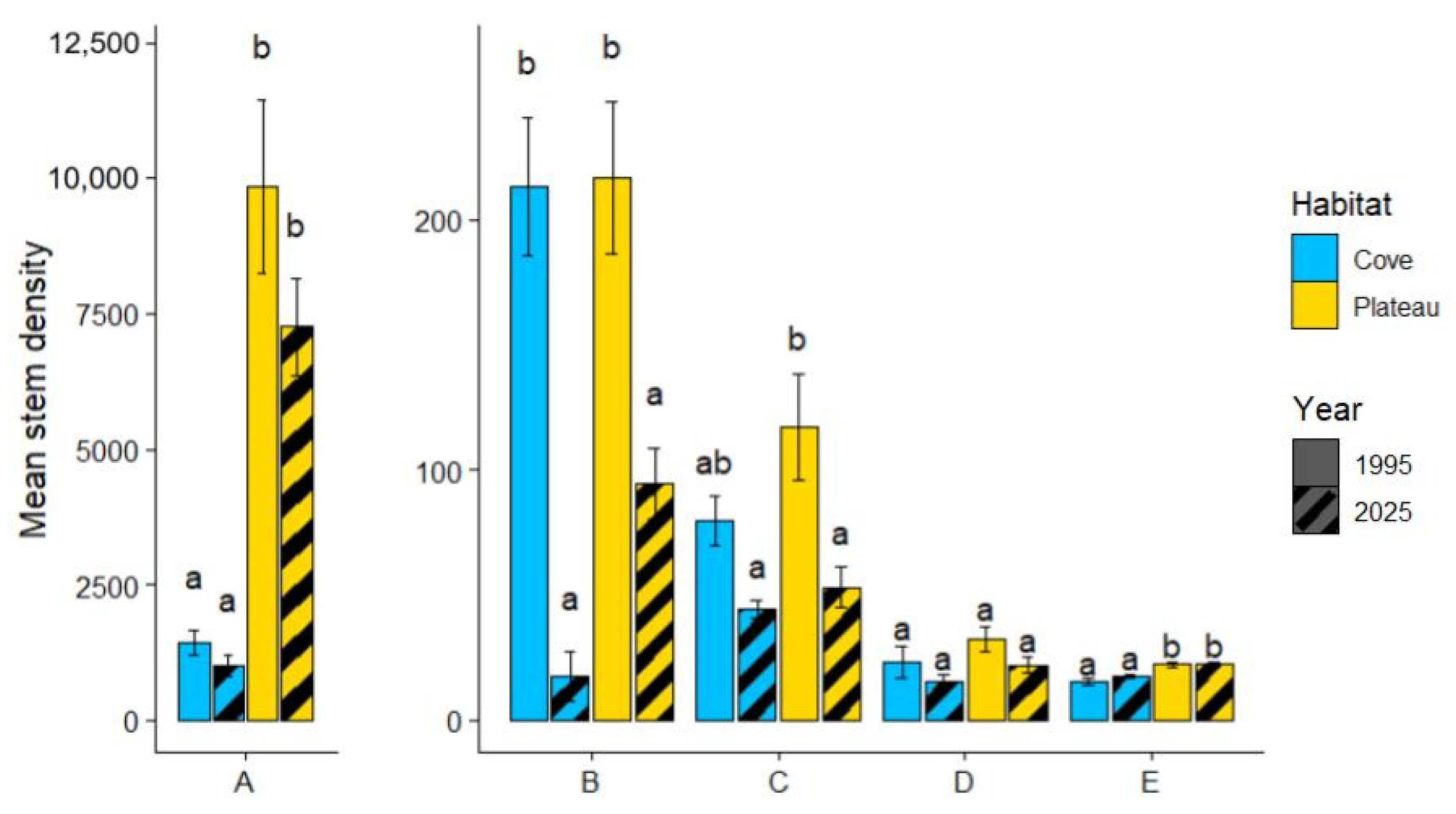
3.1. Density and Species Richness Change

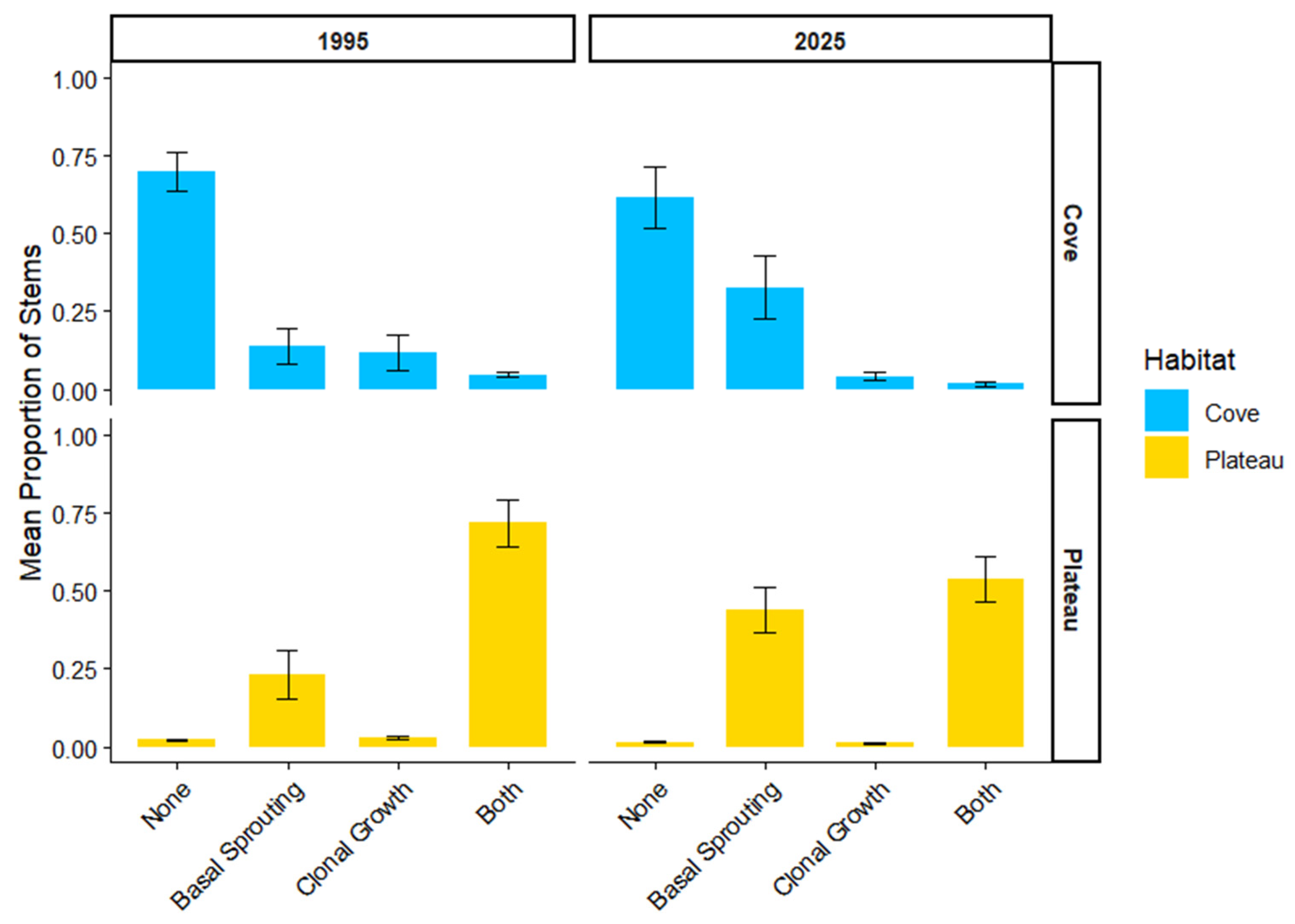
3.2. Allocation of Stem Density by Vegetative Regeneration Traits
4. Discussion
4.1. Vegetative Regeneration as Demographic Buffering
4.2. Implications for Long-Term Forest Trajectories
5. Conclusions
Author Contributions
Funding
Data Availability Statement
Acknowledgments
Conflicts of Interest
Appendix A

| Habitat | Species | Basal Sprouting | Clonal Growth | Citations |
|---|---|---|---|---|
| Cove | Acer saccharum [T] | N | N | Ward and Williams [50] |
| Cercis canadensis [T] | Y | N | Copenheaver and Keyser [51] | |
| Magnolia acuminata [T] | N | N | Burns and Honkala [29] | |
| Prunus serotina [T] | Y | Y | Closset-Kopp et al. [35] | |
| Carya spp. [T] | N | N | Dietze and Clark [24] | |
| Liriodendron tulipifera [T] | N | N | Dietze and Clark [24] | |
| Nyssa sylvatica [T] | N | Y | Copenheaver and Keyser [51]; Abrams [52] | |
| Fraxinus biltmoreana [T] | N | N | Tanis and McCullough [53] | |
| Oxydendrum arboreum [T] | Y | N | Keyser and Zarnoch [54]; Evans et al. [20] | |
| Tilia americana [T] | Y | N | Evans and Morris [36] | |
| Cornus florida [T] | N | Y | Dietze and Clark [24] | |
| Acer rubrum [T] | Y | N | Ward and Williams [50] | |
| Asimina triloba [T] | N | Y | Hosaka et al. [55] | |
| Quercus alba [T] | Y | N | Ward and Williams [50]; Tryon and Powell [56] | |
| Robinia pseudoacacia [T] | N | Y | Chang et al. [57]; Zhang et al. [58] | |
| Sassafras albidum [T] | Y | Y | Michel et al. [39] | |
| Ulmus alata [T] | N | N | Copenheaver and Keyser [51] | |
| Aesclus glabra [T] | N | Y * | Augspurger [59]; Lim [60] | |
| Quercus montana [T] | Y | N | Oldfield et al. [37] | |
| Ulmus rubra [T] | N | Y | Copenheaver and Keyser [51]; Davis et al. [61] | |
| Lindera benzoin [S] | Y | N | Godt and Hamrick [62] | |
| Quercus rubra [T] | Y | N | Heggenstaller et al. [63] | |
| Quercus velutina [T] | Y | N | Liming and Johnstone [64]; Ward and Williams [50] | |
| Celtis occidentalis [T] | N | N | Sample et al. [65] | |
| Ailanthus altissima [T] | Y | Y | Martin and Canham [66]; Pile Knapp et al. [67] | |
| Juglans spp. [T] | N | N | Copenheaver and Keyser [51] | |
| Ligustrum sinense [S] | Y | Y | Enloe et al. [68] | |
| Vaccinium spp. [S] | Y | Y | Duval [69] | |
| Viburnum acerifolium [S] | Y | Y | Overlease [70]; Pickett and Kempf [71] | |
| Castanea dentata [T] | Y | N | Dietze and Clark [24]; Copenheaver and Keyser [51] | |
| Ilex montana [S] | Y | N | Wharton [72] | |
| Ilex opaca [T] | N | N | Burns and Honkala [29] | |
| Juniperus virginiana [T] | N | N | Martin and Young [73] | |
| Morus rubra [T] | N | N | Dietze and Clark [24] | |
| Frangula caroliniana [T] | N | N | Wharton [72] | |
| Amelanchier spp. [T] | Y | Y | Stushnoff [74]; Paschke et al. [75] | |
| Viburnum rufidulum [S] | Y | N | Andruk et al. [76] | |
| Plateau | Acer rubrum [T] | Y | N | Ward and Williams [50] |
| Nyssa sylvatica [T] | N | Y | Copenheaver and Keyser [51]; Abrams [52] | |
| Oxydendron arboreum [T] | Y | N | Keyser and Zarnoch [54]; Evans et al. [20] | |
| Sassafras albidum [T] | Y | Y | Michel et al. [39] | |
| Carya spp. [T] | N | N | Dietze and Clark [24] | |
| Quercus alba [T] | Y | N | Tryon and Powell [56]; Ward and Williams [50] | |
| Quercus coccinea [T] | Y | N | Tryon and Powell [56]; Ward and Williams [50] | |
| Quercus montana [T] | Y | N | Oldfield et al. [37] | |
| Quercus velutina [T] | Y | N | Liming and Johnstone [64]; Ward and Williams [50] | |
| Robinia pseudoacacia [T] | N | Y | Chang et al. [57]; Zhang et al. [58] | |
| Pinus strobus [T] | N | N | Burns and Honkala [29] | |
| Acer saccharum [T] | N | N | Ward and Williams [50] | |
| Cornus florida [T] | N | Y | Dietze and Clark [24] | |
| Amelanchier spp. [T] | Y | Y | Stushnoff [74]; Paschke et al. [75] | |
| Liquidambar styraciflua [T] | Y | Y | Loehle [77], Sutherland et al. [78] | |
| Prunus serotina [T] | Y | Y | Closset-Kopp et al. [35] | |
| Kalmia latifolia [S] | Y | Y | Faison et al. [79] | |
| Diospyros virginiana [T] | N | Y | Burns and Honkala [29]; Ross et al. [80] | |
| Juniperus virginiana [T] | N | N | Martin and Young [73] | |
| Quercus stellata [T] | Y | N | Tryon and Powell [56]; Copenheaver and Keyser [51] | |
| Fraxinus biltmoreana [T] | N | N | Tanis and McCullough [53] | |
| Ilex decidua [S] | Y | N | Wharton [72] | |
| Vaccinium spp. [S] | Y | Y | Duval [69] | |
| Viburnum acerifolium [S] | Y | Y | Overlease [70]; Pickett and Kempf [71] | |
| Rhododendron spp. ⧫ [S] | Y | Y | Elliott and Vose [81] | |
| Liriodendron tulipifera [T] | N | N | Dietze and Clark [24] | |
| Magnolia acuminata [T] | N | N | Burns and Honkala [29] | |
| Quercus rubra [T] | Y | N | Heggenstaller et al. [63] | |
| Quercus muehlenbergii [T] | Y | N | Tryon and Powell [56]; Short et al. [82] | |
| Frangula caroliniana [T] | N | N | Wharton [72] | |
| Rhus copallinum [T] | Y | Y | Evans et al. [20] | |
| Vaccinium arboreum [T] | N | Y | Ellair [83]; Logan et al. [84] |
| Habitat | Species | Mean Δ Density (1995 vs. 2025) | C | Class | ||||||||
|---|---|---|---|---|---|---|---|---|---|---|---|---|
| A | B | C | D | E | A | B | C | D | E | |||
| Cove | Acer saccharum | −301 | −179 | −8 | 6 | 3 | 1 | −3 | −1 | 3 | 3 | S/F |
| Cercis canadensis | 64 | −4 | −8 | −2 | 0 | 1 | −3 | −3 | −1 | 1 | S/F | |
| Magnolia acuminata | −1 | −1 | −1 | 0 | 0 | −1 | −1 | −2 | −1 | 2 | S/F | |
| Prunus serotina | −28 | −1 | −1 | −2 | 1 | −1 | −2 | −1 | −3 | 2 | S/F | |
| Carya spp. | −16 | −2 | −2 | −2 | −1 | 1 | −1 | −1 | −3 | −3 | Decline | |
| Liriodendron tulipifera | 78 | −5 | −2 | −1 | 2 | −1 | −3 | −1 | −3 | 2 | Decline | |
| Nyssa sylvatica | −145 | −2 | −2 | −2 | 0 | −3 | −1 | −3 | −1 | 0 | Decline | |
| Fraxinus biltmoreana | −159 | −6 | −1 | ∅ | 0 | −1 | −2 | 0 | ∅ | 1 | S/F | |
| Oxydendrum arboreum | −3 | ∅ | 0 | −1 | 0 | −1 | ∅ | −1 | −1 | 1 | S/F | |
| Tilia americana | ∅ | −1 | −1 | −1 | 0 | ∅ | −2 | −1 | −1 | −1 | Decline | |
| Cornus florida | −8 | −1 | −11 | −2 | ∅ | −1 | −1 | −2 | −3 | ∅ | Decline ⧫ | |
| Acer rubrum | −9 | −1 | 0 | ∅ | ∅ | −1 | −2 | 0 | ∅ | ∅ | S/F | |
| Asimina triloba | 14 | 1 | 1 | ∅ | ∅ | 1 | 0 | 2 | ∅ | ∅ | S/F | |
| Quercus alba | 9 | ∅ | ∅ | −2 | 0 | −1 | ∅ | ∅ | −2 | 1 | S/F | |
| Robinia pseudoacacia | 1 | 0 | ∅ | ∅ | 0 | 1 | 0 | ∅ | ∅ | −1 | S/F | |
| Sassafras albidum | −10 | −1 | 0 | ∅ | ∅ | 1 | −1 | 1 | ∅ | ∅ | S/F | |
| Ulmus alata | 3 | 0 | 1 | ∅ | ∅ | 1 | −1 | 2 | ∅ | ∅ | S/F | |
| Aesclus glabra | 0 | −1 | 0 | ∅ | ∅ | 1 | 0 | −1 | ∅ | ∅ | S/F ⧫ | |
| Quercus montana | −8 | ∅ | −1 | ∅ | 0 | −3 | ∅ | −1 | ∅ | −1 | Decline | |
| Ulmus rubra | −1 | −1 | −1 | ∅ | ∅ | −1 | −2 | −2 | ∅ | ∅ | Decline ⧫ | |
| Lindera benzoin | 125 | 7 | ∅ | ∅ | ∅ | −1 | 0 | ∅ | ∅ | ∅ | S/F | |
| Quercus rubra | −1 | ∅ | ∅ | ∅ | −2 | 1 | ∅ | ∅ | ∅ | −3 | S/F | |
| Quercus velutina | 0 | ∅ | ∅ | ∅ | 0 | 0 | ∅ | ∅ | ∅ | −1 | S/F | |
| Celtis occidentalis | 20 | ∅ | ∅ | ∅ | ∅ | 2 | ∅ | ∅ | ∅ | ∅ | Increase | |
| Ailanthus altissima | 1 | ∅ | ∅ | ∅ | ∅ | 1 | ∅ | ∅ | ∅ | ∅ | S/F * | |
| Juglans spp. | ∅ | ∅ | ∅ | ∅ | 0 | ∅ | ∅ | ∅ | ∅ | 0 | S/F | |
| Ligustrum sinense | 1 | ∅ | ∅ | ∅ | ∅ | 1 | ∅ | ∅ | ∅ | ∅ | S/F * | |
| Vaccinium spp. | −4 | ∅ | ∅ | ∅ | ∅ | −1 | ∅ | ∅ | ∅ | ∅ | S/F | |
| Viburnum acerifolium | −16 | ∅ | ∅ | ∅ | ∅ | −1 | ∅ | ∅ | ∅ | ∅ | S/F | |
| Castanea dentata | ∅ | 0 | ∅ | ∅ | ∅ | ∅ | −1 | ∅ | ∅ | ∅ | S/F ⧫ | |
| Ilex montana | −1 | ∅ | ∅ | ∅ | ∅ | −1 | ∅ | ∅ | ∅ | ∅ | S/F ⧫ | |
| Ilex opaca | −1 | ∅ | ∅ | ∅ | ∅ | −1 | ∅ | ∅ | ∅ | ∅ | S/F ⧫ | |
| Juniperus virginiana | −1 | ∅ | ∅ | ∅ | ∅ | −1 | ∅ | ∅ | ∅ | ∅ | S/F ⧫ | |
| Morus rubra | −1 | ∅ | ∅ | ∅ | ∅ | −1 | ∅ | ∅ | ∅ | ∅ | S/F ⧫ | |
| Frangula caroliniana | ∅ | 0 | ∅ | ∅ | ∅ | ∅ | −1 | ∅ | ∅ | ∅ | S/F ⧫ | |
| Amelanchier spp. | −11 | ∅ | ∅ | ∅ | ∅ | −2 | ∅ | ∅ | ∅ | ∅ | Decline ⧫ | |
| Viburnum rufidulum | ∅ | −1 | ∅ | ∅ | ∅ | ∅ | −2 | ∅ | ∅ | ∅ | Decline ⧫ | |
| Plateau | Acer rubrum | 450 | −7 | 8 | 1 | 0 | 1 | −1 | 3 | 1 | 0 | S/F |
| Nyssa sylvatica | −114 | −23 | −11 | 1 | 0 | −1 | −3 | −3 | 1 | 0 | S/F | |
| Oxydendron arboreum | −8 | −3 | −3 | −3 | 0 | −1 | −1 | 1 | −2 | 1 | S/F | |
| Sassafras albidum | −955 | −1 | −22 | 1 | 0 | −3 | 1 | −3 | 1 | 0 | S/F | |
| Carya spp. | −99 | −10 | −8 | −1 | −1 | −1 | −3 | −3 | −1 | −1 | Decline | |
| Quercus alba | −65 | −7 | −12 | −2 | 1 | −1 | −3 | −3 | −2 | 3 | Decline | |
| Quercus coccinea | 199 | −4 | −2 | −2 | −3 | 1 | −3 | −2 | −3 | −3 | Decline | |
| Quercus montana | 243 | −3 | −6 | −4 | 2 | −1 | −3 | −3 | −3 | 3 | Decline | |
| Quercus velutina | 3 | −3 | −1 | 0 | 0 | −1 | −2 | −3 | −1 | 1 | Decline | |
| Robinia pseudoacacia | −49 | −4 | −4 | −1 | 0 | −3 | −1 | −3 | −3 | −1 | Decline | |
| Pinus strobus | 11 | 0 | 0 | 0 | ∅ | 2 | 1 | 1 | 1 | ∅ | Increase | |
| Acer saccharum | −1 | −2 | 1 | 0 | ∅ | 0 | −3 | 1 | 1 | ∅ | S/F | |
| Cornus florida | −6 | −4 | −3 | −1 | ∅ | −2 | −3 | −2 | −2 | ∅ | Decline | |
| Amelanchier spp. | 26 | −1 | −1 | ∅ | ∅ | 3 | −1 | −2 | ∅ | ∅ | S/F | |
| Liquidambar styraciflua | 3 | 0 | 0 | ∅ | ∅ | 2 | 0 | 1 | ∅ | ∅ | S/F * | |
| Prunus serotina | −16 | −1 | 0 | ∅ | ∅ | −1 | −3 | 1 | ∅ | ∅ | S/F | |
| Kalmia latifolia | −86 | −7 | −2 | ∅ | ∅ | −1 | −3 | −1 | ∅ | ∅ | Decline | |
| Diospyros virginiana | −8 | −1 | 0 | ∅ | ∅ | −3 | −1 | −1 | ∅ | ∅ | Decline ⧫ | |
| Juniperus virginiana | −1 | ∅ | 0 | ∅ | ∅ | 0 | ∅ | −1 | ∅ | ∅ | S/F | |
| Quercus stellata | 1 | ∅ | 0 | ∅ | ∅ | 1 | ∅ | −1 | ∅ | ∅ | S/F | |
| Fraxinus biltmoreana | −1 | 0 | ∅ | ∅ | ∅ | −1 | −1 | ∅ | ∅ | ∅ | S/F ⧫ | |
| Ilex decidua | −1 | 0 | ∅ | ∅ | ∅ | −1 | −1 | ∅ | ∅ | ∅ | S/F ⧫ | |
| Vaccinium spp. | −2054 | −42 | ∅ | ∅ | ∅ | −3 | −1 | ∅ | ∅ | ∅ | Decline | |
| Viburnum acerifolium | −28 | −1 | ∅ | ∅ | ∅ | −2 | −1 | ∅ | ∅ | ∅ | Decline | |
| Rhododendron spp. | −14 | ∅ | ∅ | ∅ | ∅ | −1 | ∅ | ∅ | ∅ | ∅ | S/F | |
| Liriodendron tulipifera | −8 | ∅ | ∅ | ∅ | ∅ | −1 | ∅ | ∅ | ∅ | ∅ | S/F | |
| Magnolia acuminata | 3 | ∅ | ∅ | ∅ | ∅ | 1 | ∅ | ∅ | ∅ | ∅ | S/F | |
| Quercus rubra | ∅ | 0 | ∅ | ∅ | ∅ | ∅ | 1 | ∅ | ∅ | ∅ | S/F | |
| Quercus muehlenbergii | −1 | ∅ | ∅ | ∅ | ∅ | 0 | ∅ | ∅ | ∅ | ∅ | S/F ⧫ | |
| Frangula caroliniana | 0 | ∅ | ∅ | ∅ | ∅ | 0 | ∅ | ∅ | ∅ | ∅ | S/F ⧫ | |
| Rhus copallinum | −1 | ∅ | ∅ | ∅ | ∅ | −1 | ∅ | ∅ | ∅ | ∅ | S/F ⧫ | |
| Vaccinium arboreum | 0 | ∅ | ∅ | ∅ | ∅ | 0 | ∅ | ∅ | ∅ | ∅ | S/F *,⧫ | |
References
- Greenberg, C.H.; Woodbridge, M. Successional trajectories differ among post-harvest and mature cove and upland hardwood forests. For. Ecol. Manag. 2025, 596, 123091. [Google Scholar] [CrossRef]
- Lorimer, C.G. Causes of the oak regeneration problem. In Oak Regeneration: Serious Problems, Practical Recommendations; United States Forest Service, General Technical Report SE-GTR-84; Southeastern Forest Experiment Station: Asheville, NC, USA, 1993; pp. 14–39. [Google Scholar]
- Arthur, M.A.; Paratley, R.D.; Blankenship, B.A. Single and repeated fires affect survival and regeneration of woody and herbaceous species in an oak-pine forest. J. Torrey Bot. Soc. 1998, 125, 225–236. [Google Scholar] [CrossRef]
- Schweitzer, C.J.; Dey, D.C. Forest structure, composition, and tree diversity response to a gradient of regeneration harvests in the mid-Cumberland Plateau escarpment region, USA. For. Ecol. Manag. 2011, 262, 1729–1741. [Google Scholar] [CrossRef]
- Palus, J.D.; Goebel, P.C.; Hix, D.M.; Matthews, S.N. Structural and compositional shifts in forests undergoing mesophication in the Wayne National Forest, southeastern Ohio. For. Ecol. Manag. 2018, 430, 413–420. [Google Scholar] [CrossRef]
- Evans, J.P.; Oldfield, C.A.; Cecala, K.K.; Hiers, J.K.; Van De Ven, C.; Armistead, M.M. Pattern and drivers of white-tailed deer (Odocoileus virginianus) herbivory on tree saplings across a plateau landscape. Forests 2016, 7, 101. [Google Scholar] [CrossRef]
- Cho, D.S.; Boerner, R.E.J. Canopy disturbance patterns and regeneration of Quercus species in two Ohio old-growth forests. Vegetatio 1991, 93, 9–18. [Google Scholar] [CrossRef]
- Jackson, S.T.; Sax, D.F. Balancing biodiversity in a changing environment: Extinction debt, immigration credit and species turnover. Trends Ecol. Evol. 2010, 25, 153–160. [Google Scholar] [CrossRef]
- Miller, K.M.; McGill, B.J. Compounding human stressors cause major regeneration debt in over half of eastern US forests. J. Appl. Ecol. 2019, 56, 1355–1366. [Google Scholar] [CrossRef]
- Morris, W.F.; Pfister, C.A.; Tuljapurkar, S.; Haridas, C.V.; Boggs, C.L.; Boyce, M.S.; Bruna, E.M.; Church, D.R.; Coulson, T.; Doak, D.F.; et al. Longevity can buffer plant and animal populations against changing climatic variability. Ecology 2008, 89, 19–25. [Google Scholar] [CrossRef]
- Knapp, B.O.; Pallardy, S.G. Forty-eight years of forest succession: Tree species change across four forest types in mid-Missouri. Forests 2018, 9, 633. [Google Scholar] [CrossRef]
- Knott, J.A.; Desprez, J.M.; Oswalt, C.M.; Fei, S. Shifts in forest composition in the eastern United States. For. Ecol. Manag. 2019, 433, 176–183. [Google Scholar] [CrossRef]
- Piovesan, G.; Biondi, F. On tree longevity. New Phytol. 2020, 231, 1318–1337. [Google Scholar] [CrossRef]
- McCarthy-Neumann, S.; Schutte, M.I.; Phillips, R.; Michel, J.T.; Evans, J.P. Tree Compositional Change in Upland Hardwood Forests Aligns with Mycorrhizal Type. For. Ecol. Manag. 2026; accepted.
- Hinkle, C.R. Forest communities of the Cumberland Plateau of Tennessee. J. Tenn. Acad. Sci. 1989, 64, 123–129. [Google Scholar]
- Arnold, D.H.; Smalley, G.W.; Buckner, E.R. Landtype-forest community relationships: A case study on the Mid-Cumberland Plateau. Environ. Monit. Assess. 1996, 39, 339–352. [Google Scholar] [CrossRef] [PubMed]
- Myers, B.R.; Walck, J.L.; Blum, K.E. Vegetation change in a former chestnut stand on the Cumberland Plateau of Tennessee during an 80-year period (1921–2000). Castanea 2004, 69, 81–91. [Google Scholar] [CrossRef]
- Hiers, J.K.; Evans, J.P. Effects of anthracnose on dogwood mortality and forest composition of the Cumberland Plateau (USA). Conserv. Biol. 1997, 11, 1430–1435. [Google Scholar] [CrossRef]
- Reid, J.L.; Evans, J.P.; Hiers, J.K.; BertonHarris, J.C. Ten years of forest change in two adjacent communities on the southern Cumberland Plateau, USA. J. Torrey Bot. Soc. 2008, 135, 224–235. [Google Scholar] [CrossRef]
- Evans, J.P.; Oldfield, C.A.; Reid, J.L. Differential resistance to tree species loss between two dominant communities in a resilient southeastern landscape. Nat. Areas J. 2019, 39, 182–188. [Google Scholar] [CrossRef]
- Bellingham, P.J.; Sparrow, A.D. Resprouting as a life history strategy in woody plant communities. Oikos 2000, 89, 409–416. [Google Scholar] [CrossRef]
- Del Tredici, P. Sprouting in temperate trees: A morphological and ecological review. Bot. Rev. 2001, 67, 121–140. [Google Scholar] [CrossRef]
- Bond, W.J.; Midgley, J.J. Ecology of sprouting in woody plants: The persistence niche. Trends Ecol. Evol. 2001, 16, 45–51. [Google Scholar] [CrossRef] [PubMed]
- Dietze, M.C.; Clark, J.S. Changing the gap dynamics paradigm: Vegetative regeneration control on forest response to disturbance. Ecol. Monogr. 2008, 78, 331–347. [Google Scholar] [CrossRef]
- Hiers, J.K.; O’Brien, J.J.; Will, R.E.; Mitchell, R.J. Forest floor depth mediates understory vigor in xeric Pinus palustris ecosystems. Ecol. Appl. 2007, 17, 806–814. [Google Scholar] [CrossRef]
- Clarke, P.J.; Lawes, M.J.; Midgley, J.J. Resprouting as a key functional trait in woody plants—Challenges to developing new organizing principles. New Phytol. 2010, 188, 651–654. [Google Scholar] [CrossRef]
- Evans, J.P.; Oldfield, C.A.; Priestley, M.P.; Gottfried, Y.M.; Estes, L.D.; Sidik, A.; Ramseur, G.S. The vascular flora of the University of the South, Sewanee, Tennessee. Castanea 2016, 81, 206–236. [Google Scholar] [CrossRef]
- NOAA Online Weather Data (NOWData). Available online: https://www.weather.gov/wrh/Climate?wfo=hun (accessed on 7 April 2026).
- Burns, R.M.; Honkala, B.H. Silvics of North America; Agriculture Handbook No. 654; Hardwoods; U.S. Department of Agriculture: Washington, DC, USA, 1990; Volume 2.
- R Core Team. R: A Language and Environment for Statistical Computing, Version 4.5.2; R Foundation for Statistical Computing: Vienna, Austria, 2025. Available online: https://www.R-project.org (accessed on 17 November 2025).
- Vickers, L.A.; Knapp, B.O.; Dey, D.C.; Knapp, L.S.P. Do forest health threats affect upland oak regeneration and recruitment? Advance reproduction is a key co-morbidity. For. Ecosyst. 2023, 10, 100152. [Google Scholar] [CrossRef]
- Waller, D.M.; Riege, D.A.; Alverson, W.S. The regeneration ratio: Combining seedling growth and mortality data to predict regeneration success. For. Ecol. Manag. 2024, 556, 121737. [Google Scholar] [CrossRef]
- Ross, M.S.; Sharik, T.L.; Smith, D.W. Age-structure relationships of trees species in an Appalachian oak forest in southwest Virginia. Bull. Torrey Bot. Club 1982, 109, 287–298. [Google Scholar] [CrossRef]
- Blount, T.E. The Biology of Sassafras albidum (Nutt.) Nees in Regenerating Upland Hardwood Stands in Southwest Virginia Following Clear Felling. Doctoral Dissertation, Virginia Polytechnic Institute and State University, Blacksburg, VA, USA, 1989. [Google Scholar]
- Closset-Kopp, D.; Chabrerie, O.; Valentin, B.; Delachapelle, H.; Decocq, G. When Oskar meets Alice: Does a lack of trade-off in r/K-strategies make Prunus serotina a successful invader of European forests? For. Ecol. Manag. 2007, 247, 120–130. [Google Scholar] [CrossRef]
- Evans, J.P.; Morris, A.B. Isolated coastal populations of Tilia americana var. caroliniana persist long-term through vegetative growth. Am. J. Bot. 2016, 103, 1687–1693. [Google Scholar] [CrossRef] [PubMed]
- Oldfield, C.A.; Evans, J.P.; Oldfield, S.C. Long-term demography and matrix modeling reveal mechanisms of chestnut oak (Quercus montana) population persistence through sprouting and decline. For. Ecol. Manag. 2021, 483, 118736. [Google Scholar] [CrossRef]
- Tanentzap, A.J.; Mountford, E.P.; Cooke, A.S.; Coomes, D.A. The more stems the merrier: Advantages of multi-stemmed architecture for the demography of understorey trees in a temperate broadleaf woodland. J. Ecol. 2012, 100, 171–183. [Google Scholar] [CrossRef]
- Michel, J.T.; Evans, J.P.; Fox, S.J.; Morris, A.B. Long-term demography and spatial genetic structure reveal mechanisms of Sassafras albidum population persistence through clonality. Am. J. Bot. 2026; accepted.
- Arthur, M.A.; Varner, J.M.; Lafon, C.W.; Alexander, H.D.; Dey, D.C.; Harper, C.A.; Horn, S.P.; Hutchinson, T.F.; Keyser, T.L.; Lashley, M.A.; et al. Fire ecology and management in eastern broadleaf and Appalachian forests. In Fire Ecology and Management: Past, Present, and Future of US Forested Ecosystems; Springer International Publishing: Cham, Switzerland, 2021; pp. 105–147. [Google Scholar]
- Kelly, J.M.; Beauchamp, J.J. Mass loss and nutrient changes in decomposing upland oak and mesic mixed-hardwood leaf litter. Soil Sci. Soc. Am. J. 1987, 51, 1616–1622. [Google Scholar] [CrossRef]
- Silvertown, J. The evolutionary maintenance of sexual reproduction: Evidence from the ecological distribution of asexual reproduction in clonal plants. Int. J. Plant Sci. 2008, 169, 157–168. [Google Scholar] [CrossRef]
- Dering, M.; Chybicki, I.J.; Rączka, G. Clonality as a driver of spatial genetic structure in populations of clonal tree species. J. Plant Res. 2015, 128, 731–745. [Google Scholar] [CrossRef]
- Miller, K.M.; Perles, S.J.; Schmit, J.P.; Matthews, E.R.; Weed, A.S.; Comiskey, J.A.; Marshall, M.R.; Nelson, P.; Fisichelli, N.A. Overabundant deer and invasive plants drive widespread regeneration debt in eastern United States national parks. Ecol. Appl. 2023, 33, e2837. [Google Scholar] [CrossRef]
- Bishop, D.A.; Beier, C.M.; Pederson, N.; Lawrence, G.B.; Stella, J.C.; Sullivan, T.J. Regional growth decline of sugar maple (Acer saccharum) and its potential causes. Ecosphere 2015, 6, 1–14. [Google Scholar] [CrossRef]
- Kabrick, J.M.; Dey, D.C.; Jensen, R.G.; Wallendorf, M. The role of environmental factors in oak decline and mortality in the Ozark Highlands. For. Ecol. Manag. 2008, 255, 1409–1417. [Google Scholar] [CrossRef]
- Simard, S.W.; Beiler, K.J.; Bingham, M.A.; Deslippe, J.R.; Philip, L.J.; Teste, F.P. Mycorrhizal networks: Mechanisms, ecology and modelling. Fungal Biol. Rev. 2012, 26, 39–60. [Google Scholar] [CrossRef]
- Elliott, K.J.; Miniat, C.F.; Medenblik, A.S. The long-term case for partial-cutting over clear-cutting in the southern Appalachians USA. New For. 2019, 51, 273–295. [Google Scholar] [CrossRef]
- Cortese, A.M.; Horton, T.R. Ectomycorrhizal tree islands in arbuscular mycorrhizal forests: Hotspots of fungal inoculum important for seedling establishment of historically dominant trees. J. Ecol. 2024, 112, 2680–2694. [Google Scholar] [CrossRef]
- Ward, J.S.; Williams, S.C. Effect of tree diameter, canopy position, age, and browsing on stump sprouting in southern New England. For. Sci. 2018, 64, 452–460. [Google Scholar] [CrossRef]
- Copenheaver, C.A.; Keyser, T.L. Frequency of sprout-origin trees in pre-European settlement forests of the southern Appalachian Mountains. Can. J. For. Res. 2016, 46, 1019–1025. [Google Scholar] [CrossRef]
- Abrams, M.D. Tales from the blackgum, a consummate subordinate tree. BioScience 2007, 57, 347–359. [Google Scholar] [CrossRef]
- Tanis, S.R.; McCullough, D.G. Differential persistence of blue ash and white ash following emerald ash borer invasion. Can. J. For. Res. 2012, 42, 1542–1550. [Google Scholar] [CrossRef]
- Keyser, T.L.; Zarnoch, S.J. Stump sprout dynamics in response to reductions in stand density for nine upland hardwood species in the southern Appalachian Mountains. For. Ecol. Manag. 2014, 319, 29–35. [Google Scholar] [CrossRef]
- Hosaka, N.; Kachi, N.; Kudoh, H.; Stuefer, J.F.; Whigham, D.F. Compensatory growth of the clonal understory tree, Asimina triloba, in response to small-scale disturbances. Plant Ecol. 2016, 217, 471–480. [Google Scholar] [CrossRef]
- Tryon, E.H.; Powell, D.S. Root ages of advance hardwood reproduction. For. Ecol. Manag. 1984, 8, 293–298. [Google Scholar] [CrossRef]
- Chang, C.S.; Bongarten, B.; Hamrick, J. Genetic structure of natural populations of black locust (Robinia pseudoacacia L.) at Coweeta, North Carolina. J. Plant Res. 1998, 111, 17–24. [Google Scholar] [CrossRef]
- Zhang, X.Q.; Liu, J.; Welham, C.V.; Liu, C.C.; Li, D.N.; Chen, L.; Wang, R.Q. The effects of clonal integration on morphological plasticity and placement of daughter ramets in black locust (Robinia pseudoacacia). Flora-Morphol. Distrib. Funct. Ecol. Plants 2006, 201, 547–554. [Google Scholar] [CrossRef]
- Augspurger, C.K. Frost damage and its cascading negative effects on Aesculus glabra. Plant Ecol. 2011, 212, 1193–1203. [Google Scholar] [CrossRef]
- Lim, H.W. Analyses of Genetic Variation in Aesculus (Hippocastanaceae) Using VNTR Multilocus Probes. Doctoral Dissertation, University of Cincinnati, Cincinnati, OH, USA, 2000. [Google Scholar]
- Davis, R.W.; Larimore, R.L.; Ebinger, J.E. The occurrence of slippery elm (Ulmus rubra Muhl.) root sprouts in forest understories in east-central Illinois. Trans. Ill. State Acad. Sci. 1998, 91, 13–19. [Google Scholar]
- Godt, M.J.W.; Hamrick, J.L. Allozyme diversity in the endangered shrub Lindera melissifolia (Lauraceae) and its widespread congener Lindera benzoin. Can. J. For. Res. 1996, 26, 2080–2087. [Google Scholar] [CrossRef]
- Heggenstaller, D.J.; Zenner, E.K.; Brose, P.H.; Peck, J.E. How much older are Appalachian oaks below-ground than above-ground? North. J. Appl. For. 2012, 29, 155–157. [Google Scholar] [CrossRef]
- Liming, F.G.; Johnston, J.P. Reproduction in oak-hickory forest stands of the Missouri Ozarks. J. For. 1944, 42, 175–180. [Google Scholar] [CrossRef]
- Sample, R.D.; Boggess, C.M.; Brooke, J.M.; Jenkins, M.A. Stump sprouting performance of common tree species in the midstory of hardwood forests in Indiana. For. Sci. 2022, 68, 440–446. [Google Scholar] [CrossRef]
- Martin, P.H.; Canham, C.D. Dispersal and recruitment limitation in native versus exotic tree species: Life-history strategies and Janzen-Connell effects. Oikos 2010, 119, 807–824. [Google Scholar] [CrossRef]
- Pile Knapp, L.S.; Rebbeck, J.; Hutchinson, T.; Fraser, J.; Pinchot, C.C. Controlling an invasive tree with a native fungus: Inoculating Ailanthus altissima (Tree-of-Heaven) with Verticillium nonalfalfae in highly disturbed Appalachian forests of Ohio. J. For. 2022, 120, 558–574. [Google Scholar] [CrossRef]
- Enloe, S.F.; O’Sullivan, S.E.; Loewenstein, N.J.; Brantley, E.; Lauer, D.K. The influence of treatment timing and shrub size on Chinese privet (Ligustrum sinense) control with cut stump herbicide treatments in the southeastern United States. Invasive Plant Sci. Manag. 2018, 11, 49–55. [Google Scholar] [CrossRef]
- Duval, W.L. Integration in a Clonal Woody Shrub, Vaccinium stamineum. Doctoral Dissertation, University of Georgia, Athens, GA, USA, 2008. [Google Scholar]
- Overlease, W.R. 150 years of vegetation change in Chester County, Pennsylvania. Bartonia 1987, 53, 1–12. [Google Scholar]
- Pickett, S.T.A.; Kempf, J.S. Branching patterns in forest shrubs and understory trees in relation to habitat. New Phytol. 1980, 86, 219–228. [Google Scholar] [CrossRef]
- Wharton, M.E. Trees & Shrubs of Kentucky; University Press of Kentucky: Lexington, KY, USA, 1973; Volume 4. [Google Scholar]
- Martin, D.W.; Young, D.R. Small-scale distribution and salinity response of Juniperus virginiana on an Atlantic Coast barrier island. Can. J. Bot. 1997, 75, 77–85. [Google Scholar] [CrossRef]
- Stushnoff, C. Amelanchier species. Genet. Resour. Temp. Fruit Nut Crops 1991, 290, 549–568. [Google Scholar] [CrossRef]
- Paschke, M.W.; Redente, E.F.; Brown, S.L. Biology and establishment of mountain shrubs on mining disturbances in the Rocky Mountains, USA. Land Degrad. Dev. 2003, 14, 459–480. [Google Scholar] [CrossRef]
- Andruk, C.M.; Schwope, C.; Fowler, N.L. The joint effects of fire and herbivory on hardwood regeneration in central Texas woodlands. For. Ecol. Manag. 2014, 334, 193–200. [Google Scholar] [CrossRef]
- Loehle, C. Strategy space and the disturbance spectrum: A life-history model for tree species coexistence. Am. Nat. 2000, 156, 14–33. [Google Scholar] [CrossRef]
- Sutherland, E.K.; Hale, B.J.; Hix, D.M. Defining species guilds in the Central Hardwood Forest, USA. Plant Ecol. 2000, 147, 1–20. [Google Scholar] [CrossRef]
- Faison, E.K.; Del Tredici, P.; Foster, D.R. To sprout or not to sprout: Multiple factors determine the vigor of Kalmia latifolia (Ericaceae) in southwestern Connecticut. Rhodora 2014, 116, 148–162. [Google Scholar] [CrossRef]
- Ross, N.J.; Stevens, M.H.H.; Rupiper, A.W.; Harkreader, I.; Leben, L.A. The ecological side of an ethnobotanical coin: Legacies in historically managed trees. Am. J. Bot. 2014, 101, 1618–1630. [Google Scholar] [CrossRef]
- Elliott, K.J.; Vose, J.M. Age and distribution of an evergreen clonal shrub in the Coweeta Basin: Rhododendron maximum L. J. Torrey Bot. Soc. 2012, 139, 149–166. [Google Scholar] [CrossRef]
- Short, M.F.; Stambaugh, M.C.; Dey, D.C. Prescribed fire effects on oak woodland advance regeneration at the prairie–forest border in Kansas, USA. Can. J. For. Res. 2019, 49, 1570–1579. [Google Scholar] [CrossRef]
- Ellair, D. Effects of Hurricanes and Fires on Understory Hardwoods in Pine Savannas. Doctoral Dissertation, Louisiana State University and Agricultural & Mechanical College, Baton Rouge, LA, USA, 2012. [Google Scholar]
- Logan, A.T.; Goode, J.D.; Keellings, D.J.; Hart, J.L. Microsite influence on woody plant regeneration in a Pinus palustris woodland following catastrophic disturbance. Forests 2020, 11, 588. [Google Scholar] [CrossRef]

| Habitat | Size Class | Mean # Species 1995 | Mean # Species 2025 | Richness Change 1995–2025 | t | p |
|---|---|---|---|---|---|---|
| Cove | A | 12 ± 4.2 | 9.8 ± 1.8 | −2.3 ± 3.9 | −1.6 | 1 |
| B | 6.4 ± 3.2 | 1.3 ± 0.7 | −5.1 ± 2.8 | −5.2 | 0.013 * | |
| C | 6 ± 1.5 | 2.1 ± 1 | −3.9 ± 1.5 | −7.5 | 0.001 ** | |
| D | 4.6 ± 2.6 | 1.9 ± 1.1 | −2.8 ± 2.2 | −3.6 | 0.093 | |
| E | 6.8 ± 1.3 | 6.5 ± 0.9 | −0.3 ± 1.7 | −0.4 | 1 | |
| Plateau | A | 14.5 ± 2.1 | 12.4 ± 1.2 | −2.1 ± 2.9 | −2.1 | 0.769 |
| B | 11.3 ± 2.8 | 5.3 ± 1.7 | −6 ± 3.6 | −4.7 | 0.021 * | |
| C | 9 ± 2.1 | 6.6 ± 1.1 | −2.4 ± 2.8 | −2.4 | 0.460 | |
| D | 6.4 ± 1.2 | 4.9 ± 1.6 | −1.5 ± 2 | −2.1 | 0.716 | |
| E | 5.3 ± 1.2 | 5.1 ± 1 | −0.1 ± 1 | −0.4 | 1 |
Disclaimer/Publisher’s Note: The statements, opinions and data contained in all publications are solely those of the individual author(s) and contributor(s) and not of MDPI and/or the editor(s). MDPI and/or the editor(s) disclaim responsibility for any injury to people or property resulting from any ideas, methods, instructions or products referred to in the content. |
© 2026 by the authors. Licensee MDPI, Basel, Switzerland. This article is an open access article distributed under the terms and conditions of the Creative Commons Attribution (CC BY) license.
Share and Cite
Michel, J.T.; Evans, J.P. Vegetative Regeneration Delays but Does Not Prevent Regeneration Debt: Thirty Years of Compositional and Structural Change in Adjacent Appalachian Forest Communities. Forests 2026, 17, 520. https://doi.org/10.3390/f17050520
Michel JT, Evans JP. Vegetative Regeneration Delays but Does Not Prevent Regeneration Debt: Thirty Years of Compositional and Structural Change in Adjacent Appalachian Forest Communities. Forests. 2026; 17(5):520. https://doi.org/10.3390/f17050520
Chicago/Turabian StyleMichel, J.T., and Jonathan P. Evans. 2026. "Vegetative Regeneration Delays but Does Not Prevent Regeneration Debt: Thirty Years of Compositional and Structural Change in Adjacent Appalachian Forest Communities" Forests 17, no. 5: 520. https://doi.org/10.3390/f17050520
APA StyleMichel, J. T., & Evans, J. P. (2026). Vegetative Regeneration Delays but Does Not Prevent Regeneration Debt: Thirty Years of Compositional and Structural Change in Adjacent Appalachian Forest Communities. Forests, 17(5), 520. https://doi.org/10.3390/f17050520