Article

Measurement of Forest Soil Conservation and Evaluation of Its Ecosystem Service Value Based on GIS-RUSLE Model Coupling: A Case Study of the Qilian Mountains Area in China


1
School of Economics, Lanzhou University of Finance and Economics, Lanzhou 730020, China
2
School of Statistics and Data Science, Lanzhou University of Finance and Economics, Lanzhou 730020, China
3
Key Laboratory of Western China’s Environmental Systems, Ministry of Education, College of Earth and Environmental Sciences, Lanzhou University, Lanzhou 730000, China
4
School of Geography and Remote Sensing, Guangzhou University, Guangzhou 510006, China
*
Author to whom correspondence should be addressed.
Forests 2026, 17(4), 455; https://doi.org/10.3390/f17040455
Submission received: 30 January 2026 / Revised: 31 March 2026 / Accepted: 2 April 2026 / Published: 4 April 2026
(This article belongs to the Special Issue Elemental Cycling in Forest Soils)

Abstract

Forest soil conservation is pivotal for controlling soil erosion and ensuring ecological security. Taking the Qilian Mountains Area in China as the research region, this study used ArcMap 10.8 software to process data for six prefecture-level cities in the area from 2008 to 2023. The Revised Universal Soil Loss Equation (RUSLE) model was applied to quantify the forest soil conservation amount and evaluate its ecosystem service value (ESV). Their spatiotemporal variations and dynamic evolution patterns were analyzed, alongside the influence of soil organic matter (OM) and nitrogen (N), phosphorus (P), and potassium (K) contents. The results showed that the average contents of OM, N, P and K in the forest soils of the Qilian Mountains Area were 24.22 g·kg−1, 1.54 g·kg−1, 0.70 g·kg−1, and 19.96 g·kg−1, respectively, with significant regional heterogeneity. Haibei Tibetan Autonomous Prefecture (HBTAP) had the highest while Jinchang City (JC) had the lowest. From 2008 to 2023, the average annual forest soil conservation amount and its ESV of the region were 1.749 × 10⁹ tons and 2.0444 × 10¹⁰ yuan, respectively, both showing a fluctuating trend of initial increase followed by a decrease. Spatially, HBTAP ranked first in average annual forest soil conservation amount per unit area and ESV. Jiuquan City (JQ) had the lowest forest soil conservation amount per unit area, and JC the lowest ESV. Forest soil conservation and its ESV in the region were affected by the contents of soil nutrients (OM and N, P, K elements), vegetation types and quality, topography, climate, and human activities (including ecological governance), which collectively intensified the spatiotemporal heterogeneity. These findings provide a theoretical basis for precise regional ecological protection and differentiated restoration strategies in arid regions.

1. Introduction

As the core component of terrestrial ecosystems, forests provide a pivotal regulating service through their soil conservation function, which underpins regional ecological balance and safeguards ecological security [1]. Driven by the synergistic effects of forest vegetation and soil, this function realizes key processes such as soil and fertility fixation and slope erosion reduction, playing an irreplaceable role in maintaining the structural stability of terrestrial ecosystems, curbing soil and water loss, and preserving land productivity [2]. Under the combined pressures of global climate change and human activities, issues including excessive deforestation, landscape fragmentation and land degradation have led to drastic changes in regional forest cover patterns. These changes not only aggravate soil erosion but also directly weaken the soil conservation capacity of forests, posing a significant threat to their ecological service value (ESV) [3].
The Qilian Mountains Area in China is a transition zone between the Tibetan Plateau, the Inner Mongolia Plateau, and the Loess Plateau. It serves as a vital water conservation region for the Yellow River Basin and the Hexi Inland River Basin, and acts as a core ecological functional area in western China [4,5]. However, characterized by an arid and semi-arid climate, complex topography, and fragile ecological background, this region faces a persistently high risk of soil erosion. In addition, climate change, agricultural expansion, and infrastructure development have intensified vegetation degradation and heightened soil erosion sensitivity in the region [6], thereby weakening forest soil conservation capacity and leading to a decline in forest ESV, which in turn aggravates forest ecological imbalance. With the continuous advancement of the construction of Qilian Mountains National Park, phased achievements have been made in forest ecological protection and restoration projects. There is a pressing need to quantify forest soil conservation and ESV through scientific methods to provide data support and a decision-making basis for evaluating restoration effects and implementing differentiated ecological management, which has also become an imperative demand for current ecological protection research in the Qilian Mountains.
The quantification of forest soil conservation has been approached through various established methods. The Revised Universal Soil Loss Equation (RUSLE) has become the mainstream method for estimating soil erosion and conservation at the regional scale, owing to its accessible parameters, clear physical significance and broad applicability [7,8,9]. Geographic Information System (GIS) technology has facilitated a shift from traditional qualitative descriptions to precise quantitative assessments, leveraging its strengths in spatial data processing and analysis [10].
In the field of ESV assessment, the core controversy focuses on the choice of valuation methodology. Some scholars advocate for market value-based approaches, such as the replacement cost method and the shadow project method, emphasizing the economic clarity and direct interpretability of their results [11,12,13,14]. Some scholars prefer process-based methods like the equivalent factor method, arguing that those methods accurately reflect the actual service contributions of regional ecosystems [15,16,17].
Existing studies on the Qilian Mountains Area have conducted preliminary investigations on vegetation cover change [18], the status of soil erosion, ecological and environmental protection [19,20], and ecological value assessment [21,22]. However, most of them focused on the local-scale assessment of forest soil conservation and ESV, with limited coverage of the entire Qilian Mountains Area as a whole and its constituent prefectures. This research gap hinders the understanding of the evolving spatial patterns of forest soil conservation capacity and the regional heterogeneity across different prefectures, thereby limiting the implementation of differentiated regional ecological protection policies. Additionally, those studies have predominantly relied on static or short-time series analysis, which cannot capture the spatiotemporal heterogeneity and dynamic evolution patterns of forest soil conservation and ESV through long-time series data. Furthermore, current research has centered on the influence of macro-scale factors such as climate, topography, and forest type, with limited attention to the effects of micro-scale nutrient factors, including the content of soil organic matter (OM) and key elements such as nitrogen (N), phosphorus (P), and potassium (K). These nutrient factors not only regulate forest growth and soil structural stability, but also directly affect the fertility conservation value, which accounts for the largest proportion in ESV accounting. Their intrinsic correlation mechanism with forest soil conservation and ESV remains unclear.
Based on the above, this study takes the Qilian Mountains Area as the research region, focuses on the core method of GIS-RUSLE coupling, and conducts a measurement of forest soil conservation capacity and an evaluation of ESV at a long-time series scale from 2008 to 2023. Six cities (prefectures) including Jiuquan City (JQ), Zhangye City (ZY), Wuwei City (WW), Jinchang City (JC), Haixi Mongol and Tibetan Autonomous Prefecture (HXTAP), and Haibei Tibetan Autonomous Prefecture (HBTAP) were selected as the core research units, covering the main ridge of the Qilian Mountains and its adjacent forest-concentrated zones, with a focus on the core protected areas and buffer zones of the Qilian Mountains National Park. ArcMap 10.8 software was used to complete the spatial extraction and calculation of all RUSLE model parameters, realizing an accurate measurement of forest soil conservation capacity at both the entire regional and municipal–prefectural scales. Simultaneously, the spatial distribution characteristics of soil OM and N, P and K elements were analyzed to explore their influencing mechanisms on forest soil conservation capacity and ESV. Finally, the spatiotemporal heterogeneity and dynamic evolution laws of forest soil conservation capacity and ESV were systematically analyzed. This study aims to improve the forest ecosystem service assessment system of the Qilian Mountains and provide a scientific basis for regional ecological protection and restoration, scientific management of natural resources and the construction of national parks.

2. Materials and Methods

2.1. Study Area

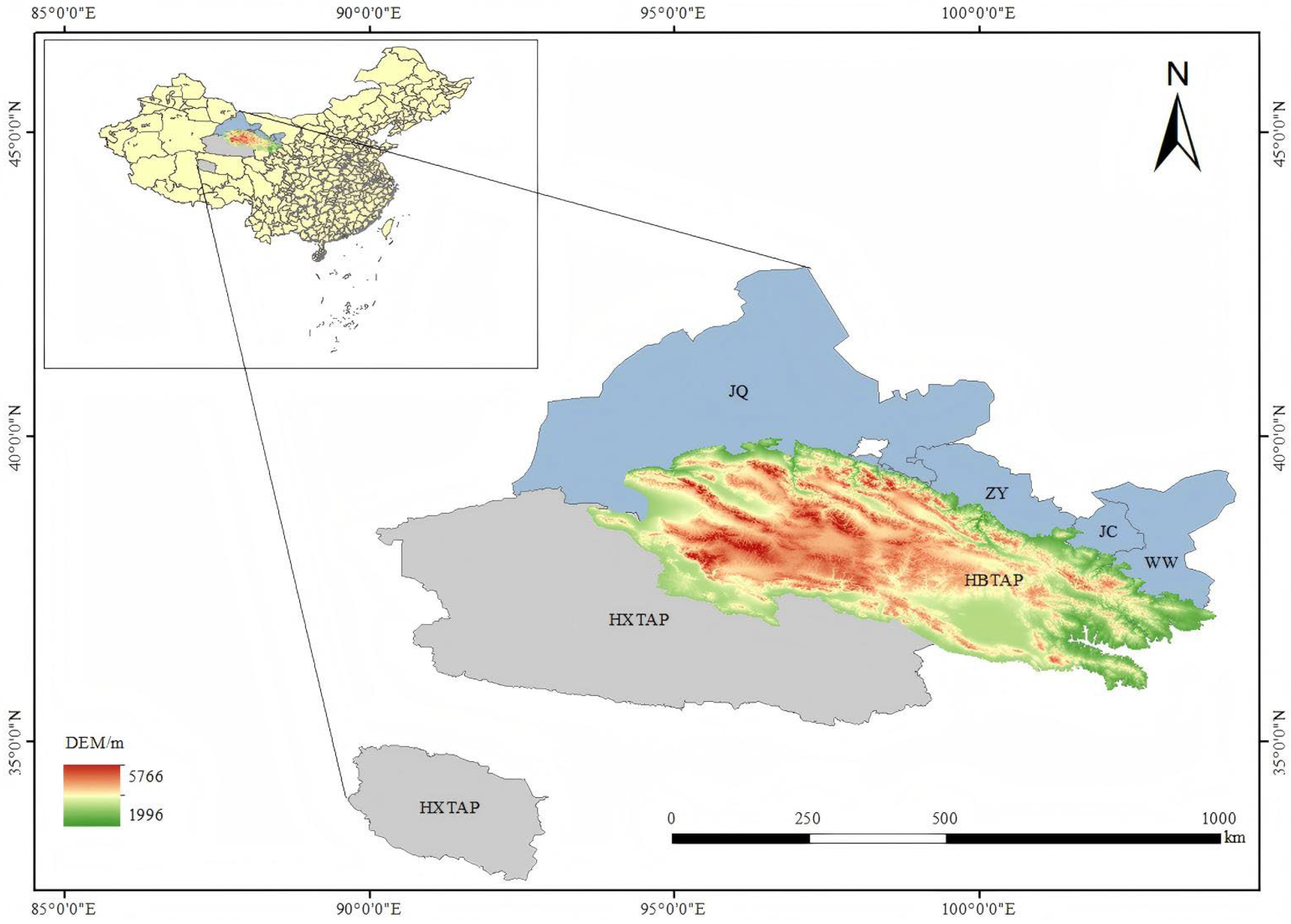
The Qilian Mountains Area (35.8° to 40.0° N and 93.4° to 103.4° E) is located in the inland northwest of China. It lies in the transitional convergence zone of the Tibetan Plateau, the Inner Mongolia Plateau, and the Loess Plateau [18]. The region extends approximately 800 km from east to west and 200–400 km from north to south [23]. Topographically, the area is higher in the northwest and lower in the southeast, with an overall trend from northwest to southeast. The landforms are dominated by high mountains, mid-elevation mountains, and river valley terraces, with a large elevation span ranging from 1996 to 5766 m. Mountain valleys and basins are interspersed throughout the region, forming a complex and diverse topographic pattern, characterized by alpine cold desert landscapes and montane forest steppe landscapes, supplemented by alluvial valley landforms [24].
The Qilian Mountains Area spans two provinces in China, Qinghai and Gansu [25]. The Gansu section covers 34,400 km2, accounting for 68.5% of the total area, while the Qinghai section covers 15,800 km2, accounting for 31.5% [21]. The administrative divisions include four prefecture-level cities in Gansu Province (JQ, ZY, WW, and JC) and two autonomous prefectures in Qinghai Province (HXTAP and HBTAP).
This study selected these six cities (prefectures) as its core research units (Figure 1), owing to the limited availability of county-level data. These cities (prefectures) represent not only the core distribution belt of the forest ecosystems in the Qilian Mountains but also key regions where soil conservation capacity is most effectively exerted [26,27]. Their ecological characteristics align closely with the assessment objectives of this study, thereby providing representative and reliable research samples for measuring forest soil conservation and evaluating its ESV. Based on data pertaining to forest resources, topography, geomorphology, meteorology, and soil, this research examined the spatiotemporal heterogeneity and dynamic evolution of forest soil conservation and its ESV in the Qilian Mountains Area.

2.2. Data Sources

The RUSLE model was employed to simulate soil conservation. The required input datasets included digital elevation model (DEM) data, precipitation data, soil properties, and vegetation cover data [7,8]. Considering data availability, data spanning the period from 2008 to 2023 were acquired for the six prefecture-level cities within the Qilian Mountains Area (Table 1). Using ArcMap 10.8 (Environmental Systems Research Institute, Inc., Redlands, CA, USA), raster data were extracted and statistically summarized into annual corresponding datasets for the six prefecture-level cities within the Qilian Mountains Area via the Spatial Analyst tools and Data Management Tools in ArcToolbox, which are built-in modules of ArcMap 10.8. Furthermore, this study employed ArcMap 10.8 to minimize potential biases caused by spatial data inconsistencies, and integrated the data characteristics, spatial attributes and analytical requirements specific to the study area into the preprocessing workflow. Specifically, all spatial datasets were projected into a unified geographic coordinate system (WGS_1984_UTM_Zone_48N) and resampled to a consistent raster resolution of 30 m using the Kriging interpolation method. This processing ensured spatial reference and resolution consistency across all raster datasets, effectively reducing computational errors arising from mismatched spatial references and resolutions. Furthermore, a comparative experiment using bilinear interpolation was conducted to validate the interpolation method. The results show that the two methods yield consistent trends, whereas Kriging interpolation exhibits superior spatial continuity.

2.3. Research Methods

2.3.1. Framework

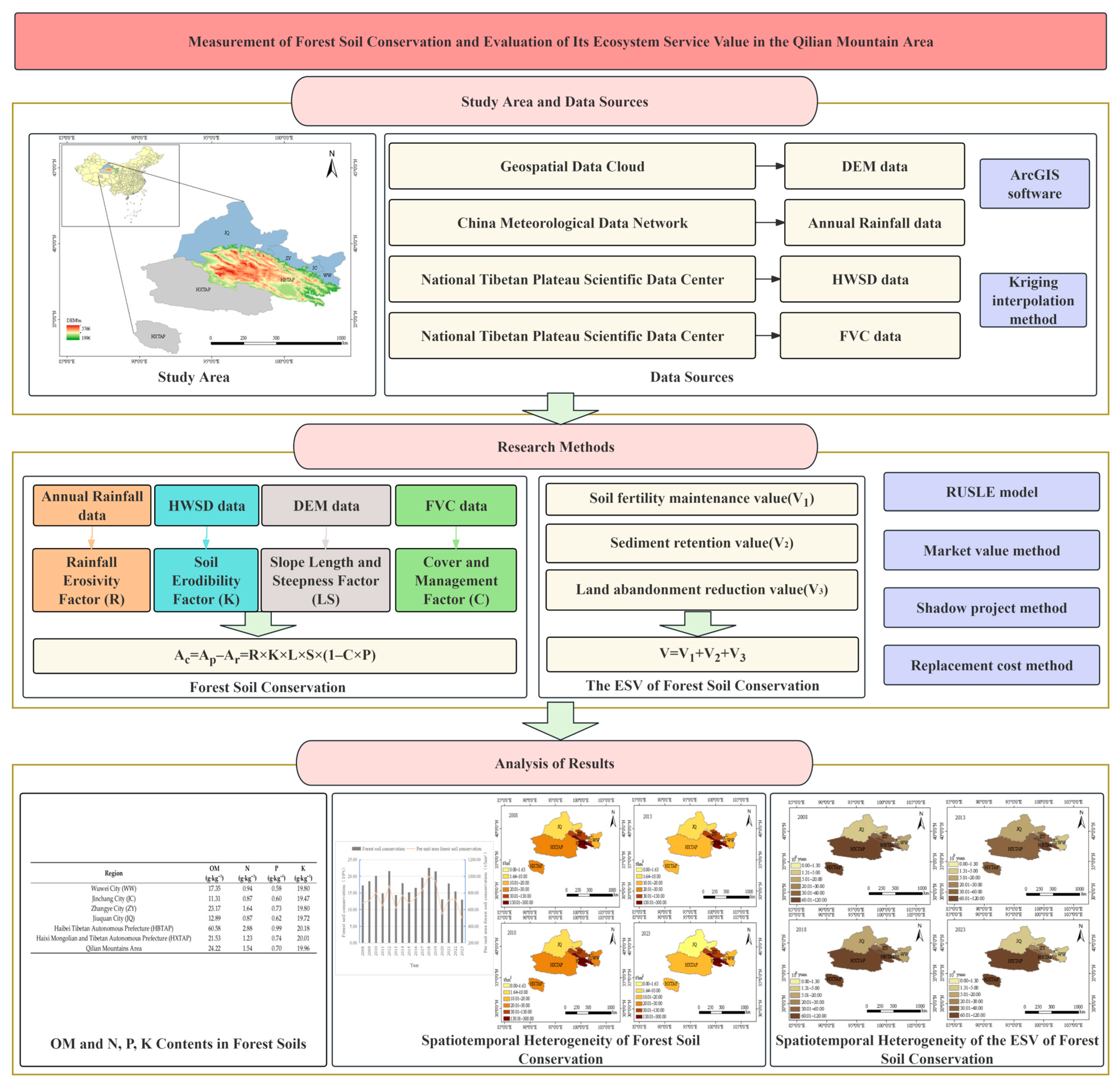
This study focused on the Qilian Mountains Area, integrating multi-source geospatial data, including DEM, meteorological rainfall records, soil properties, and fractional vegetation cover (FVC). The RUSLE model was applied to quantify forest soil conservation, while its associated ESV was evaluated using the market value, shadow project, and replacement cost methods. Finally, the spatiotemporal patterns of soil nutrient content and conservation effectiveness were analyzed to elucidate the dynamics of forest soil conservation functions and their ESV in the study area. The detailed methodological framework is illustrated in Figure 2.

2.3.2. Analytical Methods for OM and N, P, K Contents in Forest Soils

Given that most existing soil property databases provide static single-period reference data, they are insufficient for analyzing inter-annual variations in soil chemical properties. Accordingly, this study employs ArcGIS software to perform spatial processing and data extraction on the latest raster data of HWSD v2.0 released in 2023, to obtain the average contents of OM, N, P, and K in forest soils of the Qilian Mountains Area. Specifically, relevant raster data were loaded into ArcGIS, and the Kriging interpolation method was applied to resample all raster data to a consistent raster resolution of 30 m. Spatial clipping was then conducted based on the vector boundaries of the Qilian Mountains Area and its six cities (prefectures). The average contents of OM, N, P, and K in forest soils of the Qilian Mountains Area were subsequently computed using the raster calculator tool within the ArcGIS environment.

2.3.3. Soil Conservation Quantification Method

Assessing soil conservation capacity and identifying key functional zones are essential for implementing targeted ecological protection measures. In this study, the soil conservation amount is defined as the difference between potential and actual soil erosion [2]. With reference to the specifications outlined in the Technical Guidelines for Terrestrial Gross Ecosystem Product (TGEP) Accounting [28,29], the RUSLE model was employed for quantitative calculation [30,31].
This study extended the conventional framework through localized parameter calibration and dynamic optimization of key factors, thereby enhancing its applicability to the Qilian Mountains region. In addition, high-resolution multi-source data were integrated to enable refined grid-based computation and multi-scale nested analysis, while the assessment period was extended to capture long-term dynamics. Furthermore, to address the sensitivity of the RUSLE model to spatial data resolution, all raster datasets were harmonized to a 30 m resolution via the Kriging interpolation method. Cross-validation demonstrated that the errors associated with Kriging interpolation remain within acceptable limits, effectively minimizing uncertainties associated with data resolution and spatial interpolation, enhancing the reliability of the simulation results.
The specific formula is as follows:
A c   =   A p A r   =   R   ×   K   ×   L   ×   S   ×   1 C   ×   P
where Ac denotes the soil conservation amount (t·ha−1·a); Ap the potential soil erosion amount; Ar the actual soil erosion amount; R the rainfall erosivity factor; K the soil erodibility factor; LS the topographic factor, in which L represents the slope length factor and S the steepness factor; C the cover management factor; and P denotes the support practice factor. The estimated results of all these factors are presented in Table 2.
(1)
Rainfall erosivity factor (R): This factor represents the potential energy of rainfall to detach and transport soil particles. In this study, the R value was calculated using annual precipitation data. The formula is as follows [32]:
R = 0.053 P n 1.655
where R represents the annual rainfall erosivity factor ((MJ·mm)/(ha·h·a)), and Pn denotes the average annual precipitation (mm).
(2)
Soil erodibility factor (K): This factor reflects the inherent property of soil to resist detachment and transport by runoff. The value of K is closely related to the physicochemical properties of soil, including the soil structure, OM content, texture, and permeability. The formula is expressed as follows [33]:
K =   ( 0.01383 + 0.51575 K E P I C ) ×   0.1317 K E P I C = 0.2 + 0.3 e x p 0.256 m s 1 m s i l t / 100   ×   m s i l t / m c + m s i l t 0.3 × 1 0.25 o r g C / o r g C + e x p 3.72 2.95 o r g C × 1 0.7 1 m s / 100 /   1 m s / 100 + e x p 5.51 + 22.9 1 m s / 100
where K represents the modified soil erodibility factor (t·ha·MJ−1·mm−1·ha−1); mc, msilt, ms and orgC denote the percentage contents (%) of clay, silt, sand, and organic carbon, respectively.
(3)
Topographic factors L and S: The influence of topography on soil erosion is primarily reflected by the slope length factor (L) and steepness factor (S). The formula is given by [34,35] the following:
L = ( λ 22.13 ) m m = β / β + 1 β =   ( sin θ / 0.089 ) / [ 3 ( sin θ ) 0.8 + 0.56 ]   S   = 10.8 sin θ + 0.03           θ   <   5 ° 16.8 sin θ 0.50           5 °     θ   <   10 ° 21.9 sin θ 0.96           10 °     θ
λ represents the slope length (m), and θ denotes the slope gradient (%).
(4)
Cover management factor C: Vegetation mitigates soil loss. For the forest ecosystems in this study, with reference to the research by Cai et al. [36], the factor C was determined based on FVC (c).
  C = 1                                                                 c = 0 0.6508 0.3436 log c   0   <   c     78.3 % 0                                                 c   >   78.3 %
(5)
Support practice factor (P): For forest ecosystems, the P factor is conventionally assigned a value of 1, as forest ecosystems are considered to experience relatively weak anthropogenic disturbances [33,37,38,39]. Although differentiated P values have been used to account for varying disturbance levels in some studies [4,40], such methods often introduce subjectivity. Therefore, to align with established protocols and ensure parameter objectivity, the P value was set to 1 in this study.

2.3.4. Valuation of Ecosystem Service Value of Forest Soil Conservation

This study assessed the ESV of forest soil conservation in the Qilian Mountains Area across three dimensions, namely soil fertility conservation, sediment retention, and land abandonment reduction, using the quantified soil conservation amount. Corresponding valuation methods, including the market value method, shadow project method, and replacement cost method, were applied to quantify the ESV of each component. The formula is expressed as follows [41]:
  V   =   V 1   +   V 2   +   V 3 V 1   =   A   ×   B i   ×   C i   ×   D i V 2   =   0.24   ×   A   ×   C / B D V 3   =   A   ×   B / 0.6   ×   B D   ×   10,000
where V represents the total ESV of forest soil conservation (yuan); V1 denotes the value of soil fertility maintenance (yuan); A is the soil conservation amount (t); Bi is the average contents of N, P, K, and OM in forest soils of the Qilian Mountains Area, with values of 0.15%, 0.13%, 1.02%, and 6.47%, respectively; Ci is the conversion coefficient of N, P, K, and OM to corresponding fertilizers (urea, calcium superphosphate, and potassium chloride) and carbon ratio, with values of 4.762, 2.373, 1.667, and 0.5 [33], respectively; and Di is the market price of each fertilizer (yuan·t−1). For the consistency of comparison regarding the impact of fertilizer prices on soil fertility conservation, the average prices in 2023 were uniformly used for calculation, which were 2498, 770, 2899, and 780 yuan·t−1 for urea, calcium superphosphate, potassium chloride, and organic matter, respectively. V2 is the value of sediment retention (yuan); 0.24 is the national average sediment retention rate [42]; C is the unit construction cost of reservoirs (yuan·m−3), with an average of 6.64 yuan·m−3; and BD is the soil bulk density (g·cm−3), with an average of 0.85 g·cm−3 in the Qilian Mountains Area [43]. V3 represents the value of land abandonment reduction (yuan); B is the average annual forestry revenue (yuan·ha−1), derived from the China Statistical Yearbook; and 0.6 m is the average topsoil depth in the Qilian Mountains Area [44].

3. Results

3.1. Characteristics of OM and N, P, and K Contents in Forest Soils

Most available soil property datasets are static single-period products, which are not suitable for analyzing inter-annual differences in soil chemical properties. Therefore, using HWSD v2.0 raster data processed with ArcMap 10.8, this study obtained the average contents of OM, N, P, and K in forest soils of the Qilian Mountains Area as 24.22 g·kg−1, 1.54 g·kg−1, 0.70 g·kg−1, and 19.96 g·kg−1, respectively. As shown in Table 3, regions with higher average contents of OM, N, P, and K in the forest soils of the Qilian Mountains Area were concentrated in HBTAP and ZY during the study period, with the former recording values of 60.58 g·kg−1, 2.88 g·kg−1, 0.99 g·kg−1, and 20.18 g·kg−1, and the latter 23.17 g·kg−1, 1.64 g·kg−1, 0.73 g·kg−1, and 19.80 g·kg−1. As the core forested areas of the Qilian Mountains, these two cities are dominated by high-quality native tree species such as Picea crassifolia and Sabina przewalskii. These regions exhibit high vegetation coverage, and their relatively humid and temperate climatic conditions accelerate litter decomposition and nutrient return, thereby enhancing the soil’s capacity to adsorb and store OM, N, P, and K.
Areas with moderate average nutrient contents include HXTAP, where the average contents of OM, N, P, and K in forest soils were 21.53 g·kg−1, 1.23 g·kg−1, 0.74 g·kg−1, and 20.01 g·kg−1, respectively. Forests in this prefecture are relatively fragmented, litter production is limited, and the relatively arid climate restricts microbial activity. These factors contribute to low soil organic matter content, which to some extent impairs the ability of soil microbial communities to sequester OM, N, P, and K.
Regions with lower average contents include WW, JQ, and JC. Their respective average contents of OM, N, P, and K in forest soils were 17.35 g·kg−1, 0.94 g·kg−1, 0.58 g·kg−1, and 19.80 g·kg−1 (WW), 12.89 g·kg−1, 0.87 g·kg−1, 0.62 g·kg−1, and 19.72 g·kg−1 (JQ), and 11.31 g·kg−1, 0.87 g·kg−1, 0.60 g·kg−1, and 19.47 g·kg−1 (JC). In WW, forest land is interspersed with agricultural and desert areas, and some forest patches are fragmented, leading to discontinuous litter input and hindering soil element cycling. Although JQ covers a large geographical area, its forests are mainly concentrated in the southern mountainous regions and dominated by drought-tolerant shrublands. These ecosystems have low litter production and slow decomposition rates, resulting in insufficient accumulation of OM, N, P, and K in the soil. The forest resources in JC are predominantly public welfare forests, with some areas in the transitional stage of ecological restoration where plant community structures are not yet stable. Additionally, these areas are susceptible to interference from regional industrial activities and agricultural reclamation, which degrade soil structure and exacerbate the loss of soil nutrients.

3.2. Spatiotemporal Heterogeneity of Forest Soil Conservation

As a vital ecological security barrier and core water conservation zone in western China, the soil conservation capacity of the forest ecosystem in the Qilian Mountains Area holds strategic significance for safeguarding regional water security, controlling soil erosion, and ensuring the sustainable development of agriculture and animal husbandry in the Hexi Corridor. Based on the ArcGIS spatial analysis platform, this study employed the RUSLE model to simulate and quantify the forest soil conservation amount in the Qilian Mountains Area. The results were subsequently averaged by administrative boundaries to derive the forest soil conservation amounts for the six cities (prefectures).
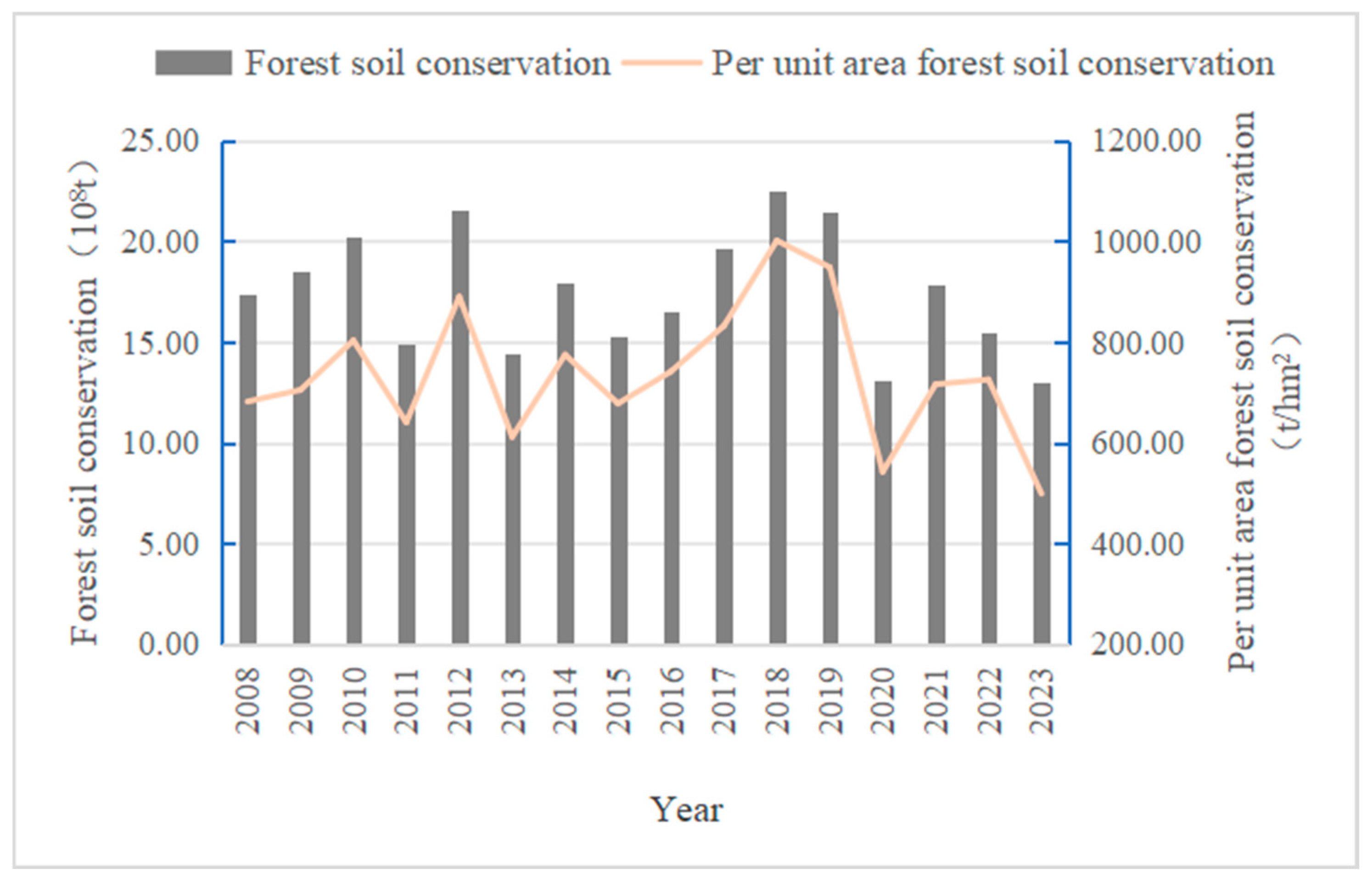
In terms of temporal variation (Figure 3, Table 4), the forest soil conservation amount in the Qilian Mountains Area from 2008 to 2023 ranged between 13.00 × 10⁸ t and 22.55 × 10⁸ t, while the per unit area value ranged from 498.53 to 1001.20 t·ha−1 (the latter serving as an indicator to assess the strength of forest soil conservation capacity). The average annual forest soil conservation amount was 17.49 × 10⁸ t, and the corresponding per unit area value was 736.59 t·ha−1. Inter-annual variation generally showed a pattern of initial increase followed by a decrease. The peak was recorded in 2018, with a forest soil conservation amount of 22.55 × 10⁸ t and a unit area value of 1001.20 t·ha−1. The lowest values were observed in 2023, with a forest soil conservation amount of 13.00 × 10⁸ t and a unit area value of 498.53 t·ha−1.
The steady upward trend of the forest soil conservation amount from 2008 to 2018 may be resulted from the cumulative long-term effects of the Natural Forest Protection Program and the implementation of integrated ecological restoration projects for mountains, rivers, forests, farmlands, lakes, and grasslands. Human disturbances such as agricultural expansion significantly decreased, leading to marked improvement in forest vegetation coverage. Additionally, the Qilian Mountains Area experienced relatively abundant precipitation with a well-distributed seasonal pattern during 2017–2018, which enhanced soil structural stability and thus contributed to the peak in forest soil conservation during this period.
From 2018 to 2023, however, the forest soil conservation amount in the study area exhibited a declining trend. This decrease may be attributed to an intensified warming and aridification trend after 2018, characterized by a rising average annual temperature and reduced annual precipitation. These climatic changes constrained vegetation growth and weakened the erosion resistance of forest soils. In addition, the region experienced a consecutive spring–summer drought, which was compounded by extreme heavy rainfall in August in 2023. These conditions further exacerbated rainfall-induced erosion on exposed surfaces, driving the regional forest soil conservation to its historical lowest level in the study period.
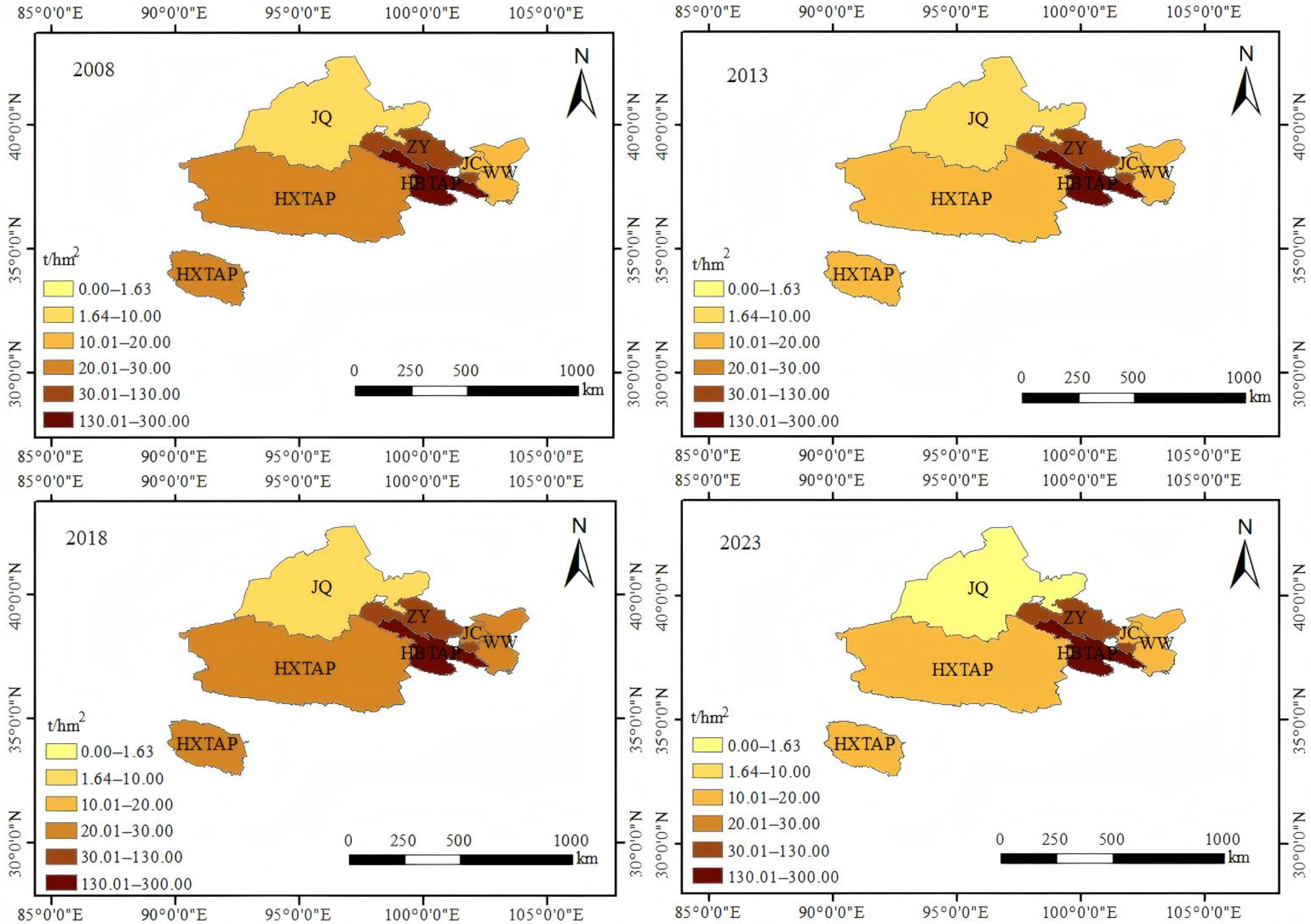
The spatial pattern of forest soil conservation per unit area (Table 4, Figure 4) in the Qilian Mountains Area showed relatively small inter-annual fluctuations from 2008 to 2023, exhibiting a spatial characteristic of high in the southeast and low in the northwest. High-value areas were concentrated in HBTAP and ZY during the study period, with average annual forest soil conservation amounts per unit area of 202.73 t·ha−1 and 86.23 t·ha−1, respectively. The abundant OM and N, P, and K contents in the forest soils of these regions significantly promote the growth of high-quality tree root systems, enhancing root reinforcement capacity. Meanwhile, vegetation growing in nutrient-rich soils tends to develop denser canopy layers, which reduces rainfall-induced erosion and further strengthens the erosion resistance of forest soils.
Medium-value areas included JC, HXTAP, and WW, with average annual forest soil conservation amounts per unit area of 20.97 t·ha−1, 20.17 t·ha−1, and 17.76 t·ha−1, respectively. Low contents of OM, N, P, and K in the forest soils may lead to simplified forest community structures, over-concentration of dominant species, and reduced biodiversity, thereby increasing the risk of vegetation degradation and keeping forest soil conservation per unit area at a moderate level.
The only low-value area was JQ, where the average annual forest soil conservation amount per unit area was only 2.42 t·ha−1. Low average contents of OM, N, P, and K in the forest soils of this city restrict vegetation growth and weaken soil erosion resistance. Furthermore, insufficient soil nutrient levels can inhibit microbial activity, hinder the decomposition and transformation of soil organic matter, and disrupt soil nutrient cycling. These factors exacerbate soil impoverishment and constrain the enhancement in forest soil conservation.

3.3. Spatiotemporal Heterogeneity of the Ecosystem Service Value of Forest Soil Conservation

The ESV of forest soil conservation in the Qilian Mountains Area was assessed using an integrated valuation framework incorporating the market value method, shadow project method, and replacement cost method. This approach was aligned with regional forest soil conservation characteristics and the relevant technical specifications for ESV assessment in the Gansu section of the Qilian Mountains National Park. The results were averaged by administrative boundaries to derive the ESV of forest soil conservation for the six cities (prefectures).
The average annual values of soil fertility conservation ( V 1 ), sediment retention ( V 2 ), land abandonment mitigation ( V 3 ), and the total ESV of forest soil conservation ( V ) in the study area from 2008 to 2023 were 166.29 × 10⁸ yuan, 32.91 × 10⁸ yuan, 6.02 × 10⁸ yuan, and 205.21 × 10⁸ yuan, respectively (Table 5). The contributions of V1, V2, and V3 to the total ESV differed significantly, accounting for 81.03%, 16.04%, and 2.93%, respectively. This indicates that the total ESV of forest soil conservation in the Qilian Mountains Area was dominated by V 1 during this period. Overall, the total ESV ( V ) showed a trend of initial increase followed by decrease from 2008 to 2023, with the peak value reaching 263.67 × 10⁸ yuan in 2018.
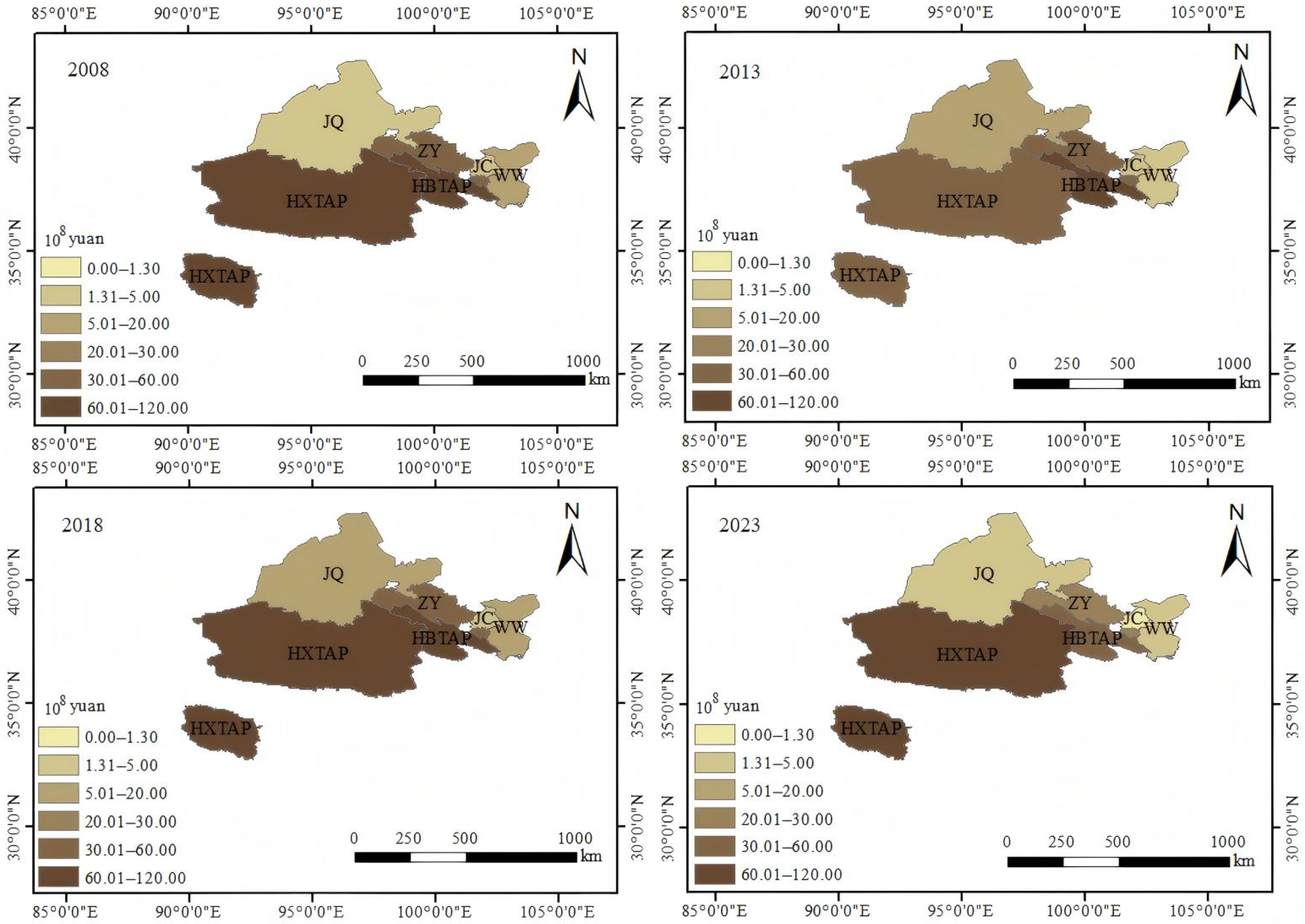
The ESV of forest soil conservation in the Qilian Mountains Area exhibited a pattern of high in the southeast and low in the northwest (Table 6, Figure 5). High-value areas were primarily concentrated in HBTAP and HXTAP during the study period, with average annual ESVs of forest soil conservation of 80.75 × 10⁸ yuan and 70.97 × 10⁸ yuan, respectively. The forest soils in HBTAP are rich in OM, N, P, and K, and the vegetation is dominated by high-altitude moist shrublands with strong water conservation capacity. Although the forest soil conservation per unit area in HXTAP falls within the medium range, its extensive forest area contributes to a large total soil conservation amount, thereby elevating its overall ESV.
The medium-value area was ZY, with an average annual ESV of forest soil conservation at 38.92 × 10⁸ yuan. The forest vegetation in ZY is primarily composed of arboreal forests, characterized by high total soil porosity and strong water retention capacity. However, its relatively limited forest area somewhat constrains the realization of ESV from forest soil conservation.
Low-value areas were distributed in WW, JQ, and JC, with average annual ESVs of forest soil conservation of 6.70 × 10⁸ yuan, 4.76 × 10⁸ yuan, and 2.33 × 10⁸ yuan, respectively. The contents of OM, N, P, and K in the forest soils of WW and JQ are low, and the integrity of their vegetation communities is inferior to that in the core high-value areas. Consequently, the ESV of forest soil conservation in these cities lags that of the core high-value regions. Although measures such as artificial rainfall enhancement to alleviate drought and the promotion of grassland ecological restoration have been implemented to improve the ESV of forest soil conservation, it remains at a relatively low level. JC has the lowest contents of OM, N, P, and K in its forest soils. Located in the desert transition zone on the northern foothills of the Qilian Mountains, it is affected by human activities such as cropland reclamation and urban construction, resulting in fragmented vegetation cover. In addition, the dominance of alpine cold desert and sparse vegetation leads to weak soil erosion resistance and extremely poor vegetation water retention capacity, resulting in the lowest ESV.

4. Discussion

4.1. Reliability of the Research Findings

Increased soil OM content promotes soil carbon cycling and enhances the stability of soil aggregates, thereby improving the erosion resistance of forest soils. In addition, N, P, and K in the soil are key nutrients that support forest vegetation growth, which in turn mitigates rainfall erosivity through canopy interception, litter layer water retention, and root reinforcement. This vegetation–soil feedback loop enhances forest soil conservation capacity, optimizes soil structure, and strengthens water and nutrient retention, ultimately elevating the ESV of forest soil conservation.
The average contents of OM, N, P, and K in forest soils of the Qilian Mountains Area are 24.22 g·kg−1, 1.54 g·kg−1, 0.70 g·kg−1, and 19.96 g·kg−1, respectively. These results are highly consistent with findings from previous studies. For instance, Wang et al. [45] reported comparable ranges of soil organic carbon (20.95–82.55 g·kg−1), total N (2.3–9.67 g·kg−1), and total P (0.49–0.73 g·kg−1) along an elevational gradient from Xianmi Forest Farm to Lenglong Ridge on the southern slopes of the Qilian Mountains. Li et al. [46] documented total K contents (12.24–14.45 g·kg−1) in the eastern Qilian Mountains that are consistent with the magnitude observed in this study.
In addition, the average annual total forest soil conservation amount in the Qilian Mountains Area during the study period reached 1.749 billion metric tons, exhibiting a spatial pattern of “higher in the southeast and lower in the northwest.” This result is consistent with existing related research in the Qilian Mountains Area. Wang et al. [47] used the Sediment Delivery Ratio (SDR) module of the InVEST model to estimate an average annual soil conservation amount of 1.3 × 10⁹ t in the Qilian Mountains National Park (2000–2019), exhibiting a decreasing east–west spatial gradient. Chen et al. [33] quantified 421 million metric tons of soil conservation amount in the Qilian Mountains National Nature Reserve of southwestern Gansu Province for 2015, with a higher retention intensity in the eastern areas.
The ESV of forest soil conservation in the Qilian Mountains Area was estimated at 205.21 × 10⁸ yuan year−1 (2008–2023), showing a spatial distribution of higher values in the southeast and lower values in the northwest, which aligns with previous findings. For example, Fan et al. [48] estimated an ESV of 137.43 × 10⁸ yuan year−1 for the Gansu Qilian Mountains National Park (2018) while Liu et al. [49] reported an ESV of 210.56 × 10⁸ yuan year−1 in the Qilian Mountains National Nature Reserve (1980–2020), confirming the reliability of our ESV assessment. Furthermore, Shi et al. [42] documented the soil conservation ESV of 612.00 × 10⁸ yuan year−1 in the Qinghai Lake Basin (1985–2020), which was notably higher than that in the Qilian Mountains Area. Zhu et al. [41] obtained the soil conservation ESV of 3.64 × 10⁸ yuan year−1 in the Yanhe Basin (2000–2015), which was significantly lower than that in the Qilian Mountains Area.
This study quantifies forest soil conservation and its ESV across the Qilian Mountains Area at both the regional and prefecture levels, and analyzes the spatiotemporal heterogeneity and temporal dynamics. The results provide a scientific basis for developing differentiated ecological restoration and site-specific management strategies for each prefecture-level city. Additionally, the findings offer quantitative support for refined forest resource management, the realization of forest ecological product values, and the establishment of cross-regional eco-compensation mechanisms. This research contributes to coordinated ecological governance among the six prefectures, strengthening the ecological security barrier in northwestern China’s arid regions, and advancing sustainable ecosystem management.

4.2. Prefecture-Level Drivers of Spatiotemporal Heterogeneity in Forest Soil Conservation and ESV

Forest soil conservation and its ESV in the Qilian Mountains Area exhibited a temporal trend of initial increase followed by a decline between 2008 and 2023, with a spatial differentiation pattern of higher in the southeast and lower in the northwest. Overall, significant spatiotemporal heterogeneity was observed across the region, which is closely related to the spatial variation in natural resource endowments and regional disparities in socioeconomic development within the study area. Specifically, beyond the influence of soil OM, N, P, and K contents, forest soil conservation and its ESV in the Qilian Mountains Area were jointly influenced by vegetation type and quality, topographic and climatic conditions, as well as human activities and ecological management practices.
Haibei Tibetan Autonomous Prefecture, the core ecological protection zone of the Qilian Mountains Area, boasts higher forest coverage and more abundant soil OM, N, P, and K contents than the five other cities. Consequently, it achieves the highest levels of forest soil conservation and ESV. In contrast, JC, a typical industrial and mining city, has low forest coverage and low levels of soil OM, N, P, and K. These conditions lead to lower levels of forest soil conservation and ESV.
In terms of vegetation type and quality, HBTAP had a natural vegetation proportion of 44.53% in 2023, while ZY recorded an arboreal forest proportion of 33.50% in the same year. The complex forest plant community structures in both areas enhance their excellent forest water conservation capacity [39], thereby sustaining high levels of forest soil conservation and ESV. In contrast, JC, HXMTAP, and WW have relatively scarce forest vegetation and fragmented forest ecosystems. Consequently, vegetation resources available for soil conservation are limited, leading to weak soil erosion resistance. JQ exhibited an average annual vegetation coverage of only 9.38% during the study period, with poor stability in its forest plant community structure, which in turn results in low levels of forest soil conservation and ESV.
Moderate topographic relief along the main ridge of the Qilian Mountains facilitates forest soil conservation, while marginal areas or steep slopes are prone to water erosion, resulting in lower soil conservation capacity and ESV. Precipitation intensity directly modulates soil erosion dynamics. The southeastern Qilian Mountains Area received a mean annual precipitation of 303.39 mm during the study period, with relatively uniform distribution. This precipitation pattern not only supports vigorous vegetation growth but also avoids high-intensity storm runoff, thus promoting forest soil conservation and its ESV. In contrast, the northwestern part of the region had a mean annual precipitation of only 140.37 mm, which often occurs as short-duration heavy rainfall. Such rainfall easily generates storm runoff and triggers soil erosion, leading to lower forest soil conservation and ESV.
Zhangye City, located in the middle section of the northern foothills of the Qilian Mountains, benefits from suitable altitude and slope gradients and had a mean annual precipitation of 282.84 mm during the study period. It maintains relatively high levels of soil conservation and ESV. JQ received a mean annual precipitation of only 82.54 mm and has 12.33 million hectares of desertified land, while JC has a Gobi area of 2535 km2 where surface materials are predominantly loose sandy sediments and gravel. Rapid surface runoff in these areas restricts vegetation growth and undermines the soil stabilization function of forest vegetation [50], resulting in lower forest soil conservation and ESV.
Concerning human activities and ecological management practices, significant regional differences exist among the six cities (prefectures) in terms of industrial and urban land expansion, population density and aggregation patterns, agricultural development intensity, and infrastructure development. As a typical industrial and mining city with highly concentrated industrial–urban land use and population aggregation in oases and built-up areas aligned with industrial distribution, JC exhibits distinct spatial clustering characteristics. This generates high anthropogenic disturbance to forest ecosystems, weakens forest soil conservation capacity [51], and places its ESV at the lowest level among the six cities (prefectures). JQ has experienced rapid industrial and urban land expansion, with moderate but uneven population density, high-intensity oasis agricultural development, and local forest disturbance caused by infrastructure construction. These factors exert moderate disturbance to forest ecosystems, impair soil conservation capacity, and result in the lowest per-unit-area forest soil conservation among the six cities (prefectures).
Guided by an ecological protection-oriented development model and serving as a core ecological zone, HBTAP features slow and scattered industrial–urban land expansion, alongside low and dispersed population density, low agricultural development intensity, and infrastructure development integrated with ecological protection requirements. These conditions result in minimal anthropogenic disturbance to forest ecosystems, well-preserved forest soil conservation capacity, and the highest levels of forest soil conservation and its ESV among the six cities (prefectures). Additionally, all cities and prefectures have actively implemented ecological restoration projects, such as the Grain-for-Green Program and afforestation, which have effectively enhanced forest soil conservation and its ESV.
Overall, the spatiotemporal heterogeneity of forest soil conservation and its ESV in the Qilian Mountains Area results from the combined effects of differences in natural resource endowments and varying intensities of human socioeconomic activities. Moreover, the distinct characteristics of each city (prefecture) closely align with their respective resource conditions, regional development orientations, and levels of anthropogenic disturbance.
Therefore, conducting a spatiotemporal heterogeneity analysis of forest soil conservation and its ESV in the Qilian Mountains Area can clarify the ecological strengths and weaknesses across different periods and regions, providing scientific support for optimizing the allocation of regional ecological governance resources and formulating differentiated ecological protection and restoration strategies.

4.3. Ecological Restoration Measures and Policy Implications

For differentiated ecological restoration, site-specific management strategies should be developed based on the spatial heterogeneity of soil OM, N, P, and K contents. In prefectures with high average SOM, N, P, and K contents (e.g., HBTAP and ZY), priority should be given to maintaining natural litter decomposition processes and soil nutrient cycling. Measures like grazing prohibition and forest floor litter preservation can sustain soil nutrient advantages. Also, unmanned aerial vehicle (UAV) remote sensing and digital technologies should be used to establish a dynamic monitoring network for tracking forest soil carbon sinks, thereby strengthening carbon sequestration functions and enhancing soil erosion resistance.
Prefectures with medium average contents of soil OM, N, P, and K, such as HXTAP, should focus on quality improvement and efficiency enhancement. Forest structure optimization projects, rational application of soil micro-fertilizers, and optimized ratios of N, P, and K in forest soils can mitigate the constraints of insufficient precipitation on litter decomposition efficiency. Additionally, improving the continuity of forest vegetation coverage and adopting digital monitoring terminals for the real-time tracking of soil nutrients and carbon sink changes in restoration areas are also recommended.
Prefectures with lower average contents of OM, N, P, and K in soils, such as WW, JQ, and JC, should prioritize foundational restoration. This involves supplementing the soil nutrient pool by adding microbial agents and planting drought-tolerant, nutrient-deficient-tolerant species. Additionally, soil improvement and carbon sink vegetation restoration in mining rehabilitation zones and core industrial areas are crucial to gradually narrow regional gaps in forest soil conservation and its ESV.
To optimize ecological compensation mechanisms and advance the operationalization of forest soil conservation ESV, the Qilian Mountains Area should explore compensation pathways and ESV transformation models in line with the governance principle of “benefits for protectors, compensation from beneficiaries.” For prefectures with high forest soil conservation ESV (e.g., HBTAP and HXTAP), ESV assessment results should be incorporated into local high-quality development evaluation indicators. Building on forest carbon sink advantages, pilot projects of voluntary forest carbon sink trading should be initiated. Concurrently, horizontal ecological compensation agreements should be established with beneficiary regions based on the forest soil conservation ESV, ensuring compensation funds are specifically allocated to forest soil nutrient conservation and carbon sink enhancement. For prefectures with moderate ESV levels, such as ZY, strategies should focus on consolidating fragmented forest land resources to establish forest ecological banks, leveraging social capital for ecological restoration investment. Optimizing forest carbon sink projects and realizing ecological asset value through carbon trading can broaden funding sources for ecological protection.
Low ESV prefectures, such as WW, JQ, and JC, should capitalize on forest vegetation restoration outcomes to develop distinctive forest ecological products like ecotourism and understory economies. Involving local communities in forest land management and soil monitoring can raise public ecological protection awareness and facilitate the transformation of ecological restoration achievements into tangible forest ecological product value.

4.4. Limitations and Future Perspectives

This study assessed forest soil conservation and its ESV across six prefecture-level cities in the Qilian Mountains Area. While the spatiotemporal patterns and key drivers of these indicators have been characterized, several limitations should be noted.
Firstly, constrained by data availability and temporal continuity, the RUSLE model employed in this study relies on simplified parameterizations. The rainfall erosivity factor (R) was estimated using an empirical formula based solely on annual precipitation, without explicitly accounting for the effects of rainfall intensity, duration, and intra-annual distribution on soil erosion. This simplification may lead to a certain overestimation of forest soil conservation and its ESV. Additionally, the support practice factor (P) was uniformly set to 1 for forest ecosystems, potentially overlooking localized anthropogenic disturbances, and introducing a slight underestimation bias in areas with intensive human activity. Furthermore, although all input layers were harmonized to a 30 m resolution using the Kriging interpolation method to ensure spatial consistency, this resampling process does not enhance the intrinsic information content of coarse-resolution source data. Consequently, fine-scale patterns should be interpreted as relative spatial trends rather than absolute pixel-level estimates. Secondly, uncertainty and sensitivity analyses were not conducted, which limits the quantification of how the fluctuations in key model parameters affect estimation accuracy and hinders the identification of a dominant driving factor. Additionally, while multi-year raster data were used to estimate soil conservation and its ESV, scenario simulation incorporating climate change and ecological restoration trajectories were not included, making it impossible to predict the evolution trend of forest soil conservation and its ESV under different intervention measures. Moreover, the unique topographic, climatic, and edaphic conditions of the Qilian Mountains Area complicate direct cross-regional comparisons using unified standards, limiting the generalizability of the findings.
Future research could leverage higher spatiotemporal-resolution datasets and field validation campaigns to obtain continuous monthly or daily time series data for the Qilian Mountains Area, thereby refining parameter estimation in the RUSLE model. Such improvements would enable quantitative attribution of the heterogeneous effects of vegetation composition, topographic gradients, climatic variability, and anthropogenic pressures on forest soil conservation and its ESV, facilitating a more mechanistic understanding of the underlying drivers.
Furthermore, integrating the present findings with effectiveness assessments of climate change and ecological restoration projects (e.g., Grain-for-Green) could simulate the evolution trends of soil conservation and its ESV under different scenarios. Multi-method validation approaches, such as cross-comparison with the equivalent factor method or process-based models, could further triangulate ESV estimates and improve confidence in the assessments. Formal uncertainty and sensitivity analyses should also be conducted to identify key model parameters and core influencing factors, enhancing the robustness of the research findings.
Ultimately, attention should be paid to the value realization of forest ecological products, investigating the market-oriented transformation pathways of forest ESV and the establishment of cross-regional ecological compensation mechanisms. These efforts would provide a theoretical basis for ecosystem service management in mountain forest regions of arid areas.

5. Conclusions

Integrating GIS with the RUSLE model, this study quantified forest soil conservation and ESV across six representative cities (prefectures) in the Qilian Mountains Area from 2008 to 2023. Their spatiotemporal variations and dynamic evolution patterns were analyzed, alongside the influence of soil OM and N, P, and K contents. Additionally, key drivers influencing forest soil conservation and its ESV were identified, providing a scientific basis for regional ecological protection, restoration, and precise natural resource management. The key findings are as follows:
(1)
The average contents of soil OM, N, P, and K in the Qilian Mountains Area exhibited significant spatial heterogeneity, with HBTAP having the highest average levels, followed by ZY, HXTAP, WW, JQ, and JC.
(2)
The average annual forest soil conservation amount in the region from 2008 to 2023 was estimated at 17.49 × 10⁸ t, showing a trend of initial increase followed by a decrease. In terms of conservation per unit area, HBTAP ranked first, with ZY, JC, HXTAP, WW, and JQ showing a clear spatial gradient in descending order.
(3)
The mean annual ESV of forest soil conservation during the same period was 204.44 × 10⁸ yuan, also exhibiting a trend of initial increase followed by a decrease. HBTAP contributed the highest average annual ESV, with HXTAP, ZY, WW, JQ, and JC trailing in descending order.
(4)
Beyond the effects of OM, N, P, and K, forest soil conservation and its ESV were jointly driven by vegetation type and quality, topography and climate, and human activities and ecological management practices. These combined factors collectively shaped the significant spatiotemporal heterogeneity of forest soil conservation and its ESV.
Overall, this study provides a scientific basis for forest management in alpine–arid transition zones. Future efforts should focus on translating these scientific findings into differentiated ecological compensation schemes and market-oriented value realization pathways, thereby providing support for strengthening the ecological security barrier in northwestern China.

Author Contributions

Conceptualization: L.H. and S.N.; methodology: Y.M., X.S. and Z.L.; data curation: L.H. and Y.M.; formal analysis: L.H. and Y.M.; investigation: L.H., Y.M., S.N. and Z.L.; writing—original draft preparation: L.H. and Y.M.; writing—review and editing: L.H., X.S., S.N., Z.L. and Y.M. All authors have read and agreed to the published version of the manuscript.

Funding

This research was funded by the Gansu Provincial University Teacher Innovation Fund Project (Grant No. 2026A-088; Funder: Department of Education of Gansu Province; Funding: 15,000 CNY) and the Gansu Province Department of Education Youth Doctor Support Program (Grant No. 2025QB-059; Funder: Department of Education of Gansu Province; Funding: 60,000 CNY).

Data Availability Statement

The data used in this study were obtained from publicly available sources. Data supporting the findings are available from the following repositories: Digital elevation model (DEM) data were retrieved from the Geospatial Data Cloud (https://www.gscloud.cn, accessed on 9 December 2025); precipitation data were obtained from the China Meteorological Data Network (https://data.cma.cn, accessed on 14 December 2025); and the Harmonized World Soil Database (HWSD) and fractional vegetation cover (FVC) data were acquired from the National Tibetan Plateau Scientific Data Center (https://data.tpdc.ac.cn, accessed on 21 March 2026 and 14 December 2025). No new publicly archived datasets were generated in this study. All data use complied with the respective data platforms’ terms and conditions.

Acknowledgments

The authors gratefully acknowledge the open data support provided by the Geospatial Data Cloud, the China Meteorological Data Network, and the National Tibetan Plateau Scientific Data Center. We extend our thanks to colleagues within the research group for their technical assistance with ArcMap 10.8 software operation and RUSLE model parameter calibration. We also appreciate the guidance and insightful suggestions from experts and scholars during the research design, manuscript structuring, and revision stages. Our thanks also go to the relevant management departments of the Qilian Mountains National Park for providing foundational materials and references on regional ecological conservation. No generative artificial intelligence (GenAI) tools were used for text generation, data processing, or figure creation in this study. All content was independently produced and is the sole responsibility of the authors.

Conflicts of Interest

The authors declare no conflicts of interest.

References

  1. Xu, P.Z.; Zhang, Y.D.; Li, Q.W.; Sun, C.W. Evaluation of forest eco-efficiency: A transformation of ecological value quantity perspective. Sci. Total Environ. 2025, 965, 178162. [Google Scholar] [CrossRef]
  2. Zhou, Y.; Pang, Q.; Xu, J. Multi–scale analysis of the supply–demand relationship of soil conservation services in China. Ecol. Indic. 2025, 181, 114386. [Google Scholar]
  3. Zhang, B.; Xu, Q.; Gao, D.; Wang, T.; Sui, M.; Huang, J.; Gu, B.; Liu, F.; Jiang, J. Soil capacity of intercepting different rainfalls across subtropical plantation: Distinct effects of plant and soil properties. Sci. Total Environ. 2021, 784, 147120. [Google Scholar] [CrossRef]
  4. Pandey, R.; Mehta, D.; Kumar, V. Quantifying soil erosion and soil organic carbon conservation services in indian forests: A RUSLE-SDR and GIS-based assessment. Ecol. Indic. 2024, 163, 112086. [Google Scholar]
  5. Shen, L.T.; Zhao, Z.Z.; Zhang, M.M.; Han, W.Y.; Zhang, K. Dynamics of ecosystem service-driven networks in the Qilian Mountainsand their implications for protected area management. Ecol. Indic. 2025, 179, 114289. [Google Scholar] [CrossRef]
  6. Zhao, L.; Hou, R. Human causes of soil loss in rural karst environments: A casestudy of Guizhou, China. Sci. Rep. 2019, 9, 3225. [Google Scholar] [PubMed]
  7. Borrelli, P.; Robinson, D.A.; Panagos, P.; Lugato, E.; Yang, J.E.; Alewell, C.; Wuepper, D.; Montanarella, L.; Ballabio, C. Land use and climate change impacts on globalsoil erosion by water (2015–2070). Proc. Natl. Acad. Sci. USA 2020, 117, 21994–22001. [Google Scholar] [CrossRef]
  8. Ganasri, B.P.; Ramesh, H. Assessment of soil erosion by RUSLE model using remote sensing and GIS—A case study of Nethravathi Basin. Geosci. Front. 2016, 7, 953–961. [Google Scholar] [CrossRef]
  9. Thomas, J.; Joseph, S.; Thrivikramji, K.P. Assessment of soil erosion in a tropical mountain river basin of the southern Western Ghats, India using RUSLE and GIS. Geosci. Front. 2018, 9, 893–906. [Google Scholar] [CrossRef]
  10. Tomczyk, M.A. A GIS assessment and modelling of environmental sensitivity of recreational trails: The case of Gorce National Park, Poland. Appl. Geogr. 2010, 31, 339–351. [Google Scholar] [CrossRef]
  11. Wu, J.; Yue, X.; Qin, W. The establishment of ecological security patterns based on the redistribution of ecosystem service value: A case study in the Liangjiang New Area, Chongqing. Geogr. Res. 2017, 36, 429–440. (In Chinese) [Google Scholar]
  12. Xiong, C.; Ren, H.; Xu, D.; Gao, Y. Spatial scale effects on the value of ecosystem services in China’s terrestrial area. J. Environ. Manag. 2024, 366, 121745. [Google Scholar] [CrossRef]
  13. Howe, C.; Suich, H.; Vira, B.; Mace, G.M. Creating win-wins from trade-offs? Ecosystem services for human well-being: A meta-analysis of ecosystem service trade-offs and synergies in the real world. Glob. Environ. Change 2014, 28, 263–275. [Google Scholar] [CrossRef]
  14. Wang, X.F.; Lv, Y.H.; Fu, B.J. Ecosystem services and ecological security. Chin. J. Nat. 2012, 34, 273–276+298. (In Chinese) [Google Scholar]
  15. Costanza, R.; d’Arge, R.; De Groot, R.; Farber, S.; Grasso, M.; Hannon, B.; Limburg, K.; Naeem, S.; O’Neill, R.V.; Paruelo, J.; et al. The value of the world’s ecosystem services and natural capital. Nature 1997, 387, 253–260. [Google Scholar] [CrossRef]
  16. Xie, G.D.; Zhang, C.X.; Zhang, L.M.; Chen, W.H.; Li, S.M. Improvement of the evaluation method for ecosystem service value based on per unit area. J. Nat. Resour. 2015, 30, 1243–1254. (In Chinese) [Google Scholar]
  17. Li, Y.; Liu, W.; Feng, Q.; Zhu, M.; Yang, L.; Zhang, J.; Yin, X. The role of land use change in affecting ecosystem services and the ecological security pattern of the Hexiregions, Northwest China. Sci. Total Environ. 2023, 855, 158940. [Google Scholar] [CrossRef] [PubMed]
  18. Yang, H.J.; Guo, X.H.; Li, Z.L.; Wei, Y.X.; Shi, W.W.; Xue, B.; Maraseni, T. Assessing ecosystem services and their spillover effects to inform cost-benefit sharing and horizontal eco-compensation mechanisms in the Qilian Mountains, China. Ecosyst. Serv. 2025, 75, 101764. [Google Scholar] [CrossRef]
  19. Jiao, L.P.; Wynne, R.H.; Han, L.Q.; Chen, P.; Zhang, Y.N.; Yang, F. Attributing vegetation disturbance change agent from Landsat time series in the arid and semi-arid ecosystem of Qilian Mountains, China. Remote Sens. Appl. Soc. Environ. 2025, 39, 101720. [Google Scholar] [CrossRef]
  20. Tian, X.M.; Feng, Q. Exploration on path of ecological protection and economic development in Qilian Mountain National Park region. Bull. Chin. Acad. Sci. 2025, 40, 1103–1112. (In Chinese) [Google Scholar] [CrossRef]
  21. Wu, N.; Pan, X.; Song, X.Y.; Zhao, R.D.; Long, T.G. Efficiency accounting for the conversion of “Green Mountains and Clear Water” into “Gold and Silver Mountains”: An empirical study of Qilian Mountain national park in China. Res. Cold Arid Reg. 2025, 17, 251–260. [Google Scholar] [CrossRef]
  22. Wang, H.; Zhao, C.Y.; Liu, Y.Y.; Chang, Y.P.; Huang, G.Z.; Zang, F. Exploring the spatiotemporal distribution and driving factors of vegetation canopy rainfall interception in the Qilian Mountains, Northwest China. Catena 2024, 237, 107829. [Google Scholar] [CrossRef]
  23. Sun, M.P.; Ma, W.Q.; Yao, X.J.; Zhang, M.J.; Li, Z.Q. Assessment and spatiotemporal characteristics of service value of glaciers in the Qilian Mountains. Acta Geogr. Sinica 2021, 76, 178–190. (In Chinese) [Google Scholar]
  24. Pei, R.A.; Ma, B.B.; Liu, S.X.; Su, J.J.; Yu, M.; Li, W.J. Spatiotemporal differentiation and trade-offs and synergies of ecosystem services in Qilian Mountains National Park. Ecol. Indic. 2024, 169, 112891. [Google Scholar] [CrossRef]
  25. Gao, Y.; Feng, Q.; Li, Z.X. An assessment on the coordinated development of ecology, economy and society in Gansu section of Qilian Mountain National Park. Chin. J. Ecol. 2022, 41, 1197–1204. (In Chinese) [Google Scholar]
  26. Yu, M.; Cao, G.C.; Cao, S.K.; Zhang, H.; Yuan, J. Analysis of Precipitation Variation Characteristics on the Southern Slope of the Qilian Mountains over the Past 30 Years. Res. Soil Water Conserv. 2019, 26, 241–248. (In Chinese) [Google Scholar]
  27. Chen, Z.X.; Liu, X.D.; Pan, X.; Li, Y.; Jin, M.; Jing, W.M.; Wang, S.L.; Wang, R.X.; Zhao, W.J. The Variation Characteristics of Nutrients Contents of Main Dominant Tree Species in Gansu Province. Ecol. Environ. Sci. 2015, 24, 237–243. (In Chinese) [Google Scholar]
  28. Lin, Y.Y.; Xu, X.B. Spatiotemporal variations of gross ecosystem product and identification of important ecological protection spaces in the Yangtze River Delta. Resour. Sci. 2022, 44, 847–859. (In Chinese) [Google Scholar] [CrossRef]
  29. Wei, W.; Yuan, Z.W.; Wei, X.X.; Dou, H.M.; Xiong, J.K. Coupling Coordination Relationship Between Gross Ecosystem Product and Economic Development in Important Ecological Functional Areas: A Case Study in the Yellow River Basin. Econ. Geogr. 2024, 44, 161–172. (In Chinese) [Google Scholar]
  30. Jiang, C.; Zhang, H.; Tang, Z.; Labzovskii, L. Evaluating the coupling effects of climate variability and vegetation restoration on ecosystems of the Loess Plateau. China. Land Use Policy 2017, 69, 134–148. [Google Scholar] [CrossRef]
  31. Zhao, J.; Li, J.; Liu, Q.; Xu, B.; Yu, W.; Lin, S.; Hu, Z. Estimating fractional vegetation cover from leaf area index and clumping index based on the gap probability theory. Int. J. Appl. Earth Obs. Geoinf. 2020, 90, 102112. [Google Scholar] [CrossRef]
  32. Wei, J.M.; Li, C.B.; Wu, L.; Xie, X.H.; Lv, J.N.; Zhou, X. Study on Soil Erosion in Northwestern Sichuan and Southern Gansu (NSSG) Based on USLE. J. Soil Water Conserv. 2021, 35, 31–37+46. (In Chinese) [Google Scholar]
  33. Chen, T.Y.; Jia, Y.F.; Wang, J.N.; Zhang, N.; Li, P. Current Situation and Function of Soil Conservation in National Nature Reserves in the Qilian Mountains Based on InVEST Model. Arid Zone Res. 2020, 37, 150–159. (In Chinese) [Google Scholar]
  34. Tallis, H.T.; Ricketts, T.; Guerry, A.D. In-VEST 2.1Beta User’s Guide; The Natural Capital Project: Stanford, CA, USA, 2011. [Google Scholar]
  35. Rife, T.L. Modeling the Value of Ecosystem Services: Application to Soil Loss in Southeastern Allegheny County; Youngstown State University: Youngstown, OH, USA, 2010. [Google Scholar]
  36. Cai, C.F.; Ding, S.W.; Shi, Z.H.; Huang, L.; Zhang, G.Y. Study of Applying USLE and Geographical Information System IDRISI to Predict Soil Erosion in Small Watershed. J. Soil Water Conserv. 2000, 02, 19–24. (In Chinese) [Google Scholar]
  37. Li, S.M.; Xie, G.D.; Zhang, C.X.; Qi, Y. Intra-annual Dynamics of Soil Conservation Value in Forest Ecosystems. Acta Ecol. Sinica 2010, 30, 3482–3490. (In Chinese) [Google Scholar]
  38. Dong, R.; Ren, X.L.; Gai, A.H.; He, H.L.; Zhang, L.; Li, P. Use of CERN for estimating the soil conservation capability of typical forest ecosystems in China. Acta Ecol. Sinica 2020, 40, 2310–2320. (In Chinese) [Google Scholar]
  39. Bo, W.J.; Wang, L.R.; Cao, J.H.; Wang, X.K.; Xiao, Y.; Ouyang, Z.Y. Valuation of China’s ecological assets in forests. Acta Ecol. Sin. 2017, 37, 4182–4190. (In Chinese) [Google Scholar]
  40. Zhou, B.; Yu, X.X.; Chen, L.H.; Zhang, Z.M.; Lv, X.Z. Soil erosion simulation in mountain areas of Beijing based on InVEST model. Res. Soil Water Conserv. 2010, 17, 9–13. (In Chinese) [Google Scholar]
  41. Zhu, Q.; Zhou, Z.X.; Liu, T.; Bai, J.Z. Vegetation restoration and ecosystem soil conservation service value increment in Yanhe Watershed, Loess Plateau. Acta Ecol. Sinica 2021, 41, 2557–2570. (In Chinese) [Google Scholar]
  42. Shi, J.L.; Zhong, J.T.; Ma, Y.J.; Mi, W.B. Spatio-temporal Evolution and Driving Factors of Soil Conservation Function in the Qinghai Lake Basin Based on the InVEST Model. Resour. Environ. Yangtze Basin 2024, 33, 1286–1297. (In Chinese) [Google Scholar]
  43. Niu, Y.; Liu, X.D.; Jing, W.M.; Lei, J.; Miao, Y.X. Relationship between Characteristics of Soil and Vertical Distribution of Vegetation on the Northern Slope of Qilian Mountains. Mount. Res. 2013, 31, 527–533. (In Chinese) [Google Scholar]
  44. Guo, Z.; Xiao, X.; Gan, Y. Ecosystem functions, services and their values: A case study in Xingshan County of China. Ecol. Econ. 2001, 38, 141–154. [Google Scholar] [CrossRef]
  45. Wang, Z.Y.; Wang, W.Y.; Xiong, Y.C.; Chen, X.Y.; Wang, Y.X.; Ma, Y.M.; Yang, F.K. Effects of Simulated Warming on Soil Carbon and Nitrogen Components Under Different Altitude Gradients in Qilian. Acta Agrestia Sin. 2025, 33, 3318–3329. (In Chinese) [Google Scholar]
  46. Li, Q.; He, G.X.; Wen, T.; Yang, D.Y.; Zhang, D.G.; Han, T.H.; Pan, D.R.; Liu, X.N. Response of soil physical and chemical properties to altitude and aspect of alpine meadow in the eastern Qilian Mountains and their relationships with vegetation characteristics. Arid Land Geogr. 2022, 45, 1559–1569. (In Chinese) [Google Scholar]
  47. Wang, X.Q.; Zhao, X.Y. Impacts of human activities on ecosystem services in national parks: A case study of Qilian Mountain National Park. J. Nat. Resour. 2023, 38, 966–982. [Google Scholar] [CrossRef]
  48. Fan, Z.L.; Li, N.; Li, W.M. Assessment of Ecosystem Service Value of Qilian Mountains National Park in Gansu Province. Contemp. Econ. 2021, 12, 70–77. (In Chinese) [Google Scholar]
  49. Liu, B.C.; Yang, H.J. Assessment of Forest Ecosystem Services Value in the Qilian Mountain National Nature Reserve. Forest Grassl. Resour. Res. 2024, 03, 18–24. (In Chinese) [Google Scholar]
  50. Sui, L.; Zhao, Z.J.; Jin, Y.; Guan, X.B.; Xiao, M. Dynamic Evaluation of Natural Ecosystem Service in Hainan Island. Resour. Sci. 2012, 34, 572–580. (In Chinese) [Google Scholar]
  51. Hussien, K.; Woyessa, Y.E. Forest Landscape Transformation in the Ecotonal Watershed of Central South Africa: Evidence from Remote Sensing and Asymmetric Land Change Analysis. Forests 2026, 17, 64. [Google Scholar] [CrossRef]
Figure 1. Geographical location and spatial extent of the Qilian Mountains Area. This map was generated based on a standard map downloaded from the Standard Map Service System of the Ministry of Natural Resources of China, with no modifications to the base map. The same cartographic standard applies to all subsequent figures. Abbreviations: JQ (Jiuquan City), ZY (Zhangye City), JC (Jinchang City), WW (Wuwei City), HBTAP (Haibei Tibetan Autonomous Prefecture), HXTAP (Haixi Mongolian and Tibetan Autonomous Prefecture).
Forests 17 00455 g001
Figure 2. Workflow of the Study.
Forests 17 00455 g002
Figure 3. Temporal trends in forest soil conservation amount and its per unit area in the Qilian Mountains Area, 2008–2023.
Forests 17 00455 g003
Figure 4. Spatial distribution of forest soil conservation per unit area in the Qilian Mountains Area 2008–2023. Abbreviations: JQ (Jiuquan City), ZY (Zhangye City), JC (Jinchang City), WW (Wuwei City), HBTAP (Haibei Tibetan Autonomous Prefecture), HXTAP (Haixi Mongolian and Tibetan Autonomous Prefecture).
Forests 17 00455 g004
Figure 5. Spatial distribution of the ecosystem service value of forest soil conservation in the Qilian Mountains Area, 2008–2023. Abbreviations: JQ (Jiuquan City), ZY (Zhangye City), JC (Jinchang City), WW (Wuwei City), HBTAP (Haibei Tibetan Autonomous Prefecture), HXTAP (Haixi Mongolian and Tibetan Autonomous Prefecture).
Forests 17 00455 g005
Table 1. Data information.
Data DescriptionResolutionData Source
DEM Data30 mGeospatial Data Cloud
(https://www.gscloud.cn, accessed on 9 December 2025)
Annual Rainfall Data1 kmChina Meteorological Data Network
(https://data.cma.cn, accessed on 14 December 2025)
Harmonized World Soil Database (HWSD) Data1 kmNational Tibetan Plateau Scientific Data Center
(https://data.tpdc.ac.cn, accessed on 21 March 2026)
Fractional Vegetation Cover (FVC) Data250 mNational Tibetan Plateau Scientific Data Center
(https://data.tpdc.ac.cn, accessed on 14 December 2025)
Table 2. Estimated parameters of the RUSLE model in the Qilian Mountains Area, 2008–2023.
YearRKLSCP
20089358.95320.01565.55350.16151.0000
20099245.53820.01565.55350.12241.0000
201010,448.09690.01565.55350.11501.0000
20118329.81690.01565.55350.11521.0000
201211,492.79500.01565.55350.10841.0000
20137962.84940.01565.55350.11611.0000
201410,047.40010.01565.55350.11221.0000
20158806.80490.01565.55350.11401.0000
20169604.29640.01565.55350.11111.0000
201710,696.03910.01565.55350.10431.0000
201812,854.96620.01565.55350.10301.0000
201912,117.21110.01565.55350.09871.0000
20207005.79720.01565.55350.10911.0000
20219229.00180.01565.55350.10681.0000
20229323.30420.01565.55350.10441.0000
20236491.74080.01565.55350.11561.0000
Table 3. Average contents of soil nutrient elements in forests of the Qilian Mountains Area and its six cities (prefectures).
RegionOM
(g·kg−1)
N
(g·kg−1)
P
(g·kg−1)
K
(g·kg−1)
Wuwei City (WW)17.350.940.5819.80
Jinchang City (JC)11.310.870.6019.47
Zhangye City (ZY)23.171.640.7319.80
Jiuquan City (JQ)12.890.870.6219.72
Haibei Tibetan Autonomous Prefecture (HBTAP)60.582.880.9920.18
Haixi Mongolian and Tibetan Autonomous Prefecture (HXTAP)21.531.230.7420.01
Qilian Mountains Area24.221.540.7019.96
Table 4. Average forest soil conservation amount per unit area in the Qilian Mountains Area and its six cities (prefectures), 2008–2023.
YearWW
(t·ha−1)
JC
(t·ha−1)
ZY
(t·ha−1)
JQ
(t·ha−1)
HBTAP
(t·ha−1)
HXTAP
(t·ha−1)
Qilian Mountains
Area (t·ha−1)
200816.1519.8085.531.98191.8021.49681.40
200914.4918.6174.801.86203.1525.81704.49
201016.6520.1796.273.50212.4526.34802.86
201116.8420.2264.801.71173.4018.08639.97
201221.2522.6396.963.66247.1626.18889.72
201312.4415.3690.232.58165.3514.27611.15
201418.8422.4289.192.98200.1421.29774.52
201517.2819.3480.602.26188.8815.28677.49
201619.0921.3792.562.77192.2817.07741.23
201719.0723.3496.822.54242.1121.16831.85
201824.8529.06121.073.26282.1022.061001.20
201919.3329.01117.424.64252.7722.10948.28
202015.1215.6760.190.89147.7716.32541.90
202115.6819.8378.871.69213.5221.77715.72
202225.8924.6873.800.86192.5616.23725.04
202311.1111.1460.491.62138.3217.33498.53
Average17.7620.7986.232.42202.7320.17736.59
Table 5. Ecosystem service value of forest soil conservation in the Qilian Mountains Area, 2008–2023.
YearSoil Fertility
Maintenance Value
V 1 (108 Yuan)
Sediment
Retention Value
V 2 (108 Yuan)
Land Abandonment
Reduction Value
V 3 (108 Yuan)
Forest Soil Conservation Ecosystem
Service Value
V (108 Yuan)
2008164.3332.525.95202.79
2009191.3637.876.93236.16
2010204.2540.427.40252.07
2011170.4733.736.17210.37
2012156.7731.025.68193.47
2013213.6542.287.74263.67
2014123.7024.484.48152.65
2015146.9429.085.32181.34
2016123.1724.374.46152.00
2017185.8836.786.73229.40
2018213.6542.287.74263.67
2019203.4840.267.37251.11
2020123.7024.484.48152.65
2021169.1133.466.12208.70
2022146.9429.085.32181.34
2023123.1724.374.46152.00
Average166.2932.916.02205.21
Table 6. Ecosystem service value of forest soil conservation in the six cities (prefectures) of the Qilian Mountains Area, 2008–2023.
YearWW
(108 Yuan)
JC (108 Yuan)ZY (108 Yuan)JQ (108 Yuan)HBTAP (108 Yuan)HXTAP (108 Yuan)
20086.102.2238.603.8976.4075.58
20095.472.0933.763.6580.9290.79
20106.292.2643.456.8784.6392.66
20116.362.2729.243.3569.0763.59
20128.022.5443.767.1998.4592.11
20134.701.7240.735.0765.8650.19
20147.112.5240.265.8679.7274.90
20156.522.1736.374.4475.2453.76
20167.212.4041.775.4476.5960.06
20177.202.6243.704.9996.4474.45
20189.383.2654.646.41112.3777.60
20197.303.2653.009.12100.6977.75
20205.711.7627.171.7458.8657.41
20215.922.2335.603.3285.0576.58
20229.772.7733.311.7076.7157.09
20234.191.2527.303.1955.1060.97
Average6.702.3338.924.7680.7670.97
Disclaimer/Publisher’s Note: The statements, opinions and data contained in all publications are solely those of the individual author(s) and contributor(s) and not of MDPI and/or the editor(s). MDPI and/or the editor(s) disclaim responsibility for any injury to people or property resulting from any ideas, methods, instructions or products referred to in the content.