Governing Forest Rights Mortgage Loans Through Hybrid Governance: Institutional Innovation and Organizational Mediation in China’s Collective Forest Regions

Abstract
1. Introduction
2. Literature Review
2.1. Property-Rights Theory and the Institutional Preconditions of FRMLs
2.2. Credit Rationing and the Structural Obstacles of Rural Lending
2.3. Financial Linkage Theory and Hybrid Governance
2.4. Synthesizing the Literature: Toward a Framework for Institutional Hybridity
3. Materials and Methods
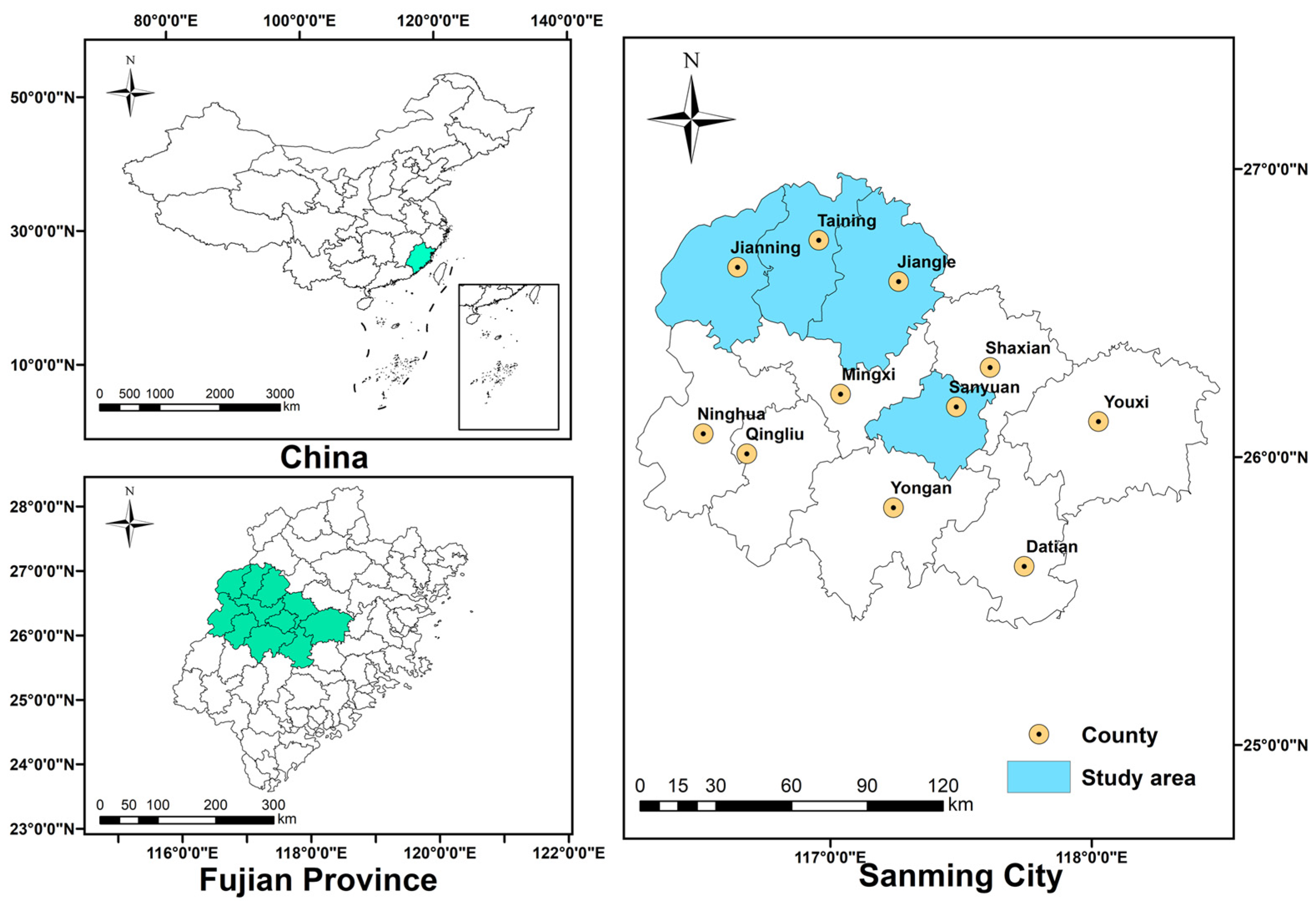
3.1. Study Area
3.2. Data Collection
3.2.1. Semi-Structured Interviews
3.2.2. Direct Observation
3.2.3. Documentary Sources
3.2.4. Ethics and Informed Consent
3.3. Analytical Strategy
3.3.1. Process Tracing
3.3.2. Thematic Coding
3.3.3. Comparative Within-Case Analysis
3.3.4. Integration with Institutional Theory
4. Results
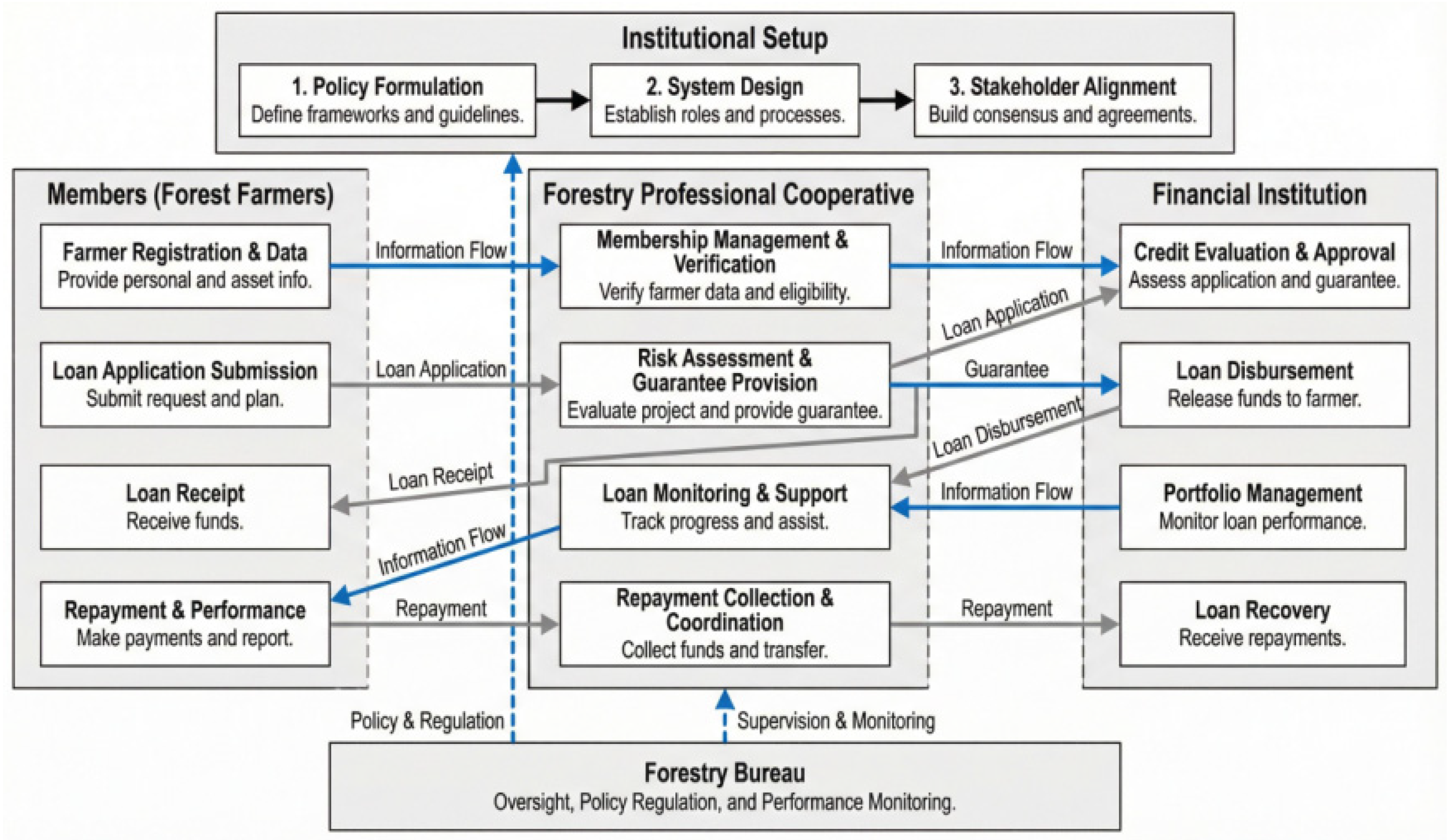
4.1. Reconstructing the Operational Mechanism
4.2. The Guarantee Structure: Internalizing Risk Within the Community
4.3. Behavioral Logics of Key Actors
4.3.1. RCCs: From Collateral Dependence to Governance Dependence
4.3.2. Forestry Cooperatives: Organizational Brokers and Local Guarantors
4.3.3. Forest Farmers: Reduced Fear, Lower Costs, Greater Willingness to Borrow
4.3.4. Local Governments and Forestry Authorities: Enablers of Institutional Coordination
4.4. Institutional Integration and the Emergence of Hybrid Governance
4.5. Synthesis: Why the Model Works Under Supportive Local Conditions
5. Discussion
5.1. Financial Linkage Mechanism
5.2. Behavioral Logics of Actors
5.3. Institutional Foundations and Hybrid Governance
5.4. Theoretical Implications
5.5. Policy Implications
5.6. Limitations and Future Research
6. Conclusions
Author Contributions
Funding
Institutional Review Board Statement
Informed Consent Statement
Data Availability Statement
Acknowledgments
Conflicts of Interest
Abbreviations
| FRMLs | Forest Rights Mortgage Loans |
| RCCs | Rural credit cooperatives |
| NPL | Non-performing loan |
| FLM | Fulin Loan Model |
Appendix A

| Document Name | Issuing Authority | Year | Key Content |
|---|---|---|---|
| Opinions on Comprehensively Advancing the Reform of the Collective Forest Tenure System | The Central Committee of the Communist Party of China (CPC) and the State Council | 2008 | First explicit proposal to advance reforms in forestry investment and financing. |
| The Third Plenary Session of the 18th CPC Central Committee | The Central Committee of the CPC and the State Council | 2013 | Granted farmers the rights to mortgage and use their contracted management rights as collateral. |
| Implementation Opinions on Forest Tenure Mortgage Loans | China Banking Regulatory Commission (CBRC) and the State Forestry Administration (now National Forestry and Grassland Administration) | 2013 | Defined the scope of forest tenure eligible for mortgage, the loan terms, and the permitted uses of funds for forest tenure mortgage loans. |
| Several Opinions on Comprehensively Deepening Rural Reform and Accelerating Agricultural Modernization (Central Document No. 1) | Central Document No. 1 | 2014 | Strengthened the policy validity for farmers’ rights to mortgage and use their contracted land management rights as collateral. |
| Notice on Advancing Work Related to Forest Tenure Mortgage Loans | CBRC, State Forestry Administration, and Ministry of Land and Resources (now Ministry of Natural Resources) | 2017 | Incorporated Fujian’s “Fulin Loan” model into the document, aiming to improve mechanisms for forest tenure financing, valuation, transfer, and repossession within forest tenure mortgage loans. |
| Rural Land Contracting Law (Amendment) | The Central Government | 2018 | Based on the “separation of three rights” (land ownership, land contracting right, and land management right), it allows for the legal transfer of land management rights through methods such as mortgage. |
| Fuyin [2022] No. 157 “Guiding Opinions on Continuously Optimizing Forestry Financial Services” | Jointly issued by: Fuzhou Central Sub-branch of the People’s Bank of China, Provincial Forestry Bureau, Provincial Local Financial Regulatory Bureau, Provincial Department of Finance, Provincial Department of Natural Resources, Fujian Banking and Insurance Regulatory Bureau, Fujian Securities Regulatory Bureau. | 2022 | Comprehensively support forestry inclusive financial products like “Fulin Loan,” clarifying supporting mechanisms such as forest tenure mortgage, credit enhancement guarantees, risk sharing, and fiscal interest subsidies. |
Appendix B
- When was your organization established, and what is its primary function in the FRML system?
- How has your organization’s role evolved since the introduction of the FLM?
- What are the main governance structures and administrative procedures your organization follows?
- How do you coordinate with other organizations (RCCs, cooperatives, forestry stations, government agencies) in the lending process?
- What formal regulations or policies guide your participation in the Fulin Loan system?
- 6.
- Can you describe the step-by-step process of borrower assessment in the Fulin Loan system?
- 7.
- How are forest assets verified and valued? What criteria are used?
- 8.
- What is the procedure for collateral filing, and how has it been simplified compared to traditional FRMLs?
- 9.
- How are loan disbursement and repayment monitored? What happens in cases of late payment or default?
- 10.
- What role does the village-level forestry guarantee fund play in the lending process?
- 11.
- How are disputes resolved within the cooperative or between borrowers and lenders?
- 12.
- What documentation is required from borrowers, and how is this processed?
- 13.
- What do you perceive as the main advantages of the FLM compared to other credit mechanisms?
- 14.
- What challenges or difficulties have you encountered in implementing the model?
- 15.
- How do community relationships and social trust affect the operation of the lending system?
- 16.
- Have there been cases of default? If so, how were they handled?
- 17.
- What improvements or changes would you suggest for the future development of the model?
- 18.
- How has the model affected the economic conditions of participating households?
- 19.
- How do different government agencies coordinate in supporting the Fulin Loan system?
- 20.
- What fiscal policies or incentives are available to support the model?
- 21.
- How do you assess the scalability and sustainability of the model?
- 22.
- What lessons from the Fulin model could be applied to other regions or policy areas?
References
- Wei, J.; Wang, F.; Xie, T.; Luo, H. Impact of collective forestland tenure reform on household forestry production efficiency: Micro-level evidence from China. Front. For. Glob. Change 2025, 8, 1622580. [Google Scholar] [CrossRef]
- Zhu, L.; Ma, Z.; Liu, J.; Gao, L. Proportion of land transfer proceeds for rural development, the rural household income, and the debt risk of the rural households in China. Front. Sustain. Food Syst. 2024, 8, 1428897. [Google Scholar] [CrossRef]
- Xu, L.; Strielkowski, W.; Liu, X.; Schneider, N.; Zhao, X. A sequential game-play modelling on forest-title mortgage loans based on Chinese forester resource and assets valuation. Front. Ecol. Evol. 2022, 10, 1060681. [Google Scholar] [CrossRef]
- Dong, J.; Liang, W.; Fu, Y.; Liu, W.; Managi, S. Impact of devolved forest tenure reform on formal credit access for households: Evidence from Fujian, China. Econ. Anal. Policy 2021, 71, 486–498. [Google Scholar] [CrossRef]
- Chudy, R.; Cubbage, F. Research trends: Forest investments as a financial asset class. For. Policy Econ. 2020, 119, 102273. [Google Scholar] [CrossRef]
- Coordes, R. Coordination of forest management through market and political institutions. For. Policy Econ. 2016, 72, 66–77. [Google Scholar] [CrossRef]
- Laerhoven, F.V. Governing community forests and the challenge of solving two-level collective action dilemmas—A large-N perspective. Glob. Environ. Change 2010, 20, 539–546. [Google Scholar] [CrossRef]
- Luck, S.; Santos, J.A.C. The valuation of collateral in bank lending. J. Financ. Quant. Anal. 2024, 59, 2038–2067. [Google Scholar] [CrossRef]
- Berger, A.N.; Frame, W.S.; Ioannidou, V. Reexamining the empirical relation between loan risk and collateral: The roles of collateral liquidity and types. J. Financ. Intermed. 2016, 26, 28–46. [Google Scholar] [CrossRef]
- Yang, L.; Ren, Y. Property rights, village democracy, and household forestry income: Evidence from China’s collective forest tenure reform. J. For. Res. 2020, 26, 7–16. [Google Scholar] [CrossRef]
- Jiang, E.X.; Zhang, A.L. Collateral value uncertainty and mortgage credit provision. J. Financ. Econ. 2025, 169, 104054. [Google Scholar] [CrossRef]
- Fang, S.; Qian, X.; Zou, W. The empirical relation between loan risk and collateral in the shadow banking system: Evidence from China’s entrusted loan market. Int. Rev. Econ. Financ. 2020, 67, 42–54. [Google Scholar] [CrossRef]
- Yin, Z.; Qiu, M.; Gan, L. Information contents of collateral under heterogeneous borrower qualities on the bank loans market in China. China Econ. Rev. 2019, 57, 101326. [Google Scholar] [CrossRef]
- Xu, T.; Zhang, X.; Agrawal, A.; Liu, J. Decentralizing while centralizing: An explanation of China’s collective forestry reform since the 1980s. For. Policy Econ. 2020, 119, 102268. [Google Scholar] [CrossRef]
- Huang, L.; Li, L.; Luo, X. The role of forestland size on rural household’s forest management efficiency. Sci. Rep. 2025, 15, 16540. [Google Scholar] [CrossRef] [PubMed]
- Nambiar, E.K.S. Small forest growers in tropical landscapes should be embraced as partners for Green-growth: Increase wood supply, restore land, reduce poverty, and mitigate climate change. Trees For. People 2021, 6, 100154. [Google Scholar] [CrossRef]
- Rakotonarivo, O.S.; Rakotoarisoa, M.; Rajaonarivelo, H.M.; Raharijaona, S.; Jones, J.P.G.; Hockley, N. Resolving land tenure security is essential to deliver forest restoration. Commun. Earth Environ. 2023, 4, 847. [Google Scholar] [CrossRef]
- Hu, S.; Fu, Z.; Chen, Z.; Xue, Q. Heterogeneity measurement of the impact of the rural land three rights separation policy on farmers’ income based on DID model. Front. Sustain. Food Syst. 2024, 8, 1359012. [Google Scholar] [CrossRef]
- Li, J.; Quan, T.; Zhang, H. Reform of agricultural land property rights system and green and high-quality development of agriculture: Empirical evidence based on China’s “Three Rights Separation” Reform. Pol. J. Environ. Stud. 2023, 32, 5147–5159. [Google Scholar] [CrossRef]
- Qian, X. Fragmented property rights and their risks on foreclosed housing: A qualitative comparative analysis based on judicial auctions in China. Humanit. Soc. Sci. Commun. 2024, 11, 3415. [Google Scholar] [CrossRef]
- Ntihinyurwa, P.D.; Vries, W.T.D. Farmland fragmentation concourse: Analysis of scenarios and research gaps. Land Use Policy 2021, 100, 104936. [Google Scholar] [CrossRef]
- Aggarwal, S.; Larson, A.; McDermott, C.; Katila, P.; Giessen, L. Tenure reform for better forestry: An unfinished policy agenda. For. Policy Econ. 2021, 123, 102376. [Google Scholar] [CrossRef]
- The State Council Information Office of the People’s Republic of China. The State Council Information Office Holds a Press Conference on the “Plan for Deepening the Reform of the Collective Forest Tenure System”. Available online: https://m.mnr.gov.cn/dt/ywbb/202310/t20231014_2803505.html (accessed on 14 October 2023).
- Kohl, R.D. Key factors for advancing innovations to scale: Evidence from multiple country case studies of agricultural innovations. Front. Sustain. Food Syst. 2023, 7, 1053152. [Google Scholar] [CrossRef]
- Kleider, H.; Toubeau, S. Public policy in multi-level systems: A new research agenda for the study of regional-level policy. Reg. Fed. Stud. 2022, 32, 277–305. [Google Scholar] [CrossRef]
- People’s Bank of China. Zhongguo Quyu Jinrong Yunxing Baogao (2019) [China Regional Financial Operation Report (2019)]; People’s Bank of China: Beijing, China, 2019; Available online: https://share.google/a9yDJHHBLh4wPtOQU (accessed on 19 July 2019).
- National Forestry and Grassland Administration. Fujian Sanming “Fulin Dai” Rang Linnong Xingfu Lai [Fujian Sanming’s “Fulin Loan” Brings Happiness to Forest Farmers]. Available online: https://www.forestry.gov.cn/c/www/dfdt/540671.jhtml (accessed on 3 January 2024).
- Wiegant, D.; Dewulf, A.; Zeben, J.V. Alignment mechanisms to effectively govern the sustainable development goals. World Dev. 2024, 182, 106721. [Google Scholar] [CrossRef]
- Barnes, J.; Durrant, R.; Kern, F.; MacKerron, G. The institutionalisation of sustainable practices in cities: How initiatives shape local selection environments. Environ. Innov. Soc. Transit. 2018, 29, 68–80. [Google Scholar] [CrossRef]
- Tao, H. Credit data, banks, “Packaging Agencies” and the promise of digital lending to small businesses in China. China Q. 2025, 262, 413–428. [Google Scholar] [CrossRef]
- Rimoli, R.; Nichiforel, L.; Acharya, A.; Nollet, A.; Snoussi, B.; Ambroise, L.; Bouriaud, L. The Property Rights Index (PRIF) can be used worldwide to compare different forest governance systems. Sci. Rep. 2023, 13, 19437. [Google Scholar] [CrossRef]
- Coase, R.H. The problem of social cost. J. Law Econ. 1960, 3, 1–44. [Google Scholar] [CrossRef]
- Besley, T. Property rights and investment incentives: Theory and evidence from Ghana. J. Political Econ. 1995, 103, 903–937. [Google Scholar] [CrossRef]
- He, J.; Kebede, B.; Martin, A.; Gross-Camp, N. Privatization or communalization: A multi-level analysis of changes in forest property regimes in China. Ecol. Econ. 2020, 174, 106629. [Google Scholar] [CrossRef]
- Yi, Y.; Köhlin, G.; Xu, J. Property rights, tenure security and forest investment incentives: Evidence from China’s Collective Forest Tenure Reform. Environ. Dev. Econ. 2014, 19, 48–73. [Google Scholar] [CrossRef]
- McLain, R.; Lawry, S.; Guariguata, M.R.; Reed, J. Toward a tenure-responsive approach to forest landscape restoration: A proposed tenure diagnostic for assessing restoration opportunities. Land Use Policy 2021, 104, 103748. [Google Scholar] [CrossRef]
- Yin, R.; Zulu, L.; Qi, J.; Freudenberger, M.; Sommerville, M. Empirical linkages between devolved tenure systems and forest conditions: Challenges, findings, and recommendations. For. Policy Econ. 2016, 73, 294–299. [Google Scholar] [CrossRef]
- Deininger, K.; Hilhorst, T.; Songwe, V. Identifying and addressing land governance constraints to support intensification and land market operation: Evidence from 10 African countries. Food Policy 2014, 48, 76–87. [Google Scholar] [CrossRef]
- Zhu, Z.; Xu, Z.; Shen, Y.; Huang, C. How forestland size affects household profits from timber harvests: A case-study in China’s Southern collective forest area. Land Use Policy 2020, 97, 103380. [Google Scholar] [CrossRef]
- Li, W.; Chen, J.; Wu, F.; Zhang, Z. Collective Forest tenure reform and forest conditions: Evidence from the social-ecological system in Southwest China. Front. For. Glob. Change 2023, 6, 1162058. [Google Scholar] [CrossRef]
- Allen, D.W.E.; Berg, C.; Davidson, S.; Potts, J. Property rights, knowledge commons and blockchain governance. In Governing Markets as Knowledge Commons; Dekker, E., Kuchar, P., Eds.; Cambridge University Press: Cambridge, UK, 2021. [Google Scholar] [CrossRef]
- Dorobantu, S.; Odziemkowska, K. Valuing stakeholder governance: Property rights, community mobilization, and firm value. Strateg. Manag. J. 2017, 38, 2682–2703. [Google Scholar] [CrossRef]
- Onoma, A.K. The Politics of Property Rights Institutions in Africa; Cambridge University Press: Cambridge, UK, 2009. [Google Scholar] [CrossRef]
- Toulmin, C. Securing land and property rights in sub-Saharan Africa: The role of local institutions. Land Use Policy 2009, 26, 10–19. [Google Scholar] [CrossRef]
- Bates, R.H.; Curry, A.F. Community versus market: A note on corporate villages. Am. Political Sci. Rev. 1992, 86, 457–463. [Google Scholar] [CrossRef]
- Bednar, J.; Page, S.E. Institutions and cultural capacity: A systems perspective. J. Econ. Behav. Organ. 2025, 234, 106990. [Google Scholar] [CrossRef]
- Bašić, Z.; Verrina, E. Personal norms—And not only social norms—Shape economic behavior. J. Public Econ. 2024, 239, 105255. [Google Scholar] [CrossRef]
- Du, Z.; Cheng, Y. A systematic review and codification of China’s ecological restoration policies and laws. Restor. Ecol. 2025, e70169. [Google Scholar] [CrossRef]
- Liu, P.; Yin, R.; Li, H. China’s forest tenure reform and institutional change at a crossroads. For. Policy Econ. 2016, 72, 92–98. [Google Scholar] [CrossRef]
- Siahaan, J.R.; Pagalung, G.; Demmallino, E.B.; Saleng, A.; Sulaiman, A.A.; Nagu, N. Reframing sustainability in post-mining landscapes: A foundational framework for institutional and behavioral integration in Indonesia. Sustainability 2025, 17, 5278. [Google Scholar] [CrossRef]
- Atinga, E.; Bannor, R.K. The commercialisation of NTFPs and conservation of forest: A systematic review for forestry policy. For. Econ. Rev. 2024, 6, 94–121. [Google Scholar] [CrossRef]
- Pistor, K. Contesting property rights: Towards an integrated theory of institutional and system change. Glob. Jurist 2011, 11, 20122001. [Google Scholar] [CrossRef]
- Arrow, K.J. The organization of economic activity: Issues pertinent to the choice of market versus nonmarket allocation. In The Analysis and Evaluation of Public Expenditure: The PPB System; U.S. Government Printing Office: Washington, DC, USA, 1969; Volume 1, pp. 59–73. [Google Scholar]
- Stiglitz, J.E.; Weiss, A. Credit rationing in markets with imperfect information. Am. Econ. Rev. 1981, 71, 393–410. [Google Scholar]
- Igawa, K.; Kanatas, G. Asymmetric information, collateral, and moral hazard. J. Financ. Quant. Anal. 1990, 25, 469–490. [Google Scholar] [CrossRef]
- Berardi, M. Credit rationing in markets with imperfect information. SSRN Electron. J. 2007. [Google Scholar] [CrossRef]
- Garvey, J.; Grigoriadis, V.; Flannery, D.; Knapp, E.; Gold, E.; Hutchinson, G.; Frewer, L.J.; Brereton, P.; Byrne, K.A. Designing financial instruments for land-based ecological restoration: A review and future research agenda. Clean. Prod. Lett. 2025, 8, 100089. [Google Scholar] [CrossRef]
- Löfqvist, S.; Garrett, R.D.; Ghazoul, J. Incentives and barriers to private finance for forest and landscape restoration. Nat. Ecol. Evol. 2023, 7, 707–715. [Google Scholar] [CrossRef]
- Hildebrandt, P.; Knoke, T. Investment decisions under uncertainty—A methodological review on forest science studies. For. Policy Econ. 2011, 13, 1–15. [Google Scholar] [CrossRef]
- Ferreira, T.R.T.; Torres-Martínez, J.P. The impossibility of effective enforcement mechanisms in collateralized credit markets. J. Math. Econ. 2010, 46, 332–342. [Google Scholar] [CrossRef]
- Yu, J.; Fu, J. Credit rationing, innovation, and productivity: Evidence from small- and medium-sized enterprises in China. Econ. Model. 2021, 97, 220–230. [Google Scholar] [CrossRef]
- Zhao, J. Formal credit constraint and prevalence of reciprocal loans in rural China. Open Econ. 2021, 4, 1–13. [Google Scholar] [CrossRef]
- Park, A.; Brandt, L.; Giles, J. Competition under credit rationing: Theory and evidence from rural China. J. Dev. Econ. 2003, 71, 463–495. [Google Scholar] [CrossRef]
- Khan, F.U.; Nouman, M.; Negrut, L.; Abban, J.; Cismas, L.M.; Siddiqi, M.F. Constraints to agricultural finance in underdeveloped and developing countries: A systematic literature review. Int. J. Agric. Sustain. 2024, 22, 2329388. [Google Scholar] [CrossRef]
- Arebo, M.J. Asymmetric analysis of the financial inclusion–growth nexus: A NARDL approach. Res. Glob. 2025, 11, 100316. [Google Scholar] [CrossRef]
- Harrison, R.; Li, Y.; Vigne, S.A.; Wu, Y. Why do small businesses have difficulty in accessing bank financing? Int. Rev. Financ. Anal. 2022, 84, 102352. [Google Scholar] [CrossRef]
- Bencivenga, V.R.; Smith, B.D.; Starr, R.M. Transactions costs, technological choice, and endogenous growth. J. Econ. Theory 1995, 67, 153–177. [Google Scholar] [CrossRef]
- Chen, B.; Xiao, J. Digital payments enhance both formal and informal credit access for rural households: Evidence from China. Front. Sustain. Food Syst. 2025, 9, 1676462. [Google Scholar] [CrossRef]
- Han, P.; Li, L.; Xu, M.; Tian, Y.; Wang, Z. The impact of people’s perception of livelihood risks on household consumption in China. Humanit. Soc. Sci. Commun. 2026, 13, 52. [Google Scholar] [CrossRef]
- Zhang, Y.; Fang, S. Housing Provident Fund, risk attitude, and household financial investment engagement: An asset-building perspective. Humanit. Soc. Sci. Commun. 2025, 12, 354. [Google Scholar] [CrossRef]
- Baker, K.; Baylis, K.; Bull, G.; Barichello, R. Are non-market values important to smallholders’ afforestation decisions? A psychometric segmentation and its implications for afforestation programs. For. Policy Econ. 2019, 100, 1–13. [Google Scholar] [CrossRef]
- Nerfa, L.; Rhemtulla, J.M.; Zerriffi, H. Forest dependence is more than forest income: Development of a new index of forest product collection and livelihood resources. World Dev. 2020, 125, 104689. [Google Scholar] [CrossRef]
- Ioannidou, V.; Pavanini, N.; Peng, Y. Collateral and asymmetric information in lending markets. J. Financ. Econ. 2022, 144, 93–121. [Google Scholar] [CrossRef]
- Ghosh, S.; Tassel, E.V. Funding microfinance under asymmetric information. J. Dev. Econ. 2013, 101, 8–15. [Google Scholar] [CrossRef]
- Akbar, S.; Pradana, M.N.R.; Rahma, A.; Rahmah, N.F. Integrating state-owned enterprises (SOEs), agro-economics, and sustainability: A systematic literature review on contract farming mechanism. J. Agrosociol. Sustain. 2025, 3, 36–56. [Google Scholar] [CrossRef]
- Louman, B.; Girolami, E.D.; Shames, S.; Primo, L.G.; Gitz, V.; Scherr, S.J.; Brady, M. Access to landscape finance for small-scale producers and local communities: A literature review. Land 2022, 11, 1444. [Google Scholar] [CrossRef]
- Aisaiti, G.; Liu, L.; Xie, J.; Yang, J. An empirical analysis of rural farmers’ financing intention of inclusive finance in China: The moderating role of digital finance and social enterprise embeddedness. Ind. Manag. Data Syst. 2019, 119, 1535–1563. [Google Scholar] [CrossRef]
- Salinas, J.; Sastre-Merino, S. Social capital as an inclusion tool from a solidarity finance angle. Sustainability 2021, 13, 7067. [Google Scholar] [CrossRef]
- Allen, F.; Qian, M. Theories, practices, and prospects of alternative finance. In Research Handbook on Alternative Finance; Edward Elgar Publishing: Cheltenham, UK, 2024; pp. 1–29. [Google Scholar] [CrossRef]
- Bell, C. Interactions between institutional and informal credit agencies in rural India. World Bank Econ. Rev. 1990, 4, 297–327. [Google Scholar] [CrossRef]
- Floro, M.S.; Ray, D. Vertical links between formal and informal financial institutions. Rev. Dev. Econ. 1997, 1, 34–56. [Google Scholar] [CrossRef]
- Ghate, P.B. Interaction between the formal and informal financial sectors: The Asian experience. World Dev. 1992, 20, 859–872. [Google Scholar] [CrossRef]
- Green, W.N. Maximizing Finance for Sustainable Development? Microfinance, Debt-Driven Deforestation, and the Self-Regulation of Environmental Harm. Ann. Am. Assoc. Geogr. 2025, 115, 1228–1247. [Google Scholar] [CrossRef]
- Shen, X.; Gatto, P.; Pagliacci, F. Unravelling the role of institutions in market-based instruments: A systematic review on forest carbon mechanisms. Forests 2023, 14, 136. [Google Scholar] [CrossRef]
- Wen, H.; Sun, T. The impact of industrial-financial collaboration on enterprise innovation: Research on DID based on dual machine learning. Sustainability 2025, 17, 10561. [Google Scholar] [CrossRef]
- Fei, X. From the Soil: The Foundations of Chinese Society; Hamilton, G.G.; Wang, Z., Translators; University of California Press: Berkeley, CA, USA, 1992. [Google Scholar]
- Zinda, J.A.; Zhang, Z. Stabilizing forests and communities: Accommodative buffering within China’s collective forest tenure reform. China Q. 2018, 235, 828–848. [Google Scholar] [CrossRef]
- Górriz-Mifsud, E.; Secco, L.; Pisani, E. Exploring the interlinkages between governance and social capital: A dynamic model for forestry. For. Policy Econ. 2016, 65, 25–36. [Google Scholar] [CrossRef]
- Song, Y.; Wang, G.; Burch, W.R.; Rechlin, M.A. From innovation to adaptation: Lessons from 20 years of the SHIFT forest management system in Sanming, China. For. Ecol. Manag. 2004, 191, 225–238. [Google Scholar] [CrossRef]
- Li, J.; Zhang, X.; Hu, J. Strategic co-funding in informal finance market: Evidence from China. J. Appl. Econ. 2021, 24, 329–349. [Google Scholar] [CrossRef]
- Zhou, X.; Ai, Y. Capitalism without capital: Capital conversion and market making in rural China. China Q. 2014, 219, 693–714. [Google Scholar] [CrossRef]
- Guo, B.; Huang, J.; Zou, L.; Sherraden, M. Asset-based policy in rural China: An innovation in the retirement social insurance programme. China J. Soc. Work 2008, 1, 63–76. [Google Scholar] [CrossRef]
- Engbring, G.; Hajjar, R. Mexican community forest enterprises as social firms: Organizational differences and the factors that shape them. For. Policy Econ. 2021, 131, 102557. [Google Scholar] [CrossRef]
- Macqueen, D.; Bolin, A.; Greijmans, M.; Grouwels, S.; Humphries, S. Innovations towards prosperity emerging in locally controlled forest business models and prospects for scaling up. World Dev. 2020, 125, 104382. [Google Scholar] [CrossRef]
- Humphries, S.; Holmes, T.; Andrade, D.F.C.D.; McGrath, D.; Dantas, J.B. Searching for win-win forest outcomes: Learning-by-doing, financial viability, and income growth for a community-based forest management cooperative in the Brazilian Amazon. World Dev. 2020, 125, 104336. [Google Scholar] [CrossRef]
- Villalba, R.; Venus, T.E.; Sauer, J. The ecosystem approach to agricultural value chain finance: A framework for rural credit. World Dev. 2023, 164, 106177. [Google Scholar] [CrossRef]
- Fischer, H.W.; Chhatre, A.; Duddu, A.; Pradhan, N.; Agrawal, A. Community forest governance and synergies among carbon, biodiversity and livelihoods. Nat. Clim. Change 2023, 13, 1340–1347. [Google Scholar] [CrossRef]
- Hajjar, R.; Oldekop, J.A.; Cronkleton, P.; Newton, P.; Russell, A.J.M.; Zhou, W. A global analysis of the social and environmental outcomes of community forests. Nat. Sustain. 2021, 4, 216–224. [Google Scholar] [CrossRef]
- Pellowe, K.E.; Leslie, H.M. The interplay between formal and informal institutions and the potential for co-management in a Mexican small-scale fishery. Mar. Policy 2020, 121, 104179. [Google Scholar] [CrossRef]
- Cui, B. Impacts of supply chain finance on enterprise resilience: The interplay between financial linkage and business relationship among supply chain partners. Int. J. Prod. Econ. 2026, 291, 109867. [Google Scholar] [CrossRef]
- Baraldi, E.; Gressetvold, E.; Harrison, D. Resource interaction in inter-organizational networks: Foundations, comparison, and a research agenda. J. Bus. Res. 2012, 65, 266–276. [Google Scholar] [CrossRef]
- Cruz-García, P.; Peiró-Palomino, J. Informal, formal institutions and credit: Complements or substitutes? J. Inst. Econ. 2019, 15, 649–671. [Google Scholar] [CrossRef]
- Ostrom, E. Collective action and the evolution of social norms. J. Nat. Resour. Policy Res. 2014, 6, 235–252. [Google Scholar] [CrossRef]
- Cole, D.H. Laws, norms, and the Institutional Analysis and Development framework. J. Inst. Econ. 2017, 13, 829–847. [Google Scholar] [CrossRef]
- Luna, P.F. Property without rights: Origins and consequences of the property rights gap. J. Peasant Stud. 2024, 52, 430–435. [Google Scholar] [CrossRef]
- Cai, M.; Murtazashvili, I.; Murtazashvili, J. The politics of land property rights. J. Inst. Econ. 2020, 16, 151–167. [Google Scholar] [CrossRef]
- Conning, J.H.; Robinson, J.A. Property rights and the political organization of agriculture. J. Dev. Econ. 2007, 82, 416–447. [Google Scholar] [CrossRef]
- Chaudhuri, K.; Cherical, M.M. Credit rationing in rural credit markets of India. Appl. Econ. 2012, 44, 803–812. [Google Scholar] [CrossRef]
- Balana, B.B.; Oyeyemi, M.A. Agricultural credit constraints in smallholder farming in developing countries: Evidence from Nigeria. World Dev. Sustain. 2022, 1, 100012. [Google Scholar] [CrossRef]
- Beyhaghi, M.; Firoozi, F.; Jalilvand, A.; Samarbakhsh, L. Components of credit rationing. J. Financ. Stab. 2020, 50, 100762. [Google Scholar] [CrossRef]
- Ndiege, B.O.; Qin, X.; Kazungu, I.; Moshi, J. The impacts of financial linkage on sustainability of less-formal financial institutions: Experience of savings and credit co-operative societies in Tanzania. J. Co-Oper. Organ. Manag. 2014, 2, 65–71. [Google Scholar] [CrossRef]
- Chowdhury, P.R. Group-lending: Sequential financing, lender monitoring and joint liability. J. Dev. Econ. 2005, 77, 415–439. [Google Scholar] [CrossRef]
- Bastelaer, T.V.; Leathers, H. Trust in lending: Social capital and joint liability seed loans in Southern Zambia. World Dev. 2006, 34, 1788–1807. [Google Scholar] [CrossRef]
- Jin, B.; Wang, H. The half is more than the whole: How China’s economic growth target affects forest eco-efficiency. Socio-Econ. Plan. Sci. 2025, 102, 102324. [Google Scholar] [CrossRef]
- Yang, G.; Wang, H.; Hou, Y.; Jiang, X.; Hu, M. The Impact of Collective Forest Tenure Reform on Timber Production in China: An Empirical Analysis Based on Provincial Panel Data. Forests 2024, 15, 312. [Google Scholar] [CrossRef]
- Xin, S.; Deng, H. Beyond entrepreneurism: China’s emerging party-statecraft of Rural Revitalization. Habitat Int. 2025, 156, 103277. [Google Scholar] [CrossRef]
- Zhang, Y.; Kant, S. Partitioning Commons and Devolving Them from Communal to Sub-Communal Groups: Evidence from China’s Community Forest Management Organizations. Int. J. Commons 2020, 14, 44–60. [Google Scholar] [CrossRef]
- Herrmann-Pillath, C. Social capital, Chinese style: Individualism, relational collectivism and the cultural embeddedness of the institutions–performance link. China Econ. J. 2010, 2, 325–350. [Google Scholar] [CrossRef]
- Zhang, Y.; Hu, N.; Yao, L.; Zhu, Y.; Ma, Y. The role of social network embeddedness and collective efficacy in encouraging farmers’ participation in water environmental management. J. Environ. Manag. 2023, 340, 117959. [Google Scholar] [CrossRef] [PubMed]
- Xinhua. China’s Sanming Embraces Green Transformation to Boost Rural Tourism. Available online: https://english.www.gov.cn/news/202408/12/content_WS66ba00e2c6d0868f4e8e9dc6.html (accessed on 12 August 2024).
- Ruan, J.; Li, Y.; Li, Z. Channel state resources into rural society under the withering of grassroots governance: Lessons from the targeted poverty alleviation “pairing-up” support system in China. J. Rural Stud. 2024, 109, 103331. [Google Scholar] [CrossRef]
- Park, A.; Wang, S. Community-based development and poverty alleviation: An evaluation of China’s poor village investment program. J. Public Econ. 2010, 94, 790–799. [Google Scholar] [CrossRef]
- Brigo, D.; Liu, Q.D.; Pallavicini, A.; Sloth, D. Nonlinearity valuation adjustment: Nonlinear valuation under collateralization, credit risk, and funding costs. In Innovations in Derivatives Markets: Fixed Income Modeling, Valuation Adjustments, Risk Management, and Regulation; Springer: Cham, Switzerland, 2016; pp. 3–35. [Google Scholar] [CrossRef]
- Su, H.; Duan, L. The role of community mutual aid networks and social relationship capital in household financial vulnerability in China: Heterogeneous influence of region. Humanit. Soc. Sci. Commun. 2025, 12, 897. [Google Scholar] [CrossRef]
- Wei, D.; Zhang, Y. Impact of formal credit and social capital on the scalability of agricultural operations. Sci. Rep. 2025, 15, 6603. [Google Scholar] [CrossRef]
- Ferrary, M. Trust and social capital in the regulation of lending activities. J. Socio-Econ. 2003, 31, 673–699. [Google Scholar] [CrossRef]
- Grashuis, J.; Su, Y. A review of the empirical literature on farmer cooperatives: Performance, ownership and governance, finance, and member attitude. Ann. Public Coop. Econ. 2019, 90, 77–102. [Google Scholar] [CrossRef]
- Shiferaw, B.; Obare, G.; Muricho, G. Rural market imperfections and the role of institutions in collective action to improve markets for the poor. Nat. Resour. Forum 2008, 32, 25–38. [Google Scholar] [CrossRef]
- Ray, B.; Bhattacharya, R.N. Transaction costs, collective action and survival of heterogeneous co-management institutions: Case study of forest management organisations in West Bengal, India. J. Dev. Stud. 2011, 47, 253–273. [Google Scholar] [CrossRef]
- Baland, J.; Bardhan, P.; Das, S.; Mookherjee, D. Forests to the people: Decentralization and forest degradation in the Indian Himalayas. World Dev. 2010, 38, 1642–1656. [Google Scholar] [CrossRef]
- Fernandes, A.; Spring, M.; Tarafdar, M. Coordination in temporary organizations: Formal and informal mechanisms at the 2016 Olympics. Int. J. Oper. Prod. Manag. 2018, 38, 1340–1367. [Google Scholar] [CrossRef]
- Vollmer, H. What kind of game is everyday interaction? Ration. Soc. 2013, 25, 370–393. [Google Scholar] [CrossRef]
- Srikanth, K.; Puranam, P. Integrating Distributed Work: Comparing Task Design, Communication, and Tacit Coordination Mechanisms; SSRN Scholarly Paper No. 1125924; Social Science Research Network: Rochester, NY, USA, 2008; Available online: https://papers.ssrn.com/sol3/papers.cfm?abstract_id=1125924 (accessed on 8 July 2021).
- Gelo, D.; Koch, S.F. The impact of common property right forestry: Evidence from Ethiopian villages. World Dev. 2014, 64, 395–406. [Google Scholar] [CrossRef]
- Tirivayi, N.; Nennen, L.; Tesfaye, W.; Ma, Q. The benefits of collective action: Exploring the role of forest producer organizations in social protection. For. Policy Econ. 2018, 90, 106–114. [Google Scholar] [CrossRef]
- Tregear, A.; Cooper, S. Embeddedness, social capital and learning in rural areas: The case of producer cooperatives. J. Rural Stud. 2016, 44, 101–110. [Google Scholar] [CrossRef]
- Wittayapak, C.; Baird, I.G. Communal land titling dilemmas in northern Thailand: From community forestry to beneficial yet risky and uncertain options. Land Use Policy 2018, 71, 320–328. [Google Scholar] [CrossRef]
- Nugroho, B.; Dermawan, A. Financing smallholder timber planting in Indonesia: Mismatches between loan scheme attributes and smallholder borrowing characteristics. Int. For. Rev. 2013, 15, 499–508. [Google Scholar] [CrossRef]
- Islam, A.; Luo, R. Financing constraints and investment efficiency: Evidence from a panel of Canadian forest firms. Appl. Econ. 2018, 50, 6201–6214. [Google Scholar] [CrossRef]
- Zhou, L.; Zhang, Y.; Dai, G.; Zhang, S. Access to microloans for households with forest property collateral in China. Small-Scale For. 2016, 15, 291–301. [Google Scholar] [CrossRef]
- Atahau, A.D.R.; Huruta, A.D.; Lee, C. Rural microfinance sustainability: Does local wisdom driven-governance work? J. Clean. Prod. 2020, 267, 122153. [Google Scholar] [CrossRef]
- Zhang, Y.; Kant, S.; Liu, J. Principal-agent relationships in rural governance and benefit sharing in community forestry: Evidence from a community forest enterprise in China. For. Policy Econ. 2019, 107, 101924. [Google Scholar] [CrossRef]
- Li, Y.; Qin, X.; Sullivan, A.; Chi, G.; Lu, Z.; Pan, W.; Liu, Y. Collective action improves elite-driven governance in rural development within China. Humanit. Soc. Sci. Commun. 2023, 10, 600. [Google Scholar] [CrossRef]
- Shen, M.; Shen, J. Evaluating the cooperative and family farm programs in China: A rural governance perspective. Land Use Policy 2018, 79, 240–250. [Google Scholar] [CrossRef]
- Zhang, Y.Z.; Mi, Y.S.; Liu, C.J. Farmer participation in cooperatives enhances productive services in village collectives: A subjective evaluation approach. Front. Sustain. Food Syst. 2024, 8, 1442600. [Google Scholar] [CrossRef]
- Kanon, M. The networked bureaucracy: Reinventing formalization in the context of collaborative governance. Public Manag. Rev. 2024, 26, 2921–2942. [Google Scholar] [CrossRef]
- Chibueze, T. Scaling cooperative banking frameworks to support MSMEs, foster resilience, and promote inclusive financial systems across emerging economies. World J. Adv. Res. Rev. 2024, 23, 3225–3247. [Google Scholar] [CrossRef]
- Hodgson, G.M. Formal and informal institutions: Some problems of meaning, impact, and interaction. J. Inst. Econ. 2025, 21, e1. [Google Scholar] [CrossRef]
- Helmke, G.; Levitsky, S. Informal institutions and comparative politics: A research agenda. Perspect. Politics 2004, 2, 725–740. [Google Scholar] [CrossRef]
- Fuentelsaz, L.; González, C.; Maicas, J.P. Formal institutions and opportunity entrepreneurship. The contingent role of informal institutions. BRQ Bus. Res. Q. 2019, 22, 5–24. [Google Scholar] [CrossRef]
- Polzer, T.; Meyer, R.E.; Höllerer, M.A.; Seiwald, J. Institutional hybridity in public sector reform: Replacement, blending, or layering of administrative paradigms. In How Institutions Matter; Glynn, M.A., Ometto, M., Eds.; Emerald Group Publishing Limited: Bingley, UK, 2016; pp. 69–99. [Google Scholar] [CrossRef]
- Abbott, K.W.; Faude, B. Hybrid institutional complexes in global governance. Rev. Int. Organ. 2022, 17, 263–291. [Google Scholar] [CrossRef]
- Zhang, Q.; Cao, Z. Unveiling rural transformation mechanisms: Quantitative evidence from 460 villages in China. Habitat Int. 2026, 168, 103678. [Google Scholar] [CrossRef]
- Meinzen-Dick, R. Property rights and sustainable irrigation: A developing country perspective. Agric. Water Manag. 2014, 145, 23–31. [Google Scholar] [CrossRef]
- Trejos, B.; Flores, J.C. Influence of property rights on performance of community-based forest devolution policies in Honduras. For. Policy Econ. 2021, 124, 102397. [Google Scholar] [CrossRef]
- Musafiri, P.M.; Ganesan, P. Repayment behaviour in credit and savings cooperative societies: Empirical and theoretical evidence from rural Rwanda. Int. J. Soc. Econ. 2009, 36, 608–625. [Google Scholar] [CrossRef]
- Anshuman, R.; Viswanathan, S. Collateral and Market Liquidity; Working Paper; Fuqua School of Business, Duke University: Durham, NC, USA, 2006. [Google Scholar]
- Ndlovu, N.P. Cross-sectoral coordination in the implementation of agroforestry in Malawi. Front. For. Glob. Change 2025, 8, 1533326. [Google Scholar] [CrossRef]
- Minkman, E.; Buuren, M.W.V.; Bekkers, V.J.J.M. Policy transfer routes: An evidence-based conceptual model to explain policy adoption. Policy Stud. 2018, 39, 222–250. [Google Scholar] [CrossRef]
- McCann, E.; Ward, K. A multi-disciplinary approach to policy transfer research: Geographies, assemblages, mobilities and mutations. Policy Stud. 2013, 34, 2–18. [Google Scholar] [CrossRef]
- Radtke, J.; Renn, O. Participation in energy transitions: A comparison of policy styles. Energy Res. Soc. Sci. 2024, 118, 103743. [Google Scholar] [CrossRef]
- Wibisono, E. Regional governance challenges in implementing EU smart specialization policy: A critical review. Eur. J. Geogr. 2024, 15, 281–292. [Google Scholar] [CrossRef]
- Xu, Z.; Zhao, G.; Wang, C.; Zhao, X. How do village social foundations shape rural residents’ participation in digital governance: Empirical evidence from village surveys in 11 provinces of China. Front. Sustain. Food Syst. 2026, 9, 1669746. [Google Scholar] [CrossRef]


| Category | Number | Affiliation | Key Topics Covered |
|---|---|---|---|
| RCC Officers | 4 | Sanyuan, Jiangle, Jianning, Taining RCCs | Credit evaluation procedures, risk assessment, loan monitoring, cooperation with cooperatives |
| Village Cadres | 25 | Village Committees | Soft information provision, community verification, governance coordination |
| Township Forestry Station Staff | 22 | Township Forestry Stations | Forest-rights registration, simplified filing procedures, asset verification |
| Forestry Bureau Officials | 4 | County-level Forestry Bureaus | Policy implementation, oversight, coordination with financial institutions |
| Forest Farmers | 420 | Various villages in the study area | Borrowing experience, risk perception, cooperative membership, collateral attitudes |
| Level | Core Category | Sub-Category | Description |
|---|---|---|---|
| Macro | Institutional Environment | Formal institutional environment | Legal and policy framework that makes forest management rights legally mortgageable, including the shift from prohibition to permission of forest-rights mortgages under the “Three Rights Separation” reform and related upper-level regulations. |
| Informal institutional environment | Local norms, value orientations, and traditional knowledge regarding forestry and forest rights; the familiar-society structure and village-level intermediary organizations that can credibly hold and internally dispose of mortgaged forest rights within the community. | ||
| Meso | Institutional Supply | Collateral system design | Design of the forest-rights mortgage system as a pioneering institutional arrangement that requires collective action by multiple departments and proactive governmental involvement to shoulder the initial “pioneering costs” of opening a new credit market for forest rights. |
| Supporting systems | Complementary arrangements such as forestland titling and certification, creation of forestry finance divisions, establishment of village-level forestry guarantee funds, autonomous valuation of reverse-collateral forest assets, and internal disposal mechanisms in which village-level organizations act as the mortgagee. | ||
| Fiscal policy support | Interest subsidies and related fiscal incentives that stimulate credit demand and supply for FRMLs; rural credit cooperatives assist eligible borrowers in applying for annual forestry interest subsidies, effectively lowering the cost of borrowing. | ||
| Governance Structure | Hybrid governance structure | A mixed governance arrangement combining bureaucratic coordination and market-oriented mechanisms. Village committees and forestry cooperatives act as quasi-hierarchical organizations that intermediate between dispersed smallholders and formal financial institutions in a “bureaucracy + market” financial linkage model. | |
| Micro | Collateral Mode | Portfolio collateral guarantee | A combined guaranteed structure consisting of reverse collateral provided by forest farmers, a pledge guarantee issued by the forestry cooperative, and additional guarantees by other members through the village-level forestry guarantee fund, thereby pooling and diversifying risk. |
| Loan Elements | Borrower | Ordinary forest farmers in collective forest regions holding small and fragmented forest rights, with relatively good credit standing and willingness to participate in the cooperative-based guarantee scheme. | |
| Collateral value | Given small and scattered plots, the model places relatively low requirements on the nominal collateral value of individual forest parcels, relying instead on collective guarantees, pooled risk, and community-based enforcement. | ||
| Transaction costs | Substantially reduced through green channels for “Fulin Loan” applications, autonomous valuation, simplified filing at township forestry stations rather than full real-estate registration, and agency-based application for interest subsidies. | ||
| Loan amount | Dynamically managed with an upper limit per borrower (typically not exceeding RMB 100,000), combined with a fixed member contribution (e.g., RMB 20,000) to the village-level forestry guarantee fund. | ||
| Interest rate | Interest rates are capped relative to the benchmark rate, with “Fulin Loan” rates set below ordinary FRMLs and effectively reduced further by forestry interest subsidies, resulting in a relatively low effective cost of borrowing. | ||
| Loan term | Follows the principle of “one-time approval, total amount control, and three-year revolving use,” allowing borrowers to draw down and repay flexibly within an approved credit line. |
Disclaimer/Publisher’s Note: The statements, opinions and data contained in all publications are solely those of the individual author(s) and contributor(s) and not of MDPI and/or the editor(s). MDPI and/or the editor(s) disclaim responsibility for any injury to people or property resulting from any ideas, methods, instructions or products referred to in the content. |
© 2026 by the authors. Licensee MDPI, Basel, Switzerland. This article is an open access article distributed under the terms and conditions of the Creative Commons Attribution (CC BY) license.
Share and Cite
Fan, L.; Wang, W.; Wei, Y.; Lai, Y.; Ye, X. Governing Forest Rights Mortgage Loans Through Hybrid Governance: Institutional Innovation and Organizational Mediation in China’s Collective Forest Regions. Forests 2026, 17, 464. https://doi.org/10.3390/f17040464
Fan L, Wang W, Wei Y, Lai Y, Ye X. Governing Forest Rights Mortgage Loans Through Hybrid Governance: Institutional Innovation and Organizational Mediation in China’s Collective Forest Regions. Forests. 2026; 17(4):464. https://doi.org/10.3390/f17040464
Chicago/Turabian StyleFan, Liushan, Wenlan Wang, Yuanzhu Wei, Yongbo Lai, and Xingwei Ye. 2026. "Governing Forest Rights Mortgage Loans Through Hybrid Governance: Institutional Innovation and Organizational Mediation in China’s Collective Forest Regions" Forests 17, no. 4: 464. https://doi.org/10.3390/f17040464
APA StyleFan, L., Wang, W., Wei, Y., Lai, Y., & Ye, X. (2026). Governing Forest Rights Mortgage Loans Through Hybrid Governance: Institutional Innovation and Organizational Mediation in China’s Collective Forest Regions. Forests, 17(4), 464. https://doi.org/10.3390/f17040464