Article

Variation in Branch Volatile Organic Compounds of Healthy and Leaf-Damaged Araucaria araucana in Two Chilean National Parks


by
Washington Aniñir
1,2,3,
Leonardo Bardehle
4,
Cristian Montalva
5,
Andrés Quiroz
2,3,* and
Javier Espinoza
2,3
1
Doctorado en Ciencias de Recursos Naturales, Universidad de La Frontera, Av. Francisco Salazar 01145, Casilla 54-D, Temuco 4811230, Chile
2
Laboratorio de Química Ecológica, Departamento de Ciencias Químicas y Recursos Naturales, Universidad de La Frontera, Av. Francisco Salazar 01145, Casilla 54-D, Temuco 4811230, Chile
3
Centro de Investigación Biotecnológica Aplicada al Medio Ambiente (CIBAMA), Universidad de La Frontera, Av. Francisco Salazar 01145, Casilla 54-D, Temuco 4811230, Chile
4
Departamento de Producción Agropecuaria, Universidad de La Frontera, Av. Francisco Salazar 01145, Casilla 54-D, Temuco 4811230, Chile
5
Laboratorio de Salud de Bosques, Instituto de Conservación, Biodiversidad y Territorio, Facultad de Ciencias Forestales y Recursos Naturales, Universidad Austral de Chile, Valdivia 5090000, Chile
*
Author to whom correspondence should be addressed.
Forests 2026, 17(4), 441; https://doi.org/10.3390/f17040441
Submission received: 27 January 2026 / Revised: 24 March 2026 / Accepted: 27 March 2026 / Published: 1 April 2026
(This article belongs to the Section Forest Health)

Abstract

Araucaria araucana (Molina) K. Koch, an endemic conifer of Chile and Argentina, has been severely impacted in recent years by Araucaria Leaf Damage (ALD). Previous research has established that volatile organic compounds (VOCs) released by healthy (H) and leaf-damaged (LD) Araucaria araucana branches modulate the behavior of Sinophloeus porteri. Specifically, myrcene, the most abundant compound in healthy branches, acts as a repellent to this insect, whereas hibaene, found in high concentrations in leaf-damaged tissue, acts as an attractant. This study compared the chemical profiles of healthy and leaf-damaged branches across two distinct geographic areas: Nahuelbuta (PNN) and Villarrica (PNV) National Parks. Following VOC capture using Porapak Q and subsequent GC-MS analysis, 31 compounds were detected and 29 were identified. The results indicate that hibaene was consistently detected across health categories, whereas camphor was particularly abundant in leaf-damaged trees from PNV. Overall, the data suggest that tree health status is associated with marked changes in VOC profiles, although the present design does not allow constitutive and induced responses to be fully disentangled. Consequently, monitoring these volatile emissions represents a strategic tool for the early detection and mitigation of damage caused by pests and diseases in these forest ecosystems.

1. Introduction

Araucaria araucana (Molina) K. Koch, commonly referred to as the Pehuén, is an evergreen, dioecious conifer endemic to southern Chile and Argentina [1,2]. It is one of the longest-lived conifers in South America and produces large, starch-rich seeds of marked ecological and cultural value within the pewen biocultural ecosystem [3,4]. In Chile, its natural distribution extends between latitudes 37° S and 39°30′ S, ranging from the Nahuelbuta Range (1000–1400 m a.s.l.) to the Andes Mountains (900–1800 m a.s.l.). On the Argentine side of the Andes, A. araucana is distributed primarily within Neuquén Province, specifically in Lanín National Park and the Ruca Choroy and Pulmarí areas [5]. Due to its restricted geographic range, slow growth rate, and profound cultural significance, A. araucana has been legally protected in Chile as a Natural Monument since 1990 (DS 43/1990). Furthermore, it is categorized as Vulnerable at the national level (DS 51/2008) and Endangered within the Nahuelbuta population (DS 79/2018), and is listed in CITES Appendix I, which strictly prohibits all international trade [6,7]. Field observations and recent studies have documented branch discoloration, foliar chlorosis, branch dieback, cankers, and canopy decline in natural populations of this species [8,9,10,11,12]. In the present manuscript, ALD is used as an operational field designation for this syndrome, whereas trees were classified for analysis as healthy or leaf-damaged based on visible foliar symptoms, because its etiology remains unresolved and likely involves interacting abiotic and biotic drivers [8,9,10,11,12]. Abiotic determinants include edaphic conditions and climatic stressors—such as wind, drought, and snow load—alongside the broader impacts of climate change [13]. Furthermore, long-term shifts in temperature and precipitation regimes may influence the incidence of insect-transmitted plant diseases by altering the geographic ranges and population dynamics of vectors, particularly through reduced mortality and accelerated reproductive development. In addition to these abiotic stressors, biotic factors potentially involved in the disease process encompass nematodes, insects, bacteria, and fungi. In response to such selective pressures, conifers have evolved both constitutive and inducible defense mechanisms against insect herbivores [14]. Generally, constitutive defenses function as a continuous protective barrier, whereas inducible defenses are deployed dynamically in response to specific sources of stress or attack [15]. In this context, various fungal agents capable of inducing damage or physiological stress have been reported for A. araucana. Notable examples include Diaporthe araucanorum, as described by Zapata et al. [16]; particular Mortierella species exhibiting pathogenicity, as reported by Velez et al. [12]; and Ophiostoma spp., which can cause canker-like symptoms under natural conditions, as noted by Zapata et al. [17]. Concurrently, A. araucana hosts a high diversity of curculionids, with approximately 23 documented species. Among these, beetles associated with necrotic branches, specifically Araucarios major, Araucarios minor, Xylechinosomus valdivianus, and Sinophloeus porteri, are highlighted as potential contributors to host stress.
Terpenes constitute the predominant fraction of volatile organic compounds (VOCs) produced by many conifers and function as attractive kairomones or aggregation-pheromone synergists. For example, a mixture of ipsenol and ipsdienol, supplemented with ethanol and α-pinene, has been shown to elicit an attractant effect on Corticeus spp. (Coleoptera: Tenebrionidae) [18]. Together with phenolic compounds, these metabolites are crucial components of conifer chemical defense and communication systems. Evidence indicates that this chemical profile significantly modulates insect behavior and physiology, influencing processes ranging from pheromone biosynthesis and host selection to larval growth and overall development. The observed variability in the composition and concentration of VOCs is driven by interactions among genetic, environmental, and geographic factors, which ultimately determine the tree’s physiological response to external stimuli [19]. Furthermore, differences in these chemical profiles have been shown to alter the physical properties of the trees, resulting in varying degrees of flammability, ignitability, and combustion rates [20,21]. Finally, under conditions of stress, the upregulation of specific terpenes has been frequently reported [22].
Recent work in Conguillio National Park showed that VOC blends from healthy and leaf-damaged A. araucana branches influence the behavior of S. porteri and that myrcene and hibaene are among the compounds associated with host discrimination [23]. However, that study was conducted at a single park and was primarily designed to evaluate insect behavioral responses. Whether comparable VOC patterns occur across distinct A. araucana populations remains unclear. Earlier studies have described the chemistry of the species, including essential oils and non-volatile specialized metabolites [24,25,26,27,28], but site-level comparisons of branch VOCs in relation to ALD are still scarce. Therefore, the aim of this study was to compare the branch VOC profiles of healthy and leaf-damaged A. araucana trees in Nahuelbuta and Villarrica National Parks, thereby providing a cross-site chemical complement to the previously published behavioral study [23]. We expected site and health status to jointly structure VOC blends and to influence the relative abundance of compounds previously implicated in insect host selection.

2. Materials and Methods

2.1. Plant Material Collection

Sampling was conducted between February and May 2021 in two protected areas within the natural distribution range of A. araucana: Nahuelbuta National Park (PNN; 37.811257° S, 73.009822° W) and Villarrica National Park (PNV; 39.565731° S, 71.475406° W). The PNN site is located at 1200–1300 m a.s.l. and is characterized by a warm–temperate climate, annual rainfall of 1000–1500 mm (2010–2019), and soils derived from metamorphic material and granite [29,30,31]. The PNV site is located at 1500–1600 m a.s.l., receives approximately 2300 mm of annual precipitation (2010–2016), and includes volcanic soils that vary from shallow coarse-textured substrates to deeper well-drained soils [29,30,31]. At each site, 500 m2 plots were established following the protocol of [32]. Three healthy trees and three leaf-damaged trees were selected per park. Throughout this study, healthy trees (H) were defined as trees without visible ALD symptoms, whereas leaf-damaged trees (LD) were defined operationally as trees showing foliar chlorosis, branch discoloration, and decline symptoms affecting more than 50% of the foliage in the sampled branches, consistent with symptom descriptions reported for declining A. araucana [10,11]. We use the term leaf-damaged rather than diseased or unhealthy because this classification was based on visible foliar symptoms in the field and not on confirmation of a single causal agent. This field classification was used to compare volatile profiles and does not imply identification of a single causal agent. From each tree, three branches were collected from comparable accessible positions around the crown, separated by approximately 120°. Crown stratum and light exposure were not quantified during sampling and were therefore not included in the analysis. Immediately after collection, branches were labeled, transported at 0 °C to the Laboratory of Chemical Ecology at Universidad de La Frontera (Temuco, Chile), and stored individually in inert paper bags at −18 °C until analysis. Plant material collection was authorized by the Corporación Nacional Forestal de Chile (Authorization No. 009/2019). Because A. araucana is a legally protected species, no voucher specimen was collected.

2.2. Volatile Capture from A. araucana Branches

Volatiles from A. araucana branches were collected by dynamic headspace adsorption onto Porapak Q cartridges, following the methodology proposed by [23]. Branch sections (30 cm) were individually enclosed in 1325 mL Pyrex glass chambers. Purified air was pumped into the vessel at 1 L/min under illuminated conditions, while a vacuum pump simultaneously drew air at 1 L/min through a cartridge containing the adsorbent (100 mg Porapak Q; 80 Å, 100 mesh), where the released VOCs were adsorbed for 24 h. Trapped VOCs were subsequently desorbed from the filter using 2 mL of hexane (GC grade; Merck, Darmstadt, Germany) and stored at −4 °C until required for chemical analysis [33,34].

2.3. Analysis of Volatile Compounds by GC-MS

VOC analysis was performed by GC-MS using a Thermo Electron Trace 1300 gas chromatograph coupled to an ISQ 7000 quadrupole mass spectrometer (Thermo Fisher Scientific Inc., Waltham, MA, USA), equipped with the Xcalibur 4.1 data system. Chromatographic separation was achieved using a BP-5 capillary column (30 m length × 0.25 mm i.d. × 0.25 μm film thickness; SGE Forte, Trajan Scientific and Medical, Ringwood, VIC, Australia). Helium was employed as the carrier gas at a constant flow rate of 1.0 mL/min. The oven temperature program was set to start at 40 °C (held for 2 min), then increase to 250 °C at 5 °C/min, and hold for 5 min. The injector, transfer line, and detector temperatures were all maintained at 250 °C. The mass spectrometer operated at 70 eV, with a scan time of 1.5 s and a mass scan range of 30–400 amu. Compounds were identified by comparing their mass spectra with those in the NIST library 2.0 library database (NIST, Gaithersburg, MD, USA) and by matching their calculated retention indices with literature values for similar stationary phases. Retention indices were determined relative to a homologous series of C9–C26 n-alkane standards 100 μg/mL in hexane (Sigma-Aldrich, St. Louis, MO, USA) using the equation described by Ettre [35]. Compound identity was confirmed when the retention time deviation was within ±0.03 min, and the spectral similarity index [36] exceeded 95%.

2.4. Statistical Analysis

Differences in the total quantity of compounds released by branches across the two parks were evaluated using an Analysis of Variance (ANOVA), followed by Tukey’s post hoc test to determine statistical significance between groups. These univariate analyses were performed using JMP software (version 16.0.2; SAS Institute Inc., Cary, NC, USA). For the multivariate analysis, data from the three branches of each tree were aggregated to represent a single biological replicate (tree), the unidentified compound were omitted for data simplification and clarity. These analyses were conducted in RStudio (version 2026.01.1+403 ‘Apple Blossom’ for Windows) with R version 4.4.1, using the FactoMineR (2.11), factoextra (1.0.7), and ggplot2 (3.5.1) packages. To correct for skewness and magnitude differences among variables prior to evaluation, the data were first log-transformed (log(x + 1)) to stabilize variance and approximate a normal distribution, and subsequently unit-variance scaled. An exploratory Principal Component Analysis (PCA) was then performed to visualize the natural groupings of samples based on health status and geographic location. Finally, structural differences between these groups were further evaluated using agglomerative hierarchical clustering employing Ward’s method.

3. Results

GC-MS analysis of the desorbed volatile blends allowed for the characterization of the VOC profile of healthy (H) and leaf-damaged (LD) A. araucana branches from Nahuelbuta National Park (PNN) and Villarrica National Park (PNV) (Supplementary Figure S1). Table 1 details the compounds identified across both locations, validated via mass spectra and Kovats retention indices.
When each compound was compared across the four groups using tree-level replicates, most compounds did not differ significantly (Table 1). Significant differences were detected for tricyclene, α-pinene, humulene, atiserene, and kaurene, all of which were more abundant in PNN-H than in the other three groups. Camphor showed the highest mean value in PNV-LD, but this difference was not statistically significant because of high among-tree variability.
The volatile blend from Nahuelbuta National Park (PNN) exhibited the highest overall richness, particularly in healthy trees (PNN-H), where 28 distinct compounds were identified. The quantitative profile of PNN-H was heavily dominated by limonene (981.8 ± 1677.43 ng/g), followed by camphor (202.5 ± 225.49 ng/g) and hibaene (151.3 ± 58.13 ng/g). In contrast, leaf-damaged trees in this park (PNN-LD) presented reduced chemical diversity (21 compounds) and a distinct shift in compound dominance. This altered profile was characterized primarily by camphor (176.6 ± 140.54 ng/g) and hibaene (72.9 ± 22.44 ng/g), alongside sesquiterpenes such as α-copaene (53.9 ± 33.31 ng/g) and caryophyllene (48.4 ± 25.31 ng/g).
In the volatile blend from Villarrica National Park (PNV), chemical diversity was comparatively lower. Healthy branches (PNV-H) contained 22 compounds, with primary emissions consisting of camphor (130.9 ± 215.00 ng/g), hibaene (89.5 ± 64.32 ng/g), and β-bisabolene (51.8 ± 53.61 ng/g). Notably, leaf-damaged branches from this site (PNV-LD) displayed the lowest diversity in the study, with only 15 compounds identified, yet they exhibited the highest individual compound concentration. Specifically, camphor levels surged to 1237.6 ± 1384.34 ng/g, vastly exceeding hibaene (43.9 ± 17.21 ng/g) and other minor compounds, such as α-copaene and caryophyllene (41.6 ng/g).
Regarding qualitative differences, limonene and eucalyptol were conspicuously absent from the PNV samples, serving as clear geographic markers. Furthermore, several specific compounds emerged as strong candidate biomarkers for tree health, regardless of geographic location. Notably, the sesquiterpenes β-elemene and sesquisabinene, alongside the diterpene verticiol, were detected exclusively in healthy branches across both parks and were completely absent in leaf-damaged trees.
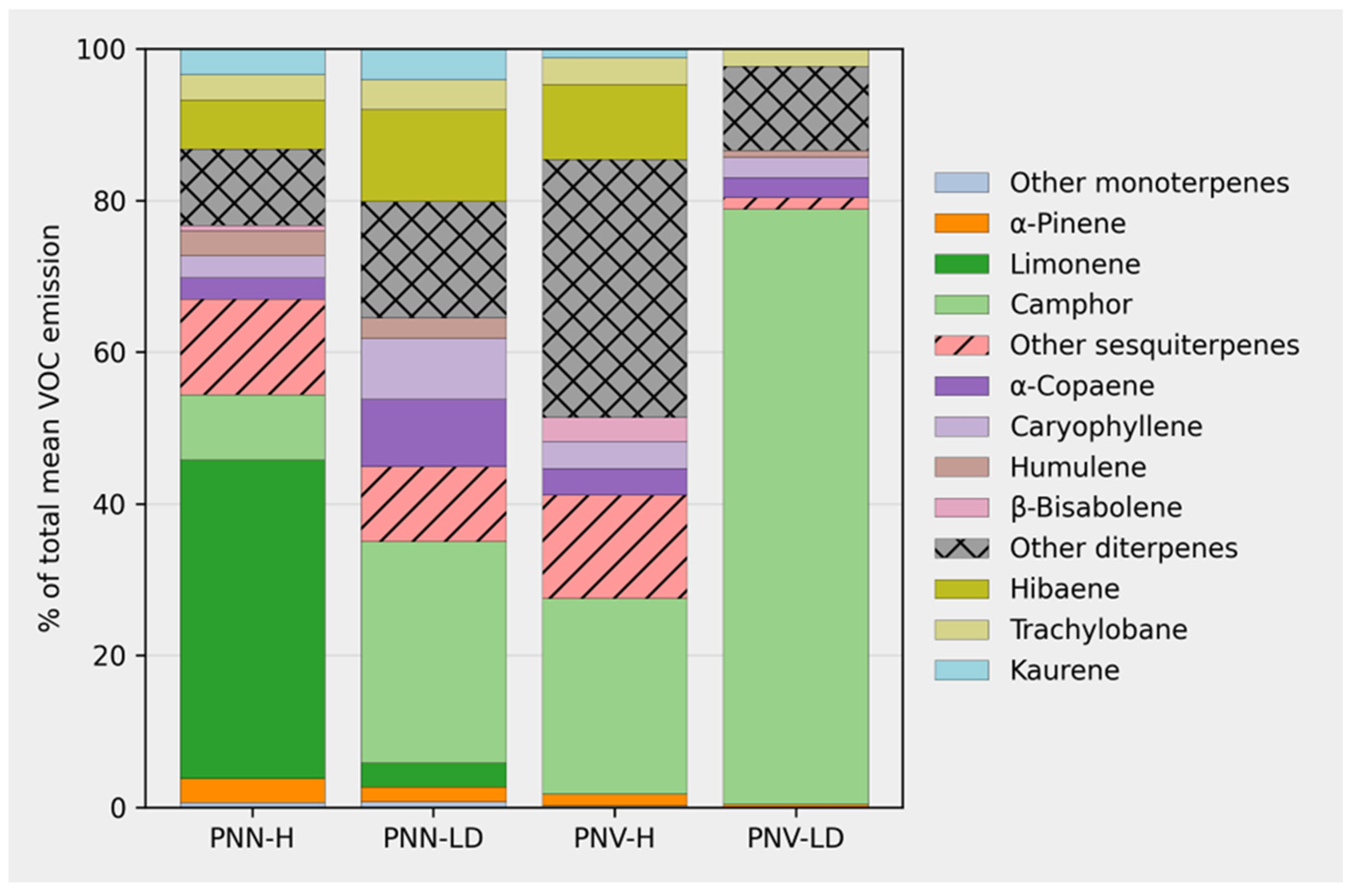
Figure 1 summarizes the relative contribution of the main compounds to the volatile blends. In PNN-H, monoterpenes contributed strongly because of the high relative abundance of limonene. In both leaf-damaged groups, the blends were less diverse, and PNV-LD was dominated by camphor.
The analysis revealed distinct, putative chemical indicators driven by both tree health status and geographic location. The profile of healthy trees in Nahuelbuta National Park (PNN-H) was characterized by a high predominance of monoterpenes, contributing to one of the largest total volatile emissions observed in the study. This robust profile was primarily driven by high concentrations of limonene and camphor. However, in the leaf-damaged state (PNN-LD), the proportion of monoterpenes decreased sharply, accompanied by a drastic decline in limonene levels. Consequently, the PNN-LD volatile profile became proportionally more balanced, with sesquiterpenes such as α-copaene and caryophyllene gaining greater relative abundance within the total emission blend.
In Villarrica National Park, healthy trees (PNV-H) exhibited a moderately balanced distribution across chemical classes. While diterpenes were prominent—with hibaene accounting for a substantial portion of the total emissions—they shared dominance with monoterpenes and sesquiterpenes. Conversely, leaf-damaged trees (PNV-LD) presented the most distinctive emission profile of the study. Despite exhibiting the lowest chemical diversity in terms of total compound count, this group was characterized by an overwhelming dominance of camphor, which reached exceptionally high concentrations. This dramatic upregulation fundamentally skewed the relative abundance of the volatile blend; camphor entirely dwarfed the contributions of sesquiterpenes and diterpenes, even though baseline compounds like hibaene remained present.
Overall, diterpenes—represented primarily by hibaene—remained relatively constant across all treatments. Similarly, the relative contribution of sesquiterpenes remained steady across the healthy states of both parks. However, the transition to an leaf-damaged state provoked starkly contrasting geographic responses: a diversification and reduction in total volatile emissions in Nahuelbuta (PNN), versus the massive overproduction of a single monoterpene in Villarrica (PNV).
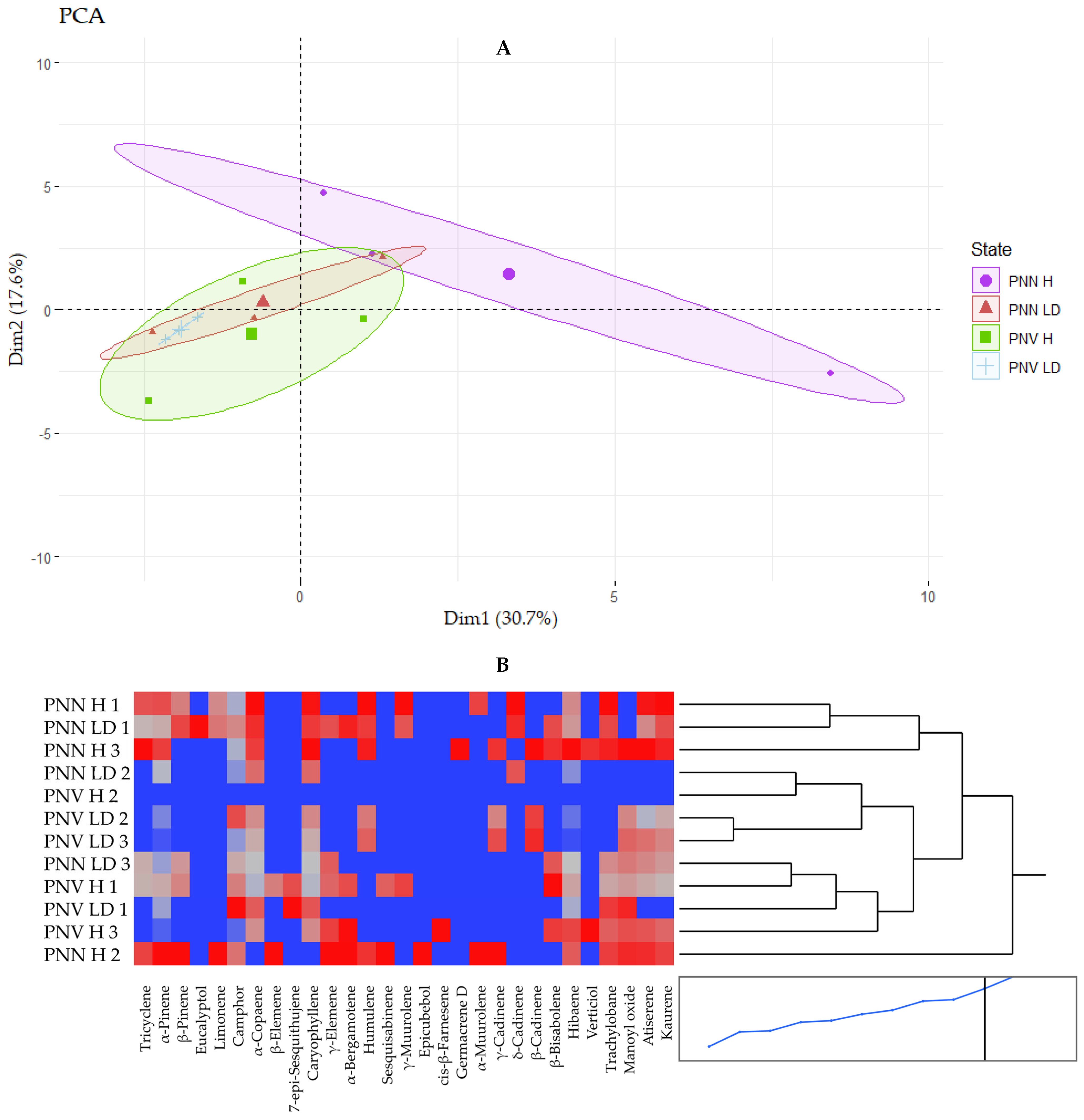
The Principal Component Analysis (PCA, Figure 2A) explained 48.3% of the total variance across the first two components. Samples from healthy trees in Nahuelbuta National Park (PNN-H) separated distinctly along the positive axis and displayed a broader confidence ellipse, reflecting substantial intra-group variability. Conversely, the leaf-damaged Nahuelbuta samples (PNN-LD) clustered closely with both the healthy and leaf-damaged Villarrica samples (PNV-H and PNV-LD) on the negative side of the plot. Interestingly, the PNV samples exhibited no clear spatial differentiation in health status across these principal dimensions.
Complementing the PCA, the hierarchical clustering and heatmap (Figure 2B) reveal that while the leaf-damaged Villarrica samples (PNV-LD) group closely together, health status is not the sole driver of the overall clustering. Instead, healthy and leaf-damaged samples are distributed across the primary dendrogram branches, reflecting complex, overlapping volatile profiles. Analysis of the specific compound clusters demonstrates that the upper clade is defined by PNN samples, which exhibit higher concentrations of specific monoterpenes—particularly tricyclene, α-pinene, and β-pinene. Conversely, the lower clade displays reduced levels of these compounds but an increased relative abundance of others, such as trachylobane and manoyl oxide. When evaluating health-specific responses within the sites, PNV samples show distinctly higher intensities of δ-cadinene and β-cadinene in leaf-damaged states. Similarly, in PNN samples, camphor concentrations are notably elevated in leaf-damaged trees relative to their healthy counterparts.
Furthermore, specific chemical markers differentiated the intermediate volatile groups. Although camphor was present in both PNV and PNN-LD samples, the latter retained a distinct chemical identity due to the exclusive presence of δ-cadinene. In contrast, the PNV-H group was uniquely characterized by the presence of cis-β-farnesene. Regarding broader trends, a constant yet graded presence of hibaene was observed across all treatments. Minor compounds, such as tricyclene and germacrene D, appeared as consistent constituents in the upper cluster of the heatmap; these likely represent a constitutive chemical baseline rather than the primary drivers of group separation.

4. Discussion

The volatile profile of A. araucana branches analyzed in this study was dominated by three primary terpene classes: monoterpenes, sesquiterpenes, and diterpenes. The identification of 29 to 31 compounds across treatments aligns with the proportions reported by Briggs and White [24], who found a distribution of approximately 25% monoterpenes, 25% sesquiterpenes, and 50% diterpenes in leaf essential oils [27]. Notably, significant monoterpene fractions were detected in all samples, contrasting with the work of Pietsch and König [28], where these highly volatile compounds were likely lost to evaporation during solvent extraction. By employing Porapak Q cartridges for dynamic headspace capture, we successfully retained the monoterpene fraction, enabling a more accurate characterization of natural A. araucana emissions. Common constituents such as α-pinene, camphor, α-copaene, caryophyllene, and hibaene were consistently identified, corroborating previous reports [23]. Furthermore, distinctive diterpenes—including kaurene, trachylobane, and 16-atisirene—were identified, matching historical chemical descriptions of the species. While literature regarding VOC emissions from A. araucana branches remains limited, the compounds identified here have been documented in the foliage of related congeners, such as A. angustifolia, A. bidwillii, and A. heterophylla [37,38]. Under healthy conditions, the volatile profiles revealed a clear geographic separation between the Coastal (Nahuelbuta, PNN) and Andean (Villarrica, PNV) populations. The high release of limonene from Nahuelbuta branches suggests this compound may act as a regional biomarker, potentially linked to the genetic divergence of this fragmented population [39,40]. This aligns with Raffi et al. [41], who noted variations in leaf alkane profiles between coastal and mountain populations. Given that environmental variables such as temperature were negligible during capture [30,42], the distinct chemical profile of PNN-H—driven by high monoterpene abundance—supports the hypothesis that genetic lineage plays a primary role in defining the constitutive defense baseline of these ancient populations.
The multivariate analyses indicate that site context and tree health status jointly contributed to variation in branch VOC blends. Healthy trees from Nahuelbuta were the most dispersed and chemically rich group, largely because of the strong contribution of limonene and several minor terpenes, whereas leaf-damaged trees from Villarrica showed the lowest richness and the highest numerical dominance of camphor. These patterns suggest that the chemical response associated with leaf damage was not uniform across populations. Unlike our previous study in Conguillio National Park, which focused on behavioral responses of S. porteri to VOC blends from a single locality [23], the present study shows that compounds linked previously to host selection are embedded within a broader site-dependent chemical background. For that reason, compounds such as limonene, hibaene, and camphor should be interpreted in a population context rather than as universally fixed markers. Therefore, the shift from a limonene-rich profile to one dominated by camphor or exposed hibaene may signal a transition from a resistant state to one of susceptibility, facilitating secondary attacks. Several compounds associated with ALD exhibit seasonal dynamics, which could influence terpene release from storage tissues prior to sampling. Despite efforts to collect samples within consistent timeframes, the influence of seasonal physiology, light exposition and canopy position cannot be entirely ruled out. Future studies should investigate these temporal effects to better understand their impact on emission profiles. The observed susceptibility may also stem from the fragmented nature of existing Araucaria populations [43]. The inability of these long-lived trees to rapidly expand or renew genetic diversity makes them particularly vulnerable to climate change [44]. The Coastal range (PNN), which showed the most drastic loss of volatile emissions under stress, appears especially susceptible
The ecological interpretation of these patterns should also consider the broader literature on A. araucana decline and stress physiology. Controlled water restriction modifies biochemical traits, foliar condition, and wood chemical profiles in seedlings [45,46], while hydraulic studies indicate substantial internal water storage and low vulnerability to drought in this species [47]. Symbiotic fungi may also improve drought tolerance during early establishment [48]. At the same time, declining adult trees and affected forests have been associated with multiple pathogens, including Pewenomyces kutranfy and Phytophthora cinnamomi, and with decline processes in which carbon shortage is not necessarily the proximate mechanism [8,9,11]. Together, these studies support interpreting ALD as a multifactorial decline syndrome. Under that framework, the VOC shifts documented here are better viewed as chemical correlates of tree condition within a complex stress scenario than as definitive biomarkers of a single causal pathway. Seasonal and canopy-position effects also cannot be excluded because sampling extended from February to May and crown exposure was not quantified.

5. Conclusions

Branch VOC profiles of A. araucana differed between parks and between healthy and leaf-damaged trees, but the magnitude and direction of these differences depended on both the compound and the site. Hibaene was detected across all treatments, whereas camphor reached its highest mean values in leaf-damaged trees from Villarrica. The main scientific contribution of this study is that it extends the previously published single-site behavioral evidence [23] to a cross-site chemical comparison in two additional national parks, showing that health-related VOC shifts are reproducible in broad terms but remain strongly conditioned by local context. VOC profiling therefore appears to be a useful complementary tool for evaluating forest health in A. araucana, although broader temporal sampling and within-tree designs are still needed before candidate compounds can be validated for early ALD diagnosis.

Supplementary Materials

The following supporting information can be downloaded at: https://www.mdpi.com/article/10.3390/f17040441/s1, Figure S1: Chromatograms of profiles of representative samples of A: PNV Healthy; B: PNV Unhealthy; C: PNN Healthy and D: PNN Unhealthy; Table S1: Raw data of volatiles captures per repetition. The value is expressed as ng/g.

Author Contributions

Conceptualization, W.A. and A.Q.; Methodology, W.A., L.B., C.M., A.Q. and J.E.; Formal analysis, W.A., A.Q. and J.E.; Investigation, W.A.; Resources, A.Q.; Writing—original draft, W.A.; Writing—review & editing, L.B., C.M., A.Q. and J.E.; Supervision, A.Q. All authors have read and agreed to the published version of the manuscript.

Funding

This research was funded by Fondo de Investigación del Bosque Nativo under grant number FIBN 042_2019, National Agency for Research and Development (ANID) under grant number 21221942, and Universidad de La Frontera grant number DI20-0016. The APC was partially covered by Dirección de Investigación—Vicerrectoría de Investigación y Postgrado, VRIP-UFRO.

Data Availability Statement

The original contributions presented in this study are included in the article. Further inquiries can be directed to the corresponding author.

Acknowledgments

We want to thank the Laboratorio de Química Ecológica at la Universidad de La Frontera (Temuco, Chile) and the Laboratorio de Salud de Bosques de la Universidad Austral (Valdivia, Chile).

Conflicts of Interest

The authors declare no conflicts of interest.

References

  1. Nanavati, W.; Whitlock, C.; Outes, V.; Villarosa, G. A Holocene History of Monkey Puzzle Tree (Pehuén) in Northernmost Patagonia. J. Biogeogr. 2021, 48, 833–846. [Google Scholar] [CrossRef]
  2. Fuentes, G.; González, F.; Saavedra, J.; López-Sepúlveda, P.; Victoriano, P.F.; Stuessy, T.F.; Ruiz-Ponce, E. Assessing Signals of Selection and Historical Demography to Develop Conservation Strategies in the Chilean Emblematic Araucaria araucana. Sci. Rep. 2021, 11, 20504. [Google Scholar] [CrossRef] [PubMed]
  3. Acuña, E.; Rodríguez, R.; Sandoval, S.; Hasbún, R.; Montecino, F.; Müller-Using, B.; Olave, F.; Carrasco, R. Differential Impact of Predator Functional Groups on Araucaria araucana Seed Predation. New For. 2026, 57, 3. [Google Scholar] [CrossRef]
  4. Sanguinetti, J.; Ditgen, R.S.; Donoso Calderón, S.R.; Hadad, M.A.; Gallo, L.; González, M.E.; Ibarra, J.T.; Ladio, A.; Lambertucci, S.A.; Marchelli, P.; et al. Relevant Scientific Information for Management and Conservation of the Pewen Biocultural Ecosystem in Chile and Argentina. Bosque 2023, 44, 179–190. [Google Scholar] [CrossRef]
  5. Schmithüsen, J. Die Nadelhölzer in Den Waldgesellschaften Der Südlichen Anden. Vegetatio 1960, 9, 313–327. [Google Scholar] [CrossRef]
  6. Petitpas, R. Politics of National Red List Classifications: Challenging the Reclassification of Araucaria araucana. Conserv. Soc. 2025, 23, 63–73. [Google Scholar] [CrossRef]
  7. Ministerio de Agricultura. Decreto 43: Declara Monumento Natural a la Araucaria araucana; Biblioteca del Congreso Nacional de Chile: Santiago, Chile, 1990. [Google Scholar]
  8. Vélez, M.L.; Marfetán, J.A.; Salgado Salomón, M.E.; Taccari, L.E. Mortierella Species from Declining Araucaria araucana Trees in Patagonia, Argentina. For. Pathol. 2020, 50, e12591. [Google Scholar] [CrossRef]
  9. Jiménez-Castillo, M.; Fajardo, A.; Lobos-Catalán, P.; Torres-Morales, P.; Piper, F.I. No carbon shortage in declining trees of the isohydric species Araucaria araucana (Molina) K. Koch under drought. Ann. For. Sci. 2022, 79, 10. [Google Scholar] [CrossRef]
  10. Cifuentes, G.; Contreras, S.; Cerda-Peña, C. Evaluation of the Foliar Damage That Threatens a Millennial-Age Tree, Araucaria araucana (Molina) K. Koch, Using Leaf Waxes. Forests 2020, 11, 59. [Google Scholar] [CrossRef]
  11. Sanfuentes, E.; González, M.; Castillo, M.; Rubilar, R.; Besoain, X.; Sanhueza, C.; Smith, M. Detection of Phytophthora cinnamomi on declining Araucaria araucana forests. For. Pathol. 2022, 52, e12765. [Google Scholar] [CrossRef]
  12. Balocchi, F.; Wingfield, M.J.; Ahumada, R.; Barnes, I. Pewenomyces kutranfy gen. nov. et sp. nov. causal agent of an important canker disease on Araucaria araucana in Chile. Plant Pathol. 2021, 70, 1243–1259. [Google Scholar] [CrossRef]
  13. Tai, X.; Mackay, D.S.; Ewers, B.E.; Parsekian, A.D.; Beverly, D.; Speckman, H.; Brooks, P.D.; Anderegg, W.R.L. Plant Hydraulic Stress Explained Tree Mortality and Tree Size Explained Beetle Attack in a Mixed Conifer Forest. J. Geophys. Res. Biogeosci. 2019, 124, 3555–3568. [Google Scholar] [CrossRef]
  14. Faiola, C.L.; Jobson, B.T.; VanReken, T.M. Impacts of Simulated Herbivory on Volatile Organic Compound Emission Profiles from Coniferous Plants. Biogeosciences 2015, 12, 527–547. [Google Scholar] [CrossRef]
  15. Arneth, A.; Niinemets, Ü. Induced BVOCs: How to Bug Our Models? Trends Plant Sci. 2010, 15, 118–125. [Google Scholar] [CrossRef]
  16. Zapata, M.; Palma, M.A.; Aninat, M.J.; Piontelli, E. Polyphasic Studies of New Species of Diaporthe from Native Forest in Chile, with Descriptions of Diaporthe araucanorum sp. Nov., Diaporthe foikelawen sp. Nov. and Diaporthe patagonica sp. Nov. Int. J. Syst. Evol. Microbiol. 2020, 70, 3379–3390. [Google Scholar] [CrossRef]
  17. Zapata, M.; Palma, M.A.; Piontelli, E. Ophiostoma pehueninum, a New Species Associated with Araucaria araucana in Chile. Phytotaxa 2018, 346, 93–103. [Google Scholar] [CrossRef]
  18. Miller, D.R.; Asaro, C. Predators Attracted to Combination of Bark Beetle Pheromones and Host Kairomones in Pine Forests of Southeastern United States. Environ. Entomol. 2023, 52, 787–794. [Google Scholar] [CrossRef]
  19. Yaman, B.; Aydin, Y.M.; Koca, H.; Dasdemir, O.; Kara, M.; Altiok, H.; Dumanoglu, Y.; Bayram, A.; Tolunay, D.; Odabasi, M.; et al. Biogenic Volatile Organic Compound (BVOC) Emissions from Various Endemic Tree Species in Turkey. Aerosol Air Qual. Res. 2015, 15, 341–356. [Google Scholar] [CrossRef]
  20. Giunta, A.D.; Runyon, J.B.; Jenkins, M.J.; Teich, M. Volatile and Within-Needle Terpene Changes to Douglas-Fir Trees Associated with Douglas-Fir Beetle (Coleoptera: Curculionidae) Attack. Environ. Entomol. 2016, 45, 920–929. [Google Scholar] [CrossRef]
  21. Ganteaume, A.; Romero, B.; Fernandez, C.; Ormeño, E.; Lecareux, C. Volatile and Semi-Volatile Terpenes Impact Leaf Flammability: Differences According to the Level of Terpene Identification. Chemoecology 2021, 31, 259–275. [Google Scholar] [CrossRef]
  22. Boncan, D.A.T.; Tsang, S.S.K.; Li, C.; Lee, I.H.T.; Lam, H.-M.; Chan, T.-F.; Hui, J.H.L. Terpenes and Terpenoids in Plants: Interactions with Environment and Insects. Int. J. Mol. Sci. 2020, 21, 7382. [Google Scholar] [CrossRef]
  23. Aniñir, W.; Bardehle, L.; Montalva, C.; Quiroz, A.; Espinoza, J. Effect of Volatile Organic Compounds from Branches of Healthy and Unhealthy Araucaria araucana (Molina) K. Koch Trees on Host Selection by Bark Beetle Sinophloeus porteri (Coleoptera: Curculionidae). Insects 2025, 16, 712. [Google Scholar] [CrossRef]
  24. Briggs, L.H.; White, G.W. Constituents of the Essential Oil of Araucaria araucana. Tetrahedron 1974, 31, 1311–1314. [Google Scholar] [CrossRef]
  25. Parveen, N.; Taufeeq, H.M.; Khan, N.U. Biflavones from the Leaves of Araucaria araucana. J. Nat. Prod. 1987, 50, 332–333. [Google Scholar] [CrossRef]
  26. Garbarino, J.A.; Oyarzún, M.L.; Gambaro, V. Labdane Diterpenes from Araucaria araucana. J. Nat. Prod. 1987, 50, 935–936. [Google Scholar] [CrossRef]
  27. Brophy, J.J.; Goldsack, R.J.; Wu, M.Z.; Fookes, C.J.R.; Forster, P.I. The Steam Volatile Oil of Wollemia nobilis and Its Comparison with Other Members of the Araucariaceae (Agathis and Araucaria). Biochem. Syst. Ecol. 2000, 28, 563–578. [Google Scholar] [CrossRef]
  28. Pietsch, M.; König, W.A. Enantiomers of Sesquiterpene and Diterpene Hydrocarbons in Araucaria Species. Phytochem. Anal. 2000, 11, 99–105. [Google Scholar] [CrossRef]
  29. Juan, P.B. CR2MET: A High-Resolution Precipitation and Temperature Dataset for the Period 1960–2021 in Continental Chile. 2023. Available online: https://zenodo.org/records/7529682 (accessed on 22 March 2026).
  30. Alvarez-Garreton, C.; Mendoza, P.A.; Boisier, J.P.; Addor, N.; Galleguillos, M.; Zambrano-Bigiarini, M.; Lara, A.; Puelma, C.; Cortes, G.; Garreaud, R.; et al. The CAMELS-CL Dataset: Catchment Attributes and Meteorology for Large Sample Studies—Chile Dataset. Hydrol. Earth Syst. Sci. 2018, 22, 5817–5846. [Google Scholar] [CrossRef]
  31. González, M.E.; Veblen, T.T.; Sibold, J.S. Fire History of Araucaria–Nothofagus Forests in Villarrica National Park, Chile. J. Biogeogr. 2005, 32, 1187–1202. [Google Scholar] [CrossRef]
  32. Mueller-Dombois, D.; Ellenberg, H. Aims and Methods of Vegetation Ecology; Aims Methods Veg Ecol_ch5.29; John Willy & Sons: Toronto, ON, Canada, 1974; pp. 47–54. [Google Scholar]
  33. Parra, L.; Mutis, A.; Ceballos, R.; Lizama, M.; Pardo, F.; Perich, F.; Quiroz, A. Volatiles Released from Vaccinium corymbosum Were Attractive to Aegorhinus superciliosus (Coleoptera: Curculionidae) in an Olfactometric Bioassay. Environ. Entomol. 2009, 38, 781–789. [Google Scholar] [CrossRef]
  34. Quiroz, A.; Fuentes-Contreras, E.; Ramírez, C.C.; Russell, G.B.; Niemeyer, H.M. Host-Plant Chemicals and Distribution of Neuquenaphis on Nothofagus. J. Chem. Ecol. 1999, 25, 1043–1054. [Google Scholar] [CrossRef]
  35. Ettre, L.S. The Kovats Retention Index System. Anal. Chem. 1964, 36, 31A–41A. [Google Scholar] [CrossRef]
  36. Pesyna, G.M.; Venkataraghavan, R.; Dayringer, H.E.; McLafferty, F.W. Probability Based Matching System Using a Large Collection of Reference Mass Spectra. Anal. Chem. 1976, 48, 1362–1368. [Google Scholar] [CrossRef]
  37. Abdelhameed, M.F.; Asaad, G.F.; Ragab, T.I.M.; Ahmed, R.F.; Gendy, A.E.G.E.; El-Rahman, S.S.A.; Elgamal, A.M.; Elshamy, A.I. Oral and Topical Anti-Inflammatory and Antipyretic Potentialities of Araucaria bidiwillii Shoot Essential Oil and Its Nanoemulsion in Relation to Chemical Composition. Molecules 2021, 26, 5833. [Google Scholar] [CrossRef] [PubMed]
  38. Frezza, C.; Venditti, A.; Vita, D.D.; Toniolo, C.; Franceschin, M.; Ventrone, A.; Tomassini, L.; Foddai, S.; Guiso, M.; Nicoletti, M.; et al. Phytochemistry, Chemotaxonomy, and Biological Activities of the Araucariaceae Family—A Review. Plants 2020, 9, 888. [Google Scholar] [CrossRef] [PubMed]
  39. Martín, M.A.; Mattioni, C.; Lusini, I.; Molina, J.R.; Cherubini, M.; Drake, F.; Herrera, M.A.; Villani, F.; Martín, L.M. New Insights into the Genetic Structure of Araucaria araucana Forests Based on Molecular and Historic Evidences. Tree Genet. Genomes 2014, 10, 839–851. [Google Scholar] [CrossRef]
  40. Taft, S.; Najar, A.; Godbout, J.; Bousquet, J.; Erbilgin, N. Variations in Foliar Monoterpenes across the Range of Jack Pine Reveal Three Widespread Chemotypes: Implications to Host Expansion of Invasive Mountain Pine Beetle. Front. Plant Sci. 2015, 6, 342. [Google Scholar] [CrossRef]
  41. Rafii, Z.A.; Dodd, R.S. Genetic Diversity among Coastal and Andean Natural Populations of Araucaria araucana (Molina) K. Koch. Biochem. Syst. Ecol. 1998, 26, 441–451. [Google Scholar] [CrossRef]
  42. Zhang, Q.-H.; Schlyter, F.; Anderson, P. Green Leaf Volatiles Interrupt Pheromone Response of Spruce Bark Beetle, Ips typographus. J. Chem. Ecol. 1999, 25, 2847–2861. [Google Scholar] [CrossRef]
  43. Marchelli, P.; Baier, C.; Mengel, C.; Ziegenhagen, B.; Gallo, L.A. Biogeographic History of the Threatened Species Araucaria araucana (Molina) K. Koch and Implications for Conservation: A Case Study with Organelle DNA Markers. Conserv. Genet. 2010, 11, 951–963. [Google Scholar] [CrossRef]
  44. O’Neill, G.A.; Hamann, A.; Wang, T. Accounting for Population Variation Improves Estimates of the Impact of Climate Change on Species’ Growth and Distribution. J. Appl. Ecol. 2008, 45, 1040–1049. [Google Scholar] [CrossRef]
  45. Papu, S.; Ortega-Rodriguez, D.R.; Roig, F.A.; Navas, F. Incidence of Controlled Water Restriction on Density and Chemical Profiles in Tree Rings of Araucaria araucana Seedlings. Ecol. Process. 2024, 13, 45. [Google Scholar] [CrossRef]
  46. Papú, S.; Berli, F.; Piccoli, P.; Patón, D.; Ortega Rodriguez, D.R.; Roig, F.A. Physiological, biochemical, and anatomical responses of Araucaria araucana seedlings to controlled water restriction. Plant Physiol. Biochem. 2021, 165, 47–56. [Google Scholar] [CrossRef]
  47. Bucci, S.J.; Carbonell-Silletta, L.; Cavallaro, A.; Arias, N.S.; Campanello, P.I.; Goldstein, G.; Scholz, F.G. Bark and Sapwood Water Storage and the Atypical Pattern of Recharge and Discharge of Water Reservoirs Indicate Low Vulnerability to Drought in Araucaria araucana. Tree Physiol. 2023, 43, 248–261. [Google Scholar] [CrossRef]
  48. Chavez, D.; Rivas, G.; Machuca, A.; Santos, C.; Deramond, C.; Aroca, R.; Cornejo, P. Contribution of Arbuscular Mycorrhizal and Endophytic Fungi to Drought Tolerance in Araucaria araucana Seedlings. Plants 2023, 12, 2116. [Google Scholar] [CrossRef]
Figure 1. A stacked bar chart showing the composition of volatile compounds emitted from branches of A. araucana. (PNV: Villarrica National Park; PNN: Nahuelbuta National park; H: healthy branches; LD: Leaf damage).
Forests 17 00441 g001
Figure 2. Multivariate analysis of the volatile profiles from A. araucana branches. (A) Principal Component Analysis (PCA) score plot based on the 29 terpenes identified across healthy and leaf-damaged samples. (B) Heatmap and hierarchical clustering dendrogram illustrating the relative abundance of these 29 volatile compounds, with a color gradient ranging from blue (low abundance) to red (high abundance). Abbreviations: PNN, Nahuelbuta National Park; PNV, Villarrica National Park; H, Healthy; LD, leaf-damaged.
Forests 17 00441 g002
Table 1. Chemical composition of the volatile blends emitted by healthy (H) and leaf-damaged (LD) A. araucana branches from different national parks.
CompoundRT 1RIexpRIlitConcentration (ng g−1)
PNN HPNN LDPNV HPNV LD
Tricyclene9.2792291410.8 ± 5.1 a1.2 ± 1.1 b0.6 ± 1.1 b0.0 ± 0.0 b
α-Pinene9.6393593874.5 ± 31.1 a12.3 ± 4.3 b7.7 ± 8.4 b5.9 ± 2.8 b
β-Pinene10.919769804.3 ± 5.3 a2.4 ± 2.7 a0.8 ± 1.4 a0.0 ± 0.0 a
Eucalyptol12.5102810310.0 ± 0.0 a0.7 ± 1.2 a0.0 ± 0.0 a0.0 ± 0.0 a
Limonene13.810721033981.8 ± 1677.4 a18.8 ± 32.6 a0.0 ± 0.0 a0.0 ± 0.0 a
Camphor15.7911381143202.5 ± 225.5 a176.6 ± 140.5 a130.9 ± 215.0 a1237.6 ± 1384.3 a
α-Copaene22.641385137765.5 ± 60.5 a53.9 ± 33.3 a17.8 ± 18.5 a41.6 ± 15.4 a
β-Elemene23.021399139249.7 ± 86.1 a0.0 ± 0.0 a2.8 ± 4.8 a0.0 ± 0.0 a
7-epi-Sesquithujene23.3141114080.0 ± 0.0 a0.0 ± 0.0 a3.7 ± 6.4 a12.0 ± 20.8 a
Caryophyllene23.71428141969.3 ± 60.1 a48.4 ± 25.3 a18.3 ± 18.6 a41.6 ± 15.5 a
γ-Elemene23.991440143529.8 ± 51.6 a16.7 ± 14.7 a18.6 ± 18.5 a0.0 ± 0.0 a
α-Bergamotene24.021441143812.9 ± 22.3 a9.3 ± 16.1 a17.4 ± 18.8 a0.0 ± 0.0 a
Humulene24.461459145577.4 ± 22.1 a16.5 ± 28.7 b0.0 ± 0.0 b15.8 ± 14.4 b
Sesquisabinene24.511460145918.7 ± 32.4 a0.0 ± 0.0 a3.4 ± 5.8 a0.0 ± 0.0 a
γ-Muurolene24.951478147733.7 ± 58.4 a7.4 ± 12.9 a10.7 ± 18.5 a0.0 ± 0.0 a
Epicubebol25.051482149230.0 ± 52.0 a0.0 ± 0.0 a0.0 ± 0.0 a0.0 ± 0.0 a
cis-β-Farnesene25.15148614460.0 ± 0.0 a0.0 ± 0.0 a12.4 ± 21.5 a0.0 ± 0.0 a
Germacrene D25.261490148010.6 ± 18.4 a0.0 ± 0.0 a0.0 ± 0.0 a0.0 ± 0.0 a
α-Muurolene25.361494149925.9 ± 29.5 a0.0 ± 0.0 a0.0 ± 0.0 a0.0 ± 0.0 a
γ-Cadinene26.01521151348.1 ± 49.4 a0.0 ± 0.0 a0.0 ± 0.0 a12.6 ± 14.4 a
δ-Cadinene26.141527152434.6 ± 59.9 a26.3 ± 28.1 a0.0 ± 0.0 a0.0 ± 0.0 a
(-)-β-Cadinene26.221531152915.7 ± 27.1 a0.0 ± 0.0 a0.0 ± 0.0 a15.8 ± 14.4 a
β-Bisabolene26.411539150919.7 ± 34.1 a22.3 ± 19.6 a51.8 ± 53.6 a0.0 ± 0.0 a
Unid. 2 oxygenated diterpene-130.981743-44.7 ± 40.4 a24.4 ± 25.0 a18.6 ± 19.5 a41.4 ± 15.5 a
Unid. 2 oxygenated diterpene-231.151752-54.4 ± 47.2 a24.4 ± 25.0 a18.5 ± 19.3 a41.4 ± 15.5 a
Hibaene34.9319381933151.3 ± 58.1 a72.9 ± 22.4 a89.5 ± 64.3 a43.9 ± 17.2 a
Verticiol35.671977-6.3 ± 11.0 a0.0 ± 0.0 a12.2 ± 21.1 a0.0 ± 0.0 a
Trachylobane36.031995198978.0 ± 21.7 a24.2 ± 25.0 a18.3 ± 19.2 a19.5 ± 33.7 a
Manoyl oxide36.442018201544.1 ± 39.7 a7.4 ± 12.8 a17.4 ± 18.4 a35.3 ± 20.5 a
Atiserene36.852041-67.4 ± 10.5 a14.8 ± 12.8 b17.8 ± 18.7 b12.6 ± 14.4 b
Kaurene36.942046-78.3 ± 21.0 a24.3 ± 24.9 b18.5 ± 19.3 b15.8 ± 14.4 b
1 RT, retention time (min); RIexp, experimental retention index; RIlit, retention index from the literature. Values are means ± SD (n = 3 trees per group). Within each row, different letters indicate significant differences among groups according to one-way ANOVA followed by Tukey’s HSD test (p < 0.05). 2 Unidentified.
Disclaimer/Publisher’s Note: The statements, opinions and data contained in all publications are solely those of the individual author(s) and contributor(s) and not of MDPI and/or the editor(s). MDPI and/or the editor(s) disclaim responsibility for any injury to people or property resulting from any ideas, methods, instructions or products referred to in the content.