A Probe-Based qPCR Method for Rapid Detection of Ips typographus (Coleoptera: Curculionidae, Scolytinae) in Border Inspections and Forest Surveillance

 , , ,
, , , 
Abstract
1. Introduction
2. Materials and Methods
2.1. Samples
2.2. Preparation of Artificial Frass Controls
2.3. Non-Target Panel for Specificity Testing
2.4. DNA Extraction and Sample Processing
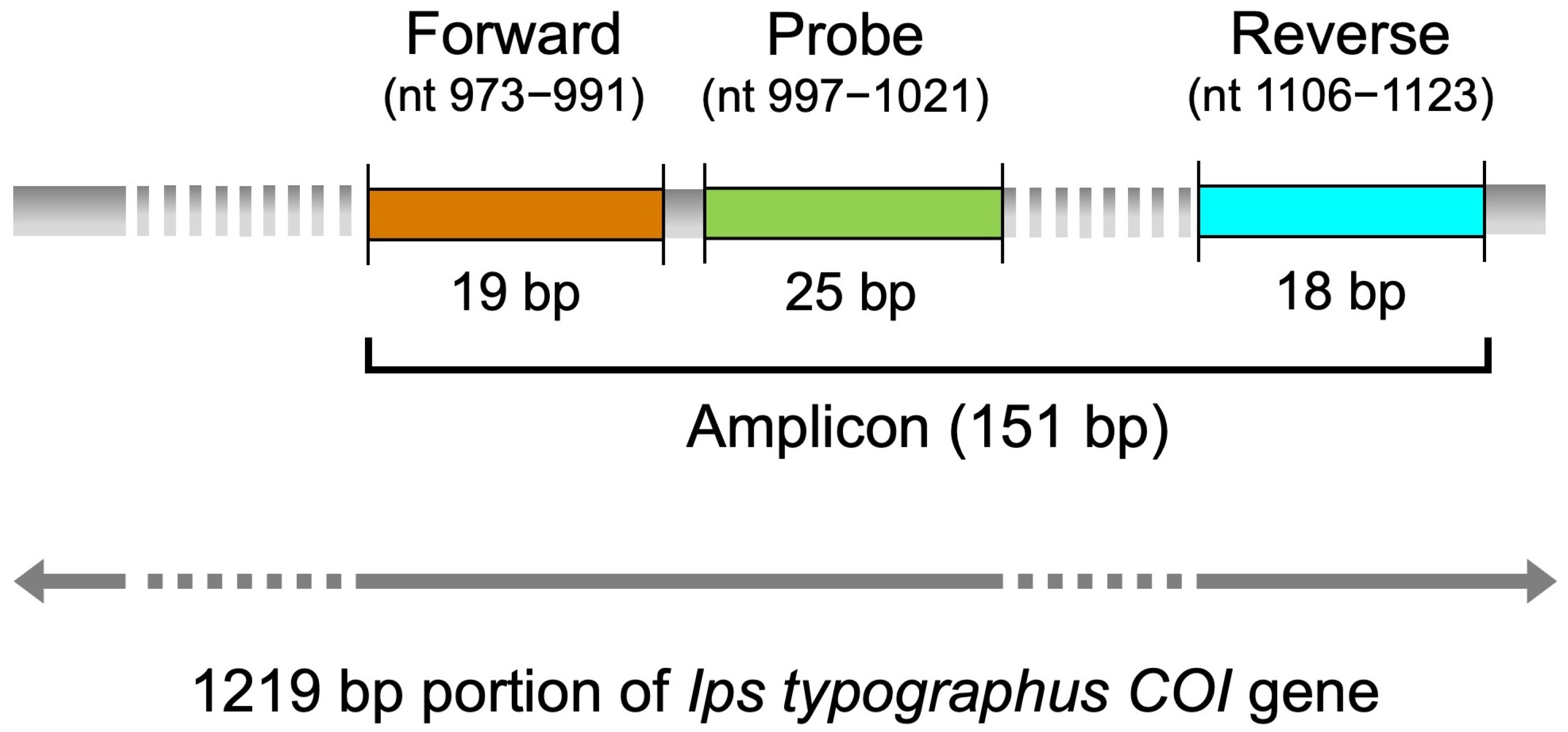
2.5. Primer and Probe Design and In Silico Validation
2.6. qPCR Assay Optimization
2.7. Analytical Validation
2.8. Repeatability and Reproducibility
2.9. Inter-Laboratory Blind Validation
3. Results
3.1. DNA Isolation
3.2. qPCR Optimization
3.3. Analytical Validation
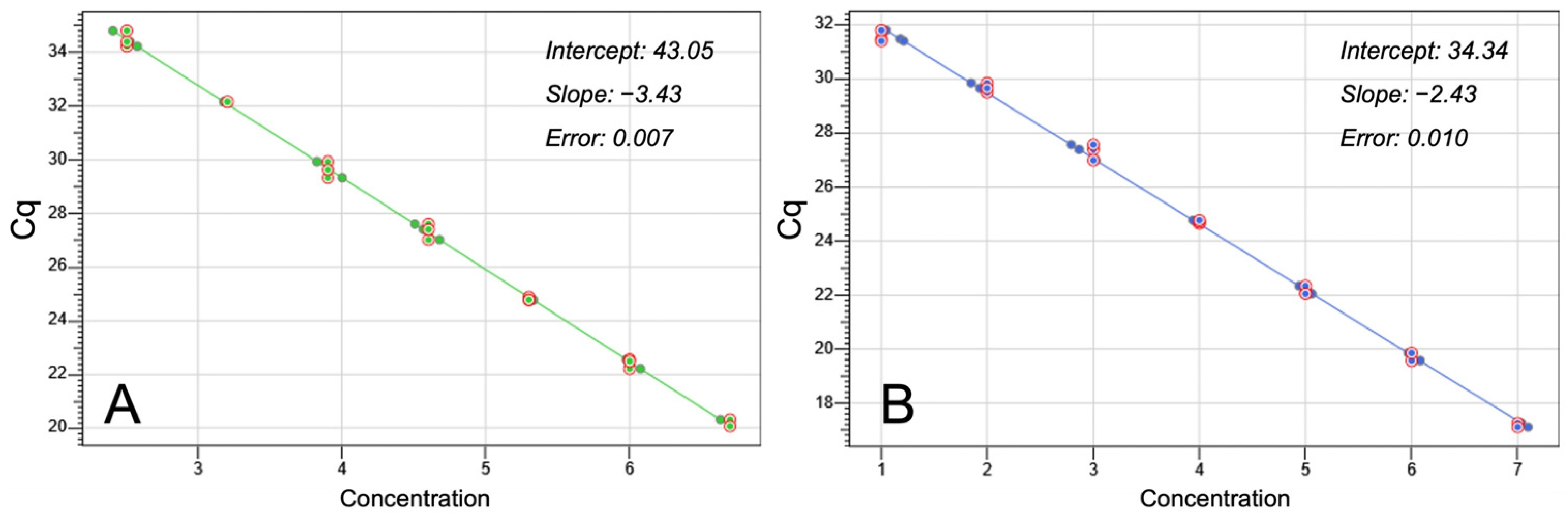
3.4. Assay Sensitivity
3.5. Repeatability and Reproducibility
3.6. Inter-Laboratory Blind Test
4. Discussion
5. Conclusions
Supplementary Materials
Author Contributions
Funding
Data Availability Statement
Conflicts of Interest
Abbreviations
| BHQ1 | Black Hole Quencher 1 |
| BIP/BIPs | Border Inspection Post(s) |
| CTAB | Cetyltrimethylammonium bromide |
| CV | Coefficient of variation |
| Cq | Quantification cycle (qPCR cycle threshold value) |
| CREA | Council for Agricultural Research and Economics (Italy) |
| eDNA | Environmental DNA |
| EPPO | European and Mediterranean Plant Protection Organization |
| ESBB | European spruce bark beetle (Ips typographus) |
| FAM | 6-carboxyfluorescein (fluorophore label) |
| LoD | Limit of detection |
| MAFFT | Multiple Alignment using Fast Fourier Transform (alignment software) |
| MIQE | Minimum Information for Publication of Quantitative Real-Time PCR Experiments |
| Pg | Picogram |
References
- Raffa, K.F.; Grégoire, J.-C.; Staffan Lindgren, B. Natural History and Ecology of Bark Beetles. In Bark Beetles; Elsevier: New York, NY, USA, 2015; pp. 1–40. ISBN 978-0-12-417156-5. [Google Scholar]
- Jaime, L.; Batllori, E.; Lloret, F. Bark Beetle Outbreaks in Coniferous Forests: A Review of Climate Change Effects. Eur. J. Forest Res. 2024, 143, 1–17. [Google Scholar] [CrossRef] [Scilit]
- Singh, V.V.; Naseer, A.; Mogilicherla, K.; Trubin, A.; Zabihi, K.; Roy, A.; Jakuš, R.; Erbilgin, N. Understanding Bark Beetle Outbreaks: Exploring the Impact of Changing Temperature Regimes, Droughts, Forest Structure, and Prospects for Future Forest Pest Management. Rev. Environ. Sci. Biotechnol. 2024, 23, 257–290. [Google Scholar] [CrossRef] [Scilit]
- Weed, A.S.; Ayres, M.P.; Bentz, B.J. Population Dynamics of Bark Beetles. In Bark Beetles; Elsevier: New York, NY, USA, 2015; pp. 157–176. ISBN 978-0-12-417156-5. [Google Scholar]
- Lantschner, V.; Gomez, D.F.; Vilardo, G.; Stazione, L.; Ramos, S.; Eskiviski, E.; Fachinetti, R.; Schiappacassi, M.; Vallejos, N.; Germano, M.; et al. Distribution, Invasion History, and Ecology of Non-Native Pine Bark Beetles (Coleoptera: Curculionidae: Scolytinae) in Southern South America. Neotrop. Entomol. 2024, 53, 351–363. [Google Scholar] [CrossRef] [Scilit] [PubMed]
- Vilardo, G.; Faccoli, M.; Corley, J.C.; Lantschner, M.V. Factors Driving Historic Intercontinental Invasions of European Pine Bark Beetles. Biol. Invasions 2022, 24, 2973–2991. [Google Scholar] [CrossRef] [Scilit]
- Ward, S.F.; Brockerhoff, E.G.; Turner, R.M.; Yamanaka, T.; Marini, L.; Fei, S.; Liebhold, A.M. Prevalence and Drivers of a Tree-Killing Bark Beetle, Ips typographus (Coleoptera, Scolytinae), in International Invasion Pathways into the USA. J. Pest Sci. 2023, 96, 845–856. [Google Scholar] [CrossRef] [Scilit]
- Poland, T.M.; Rassati, D. Improved Biosecurity Surveillance of Non-Native Forest Insects: A Review of Current Methods. J. Pest Sci. 2019, 92, 37–49. [Google Scholar] [CrossRef] [Scilit]
- Andrei, S.; Ifrim, I.-L. Ips Infestation—A Global Problem for Coniferous in the Face of Climate Change. Sci. Study Res. Chem. Chem. Eng. Biotechnol. Food Ind. 2021, 22, 245–261. [Google Scholar]
- Cognato, A.I. Molecular Phylogeny and Taxonomic Review of Premnobiini Browne, 1962 (Coleoptera: Curculionidae: Scolytinae). Front. Ecol. Evol. 2013, 1, 1. [Google Scholar] [CrossRef] [Scilit]
- Marais, G.C.; Stratton, I.C.; Johnson, A.J.; Hulcr, J. Progress in Developing a Bark Beetle Identification Tool. PLoS ONE 2025, 20, e0310716. [Google Scholar] [CrossRef] [Scilit]
- Hallas, T.; Steyrer, G.; Laaha, G.; Hoch, G. Two Unprecedented Outbreaks of the European Spruce Bark Beetle, Ips typographus L. (Col., Scolytinae) in Austria since 2015: Different Causes and Different Impacts on Forests. Cent. Eur. For. J. 2024, 70, 263–274. [Google Scholar] [CrossRef] [Scilit]
- EFSA Panel on Plant Health (PLH); Jeger, M.; Bragard, C.; Caffier, D.; Candresse, T.; Chatzivassiliou, E.; Dehnen-Schmutz, K.; Gilioli, G.; Jaques Miret, J.A.; MacLeod, A.; et al. Pest Categorisation of Ips typographus. EFSA J. 2017, 15, e04881. [Google Scholar] [CrossRef] [Scilit]
- Grégoire, J.-C.; Bonte, J.; Bourke, A.; Cocos, D.; Fielding, N.; Gohli, J.; Inward, D.; Klapwijk, M.; Nikolov, C.; Økland, B.; et al. Territorial Expansion of the European Ips Species in the 20th Century—A Review. Entomologia 2024, 44, 1359–1375. [Google Scholar] [CrossRef] [Scilit]
- Giupponi, L.; Panza, R.; Pedrali, D.; Sala, S.; Giorgi, A. Ecology, Floristic–Vegetational Features, and Future Perspectives of Spruce Forests Affected by Ips typographus: Insight from the Southern Alps. Plants 2025, 14, 1681. [Google Scholar] [CrossRef] [Scilit] [PubMed]
- Blake, M.; Straw, N.; Kendall, T.; Whitham, T.; Manea, I.A.; Inward, D.; Jones, B.; Hazlitt, N.; Ockenden, A.; Deol, A.; et al. Recent Outbreaks of the Spruce Bark Beetle Ips typographus in the UK: Discovery, Management, and Implications. Trees For. People 2024, 16, 100508. [Google Scholar] [CrossRef] [Scilit]
- EFSA; Rondoni, G.; Carotti, L.; Mattion, G.; Vos, S. Pest Survey Card on Ips typographus. EFSA Support. Publ. 2025, 22, 9141E. [Google Scholar] [CrossRef] [Scilit]
- European Commission. Commission Implementing Regulation (EU) 2019/2072 of 28 November 2019. Off. J. Eur. Union 2019, 319, 1–279. [Google Scholar]
- Faraglia, B.C. Misure Fitosanitarie d’emergenza per Il Contrasto Di Ips typographus Atte a Contenere La Sua Diffusione Nel Territorio Della Repubblica Italiana. Ordinanza n. 8 Del 12/06/2024. Gazz. Uff. Della Repubb. Ital. 2024, 175, 5–9. [Google Scholar]
- Wu, Y.; Trepanowski, N.F.; Molongoski, J.J.; Reagel, P.F.; Lingafelter, S.W.; Nadel, H.; Myers, S.W.; Ray, A.M. Identification of Wood-Boring Beetles (Cerambycidae and Buprestidae) Intercepted in Trade-Associated Solid Wood Packaging Material Using DNA Barcoding and Morphology. Sci. Rep. 2017, 7, 40316. [Google Scholar] [CrossRef] [Scilit]
- Nahrung, H.F.; Liebhold, A.M.; Brockerhoff, E.G.; Rassati, D. Forest Insect Biosecurity: Processes, Patterns, Predictions, Pitfalls. Annu. Rev. Entomol. 2023, 68, 211–229. [Google Scholar] [CrossRef] [Scilit]
- Pace, R.; Ascolese, R.; Miele, F.; Russo, E.; Griffo, R.V.; Bernardo, U.; Nugnes, F. The Bugs in the Bags: The Risk Associated with the Introduction of Small Quantities of Fruit and Plants by Airline Passengers. Insects 2022, 13, 617. [Google Scholar] [CrossRef] [Scilit]
- Rizzo, D.; Downes, A.; Zubieta, C.G.; Moriconi, M.; Ranaldi, C.; Palmigiano, B.; Aronadio, A.; Bartolini, L.; Bolige, E.; Garonna, A.P.; et al. Development of an LNA-Based qPCR Assay for Detecting Toumeyella parvicornis (Cockerell, 1897) (Hemiptera: Coccidae) from Insect and Honeydew DNA. Insects 2025, 16, 982. [Google Scholar] [CrossRef] [Scilit]
- Valentin, R.E.; Fonseca, D.M.; Gable, S.; Kyle, K.E.; Hamilton, G.C.; Nielsen, A.L.; Lockwood, J.L. Moving eDNA Surveys onto Land: Strategies for Active eDNA Aggregation to Detect Invasive Forest Insects. Mol. Ecol. Resour. 2020, 20, 746–755. [Google Scholar] [CrossRef] [Scilit]
- Larson, E.R.; Graham, B.M.; Achury, R.; Coon, J.J.; Daniels, M.K.; Gambrell, D.K.; Jonasen, K.L.; King, G.D.; LaRacuente, N.; Perrin-Stowe, T.I.; et al. From eDNA to Citizen Science: Emerging Tools for the Early Detection of Invasive Species. Front. Ecol. Environ. 2020, 18, 194–202. [Google Scholar] [CrossRef] [Scilit]
- Bell, K.L.; Campos, M.; Hoffmann, B.D.; Encinas-Viso, F.; Hunter, G.C.; Webber, B.L. Environmental DNA Methods for Biosecurity and Invasion Biology in Terrestrial Ecosystems: Progress, Pitfalls, and Prospects. Sci. Total Environ. 2024, 926, 171810. [Google Scholar] [CrossRef] [Scilit]
- Rizzo, D.; Zubieta, C.G.; Carli, M.; Marrucci, A.; Ranaldi, C.; Palmigiano, B.; Bartolini, L.; Pennacchio, F.; Bracalini, M.; Garonna, A.P.; et al. Rapid Identification of Ips sexdentatus (Boerner, 1766) (Curculionidae) from Adults and Frass with Real-Time PCR Based on Probe Technology. J. Plant Dis. Prot. 2024, 131, 1473–1481. [Google Scholar] [CrossRef] [Scilit]
- Rizzo, D.; Da Lio, D.; Bartolini, L.; Salemi, C.; Del Nista, D.; Aronadio, A.; Pennacchio, F.; Binazzi, F.; Francardi, V.; Garonna, A.P.; et al. TaqMan Probe Assays on Different Biological Samples for the Identification of Three Ambrosia Beetle Species, Xylosandrus compactus (Eichoff), X. crassiusculus (Motschulsky) and X. germanus (Blandford) (Coleoptera Curculionidae Scolytinae). 3 Biotech 2021, 11, 259. [Google Scholar] [CrossRef] [Scilit]
- Rizzo, D.; Taddei, A.; Da Lio, D.; Nugnes, F.; Barra, E.; Stefani, L.; Bartolini, L.; Griffo, R.V.; Spigno, P.; Cozzolino, L.; et al. Identification of the Red-Necked Longhorn Beetle Aromia bungii (Faldermann, 1835) (Coleoptera: Cerambycidae) with Real-Time PCR on Frass. Sustainability 2020, 12, 6041. [Google Scholar] [CrossRef] [Scilit]
- Ide, T.; Kanzaki, N.; Ohmura, W.; Okabe, K. Molecular Identification of an Invasive Wood-Boring Insect Lyctus brunneus (Coleoptera: Bostrichidae: Lyctinae) Using Frass by Loop-Mediated Isothermal Amplification and Nested PCR Assays. J. Econ. Entomol. 2016, 109, 1410–1414. [Google Scholar] [CrossRef] [Scilit]
- EPPO PM 7/98 (5) Specific Requirements for Laboratories Preparing Accreditation for a Plant Pest Diagnostic Activity. EPPO Bull. 2021, 51, 468–498. [CrossRef] [Scilit]
- Douglas, H.B.; Cognato, A.I.; Grebennikov, V.; Savard, K. Dichotomous and Matrix-Based Keys to the Ips Bark Beetles of the World (Coleoptera: Curculionidae: Scolytinae). Can. J. Arthropod Identif. 2019, 38, 1–234. [Google Scholar] [CrossRef]
- Ioos, R.; Fourrier, C.; Iancu, G.; Gordon, T.R. Sensitive Detection of Fusarium circinatum in Pine Seed by Combining an Enrichment Procedure with a Real-Time Polymerase Chain Reaction Using Dual-Labeled Probe Chemistry. Phytopathology 2009, 99, 582–590. [Google Scholar] [CrossRef] [Scilit]
- Ioos, R.; Kowalski, T.; Husson, C.; Holdenrieder, O. Rapid in Planta Detection of Chalara fraxinea by a Real-Time PCR Assay Using a Dual-Labelled Probe. Eur. J. Plant Pathol. 2009, 125, 329–335. [Google Scholar] [CrossRef] [Scilit]
- Porter, T.M.; Gibson, J.F.; Shokralla, S.; Baird, D.J.; Golding, G.B.; Hajibabaei, M. Rapid and Accurate Taxonomic Classification of Insect (Class Insecta) Cytochrome c Oxidase Subunit 1 (COI) DNA Barcode Sequences Using a Naïve Bayesian Classifier. Mol. Ecol. Resour. 2014, 14, 929–942. [Google Scholar] [CrossRef] [Scilit]
- Forootan, A.; Sjöback, R.; Björkman, J.; Sjögreen, B.; Linz, L.; Kubista, M. Methods to Determine Limit of Detection and Limit of Quantification in Quantitative Real-Time PCR (qPCR). Biomol. Detect. Quantif. 2017, 12, 1–6. [Google Scholar] [CrossRef] [Scilit]
- Koohkanzade, M.; Zakiaghl, M.; Dhami, M.K.; Fekrat, L.; Namaghi, H.S. Rapid Identification of Bactrocera zonata (Dip.: Tephritidae) Using TaqMan Real-Time PCR Assay. PLoS ONE 2018, 13, e0205136. [Google Scholar] [CrossRef] [Scilit]
- Qi, J.; Gao, X.; Nan, J.; Ayaovi, A.; Zhao, M.; Fan, J.; He, H. Early Detection and Tracking of Wood Borers Using Improved Environmental DNA Aggregation and TaqMan Quantitative PCR Approaches in Forests. Insect Sci. 2025, 52, 1–16. [Google Scholar] [CrossRef] [Scilit]
- Bustin, S.A.; Benes, V.; Garson, J.A.; Hellemans, J.; Huggett, J.; Kubista, M.; Mueller, R.; Nolan, T.; Pfaffl, M.W.; Shipley, G.L.; et al. The MIQE Guidelines: Minimum Information for Publication of Quantitative Real-Time PCR Experiments. Clin. Chem. 2009, 55, 611–622. [Google Scholar] [CrossRef] [Scilit]
- Zink, F.A.; Tembrock, L.R.; Timm, A.E.; Gilligan, T.M. A Duplex ddPCR Assay for Simultaneously Detecting Ips sexdentatus and Ips typographus (Coleoptera: Curculionidae) in Bulk Trap Samples. Can. J. For. Res. 2019, 48, 903–914. [Google Scholar] [CrossRef] [Scilit]
- Becker, M.; König, S.; Hoppe, B. A Simple PCR-Based Approach for Rapid Detection of Ips typographus and Ips duplicatus in the Presence of (Associated) Symbionts and Parasites. J. Plant Dis. Prot. 2021, 128, 527–534. [Google Scholar] [CrossRef] [Scilit]
- Mehta, N. RT-qPCR Made Simple: A Comprehensive Guide on the Methods, Advantages, Disadvantages, and Everything in Between. URNCST J. 2022, 6, 1–6. [Google Scholar] [CrossRef] [Scilit]
- Cognato, A.I. Biology, Systematics, and Evolution of Ips. In Bark Beetles; Elsevier: New York, NY, USA, 2015; pp. 351–370. ISBN 978-0-12-417156-5. [Google Scholar]
- Balachowsky, A.S. Coléoptères Scolytides; Chevalier: Paris, France, 1949. [Google Scholar]
- Saccaggi, D.L.; Karsten, M.; Robertson, M.P.; Kumschick, S.; Somers, M.J.; Wilson, J.R.U.; Terblanche, J.S. Methods and Approaches for the Management of Arthropod Border Incursions. Biol. Invasions 2016, 18, 1057–1075. [Google Scholar] [CrossRef] [Scilit]
- Schrader, C.; Schielke, A.; Ellerbroek, L.; Johne, R. PCR Inhibitors—Occurrence, Properties and Removal. J. Appl. Microbiol. 2012, 113, 1014–1026. [Google Scholar] [CrossRef] [Scilit]
- Demeke, T.; Jenkins, G.R. Influence of DNA Extraction Methods, PCR Inhibitors and Quantification Methods on Real-Time PCR Assay of Biotechnology-Derived Traits. Anal. Bioanal. Chem. 2010, 396, 1977–1990. [Google Scholar] [CrossRef] [Scilit]
- Wilson, I.G. Inhibition and facilitation of nucleic acid amplification. Appl. Environ. Microbiol. 1997, 63, 3741–3751. [Google Scholar] [CrossRef] [Scilit] [PubMed]



| Name | Nucleotide Sequence | Length (bp) | Tm (°C) | GC Content (%) | Self-Dimer (ΔG) |
|---|---|---|---|---|---|
| Ityp_973F | CTAGGTTTAAGAGGAATGC | 19 | 58.8 | 42.1 | −1.7 |
| Ityp_1123R | TTCGGTGAGAAGAGAATC | 18 | 59.8 | 44.4 | −0.6 |
| Ityp_997P | FAM–CGTTACTCAGATTATCCAGATGCGT–BHQ1 | 25 | 67.6 | 44.0 | −0.5 |
| Matrix | DNA Concentration (ng/µL) | Mean ± SD (ng/µL) | A260/A280 Ratio (Range) |
|---|---|---|---|
| Adults | 13.40–65.70 | 39.55 ± 26.15 | 1.72–2.12 |
| Natural frass | 32.14–80.15 | 56.15 ± 24.01 | 1.68–2.09 |
| Artificial frass | 26.30–92.56 | 59.43 ± 33.13 | 1.76–2.11 |
| Exit-hole wood chips | 43.56–76.32 | 59.94 ± 16.38 | 1.82–2.08 |
| Matrix | Cq Range | Cq Means ± SD |
|---|---|---|
| Adults | 18.58–22.45 | 20.76 ± 1.33 |
| Natural frass | 29.64–33.45 | 31.72 ± 1.39 |
| Artificial frass | 23.43–35.91 | 29.38 ± 4.55 |
| Exit-hole wood chips | 31.55–32.80 | 31.91 ± 0.63 |
| Adult DNA | Artificial-Frass DNA | ||
|---|---|---|---|
| Dilutions 1:5 (ng/µL) | Cq Means ± SD | Dilutions 1:5 (ng/µL) | Cq Means ± SD |
| 5 | 20.06 ± 0.25 | 25 | 17.18 ± 0.11 |
| 1 | 22.41 ± 0.18 | 5 | 19.71 ± 0.2 |
| 0.2 | 24.81 ± 0.7 | 1 | 22.17 ± 0.16 |
| 0.04 | 27.33 ± 0.3 | 0.2 | 24.71 ± 0.07 |
| 0.008 | 29.63 ± 0.3 | 0.04 | 27.31 ± 0.29 |
| 0.0016 | 32.16 ± 0.01 | 0.008 | 29.68 ± 0.17 |
| 0.00032 | 34.46 ± 0.3 | 0.0016 | 31.56 ± 0.21 |
| 0.000064 | - | 0.00032 | - |
| Replicates | Repeatability (Intra-Run) | Reproducibility (Inter-Run) | ||
|---|---|---|---|---|
| Cq Means ± SD | CV (%) | Cq Means ± SD | CV (%) | |
| 1 | 34.19 ± 0.35 | 1.03 | 33.55 ± 0.6 | 1.78 |
| 2 | 34.71 ± 0.96 | 2.77 | 33.63 ± 0.9 | 2.66 |
| 3 | 34.46 ± 0.06 | 0.17 | 33.96 ± 0.39 | 1.13 |
| 4 | 34.53 ± 0.9 | 2.62 | 33.22 ± 0.57 | 1.72 |
| 5 | 34.26 ± 0.38 | 1.12 | 33.70 ± 0.44 | 1.31 |
| 6 | 34.85 ± 0.69 | 1.98 | 33.31 ± 0.33 | 0.98 |
| 7 | 34.23 ± 0.72 | 2.11 | 33.35 ± 0.13 | 0.38 |
| 8 | 34.53 ± 0.48 | 1.40 | 33.60 ± 0.47 | 1.40 |
Disclaimer/Publisher’s Note: The statements, opinions and data contained in all publications are solely those of the individual author(s) and contributor(s) and not of MDPI and/or the editor(s). MDPI and/or the editor(s) disclaim responsibility for any injury to people or property resulting from any ideas, methods, instructions or products referred to in the content. |
© 2026 by the authors. Licensee MDPI, Basel, Switzerland. This article is an open access article distributed under the terms and conditions of the Creative Commons Attribution (CC BY) license.
Share and Cite
Rizzo, D.; Zubieta, C.G.; Marrucci, A.; Moriconi, M.; Palmigiano, B.; Bartolini, L.; Bracalini, M.; Garonna, A.P.; Panzavolta, T.; Ranaldi, C.; et al. A Probe-Based qPCR Method for Rapid Detection of Ips typographus (Coleoptera: Curculionidae, Scolytinae) in Border Inspections and Forest Surveillance. Forests 2026, 17, 440. https://doi.org/10.3390/f17040440
Rizzo D, Zubieta CG, Marrucci A, Moriconi M, Palmigiano B, Bartolini L, Bracalini M, Garonna AP, Panzavolta T, Ranaldi C, et al. A Probe-Based qPCR Method for Rapid Detection of Ips typographus (Coleoptera: Curculionidae, Scolytinae) in Border Inspections and Forest Surveillance. Forests. 2026; 17(4):440. https://doi.org/10.3390/f17040440
Chicago/Turabian StyleRizzo, Domenico, Claudia Gabriela Zubieta, Andrea Marrucci, Michela Moriconi, Bruno Palmigiano, Linda Bartolini, Matteo Bracalini, Antonio Pietro Garonna, Tiziana Panzavolta, Chiara Ranaldi, and et al. 2026. "A Probe-Based qPCR Method for Rapid Detection of Ips typographus (Coleoptera: Curculionidae, Scolytinae) in Border Inspections and Forest Surveillance" Forests 17, no. 4: 440. https://doi.org/10.3390/f17040440
APA StyleRizzo, D., Zubieta, C. G., Marrucci, A., Moriconi, M., Palmigiano, B., Bartolini, L., Bracalini, M., Garonna, A. P., Panzavolta, T., Ranaldi, C., & Russo, E. (2026). A Probe-Based qPCR Method for Rapid Detection of Ips typographus (Coleoptera: Curculionidae, Scolytinae) in Border Inspections and Forest Surveillance. Forests, 17(4), 440. https://doi.org/10.3390/f17040440